Blog Archives
Backrooms (2026)

I’ve been a fan of horror movies since my high school days. I’ve literally watched hundreds of them over the decades and find myself more drawn to them of late, perhaps a reflection of the horrors we seem to be processing in our daily lives from the deluge of current events, scandals, and moral failures. I will often feel discomfort, dread, and tension from horror and suspense movies, but it’s rare for me to feel genuine terror, to be afraid to the point where I could be haunted afterwards with the threat of nightmares. It takes a lot to get to me. It’s been maybe ten years since a horror movie really unnerved me and got under my skin. Backrooms is that movie. I was deeply affected and jarred from this little liminal horror movie. That’s the highest praise I can offer, and the fact that a 20-year-old director is responsible for that is amazing. Even if you have no knowledge of the popular YouTube series, dive into Backrooms.
Based on the creepy pasta Web series, Backrooms is set in 1990 and primarily follows two characters. Clark (Chiwetel Ejiofor) is the owner of a failing furniture store with plenty of personal baggage over his failed marriage and unrealized career as an architect. His therapist, Dr. Mary Kline (Renate Reinsve), has her own parental trauma she’s trying to work through. One day Clark discovers a strange doorway to another dimension in the basement of his furniture store. It’s a seemingly endless hallway reminiscent of an open-spaced office building, and Clark decides he needs to explore this strange new space, but can he make it back, will he hold onto his sanity, and are there malevolent forces inside this space to avoid?
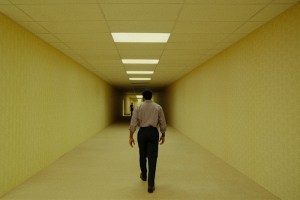
The strength of Backrooms, as a concept as well as a feature film, is how it taps directly into your limbic system to communicate that everything is just inescapably wrong. Everything looks wrong, everything sounds wrong, you worry that another turn of another hallway is only going to bring about further ruin, and so every additional second in this inter-dimensional space makes you want to retreat. It has the living contours of a nightmare world where there is a lack of concrete details, where things are approximating real-life but just a means off, little uncanny differences or limitations that alert your brain that things are not as they should be. There are small examples, like a chair with five legs instead of four or a stop sign with its writing backwards, and then there are more arresting imagery, like chairs sinking into the floor like sand, or a series of telephone poles increasingly bending forward like a splayed rib cage. Exploring a world of these distortions leads to deeply fascinating and also unsettling imagery that can lead to a suffocating atmosphere of unease. It makes for a rather entrancing experience of analogue, dead mall aesthetics that have a subliminal pull that draws you innately while making you feel off-balance. Like the definition of the uncanny, it takes the familiar and mundane and distorts it into something truly eerie.
But this is more than just a 100-minute extension of the short-form YouTube videos. Director Kane Parsons has certainly leveled up his craft in his film debut. This is a weird world he’s intimately familiar with, but the big-screen jaunt is carefully made to be inclusive and adapted like an actual movie. There’s work here on characters using the Backrooms as an exploration of their unresolved personal traumas, for Clark his rage against a world and the people he felt have failed him, for Dr. Kline her oppressive and mentally ill mother. I like that it’s never clarified whether or not Dr. Kline’s mother was just crazy or whether she too became aware of the Backrooms dimension and was trying to protect her daughter. There are hints of larger lore but the movie isn’t drowning in it, just like there’s some basic explanation given to this dimension and its rules, just enough to satisfy without going into too much explanation. This was my main issue with 2019’s Us, Jordan Peele’s creepy and thrilling nightmare about dopplegangers revolting, and also a movie that shattered its own credulity once it attempted to provide a logical explanation. Not everything that’s strange in a movie needs a thorough explanation. We can readily accept the unbelievable on its own terms. There are more traditional horror movie elements, like jump scares, frantic chases, and the Big Scary Something Coming to Get You, but Parsons makes them all work. There’s a jump scare in this movie that didn’t just make me jump but made me gurgle something unintelligibly in response. There are several agonizing setups of characters contemplating journeying through tight or slanted or altogether ominous spaces and I was shrinking in my theater chair, dissolving in the simmering anxiety, and repeating “no” a lot. The use of found footage is perhaps the best in any movie in a decade. Even at the young age of twenty, Parsons shows not just a knack for creepy imagery but on how to craft and escalate suspense set pieces, how to build and punctuate a suffocating atmosphere, while also balancing characters, story arcs (learning acceptance and accountability!), and metaphors (a concrete hand print she carries with her from childhood!) and themes without losing sight of the core scares and their appeal. Parsons has already proven that he’s the real deal and he’s not even old enough to legally drink in the U.S. yet.

There’s an interesting meta commentary here about the junky iterative process of generative A.I., though this is speculation on my part, though I find it founded in logic within the movie. We’re told repeatedly that the Backrooms doesn’t create things as much as it recreates from its surroundings and the memories of its participants. There’s a reason most of what is explored is a reflection of the furniture store it’s attached to. Except it cannot get things exactly right. Clark explains it like describing a dog to an alien that’s never seen or known the reference and then having the alien create what it thinks a dog would be; the larger shape and idea might be there but the details are inexact or incorrect. For me, this corresponds with the rise of generative A.I., where it tries to replicate real-life but is often prone to strange hallucinations, like human bodies with peculiar joint hinges, extra fingers, or smoothly elastic skin. There’s also very Backrooms-esque visuals of furniture being eaten by walls and floors. Generative A.I. is limited to only replicating what it has been fed, and it often spits back something that looks alien, missing those crucial details to seem real. There’s a memorable tracking shot in the movie that descends floor after floor, and we witness the same room layout go through round after round of regeneration and distortion, getting further and further from the original source with each iteration. What begins with a recliner and windows becomes chairs sinking into the floor, the outlines of windows against solid walls, and finally nothing. Parsons doesn’t have to be explicit but the pointed commentary can be found on A.I.’s limits.
I don’t know about you but if I discovered a portal to another dimension, I don’t think I’d take it upon myself to go exploring. I understand why the movie does so because, well, we need a movie, and that discovery is where the horror lies, and it makes sense for Clark since it’s a reflection of his own memories and unfulfilled ambitions. I get it. However, if this was real-life, I would immediately retreat after confirming that, yes, this strange doorway indeed exists. Perhaps I’ve seen enough spooky movies or it’s just an overabundance of caution in my nature, but I would definitely stay home and let someone else become the latest lost entity to the siren song of human curiosity. Somebody else can be monster chow.
The origins of the Backrooms predates Parsons and his popular YouTube experimental shorts, but it was he who really popularized it and took it to another level, and now with his film debut, Parsons has done something remarkable. It’s not just the bold announcement of a new cinematic voice. It really feels like this movie could be the start of something monumental, a tide-changer along the lines of John Carpenter’s Halloween. He’s not the first filmmaker to explore liminal imagery and dream logic, as we’ve seen from Severance, to The Stanley Parable, to the entire career of David Lynch. I can already hear some Hollywood studio exec saying, “Gen-Z kids, they love them their liminal spaces,” or some kind of erroneous lesson from the runaway success of Backrooms. Get ready for a flood of imitators exploring minimalIst abandoned spaces. I was entranced and deeply disturbed by this movie to the point where I kept shuddering even after the credits rolled. It’s not because of shock value or emotional manipulation, it was because Backrooms got to me, unnerved me, and shook me up, in a way no movie has for a long time.
Nate’s Grade: A
Share this:

28 Years Later (2025)/ The Bone Temple (2026)
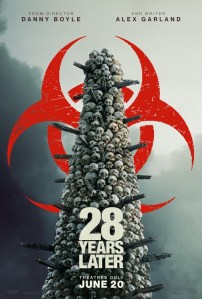 While not officially 28 years after its release in 2003, you’ll have to settle for only 23, comes a sequel to the zombie outbreak that kicked off a resurgence in zombie media in the 2000s. 28 Years Later is a far more experimental and meditative and genuinely surprising and surprisingly poignant sequel than I think many fans were expecting. They thought it was going to be more like a father/son (Aaron Taylor-Johnson, Alfie Williams) coming-of-age zombie hunt and weekend of survival. It is that, but it’s also a meditation on life, death, family, nature, and how we respond to grief. Director Danny Boyle returns, for his first film since 2019’s Yesterday, and screenwriter Alex Garland (Ex Machina, Civil War) returns, and together they provide a sequel that attempts to answer what society might be like growing up in this new dystopian world. The movie can get weird, with old movies and archival footage thematically mixed into scenes, Boyle’s camera in constant nervous anticipation, an active member of the hunt, and the use of an iPhone rig to provide Matrix-esque bullet time effects for zombie head shot splatter. Garland has also come up with some interesting zombie evolution over those ensuing three decades of development (granted I thought since the “zombies” were infected living people that you just had to wait them all out to die from dehydration). It seems like a father/son adventure thriller, and it’s quite good at being that, but then it transforms into something unexpected, giving mom (Jodie Comer) the spotlight as she confronts the reality of her physical and mental maladies. From there, the movie becomes this beguiling and thoughtful examination on grace and grief, on processing loss and finding a sense of stability in an unstable world. Ralph Fiennes appears late as a former doctor who seems a little crazy, the grave-keeper to an impressive monument built from thousands of human bones. It’s such a welcomed surprise for a movie replete with them, a movie that refuses easy categorization and wants to do something meaningful than just being a zombie action/thriller.
 Even more unexpected was an immediate sequel and continuation a mere six months removed from 28 Years Later‘s wide release. The Bone Temple is divided into two stories, both holdovers from the prior film. Spike (Alfie Williams), the son going on his own journey of self, has been conscripted into a weird and violent gang, The Jimmies, lead by Sir Lord Jimmy (Jack O’Connell), the twisted grown-up version of the child seen in the harrowing prologue to 28 Years Later. He’s a sadistic leader who also tells his followers he’s the son of Satan. Then there’s Dr. Kelson (Ralph Fiennes) who we initially thought of as menacing but becomes the most humane caretaker in this post-apocalyptic landscape. The two male figures serve as competing responses to unmitigated tragedy, one retreating to religion as a tool for meaning but it’s really exploitation and manipulation through violence and fear, and the other devoting himself to science and making the world just a little more liveable through empathy and trial and error. Dr. Kelson develops an unexpected friendship with one of the big Alpha zombies, “Samson” (Chi Lewis-Parry), after he discovers this behemoth, who was ripping spines out in rage fits in the previous movie, is seeking out relief through the doc’s morphine darts. Dr. Kelson ponders whether or not there is a chemical compound that could bring back the humanity to the infected. The difficulties with communication do not deter the good doctor, and these paths cross in a climax where the Jimmies come to think of Dr. Kelson as the Dark Lord himself. The movie is consistently interesting, further building out this new damaged world began in 28 Years Later. Nia DaCosta (Candyman, The Marvels) takes over as director and offers a more patient camera, forcing us to dwell in the moments, both horrific and moving. There are torture sequences, long demented monologuing, and questions over the tenacity of human connection despite incredible obstacles, and yet the movie is both more a straightforward horror-thriller than its predecessor and a more focused human drama about loss and holding onto one’s sense of dignity and empathy. It lacks the visual fireworks of Boyle’s style, and I found Sir Lord Jimmy to be more tiresome than interesting, but The Bone Temple is an effectively engrossing lateral sequel that slowly builds Garland’s world a little wider. Now I’ll actually have a third 28 Years movie to look forward to that hopefully won’t take 28 (or 23) years..
Nate’s Grades:
28 Years Later: B+
The Bone Temple: B
Share this:

Crime 101 (2026)
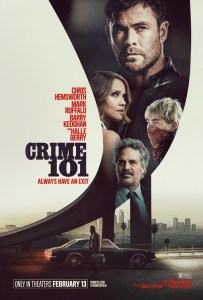 Sleek, sexy, and surprisingly character-centric, Crime 101 isn’t so much a how-to guide on criminal activities, it’s more a how-to on successfully replicating Michael Mann style of urban crime thriller. Chris Hemsworth plays a meticulous gentleman thief whose last job went bad. The LAPD detective (Mark Ruffalo) is on the case and is convinced there is one master thief connecting several high-end robberies along the 101 Highway in Los Angeles (thus the title, not in reference to a college class). Monica Barbaro (A Complete Unknown) is the romantic partner tempting our thief to retire to a “normal life.” Halle Berry plays an insurance broker to the rich who is eager to be made partner in her firm. And Barry Keoghan is, you guessed it, playing a psychopathic chaos agent. Draw all these characters into one big score, throw in one-or-two-scene players like Jennifer Jason-Leigh as Ruffalo’s divorcing wife, Nick Nolte as a grizzled criminal middleman, and Corey Hawkins as a police detective, and it’s quite a stacked cast for your standard crime thriller. That’s because, thanks to writer/director Bart Layton, the man behind one of the best movies of 2018, American Animals, which was also an unusual take on dispelling our movie fantasy notions on crime, and also co-starred Keoghan. Layton’s adaptation of the novel by Don Winslow keeps the people at the heart of the action. Trust me, the actual chases and schemes are indeed thrilling, but it’s the rich and generous characterization that makes the inner life of this movie feel so much more bristling. You could have taken any of these major characters and made them the focal point, they’re that interesting and complicated. Mixing them together into an ensemble while still finding time for each of their perspectives and idiosyncrasies is just a feast for fans of engrossing and empathetic thrillers. Whatever you’re expecting, Crime 101 is likely better than that. Layton, already proven to be a master at genre replication, deserves more film opportunities when he’s delivering quality movies that know how to deliver the goods.
Nate’s Grade: B+
Share this:

Five Nights at Freddy’s 2 (2025)
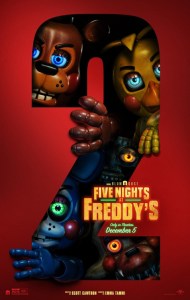 I wasn’t a fan of the original 2023 movie based upon the insanely popular video game series that serves as an entry point into horror for kids. It didn’t work for me but I thought fans of the series would have fun watching the characters come to life in live-action. Now with the sequel, I don’t know anyone that could enjoy this dreck except for the most diehard of the Freddy’s fanbase. I’ve watched the movie and I couldn’t understand it. I read the Wikipedia summary and that didn’t clear it up. So much hinges on so many characters having peculiar responses and relationships to what are… killer animatronics powered by the spirits and literal corpses of murdered children. Why is this pizza parlor even still standing? These robots went on a killing spree in the first movie, and yet this lonely little girl misses her “friends” and runs away to see them again. This isn’t E.T. here, it’s a weird killer robot horror movie that seems to be making up its lore and rules as it goes, like one unending “yes and?’ improv game you’re desperate to tap out from. I guess there’s more killer robots this time, and some unintelligible distinction between the good bad robots and the really bad robots. I don’t know. I gave up trying to comprehend what was happening and felt like maybe I could just try and enjoy the minimal PG-13 scares and tension. The animatronic designs are solid. Wayne Knight (Seinfeld) appears as a villainous robotics teacher. There’s a marionette character that’s kind of sinister to watch. That’s about it, folks. It’s a fairly nonsensical waste of 100 minutes, and unless you’re steeped in the lore and history of the series, you too will wish that this town would just set fire to the whole parlor.
Nate’s Grade: D+
Share this:

Mercy (2026)
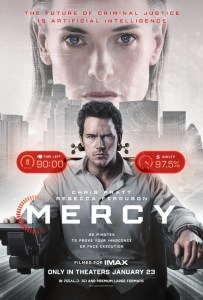 Detective Chris Raven (Chris Pratt) wakes up strapped to a chair. An A.I. judge (Rebecca Ferguson) informs him that he has been changed with the murder of his wife, and thanks to the new Mercy program instituted by the Los Angeles justice system, he will have 90 minutes to prove his innocence to a “reasonable doubt” level of 91% guilty (is that all a “reasonable doubt” is going for these days?). If he fails to convince the A.I. judge, then he will be terminated at the end of those 90 minutes. Start the clock.
Mercy is essentially a screen life movie with a high-concept twist, but at no time was I captivated with the mystery or intellectually satisfied by the application of its storytelling angle. We’ve seen similar movies recently, notably 2018’s Searching and far far less notably the 2025 War of the Worlds, where the movie screen is an extension of a computer screen that holds the borders and tools of our storytelling. In a way it reminds me of the found footage boom of the early 2010s, a hot gimmick that could get studio execs to say yes to projects that they would otherwise have passed on. However, there still needs to be careful ingenuity about how to incorporate these elements and, even more importantly, how to work within the limitations of your gimmick. With Mercy, our main character is basically trying to prove his innocence in real time with an A.I. judge who really functions more like an A.I. assistant, granting him access to people and databases even his police position would not have immediate access to. The recreation of the crime scene with the clues and evidence has a very Detroit Become Human feel (that’s a sci-fi video game that plays more like a movie). The A.I. judge is willing to help out this convicted man as long as he doesn’t admit guilt, because then it’s straight to execution time. For ninety minutes, Chris Raven has to crack his own murder case. The real-time element is meant to provide a sense of urgency, a literal ticking clock, but it’s also quite the misstep when your movie isn’t very good. This allows the audience to mentally count down how much time is left before your movie is finally over. The screen life aspects are pretty superficial and visually dull even if the graphics as being pulled around like interactive three-dimensional objects. The fact that this movie was shot for IMAX is astounding.
 The problem is that the plot is too predictable at every turn. We have a future criminal justice system made for automation and expediency, so it’s not going to be too much of a leap to suspect it might not be operating at the level of success its proponents profess. There’s a long history of stories presenting a new technological leap that is meant to be fool-proof that, shocker, is proven to be anything but. Right away, the audience is already going to be suspecting that the Mercy system is compromised or at least prone to errors like our present criminal justice system. We can safely assume that our protagonist is innocent, and if that’s the case then the implicit question is how many others who were tried and convicted were also ultimately innocent? Some might call it a death row metaphor but it’s literally the same thing just with a high-tech A.I. spin. The next question becomes is the potential error a sign of the limitations of assigning such power to seemingly infallible computers, or is it being deliberately compromised and manipulated? Are certain powers-that-be using this as an excuse to eliminate undesirable peoples and populations? The case of Chris Raven is meant to unveil a larger, systemic problem of justice not being served. And yet, the movie doesn’t exactly explore this obvious implication.
I’m going to dive into spoilers with this next paragraph because I think it’s worthwhile and also I don’t think you’re missing anything with Mercy. If you already assume that Chris is innocent or set up, there’s only so many other places you can go as a story. So with that warning addressed, the Mercy system is really easy to trick, as evidenced by our eventual culprit who has the know-how to digitally erase and alter security footage. Didn’t know this guy had those kinds of skills but, hey, people can surprise you or, more accurately, when the screenplay calls upon enough coincidences. However, there’s another layer of conspiracy afoot. This one guy is responsible for setting Chris Raven up because his own brother was accused and executed by Mercy even after he gave the police an alibi that was ignored. He wants vengeance for the injustice done to his family. This means there’s also the unraveling of who was responsible for this other guy’s wrongful arrest and execution, and wouldn’t you know it happens to be Chris Raven’s own partner, who needed the Mercy program to be seen as trustworthy. The movie never deals with the implications of this. It doesn’t really confront the moral turpitude of killing an innocent man, and it doesn’t think big picture to ask how many other innocent people have been sacrificed as cover. Amazingly, the last line of the movie involves Chris Raven saying, “Humans and A.I., we all make mistakes. And we learn.” What? Technology shouldn’t make mistakes. Alexander Pope didn’t say, “To err is human, and also these new contraptions. Have you seen these textile factories? Wild.” We don’t expect technology to fail us, especially if we are putting judgement over life and death as one of its tasks. This sounds like dubious excuse-making for a system literally killing innocents in the name of the law, and yet our hero treats the whole revelation like, “Well, you gotta break some eggs for an omelette.” It’s such a callous, incompetent response to an immediate problem that his own police force is exploiting. Yet the movie doesn’t blame the faulty A.I. system, which I repeat even some random guy was able to hack and manipulate, and instead looks at it as a tool, like when people try to separate guns from gun violence. However, in this case, the gun is making its own calculations on who deserves to die, and, again, being manipulated by randos. This gets a little more unseemly when you realize that the movie studio’s release is from Amazon, which would very much like you, dear citizen, to stop villainizing A.I. and accept its omnipresence in your new digital life.
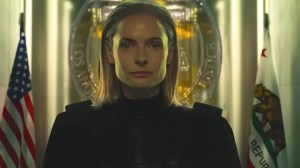 Mercifully, Mercy holds to its countdown, though there’s an extra period of “stoppage time” with an action sequence outside of the chair as climax. The mystery is dull, the plot is predictable (if you don’t suspect who the real killer is after 30 minutes, this might be your first movie, so I’ll tell you now – they get better), the world building is underwritten (who needs an exploration of the large-ranging moral implications of this system when we get police on drone cycles!), and the fun of its creative ingenuity is gasping. It’s forever going to be the Chris-Pratt-stuck-in-a-death-chair movie. This concept could have worked but there needed to be significant revisions, especially unpacking the larger implications for this new system of justice outsourcing justice to all-knowing machines. That’s not this movie. Mercy isn’t even overtly critical of artificial intelligence, instead excusing its faults as “user error” from bad actors. It’s a film too afraid to have any strong sentiments, which makes for a pretty lifeless time at the movies. The machines have won.
Nate’s Grade: D+
Share this:

Send Help (2026)

I am grateful for Sam Raimi and I’m even more grateful for Sam Raimi movies. The director began in low-budget gore-fests with a dash of goofy slapstick to balance the gross-out gratuity, and these sensibilities have never left the man. He enlivens any genre he works in, from Western (The Quick and the Dead), to superhero (original Spider-Man trilogy, Dr. Strange and the Multiverse of Madness), and the occasional awards-drama crime tragedy (A Simple Plan). But the man is at his best on his home turf of horror/thrillers with his gonzo style and devilish sense of humor. Send Help is the most unabashedly “Sam Raimi movie” since 2009’s Drag Me to Hell, which already makes it worth your time. It’s basically the schlockier, more condensed and focused version of Triangle of Sadness, even borrowing a similar premise of a put-upon corporate subordinate (Rachel McAdams) and her fussy, misogynist, blowhard of a boss (Dylan O’Brien) stranded on a deserted island and the power dynamics flip. Now she’s the one in charge because she has leaned survivalist skills thanks to her aspirations to being a contestant on the reality TV show Survivor. As the movie progresses, what I really appreciated was the level of nuance given to both of these stranded characters. It would be all-too easy to make her character impossibly noble, and the screenplay adds some intriguing dimensions that make you question some of her motives. It would be all-too easy to make his character irredeemably evil, and while you’re never going to be in danger of switching loyalties, the screenplay provides shades of empathy to him too. I also appreciated how nasty the movie gets, both in lurches of horror comedy zaniness, but also in how nasty the characters get to one another. McAdams is wonderful, though the concerted effort to “ugly up” a Hollywood starlet amounts to frumpy sweaters and a dash of tuna fish at the corner of her mouth. There was no point I wasn’t entertained, especially from the shifting dynamic between the two leads. I may be in a minority here but Send Help is a better developed and more satisfying version of Best Picture-nominee Triangle of Sadness. It made me laugh and cower. May we never be without new Sam Raimi movies.
Nate’s Grade: B+
Share this:

The Rip (2026)
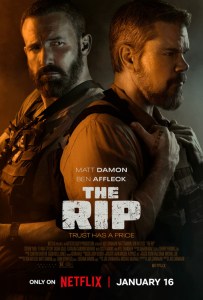
Director Joe Carnahan (The A-Team, Narc) excels at machismo, and I mean that not as a detriment. He makes muscular action-thrillers, often about corrupted men coming to terms with their ruination. 2012’s The Grey is still one of the best movies I’ve ever seen released in January. Well here comes The Rip, also released in January, starring Matt Damon and Ben Affleck as combustible Miami cops who follow a tip to a cartel stash house that holds a cache of twenty million dollars. The cops are supposed to follow protocol, call it into their superiors, but with that kind of money, much more than what the tip reported, it’s hard to resist the life-altering implications of indulging in that kind of haul. I thought The Rip, named after the seizure of contraband, was going to be a modern-day Treasure of the Sierra Madre, where the power of greed is irresistible and leads to betrayals and murder among our characters. It does that, with each questionable decision going against protocol making us question who might be most susceptible and who might be heading for a collision. The movie, co-written by Carnahan, is strictly genre boilerplate. The characters are never more than archetypes, the dialogue is aggressively expository often reminding us of all the conflicts and characters on the periphery that haven’t been brought back yet, and the majority of the film is a contained thriller awaiting trouble at the stash house. And yet I was entertained from start to finish thanks to the cast and a simmering tension that Carnahan unleashes between his paranoid characters. There are some late plot turns that I don’t know if they’re actually clever, convoluted, or both. It’s the kind of thing that’s meant to excuse bizarre behavior that we’d have no reason to assume differently, so it feels a little bit like being jerked around. However, The Rip is a fairly fun way to blow through two hours built upon movie stars unleashing their swagger.
Nate’s Grade: B-
Share this:

It Was Just an Accident (2025)
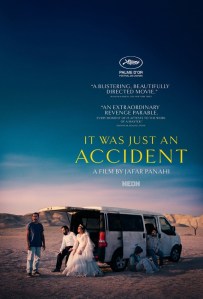
Iranian writer/director Jafar Panahi (The White Balloon, The Circle) is an example of an artist literally willing to put it all on the line for his art. He’s been banned by the authorities of Iran from making movies, and then Panahi secretly made a documentary of himself serving as a taxi driver in 2015. Scanning his filmography, all of his movies after 2000 were either made “illegally” or banned in his home country before their release. He was sentenced to a six-year prison sentence in 2022 and was released shortly after undergoing a hunger strike. Panahi filmed his latest movie, It Was Just an Accident, in secret without knowledge by the Iranian Authority, which makes sense considering how openly critical it is about the regime. It won the Palm D’or, the top prize, at the 2025 Cannes film festival and has been one of the most acclaimed movies of the year. It’s also likely going to make life much harder for Panahi, who was also sentenced in absentia by Iran to another prison sentence for “propaganda activities.” Yet his art persists, and It Was Just an Accident is easily one of the finest movies of 2025 and it’s no accident.
It begins simple enough. A middle-aged man and his family have car trouble after accidentally hitting a stray dog (sorry fellow animal lovers, but at least you don’t see it). They are taken into a nearby garage and that’s where the owner overhears the family man’s voice and then freezes in terror. He sounds EXACTLY like the man who interrogated and tortured him for the Iranian government years ago. Could it be the same man? How can he verify? And if so, what does he plan to do with his possible former captor?
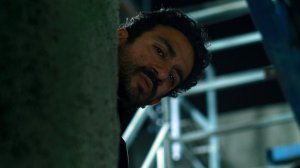
What a brilliantly developed and executed movie this is, taking a concept that’s easy to plug right into no matter the language and cultural barriers, and then to unfold in such contemplative, bold, and unexpected ways. It captures mordant laughter, poignant human drama, and a nerve-wracking thrills. Most of all it’s terribly unexpected. As more and more people get brought in on the kidnapping, and more reveal their personal trauma from their shared captor, I really didn’t know what the fate would be for anyone. Would they kill this man? If so, what would that say and how would they view themselves after? If not, what lessons might they have learned from this ordeal and what lessons might their former captor have learned? It really kept me guessing and because it’s so exceptionally well developed and written, the script could have gone in any direction and I would have likely found satisfaction. There’s even the question over whether or not all these people are mistaken and projecting their fury onto an innocent man. However, I will say, the movie flirts with Coen-essque dark comedy, almost at a farcical level for its first half as these amateurs stumble their way through a kidnapping plot they are not equipped to control (a woman is stuck in her wedding dress for the entirety of these vigilante deliberations). Then in its second half it transitions into a really affecting moral drama about the lengths of trauma and the desire for forgiveness as a key point toward processing grief and preparing oneself to move forward. Even though the circumstances are specific to Iran, the movie is emblematic of accountability and reconciliation, and those elements can be easily empathized with no matter one’s cultural borders.
As you might expect, this is a movie brimming with anger, but it’s not suffused with bitterness, which is a remarkable feat given its subject matter. This is a movie that unfolds like a crime thriller, with each scene unlocking a better understanding of a hidden shared history. Each new character provides a larger sense of a bigger picture of oppressive state control and abuses, with each new person adding to the chorus of complaints. Naturally, many of these victims want to seek the harshest retribution possible for a man who tortured them with impunity. It’s easy to summon intense feelings of outrage and to demand vengeance. The filmmakers have other ideas in mind that aren’t quite as tidy. It’s easy to be consumed by anger, by outrage, that surging sense of righteous indignation filling you with vibrant purpose. It’s another matter to work through one’s anger rather than simply serve it. I’m reminded of the masterful 2021 movie Mass, a small indie about two groups of parents having a lengthy conversation; it just so happens one couple’s son was killed in a school shooting and the other couple’s son was the gunman responsible. It was a remarkably written movie (seriously, go watch it) and a remarkably empathetic movie for every character. It’s easy to pick sides of right and wrong, but it’s so much more engaging, intriguing, but also humane to find the foundations of connections, that every person lives with their own regrets and guilt and doubts. It Was Just an Accident follows a similar moral edict. Every character is a person, and every person is deserving of having their perspective better known, and we are better having given them this grace.

I think the movie is also especially prescient about this time and place in American history. It very well may prove a sign of the future, detailing a populace of the abused and traumatized and the former aggressors who worked for an authoritarian agent and administered cruel violence to cruel ends. It’s not difficult to see a version of this movie set in, say, 2035 America, with a ragtag group of characters discovering a retired ICE agent who they all have an antagonistic relationship with. In many ways the movie is about Iran and its history of an oppressive government turning on its own people, but in many ways it can also be about any system of power abusing that power to inflict fear and repudiation. It’s about a reckoning, and that’s why I think while the movie is clearly of its culture and time it’s very easy to apply the movie’s lessons and themes and larger ideas to any country, It’s all about characters coming to terms with harm and accountability, and sometimes it takes a long time after the fact for the perpetrators to accept that harm has been done, especially if they can fall on the morally indefensible “just following orders” defense. In the near future, will ICE agents, especially the ones who joined up after Trump took office for the second time, argue the same as the Nazis at Nuremberg? Will they rationalize their actions as just fulfilling a job to pay a mortgage? It might even be overly optimistic to believe a reckoning would even occur in the not-so-distant future, not to the profile of the Nuremberg trials but even just an individual accounting of individual wrongdoing. That assumes an acceptance of wrong and ostensibly a sincere request for forgiveness. As I write this, with an ICE officer whisked away to the protective bosom of federal government after executing a woman shortly after dropping her child off at school, it’s difficult for me to even accept that those in power and so eager to impose their bottomless grievances upon the vulnerable and innocent would ever allow themselves to accept the possibility of blame or regret. But then again this is perhaps what the citizens of Iran felt and they’re presently marching in the thousands to protest their authoritarian government in 2026, so maybe there’s hope yet for we Americans in 2026 too.
There is a deliberate sense to every minute of It Was Just an Accident, from its long takes to its interlocking sense of discovery, to the questions it raises, answers, and leaves for you to ponder. It’s a movie that drops you into a fully-realized world with rich characters that reveal themselves over time. If there’s one pressing moral for Panahi, I think it’s that every person matters, even the ones we’re told have less value. This is an insightful, searing, and ultimately compassionate cry for justice and empathy. It will be just as effective no matter the date you watch it, but with a movie this good, why wait?
Nate’s Grade: A
Share this:

HIM (2025)
 Setting a horror movie in the world of competitive sports, especially American football with its fandoms akin to dangerous cults of zealots, is a smart concept that could have so much possible commentary, from the sacrifices and exploitation of the players for the blood-lust of the fans, to the conspiracy of a cadre of white owners profiting from the labor of black athletes, to even the blinding psychopathy of extreme tribalism as an identity and dividing line. HIM does little to none of this, and being produced by Jordan Peele, I expected so much more than what I got. We follow a college phenom quarterback who wants to be the greatest, so he accepts an offer to train with a famous champion (Marlon Wayans) who puts him through a series of intense trials to prove whether he has what it takes. The horror elements are more confusing and surreal than unsettling, often crashing into unintentional comedy, like watching mascots with sledgehammers. This is one of those movies that seems to shift from scene to scene, with murky elements meant to keep the main character guessing but really just keeps the viewer guessing if this will ever come to something meaningful. The horror grew tiresome and repetitive. I was hoping for more scenes like where our young QB’s misses in practice lead to other players being physically abused, but mostly HIM hinges on tired occultly leftover furnishings, including an ending that is simultaneously underwhelming and predictable, a shrug meant as catharsis. An electrifying horror movie can certainly be made about the world of football. HIM isn’t it, let alone the possible GOAT.
Nate’s Grade: D
Share this:

No Other Choice (2025)
 The title of the Korean movie No Other Choice is spoken, in English actually, a few minutes into the movie. It’s the brief, unhelpful reasoning from an American exec that just bought a South Korean paper company and is reducing the local labor force. Our main character, Yoo Man-su (Lee Byung-hun), has been work-shopping his spirited speech about how important these jobs are to appeal to the American businessmen, and then when it comes time to deliver, he’s reduced to chasing them down as they quickly depart. Before he can even get into a second poorly-formed sentence, the exec cuts him off by saying, “No other choice,” and then sidles into the protective safety of a chauffeured vehicle. The implication is that this business has to reduce its labor force to stay profitable, and yet rarely is this so simple. In legendary director Park Chan-wook’s (Old Boy, Decision to Leave) latest, characters will often repeat the title of the movie as a deference to guilt, that they were forced to make hard decisions because those were the only decisions that could be had. Unfortunately, as this mordantly funny, exciting, and intelligent movie proves, people have a way of deluding themselves when it comes to finding justifications for their bad behavior and greed.
 The real plot of No Other Choice is Man-su’s readjustment. In the beginning, we see the life he’s built for his family, his wife Lee Mi-ri (Son Ye-jin), stepson Si-one, and daughter Ri-one, with their two big dogs. After a year of job searching, Man-su is bouncing from one job to another, and the family has been forced to make cutbacks to their lifestyle (“No Netflix?!” the son says in shock). Lee Mi-ri takes on a part-time job as a dental assistant to a hunky doctor. The dogs are shipped to Lee Mi-ri’s parents. Ri-one might have to stop her expensive cello lessons, which is a big deal as her teacher says the Autistic child is a prodigy, but her parents never hear her play. The paterfamilias needs to find a good job fast. That’s when Man-su gets the idea to post a fake job for a paper company manager to better scope out his competition. He takes the top applicants, the guys he acknowledges would be hired ahead of him, and creates a list. From there, Man-su pledges to track them down and eliminate them so his own odds of being rehired climb up.
The movie keeps shifting in new directions and tones with each new target, and it creates a much more fascinating and intriguing experience. I loved how each of the targeted rivals is treated differently and how each of these men come across as people who are struggling, hopeful, and quite like our beleaguered protagonist. There are good reasons why this movie has been described as Chan-wook’s Parasite, his culminating condemnation on the pitfalls of capitalism, how it pits peers against one another when they should be allies. Man-su views each man as his competition, impediments to him getting that prized position. However, each of these people is far more complicated than just their resume. At any time the movie could stop on a dime and just have two strangers, one of them intending to possibly kill the other, just have a heartfelt conversation about the difficulties of providing for your children and knowing that there are hard limitations that cannot be overcome. One man is struggling to adapt to a new marketplace after working in the paper industry for twenty years, and Man-su even echoes the complaints from the man’s wife, chiefly that he could have applied himself to other industries and jobs, that he didn’t have to be so discriminating when it came to a paycheck. Now, from her perspective, she’s arguing this point because she feels he is not casting a wider net for promising non-paper job opportunities. From Man-su’s perspective, he’s chiding the man because he doesn’t want to kill him but the guy’s intractability has put him in Man-su’s crosshairs. The unspoken comment is that Man-su is doing the same thing. At no point does he really consider getting a different job and thus being in a position where he does not feel forced to literally eliminate his best competition. He too is just as stubborn and blind to his own intractability. The system has a way of turning men against one another in order to boost a corporate balance sheet. This movie is just taking things a little further to the extreme when it comes to cutthroat competition.
 I also appreciated that the movie has a larger canvas when it comes to charting the ups and downs of its conspiracy. Man-su’s wife is not kept as some afterthought, you know the kind of movie where the husband goes on these wild journeys of the soul and his wife is just as home going, “Where have you been?” She’s an active member of her household and she is not blind to their financial shortfalls nor her husband’s increasingly worrying behavior and absences. She’s worried her husband may have begun drinking again after years of sobriety and peace. She makes attempts to reconnect with her distant husband, who is becoming more consumed with jealousy about her boss and his desirability. She’s not just the doting spouse or concerned spouse. She’s a resourceful character who recognizes problems. When another threat to their family materializes, Lee Mi-ri takes it upon herself to find a solution. Naturally, given the premise, whenever you have one member of a couple doing dastardly deeds, whether they get caught by their partner is a primary point of tension, as well as if so, how will their partner respond. I think the track that Chan-wook and co-writers Lee Kyoung-mi, Don McKeller, and Le Ja-hye decide is perfect for the story that has been established and especially for the darker satirical tone of the enterprise.
Despite the murder and gnawing guilt, No Other Choice is also a very funny dark comedy as it channels the absurdity of its premise. It’s always a plus to have amateur murderers actually come across as awkward. Just because they decide to make that moral leap shouldn’t translate into them being good at killing. There’s unexpected humor to Man-su’s amateur stalking and preparations. He’s also not immune to the aftereffects of his actions, getting queasy with having to dispose of these men and thinking of the best ways to obscure his physical presence from crime scenes (there was one moment I was literally screaming at the screen because I thought he forgot a key detail). Lee Byung-hun (Squid Games) is terrific as our lead and finds such fascinating reactions as the movie effortlessly alters its style and tone, one minute asking him to engage in silly slapstick and the next heartfelt rumination. I don’t think the film would be nearly as successful without his sturdy performance serving as our foundation. You really do feel for him and his plight, and perhaps more than a few viewers might feel the urge for Man-su to get away with it. The culmination of the first target is a masterful sequence where three characters all have a different misunderstanding of one another as they literally wrestle for a gun inside an oven mitt. It’s one of those moments in movies where you can stop and think about all the small choices that got us here and appreciate the careful plotting from the screenwriters. I found myself guffawing at various points throughout the movie and I think many others will have the same wonderfully wicked reaction.
 I could go on about the movie but hopefully I’ve done enough to convince you, dear reader, to give No Other Choice the ultimate decision for your potential entertainment. It’s a movie that covers plenty and leaves you deeply satisfied by its final minutes, feeling like you’ve just eaten a full meal. The ending is note-perfect, but then I could say just about every scene beforehand is also at that same artistic level. I won’t go so far as some of my critical brethren declaring this as Chan-wook’s best movie; I’ll always fall back on 2016’s The Handmaiden, also an adaptation of an English novel, much like No Other Choice (would you believe the source materiel is from the same author who gave us the novel for Play Dirty?). Regardless, this is exceptional filmmaking with a story that grabs you, surprises you, and glues you to the screen because you don’t know what may happen next (Patricia Highsmith would have loved this film).
Nate’s Grade: A


You must be logged in to post a comment.