Category Archives: 2026 Movies
Resident Evil (2026)
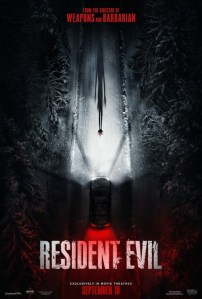 I’ve never played any of the popular Resident Evil video games but I have watched every movie, at least the ones starring Milla Jovovich, as I consider them the right kind of entertaining trash. In no way will I argue that any of the six movies from 2002 to 2017 are defensibly good by traditional standards (I’m purposely ignoring the 2021 failed reboot Welcome to Racoon City). I will, however, gladly sit and watch any of them if they are on TV because they are, at their best, gloriously ridiculous and silly spectacles. My interest dramatically increased in a new Resident Evil movie when writer/director Zack Cregger’s name was attached. The man behind twisty genre-benders Barbarian and Weapons helming a video game franchise best known for schlocky genre filmmakers like Paul W.S. Anderson? Weapons won an Oscar for a performance, a rarity for a horror movie, and now that same filmmaker wants to revive Resident Evil? My interest increased even further when Cregger confirmed it would be an original story and not really beholden to the established characters and plots of the many games (many fans did not agree with me). It felt like a fresh start with an exciting filmmaker on the rise, and having seen Resident Evil, I can declare it a gory blast, a brilliantly-calculated thrill ride to make you laugh and scream in good fun.
The entire 90-minute movie follows one character’s hellish night into the madness of the early signs of a deadly outbreak. We follow Bryan (Austin Abrams) as a medical courier delivering organs to hospitals. He’s ready to head home when he gets a special urgent delivery needed in Racoon City up in the snowy mountains. It will pay double and so he snatches the opportunity. It might be the allure of more money or it might be another chance to think about something other than the frightening reality that his girlfriend (Sara Paxton, off-screen) is pregnant. Along the dark and snowy drive up the mountains, a woman walks into his path and Bryan strikes her with his car. The rest of his night is about to get so much worse.
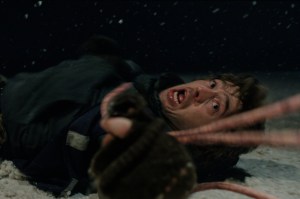 Considering its basis as a survival horror game, at least until it became a bombastic action-movie opera that better resembles the Jovovich screen spectacles, I think a streamlined approach by Cregger is smart. It narrows down the universe to this one guy’s very bad night, and it presents an immediately immersive experience, akin to playing a game and thinking through what is your best option out of a bunch of very bad options. From the very beginning, we are in Bryan’s frantic perspective. What he knows and experiences are what we know and experience. The clarity of focus provides a satisfying line of escalation as he gets into more and more danger. Cregger allows the audience to think through Bryan’s predicaments along with him, and there isn’t much he does that seems out of question, considering the extreme circumstances. I appreciated how once things really start going sideways that Bryan doesn’t miraculously transform into like an action movie hero. He’s just a normal guy relentlessly in over his head like any of us would be confronting monstrous horrors. I loved how bad he is with guns. Just because Bryan has some experience playing video games doesn’t mean he knows how to operate real firearms, and that doesn’t mean that the weapons of the real world perform like they do in games. There’s an ongoing joke about how he keeps trying to shoot off padlocks and failing that made me smirk every time. These little touches of realism in an elevated space made Resident Evil feel more engaging. It made it feel like even the little things mattered. This guy felt vulnerable, and sometimes his impulsive solutions only serve to get him into more trouble. The screenwriting plotting of A-to-B-to-C has a satisfying logic that manages to ground the mayhem on its own terms. He often has to think through an obstacle.
Cregger’s command of a scene is so enjoyable and assured, and he knows when he wants to make you squirm and when he wants to make you laugh. He can draw out a scene with excellent sound design for chills, like when a figure is quickly advancing on Bryan and clamoring up stairs while he desperately tries to reload a shotgun. The pacing of the moment is terrific. The resignation of desperation can also lead to many dread-fueled moments, like venturing into dark tunnels to sewers to blood-soaked halls. You don’t want to go down there, but you also kind of want to see. There’s also a heightened level that naturally draws mordant laughs, like when he’s being chased around a flipped-over police vehicle and sloppily shooting behind him. The movie wants you to laugh at the absurdity of trying to make sense of this nightmare scenario. It’s the release to get ready for more. Much of the humor is drawn from subverting our expectations of genre movies, like trying to ram open a locked gate, and particularly Bryan’s response to the madness. His panicked, befuddled reactions and clumsy physicality, accompanied with often high-pitched scream, serve as a reminder that he is a normal guy in unusual circumstances (I’d like to try and see you do any better). One of the biggest laughs for me was just a joke about stairs.
 This is also a great looking movie. Cregger has the enviable talent of cinematographer Dariusz Wolski, the man who photographed The Crow, the Pirates of the Caribbean trilogy, and nine (!) Ridley Scott movies since 2012. The man knows how to frame striking contrasts, so the whites of the snow-covered landscapes in the first half visually pop with the dark blacks of the silhouettes and the blood trails. The movements of the camera and compositions add such a charged sense of energy that reminded me of the best of Sam Raimi without feeling like a derivation in Cregger’s overall sense of style. The movie also doesn’t bend over backwards to bring to life the visual dynamic of the game, though there are more than a few passing gun barrel POV shots to sate the faithful.
This is also a very messy movie in the best/worst way. For gore-hounds, there is some impressively gnarly gore, which isn’t surprising considering the viral outbreak is turning residents into split-faced, multi-tentacled monsters. The body horror is gruesomely inventive. There’s one monster that reminded me of a different video game, 2004’s Katamari Damacy, a Japanese game where you start with a small sticky ball and roll it around, collecting more and more items and people, growing in size to the point that you attach the whole world. Imagine that but a snowman of men, and you can only see limbs moving at angles that limbs shouldn’t do. It’s quite unnerving to glimpse. I also found myself audibly wincing during a sequence where zombies are throwing themselves off the roofs of buildings while Bryan runs down an alley, bodies exploding all around him in eruptions of viscera. There’s another sequence of zombie rats that makes me shake my head in disbelief even now remembering it. Credit to Cregger, the man is unafraid to go places other horror movies fear to tread. Whether it’s animals or children, nobody is safe in this disturbing universe. There was one moment in a mutated maternity ward where I cautiously decided to shut my eyes to avoid poisoning my brain with fresh nightmare fuel to review when I came home and embraced my almost two-year-old son. There are some things I just don’t need to see presently.
 At a brisk 90 minutes, this is one of those rare movies I think would have benefited from another ten to fifteen minutes, especially with its abrupt ending. The final act loses some of the momentum accumulated beforehand, which isn’t a deal-breaker considering the film was moving like a runaway freight train up until that point. It also feels like a slightly different movie, both in approach and tone, going bigger and not exactly better. There’s also a question over what is gained from giving Bryan a characterization starting point. Over the course of the movie, he certainly re-examines his perspective on being a prospective father (and that’s before the mutated maternity ward). I thought this was going to climatically lead to a significant deliberation over making a selfish versus selfless decision, but Cregger doesn’t go there. The ending is kind of a cinematic middle finger to anyone expecting that character arc to come to something more meaningful, which is fine, but then why include the thread at all unless it’s just intended to be another deliberate rug-pull of your expectations? While the last ten minutes doesn’t quite live up to the amazing alacrity of the prior 80 minutes, it doesn’t ruin the good fun Cregger has earned in excess.
For many years, I thought it was impossible to make a good video game movie. This was because of the interactive nature of games versus the more passive medium of movies, but it was also a statement borne of the adaptations of the time, many of which had Uwe Boll’s name attached. I’m here to say times have changed but also so have the games. Over the last two decades, video games have reached new creative heights and that includes dramatic storytelling depth as well. Playing a game like Red Dead Redemption II is like burning through seven seasons of an epic and invigorating TV series. That’s not the intent of a movie like Cregger’s Resident Evil, a more streamlined and specifically designed contraption that is like riding a perfectly engineered ride. By the end credits, you might just have to catch your breath. While I have some minor quibbles about the ending and some dangling plot threads, Resident Evil is such a nasty, squishy, gruesomely entertaining movie, that I’m thankful for the privilege of watching Cregger operate at B-movie studio level (will Cury Barker be able to find similar results with his looming Texas Chainsaw Massacre reboot?). If we can give artists with a vision the berth to see it through, we might be able to turn around every moribund video game franchise. Look out for Ari Aster’s Doom next, and it will still be three hours and a metaphor for penises.
Nate’s Grade: B+
Share this:

One Night Only (2026)
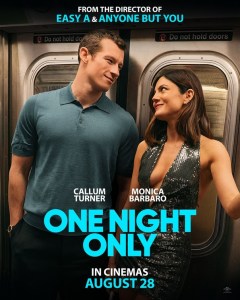 What if you could only have sex one night a year unless you were legally married? That’s the bizarre premise of the even more bizarre rom-com One Night Only, nick-named the “sex Purge movie.” Directed by Will Gluck (Anyone But You, Easy A), here is a mainstream studio rom-com with a dystopian sci-fi twist, and I cannot stop thinking about what a weird miscalculation this whole movie is. Rather than worrying whether down-on-his-luck, recently dumped nice guy pizzeria man Owen (Callum Turner) will find a rebound, or whether struggling singer and sexually frustrated Allie (Monica Barbaro) will find a man worthy of her desires, instead I just kept wondering more about this nightmare world.
Given that the setting is a fascist government state where those in power are regulating people’s bodily autonomy, it feels really strange to take this scenario and turn it into a breezy rom-com. It’s not that you can’t set comedies across any landscape of tone, but significant work needs to be ably handled to make that work. As an extreme example, imagine a meet-cute between a star-crossed couple of crazy kids that just can’t get enough of each other, complete with wise-cracking gay best friends, set in a concentration camp during the Holocaust. Hopefully you just winced reading that. It feels like a miscalculation to tell this kind of story with this tone and with this setting. Frustratingly, the movie rarely engages with the larger implication of its fascist state, and that’s exactly where all of my thinking went. I didn’t so much care about the characters as I did this scary world they seemed too blithe to contemplate. If this totalitarian government is so against premarital sex, why do they even allow for one available night? Wouldn’t having no available time force more people into marriages? Why would they even allow a “sex purge night?” Along those lines, what is the divorce rate in this universe? I would assume numerous very determined and very horny singles would be shacking up for many a weekend marriage that they could then annul. Once you’ve got the official matrimonial ring on that finger, does that thwart extra-marital sex? Can you cheat on your spouse, as long as the person you’re cheating with is also married? If that’s the case, what’s stopping every person at the age of early adulthood from getting married to the first agreeable person, shaking hands, and going about their business for the rest of their lives until they actually may want to settle down with a legitimate partner? How exactly is masturbation covered? Why does the conservative fascist government look the other way when it comes to non-heterosexual activity? That seems certainly out of character for repressive regimes policing people they despise. Wouldn’t there be a seismic exodus of unmarried people to other countries that permit premarital sex? Wouldn’t there be a natural brain drain of young professionals leaving the American work force? It’s a world that doesn’t make sense and the more you pull at the edges, the more it all unravels, and that’s all I wanted to do, because this setup was so bizarre and unique, I just wanted to keep exploring this alternate world.
 There’s another aspect that the sex during this one night of physical freedom must be used with a contraceptive. Much of the movie becomes a chase to find a condom, strangely like a 1997 Jennifer Love Hewitt sex comedy The Trojan War. This didn’t make sense to me. First off, wholesalers should be selling out of condoms and up-charging them all week leading up to this event considering the incredible rise in demand approaching. How does the government know whether or not someone’s genitals have a thin latex barrier over them? Even if that stopped your traditional hetero sexual congress, you’re going to tell me enterprising and horny people are going to limit themselves to only one option? More so, if this is indeed a conservative American government, and considering they’re oppressively dictating people’s bodily activities, I’d say that’s clear, then they also likely subscribe to the panic that not enough Americans are having enough babies. The insistence of contraceptives would seem antithetical to their larger goals of a higher birthrate. Imagine a government office making sure certain people get condoms and others don’t. I did laugh at Owen trying to improvise a condom in desperation. Imagine baby booms every nine months after this sex purge. It seems believable given the circumstances. Again, all I want to do with this movie is pick apart its strange cracked-mirror world-building, which we don’t often get in rom-coms.
I’ll say that this premise could have worked but it needed a different setting. It needed to be in a more fantastical and altered version of a near-future world, something akin to 2009’s Timer or a Black Mirror episode. It can be recognizable but it shouldn’t be too recognizable given the fantastical nature of its premise. Maybe it’s about a couple trying to go through the bureaucratic hoops and hurdles and paperwork to apply to have a sexual relationship, something more akin to runaway regulation and satire than merely a fascist police state that wants to make unmarried people second-class citizens.
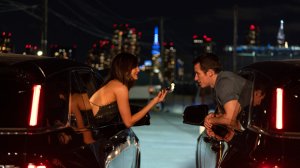 The problem with releasing this movie with this premise with this setting in 2026 is that the United States is already undergoing the starts and stops of a government more politically aligned with fascism than democracy. For many, especially those in vulnerable communities, it’s not hard to imagine a universe where government-controlled sexual health is a reality when the current administration is stripping people of rights, protections, and especially bodily autonomy for women and the trans community. It’s harder to brush this daunting and terrifying reality aside to sit in a theater and giggle at familiar meet-cute antics and rom-com plot devices when this world seems too close to our own. And when the movie is so resolutely incurious about analyzing its universe, then it becomes even worse. Rather than being some kind of revolutionary act of defiance, an exploration of the forces being oppressed by this regime and their refusal of acceptance of this absurd status quo, it demonstrates a myopic acceptance, rolling over and trying to live one’s life while ignoring the ills of society. Again, you could fashion a rom-com happening during Nazi Germany where a charming boy meets beautiful girl and their whirlwind courtship just happens to be while the neighborhood is being evacuated of specific minorities, with the characters shrugging and going about their days without larger comment. Does that seem enchanting? Does that seem like a good idea? I hope you would say no.
Can you turn off your brain and enjoy One Night Only? Every person is unique, so perhaps, but I might judge you a little for it, if I’m being honest. The comedy for me never rose above the occasional chuckle. It’s less a sex comedy and more a rom-com set in a fascist universe of puritanical repression. The comedy never rose above the questions for me, and the lingering bad taste of the movie’s universe and especially its characters’ attitudes to their world left me befuddled. There’s some pushback, which feels obligatory to check a box of red flag atonement, but the entire enterprise feels built upon such a drastic tonal miscalculation that it approaches in-universe propaganda. As so many of the randy characters eager for a physical contact are wont to hear, reader, you could certainly do better than this.
Nate’s Grade: C-
Share this:

Coyote Vs. Acme (2026)
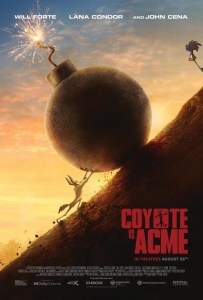 It’s the movie Warner Bros never wanted you to see. Intended to be scrapped for a $30 million tax write-off, the little family film about the little guy taking on the power and corruption of big conglomerates seemed destined to be yet another victim of ledger-shifting for CEO portfolio bonuses. Fortunately, an indie distributor came in and bought the movie and now, three years later, audiences can see Coyote vs. Acme and judge for themselves. And it’s actually pretty great. Reminiscent of Who Framed Roger Rabbit?, the movie has a meta-satirical take on legal thrillers, but it’s also so unfailingly pleasant, inventive, and silly. Will Forte is the real star as the self-doubting lawyer tasked by famous Looney Tune Wile E. Coyote to sue the Acme company for years of faulty products. Forte plays the straight man to the chaos around him and provides a well-needed baseline that allows the audience to take in the zany jokes and wonderfully daffy visual gags. The melding of animation and live-action is lively and the physicality of it all provides an ongoing sense of wonder. John Cena is also wonderfully pompous, exactly how I like him, as Acme’s lead attorney. I was smiling and chuckling throughout, but what genuinely surprised me is that I felt a lump in my throat at the very end with what my pal Eric Muller deemed the most emotional “beep-beep” in cinematic history. It’s a satisfying movie that can appeal to all ages, even if you don’t recognize the classic Looney Tunes or a cartoon Peter Lorre. Even more, the fact that this good movie is widely available to be enjoyed is itself an act of defiance against corporate greed. Coyote vs. Acme is worth the wait and a reward for families.
Nate’s Grade: B+
Share this:

Buddy (2026)
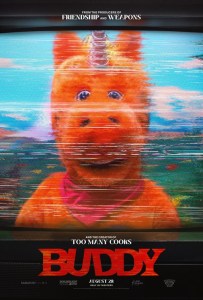 What if Barney the friendly dinosaur was really a murderous monster? That’s the catchy premise of co-writer/director Casper Kelly’s surreal horror fantasy Buddy, a crazy yet admirably committed exploration of kids TV tropes to their fullest extent. Considering Kelly might be best known for his insane yet brilliant deconstruction of sitcom opening theme songs, the Adult Swim short film Too Many Cooks, this makes sense. My first question was whether the pastel-colored, stagey world of Buddy the Unicorn (voiced by Keegan Michael-Key) was supposed to be literally real or was simply a TV set. The universe of Buddy, while adhering to the tropes and mechanics of children’s TV storytelling, is indeed its own reality. I enjoyed how Buddy knows he must gather the children to sing the closing theme song because then “the words appear” (he means end credits) and everything resets, which would allow him to heal from his injuries or perhaps have the children forget witnessing his horrors. The puppet-heavy world of Buddy is interesting, as are the subversive and disturbing edges glimpsed like Buddy trying to explain the disappearance of a child and the strange “red paint” on his outfit. Short of twenty minutes, the entire movie takes place in this strange fantasy setting, so I kept wondering about the lore and workings of this universe, especially how Buddy is capturing kids from the real world. The last ten minutes fulfilled that but I wanted more. That’s because the Buddy set itself, modeled after PeeWee’s Playhouse and Barney, feels a little too closed-off, the building threat of Buddy being rather redundant. I became frustrated at how limited the movie was settling with its subversive satire, at several points feeling like an overextended skit going off the rails rather than a complete movie. Then again that structural gambit might appeal to other viewers who are on the same twisted wavelength of Kelly. It held my interest, but I kept wondering if this was all there was, and whether maybe Buddy was a little too much of the same.
Nate’s Grade: B-
Share this:

Teenage Sex and Death at Camp Miasma (2026)
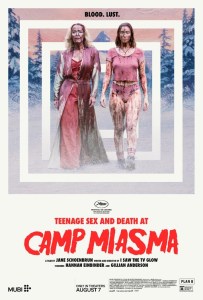 After 2024’s I Saw the TV Glow, writer/director Jane Schoenbrun became an indie darling with a daring perspective and a genre-bending feel for combining 90s nostalgia with coming-of-age ennui. While the movie didn’t exactly entrance me, I did write, “It’s a weird movie but it’s designed for weird kids, or weird adults who used to be weird kids, who found kinship through weird media.” I think this might be Schoenbrun’s style from here out. Their follow-up, Teenage Sex and Death at Camp Miasma, is another conflation of tones and styles, looking at the slasher movies of the 1980s with satire and fondness. We follow Kris (Hannah Einbinder), a Sundance-darling director whose big artistic break has now given her the opportunity to reboot the dormant Camp Miasma horror series. The killer, a gender fluid camper that was drowned in the lake, comes back as Little Death, wrecking bloody havoc across camp. Kris wants to approach the franchise’s original Final Girl, Billie Presley (Gillian Anderson), who voluntarily left Hollywood afterwards and has been a mystery. Kris wants Billie’s blessing to reboot the film, but Kris might also be looking for something more from Billie, and their relationship changes dramatically.
At one point, Billie gently chastises her special guest to stop thinking about film in such exclusively academic terms and to see it as a movie and less a discourse, and I feel like that advice could have been heeded by Schoenbrun. I come away from Teenage Sex and Death at Camp Miasma feeling like it is a movie that exists in air quotes, that resides on a level of discourse far above the events of the movie, that it’s intended less for artistic expression and entertainment and more as a film theory thesis for smug Letterboxd users. That’s not to deride the movie because it has a point of view or is another deeply personal exercise that feels like Schoenbrun turning their awkward coming-of-age into a transformative tableau for public consumption and, well, discourse. I don’t have an issue with Schoenbrun’s movie wanting to go deeper in an analysis of our personal connections to problematic art, in this case the schlocky slasher movies of the 1980s, otherwise known as a genre built upon “flesh and fluids,” as Billie informs us. My nagging issue with the film is that I don’t feel like it adds up to much, that Schoenbrun is so busy operating on that academic level with the material that it feels beyond reach. If the movie wasn’t occasionally elbowing you in the ribs by underlining its metaphors, I wouldn’t ultimately know what the larger themes or messages are amidst a miasma of haphazard ideas and genre riffs. I love the premise and how it twists into a Lynchian psycho-sexual nightmare that causes our characters to question what is real, but the end results left me shrugging and wishing I was enjoying the finished product more.
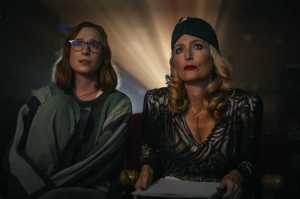 The idea behind Camp Miasma has all sorts of juicy layers-within–layers fun. Kris is obviously a stand-in for Schoenbrun and their experiences shuffling through the studio system as the Next Hot Indie Auteur, likely offered all manner of IP slop and zombie franchises similar to the flagging Camp Miasma horror franchise. Kris knows that her queerness and perspective is being commoditized to resuscitate an outdated franchise that has a history of transphobia (the Sleepaway Camp allusions are pretty clear here). Kris accepts these studio suits want to use her to provide cover for bringing the franchise back, but she wants to use them as well. Instead of delivering the same old schlock, Kris wants to go back to the original Final Girl who swore off acting afterwards, using the movie as her personal vehicle to interrogate a reclusive actress that she just happens to have a formative sexual connection with. Combine that with our Norma Desmond-like faded star literally living on the camp grounds where the original movie was shot, and that’s a terrific mixture of intrigue and obsession, of fantasy and reality bleeding together. So why does the finished movie feel rather unfulfilling to me then? Why does the sum feel less than the pieces?
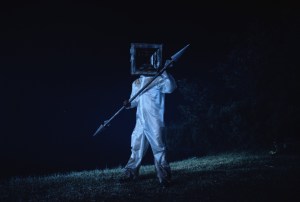
Maybe it’s because the obviousness of some of Schoenbrun’s points acts as an artistic ceiling. The voyeurism of slasher cinema in particular, born from Norman Bates and given new form by Michael Myers, is endemic to the genre, placing the viewer in the perspective of the mad murderer and the nubile teens finding silly ways to slink off to their gory demises. Kris is obsessed with one moment in the original Camp Miasma when a young Billie had a certain look in her eye that has always haunted her. It just so happens this moment was during the scene where Billie’s character lost her virginity on film, and there is an added context to the scene that makes the moment even more unsettling. Schoenbrun hinges Kris’ sexual awakening to a moment of old media that also happens to be Billie’s own sexual awakening, linking the two characters through a mirror of art, with the camera serving as transport. The nature of the scene involved Billie imagining Little Death coming for her and killing her, with her seeing the moment from her own eyes but also simultaneously from the eyes of the killer. It’s the voyeurism that unlocked something in both of these women, and yet Schoenbrun doesn’t seem interested in going further with an examination on this topic, only setting it up to be repeated and shared as supposed personal growth. Maybe, but maybe it could have been more interesting to dig into why disassociating from her own body during sexual congress was the key to pleasure for this woman, especially from a trans filmmaker. Likewise, there are some points that are blunt but to the point of making me want to sigh. Our killer has a long phallic spear that he struts around repeatedly thrusting and penetrating his victims. We get it. The killer is named Little Death, the pithy French term for an orgasm, which is perhaps why he wants to spear all these people. We get it. It’s so obvious it circles back from meta clever and back to just being too obvious. The ending descends into a wacky Ari Aster-like dark cartoon of fantasy convergence, like the movie had just been consumed from the inside out, but the insights are limited and glancing, amounting to little more than, “Hey, everybody can like the art they like and we don’t get to choose what turns us on.” Sure, I guess. Like what you like, folks. I was hoping the movie might be more than one woman’s quest to harness her big O under very specific scene-dependent circumstances.
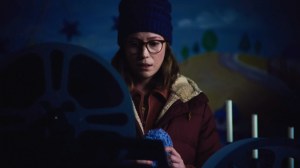 Far be it from me to dictate what artists should do with their personal stories hewn from their souls, but there’s a strong part of me that feels like I would have enjoyed a more straight-forward (pun not intended) version of this story. I think a fledgling director getting in over their head and blurring professional and personal lines with their subject is ripe for engrossing drama and conflict. Likewise, having a reclusive actress on the cusp not just of a comeback within the industry but possibly of a fellow artist that really took the effort to understand her perspective and wanted to give it a meaningful platform, that too could be intoxicating, so for the both of them to feel an attraction would only further complicate boundaries. Simply delving into that would be a fascinating exploration of fantasy, projection, and power dynamics. It could also explore the difference between when reality doesn’t match our personally-curated fantasy. Throw in some repressed sexual kinks tied directly to the problematic art/genre, like Kris admitting she can only feel pleasure if she imagines herself as the highly sexualized Final Girl of 1980s horror, and that’s quite a fascinating brew destined to challenge characters and their identities and desires. Now imagine that movie had an extended sequence of Little Death’s point of view while he speared and decapitated people with set to the Counting Crows’ “Long December.” Now imagine the concept that the movies aren’t movies but real life is the movie, and we’re all the characters that Little Death is watching in his underwater video store. Okay. Sure, I guess. Look, maybe you’ll click with Schoenbrun’s wavelength but I felt like it was too often operating outside itself, keeping me distant.
That’s not to say that Teenage Sex and Death at Camp Miasma is without its virtues. It’s an often funny movie, though keeping to an awkward chuckle best personified by Anderson’s deep-fried Southern charm and peculiarity. Just listening to this woman opine about breakfast cereals could make me laugh. Both actresses give quite good performances and they have strong chemistry together, finding ways to sell lines and moments that might be too goofy to accept with actors of lesser talent. The gore is over-the-top and enjoyably ridiculous without the violence feeling uncomfortable, which itself is a feat considering there are some loaded themes of exploitation, hate crimes, and sexual assault throughout. The first ten minutes might be my favorite part because the precise period details of creating the fake history for the Camp Miamsa series, including the 8-bit arcade video game, are so wonderfully perfect. I appreciate how personal Schoenbrun makes every one of their movies, often exploring how art shapes our sense of ourselves and reckoning with that into the uncertainty of adulthood. Schoenbrun is a talent that exists on a slippery dream logic level, who likes to throw out questions without clear answers, and I appreciate their artistic ambition even if this is the second movie in a row that feels overburdened with ideas and stubbornly underdeveloped in execution.
 There will be plenty that sing the praises of Teenage Sex and Death at Camp Miasma and find personal connections that provide added depth and meaning. Art is personal, and every one of Schoenbrun’s movies is almost unbearably personal. There is a distinct affection and appreciation for what most would classify as “bad art,” these old junky movies that probably didn’t mean much to those making them but could be indelible to the right kid at the right moment late at night. Maybe some day Teenage Sex and Death at Camp Miasma will be that movie for some kid late at night, and that’s something even if it wasn’t quite something for me.
Nate’s Grade: B-
Share this:

The Last House (2026)
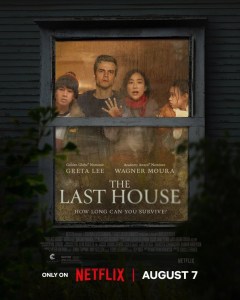 What begins as a clear allegory for COVID lockdown with a supernatural, Twilight Zone twist unravels quickly to be a muddled, confused, and disappointing monster movie that feels far too busy and silly for a movie this self-serious. The Last House starts off promisingly with a mysterious rain that essentially traps everyone in their homes, acting like a superglue force field. From there it becomes a question over if you were trapped in your home, what could you do to survive? At first it’s just general boredom with a family of four, and the parents (Wagner Moura, Greta Lee) trying to maintain their sanity. As weeks pass, it becomes a more pressing question over resources and food. I was expecting the movie to get creative with solving its in-universe dilemmas, but some of those solutions feel rather arbitrary and cheap. Why is there still electricity? If the rain is presented as creating a barrier, why is a hole in the chimney somehow able to circumvent this rule? There’s a whole lot of animal death in the movie, including mercy-killing the family dog and literally using its chopped carcass to lure small woodland creatures into a improvised fishing trap. It would be more disturbing if it wasn’t so ridiculous. I’ll credit the script for a major time jump because it renewed my flagging interest, trying to analyze what growing up in this extreme setting could do to a new generation who have only really known a strange world of isolation. I suppose that wasn’t interesting enough to Netflix because the last 40 minutes of the movie are about fighting Lovecraftian monsters that are, I guess, controlling the rains and just messing with people. Much like the characters onscreen, the movie is trying to do as much with what little resources it has left. The movie combusts at an alarming rate once it becomes an incomprehensible monster movie, and incomprehensible about even following the quick-cut action onscreen, which is obscured by the editing but also a majority of the scenes being underwater. The actors are wasted, the ideas are wasted, and The Last House doesn’t even give us the benefit of a true ending, instead previewing what a Last House(s) franchise could like like. I’d rather stay inside and eat the remains of my dog.
Nate’s Grade: C-
Share this:

Masters of the Universe (2026)
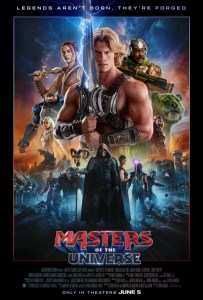 Masters of the Universe is an intriguing conundrum. It was a box-office failure upon release, as it seems few people wanted to venture out for a reboot of a 1980s Saturday morning cartoon that was created to primarily sell toys for Mattel. It was an expensive flop, and then upon its arrival to Amazon Prime and wide availability, the movie has since become one of the most streamed movies in Amazon history. I think I can explain this. The fan base for this franchise is dwindling with aging Millennials and few felt a big-budget remake was a necessary theater appointment, but in the privacy of your own home, and thinking back on the bad headlines and buzz, you might find yourself just like me, remarking, “I am actually digging this. Why were people so harsh?” It’s a candy-colored meta-fantasy adventure that rips Adam (Nicholas Galitzine) into the real world for some fish-out-of-water comedy, then reunites him back as an adult into his home world, Eternia, under the sway of the dark lord, Skeletor (Jared Leto). The tone is clearly inspired by Taika Watiti’s Thor: Ragnarok, keeping things breezy while side-stepping the more ridiculous elements with an eyebrow-raise. I actually enjoyed the explanation that the very simplistic names for the characters, such as Fisto and Ram-Man, were because Adam was a kid when he was deported and that’s what a kid would recall. The joke does run up to the line of excess, and it’s not alone, but I think overall the tone is so unabashedly fun that I could forgive missteps or annoyances. Under direction by Travis Knight, a man from the world of stop-motion animation, the big screen visuals are crisp, dynamic, and consistently making excellent use of the space of the frame, something I find that directors with animation experience really utilize better. There are nice character moments I appreciated (“Your dad’s gonna turn around any second and see… any second now…”), entertaining fights and locations, and maybe my favorite Leto performance in… years? He’s actually quite enjoyable as the contemptuous baddie. I never cared in the slightest for He-Man and the cartoon growing up, so I have no built-in nostalgia for this franchise, but even I found myself enjoying the characters, their comradery, and the confrontations. It’s hard not to be cheesy or goofy given the subject matter, but I think Masters of the Universe threads the needle as well as could be between reverence and irreverence. It may not be masterful but it’s plenty entertaining and fun and, certainly with lowered expectations, a perfectly fine way to unwind over two hours at home.
Nate’s Grade: B
Share this:

Good Luck, Have Fun, Don’t Die (2026)
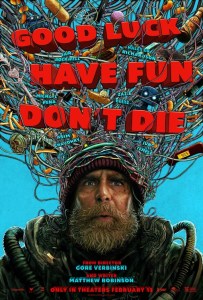 It’s been nearly a decade since director Gore Verbinski’s last movie, 2016’s A Cure for Wellness, and his dynamic visual style, impish sense of humor, and general prevailing oddness have been sorely missed in mainstream Hollywood. Here comes the creatively titled Good Luck, Have Fun, Don’t Die, which is accompanied by cheering children shouting he title whenever it appears onscreen. It’s a satirical sci-fi parable with its tongue firmly planted in its cheek. At 134 minutes, it plays like an entire season of Black Mirror episodes hung together with a wacky time travel adventure caper. Sam Rockwell plays The Man From the Future, actually his character name, though he looks like a scraggly hobo when he stumbles into a diner wrapped in trash and what appears to be a bomb. He uncorks a hyperactive speech informing the patrons he is from the future, that future is very bad thanks to technology, and he has come to this diner over 100 times previously because he is convinced within this eatery is some combination of the right people that will help him ensure this nightmare future never comes to be. Immediately, the screenplay by Matthew Robinson (The Invention of Lying, Love & Monsters) grabs you and refuses to let go, bouncing off the walls with ideas, gags, and manic energy mixed with trenchant commentary about the perils of technology in our crushing age of doom scrolling and diversion. Even better, the movie keeps shifting and surprising every so often. The structure is broken into a series of extended vignettes showcasing different members of the team and their personal back-stories, each treated like its own Black Mirror episode covering some different nefarious aspect of modern technology, from a school of student zombies addicted to their cell phones to a secret program that clones deceased children for the right price, though the government foots the bill if your kid was a victim in a school shooting. You can see the mordant tone and perspective of the movie. It gets dark but at no point is it suffocated by that darkness. Instead, Verbinski keeps things sure-footed and breezy, relying upon slapstick, goofy humor, sudden bloody violence, and layered revelations to maintain a consistent sense of entertainment. I don’t think there’s an emotional investment in the movie, and a very late revelation feels like a hasty attempt to force some in when that ship has sailed. I don’t mind that the film’s tone can be rather snide because its aim is strident anti-A.I. satire. It’s also easy to feel that many of the supporting players don’t get as much to do as they’re dragged along on this quest, especially after Zazie Beetz showed how capable she was as a formidable action heroine with They Will Kill You. Still, Good Luck, Have Fun, Don’t Die is a gonzo, violent, inventive, macabre whirlwind that invites the audience to laugh at the chaos and downturn of modern society. Hey, watching this screen is actually part of the solution, not the problem.
Nate’s Grade: B+
Share this:

Toy Story 5 (2026)
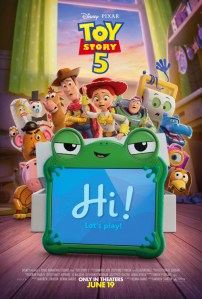
Every time Pixar resuscitates the storied Toy Story franchise, going on three decades now, I get a little wary of them upending the good will. The series had a perfect ending in the third edition in 2010, but being Pixar’s golden and most bankable franchise, it wasn’t allowed to remain an ending. I quite enjoyed the fourth edition in 2019 and consider it a fitting and poignant sendoff for Woody, if, of course, they could accept this as his settled ending. Now in 2026, here comes a fifth Toy Story, and my emotions are decidedly mixed, excited for the creative possibilities of another entry in Pixar’s flagship series and girding myself in anticipation of whether or not these fitting and earned endings are disturbed. Perhaps I’ve been overly protective of these endings, or perhaps it’s just a reflection of our modern IP-revivial cycles that studios cannot accept anything that makes money having finite story endings. Well, while I believe Toy Story 5 to be likely the weakest of the five films, it’s still a marvelous movie that elicited tears from my grown-up eyes on more than one occasion.
Now that Woody (voiced by Tom Hanks) has settled into a new life, the plucky leader of Bonnie’s toys has become the next cowgirl in line, Jessie (voiced by Joan Cusack). Life is good until Bonnie’s parents introduce an educational tablet device, Lilypad or “Lily” (voiced by Greta Lee). They want Bonnie to socialize more and make friends with the neighbors, something she’s having difficulty achieving. Bonnie becomes enthralled with her first smart screen, spending hours upon hours with it inches away from her unblinking face. Jessie sees the new tech as an enemy to traditional play time, as Bonnie’s toys have been chiefly neglected as she devotes all of her attention to this new shiny device. She plots to remove the Lilypad; however, Lily has her own ideas about what Bonnie needs, and it involves getting rid of the outdated toys of childhood so she can be better accepted by her more tech-adopting peers.

Right away, Toy Story 5 provides a meaningful reason for its own existence, examining the immersion of technology and in particular screen time into the development and maturation of children. It’s a substantial issue today for millions of parents, and a genuine worry about whether or not these magical electronic devices are helping or hindering childhood development. Are we building synapses with these games and social media apps or are we building a dependency and despondency when un-synched? It’s an age-old question over whether technology is facilitating growth or substituting for it, an especially pertinent question in the realm of education that ruling parties go back and forth with. This is a fabulous and thorny issue to explore in the Toy Story universe, and with co-writer/co-director Andrew Stanton (WALL-E, Finding Nemo) at the helm, there’s an assurance that all will be handled with wit and warmth (Stanton has co-written all five Toy Story movies, though this is his first directing credit). I actually think this movie utilizes its central premise better than Toy Story 4 did with the murky existential questions with Forky over what constituted play and thus was granted existence and consideration. Now, that movie transformed into a different and more emotionally resonant theme about broken toys still having purpose and dignity after being cast off from their owners, a disability empowerment message that was beautifully handled, so much so that I forgave the dropped exploration of thorny prior themes. With Toy Story 5, the question over the role of tech is front and center throughout.
At the core of this movie is the question of growing up and the malignancy of time. Lily wants Bonnie to be accepted and thus happy, and her reasoning is that these other toys are a detriment to this goal. In her view, they are dragging Bonnie down and imprisoning her in a juvenile state that her peers have already graduated from. For Lily, growing up is a process to be hurried, to become more like a “grown kid,” and thus more like everyone else on the block who has adopted tech and screens earlier in their lives. For Lily, Bonnie, even only at a mere eight years old, is already behind in her maturation process and she’s desperate to get her caught up. For Jessie, it’s about holding onto the status quo as long as possible. For three sequels now the movies have explored the nature of change, acceptance, and identity, and it’s still a wellspring of insight and emotional and intellectual relevance. Having Jessie be the primary protagonist of this sequel was a brilliant choice because she’s the toy who has been defined by abandonment issues. She’s been left behind by two other kids, first Emily and then Andy, and she’s afraid history is repeating with Bonnie’s dwindling attention now that tech has entered the home. There’s a clear parallel with the original Toy Story when Woody became jealous and insecure about the shiny new toy of Andy’s fascination, Buzz Lightyear (voiced by Tim Allen). Oh, and thanks to 2022’s Lightyear, we now know all these toys were the discount knockoffs of Chris Evans’ voice and that this original movie that Andy declared his favorite was not quite worthy of his adoration. Anchoring the major theme onto Jessie’s existing emotional attachment issues is smart, and it allows the fifth film to serve as a means of long-delayed closure for the cowgirl much as Toy Story 4 was a means of closure for Woody. It’s about confirmation that these relationships they build with their kids are not one-way, and that even after they end, and everything has an ending whether we like it or not, we know that they have mattered. No one, not even toys, wants to feel disposable.

I especially loved the imaginary play sequences in the film, highlighted by a different animation style. It’s painterly and with pastel colors, and it’s a great artistic choice to visually code the imaginary sequences from the standard reality. I loved how chaotic and silly these sequences were, converging escalating threats, dramatic twists, and ridiculous double crosses and resolutions, perfectly embodying the wild mind of a child in the midst of imaginary play. These little interludes were welcomed at every turn.
I did say Toy Story 5 was the weakest entry in the franchise, again no shame being a bronze medalist at the Olympics, so to speak, as you’ve gotten ahead of so many others to attain this honor. I enjoyed the lowered stakes of simply trying to tell a story about two factions fighting over what they felt was best for the mental well-being of a child. There’s something inherently sweet about a movie whose big goal is to just help a shy little girl make some friends. I do wish there was more persistent commentary on what screen-addiction has done to a generation of kids at an important time besides turn the neighborhood girls catty and mean. Bonnie, you are not the “weird kid” just because you prefer playing outdoors. At no point is Jessie really threatened with annihilation, and even as she’s lost she still finds a new and nurturing owner that could possibly even replace Bonnie. Because of those lowered stakes, the script can feel a little like an expanded TV episode where a character learns a valuable lesson. The supporting characters are sidelined with few exceptions. This is the second movie in a row that merely gives Buzz a jokey storyline, this time working up the courage to ask Jessie to be his wife. It’s more a recurring joke at his fumbling awkwardness. It feels like Pixar knew it was giving the character such a short shrift, which is why they also included an ongoing subplot of a group of Buzz Lightyear action figures bandying together to go searching for “star command.” Until finally tied into the action at the very climax, they’re a diversion that is never really as funny as it could have been. I will also firmly proclaim my stance that Woody should not have returned for this sequel. He offers little to the story, beyond to once again reflect upon how old he has gotten, which itself is just turned into a repeating joke. Woody’s involvement is wasted and his perspective isn’t different enough that some other toy, perhaps Buzz, could have fulfilled his role and left the former sheriff in retirement with Bo Peep.

Does Toy Story 5 upend the cherished endings of its predecessors? No, not really. Those endings still have meaning because the audience has invested relationships with these characters over thirty years. The latter sequels, in my mind, have served as closure vehicles for individual characters, and I think that’s a smart way to handle the franchise. Of course, I also think just telling original stories with new characters in this universe would be even more appealing, but the likelihood of that seems slim when Disney wants to sell another billion dollars in merch with their established and beloved characters. It’s probably naive to think this movie will ultimately be the franchise’s last, so instead I’ll just hold out hope that its ongoing quality will persist, and as long as Stanton and other Pixar brain-trust remember its innate and lasting appeal, I have a buoyant sense of hope that newer editions can still capture that initial magic that began in 1995.
At the conclusion of Toy Story 3, which I still gauge as the best in the series, it made me reflective and want to break out my old neglected toys, giving them one more hurrah of play. At the conclusion of Toy Story 5, it made me reflective, but I didn’t want to reach for any old toys and give them an extra dose of affection; it made me want to grab my toddler and soak up the time I have available with him, now, in this moment, while there’s a childhood to relish before it too vanishes at the mercy of time. This movie is all about the struggle over childhood, one side hoping to elongate it and the other hoping to rush through. From a different perspective, like a parent, it’s inevitably a losing battle, but it makes me reflect more on cherishing those moments while they are available. That’s pretty deep for a movie with a talking electronic poop assistant voiced by Conan O’Brien. Not too shabby, Pixar. Here’s your billion dollars.
Nate’s Grade: B+
Share this:

Moana (2026)
 If you’re a fan of the 2016 animated film Moana, then watch that again. If you’ve never watched the animated movie, then watch that instead. The live-action Moana is everything I have feared and dreaded when it comes to the assembly line of Disney live-action remakes. It is a carbon copy of the original, beat for beat the same story, the same jokes, the same visual shots, even the same character designs of the non-human characters. It’s all just worse. The lush colors and lively energy of the animated movie have been replaced by drab “realistic” colors, transparent green screens, and a performance from Dwayne Johnson absent the chaotic energy of his cartoon portrayal. The CGI animals, especially the chicken, looked terrifying. The songs are still great, the performance from our new Moana, Catherine Laga’ala, is pretty decent, though throughout the entire movie, even when it hit some strides of, “Well, this isn’t too bad,” it made me feel like I was watching a competent cover band play the hits of a much better and more famous band. It’s like the Moana Road Tour versus the real deal, and for many that could be plenty to provide sufficient entertainment, especially if you have a little one who has never seen any form of Moana. Then again, why start with the live-action one? Beyond being completely superfluous as the original is not even a full ten years old upon release, it’s just not as good in every measure. There’s not a single improvement, only artistic downgrades, and at such how far it goes creatively is actually very minute.
Nate’s Grade: C


You must be logged in to post a comment.