Blog Archives
Resident Evil (2026)
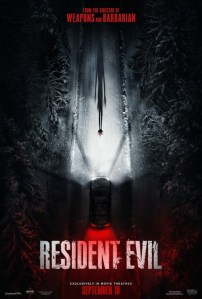 I’ve never played any of the popular Resident Evil video games but I have watched every movie, at least the ones starring Milla Jovovich, as I consider them the right kind of entertaining trash. In no way will I argue that any of the six movies from 2002 to 2017 are defensibly good by traditional standards (I’m purposely ignoring the 2021 failed reboot Welcome to Racoon City). I will, however, gladly sit and watch any of them if they are on TV because they are, at their best, gloriously ridiculous and silly spectacles. My interest dramatically increased in a new Resident Evil movie when writer/director Zack Cregger’s name was attached. The man behind twisty genre-benders Barbarian and Weapons helming a video game franchise best known for schlocky genre filmmakers like Paul W.S. Anderson? Weapons won an Oscar for a performance, a rarity for a horror movie, and now that same filmmaker wants to revive Resident Evil? My interest increased even further when Cregger confirmed it would be an original story and not really beholden to the established characters and plots of the many games (many fans did not agree with me). It felt like a fresh start with an exciting filmmaker on the rise, and having seen Resident Evil, I can declare it a gory blast, a brilliantly-calculated thrill ride to make you laugh and scream in good fun.
The entire 90-minute movie follows one character’s hellish night into the madness of the early signs of a deadly outbreak. We follow Bryan (Austin Abrams) as a medical courier delivering organs to hospitals. He’s ready to head home when he gets a special urgent delivery needed in Racoon City up in the snowy mountains. It will pay double and so he snatches the opportunity. It might be the allure of more money or it might be another chance to think about something other than the frightening reality that his girlfriend (Sara Paxton, off-screen) is pregnant. Along the dark and snowy drive up the mountains, a woman walks into his path and Bryan strikes her with his car. The rest of his night is about to get so much worse.
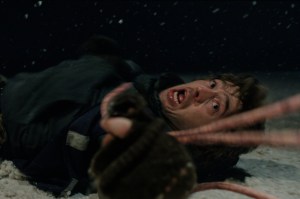 Considering its basis as a survival horror game, at least until it became a bombastic action-movie opera that better resembles the Jovovich screen spectacles, I think a streamlined approach by Cregger is smart. It narrows down the universe to this one guy’s very bad night, and it presents an immediately immersive experience, akin to playing a game and thinking through what is your best option out of a bunch of very bad options. From the very beginning, we are in Bryan’s frantic perspective. What he knows and experiences are what we know and experience. The clarity of focus provides a satisfying line of escalation as he gets into more and more danger. Cregger allows the audience to think through Bryan’s predicaments along with him, and there isn’t much he does that seems out of question, considering the extreme circumstances. I appreciated how once things really start going sideways that Bryan doesn’t miraculously transform into like an action movie hero. He’s just a normal guy relentlessly in over his head like any of us would be confronting monstrous horrors. I loved how bad he is with guns. Just because Bryan has some experience playing video games doesn’t mean he knows how to operate real firearms, and that doesn’t mean that the weapons of the real world perform like they do in games. There’s an ongoing joke about how he keeps trying to shoot off padlocks and failing that made me smirk every time. These little touches of realism in an elevated space made Resident Evil feel more engaging. It made it feel like even the little things mattered. This guy felt vulnerable, and sometimes his impulsive solutions only serve to get him into more trouble. The screenwriting plotting of A-to-B-to-C has a satisfying logic that manages to ground the mayhem on its own terms. He often has to think through an obstacle.
Cregger’s command of a scene is so enjoyable and assured, and he knows when he wants to make you squirm and when he wants to make you laugh. He can draw out a scene with excellent sound design for chills, like when a figure is quickly advancing on Bryan and clamoring up stairs while he desperately tries to reload a shotgun. The pacing of the moment is terrific. The resignation of desperation can also lead to many dread-fueled moments, like venturing into dark tunnels to sewers to blood-soaked halls. You don’t want to go down there, but you also kind of want to see. There’s also a heightened level that naturally draws mordant laughs, like when he’s being chased around a flipped-over police vehicle and sloppily shooting behind him. The movie wants you to laugh at the absurdity of trying to make sense of this nightmare scenario. It’s the release to get ready for more. Much of the humor is drawn from subverting our expectations of genre movies, like trying to ram open a locked gate, and particularly Bryan’s response to the madness. His panicked, befuddled reactions and clumsy physicality, accompanied with often high-pitched scream, serve as a reminder that he is a normal guy in unusual circumstances (I’d like to try and see you do any better). One of the biggest laughs for me was just a joke about stairs.
 This is also a great looking movie. Cregger has the enviable talent of cinematographer Dariusz Wolski, the man who photographed The Crow, the Pirates of the Caribbean trilogy, and nine (!) Ridley Scott movies since 2012. The man knows how to frame striking contrasts, so the whites of the snow-covered landscapes in the first half visually pop with the dark blacks of the silhouettes and the blood trails. The movements of the camera and compositions add such a charged sense of energy that reminded me of the best of Sam Raimi without feeling like a derivation in Cregger’s overall sense of style. The movie also doesn’t bend over backwards to bring to life the visual dynamic of the game, though there are more than a few passing gun barrel POV shots to sate the faithful.
This is also a very messy movie in the best/worst way. For gore-hounds, there is some impressively gnarly gore, which isn’t surprising considering the viral outbreak is turning residents into split-faced, multi-tentacled monsters. The body horror is gruesomely inventive. There’s one monster that reminded me of a different video game, 2004’s Katamari Damacy, a Japanese game where you start with a small sticky ball and roll it around, collecting more and more items and people, growing in size to the point that you attach the whole world. Imagine that but a snowman of men, and you can only see limbs moving at angles that limbs shouldn’t do. It’s quite unnerving to glimpse. I also found myself audibly wincing during a sequence where zombies are throwing themselves off the roofs of buildings while Bryan runs down an alley, bodies exploding all around him in eruptions of viscera. There’s another sequence of zombie rats that makes me shake my head in disbelief even now remembering it. Credit to Cregger, the man is unafraid to go places other horror movies fear to tread. Whether it’s animals or children, nobody is safe in this disturbing universe. There was one moment in a mutated maternity ward where I cautiously decided to shut my eyes to avoid poisoning my brain with fresh nightmare fuel to review when I came home and embraced my almost two-year-old son. There are some things I just don’t need to see presently.
 At a brisk 90 minutes, this is one of those rare movies I think would have benefited from another ten to fifteen minutes, especially with its abrupt ending. The final act loses some of the momentum accumulated beforehand, which isn’t a deal-breaker considering the film was moving like a runaway freight train up until that point. It also feels like a slightly different movie, both in approach and tone, going bigger and not exactly better. There’s also a question over what is gained from giving Bryan a characterization starting point. Over the course of the movie, he certainly re-examines his perspective on being a prospective father (and that’s before the mutated maternity ward). I thought this was going to climatically lead to a significant deliberation over making a selfish versus selfless decision, but Cregger doesn’t go there. The ending is kind of a cinematic middle finger to anyone expecting that character arc to come to something more meaningful, which is fine, but then why include the thread at all unless it’s just intended to be another deliberate rug-pull of your expectations? While the last ten minutes doesn’t quite live up to the amazing alacrity of the prior 80 minutes, it doesn’t ruin the good fun Cregger has earned in excess.
For many years, I thought it was impossible to make a good video game movie. This was because of the interactive nature of games versus the more passive medium of movies, but it was also a statement borne of the adaptations of the time, many of which had Uwe Boll’s name attached. I’m here to say times have changed but also so have the games. Over the last two decades, video games have reached new creative heights and that includes dramatic storytelling depth as well. Playing a game like Red Dead Redemption II is like burning through seven seasons of an epic and invigorating TV series. That’s not the intent of a movie like Cregger’s Resident Evil, a more streamlined and specifically designed contraption that is like riding a perfectly engineered ride. By the end credits, you might just have to catch your breath. While I have some minor quibbles about the ending and some dangling plot threads, Resident Evil is such a nasty, squishy, gruesomely entertaining movie, that I’m thankful for the privilege of watching Cregger operate at B-movie studio level (will Cury Barker be able to find similar results with his looming Texas Chainsaw Massacre reboot?). If we can give artists with a vision the berth to see it through, we might be able to turn around every moribund video game franchise. Look out for Ari Aster’s Doom next, and it will still be three hours and a metaphor for penises.
Nate’s Grade: B+
Share this:

Mortal Kombat II (2026)
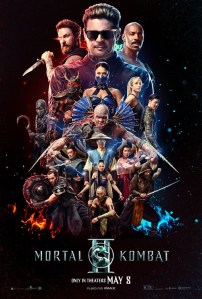 The 2021 Mortal Kombat movie was a mostly successful kick-start for the franchise to, at long last, stretch its legs on the big screen as a reverent representation of the appeal of the popular video game series. It was the first R-rated movie that showcased the inventively disgusting gore that is the hallmark of the bone-crunching series. It wasn’t a huge hit at the box-office so soon after the COVID shutdowns but it proved to be popular on HBO Max’s streaming network, and so now we have Mortal Kombat II, not strictly a straight adaptation of the game Mortal Kombat II, which was my favorite as a 90s kid when I had all the fighter moves and fatalities memorized. This time there is an actual fighting tournament germane to the story, and we’ve got the inclusion of movie star-turned-Kombatant Johnny Cage (Karl Urban). Can it escape the doomed fate of other Kombat movie adaptations and actually be good?
Early on, there’s an extended clip from one of Cage’s cheesy 90s action movies. It’s bad, goofy, and unintentionally funny as Cage fights his way through a warehouse of goons and does a jumping split kick over an incoming RPG. It’s a fitting send-up of the bombastic excesses of 90s action movies while demonstrating Cage’s limited real-life martial arts application. I wasn’t expecting Mortal Kombat II to essentially transform into that self-parody of 90s action movies. Watching the movie and trying to make sense of its runaway plot and throwaway explanations, I was reminded of the story modes in the newer games, how convoluted and ridiculous they are, bridging timelines and reincarnations and multiple iterations of characters and how it lacks excitement and engagement. For a fighting game, an okay story can be enough to connect between the different playable matches because the point is the hands-on fighting. This feels more like I’m watching someone else play the lousy story mode of the video game. It doesn’t feel like a movie to the point that I’m re-evaluating the 2021 movie on a higher level.
 That at least felt like an adaptation that intended to exist as a film story, streamlining certain elements and making others accessible. This movie feels like it’s just made for diehard Kombat fans, not because it’s heavy in lore complexity and intrigue but because the fans will be the most easily forgiving. With Cage being the fish out of water, you would think his arc would take center stage. He’s the washed-up actor living off his fading reputation. He’s seen by the Outworld as a tremendous and worthy fighter but he’s just an actor. This misconception from his movies could have provided a more intriguing, grounded, and funny story along the lines of Galaxy Quest, where an actor has to keep up the ruse. This plays into the best scene of the movie, where Cage has to challenge the dentally-challenged blade-armed Baraka (CJ Bloomfield) among his community of angler fish-mouthed working class monster-people. Cage has to lean into his persona to become intimidating and then to escape the threat of his opponent. It’s the best fight in the movie because it has more setup and makes actual use of its geography. There’s also a fun dynamic of Cage having to live up to the reputation his running mouth has presented. This could have been the whole movie. Cage’s character arc is a dull zero-to-hero transformation, where I guess he has to believe in himself enough and then he’ll become a legendary fighter. Why this makes sense I do not know. It would make better sense if he was tapping into the muscle memory of his old fighting routines, like we watched him mirror those moves we saw in that introductory film clip. That would produce a setup and payoff. Instead, Cage becomes a deus ex machina fighter through his unshaken belief he can kick real good. His protagonist status is split evenly with Kitana (Adeline Rudolph), who is a familiar and boring archetype of the overthrown princess training to avenge her fallen father and restore her kingdom. For a supposed double agent, it never feels like Kitana is in any danger, especially as she travels back and forth between secret bases in broad daylight without bothering to cover her tracks beyond obscuring her special magic necklace. Because her character arc is so stock, we could have pared down her screen-time considerably and gotten the same effect, giving those precious minutes over to Cage for a fuller arc.
Not that you were coming to Mortal Kombat II for a story, but it’s plenty bad. We have a second entry point character to learn the ways of inter-dimensional combat between gods and monsters, after the 2021 movie gave us… an entry point character. Seems rather redundant to go through this again, right? Do you even remember that character’s name? Do you remember what his special power was once he became fully self-actualized? I didn’t either, so when he appeared briefly in this sequel, it wasn’t until it was long over that I thought to myself, “Oh wait, that was that guy?” Even the protagonist of the first movie is a discarded afterthought. The story elements from the first movie are tacked on like calling upon support at the last moment, akin to hailing Godzilla to come out and fight the big monster terrorizing Japan for the first two acts of the movie. “Hey, remember the spirit of the Scorpion warrior? Well now he’s back to once again kill the spirit of Sub-Zero who is now Smoke with different powers, I think.” The entire universe-defining inter-galactic tournament feels so underrepresented and insignificant. There’s a culminating fight that requires not one energy beam blast, not two energy beam blasts, but three different energy beam blasts and a very special kick, and every moment feels as arbitrary and airless as the last. Even if you’re not expecting much from a movie that spells “combat” with a K, it should still follow the expectations of a movie, namely that the characters are meaningful and there’s an internal connectivity. Once you start introducing the mechanic that we can bring fighters back from the dead, or just stroll into the Netherworld to hang out with the dead and ask them favors, the stakes lessen dramatically. If death in the fight-to-the-death tournament is just a transitory phase, then why even stress about the tournament?
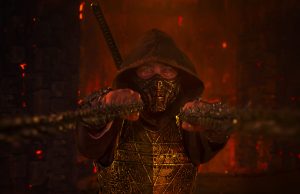 I know this sequel has a bigger budget than its 2021 predecessor but it looks so much worse visually. The increased number of special effects look dodgier and all of the sets look like big empty green screen stages. Too much of this world looks dim and fake. The fighting stages (acid pit, spike pit) are faithfully recreated from the video games but at a cost. There’s so little that feels tactile or even interactive with the actors onscreen. The environments feel empty and vast and often visually unfinished. There’s one stage surrounded by what looks like a screen saver of old with glowing stars moving like in Star Wars hyperspace. It’s not just that it looks phony, it’s that it doesn’t even appear to look otherwise. There are some gruesome deaths but even they are limited by the range of attacks from the primary villains. Having a big guy wield a big hammer limits what can be done. Often people are just being impaled, and I hate to sound like a jaded Spanish Inquisition flunkey, but you see one bloody impaling, you’ve seen most. Even by the standards of its memorable gore and intensity of its brawls, Mortal Kombat II falls flat. It’s too goofy to be as serious as it is, and it’s too serious to really generate a passing sense of fun.
By most accounts, Mortal Kombat II is going to be a movie that most viewers have a sliding scale of expectations for because it’s based on a fighting video game, because it’s a sequel, and because it’s populated with silly characters in colorful regalia. Is it my fault that I was expecting better? I don’t think so. The results of the 2021 movie show what could be possible, especially with its thoughtful and terrifying opening flashback to 1600s Japan establishing the deadly prowess of Sub-Zero. That’s what a Kombat movie could be like, elevated and cinematic and devastating. It doesn’t have to be junk. Mortal Kombat II doesn’t aspire to be anything other than tasty, disposable junk, and it’s not even good at that.
Nate’s Grade: C-
Share this:

Five Nights at Freddy’s 2 (2025)
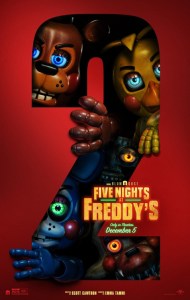 I wasn’t a fan of the original 2023 movie based upon the insanely popular video game series that serves as an entry point into horror for kids. It didn’t work for me but I thought fans of the series would have fun watching the characters come to life in live-action. Now with the sequel, I don’t know anyone that could enjoy this dreck except for the most diehard of the Freddy’s fanbase. I’ve watched the movie and I couldn’t understand it. I read the Wikipedia summary and that didn’t clear it up. So much hinges on so many characters having peculiar responses and relationships to what are… killer animatronics powered by the spirits and literal corpses of murdered children. Why is this pizza parlor even still standing? These robots went on a killing spree in the first movie, and yet this lonely little girl misses her “friends” and runs away to see them again. This isn’t E.T. here, it’s a weird killer robot horror movie that seems to be making up its lore and rules as it goes, like one unending “yes and?’ improv game you’re desperate to tap out from. I guess there’s more killer robots this time, and some unintelligible distinction between the good bad robots and the really bad robots. I don’t know. I gave up trying to comprehend what was happening and felt like maybe I could just try and enjoy the minimal PG-13 scares and tension. The animatronic designs are solid. Wayne Knight (Seinfeld) appears as a villainous robotics teacher. There’s a marionette character that’s kind of sinister to watch. That’s about it, folks. It’s a fairly nonsensical waste of 100 minutes, and unless you’re steeped in the lore and history of the series, you too will wish that this town would just set fire to the whole parlor.
Nate’s Grade: D+
Share this:

Tron: Ares (2025)
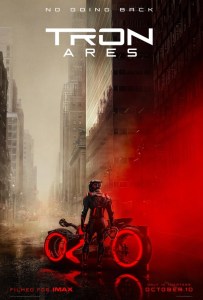 Known more for its cutting-edge visual effects, the Tron series has long felt like a franchise that Disney keeps trying to reanimate every generation with the hopes that this time, this time, it won’t be ahead of its time and merely of its time and a measurable hit. I think the issue I’ve had with the Tron movies, the original in 1982 and the 2010 glitzy sequel by debut director Joseph Kosinski (Top Gun: Maverick), is that the computer world that the characters get sucked into is, quite simply, boring. The world-building of life inside the computer is dominated by design and less by depth. It’s cool-looking and sleek and alien but it’s also over-glorified setting details without a larger sense of life. That’s probably why every movie has dealt with the threat of the computer world coming into the real world. That’s where Tron: Ares does right, spending far more time in the real world than the computer one, with a flesh-and-blood character (Greta Lee) traveling into the computer realm and a digital one (Jared Leto) traveling out to track her down. On the outside is a war between two tech companies, both racing to be able to replicate structures from the computer world into our own, except they disintegrate after 30 minutes. This is a smart limitation as it naturally presents a goal, to outlast this measure, but it also presents a ticking clock for our computer programs tracking down their missions. Much of the characterization is Leto’s security program, Ares, becoming self-aware and questioning the orders of his superiors, which makes for a pretty predictable arc from a pretty stoic if tedious character. He’s simply the cool fighter that we need for cool fighting, and admittedly, there are plenty of cool fights here. The Tron visual aesthetic of force movements creating warriors makes for some nifty images, especially when those barriers are used for strategic purposes in escapes or combat. You could mentally check out from all the tech mumbo-jumbo and just enjoy the pleasure of the sci-fi action, especially with Nine Inch Nails (really Trent Reznor & Atticus Ross) providing the sonic musical accompaniment. I don’t know if I’ll ever really love a Tron movie but there’s enough offered with Ares that allows me to at least like a Tron movie.
Nate’s Grade: B-
Share this:

A Minecraft Movie (2025)

I was fully prepared to dismiss A Minecraft Movie as junk for its target audience, and then a funny thing happened in fact pretty early in the movie: I was laughing. Then I laughed again. Genuine laughter. I’m here to say that the Minecraft movie is not the silly and stupid kid’s movie you may have dreaded. It’s actually a pretty pleasant fantasy adventure movie that, while aimed for kids, can still be enjoyable for like-minded adults looking for some colorful and silly escapism. It’s hip to be square, baby.
Steve (Jack Black) is a guy who loves to create, and mines for whatever reason, and finds a portal to another very cube-centrist world. In this new world, Steve finds friends and freedom, but this is ruined when a nefarious force comes through wanting to conquer this new world as well as Steve’s home world. He sends out help and seals off a portal. Years later, a pair of siblings, Henry (Sebastian Hansen) and Natalie (Emma Myers), move into Steve’s old home and discover his portal, along with an middle-aged arcade game champion and local legend, Garret (Jason Momoa), and realtor, Dawn (Danielle Brooks). These newcomers must adjust to this strange world and defend themselves against zombies, creepers, and other dangers. Fortunately, Steve serves as a valuable guide, but can they all defeat the evil forces?
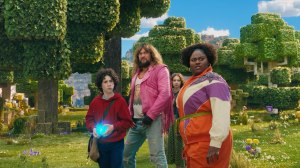
There’s a robust silliness to Minecraft that invites you to not ever take things too seriously and have fun with the vibes. Much like the Super Mario Brothers adaptation, there isn’t really a story to adapt here. There were several moments that felt like it was a satirical parody of the fantasy adventure movie while also working as examples of fantasy adventure tropes. Refreshingly, much of the humor is not derived from fish-out-of-water juxtaposition. This could have easily been a “Well, that happened” kind of nonchalant comedy, holding up the weirdness to scrutiny for easy yuks. It finds better jokes through pushing further than simple observational irony (“My dad says math has been debunked”). It’s good-natured humor that keeps things positive and goofy, channeling the open-sandbox creativity of the video game. Its “be yourself” message is easier to accept than more disingenuous kid’s movie junk like The Emoji Movie. The Minecraft world is presented less as a purchasable video game rather than a new world to explore that rewards exploration (during daylight hours). The very enemy of the movie is a sorceress (voiced by Rachel House) that hates creativity and sees it as a waste in her pursuit of always plundering and hoarding more gold. I might be reaching but there seems even like a possible A.I. reading there, with our giant pig sorceress standing in for tech bros who are trying to eliminate avenues of creativity because all they care about is wealth and cannot understand the appeal of creativity. The movie has several little comic asides that caused me to chuckle and laugh and smile, and I looked over at my adult friend beside me for my screening, and his response was the same. We both had been surprisingly taken by the genial silliness of this movie.
Black (Jumanji) has become a kids’ movie juggernaut thanks to his zany energy and willingness to go above and beyond no matter the request. He’s a charming and delightful performer by nature, whether he’s voicing an animated character or singing a sexually explicit song about all the positions he will execute. He dips out for the first half hour after the exposition dump that opens the movie, but once he’s back on screen, it’s easy to remember there just isn’t another actor like Black. He’s funny and completely bought-in with whatever the movie asks for, but every single line and every single gesture is at a ten. He is selling every second of this movie and I can completely understand why some people just might get overstimulated by Black’s histrionics. You can tell the filmmakers were like, “We want our own version of ‘Peaches’ to go viral,” and so we get three different moments of Black singing original songs. This aspect was the most transparent and contrived decision that felt based upon chasing after the success of another movie popular with the kids. The actor I enjoyed the most was Momoa (Fast X) who has lots of fun undercutting his own masculine image and his character’s over-inflated ego masking his insecurity.
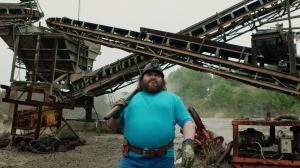
The visuals are bright and enjoyably retro. The Minecraft video game is famously low-grade with its pixelated graphics, more akin to the visual landscape of video games from the 1990s than 2011 when it was first published (it has since become the best-selling video game of all time). Starting with that visual scheme, it allows the movie to be good looking without having to be photo-realistic with its CGI. We have a stylized world to explore that’s full of vibrant colors and characters. This is easily the best looking movie of director Jared Hess’ (Napoleon Dynamite, Nacho Libre) career. His skewed sensibilities work as a nice fit with the comic direction of the movie, and there are some engaging visual arrangements.
Regrettably, this adventure is a bit of a boys-only club. The female half of our adventurers don’t really get the attention that the boys do. Both Natalie and Dawn sit out for long stretches of the movie that I forgot they were in the movie. Usually, these kinds of stories make it so each character has some kind of arc that can be fulfilled by the end, even if it’s minor. I suppose you might be able to argue that Natalie is learning to accept the responsibility of being a parental figure to her younger sibling, and Dawn getting the gumption to quit her job to pursue her dream of running a petting zoo. I’m not keen on bestowing credit for just having a scene at the end where the characters celebrate whatever their goals had been. If you don’t see the work and the development toward those goals, then you don’t get the credit. Why can’t these women have their own adventure that meaningfully connects to the larger plot? Or, even better, why can’t they also go along and contribute to the quest along with all the boys? It’s not like I think the movie is actively trying to downplay the role and importance of women, but it’s also disappointing that there are clear tiers of the characters as far as what kinds of fun and story integration they ultimately earn.
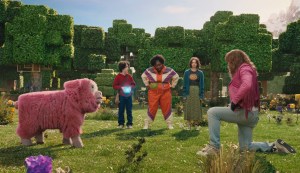
Behold, the Gen Alpha cultural epoch and its name is “chicken jockey.” By now you may have heard of this infamous scene that has caused some theaters to erupt in a calamity of noise, rowdy behavior, and throwing a live chicken at the screen. I even had a theater employee warn our audience before the movie began what is acceptable behavior and how people not abiding by these expectations would be removed from the theater. I’ve been watching movies my entire adult life and other than special screenings for movies intended for audience interaction, like Rocky Horror and The Room, I have never had a theater employee warn me about proper decorum, and this was before the Minecraft movie. It’s astounding. What’s also astounding is how ultimately meaningless this moment is. It’s a baby zombie that falls atop a chicken and rides it, and from what I’m told, this is a very rare occurrence in the game, but I guess it means something more to a generation of fans relishing a rare reference in their favorite game. While I was standing outside the restroom waiting for my own kid to return, a little girl was impatiently asking her father if he was done using the restroom, much to his growing annoyance. “Please hurry. I don’t want to miss the chicken jockey part,” she explained in desperation. I’m happy that this moment seems to be so highly anticipated for millions of fans, but as an outsider, this moment feels so incidental and flimsy that it would be like a generation excitedly waiting for Indiana Jones to lean against one particular wall.
This movie could have been so much worse, and the fact that it’s relatively breezy, funny, and entertaining for non-fans of Minecraft, such as myself, counts as a success in my book. It’s telling that the title is A Minecraft Movie and not The Minecraft Movie. It is but one story in this universe, and given the popularity, it will surely not be The Last Minecraft Movie. Its runaway success at the box-office means we’re probably headed for even more Gen Alpha-centered game adaptations, like some Roblox game you’ve never heard about if you’re over the age of twenty. Hey, it all might work somehow. This one did.
Nate’s Grade: B
Share this:

Borderlands (2024)

I’ve never played the popular looter-shooter video game that Borderlands is based upon, but I have to say that the fan base certainly deserved more than a low-rent combination of Guardians of the Galaxy merry pranksters with Mad Max freakazoid wasteland gangs. You can clearly tell the specific X-Meets-Y of the pitch, although apparently writer/director Eli Roth (Cabin Fever, The House with a Clock in the Walls) was auspiciously inspired one day by, literally, watching his dog squat over and poop and said, “This, this has to be in the movie.” So, from those noble creative origins comes a movie that labors so hard to be breezy and fun but feels so gassed and desperate. In this future sci-fi universe, there’s a special planet that is populated with different space crooks and gangs all fighting to discover a hidden vault of legend. The world is overrun by masked marauders known cheerfully as “psychos.” There’s also a prophecy about a chosen one, a kidnapped daughter to a very dangerous man, and Jack Black voicing one of the most obnoxious sidekicks in recent memory. That’s the thing about Borderlands: everyone is obnoxious or trying badly to be so indifferently cool. It doesn’t work. Cate Blanchett is not the right fit for the lead character of Lilith, a blase bounty hunter/for-hire killer that finds herself gathering a band of bickering bandits. The movie wants us to see them as a dysfunctional family of lovable losers, but each mediocre character is distilled to an underwhelming essence of quips, snark, and stylish killing. If there was a whiff of personality to be had with the different characters, their different and conflicting perspectives, this universe and its interesting locations for world building, even the unique weapons and fighting abilities, there might be even some fleeting entertainment to be had. Alas. It’s not funny. It’s not exciting. It’s not visually appealing. It’s not interesting. It’s not surprising. It’s just sort of loud with capital A-attitude and a forced sense of jocular PG-13 whimsy. It’s not… a lot of important things. Instead, Borderlands only makes me reflect how much better James Gunn has proven himself with these kinds of funky found families.
Nate’s Grade: C-
Share this:

Tetris (2023)
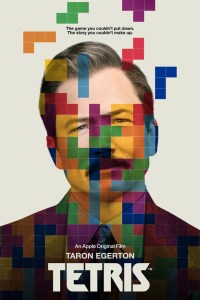 The “real” story behind the addictive puzzle game is an engaging tale of underdogs and corporate intrigue that might prove surprisingly fun and complicated for such a simplistic and straightforward game. We zoom back to the late 1980s and two converging storylines: the rise of handheld gaming and the decline of the Soviet Union. Taron Egerton (Rocketman) plays Herk Rogers, an American businessman living in Tokyo with his wife and family who has put all his hopes on the Japanese license rights of a small little game made in Russia. What follows is one man trying to finagle a system of questionable IP rights between scheming businessmen and Soviet KGB agents. The numerous players fighting for dominance over the course of legal copy, meeting rooms, and offers and counter offers was, for me, the most entertaining part of the movie, and the version that felt the most tethered to reality. There are some Hollywood exaggerations in this retelling, especially in the final act where the movie takes a cue from Argo and has its heroes in a careening car chase to get to the Moscow airport and eave the country (externalizing the internal feelings, much like Argo). Since we all know that the game ultimately ends up as one of the best-selling and most iconic, and packaged with the launch of Nintendo’s GameBoy, the appeal of the behind-the-scenes story is the struggle that our heroes overcome, and Tetris succeeds through its accessible but ever-moving plot mosaic that feels like legal knots trying to come undone. I think the movie gets even better when Herk becomes friends with Alexey, the state worker who created the game in his spare time and is hassled by KGB agents for the game harming national productivity. There are a few too many cutesy touches the movie could do without, like the inclusion of 8-bit sprites as visual transitions, something that is layered over the climactic car chase making it look much duller. I also feel like the honeypot twist feels a little too overinflated Hollywood drama for its own sake. There’s already plenty of drama here that didn’t need the help. Regardless, Tetris is a solid drama that stacks up.
Nate’s Grade: B
Share this:

Uncharted (2022)
 The successful Uncharted series (2007-2016) are some of the most movie-ready video games for big screen adaptation. While playing the globe-trotting, puzzle-solving, treasure-hunting action-adventures, it feels very much like you’re already in the middle of a big-budget Hollywood blockbuster. The game was in development for so long that the producers have finally ditched Nathan Fillion, the celebrity doppelganger in look and attitude of the game’s swashbuckling protagonist Nathan Drake, and resorted to everyone’s favorite web-slinger Tom Holland as a younger version of the hero. He’s a brainy bartender who is looking for some hidden Magellan treasure, and maybe his missing older brother too, and is aided by Victor “Sully” Sullivan (Mark Wahlberg), an Army vet with a shared goal of retrieving the gold before his rival, wealthy industrialist Santiago (Antonio Banderas). It’s a race against time and while it doesn’t reinvent the action-adventure wheel, Uncharted is a perfectly diverting piece of entertainment. The banter is fun between Holland and Wahlberg, the action set pieces are brisk, and the third act in particularly is just a showstopper of big action bravado. The visuals are eye-grabbing and the action sequences are inventive and exciting. That’s what Uncharted gets the most right, that sense of fun the games have built into their core, while keeping things moving smoothly with colorful characters and large-scale action. You’ve seen some combination of this movie before, but even genre masterpieces are built from their influences, so being derivative is not a fatal flaw as long as the filmmakers get the essentials of storytelling and action cinema right, and they do here. The world of video game movies is already one where the bar is fairly low for quality, but it seems like Hollywood has started raising its game, like with the new Tomb Raider, Detective Pikachu, Sonic the Hedgehog, and the upcoming Last of Us prestige HBO series. Count Uncharted as the Saturday morning popcorn spectacle that knows exactly how to deliver a good time in only 105 minutes.
Nate’s Grade: B
Share this:

X (2022)/ Choose or Die (2022)
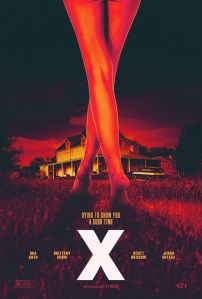 Horror is likely the most forgiving genre out there for being derivative. Just about every modern horror movie wears its many influences, even the recent trend of elevated horror movies that are trying to say Big Things with equal amounts of arty style and bloodshed. There’s only so many monsters that can chase so many teenagers. Ti West (House of the Devil) is a director I haven’t fully enjoyed, though I would say X is his most accomplished film to date for me. It’s clearly going for a Texas Chainsaw Massacre vibe and docu-drama aesthetic. It’s set in 1979 and we follow a ragtag film crew trying to make “a good dirty movie.” They’ve rented a guest house in the middle of nowhere Texas as their film site because who knows. The octogenarian couple who owns the farm property doesn’t seem to approve of these young folk, and the old lady ends up becoming the slasher killer that mows down the randy young adults. Turns out the old lady has her own urges that the old husband is no longer physically able to satisfy, so she seeks out solace one way or another with the newcomers, whether that be through her sexual satisfaction or through violence. To West’s credit, he has given more attention to his characters. These people are not going to be confused with three-dimensional figures but there’s enough character shading that made me more interested in spending time with them and a little more rueful that most of them will probably die horribly soon enough (Chekhov’s alligator). The slow burn is not wasted time or dawdling, and there are some very well-executed squirm-worthy moments of discomfort. I don’t think X quite works on that elevated horror level of late; it’s mostly a slasher movie with a dollop more complexity and style. The real reason to appreciate X is from the dual performances from actress Mia Goth (Suspiria), the first as a stripper-turned-ingenue that sees pornography as a path of possible self-actualization, but she’s also secretly the killer old lady under piles and piles of makeup. Her wild performances, including scenes where she is facing off against herself, makes the movie far more interesting. Goth goes for broke. I don’t think the X is as fun as it thinks it is, nor is it as thoughtful as it thinks it is, and I don’t know if I care about a prequel that was shot back-to-back that illuminates the killer old lady’s younger life. Is this character really that interesting to warrant her own movie? As a horror movie, it’s disturbing and bloody and surprising in equal measure even as it doesn’t do much with re-configuring the many conventions of its genre.
 Netflix’s Choose or Die is one of those spooky horror movies that wants the audience to play its deadly games alongside the unfortunate characters, much like Saw and Would You Rather?, and I typically enjoy these kinds of movies and thinking what options or strategies I would undergo if I was in their place. The structure is pretty straight forward, with a young woman (Iola Evans) and her programmer friend (Asa Butterfield) coming across a cursed old school text-based computer video game that forces its users to make awful choices. The game turns itself on every 24 hours, so there’s a natural delivery of set pieces, each increasing in its personal stakes. There’s the amateur investigation of the history of this 80s video game and uncovering the possible owner who might be benefiting from all this cruelty and sadism. This is a movie built around its set pieces and they start strong. When the protagonist sees the game in action, with a poor diner worker force-feeding herself broken pieces of glass, it’s truly horrifying and the sound design makes it so much worse. The movie isn’t s gory as it could have been and implies a lot more than it shows. The problem with Choose or Die is that there are too many leaps in logic and characters doing silly things just for the sake of the plot. There needs to be an established system of rules or else everything will feel arbitrary, and eventually that is what dooms Choose or Die. Even while we get more of an explanation behind the makers of the game and their occult connections it never feels like we’re better positioned to beat the game. I will say the final act, the Boss Battle, is where the movie cranks things up and gets really intense and darkly humorous. There’s a showdown that involves a key concept of self-harm that plays out in moderately clever, bizarre, and surprising ways, and this splashy, silly finish made me wish the rest of the movie could have lived in this tonal space. I found the overall sound design to be very annoying as it cranked up the volume on lots of glitchy electronic noises that just made me want to turn it off. There are some good ideas here, like the criticisms of being too nostalgic to the past, and of misogynist men believing nobody else is deserving of being the hero of their story, but this is a movie that lives or dies on its killer set pieces, and those just fall flat after its unsettling first level. Watching someone vomit VHS tape is not scary. Watching people move their bodies like they have no control over them will inherently look goofy. Choose or Die wouldn’t be the worst choice of a movie to kill 85 minutes but it’s certainly not much more than the sum of its parts, and even those are overly derivative and been done better by its predecessors.
Nate’s Grades:
X: C+
Choose or Die: C
Share this:

Sonic the Hedgehog 2 (2022)
 While not as enjoyable as the first outing, Sonic 2 mostly fulfills what you would be looking for with a sequel. This is the kind of kids movie that is aimed primarily for the little ones, and that’s okay, not every movie intended for children has to work on multiple levels of maturity. We follow our signature alien speedster as he meets two of the other famous faces from the video game franchise, Tails (voiced by the game’s original actress) and Knuckles (Idris Elba), except Knuckles is working with a returned Doctor Robotnik (Jim Carrey) to find a hidden gem of ultimate power. The plot is just a disposable excuse to set up some big screen adventure-seeking, and everything is kept at a very low-stakes realm of entertainment, breezy and quippy and pleading with you to just accept it on its own minor terms. At points, the Sonic sequel can feel like a direct continuation of its predecessor and Carrey is once again the MVP. I enjoyed the Knuckles character because the screenwriters have made this new alien warrior very much like the literal-minded himbo, Drax (Guardians of the Galaxy). Plus I just enjoy Elba’s natural British voice. The length of the movie is a bit padded at over two hours, a full twenty minutes longer than the 2020 original, and the attempts at heart feel strictly boilerplate and perfunctory. The subplot about a destination wedding in Hawaii feels included just to give the humans something to do away from the action, and while I enjoyed Natasha Rothwell (Insecure) getting to go full avenging bridezilla ham, this stuff could have easily been cut as much as it matters to the bigger picture of world-saving and robot-smashing. If you were a fan of the first Sonic movie, which I found to be a pleasant surprise, then you’ll likely relive those same feelings but just a little less potent. It’s still a fun, agreeable kids movie and one that can be enjoyed on that level even by adults, though the fun just might not be the same size as before.
Nate’s Grade: B-


You must be logged in to post a comment.