Monthly Archives: March 2026
Avatar: Fire and Ash (2025)
 When Avatar: The Way of Water was released in 2022, it had been 13 years since a new Avatar movie, so the return to Pandora was a reminder about how immersive and captivating this world could be, and another reminder that writer/director James Cameron can deliver blockbusters of scale like few others. Now it’s been three years in between Avatar movies and the novelty is definitely missing. Fire and Ash feels in many ways like Avatar 2.5, a direct holdover of characters and plots languishing from the second film. Some of this continuity is a given considering it’s an ongoing series, but each movie should feel like it’s own complete story. Too many of the characters feel stuck in the same place we left them by the end of the second movie, which means it’s another sequel where Zoe Saldana’s Neytiri spends most of those three hours bereft and crying before getting into fighting mode in that last climactic hour. There’s a general sense of same-ness to this story, extending conflicts and character arcs from the second but forgetting to give them more to do. The Na’Vi teens feel disconnected from the larger storyline, off assembling aquatic allies. Primarily, Fire and Ash is the story of Spider (Jack Champion), the son of dead Quaritch (Stephen Lang), raised by stepdad Jake Sully (Sam Worthington), and pursued by the Na’vi clone of his biological father (also Lang). He undergoes a physical transformation that makes him the object of desire for the greedy humans exploiting the natural resources of Pandora. I just didn’t care about Sully child #5 (a.k.a. Spider) when he felt like a tag-along to the group anyhow. To base the majority of the emotional arc of the movie around him is a bold and unfortunately unsuccessful gambit. There’s also a flamboyant and unstable Na’vi antagonist played with magnetic allure by Oona Chaplin (Game of Thrones, Taboo). The character isn’t particularly interesting but the brash commitment of Chaplin and her high energy, especially in a movie where so many other characters are morose and dull, makes you draw a little closer every time she’s onscreen. Bringing the same villain back for a third movie in a row, while failing to explore the more existentially compelling questions of identity of a clone, is just boring. The visual spectacle of the world, the special effects, the different elements all mixing together into a stunning photo-realistic tapestry is still world-class and state-of-the-art. The plots of the Avatar movies have never been as groundbreaking as their special effects but they were serviceable, reliable, and sincere, and they followed plot formulas that worked. This time Fire and Ash feels too much like the cobbled together leftovers of the second movie, and with the longest running time of the series yet, the whole experience feels bloated and overburdened with tying up storylines and threads that felt mostly completed with Way of Water. This movie probably could have been condensed down into 45 minutes of additional footage for the second movie. Sorry, James, but this one was more listless than transporting.
Nate’s Grade: C+
Share this:

Project Hail Mary (2026)
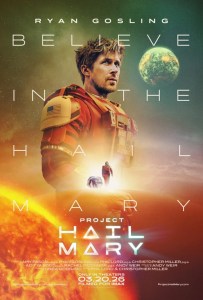
Being stranded for two hours in tight quarters with Ryan Gosling sounds like a dream come true for many. Something tells me I made this same joke except using Matt Damon’s name for the 2015 release of The Martian, another winning mixture of nuts-and-bolts scientific problem-solving and sci-fi exploration from best-selling author Andy Weir. Project Hail Mary is one of those big screen adventures that nourishes your imagination and heart. In short, it’s a rare full-package blockbuster, something to excite the senses as well as appeal to your intelligence to leave you fully satisfied. If you enjoyed the book like myself, then breathe easy, because the film has done this story a great justice. Best of all, it’s the rousing, heart-warming buddy movie you never knew you needed, and it all starts at the end of the world.
In the near future, science discovers an alien microbe that is literally eating the sun. The estimates are that our sun will dim over decades, causing widespread cooling and threatening the lives of billions. The world needs a hero. It got middle school science teacher and disgraced molecular biologist Ryland Grace (Ryan Gosling) instead, who awakens on a spaceship in a different stretch of the galaxy far, far away from Earth and its dimming sun. He has little memory of what transpired before and must piece together not just his understanding of who he is but also his world-saving mission that he now, unfortunately, is the only one who can accomplish. He’s very literally tasked with saving the world, so no pressure.
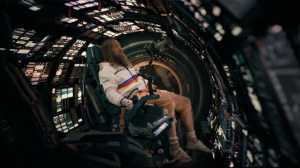
I’m going to avoid major spoilers but there is one plot development I feel needs to be discussed as it gets to the core appeal of the movie, so if you want to go into Project Hail Mary completely unspoiled, and I would advise it if you could, then end this review and come back once you’ve enjoyed the movie. For everyone else, let’s proceed ahead. Thankfully, the amnesia setup isn’t dragged out long. The film is structured to alternate between present-day problem-solving in space and flashbacks to Earth when Ryland was contacted by the top levels of the U.S. government to determine the extent of the unusual problem with water-molecule microbes somehow living and consuming the sun. The microbes are termed “astrophage” and release tremendous amounts of energy, enough so that they become the unexpected fuel for this long-shot space mission that Ryland finds himself the only survivor. He was never supposed to be mankind’s only hope (the other astronauts, the professionals, died from the induced comas for travel).
However, Ryland isn’t alone for long in the movie, and that’s where Project Hail Mary reaches a new level of entertainment and imagination. Our sun isn’t the only one affected by the astrophage, and Ryland is greeted by an alien spacecraft that has also traveled the long journey to figure out why this one sun is unaffected by the astrophage. The sense of discovery is greatly entertaining and I appreciated that there is something remarkably alien about our alien. Our intrepid alien will be nick-named “Rocky” because he best resembles a spider made out of rocks. That’s different. It’s not the old Star Trek school of slapping a forehead ridge onto somebody’s head and calling it a day. A significant and very gratifying sequence of the movie is just watching these two different lifeforms interacting and learning from one another. The language barrier has been explored before, most effectively in 2016’s grounded and somber Arrival. If Arrival was more the contemplative indie about conquering the linguistic challenges of first contact, then Project Hail Mary is the feel-good Spielbergian popcorn spectacle about saving the day and having fun. That doesn’t mean it’s a dumbed-down version; it just has different priorities, and chief among them is the winning buddy comedy of Gosling and a cuddly alien, two humble representatives of distant worlds in shared desperation for saviors. The relationship that blossoms between Ryland and our plucky, curious little space spider is naturally funny but also refreshingly serious too. Rocky is treated like an actual character, not some glorified pet or something to sell toys and Happy meals. He has a distinct perspective, learning curve, peculiarities, and determination that makes him feel more fully-developed than many human characters in terrestrial cinema. If you don’t walk away from the movie wanting your own personal huggable rock spider, then you watched a different movie than I did and, frankly, I pity you.
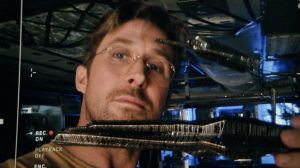
In my review for The Martian, I wrote, “There is an inherent enjoyment watching intelligent people tackle and persevere over daunting challenges, and this sets up The Martian for lots of payoffs and satisfaction. We see both sides of the problem and it provides even more opportunities for challenges and payoffs.” It’s tremendously enjoyable to watch Ryland and Rocky resolve serious scientific problems, whether it be studying the astrophage, the alien sun and its immunity to astrophage, or even just how to interact with one another when there are different systems for breathing and eating. It’s heady without being weighed down by too much scientific jargon, making the analytical discussions accessible and thus engaging. The conflict of Project Hail Mary isn’t quite as realistic as The Martian, given to more convenient cheats with “alien technology,” though the resulting resolutions still felt well-earned and satisfying thanks to the setups and payoffs that screenwriter Drew Goddard (Bad Times at the El Royale, The Martian) has layered throughout. The source material’s author, Andy Weir, has found himself a very profitable and marketable niche, dropping science whiz everymans into impossible scenarios and having them think their way out of them. At least this time the entire world is working in tandem, and spending likely trillions of dollars, to save the entire solar system instead of just retrieving one misplaced American astronaut. Weir will likely be throwing darts at what new setting someone could be stranded in next.
Now, as a film adaptation, Project Hail Mary goes the distance. This is the first live-action movie directed by Phil Lord and Christopher Miller since 2014’s 22 Jump Street (granted, they were notoriously fired from finishing 2018’s Han Solo prequel). For those worried that the movie might be more anarchic or yuk-heavy like the duo’s animated oeuvre, such as The Lego Movie and the Spider-Verse films, they have adapted their style to best suit the material. There’s plenty of humor in this movie because of the ridiculously high stakes and general odd couple nature of our buddy dynamic, but the movie never feels like it loses its focus on the bigger world-saving picture. For Ryland, he knows this mission is a one-way trip, as the capsule doesn’t have enough fuel to make the return trip to Earth. He knows this is a sacrifice, but the entirety of all living things on the planet are holding out hope that his sacrifice is successful. Lord and Miller are able to balance the comedy and dramatic elements, as well as finding appropriate spaces for the viewer, as well as Ryland, to take in the natural majesty of space in another star system. The cinematography by Greg Frasier (Dune Parts One and Two) is grand and visually sumptuous, mixing in aspect ratios and focus depth to distinguish between timelines and emotional states. The musical score by Daniel Pemberton (Spider-Man: Into the Spider-Verse) is remarkably pleasing to the ears, finding room to be rousing and immersive and awe-inspiring, perfectly aiding the gorgeous visuals. At 150 minutes long, there’s the concern about pacing, especially with a movie that has so much to explain on the go as well devoting nearly half its runtime to flashback morsels doled throughout. I never felt lag. I also never felt crushed with the exposition, as the key details are expertly elevated, then as we progress from one challenge to the next, the screenplay keeps us keyed in on what matters in that moment.

And lastly, where this movie really hinges upon is on the relationship and performances of its two leads. I’m not talking about Sandra Huller (Anatomy of a Fall) as the head of the Project Hail Mary mission, assembling cooperation among the world’s countries and experts for this longest of long-shots. Gosling (Barbie, The Fall Guy) is an immensely charming actor, self-effacing and relatably overwhelmed by the faith entrusted to him. Gosling makes us instantly connect with the protagonist, feeling the same nagging pull of his curiosity and excitement when studying something as uniquely fascinating as alien microbes, as well as the mounting trepidation of being out of your depth and having to adapt quickly or else. The film is taken to another level of entertainment thanks to Rocky, who is the clear MVP of the movie. He’s brought to vibrant life through puppeteer James Ortiz, who also provides the computer translation voice, and through the magic of empathy, we’re shedding tears for a creature without a discernible face. The dynamic between the two characters is so enjoyable, so funny, and ultimately so poignant, that it warms your heart while making you feel full by its perfect closing image.
Project Hail Mary is a crowd-pleaser to its very DNA, big yet accessible, brainy but still capable of popcorn thrills and visual fireworks, heartfelt but mordantly funny and even goofy at points, and always engaging and rewarding. It’s also a hopeful movie, something the present world could use more of. In the face of epoch-ending cataclysm, human beings are capable of working together to solve impossible problems, and heroes can emerge from the least likely places. It’s inspirational without falling into sappier, inauthentic maudlin drama, and it’s a celebration not just of teamwork but interstellar teamwork, working across enormous barriers for a common good. It’s invigorating to watch human decency and noble sacrifices prevail but also just an enviable demonstration of competency. What a wonderful world where experts are given deference and praise for their expertise and professionalism (if only this didn’t feel so tragically the stuff of “fiction” in present-day America). Project Hail Mary is a superbly made adventure movie that has a little of everything we’re looking for in mass-appeal blockbusters, and there’s a considerable skill to hold all these parts together into a movie that feels complete and enriching. Fans of heady sci-fi, buddy comedies, disaster movies, and space operas should find plenty to enjoy, but really Project Hail Mary is the kind of movie that all you need is eyes and ears to understand the appeal.
Nate’s Grade: A
Share this:

Scream 7 (2026)
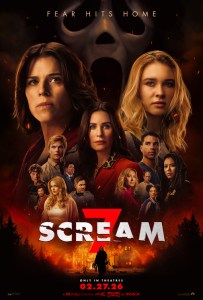 For a franchise that began as an ironic commentary on 1980s slasher movies, then sequels, then trilogies, then reboots, then legacy sequels, then franchises, it sure feels like Scream 7 has run out of things to say. There isn’t even a particular emphasis for critical assessment this go-round, perhaps because the entire enterprise feels clunky and rushed. I enjoyed Screams 5 and 6 and found them to be some of the best sequels in the series, so I was genuinely disappointed when the stars and creative team of those two movies left (or pushed out for political solidarity, but who’s to say?). In their place, we get Kevin Williamson as co-writer and director. Williamson was the original writer for the Scream series and has made a name for himself with his hyper-verbose, genre-riffing (The Faculty is underrated) and translated into running successful TV soaps with Dawson’s Creek and The Vampire Diaries. A director he is not, as evidenced by his only credit, 1999’s Teaching Mrs. Tingle. The seventh entry brings back Neve Campbell as Sidney Briscoe attempting to live a “normal life” running a coffee shop in middle America. Wouldn’t you know her teen daughter, Tatum (1883‘s Isabelle May), is being stalked by Ghostface because the terror never ends. There’s a higher body count with this sequel, and the kills are grislier and more cruel, including a guy impaled on a broken beer tap with a flow cascading out of his dead mouth, but this might be the first Scream movie I’d actively cite as boring. Even when the franchise has been at its worst, like 2011’s Scream 4, the last one scripted by Williamson and directed by Wes Craven, the movies still had some bite to them, some snarky genre commentary and twists. There’s none of that with Scream 7. There’s no focal point. It’s just a mechanical slasher with our middle-aged characters being asked yet again to scream and run. There are assorted franchise cameos that don’t make much sense in-universe except as sops to the fanbase to get them to come for the seventh movie in a 30-year horror franchise. The previous movies began to tease an enticing prospect, the idea that Ghostface could be an anonymous fame-seeker or conspiracy-rotted hanger-on. I thought for a while, “Was this movie going to present my suggestion for Scream 6 as Scream 7?” Nope. The eventual reveal of the killer(s) is the biggest shrug of the entire franchise. Beforehand, there’s chase scenes and cowering behind walls and dull genre cliches presented without ironic comment. Characters repeatedly talk about lives of constant trauma, yet they don’t even make a nod to modern elevated horror’s penchant for making everything a metaphor for trauma. Alas, Scream 7 is the kind of empty slasher movie the franchise was satirizing at its start, proving that with enough time, every franchise becomes its own parody.
Nate’s Grade: C
Share this:

If I Had Legs I’d Kick You (2025)

I have been told by numerous friends and other critics that If I Had Legs I’d Kick You falls in that dreaded entertainment zone of the “difficult watch.” These are usually made up of admired movies tackling challenging subjects in unflinching ways, movies that are easier to admire than love. I was girding myself to finally watch If I Had Legs (this will be the reference for the title from here out because, frankly, I’m too lazy to type out an extra three words every reference), I found it pretty despairing, especially for women, especially for parents of young children, and especially for those suffering or who have suffered through some degree of post-partum depression. This movie is a sensory immersion into the frazzled, anxious, and punishing existence of our heroine, just trying to catch her breath or get a break in a universe that seems cruelly engineered to only provide stressors. It’s a truly phenomenal movie giving bristling life to the perspective of writer/director Mary Bronstein (Yeast), with stylistic and surreal touches that reminded me of Charlie Kaufman or even Franz Kafka. The tragi-comic absurdity, as well as the unrelenting existential anxiety, is meant to provoke a primal, wince-inducing response, eliciting sympathy for the countless mothers coasting hour-to-hour looking for a little oasis of relief. If I Had Legs is one of those rare feel-bad experiences that I not only admire but I think I actually love.
Rose Byrne plays Linda, a forty-something woman being pulled in every direction. Her young daughter is suffering from a physical malady that requires her to have a feeding tube, and she needs to gain weight in order to have the tube removed, but the child can’t gain weight because she doesn’t want to eat, and this obstacle is compounded by the hospital telling Linda if the child doesn’t meet her goal weight, then it’s a reflection of neglect, and Linda herself will have to attend parenting classes. The child is also, let’s put this nicely, very high-maintenance and attention-demanding. There’s also Linda’s husband who is away at sea and generally unhelpful and curt whenever caught on the phone. Linda also has a therapist (Conan O’Brien) who is likewise generally unhelpful and seems disdainful even talking to her. Then the roof of her apartment explodes with a torrent of water, and now Linda and her daughter have to live out of a local motel, further exacerbating all of their personal problems. It’s forty minutes in when the movie reveals Linda’s profession and I genuinely gasped: she’s a psychiatrist with her own very demanding clients to counsel. It’s not easy being Linda, but then again, there are plenty of Lindas in the world just waiting to catch a break.

This movie is a lot. It’s a lot to process, and it’s very deliberately using disorienting creative decisions to test your limits. The sound design is an especially effective dynamic that raises anxiety. Bronstein never shows you the face of Linda’s daughter, at least not until the very end of the movie, and there’s a stark reason for this. Our identity is Linda, and this voice that keeps coming in, frequently interrupting, occasionally screaming, and often compounding the stress of her mom, is designed to be viewed as a primary source of agitation. We don’t see the daughter because in this vision she doesn’t exist as a character but more as a burden. We view the child as Linda perceives her. There’s a trying sequence where Linda’s client leaves her baby behind and vanishes, forcing Linda to cart around a crying baby while frantically looking for the mother. The soundtrack of a crying baby is like a direct line to your nervous system that something is wrong and all you want is for the child to be soothed, but it keeps going for nearly five minutes straight, with that screechy wailing eating away at you one cry at a time. I can readily imagine my wife watching this movie and just turning it off after ten minutes.
The movie is packed with these creative decisions, all designed to make Linda’s perspective that much more empathetic and exhausting. For those tut-tuting Linda viewing her daughter as a burden, I’d ask for some grace, but also the movie doesn’t withhold criticism from its protagonist. She can be selfish as she’s spiraling, even seeking comfort in bad places. It would be harder to endure if the perspective was purely Job-like, wherein Linda relentlessly suffers because the universe is indifferent, or God is unhappy and spitefully targeting this poor woman. It does feel like everything is going wrong, but that’s also because we’re anchored in Linda’s perspective. Seeing things from her daughter’s perspective would make for a fairly different movie, but that’s not what this movie aspires to be. It’s not meant to be balanced, it’s meant to convey a very specific viewpoint, and that perspective feels like everything is stacked against you. In one key moment, what my pal Eric Muller dubbed Byrne’s “Oscar clip moment,” she unloads on her therapist and desperately pleads for someone to just tell her exactly what to do, to have responsibility and uncertainty stripped from her life. She wants a clear direction and the relief of knowing what to do, something that is rarely so clear in the adult world. It’s hard not to feel for Linda in the movie unless you’re actively trying to reject the vision of the director. If I Had Legs is a movie deliberately designed to be overstimulating and upsetting, so it’s going to be a select audience willing to wallow in the discomfort for the insight offered. I can see plenty saying, “Yeah, I live this, so no thanks.” I get it. After becoming a parent myself, my tolerance for emotionally-draining media certainly lowered. However, I think there’s ample artistic accomplishment to be savored with If I Had Legs that is worth treading the discomfort.
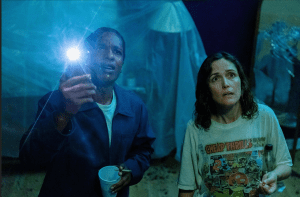
Byrne has been playing around the world of comedies since 2010’s Get Him to the Greek (a peak candidate for “most canceled cast” of the modern era, Byrne excluded) that I forgot how great she can also be in dramas. This is my favorite female performance of 2025. She is astounding. It’s smart to hire an actress of Byrne’s caliber, someone capable of finding the dark humor and exasperated guffaws of a life that feels like an assembly line of slaps to the face. The camera also rarely leaves her orbit, tacitly tying our sympathies, and it takes a lot to command the screen knowing your face is often going to be the measured focal point of every reaction to every slight and surprise and shock. She is the face of beleaguered motherhood, and it’s hard not to relate to at least a dozen moments of this nuanced and transcendent performance.
I don’t believe that If I Had Legs is unforgivably bleak; it’s certainly intense and agitating, but in order to make my finer point I need to spoil the end of the movie. However, dear reader, I truly don’t believe this is a movie that can be ruined through spoilers. So much of its appeal is the execution of such a specific vision, and to give one’s self over to that voice and its effect cannot be diminished through prior knowledge. It’s about the experience. Consider yourself warned, folks. Throughout the movie, the hole in Linda’s apartment ceiling becomes a sort of metaphor for her experience, an empty void. She dreams about losing herself inside the void, giving herself to the emptiness, and it’s easy to make a connection to darker impulses of self-destruction. This comes to a head at the very end, when Linda literally tries to run into the ocean to escape the troubles of her life, and the sea won’t have it, repeatedly throwing her back onto the shore. Even her attempt to escape ends up in tragic-comic slapstick. But it’s here where the movie switches gears, and we now see Linda’s daughter for the first time just as Linda is promising to be better for her. This changing of perspective effectively communicates Linda seeing her daughter, actually seeing her as a person rather than a nuisance, a peripheral voice of need and stress. The movie ends not on the harried breathing of Linda trying to calm down but on the hopeful smile of her daughter, and it might be misplaced optimism after a movie that feels plenty pessimistic, but I viewed this as a meaningful change. Even after all her struggles, even after her mistakes, there’s still the desire to do right for your loved ones, to improve.
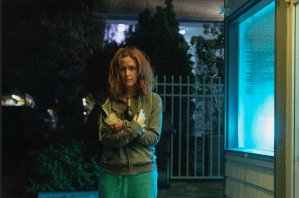
I originally wanted to do a double review, pairing If I Had Legs with Die My Love, the newest Lynn Ramsey movie that explores the inexplicable loneliness of post-partum depression with Jennifer Lawrence trying to reconnect with her body, her sense of self, and the world as it was and is. I felt beforehand that the movies would have the connecting themes of the difficulties of motherhood, and they do, but I feel both movies are so tonally different in approach and execution that they deserve to be judged separately. If I Had Legs I’d Kick You might just be that hard-to-stomach film-experience so many have warned about (don’t expect the hamster to last long), but it’s such a transporting, exhilarating, and deeply humane vision executed to a remarkable degree of vibrant life. It’s personal and yet easily empathetic. It’s an unflinching and unsentimental portrayal not just of motherhood but of the difficulties of maintaining sanity in a world that often feels indifferent to your needs. It’s a difficult movie to watch, yes, but that doesn’t mean it lacks value and impact. If you’re brave and willing to wade through the deliberate discomfort, If I Had Legs is a remarkably good bad time at the movies.
Nate’s Grade: A


 nathanzoebl
You must be logged in to post a comment.