Blog Archives
Scary Movie (2026)
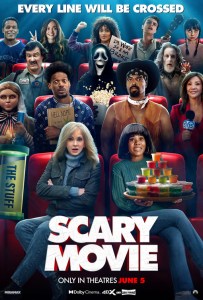 The Wayans brothers birthed the original Scary Movie spoof and then after one mixed sequel in 2001 they were ditched by the studio. There were three more Scary Movie sequels that became less and less popular. The Wayans stuck by their raunchy satirical playbook, making two A Haunted House spoofs and even a parody of Fifty Shades of Grey. Now the Wayans brothers are back, along with Scary Movie alums Anna Faris and Regina Hall, the real MVPs of the franchise. It’s a homecoming, a nostalgic throwback for fans of the original Scary Movie, and a hopeful upswing for big-screen studio comedy to make a comeback. If only the movie were funnier.
Since the last Scary Movie sequel in 2013, horror movies have flourished. There’s the Conjuring franchise, which has made over a billion dollars, the miraculous ascendancy of Jordan Peele as an Oscar-winning horror maven, as well as the rise in elevated “A24-style” horror, movies heavy in atmosphere and layered metaphors, by the likes of Ari Aster, Osgood Perkins, Robert Eggers, and Zach Cregger. Coralie Fargeat was even nominated for Best Director for making The Substance, generally unheard of in Academy Award history. There is so much that can be satirized about horror since 2013, especially how it compares to horror from the 1980s and 1990s. Instead of tackling any of these new perspectives and movements in a meaningfully satirical manner, Scary Movie 2026 is, much like the Scream franchise itself, stuck in the past. This movie could have even covered the evolution of modern slashers into grueling gore endurance contests, like the Terrifier films, or the more experimental genre deep dives like Ti West’s Pearl trilogy with Mia Goth and In a Violent Nature. That would require more effort, so since Scary Movie 2026 is setting itself up as a reboot/legacy sequel, there is a logic for it to attach itself to the plots of Halloween 2018 and Scream 5 (it’s shocking how much plot is pulled from Scream 5). However, any satirical derision over the nature of cash-grab franchise reboots is reserved for the very last ten minutes, which happens to be the best part. Instead, there are too many moments where the same joke is run into the ground (like Ray being closeted, which doesn’t make as much sense in 2026 America), or the end result is just somebody getting hurt. Personally, I chuckled maybe about five times, so my entertainment output was not high. The best joke is a visual gag that goes unspoken about the very disastrous Final Destination amusement park.
 The spoof pacing requires a lot of material to burn through, and as a result everything gets sucked into the comedy cauldron whether it seems related to horror or not. There’s a parody of the Michael Jackson movie, most likely because it’s popular and not because there are new jokes to be had about one of the most famous celebrities who’s been dead for over 15 years. I’ll save you the time: the punchline is that a man moonwalks and falls down the stairs. Why is there an animated sequence parodying K-Pop Demon Hunters? Why is there an extended John Wick parody? The answer is simple: because they made money. Like the Friedberg/Seltzer (Epic Movie, Meet the Spartans) playbook, anything that has some minute draft of pop-culture cache gets thrown into the mix, sometimes references that have a perishable shelf life that will be considered old only in a matter of months. I wouldn’t ever advise it, but if you go back and watch any of the Friedberg/Seltzer spoofs of old, you probably won’t be able to remember a quarter of the references. This is because the filmmakers are sacrificing the integrity of their comedy for the quick dopamine hits of timely pop-culture recognition. Is anyone in five years going to remember that the Meagan robot became meme-famous from her weird dance? That’s all the Wayans seem to remember about M3agan, so that’s all you’re getting, folks. It all feels like swimming through someone else’s half-forgotten memories of pop-culture relics.
There’s also a string of jokes that I’ll call “these kids today don’t get it” observations from an older generation feeling rapidly out of place and thus resentful. Look, Gen-Z culture is ripe for satirizing and mockery, but when your targets are pronoun preferences and a trans character just… existing, then it certainly feels like your satire is regurgitating the same grievance points as most hacky Boomer comics. Every rendition of this felt like an example of the “old man yells at cloud” Simpsons meme. If they really wanted to hone in on this generational misunderstanding, they could have really gone further in the different perspectives from Cindy (Faris) and her teenage daughter, but that doesn’t really happen. It all makes the comic perspective feel not just out of touch but grasping and desperate. Why include a trans kid if the only joke is going to be a tedious series of misgendering them? These jokes are meant to act as a comedic heat shield, proposing the Wayans as no-holds-barred comics, unafraid to tackle whatever modern taboos we may have across politics. Except the fact that these jokes are so thin and obvious and disposable creates the unmistakable impression that these are sops for a commercial demographic, the same people that would get excited by seeing a character on the poster with a “woke is broke” sign.
 Let’s analyze just one example of the creative rut here. Weapons was a popular movie from 2025 and Amy Madigan’s Aunt Gladys character instantly became iconic. There’s plenty you can do with this character and the modern-day scenario of a wicked witch absconding with children (sample: Kristi Noem as Aunt Gladys as she cruelly sets up child abductions as part of ICE – the makeup preferences between the two could also cement the connection). The only thing Scary Movie 2026 does with this Oscar-winning horror movie is so thoroughly lazy and half-hearted. The joke is that the Trick or Treat kids received weed gummies and are running around high. That’s at least a starting point, and you could see where there could be comedic misunderstandings and mischief. However, that setup is just it. There isn’t anything else. We watch kids running like they did in Weapons and they have offhand ADR lines along the likes of, “I’m so high.” The worst example is a kid just saying the “six seven” meme. That’s it, like the utterance of the meme is the joke, another lowly example of the reference being misunderstood as a joke. Then one of the kids gets hit by a car (ha ha). Do we feature the driver freaking out thinking they’ve killed a kid? The kid protected thanks to the weed gummies? The driver mistaking the inebriated child for a dangerous tool for killing like, you know, in Weapons? Anything? The car hitting the kid, bouncing them high into the air like a trampoline, is the end of the scene. That’s it. It’s practically an admission that the writers didn’t know how to end their scene, and there are many, many examples of this throughout where scenes just abruptly end, lacking larger punchlines and escalation. It’s just weak.
The funniest thing might be the unintended poor timing on Scary Movie’s part. Had this movie waited maybe four months or longer, it could have incorporated the summer horror resurgence happening presently at the box-office. Backrooms is slated to become A24’s highest grossing movie of all time, opening at an eye-popping $80 million. That’s superhero movie numbers. Then there’s Obsession, which has grown and grown from its wide release and is now slated to become Focus Features’ highest grossing movie of all time. Obsession is a phenomenon we haven’t seen in decades. It made more money in its second weekend than its opening weekend, and then it made more money in its third weekend than its second, and then in its fourth weekend of release it STILL amazingly made $25 million. This is a genuine word-of-mouth sensation. I don’t want to overload you on box-office numbers, but as of this writing, Obsession has been released for a total of 24 days and only one of those days did it gross less than $3 million, and that was its fourth day of release. This just doesn’t happen, let alone to a movie that cost under a million dollars to make (we’re talking Paranormal Activity-levels of success here, where a $15,000 budget indie grossed nearly $200 million worldwide, and that was in 2009 dollars too).
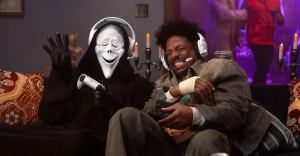 I bring this up because horror movies are clearly a force to be reckoned with in the larger culture, and with the success and critical accolades for movies like Get Out, Sinners, The Substance, and Weapons, there is plenty of material available to satirize this new ascendant horror movement. That’s why Scary Movie 2026 is even more disappointing and dispiriting, tying itself back to teen slasher movies that haven’t been relevant for decades. There was so much this movie could have critiqued about horror as it is today, and instead we get sketches without punchlines, fleeting reference-based humor, and lazy jokes that settle for easy vulgarity without a wisp of cleverness. With any comedy, especially spoofs, your mileage will vary on the hit-to-miss ratio, and it’s hard to be really mad at the Wayans for doing their same schtick for decades, but Scary Movie 2026 feels less transgressive and edgy and more tired and dated and, sadly, lost. It feels like the Wayans have lost hold of the cultural zeitgeist or the ability to recognize it, and as such Scary Movie 2026 isn’t any better than any other Scary Movie sequel slop. It’s all exaggeration and mugging with the same old scatological punchlines (when there are punchlines) and further diminishing results.
Nate’s Grade: C-
Share this:

The Rip (2026)
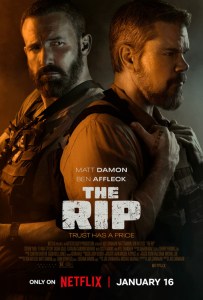
Director Joe Carnahan (The A-Team, Narc) excels at machismo, and I mean that not as a detriment. He makes muscular action-thrillers, often about corrupted men coming to terms with their ruination. 2012’s The Grey is still one of the best movies I’ve ever seen released in January. Well here comes The Rip, also released in January, starring Matt Damon and Ben Affleck as combustible Miami cops who follow a tip to a cartel stash house that holds a cache of twenty million dollars. The cops are supposed to follow protocol, call it into their superiors, but with that kind of money, much more than what the tip reported, it’s hard to resist the life-altering implications of indulging in that kind of haul. I thought The Rip, named after the seizure of contraband, was going to be a modern-day Treasure of the Sierra Madre, where the power of greed is irresistible and leads to betrayals and murder among our characters. It does that, with each questionable decision going against protocol making us question who might be most susceptible and who might be heading for a collision. The movie, co-written by Carnahan, is strictly genre boilerplate. The characters are never more than archetypes, the dialogue is aggressively expository often reminding us of all the conflicts and characters on the periphery that haven’t been brought back yet, and the majority of the film is a contained thriller awaiting trouble at the stash house. And yet I was entertained from start to finish thanks to the cast and a simmering tension that Carnahan unleashes between his paranoid characters. There are some late plot turns that I don’t know if they’re actually clever, convoluted, or both. It’s the kind of thing that’s meant to excuse bizarre behavior that we’d have no reason to assume differently, so it feels a little bit like being jerked around. However, The Rip is a fairly fun way to blow through two hours built upon movie stars unleashing their swagger.
Nate’s Grade: B-
Share this:

One Battle After Another (2025)
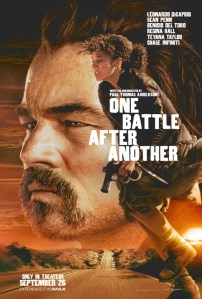
Over his thirty-year career, writer/ director Paul Thomas Anderson (PTA) has developed a mystique and reputation like few other auteurs working in cinema. He’s a visionary filmmaker whose first few movies count among my favorites of all time (Boogie Nights, Magnolia) and whose latter output can leave me shrugging and sighing (Licorice Pizza, Inherent Vice, The Master). My decade-plus-long observational bon mot has been that Anderson decided to make amends for his plot-heavy early movies with more airy, far less plotted vibes-movies. One Battle After Another is something far different from Anderson. He’s making his own version of a $150-million studio action movie, with big ideas and Leonardo DiCaprio as lead (DiCaprio has long regretted passing on Dirk Diggler, still Mark Wahlberg’s acting high-point, so thanks Leo). PTA is using the big-budget storytelling of action cinema to tell something new and personal and politically relevant behind all the gunfire and daring car chases. It’s been dubbed the movie of the moment and perhaps the one to beat for the 2025 Academy Awards. Now that I’ve finally watched all 150 minutes of Anderson’s opus, I’m not as high on it as others but do acknowledge it is a thrilling, engrossing, and occasionally frustrating work from a visionary artist.
Bob (DiCaprio) used to run with a leftist military group known as the French 75. He fell in love with Perfidia (Teyana Taylor), one of the leaders of the group, and together they had a baby, little Willa. Perfidia runs off, unable to settle down, leaving Bob to raise their daughter under a different identity. Sixteen years later, that old life comes back to Bob. It so happens Colonel Steven J. Lockjaw (Sean Penn) had an ongoing sexual tryst with Perfidia during one of their stings. There’s a chance that Willa (Chase Infiniti), now a teenager wanting to live a normal life, is actually his biological daughter. He needs to capture her under any circumstance and possibly dispose of her in order to be admitted to an exclusive white supremacist cabal within the U.S. government. Bob is forced back to action to find and protect Willa but he’s not exactly in the best shape. He’s been a burnout for so long. Can he now be a hero?
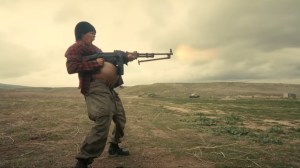
While the movie was filmed throughout 2024, and supposedly has been in the works for over twenty years by Anderson, One Battle After Another feels extremely timely and relatable in these troubled political days of ours (even the title expresses what it’s like to get up and try and process the daily barrage of horrifying news in this Trump Administration 2.0 Era). Anderson’s screenplay, loosely adapted from Thomas Pynchon’s 1990 novel Vineland, proposes a right-wing U.S. government swept up in fascist impulses that is highly militarized and declares war on immigration, rounding up primarily Hispanic men, women, and children and locking them away in camps. It’s also a law enforcement unit that pose as protestors to create a rationale for enacting physical violence and intimidation against peaceful protestors. At the core is a secret society of white supremacists running the show. Short of a concurrent documentary, it will be harder to find a movie more politically topical to the status of life in 2025, especially for the many shaking their heads and wondering how exactly we got here. Pynchon’s original novel was about the transformation of 1960s America to the 1980s, and it feels highly relevant to our 2025 times where there yet again seems to be great upheaval and conflict over those in power operating said power against the governed. It’s impossible to watch One Battle After Another and not think about the headlines. It’s not exactly the escapism many might be seeking. There’s never been a leftist paramilitary group as organized and as successful as the French 75 (they have their own affiliated convent – nuns with guns). The movie isn’t leftist wish-fulfillment to take down the current administration. It’s more a father-daughter battle to reunite in the face of state terror. It certainly has its fiery political commentary, but it’s more a family striving to stay together.
I did quite enjoy that the movie undercuts Bob as our hero, using him more as an entry point into other characters in this story, others who have a much larger impact and prove more capable. The character of Bob serves as a gateway for the other characters to really take over and shine, and it’s smart to use the familiar archetype of the old gunslinger being called back into action past his prime to atone for the sins of the past. We’ve seen this kind of character before, but Bob is kind of hapless and far out of his depth, and it makes the movie so much more entertaining. The rest of the movie exists in a more familiar action-thriller setting, albeit with some fun house mirror edges for pointed satire, but Bob is this bumbling, stumbling dope from a stoner comedy whose been copy-pasted into a different genre. He provided explosives for the French 75 but that doesn’t mean he’s got a wealth of clandestine knowledge and cunning at his disposal, especially since he’s normally inebriated. Now sixteen years later, the archetype would typically have to pull out their old skills that have calcified over a long hibernation, but Bob doesn’t have those skills. When he has an opportunity to take the big heroic shot, he misses. When he has the opportunity to make a daring escape, he falls off the side of a building. When he has to remember the coded exchanges of old, he can’t remember all of the parts. The climax doesn’t really even involve him as he’s playing catch-up for most of the extended conclusion. He’s more like the Big Lebowski waking up in, say, No Country for Old Men and desperately seeking shelter.
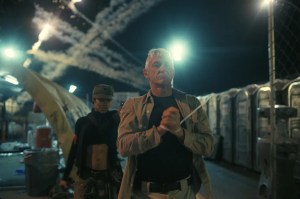
However, Anderson’s empathy for his characters of all stripes shines through, and while Bob is presented as diminished or bumbling, he’s not a complete moron without any redeeming qualities. His most resounding positive quality is his complete dedication and love for his daughter. We’ve seen this kind of story before, the overbearing parental figure trying to drill their child to be prepared for when danger inevitably arises, and the child growing resentful and distant to the parent because of that demanding and limiting home life. Then trouble strikes and the child has to rely upon those seasoned skills they practiced while that paranoid and obsessive adult was ultimately proven right for their unorthodox parenting. Bob’s love for Willa is what has shaped his life for these past sixteen years. He’s the parent who stayed, the one who settled from his old life to take on the responsibility of raising a child as a new life. He’s the one who changed her diapers, the one who shows up for parent-teacher conferences even if it’s to lecture the teachers about the curriculum while lighting up a joint. His love for his daughter is the thing that drives him forward and keeps him going. You feel that love between them, and in the climax of the movie, it becomes something poignant about the connection between these two over such extreme circumstances. There’s an ongoing question over the paternity of Willa but this never for a second changes Bob’s view of his daughter or his willingness to do anything to save her. If he was a Liam Neeson-styled master spy with a particular set of skills, the journey wouldn’t feel as rewarding. With Bob being punched down by the universe again and again but still going, it makes us root for him more.
Penn is completely enthralling as Lockjaw. His danger is never downplayed, and he’s frequently shown as a man who will use his considerable means of power to get what he wants, but Anderson also finds interesting ways to lampoon him and complicate him. I loved that the secret white supremacist society Lockjaw is so eager to join is called the Christmas Adventurers Club. It’s so stupidly anodyne that it sounds like a rejected title for a Boxcar Children novel. The members even pledge, “Merry Christmas. Hail Saint Nick.” It’s so stupid but so are many of the associative slogans of these right-wing groups (I learned the Proud Boys are named after a cut song from Disney’s animated Aladdin, “Proud of Your Boy,” and no I am not kidding). These men are indeed dangerous but they’re also not insurmountable, and I think that’s an important distinction. They’re small, angry, racist men trying to forcibly reshape the world but they are a minority of a minority clinging to power to reject progressive reforms. Lockjaw’s big problem is that he has a tremendous attraction to African-American women, the type of people he should see as inferior. The movie’s momentum is kicked into gear all because Lockjaw wants to be accepted in this special club. Penn is incredible in how he brings to life the snarling contradictions of this man, someone so aggressively challenging but who is also given to gnawing insecurities. Even the way Penn holds his body and walks is an indication of who this man is, with stick firmly planted in rear. He’s scary but he is also stupid, a fine encapsulation of our present political quandary. I’d expect him to be the current front-runner for Best Supporting Actor at the Oscars but it is still plenty early for predictions.

I do wish those engaging supporting characters had more to do besides Lockjaw. Even at 150 minutes, there isn’t much development for Willa to really grow as a character. She’s the target for the chase, and she’s the one trying to understand what is happening as it happens. It would make sense for her to have been the protagonist as she has the most to learn. For far too much of the movie she’s just a passive passenger, being shipped from one location to another. I wish we had more moments to really grapple with her perspective and her shifting opinion about her father and his past. I do enjoy that she’s the real star of the climax but at that point I wished we had seen far more of her resilience and determination and making use of what her father had been teaching her, not simply trading coded conversations. If she is the future, the possibility of turning this world around as someone declares by film’s end, then maybe let’s spend a little more time with her being active and reflective and taking more ownership of her survival. It’s as much her movie as it is Bob’s but he gets far more generous screen time over those 150 minutes.
The same can be said for Willa’s mother, Perfidia. I never found her that interesting as a character. She’s a true-born revolutionary from a family of revolutionaries, but some part of her is drawn back to Lockjaw, whether it’s simply the transactional exchange of sex for protection and assurances, or maybe something more, perhaps the power play of dominance over the very kind of bad men in power she wanted to control. She runs away from a domestic life with baby Willa because she knows she’s ill-suited for it. From there, she gets captured and turns on her former comrades to enter Witness Protection, which she runs away from. I kept waiting for her to resurface in a meaningful way in the story since we’re shown that she escapes into Mexico (Lockjaw lies that he killed her rather than admit she ran off). However, Anderson only utilizes the character as a catalyst, a means of entangling the two men into a paternal showdown. It’s disappointing that Perfidia is reduced to such a nothing of a character when there was much to explore.
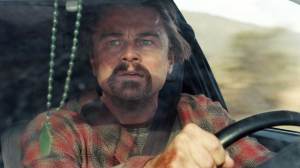
And now comes the part of the review where we talk about Anderson’s bold leap into action filmmaking. He’s not the first prestige indie darling to make a grand genre jump into action-thriller bravado. One thinks of Sam Mendes tackling Skyfall with aplomb, Paul Greengrass with the Bourne series, Patty Jenkins going from Monster to Wonder Woman, Lee Issac Chung going from Minari to Twisters, and of course the big man himself, Christopher Nolan. It can be done with the right filmmaker understanding the key tenets of action, in particular how to connect the various set pieces and conflicts with the characters and their emotional state and chain of needs and priorities. I was impressed with Anderson’s sense of scope and his ability to wring tension. There aren’t really many strict action scenes. Much ink has been spilled on the climactic chase that utilizes a series of rolling hills as the focal point of this battle, and it’s immersive and exciting and different. I’d also be lying if I said I wasn’t a little disappointed by it. This is because this sequence, up until the very very end, is all about one car tailing another. It’s taut and extremely well photographed, but ultimately it amounts to two cars following one another until one clever conclusion. It’s not really a sequence that changes and finds organic complications. It has the makings of a great action sequence but stalls. I thought back to 2014’s Snowpiercer and the sniper shooting match at two different points in the train, where each participant was waiting for the train to curve just so to better facilitate their shot. That was geography as advantage. Overall, Anderson is definitely making his version of an action movie but I don’t feel like he’s fully committed to the planning and development of those sequences. It feels more like ironic subversion when the genuine article would have been more appealing and impactful and just novel.
While One Battle After Another doesn’t rise to the capital-M masterpiece that so many of my critical brethren are falling over themselves to proclaim, it is a good movie with bold artistic swings. It thrums with energy and empathy. It’s probably PTA’s most accessible movie since There Will Be Blood or arguably Boogie Nights. I enjoyed the different characters and the brimming conflict and how much of the movie is grounded on the character relationships and their perspectives. There is a clear command of craft here like every PTA movie. He’s definitely passionate about bringing this world to life, which is eerily relevant to our own politically tumultuous times, but he still finds room for satirical mockery that doesn’t diminish the tension of the villains. It’s a universe I wanted more explanation and exploration, and the most interesting character by far is Benicio del Toro as a humble town sensei who is at the forefront of an immigrant underground railroad. I was never bored and often quite entertained but I stepped away wanting more, and maybe that’s greedy of me or an entitlement of the viewer. One Battle After Another flashes such terrific intrigue and personality that I wanted more refinement and development to better accentuate its mighty potential.
Nate’s Grade: B


You must be logged in to post a comment.