Monthly Archives: August 2026
Buddy (2026)
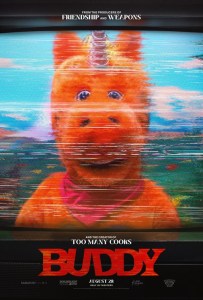 What if Barney the friendly dinosaur was really a murderous monster? That’s the catchy premise of co-writer/director Casper Kelly’s surreal horror fantasy Buddy, a crazy yet admirably committed exploration of kids TV tropes to their fullest extent. Considering Kelly might be best known for his insane yet brilliant deconstruction of sitcom opening theme songs, the Adult Swim short film Too Many Cooks, this makes sense. My first question was whether the pastel-colored, stagey world of Buddy the Unicorn (voiced by Keegan Michael-Key) was supposed to be literally real or was simply a TV set. The universe of Buddy, while adhering to the tropes and mechanics of children’s TV storytelling, is indeed its own reality. I enjoyed how Buddy knows he must gather the children to sing the closing theme song because then “the words appear” (he means end credits) and everything resets, which would allow him to heal from his injuries or perhaps have the children forget witnessing his horrors. The puppet-heavy world of Buddy is interesting, as are the subversive and disturbing edges glimpsed like Buddy trying to explain the disappearance of a child and the strange “red paint” on his outfit. Short of twenty minutes, the entire movie takes place in this strange fantasy setting, so I kept wondering about the lore and workings of this universe, especially how Buddy is capturing kids from the real world. The last ten minutes fulfilled that but I wanted more. That’s because the Buddy set itself, modeled after PeeWee’s Playhouse and Barney, feels a little too closed-off, the building threat of Buddy being rather redundant. I became frustrated at how limited the movie was settling with its subversive satire, at several points feeling like an overextended skit going off the rails rather than a complete movie. Then again that structural gambit might appeal to other viewers who are on the same twisted wavelength of Kelly. It held my interest, but I kept wondering if this was all there was, and whether maybe Buddy was a little too much of the same.
Nate’s Grade: B-
Share this:

Teenage Sex and Death at Camp Miasma (2026)
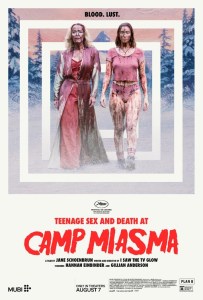 After 2024’s I Saw the TV Glow, writer/director Jane Schoenbrun became an indie darling with a daring perspective and a genre-bending feel for combining 90s nostalgia with coming-of-age ennui. While the movie didn’t exactly entrance me, I did write, “It’s a weird movie but it’s designed for weird kids, or weird adults who used to be weird kids, who found kinship through weird media.” I think this might be Schoenbrun’s style from here out. Their follow-up, Teenage Sex and Death at Camp Miasma, is another conflation of tones and styles, looking at the slasher movies of the 1980s with satire and fondness. We follow Kris (Hannah Einbinder), a Sundance-darling director whose big artistic break has now given her the opportunity to reboot the dormant Camp Miasma horror series. The killer, a gender fluid camper that was drowned in the lake, comes back as Little Death, wrecking bloody havoc across camp. Kris wants to approach the franchise’s original Final Girl, Billie Presley (Gillian Anderson), who voluntarily left Hollywood afterwards and has been a mystery. Kris wants Billie’s blessing to reboot the film, but Kris might also be looking for something more from Billie, and their relationship changes dramatically.
At one point, Billie gently chastises her special guest to stop thinking about film in such exclusively academic terms and to see it as a movie and less a discourse, and I feel like that advice could have been heeded by Schoenbrun. I come away from Teenage Sex and Death at Camp Miasma feeling like it is a movie that exists in air quotes, that resides on a level of discourse far above the events of the movie, that it’s intended less for artistic expression and entertainment and more as a film theory thesis for smug Letterboxd users. That’s not to deride the movie because it has a point of view or is another deeply personal exercise that feels like Schoenbrun turning their awkward coming-of-age into a transformative tableau for public consumption and, well, discourse. I don’t have an issue with Schoenbrun’s movie wanting to go deeper in an analysis of our personal connections to problematic art, in this case the schlocky slasher movies of the 1980s, otherwise known as a genre built upon “flesh and fluids,” as Billie informs us. My nagging issue with the film is that I don’t feel like it adds up to much, that Schoenbrun is so busy operating on that academic level with the material that it feels beyond reach. If the movie wasn’t occasionally elbowing you in the ribs by underlining its metaphors, I wouldn’t ultimately know what the larger themes or messages are amidst a miasma of haphazard ideas and genre riffs. I love the premise and how it twists into a Lynchian psycho-sexual nightmare that causes our characters to question what is real, but the end results left me shrugging and wishing I was enjoying the finished product more.
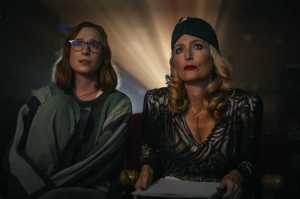 The idea behind Camp Miasma has all sorts of juicy layers-within–layers fun. Kris is obviously a stand-in for Schoenbrun and their experiences shuffling through the studio system as the Next Hot Indie Auteur, likely offered all manner of IP slop and zombie franchises similar to the flagging Camp Miasma horror franchise. Kris knows that her queerness and perspective is being commoditized to resuscitate an outdated franchise that has a history of transphobia (the Sleepaway Camp allusions are pretty clear here). Kris accepts these studio suits want to use her to provide cover for bringing the franchise back, but she wants to use them as well. Instead of delivering the same old schlock, Kris wants to go back to the original Final Girl who swore off acting afterwards, using the movie as her personal vehicle to interrogate a reclusive actress that she just happens to have a formative sexual connection with. Combine that with our Norma Desmond-like faded star literally living on the camp grounds where the original movie was shot, and that’s a terrific mixture of intrigue and obsession, of fantasy and reality bleeding together. So why does the finished movie feel rather unfulfilling to me then? Why does the sum feel less than the pieces?
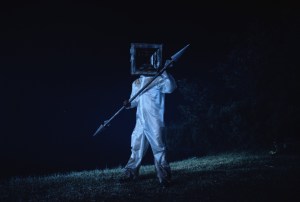
Maybe it’s because the obviousness of some of Schoenbrun’s points acts as an artistic ceiling. The voyeurism of slasher cinema in particular, born from Norman Bates and given new form by Michael Myers, is endemic to the genre, placing the viewer in the perspective of the mad murderer and the nubile teens finding silly ways to slink off to their gory demises. Kris is obsessed with one moment in the original Camp Miasma when a young Billie had a certain look in her eye that has always haunted her. It just so happens this moment was during the scene where Billie’s character lost her virginity on film, and there is an added context to the scene that makes the moment even more unsettling. Schoenbrun hinges Kris’ sexual awakening to a moment of old media that also happens to be Billie’s own sexual awakening, linking the two characters through a mirror of art, with the camera serving as transport. The nature of the scene involved Billie imagining Little Death coming for her and killing her, with her seeing the moment from her own eyes but also simultaneously from the eyes of the killer. It’s the voyeurism that unlocked something in both of these women, and yet Schoenbrun doesn’t seem interested in going further with an examination on this topic, only setting it up to be repeated and shared as supposed personal growth. Maybe, but maybe it could have been more interesting to dig into why disassociating from her own body during sexual congress was the key to pleasure for this woman, especially from a trans filmmaker. Likewise, there are some points that are blunt but to the point of making me want to sigh. Our killer has a long phallic spear that he struts around repeatedly thrusting and penetrating his victims. We get it. The killer is named Little Death, the pithy French term for an orgasm, which is perhaps why he wants to spear all these people. We get it. It’s so obvious it circles back from meta clever and back to just being too obvious. The ending descends into a wacky Ari Aster-like dark cartoon of fantasy convergence, like the movie had just been consumed from the inside out, but the insights are limited and glancing, amounting to little more than, “Hey, everybody can like the art they like and we don’t get to choose what turns us on.” Sure, I guess. Like what you like, folks. I was hoping the movie might be more than one woman’s quest to harness her big O under very specific scene-dependent circumstances.
 Far be it from me to dictate what artists should do with their personal stories hewn from their souls, but there’s a strong part of me that feels like I would have enjoyed a more straight-forward (pun not intended) version of this story. I think a fledgling director getting in over their head and blurring professional and personal lines with their subject is ripe for engrossing drama and conflict. Likewise, having a reclusive actress on the cusp not just of a comeback within the industry but possibly of a fellow artist that really took the effort to understand her perspective and wanted to give it a meaningful platform, that too could be intoxicating, so for the both of them to feel an attraction would only further complicate boundaries. Simply delving into that would be a fascinating exploration of fantasy, projection, and power dynamics. It could also explore the difference between when reality doesn’t match our personally-curated fantasy. Throw in some repressed sexual kinks tied directly to the problematic art/genre, like Kris admitting she can only feel pleasure if she imagines herself as the highly sexualized Final Girl of 1980s horror, and that’s quite a fascinating brew destined to challenge characters and their identities and desires. Now imagine that movie had an extended sequence of Little Death’s point of view while he speared and decapitated people with set to the Counting Crows’ “Long December.” Now imagine the concept that the movies aren’t movies but real life is the movie, and we’re all the characters that Little Death is watching in his underwater video store. Okay. Sure, I guess. Look, maybe you’ll click with Schoenbrun’s wavelength but I felt like it was too often operating outside itself, keeping me distant.
That’s not to say that Teenage Sex and Death at Camp Miasma is without its virtues. It’s an often funny movie, though keeping to an awkward chuckle best personified by Anderson’s deep-fried Southern charm and peculiarity. Just listening to this woman opine about breakfast cereals could make me laugh. Both actresses give quite good performances and they have strong chemistry together, finding ways to sell lines and moments that might be too goofy to accept with actors of lesser talent. The gore is over-the-top and enjoyably ridiculous without the violence feeling uncomfortable, which itself is a feat considering there are some loaded themes of exploitation, hate crimes, and sexual assault throughout. The first ten minutes might be my favorite part because the precise period details of creating the fake history for the Camp Miamsa series, including the 8-bit arcade video game, are so wonderfully perfect. I appreciate how personal Schoenbrun makes every one of their movies, often exploring how art shapes our sense of ourselves and reckoning with that into the uncertainty of adulthood. Schoenbrun is a talent that exists on a slippery dream logic level, who likes to throw out questions without clear answers, and I appreciate their artistic ambition even if this is the second movie in a row that feels overburdened with ideas and stubbornly underdeveloped in execution.
 There will be plenty that sing the praises of Teenage Sex and Death at Camp Miasma and find personal connections that provide added depth and meaning. Art is personal, and every one of Schoenbrun’s movies is almost unbearably personal. There is a distinct affection and appreciation for what most would classify as “bad art,” these old junky movies that probably didn’t mean much to those making them but could be indelible to the right kid at the right moment late at night. Maybe some day Teenage Sex and Death at Camp Miasma will be that movie for some kid late at night, and that’s something even if it wasn’t quite something for me.
Nate’s Grade: B-
Share this:

The Last House (2026)
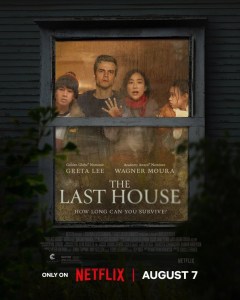 What begins as a clear allegory for COVID lockdown with a supernatural, Twilight Zone twist unravels quickly to be a muddled, confused, and disappointing monster movie that feels far too busy and silly for a movie this self-serious. The Last House starts off promisingly with a mysterious rain that essentially traps everyone in their homes, acting like a superglue force field. From there it becomes a question over if you were trapped in your home, what could you do to survive? At first it’s just general boredom with a family of four, and the parents (Wagner Moura, Greta Lee) trying to maintain their sanity. As weeks pass, it becomes a more pressing question over resources and food. I was expecting the movie to get creative with solving its in-universe dilemmas, but some of those solutions feel rather arbitrary and cheap. Why is there still electricity? If the rain is presented as creating a barrier, why is a hole in the chimney somehow able to circumvent this rule? There’s a whole lot of animal death in the movie, including mercy-killing the family dog and literally using its chopped carcass to lure small woodland creatures into a improvised fishing trap. It would be more disturbing if it wasn’t so ridiculous. I’ll credit the script for a major time jump because it renewed my flagging interest, trying to analyze what growing up in this extreme setting could do to a new generation who have only really known a strange world of isolation. I suppose that wasn’t interesting enough to Netflix because the last 40 minutes of the movie are about fighting Lovecraftian monsters that are, I guess, controlling the rains and just messing with people. Much like the characters onscreen, the movie is trying to do as much with what little resources it has left. The movie combusts at an alarming rate once it becomes an incomprehensible monster movie, and incomprehensible about even following the quick-cut action onscreen, which is obscured by the editing but also a majority of the scenes being underwater. The actors are wasted, the ideas are wasted, and The Last House doesn’t even give us the benefit of a true ending, instead previewing what a Last House(s) franchise could like like. I’d rather stay inside and eat the remains of my dog.
Nate’s Grade: C-
Share this:

Run (2025)
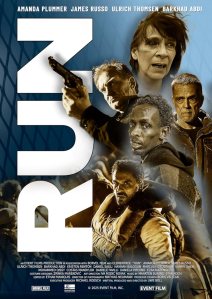
I’m going to do something I rarely if ever do, and that’s requesting a bit of homework before you delve further into this specific review. If you haven’t, please read my review for writer/director Uwe Boll’s 2026 grisly thriller Citizen Vigilante first. I’ll even provide the link. It doesn’t even have to be my review, though it would be appreciated of course. Familiarize yourself with this surprise xenophobic hit of a movie and then come back here to read about Boll’s 2025 effort, the generically-titled Run. It’s fair to gather an unfavorable opinion of Boll’s views on immigrants from Citizen Vigilante, which posits that thousands upon thousands of Europeans are being killed by merciless immigrants who refuse to assimilate with their poisonous cultures and attitudes, the kind of movie where a guy just slices a mother’s throat in the opening seconds while walking because why not? It’s a vile, disgusting movie that panders to the worst elements of the worst people, glorifying a racist vigilante that massacres an entire family for the sins of their teenage son. But I don’t need to remind you because, of course, you read that review. The discourse turned into an examination on Boll himself, appropriate since he was the writer and director and even dedicated the movie to the “countless victims of immigrant violence.” The most obvious interpretation was that Boll was beholden to this rotten anti-immigrant ideology. Perhaps he is. However, after having reviewed 29, now 30, of this man’s movies and written extensively about them and him, I had some doubts. It turns out Run is exactly why, as it stands as a stark refutation of the worst of Citizen Vigilante.
Forgive me, but I’ll be comparing Run and Citizen Vigilante throughout this review because I feel they are insightful mirrors for one another and demanding the comparative treatment. So, once again, if you haven’t yet, please read a Citizen Vigilante review so you’re caught up, dear reader. Thank you kindly.
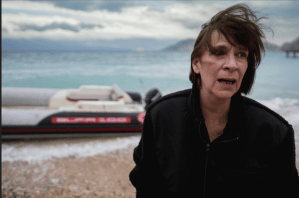
Run opens in a harrowing if familiar situation ripped from years of human interest headlines. We open on a boat heading out to sea. It’s filled with migrants from all countries looking to escape their home countries to avoid political persecution, imminent violence, or simply to start anew in a better place. They’re desperate people. They’re scared. They’re being exploited by the men in charge of the boat, whom we’ll learn later are charging up to $20,000 a person for their clandestine services. These men are also brutal when questioned and stab several of the people on the boat and throw them overboard. It’s grim and upsetting and this is Boll’s introduction for the audience to the plight of the immigrants. It already begs further questions of what they’re escaping if they’re willing to endure this terrifying trip.
The boat eventually does arrive onto the Italian coast (though really scenic Croatia) and from there the movie is split among an ensemble of storylines: 1) Anna (Amanda Plummer) is an ex-pat American who stumbles upon a pregnant immigrant, Selena (Hannah Balogun), hiding in the bushes after fleeing from the local police, and offers her refuge; 2) Ismael (Oscar-nominee Barkhad Abdi) is a Somali immigrant who has given everything to seeking political asylum and a new life; 3) Eddie (James Russo) and his daughter Julia (Kristen Retton) are American ex-pats and have run a business in town that has been going downhill and they’re running low on options to salvage their impending financial ruin; 4) a local police officer, Cappi (Daniel Sauli), struggling to do his best, watches over his aging mother who lives with him, and keeps up with the influx of immigrants in town; and 5) the pair responsible for the boat ferrying (Sammy Sheik, Michel Qissi) who are looking to get in good with a local mobster (Costas Mandylor).

From its opening scene amidst the boat, I found myself leaning a little closer to the screen, eager to see if this more empathetic approach would be met with sincerity throughout. It was! Run is a consistently compassionate examination about the modern-day immigrant experience, especially upon trying to work through the often byzantine system of bureaucracy to be counted and approved for asylum or migration status. It’s an open-hearted look that refuses to view these people as “invaders” or “vermin,” and instead looks at them as the desperate and vulnerable human beings they are. I thought that Run might follow a similar plot trajectory of 2007’s The Visitor, where our lonely, older, white American befriends an illegal immigrant, grows as a person, then has that person ripped away from the cruel indifference of the immigration and asylum system, only to learn a larger lesson through their personal experience. Run kind of follows that path but not as closely as I would have predicted. Selena gets taken by Officer Cappi around the 40-minute mark, not really enough time to fully develop the unexpected relationship between her and Anna. From there, the rest of her storyline is Anna trying to negotiate for the release of Selena by scrounging up thousands of dollars to bribe the local officials into letting her loose. There’s an engaging urgency and desperation there that can mirror what some of the immigrants experience as forces with more entrenched power, and the ability to abuse that power, are placed in opposition to freedom.
The American family is the mouthpiece for our more xenophobic perspective, but over the course of the movie Boll always showcases them as being in the wrong, as the angry assholes who have lost sight that even they were immigrants too. The cranky father figure, Eddie, says he served thirty years in the military and knows firsthand how “these people” behave. Anna calls him out, saying he should then acknowledge the potential culpability the U.S. government/military and other larger bodies could have in supplanting civil order/local autonomy for profit. The second half of the movie completely dumps all over Eddie’s worldview and refutes so much of Citizen Vigilante, down to its racist core premise, that I almost wanted to stand up and applaud. Spoilers ahead, but it’s worth it, trust me. At one point, a man hiding along the shore is discovered and in his panic he grabs a teen boy and holds him hostage, placing a machete under his chin. He just keeps screaming “I want free” in English and he looks completely spooked. He is also dangerous, as he slashes a guy in the face for getting too close. Sitting out to sea is the American family, and Julia gets an idea. She takes her speargun and swims out to the shore, coming up from behind the machete-wielding hostage scenario. She takes it upon herself to intervene and fires the speargun, which goes right through the immigrant’s chest, killing him. However, it also injures the boy being held hostage… and the boy dies. Julia is shaken up from the results, never intending to kill the boy, and yet her vigilante act caused an innocent boy to get killed. Then she’s taken by the police, ostensibly for a witness statement, but she’s arraigned instead for manslaughter. Beforehand, she’s been viewed as the more level-headed of her family, the one trying to assess their problems and deal with them. Boll sets her up as, for lack of a better term, “the good one” of her family, and then she does this, and not only that, she’s offended that she would even be charged with a crime. Her blithe entitlement and dismissal of her actions and responsibility is truly telling. Boll is indicting her sense of privilege at being able to float above consequences because she was white and well-intentioned even when it came to vigilantism. She tried her hand at being a vigilante and made the matter worse. Check that, Citizen Vigilante.

It gets even more explicit in the tragic finale (still spoilers, but it’s worth it). Eddie’s response to his daughter being arraigned for manslaughter is further evidence of his reactionary projections to scapegoat immigrants for all the ills of the world. Rather than legally disputing her arraignment or finding money for bail, he and his compadre fashion a stockpile of Molotov cocktails and ammo. They drive to the immigration/refugee shelter, and they mercilessly unload, killing innocent human beings for the crime of being on the other side of a fence. They murder dozens, and this murder isn’t covered in glory or tacit approval from Boll, it’s treated as an act of terror and doom. They even kill the local cops who are trying to put an end to their massacre, which shows how far their allegiance to law and order actually goes. I was reminded of Citizen Vigilante where the protagonist (Armie Hammer) also mows down room after room of police officers doing their job, bringing a killer to justice, though he at least says, “I know you’re just doing your jobs but please let me murder others with impunity.” It’s fascinating to me that the presented hero of one movie could just as easily be the presented villain of another movie without a change in their ideology. The fact that these movies are released a year apart from one another is stunning.
Lest you think I’m going to give Boll a pass because his film falls closer to a political ideology that matches my own way of thinking, there are still myriad issues plaguing Run. The storylines can feel arbitrary with how abrupt we jump from one to another and they don’t interconnect as much as they could, allowing for a wider berth of perspective shifting. The attention paid on the pair who steered the boat and them getting into the mob is completely underwritten to the point that they could have been eliminated. Some of the character choices can equally be arbitrary, like when Anna ushered Selena out of her home mere minutes before her brother is going to arrive and pick her up. Why not wait for confirmation before leaving the sanctity of the indoors? The local officer is initially presented as a down-to-Earth figure but then takes a villainous turn, being the one holding Selena hostage and insisting on the thousands of dollars as ransom. If he’s going to take this dramatic heel turn, we should spend more time with him dwelling on his actions, trying to justify them to himself, or even simmering in guilt and fear over how far he may have gone and can he salvage his integrity. The political commentary isn’t subtle in the least, though this does not bother me as we live in extremely unsubtle times. Still, having characters utter dialogue that’s clearly underlining the messages can be a bit much, like when a local official ruefully shakes her head and says, “I’m sorry. You did everything right but you’re going back home.” I also think it ends about three minutes later than it should. There’s a rather perfect ending moment that echoes the beginning of the movie and shows genuine character changes. Boll continues past that for questionable reasons, perhaps trying to establish the point that even if these immigrants find employment, they’ll still be looking over their shoulders in paranoia for potentially ever. Even so, the very ending scene is confounding.

I wouldn’t quite qualify Run as a good movie, or at last a traditionally good movie, but it’s actually okay, especially given the filmography of its writer/director. It serves as a possible eye-opener for audiences about the troubled experience many immigrants face in their desperate dash for a better life, and while giving voice to a plurality of political viewpoints and frustrations, Boll’s movie is always siding with the side of the poor, huddled masses yearning to breathe free. In a minor way, he has done justice to their stories. Now, that brings up a salient question regarding Citizen Vigilante. I concluded my review of that film theorizing that perhaps the movie was indeed a grift of Boll’s, serving up wish-fulfillment agitprop to despicable people who see the world through its hateful lens. I think Run is perhaps compelling evidence that my theory might be right. Here’s the rub: whether you’re genuinely racist or merely pretending to be, when you make racist propaganda, it still exists. You’ve still created harmful art that comforts the horrid beliefs of racists, and you don’t get a pass for that because you don’t actively believe in that ideology. You have still contributed to it. Boll doesn’t get a pass merely because I doubt he favors the xenophobic dogma of his vigilante murderer. He didn’t have to make it in the first place, or he could have made it a more explicit critique of the right-wing zealot who demonizes immigrants for any crime real or imagined. He could have done a lot more movies like Run. So, congrats Uwe, on making a fairly cogent and resonant political drama about immigrants. It’s a shame that your other movie about immigrants will overshadow this one completely. Enjoy that money.
Nate’s Grade: C+


 nathanzoebl
You must be logged in to post a comment.