Blog Archives
Run (2025)
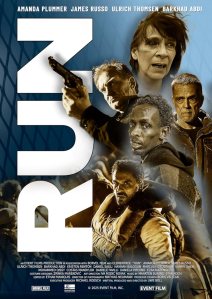
I’m going to do something I rarely if ever do, and that’s requesting a bit of homework before you delve further into this specific review. If you haven’t, please read my review for writer/director Uwe Boll’s 2026 grisly thriller Citizen Vigilante first. I’ll even provide the link. It doesn’t even have to be my review, though it would be appreciated of course. Familiarize yourself with this surprise xenophobic hit of a movie and then come back here to read about Boll’s 2025 effort, the generically-titled Run. It’s fair to gather an unfavorable opinion of Boll’s views on immigrants from Citizen Vigilante, which posits that thousands upon thousands of Europeans are being killed by merciless immigrants who refuse to assimilate with their poisonous cultures and attitudes, the kind of movie where a guy just slices a mother’s throat in the opening seconds while walking because why not? It’s a vile, disgusting movie that panders to the worst elements of the worst people, glorifying a racist vigilante that massacres an entire family for the sins of their teenage son. But I don’t need to remind you because, of course, you read that review. The discourse turned into an examination on Boll himself, appropriate since he was the writer and director and even dedicated the movie to the “countless victims of immigrant violence.” The most obvious interpretation was that Boll was beholden to this rotten anti-immigrant ideology. Perhaps he is. However, after having reviewed 29, now 30, of this man’s movies and written extensively about them and him, I had some doubts. It turns out Run is exactly why, as it stands as a stark refutation of the worst of Citizen Vigilante.
Forgive me, but I’ll be comparing Run and Citizen Vigilante throughout this review because I feel they are insightful mirrors for one another and demanding the comparative treatment. So, once again, if you haven’t yet, please read a Citizen Vigilante review so you’re caught up, dear reader. Thank you kindly.
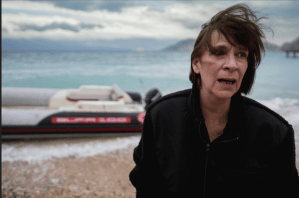
Run opens in a harrowing if familiar situation ripped from years of human interest headlines. We open on a boat heading out to sea. It’s filled with migrants from all countries looking to escape their home countries to avoid political persecution, imminent violence, or simply to start anew in a better place. They’re desperate people. They’re scared. They’re being exploited by the men in charge of the boat, whom we’ll learn later are charging up to $20,000 a person for their clandestine services. These men are also brutal when questioned and stab several of the people on the boat and throw them overboard. It’s grim and upsetting and this is Boll’s introduction for the audience to the plight of the immigrants. It already begs further questions of what they’re escaping if they’re willing to endure this terrifying trip.
The boat eventually does arrive onto the Italian coast (though really scenic Croatia) and from there the movie is split among an ensemble of storylines: 1) Anna (Amanda Plummer) is an ex-pat American who stumbles upon a pregnant immigrant, Selena (Hannah Balogun), hiding in the bushes after fleeing from the local police, and offers her refuge; 2) Ismael (Oscar-nominee Barkhad Abdi) is a Somali immigrant who has given everything to seeking political asylum and a new life; 3) Eddie (James Russo) and his daughter Julia (Kristen Retton) are American ex-pats and have run a business in town that has been going downhill and they’re running low on options to salvage their impending financial ruin; 4) a local police officer, Cappi (Daniel Sauli), struggling to do his best, watches over his aging mother who lives with him, and keeps up with the influx of immigrants in town; and 5) the pair responsible for the boat ferrying (Sammy Sheik, Michel Qissi) who are looking to get in good with a local mobster (Costas Mandylor).

From its opening scene amidst the boat, I found myself leaning a little closer to the screen, eager to see if this more empathetic approach would be met with sincerity throughout. It was! Run is a consistently compassionate examination about the modern-day immigrant experience, especially upon trying to work through the often byzantine system of bureaucracy to be counted and approved for asylum or migration status. It’s an open-hearted look that refuses to view these people as “invaders” or “vermin,” and instead looks at them as the desperate and vulnerable human beings they are. I thought that Run might follow a similar plot trajectory of 2007’s The Visitor, where our lonely, older, white American befriends an illegal immigrant, grows as a person, then has that person ripped away from the cruel indifference of the immigration and asylum system, only to learn a larger lesson through their personal experience. Run kind of follows that path but not as closely as I would have predicted. Selena gets taken by Officer Cappi around the 40-minute mark, not really enough time to fully develop the unexpected relationship between her and Anna. From there, the rest of her storyline is Anna trying to negotiate for the release of Selena by scrounging up thousands of dollars to bribe the local officials into letting her loose. There’s an engaging urgency and desperation there that can mirror what some of the immigrants experience as forces with more entrenched power, and the ability to abuse that power, are placed in opposition to freedom.
The American family is the mouthpiece for our more xenophobic perspective, but over the course of the movie Boll always showcases them as being in the wrong, as the angry assholes who have lost sight that even they were immigrants too. The cranky father figure, Eddie, says he served thirty years in the military and knows firsthand how “these people” behave. Anna calls him out, saying he should then acknowledge the potential culpability the U.S. government/military and other larger bodies could have in supplanting civil order/local autonomy for profit. The second half of the movie completely dumps all over Eddie’s worldview and refutes so much of Citizen Vigilante, down to its racist core premise, that I almost wanted to stand up and applaud. Spoilers ahead, but it’s worth it, trust me. At one point, a man hiding along the shore is discovered and in his panic he grabs a teen boy and holds him hostage, placing a machete under his chin. He just keeps screaming “I want free” in English and he looks completely spooked. He is also dangerous, as he slashes a guy in the face for getting too close. Sitting out to sea is the American family, and Julia gets an idea. She takes her speargun and swims out to the shore, coming up from behind the machete-wielding hostage scenario. She takes it upon herself to intervene and fires the speargun, which goes right through the immigrant’s chest, killing him. However, it also injures the boy being held hostage… and the boy dies. Julia is shaken up from the results, never intending to kill the boy, and yet her vigilante act caused an innocent boy to get killed. Then she’s taken by the police, ostensibly for a witness statement, but she’s arraigned instead for manslaughter. Beforehand, she’s been viewed as the more level-headed of her family, the one trying to assess their problems and deal with them. Boll sets her up as, for lack of a better term, “the good one” of her family, and then she does this, and not only that, she’s offended that she would even be charged with a crime. Her blithe entitlement and dismissal of her actions and responsibility is truly telling. Boll is indicting her sense of privilege at being able to float above consequences because she was white and well-intentioned even when it came to vigilantism. She tried her hand at being a vigilante and made the matter worse. Check that, Citizen Vigilante.

It gets even more explicit in the tragic finale (still spoilers, but it’s worth it). Eddie’s response to his daughter being arraigned for manslaughter is further evidence of his reactionary projections to scapegoat immigrants for all the ills of the world. Rather than legally disputing her arraignment or finding money for bail, he and his compadre fashion a stockpile of Molotov cocktails and ammo. They drive to the immigration/refugee shelter, and they mercilessly unload, killing innocent human beings for the crime of being on the other side of a fence. They murder dozens, and this murder isn’t covered in glory or tacit approval from Boll, it’s treated as an act of terror and doom. They even kill the local cops who are trying to put an end to their massacre, which shows how far their allegiance to law and order actually goes. I was reminded of Citizen Vigilante where the protagonist (Armie Hammer) also mows down room after room of police officers doing their job, bringing a killer to justice, though he at least says, “I know you’re just doing your jobs but please let me murder others with impunity.” It’s fascinating to me that the presented hero of one movie could just as easily be the presented villain of another movie without a change in their ideology. The fact that these movies are released a year apart from one another is stunning.
Lest you think I’m going to give Boll a pass because his film falls closer to a political ideology that matches my own way of thinking, there are still myriad issues plaguing Run. The storylines can feel arbitrary with how abrupt we jump from one to another and they don’t interconnect as much as they could, allowing for a wider berth of perspective shifting. The attention paid on the pair who steered the boat and them getting into the mob is completely underwritten to the point that they could have been eliminated. Some of the character choices can equally be arbitrary, like when Anna ushered Selena out of her home mere minutes before her brother is going to arrive and pick her up. Why not wait for confirmation before leaving the sanctity of the indoors? The local officer is initially presented as a down-to-Earth figure but then takes a villainous turn, being the one holding Selena hostage and insisting on the thousands of dollars as ransom. If he’s going to take this dramatic heel turn, we should spend more time with him dwelling on his actions, trying to justify them to himself, or even simmering in guilt and fear over how far he may have gone and can he salvage his integrity. The political commentary isn’t subtle in the least, though this does not bother me as we live in extremely unsubtle times. Still, having characters utter dialogue that’s clearly underlining the messages can be a bit much, like when a local official ruefully shakes her head and says, “I’m sorry. You did everything right but you’re going back home.” I also think it ends about three minutes later than it should. There’s a rather perfect ending moment that echoes the beginning of the movie and shows genuine character changes. Boll continues past that for questionable reasons, perhaps trying to establish the point that even if these immigrants find employment, they’ll still be looking over their shoulders in paranoia for potentially ever. Even so, the very ending scene is confounding.

I wouldn’t quite qualify Run as a good movie, or at last a traditionally good movie, but it’s actually okay, especially given the filmography of its writer/director. It serves as a possible eye-opener for audiences about the troubled experience many immigrants face in their desperate dash for a better life, and while giving voice to a plurality of political viewpoints and frustrations, Boll’s movie is always siding with the side of the poor, huddled masses yearning to breathe free. In a minor way, he has done justice to their stories. Now, that brings up a salient question regarding Citizen Vigilante. I concluded my review of that film theorizing that perhaps the movie was indeed a grift of Boll’s, serving up wish-fulfillment agitprop to despicable people who see the world through its hateful lens. I think Run is perhaps compelling evidence that my theory might be right. Here’s the rub: whether you’re genuinely racist or merely pretending to be, when you make racist propaganda, it still exists. You’ve still created harmful art that comforts the horrid beliefs of racists, and you don’t get a pass for that because you don’t actively believe in that ideology. You have still contributed to it. Boll doesn’t get a pass merely because I doubt he favors the xenophobic dogma of his vigilante murderer. He didn’t have to make it in the first place, or he could have made it a more explicit critique of the right-wing zealot who demonizes immigrants for any crime real or imagined. He could have done a lot more movies like Run. So, congrats Uwe, on making a fairly cogent and resonant political drama about immigrants. It’s a shame that your other movie about immigrants will overshadow this one completely. Enjoy that money.
Nate’s Grade: C+
Share this:

First Shift (2024)
 Notorious film director Uwe Boll is back, baby, from his semi-retirement. Not only that, he has stumbled upon a hit, something decidedly uncommon in the man’s multi-decade independent filmmaking career, especially since he faded from the outer rings of the studio system in the late 2000s. I’m writing this after the release of 2026’s Citizen Vigilante, another surprisingly popular movie for Boll, though popular with the worst people and for the worst reasons. I was unaware that Boll had shed his retirement, so now I’m catching up with some of his latest films, and 2024’s First Shift was his return splash. It’s a cop drama actually filmed in New York City, a bit of a change for the more threadbare and mercenary director. However, when this little movie debuted on streaming for Paramount Plus, it opened as the number two movie and stayed in the streamer’s top ten for an astonishing twenty weeks, nearly half a year. Clearly, this movie caught on with audiences and Boll has already planned two more installments, as well as a potential First Shift TV series. When I read this information I pumped my fist, not necessarily cheering for Boll’s success, not that I have anything against the man’s fortunes improving, but because all through my watch of First Shift I kept remarking, “This feels like Boll’s attempt at a cop show.” Lo and behold, that might have just been the plan all along, and considering Paramount is the home of a plethora of CBS long-running crime procedurals with little variation in their formula comforts, he might have struck gold.
The plot is fairly simple. Veteran cop Detective Deo Russo (Gino Anthony Pesi) likes to be alone, and then he gets assigned a new partner, Angela Dutton (Kristen Renton). He’s grumpy and cynical and she’s sunshine and optimism. He likes to keep to himself and she’s an open book, to go with her non-stop chatter. Over the course of their first shift, they’ll spend twelve hours traversing New York City, resolving various crimes including a mob hit and a personal episode of violence with Dutton’s family.
 After 29 Boll movies and counting under my watch, I must say that, to my full academic analysis, First Shift is actually mostly enjoyable. To a point. I’ll get to that later with some significant spoilers over the last twenty minutes. However, this is a crime thriller that eschews a sense of gritty realism for something far more breezy and light-hearted without being too flip or glib. The pervading feeling of the movie is just something familiar and nice, a soothing balm that tells you even when the officers are confronting a literal knife-wielding maniac, that things aren’t going to get too heavy. This is a world of cops and officials that seems ripped from the cozy confines of the network TV procedural, the world of NCIS, Bones, In Plain Sight, Castle, Hawaii Five-O, Monk. The crimes are never too grisly and the overall tone of the show is mirthful and suffused with bickering and snappy banter (“This city is my new home,” with the ready reply, “Your new home smells like piss.”) from a bunch of professionals more prone to rolling their eyes than getting into fistfights. It’s a distorted reality that’s ready-made for comfort viewing, and it mostly works. I enjoyed the introduction of the team from the typically been-there-seen-it-all boss, Lieutenant Walden (Tia Dionne Hodge), whose wisecracks actually got me to chuckle. I appreciated the unpredictable areas the banter could head, including both officers trying their best to define what a sexual act was named after a particularly popular Little Debbie treat could be. Most of all, I appreciated that Boll understood the tone he wanted and implemented it from the start. It’s such a light, pleasant feeling that I found my attention drifting, not because I was bored but because it was a familiar sensation that put me at ease.
That doesn’t mean everything snapped together with precision. For a movie just under 90 minutes, it feels a little stretched to get to that running time. The opening three minutes are devoted to watching Russo’s morning routine including making a protein shake. I kept waiting for some added detail, like he’s sneaking booze into his shake’s recipe, but alas, it was just a protein shake. There’s plenty of moments in the car with the cops that just feel like Boll was riding in the back and said, “Go on and improv,” and they just riffed for ten minutes and he cobbled together his favorite bits. It’s an ongoing impression throughout the movie, with scenes feeling a bit more loping in their rhythms, allowing certain scenes to feel aimless, drifting past the point being established. I didn’t mind so much because the stakes were low and the vibes were pleasant, but it did feel padded. Do we need to see an old man walking down the store aisles so extensively before he’s ultimately attacked? If this was designed in the TV procedural format, there would be a brevity to some of these plot points. I did find the behavior of Dutton to be a bit of a reach at points. Her posting of TikToks live from the station seemed rather unprofessional and something she’d be dinged for. It gives the impression of someone unfamiliar with the restraints of police work, which made me initially think Dutton wasn’t a transplanted cop from Atlanta but some civilian riding along for research, like with Castle, before that show long exhausted the premise of why a mystery novelist would be so indispensably integrated in the L.A. police force. The larger mob plot is also muddled, as there is an introductory scene establishing our Bad Guy getting back against an underling who betrayed him. However, before the end of the movie, this Bad Guy is hastily removed to introduce a different Bad Guy Boss. If this was the case, why didn’t we just begin with the man at the top if he’s the one who actually matters?
 Unfortunately, the last twenty minutes of First Shift are a sharp tonal disconnect that seriously harms the good vibes of the movie, and one that requires extensive spoilers, so if you seriously care about whether or not a Uwe Boll movie experience will be pure for you, skip ahead to the next paragraph, dear reader. Earlier in the movie we get a couple quick flashes of a bearded man growing in agitation. He seems to have some substance abuse issues and the deterioration of his marriage. It isn’t until the final act that his storyline really surfaces with clarity. This man happens to be Dutton’s brother, an Iraq War veteran suffering from PTSD and drinking. His wife is preparing to leave him and take away her son, his stepson, so what’s a mentally unstable man to do? He blames the stepson for poisoning the relationship with his wife, pushing her to leave, and he throttles the child and suffocates him with a pillow. He then also kills his wife and himself. Take a minute to catch your breath, reader. That’s a lot, and especially for a movie that had an entire storyline about taking care of an elderly man’s dog while he recuperates and tricking their commanding officer into buying the dog’s lavish lunch. This murder-suicide family annihilator plot is far too dark and serious for a movie that, thus far, had been more whimsical and light. It completely crashes the tone of the movie. It’s an attempt by Boll to trauma-bond his two lead characters, but it really feels more like a trauma dump for the audience. Both of the cops just blurt out their feelings and personal failings at high volume, speeding over the character development that should unite them. It’s clunky. It’s also an unwelcomed and miserably dour turn for a movie that cannot support that level of dire realism.
In the final minutes of First Shift, it cuts to additional footage and promises a Part Two, kind of like the end of Kevin Costner’s Horizon: Part One previewing a trailer for its forthcoming Part Two. We still have never gotten Horizon: Part Two and it’s been two years and counting since it was pulled from the release calendar. I don’t know if this was always the plan or Boll was adding an additional tease to capitalize on the unexpected groundswell of audience interest. In October 2025, Boll had officially wrapped New York City filming for the two sequels, titled First Shift: Vengeance and First Shift: Redemption, which seems a shame because Second Shift and Third Shift were right there. The TV series is still in development. In replicating the familiar, low-stakes, ensemble character workplace cop procedural, Boll might have stumbled upon a new echelon of success for his career. If he can reassert the tone that made the movie a successful if disposable innocuous cop procedural in movie form, then I think the First Shift sequels could be modestly entertaining. However, if the shocking downturn that the film takes in its climax is an indication of the direction ahead, then the good vibes might be dead after all. Still, for the man’s return to the world of cinema, First Shift is a cut above for Dr. Boll.
Nate’s Grade: C+
Share this:

Citizen Vigilante (2026)
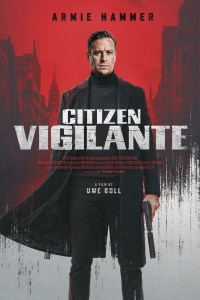 In 2016, notorious film director Uwe Boll announced his retirement from the movies, and for a while it seemed like it would stick. He settled into being a surprisingly successful restaurant owner and seemed comfortable with leaving directing behind. Still, as someone who had watched and reviewed 27 Boll movies and written over 48,000 words on the man’s oeuvre, I had my doubts. I even said in my review for the 2019 documentary about his career, “I also don’t think Boll will stick with his retirement. Much like Kevin Smith and Steven Soderbergh, other filmmakers who swore retirement, I think this period will be but a breath, a pause until Boll finds something that inspires him.” Well, it looks like what inspired him was making his own even-more-racist version of Death Wish. Originally titled The Dark Knight, until the lawyers got involved, Citizen Vigilante is Boll’s most prominent movie in nearly two decades. He’s actually injected himself into the culture wars and gained a whiff of relevancy that’s long eluded him. Citizen Vigilante is being hailed by rightwing audiences and pundits as “the movie woke Hollywood would never make.” Elon Musk posted the entire movie on Twitter, which is technically piracy. It became the number-one movie for digital platforms like Apple and Amazon. I’ve watched Citizen Vigilante and I can say with full confidence…welcome back to the Worst of the Year film lists, Uwe Boll. We’ve been saving a spot for you in your absence.
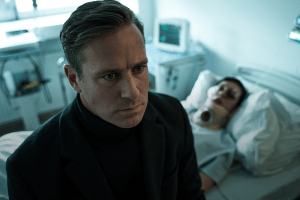 Michael Sanders (Armie Hammer) is an ex-Army officer living in “Europe.” Where in “Europe” you might ask? Unclear, though probably Germany. I raise this because the movie literally opens with a title card that just tells us we are in “Europe,” not a country or a city but the continent. In the opening minutes, we also see an immigrant stab a nice lady in the neck for no reason. The news informs us that immigrants and migrants have been coming to “Europe” and wreaking havoc, terrorizing God-fearing, tax-paying citizens with their foreign cultures, foreign languages, and depraved sensibilities. It’s in this setting that the people need a hero. It just so happens Michael stalks the streets of “Europe” as the Vigilante Citizen, finding those who have exploited the “European” systems of justice.
Let’s take three scenes that I think are emblematic of the thinking behind this whole endeavor as well as the impression of our problematic protagonist The first follows Michael as he heads to the hospital to talk with a survivor of rape and assault. However, on the way there, a trio of teenage hooligans board his bus and refuse to pay the fare, to the consternation of the beleaguered bus driver. Michael agrees to pay their fares and sits down beside them. He then lectures the trio of teens on macro-economics, explaining how their breaking the law and refusing to pay bus fare eventually contributes to a larger cost the rest of society has to pay. To no one’s surprise, the teens seem unimpressed, and later in the movie will be hilariously harassing one kid just sitting at a bench. These teen hooligan characters are so devoid of believability that they exist merely as an older generational boogeyman (“You can’t go out at this hour… there’s teens! And they have… attitude!”). Anyway, he ventures into the hospital and talks with the poor woman who was gang-raped and beaten. He asks her a series of questions about her attackers and says he’s there to seek justice. However, he purposely manipulates her by indicating the judicial process is slow and will require her to relive all of her trauma, and she doesn’t really want that, does she? Instead, he argues, he could provide his own justice on her behalf. To no surprise, she chooses the latter. Way to prey on this woman’s fears to be given permission to do what you really want to do, hurt bad people. Do you think he would have actually respected her choice if she chose to side with the court system? I doubt it. He might pretend to be serving unmet justice, but he’s looking for access to his blood-lust by any means. Another bewildering example of this is when he’s kidnapped a judge to lecture and execute, and to prove some point about the docility of innocents, he literally drives into oncoming traffic, forces a car to crash and roll over, and presumably kills an innocent motorist. What was that guy’s sin, huh?
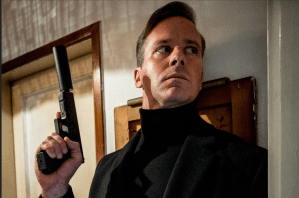 Another telling moment is when he’s walking the halls of a brothel, which literally looks like a general office hallway. Granted, since we’re in “Europe,” who’s to say that there couldn’t be an entrepreneur making unorthodox use of their building space? Regardless, he propositions one woman ($15 for sex and $30 for more than one position). They go into her office/bedroom and have at it. Now, I thought Michael was patrolling this location because the women were victims of sex trafficking and he was going to free them from their terror. I wasn’t expecting him to merely partake, and partake he does, though at no point does Michael ask her to role play cannibalism. However, during sex, he is distracted because he sees mold spots on the ceiling. He explains to her that this is a hazard from too much moisture, as if she’s the one in charge of the upkeep of the dwellings. He then reveals he’s actually the landlord of the building and he came for a “surprise inspection.” He then tells her that he will, indeed, pay her the thirty-dollars and flips her over for some more sex (you better believe this guy is into choking). What a modern gentleman. Despite his “generosity,” Michael is more concerned about the building upkeep than these women, again, who could be suffering from trafficking and lacking agency or the choice to leave. I guess since it might not be some immigrant responsible for their torment he’s decided to overlook this possible oppression.
The last telling moment is when the police storm his apartment. Through a series of security cameras, he anticipates their imminent arrival and hides behind a metal shield with thin openings for two automatic rifles to stick their barrels out. He warns the armed officers that he understands they’re doing their duty but advises them to leave. They obviously do not. He then massacres them all from behind his shield wall, awkwardly handling each rifle with one arm, magically shooting every one of these officers. Then again these guys all stand in the open and do not move for cover, so maybe they weren’t the top of their class. They then send in more guys who also get massacred. Firstly, did these new guys not learn anything from the last batch of sacrificial offerings? Does nobody maybe just plan for a long-term siege and wait him out considering they know he’s stuck behind his little wall? The other telling aspect is that Michael shows no compulsion in killing these officers. He would say he warned them, but he also acknowledged they were doing their jobs, and for that he has declared they must die. So Mr. Law and Order doesn’t care so much about said law and order if it impedes his vigilante hobby. I would argue this fact should make the character less appealing to certain conservative audiences but after January 6th, perhaps taking their violent fantasies out on law enforcement when it stops them from doing whatever they want to do is their new definition of “backing the blue.”
 As a whole, I think all of these scenes really paint a picture as to the character of Michael, the self-styled Vigilante Citizen, who says he’’s the protector of the people, but I think he’s really more just a guy who likes violence and finds flimsy moral justifications to enact it. Still, that could have been somewhat interesting to explore as a character study, but that’s not what Boll is interested in. This movie transforms completely in its final twenty minutes into a dehumanizing and racist diatribe (spoilers to follow). He tracks one of the rapists down and it happens to be a teenager from the Middle East. So Michael decides to hold the entire family hostage and blames them all. What did this kid’s teen sister have to do with this? Or his mom and dad? Mom says her culture has conditioned her to blame these scantily-dressed European women for any sex crimes brought against them, but then is she not also a victim of bad thinking? Is she so irredeemable in her perspective that she could not change her mind over time? Should she be sentenced to death for having bad thoughts? If you open that up, where do you even stop? Michael coaxes the kid to call his friends and tell them to come over so they can be executed one-by-one, but what verification is there in Michael’s alleged hunt for justice? He’s shooting people as they arrive, some of whom he never even sees their faces, so how can he verify these are the culprits? What if some guy just walked in? What if one of these guilty teens brought along an innocent friend? Who’s to say that the Middle Eastern kid even sent the message to the correct people. Ladies and gentlemen, this ugly incident of mass execution by way of racism is the movie’s climax. It made me feel not just bad but scathingly unclean, especially knowing some will pump their fists in celebration, point to the screen, and holler, “Damn right my dude!”
This is only the second movie for Hammer since 2022’s Death on the Nile, the last time he graced a Hollywood studio production. Boll is known for welcoming actors on the fringes and people Hollywood has turned a cold shoulder to, so it makes sense for him to swoop up Hammer. And you know what? He’s as convincing as this sort of character was ever going to be. Hammer still has screen presence, and even though this is schlocky genre nonsense, the man still brings something to the role. I want to respect that but I also find it hard to respect a role that is so blatantly xenophobic wish-fulfillment propaganda.
 Considering the vile politics of Citizen Vigilante, and considering it literally ends with a dedication to the “thousands of murder and rape victims from immigrants,” it’s worth bringing up the question whether or not Boll believes any of the messages of his movie or if he’s merely pandering to people that do. Other critics have commented that Boll has had conservative leanings given some of his earlier films like Postal, and I must say, as the world’s leading expert on the cinematic offerings of one Dr. Boll, I disagree. Now, obviously I can’t look into the man’s heart and know what he truly feels about this subject, but now after watching 28 of the man’s movies, I feel like he’s at least a quirky neighbor that I’ve gotten to better know. This is the same man who made a movie about the genocide in Sudan (Attack on Darfur), the same man who lambasted the prison system for its abuses (Stoic), the same man who denounced the greedy fat cats of Wall Street (Assault on Wall Street), the same man who early in his career made a movie denouncing gun violence in schools (Heart of America), and the same man who crafted a nihilistic Vietnam War movie that condemned the very idea of war (Tunnel Rats), which still happens to be his best movie. Despite his recent output’s fascination with self-righteous spree killers (Rampage 1-3), I don’t think Boll really leans rightward. That brings up the alternative: this is a calculated grift aimed directly at racists. This I can believe, as Boll will chase after any audience that might provide him enough funding to move onto the next project and the next. Does that make the movie worse or does that make the movie a secret screed against this diseased way of thought? After all, the main character is a U.S. citizen living in “Europe,” making him… a violent and dangerous immigrant. I’m putting too much of my own thought into what is ultimately a thoughtlessly grimy vigilante thriller, but after 28 Uwe Boll movies, it’s hard not to pontificate. Unless you’ve been dying to see a certain selection of people die onscreen, steer clear of Citizen Vigilante at all costs.
Nate’s Grade: D-
Share this:

F*** You All: The Uwe Boll Story (2019)
 Notorious German director Uwe Boll hasn’t made a movie since 2016 and says he is done, retired, and not turning back to movies. What’s somebody like me, who has spilled thousands upon thousands of words on the man, to do? Why watch a feature documentary on the man and his unorthodox methods. F*** You All: The Uwe Boll Story is potentially the “last” Boll film, so it felt right to review it for my ongoing Boll retrospective and as a sendoff for a man I’ve chronicled for fourteen years.
The documentary also confirmed for me several speculative questions I’ve posed over the long course of my reviewing of his catalogue of hits and misses and misses. There is a reason he gets bigger name actors like Ben Kingsley and Jason Statham, or at least did for a while, and that’s because he doesn’t cast his movies until a few weeks before they are set to shoot. Then he asks for actors that are available his shooting dates and offers a check, and it’s sudden but it can work. Even he admits it’s a crazy process because the actors have no rehearsal time, you might not even get people right for the roles, but it’s only a problem if one cares about that sort of thing, and then he laughs knowingly. I’ve also suspected for some time that the screenplays for Boll movies are incomplete or heavily rewritten on the spot, and this is confirmed as well. Guinevere Turner is a fine writer, having worked on several Mary Harron movies including American Psycho, The Notorious Bettie Page, and the recently released Charlie Says. She is also the sole credited writer to Bloodrayne. To say this movie is below her standards is an understatement. As she details, only twenty percent resembles her original script. But, she notes, Boll paid in full. If you’re going to be relegated to schlock cinema, at least get paid for it. In general, Boll flashes disdain for what he feels are the excesses of filmmaking, wasted time to work on nuance or camera setups for dynamic shooting. The cast say they rarely get more than two takes even if they beg for more. Sometimes Boll won’t even be looking at the monitor as a scene plays out. His producer instincts dominate his writer/director instincts, and it becomes a product to mash out.

Perhaps the most insane example of this was in 2010 when Boll elected to shoot three films simultaneously. He got a budget for the third Bloodrayne movie, which was finally set during the time period of the video game, Nazi Germany. Boll says he secured financing by promising two movies for the price of one, shooting the specific parody Blubberella on the same sets, with the same actors, and following the same plot. Actress Lindsay Hollister was on set and scribbling joke ideas with the Bloodrayne 3 screenplay. When it came time to writing the script for Blubberella, she assumed an actual writer would be utilized. When she sat down for a read through, she was shocked to discover the Blubberrella “shooting script” was merely her copy of the Bloodrayne script with her notes in the margins. The Bloodrayne movie was the priority and had to look the best, so it got the majority of the time, and then according to Hollister they would get a take or two to film the Blubberella version and just go with it. It didn’t matter if the movie didn’t make sense. It only mattered that it was made (“I just have to get it to 77 minutes,” Boll candidly told Hollister). On top of this insane setup, several weeks into production Boll added a third film, live-action recreations for Auschwitz, detailing the horrors of the gas chambers. He had to keep track of three separate film productions simultaneously making use of the same schedules. It’s not a surprise that the films didn’t turn out well, but just imagine juggling tone, going from a cheesy genre movie, to a goofy satire of that cheesy genre movie, to a deadly serious Holocaust recount. That would make my head explode and I only watched all three movies.
As a documentary, F*** You All seems too conflicted with resurrecting Boll’s image. The real ammunition this story has are the crazy, juicy behind-the-scenes anecdotes that should spill from baffled actors. There are a few but this currency is too quickly depleted. Instead writer/director Sean Patrick Shaul (who worked on Boll’s 2013 film, Assault on Wall Street) is trying to break open the contradictions of Boll, the man who seems to love being a director but not actually directing, who seems to love making movies but doesn’t want to put that much effort into making them better. That’s fine territory but too often Shaul seems to mitigate the director’s own bad behavior as simply his interpersonal style. He provokes outrage and has no filter and thrives on making people uncomfortable, but he doesn’t know when to quit. There’s one gross moment where Boll is bullying and belittling actress Natassia Malthe (the replacement Rayne for the sequels) for not going naked in his movie. He presses her that she’s done nudity before and should be volunteering to expose herself again. He says the audience comes to his movies for “blood and boobs,” and Malthe concurs with him, recognizing what kind of movie she is starring in, but that doesn’t give him entitlement over her body. We’re repeatedly reminded by cast that they would work again with Boll in a heartbeat or genuinely enjoy him (Malthe is not interviewed) because he’s direct and gets things done, albeit not always the best of things. It feels a bit like trying to convince your skeptical pals that your drunk, obnoxious friend is really a good guy if you just got to know him. Boll is an interesting subject. I just wish the filmmaker had probed further to better examine those contradictions that make him who he is.

Boll lives for publicity stunts and perhaps none was bigger than when he challenged four of his critics to a public boxing match. It’s hard to think of any other situation where a much-derided filmmaker was literally challenging his critics to a physical fight and they miraculously took him up on it. Apparently, the critics thought it was going to be a silly joust and more a stunt. Oh no. Boll had been practicing for months, taking breaks on sets to get in a 5K run, and he’d been an amateur boxer for most of his life. He pummeled the out-of-shape film critics (Sam Peckinpah would be proud). Was he seeking vengeance against his tormentors or was it all a stunt? It’s hard to say. The legend of Uwe Boll and the actual man get blurry, as Boll would lean into his infamy as the “worst filmmaker ever” to gather further worldwide attention and further funding.
Boll has successfully transitioned into the restaurant industry, forming one of the most acclaimed dining establishments in all of Canada. He’s even stated how if a dish needs three days to be properly prepared, then that’s what it takes, which seems like the opposite of his approach to filmmaking. Perhaps that’s a sign that his passion has transferred from film to food and that his would-be retirement will keep. He talks about how the rise in streaming platforms has mitigated the DVD and home video markets, directly siphoning away the funds that he would take advantage of for his slate of movies. He says filmmaking is no longer a good investment and thus he cannot continue. This might be true specifically for Boll’s avenues for cash flow, but it sure hasn’t stopped the influx of genre and exploitation indies. Take a look at Kickstarter or any other crowdfunding site and they’re inundated with low-budget horror productions (I’ve supported a few myself). I do think Boll could find a market if he desired, even if his Kickstarter for Rampage 3 failed to meet its target. I also don’t think Boll will stick with his retirement. Much like Kevin Smith and Steven Soderbergh, other filmmakers who swore retirement, I think this period will be but a breath, a pause until Boll finds something that inspires him.

However, if this is his final stamp on the world of filmmaking, I feel like some summation is in order. I’ve been watching and reviewing this man’s movies for over fourteen years, specifically seeking out each new release to add to what amounts to a would-be Master’s thesis of criticism about one of the most reviled directors to ever work in Hollywood. Is Uwe Boll the worst filmmaker of all time? I can answer decisively…. no, he is not. For all the vitriol he provokes, some of his own doing, he has a competency that others cannot even hope to achieve, like Neil Breen or Mark Region (After Last Season might be the most painful movie I’ve seen). Boll definitely has his shortcomings as a writer and director, which his own cast and crew will agree, but I would love to have the man as a producer. He’s a born hustler and his ability to gather necessary resources and money is what kept him in business for decades. He could be a modern-day Roger Corman. If this is the end of Uwe Boll, Director, then it’s been a long, strange journey, and one that has given me reflection on my own relationship to filmmaking and film criticism. To quote, of all people, the band Fall Out Boy, thanks for the memories, Uwe, even if they weren’t so good.
See you again?
Nate’s Grade: C
Share this:

Auschwitz (2011)
 I’ve been waiting years to finally see Uwe Boll’s take on the Holocaust. It was originally filmed around 2010 but never got a home release, making me scan the Internet for a chance to see a German movie that nobody in the world seemed to want to see. I’m not surprised it took almost eight years to finally see this movie, which was widely available on YouTube in its entirety, uncut, for over a year. If you’re curious, dear reader, you can easily see it for yourself, though I might caution you against that. It is, after all, the harsh reality of the Holocaust, and it is, after all, Uwe Boll, a filmmaker not exactly known for subtlety and tact in his career. I was worried that Boll’s Auschwitz (even that phrasing seems unduly unkind) would be a disservice to the men, women, and children who perished in that horrible atrocity. I’m relieved that Boll seems to have his mind on higher ambitions than exploitation, though I don’t know how well the academic intent translates.
It’s less a movie and more of an educational special on the practices of a concentration camp and the mentality of the people sentencing others to their doom. The opening four minutes consist of Boll speaking directly to the camera, switching off talking in German and then English three times, setting up his rationale for why he would tackle a filmed recreation of an Auschwitz gas chamber. He says that young people today do not know about the Holocaust and the concentration camps and are in need of a powerful reminder (more on this later). What then follows is about six minutes of Boll interviewing various German teenagers over what they know about Hitler, WWII, the Holocaust, and the systematic eradication of European Jews. After that, Boll’s film goes into a 35-minute live-action recreation of life at a concentration camp, leading dozens of people to their deaths in the gas chambers of Auschwitz. After that, Boll returns to his interviews with real German teens, interspersed with archival footage from WWII. That’s the whole movie, amounting to a little over 68 minutes long, not meeting the typical minimum.
 As someone who has worked in education for ten years now, I can reaffirm that a distressing number of young people have a general ignorance about the Holocaust. I suppose part of this is inevitable with the passage of time; the more years pass the less people can get to know survivors and veterans of the war. As it recedes into the past it becomes less pertinent and in some ways less real for many people. This is the reason why I personally include Holocaust texts in my school curriculum to check the knowledge level of students and build upon it, to make sure something this dastardly would not be forgotten. The early interviews Boll conducts (in what appears to be a bathroom?) appear to have a slippery sense of what the Holocaust was about as well as the cruel realities that befell those Hitler found as sub-human. But the latter interviews involve different students who have an amazing command of the Holocaust, even citing centuries-old incidents of anti-Semitism. If Boll’s intent is to show that his movie is needed why include interviews with students who are clearly not ignorant of the subject? That seems self-defeating, even if I’m pleased that there are articulate, intelligent students out there.
The biggest discussion piece will be on Boll’s extended live-action recreations of the atrocities of Auschwitz. Recreating the crushing reality of the Holocaust is a delicate subject, trying to find a line to maintain respectful voracity to what the people suffered through and steer away from exploitation thrills that highlight the perverse depravity for titillation. Stanley Kubrick famously said to make a Holocaust film that would do justice to the events would make it unbearable. Boll said in a 2010 Vice interview that he didn’t want a narrative to dull the impact of his intents, citing Schindler’s List and The Pianist as fine films but flawed because they attempted stories. Ignoring that both as personal accounts, I think Boll misses the importance of narrative, a device that makes the horrors of history more palatable for viewing because of an accessible entry point. We focus on a character and their experiences, their character’s journey, and how the events impact and change this person, which provides a rooting interest to maintain watching. The other unfortunate reality of purposely removing a narrative is that it makes the recreations seem constructed merely for their shock value. They exist not in the larger realm of a story but as events meant to convey the horrific reality and nothing more. I think this was a misstep.
Boll has handled real-world violence and genocide before, from school shootings (2003’s Heart of America) to mass shooters with god complexes (the woe begotten Rampage series), to the genocide in Darfur (2009’s Attack on Darfur), and the results have been decidedly mixed. His heart may be in the right place but rarely do his message movies succeed at their ambitions. The messages often get lost amidst the exploitation elements or Boll goes overboard to wake up his audience, leaning into the suffering in a manner that can come across as indulgent. This too happens with Auschwitz, as it seems Boll is unable to restrain himself with a subject as well known as the factory of death. One could argue restraint dilutes the memory of those who died, but again it becomes a delicate balancing act to veer away from being pornographic.

Boll’s recreations are solemn and affecting. You can certainly feel his reverence for the topic and his desire to do right. The onscreen depiction follows a group arriving at the death camp, being separated, lead to a gas chamber, where the collection of women, the elderly, children, and the disabled choke to death on the fumes of poison gas. We then watch a handful of prisoners gather the dead, shave their heads, pull out their teeth, transport their clothes and shoes, and then dispose of the bodies in the ovens. It’s impossible to watch the recreations of these panicked deaths and not feel something, especially when Boll includes innocent young children in the mix. It’s horrifying and Boll films the reality of these scenes in an admirable docu-drama style. The nudity is not played for titillation but as a means of showcasing the vulnerability and humanity of the victims. It’s not shied away from but Boll’s camera doesn’t make a point of finding it either. Granted, the close-ups, especially once the gas hits, seem to predominantly feature the pained grimaces of women, but I’ll chalk that up to Boll viewing distressed women as more emotionally powerful. The people featured during these sequences are also admirably ordinary. These people look like who you would see walking down your street. They don’t look like models who were hired because their nude bodies would be something the audience would desire. There are children and they too are seen with the same vulnerability in the nude, though I’m sure the inclusion of naked children will sabotage any noble intent for some viewers.
However, Boll’s inclinations can get the better of him, like the majority of his more high-minded “message movies” that can transform into pulpy genre fare. There are moments where Boll just goes too far, chief among them the baby murdering sequence. Of course this was a reality of Auschwitz and other extermination camps because the Nazis had no need for babies. One of the most startling details in Elie Wiesel’s famous novel is his recount of watching babies hurled into a pit of fire, as it would naturally traumatize anyone for life. But just because it happened doesn’t mean it needs to be given inordinate attention. There’s a difference between unflinching and simply gratuitous. A child is held in the air and we see another SS officer point a pistol at the baby’s head. Rather than cut away and imply the ensuing violent death, Boll purposely stays within the scene, watching the muzzle flash and the CGI blood spray lightly (thankfully that’s the extent of whatever gore is applied to this scene). This happens three times and each time Boll makes sure we know this gun is firing at this baby’s head. Once gets the point across but three times is just excess. The same can be said for the gas chamber sequences. There are two, one presented at the very start of the arrival at Auschwitz, intercut with the people disembarking from the train and lining up. It’s unclear whether this is a flash forward but the faces seem different. Also, I have no interest in re-watching it for further study. That means in the course of 35 minutes we endure two groups of people asphyxiating to death. Here’s another instance where a lack of narrative is harmful. Without a story, without characters, this presentation is just nameless innocents suffering. What does the second sequence provide that the first lacks? It’s indulgent, and indulgence built upon human suffering is just bad.

Boll’s limited budget also constrains his ambitions. He filmed Auschwitz simultaneously as he filmed two other movies, a third Bloodrayne film and a bizarrely conceived satire of this same movie, Blubberella. Even for a workaholic like Boll, making three movies at once is insane. This might be why the live-action segment only amounts to 35 minutes and involves minimal dialogue. There are only three credited actors including Boll himself as an SS guard (the symbolism of director as participant seems ripe for dissecting). There is one extended sequence where two SS officers discuss mundane small talk, hammering home the banality of evil. But it’s right back to another gas chamber sequence from there, the director’s true preoccupation. The Auschwitz camp was half the size of Manhattan. What we see onscreen is a pittance. It feels so incredibly small. It makes me wonder why Boll felt the need to draft off the name recognition of Auschwitz. This setting could have been any concentration camp as the gas chamber outcome was not unique to Auschwitz, and that is really the only thing visualized with these recreations. It’s not life at the camp, the struggles of survival, it’s only a quick march to a painful death. There’s no reason this had to be Auschwitz.
Even with misgivings, I do think there can be an academic value to what Boll has put together. Written accounts and stories are a valuable tool, but sometimes a visceral and visual demonstration can bring to life history for people in powerful and valuable ways. This movie could rattle people and stay with them years after viewing, translating the horrors of the Holocaust in a way that is blunt, direct, and reverent. However, Boll’s yearning for profundity comes into direct conflict with his schlocky, exploitation-loving impulses, which pushes him to prolong the onscreen misery in the name of “staying true to how it was.” Without a narrative to provide a foundation, the movie becomes an uneven documentary with bouts of strained intensity. I wouldn’t judge this movie as harshly as Boll’s Rampage films. I sense his noble intents. There’s even a maturity with the filmmaking that I don’t think a younger Boll would have found. Ultimately, Auschwitz is more supplemental teaching tool than movie, and to that end it might do some needed good, proving that even Uwe Boll can make the world a little better.
Nate’s Grade: C+
Share this:

Rampage: President Down (2016)
 In the close for my review of the awful 2014 hostage thriller Rampage: Capital Punishment, I was fairly prescient with a concern that sat in the pit of my stomach:
“I fear Uwe Boll thinks that there is a level of audience attachment to his spree killer that simply doesn’t exist. He’s not an anti-hero, he’s not a revolutionary, he’s not even an engaging character by any generous metric and that’s because he’s just a stand-in for tedious ideology. He’s a mouth and a trigger finger, and that’s all Bill (Brendan Fletcher) is, in no compelling manner. I worry that Boll will continue to insert Bill into new settings, have him round up some innocent people, and then we’ll watch him sputter for an hour about whatever cultural and political misdeeds are currently bugging Boll. I worry that the promise of “Capital Punishment” inherent in the title will really just lead to a third Rampage film with this promise actually, finally, followed through. Generally, I just worry that the world will have to suffer more abuse from further appearances by Bill, the world’s most irritating psychopath who loves to hear himself talk.”
Flash to 2015, and Boll and Fletcher are pushing a Kickstarter to raise funds in order to make a third (and final?) Rampage movie that will be guaranteed to be “the film we want to make, and you will want to see.” It seems that the requested $56,000 was to fund a climactic action sequence that would “leave the streets of Washington ruined, in a sequence more explosive than anything scene before in the Rampage trilogy.” It did not meet its target goal, and Boll’s response was titled, “F you all.” Those discerning folks of the Internet couldn’t stop Boll and his ridiculously misapplied love and devotion to the Rampage series, and so my dire warning has come true. The only good thing about Rampage: President Down is it might be the merciful end of this merciless franchise.
 Bill Williamson (Fletcher) has come out of hiding and made big news. He assassinates the United States’ president, vice president, and Secretary of Defense, and inexplicably goes back into hiding in the woods. FBI agents Vincent Jones (Ryan McDonell), James Molokai (Steve Baran), and Murray (Scott Patey) are on the hunt to find out who is responsible, and they’re shocked to discover Bill is alive and well. Not only that he’s a new father, sneaking in visits with his child and baby mama (Crystal Lowe, a Boll acting reappearance stretching all the way back to 2000’s Sanctuary). Bill is making one final stand and has deadly plans for the government agents looking to bring him to justice.
As much as the subtitle was misleading from 2014’s Capital Punishment, with a picture of the U.S. Capitol building that was never featured, this one may prove to be even more of a misleading promise. President Down makes it sound like the president is under immediate threat, and he was, at the ten-minute mark. At that point Bill has taken out the president, the vice president, and even the secretary of defense, which means they must have had the absolute least qualifies team of Secret Service agents. It’s never explained how exactly he accomplishes this feat or whether suspicions creep toward the Speaker of the House (line of succession, folks). You would expect the entire nation to be on high alert, that a manhunt would be under full swing with every agency utilizing very even means to capture the culprit and bring them to justice. If you worried about the NSA spying on people and the defense department’s predilection for of drone warfare, just imagine after a wave of high-profile assassinations at the top of the executive branch. And yet the frantic world of political instability is manifested by two or three mediocre FBI agents who then, when successfully identifying THE U.S. PRESIDENT’S KILLER, go at it alone and miserably. This world lacks any sense of urgency and any sense of reality. The only reason a writer would bump off the U.S. president in the story is to deal with the consequences, and weirdly the consequences almost feel entirely unrelated. The FBI is tracking Bill but they could have been doing that already after he murdered over 100 people. Oh, I’m sorry, he was so remarkably clever that he faked his own death. There is no real chaos at least as it pertains to the movie’s plot. We hear offhand news broadcasts about the world spiraling out of control, possibly nuclear attacks on ISIS. It’s all pretty vague. However, our characters just go about their duty like it was a boring Tuesday. What’s the point of toppling the president if it isn’t significant to the story?
The movie suffers from a plot that struggles to fill out a feature-length running time, stretching this manhunt and then providing a climactic confrontation that doesn’t so much feel climactic as it does a relief from the prior crushing monotony. The first hour is built around the FBI agents getting tracking down Bill but there’s no reason this manhunt even needs to be as long as it is, and that’s because of the contrivance of the magic facial recognition software. If you’re going to through in that device, it might as well find him immediately rather than stretch out this storyline and have to reboot the system to reach the inevitable recognition. It’s delaying what everyone already anticipates, so why wait? The manhunt isn’t even that interesting because it’s watching three stock FBI characters stare at computer screens and occasionally engage in their own political debate. I think one of them might have been a mole who was sympathetic to Bill, but I can’t say for certain because the copy I watched had German subtitles for the onscreen texts. If this is the case, and it might not be, then revealing this mole at the half-hour mark is far too early and robs the film of greater mystery and suspense. This isn’t The Departed. There’s far too little that happens for the first hour. Finally, once the FBI agents raid Bill’s cabin, something does happen, and it’s slow-mo combat and explosions. Why did only two agents try and take down America’s most prolific murderer? Why does the FBI not send out a drone and just blow up the entire area? The ensuing action is pretty pointless. Boll also opens the movie with a flash-forward of this cabin assault, which confuses the timeline of events but also pads out his otherwise meager running time. There’s not enough plot here to justify a feature film and adding more Bill rants is not the answer.
 The biggest problem with this series has been twofold: the empty void of its central protagonist and the lack of cohesive or, at times, even existent commentary. I reiterate what I said in my Capital Punishment review: “Bill is no different than your garden-variety college freshman that thinks they have suddenly come across amazing psychic insights into the rotten core of humanity after one political science class. I do find Bill’s moral championing of stricter gun control laws to be somewhat comically disingenuous.” Boll thinks he’s really saying deep things through his mouthpiece but his sputtering diatribes lack direction and articulation. It’s like making a trilogy of movies about the guy who yells at passing cars. Bill chastises the media and his online followers for losing sight: “You’re obsessed with violence. You focus on my body count rather than what I was telling you.” Gee, has there ever been a spree killer that enacted radical social change? I’m fairly certain Martin Luther King Jr. wasn’t gunning down innocent people for trivial crimes as practicing yoga (that freaking happened in Capital Punishment! — not the MLK part).
Bill is an attention-seeking hypocrite with a healthy martyr complex and an oversized ego, but where is he really fails is that he’s boring. There’s not one interesting thing about this guy even after three full movies. Boll tries to give him depth through the hackneyed addition of Bill becoming a father with a… fan? It’s not really explained, and Bill does fall into what comedian Paul F. Tompkins dubbed “new dad” sotto voice. Does having a child in this world cause him to reflect? Does it change his perspective? Does it make him think of the hundreds of fathers and mothers that he took from this Earth? There are no insights provided at all except that he occasionally cries. The entire baby mama storyline is a pathetic attempt to humanize a remorseless killer, but it’s even more pathetic as a last-ditch attempt to inject some semblance of life into this empty vessel.
The other major issue that goes directly back to the start of this terrible film franchise is that the violence lacks any sort of relevant commentary. The movie isn’t bereft of social commentary but it’s a messy shotgun blast without a clear direction. Boll has a lot of anger directed at government overreach with modern surveillance and he also takes time to re-litigate the Iraq War and ethically murky War on Terror. There are points to be made here, relevant, searing, and eye-opening points, but Boll cannot focus his thoughts beyond ire and brimstone. I think he wants Bill to be a wake-up call but for what exactly? He points to vague things about income inequality and the rights of the people being taken away, but there’s a dangerous opaque quality to these charges, especially when the end result is that The People are stirred to take up arms and become spree killers. Is random murder of innocent human beings the solution to income inequality? At the conclusion of the movie, a news anchor informs us that George W. Bush, the CEOs of Microsoft, GE, and Facebook have been murdered by The People, along with the likes of singers Rihanna, Taylor Swift, and Britney Spears (hey girl, you still got it). Regardless of what you think about their music, do these people deserve to be the first against the wall in a revolution? That seems pretty petty and a wasted grievance.
 Boll’s misguided view of his lead character can best be summarized by Bill’s baby mama. She’s tear-stricken to discover news that her man has been declared dead by authorities, and she takes great umbrage at their choice of vocabulary: “He wasn’t a terrorist! He was just doing what needed to be done!” It’s fortunate I wasn’t drinking something at the time of this dialogue line because it would have been spat all over my computer screen. What an immensely asinine rationalization. Of course this dude is a terrorist! He literally terrorizes the nation, mowing down dozens and dozens of innocent people, rising in infamy with a record-breaking body count of wreckage. This guy is a definition of a terrorist, although I guess he’s not Middle Eastern of Muslim and so might not fit the profile for some. The revolution was only one yoga-practitioner away from being realized, we just never knew about it before (non-terrorist) St. Bill.
I’ll never understand why Boll hitched his wagon to such a depraved and empty central figure. With the first Rampage film I wondered if Boll was trying to understand the disaffected angry male voice out there, to try and put the audience in the shoes of a human being who would commit horrifying acts of butchery as a means of lashing out against a system that made him feel inconsequential. That wasn’t Rampage, a nihilistic and tiresome exercise in shock value that was mistaken as commentary. The 2014 sequel only reinforced the flaws of Bill and his rise-up manifesto, and once again Boll’s story dawdled with contrived false tension until an explosive climax that lingered on the violence, celebrating the carnage. If Bill wants to complain about the people’s love of violence he might want to direct his fury at his own director. With President Down, Bill is dead and his message has inspired the populace to take control of their lives via the conduit of indiscriminate murder and terrorism. I think the message may have gotten a tad lost along the way. The Rampage films were never good movies but they were even worse intellectual exercises, and I worry about people who charitably refer to them as the “good Boll movies.” They’re not, and as one of the world’s foremost experts on the catalogue of Boll, I can legitimately say he has made some almost-good movies (Attack on Wall Street and Tunnel Rats). I beg audiences not to give Boll an easy pass. If this is the end of the franchise, it goes out with a whimper and no lasting impression beyond angry, misplaced rhetoric and violent nihilism masquerading as social commentary. Follow the lead of the Kickstarter folks and steer clear of this mighty mess.
Nate’s Grade: D
Share this:

Rampage: Capital Punishment (2014)
 Rampage was one of the better-received films from director Uwe Boll, with several critics and members of the public declaring it his best work, something that could actually be qualified as “good.” Despite tracking Boll from the beginning, I could not count myself amongst their numbers. I found Rampage to be a rather empty exercise in shock violence that grew tedious and misguided as it continued. A sequel to an intellectually empty and violent film minus meaningful subtext or commentary was not exactly what I would have requested.
Years after his murderous spree in a small town, Bill (Brendan Fletcher) is back with another “important” message to deliver to the masses. He storms a TV news station, rounds u a number of hostages after murdered an equal number, and appoints egotistical anchor Chip (Lochlyn Munro) as his go-between with the police. He insists his message must be heard. You can guess already whether it’s worth the fuss.
 Rampage 2: Capital Punishment is an exercise in testing your patience with its aimless nihilism. It’s a formless diatribe against all the world’s evils. Topics include the NSA and spying, the war in Iraq, Bush’s status as a war criminal, oil companies, drone strikes, Edward Snowden, Obamacare, the media, reality TV, global warming, Wall Street, and just about every other political target you can think of from an angry reactionary with a healthy sense of outrage. It’s not that these topics are beyond scrutinizing or that Bill might have some legitimate points as he’s skipping around from subject to subject, but he’s too scatterbrained, inarticulate, and just a poor mouthpiece for the revolution he wants to inspire. Bill is no different than your garden-variety college freshman that thinks they have suddenly come across amazing psychic insights into the rotten core of humanity after one political science class. I do find Bill’s moral championing of stricter gun control laws to be somewhat comically disingenuous. This is the problem with Bill as a character and his ongoing rampages. He’s all sputtering outrage without a filter and direction, without honing his fury. It’s easy to tune this guy out because he sounds no more particularly articulate than any other person who legitimately uses the word “manifesto” in daily life. Chances are if anyone in your life refers to something they wrote, un-ironically, as a “manifesto,” get a new friend pronto.
Here’s an example of the overall aimlessness of Bill’s indignation. One of his hostages is quivering in yoga pants. He asks if she does yoga and she nods her head. He demands she perform some yoga poses at gunpoint. “Yoga is not good for the world. It is gymnastics for the egocentric,” he argues. Then he shoots her. He shoots this woman just because she does yoga. Huh? It’s not like this character was going to have any semblance of a moral high ground considering he’s coming off a spree killing with over 100 victims in his wake, but it makes any political points he may attempt null and void. Want one more example of just how incoherently rambling Bill’s diatribes are? Amongst his targets is the 2012 film Lincoln and Steven Spielberg himself (really!). He declares that, “You think the Civil War happened to free the slaves and billionaire Spielberg makes you dumber. The reality is every war is about money, and the stupid people must die because the elite decided it.” I cannot believe this guy has the number of online devotee he has because he’s not charismatic, he’s not articulate, and he’s definitely not insightful. I got bored listening to him. Sadly, that’s what a good majority of the film ends up being: listening to this guy endlessly complain. It’s like the guy who yells on the street corner just got a bigger stage but his act is the same.
One of my major criticisms with Boll’s first Rampage was that it was too limited and without providing any relevant commentary to go with its violence. The sequel doesn’t make much progress. Every victim that Ben shoots has to be given a tighter slow-mo shot so we can better soak up the squib hit of his or her chest exploding with blood. At least Ben’s violence is channeled to a single source rather than unleashing it against the denizens of an entire town, but his message is a messy shotgun blast of social ills. It’s angry and nihilistic but without anything to add. If there is a cogent message it flies completely under the radar and gets lost in all the rambling rhetoric and macho posturing.
Let’s talk about the bait and switch nature of the movie’s title as well as the DVD cover advertising. When you see a masked gunman standing next to a burning Capital building and the title proclaims “Capital Punishment,” I think 99 out of 100 people would correctly assume the majority of the action takes place in D.C. and would be directed at elected officials. Oh how wrong those 99 people would be (the 100th was just dumb luck, so don’t get too smug). The entire plot revolves around Bill holding a TV station hostage. That’s it. No government building, no government officials, nothing even remotely related to Washington D.C., especially when the local gas stations are for “Canada Petrol.” Before viewing, I assumed that Rampage 2 was going to be a combination of the first film and Boll’s nearly good Assault on Wall Street, bringing a populist fury to the lawmakers in Washington. It seems like the next step on Boll’s populist journey. Instead, most of the film is a series of ugly vignettes of Bill terrorizing the frightened station employees by gunpoint, demanding his interview and an airing of his nihilistic rhetoric. Even at a little over 85 minutes, the film feels laboriously padded out and stretched thin. At one point, Chip accidentally breaks the DVD Bill demanded be broadcast. The movie literally spends almost eight minutes on this subject, like it’s a great uptick in suspense. “I’m sure he’s got another one,” a SWAT officer says. “He will not shoot you, trust me,” he says, unhelpfully. Lo and behold, he does have an additional DVD copy. “Always have a duplicate,” he says. Wasn’t that worth spending valuable time on?
 Fletcher (Freddy vs. Jason) returns to the completely underwritten role of Bill, more uncontrollable mouthpiece than anything resembling a person. He’s effectively peeved but he still doesn’t come across as that threatening a screen presence, which is saying something considered he’s carrying high-powered assault weapons. Munro (Scary Movie) feels like he just got the call minutes before filming. He seems like he’s constantly judging what he should be doing in every scene; perhaps that’s a beneficial sign of his performance since his man is playing it on the fly in a hostage situation. His long speech to the camera as a news anchor is tiresome, circuitous philosophical vomit, which also summarizes most of the dialogue. The one amusing aspect from casting is that Boll himself plays Chip’s advantageous and morally unscrupulous news director. He’s thrilled with the ratings and attention the station is getting. You decide if this is some sort of meta commentary on Boll and his penchant for rolling with the punches.
I fear Boll thinks that there is a level of audience attachment to his spree killer that simply doesn’t exist. He’s not an anti-hero, he’s not a revolutionary, he’s not even an engaging character by any generous metric and that’s because he’s just a stand-in for tedious ideology. He’s a mouth and a trigger finger, and that’s all Bill is, in no compelling manner. I worry that Boll will continue to insert Bill into new settings, have him round up some innocent people, and then we’ll watch him sputter for an hour about whatever cultural and political misdeeds are currently bugging Boll. I worry that the promise of “Capital Punishment” inherent in the title will really just lead to a third Rampage film with this promise actually, finally, followed through. Generally, I just worry that the world will have to suffer more abuse from further appearances by Bill, the world’s most irritating psychopath who loves to hear himself talk. The scariest part is that some people will actually think this is good. You might want to reconsider your friendship with these people too, especially if they also use the word “manifesto.”
Nate’s Grade: D
Share this:

In the Name of the King 3: The Last Mission (2014)
 You ever get a sense of déjà vu while watching movies? The world of cinema is replete with derivative ideas and an intense sense of, we’ll call it, sharing. However, when it comes to notorious director Uwe Boll, the man has a habit of changing his style to suit his newest interest in flattery (i.e. ripping off some other influence). With In the Name of the King 3: The Last Mission, he ends up ripping off himself, namely the previous film.
Hazen Kane (Dominic Purcell) is a mercenary looking to get out. He’s been working in Bulgaria ever since a tragic event in his past. His boss (Marian Valev) gives him “one last mission” – kidnapping two preteen daughters of Bulgarian royalty and locking them in a shipping container. Hazen reluctantly goes through with the kidnapping, but after he takes one of the girls’ strange necklace, a portal opens that sucks him into a fantasy kingdom, a kingdom that just also happens to be called Bulgaria. Hazen is befriended by a pair of sisters (Ralitsa Paskaleva, Daria Simeonova) who we learn are deposed princesses. Their uncle Tervin (also Valev) killed their father and usurped the throne. Tervin also has a dragon at his command. The sisters and the people of the land look to Hazen as the man who will save them from their evil king. Oh, and he has to figure out a way back to Real World Bulgaria because he feels guilty about those locked away kids.
There truly is no reason for this movie to exist, which may seem obvious to many simply by having Boll’s name attached. The reason is this: In the Name of the King 3 is pretty much the exact same story as In the Name of the King 2. Sure there are qualifying differences in plot and character, but once again it’s a fish-out-of-water tale as a modern man, with military/mercenary experience who’s gone somewhat rogue, is transported into a magical fantasy world in dire need of rescue. Once again an evil king has slain the good one and the bereaved royal relatives need a hero to topple the current order. Once again the protagonist kinda sorta falls for a lass from the fantasy kingdom. Once again there’s an ancient prophecy to be reckoned with. Once again, there’s a dragon that sort of is forgotten about. It’s the same plot beats just given a “copy and paste” treatment because, perhaps, Boll still had access to the medieval costumes and didn’t feel like returning them just yet. The more interesting aspects of the previous film, namely Dolph Lundgreen’s blasé fish-out-of-water observations, are replaced with a rush to get to the finish line, resulting in one of the most predictable, formulaic fantasy films imaginable. Just given the premise, you can likely foresee every major step in the plot that follows, and the movie puts forth no effort to surprise or entertain if you deign to have higher standards.
 The shopworn, simple story is also sabotaged by the most one-note of characters, each given futile amounts to work with. These people are more defined by their outfits than anything they say or do. In seconds, I had Purcell’s character figured out. He’s got a woman’s name engraved on his watch he stares at with great despondency, so it’s either got to be a dead wife or a dead daughter. He’s in deep with some shady people but wants to get out, which shows him as flawed but with some form of a moral compass intact, making him dangerous but acceptably bad. Apparently his dead wife (surprise, not daughter) insisted he get a certain tattoo design, and this tattoo just happens to look exactly like the necklace emblem of the kidnapped Bulgarian royal girl. Did his wife have any connection to Fantasy Bulgaria or did she have any sense of clairvoyance when it came to her husband’s destiny? We’ll never know. The deposed Fantasy Bulgaria princesses are just as bland as you would expect, more basic fantasy avatars than people. They ride horses, shoot arrows, and talk tough. Oh, and they’re pretty. The assorted supporting characters, all resigned to sad stock roles, fail to register, so much so that the actually evil king Tervin only has two scenes before the final battle.
The action is unspectacular, routinely unable to conceal the limitations of Boll’s budgets,, chiefly the small number of fighters present. When we flash to Tervin’s castle, it always seems like the majority of the castle guard must be on an extended lunch break because the place is so lightly fortified. If the princesses had just studied the guard lunch habits, they would be able to retake the throne without even having to wait for their Chosen One. The special effects for the dragon are decent for the low budget but it too points out the limitations. If you had a dragon under your spell, why wouldn’t you continuously use that strategically valuable asset to engulf all your enemies in flame? A few of the dragon attacks are then followed by the dragon being mysteriously absent, as if this winged creature was too aloof to follow-through with killing its prey, like a cat with a bug. This dragon is a hard creature to read. In one moment it’s chasing the good guys, then taking out the bad guys, then just doing whatever it wants. Maybe it is like a cat. Anyway, if you like watching people in cloaks and thatched huts talk about prophecies and destinies and a childish notion of good and evil, then enjoy In the Name of the King 3.
I may be reading too much into this film in a vain attempt to search for any sort of meaning, but there was one storyline that left me feeling odd. In Real Bulgaria, Hazen kidnaps two royal sisters and locks them away, and then when he is transported to Fantasy Bulgaria, he’s immediately teamed up with another group of royal sisters. This is no coincidence, right? They have to be stand-ins for the imprisoned gals. For crying out loud, it’s even the same actor in both worlds that threatens them (Valev plays both baddies and no mention is made about this fact). If this all connects, then it’s really uncomfortable when Hazen starts making out with one of Fantasy Bulgaria’s princesses. She’s the analogue for the captured pre-teen girl in Real Bulgaria, and he’s becoming romantically involved with her. Weird, right?
 Purcell (TV’s Prison Break) has become the latest actor to assimilate into the Boll Repeat Players, appearing in three Boll flicks in a row. He actually performed well in Assault on Wall Street, a Boll movie that almost worked, but in this movie he’s just the Reluctant Hero set to sleepwalking mode. He’s supposed to be haunted by his past, his gambling debts leading to his wife’s demise, but it never seems like anything rattles Hazen, who just kind of half-heartedly shrugs his way through the entire fantasy journey. He grumbles and spews profanities (the film’s only R-rating quality), but at no point do you ever feel like he has processed just how strange what has happened to him is. He even stops to brew and savor a cup of coffee in the same room he just murdered a bunch of security guards. The rest of the actors are unrecognizable to America audiences and may be to Bulgarian audiences as well. There’s no standout, however, there is one single standout moment. It involves Valev responding to a charge of betrayal. “Betrayal?” he bellows indignantly. “Whatdoyouknowaboutbetrayal?! I’vebeenthroughthisallmylife,” then spills out like a chunk of undigested word vomit, the words falling all over one another. After I heard this awful line reading, my attention refocused. I had to watch the scene again just for this. It’s the highlight of the entire movie.
Another complaint: whoever came up with these character names (presumably debut screenwriter Joel Ross) should be fired and never given this privilege again. The protagonist’s name is Hazen Kane, not to be confused with Raisin’ Canes, the delicious fried chicken restaurant that would be a better use of your time and money (love me that Cain sauce). According to Babynamespedia.com, “Hazen” had its peak of naming around 1901 when it was the 807th most popular baby boy name. Not to be outdone, our villain’s name is Tervin. That’s the kind of name of the kid who gets picked on at school, not a feared tyrant. Other names include Arabella, Emeline, Alys, Ayavlo, Andon, Ana, Alekandar, Kardam, and Sophie. Just from a screenwriting standpoint, it’s not a good idea to have a vast majority of your speaking roles all start with the same letter as it can get confusing to the reader, let alone the eventual audience, if there is one.
By all accounts, In the Name of the King 3 is a step backwards for Boll, both figuratively and literally. It’s a simplistic and lazy fantasy film that doesn’t bother to set up its characters, develop those characters, or even provide much in the way of entertainment. The fact that Boll is essentially repeating the previous In the Name of the King, which makes it even harder to justify its existence. It’s your typical fantasy epic with the epic parts sanded down to the limits of its budget. The characters are nonstarters, our hero is dull, the quest is rushed, the action is plain, and even the dragon is under utilized. I’ve seen considerably worse with Boll’s name attached as director, but rarely have I seen a Boll film where I’m struggling to even come up with anything, good or bad (mostly bad), to reference to possibly validate a derisive viewing. This is just bland, formulaic pap from start to finish and nobody puts much effort into disguising this. Three films is more than enough for this undercooked fantasy film series. Let it stay in Fantasy Bulgaria for good.
Nate’s Grade: C-
Share this:

Suddenly (2013)
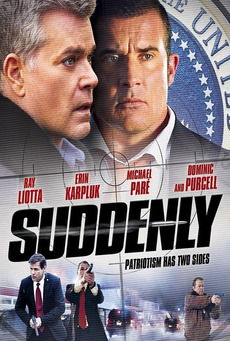 I can genuinely say that director Uwe Boll pleasantly surprised me with the last film I watched that had his imprint, Attack on Wall Street. It almost worked. It felt like Boll had maybe gotten over the hump of mediocrity, and sub-sub-mediocrity, that has become synonymous with his career writing and directing movies. Then one day, Suddenly suddenly popped up on Netflix, available for consumption, and 90 very tepid minutes later, my renewed hopes for a turnaround had been dashed and trashed once more.
The President of the United States of America is stopping by the sleepy mountain town of Suddenly. The secret service is canvassing the neighborhood to secure locations. Officer Todd Shaw (Ray Liotta) is working off another bender and may just get suspended. Ellen (Erin Karpluk) and her teenage son Pidge (Cole Corker) are living up on the mountain with a great view of the town. Agents Baron (Dominic Purcell), Conklin (Michael Pare), and Wheeler (Tyron Leitso, though he’s referred to as “Agent Young” several times) come knocking on her door to inspect. Except they aren’t real secret service agents. They’re posing to coordinate an assassination on the president, a hit ordered by the “Committee” that they work for. The assassins in suits lock Ellen, her son, and her elderly father (Don MacKay) in the basement, and wait for the president to arrive. There’s just the problem of keeping their cover and making sure Todd doesn’t intervene. Oh, and the town has a shop that advertises “fetish” in its name. So there’s that.
 Given the assassination premise, Suddenly is shocking in just how overwhelmingly boring it is. There’s a noticeable lack of urgency in just about every scene despite the stakes of men with guns threatening people’s lives. A solid majority of the movie is an almost comically low-key hostage situation where we watch Ellen’s family bumble around the basement as captives and try to outsmart the relatively dimwitted assassins. It’s nothing quite along the lines of, say, Home Alone, but it feels comically off in tone, aided by an inappropriate musical score. These people don’t ever feel scared or panicked, and their conversations show it. The stupid grandfather character in this feels like he was plucked from a different, more broadly comical movie. Oh look, he’s fussing about with things; oh look, now he’s going to tell one of his old stories. In the context of a hostage thriller, it doesn’t work. Grandpa half-heartedly relates a tale about being snowed in with grandma where, surprise, they got out (the man is standing there after all). “See, it all works out in the end,” he reasons with no convincing evidence. And then (spoilers) he dies in the most idiotic way possible. During a light scuffle, he gets shoved and falls over. “He has a heart condition,” Ellen screams, informing us for the first time of this malady. I’m thinking he’s faking, so as to strike when the attacker draws near. Nope, he just lies there and dies in the most pathetic way possible, as if the plot had just decided it didn’t need him after all. One of the armed men actually tries to revive him, how nice.
Suddenly literally takes its sweet time getting to that presidential moment, saving that for the last few minutes of the film. Almost all of Raul Inglis’ (The Killing Machine) screenplay revolves around one scenario: will the bad guys’ cover be blown as different people keep finding their way back to Ellen’s secluded home. Oh no, the deputy will spoil things! Oh wait, he’s easily fooled. Well thank goodness that problem was solved in a not interesting manner. This takes up an hour of the movie, and it’s rather repetitious without any escalation. The entire setup feels like a series of lame stalling techniques to save the good stuff for the very end, rather than dealing with reversals and rising action. Then there’s the nature of the ending, which is so abrupt and without a single trace of resolution. As soon as that shot’s fired, the film ends a minute later. We learn via the news that the gunman shot himself… in the chest? At a distance? None of this holds together and the ending does not justify the time it took, and wasted, to get to that point.
There is exactly one point where this movie flashes the kind of quality story it could have been and it happens 70 minutes into the picture. Baron miraculously deduces how Ellen’s husband was killed: friendly fire, and Todd was the culprit. It was naturally an accident, one that haunted Todd deeply, but he returned home and everyone started throwing around the word “hero.” So he kept the truth to himself. Now, right there is an interesting premise that could produce a flurry of intriguing and complicated drama. Todd would live his day feeling like a fraud but also not wanting to disappoint his loved ones, the people he cares about, and so hiding the truth could be a justifiable evil, or could it? This little reveal of character backstory is only intended to explain Todd’s penchant for drinking, and the movie just skirts along a few minutes later, already over this revelation. Suddenly should have dropped all of the cheesy and half-baked thriller aspects and gone in this other direction.
 The villains in this movie lack conviction and competency. First of all, they just leave Ellen and her son and father unattended in the basement rather than tying them up. Then there’s just their general unconvincing nature when speaking with locals. They pose as secret service agents but there are actual secret service agents still in their midst. These turncoats are plotting to murder the president because the “Committee” they work for has demanded such. This phantom “Committee” is only known through one agent, Baron, and each man is selected for duty. They have a cause, though none of them can articulate exactly what that would be. At one point Conklin insists not killing the hostages because it would be bad PR and dissuade the public to the merits of their unexplained cause. Are these guys thick enough to think that killing the United States president will win over the public, just as long as they have good reasons for killing the president? It seemed obvious that Baron was going to be the lone person of this “Committee,” and yet the film doesn’t even tie up this loose end. We never know whether Baron was making it all up or whether there is a clandestine organization that has its sights set on the president.
Boll’s diffident direction mirrors the lack of enthusiasm throughout the production. This just doesn’t come across as a story that separates itself from your bargain basement, straight-to-DVD action flick. In fact there isn’t any action in the movie short of a few tidy scenes. And as far as thrills and suspense, they’re undercut at just about every turn, thanks to the lack of urgency and the comical misuses of Ellen and her family. At no point will you be watching Suddenly and get the sensation that anybody really cared about making this movie as best it could be. Usually Boll’s movies feel pasted together and derivative of other, better movies and visual influences; this movie is too dull to even be derivative. The movie even has the temerity to reuse that trite cliché, having the villain remark, “Under other circumstances you and I could have been friends.” The dumb villains, the dumb characters, the lackluster pacing and suspense, the lack of resolution, it all contributes to making what is easily the most boring movie in Boll’s filmography.
Usually these kinds of thrillers are churned out into the straight-to-DVD market, a glut of recycled plots and tortured/reluctant action heroes. There’s a formula that works and there’s been a proven audience that enjoys something cheesy, thoughtless, and familiar. And that’s what puzzles me even more about Suddenly because every somnambulist second of the film leaves you with the stark impression that nobody cared. The tale of a hostage thriller mixed with a presidential assassination, with some war drama thrown in, could work as far as the genre goes. All you need is a solid premise and some gung-ho execution, which explains why we had two Die–Hard-in-a-White-House films last year. Suddenly is nothing special, which we all suspected from the particulars involved, but it’s not even worthwhile or workable genre pap, which is even more insulting. From the wacky grandfather to the idiot villains who blindly trust their leader to the abrupt ending, or how about the fact that a kid is named Pidge, this is just one bad movie.
Nate’s Grade: D
Share this:

Assault on Wall Street (2013)
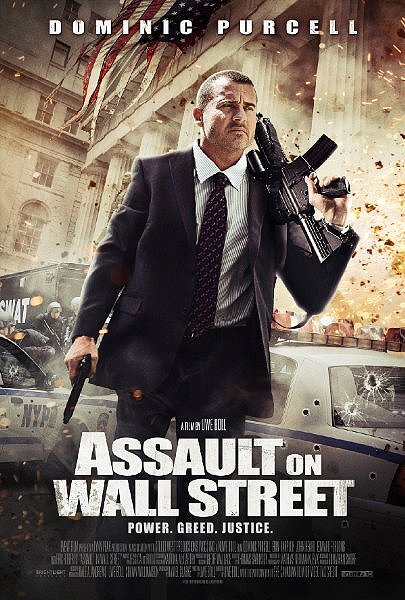 When it comes to notorious German director Uwe Boll, many are still waiting for what could be the man’s first genuinely good movie. The man has been prolific over the past ten years but sure-fire candidates for First Good Film, like Max Schmeling or Attack on Darfur, inevitably have some tragic flaw or approach that places them back in mediocrity, the company of many of Boll’s other movies. After reviewing more Boll films than a human should be allowed to willingly, I feel like I’ve been beaten down enough that when I find something that genuinely works, be it an actor or a sequence or plot turn, that I should be just as vocal as with the contingent of failure. So allow me to refreshingly applaud Boll for Assault on Wall Street, on coming up with a topic and a story structure that… actually… works. It not just works, it succeeds, and if a more polished professional screenwriter got a hold of this, I think it could actually impress the masses. If it weren’t for the surprisingly effective war drama, Tunnel Rats, I’d say without a doubt that Assault on Wall Street is the best work of Boll’s much-maligned career. And yet… it has just enough minor faults that hold it back.
Jim (Dominic Purcell) is a regular guy working as an armored security transport. His wife Rosie (Erin Karpluk) suffers from a rare tumor that requires an expensive series of injections to keep it at bay. Their insurance company won’t pay, and so they have to rely on Jim’s savings. Except those are gone as well. Jeremy Stancroft (John Heard) has ordered all his brokers to dump toxic assets, eliminating most investor savings but profiting the shareholders. Jim and Rosie are broke. Vowing vengeance, especially after some drastic decision-making by Rosie, Jim sets off to make the high-priced traders and corporate raiders on Wall Street feel the pain of what they have wrought.
 The setup is concise and Boll does a nifty job of compounding Jim’s problems and showing how all the industries are interconnected to put the squeeze on. Because of unscrupulous health insurers, his wife’s medical treatment, deemed experimental, is quite expensive and they’ve reached a cap. With the brokers pushing their clients assets into junk stocks, at the behest of the betters and for commissions, Jim loses his entire financial cushion. He hires a lawyer (Eric Roberts) but has to pay $10,000 just to retain him to fight the $60,000 penalty his broker says is owed. He goes into debt and refinances his skyrocketing mortgage (variable rate) to pay for his wife’s treatments. His employer takes notice of his perilous situation and is uncomfortable with enlisting someone in deep financial woes with guarding money. He loses his job. The bank is poised to foreclose on the house. His wife won’t get her treatments to save her life. All of this leads to a drastic and completely understood decision of desperation and sacrifice. Admittedly, Boll does a compelling job of connecting all the dots, making each new pitfall a result of the previous, each compounding the misery of Jim. It takes a little long to go through all these points, and I think Boll could have trimmed it down so that a key event happens at the Act One break point, but I was flabbergasted that the man found a story structure that succeeds.
The second half of the film is Jim planning his vengeance, and after all of the callous movers and shakers have bled him dry, you’re onboard for some sort of righteous payback. Boll takes on Wall Street and the healthcare industry (double the populist outrage). Jim as a character could be made much more compelling, but he’s really serving as a symbol for how the forces are ganged up against the little guy, how the fix is in. When confronted, the big CEO of the brokerage firm barks that it’s always the same old story, that the titans of industry were all crooks and manipulated the system to their advantage, and he’s no different. In short, the little guy always loses.
What holds back Assault on Wall Street, beside the fact that the titular assault is reserved for the last fifteen minutes of the film, is its too slick ending and Boll’s obvious transparency when it comes to his political message. After Jim suffers loss after loss, he puts together a plan pretty quickly, utilizing that Army training we’ve heard about. It’s actually too easy with little complications that can’t be solved in a David Fincher-style montage of death. It’s a full 70 minutes before he takes out his first Wall Street fat cat, and that’s just way too much dawdling. And then from there the climax involves Jim just going on a rampage in an office building, shooting several faceless employees who could very well be innocent for all we know. I think Boll is satisfied with a guilt-by-association catch-all for Jim’s fury, but it would be more satisfying just from a payoff standpoint if we saw these people in villainous lights prior, kind of like what Saw 6 did with its insurance characters before turning the tables on them. The last thing we need in our populist screed is to worry that the wrong people were dispatched. And what kind of office building fails to evacuate after a confirmed shooter has attacked?
 This storyline could have also worked in a Falling Down turn, where a man consumed with evening the scales of a system broken loses his moral bearing and lumps all guilty parties together and condemns them all. Perhaps it was meant to examine the slippery slope of vigilante justice and how this too can decay one’s sense of self, sort of like what Jodie Foster went through in 2007’s The Brave One. However, I don’t think Boll was intending this direction because he’s not very subtle about anything in the movie. Oftentimes the characters just become mouthpieces for ideological talking points: “We’re busy busting some homeless guy when the real criminals are on Wall Street.” The bad guys actually say, with no hint of self-awareness, “We all took a loss. When I told my wife we couldn’t vacation in Barbados any longer…” It’s all just a little too on-the-nose to remind you of the overall intent rather than the story. Therefore, I think Boll is just going for a sense of (misplaced?) justice in the end, in a ludicrous plan that somehow invalidates witnesses, forensic evidence, and security footage to pin the blame on someone else. It’s too clever by half that it undercuts the final payoff. It gets even worse with the Batman-esque voice over to close out the film with a promise to all evildoers.
With such a tight focus on the plot, the acting is a marked step up from previous Boll outings. Purcell (TV’s Prison Break, Killer Elite) doesn’t exactly come across as a regular Joe but he has enough onscreen presence to pull off his character’s anguish as well as the requisite badass stuff. And apparently Boll has become fond of him because Purcell is scheduled to appear in future Boll films. Karpluk, a Canadian actress best known for the TV show Being Erica, has a natural grace to her, forgoing big moments to concentrate on the gnawing guilt and concern her character feels. While she’s a bit too willfully ignorant early on, Karpluk makes you care and provides whatever depth can be applied to Jim. I’m actually curious to see her comic skills since she has a face tailor-made for romantic comedies. Heard (Sharknado, Home Alone) doesn’t seem to embrace his duplicitous CEO role with enough gusto, appearing to be annoyed when he should be menacing. This is not the kind of movie to hold back.
There are plenty of other Boll Players, including Edward Furlong (3 appearances), Lochlyn Munro (2 appearances), Tyron Leitso (5 appearances, also stars in Being Erica), Michael Eklund (8 appearances), Natassia Malthe (4 appearances), and the stalwarts of Clint Howard (6 appearances) and Michael Pare (13 appearances). It’s been 13 years since Eric Roberts (The Dark Knight) last appearance in a Boll film. Most of these are blink-and-you’ll-miss-them, but then there’s Keith David (The Thing, Cloud Atlas) in a thankless role that didn’t need to exist. But hey, I’ll take Keith David in anything.
A welcome surprise, for the most part, Assault on Wall Street is a finely structured revenge tale with clear and precise plot points and a natural buildup. It’s Boll on a soapbox and the naked transparency of his ire and populist messages limits the effectiveness of his storytelling, but you might not mind, especially if you are a person who has slogged through far less competent Boll ventures. There is a marked improvement in just about every facet of filming. It genuinely works, that is, until the pacing becomes lopsided and the end just reverts to celebratory action mode. A more professional writer could take this film and whip it into a crowd-pleasing populist thriller. It’s got so much that works, and genuinely works well, that I feel like a buzzkill to keep harping on the elements that do not succeed. But if Boll wants to earn an undisputed victory, he’s got to earn it without lowered standards. Assault on Wall Street is so tantalizingly close to being Boll’s First Good Film but it doesn’t capitalize enough.
Nate’s Grade: C+


 nathanzoebl
You must be logged in to post a comment.