In the Blink of an Eye (2026)
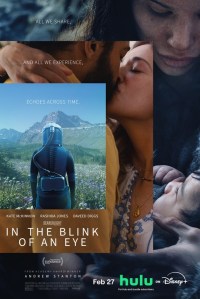 Having a sprawling meditation on the nature of humanity with a story spanning thousands of years sounds intriguing, at least for the ambition alone. Add in director Andrew Stanton (WALL-E, Finding Nemo) in his first live-action movie since 2012’s John Carter and there’s a greater curiosity factor. Unfortunately, In the Blink of an Eye is like speed-running through Cloud Atlas and losing all the connectivity and conflict. We have three storylines that we bounce between: 1) a Neanderthal family from 47,000 years ago, 2) Rashida Jones as a research scientist in modern-day, and 3) Kate McKinnon aboard a colony spaceship around 2400. Naturally, you would think these storylines would impact one another or at least find unexpected and interesting parallels, braiding together to demonstrate our shared humanity through past, present, and future. Yet it doesn’t really materialize, as the storylines feel too separate and fail to come together in a clever, satisfying, or enlightened way. As a result, In The Blink of an Eye now has three underdeveloped stories slammed together and butting in on one another over a still too tedious 94 minutes (about 75 minutes shorter than Cloud Atlas, by the way).
The problem is there isn’t much to learn from any of these storylines and they lack important conflict. The oldest, with the Neanderthals, has births and deaths, but it’s mostly a family sitting along a coastal forest. This entire storyline is also in an ancient language without subtitles, limiting its scope and impact. Next, the present-day story is an un-engaging romance between Jones and Daveed Diggs while she prepares to lose her mother. This dull relationship moves in such jarring starts and stops so it doesn’t feel believable, with Jones’ character more a prickly, socially-challenged egghead. The final storyline in the future has the most conflict with McKinnon having to figure out life-and-death stakes with depleting oxygen on her colony ship. With twenty minutes left to go, I kept thinking, “Everything is going too well in all three stories. We must be heading into Act Three disaster.” Nope. It’s such a strange movie experience because only one of the three stories has some danger and emotional involvement, with the middle only serving to provide some historical context for the oldest storyline (Neanderthals weren’t actually intellectually inferior, ya’ll) and vaguely set up the future. So we have an airy, slightly experimental movie driving at something more thematic and revelatory than a typical three-act structure following characters through momentous plot events. Despite some shared themes of grief, mortality, family, and legacy, the movie doesn’t have the space to really say anything meaningful, so its efforts at sentimentality feel mawkish and awkward, meant to salve the missing emotional investment. The characters thus become more symbolic and even less relatable. Even worse, it’s all so boring. We literally go from one scene where parents discuss their teenage son’s porn habits to the next scene where this same son, now an adult, is leading a Ted Talk about defying the laws of aging. They grow up so fast?
Lacking more thoughtful integration and contemplation, In the Blink of an Eye feels less like a film story and more like some overly generalized, glossy advertisement for some inscrutable company. It’s vaguely human-like, vaguely emotionally affecting or uplifting in intent, and forgettable in a blink. Just watch Cloud Atlas.
Nate’s Grade: C
Share this:


Posted on May 30, 2026, in 2026 Movies and tagged andrew stanton, daveed diggs, drama, kate mckinnon, rashida jones, sci-fi. Bookmark the permalink. Leave a comment.


Leave a comment
Comments 0