Blog Archives
Toy Story 5 (2026)
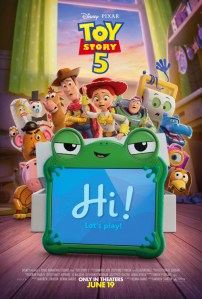
Every time Pixar resuscitates the storied Toy Story franchise, going on three decades now, I get a little wary of them upending the good will. The series had a perfect ending in the third edition in 2010, but being Pixar’s golden and most bankable franchise, it wasn’t allowed to remain an ending. I quite enjoyed the fourth edition in 2019 and consider it a fitting and poignant sendoff for Woody, if, of course, they could accept this as his settled ending. Now in 2026, here comes a fifth Toy Story, and my emotions are decidedly mixed, excited for the creative possibilities of another entry in Pixar’s flagship series and girding myself in anticipation of whether or not these fitting and earned endings are disturbed. Perhaps I’ve been overly protective of these endings, or perhaps it’s just a reflection of our modern IP-revivial cycles that studios cannot accept anything that makes money having finite story endings. Well, while I believe Toy Story 5 to be likely the weakest of the five films, it’s still a marvelous movie that elicited tears from my grown-up eyes on more than one occasion.
Now that Woody (voiced by Tom Hanks) has settled into a new life, the plucky leader of Bonnie’s toys has become the next cowgirl in line, Jessie (voiced by Joan Cusack). Life is good until Bonnie’s parents introduce an educational tablet device, Lilypad or “Lily” (voiced by Greta Lee). They want Bonnie to socialize more and make friends with the neighbors, something she’s having difficulty achieving. Bonnie becomes enthralled with her first smart screen, spending hours upon hours with it inches away from her unblinking face. Jessie sees the new tech as an enemy to traditional play time, as Bonnie’s toys have been chiefly neglected as she devotes all of her attention to this new shiny device. She plots to remove the Lilypad; however, Lily has her own ideas about what Bonnie needs, and it involves getting rid of the outdated toys of childhood so she can be better accepted by her more tech-adopting peers.

Right away, Toy Story 5 provides a meaningful reason for its own existence, examining the immersion of technology and in particular screen time into the development and maturation of children. It’s a substantial issue today for millions of parents, and a genuine worry about whether or not these magical electronic devices are helping or hindering childhood development. Are we building synapses with these games and social media apps or are we building a dependency and despondency when un-synched? It’s an age-old question over whether technology is facilitating growth or substituting for it, an especially pertinent question in the realm of education that ruling parties go back and forth with. This is a fabulous and thorny issue to explore in the Toy Story universe, and with co-writer/co-director Andrew Stanton (WALL-E, Finding Nemo) at the helm, there’s an assurance that all will be handled with wit and warmth (Stanton has co-written all five Toy Story movies, though this is his first directing credit). I actually think this movie utilizes its central premise better than Toy Story 4 did with the murky existential questions with Forky over what constituted play and thus was granted existence and consideration. Now, that movie transformed into a different and more emotionally resonant theme about broken toys still having purpose and dignity after being cast off from their owners, a disability empowerment message that was beautifully handled, so much so that I forgave the dropped exploration of thorny prior themes. With Toy Story 5, the question over the role of tech is front and center throughout.
At the core of this movie is the question of growing up and the malignancy of time. Lily wants Bonnie to be accepted and thus happy, and her reasoning is that these other toys are a detriment to this goal. In her view, they are dragging Bonnie down and imprisoning her in a juvenile state that her peers have already graduated from. For Lily, growing up is a process to be hurried, to become more like a “grown kid,” and thus more like everyone else on the block who has adopted tech and screens earlier in their lives. For Lily, Bonnie, even only at a mere eight years old, is already behind in her maturation process and she’s desperate to get her caught up. For Jessie, it’s about holding onto the status quo as long as possible. For three sequels now the movies have explored the nature of change, acceptance, and identity, and it’s still a wellspring of insight and emotional and intellectual relevance. Having Jessie be the primary protagonist of this sequel was a brilliant choice because she’s the toy who has been defined by abandonment issues. She’s been left behind by two other kids, first Emily and then Andy, and she’s afraid history is repeating with Bonnie’s dwindling attention now that tech has entered the home. There’s a clear parallel with the original Toy Story when Woody became jealous and insecure about the shiny new toy of Andy’s fascination, Buzz Lightyear (voiced by Tim Allen). Oh, and thanks to 2022’s Lightyear, we now know all these toys were the discount knockoffs of Chris Evans’ voice and that this original movie that Andy declared his favorite was not quite worthy of his adoration. Anchoring the major theme onto Jessie’s existing emotional attachment issues is smart, and it allows the fifth film to serve as a means of long-delayed closure for the cowgirl much as Toy Story 4 was a means of closure for Woody. It’s about confirmation that these relationships they build with their kids are not one-way, and that even after they end, and everything has an ending whether we like it or not, we know that they have mattered. No one, not even toys, wants to feel disposable.

I especially loved the imaginary play sequences in the film, highlighted by a different animation style. It’s painterly and with pastel colors, and it’s a great artistic choice to visually code the imaginary sequences from the standard reality. I loved how chaotic and silly these sequences were, converging escalating threats, dramatic twists, and ridiculous double crosses and resolutions, perfectly embodying the wild mind of a child in the midst of imaginary play. These little interludes were welcomed at every turn.
I did say Toy Story 5 was the weakest entry in the franchise, again no shame being a bronze medalist at the Olympics, so to speak, as you’ve gotten ahead of so many others to attain this honor. I enjoyed the lowered stakes of simply trying to tell a story about two factions fighting over what they felt was best for the mental well-being of a child. There’s something inherently sweet about a movie whose big goal is to just help a shy little girl make some friends. I do wish there was more persistent commentary on what screen-addiction has done to a generation of kids at an important time besides turn the neighborhood girls catty and mean. Bonnie, you are not the “weird kid” just because you prefer playing outdoors. At no point is Jessie really threatened with annihilation, and even as she’s lost she still finds a new and nurturing owner that could possibly even replace Bonnie. Because of those lowered stakes, the script can feel a little like an expanded TV episode where a character learns a valuable lesson. The supporting characters are sidelined with few exceptions. This is the second movie in a row that merely gives Buzz a jokey storyline, this time working up the courage to ask Jessie to be his wife. It’s more a recurring joke at his fumbling awkwardness. It feels like Pixar knew it was giving the character such a short shrift, which is why they also included an ongoing subplot of a group of Buzz Lightyear action figures bandying together to go searching for “star command.” Until finally tied into the action at the very climax, they’re a diversion that is never really as funny as it could have been. I will also firmly proclaim my stance that Woody should not have returned for this sequel. He offers little to the story, beyond to once again reflect upon how old he has gotten, which itself is just turned into a repeating joke. Woody’s involvement is wasted and his perspective isn’t different enough that some other toy, perhaps Buzz, could have fulfilled his role and left the former sheriff in retirement with Bo Peep.

Does Toy Story 5 upend the cherished endings of its predecessors? No, not really. Those endings still have meaning because the audience has invested relationships with these characters over thirty years. The latter sequels, in my mind, have served as closure vehicles for individual characters, and I think that’s a smart way to handle the franchise. Of course, I also think just telling original stories with new characters in this universe would be even more appealing, but the likelihood of that seems slim when Disney wants to sell another billion dollars in merch with their established and beloved characters. It’s probably naive to think this movie will ultimately be the franchise’s last, so instead I’ll just hold out hope that its ongoing quality will persist, and as long as Stanton and other Pixar brain-trust remember its innate and lasting appeal, I have a buoyant sense of hope that newer editions can still capture that initial magic that began in 1995.
At the conclusion of Toy Story 3, which I still gauge as the best in the series, it made me reflective and want to break out my old neglected toys, giving them one more hurrah of play. At the conclusion of Toy Story 5, it made me reflective, but I didn’t want to reach for any old toys and give them an extra dose of affection; it made me want to grab my toddler and soak up the time I have available with him, now, in this moment, while there’s a childhood to relish before it too vanishes at the mercy of time. This movie is all about the struggle over childhood, one side hoping to elongate it and the other hoping to rush through. From a different perspective, like a parent, it’s inevitably a losing battle, but it makes me reflect more on cherishing those moments while they are available. That’s pretty deep for a movie with a talking electronic poop assistant voiced by Conan O’Brien. Not too shabby, Pixar. Here’s your billion dollars.
Nate’s Grade: B+
Share this:

In the Blink of an Eye (2026)
 Having a sprawling meditation on the nature of humanity with a story spanning thousands of years sounds intriguing, at least for the ambition alone. Add in director Andrew Stanton (WALL-E, Finding Nemo) in his first live-action movie since 2012’s John Carter and there’s a greater curiosity factor. Unfortunately, In the Blink of an Eye is like speed-running through Cloud Atlas and losing all the connectivity and conflict. We have three storylines that we bounce between: 1) a Neanderthal family from 47,000 years ago, 2) Rashida Jones as a research scientist in modern-day, and 3) Kate McKinnon aboard a colony spaceship around 2400. Naturally, you would think these storylines would impact one another or at least find unexpected and interesting parallels, braiding together to demonstrate our shared humanity through past, present, and future. Yet it doesn’t really materialize, as the storylines feel too separate and fail to come together in a clever, satisfying, or enlightened way. As a result, In The Blink of an Eye now has three underdeveloped stories slammed together and butting in on one another over a still too tedious 94 minutes (about 75 minutes shorter than Cloud Atlas, by the way).
The problem is there isn’t much to learn from any of these storylines and they lack important conflict. The oldest, with the Neanderthals, has births and deaths, but it’s mostly a family sitting along a coastal forest. This entire storyline is also in an ancient language without subtitles, limiting its scope and impact. Next, the present-day story is an un-engaging romance between Jones and Daveed Diggs while she prepares to lose her mother. This dull relationship moves in such jarring starts and stops so it doesn’t feel believable, with Jones’ character more a prickly, socially-challenged egghead. The final storyline in the future has the most conflict with McKinnon having to figure out life-and-death stakes with depleting oxygen on her colony ship. With twenty minutes left to go, I kept thinking, “Everything is going too well in all three stories. We must be heading into Act Three disaster.” Nope. It’s such a strange movie experience because only one of the three stories has some danger and emotional involvement, with the middle only serving to provide some historical context for the oldest storyline (Neanderthals weren’t actually intellectually inferior, ya’ll) and vaguely set up the future. So we have an airy, slightly experimental movie driving at something more thematic and revelatory than a typical three-act structure following characters through momentous plot events. Despite some shared themes of grief, mortality, family, and legacy, the movie doesn’t have the space to really say anything meaningful, so its efforts at sentimentality feel mawkish and awkward, meant to salve the missing emotional investment. The characters thus become more symbolic and even less relatable. Even worse, it’s all so boring. We literally go from one scene where parents discuss their teenage son’s porn habits to the next scene where this same son, now an adult, is leading a Ted Talk about defying the laws of aging. They grow up so fast?
Lacking more thoughtful integration and contemplation, In the Blink of an Eye feels less like a film story and more like some overly generalized, glossy advertisement for some inscrutable company. It’s vaguely human-like, vaguely emotionally affecting or uplifting in intent, and forgettable in a blink. Just watch Cloud Atlas.
Nate’s Grade: C
Share this:

Finding Dory (2016)
 Victims of their own meteorically raised expectations, there’s still never been such a thing as a “bad Pixar” movie, and yet that doesn’t stop a growing lower tier from emerging, mostly the non-Toy Story sequels. I was wary about their latest, Finding Dory, mostly because I wasn’t completely enamored with its predecessor and also because it felt like writer/director Andrew Stanton was resorting to safe territory after helming the high profile flop, John Carter. It’s an amusing, cute, and effortlessly beautiful movie to watch but the threadbare plot reminds me of those direct-to-DVD sequels that were born from many a Disney animated classic from the 1990s. This is simply a story that didn’t need telling, much like Monster’s University, Cars 2, and The Good Dinosaur. This narratively fishy fish tale is firmly in that lesser league of Pixar cinematic adventures. I laughed here and there and there are some emotionally resonant moments as Dory looks for her missing parents, but so much of the plot feels transparently utilitarian, moving pieces around, and without the imagination and wonder the original provided. Hank the octopus feels less like a fully defined character and more a merchandizing opportunity. The majority of the plot takes place at a marine park, which limits the discoveries. Where are the narrative payoffs and economical storytelling of Stanton’s masterpiece, WALL-E? There’s an emotional lesson during the third act that would have hit harder had the filmmakers had the courage to see it through. I was picking up a heavy parallel with Dory and raising children with special needs. I would imagine much like the brilliant Inside Out that parents might get more out of the film’s emotional relationships than children. Finding Dory is fun and difficult to dislike, what with its loveably optimistic lead character; however, it does too little thematically to separate itself from a sea of imitators.
Nate’s Grade: B
Share this:

John Carter (2012)
 John Carter has been in the longest development hell of any movie project in the history of cinema. If nothing else, that’s at least an accomplishment. Author Edgar Rice Burroughs first published his tale of interplanetary adventure in “A Princess of Mars” way back in 1912. It was his first published work, even before the phenomenon that would make him a star, Tarzan. Ever since 1931, filmmakers have been trying to realize Burroughs’ grandiose sci-fi vision but have never been able to finish. In the last decade, the movie has gone through different stages of development, with Robert Rodriguez, Kerry Conran (Sky Captain and the World of Tomorrow), and Jon Favreau attached as director at different points. Then Disney snatched up the rights and hired one of its own, Pixar director Andrew Stanton, to do what nobody has been able to do for 80 years –bring Burroughs’ vision to the big screen. It doesn’t hurt when Disney gives you a reported $250 million to spend.
John Carter (Taylor Kitsch) is a Civil War veteran haunted by his past. He’s chased by a group of bandits and stumbles into a cave that transports him to Mars, known as Barsoom to the natives. Carter discovers that he’s found himself in the middle of another civil war, this time between the cities of Zodanga and Helium. The Tharks are a race of 10-foot tall four-armed warrior creatures, and their leader, Tars Tarkus (Willem Dafoe), sees Carter as the turning point in getting his people’s lands back. Carter will also help solidify Tars Tarkus’ place as leader to his people. John Carter is a coveted free agent on the red planet. Princess Dejah Thoris (Lynn Collins) wants John to help her people survive against the Zodangans, lead by Sab Than (Dominic West). Dejah’s father (Cirian Hinds) has brokered a shaky peace on the promise that she and Sab Than will marry. The mysterious Therns, lead by Matai Shang (Mark Strong), are the real power players on Mars. They have offered a powerful new weapon known as the “ninth ray” to give Sab Than the upper hand. All John really wants to do is return home, but first he has to find a way back.
 John Carter is an amusing, entertaining throwback to old-fashioned B-movies. Even the depiction of life on Mars is charmingly retro, what a future would look like to a man from the early twentieth century perspective. As a result, the aliens fight with Bronze era weapons and guns that behave like trinkets from a Western. Even the minimalist alien design, the Roman-esque costumes, the fact that everyone can breathe air, and low-grade technology of these advanced species (flying machines that look like Da Vinci designed them) come across as nostalgic, vestiges of the past more so than insights into the future. It’s like watching those old sci-fi TV shows from the 1950s and how they predicted man would have colonized the solar system by now and already have a working lunar colony (Newt Gingrich is trying his best). The movie channels the spirit of old adventure serials and captures a certain gee-whiz, childlike sense of fun. There are moments where Stanton has a playful sense of storytelling, like a near montage of Carter’s determined escapes from officer Powell (Bryan Cranston? Why not?). While being PG-13, there is still a feeling of the Disney-fication of the tale, complete with tamer outfits for Dejah Thoris (do a Google image search) and an adorable alien “dog” sidekick that befriends John.
The best moments are easily the scenes where John integrates into the indigenous Thark tribes, finding a sense of community and a bonding with Tars Tarkas. If the movie had only featured this alien race instead of all those warring people-who-have-red-henna-tattoos-on-so-they-must-be-aliens-right, I think the movie would have succeeded better. One alien race focuses the narrative but instead we get four (three?). When our climax does come into view, the pieces have all fallen into place and the action is suitably thrilling. Stanton’s live-action debut isn’t the homerun that Brad Bird’s Mission: Impossible 4 was, but the large-scale action is satisfying and imaginative enough. The payoffs work and Stanton has nicely intertwined his storylines so that everything comes to a head. The Earthbound framing device, with Edgar Rice Burroughs (Daryl Sabara) reading the diary of his rich departed Uncle John, enriches the narrative once the full context is revealed, gearing up the audience for a long-awaited reunion to end the movie on a perfect high note.
What John Carter also has going against it is the pull of time. It’s hard not to see how derivative the story and characters are; Burroughs’ original novels were hugely influential to science fiction writers, and you can see similarities in Star Wars, Avatar, and other works. Scenes in this movie will feel like rip-offs from other movies, like an arena battle with giant alien hordes from Attack of the Clones, riling up a native alien species against its imperial antagonists in Avatar, Deja Thoris clearly has her DNA all over Princess Leia, and the dynamics of jumping through space travel via gateways made me think of how excellent a movie Stargate was (watch it again; it’s terrifically executed). Carter can easily be credited as the predecessor to superheroes. Now it’s unfair to say that John Carter rips off these other sci-fi movies when every one of them was released long after Burroughs’s novels had been widely published. It’s unfair, but you can’t help but feel the way you feel, and I was feeling a fairly resounding sense that I had seen much of this tale before and better. The actual terrain of Mars is a little less than inspiring. Its rocky vistas don’t make it feel too noticeably alien. We don’t ever really get a good view of alien culture outside of the Tharks. John Carter’s one big addition is that the character, given his physiological makeup and Mars’ gravity, can leap to impressive heights that were only previously known by Italian plumbers in video games. This means we get a lot of John Carter jumping up, jumping around, jumping like a Martian jumping bean. But just because you can jump really high, doesn’t that mean you’d be plummeting at a high rate of force? Wouldn’t John seriously break his legs leaping 500 feet in the air and then landing?
 The script, credited to Stanton, Mark Andrews (co-director of Pixar’s upcoming Brave), and Pulitzer Prize-winner Michael Chabon, is weighed down with expositional slog that it cannot break until the third act. I was expecting a better and more graceful story given Stanton’s previous film, WALL-E, which could be taught in film classes as a textbook example of elegant visual storytelling. With John Carter, it feels like we’ve been hit with the Martian phone book. We’re inundated with unfamiliar names and given scant time to adjust. While a gamble that the audience intelligence will catch up, it also makes for a confusing half of a movie. It’s hard to keep track of all the different names; Tharks this, Hellium that, Zodanga this, Jeddak that, Therns here, Barsoom there, etc. The movie doesn’t gradually expand its Martian history, it just plops us, along with Carter, right into the middle. The opening structure is also a bit confusing, as we’re jumping around time without any proper setup. Still, the movie cannot be accused of being stupid; hokey and convoluted, yes, but not stupid.
And boy do we get a lot of talking for an action movie set on Mars. The middle section is quite heavy with yapping. Kids who came thank to their trust of the Disney name will probably be bored as the movie explains to us things we already know and things we don’t care about knowing. For a two-hour plus film that has a lot of political infighting, I’m surprised that the movie is pretty pedestrian when it comes to its politics. It all really comes down to an arranged marriage to broker peace. That’s not very complicated. The main villains, the ghostly Therns, are completely incomprehensible when it comes to motivation. I have no idea what they stood to gain. If they have a gateway that can take them to Earth, or they have their own copies on Earth, why aren’t they using this to their advantage? Why aren’t they grabbing more Earthmen to form an army of jumping Jacks? Why the significance of the “ninth element” when we all know the fifth element is love? But more importantly, as last year’s Green Lantern proved, it hurts your movie when your hero can’t be bothered to be heroic. It takes far too long for John Carter to seem like he gives a damn about anything. I understand he’s a war-weary vet, but the movie feels like 90 minutes of him shrugging while everyone on Mars desperately pleads with him to save them.
Kitsch (X-Men Origins: Wolverine) is going to be having a fairly big breakout year given his mug appearing in several high-profile, high-budgeted movies. The guy has already proven with steady work on TV’s Friday Night Lights that he can act, though the results are not so convincing with John Carter. I think he was going for some sort of gruff, Clint Eastwood-esque loner but he just comes across as wooden. Add his character’s reluctant nature, and it makes for a pretty uninvolving hero. Fortunately for Kitsch (what an unfortunate last name), the supporting cast is there to pick up the slack. Collins (TV’s True Blood) is the real breakout star of the movie. She’s feisty and strong and passionate and altogether easy on the eyes she could give Leia a run for her money in a metal bikini competition. Collins’ performance is filled with urgency, like she’s compensating for our taciturn lead actor. When she’s on screen you feel engaged in the story. Dafoe (Spider-Man) finds the right mixture of humor and pathos as the leader of the Tharks. West (300) has such a slimy sneer to him, it’s magnificent to watch. I’m starting to think that Strong needs to take a break from playing villains (I count eight bad guy roles sine his breakout in 2008’s RocknRolla) except that he’s so good at playing them. I think if Mark Strong ever plays himself in a movie about his own life, he’ll inevitably be the bad guy.
John Carter is an entertaining throwback to the adventure serials of old, a retro sci-fi action film that falters somewhat from a talky, uneven, exposition-laden script. When this movie works, it works quite well. There’s just too much stuff in this movie, too many alien races, too much exposition, and too many other movies that make John Carter feel derivative. What was once amazing and imaginative in 1912 will not have the same effect on audiences in 2012, especially those who have grown up on pop culture inspired by John Carter. I don’t think anyone can say the final product was worth the wait, but John Carter is a modestly fun adventure. I wouldn’t mind taking another trip to Mars, just as long as it doesn’t take 80 years.
Nate’s Grade: B-
Share this:

WALL-E (2008)
 At this point, is there anything Pixar can’t do? They’ve explored the secret life of toys, what’s under the sea, the pains of rearing a family of super heroes, and of course a rat that dreams of becoming a chef. Seriously, anyone that can make that last one not only work but one of the most sparkling, imaginative, enchanting, and poignant films of the year deserves every accolade in the book. Pixar’s newest film, WALL-E, is certainly its most ambitious and potentially its most rewarding yet.
The year is 2700 and the planet Earth has long been left behind by mankind. Humans have exhausted their resources and left behind a planet that looks like one never-ending landfill. Skyscrapers are being built out of garbage cubes. The Waste Allocation Load Lifter – Earth class (WALL-E) robots have been left to toil away and clean up mankind’s mess. There is but one WALL-E robot left and it leads a solitary life of routine. It gets up, it compacts trash into cubes, and it assembles those cubes into eventual giant structures. Then one day a probe lands called EVE. This floating capsule-like robot is easily frustrated and quick on the trigger and WALL-E falls completely in love with his unexpected new companion. The two become close and then EVE is taken away unexpectedly. WALL-E hitches a ride on the ship that collects his beloved and journeys through space to save her.
 I was having reservations citing certain words of praise but this film deserves every ounce of praise; WALL-E is a masterpiece. This is a beautiful story told in a beautiful way in a beautiful looking movie. I imagine kids will be tickled by the funny robots but I really believe that this film will play much better for adults, and when was the last time a mainstream, American family film did that? Most “family” films are an excuse to do something lowbrow and cynical to make a quick buck, like the atrociously cringe-worthy trailer I saw for Beverly Hills Chihuahua (seriously, a civilization of singing/rapping Taco Bell dogs?). Pixar, and God bless them, are proving with each new release that family films need not be brain-killing hours. That reliable Pixar quality touch is never more present than with WALL-E. If you told me that a film that takes place on a trash-filled Earth, with minimal dialogue, and a romance between two robots would be the most thrilling, moving, and wonderful film of 2008, I would have scoffed.
Writer/director Andrew Stanton (Finding Nemo) relies on a universal visual storytelling language to tell the bulk of his tale. WALL-E plays like a gloriously enjoyable silent movie where body language and physicality advance the storyline and provide surprising depth; ignoring brief TV clips of Fred Willard and Hello Dolly, the movie doesn’t have actual dialogue until the 45-minute mark. And it is fantastic. The character of WALL-E is immediately empathetic and the audience will see slivers of themselves inside this independent robot that finds another reason for being. It’s a simple love story told in simple strokes, but it just so happens that Stanton has provided great emotional heft to those strokes. The film has such a huge and vibrant heart. More is said in indecipherable robot bleeps than in much of the tripe Hollywood calls dialogue. Watching WALL-E court EVE, a bit unsuccessfully at first, begins as cute, moves into being adorable, and ends up being greatly touching and flirting with the profound. How many other movies, let alone romances, end with the long-desired climax of two characters merely holding hands? This movie is a delight from beginning to end and a classic example of the power of expert storytelling.
When the film transitions into space is when the potent environmental message, and subversive satire, emerge. Beforehand we have witnessed the awe-inspiring landscape of Earth littered with garbage and empty shopping centers. Humans left the Earth to wait for the robots to do all the work and make the planet hospitable for life once again. For the last 700 years humans have been living in a heavy-duty luxury spaceship. Humans have grown to be fat, lazy, and completely self-involved; people only communicate with others through video screens, even when the other person is inches away. The movie also manages to satirize consumer culture, and in the future one corporate behemoth essentially dictates life’s choices; I found it highly amusing that the former president of the future (a live-action Willard) is also the CEO of the super corporate conglomerate. Business and government have merged completely. The social commentary isn’t as merciless as Mike Judge’s Idiocracy, nor is the environmental message subtle in the slightest, but the satire is sharp enough and blunt that some viewers might be offended, and I think that is genius.
Being a Pixar film, naturally WALL-E is resplendent to look at. The animation is superb and the imagination on display seems limitless. This is one of those films I’m certain I could watch again and again and find something new every time. I don’t really need to say much more about the visuals because they are breathtaking to behold (Roger Deakins, by the far the greatest living cinematographer, was even consulted to help with the look of the film. How awesome is that?).
 And yet even though WALL-E is primarily a love story the film also manages to be greatly exciting and equally funny. Stanton’s screenplay nimbly assembles characters and reintroduces them at key points to push his story onward. I loved that WALL-E is introduced to all sorts of unique robots on the mankind’s space ship and that he even stumbles into, more or less, a group of malfunctioning robots that come to his aid (think the Island of Misfit toys). Stanton manages to reconnect his storytelling threads so that every moment in this movie matters. The last third of the film is a back and forth cat-and-mouse struggle that manages to pump up suspense in smart ways. Stanton lays out his scenario for action and then builds organic complications. I am deeply satisfied when a filmmaker has a firm command of action that they can setup a situation, establish the rules, and then naturally construct obstacles and surprises that feel natural and germane to the story. Pixar has always been able to craft exciting action scenes that felt fully realized and WALL-E is no different.
If there is but one minor quibble I have with this near-perfect film, it is the missed opportunity to explore the mortality of robots. While WALL-E is going through his day-to-day duties he passes by older versions of other WALL-E models. The movie could have pushed just a little harder with the concept that this tiny robot is going to live to collect trash and then die like all the rest, becoming another piece of forgotten garbage. I think if Stanton had only explored this idea a little more it would have made his robo-love story even richer considering that both robots are going against their programming because they have found something that completely changed their world — love. The idea of mortality was explored to excellent effect in 1999’s Toy Story 2, so perhaps the Pixar folk didn’t want to fall into a philosophical repeat.
WALL-E is a wonderful love story, a heartfelt and immensely charming character piece, and a thrilling sci-fi tale that soars to broad heights of imagination. It’s timeless while still being rather timely thanks to its environmental message. Moments after the movie was over I wanted to see it again. I think I’ll feel the same way after the second viewing and the third. This is a phenomenal movie that will stand the test of time as one of the greats.
Nate’s Grade: A


 nathanzoebl
You must be logged in to post a comment.