Monthly Archives: May 2026
In the Blink of an Eye (2026)
 Having a sprawling meditation on the nature of humanity with a story spanning thousands of years sounds intriguing, at least for the ambition alone. Add in director Andrew Stanton (WALL-E, Finding Nemo) in his first live-action movie since 2012’s John Carter and there’s a greater curiosity factor. Unfortunately, In the Blink of an Eye is like speed-running through Cloud Atlas and losing all the connectivity and conflict. We have three storylines that we bounce between: 1) a Neanderthal family from 47,000 years ago, 2) Rashida Jones as a research scientist in modern-day, and 3) Kate McKinnon aboard a colony spaceship around 2400. Naturally, you would think these storylines would impact one another or at least find unexpected and interesting parallels, braiding together to demonstrate our shared humanity through past, present, and future. Yet it doesn’t really materialize, as the storylines feel too separate and fail to come together in a clever, satisfying, or enlightened way. As a result, In The Blink of an Eye now has three underdeveloped stories slammed together and butting in on one another over a still too tedious 94 minutes (about 75 minutes shorter than Cloud Atlas, by the way).
The problem is there isn’t much to learn from any of these storylines and they lack important conflict. The oldest, with the Neanderthals, has births and deaths, but it’s mostly a family sitting along a coastal forest. This entire storyline is also in an ancient language without subtitles, limiting its scope and impact. Next, the present-day story is an un-engaging romance between Jones and Daveed Diggs while she prepares to lose her mother. This dull relationship moves in such jarring starts and stops so it doesn’t feel believable, with Jones’ character more a prickly, socially-challenged egghead. The final storyline in the future has the most conflict with McKinnon having to figure out life-and-death stakes with depleting oxygen on her colony ship. With twenty minutes left to go, I kept thinking, “Everything is going too well in all three stories. We must be heading into Act Three disaster.” Nope. It’s such a strange movie experience because only one of the three stories has some danger and emotional involvement, with the middle only serving to provide some historical context for the oldest storyline (Neanderthals weren’t actually intellectually inferior, ya’ll) and vaguely set up the future. So we have an airy, slightly experimental movie driving at something more thematic and revelatory than a typical three-act structure following characters through momentous plot events. Despite some shared themes of grief, mortality, family, and legacy, the movie doesn’t have the space to really say anything meaningful, so its efforts at sentimentality feel mawkish and awkward, meant to salve the missing emotional investment. The characters thus become more symbolic and even less relatable. Even worse, it’s all so boring. We literally go from one scene where parents discuss their teenage son’s porn habits to the next scene where this same son, now an adult, is leading a Ted Talk about defying the laws of aging. They grow up so fast?
Lacking more thoughtful integration and contemplation, In the Blink of an Eye feels less like a film story and more like some overly generalized, glossy advertisement for some inscrutable company. It’s vaguely human-like, vaguely emotionally affecting or uplifting in intent, and forgettable in a blink. Just watch Cloud Atlas.
Nate’s Grade: C
Share this:

28 Years Later (2025)/ The Bone Temple (2026)
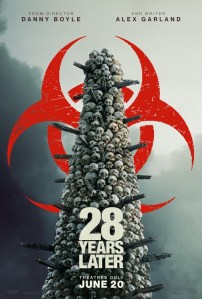 While not officially 28 years after its release in 2003, you’ll have to settle for only 23, comes a sequel to the zombie outbreak that kicked off a resurgence in zombie media in the 2000s. 28 Years Later is a far more experimental and meditative and genuinely surprising and surprisingly poignant sequel than I think many fans were expecting. They thought it was going to be more like a father/son (Aaron Taylor-Johnson, Alfie Williams) coming-of-age zombie hunt and weekend of survival. It is that, but it’s also a meditation on life, death, family, nature, and how we respond to grief. Director Danny Boyle returns, for his first film since 2019’s Yesterday, and screenwriter Alex Garland (Ex Machina, Civil War) returns, and together they provide a sequel that attempts to answer what society might be like growing up in this new dystopian world. The movie can get weird, with old movies and archival footage thematically mixed into scenes, Boyle’s camera in constant nervous anticipation, an active member of the hunt, and the use of an iPhone rig to provide Matrix-esque bullet time effects for zombie head shot splatter. Garland has also come up with some interesting zombie evolution over those ensuing three decades of development (granted I thought since the “zombies” were infected living people that you just had to wait them all out to die from dehydration). It seems like a father/son adventure thriller, and it’s quite good at being that, but then it transforms into something unexpected, giving mom (Jodie Comer) the spotlight as she confronts the reality of her physical and mental maladies. From there, the movie becomes this beguiling and thoughtful examination on grace and grief, on processing loss and finding a sense of stability in an unstable world. Ralph Fiennes appears late as a former doctor who seems a little crazy, the grave-keeper to an impressive monument built from thousands of human bones. It’s such a welcomed surprise for a movie replete with them, a movie that refuses easy categorization and wants to do something meaningful than just being a zombie action/thriller.
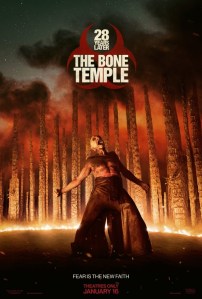 Even more unexpected was an immediate sequel and continuation a mere six months removed from 28 Years Later‘s wide release. The Bone Temple is divided into two stories, both holdovers from the prior film. Spike (Alfie Williams), the son going on his own journey of self, has been conscripted into a weird and violent gang, The Jimmies, lead by Sir Lord Jimmy (Jack O’Connell), the twisted grown-up version of the child seen in the harrowing prologue to 28 Years Later. He’s a sadistic leader who also tells his followers he’s the son of Satan. Then there’s Dr. Kelson (Ralph Fiennes) who we initially thought of as menacing but becomes the most humane caretaker in this post-apocalyptic landscape. The two male figures serve as competing responses to unmitigated tragedy, one retreating to religion as a tool for meaning but it’s really exploitation and manipulation through violence and fear, and the other devoting himself to science and making the world just a little more liveable through empathy and trial and error. Dr. Kelson develops an unexpected friendship with one of the big Alpha zombies, “Samson” (Chi Lewis-Parry), after he discovers this behemoth, who was ripping spines out in rage fits in the previous movie, is seeking out relief through the doc’s morphine darts. Dr. Kelson ponders whether or not there is a chemical compound that could bring back the humanity to the infected. The difficulties with communication do not deter the good doctor, and these paths cross in a climax where the Jimmies come to think of Dr. Kelson as the Dark Lord himself. The movie is consistently interesting, further building out this new damaged world began in 28 Years Later. Nia DaCosta (Candyman, The Marvels) takes over as director and offers a more patient camera, forcing us to dwell in the moments, both horrific and moving. There are torture sequences, long demented monologuing, and questions over the tenacity of human connection despite incredible obstacles, and yet the movie is both more a straightforward horror-thriller than its predecessor and a more focused human drama about loss and holding onto one’s sense of dignity and empathy. It lacks the visual fireworks of Boyle’s style, and I found Sir Lord Jimmy to be more tiresome than interesting, but The Bone Temple is an effectively engrossing lateral sequel that slowly builds Garland’s world a little wider. Now I’ll actually have a third 28 Years movie to look forward to that hopefully won’t take 28 (or 23) years..
Nate’s Grades:
28 Years Later: B+
The Bone Temple: B
Share this:

Slanted (2026)
 It’s The Substance meets Mean Girls and it’s a frustrating execution of a provocative concept. Writer/director Amy Wang follows Chinese-American teenager Joan Huang (Shirley Chen) as she struggles to be accepted in her predominantly white, middle class, suburban school system. She sets her sights on being accepted by the popular girls, so she abandons her Chinese heritage, food, and looks to better adopt the habits of the very blonde popular clique, but bleaching her hair isn’t good enough to get what she wants. She discovers a mysterious company promising a scientific solution: they will genetically alter you to the race that you desire. What a fantastic plot device to explore racial identity, assimilation, prejudice, stereotypes, and more. It’s a crying shame then for this premise to be completely shackled to a high school cliques storyline. It’s so boring for our protagonist to be completely consumed with being prom queen when she’s just undergone an amazing and ethically questionable procedure. I kept waiting and wanting Slanted to do something more, to better explore the social commentary at stake but it’s really no different than your familiar story of non-popular girl sacrifices her personality and old friends to be popular only for them to remark, “You’ve changed!” This is such a crushing waste of such a promising premise. There’s not even memorable body horror; at one point we do get droopy face. Slanted is less a horror movie and more a middling drama too timid to better explore the rich implications of its concept. This is the kind of idea calling for surreal and excoriating satire, something along the likes of Boots Riley (Sorry to Bother You). To narrowly frame this story as an outsider wanting to be popular in high school is just terribly limited and disappointing and ultimately dull.
Nate’s Grade: C
Share this:

The Crash (2026)
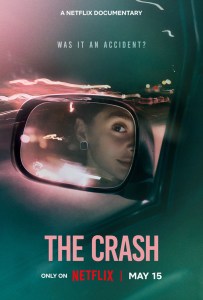 The Crash is an intriguing true-crime documentary on Netflix that hits a narrative wall, echoing its own case. It follows the fatal 2022 car crash of three young people in Steubenville, Ohio. The 17-year-old driver, Mackenzie Shirilla, was the only survivor and eventually tried for their murders. It appears that the car was going 100 miles per hour with no attempt at braking, no skid marks, no defensive maneuvering to avoid a high-speed head-on collision with a brick wall. The 90-minute documentary examines the tragedy and tries to ask how it could happen and then shifts into why, delivering agonizingly little in answers. The case seems pretty clear with forensic evidence, so it becomes an exploration into who Mackenzie Shirilla is and what might have driven her to make such a reckless decision. The problem for the movie is that Mackenzie is unhelpfully her own brick wall. She has convenient amnesia and doesn’t remember anything about the crash, though she knows she would never have done it. The selling point of “Mackenzie speaks out since her trial” is mitigated when she offers so little of value besides canned apologies and she refuses to divulge insights while her onset lawyer consults her interview responses. This, frustratingly, can make the movie feel rather inert when it comes to a deeper examination on the kind of person who might commit such an impulsive and volatile act. How did Mackenzie possibly end up like this? Is it negligent parents who refuse to hold their child accountable? Is it the allure of social media creating a false sense of self? Was her relationship with her boyfriend and crash victim as wholesome as believed? Are we getting drunk on outrage and vilifying this woman to make ourselves feel morally superior? The movie doesn’t offer answers or even exploration of these issues, and so The Crash feels like a protracted episode of any Dateline case-of-the-week scandal rather than an engrossing doc.
Nate’s Grade: C+
Share this:

Obsession (2026)
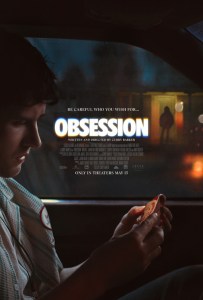 It seems like the world has become obsessed with the new indie horror film, Obsession. It’s the gruesome brainchild of writer/director Curry Barker, a 26-year-old debut filmmaker best known for sketch comedy on his YouTube channel, That’s a Bad Idea. With RackaRacka’s Talk to Me, Chris Stuckmann’s Shelby Oaks, Mark Iplier’s Ironlung, and now Barker’s Obsession, it appears we’re heading into a renaissance of YouTube creators blossoming as indie horror mavens, and this is days away from 20-year-old Kane Parsons’ release of Backrooms, a feature based on his experimental liminal nightmare YouTube video. It’s probably inevitable for Mr. Beast to eventually make a horror movie, isn’t it? That’s scary.
Baron “Bear” Bailey (Michael Johnston) has been nursing a crush on his friend and co-worker Nikki (Inde Navarrette) for years. He’s never had the courage to just tell her how he feels.Then one night Nikki just point-blank asks him: do you have feelings for me? He stammers and says, “I think we’re good as friends.” Immediately afterwards in his humiliation, he breaks a novelty One Wish Willow stick and says, “I wish Nikki loved me more than anyone in the world.” From that moment forward, Nikki changes. She’s ferociously devoted to Bear and incredibly needy and volatile. She takes clingy to another level.
 We’ve seen plenty of iterations of the “be careful what you wish for” tale of horror and irony, but Barker makes it his own with such confidence. There’s a prevailing sense of dread throughout the movie that just sits in your gut, miring every post-wish scene in discomfort. It can be greatly entertaining to anticipate just how things will go wrong with each scene. Barker demonstrates a tremendous sense of restraint and dedication, favoring to tease out the audience discomfort. I appreciate how much of the movie’s focus is on building unease over jump scares. There are moments where Barker’s camera forces you to study Nikki’s face draped in shadows as she stands upright in a corner, and it’s far more unsettling than if she had just popped around a corner to startle the audience. There’s a certain dark enjoyment to watching a character get in over their head, especially when they have robbed another character of agency, the whole reaping the consequences of their actions. Watching Bear get punished is a sort of cosmic reward as well as a test to see how far he will go to try and make this “relationship” work. Barker’s background in comedy is evident through his skill with pacing scenes and as a whole, and the film benefits from the mordant tone often dipping into cringe comedy and nervous laughter. This man clearly has an affinity for horror and the chops to make a compelling movie connect with an audience and leave a mark.
Obsession wouldn’t be nearly as worthy of obsession without the captivating and shifty lead performance of Navarette (Superman & Lois). I initially thought it was a mistake we see so little of the Before Wish Nikki, but limiting our exposure means we’re trapped in defining Nikki through Bear’s perceptions and projections, and I think that’s smart. The majority of her performance is after the wish, and Navarrette is just as terrifying as she is unexpectedly hilarious. She contorts her face into exaggerated, almost Jim Carrey-esque expressions. When she’s trying to be the blithely happy girlfriend, she scrunches her face into a pained smile that approaches a grimace, a mockery of how women might be expected to look when given the unhelpful advice to smile more. Her juvenile meltdowns and tantrums remind us that Nikki has degenerated into a sickening distortion. Navarratte’s performance has layers to it, finding little physical tricks to cue us about the Nikki imprisoned inside her own body. It’s amazing the flickers of “help me” she can manifest through her eyes alone while the rest of her face is pretending to be a different person. Some of the greatest acting performances of our modern era come from overlooked actresses in unfairly underrated horror movies. In a just universe, Florence Pugh would have been nominated for an Oscar for 2019’s Midsommar, Naomi Scott would have been nominated for 2024’s Smile 2, Sophie Thatcher would have been nominated for 2025’s Companion, and Inde Navarrette would be nominated for Obsession.
 Obsession has such a great premise and direction, which is why it’s a shame that there are plot turns that feel disconnected from the rules and characterization Barker has established. Having a super obsessive significant other leads to obvious disadvantages, like being dangerously possessive, paranoid, and losing one’s sense of having an independent identity. Having Nikki make awkward scenes in public, test her partner’s love and devotion, and get easily jealous to the point of madness all makes sense as an extreme encapsulation of Bear’s wish for unparalleled love. Having Nikki stand literally in place for hours and wait for Bear to return from work, to the point that she even pees down her own legs, is quite effective at communicating just how much this woman is losing herself under this spell. Those decisions refine and perfectly demonstrate the disturbing outcomes of Bear’s wish. However, not all of her decision-making has this same identifiable logic. Early in the film, Bear’s cat dies from ingesting a bunch of his prescription drugs. How the cat got into the medicine cabinet or broke the child-proof seal without thumbs is never fully explained except for the implicit assumption that Bear had his pill bottles open and accessible (this guy really shouldn’t be trusted with anyone’s care, human or animal). Afterwards, when Nikki is fully under the wish’s evil power, she does two things with this dead cat. The first might be explained as a means of memorializing the pet, but the second one is just inexplicable and feels more like a cruel prank. It’s hard for me to connect this action to the film’s extension of obsessive love. It broke me from the movie, the same as when during a party game, Nikki recites a twisted retelling of Hansel and Gretel that devolves into incestuous role play. Does she think this little performance will impress Bear? If she’s purposely trying to just be oft-putting to the others, why even indulge the game? The problem for me is that Obsession has just enough of these questionable little turns that felt outside the bounds of its rules. The impulsive self-harm as misguided devotion or flagrant emotional manipulation makes sense. Looming over Bear while he sleeps to watch can even make sense. But not every crazy action has the same logic. Now, you could just wave away every crazy act as, “Well, it’s unexplainable magic,” but I find that an unsatisfying excuse for plot developments that feel more arbitrary than organic extensions.
The other area that nagged at me was the ending and how I felt it conflicts with not just the characterization of our protagonist but also the social commentary against Bear. In order to really delve into this, I’ll have to invoke spoilers, so skip ahead TWO paragraphs dear reader if you wish to remain pure. Earlier, when Bear is on the phone with the One Wish Willow customer support, a fabulous scene by the by, we learn that the wish will remain in gruesome effect until either the recipient or the wish-maker is deceased. Barker has set up the possibility for ending this nightmare but it involves permanent death. Late in the film, the “real Nikki” manages to speak to Bear while Nikki sleeps, like a ventriloquist voice sneaking out undetected. In this fleeting moment of communication, she begs for death to end her torment. Bear is aghast at the request but he’s also offended; would a romance with Bear be so intolerable to prefer death? That’s because Bear is a bad person. He shrouds himself in the armor of being the unassuming “nice guy” and yet his ensuing behavior seems far more selfish and entitled. It’s evident to everyone who knows Nikki that, post-wish, this version of her is not the real Nikki. She’s a completely different person. They’re justifiably worried. It’s purposely incredulous for Bear to think that Nikki has just come around and her sudden and very intense fixation is her genuine choice. He’s not that stupid. However, this Nikki is a scary, crazed cartoon version, with her personality, humor, and ambition hollowed out. For all intents and purposes, it’s like Bear has lobotomized his crush. He takes his time before getting physically intimate with her despite her begging, but it still doesn’t stop him. He finally got the girl and he doesn’t want to let go of her even if it means trapping her in a unique hell.
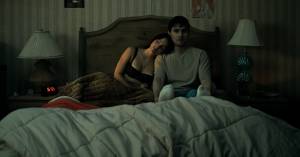 Now, after some unfortunate and bloody consequences, Bear locks himself in his bathroom with the determination to finally take account and end his life. He thinks about putting a gun in his mouth but doesn’t have the resolve for that. Instead, he takes the same prescription drugs his cat overdosed on and swallows the bottle’s contents. From everything I’ve witnessed of this character, I do not believe he would be the kind of person who would accept accountability and sacrifice himself. He’s too selfish and cowardly. He’s also just too meek and incapable of making hard choices. I could believe him wanting to be brave and noble and make the sacrifice to save Nikki but then, after swallowing the pills, he immediately regrets this decision and throws them up. I don’t buy Bear learning from his grave error. I can believe him having to live with it and being consumed by guilt, and yet he’ll grow numb and accept his new normal eventually, with the guilt likely leveling out over time. The pointed commentary is against the toxic entitlement that men feel in possession of women, especially those denigrating being “friend-zoned” as if platonic friendship is itself a worthless compensatory prize from a woman. It’s sizing up guys like Bear who think of themselves as the guy who just wants a break from the universe who also happens to be completely ignorant to those other opportunities within reach. He’s too fixated on what he doesn’t have to the point that it’s become his identity. He wouldn’t know what to do with Nikki if he got her, which is evident by the rest of the movie. God help this guy if he actually decided to work on himself or calibrate his insecurities and projections. This guy sucks and that’s the point. Horror movies typically end with a would-be solution to the dilemma that proves false, ultimately dooming the protagonist to misery. For Obsession to revive the real Nikki through Bear’s ultimate sacrifice feels completely wrong. It’s giving this loser character a chance at unearned redemption as well as harming its critical message.
While not quite living up to its momentous hype, Obsession is still an unnerving and memorably uncomfortable film experience, from its compounding dread, to its macabre laughs, to its provocative performances, chiefly our chief victim. I have some issues with the iffy internal logic too often feeling arbitrary, and the ending feels both rushed and wrong, sabotaging the larger commentary against men like our self-pitying protagonist. Some might complain that much of the movie could have been resolved had the four main characters just had one honest conversation, but that’s what makes the movie tragic. We see the many detours that could have avoided the worst. I know the majority of my review is me assessing my gripes, but Obsession is a good and very disquieting movie. I just felt like it could have been a great film. Still, this is quite a promising debut for Barker, who has now been tapped by A24 to remake none other than The Texas Chainsaw Massacre. While I might not be as smitten, Obsession is a creepy and entertaining modern update on an old cautionary adage.
Nate’s Grade: B
Share this:

Crime 101 (2026)
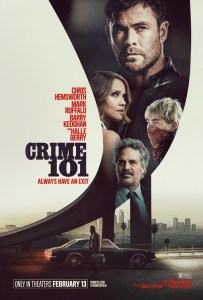 Sleek, sexy, and surprisingly character-centric, Crime 101 isn’t so much a how-to guide on criminal activities, it’s more a how-to on successfully replicating Michael Mann style of urban crime thriller. Chris Hemsworth plays a meticulous gentleman thief whose last job went bad. The LAPD detective (Mark Ruffalo) is on the case and is convinced there is one master thief connecting several high-end robberies along the 101 Highway in Los Angeles (thus the title, not in reference to a college class). Monica Barbaro (A Complete Unknown) is the romantic partner tempting our thief to retire to a “normal life.” Halle Berry plays an insurance broker to the rich who is eager to be made partner in her firm. And Barry Keoghan is, you guessed it, playing a psychopathic chaos agent. Draw all these characters into one big score, throw in one-or-two-scene players like Jennifer Jason-Leigh as Ruffalo’s divorcing wife, Nick Nolte as a grizzled criminal middleman, and Corey Hawkins as a police detective, and it’s quite a stacked cast for your standard crime thriller. That’s because, thanks to writer/director Bart Layton, the man behind one of the best movies of 2018, American Animals, which was also an unusual take on dispelling our movie fantasy notions on crime, and also co-starred Keoghan. Layton’s adaptation of the novel by Don Winslow keeps the people at the heart of the action. Trust me, the actual chases and schemes are indeed thrilling, but it’s the rich and generous characterization that makes the inner life of this movie feel so much more bristling. You could have taken any of these major characters and made them the focal point, they’re that interesting and complicated. Mixing them together into an ensemble while still finding time for each of their perspectives and idiosyncrasies is just a feast for fans of engrossing and empathetic thrillers. Whatever you’re expecting, Crime 101 is likely better than that. Layton, already proven to be a master at genre replication, deserves more film opportunities when he’s delivering quality movies that know how to deliver the goods.
Nate’s Grade: B+
Share this:

Mortal Kombat II (2026)
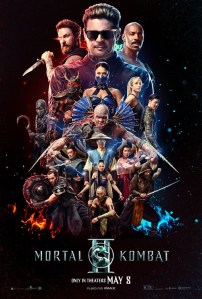 The 2021 Mortal Kombat movie was a mostly successful kick-start for the franchise to, at long last, stretch its legs on the big screen as a reverent representation of the appeal of the popular video game series. It was the first R-rated movie that showcased the inventively disgusting gore that is the hallmark of the bone-crunching series. It wasn’t a huge hit at the box-office so soon after the COVID shutdowns but it proved to be popular on HBO Max’s streaming network, and so now we have Mortal Kombat II, not strictly a straight adaptation of the game Mortal Kombat II, which was my favorite as a 90s kid when I had all the fighter moves and fatalities memorized. This time there is an actual fighting tournament germane to the story, and we’ve got the inclusion of movie star-turned-Kombatant Johnny Cage (Karl Urban). Can it escape the doomed fate of other Kombat movie adaptations and actually be good?
Early on, there’s an extended clip from one of Cage’s cheesy 90s action movies. It’s bad, goofy, and unintentionally funny as Cage fights his way through a warehouse of goons and does a jumping split kick over an incoming RPG. It’s a fitting send-up of the bombastic excesses of 90s action movies while demonstrating Cage’s limited real-life martial arts application. I wasn’t expecting Mortal Kombat II to essentially transform into that self-parody of 90s action movies. Watching the movie and trying to make sense of its runaway plot and throwaway explanations, I was reminded of the story modes in the newer games, how convoluted and ridiculous they are, bridging timelines and reincarnations and multiple iterations of characters and how it lacks excitement and engagement. For a fighting game, an okay story can be enough to connect between the different playable matches because the point is the hands-on fighting. This feels more like I’m watching someone else play the lousy story mode of the video game. It doesn’t feel like a movie to the point that I’m re-evaluating the 2021 movie on a higher level.
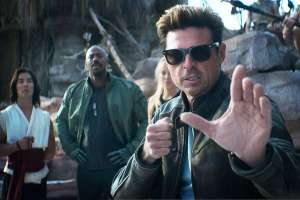 That at least felt like an adaptation that intended to exist as a film story, streamlining certain elements and making others accessible. This movie feels like it’s just made for diehard Kombat fans, not because it’s heavy in lore complexity and intrigue but because the fans will be the most easily forgiving. With Cage being the fish out of water, you would think his arc would take center stage. He’s the washed-up actor living off his fading reputation. He’s seen by the Outworld as a tremendous and worthy fighter but he’s just an actor. This misconception from his movies could have provided a more intriguing, grounded, and funny story along the lines of Galaxy Quest, where an actor has to keep up the ruse. This plays into the best scene of the movie, where Cage has to challenge the dentally-challenged blade-armed Baraka (CJ Bloomfield) among his community of angler fish-mouthed working class monster-people. Cage has to lean into his persona to become intimidating and then to escape the threat of his opponent. It’s the best fight in the movie because it has more setup and makes actual use of its geography. There’s also a fun dynamic of Cage having to live up to the reputation his running mouth has presented. This could have been the whole movie. Cage’s character arc is a dull zero-to-hero transformation, where I guess he has to believe in himself enough and then he’ll become a legendary fighter. Why this makes sense I do not know. It would make better sense if he was tapping into the muscle memory of his old fighting routines, like we watched him mirror those moves we saw in that introductory film clip. That would produce a setup and payoff. Instead, Cage becomes a deus ex machina fighter through his unshaken belief he can kick real good. His protagonist status is split evenly with Kitana (Adeline Rudolph), who is a familiar and boring archetype of the overthrown princess training to avenge her fallen father and restore her kingdom. For a supposed double agent, it never feels like Kitana is in any danger, especially as she travels back and forth between secret bases in broad daylight without bothering to cover her tracks beyond obscuring her special magic necklace. Because her character arc is so stock, we could have pared down her screen-time considerably and gotten the same effect, giving those precious minutes over to Cage for a fuller arc.
Not that you were coming to Mortal Kombat II for a story, but it’s plenty bad. We have a second entry point character to learn the ways of inter-dimensional combat between gods and monsters, after the 2021 movie gave us… an entry point character. Seems rather redundant to go through this again, right? Do you even remember that character’s name? Do you remember what his special power was once he became fully self-actualized? I didn’t either, so when he appeared briefly in this sequel, it wasn’t until it was long over that I thought to myself, “Oh wait, that was that guy?” Even the protagonist of the first movie is a discarded afterthought. The story elements from the first movie are tacked on like calling upon support at the last moment, akin to hailing Godzilla to come out and fight the big monster terrorizing Japan for the first two acts of the movie. “Hey, remember the spirit of the Scorpion warrior? Well now he’s back to once again kill the spirit of Sub-Zero who is now Smoke with different powers, I think.” The entire universe-defining inter-galactic tournament feels so underrepresented and insignificant. There’s a culminating fight that requires not one energy beam blast, not two energy beam blasts, but three different energy beam blasts and a very special kick, and every moment feels as arbitrary and airless as the last. Even if you’re not expecting much from a movie that spells “combat” with a K, it should still follow the expectations of a movie, namely that the characters are meaningful and there’s an internal connectivity. Once you start introducing the mechanic that we can bring fighters back from the dead, or just stroll into the Netherworld to hang out with the dead and ask them favors, the stakes lessen dramatically. If death in the fight-to-the-death tournament is just a transitory phase, then why even stress about the tournament?
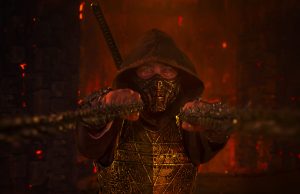 I know this sequel has a bigger budget than its 2021 predecessor but it looks so much worse visually. The increased number of special effects look dodgier and all of the sets look like big empty green screen stages. Too much of this world looks dim and fake. The fighting stages (acid pit, spike pit) are faithfully recreated from the video games but at a cost. There’s so little that feels tactile or even interactive with the actors onscreen. The environments feel empty and vast and often visually unfinished. There’s one stage surrounded by what looks like a screen saver of old with glowing stars moving like in Star Wars hyperspace. It’s not just that it looks phony, it’s that it doesn’t even appear to look otherwise. There are some gruesome deaths but even they are limited by the range of attacks from the primary villains. Having a big guy wield a big hammer limits what can be done. Often people are just being impaled, and I hate to sound like a jaded Spanish Inquisition flunkey, but you see one bloody impaling, you’ve seen most. Even by the standards of its memorable gore and intensity of its brawls, Mortal Kombat II falls flat. It’s too goofy to be as serious as it is, and it’s too serious to really generate a passing sense of fun.
By most accounts, Mortal Kombat II is going to be a movie that most viewers have a sliding scale of expectations for because it’s based on a fighting video game, because it’s a sequel, and because it’s populated with silly characters in colorful regalia. Is it my fault that I was expecting better? I don’t think so. The results of the 2021 movie show what could be possible, especially with its thoughtful and terrifying opening flashback to 1600s Japan establishing the deadly prowess of Sub-Zero. That’s what a Kombat movie could be like, elevated and cinematic and devastating. It doesn’t have to be junk. Mortal Kombat II doesn’t aspire to be anything other than tasty, disposable junk, and it’s not even good at that.
Nate’s Grade: C-


You must be logged in to post a comment.