Blog Archives
Slanted (2026)
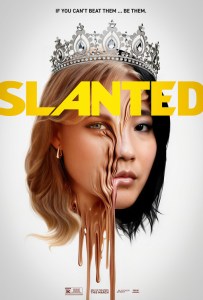 It’s The Substance meets Mean Girls and it’s a frustrating execution of a provocative concept. Writer/director Amy Wang follows Chinese-American teenager Joan Huang (Shirley Chen) as she struggles to be accepted in her predominantly white, middle class, suburban school system. She sets her sights on being accepted by the popular girls, so she abandons her Chinese heritage, food, and looks to better adopt the habits of the very blonde popular clique, but bleaching her hair isn’t good enough to get what she wants. She discovers a mysterious company promising a scientific solution: they will genetically alter you to the race that you desire. What a fantastic plot device to explore racial identity, assimilation, prejudice, stereotypes, and more. It’s a crying shame then for this premise to be completely shackled to a high school cliques storyline. It’s so boring for our protagonist to be completely consumed with being prom queen when she’s just undergone an amazing and ethically questionable procedure. I kept waiting and wanting Slanted to do something more, to better explore the social commentary at stake but it’s really no different than your familiar story of non-popular girl sacrifices her personality and old friends to be popular only for them to remark, “You’ve changed!” This is such a crushing waste of such a promising premise. There’s not even memorable body horror; at one point we do get droopy face. Slanted is less a horror movie and more a middling drama too timid to better explore the rich implications of its concept. This is the kind of idea calling for surreal and excoriating satire, something along the likes of Boots Riley (Sorry to Bother You). To narrowly frame this story as an outsider wanting to be popular in high school is just terribly limited and disappointing and ultimately dull.
Nate’s Grade: C
Share this:

Five Nights at Freddy’s 2 (2025)
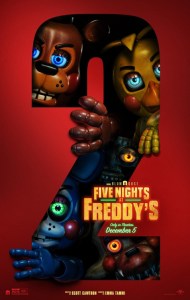 I wasn’t a fan of the original 2023 movie based upon the insanely popular video game series that serves as an entry point into horror for kids. It didn’t work for me but I thought fans of the series would have fun watching the characters come to life in live-action. Now with the sequel, I don’t know anyone that could enjoy this dreck except for the most diehard of the Freddy’s fanbase. I’ve watched the movie and I couldn’t understand it. I read the Wikipedia summary and that didn’t clear it up. So much hinges on so many characters having peculiar responses and relationships to what are… killer animatronics powered by the spirits and literal corpses of murdered children. Why is this pizza parlor even still standing? These robots went on a killing spree in the first movie, and yet this lonely little girl misses her “friends” and runs away to see them again. This isn’t E.T. here, it’s a weird killer robot horror movie that seems to be making up its lore and rules as it goes, like one unending “yes and?’ improv game you’re desperate to tap out from. I guess there’s more killer robots this time, and some unintelligible distinction between the good bad robots and the really bad robots. I don’t know. I gave up trying to comprehend what was happening and felt like maybe I could just try and enjoy the minimal PG-13 scares and tension. The animatronic designs are solid. Wayne Knight (Seinfeld) appears as a villainous robotics teacher. There’s a marionette character that’s kind of sinister to watch. That’s about it, folks. It’s a fairly nonsensical waste of 100 minutes, and unless you’re steeped in the lore and history of the series, you too will wish that this town would just set fire to the whole parlor.
Nate’s Grade: D+
Share this:

Regretting You (2025)
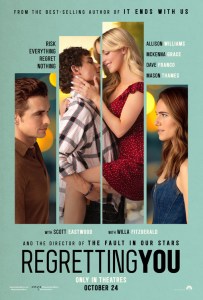 I do not care for Colleen Hoover as an author. She exploded thanks to social media and has, as of 2024, sold over 34 million books, primarily romantic dramas, primarily featuring wounded women trying to get back on their feet. She is a full-blown publishing phenomenon. Hoover has become so prolific and successful that she takes up an entire shelf. She’s already joined the ranks of your James Pattersons, Stephen Kings, Danielle Steels, the familiar names of authors that can be found in grocery checkout lanes. Her popularity is indisputable. Her quality is another matter, and that’s where I have trepidation with Hoover as a storyteller. Admittedly, I have never read any of her novels, so take all criticisms with a degree of incredulity. I’m making my judgement based entirely on the movie adaptations of her novels. Again, this might be an unfair guide considering if I did the same thing for, say, Stephen King, it would be easy to form a scathing opinion of the man’s literary work. 2024’s It Ends With Us made me deeply uncomfortable with its misplaced attempts to romanticize domestic violence. It wasn’t just misguided but it offered little insights into the mentality of abuse victims, instead slotting this disturbing story element into the awkward love triangle expected from the genre. It wasn’t good. Next, we have Regretting You, based upon Hoover’s 2019 novel of the same name. At this point, I’m wondering if I need to hold a regular spot in my annual worst of the year lists for the slew of Hoover adaptations to come.
In 2007, Morgan Grant (Allison Williams) and her friend Jonah Sullivan (Dave Franco) are clearly in love. I guess it’s too bad they’re seeing other people. Both are also dealing with pregnancies. Morgan marries Chris (Scott Eastwood) and has her baby, Clara. Jonah abandons his pregnant girlfriend, Jenny (Willa Fitzgerald) but comes back many years later to have another baby together (I guess Jenny terminated her earlier pregnancy but it’s never really dealt with). Cut to present-day, and teenage Clara (Mackenna Grace) is smitten with the charming film school aspiring Miller Adams (Mason Thames), a guy ripped out of a quirky rom-com. Then the big tragedy happens: Jenny and Chris die in a car accident, the same car, and it’s revealed the two were engaging in a longstanding affair. Morgan and Jonah must try and navigate these complex feelings of betrayal while also determining how much to tell Clara.
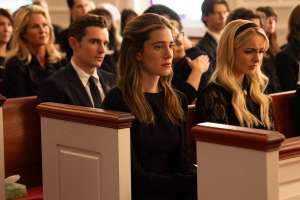 Just glancing through that brief plot synopsis, there are a LOT of elevated, dangerously soapy story elements packed into a two-hour movie, and that’s not including Clancy Brown as a cranky grandfather who Miller feels indebted to take care of as he’s scheduled to begin chemotherapy. There’s a lot going on here, and I’ll just state that there are two movies jostling for dominance that should have been split. The teen storyline does not fit next to the adult storyline. Every time it jumps from one to another, it was tonal whiplash and it became so much more dissonant. That’s because the teen storyline is awash in the burgeoning feelings of new love that we see in many YA tales and teen-centric rom-coms. It’s new and hopeful and very familiar for the teen drama genre. The adult storyline is awash in grief and betrayal, with both spouses trying to make sense of their pain and heartache and uncover what they can of what they didn’t know. One of these stories is bubbly and sunny and comedic, and one of these stories is tragic and searching and painful. They do not work in tandem, each taking away from the appeal of the other.
In particular, the adult drama deserved its own showcase to really explore the details of its complex feelings. Discovering after death that your spouse was not who you thought they were is so conflict-rich, especially that they were linked to another person experiencing that same shock and loss and confusion, it’s a recipe for real anguish and an unknown path of healing. Morgan and Jonah should never have known one another, let alone had an unrequited romance that hangs over them as adults. All this does is set up the obvious coupling, cruelly killing their spouses so these two can finally be together as destiny demands. It would have been far more intriguing for them to discover one another through this shared betrayal, but then again that might remind people of Random Hearts, but then again I doubt anyone recalls much about this 1999 movie that has an 18% rating on Rotten Tomatoes. This is where the real drama lies, but like much else of Regretting You, it’s unexplored and replaced with tropes and predictability. The exploration of grief and anger isn’t even given its proper due. Morgan primarily sits on her couch and drinks wine throughout the day. Jonah at one point rejects his new baby thinking he’s not the biological father. This conflict is, like many others, resolved so simply, merely having Morgan tell him to man up. These characters should be discovering unexpected aspects of themselves through this unique circumstance. These two characters should be striving to process their varied emotions but it’s all too easily distilled into a predictable payoff to their decades-in-the-making romantic matching. It’s reductive and boring.
 The YA-styled romance is also too familiar and underdeveloped as its adult drama. Miller (I hate that his first name is “Miller” – apologies to all first-name “Miller”s out there reading) is the kind of kid who loves movies but never seems to talk about what he loves about them or even make references to them. He wants to be a filmmaker but we don’t see his projects. That’s because Miller isn’t so much a character but being a dreamy ideal boyfriend, a sweetheart who is always concerned for Clara’s well-being and is so respectful of her boundaries and desire to wait to be intimate. He requests help moving a town limits sign a couple blocks every so many days with the intention of eventually having the ability to order from his favorite pizza place that said his home was out of their delivery zone. This is the kind of cute, whimsical activity we expect from the Manic Pixie Dream Girls of romantic comedies. If you think harder about this it actually becomes nonsensical. Why would the pizza shop change their earlier refusal because now there is a sign in front of Miller’s home that says it’s within city limits? It’s only a single sign. The house hasn’t physically moved, the distance is still the same, and the store’s GPS would still indicate as such (“But-but there’s a sign, and even though the sign is inaccurate, you should abide by it”). This is only a silly detail that I don’t mean to harp on but it’s indicative of the lackluster character writing. Because of this there’s really no genuine conflict between the two young lovers. He’s a dull dreamboat ideal.
Really, the only drama present with Clara is when she will discover the harsh truth about her father, and so you’re just waiting for this eventual Sword of Damocles to fall, to have her question why her mom would make this choice. In some regard it makes sense, to hide a painful truth from her daughter, to delay further having to process it herself, but it’s also something that cannot be contained forever. She’s going to find out eventually, and then she’s going to be additionally upset that her own mother withheld this news from her. It’s not like Morgan has complete ownership of this information. It likely would be common knowledge that they died together, in the same car, and it’s hard to believe rumors would not emerge, with classmates snickering behind her back through the school hallways or taunting her directly. It’s a shame that this looming hard truth is the only thing that Clara has going for her in this movie. Their relationship is generally conflict-free, or what conflicts there are are so easily resolvable. She’s young, in love, and her dreamy boyfriend easily ditches his girlfriend, the one obstacle to their union. This is because Clara is not her own character, not even a reflection of her mother; she is only a plot device to be plucked into tears.
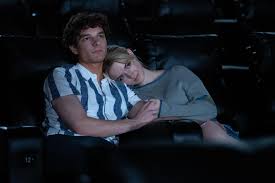 There are a few creative decisions that caused me deep confusion. Chief among them is the choice to have the same actors play their mid-to-late 30s selves as their high school selves. The opening high school graduation just establishes the four characters’ relationships, the obvious fact that Jonah and Morgan feel something for one another but oh well, and that there are unexpected pregnancies. From there the movie makes a sizable time jump but doesn’t make that clear this has happened. So we went from Morgan at a graduation party to Morgan chatting with Clara, and I thought she was a younger sister. Why would I have automatically assumed this is now the 16-year-old daughter that we had just confirmed was a zygote in the previous scene especially when Williams is made to look exactly the same over those 17 or so years? I don’t think the opening was even necessary. They could have established these character histories without a direct flashback where Jonah literally says that maybe they’re with the “wrong people” as he stares deeply into her eyes. This is also the kind of movie that has no faith in its audience, and yet we’re intended to catch the big time jump. Clara sees a movie at Miller’s theater, and he asks her why she’s crying at the conclusion of a Mission: Impossible sequel. She says it’s because her dad took her to a lot of movies. We get it. She associates the movies with her father who she dearly misses. But then the movie adds an additional line where she literally says, “That’s why I’m crying.” Thanks, movie. Ugh.
Something amusing to me that I doubt anyone else would really notice is the design of the movie theater. Miller works at an AMC movie theater so there are a few sequences, including the big rom-com rush to greet one another and have the big swooning kiss moment. Because the movie is a Paramount production, there are only posters present promoting other Paramount movies, 2025 releases like The Running Man and the latest Mission: Impossible, but then also classic movies like Sabrina and The Godfather. God forbid a movie theater advertise other titles from competing film studios. Perhaps this is just a very singularly loyal theater. Anyway, as a person who worked at a movie theater for over a decade, this little incongruous detail stuck with me. It’s the same thing with Miller’s bedroom. All of his posters are Paramount movies, which means he just loves that studio so much. Maybe that’s why he works at a movie theater that plays exclusively Paramount movies (the corporate synergy reminds me of young Christian Grey having a Chronicles of Riddick poster in his childhood bedroom brought to you by Universal). Perhaps somehow Miller doesn’t even know the existence of non-Paramount movies and is in for a world of shock when film school students talk about stuff like Godard and Cassavetes and Fincher and Tarantino, and he’ll just be so pitifully confused.
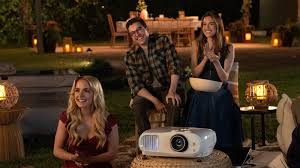 With a title like Regretting You, it allows for so many ready-made quips, especially when the finished movie isn’t quite up to snuff. The term “soap opera” is usually referenced as a pejorative, that a movie has so much heightened incidents to be distanced from the nuance of adult reality. However, just because something is soapy in scope doesn’t mean it cannot be fascinating and engrossing in execution. The films of Pedro Almadovar (All About My Mother, Talk to Her, Parallel Mothers) are often, on paper, a random assembly of soap opera histrionics, and yet the man’s creativity and empathy finds, almost without fail, ways to really open up and explore the details of his characters and their unique emotional states. The premise of Regretting You could have done this, but the desire to be appealing to teenagers with the YA-styled teen romance, sabotages the exploration of grief and betrayal into a clipped and frustratingly tidy little package. It’s not good storytelling, folks, but it had some potential to be. There are two more Colleen Hoover film adaptations slated for 2026, and most definitely more even after, so it’s best to prepare dear reader because It Ends With Us wasn’t actually predictive with its title. It only begins.
Nate’s Grade: C-
Share this:

Ghostbusters: Frozen Empire (2024)
 I am a lifelong Ghostbusters fan, I enjoyed the 2021 reboot, and I come to the sequel, Frozen Empire, as one of those fans that grew up with the cartoon series in the 1980s. There is a contingent of Ghostbusters fans who dismiss the movie as merely a comedy about a bunch of schlubs who resort to paranormal shenanigans to make a buck, and these fans dismiss anything larger in world-building, mythology, or direct sincerity as missing the point. I disagree. There can be a vivid, flourishing world of supernatural beings and connections to the human world, if you can tell a compelling story with characters we want to follow. Frozen Empire is an okay TV episode expanded into movie form, finding little for most of the voluminous characters to do. There’s an ancient evil and tying back the legacy characters, who don’t present much meaning beyond extended cameos. The 2021 movie had me on an emotional level, saying goodbye to a character and seeing how that loss has affected multiple generations of his estranged family. The closest thing Frozen Empire features to emotion is young Phoebe Spangler (Mackenzie Grace) wanting to be treated like a responsible adult and making friends with a ghost girl. It’s kind of sweet, and it’s smart to tie this friendship into the larger threat. The movie has several side plots littering the peripheral, from Finn Wolfhard trying to catch Slimer and being trusted to drive the Ecto-One, to Paul Rudd trying to find his footing as a stepdad, to Kumail Nanjiani as a junk dealer learning to follow his family’s noble mission of protecting others. I liked learning more about Winston’s (Ernie Hudson) Men in Black-style secret agency of studying ghosts and testing out new supernatural tech, and it presents a fun new setting where we can learn more. The ultimate story about defeating an evil spirit, coming together as a team, and learning to give others room to succeed or fail all seem a little pat, a little too familiar. It’s fine that this movie has lower stakes, even with a would-be apocalyptic threat of ancient evil. Not every movie needs to avert the apocalypse. It feels like little thought has been given to extending the new characters from the 2021 movie. There are too many characters to service here, which is why everyone other than Phoebe feels like a nascent supporting character or overextended cameo at worst (did we need the return of Podcast?). It’s still a fun movie that any Ghostbusters fan will likely find enough to enjoy, but it also feels like it might be the last Ghostbusters movie, at least this iteration, and it ends with a reminder of what the franchise can be, at its best, but also a warning of what it can be without careful development and vision.
Nate’s Grade: B-
Share this:

Ghostbusters: Afterlife (2021)
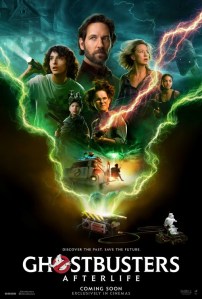
As I stated in my review for the 2016 Ghostbusters, allow me to wax nostalgic and explain my own private history with the franchise: “Growing up in the 80s, other kids had Transformers, or G.I. Joe, or He-Man, but I was a Ghostbusters kid. I fell in love with the 1984 original movie, slept below the poster for most of my childhood, and obsessively collected all of the action figures and toys, watched with glee the animated TV series, and hold the world and its characters in a special personal place.” This franchise means something to me. I think about the hours I spent playing in this world and my imagination and my own stories illustrated with marker and crayon, and it makes me extremely happy as well as reminds me how I fell in love with weird storytelling and macabre, ironic humor. I’ve been waiting for more Ghostbusters movies for my adult life. The 2016 movie was fine, I wasn’t enraged by it in the slightest, but it didn’t scratch that itch. While replicating some of the same plot beats, the 2016 movie was not reverent to its source material. Now the 2021 Ghostbusters, delayed over a year and a half from COVID, goes completely in the other direction. Ghostbusters: Afterlife is reverent to a fault, and while it has been met with mixed reviews and complaints of overdosing on slavish fan nostalgia, I found it to be a charming and fun family adventure that left me laughing, cheering, and even crying.
Egon Spangler (Harold Ramis, R.I.P.), original Ghostbuster, is dead, killed by a malevolent spirit. His estranged adult daughter, Callie (Carrie Coon), and her two teen children, Trevor (Finn Wolfhard) and Phoebe (Mackenna Grace), are shocked to learn of his death and their unexpected inheritance: a dirt farm in small-town nowheresville Oklahoma. They don’t know much about their grandfather and the kids are not exactly excited about relocating to a secluded mining town. Phoebe starts discovering weird pieces of technology hidden in the old house of her grandfather’s. A presence seems to be reaching out and trying to get the family to understand their real legacy. It appears that Gozer the Gozerian was not fully defeated on top of that New York City skyscraper in 1984, and Phoebe and her family must learn about the past in order to make sure we all have a future.
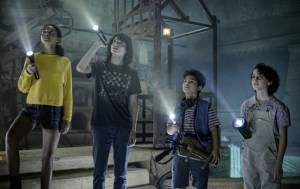
I can understand the charges of Afterlife being too nostalgic, but I don’t understand the charges of it being so enamored with its past that it poses a disservice to the movie standing on its own. This movie is intended at its very DNA to live within the shadow of the original films. The director and co-writer, Jason Reitman, is the son of the original films’ director, Ivan. It’s going to be reverent but that’s not an automatic bad thing. Whereas the 2016 reboot shrugged at past convention and went completely comedic, this edition takes the opposite approach, hugging onto the lore and past of Ghostbusters with heartfelt affection. If you’re a fan of the franchise, this adoring approach will likely be more favorable, not that the 2016 film is wrong for eschewing the established canon of the franchise and trying something new. If Afterlife had been a completely original story set in a Ghostbusters universe, I would have happily accepted that. However, just because something is outwardly nostalgic, or taps into fan service, does not mean it is destined to be an exclusive retread that only satisfies the hardcore base. I didn’t need the gratuitous Easter eggs of passing shots of a twinkie or Crunch bar, but they’re blink-and-you’ll-miss-them moments that don’t really relate to anything of consequence, so I can excuse them. Afterlife is similar to The Force Awakens in that it uses familiar plot beats to mirror events of its predecessors to ease back fans and new members to the fanclub, most especially in Act Three where Gozer’s demonic pooches are unleashed. I can understand many chaffing at this, but I feel that Afterlife does enough to justify its own creative existence even in facsimile rather than as some insular, facile, fan-stroking cash-grab.
This is, by far, the most dramatic of the Ghostbusters movies, a series that has existed in the realm of comedy. The prior movies were never spooky on adult terms, but they reached back into a primal, childlike curiosity and anxiousness over the unknown that made them creepy when they wanted to be. I don’t understand the umbrage some have expressed over Afterlife being more of a drama. First, the comedy is present throughout the movie with the characters making specific and wry observations that feel fitting for their situation. The humor is not as forced as the loping line-a-rama improv jazz riffs of Paul Feig’s 2016 film. I think this universe can sustain different kinds of stories being told, and I think that drama is perfectly acceptable as long as it’s earned, just like the comedy or horror elements. The central premise involves an estranged family coming to know the secret life of an absentee relative who abandoned them, so the more they learn about his Ghostbusting past and responsibilities, the closer they come to uncovering a clearer picture of who this man really was as well as their connections to him. Reitman and co-screenwriter Gil Kenan (Monster House) have smartly connected the investigation of the past into the development of personal relationships. We in the audience know the significance of the Ecto One and the ghost traps, but the new characters do not. We await them to understand the knowledge we already attain, but the movie doesn’t play this as characters dawdling. Each discovery unlocks new potential for the characters to shape who they choose to be, and each one gets them closer to their grandfather and reshaping their conception of the man who they wrongfully believed abandoned them for folly.
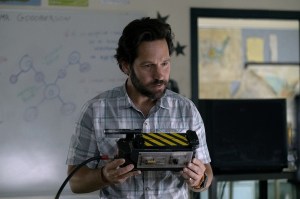
This all leads to a climax that had me genuinely in tears. I won’t exactly spoil it but Afterlife’s conclusion is less concerned with beating the Big Bad Gozer yet again and saving the universe. Reitman and company have smartly placed the real climax as an emotional catharsis; it’s more in keeping with Field of Dreams than some huge Marvel apocalyptic showdown. The ending is personal, emotional, and reaches into our universal desire for closure, for having that one last moment with a beloved who we no longer have any moments left to share, Reitman is clearly missing Ramis, a close family friend and inspiration who died in 2014, and this is his own way of processing his personal grief, offering an emotional output for the fans to share in, and allowing a grieving character/surrogate to find that needed release. It serves as a fitting conclusion and a special end note for any Ghostbusters fan who has held this franchise close to their heart for several decades, especially if shared with a paternal figure who may be gone.
The film also successfully channels a childhood perspective of awkward and awesome. It’s hard to create a story where a group of precocious adolescents discover strange things cooking in their sleepy small town without suggesting Stephen King and Stranger Things, but this isn’t necessarily a total negative. The earlier movies were always from a more cynical adult perspective. Yes, there were characters like Ray (Dan Ackroyd) and Egon who were true believers, but they were often set up for easy laughs. The tone of the series was mostly tied to the irony of the character of Peter Venkman (Bill Murray) that looked at the supernatural with droll detachment. This is the first Ghostbusters entry where the primary perspective is from children, and there’s something hopeful and heartfelt about a younger point of view with the supernatural material. These kids are excited and eager to learn more about the somethings strange in their neighborhood. It becomes endearing to ride along with them as they get to jump into the action. I loved the concept of a sidecar gunner seat for the Ecto One and how it felt like a childhood dream coming true. But it’s more than fan service because it serves as a point of progression for Phoebe’s sense of self, of embracing her scientific interests and roots, and taking charge in the face of unknown danger. It’s a coming out of sorts. When the kids are driving through (the always empty?) town and chasing a runaway ghost, wrecking storefronts from the boom of the proton pack, it’s a blast for them and us.

This is Reitman’s most commercial and mainstream film of his Oscar-nominated career. It’s interesting to me that this indie darling, who was on such a hot streak in the late 2000s, hit some speed bumps with the critical misfires of 2013’s Labor Day, 2014’s Men, Women, and Children, and 2018’s The Front Runner, so the next movie is a retreat to a big-budget franchise film. Reitman doesn’t necessarily have the best feel for large-scale spectacle, but he knows intimate character dramas and guides his actors well. Grace (Gifted, Haunting of Hill House) is wonderful as our plucky lead. Unfortunately for Wolfhard (It, Stranger Things), his dull character has nothing to do but pine for a local girl, scoff at his family, and then fix up the old ghostbustin’ mobile. Paul Rudd (Ant-Man) is as charming as ever as the school science teacher, especially as he nerds out over interacting with the Ghostbusters paraphernalia like an excitable fanboy living out his childhood dream. I wish Coon (The Leftovers) had more to do, but that’s my primary complaint in any movie where Carrie Coon is a supporting actress. Her chemistry with Rudd is strong and they could have done so much more together as adults trying to make sense of madness. They could have eliminated Wolfhard’s mopey older brother character entirely and given us more time with the goofy adults too. One feels like there is some secret contract where anything relating to 80s nostalgia requires the hiring of Wolfhard on hand.
Ghostbusters: Afterlife will not be the best movie of 2021. There are areas that could have been improved and streamlined and better developed. However, Ghostbusters: Afterlife will most assuredly be my favorite film experience of 2021. It’s a heart-warming continuation for fans with enough wit and whimsy to charm while owning its obvious and intended connections to the original. I may not be the most objective source on this particular matter, but I know what I like, and this movie had moments of pure happiness that just shot right through to my dopamine center. We’ll see if this movie can restart the dormant franchise, and strike more on its own, but even if this lone 2021 entry is all that we eventually get, I’m happy I got to experience this magic once again. I can’t wait to see it again with my dad.
Nate’s Grade: B+
Share this:

I, Tonya (2017)
 Back in 1994, popular culture was rabidly obsessed with figure skating thanks to Tonya Harding (Margot Robbie), the “bad girl” who was accused of coordinating an attack on her skating rival, Nancy Kerrigan. Tonya’s skuzzy husband, Jeff Gillooly (Sebastian Stan), had hired a friend to “intimidate” Kerrigan, and the end result was a broken knee and the world-famous outcry of, “Why?!” I, Tonya takes a look at the players of this media circus and lets them tell their own stories in their own words.
I,Tonya feels brazenly like a Scorsese movie populated with kooky Coen brothers characters. Director Craig Gillespie (Lars and the Real Girl) cribs from the best and uses all those propulsive camera moves, voice over leading to fourth-wall-breaking, and music needle drops to draw an audience into this crackling crime story. The biggest decision made by screenwriter Steven Rogers (P.S. I Love You) is the dueling perspectives of Tonya and Jeff being given equal treatment. They both sit for a series of on-camera interviews and will even interrupt the flashbacks to object. Jeff will recount a time Tonya chased him around with a loaded shotgun, and then Tonya will turn to the camera and argue that this moment never happened. I, Tonya doesn’t tell you who to believe and who to doubt. The account will purposely contradict one another, often demonizing the other party and painting themselves as a larger victim of fate. The movie is steadily entertaining as it mixes moments of light and dark. Tonya breaking the fourth wall to talk about her domestic abuse is another way of showing just his disassociated she’s become to a life of abuse. It turns fourth wall break into coping mechanism. I was laughing at the buffoonery of Jeff’s goons and moved by the relentless torment of Tonya. It’s a story that’s worth revisiting and is given an invigorating sheen of inept crime thriller. Gillespie goes a little too hard with the Scorsese speed ramp zooms and quantity of literal song selections, but it doesn’t detract from the film’s overall entertainment impact.
 This is a film about reassessing preconceived notions about who the characters are, what the story exactly is, and where the truth lies amidst all the madness. Tonya scoffs, “There is no such thing as truth,” as if she were channeling the forty-fifth president of the United States of America. This becomes a foundational thesis of the movie as we’re presented with conflicting personal accounts where characters will break the fourth wall to criticize the validity of what they are doing or saying. All of these conflicting accounts force the audience to constantly reconsider what we are seeing and being told. We have to consistently think about the source and how there might be bias at play. As expected, Tonya and Jeff’s differing versions of events paint the other as more knowingly duplicitous. Tonya flat-out accuses Jeff of years of physical abuse, the kind of relationship Tonya’s vicious mother had primed her for. LaVona Golden (Allison Janney) would say all of her cruel hostility was valuable in an ends-justify-the-means crucible. Through fighting to earn the approval of an abusive authority figure, Tonya became one of the greatest figure skaters in the world, the first to achieve the vaulted triple axle. LaVona shouts that “nice” doesn’t get you anything in this world (her own mother was nice and LaVona became a waitress). People throughout I, Tonya are reshaping worldviews, angling for sympathy, and spinning history for personal advantage. Everyone wants to be a victim, a martyr, or at least the person who was right in the end. By the end, you don’t know what exactly to believe and whose truth is closest.
This was a media scandal that the public gladly gobbled up every new morsel, bringing out the knives to carve up a villain served up on the Olympic stage, but I, Tonya is a very empathetic portrayal that still doesn’t take the edge off of its title heroine. She grew up poor and scrappy and had to make her own costumes for her skating performances. From a technical standpoint, Tonya Harding could out skate anyone, but she didn’t fit into the cookie cutter beauty pageant image of what a wholesome girl should represent. The same bias against her, the trailer trash girl who couldn’t catch a break, was still dragging her down even when her skating was superior to her competitors. It definitely helps to paint a sympathetic portrayal for the woman, and that’s even before the years of abusive relationships, and a husband she may have returned to in order to appear more “wholesome family.” It’s easy to castigate Tonya Harding as a villain, but it’s even harder to see the person inside the caricature that was sold for mass media consumption.
The use of humor has to be very delicate because of all the controversial material. We have naturally offbeat characters doing incredibly stupid things, and then we have a husband repeatedly hitting his wife. This seesaw of tone means that the comedy needs to be precise or else it will undercut the drama or, worse, cross into gross mitigation of abuse. LaVona is a popular source for verbal abuse, and it’s meant to be shocking, but at no point do I think the film trivializes the conditions of Tonya’s childhood for ironic comic fodder. It’s presenting an abnormal treatment of an abnormal upbringing, and the later detours with “The Incident” are highlighting the naturally cracked criminals. These people were not good at what they were doing and were easily caught. The nimwits-try-their-hands-at-crime subgenre is ripe for laughter, in particular Shawn Eckhardt (Paul Walter Hauser) and his self-professed masterful skills at counter terrorism planning. The Tonya Harding scandal is so inherently sensational and with so many bizarre, colorful characters that to treat it without its penchant of natural humor would be a disservice. Crazy people doing dumb things are going to tend to have some humor value. Where the film falls short is in the realm of media satire. There are a few tasty morsels sprinkled throughout, like LaVona forcing reporters to stand behind a rope line if they wanted to snap her picture, but overall the media satire feels flat. Bobby Cannavale (Spy) feels completely wasted as a Hard Copy reporter/exposition device. He offers few insights and fewer colorful anecdotes. The most pointed the film gets with media commentary is when Tonya looks directly into the camera and accuses each person of being her abuser. It’s a stark turn that stops the action cold, and the audience has to think about their own tacit approval through media consumption. By rewarding this coverage and the easily packaged version of events, have we all played a part in Tonya’s suffering and shame?
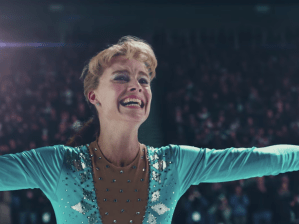 Robbie (Suicide Squad) is sensational in the role, eliciting so much emotion that it can instill whiplash. One moment you’re impressed by the depth of her vulnerability and the next you’re whistling at her hard-as-nails persona and sheer tenacity. It’s an unapologetic performance that goes dark places and serious places, but Robbie doesn’t stoop to pander. Tonya wants your empathy but she doesn’t want your pity, and she sure as hell isn’t going to pretend to be somebody she’s not. The tricky part is the question over who is Tonya Harding. With Robbie, she’s a profane firebrand who is impatient with a world that refuses to accept her and her talents. The scene where Tonya is stripped of ever competing again in professional figure skating is a dazzling piece of acting on Robbie’s part. Tonya has sacrificed much of her own life for this sport, and by her own admission she doesn’t know how to do anything else. To see it all go away with the pound of a gavel, she pleads for jail instead as a more humane punishment. This feels like Robbie marking her grand entrance into the next acting echelon in Hollywood.
The supporting roles nicely serve their purpose, with Janney (The Girl on the Train) being the obvious standout. Her hellish mother is overpowering in every sense. Janney is abrasive and fierce and a crutch for the screenplay when it needs something shocking. I do not doubt the voracity of what the Tonya and other participants have said about LaVona, but the filmmakers don’t know when to leave enough alone. There are insights to be had through LaVona’s relationship with her daughter but it’s too often one-note. She’s the angry older woman berating people for shock, comedy, or a transition.
I, Tonya might change your mind about Tonya Harding. She’s definitely unrepentant in the movie while at the same time asking you to view her with an empathy that was lacking during the parade of 1990s tabloids. She’s an abuse survivor who had to claw for every advantage she could earn. You might not like her, or maybe you’ll grow to appreciate her, but you will understand her better. Robbie is outstanding, Janney is highly memorable and perfectly cast, and the direction provides plenty of jolts, from electric camerawork to the energetic propulsion through its diverging viewpoints. The dark comedy works, the serious drama works, and the domestic violence is not trivialized with so many ironic winks. I, Tonya is an unflinching expose that forces you to question the validity of everything. It’s a movie that dares you to question your perceptions while you’re keenly watching. Perhaps twenty years later, Tonya Harding will get whatever she is due.
Nate’s Grade: B+


You must be logged in to post a comment.