Blog Archives
28 Years Later (2025)/ The Bone Temple (2026)
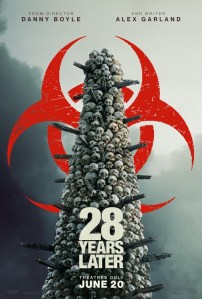 While not officially 28 years after its release in 2003, you’ll have to settle for only 23, comes a sequel to the zombie outbreak that kicked off a resurgence in zombie media in the 2000s. 28 Years Later is a far more experimental and meditative and genuinely surprising and surprisingly poignant sequel than I think many fans were expecting. They thought it was going to be more like a father/son (Aaron Taylor-Johnson, Alfie Williams) coming-of-age zombie hunt and weekend of survival. It is that, but it’s also a meditation on life, death, family, nature, and how we respond to grief. Director Danny Boyle returns, for his first film since 2019’s Yesterday, and screenwriter Alex Garland (Ex Machina, Civil War) returns, and together they provide a sequel that attempts to answer what society might be like growing up in this new dystopian world. The movie can get weird, with old movies and archival footage thematically mixed into scenes, Boyle’s camera in constant nervous anticipation, an active member of the hunt, and the use of an iPhone rig to provide Matrix-esque bullet time effects for zombie head shot splatter. Garland has also come up with some interesting zombie evolution over those ensuing three decades of development (granted I thought since the “zombies” were infected living people that you just had to wait them all out to die from dehydration). It seems like a father/son adventure thriller, and it’s quite good at being that, but then it transforms into something unexpected, giving mom (Jodie Comer) the spotlight as she confronts the reality of her physical and mental maladies. From there, the movie becomes this beguiling and thoughtful examination on grace and grief, on processing loss and finding a sense of stability in an unstable world. Ralph Fiennes appears late as a former doctor who seems a little crazy, the grave-keeper to an impressive monument built from thousands of human bones. It’s such a welcomed surprise for a movie replete with them, a movie that refuses easy categorization and wants to do something meaningful than just being a zombie action/thriller.
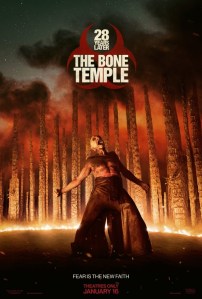 Even more unexpected was an immediate sequel and continuation a mere six months removed from 28 Years Later‘s wide release. The Bone Temple is divided into two stories, both holdovers from the prior film. Spike (Alfie Williams), the son going on his own journey of self, has been conscripted into a weird and violent gang, The Jimmies, lead by Sir Lord Jimmy (Jack O’Connell), the twisted grown-up version of the child seen in the harrowing prologue to 28 Years Later. He’s a sadistic leader who also tells his followers he’s the son of Satan. Then there’s Dr. Kelson (Ralph Fiennes) who we initially thought of as menacing but becomes the most humane caretaker in this post-apocalyptic landscape. The two male figures serve as competing responses to unmitigated tragedy, one retreating to religion as a tool for meaning but it’s really exploitation and manipulation through violence and fear, and the other devoting himself to science and making the world just a little more liveable through empathy and trial and error. Dr. Kelson develops an unexpected friendship with one of the big Alpha zombies, “Samson” (Chi Lewis-Parry), after he discovers this behemoth, who was ripping spines out in rage fits in the previous movie, is seeking out relief through the doc’s morphine darts. Dr. Kelson ponders whether or not there is a chemical compound that could bring back the humanity to the infected. The difficulties with communication do not deter the good doctor, and these paths cross in a climax where the Jimmies come to think of Dr. Kelson as the Dark Lord himself. The movie is consistently interesting, further building out this new damaged world began in 28 Years Later. Nia DaCosta (Candyman, The Marvels) takes over as director and offers a more patient camera, forcing us to dwell in the moments, both horrific and moving. There are torture sequences, long demented monologuing, and questions over the tenacity of human connection despite incredible obstacles, and yet the movie is both more a straightforward horror-thriller than its predecessor and a more focused human drama about loss and holding onto one’s sense of dignity and empathy. It lacks the visual fireworks of Boyle’s style, and I found Sir Lord Jimmy to be more tiresome than interesting, but The Bone Temple is an effectively engrossing lateral sequel that slowly builds Garland’s world a little wider. Now I’ll actually have a third 28 Years movie to look forward to that hopefully won’t take 28 (or 23) years..
Nate’s Grades:
28 Years Later: B+
The Bone Temple: B
Share this:

The Bikeriders (2024)
 For a four-year period, writer/director Jeff Nichols is a filmmaker who appeared on my Best of the Year list three years, including making my top movie of 2011, Take Shelter. He’s a filmmaker I highly prize, so an eight-year gap from Nichols is an extended leave that makes me personally sad, though his latest movie, The Bikeriders, was delayed by a year after Disney decided to sell it rather than release it for the 2023 awards season. It’s a pretty straightforward drama about a Chicago motorcycle club in the 1960s. It’s all about a group of men that really don’t know how to express their feelings, so it comes out as drinking and fighting and general rebellion against outside authority. These social outsiders find kinship under the leadership of Johnny (Tom Hardy), an unstable man with his own code of honor and retribution. Our narrator is Kathy (Jodie Comer), a plucky woman who falls for a reckless biker, Benny (Austin Butler). There are plenty of interesting moments and sequences, like the rejection of wannabe new members too eager for approval for institutional violence. The changes the club undergoes through the mid 1970s are interesting, especially as the rules of the club begin to fray with the influx of new members and drug addictions, and the challenges to leadership we know will eventually end in tragedy and a betrayal of what the club was intended to be. Regardless, it feels like the movie has all the authentic texture and period details right but is missing a stronger sense of story. It’s more a collage of moments that doesn’t add up to a much better understanding of the three main characters. It’s more like a mood mosaic than engrossing drama, so if you have a general interest in retro motorcycle culture or the time periods, then maybe it will cover the absences in character. I found The Bikeriders to be a good-looking coffee-table book of a movie, more recreation than investment.
Nate’s Grade: B-
Share this:

House of Gucci (2021)/ The Last Duel (2021)
 The octogenarian filmmaker Ridley Scott has been a prolific and influential director for decades, but rarely has his high-powered work ethic been as obvious as within a 30-day window. Scott directed two movies, both aimed at adults and potential awards consideration, and both co-starring Adam Driver in a supporting role, and both as subtle as the outlandish fashions of the 1980s. Scott is not a subtle filmmaker by trade. He favors rousing excess and bold characters making bold decisions. This is not the first time Scott has managed to release two movies in a single calendar year (2017: Alien Covenant and All the Money in the World; 2001: Black Hawk Down and Hannibal) but for both movies to be released within a month, and share thematic similarities, is worth noting. The films also share many of the same artists (editor, composer, director of photography) as House of Gucci was filmed a mere four months after wrapping The Last Duel, which was delayed because of the pandemic. Both movies are based on true stories but go in different directions for artistic impact. House of Gucci veers into tragi-comic camp to its entertainment benefit, and The Last Duel spares subtlety for blunt political points.
The Gucci family has enjoyed nearly a century as fashion royalty. They’re known for their classic look, the care that’s put into their leather, and the long-standing resistance to change. Enter Patrizia (Lady Gaga), an ambitious young woman who doesn’t want to work for her father’s truck-driving company forever. She sets her sights on Maurizio (Driver), the mild-mannered son of Rodolfo (Jeremy Irons) and nephew to Aldo (Al Pacino), the co-heads of the Gucci empire. Their whirlwind romance leads to marriage and Patrizia insisting that her beloved take more control of the family business and make his mark as a Gucci.
 The real reason you should go to the theaters for all 150 minutes of gargantuan Gucci drama is because of the monumentally captivating performance by Gaga. I will suffer no fools on this subject: Gaga is flat-out wonderful. As the kids on the social media say, she clearly understood the assignment. Gaga is knowingly broad and hamming it up but she is having the time of her life. I was impressed with her acting in 2018’s A Star is Born and how natural she was onscreen. Now she’s playing a distinctly drawn character and she dissolves into the role, smirking it up and purring with every line. You won’t exactly trust this woman, who is proven to be conniving and ambitious but also effective at manipulating others and earning her position of prominence, but you’ll love watching her onscreen whether alone or dancing circles around her cohorts. Gaga understands completely that this sordid tale plays better intentionally dipping into camp, making bold and outrageous what otherwise could have been underplayed. It’s an outrageous story with outrageous wealth and privilege, and it deserves to be told in an outrageous manner. That doesn’t mean dismiss the drama as minimal, but it recognizes the tone that will best bring out the entertainment value of the soapy plot elements. No one needs this kind of story played miserably strait-laced and absent any light; nobody needs another astoundingly awful The Counselor (sorry, Ridley). Take the sex scene between Gaga and Driver. It is so loud, so obnoxious, so over-the-top, and it stays at that level for a thrust-heavy protracted period, that the movie, and Gaga especially, is inviting you to laugh along. Gaga is the one who fully understands the edict of more-more-more the most and demonstrates it with her charmingly over-the-top performance. She is fully deserving of Academy recognition and to be memorialized as a thousand memes and GIFs.
House of Gucci feels very much like a Ryan Murphy show condensed to a feature-length over-extended special. For those unfamiliar with Murphy’s genre-bending TV work on FX (American Horror Story, American Crime Story) and now Netflix (Ratchet, Hollywood), the provocateur never met a juicy twist or outlandish plot element he didn’t love to use, abuse, and inundate the viewer. He’s like a creative prankster freely celebrating the ridiculousness of the prime-time soaps of old while also providing ironic counterpoints to them. It can be a riveting experience when it all works together and an unmitigated yet often fascinating hot mess when it doesn’t. Subtlety also rarely factors into a Murphy show. He also loves opening up the fabulous lives of the fabulously wealthy, including the heralded Versace family, and the fabulous lives of Hollywood stars in tremendous acrimony, like Bette Davis and Joan Crawford, for our envious guilty pleasure consumption. The House of Gucci feels comfortably pitched in that Ryan Murphy sweet spot, especially if you’re a fan of the populist high-gloss escapism of Murphy’s campy forays.
 Because of this tragi-comic tone, House of Gucci keeps things rolling with eye-rolling excess and consistent laughter. It’s essentially watching Patrizia climb the ladder of power within the Gucci family, eliminating her enemies and neutralizing her opposition. She’s so strong-willed, ruthless, and successful, that it’s fun to watch this outsider, who was seen as a gold-digging harlot by some within the cloistered family, systematically tear apart the tut-tutting elites. It’s structured in many ways like a gangster movie with its rise-and-fall narrative and, in its final half hour, it becomes a full-fledged crime story, one whose outcome I had no idea about. If you’re unfamiliar with the Gucci family story and scheming, like me, the movie will play even better with its level of surprise and colorful characters. This is Scott’s most light-footed work since 2015’s The Martian.
Another shocking surprise is how enjoyable Jared Leto (The Little Things) is as clownish cousin, Paolo Gucci. The actor is buried under pounds of prosthetic makeup and is performing on the same tonal wavelength as Gaga; these two know best what kind of movie they’re starring in. Leto is so deliciously, amazingly over-the-top that all of his Method affectations are part of the appeal rather than being a distraction. This character is a riotous naïve hack, a Gucci with the worst ideas in fashion but the inability to recognize his creative shortcomings. He would be set up for tragedy in a different kind of movie, like a Falstaff if you want to go all Shakespearean, but in this version of this story, he’s a buffoon with no self-awareness. Every time he appears onscreen, it’s deserving of a live studio audience applauding like a TV sitcom character that has stumbled into a prestige drama by mistake. This performance is so hugely Italian is practically exhaling mozzarella cheese. He could be the missing Mario triplet. Watching Leto and Pacino go back and forth is like watching a competition over who can chew the most scenery with the most overblown Italian accent, and I gave in and loved every second of it.
 The overall length of House of Gucci starts to grate and the indulgence of the lavish lifestyles of the famous family gets repetitive. We don’t need five montages of wealth and luxury when one will do. Once Patrizia and Maurizio rise to control Gucci, the movie seems to coast, so much so that the eventual divide between the two seems arbitrary and undeveloped. When the movie transitioned to this point, I was left wondering what had exactly been their relationship breaking point. Maybe that’s the point and the absence is meant to convey how Maurizio has changed, given into the fast cars and fancy suits of a lifestyle he previously seemed indifferent to. The movie feels long and overly extended for a feature. The content could have worked as one of those glossy Ryan Murphy miniseries, but as a movie it could have used some judicious accounting.
House of Gucci is going to be the most entertaining for people seeking a less realistic, brooding, and contemplative drama about power and corruption and more seeking a delightfully baffling and campy mess of a movie. Lady Gaga and Jared Leto are playing their respective roles to the hilt, and it’s a hoot to watch them have as much fun with such broadly comic characters. Perhaps the tragi-comic tone will feel in poor taste for some (designer Tom Ford, a player in the Gucci resurgence in the 1990s, has said so), but I found House of Gucci to be a ridiculous movie that knew where it should go big and where it should go small, and it favored big early and often.
 In contrast, The Last Duel is based upon a true story of the last time France used judicial trial by combat. It’s the 1300s, and Sir Jean de Carrouges (Matt Damon) is a soldier for King Charles VI and looking to repay his mounting debts. He enters a marriage with Marguerite (Jodie Comer) for her dowry and promised land. However, Sir Jean finds his former squire and friend Jacques Le Gris (Driver) the recipient of the land, having been gifted it as thanks from the local lord, the carousing Pierre d’Alencon (Ben Affleck). Sir Jean is outraged by the offense. Then the bombshell hits: Marguerite accuses Le Gris of raping her. Le Gris denies it to his core. Sir Jean challenges his former friend to a trial by combat whereupon only one man will walk away alive.
The Last Duel could have also just as easily been titled, Sucks to Be a Woman: The 14th Century Edition. It’s a blunt assessment of systemic misogyny and the cruelty that was so casual that Church officials were blaming women for tempting men into raping them. This is an upsetting movie by design, and it’s filled with head-shaking arguments like a “real rape” cannot cause a pregnancy (“That’s science,” the court prosecutor says, in a nod to a future Todd Akin), that pregnancy is facilitated if the woman experiences an orgasm, so ipso facto how could the accused rape be in fact a rape if the lady is pregnant because that means she must have enjoyed herself. It hurts me to even type this diseased thinking, and I don’t consider it a spoiler to list some of the absurd arguments that will be unleashed in the name of institutional sexism. You could just as likely come up with your own ridiculous arguments playing a game of sexist Mad Libs and it will likely be featured at some point throughout The Last Duel. This is not a condemnation of the movie but a realization that its main journey is going to be a bleak grind, one that consistently makes you sigh deeply and feel uncomfortable for all the countless millions of women.
 I fully believe that there are important lessons to be had in empathy and shattering ignorance when it comes to uncovering history as it is and not history as it is written. For some, the events of The Last Duel will hardly be eye-opening, but that doesn’t mean that it cannot engender greater consideration and thought to not just the historical context of the Medieval period but on the classic tales of chivalry and masculinity that have been passed down verbatim through centuries. The division of character perspectives is almost like uncovering the historical perspective through layers of obfuscation and legend. We see the movie three times, each from the point of view of another. We start with Sir Jean who views his life as abused loyalty, a dutiful soldier who fights for God and country and is constantly attacked by scheming upstarts. This beginning perspective is the most basic one, lacking dimension and keeping to a rigid right/wrong dichotomy. This is the kind of boilerplate that goes into legends. The second perspective, and seemingly longest, presents the villain’s perspective but where he clearly views himself as a dutiful soldier whose loyalty is also abused. He becomes obsessed with Marguerite and dreams of her and is convinced that her evinced kindness is really flirtation. He completely views the rape as a consensual outing. This perspective is more reflective than the first and insightful insofar as it’s meant to convey how men of this society can fool themselves into thinking their abuse is requested and obliged. This perspective is meant to convey the, for lack of a better word, common thinking and confirmation bias of centuries of entrenched systemic misogyny.
Despite its grim subject matter, The Last Duel is assuredly a feminist film and does not condone or dismiss the actions of its sexual predators. In trying to showcase differing perspectives, the movie is not asking us to question whether the rape was real or not, it’s asking us to understand, not excuse, the perspective of the perpetrator to better understand, not excuse, the landscape that produced so many more perpetrators. It’s historical context that some will argue is exploitative. Do we need to have the brutality shoved in our faces to better understand the plight of women? The screenplay is written by Damon and Affleck, their first collaboration since 1997’s Oscar-winning Good Will Hunting, and they made the decision to have Nicole Holofcener (Can You Ever Forgive Me?) write the feminine perspective from their story.
 The third and final perspective is the one more aligned with the truth, and it’s here that we can begin to compare the points of difference between the prior two male perspectives. Early on, Marguerite’s marriage is de-romanticized. She is expected to bear a son at all costs. As time passes without a child, her husband begins to have his doubts about her worth. He didn’t have this problem with his first wife, he adds, to let her know where the problem is coming from. Yet Marguerite is also a natural problem-solver and manager, and when left alone to tend to her husband’s estate, she enacts policies that are clear improvements. Again, it’s another symbolic example of how many capable and intelligent women were intimidated into being primarily child-bearing mares. When she tells her husband she has been raped, Sir Jean takes it as an offense against him first and foremost. He also undresses and insists that Le Gris will not be the last man to “know [his] wife.” When Sir Jean boldly challenges Le Gris to a trial by combat, he fails to mention to his wife that if he were to lose, and thus found unfavorable in God’s eyes, then she will be burned alive as punishment for a false accusation. She asked for the justice of the courts, but that wasn’t good enough for her husband’s pride (to be fair, the courts were also stacked with bias to the liege lord). If the first perspective is the one most likely to be recorded, and the second most likely to be held by the men of this time, then it’s the final perspective that is reality, and one that has been ignored.
This all leads up to a climactic duel that had me rooting for both men to kill each other, unless that forfeited the life of Marguerite somehow through its arcane rules. I felt genuine tension because I was dreading the bloody outcome. I was suspecting the worst, with Le Gris to persevere and the movie to basically say, “Well, that’s what it was like, folks.” It’s a brutal sequence. The extended confrontation is thrilling exactly because the movie has done its work to establish genuine emotional stakes. I feared for the life of Marguerite, trapped in this ridiculous system of narcissistic men hitting each other for God’s favor rather than trusting the voice of the victim. It’s absurd in the same vein as drowning a woman to prove whether she was a witch is absurd. I won’t spoil the ending results, but I think it pays off the grind of the preceding two hours while staying true to the characters and their perspectives until the bitter end.
 The Last Duel is not exactly a subtle film, but when the political message is intended to be blunt and alarming, is it better to use the dross of artistic subterfuge or be blunt? The characters are more archetypes than multidimensional figures, and even the extra time with them produces more of the same but at least offers a reflection of their respective reality distortion fields. The symbols are rather obvious throughout, like Marguerite breeding horses (look, that mare is like you!) and the cultural lessons are not exactly revolutionary. But when people need to be shaken, to dramatically rethink their cozy relationship with historical assumptions, then I say you bring a rhetorical sledgehammer rather than a scalpel. One can almost hear a certain political figure of recent prominence flatly echoing, “But he strongly denies it,” as proof of innocence in the face of overwhelming evidence otherwise (“locker room talk” and the like). But this story of toxic masculinity and systemic victimization doesn’t deserve to be told subtle and with brave faces in the wake of quiet indignities. It’s trying to re-contextualize heroes and villains of chivalric legend without losing sight on the human viewpoint. Whether viewers think they need a 150-minute lesson in how awful it was to be a woman is going to be a personal decision, and the reason I think many adults stayed away (sorry Ridley, it’s not we Millennials that this movie was marketed toward). This could have been trimmed down, especially with all the overworked palace intrigue in the middle. It’s an uncomfortable movie by nature, but one with relevant power and empathy and grueling suspense. The Last Duel is an uncompromising movie that asks the audience to think most of the unseen perspective too often overlooked.
House of Gucci is meant for titillation and diversion. The Last Duel is meant for conversations and denied catharsis. Even when the movie ends, you’re left with the underlined impression that this one woman’s plight is the same as so many others who will never know the spotlight. Both movies take clear aim at distinctly different tones and achieve their aims through their devotion and execution. Scott is a brilliantly visual tactician who simultaneously makes the outdoors look their driest and wettest. I cannot say either movie is elevated to another level it would have been unable to achieve thanks to Scott’s able direction, but he feels more committed and invested in both stories, and in particular the performances, than in his most recent output. I’m happy that Hollywood is still making mature moves for grown-ups, even if The Last Duel looks like a costly box-office dud. Both of these Scott ventures are worth watching. It all depends on your desired mood. Do you want to lounge in luxury and laugh it up, or do you want to feel miserable but more educated? Either way, these movies will mostly deliver what they promise for your 150 minutes of attention.
Nate’s Grades:
House of Gucci: B
The Last Duel: B+


You must be logged in to post a comment.