Blog Archives
28 Years Later (2025)/ The Bone Temple (2026)
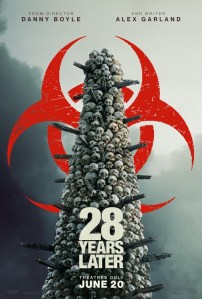 While not officially 28 years after its release in 2003, you’ll have to settle for only 23, comes a sequel to the zombie outbreak that kicked off a resurgence in zombie media in the 2000s. 28 Years Later is a far more experimental and meditative and genuinely surprising and surprisingly poignant sequel than I think many fans were expecting. They thought it was going to be more like a father/son (Aaron Taylor-Johnson, Alfie Williams) coming-of-age zombie hunt and weekend of survival. It is that, but it’s also a meditation on life, death, family, nature, and how we respond to grief. Director Danny Boyle returns, for his first film since 2019’s Yesterday, and screenwriter Alex Garland (Ex Machina, Civil War) returns, and together they provide a sequel that attempts to answer what society might be like growing up in this new dystopian world. The movie can get weird, with old movies and archival footage thematically mixed into scenes, Boyle’s camera in constant nervous anticipation, an active member of the hunt, and the use of an iPhone rig to provide Matrix-esque bullet time effects for zombie head shot splatter. Garland has also come up with some interesting zombie evolution over those ensuing three decades of development (granted I thought since the “zombies” were infected living people that you just had to wait them all out to die from dehydration). It seems like a father/son adventure thriller, and it’s quite good at being that, but then it transforms into something unexpected, giving mom (Jodie Comer) the spotlight as she confronts the reality of her physical and mental maladies. From there, the movie becomes this beguiling and thoughtful examination on grace and grief, on processing loss and finding a sense of stability in an unstable world. Ralph Fiennes appears late as a former doctor who seems a little crazy, the grave-keeper to an impressive monument built from thousands of human bones. It’s such a welcomed surprise for a movie replete with them, a movie that refuses easy categorization and wants to do something meaningful than just being a zombie action/thriller.
 Even more unexpected was an immediate sequel and continuation a mere six months removed from 28 Years Later‘s wide release. The Bone Temple is divided into two stories, both holdovers from the prior film. Spike (Alfie Williams), the son going on his own journey of self, has been conscripted into a weird and violent gang, The Jimmies, lead by Sir Lord Jimmy (Jack O’Connell), the twisted grown-up version of the child seen in the harrowing prologue to 28 Years Later. He’s a sadistic leader who also tells his followers he’s the son of Satan. Then there’s Dr. Kelson (Ralph Fiennes) who we initially thought of as menacing but becomes the most humane caretaker in this post-apocalyptic landscape. The two male figures serve as competing responses to unmitigated tragedy, one retreating to religion as a tool for meaning but it’s really exploitation and manipulation through violence and fear, and the other devoting himself to science and making the world just a little more liveable through empathy and trial and error. Dr. Kelson develops an unexpected friendship with one of the big Alpha zombies, “Samson” (Chi Lewis-Parry), after he discovers this behemoth, who was ripping spines out in rage fits in the previous movie, is seeking out relief through the doc’s morphine darts. Dr. Kelson ponders whether or not there is a chemical compound that could bring back the humanity to the infected. The difficulties with communication do not deter the good doctor, and these paths cross in a climax where the Jimmies come to think of Dr. Kelson as the Dark Lord himself. The movie is consistently interesting, further building out this new damaged world began in 28 Years Later. Nia DaCosta (Candyman, The Marvels) takes over as director and offers a more patient camera, forcing us to dwell in the moments, both horrific and moving. There are torture sequences, long demented monologuing, and questions over the tenacity of human connection despite incredible obstacles, and yet the movie is both more a straightforward horror-thriller than its predecessor and a more focused human drama about loss and holding onto one’s sense of dignity and empathy. It lacks the visual fireworks of Boyle’s style, and I found Sir Lord Jimmy to be more tiresome than interesting, but The Bone Temple is an effectively engrossing lateral sequel that slowly builds Garland’s world a little wider. Now I’ll actually have a third 28 Years movie to look forward to that hopefully won’t take 28 (or 23) years..
Nate’s Grades:
28 Years Later: B+
The Bone Temple: B
Share this:

The Marvels (2023)
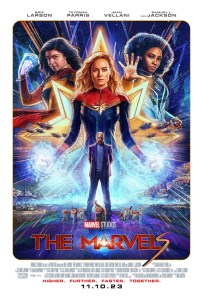
No Marvel Cinematic Universe (MCU) movie has had a bigger trail of negative buzz than The Marvels, the supposed sequel to not just 2019’s Captain Marvel but also an extension of two Marvel television series from the Disney streaming service. The film has had its release delayed three times, rumors abound that heavy portions were re-shot, and its own director, Nia DeCosta (2021’s Candyman), had already moved on to starting her next project while her last movie was still being finished in post-production (to her defense, the movie was delayed three times). The opening weekend wasn’t kind, setting an all-time low for the MCU, and the critical and fan reception was rather dismal, with many calling the movie proof that Marvel was in trouble. There is a lot going against this movie, and yet when I actually sat and watched The Marvels, I found it a flawed but fun B-movie that doesn’t deserve its intense pile-on. Although, caution dear reader, as I’m also one of the seemingly few critics who enjoyed Black Widow and most of Eternals as well.
Carol Danvers a.k.a. Captain Marvel (Brie Larson) has been absent for most of the past 30 years, trying to do right by the universe’s many alien civilizations in need. The people of Earth also feel a little left behind, notably Monica Lambeau (Teyonah Parris), who knew Carol as a child in the 1990s and is now acclimating to her own light-based superpowers (see: WandaVision). A power-hungry Kree warrior, Dar-Benn (Zawe Ashton, Tom Hiddelston’s wife in real life), is seeking a way to restore a home world for her people. She finds one super-powerful weapon, a bangle she wears on her arm that opens interstellar portals. The other bangle happens to belong to a New Jersey teenager, Kamala Khan (Iman Vellani), a first generation Pakistani-American who also moonlights as the bangled-powered hero, Ms. Marvel (see: Ms. Marvel). Through strange circumstances, Kamala, Monica, and Carol are all linked by their powers, so if one of them uses said powers they happen to swap places in space, teleporting from three different points. It makes it really hard when you’re supposed to save the day and work together to defeat the bad guy.
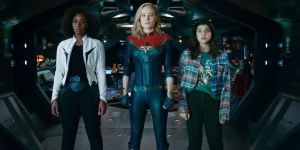
The core dynamic of the movie is this trio of powerful women learning to work together, and while that might sound trite for the thirty-third movie in a colossal franchise, it’s a serviceable arc for a movie that only runs 100 minutes, the shortest in MCU history. The swift running time is both a help and a hindrance, but it allows the film not to overstay its welcome while juggling three lead characters and multiple space-time-hopping action set pieces. I wish Marvel could return to an era of telling smaller stories that don’t have to feel so grandiose, with personal stakes tied more to their characters than saving the planet yet again (2017’s Spider-Man: Homecoming is a great example). Even though this too falls into the trap of world-destroying-energy-hole, it still feels lighter and breezier, and I think that is a result of its pacing and lowered ambitions. That’s not an insult to the filmmakers, more a recognition that The Marvels doesn’t have to compete with the likes of Endgame or the Guardians for emotional stakes. It can just be fun, and simply being a fun and well-paced action movie is fine. That’s what the MCU diet can use more of, especially considering the Ant-Man movies have transformed from palate cleansers to same-old bombast.
On the flip side, the speedy running time is also a very real indication of its troubled production and the attempt to salvage multiple versions into one acceptable blockbuster. There are signs of heavy editing and re-shoots throughout, from lots of ADR dialogue hiding actors visibly mouthing these patchwork lines, to world-building problems and solutions that can seem hazy. The rationale for why these three women become linked is so contrived that even Nick Fury (Samuel L. Jackson) bemoans Carol not to touch a strange unknown space light because it’s shiny. The concept of the three heroes being linked by their powers offers plenty of fun moments, of which I’ll go into more detail soon, but the execution left me questioning. Which superpower use qualified and which did not? It seems a little arbitrary which powers using light trigger the switcheroo. I don’t think the movie even knows. There’s also a late solution that feels so obvious that characters could have been like, “Oh yeah, we could have tried that this whole time.” A reasonable excuse was right within reach, blaming the inability to attempt the solution on not having sufficient power before assembling both of the bangle MacGuffins. It also, curiously, allows the villain to win in spite of her vengeful indiscriminate killing, but don’t think too much about that or its possible real-world parallels as that will only make you feel dramatically uncomfortable.

There are remnants of what must have been a fuller movie of Marvels’ past, as each character has an intriguing element that goes relatively under-developed. Monica was gone thanks to Thanos while her mother died and is also trying to square her feelings of resentment for Carol, a woman she felt so close to as a child who flew away and didn’t return for decades. So we have attachment issues and issues of closure. Carol is likewise trying to rebuild her relationship with this little girl she let down, and she has to also consider the unintended consequences of being a superhero. The Kree worlds refer to Carol as “The Annihilator,” a powerful being that doomed their civilization. She’s become a culture’s nightmare. That re-framing of heroism and perspective, as well as the larger collateral damage of the innocents from defeating villains makes for an interesting psychological stew of guilt and doubt and moral indecision. Then there’s Kamala, who worships Captain Marvel as her personal hero and wants nothing more than to join the ranks of superheroes. Her rosy version of the duties of being a hero could be seriously challenged by the harsher reality, like when Carol has to determine that saving “some lives” is more important than losing all life to save more. She could become disillusioned with her heroes and re-examine her concepts of right and wrong. And there are elements of all these storylines with our trio but they’re only shading at best. There’s just not enough time to delve into this drama when the movie needs to keep moving.
However, the fun of the body-swapping concept leads to some of the more enjoyable and creative action sequences in the MCU. DeCosta really taps into the fun comedy but also the ingenuity of characters jumping places rapidly. It begins in a disorienting and goofy way, as characters jump in and out of different fights and have to adapt. It makes for a fun sequence where at any moment the action can be shaken up, as well as forcing there to be enough action going on for three people. This also leads to some interesting dangers, as Kamala gets zapped high above her neighborhood and plummets to the ground, as these are the dangers when your two other linked superheroes can fly. The use of the powers into the action feels well thought through, and the combination of the women working together and strategizing when and where to swap places makes for creatively satisfying resolutions. The action sequences are also very clearly staged and edited without the use of jarring and confusing edits. You can clearly see what is happening and what is important, and the choreography is imaginatively spry.

There are some asides to this movie that had me smiling and laughing and just plain happy. The Marvels visit a planet where the only way to communicate with the locals is through song, and it starts out like a big old school Hollywood musical with some Bollywood flourishes. I wish the movie had done even more with this wonderfully goofy rule, possibly even setting a fight sequence that also plays into the musical quality of the weird setting. Oh well, but it was pure fun and forced the characters outside of a comfort zone (though this too had some hazy rules application). There’s also a montage involving alien cats and a life-saving and space-saving solution that had me giggling like crazy (my extra appreciation for the ironic use of “Memory”). It’s because of these sequences, the delightful exuberance of Vellani, and the above-average action sequences that make it impossible for me to dismiss the movie as a waste.
The Marvels has problems, sure, with its lackluster villain, some hazy rule-setting and application, not to mention an overstuffed plot that feels a bit jumbled from the likes of twenty other stories trying to appear as one semi-unified whole. But it’s also fun, light, and entertaining in its best moments, and even the good moments outweigh the bad in my view. I would gladly re-watch this movie over the likes of Multiverse of Madness, Love and Thunder, and Quantumania. While it can seem initially overwhelming to approach, the movie does a workable job to catch up its audience on who the other Marvels happen to be just in case you didn’t watch 17 episodes of two different TV shows. It’s mid-tier Marvel but refreshingly comfortable as such, only aiming for popcorn antics and goofy humor with some colorful visuals. It all feels like a special event from a Saturday morning cartoon, which again might be faint praise to many. Blame it on my lowered expectations, blame it on my superhero fandom, or simply call me a contrarian lashing out against what seems a very ugly strain of vitriol for this movie to fail, but I found The Marvels to be a perfectly enjoyable 100 minutes of super team-up tomfoolery.
Nate’s Grade: B-


You must be logged in to post a comment.