Blog Archives
Teenage Sex and Death at Camp Miasma (2026)
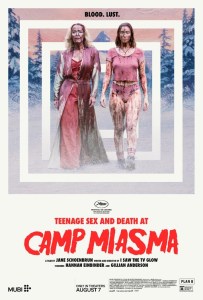 After 2024’s I Saw the TV Glow, writer/director Jane Schoenbrun became an indie darling with a daring perspective and a genre-bending feel for combining 90s nostalgia with coming-of-age ennui. While the movie didn’t exactly entrance me, I did write, “It’s a weird movie but it’s designed for weird kids, or weird adults who used to be weird kids, who found kinship through weird media.” I think this might be Schoenbrun’s style from here out. Their follow-up, Teenage Sex and Death at Camp Miasma, is another conflation of tones and styles, looking at the slasher movies of the 1980s with satire and fondness. We follow Kris (Hannah Einbinder), a Sundance-darling director whose big artistic break has now given her the opportunity to reboot the dormant Camp Miasma horror series. The killer, a gender fluid camper that was drowned in the lake, comes back as Little Death, wrecking bloody havoc across camp. Kris wants to approach the franchise’s original Final Girl, Billie Presley (Gillian Anderson), who voluntarily left Hollywood afterwards and has been a mystery. Kris wants Billie’s blessing to reboot the film, but Kris might also be looking for something more from Billie, and their relationship changes dramatically.
At one point, Billie gently chastises her special guest to stop thinking about film in such exclusively academic terms and to see it as a movie and less a discourse, and I feel like that advice could have been heeded by Schoenbrun. I come away from Teenage Sex and Death at Camp Miasma feeling like it is a movie that exists in air quotes, that resides on a level of discourse far above the events of the movie, that it’s intended less for artistic expression and entertainment and more as a film theory thesis for smug Letterboxd users. That’s not to deride the movie because it has a point of view or is another deeply personal exercise that feels like Schoenbrun turning their awkward coming-of-age into a transformative tableau for public consumption and, well, discourse. I don’t have an issue with Schoenbrun’s movie wanting to go deeper in an analysis of our personal connections to problematic art, in this case the schlocky slasher movies of the 1980s, otherwise known as a genre built upon “flesh and fluids,” as Billie informs us. My nagging issue with the film is that I don’t feel like it adds up to much, that Schoenbrun is so busy operating on that academic level with the material that it feels beyond reach. If the movie wasn’t occasionally elbowing you in the ribs by underlining its metaphors, I wouldn’t ultimately know what the larger themes or messages are amidst a miasma of haphazard ideas and genre riffs. I love the premise and how it twists into a Lynchian psycho-sexual nightmare that causes our characters to question what is real, but the end results left me shrugging and wishing I was enjoying the finished product more.
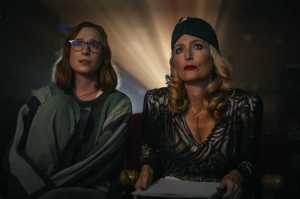 The idea behind Camp Miasma has all sorts of juicy layers-within–layers fun. Kris is obviously a stand-in for Schoenbrun and their experiences shuffling through the studio system as the Next Hot Indie Auteur, likely offered all manner of IP slop and zombie franchises similar to the flagging Camp Miasma horror franchise. Kris knows that her queerness and perspective is being commoditized to resuscitate an outdated franchise that has a history of transphobia (the Sleepaway Camp allusions are pretty clear here). Kris accepts these studio suits want to use her to provide cover for bringing the franchise back, but she wants to use them as well. Instead of delivering the same old schlock, Kris wants to go back to the original Final Girl who swore off acting afterwards, using the movie as her personal vehicle to interrogate a reclusive actress that she just happens to have a formative sexual connection with. Combine that with our Norma Desmond-like faded star literally living on the camp grounds where the original movie was shot, and that’s a terrific mixture of intrigue and obsession, of fantasy and reality bleeding together. So why does the finished movie feel rather unfulfilling to me then? Why does the sum feel less than the pieces?
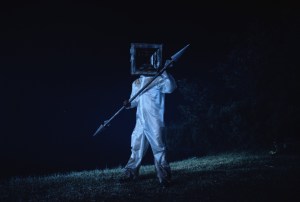
Maybe it’s because the obviousness of some of Schoenbrun’s points acts as an artistic ceiling. The voyeurism of slasher cinema in particular, born from Norman Bates and given new form by Michael Myers, is endemic to the genre, placing the viewer in the perspective of the mad murderer and the nubile teens finding silly ways to slink off to their gory demises. Kris is obsessed with one moment in the original Camp Miasma when a young Billie had a certain look in her eye that has always haunted her. It just so happens this moment was during the scene where Billie’s character lost her virginity on film, and there is an added context to the scene that makes the moment even more unsettling. Schoenbrun hinges Kris’ sexual awakening to a moment of old media that also happens to be Billie’s own sexual awakening, linking the two characters through a mirror of art, with the camera serving as transport. The nature of the scene involved Billie imagining Little Death coming for her and killing her, with her seeing the moment from her own eyes but also simultaneously from the eyes of the killer. It’s the voyeurism that unlocked something in both of these women, and yet Schoenbrun doesn’t seem interested in going further with an examination on this topic, only setting it up to be repeated and shared as supposed personal growth. Maybe, but maybe it could have been more interesting to dig into why disassociating from her own body during sexual congress was the key to pleasure for this woman, especially from a trans filmmaker. Likewise, there are some points that are blunt but to the point of making me want to sigh. Our killer has a long phallic spear that he struts around repeatedly thrusting and penetrating his victims. We get it. The killer is named Little Death, the pithy French term for an orgasm, which is perhaps why he wants to spear all these people. We get it. It’s so obvious it circles back from meta clever and back to just being too obvious. The ending descends into a wacky Ari Aster-like dark cartoon of fantasy convergence, like the movie had just been consumed from the inside out, but the insights are limited and glancing, amounting to little more than, “Hey, everybody can like the art they like and we don’t get to choose what turns us on.” Sure, I guess. Like what you like, folks. I was hoping the movie might be more than one woman’s quest to harness her big O under very specific scene-dependent circumstances.
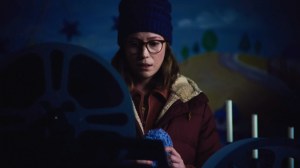 Far be it from me to dictate what artists should do with their personal stories hewn from their souls, but there’s a strong part of me that feels like I would have enjoyed a more straight-forward (pun not intended) version of this story. I think a fledgling director getting in over their head and blurring professional and personal lines with their subject is ripe for engrossing drama and conflict. Likewise, having a reclusive actress on the cusp not just of a comeback within the industry but possibly of a fellow artist that really took the effort to understand her perspective and wanted to give it a meaningful platform, that too could be intoxicating, so for the both of them to feel an attraction would only further complicate boundaries. Simply delving into that would be a fascinating exploration of fantasy, projection, and power dynamics. It could also explore the difference between when reality doesn’t match our personally-curated fantasy. Throw in some repressed sexual kinks tied directly to the problematic art/genre, like Kris admitting she can only feel pleasure if she imagines herself as the highly sexualized Final Girl of 1980s horror, and that’s quite a fascinating brew destined to challenge characters and their identities and desires. Now imagine that movie had an extended sequence of Little Death’s point of view while he speared and decapitated people with set to the Counting Crows’ “Long December.” Now imagine the concept that the movies aren’t movies but real life is the movie, and we’re all the characters that Little Death is watching in his underwater video store. Okay. Sure, I guess. Look, maybe you’ll click with Schoenbrun’s wavelength but I felt like it was too often operating outside itself, keeping me distant.
That’s not to say that Teenage Sex and Death at Camp Miasma is without its virtues. It’s an often funny movie, though keeping to an awkward chuckle best personified by Anderson’s deep-fried Southern charm and peculiarity. Just listening to this woman opine about breakfast cereals could make me laugh. Both actresses give quite good performances and they have strong chemistry together, finding ways to sell lines and moments that might be too goofy to accept with actors of lesser talent. The gore is over-the-top and enjoyably ridiculous without the violence feeling uncomfortable, which itself is a feat considering there are some loaded themes of exploitation, hate crimes, and sexual assault throughout. The first ten minutes might be my favorite part because the precise period details of creating the fake history for the Camp Miamsa series, including the 8-bit arcade video game, are so wonderfully perfect. I appreciate how personal Schoenbrun makes every one of their movies, often exploring how art shapes our sense of ourselves and reckoning with that into the uncertainty of adulthood. Schoenbrun is a talent that exists on a slippery dream logic level, who likes to throw out questions without clear answers, and I appreciate their artistic ambition even if this is the second movie in a row that feels overburdened with ideas and stubbornly underdeveloped in execution.
 There will be plenty that sing the praises of Teenage Sex and Death at Camp Miasma and find personal connections that provide added depth and meaning. Art is personal, and every one of Schoenbrun’s movies is almost unbearably personal. There is a distinct affection and appreciation for what most would classify as “bad art,” these old junky movies that probably didn’t mean much to those making them but could be indelible to the right kid at the right moment late at night. Maybe some day Teenage Sex and Death at Camp Miasma will be that movie for some kid late at night, and that’s something even if it wasn’t quite something for me.
Nate’s Grade: B-
Share this:

Tron: Ares (2025)
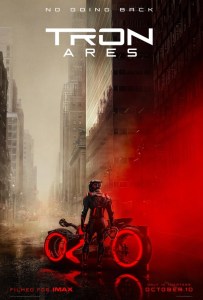 Known more for its cutting-edge visual effects, the Tron series has long felt like a franchise that Disney keeps trying to reanimate every generation with the hopes that this time, this time, it won’t be ahead of its time and merely of its time and a measurable hit. I think the issue I’ve had with the Tron movies, the original in 1982 and the 2010 glitzy sequel by debut director Joseph Kosinski (Top Gun: Maverick), is that the computer world that the characters get sucked into is, quite simply, boring. The world-building of life inside the computer is dominated by design and less by depth. It’s cool-looking and sleek and alien but it’s also over-glorified setting details without a larger sense of life. That’s probably why every movie has dealt with the threat of the computer world coming into the real world. That’s where Tron: Ares does right, spending far more time in the real world than the computer one, with a flesh-and-blood character (Greta Lee) traveling into the computer realm and a digital one (Jared Leto) traveling out to track her down. On the outside is a war between two tech companies, both racing to be able to replicate structures from the computer world into our own, except they disintegrate after 30 minutes. This is a smart limitation as it naturally presents a goal, to outlast this measure, but it also presents a ticking clock for our computer programs tracking down their missions. Much of the characterization is Leto’s security program, Ares, becoming self-aware and questioning the orders of his superiors, which makes for a pretty predictable arc from a pretty stoic if tedious character. He’s simply the cool fighter that we need for cool fighting, and admittedly, there are plenty of cool fights here. The Tron visual aesthetic of force movements creating warriors makes for some nifty images, especially when those barriers are used for strategic purposes in escapes or combat. You could mentally check out from all the tech mumbo-jumbo and just enjoy the pleasure of the sci-fi action, especially with Nine Inch Nails (really Trent Reznor & Atticus Ross) providing the sonic musical accompaniment. I don’t know if I’ll ever really love a Tron movie but there’s enough offered with Ares that allows me to at least like a Tron movie.
Nate’s Grade: B-
Share this:

Scoop (2024)
 It’s like a British Bombshell, a behind-the-scenes account of the media attempting to hold key political and public figures to account for gross sexual imposition. With the Netflix drama Scoop, it just so happens to be Prince Andrew (Rufus Sewell), interviewed by BBC TV journalist Emily Maitlis (Gillian Anderson) in 2019 and scrutinized heavily for his close ties to former friend Jeffrey Epstein. The first half of the movie is about the wheeling and dealing behind the scenes to garner the high-profile interview, to convince Andrew he can clear his name after his connections to Epstein resurfaced. The second half of the movie is pretty much just the interview, which is indeed interesting to watch for the inherent drama, but after a while, I wondered what this movie was adding that I otherwise couldn’t gain from simply watching the actual 2019 BBC interview? There aren’t really scintillating details or clever scheming to guarantee the interview or outfox its news rivals, and the newsroom personalities, lead by Billie Piper (Doctor Who), are hard-working and tireless stock types that don’t leave much of a distinct impression even after the time together. It’s really a plainly presented dramatized version of the infamous interview, the one where Andrew was professing his innocence against his Epstein accuser with his bizarre argument that he has a condition where his body doesn’t sweat. Anderson is great, and Sewell is terrific as he melds into this figure of complacent arrogance and self-delusion (the makeup is also quite impressive). Still, if you’re really interested in gaining further insight, you might be better off looking elsewhere, or just watching the original interview. Consider this a bonus epilogue to Netflix’s The Crown for any die-hard royal aficionados.
Nate’s Grade: B-
Share this:

The X-Files: I Want to Believe (2008)
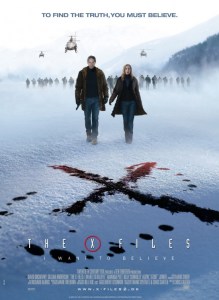 To all fellow X-Files fans out there, the movie is not nearly as bad as you may have been lead to believe. That said, it’s pretty much a so-so standalone episode of the TV show needlessly expanded. And yes, for all concerned fans, Mulder (David Duchovny) and Scully (Gillian Anderson) kiss on more than one occasion. The plot that reunites the characters is fairly mediocre, something about a ring of mad scientists that want to be a modern-day Dr. Frankenstein. You don’t need a two-headed attack dog to know that plot is way too hokey. The most intriguing aspect of the film is a priest (Billy Connolly) who also receives psychic visions, cries tears of blood, and, oh yeah, is a convicted pedophile. Could God be responsible for his special abilities as well as the abhorrent sexual urges? There is so much great conflict and human drama in this character worth examining, so it’s a pitiful shame that he just gets shoved off so the third act can concentrate on the lame mad scientists. A majority of the flick occurs in snowy West Virginia, which doesn’t translate into anything too special to look at. I’ll admit, my rating is inflated because I was an ardent fan of the TV show until the last years when it felt like they weren’t even trying any more. If you stripped away my allegiance, I’d say that the second X-Files movie serves little purpose other than to add a tiny coda to a TV show that went off the air in 2002. The characters are worth revisiting, just not in this tepid tale.
Nate’s Grade: C+


You must be logged in to post a comment.