Blog Archives
Buddy (2026)
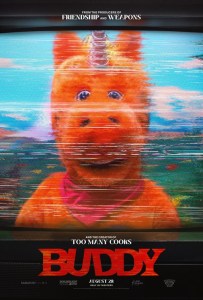 What if Barney the friendly dinosaur was really a murderous monster? That’s the catchy premise of co-writer/director Casper Kelly’s surreal horror fantasy Buddy, a crazy yet admirably committed exploration of kids TV tropes to their fullest extent. Considering Kelly might be best known for his insane yet brilliant deconstruction of sitcom opening theme songs, the Adult Swim short film Too Many Cooks, this makes sense. My first question was whether the pastel-colored, stagey world of Buddy the Unicorn (voiced by Keegan Michael-Key) was supposed to be literally real or was simply a TV set. The universe of Buddy, while adhering to the tropes and mechanics of children’s TV storytelling, is indeed its own reality. I enjoyed how Buddy knows he must gather the children to sing the closing theme song because then “the words appear” (he means end credits) and everything resets, which would allow him to heal from his injuries or perhaps have the children forget witnessing his horrors. The puppet-heavy world of Buddy is interesting, as are the subversive and disturbing edges glimpsed like Buddy trying to explain the disappearance of a child and the strange “red paint” on his outfit. Short of twenty minutes, the entire movie takes place in this strange fantasy setting, so I kept wondering about the lore and workings of this universe, especially how Buddy is capturing kids from the real world. The last ten minutes fulfilled that but I wanted more. That’s because the Buddy set itself, modeled after PeeWee’s Playhouse and Barney, feels a little too closed-off, the building threat of Buddy being rather redundant. I became frustrated at how limited the movie was settling with its subversive satire, at several points feeling like an overextended skit going off the rails rather than a complete movie. Then again that structural gambit might appeal to other viewers who are on the same twisted wavelength of Kelly. It held my interest, but I kept wondering if this was all there was, and whether maybe Buddy was a little too much of the same.
Nate’s Grade: B-
Share this:

Palm Springs (2020)

I am a sucker for a clever time travel tale, or parallel universes, a sci-fi story where the creative ingenuity is front and center, and Palm Springs is a delightful new rom-com bursting with imagination. By this rate, most audiences should be familiar with the time loop formula, from comedy classic Groundhog Day to Source Code to Edge of Tomorrow to Netflix’s audacious series, Russian Doll. It’s a creative conceit that rests on building patterns and subverting expectations, allowing a writer an unparalleled opportunity to retell a story, pulling at the edges and getting to answer an assembly of “But what if?” questions. It builds out its world and makes it feel richer and more intricate, all the little stories and characters that might have been missed had there only been a single avenue. It requires a creative storyteller with a big imagination for details, but when done correctly, the time loop movie can be a wealth of satisfying payoffs and intriguing detours. Palm Springs deserves to be added to that list of hallowed time loop movies.
It’s the day of the wedding for Sarah’s (Cristin Milioti) sister. There’s one wedding guest that seems to stand out. Nyles (Andy Samberg) seems prescient on the dance floor, has a prepared speech that earns tears, and strolls through the reception like he owns it. Sarah becomes smitten with him and, against her better judgment, follows him into a mysterious glowing cave. She wakes up in her bed and relives the wedding day again, learning she too is now trapped in that 24-hour loop with Nyles. He laments that she followed him, having once encouraged another person to join him in the world of no tomorrows (a rueful Roy, played by J.K. Simmons). But with a partner, the many days have a new relevance, and Nyles and Sarah depend on each other, but is there a chance that they can escape or are they doomed to perform the Electric Slide forever?

Right away, you can tell that writer Andy Siara (TV’s Lodge 49) has given his story tremendous thought, and the fun of it is watching our main characters go through the process of discovery while learning more about each. The rules of the universe are straightforward; whether death or sleep, they will wake up back that fateful wedding morning. Nyles has felt trapped for so long and the prospect of another companion going through his same purgatory fills him with guilt, but he cannot help feeling a new purpose when he finds a partner for this weird world. Initially she’s looking for an escape, but then she opens up to the possibility to a life permanently on pause, without consequences, and how freeing this can be. Then the appeal dampens as we come to understand why this day is a personally painful one for Sarah and why she would be desperate to live another day, any other day. When she drops out for a solid stretch in the second half, you miss her just as much as Nyles and better realize what a great team they made. Palm Springs has plenty of fun with the possibilities (Nyles requests a quick death over a long drive to “beat the traffic”) but it doesn’t lose sight over why we should care about these people. It doesn’t really matter how the time loop began or whatever theory will end the loop. It’s the central relationship that will ultimately provide the emotional anchor, and it’s because of that attention that by the conclusion of Palm Springs I felt uplifted, buoyant, and happy (a mid-credits scene thankfully answers the one lose thread, providing an even more welcomed conclusion).
Make no mistake, this is a funny movie and I laughed often. Samberg (TV’s Brooklyn 99) and Milioti (Black Mirror) are terrific together and genuinely seem to enjoy one another. They have a combustible spark to them that reminded me of older screwball comedies. Having a willing partner allows Nyles to cater to different impulses but also pushes him to re-examine his perspective when he has someone new who sees the excitement in their unique position. However, except for Roy and his long drive from Irvine, they are hopelessly alone, unable to move forward, and the question arises can there be anything of significance without consequences? The screenplay has a natural dark streak with its humor, so even when things get heavy with existential quandaries, it doesn’t stop the movie from being smart and enjoyable. There are so many wonderful little payoffs, little running gags, and larger payoffs to be had with the time loop formula. It also hooks an audience by watching a character fail, and fail, and fail, only to succeed. Palm Springs is a romantic comedy that can be funny, romantic, and make me care.

Debut director Max Barbakow keeps the pacing swift and has fun playing with bold primary colors across the desert setting. The tone of the movie is delicate as it can go into silly revelry, like a surprise coordinated dance routine and a wedding outburst involving a bomb, into yearning romance, into heartfelt pathos, and then even the occasional stomach punch. For as rightfully beloved as Groundhog Day is, there’s nothing that comes close to feeling like an emotional gut punch. With Palm Springs, the time loop is given its sci-fi examination, the comedy is given is full exploration, but it’s the characters that matter most, and Barbakow prioritizes the right feelings at the right times. By the end, you feel sweetly fulfilled by these 90 charming minutes.
At first, I wondered why the Roy character was included except as a cautionary tale why Nyles would not want to rope someone else into his purgatory. But then as we visited with the older man, I realized, as he does, that he’s meant to symbolize the change in perspective (mild spoilers to follow). The family that he couldn’t stand before his loop-life has now become his personal oasis. He’s grown in appreciation and love of his family bonds. He is the example for Nyles about how one can personally grow and change when given dedication and enough time to see it through. It’s a nice moment, and while Simmons (Whiplash) is always wildly entertaining when he’s bulldozing over others, giving Roy a poignant sendoff made me feel like he was a much more integral character and his earned wisdom was its own special reward.
Palm Springs is a great detox of movie, with enough sunny comedy and winning romance to make you smile and enough tortured existential drama to provide substance. Everyone involved, from the writer to the director to the cast, is having a blast and it’s fun to join in the good times. When it comes to time loop cinema, Palm Springs is a respite of entertainment and smartly developed and richly realized execution. Find it on Hulu and kick back.
Nate’s Grade: A
Share this:

The Wolf of Wall Street (2013)
 Martin Scorsese. The greatest living filmmaker on the planet. Enough said. When his latest, The Wolf of Wall Street, was pushed back due to an editing crunch, the rumor mill started as it normally does. Are there problems? Is it any good? Will it be forgotten this late into the awards season? While I can’t speak for the Academy, but for me The Wolf of Wall Street just about blows every competing movie out of the water this season. It’s brash, exhilarating, uproarious, mesmerizing, and just about every other adjective you can fetch from a dictionary. This is first-class filmmaking from a master, and consider Wolf of Wall Street the white-collar companion piece to Scorsese’s gangster masterpiece, Goodfellas. It’s that good, folks.
Based on his memoirs, Jordan Belfort (Leonardo DiCaprio) rises on Wall Street from a rookie stock trader to the king of his own empire. From the late 80s to the 90s, Jordan assembles a cutthroat team that knowingly sells lousy stocks to gullible investors and stuffing their pockets with hefty commissions. “Better there money was with me. I knew how to spend it better,” he admits. His closest friend and business partner, Donnie Azoff (Jonah Hill), literally quits his job to work for Jordan after spying one of his pay stubs. The guys start their own firm, specializing in high-pressure sales and on penny stock commissions. From there, they expand and expand until they’re making their own noise on Wall Street. The trading floor more closely resembles a frathouse party, complete with chimp, strippers, marching bands in their underwear, midget tossing, and other objectionable behavior. Jordan easily succumbs to the sex and drugs of the high-finance world of money, leaving his plain wife for Naomi (Margot Robbie), a gorgeous underwear model. He’s got a giant estate, a huge yacht, his own helicopter, and more money than he can spend. He’s also got the attention of the FBI and Agent Patrick Denham (Kyle Chandler). With the feds circling in, Jordan has to take extra steps to keep the good times rolling.
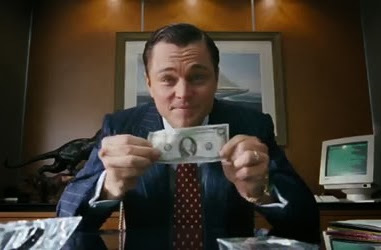 With a running time exactly one minute shy of three hours, it’s easy to call The Wolf of Wall Street self-indulgent and excessive, except that’s exactly the point. The movie is an orgy of unchecked male ego, a perverse bacchanal of Earthly pleasures that Caligula might blushingly admire. They are literally two orgies depicted in the movie and plenty of thrust-heavy sexual congress (I counted eight walkouts in my theater, most of them the little old lady variety). Here is a tilt-o-wheel of madness. These people were living like there was no tomorrow, had more money than they knew what to possibly do with, and would figuratively dance while Rome burns (in this instance, the stability of the U.S. economy). What’s important is to communicate that these individuals were having the time of their lives. It wasn’t just the hedonistic pleasures and the mountains of drugs; it was the power, the uninhibited embrace of a life available via poorly regulated capitalism. Many of those brokers in Jordan’s company were people from ordinary backgrounds. Their self-made success (that wasn’t so much earned as swindled) is a point of pride that fills them with purpose. They are seizing their full potential. There is no doubt in my mind that every broker in this movie would do it all again in a heartbeat. There is no remorse on display anywhere. The only remorse is having the ride unceremoniously end. “Was it obscene? Yeah it was obscene. In the normal world,” Jordan narrates. “And who wants to live there?”
I won’t say that there aren’t scenes and moments that could have been trimmed, but I was enjoying myself way too much to care about the bloat. This is the fastest three hours you’ll ever experience in your life. There’s some fat, yes, but man does this picture just move along like a freight train. The screenplay by Terence Winter (creator of HBO’s Boardwalk Empire) is impeccably drawn. The movie just courses with energy and watching it is often an exhilarating rush, communicating the highs the characters are undergoing. The supporting players are used to great effect to punctuate the comedy moment to moment. I loved Rob Reiner’s exasperated and profane performance as Jordan’s father. Naturally the bad behavior is entertaining in how absurd and over-the-top it can get, but one key sequence ranks up there with the finest sequences Scorsese has ever put to film. It’s the “Lemon” sequence, named after a legendarily potent batch of Quaaludes. It is a sequence of pure movie bliss, brilliantly edited and staged, as Jordan is placed in a precarious position when the drugs kick in, and his comic floundering is riotous. Winter and Scorsese have taken what, in other hands, could have been a modern American tragedy and decided to portray it as a darkly comic fantasia. I laughed long and hard throughout the movie. There are numerous scenes I can think back on and start laughing again. The ridiculous nature of moments, like discussing the logistics of tossing midgets at a dart board (“This is their gift”) is to be expected, but it’s the overall degenerate lifestyle these clowns chase after with impunity that kept me laughing.
I’ve read cantankerous critiques of the film, chastising Scorsese for celebrating the lavish lifestyle and excessive hedonism of his characters. I could not disagree with this appraisal more. The error is assuming that witnessing Jordan behaving badly is akin to celebrating it, as if adopting the perspective of our lead is the same as excusing his actions. Scorsese makes it clear early, and often, that Jordan Belfort is not a good person. Hopefully you don’t need him hitting his wife for this point to stick. This guy is fleecing people out of their life savings, living high off the fat of the land, and openly admitting to the camera how deeply illegal his activities are. But you’re under his spell, much like his brokers that worship him with unflinching zeal. Jordan, especially as portrayed by DiCaprio, is a volcano of energy and single-minded determination. He whips his troops up like a religious revival, manipulating you with every tactic in his employ. Early on, he’s defrauding ordinary middle-class and low-income clients, but because we’re all addicted to the adrenaline rush of the sale, of the con, we push this troubling reality from our minds. When he moves onto wealthier clients, we adopt a similar attitude of Teresa, Jordan’s first wife, mainly that these people can afford the losses and therefore get what they deserve from a silver-tongued shyster. It’s the audience that proves to have a selective memory because we’re drawn to Jordan’s charisma, expertise, and talent, so we ignore the pesky details of who gets stuck with the bill. Don’t pin that on Scorsese. He makes it abundantly clear that Jordan is a bad man, and the depths of his greed is but the tip of the iceberg when it comes to Wall Street. Jordan’s firm was a tiny player. Think of what horror stories Goldman Sachs or Lehman Brothers would offer if ever exposed.
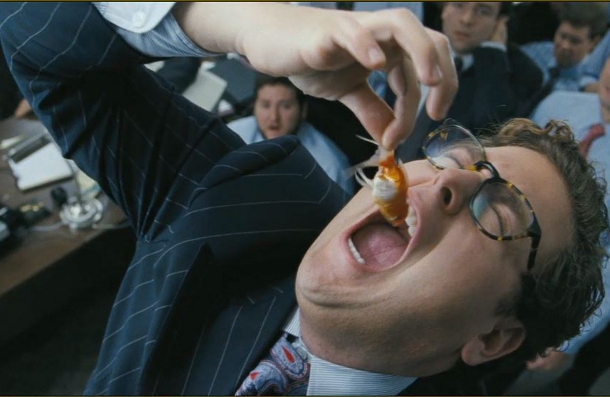 This is my favorite Scorsese film since Goodfellas, and they have plenty of similarities. It makes sense because these men of finance take their cues from movie gangsters, styling themselves as tough guys. At one point, brokers hold a guy over a building to intimidate him. There’s also certainly as much cocaine as there may have been in Scarface. But like that classic of the gangster cinema, Scorsese propels us into the hidden world of the financial institution run amok, allowing us a backstage pass to the people profiting from wrecking the economy. It’s a fascinating perspective that confirms some of our worst fears about stockbrokers. It’s a misogynistic boys club and the few women that do participate have to play by their hyper masculine, juvenile rules. These are people that find any number of ways to skirt the law, rip off their clients, and live in luxury until they can find another sucker. It’s a system built for the entertainment of the few on the backs of the many, and it’s just as relevant today as it was in the 90s. With Jordan’s inside knowledge, we’re educated on the many corrupt ways of Wall Street.
Marking the fifth collaboration with Scorsese, this may be the finest DiCaprio (The Great Gatsby) performance yet. The man sheds his vanity, easily fitting into the shark that is Jordan Belfort. He’s ruthless in one moment and completely inept in another, at the whim of his vices. DiCaprio taps into Jordan’s leadership qualities with the dynamite sales speeches, but he also shows what an insecure man he is at heart. He’s got a taste for the good life and is reinventing himself, including trading up in wives to attain that proverbial American Dream. He’s living empty pleasure to empty pleasure and he doesn’t care. DiCaprio acts as our ringmaster through his own circus, and you’ll be delighted and horrified by his actions (and also his peculiar, bird-like dance moves). There’s not a bad performance in the whole cast, and this is one huge cast. Hill (This is the End) is a becoming more and more credible as a dramatic actor, though he excels at the blustery outrageousness as Jordan’s number two. He’s a treat. Robbie (About Time) nails her New Yawk accent but more importantly nails the portrayal of a trophy wife who recognizes and eventually resents her lifestyle. And oh does she just exude sexual heat.
I want to focus on the very end of the film, so there will be some mild spoilers in this paragraph but nothing I feel that would ruin the viewing experience. You have been warned, spoiler phobes. As expected, Jordan eventually winds up in jail for his felonious misdeeds. Ordinarily this would be the end of our traditional law-and-order morality tales; the bad guys are locked away to pay for their crimes. Jordan tells us how nervous he was on his first day of prison, that is, until he remembered one very important fact: he’s rich. White-collar prison is not the same as other penitentiaries, and we see Jordan loftily playing tennis. His sentence is only three years as well, which seems like an insult given the thousands of lives he may have instrumentally ruined. But that’s the ultimate condemnation in the end: the system is rigged for people like Jordan, people with money. In the end, he wins. He goes to prison, his family life is torn asunder, and his personal relationships are strained, but the guy wins. He continues his speaking engagements motivating everyday saps how, with his cherished expertise, they too can rake in wealth. The final shot of the movie tells me everything I need to know. It’s a slight pan out to the crowd in attendance of Jordan’s speaking session. We see the collection of faces, each person hanging onto Jordan’s every word, each filled with idolatry. They want to be him. Despite everything, the bad behavior, the crimes, the waste, they all want to be him, and that’s why people like Jordan will always succeed, will always prevail, will always have the last laugh. There will always be a healthy supply of suckers that want to believe whatever nonsense he’s peddling. That’s the point. He won.
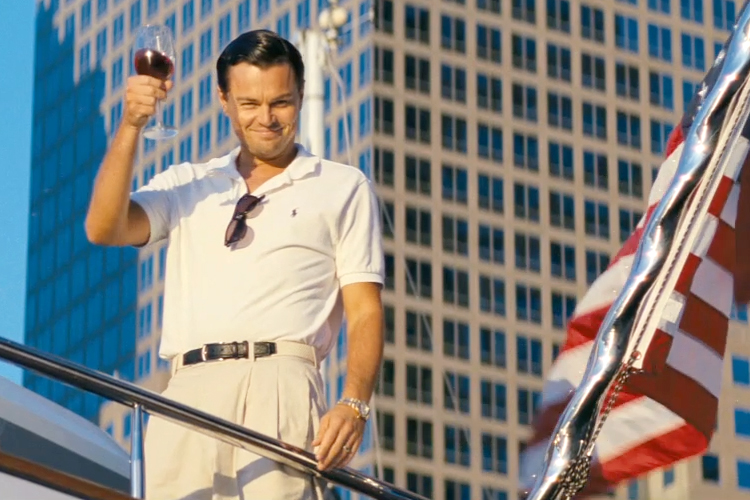 Recently I watched the very good crime caper American Hustle and noted that its director looked to be fashioning a loving Martin Scorsese homage. Well, after watching The Wolf of Wall Street twice (not back to back, mind you; I’m not nuts) I can say that there is no Scorsese like the source. This is vintage Scorsese. This is brilliant filmmaking, a bold movie that practically sings, it flies by with exhilarating force and acumen, daring you to keep watching. The fact that 71-year-old Scorsese could make a movie this highly energetic, this debased, this brash, this borderline indecent, and this awesomely entertaining is encouraging. It’s even more hilarious to me that older Academy members at a recent screening of the film accosted Scorsese, essentially being termed a “debauched scoundrel.” That’s got to count as some badge of honor. Yes, at three hours the movie can get long but it’s never dull or taxing. The propulsive narrative, the hilarious humor, the shrewd characterization, the wanton excess, the filmmaking bravado that hums, it all coalesces into a disturbing and disturbingly enjoyable condemnation of greed and our inherent celebration of this lifestyle. There is not one aspect of this movie that falls flat. The Wolf of Wall Street is an invigorating piece of cinema. The choice of music, the swinging cinematography, the wide ensemble of actors, the feverish editing, it all comes beautifully together to form a whole that surpasses everything else in cinema this year. Dig in.
Nate’s Grade: A


 nathanzoebl
You must be logged in to post a comment.