The Social Reckoning (2026)
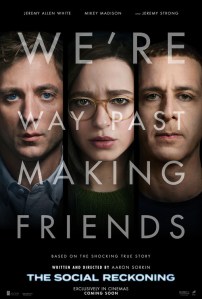
I’m trying hard to articulate why exactly The Social Reckoning was nowhere near the experience that The Social Network was, albeit it’s extremely hard to replicate the exact alchemy that went into making one of the best movies of the twenty-first century. Seriously, The Social Network is a masterpiece and won screenwriter Aaron Sorkin his only Oscar. Now 16 years later, it’s all Sorkin, returning as writer and taking on the duties of director. The absence of director David Fincher is obviously massive, as the mercurial maestro brings excellent storytelling and presentation sensibilities to elevate any tale. Nobody can match that. I wonder if the biggest difference is less the change in artists and simply the times we live in to receive the story. Perhaps Reckoning not only missed its window of relatability but now feels quaint and unimportant, lacking the rise-and-fall tragic trajectory of the friendships at the formation of Facebook that captivated the original 2010 movie. Whereas the original felt engrossing and revelatory, this one feels hectoring, tin-eared, and already painfully dated for its alarmist messages about Internet veracity. Sorkin is no Fincher, but by all accounts who can be? However, more disappointingly, 2026 Sorkin is no 2010 Sorkin, and his headline-grabbing sequel to An Important Movie sure wants to be important. It’s too bad that the world has moved on and its lessons and moralizing have already been tuned out by the public.
Bouncing between 2019 and 2021, we follow Frances Haugen (Mikey Madison), a Facebook employee growing increasingly alarmed that their algorithm is radicalizing users through a steady stream of disinformation and media manipulation. She seeks help from Wall Street Journal tech reporter Jeff Horowitz (Jeremy Allan White) to expose the malpractice going on so that Facebook can reform. But with CEO/co-founder Mark Zuckerberg (Jeremy Strong, replacing Jesse Eisenberg) prioritizing profit over civic responsibility, is there anybody in the higher reaches of the company that even wants to care?

Newsflash: social media prioritizes keeping you hooked on its site as long as possible, and the best way to do so is through stories that will outrage you. Were you aware of this shocking revelation, something the movie seems to consider a hidden agenda that needs to be exposed? If stories about kittens and puppies cuddling together would keep your older aunts and uncles from clicking to another site, then that’s what Facebook or any other social media algorithm would be feeding them a steady drip of. It just so happens that fear and outrage is the median driver of user engagement, and so instead of kittens and puppies cuddling, it’s stories about Sharia law invading the heartland, or Obama’s fake birth certificate, or fluoride in the water making all the children trans that your kooky aunt and uncle are sharing with you. There’s a heavy correlation with misinformation because, unless somebody is fact-checking, there is no punishment for publishing and sharing conspiracy theories and gossip. It’s much harder to verify real facts and witness statements and times and the like then just making it all up, and if you can train a data center of Russian bots to sow the Internet with acrimonious misinformation, who is going to stop you?
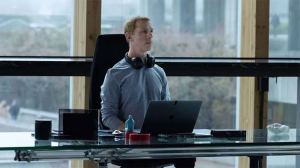
Not Facebook, which Zuckerberg makes abundantly clear in his section of the movie that feels completely tacked on to the rest of the story. Zuckerberg is practicing his Congressional testimony with a team of advisors in preparation for an upcoming grilling over the legal liability of social media companies. Zuckerberg has adopted the convenient stance of the tech billionaires of being a “free speech absolutist,” which in his mind means presenting a platform but not censoring whatever is digested on said platform. Under these terms, Zuckerberg (dear reader: as a side note I want to share, while typing this sentence I accidentally wrote “Suckerberg” and that feels so fitting, doesn’t it?) would allow posts about racial superiority and bomb making and tips on how to kill your kids and get away with it. That’s because his “hand’s off” view has to exist in the all-or-nothing extremes of his cherished conception of liberty. Except Facebook isn’t the government, it’s a private company. It can set its own rules, especially if it learns how harmful its platform can be for misinformation and radicalization via polarized echo chambers. The Zuckerberg scenes feel like Sorkin performing a cross-examination with a mirror, arguing the edicts of culpability in a way to underline how derelict of its duties our Silicon Valley tech lords have become. It feels like it’s talking circles around the same points with some of the most clunky dialogue that twists metaphors into pithy trailer-ready soundbites. Ultimately, it culminates with the insurrection of January 6, 2021 and Zuckerberg having to consider the extreme harm of misinformation on his platform.
Except does he? I would argue, decisively, no. That’s where the “reckoning” part of the movie feels not only premature in celebration and admonition but also outdated and incorrect. Had this movie come out in 2022 or maybe even 2023, audiences might feel a little inflated sense of relief by its traditional conclusion, with Frances using whistleblower status to expose the ills of Facebook’s algorithm and testify before Congress, galvanizing the moment for change. We too might feel as she does, pumping her fist in declamatory yet awkward celebration. These guys sure will learn a valuable lesson. Except the only lesson they learned in the 2020s is that Republicans are the party that don’t want to regulate them as long as they 1) contribute to Republican candidates, 2) refuse to censor misinformation that is disproportionately aggregated to Republican voters. There’s a reason that Trump voters stormed the Capitol in 2021 and Kamala Harris voters didn’t similarly storm the Capitol in 2025. Studies and surveys have shown that the Republican voting base is more likely to ingest misinformation and is more prone to conspiracies, like Q-Anon, or Pizzagate, or Obama’s birth certificate, or Stop the Steal, etc. Fox News has profited for decades following the same faux outrage model to keep its loyal viewers angry and afraid. When Fox News attempted to move on from Trump post-insurrection, its viewers revolted, and so it was back to the reactionary misinformation farming that led to an $800 billion defamation settlement. If Fox News, after paying out close to a billion dollars for blatant lies, hasn’t learned a lesson, do we think the tech bros have? The concluding text for the movie is more revealing than anything else. It states that not only did Facebook remove fact-checkers from political ads and stories, it removed them from everything. Who needs to be an arbiter of truth in a frightening new digital age where people can create their own truths, following a president who attempts to bend reality to his will, unless it’s Iran and gas prices?
Much of The Social Reckoning is a story about journalism that feels flat and tripping over its own sense of self-importance and verbosity. The story just isn’t as interesting, and despite the jumps through linear time with the Zuckerberg sessions, not having the dual lawsuit depositions makes the script lose the fun of its storytelling puzzle coming together. This story is far more simple and with less morally grey proponents so as to signal Good Side and Bad Side. A great comparative lens is that both Social Network and Reckoning have the same cinematographer, Jeff Corenweth, but boy do these movies look different. That’s because Sorkin is at best a competent visual stylist, favoring choices that put the attention on his spoken words. That makes sense when the words are elevated and captivating, as Sorkin’s writing can be, but sub-Sorkin is not worthy of pushing all the other elements of cinematic storytelling to the fringes. I quite enjoyed the 2015 Steve Jobs movie but something vital would be lost if a dynamic visual artist like Danny Boyle was not at the helm as its director. That’s because someone is needed to make Sorkin’s digressive dissertations cinematic. There are moments or streaks of dialogue where Sorkin feels like he’s in a groove, the syncopation of the fast-paced dialogue beginning to coalesce like an orchestration calibrating together. The problem is there are only fleeting moments, recognition of the electric sense Sorkin can provide but isn’t consistently delivering with his staid and mechanical sequel. The cross cuts between Frances delivering her testimony before Congress and the January 6th rioters is trying too hard. The comedy banter are clunkers, with older Boomer media references (Frank Capra, Gilligan’s Island, Greek tragedy) reminding the audience about Sorkin’s increasing distance from the cultural zeitgeist. His character dismissing the term “mansaplining” as what women say when they’re losing an argument is… well, it’s not exactly going to dispel the prolonged criticism that Sorkin has difficulty writing women.

The actors also feel ill-equipped to handle the needs of a Sorkin script, with Madison (Anora) and White (The Bear) feeling miscast and low on energy and overall engagement. Frances not understanding why a basketball player would pump his fist in celebration feels like a low moment in trying to convey her difficulty with relating to others. This goes into robot territory, just waiting for her to swing her arms wildly and mutter, “Does not compute” (another Boomer reference for you, you’re welcome). The running joke with Horowitz is he doesn’t know technology. He’s mostly just a plot device to ask people questions and restate topics for the audience. Strong (Succession, The Apprentice) delivers an uncanny Zuckerberg imitation, from the tenor of his voice to his posture, but this Zuck isn’t quite the character that Eisenberg got to play. It’s not even a “how far has he fallen?” sort of reappearance because this character isn’t just a stand-in for all Wall Street/Silicon Valley leaders but for an ideology Sorkin wants to rattle with prosecutorial scrutiny by Bill Burr, who actually delivers the best performance in the film. Burr’s acerbic tone and sharp wit are an asset as the primary voice against Zuck’s prevailing perspective.
Sixteen years later, The Social Network is still a towering achievement and one of the finest films of the last few decades. In sixteen years, will anyone have anything to say about The Social Reckoning, especially when it doesn’t have much to add to the milieu we’re already too deep into? It wants to be alarmist but it feels too quaint and late to the party. Imagine a hard-hitting story about the addictive nature of tobacco in 2026 and having the filmmakers ask, “Did we just blow your minds? It’s about time people might want to look more into that.” Thanks, but you’ve missed your window of alert activism. That certainly doesn’t mean society should just accept the status quo and forgo regulation of social media and further scrutiny of the ties between government and tech and misinformation, but this moment has been a long time coming since the dawn of the Internet allowed people to prioritize confirmation bias. Our current predicament is not solely Facebook’s fault, and younger users have already migrated away to the realm of TikTok, hopping onto the newer, cooler playground, so the influence of Facebook is waning by the hour. The Social Reckoning is ultimately a disappointment, not just in comparison to its predecessor but just as two hours of entertainment on even its own terms. By the end, it’s less a reckoning and more a ret-conning.
Nate’s Grade: C
Share this:


Posted on October 10, 2026, in 2026 Movies and tagged aaron sorkin, drama, internet, jeremy allan white, jeremy strong, journalism, lawyers, mikey madison, politics, sequel, true-life. Bookmark the permalink. Leave a comment.


Leave a comment
Comments 0