Blog Archives
The Social Reckoning (2026)
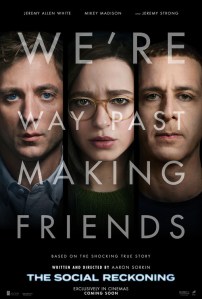 I’m trying hard to articulate why exactly The Social Reckoning was nowhere near the experience that The Social Network was, albeit it’s extremely hard to replicate the exact alchemy that went into making one of the best movies of the twenty-first century. Seriously, The Social Network is a masterpiece and won screenwriter Aaron Sorkin his only Oscar. Now 16 years later, it’s all Sorkin, returning as writer and taking on the duties of director. The absence of director David Fincher is obviously massive, as the mercurial maestro brings excellent storytelling and presentation sensibilities to elevate any tale. Nobody can match that. I wonder if the biggest difference is less the change in artists and simply the times we live in to receive the story. Perhaps Reckoning not only missed its window of relatability but now feels quaint and unimportant, lacking the rise-and-fall tragic trajectory of the friendships at the formation of Facebook that captivated the original 2010 movie. Whereas the original felt engrossing and revelatory, this one feels hectoring, tin-eared, and already painfully dated for its alarmist messages about Internet veracity. Sorkin is no Fincher, but by all accounts who can be? However, more disappointingly, 2026 Sorkin is no 2010 Sorkin, and his headline-grabbing sequel to An Important Movie sure wants to be important. It’s too bad that the world has moved on and its lessons and moralizing have already been tuned out by the public.
Bouncing between 2019 and 2021, we follow Frances Haugen (Mikey Madison), a Facebook employee growing increasingly alarmed that their algorithm is radicalizing users through a steady stream of disinformation and media manipulation. She seeks help from Wall Street Journal tech reporter Jeff Horowitz (Jeremy Allan White) to expose the malpractice going on so that Facebook can reform. But with CEO/co-founder Mark Zuckerberg (Jeremy Strong, replacing Jesse Eisenberg) prioritizing profit over civic responsibility, is there anybody in the higher reaches of the company that even wants to care?
 Newsflash: social media prioritizes keeping you hooked on its site as long as possible, and the best way to do so is through stories that will outrage you. Were you aware of this shocking revelation, something the movie seems to consider a hidden agenda that needs to be exposed? If stories about kittens and puppies cuddling together would keep your older aunts and uncles from clicking to another site, then that’s what Facebook or any other social media algorithm would be feeding them a steady drip of. It just so happens that fear and outrage is the median driver of user engagement, and so instead of kittens and puppies cuddling, it’s stories about Sharia law invading the heartland, or Obama’s fake birth certificate, or fluoride in the water making all the children trans that your kooky aunt and uncle are sharing with you. There’s a heavy correlation with misinformation because, unless somebody is fact-checking, there is no punishment for publishing and sharing conspiracy theories and gossip. It’s much harder to verify real facts and witness statements and times and the like then just making it all up, and if you can train a data center of Russian bots to sow the Internet with acrimonious misinformation, who is going to stop you?
Not Facebook, which Zuckerberg makes abundantly clear in his section of the movie that feels completely tacked on to the rest of the story. Zuckerberg is practicing his Congressional testimony with a team of advisors in preparation for an upcoming grilling over the legal liability of social media companies. Zuckerberg has adopted the convenient stance of the tech billionaires of being a “free speech absolutist,” which in his mind means presenting a platform but not censoring whatever is digested on said platform. Under these terms, Zuckerberg (dear reader: as a side note I want to share, while typing this sentence I accidentally wrote “Suckerberg” and that feels so fitting, doesn’t it?) would allow posts about racial superiority and bomb making and tips on how to kill your kids and get away with it. That’s because his “hand’s off” view has to exist in the all-or-nothing extremes of his cherished conception of liberty. Except Facebook isn’t the government, it’s a private company. It can set its own rules, especially if it learns how harmful its platform can be for misinformation and radicalization via polarized echo chambers. The Zuckerberg scenes feel like Sorkin performing a cross-examination with a mirror, arguing the edicts of culpability in a way to underline how derelict of its duties our Silicon Valley tech lords have become. It feels like it’s talking circles around the same points with some of the most clunky dialogue that twists metaphors into pithy trailer-ready soundbites. Ultimately, it culminates with the insurrection of January 6, 2021 and Zuckerberg having to consider the extreme harm of misinformation on his platform.
 Except does he? I would argue, decisively, no. That’s where the “reckoning” part of the movie feels not only premature in celebration and admonition but also outdated and incorrect. Had this movie come out in 2022 or maybe even 2023, audiences might feel a little inflated sense of relief by its traditional conclusion, with Frances using whistleblower status to expose the ills of Facebook’s algorithm and testify before Congress, galvanizing the moment for change. We too might feel as she does, pumping her fist in declamatory yet awkward celebration. These guys sure will learn a valuable lesson. Except the only lesson they learned in the 2020s is that Republicans are the party that don’t want to regulate them as long as they 1) contribute to Republican candidates, 2) refuse to censor misinformation that is disproportionately aggregated to Republican voters. There’s a reason that Trump voters stormed the Capitol in 2021 and Kamala Harris voters didn’t similarly storm the Capitol in 2025. Studies and surveys have shown that the Republican voting base is more likely to ingest misinformation and is more prone to conspiracies, like Q-Anon, or Pizzagate, or Obama’s birth certificate, or Stop the Steal, etc. Fox News has profited for decades following the same faux outrage model to keep its loyal viewers angry and afraid. When Fox News attempted to move on from Trump post-insurrection, its viewers revolted, and so it was back to the reactionary misinformation farming that led to an $800 billion defamation settlement. If Fox News, after paying out close to a billion dollars for blatant lies, hasn’t learned a lesson, do we think the tech bros have? The concluding text for the movie is more revealing than anything else. It states that not only did Facebook remove fact-checkers from political ads and stories, it removed them from everything. Who needs to be an arbiter of truth in a frightening new digital age where people can create their own truths, following a president who attempts to bend reality to his will, unless it’s Iran and gas prices?
Much of The Social Reckoning is a story about journalism that feels flat and tripping over its own sense of self-importance and verbosity. The story just isn’t as interesting, and despite the jumps through linear time with the Zuckerberg sessions, not having the dual lawsuit depositions makes the script lose the fun of its storytelling puzzle coming together. This story is far more simple and with less morally grey proponents so as to signal Good Side and Bad Side. A great comparative lens is that both Social Network and Reckoning have the same cinematographer, Jeff Corenweth, but boy do these movies look different. That’s because Sorkin is at best a competent visual stylist, favoring choices that put the attention on his spoken words. That makes sense when the words are elevated and captivating, as Sorkin’s writing can be, but sub-Sorkin is not worthy of pushing all the other elements of cinematic storytelling to the fringes. I quite enjoyed the 2015 Steve Jobs movie but something vital would be lost if a dynamic visual artist like Danny Boyle was not at the helm as its director. That’s because someone is needed to make Sorkin’s digressive dissertations cinematic. There are moments or streaks of dialogue where Sorkin feels like he’s in a groove, the syncopation of the fast-paced dialogue beginning to coalesce like an orchestration calibrating together. The problem is there are only fleeting moments, recognition of the electric sense Sorkin can provide but isn’t consistently delivering with his staid and mechanical sequel. The cross cuts between Frances delivering her testimony before Congress and the January 6th rioters is trying too hard. The comedy banter are clunkers, with older Boomer media references (Frank Capra, Pentagon Papers, Gilligan’s Island, Greek tragedy) reminding the audience about Sorkin’s increasing distance from the cultural zeitgeist. His character dismissing the term “mansaplining” as what women say when they’re losing an argument is… well, it’s not exactly going to dispel the prolonged criticism that Sorkin has difficulty writing women.
 The actors also feel ill-equipped to handle the needs of a Sorkin script, with Madison (Anora) and White (The Bear) feeling miscast and low on energy and overall engagement. Frances not understanding why a basketball player would pump his fist in celebration feels like a low moment in trying to convey her difficulty with relating to others. This goes into robot territory, just waiting for her to swing her arms wildly and mutter, “Does not compute” (another Boomer reference for you, you’re welcome). The running joke with Horowitz is he doesn’t know technology. He’s mostly just a plot device to ask people questions and restate topics for the audience. Strong (Succession, The Apprentice) delivers an uncanny Zuckerberg imitation, from the tenor of his voice to his posture, but this Zuck isn’t quite the character that Eisenberg got to play. It’s not even a “how far has he fallen?” sort of reappearance because this character isn’t just a stand-in for all Wall Street/Silicon Valley leaders but for an ideology Sorkin wants to rattle with prosecutorial scrutiny by Bill Burr, who actually delivers the best performance in the film. Burr’s acerbic tone and sharp wit are an asset as the primary voice against Zuck’s prevailing perspective.
Sixteen years later, The Social Network is still a towering achievement and one of the finest films of the last few decades. In sixteen years, will anyone have anything to say about The Social Reckoning, especially when it doesn’t have much to add to the milieu we’re already too deep into? It wants to be alarmist but it feels too quaint and late to the party. Imagine a hard-hitting story about the addictive nature of tobacco in 2026 and having the filmmakers ask, “Did we just blow your minds? It’s about time people might want to look more into that.” Thanks, but you’ve missed your window of alert activism. That certainly doesn’t mean society should just accept the status quo and forgo regulation of social media and further scrutiny of the ties between government and tech and misinformation, but this moment has been a long time coming since the dawn of the Internet allowed people to prioritize confirmation bias. Our current predicament is not solely Facebook’s fault, and younger users have already migrated away to the realm of TikTok, hopping onto the newer, cooler playground, so the influence of Facebook is waning by the hour. The Social Reckoning is ultimately a disappointment, not just in comparison to its predecessor but just as two hours of entertainment on even its own terms. By the end, it’s less a reckoning and more a ret-conning.
Nate’s Grade: C
Share this:

Being the Ricardos (2021)
 Have you ever wondered what a week in the production of the I Love Lucy show would be like? Have you ever wondered about Lucille Ball and Desi Arnaz’s marriage? Have you ever wondered if Ball was secretly a communist? Well worry no longer, because Being the Ricardos is writer/director Aaron Sorkin’s ode to early television, the creative process, and recapturing something he was trying to articulate in his failed TV series, Studio 60 on the Sunset Strip. Yes, this feels like an especially long edition of that old show, with too many plotlines vying for attention like B-stories and C-stories for an episode of television, and several of them have curious conclusions. The storyline given such outward significance, whether or not Ball will be shunned as a possible communist in her youth, is wrapped up so anticlimactically and easily, and the storyline given such minimal coverage, Desi’s possible infidelity, is then given an ending that doesn’t feel nearly as setup to have its proper impact. The acting is another issue. Everyone is mostly good, but Kidman is no Lucille Ball, and while she doesn’t attempt a direct impression it’s still not a favorable comparison. Bardem is better as Arnaz but you can’t help but feel both actors are miscast. The supporting players, like J.K. Simmons as William Frawley, Nina Arianda as Vivian Vance, and Tony Hale as show creator Jess Oppenheimer, offer the more entertaining and insightful positions from the wings. Being the Ricardos feels like Sorkin trying to work his signature rat-a-tat snappy dialogue but missing a few rhythms, and part of that might be Sorkin serving as his own director for the third time. Director Sorkin plays everything too stately and serious, so even when the script is telling us these comedy writers are making a comedy show, the flow is off and everything is a little too self-important and reaching for culture war symbolic terms, reminiscent of, you guessed it, Studio 60 on the Sunset Strip. I guess my disappointment was not really getting to know more about Ball besides her perfectionism and underrated comedy savvy. This movie is just too busy with narrative devices; there are documentary-esque interviews with aged crew members in the future, a present-day storyline about workshopping one episode through a week’s schedule, and intermittent flashbacks to Lucy and Desi that can be confusing when past and present swap. Then there’s the black and white interludes of the show which are Lucy’s imagination of what may be? It’s a cluttered mess with pacing issues. You also get to watch Lucy and Desi have sex, which is like walking in on your parents. Being the Ricardos feels like an overly serious TV movie that’s too busy and scattered to remind itself that funny people can also be fun people.
Nate’s Grade: B-
Share this:

Trial of the Chicago 7 (2020)/ Borat Subsequent Moviefilm (2020)
 Two new movies have been released for streaming, both coincidentally starring Sacha Baron Cohen, and both are highly political, one by design and the other through fortuitous circumstances of history regrettably repeating itself, and both are simultaneously everything you would expect from their creative forces and worth watching in our tumultuous times.
The Trial of the Chicago 7 is a courtroom drama depicting the injustices applied to a dispirit group of anti-war activists who were charged with inciting a riot at the 1968 Democratic National Convention. The various men of different backgrounds and affiliations had their reasons for being there to protest, whether it was building public support to end the Vietnam War, to gain personal publicity, or to get laid, and tensions mounted inside and out the group as the police plan to send a message, harassed protesters, and in one amazingly prescient moment, remove their badges and name tags to then inflict state-sanctioned violence. This is an Aaron Sorkin movie through and through, and his second offering as a director after 2017’s Molly’s Game, and the best thing about the Oscar-winning wordsmith is that watching one of his movies feels like you’ve just downloaded a complete syllabus. The sheer audacious density of information can be overwhelming, but when Sorkin is able to get into his well-established rhythms, the actors feel like wonderful pieces in an orchestra playing to its peak. The real-life story of the activists has plenty of juicy drama and intriguing characters and intra-group conflicts breaking open, mostly between the divided poles of political leaders Tom Hayden (Eddie Redmayne) and counter-culture prankster Abbie Hoffman (Cohen). Bobby Seale (Yahya Abdul Mateen, HBO’s Watchmen) could have gotten his own movie and suffers many of the worst indignities as a member of the Black Panthers who was grafted onto the case in order to make the rest of the indicted men seem scarier by association. The consistent interference by the trial judge (Frank Langella) is shocking. It’s so transparently biased, racist, and unprofessional that I have to believe that many of these anecdotes actually happened because otherwise they seem so absurdly prejudicial that nobody would believe this happened. For a movie with such a sizeable cast of trial litigants, lawyers on both sides, friends and family, and maybe every police officer in Chicago, it’s impressive that Sorkin is able to provide so many with great Sorkin moments, meaning those grandstanding speeches, cutting one-liners, and intensive cross-examination. Not everyone is on the same level of importance. Several of the Chicago 7 are merely bodies on screen, two of the guys serve as little more than a quip-peddling Greek chorus. You sense there’s more being left out to fit into a crammed yet tidy narrative that plays to our demands for satisfying character arcs, reconciliation, and a morally stirring final stand. As a director, Sorkin doesn’t distinguish himself but he lets his meaty script and the performances of his actors get all the attention. The editing, like in Molly’s Game, can be a bit jumpy but it’s to serve the sheer size of information being downloaded during the 129 minutes. The political parallels for today are remarkable and a condemnation of our modern times. The Trial of the Chicago 7 is an invigorating and, at points, exhausting film going experience that can feel like a retro, overstuffed special episode of The West Wing. It’s everything you should expect and want in an Aaron Sorkin courtroom drama, so if you’re already in that anxious camp then this Netflix original will be preaching to the overly verbose choir.
 Secretly filmed over the past year, Sacha Baron Cohen reprises his outlandish Borat character to once again lampoon people’s not-so-hidden prejudices, anti-Semitism, xenophobia, and misogyny, which seem to have only gotten worse since the first Borat movie in 2006. The flimsy story follows international journalist Borat returning to America to help improve the standing of his home nation Kazakhstan by offering his daughter Tutar (Maria Bakalova) to the Trump administration. It’s really just a platform for Cohen to adopt a series of disguises (his Borat is too recognizable) and dupe some rubes while exploiting their ignorance and patience. Much of the entertainment comes from the cringe-inducing interactions of how far Cohen and Bakalova will go, marveling at their improvisational skills and also dreading what lines they might cross next. I was laughing fairly consistently, though the schitck naturally won’t be as funny the second time around, even with a 14-year gap in movies. I was really impressed by Bakalova and her own commitment and quick-thinking, keeping pace with a pro like Cohen and really stealing the show because Borat can’t go out in public as before. There are some outrageous moments that work, like Cohen imitating a country singer leading an anti-masking crowd into a singalong with ridiculous verses, and some that simply don’t, like an ongoing stretch where Bakalova explains the appeal of masturbation to a gaggle of deadly silent Republican ladies. Sometimes the comedy seems so broadly caricatured that it’s questionable whether its helpful or harmful, especially the anti-Semitic tropes that Cohen embraces as means of satire. Saying something outrageous to an outraged or shocked party isn’t quite enough. When compiling these hidden camera comedies, they thrive on the oxygen given to them by the targets of the prank. If they don’t really engage, it can feel a bit tired and desperate. I’d say the ratio of hits-to-misses is about half and half but the movie has enough big moments to keep fans happy. The most notorious moment has already been widely disseminated through social media and serves as the climax of the movie, strangely both as the high-point of pranks with big names but also as the emotional catharsis. Tutar poses as a foreign journalist and interviews Trump surrogate Rudy “America’s mayor” Giuliani, who drinks, goes into a hotel bedroom alone with Bakalova, and then lays on the bed while slipping his hand down his pants (like a gentleman does). Borat realizes he doesn’t want to offer his daughter to this creepy, sleazy man and rescues her because he truly does care about her. Borat 2, or Borat: Subsequent Moviefilm, takes a scattershot approach to satire and squarely aims at the science-denying MAGA crowd celebrating the excesses of their leader (who doesn’t sound that different from Borat, come to think of it). It might be more admirable in intent than execution but the new Borat can provide a few belly laughs and a more than a few groans as Cohen attempts to make American funny again.
Nate’s Grades:
Trial of the Chicago 7: B+
Borat: Subsequent Moviefilm: B-
Share this:

Molly’s Game (2017)/ Call Me By Your Name (2017)
 Two new awards-caliber film releases couldn’t be more different. One of hyper-literate in a high-stakes world of drama, gambling, and crime, and another is somber, lackadaisical, and personal, chronicling a summer love that changed lives. One movie has scads of plotting it zooms through with high-powered visuals and voice over, and another luxuriates in the moment, a placidity on the surface interrupted by rising passions. One of these movies I found captivating and the other I found perfectly nice but unremarkable.
Molly’s Game is Aaron Sorkin’s directorial debut, clearly having studied at the altar of David Fincher, and he packs a lot into his 140 minutes chronicling the rise and fall of Molly Bloom (Jessica Chastain), a former Olympic hopeful who found herself running an expensive, private series of poker games. She’s drawn into an unfamiliar world and through her tenacious grit, preparation, and fortitude, she is able to become a fixture amongst the rich. Then the FBI comes knocking and wants to charge her in conjunction with being part of a Russian money laundering operation. Driven by a fierce performance from Chastain, Molly’s Game is a gloriously entertaining movie that glides by. It burns through so much plot so quickly, so much information, that you feel like you might have downloaded Bloom’s book while watching. The musical Sorkin dialogue has never sounded better than through the chagrined, take-no-prisoners Chastain. The snappy dialogue pops, the characters are richly realized, and even during its more outlandish moments, like a surprise paternal reunion therapy session, Sorkin packs multiple movies of entertainment in one brisk, excellently manicured production.
 In contrast, Call Me By Your Name is a slower peak into the discovery of romantic feelings between 17-year-old Elio (Timothee Chalamet) and grad student Oliver (Armie Hammer). Set amid the sunny countryside of northern Italy, the film takes it sweet time establishing the lazy world of its characters and their closely intersecting orbits. I became anxious because the characters kept me at arm’s length, leaving their burgeoning romance to feel distant and tame. I understand the hesitation of both parties and the age difference complicating matters. I understand caution. But it feels like the film is cautious to a fault, to the point that one of them laments later why they wasted so much time. The acting is pleasant if undistinguished. The best scene is a terrific monologue by Michael Stuhlbarg as the world’s most lovably accepting father. For an earth-shattering romance, I too often felt unmoved and restless. If we’re going to spend this much time hanging out with these people we should get to know them more intimately, and not just in the physical sense. I missed the compelling artistic charge of something like a Moonlight. I’m a bit stupefied at all the praise heaped upon Call Me By Your Name, a fine indie drama that, for me, too infrequently delves below its pretty surface into something more substantial.
I don’t know if this recent comparison sheds light on any personal insight, but perhaps I just love big, showy, obvious plot that calls attention to itself, with characters that fill a room, rather than an airy romance that moves at the speed of its own breeze. Anyway you have it, one of these movies makes my Best Of list and the other just makes me shrug.
Nate’s Grades:
Molly’s Game: A-
Call Me By Your Name: B-
Share this:

Steve Jobs (2015)
 Dizzying with its dialogue, Steve Jobs tells the story of its titular man through three Apple product launches, 1985’s Macintosh computer, 1988’s Apple rival and failure, Next, and 1998’s iMac, the beginning of the re-emergence of Apple into ubiquity. It’s really an Aaron Sorkin movie above all else, which means we get absurdly intelligent characters walking and talking at rapid-fire with brilliant one-liners and snappy dialogue that bristles with musicality to it, the kind that your ears perk up for. It’s a feast for the ears; however, Steve Jobs is really an emotionally cold stage play on film. Danny Boyle (Slumdog Millionaire) is the director but the staginess of the conceit is too much for the visually nimble filmmaker to overcome. There are a few small visual flourishes as inserts but the star is Sorkin’s verbose screenplay. We get a glimpse into the prickly, egotistical, bullying, visionary, and curious man that was Steve Jobs. His continual denial of being the father to his daughter is a source of great contrarian insight. The structure of the script lends itself to repetition and artificiality. All these characters keep turning up and having these important conversations at these moments? After a while it feels like the characters are talking in circles and waiting for catharsis, and the concluding ten minutes is a detour into unearned sentiment. The movie and its major themes just do not come together with the clarity or force that the filmmakers believe. Michael Fassbender is superb as Jobs and there isn’t a bad performance in the bunch. It’s an engaging movie in the moment but I don’t feel like I know Jobs any better than before. In attempting to tell the life of one influential man, Sorkin has made the movie about himself, but The Social Network this is not.
Nate’s Grade: B
Share this:

Moneyball (2011)
 Moneyball, based on the non-fiction book by journalist Michael Lewis (The Blind Side), finds a new way to reinvent the David v. Goliath tale with a man who reinvented the business model of baseball.
In 2001, the New York Yankees (team payroll: $125 million) have just knocked the Oakland As (team payroll: $41 million) out of the playoffs. Oakland General Manager Billy Beane (Brad Pitt) also has to suffer a summer where his biggest players leave the team to sign hefty free-agent contracts with bigger teams. He’s left with sizeable holes, a meager payroll, and the expectations to carry on winning. Beane is convinced that his group of paid scouts will be of no help. They’re men of an older era, sticking to the old ways of selecting talent (why the hell do these guys even calculate stuff like “good face” and “ugly girlfriend”?). Beane finds a kindred spirit in Peter Brand (Jonah Hill), a Yale grad with a degree in Economics. Brand’s mathematical data focuses on one all-important stat – on-base percentage. Without getting on base a player can’t score runs, and no runs make it hard to win a game. Brand and Beane calculate a series of players undervalued by other teams. Their more cost-efficient model for success becomes known as “moneyball.” Together they put together a team of castoffs and misfits to contend for a championship against teams that have three times the Oakland As’ payroll.
Moneyball could be described as a baseball movie for people who don’t like baseball, but that’s a little too glib by half. It’s very much a sports film but it takes the underdog approach in a new, sleekly modernized manner. It’s about a guy bucking the traditional mode of thinking, the established order, and the chaffing and nay saying of those entrenched in the traditional, outmoded, establishment. There’s always something inherently entertaining about an innovator fighting the system and eventually being proven right after all the trials and tribulations. And with Pitt, a major movie star, giving a movie star-caliber performance, self-effacingly charming with a twinkle and a swagger, Moneyball just seems to fly by like a spirited caper. We’re watching a smooth operator work the room, playing other general managers off one another and secretly accruing his talent while duping his peers. At its best moments, Moneyball feels almost like a breathless con game. The intelligent, stats-heavy dialogue doesn’t stoop for much exposition. The stats and acronyms whiz by, with Social Network-style crispness thanks to Oscar-winning screenwriters Steven Zallian and Aaron Sorkin. It’s a pleasure listening to top actors savoring the smart dialogue. You just want to kick up your heels and relax like you’re watching a game at home, rooting for your team to pull out an unlikely coup. Moneyball plays best for baseball fans who won’t bat an eye at the stat-heavy chat. For non-fans of the game, well, you can watch Pitt spit chewing tobacco into a cup a lot.
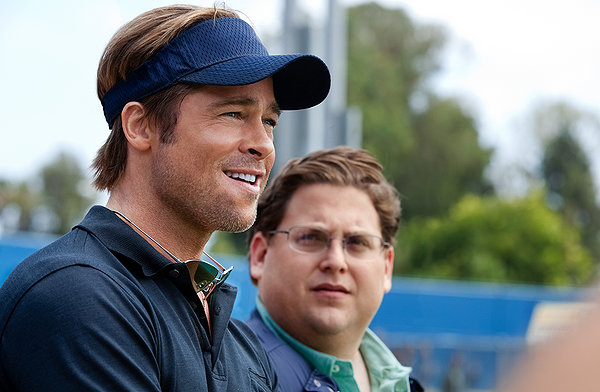 Beane chooses not to get to close to his players so that eventual roster cuts and trades will be all the easier without emotional involvement. The movie kind of follows suit. The characters are kept at a surprising distance. The movie seems practically ambivalent about people. Moneyball seems to lack an emotional center; and people thought The Social Network was cold. Beane is given flashes of back-story about his flameout in the majors, which supposedly provides the guy a motivation to prove himself against his legion of detractors. But these flashes are not enough. Director Bennet Miller (his first film since 2005’s Capote) incorporates way too many scenes where we watch Beane driving, silently contemplating his life-changes. The feud between Beane and his curmudgeon manager, Art Howe (Phillip Seymour Hoffman with the unkindest of haircuts), never comes to a head. Howe is upset at the thankless job of corralling a team of misfits and cast-offs into a competitive team. But like many other conflicts, the movie ducks from finding a real purpose for its integration. Howe just seems to be another naysayer who shakes his head at Billy. Surely the relationship between GM and manager should be more complicated than as presented. The Beane family flashbacks and his scenes with his daughter (the adorable Kerris Dorsey) are attempts to further humanize a man who has abandoned the advice of people for spreadsheets.
It’s easy to get caught up in the romanticism of the nation’s oldest sporting games, but Moneyball’s tone seems to toggle between reality and romanticism. For Beane, there are no small victories. Even success is deemed failure under the metrics of championship-or-nothing. “People only remember your last out,” he says despondently. So when the Oakland As fail to make a run into the playoffs (is a 2002 playoff series considered a spoiler?) the movie is left with a listless conclusion. Brand tries to prove to his boss the significance of what they have accomplished on their meager payroll, at one point winning a record 20 games in a row. But a winning streak of 20 games is not the same as a championship. Moneyball rightly proclaims the game of baseball as a rigged sport, where the divide between “haves” and “have nots” is vast. It is the only major league sport without a salary cap. The teams with the big pockets can afford the marquee talent. There’s a reason Lewis’ book has the subtitle “The Art of Winning and Unfair Game.” The implications of Beane’s accomplishments are unclear. His cost-efficient, stat-heavy approach was co-opted by the Boston Red Sox and turned into championships in 2004 and 2007. Is that a real vindication for Beane? It seems to me that the game’s issue of wealth disparity is still in full effect. Even if teams follow Bean’s approach, it still means that the bigger city, wealthier teams like the Red Sox or the Yankees can still outspend their competition. So it seems like to me that Bean’s moneyball approach simply meant that the focus changed on less costly talent. It did nothing to alter who could outbid their peers for the now-cheaper talent. It’s hard to squeeze a happy ending out of a story that concludes with the rich getting richer.
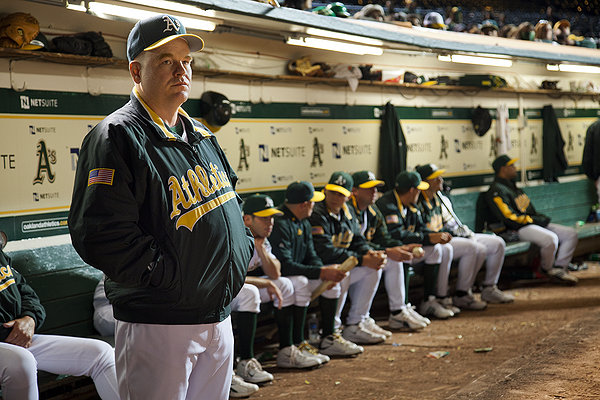 The movie is pretty much a buddy comedy, granted Beane is a much more dominate personality. Pitt feels like he’s coasting on charisma, though the actor gives a greatly entertaining performance. It’s not so much nuanced but he’s enjoying himself. The man looks eerily to be aging into Robert Redford, which begs the question about the nature of time travel. Hill (Superbad, Get Him to the Greek) gives a surprisingly adept dramatic performance. The comedic actor seems subdued next to the charisma of Pitt, like the character is continually awed by Billy. The Oscar-talk for the comedian seems a tad premature. He’s good but just because Hill delivers a good dramatic performance does not mean people should automatically start fielding his name as an award contender. That’s like saying let’s give an award to Paris Hilton because she could remember her lines. It’s also fun watching actors like Chris Pratt (TV’s Parks and Recreation) portray players that are still recognizable.
Moneyball says that baseball is not a game about heart, sweat, or the love of the game. It’s about numbers. That’s something of a cold message but Billy Beane is not one for false comforts. At its best, the film is a breezy caper with crisp dialogue and slick editing, but it’s also hamstrung by an inconsistent tone, a methodical pacing (133 minutes!), and a dearth of strong characterization. Beane was destined to be a baseball star but it wasn’t to be. Baseball is the most mental of all national sports, and it’s hard to crack such an insular model of play. That’s why baseball movies resort so much to romantic staples about the lore of this game. This is not a romantic movie; it toys with romanticism but ultimately sides with the science and number crunching. The emotion seems to have been squeezed out of the story thanks to the statistics. Moneyball is a baseball movie that fantasy baseball nerds have been waiting for. I’m not particularly a baseball fan (too slow), but I still found the movie to be a rewarding night out sans crackerjacks.
Nate’s Grade: B+
Share this:

The Social Network (2010)
 Dismissively branded as “the Facebook movie,” the whip smart and hypnotic, yet poorly titled, The Social Network is much more than a rote TV-movie on the start of a popular website (coming out next year: Twitter: The Musical in 144 Characters). Yes, the film chronicles the people responsible for the Internet’s most ubiquitous time waster and their very varying accounts of who was responsible and who was unscrupulous. But the backdrop could be just as much any start-up business. Truth be told, the “Facebook movie” bares a striking resemblance to Citizen Kane. It is the story of one man who may be a genius in some regards but can?t help but push everybody he cares about away. It’s about powerful men who don’t know what to do with power. It’s about ambitious men who dedicate their lives to that ambition. It’s not about terabytes and html coding, this is a movie about people, betrayal, ego, greed, jealousy, and the great irony that Mark Zuckerberg created the world’s most dominant social network and yet he himself cannot hold onto a single legitimate friend.
In 2003, Zuckerberg (Jesse Eisenberg) is a Harvard student obsessed with getting into the prestigious clubs and fraternities on campus. But he’s not well connected or athletic or close to being rich. So after being dumped on night, he goes home and hacks into various Harvard sorority websites and steals pictures of coeds. He then creates the crude website Facemash (while also drunk, mind you) where Harvard undergrads rank their fellow classmates side-by-side two at a time. It’s an immediate hit and crashes the Harvard server. Zuckerberg is then approached by Cameron and Tyler Winklevoss (Armie Hammer and Josh Pence), handsome blue-blooded WASP twins who have an idea. They want to create their own social website just for Harvard students to communicate with each other. They are impressed with Zuckerberg’s tech skills and want to hire him to build the site. Zuckerberg takes the idea to his roommate and best friend Eduardo Saverin (Andrew Garfield), proposing to make their own site with Saverin’s limited means.
From there is where the different parties diverge on their versions of truth. Zuckerberg secretly works on his own side project while stalling and dodging the Winklevoss twins. He offers to have Saverin be CFO of the company and split the stakes. Then as success mounts, the Facebook website gets the attention of Sean Parker (Justin Timberlake), notorious for co-founding Napster at age 19. Parker immediately has the ear of Zuckerberg, and it isn’t long before Saverin starts feeling on the outskirts of his own company, and then eventually shut out completely. The Winklevoss twins and Saverin each file multi-million dollar lawsuits accusing Zuckerberg of intellectual theft and underhanded business tactics.
 Watching The Social Network feels like you?re downloading an entire semester?s worth of information directly to your brain. Adapted by uber wordsmith Aaron Sorkin (TV’s West Wing, Charlie Wilson’s War), this is a story that gallops at full speed and leaves you spinning. The dialogue flies by so blazingly quick that it?s easy to get left behind. I would not advise eating any concession snack with this movie or else you might miss reams of dialogue. Sorkin smartly weaves together a murky and litigious tale of alternate truths, showing different sides when it comes to the creation of Facebook. Was it really stealing or did the Winklevoss twins merely inspire Zuckerberg? Is he truly indebted to them? “Does a guy who makes a chair have to pay a fee to every person who ever made a chair before in history,” Zuckerberg snaps. How deep did Saverin?s involvement go, and was he naïve or just thinking too small in scope? How much is a friendship worth in dollars and cents? Sorkin gives a definite impression to these answers, and it should surprise nobody that Saverin comes across as angelic and the obviously wronged party here. But the script as a whole is meticulous with detail, characters, and dates. It almost feels like the content of a miniseries has been squeezed into a brisk two-hour time frame. The characters are just as layered as the plot. The opening scene where Mark is dumped by his girlfriend (Rooney Mara, soon to be Lisbeth Salander in Fincher’s remake of The Girl with the Dragon Tattoo) sets the tone of the movie. The dialogue feels like an assault and it is unrelenting. You openly wonder how Eisenberg can breathe reciting his verbose lines with such lightning speed. Mara is aghast at her hyper-literate yet bitter boyfriend spewing bile at the elite and yet unashamedly pining for that life. He’s brilliant and cutting but socially awkward and unable to understand the feelings he’s hurting. Mara has had enough and dumps him right there, spurring Zuckerberg into a drunken night of revenge that will set the stage for Facebook. Sorkin can pretty much start clearing shelf space for his Best Adapted Screenplay Oscar right now.
Many will find Zuckerberg to be unlikable from the get-go, but I never could bring myself to actively dislike or loathe the man. He’s really more of a figure of Greek tragedy. Zuckerberg is a blissful conundrum of a character, a walking contradiction. He can be sullen and wounded one minute and the next casually cruel. He seethes at deposition hearings; unable to control the contempt he has for others. Zuckerberg’s anger boils over, and his beady-eyed glares communicate an incredulous, “You are worlds below me.” He can?t stand people who have easy breaks, the select and privileged, and yet he nakedly longs to be apart of that group and meet their approval. He can be childish and narcissistic, insular and insecure, and then he can be charitable. Zuckerberg created a music application that Microsoft was willing to purchase. “Why didn’t you sell?” asks one of the Winklevoss twins. Zuckerberg just shrugs his shoulders. He doesn’t want to sell ad space on Facebook and get rich quick because it would ruin the site experience. He is a champion of the democracy of the World Wide Web; a modern-day Thomas Paine? Probably not, but Zuckerberg’s hard-driven ambition and crooked tactics make him a modern-day robber baron, a titan of industry. Rockefeller and Carnegie and J.P. Morgan are all men that don’t seem any different in practice than Zuckerberg, though they probably had more family money as a starting point. That’s not an excuse for Zuckerberg’s behavior, but I want to add some perspective before the world tars and feathers the guy. Zuckerberg is the Internet’s first self-made billionaire, but what are the costs? By sacrificing all, and burning personal relationships, Zuckerberg may have advanced Facebook to unparalleled heights. But whom does he get to share his success with? It’s a little simplistic to boil such a complex film to the greeting card-esque moral “It’s people that matter most?” but the film always circles back to the question of cost. It’s also rather simplistic to chalk up the creation of Facebook as a means of impressing a girl, but then operas have been written, art has been sculpted, and wars have been fought over the need to impress a woman. Zuckerberg is a fascinating creature and brilliantly played by Eisenberg. This is a character Ayn Rand would love.
 It seems that Zuckerberg’s instincts about human obsession with being apart of something exclusive were right on the mark. What separated Zuckerberg’s site from the likes of MySpace and Friendster is that you needed a college-based web address to get inside. It was a closed community, which made it cool and desirable. It started as a restricted club that all the cool kids wanted to belong to, then everyone joined, and now it’s damn near impossible to resist. First it was college kids, then college kids from other countries, then high school kids, then adults, now everybody on the planet has a Facebook page making sure the world doesn’t miss a single detail about their personal lives. I resisted as long as I could but broke down and got a Facebook account earlier this year. The Social Network is not concerned with the business angle of success unless it related directly to how it impacts the characters. You’re not going to find many insights into why Facebook took off or became entrenched in our navel-gazing society, which is a pity. The film also doesn’t concern itself with outright social commentary. Sure by exploring the micro personal struggles and betrayals of Mark and Eduardo the film marginally comments on the macro idea of generational self-absorption and ego, but so much more could be said about society as a whole. The film’s one clear moment of social satire is when Eduardo’s girlfriend berates him about his Facebook relationship status remaining single. She’s incensed and wants to know what he truly means by this outrageous declaration. He says he’s embarrassed but he doesn’t know how to change it, plus he’s hardly ever on the site. She responds to this by setting his gift on fire. Ah, petulant and jealous and self-absorbed concerning what a few scraps of digital bits say rather than direct, personal, face-to-face communication. It’s a brief, albeit nice slam on the myopic self-absorption of millennials, who came out of the womb with something electronic attached to their fingertips. The film doesn’t even touch the idea of millennials’ free sense of privacy and over sharing. This is not a generation -defining movie, folks.
This is all strange ground for director David Fincher (Seven, Zodiac), a visual stylist with few peers. Nerds creating a website doesn’t exactly strike anybody as fertile ground for a visually exciting drama, and yet Fincher proves once again that he is a masterful artist. The film looks beautifully sleek from beginning to end with Fincher’s typical green tinted, deep focus cinematography. Fincher also makes the best use of special effects I’ve seen this year. The Winklevoss twins were not played by actual twins. Hammer had his face digitally placed onto a stand-in’s (Pence) body. The digital cut-and-paste was remarkable in Fincher’s Benjamin Button but it also called attention to itself. Nobody would walk in believing Brad Pitt’s face somehow was on the body of a three-foot tall old man. However, in The Social Network, you would never once doubt that there are two twin actors on screen the whole time. Hammer manages to make each twin distinct and frustrated without coming across as jerky or entitled. The rest of the actors do fantastic work as well, and special notice to Timberlake who plays his mercurial role with glee.
 So what does the real Mark Zuckerberg think about all this attention? Well, in a surprise to people who do not have a firm understanding of the word, Facebook has declined all advertising for The Social Network and is staying mum on the film, hoping to ride out the critical storm. I don’t think anyone is going to be using Facebook less now that they have learned the ethically murky beginnings of the website. But Zuckerberg and his Facebook crew might want to think of formulating some response strategy because this movie, and talk of this movie, isn’t going away any time soon (Zuckerberg recently donated $100 million to Newark city schools on Oprah coincidentally the same week Social Network was opening). It’s rare to find a studio film that is as polished across the bard as this film. The writing is sharp, the direction is sleek, the acting is top-notch, the film rollicks with intrigue and suspense and juicy drama, and the film can’t help but be relevant in our modern society. You do not have to know a lick about coding and websites and whatever to get absorbed in this high-stakes drama. It may not be the generation defining experience some critics are wetting themselves over in hype, but The Social Network is easily one of the best films of 2010. Perhaps the Academy will give it the ultimate “friend request” come this winter. In the meantime, log off and get yourself into a theater to see this great American movie.
Nate’s Grade: A


You must be logged in to post a comment.