Blog Archives
Backrooms (2026)
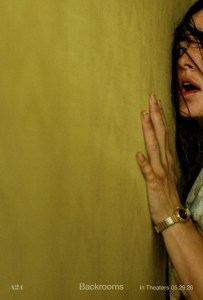
I’ve been a fan of horror movies since my high school days. I’ve literally watched hundreds of them over the decades and find myself more drawn to them of late, perhaps a reflection of the horrors we seem to be processing in our daily lives from the deluge of current events, scandals, and moral failures. I will often feel discomfort, dread, and tension from horror and suspense movies, but it’s rare for me to feel genuine terror, to be afraid to the point where I could be haunted afterwards with the threat of nightmares. It takes a lot to get to me. It’s been maybe ten years since a horror movie really unnerved me and got under my skin. Backrooms is that movie. I was deeply affected and jarred from this little liminal horror movie. That’s the highest praise I can offer, and the fact that a 20-year-old director is responsible for that is amazing. Even if you have no knowledge of the popular YouTube series, dive into Backrooms.
Based on the creepy pasta Web series, Backrooms is set in 1990 and primarily follows two characters. Clark (Chiwetel Ejiofor) is the owner of a failing furniture store with plenty of personal baggage over his failed marriage and unrealized career as an architect. His therapist, Dr. Mary Kline (Renate Reinsve), has her own parental trauma she’s trying to work through. One day Clark discovers a strange doorway to another dimension in the basement of his furniture store. It’s a seemingly endless hallway reminiscent of an open-spaced office building, and Clark decides he needs to explore this strange new space, but can he make it back, will he hold onto his sanity, and are there malevolent forces inside this space to avoid?
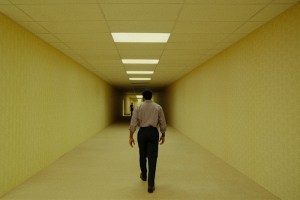
The strength of Backrooms, as a concept as well as a feature film, is how it taps directly into your limbic system to communicate that everything is just inescapably wrong. Everything looks wrong, everything sounds wrong, you worry that another turn of another hallway is only going to bring about further ruin, and so every additional second in this inter-dimensional space makes you want to retreat. It has the living contours of a nightmare world where there is a lack of concrete details, where things are approximating real-life but just a means off, little uncanny differences or limitations that alert your brain that things are not as they should be. There are small examples, like a chair with five legs instead of four or a stop sign with its writing backwards, and then there are more arresting imagery, like chairs sinking into the floor like sand, or a series of telephone poles increasingly bending forward like a splayed rib cage. Exploring a world of these distortions leads to deeply fascinating and also unsettling imagery that can lead to a suffocating atmosphere of unease. It makes for a rather entrancing experience of analogue, dead mall aesthetics that have a subliminal pull that draws you innately while making you feel off-balance. Like the definition of the uncanny, it takes the familiar and mundane and distorts it into something truly eerie.
But this is more than just a 100-minute extension of the short-form YouTube videos. Director Kane Parsons has certainly leveled up his craft in his film debut. This is a weird world he’s intimately familiar with, but the big-screen jaunt is carefully made to be inclusive and adapted like an actual movie. There’s work here on characters using the Backrooms as an exploration of their unresolved personal traumas, for Clark his rage against a world and the people he felt have failed him, for Dr. Kline her oppressive and mentally ill mother. I like that it’s never clarified whether or not Dr. Kline’s mother was just crazy or whether she too became aware of the Backrooms dimension and was trying to protect her daughter. There are hints of larger lore but the movie isn’t drowning in it, just like there’s some basic explanation given to this dimension and its rules, just enough to satisfy without going into too much explanation. This was my main issue with 2019’s Us, Jordan Peele’s creepy and thrilling nightmare about dopplegangers revolting, and also a movie that shattered its own credulity once it attempted to provide a logical explanation. Not everything that’s strange in a movie needs a thorough explanation. We can readily accept the unbelievable on its own terms. There are more traditional horror movie elements, like jump scares, frantic chases, and the Big Scary Something Coming to Get You, but Parsons makes them all work. There’s a jump scare in this movie that didn’t just make me jump but made me gurgle something unintelligibly in response. There are several agonizing setups of characters contemplating journeying through tight or slanted or altogether ominous spaces and I was shrinking in my theater chair, dissolving in the simmering anxiety, and repeating “no” a lot. The use of found footage is perhaps the best in any movie in a decade. Even at the young age of twenty, Parsons shows not just a knack for creepy imagery but on how to craft and escalate suspense set pieces, how to build and punctuate a suffocating atmosphere, while also balancing characters, story arcs (learning acceptance and accountability!), and metaphors (a concrete hand print she carries with her from childhood!) and themes without losing sight of the core scares and their appeal. Parsons has already proven that he’s the real deal and he’s not even old enough to legally drink in the U.S. yet.
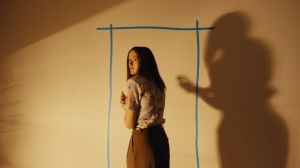
There’s an interesting meta commentary here about the junky iterative process of generative A.I., though this is speculation on my part, though I find it founded in logic within the movie. We’re told repeatedly that the Backrooms doesn’t create things as much as it recreates from its surroundings and the memories of its participants. There’s a reason most of what is explored is a reflection of the furniture store it’s attached to. Except it cannot get things exactly right. Clark explains it like describing a dog to an alien that’s never seen or known the reference and then having the alien create what it thinks a dog would be; the larger shape and idea might be there but the details are inexact or incorrect. For me, this corresponds with the rise of generative A.I., where it tries to replicate real-life but is often prone to strange hallucinations, like human bodies with peculiar joint hinges, extra fingers, or smoothly elastic skin. There’s also very Backrooms-esque visuals of furniture being eaten by walls and floors. Generative A.I. is limited to only replicating what it has been fed, and it often spits back something that looks alien, missing those crucial details to seem real. There’s a memorable tracking shot in the movie that descends floor after floor, and we witness the same room layout go through round after round of regeneration and distortion, getting further and further from the original source with each iteration. What begins with a recliner and windows becomes chairs sinking into the floor, the outlines of windows against solid walls, and finally nothing. Parsons doesn’t have to be explicit but the pointed commentary can be found on A.I.’s limits.
I don’t know about you but if I discovered a portal to another dimension, I don’t think I’d take it upon myself to go exploring. I understand why the movie does so because, well, we need a movie, and that discovery is where the horror lies, and it makes sense for Clark since it’s a reflection of his own memories and unfulfilled ambitions. I get it. However, if this was real-life, I would immediately retreat after confirming that, yes, this strange doorway indeed exists. Perhaps I’ve seen enough spooky movies or it’s just an overabundance of caution in my nature, but I would definitely stay home and let someone else become the latest lost entity to the siren song of human curiosity. Somebody else can be monster chow.
The origins of the Backrooms predates Parsons and his popular YouTube experimental shorts, but it was he who really popularized it and took it to another level, and now with his film debut, Parsons has done something remarkable. It’s not just the bold announcement of a new cinematic voice. It really feels like this movie could be the start of something monumental, a tide-changer along the lines of John Carpenter’s Halloween. He’s not the first filmmaker to explore liminal imagery and dream logic, as we’ve seen from Severance, to The Stanley Parable, to the entire career of David Lynch. I can already hear some Hollywood studio exec saying, “Gen-Z kids, they love them their liminal spaces,” or some kind of erroneous lesson from the runaway success of Backrooms. Get ready for a flood of imitators exploring minimalIst abandoned spaces. I was entranced and deeply disturbed by this movie to the point where I kept shuddering even after the credits rolled. It’s not because of shock value or emotional manipulation, it was because Backrooms got to me, unnerved me, and shook me up, in a way no movie has for a long time.
Nate’s Grade: A
Share this:

Sentimental Value (2025)
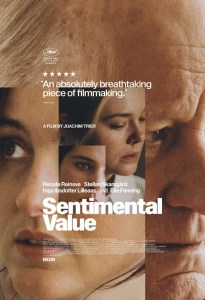
It’s an old cliche to say “they don’t make movies like this anymore,” but with our current media environment, there’s a reluctant truth to the fact that many genres, particularly adult dramas, romantic comedies, and non-action comedies, have declined steadily from their studio heyday. And yet Sentimental Value is also proof against this adage, as this wonderful movie is the kind of engrossing, mature, and thoroughly artistic original adult drama that Hollywood would have positioned decades ago to prominent award glory, like your Terms of Endearment or Rain Mans. I guess the caveat is that Sentimental Value comes from Norway, so outside the Hollywood system, and it’s reminding every movie lover not just of what we’ve lost in recent times with studio output of rich adult dramas, but it reminds us why we love the movies. Sentimental Value is easily one of the best movies of the year and a triumph all around of acting, writing, directing, and editing. It’s so thoroughly well-realized that it feels like we’ve been dropped into the realm of a classic novel brought to stunning life with a level of care, insight, and artistry that is rare to experience in any medium. I knew right away I was in for something truly special.
We begin by tracing the history of a house in Oslo, particularly the Borg family that has lived there for generations going back to pre-World War II. The father, Gustav (Stellan Skarsgard), is a famous film director who divorces his wife when their two daughters are young. The oldest daughter, Nora (Renate Reinsve), grows into a talented but neurotic theater actress, one beholden to stage fright even after all her accolades. Her younger sister, Agnes (Inga Ibsdotter Lilleaas), has married, has a young son, Erik, and she works as a historian researching specifically her grandmother who was tortured by the Nazis. After the death of their mother, Gustav resurfaces in their lives after a long absence working in Hollywood. He has plans. He has written a semi-autobiographical screenplay about the life of his mother, and he wants to film it in their family house, and he wants Nora to play the starring role. The sisters are resentful and wary of their father, but could this entire artistic enterprise be a push for reconciliation and better understanding for everyone?
I’m talking mere seconds into the movie, director/co-writer Joachim Trier (The Worst Person in the World) had already grabbed me with his deft storytelling. A narrator provides the complicated history of this house, treating it like a living vessel that itself has been an observer to the many generations residing within. The details are so precise and telling, like a novel giving you a larger sense of the world that exists beyond the margins of what we can see and hear. To say the movie is a complex family drama is only scratching the surface. Let’s just unpack some of the layers inherent from its premise. Gustav’s world is cinema and he wants to make what might be his last movie his greatest and most personal. He’s telling his story, asking his own daughter to play his own mother. When Gustav was a child, he was the last person to speak to his mother before she decided to take her own life by hanging herself. Think about the psychology at work here, a father trying to reconnect with his estranged daughter through the means of her playing his own mother and possibly better understanding his loss that has haunted him since childhood. Then Gustav also wants Erik, his grandson, to play the younger version of himself in the movie, though Agnes is against the idea. There are so many intriguing layers at play with all of this, the use of art to process grief and trauma, the mirrors of family members portraying other members as engines of empathy, and the act of filmmaking as recovery. I’ll slightly spoil the movie to say that Nora turns down the role. The rest of the movie is about how she gets to “yes.”
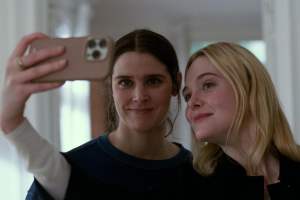
In the wake of Nora’s rejection, Gustav offers the role to an American actress, Rachel Kemp (Elle Fanning), a hot commodity that convinces Netflix to get involved. However, with the streaming giant attached, there are several compromises that Gustav must endure. He intended the project to be in his native tongue but now it’s in English. He isn’t allowed to bring back older members of his crew he’s worked with for decades, like a retired cinematographer who is infirm to the point where he needs to walk around with a cane. With each compromise, you can see Gustav making a mental cost-benefit equation. He envisions this movie as his most important, and possibly his last, and it becomes a gauntlet of what shape it might eventually take to get made and if that shape is too malformed and unrecognizable from his original artistic vision. When you consider this movie could also be his vehicle to better understand his own mother, as well as an amends to his daughters, then every new compromise bears even more significance. Rachel is eager to please a director as well-regarded and as famous as Gustav, but she also recognizes her vulnerabilities and shortcomings. She can’t shake the feeling that she’s not right for the part, that Nora is the rightful pick, and she’s struggling to get a better grip, plus there’s the whole Norwegian accent that she has to master as well. Fanning (Predator Badlands, A Complete Unknown) has a few standout scenes but even she recognizes she’s the interloper to this family.
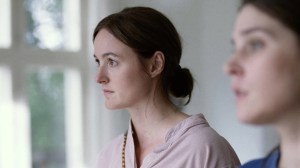
Reinsve has been a collaborator of Trier’s all the way back to 2011’s Oslo, August 31st, but it was her starring role in 2022’s The Worst Person in the World that cemented her international stardom. She’s a wonderfully intuitive and expressive actress, inviting us in with every scene to study her character’s guarded emotional responses and occasional outbursts, like her stage fright hysteria. As the older sister, Nora has built more resentment against their father, whom she blames for everything that her family lacked back in Norway while her father was off in Hollywood making movies with celebrities. Nora is wary about filmmaking, viewing the theater as more of a pure artistic and worthy medium for acting, though you could even view this designation as a division she has drawn: “this is my territory, and that is my father’s territory.” Now he wants to bring her into his world, and she can’t help but be skeptical after all their time apart. Why now? Why this? While this is a splendid ensemble drama with great attention paid to many characters, for all intents and purposes, Nora is our protagonist, and Reinsve keeps us compelled to examine every internal development of this character.
Every actor is at the top of their game, contributing to a marvelous ensemble that makes this family so richly felt. Skarsgard (Dune) is used to playing heavies, stooges, and bad dads, and the role of Gustav allows him to tap into all of those mercurial skills to bring to life a man who is trying to take stock of his life late in its run and make some changes, notably who is allowed inside his cherished circle. Skargsard is mournful but still egotistical, reaching for reconciliation but not begging for it, using the enterprise of the movie and particularly the leading role offer as the unspoken apology. However, Gustav is more than just an absent father, as in the screenplay, by Trier and longtime collaborator Eskil Vogt, he’s also still suffering from his own trauma with the loss of his mother. This movie is an attempt to better understand her and perhaps her psychology that would lead her to make such a heartbreaking decision to end her life. It’s an honest attempt to bring back to life a woman he dearly misses while also discovering a path of forgiveness, while he seeks his own act of forgiveness with his own adult daughters. I told you, there are layers all over this movie.

As the younger sister, Agnes has a more charitable view of her father, and she even acted for him in one of his earlier movies and fondly recalls how warm his attention and affection felt. She’s wary about his desire to have her son, who has professed an affinity for filmmaking but not acting, play the role of young Gustav. She’s worried about her child going through the same level of attachment and disenchantment that she experienced when she was younger and wanting to grow closer to a man who had kept his distance from his family. Agnes’ story is one of uncovering the history of her grandmother, a member of the Norwegian resistance who was taken into custody during Nazi occupation and endured all kinds of torture. Her grandmother is indicative of an entire generation of resistance, and by re-examining one person it provides a larger statement about the sacrifices of those who deserve not to be forgotten, whose memories persist even after the horrors they survived. The movie makes an implicit line between her suffering and eventual suicide but making it a direct line of cause and delayed effect is not so simple. People are complicated by nature, and Agnes fits this bill as well, as demonstrated by Lilleaas’s commanding supporting performance. I think she has what may be the most affecting scene in the movie, a sisterly heart-to-heart that strikes you right in your own heart.
Reminiscent of Ingmar Bergman and Francois Truffaut, Sentimental Value is a richly realized drama with such engrossing and complex characters told in a richly entertaining fashion. There are stylistic touches, like the recurring omniscient narrator, but the movie is more grounded in the simple pleasures of transporting us into the lives of other people and to embrace their flaws and hopes and desires. The actors are incredible and bring such startling life to these characters and their nuances. I could have endured an entire series in this world but at a little over two hours, Sentimental Value feels complete and satisfying. It’s the kind of movie “they don’t make anymore,” to our detriment, so when you discover a film as beautifully executed as this one about the relatable issues that drive many families apart and can bring them back together, then you thank your lucky stars that we still have filmmakers dedicated to making complex adult dramas without any high-concept gimmick to couch their real intentions. This is a marvelous movie about life. Full stop. See it, reader.
Nate’s Grade: A


You must be logged in to post a comment.