Blog Archives
Raw (2017)
 Justine (Garance Marilliier, looking like a Gallic Rooney Mara) comes from a family of vegetarians and veterinarians. She’s entering a famed veterinary college as a legacy and her big sister, Alexia (Ella Rumpf), is already established among the school hierarchy. The incoming students are mercilessly hazed and Justine is forced to eat meat against her will. This moment unlocks a secret craving within her that consumes her. She starts looking at her fellow students less as dinner dates and more as dinner.
For the first half of Raw I thought I was watching a French nouveau version of Carrie. The first half of the movie is dominated by the pressures, and in particular, the cruel hazing from the upperclassmen at the college. The hazing is extreme, rampant, and omnipresent, with every older classmate throwing around his or her sense of privilege and bullying the freshmen candidates. It’s the kind of harassment and abuse we’ve seen in other stories relating to fraternities and sororities where institutions of power abuse others because they were abused and so on and so on, normalizing the cruelty. However, those are organizations that are elective and enclaves among a larger campus. With Raw, it appears that every upperclassman is part of this system of hazing, meaning there is no escape if the young candidates want to continue their education. The professors seem complicit in their negligence, and Justine even has one professor who hilariously criticizes her for doing too well in class. He says her good scores are depressing the other students, possibly making them become worse doctors. The overall impression of this scholarly environment is one of sickness and exploitation. There’s even a culminating “class picture” where they are bathed in buckets of (pig?) blood. With this sort of build-up, I was anticipating that when Justine got her crazy cravings that the movie was going to set up some tasty just desserts for these sadistic upperclassmen. I was looking forward to these mean people getting killed and eaten to service Justine. Perhaps that’s the American version of what this movie would become, or my own preferred version with the established first half, but that’s not the movie Raw ends up becoming.
 Stuck somewhere between body horror and weird compulsion, Raw falters trying to stake its own territory. It’s definitely structured like a coming-of-age/sexual awakening story except said awakening is connected with cannibalism. That’s an excellent starting point for some cringe horror but Raw gets too lost in its dreamlike atmospherics. We explore rave-like revelries, hedonistic escapades, and the allure of the unknown. The best part of the film is the deterioration of Justine’s inhibitions as she gives in to her inner carnivore. There’s an obvious carnality metaphor here (college is a time for experimentation) and there’s a clear entertainment factor in watching a meek character assert herself. Her character gets lost in the oblique mystery that leaves a lot of unanswered questions and unclear motivations. One minute our heroine is rejecting the pressure of her peers and the next she’s nibbling on a severed finger. Her downward spiral doesn’t feel adequately developed as she’s immediately caught in the swirl of campus hazing. The progression feels phony. Outrageous things happen without a tonal grounding, and so it feels more like David Lynch dream logic. I could better accept this drifting quality if the movie had more plot to offer. At the halfway mark, once big sis makes her major personal reveal, the movie generally stalls. The plot doesn’t advance, the characters don’t really deepen, and we’re getting variations on the same things from before. The body horror elements don’t fully feel integrated as well. Justine has breakouts of hives and rashes, presumably from eating meat, though this comes and goes. She doesn’t ever seem too fraught over what she may be becoming, but maybe that’s just being French.
Writer/director Julia Ducournau certainly has talent and a natural way of handling her actors, but her film debut is just trying too hard. The constant crimson color scheme is heavy-handed to convey the protagonist’s frayed state of mind. The symbolism is also just as obvious. The suppression of darker, more animalistic desires is an intriguing concept, except several of the jumps in character development, or debasement, happen while Justine is unconscious. This provides a “what did we do last night?” air of mystery but it also hinders the character growth on screen. It’s like the movie is trying to have Justine sleep through her character development. It’s too bad because there are fascinating pieces and ideas that emerge like flotsam in the wake of Ducournau’s tale. The second half has the potential to become a bizarre sisterly bonding story. How far is each sister willing to go to help the other and to cover up for her actions? Will there be a rivalry when they target the same man? These kinds of questions could have further explored their relationship, but alas it was not to be. You’ll never know how the sisters are supposed to feel for one another throughout the movie. The characters are pretty thin to begin with and then Ducournau introduces a new element to provide added dimension and then lets it slip away. Back to shock value and obvious metaphors.
 Here’s an example how Raw gets too caught up in the sensations of the moment, the allure of its images, which admittedly are a key part to horror. There’s a scene where Justine is dancing in front of a mirror. She’s wearing her sister’s clubbing dress, an article of clothing she had earlier been disdainful over. Now she sways to the beats of a rap song and applies lipstick to her pert lips. She then gazes lustfully at her reflection and leans into the mirror, kissing it and herself. And then she does this for another minute, going in for like four more kisses, as if one wasn’t sufficient. We get the idea pretty early, about Justine’s emerging new self, her carnal cravings, and yet Ducournau keeps going, convinced that redundancy is required to satisfactorily convey obsession.
Raw is also somewhat notorious on the festival circuit for its shock value. Reportedly people were fainting or leaving in droves from the content of the movie. I think this hyperbolic response is overblown. There is a fair bit of gore in the movie but it’s almost all animal related. If you’re an animal lover, watching corpse after corpse might be too much. I certainly averted my eyes more than once during a dog carcass autopsy. The human gore is surprisingly minimal though bloody. By far the most squirm-inducing part of Raw didn’t involve cannibalism at all but a homemade Brazilian wax that gets a little too close for comfort for all involved. At least I now know what my tolerance level will be like for the eventual European coming-of-age horror film set at a waxing station.
While watching Raw with my friend Ben Bailey, we would occasionally turn to each other after a shocking or gratuitously exploitative scene and say, “It is a French movie.” When characters strip for casual nudity, or start chowing down on human remains, or frolic in blood-soaked clothing, we’d say, “It is a French movie.” This turned into a game, ultimately with us imagining a climax involving a cannibalistic ménage à trios. “That,” we remarked, “would be the ultimate French movie.” Raw is a seductive and intriguing movie that has enough surface-level pleasures for devoted horror hounds. Unfortunately, it feels like the least interesting version of this story and premise. There are interesting pieces here to be certain. I just wish someone else had assembled them.
Nate’s Grade: C+
Share this:

Alien: Covenant (2017)
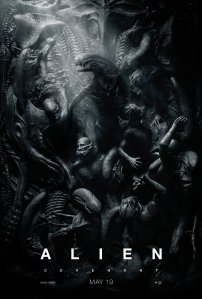 Was Prometheus really as bad a movie as fans made it out to be? While the 2012 Alien prequel could be rather obtuse, and the characters made some of the stupidest decisions as reportedly intelligent scientists, it had an intriguing central mystery, moody sense of atmosphere, great sets, some viciously memorable sequences like Noomi Rapace’s self-directed surgical operation, and a delightfully supercilious Michael Fassbender bot. By the film’s end there were still plenty of outstanding questions unanswered, and so five years later director Ridley Scott has returned with Alien: Covenant to further confound and entertain. The crew of a colony ship takes a detour to land on a habitable world and trace the mysterious transmission belonging to the android David (Fassbender). As expected, all is not what it seems and the crew is almost immediately put into jeopardy. For fans who wanted more answers from Prometheus, there is a surprising amount of carryover to serve as a resolution for the prior film. There are a few big reveals, particularly about the xenomorph evolution, but the overall Alien storyline is moved just mere inches forward, slightly closer to the events of the 1979 original. The biggest problem with Covenant is that it’s too pedestrian for far too often. It sticks pretty close to the formula we’ll all familiar with, so we know it’s only a matter of time before the xenomorphs hit the fan. There is a dearth of memorable scenes here. The characters in Covenant aren’t that much smarter and make their fair share of stupid decisions (hey, let’s ignore the existence of wheat on an alien world or the possibility of killer microbes being in this breathable air). There’s just more of them to be killed off. The movie doesn’t really bother getting to know a far majority of them, consigned to the fact that they’re only here to be later ripped apart and exploded in gore. Katherine Waterston (Fantastic Beasts and Where to Find Them) does a fine job as a Ripley replacement. Danny McBride (Eastbound and Down) has some effective dramatic moments too. But the best reason to watch Covenant, an altogether middling Alien sequel/prequel, is for twice the Fassbender robot action (there’s a Fassbender-on-Fassbender kiss, which will likely break Tumblr). Alien: Covenant is a missed opportunity of a movie hampered by a disappointingly predictable script, tedious characters, and a lack of strong set pieces. It’s acceptable entertainment but not much more. The moral: don’t be a dick to robots.
Nate’s Grade: C+
Share this:

Get Out (2017)
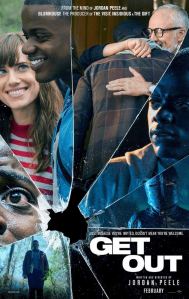 After years as a brilliant sketch comedian, Get Out is Jordan Peele’s first foray into horror, and if this gifted comic mind only wanted to make suspense thrillers from now on, that would be mighty fine. This is the first horror movie in years that left me buzzing, feeling charged and anxious, anxious to share with others so they too can feel the full effect of this live wire of a movie. It may be my favorite theatrical horror film since 2012’s The Cabin in the Woods, and what they both have in common is a knowing understanding of their genres and expectations, a delicately balanced sense of tone, and a funhouse of darkly clever surprises. This is a movie rich with commentary, suspense, payoffs, and it all begins by exploring the dread-filled everyday existence of African-American men in this country as a waking horror movie that cannot be escaped.
Before even going further, I advise most readers to go into Get Out with as little knowledge as possible, which I understand means delaying reading this review. I can accept the loss of eyeballs knowing that more people will go in with an even greater ability to be surprised (I’ll avoid significant spoilers below, so fear not, dear reader).
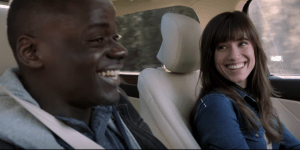
Chris (Daniel Kaluuya) is visiting the parents of his girlfriend for the first time. He’s worried that Rose Armitage (Allison Williams) hasn’t mentioned that he’s black. She assures him that her rich, wealthy, and liberal family won’t care in the slightest. Rose swears her parents are the least racist people she can think of. Dean (Bradley Whitford) is a retired brain surgeon, Missy (Catherine Keener) is a hypnotherapist who volunteers to help Chris stop smoking, and Rose’s younger brother, Jeremy (Caleb Landry Jones), is obsessed with martial arts and lacrosse. They also have black housekeepers, which Dean says he hates how it looks. It isn’t long before Chris’ sense of unease starts to make him rethink this weekend getaway and whether or not something sinister is under the surface.
 Early on, Peele tips his hand to the sharp social and genre criticism. In the opening scene we watch Andrew (Lakeith Stanfield), a young black man, walking around lost in a tony suburban neighborhood. He checks his phone for an address when a lone car drives past him, stops, and turns around, pulling up next to Andrew and idling, blasting the old song “Run Rabbit Run.” He takes one look at the situation and immediately turns around, heading in the opposite direction. “Not today,” he says to himself, clearly providing voice to the audience’s apprehension. And yet, he’s incapacitated, and abducted by masked assailants. Even self-awareness and avoidance will not be enough for this man to survive if captured within the crosshairs of modern White America. He becomes another horror victim just like we might see splashed across the news all too often.
Peele’s biting social commentary is ever-present but it never outpaces the genuine fun and entertainment from his genre storytelling. It’s a condemnation of the fallacy of a post-racial society and an exploration of the uncomfortable burdens African-Americans are disproportionately expected to bear in general. Rose’s family is all too happy to show off how seemingly inclusive they are. Rose’s father confesses, with no legitimate conversational prompting, that he would have voted for Obama a third time (trust me, there’s a lot of people in the camp, Dean). Yet he seems to enjoy awkwardly inserting recitations of “my man” while also trying to openly explain why he has eerily subservient black housekeepers. Rose’s antic brother seems to hungrily size Chris up as a physical challenge to battle, openly admiring his “genetic gifts.” Despite their self-styled liberalism and protests to the contrary that race doesn’t matter, the family can’t help but treat Chris like an other. Race “doesn’t matter” to people who have the position where it might not matter, the same going for those who elect to be “color blind.”
This stifling sense of condescension and pandering is best exemplified in a deeply awkward sequence where Chris is introduced at a party to the whole older majority-white neighborhood. One man informs him he likes Tiger Woods. Another says being black is hip. A woman squeezes his muscles in transparent lust. Another asks what the “African-American experience” is like and whether Chris feels being born black is an advantage. All through this meet-and-greet gauntlet, Chris is holding his carefully crafted smile, trying to shrug off the mounting discomfort, and being told not to make a big deal out of it. After all, these are well-educated liberals, the “good ones.” They can’t be racist too.
 Get Out is also an excellent example of a movie that straddles a precise tone to perfection. Peele has a carefully refined comedy sensibility, but I was genuinely awed in his ability to go from sardonically funny to creepy funny to just plain creepy. There’s an increasingly heightened sense of dread from the get-go. It’s like any other horror premise where our protagonist goes into the house they shouldn’t and combats a host of horrors be they supernatural or superhuman. In this case, the scary scenario is white people. There’s a general off feeling about the Armitage estate and this is best encapsulated with their hired help, Walter (Marcus Henderson) and Georgina (Betty Gabriel). They seem to be in a robotic daze, smiles plastered to their faces, their tone of voice disquietingly calm and meticulous. Even the antiquated and culturally incongruous vocabulary they employ contributes to their unsettling vibes. Something is wrong here. There is a remarkable scene where Chris speaks with Georgina, and she hovers closer to him to apologize. Peele keeps the camera locked on his actor’s faces in extreme close-ups and he has a damn good reason for it. Gabriel (The Purge: Election Year) tries to reassure him all is normal and in one mesmerizing moment the camera fixates on her as she repeats “no,” each time a different reflection, her eyes tearing up as she tries to fight back subverted emotions. It feels like you’re watching twenty emotions and impulses fighting for dominance behind an impassive mask of compliance. Peele magnificently finds ways to keep his elements intensely upsetting while still finding room to laugh and break tension and increase tension.
While more a suspense thriller than a traditional horror film, Peele proves himself shockingly adept at a genre that I would have assumed outside his comfort zone. The shot arrangements and the natural development of tension shows clear knowledge and affinity for the horror genre; Peele knows when to hold onto a moment for extra suspense, when to pull back, and especially when to litter the camera frame with something to draw the eye. Peele has a great eye for his troubling, surreal visuals. When Chris is hypnotized and instructed to “sink into the floor” it’s like he’s falling into an inky void while his consciousness plays out on a square, like his life is a movie only he can watch from a distance. You feel the helplessness but it’s also a beautiful and beautifully unnerving image. There are a few jump scares accompanied by loud musical stings but the far majority of the movie is the overwhelming discomfort and dread marvelously kept at a continual simmer. I was squirming in my seat for long stretches and started backpedaling in others, and I can’t remember another movie in years affecting me that well. It’s partly the terrific execution of his genre elements but also partly because I liked the protagonist and had no idea what would happen to him next, which is the foundation of all horror. The last act cranks up the genre elements but Peele has brilliantly structured his script, laying out all the pieces he’ll need that provide an array of payoffs when we’re breaking for the finish line. This is a movie that knows how to satisfy all audiences, rest assured.
The actors are pitch-perfect and Kaluuya (Sicario, Black Mirror) delivers a star-making performance. He has to wear his own mask to deal with the small and large iniquities of whether or not these people are sinister or whether they’re just oblivious cretins. Chris is a black man expected to mind his manners and to laugh away the casual ignorance afforded by the oblivious privilege of others. He can never be unaware as the lone black man in a sea of white faces. It’s a position I think many people in the audience will be able to relate to and hopefully others can empathize with. Kaluuya has some standout emotional sequences where he digs deep to show the real depth of a character others fetishize or dismiss. Kaluuya is also British and you’d never know it. The Armitage family clan are each their own slice of weird. Whitford (The Cabin in the Woods) is exploding with thinly veiled smarm and great comic awkwardness. Keener (Capote) is chilling in her icy WASP den mother role with her weapon of choice, and hypnotic aid, being a literal silver spoon. Williams is like her blithely privileged character stepped out of HBO’s Girls, and her flippant attitude to Chris’s perspective belies something familiar and darker. The other best actor in the movie is LilRel Howrey (The Carmichael Show) who play’s a friend to Chris that works for the TSA. He’s a reliable and reliable crude source of comic relief but he’s also our ally on the outside, and he behaves like an intelligent investigator trying to save him. I was actually applauding his sensible steps to see through the sinister conspiracy.
 It’s been hours since I saw Get Out and I’m still buzzing from the experience. I was unprepared for how genuinely unnerving and invigorating the movie was as a horror thriller, character piece, but also as a trenchant social satire on race. Jordan Peele has established himself as an immediate visionary in the world of horror, taking the black protagonist who might usually be the first to get killed in a Hollywood slasher flick and widening the boundaries of horror. The real-lie horror film is day-to-day existence in the United States as a person of color. Get Out was conceived in the Obama era but has even more renewed resonance under the beginnings of the Age of Trump. I remember people saying that America now existed in a post-racial world, but we live in the kind of world that takes a call for innocent black lives to stop being executed by police officers and transforms it into All Lives Matter. It’s a hazardous world and Peele has created a marvelous movie where the insidious, ever-present force that cannot be escaped is not a maniac with a chainsaw or some cranky ghost, it’s white society itself. As the news has indicated, from Trayvon Martin to Sandra Bland and numerous others, there isn’t exactly a safe territory to escape to. Danger and death can come at any moment as long as a larger society perceives black skin as a threat first and a person second. Get Out is a timely movie but also timeless, thanks to how brilliantly conceived, developed, and executed Peel’s movie performs. This will make my top ten list for the year. Simply put, stop whatever you’re doing and go out to go see Get Out as soon as possible.
Nate’s Grade: A
Share this:

High-Rise (2016)
 Watching High-Rise left me in an agitated state of bafflement. I was desperately trying to fumble for some kind of larger meaning, or at least some kind of narrative foothold from this indie movie about a high-rise apartment complex where the rich reside at the top and the lower classes below. I was holding onto hope that what came across as messy, incoherent, and juvenile would magically coalesce into some sort of work of satiric value. This hope was lost. Director Ben Wheately’s (Kill List) movie is disdainful to audience demands, disdainful to narrative, disdainful to characters that should be more than vague metaphorical figures against the British class system. The social class commentary is so stupidly simple. At one point, the upper floor rich talk about how they have to throw a better party than the lower floor plebs (slobs versus snobs!). The movie lacks any sort of foundation but just keeps going; I would check how much time was left every fifteen minutes and exclaim, “How is there still more left?!” This is a chore to sit through because it’s so resoundingly repetitive and arbitrary. You could rearrange any ten minutes of the movie and make nary a dent in narrative coherence. There are some striking visuals and weird choices that keep things unpredictable; it’s just that I stopped caring far too early for anything to have mattered. Tom Hiddelston plays a doctor in the building and becomes the intermediary between the oblivious rich and the rabble rousing and vengeful poor. I can’t tell you why anything happens in this movie. I can’t say why the characters do what they do, why the events happen, why anything. It’s all just weightless materials for Wheatley’s empty impressionistic canvas. As society breaks down, things get violent and yet the movie is still boring. I was hoping for something along the lines of Snowpiercer but I got more of a pulpy Terence Mallick spiral of self-indulgent nothingness. High-Rise is a highly irritating and exasperating movie and I know it’s destined to be a future favorite of the pretentious. If anyone says it’s one of his or her favorite movies of all time, please kindly walk in the other direction as fast as you are able and then tell an adult.
Nate’s Grade: D
Share this:

Blair Witch (2016)
 As is mandatory with all reviews, let us acknowledge the tremendous impact of the original Blair Witch Project, a full-borne cultural event that tapped into the zeitgeist. It was a rare indie movie that curated a must-see reputation and became a blockbuster. The found footage format was highly influential afterwards as were its low-fi thrills, community interactivity, viral marketing, and experimental construction. I remember having heated arguments with people about whether the movie was indeed real or a work of fiction. I pointed to the TV once and said, “Look, the actors are promoting it on MTV.” Naturally imitators followed suit and the studio looked to eagerly turn a curiosity into a franchise. 2000’s hasty sequel Book of Shadows was quickly rejected and just as quickly the Blair Witch phenomenon had slipped away. It remained dead until this summer. Director Adam Wingard (You’re Next, The Guest) and frequent screenwriting partner Simon Barrett had recently made a horror movie called The Woods, but at 2016’s Comicon the secrecy was finally dropped. It was a sequel to The Blair Witch Project, filmed in secret J.J. Abrams-style. It was a stunt that worked, and once again there was life in this franchise. This will only last until people see the new Blair Witch, a monotonous, confused jump-scare haven that’s too indebted to the original and discards anything interesting it stumbles onto.
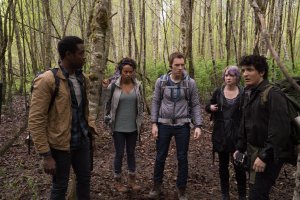
Sixteen years after three backpackers went missing, footage has been posted that possibly shows one of these backpackers, Heather, still alive. James (James Allen McCune) is now an adult male and determined to find out if his sister is alive. Lisa (Callie Hernadez), a film student and maybe James girlfriend, tags along to record James’ hunt for the truth into her graduate thesis. Their friends (Corbin Reid, Brandan Scott) come along for the adventure into the woods, as well as a conspiracy couple (Wes Robinson, Valorie Curry) responsible for posting that new footage. The conspiracy couple leads them into the woods and it isn’t long before people get lost, tempers get heated, and strange disturbing noises materialize from the never-ending night.
 Much can be forgiven if a scary movie delivers the spine-tingling goods, and standing in the shadow of one of the biggest horror hits of all time is no easy proposition. It’s too bad then that Wingard’s Blair Witch is far more tedious than terrifying. I didn’t fall under the spell of the 1999 original but I could appreciate its slow-burn efforts and execution, which relied upon a lot of unsettling dread left to audience imagination. With the 2016 reboot, the filmmakers have upped the ante but don’t have patience. There are over six different jump scares, each punctuated by a loud, often shrill scream. At one point there are three in a row in a succession of mere minutes, enough so that a character provides a meta dose of commentary by saying in exasperation, “Why do people keep doing that?” Calling attention to the annoying trait doesn’t make it better. The sound design is also, in a word, amplified. It sounds like Bigfoot or a dinosaur is tearing through the woods and wrecking havoc. It was enough that I hoped the movie would just reveal the Blair Witch never existed and instead it was some other sizeable monster of legend. I’ll give Wingard credit for the found footage cinematography not being self-consciously overdone. The characters have an incredible stash of cameras, from GoPros to flying drone cameras, which makes the editing less choppy and the movie easier to watch.
There are exactly two scenes that unnerved me. One is the sheer numbers of an expected item upon waking up, the immense quantity and variation in size providing an eerie sight as it fills the screen. The other is a late sequence that involves squeezing in a tight space, which allows Wingard to employ some nice claustrophobic tension. Short of these two moments, and they are mere moments, the movie was boring me so profoundly that I considered just leaving, and I’ve never walked out on a movie before. It felt like it was going nowhere fast with characters I didn’t care about and without any relevant suspense. The found footage filming elements are even used to enhance the jump scares with sudden visual and sound glitches amplifying the tired attempts to constantly startle its audience. This is a movie more concerned with startling its audience than scaring it.
When the movie does start to tantalize your interest, it’s like a mirage that soon vanishes and you’re once again left in your dire predicament. Getting lost in the woods is not interesting minus interesting aspects. However, finding out that time is operating at a different level, now that’s interesting. The characters set their alarms for seven A.M. but it’s still dark out. The possibility of the Blair Witch manipulating time to trap hikers was the first moment in this entire movie that made me sit up in my chair. It took the movie in a different direction that demanded my attention, and it opened up the possibilities of what had been a rather lifeless enterprise up that point. Show me this movie. Alas, it’s an aspect that is quickly shoved aside and largely forgotten even with the timeline of events regarding the footage. There’s a scene where the stick figures directly communicate a powerful connective relationship, and yet this too is never touched upon again. There’s a new threat introduced that takes the movie in a body horror direction and raises questions about whether the woods themselves can become alive. It’s another intriguing moment that culminates in what promises to be a memorable gross-out image, and instead it too peters out and then unwisely abandons the body horror angle. It’s almost like the movie is so single-minded in its path that it ignores the intriguing and preferable detours.
Wingard and Barrett are trying to expand the Blair Witch mythology but their reboot operates on the assumption that there is even a base to work upon and that its audience is familiar with heretofore unspoken rules that appear arbitrarily and randomly. This reboot operates in a world that acknowledges the release of the first Blair Witch movie, yet nobody seems to be any different from this. Obviously James is different having to lie with the legacy of the movie, but why venture out into the woods on a whim of hope to find his long-lost sister who vanished 16 years ago? Does he think she’s just been living off squirrels and twigs in the ensuing time? Why doesn’t James try and question who edited the footage from his sister into a narrative? Why doesn’t he try suing the film production for profiting off his family pain? Why hasn’t Burkitsville, Maryland become a counter-culture tourist destination from taking ownership over its supernatural legend, much like Salem or Roswell? The town should be swamped with adventurous backpackers who want to live the experience. The much maligned Book of Shadows did far more to discuss the reality of the Blair Witch phenomenon and the tenuous hold on reality that the Internet age was ushering in. Wingard’s version eschews this world-building context for narrative immediacy. James wants to find his sister, he gets a clue that she might be out in those woods still, so they all go into the woods. Once the conspiracy theory couple insert themselves onto the trip it seems odd that we’ve ignored the larger context of the legend, instead rehashing how the Blair Witch died.
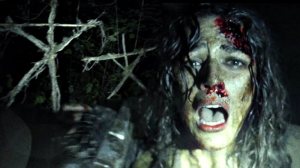 As things begin to fall apart in the second half, the events start to feel arbitrary and poorly defined. There’s a sequence during the climax that I’ll try my best to describe with some discretion but be warned, folks (spoilers): the remaining characters eventually find that same shack in the middle of the woods, though the exact number of floors seems unclear. The witch looks to finally confront our characters, though why she/it waited until this moment is also unclear since she/it seems to be entirely overpowering. That’s when a character declares, with no prior guesswork to arrive at this conclusion, that they have to stand in corners and as long as they don’t turn around and look they will survive. And this works. It’s not explained why this Raiders of the Lost Ark closed-eyes routine is somehow the secret to supernatural survival (ignorance is bliss?). When the character unleashes this tidbit it’s treated like the audience knows the rules of the Blair Witch universe, and we sure don’t. At no point has a larger system been established, so when characters start spouting rules it feels like the movie is making it up as it goes. This don’t-look-back trick is played out almost to a comical effect, which culminates in the rising question of whether a character is going to backwards walk out of the whole stupid forest. The muddled world building (time dilation, voodoo sticks, tree monsters?) makes it feel like the doomed characters are ultimately trapped in a half-finished screenplay.
I was honestly expecting more from Wingard and Barrett after their previous genre collaborations. These guys know the underpinnings of enjoyable genre filmmaking and how and when t upend the conventions and expectations, zigging when others would zag. I felt these two would be able to take a studio gig like Blair Witch and find something new, something interesting, and certainly something scary with the property. I regret to say that this Blair Witch might be new but it sure fails to be interesting or scary. The characters are meaningless and interchangeable and boring. Their decisions are often illogical and stupid. The scares are stacked too high in favor of cheap jump scares, and the movie lacks the patience to develop its tension and horror. It can’t even properly establish rules for the audience to follow. It’s like the filmmakers are being upfront with their lack of faith in their final product. I think the key missing ingredient is, surprisingly, humor. Both You’re Next and The Guest balance along a delicate tonal line that can veer into macabre comedy any moment to lighten or heighten the tension. There are no (intentional) laughs to be had with this retread into the woods. I think the newest Blair Witch has done the unthinkable: it’s redeemed Book of Shadows.
Nate’s Grade: C-
Share this:

The Neon Demon (2016)
 The prospect of a new Nicolas Winding Refn movie is akin to a trip to the dentist for me: long, painful, and full or regret over one’s life choices. The Neon Demon will not change this perception of mine. I hated this movie, and the more I think about it the more I hate it. Unlike Refn’s last film, the punishing, overwrought, and nihilistic Only God Forgives, there isn’t even a kernel of an idea of a movie here. I loathed Only God Forgives but I’ll at least credit Refn for crafting something with potential in its plot dynamics. In better hands, somebody could have done something with the setup for that movie. I don’t think anyone could work with what Refn offers in The Neon Demon because he offers nothing. That’s not entirely true. He offers pretty pictures and alluring shot compositions, bathing the screen in high-contrasting colors. What he fails to offer is a story, or characters, or any reason that this movie shouldn’t exist instead as a ten-minute short. Somebody enlighten me and tell me what exactly this vacuous and tedious art exercise offers.
Perhaps I’m being too cruel so allow me to explain the plot. Jesse (Elle Fanning) is a 16-year-old girl fresh off the bus to L.A. She gets hired at a modeling agency and makes friends with a makeup artist, Ruby (Jena Malone), who also works in a coroner’s office beautifying corpses. Jesse quickly rises through the ranks of the modeling world because of her fresh face and youthful, pure demeanor. She makes enemies with older models (Bella Heathcote, Abbey Lee) who feel threatened by her. And Keanu Reeves plays a sleazy motel owner who sticks a knife down Jesse’s throat for fun. Or that was a dream. I think. Then there’s a confrontation that includes necrophilia, murder, and cannibalism. And even after the cannibalism the movie still goes on for another fifteen minutes!
 There is not nearly enough plot or any substance to carry out Refn’s near two-hour running time, which becomes all the more obvious with one dreary, pretentious, artfully self-indulgent scene after another. There are long segments where I cannot even tell you from a literal level what is happening on screen. Is Jesse descending into madness? Is Jesse losing herself to the vanity of the industry in a heavy-handed visual metaphor? Does anything happening register with the slightest merit? Refn is possibly trying to tackle the same meandering dream logic that populates David Lynch’s more obtuse filmmaking entries, like Lost Highway and Mullholland Drive (recently voted the top film so far of the twenty-first century by the BBC). I’m not a fan of untethered David Lynch but he will at least keep things interesting. The Neon Demon is a powerfully boring enterprise in annihilating audience patience. There’s no there there.
Another problem I have with Refn’s movies is that he hangs much of his meandering on broad and obvious themes and assumes they’re revelatory. Only God Forgives was all about the pointless nature of vengeance and cyclical violence, and you felt the pointlessness with one grisly and uncomfortable moment after the next. With The Neon Demon, Refn falls back on the most general of broadsides against the fashion industry. Did you know that people working in a surface-level industry could be shallow? Did you know that young women are exploited for their beauty and then quickly cast aside? Did you know that succumbing to the appeals of vanity could be self-destructive? These are the most general themes and they are presented without able commentary. It’s like Refn thinks touching upon these shallow themes is enough substance to justify all the excesses.
This is borderline unwatchable cinema. The plot is like Showgirls without the camp but still following some of the basic plot beats. There is nothing interesting about these characters at all and that’s because they’re not people but robotic figurines at best. They’re dolls for Refn to pose and play around with his purple lights. It’s like watching two hours of somebody rearrange fancy-looking furniture. The characters are just as significant as the nearest love seat or coffee table. I’ve complained about all the empty space in Refn movies and The Neon Demon is no different. This movie is padded out exponentially to become Refn’s longest movie in his career. He cares far more about his shot compositions and cinematography than storytelling. At this point I don’t think Refn has any interest whatsoever in telling a story. He wants to construct a visually immersive film experience. The Neon Demon is little more than the misty atmosphere of the impermissible, the phantasmagorical. Refn deploys controversial imagery and plot elements but he deploys them in place of actual substance. Anybody can get a strong response by throwing in a necrophilia sex scene, but has that reaction been earned and has this moment been properly setup by careful development? Absolutely not. Things just happen.
 This was also billed as Refn’s horror movie but there’s nothing genuinely terrifying, at least from an intentional standpoint. You don’t feel any sense of danger or even a sense of uncertainty until the very end, and by then the movie has meandered far too much for the horror elements and gore to have an impact beyond lazy shock value. This is a movie where pretty people stand around and then, on the turn of a dime, do something outrageous. Refn hasn’t laid the groundwork for a descent into mental instability with our lead character, which seems like the most obvious solution. I could see a Black Swan-style psychosexual story about obsession with perfection and how this blinds one woman into making a multitude of sacrifices, driving her over the edge and into murder. Black Swan was a great, often brilliant movie. Go watch Black Swan instead, folks.
I think I have a solution that will benefit us all, dear reader. Nicolas Winding Refn should forgo the director’s chair and devote his career to being a cinematographer. He has an alluring eye for visual compositions and a great feel for atmospheric lighting, but with each passing movie I feel the man’s disdain for narrative filmmaking. His skill set is best utilized at making pretty pictures. Get him away from directing actors. Get him away from writing stories. Have adults in charge of the other aspects that help make a movie what a movie should be. The Neon Demon is a confounding, obnoxious, obtuse, intellectually destitute and monotonous movie experience. It’s frustrating to deal with the Cult of Refn in cinematic circles because I just cannot see what they see (I liked Drive well enough). The Neon Demon is too shallow and tortuous to be an insightful commentary on beauty, too oblique and maddeningly dreamlike to be an engaging story, and too devoid of interesting characters to hold your attention as they drift from one scene to the next. I’d be more forgiving of Refn’s indulgences if he was a short filmmaker. I’d allow more latitude for experimentation. The Neon Demon is not a movie. It’s a collection of half-formed, shallow ideas that Refn has thrown together, a whole lot of dead and empty space connecting them together, and an 80s synth score to underline the high-contrast colors. At this point I’d rather go back to the dentist than sit through another Refn film.
Nate’s Grade: D
Share this:

Don’t Breathe (2016)
 Alex (Dylan Minnette), Rocky (Jane Levy), and “Money” (Daniel Zovatto) are a team of burglars that use security codes to break into homes. They steal materials under $10,000 to keep them below larger charges. The trio hear about a visually impaired Gulf War vet (Stephen Lang) and his thousands of dollars he keeps inside his home. The naive burglars break into his home and sneakily search for his stashed cash, but the Blind Man (that’s how he’s credited) is a far more formidable victim than they ever could have imagined, and he’s keeping his own secrets that may be worth killing for.
The suspense in Don’t Breathe is deliciously developed and tautly executed, taking a premise that sounds silly on paper and wringing every juicy suspenseful morsel out of it. The crux of this movie is dramatic irony wherein the audience knows more than the characters, and once the Blind Man is activated, so to speak, it becomes an intense game of hide and seek with the audience in on the game. Director Fede Alvarez (Evil Dead) and company have established the layout and geography of the game space, the various rooms and hallways and hiding places, and we spend significant time in every location. A haven one minute might be endangered the next, and the way out or at least a momentary escape from immediate danger might be upstairs or downstairs, or in the walls. An essential part of effective suspense is fearing what happens to your characters, and Don’t Breathe achieves this often with clever setups. There’s one scene where a character falls out a window and lands unconscious on a skylight. The glass begins to crack underneath his weight, and then we see the Blind Man in the room below, anxiously looking for his target. Then there’s also the Blind Man’s attack dog, which you forget about and then pops back up, providing a new threat that changes the dynamics of the moment. The suspense sequences change up so frequently that there’s always something new going on every few minutes. The movie’s attention even seems to alternate between Rocky and Alex and their personal obstacles when separated. The technical merits are present without being overly flashy and self-indulgent. An opening tracking shot inside the house nicely establishes the general layout of the space. Alvarez doesn’t rush his suspense set pieces either, showcasing a wonderfully natural feel for teasing out the tension to make his audience squirm in their seats. With the variety of the suspense set pieces, their clever development, the clear understanding of the geography and stakes, and a swift pacing that doesn’t allow the audience to catch its own breath, Don’t Breathe is a small-scale case study in exactly how to maximize your premise for the most entertainment.
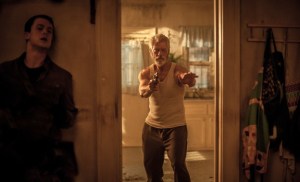 Don’t Breathe packs a punch and this is aided by how streamlined and clean the narrative proves to be, whittling down all unnecessary plot strands. I hated the Money character. He brought nothing to the burglary team besides perhaps some muscle (and a firearm), but I was worried that the movie was going to drag out his inevitable demise. Clearly Rocky and Alex were going to be the main participants and that meant that Money was the most expendable, and given the small number of characters, I worried he wouldn’t be given his merciful end until long into the movie. Well Alvarez must have heard my worry because Money is killed very early on, sparing the audience from dragging out the inevitable. I was appreciative but it also raised the stakes with the two remaining characters because now nobody was obviously next in line for death. A dead Money actually proves more useful than a living Money for the characters. I also appreciated that the movie didn’t dawdle when it came to setting up its trio of burglars and their goals. They’re breaking into the Blind Man’s house at about the 15-minute mark. There’s also no concerted effort at layering in larger social commentary. The economically depressed Detroit setting works to communicate the desperation of the characters, their desire to escape their trappings, and it also provides a tidy explanation for why the Blind Man can drag an unconscious girl by her hair down the middle of the road without alarm (it’s the opening image, so chill spoiler-phobes). This is not a movie that has larger things to say about The Way We Live Now, and to pretend otherwise would be a waste of valuable time. Also, having three white characters serve as the social commentary for Detroit’s ailments would seem rather tone deaf and ill advised.
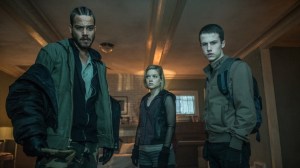 I think if the Blind Man had been a complete innocent that the movie would have been even more interesting as it forces the audience to test its loyalties and choose sides. As my friend Ben Bailey said upon leaving the theater, once they introduce a third act twist involving the Blind Man’s true goal, he ceased having any sympathy and “just needed to die.” I’ll concur mostly, but man I fell out of favor with our trio of young burglars and the best way I can explain is by making an analogy to the Howie Mandel prime time game show, Deal or No Deal. Contestants would randomly choose briefcases hoping that they contained low amounts of money, furthering the odds that their briefcase would contain a larger and joyous amount. It’s really just a game of odds and averages. It’s mildly fun but with every contestant there was a breaking point for me, a point where they really should have cashed out but instead chose to go forward against unfavorable odds. Once a contestant crossed this imagery point of no return in my mind I was rooting for their downfall (probably to just confirm that I was right all along). Horror movies are the same, and once the main characters make too many stupid decisions, then my sympathies generally gravitate elsewhere. With Don’t Breathe, the young characters have multiple opportunities to escape the house but make too many bad choices. They want to keep the stolen money above their own lives, and after the third missed chance I felt my loyalties wavering. Their first mistake was when they were casing the man’s house in broad daylight and see him walking his dog. Hello, here’s a golden opportunity to break into the home where you know he and his pooch will be absent. Why wait when they’re both back at home and needing to be dealt with? If the Blind Man had been an innocent, or even if they had simply omitted the insidious third act twist, I would have been rooting for this visually impaired war veteran to smite these punk-nosed kids but good.
Earlier this year Netflix debuted Hush, a home invasion thriller featuring a deaf protagonist. Now we have Don’t Breathe with a blind man trying to thwart home invaders. Let’s continue this trend: Don’t Taste, about a man that has to flick his tongue out to sense his hiding home invaders, or Don’t Smell, a pulse-pounding race-the-clock thriller where a scent-disabled man must match wits with attackers while his home, unbeknownst to him, fills up with carbon monoxide. It’s an easy punch line but credit Don’t Breathe for taking its potentially silly premise and treating it with deadly seriousness while still knowing how to have fun with its audience. There are several moments designed to get an audience to jolt or groan, and it all contributes to a skillful, above average experience at the movies that wears down your nerves. The film is terrifically tense, well developed, well paced, and not too stupid, veering in new directions and upping the ante with new twists to amplify the stakes. If you’re looking for a solid way to close out was has been an otherwise mediocre summer movie season, give Don’t Breathe a chance, sit back, and try to keep up with the fun.
Nate’s Grade: B+
Share this:

Lights Out (2016)
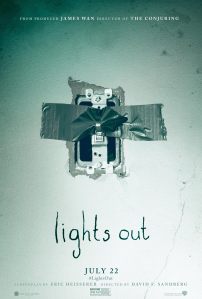 When it comes to horror, concept is king, but what’s just as important is fully developing that concept to meet its potential, and that’s where Lights Out succeeds. This is a low-budget horror movie that taps into a primal fear of the dark with a supernatural entity named Diana that can only be seen outside light sources. Thankfully, director David F. Sandberg smartly thinks of fun and interesting ways to play with this concept, like Diana disappearing in bursts of muzzle fire and a frantic, life-saving use of a car alarm. There’s a great suspense sequence where an off screen light from a flickering neon sign, switching off and on steadily, sets up audience expectations and lingers, drawing out the fear. The editing is terrific. There’s also a surprising subtext tackling the issue of mental illness and depression, as Diana, the malevolent spirit tethered to Maria Bello’s character, only seems to appear during the rougher patches of her life, and Diana fights against Bello getting “better” which weakens her existence. Theresa Palmer (Warm Bodies) settles in as a capable heroine that genuinely cares for her younger brother in danger from her mother and her “friend.” I cared about the people in this. The movie also subverts some genre clichés and treats its handful of characters with credibility. While the very end leaves some questionable final statements on mental illness, Lights Out is an elevated B-movie that takes its fun premise and executes it with aplomb. It’s worth 90 minutes in the dark.
Nate’s Grade: B
Share this:

The Conjuring 2 (2016)
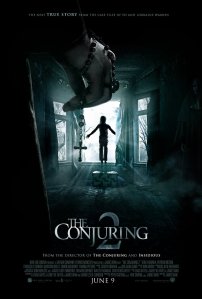 Horror is one genre where sequels rarely if ever satisfy. Usually the repetition is mind numbing and what was once scary has been eradicated. The true signs of great horror is the dread of what’s coming next, and to this end James Wan has shown tremendous skill at playing an audience and their fears. The Conjuring 2 isn’t quite the thrilling success that its predecessor was but it still upholds the best parts of what made the first movie frightening. We follow the Warrens once more, the husband and wife paranormal investigators, and this time to England where a malevolent spirit is haunting a family. One of the few miscues is delaying the meeting of the Warrens with the beleaguered family to almost an hour, pushing the running time to a needlessly overblown 133 minutes. The movie seems to be stretching out the ghost set pieces. Fortunately, Wan knows exactly how to build tension and let it simmer. The demon nun imagery is effectively unsettling, and there’s a brilliant sequence where Mrs. Warren (Vera Farmiga) has to slowly pull a light cord, all while the portrait of the demon nun hangs visibly in the dark. It’s a small scene that explains in full the clever construction of the whole. It sets up the parameters, develops them, and then lets the audience dread what it knows is coming. These are not cheap scares or lame jump scares but genuinely earned terror within a carefully constructed atmosphere. It might not be as good as the first one but The Conjuring 2 is still plenty good, which by default makes it possibly one of the greatest horror sequels of all time. Let’s hope the demon nun spinoff goes better than Anabelle.
Nate’s Grade: B+
Share this:

The Boy (2016)
 The scariest thing about The Boy is how much potential it wastes, foolishly abandoning a horror direction that was eerie, supernatural, and with one leg rooted in a psychological breakdown, and instead cheerfully dives headfirst into an unwanted new direction of cheap campy thrills. I haven’t seen a decent movie unravel with this high-speed velocity and tone-shift since Danny Boyle’s Sunshine, an intelligent sci-fi vision that decided, hey, let’s just make the entire final act a slasher movie in space. The Boy is about an American nanny who travels abroad to care for an elderly couple’s young son Brahms, a son who happens to be a porcelain doll. There are rules to be followed and consequences if they are disobeyed. I liked that our heroine (Lauren Cohan, The Walking Dead) doesn’t try and ignore what she’s seeing for a majority of the movie and instead embraces the unusual circumstances, testing Brahms and discovering more. It kept the film moving in more engaging directions rather than denying the obvious and padding out its run time. I wish that the script opened up more about the domestic violence that haunts our heroine, literally and figuratively, but for a solid hour I was fairly entertained by the supernatural parlor games and lead performance by Cohan. Then the last act occurred, which just swiped away all the good will. I groaned aloud when the shift happened. I won’t go into detail but suffice to say it feels distinctly like two different movies clumsily grafted onto one another at the behest of exec. What once could be excused or forgiven in a supernatural realm cannot when trying to ground the story in reality, and it only unleashes a horde of nagging questions that don’t add up, especially concerning Brahm’s parents and the implications of its ending. The Boy is a cautionary tale about leaving well enough alone, understanding the strengths of your spooky story and tone, and committing to the best idea rather than one that “surprises” while laying waste to your larger story.
Nate’s Grade: C


You must be logged in to post a comment.