Blog Archives
The Forest (2016)
 The Forrest is an initially promising horror-thriller that abandons every interesting possibility with every turn, becoming another interchangeably shortsighted and mediocre movie that only manages to scare an audience with how bad it becomes.
Sara (Natalie Dormer) is investigating the disappearance of her twin sister, Jess (also Dormer). Jess was working as a teacher in Tokyo when she visited the Aokigahara forest at the base of Mt. Fuji. This forest is nicknamed the “suicide forest” because of its reputation for being a favored location for Japanese citizens to kill themselves. Sara tracks down her sister to her campsite in the forest, with the help of a guide (Yukiyoshi Ozawa) and Aiden (Taylor Kinney), a journalist interested in writing her story. The guide stresses they must stay on the path at all costs and not trust the sounds they hear. There are plenty of unhappy spirits inside and they’re looking for permanent company.
The problem with dumb characters behaving stupidly is that it obliterates any investment the audience has in them, which is highly important in the horror and thriller genre. If you don’t care about the characters then you don’t care what happens next to them. With The Forest, we have characters that are wildly veering in the logistics of their decision-making that it becomes nigh impossible to care about what befalls them. They break the rules fairly early about staying on the path but the knowledge that everything they see is only a ghostly manifestation should register more. I understand that when you’re in the middle of a fraught experience that perhaps fear can cloud the mind, but perhaps you should start second-guessing things like lost Japanese schoolgirls miraculously finding you in the woods, or the fact that your childhood home is recreated in Japan. It’s scary, sure, but shouldn’t these characters no better? Also, the second-guessing of what is real causes Sara to view Aiden with great suspicion, except when she remarkable forgets. We’ll have a scene where she runs away from him out of paranoid fear, and then the next scene they’re back hiking through the woods together. It starts to feel like no two scenes connect or build off one another and The Forest is just an aimless sprint through random spooky genre grist that keep scaring our dimwitted characters.
 There’s so much that is left unexplained, but not in some tantalizing way meant to provoke a greater sense of realism through ambiguity, but because the screenplay just can’t be bothered. The premise of The Forest is great and the setting should be mined for all the unsettling dread that it could manage. The little details of this unique place sink in, like the lines of rope and string that lead off to, presumably, suicide victims hoping to lead others to their fateful resting places. There’s something so brilliantly creepy about this place, and every length of rope that ventures deep into the woods has its own story and its own larger significance, symbolizing a life taken. Why does The Forest so rarely make use of the unique details of its setting? This location could have been any patch of woods with your standard unhappy ghosts to roam. That’s the biggest failure of the movie, wasting the potential of its special location and making it indistinguishable from hundreds of other cheap horror settings.
Let’s talk about some of those scares as well. The Forest abandons the unsettling atmosphere of its setting and the possibility of the fraying psychology of its character (coherent unraveling, I should say) for what amount to a relentless assault of cheap jump scares. The jump scare is the bottom of the barrel, utilizing sudden appearance to startle. It is ultimately empty and any movie that relies on a diet heavy on jump scares is essentially admitting that it could not build a tense environment on its own. It is admitting defeat, and that is what The Forest admits when it relies on a jump scare, I kid you not, like every five minutes. Oh no, something suddenly popped up and Sara jolted out of a dream. Oh no, something suddenly popped up and flew at the camera and Sara jolted out of a dream. Repeat as needed to pad the running time. It’s tiresome and leads to diminishing returns. The only way jump scares work is when they are unexpected. If you start to anticipate them then they lose all of their power and relevance.
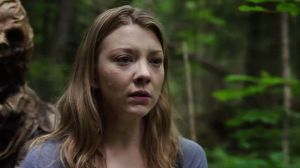 As the movie continued running in one direction and then suddenly running in another, I was reminded of 2014’s Occulus. I wasn’t completely taken with that horror movie but it is far better than The Forest. The premise of Occulus involves a brother and sister trying to prove a cursed mirror is responsible for a history of murder. The mirror would play with the minds of its victims by putting them in false settings and scenarios, thus creating illusions to trick them into deadly behavior. The difficult part of Occulus was that you couldn’t trust what you were watching, which either forced the audience to pay more attention or to just give up and wait for the eventual reveals. The Forest is similar in that a good portion of its running time is a series of hallucinogenic tangents. Are there really maggots crawling under Sara’s skin? Is that water in the creek running the wrong way? It becomes frustrating when the characters don’t respond with nearly enough skepticism, especially when they’re fooled again and again. Occulus, while purposely hard to follow, was worth watching and ultimately felt well developed. The Forest feels lost in the woods.
Unless you’re a sucker for the kind of genre, there’s nothing that The Forest does well enough to warrant a theatrical viewing. It’s so frustrating because there are elements and potential there and the movie just continues to not care, falling back on the same-old same-old cheap jump scares and indistinguishable hackneyed genre tropes, losing sight of the inherent awe and fright of its special location. Dormer (HBO’s Game of Thrones) gives a suitably spooked performance but does little to stand out among the scenery. If you’re contemplating watching The Forest, just watch Occulus instead and be grateful.
Nate’s Grade: C-
Share this:

The Human Centipede 3 (2015)
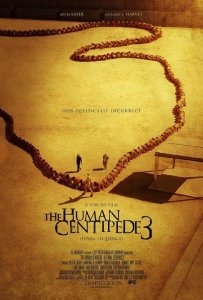 Sometimes as a critic I seek out the worst of the worst so you don’t have to, America. And you really owe me big time for sitting through all 100 torturous minutes of the regretful-in-every-aspect horror… “comedy,” Human Centipede 3: Final Sequence. I’ll confess that horror is a genre I’ve grown to enjoy and I genuinely liked the first Centipede film, finding its premise near ingenious and that writer/director Tom Six developed his horror grotesquerie in a way that turned it into an accessible survival thriller with some gonzo edges. The sequel was pretty repulsive and the third film, with the hopeful promise of being the “final sequence,” is even worse. This is a horrifying endurance test not unlike Tom Green’s abysmal lone directorial affront, Freddy Got Fingered. It is that bad. Scenes just seem to go on and on and exist for no purpose. It’s like Dieter Laser was just told to do whatever he wanted as long as he yelled as loud as he could and based his performance after the Looney Tunes cast. It’s cheap vulgarity masquerading as edgy provocation; it’s transparently lazy and insufferable. It’s not funny no matter how weird or loud or garish or bloody or dumb it gets. The premise is basically an insane prison warden (Laser) is going to create his own human centipede, the biggest ever, linking over 100 inmates. Ignoring the escalation of all the Centipede sequels, it’s a facile plot device and it doesn’t even happen until the very end. Until that awful reveal, you will have to endure, no a better word is survive, extended “comedy” bits like Laser sticking his tongue out and roaring in orgasm while his secretary (Bree Olsen) is forced to felate him while others are in the room. The movie is trying so hard to be shocking and irreverent that you can see all the pained efforts. It’s tedious and boring. Human Centipede 3 is 100 minutes of pathetic flop sweat that could more or less end with the throwaway punchline, “The Aristocrats!”
Nate’s Grade: F
Share this:

Knock Knock (2015)/ The Green Inferno (2015)
 Whatever happened to Eli Roth as a director? In 2003, I watched Cabin Fever and was instantly smitten with the twisted new talent on the horror scene. His sense of humor reminded me of Sam Raimi and Peter Jackson before they went Hollywood from their splatterfest beginnings. He directed two movies after, Hostel and its sequel, and while I found Part Two to be underwhelming in execution, I was quite a fan of the original Hostel. It further cemented that it felt like Roth was going places. Most of those places were as an actor or a producer. Roth has acted in more movies (two Quentin Tarantino flicks) than he’s directed since 2007’s Hostel: Part Two. His name was attached to and then departed other projects, notably an adaptation of Stephen King’s Cell, and then it felt like he just vanished altogether. Roth has re-emerged with two films bearing his name as director, The Green Inferno, which premiered in 2013 at the Toronto Film Festival, and Knock Knock. After having watched both movies in one day I can say neither was worth the wait.
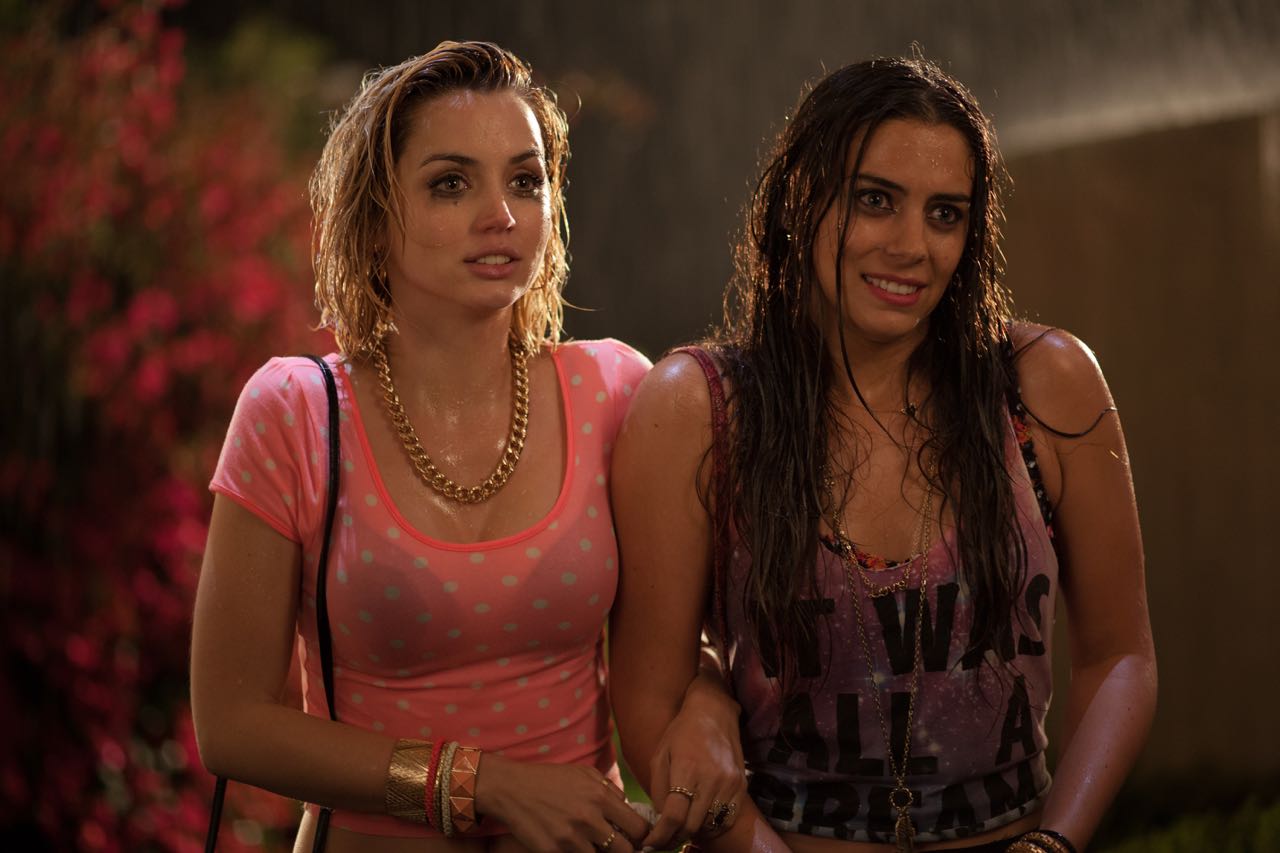
Knock Knock concerns Evan (Keanu Reeves), an architect, a former world-famous DJ (?), and family man. His wife and children have left for the weekend so that dear old dad can finally get some work done. Then one rainy evening a knock knock comes upon his chamber door. Two soaked coeds, Genesis (Lorenza Izzo) and Bel (Ana de Armas), politely ask if they can dry off inside. They’re supposed to meet at a friend’s house and have gotten lost. Evan is hospitable to a fault and indulges with them in conversation. The girls are flirty and very interested in a sexual dalliance with Evan, and finally he gives in. The next night Evan is ready to move on and pretend like nothing happened. However, Genesis and Bel are refusing to leave, and they have a design to punish and humiliate Evan for his martial indiscretion.
 The premise is a mixture of Fatal Attraction and a home invasion movie, and there is potential here for a slowly escalating thriller or a comically degenerating farce that surprises with its dips into darkness, like 2013’s Cheap Thrills. Alas, Knock Knock is an unbalanced and unintentionally funny morality play that is so poorly executed, ham-fisted, and awkwardly developed that it’s more horrifying mess than horror. The first act of the film is a bit overwrought with making sure the audience knows exactly what kind of temptation trap Evan is falling under. Every line has an innuenduous ring, every flirtatious line an extended second of awkward eye contact, and every innocuous moment begins to feel like the forgotten detail in one of those absurd Letters to Penthouse fantasies (“You’ll never believe what happened to me…”). You can see the better film that has been crushed to death under the rush to make something tawdry, complete with both girls soaping up their bodies in a joint shower and then jointly pleasuring Evan to eliminate the last of his denials. If you felt the slowly escalating sexual tension, the desire, and yearning, and then weighing the consequences, the movie would have been a far more compelling moral dilemma and character piece. Instead, the girls are over-the-top in their seduction routines and once Evan gives in it all gets even worse. It’s not so much relatable or an interesting ethical conflict as it is the in-between scenes for a soft-core porn biding its time. For what it’s worth, the gratuitous nudity is a bit shrift.
At no point do Genesis or Bel feel like actual human beings; they are unhinged one-dimensional lascivious cartoons with ridiculous and guffaw-inducing motivation. As soon as the morning comes, Genesis and Bel have transformed from seductive and coy young adults to infantilized and highly sexualized bratty teenagers. Our reintroduction involves both ladies filling the kitchen with breakfast supplies and throwing food around, laughing obnoxiously, and practically bouncing off the walls. Their initial adversarial one-upsmanship includes mooning Evan while he’s on a Skype call and drawing penises on his wife’s art. When a concerned neighbor stops by I was hoping for something a little more serious and dangerous, but they can’t even do that, which is what makes their late turn into would-be murderers to be completely unbelievable and forced. It’s so forced that Reeve’s sputtering monologue of incredulity pretty much sums up the point of view of any rational viewer. They play dress up and appear to have some psychosexual daddy issues, possibly resulting from childhood abuse or molestation, but at no point do they come across as a credible menace. Then there’s the concluding justification for their acts of retribution and it’s so lame and uninspired and a cop-out that you wish Roth had committed to the direction the film had been steering toward.
 That’s the biggest failing of Knock Knock is that it could have worked as a thriller if Roth and co-writer Nicolas Lopez (Aftershock) had fully developed their scenario. There’s a fine story of events spinning out of control as one man gets in over his head trying to cover up his indiscretion. Evan doesn’t really grapple with his guilt because everything is manifested as an external threat. He becomes a literal hostage to his guests but they don’t ever turn the screws in a manner that belies a plan or even a sharper point. The first act should have been setting up storylines that would further complicate this hostage scenario with people dropping by and more opportunities to be caught. Rather than playing as a slow-boil hostage thriller or a be-careful-what-you-wish-for morality play, Knock Knock more approaches a failed farce. The film even lacks any visual polish or carefully constructed set piece to stand out from the bargain bin of cheap horror thrillers, and Chile does not convincingly double for California either.
Roth has been a filmmaker who found dark and creative ways to mix humor into his horror, but Knock Knock is one where his signature humor doesn’t feel intended. First off, the behavior of Genesis and Bel is wildly over-the-top, screechy, and just insufferable. Izzo and Armas are way too broad and way too unhinged without any sense of mooring from Roth as a director. It’s just not fun to watch. Their batty babydoll shtick isn’t funny or sexy or dangerous. The tone cannot find a balance or commitment. There are lines of dialogue that are howlers and then there are moments that are played without the right sense of pacing or delivery and they can transform something inane into something dreadfully funny. It’s hard to describe in words but Reeves’ strident yet flat delivery of “I’m a happily married man” after being bamboozled by two naked and nubile young women is hilarity in itself. Then there’s the final scene (spoiler alert) that rests upon a struggle to eliminate a damning social media post. The resulting action and Reeves’ resultant scream to the heavens left me doubling over with laughter, more so because this is part of the misguided climax to a misguided movie. Suffice to say the moments that seemed intended to be comedic fall flat and the ones that are not, at least in their primary and secondary purpose, are the ones that produce hearty derisive laughter.
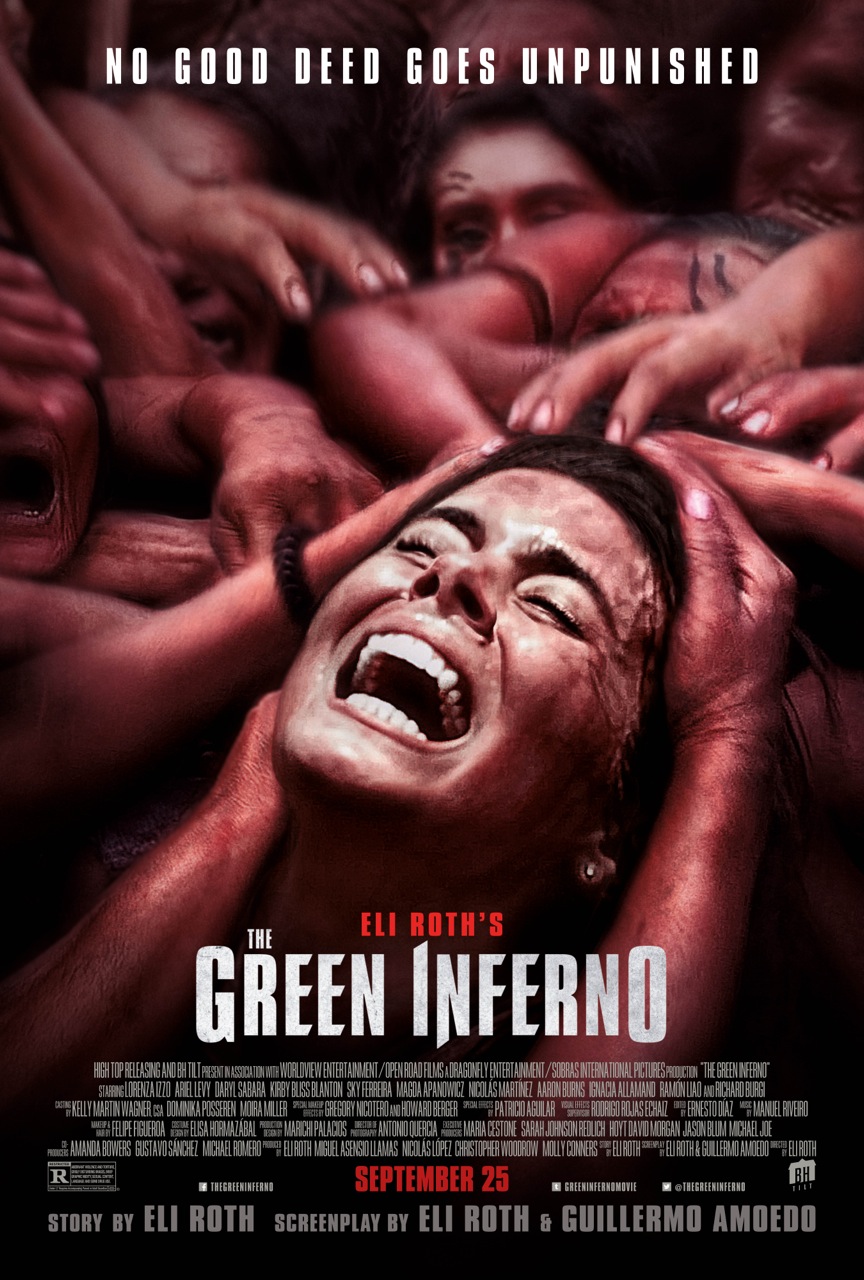 At least Roth’s other 2015 release knows exactly what it wants to be, which is a stomach-churning gore-fest homage to one of cinema’s most notorious movies, Cannibal Holocaust. From an early college lecture about female genital mutilation, you know exactly where Roth is leading this story. Unlike Knock Knock, you get a sense of Roth’s passion for the material here, and while much of that material is the systematic exposure of other people’s guts, it’s at least treated with the right amount of horror and dread. In grand slasher tradition, our poorly developed characters are but bodies to be sacrificed for our sickening amusement, but at least this is where Roth comes alive with creativity. The plot is fairly bare-bones: a group of activists from a liberal arts college travel to the Amazon jungle to protest the local government tearing down acres of forest that rightfully belong to native communities. After having successfully staged their protest, the activists’ plane goes down in the jungle and the cannibalistic natives collect the survivors and do what they do best. While it takes a bit too long without layering in mystery or essential plot, or even ironic counterpoints to fold back upon, once the students meet the hungry villagers, the movie becomes everything it was intended to be, one gory torture sequence after another. There are some memorably gross and uncomfortable moments. Similar to Roth’s Hostel, sometimes the threat of torture is worse than a grisly death. When the practices of female circumcision come roaring back as a plot point, you won’t be able to stop squirming in your seat in appropriate trepidation of what’s next.
 The Green Inferno might prioritize its colorful slaughter but at least Roth puts something approaching a survival story in play to fill in the gaps. The first human sacrifice is so methodical that it serves as a grandly grotesque statement to better motivate the other survivors. Izzo (Roth’s wife) appears as the movie’s version of the Final Girl, so we’re anticipating that she’ll be able to escape somehow. The villagers keep our characters locked in cages and slowly we get a greater sense of their routines and eating habits. There’s a clever use of marijuana to purposely drug their captors. While there is an overwhelming sense of doom and futility, partially just by knowing what kind of movie this is, I’ll credit Roth that the movie doesn’t feel repulsively nihilistic. It may feel genuinely repulsive for other reasons, but you still hold onto a small glimmer of hope that at least some of these college students might maybe make it out alive. Maybe.
There’s also the elephant in the room when it comes to the cultural depiction of a bunch of savages feasting upon primarily white Americans. It’s certainly not an enlightened or nuanced analysis of another culture and it brings to mind some rather ignorant and racist imagery of old where the “backwards natives” were seen as dangerous and uncivilized villains more in common with wild animals than human beings. The villagers in the movie are all bathed in a blood-red skin dye as if they were to be recognized as devils and otherworldly demons. I can’t fathom that a village of this size comes across enough wayward humans to keep itself nourished. It’s hard to get a read on what commentary Roth has in mind. Is he playing into xenophobia or is he sending up the ignorance of the college activists who think getting to the front page of Reddit is a major accomplishment? I can’t tell and this indecision on Roth’s part doesn’t help the movie. It’s easy in slasher cinema to root for the charismatic killer to mow down our gullible and dumb teenagers, but it’s also easy to find a survivor to root for against all odds. I can’t tell which side Roth was more interested in highlighting the plight of. The ending doesn’t clarify this either.
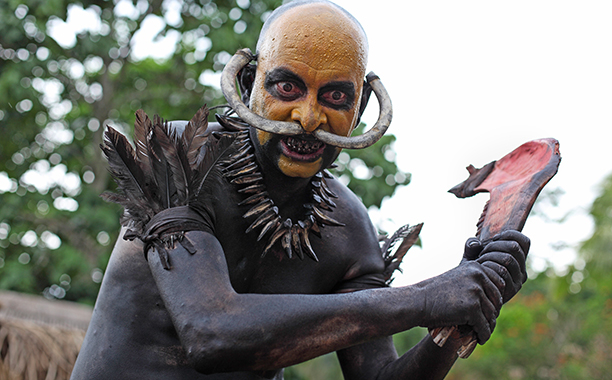 By no means am I saying that The Green Inferno is a conventionally enjoyable movie, but if you’re a gore hound looking to slurp up your next bloody feast, then this might hit the spot. It’s an uncomfortable and too often tedious film, and some of the character setbacks just seem mean-spirited or unnecessary, like a character literally defecating in a corner for what feels like a solid minute with Farrelly Brothers sound effects (even the natives point and laugh). This is not a pleasant filmgoing experience, nor is it particularly articulate with its social commentary, but the thing that The Green Inferno accomplishes is in its sense of grisly purpose. It’s not groundbreaking or even particularly artistic but for its select audience of horror aficionados, I feel like there is enough to merit watching. Unlike Knock Knock, which doesn’t know who its audience is, The Green Inferno knows all too well, beholden to their bloodlusts, and thus too limited to attract wider appeal. Then again any film that can be thematically linked to Cannibal Holocaust wasn’t exactly going to be targeting the masses. After a long drought behind the camera, these two releases have shown me that Roth’s interests have become a bit more base, his skills a bit more ramshackle, and his sick sense of humor a bit more misapplied. After Cabin Fever and Hostel, I had high hopes that Roth would follow in his mentor Tarantino’s footsteps and rise above genre trappings as an artist. With news that Roth will produce a Cabin Fever remake for 2016, well I think my hopes for the man have gone up in smoke.
Nate’s Grades:
Knock Knock: D
Green Inferno: C
Share this:

The Visit (2015)
 For the past ten years, M. Night Shyamalan has been a figure of piñata-whacking derision, and yet the man has consistently been at work on films big and small. You would think a decade of duds would lead to Shyamalan being unable to direct more than a junior high theater production, and yet people like Will Smith were specifically seeking him out to direct inevitably terrible movies like After Earth (oh is that one bad). The association has been burned into our minds: Shyamalan and bad movies. Is it even possible for a man whose name has become a punchline to turn his career around? A low-budget lark like The Visit allows Shyamalan the freedom of risk. If he fails, he’s only made one more bad found footage horror movie in a near infinite sea of them, and the budget number isn’t one that will bankrupt his generous producers. Perhaps it’s through the benefit of low expectations cultivated over ten grievous years of filmmaking, but The Visit is a modest little thriller that has enough suspense and campy humor that it works, mostly. I walked out of the theater generally satisfied and entertained, which are two attributes that haven’t been associated with Shyamalan films since… Signs? Goodness, that was back when Mel Gibson was a box-office titan.
15-year-old Becca (Olivia DeJonge) and her 13-year-old brother Tyler (Ed Oxenbould) are visiting their grandparents for the first time. Becca is a budding documentary filmmaker and brings her camera along to make a movie about the five-day visit. Nana (Deanna Dunagan) and Pop Pop (Peter McRobbie) live deep in the woods of rural Pennsylvania (the local police force consists of one guy). Everything is warm and cozy until it’s nighttime and Pop Pop insists that, for their safety, the kids stay in their rooms after nine o’clock. The strict rules and forbidden areas of the home encourage the kids to go exploring. Their grandparents may just be more than weird and old.
 The premise is deceptively simple and yet perfectly relatable and dripping with potential. I heartily enjoyed the fact that for a solid two acts, The Visit is a horror film where the horror elements are old people. Nana and Pop Pop both display fraying mental states, and Nana has an unusual trance-like state that kicks in once the sun goes down. I was expecting something supernatural or vaguely related to fairy tales to emerge to explain the overall weirdness and creepy affectations, but it never does. For most of the movie, the ravages of aging provide the scary business, and I think that’s great. Telling the story from the perspective of Becca and her camera also reinforces the cross-generational peculiarities, where the elderly and their older system of rules and way of life seem even more alien and alarming. Shyamalan, to his credit, does a fine job of coming up with suspense sequences built around his premise. Watching Becca and Tyler debate opening their bedroom door at night, especially after a series of unsettling scratching noises, is a well developed moment that revs up the audience imagination. Of course they shouldn’t open that door but boy do we want them to and discover what is going on. The performances from Dunagan and McRobbie hint at something menacing lurking below the surface but in a casual way. Nana asking Becca to literally crawl inside the oven to clean it is the kind of memorable what-the-hell moment that makes a horror thriller.
The offhand comments from the grandparents and their occasional erratic behavior are also played for laughs thanks to the camp factor of the actors. There is a clear absurdity to the scares and tension, and Shyamalan smartly embraces this. The Visit encourages you to laugh. Apparently, Shyamalan delivered three different edits of the movie: one pure comedy, one pure horror, and one a mixture of the two. The horror/comedy edit was the one released to theaters, and the film is better because of the inclusion of its offbeat humor. Without it, the movie would risk being too serious. To be fair, the movie isn’t making fun of dementia or ridiculing the elderly just because they’re out of touch. When the kids first see signs of Nana and Pop Pop getting confused, they behave very compassionately, like when Pop Pop dresses for a costume party he doesn’t know anything else about. Strangely enough, my theater was mostly populated with people over the age of 50, which made me wonder if they were duped into what kind of movie they were seeing or relished the chance to be seen as the scary boogeyman to teenagers.
 Which leads me to the point of the review where I discuss the parts of The Visit that don’t work quite as well. I don’t think Shyamalan knows how to write for teenagers because Becca is far too precocious for her age (using terms like “elixir” and “mise-en-scene” as everyday vocabulary) and Tyler is just downright annoying. There are three separate incidents of Tyler free-style rapping and it’s about as successful as you would expect, though it provides me amusement thinking about Shyamalan writing free-style raps for a thirteen-year-old white kid from the suburbs. My engagement with The Visit was more tethered to a general sense of morbid curiosity than a concern for the teen characters. I would have been perfectly fine if the teens didn’t make it out alive. I knew that was never going to happen because of the PG-13 rating, which does put some limitations on just how far out there Shyamalan can go. Though it doesn’t limit a scant shot of elderly nudity used for comic purposes. There is a great reveal that leads into the third act that ups the stakes, but it also shifts the movie into a more definitive slasher territory, and a PG-13 rating is going to further limit that territory. There are plot holes (a disabled laptop Webcam; the fact that they don’t have cell phone service but can Skype with their mom) and several mysteries are short-lived and anticlimactic (What’s in the shed? Oh, it’s just soiled adult diapers – incontinence!). Like many found footage movies, the movie fails to justify or incorporate this forced narrative device. Becca is a teen with two cameras and yet she stages them so counter-intuitively. For her first meeting with her grandparents, she sets down the camera and then runs into the distance to hug them. Would it not make more sense to get a closer shot of this first meeting? The found footage structure also provides a coda that frustratingly undercuts the climax of tension and replaces it with a sentimental monologue. It makes sense as a movie-within-a-movie but it’s a poor choice to end a horror/comedy that just hit its peak with an unnecessary and tonally-unwarranted resolution meant to warm the heart.
Shyamalan has a long road ahead to atone for his cinematic sins, and while I wouldn’t call The Visit an outright success, the movie succeeds more often than it fails. I think more could have been done to subvert and push the premise further, but the limitations of the rating and the found footage structure keep the movie from getting too crazy. There are some well-drawn suspense sequences and the use of campy humor is a strong asset that allows the shortcomings to be more forgivable. It’s the best Shyamalan movie in over a decade, which is really saying everything you need to know. Who knows? Maybe the comeback starts here with a tiny horror movie with rapping kids and dirty Depends. Stranger things have happened in Hollywood.
Nate’s Grade: B-
Share this:

It Follows (2015)
 Indie horror is always looking for the Next Big Thing, and at the start of 2015, that movie was It Follows. Coming out of relatively nowhere, the second film by writer/director David Robert Mitchell was dubbed the real deal, and audiences flocked to see what all fuss was over. I would have been intrigued before the positive word-of-mouth namely because Mitchell made one of my favorite films of 2011, the understated and perfectly yearning ode to adolescence, The Myth of the American Sleepover. I dearly hoped that Mitchell was not another flash in the pan. In retrospect, I did not have need to fear. It Follows is unsettling, suspenseful, and borderline ingenious with its concept, but it also has some faults that mitigate its concluding power.
Jay (Maika Monroe) is a normal 19-year-old girl going to college in Michigan until the night she sleeps with her object of desire, Hugh (Jake Weary). In her post-coital mediation, he drugs her, ties her to a wheelchair, and then waits. He wants to show her something, or more accurately someone (perhaps something is actually more appropriate). A woman slowly trudges toward them, the embodiment of a curse he passed on to Jay through sex. It will keep following her until it gets her and kills her. The only way she can protect herself is to sleep with someone else, to pass the curse onto a new recipient. Then the monster goes after them; however, once this newest curse-holder is murdered, the monster moves back up the ladder, attacking the next curse-holder. Once you have it, there’s no getting rid of this curse, only delaying it.
 The top question with a horror movie is whether it provides enough suspense, spooks, and scares to jolt an audience, and in this regard It Follows is quite good; not as unsettling as last year’s Babadook but still plenty unnerving and extremely well executed and developed. The opening hooks you, with a teen girl constantly looking in the direction of the camera and clearly scared out of her mind. The camera has adopted the identity of the monster. The central premise is wonderful, rich with thematic potential about the alienation and anxiety of being a teenager navigating the world, but also intriguing enough that I always wanted a large expository info dump scene just to learn more about the rules or its history. Rare is the film, let alone a horror film, where I’m left desiring lengthy exposition. One of the clever developments of its monster is that it can adopt the appearance of anyone, including people close to you (though it rarely does this for an unexplained reason). That means anyone can be your doom and the only way to know is to double-check whether other people can see this menacing phantom as well. Imagine going the rest of your life always having to look over your shoulder, always having a little nagging doubt in your mind about whether or not this person or that person is real. The premise is well developed with sequences that draw out the tension and make us dread what’s coming next or what may or may not be real. Now, slow-trotting fully naked people might not be a scarier monster than, say, Leatherface, but it’s still alarming.
The premise also allows the audience to imagine what course of action they would do if they were stuck in this situation. Would you doom an innocent human being to protect yourself? If so, would you be upfront about it and the ensuing danger? Would you formulate a plan like Hugh and drive long distances to provide further distance? If you thought you were being followed, would you immediately find a sexual partner? The clever premise gets your brain thinking of what you would do to survive and at what cost.
There’s a distinct Stanley Kubrick and John Carpenter vibe with the filmmaking, which will enhance the overall mood of the film or drive certain viewers crazy. The camera movements fall into very few selections, mostly slow pans, slow zooms, or long tracking shots with the subject routinely framed in the center. It’s hard not to evoke feelings with The Shining, an all-time great horror film that likewise built a sense of foreboding terror, and Halloween. You’re conditioned to feel that something bad is about to happen as the camera turns or hovers, waiting for the creepy thing to pop around the corner. It plays into second-guessing everything you see, taking away the illusions of safety, and the steady and controlled camerawork enhances this mood. The entire movie feels vaguely out of time, notably a capsule from the 1980s save for one strange inclusion of a wireless reading device. The musical score by Disasterpeace (nee Rick Vreeland) is another throwback to the 80s, and its fuzzy synth-drenched soundtrack smoothly blends in and enhances the atmosphere.
 If anyone caught Mitchell’s previous film, you’ll know that besides a wonderful eye for framing visual compositions, the guy has a very natural feel for developing realistic teenage characters milling about their relatable existences. It Follows is no different, and while I would stop short of saying that the characters have depth to them, they are realistically drawn and portrayed by actors who look and act like scared teenagers. The relatablility of unrequited feelings, or going out on a limb and getting your heart broken, of trusting the wrong people who have ulterior motives, are universal pains that makes it all the easier to put ourselves in these unfortunate character’s shoes. It also helps that, up until the final act, the characters defy the arc of rampant stupidity in horror. After realizing the danger she’s trapped in, Jay actually seeks out the one person who she can get answers from, even if he’s the same person who doomed her with the curse.
It’s unfortunate that the movie loses steam when it creeps into its third act and forces a solution and showdown with the monster that makes no sense whatsoever. I understand the need to feel like the teens can regain the upper hand or somehow outsmart the curse that doggedly follows them, but with everything presented, it’s just not believable. For the entire movie, we’ve seen that this supernatural force doesn’t really have a loophole in its system of rules. The only way to stave off annihilation is to pass it along and create a series of firewalls as protection with other sexual partners. Otherwise, it’s relentless and like zombies the eventuality is what helps magnify the sense of dread. We even see it get shot in a hasty defense from the teens and the gunshots do nothing. And yet, this vital information doesn’t seem to register with our band of teenagers. Their third act solution (spoilers): they’re going to lure the following terror into a pool and… electrocute it. Huh? Why would a supernatural entity that has not shown any weakness to electricity, or any mortal dangers, be able to be killed? This plan makes no sense and not one character voices a counter-argument to what is proven to be a very bad plan. Maybe the point is that it’s supposed to be bad, that it’s an example of how desperate these characters have become that they would hold out hope for something that is completely inaccurate. After this failed plan, Jay does exactly what you’d expect with the boy who’s been itching to jump her bones for the entire movie. He gets what he wants (physical copulation, being the white knight), she gets what she wants (flimsy security), and then the movie just kind of peters out and ends. I understand that Mitchell’s extended point is that there is no happy ending possible and the characters will have to uneasily look over their shoulders for the rest of their lives. However, the point could have been made even without the third act. I wish It Follows could have found a better landing than just shrugging and saying, “Well, what are you gonna do with curses, you know?”
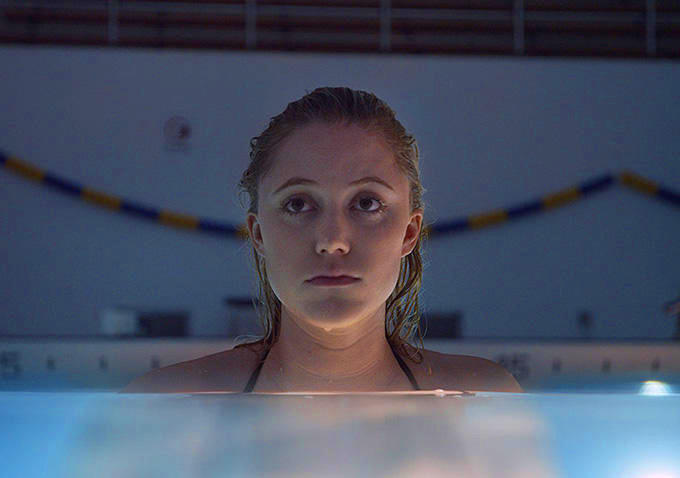 Before the movie hits the skids in the third act, I was pondering the greater implications and logistics of its sexually transmitted curse. Does “passing” it along require some form of genital contact? Does it require fluid exchange? If you wear a condom, does the prophylactic also protect your sexual partner from the transmission? Does the curse function relatively the same for same sex couples? What about people with non-functioning parts below the waste? Can someone who suffers from erectile dysfunction pass the curse along? Can it be transferred onto inanimate objects? Can men ejaculate into some sort of container and then send the container into space via the space shuttle and be protected? Actually, banging an astronaut who’s about to live on the space station or go to Mars might be the smartest move. I enjoyed thinking of a stratagem to best protect myself if I was caught in this scenario; even after passing it along and providing a buffer, you still always have to be on guard for the curse to move back up the ladder. My solution: have relations with a prostitute. This is probably a guarantee that the curse will be passed on within a 24-hour period, and even if that john is found and killed, chances are this prostitute may have already passed the curse along to a new client. If one cannot inoculate themselves from a supernatural STD-like curse with the aid of prostitutes, then there’s no hope for the rest of us poor mortals. Anyway, my mind wandered a tad.
It Follows may suffer due to the hype, the inconclusive resolution, and a third act that deflates, but it’s still an extremely well executed horror thriller with a terrific concept at heart. The sense of dread is stark and the camerawork and storytelling draw out the tension until you feel you’re about to break. It’s more unnerving than traditionally scary, but it has a power that does stay with you, particularly its fascinating premise and the natural relatability of the characters and their choices. I don’t know if this premise could sustain a sequel, especially with a villain that appears to be unstoppable, but that hasn’t thwarted the horror genre before in its stampede at cashing in on success. It Follows is a solidly entertaining and creepy movie, but it’s even more confirmation for me that David Robert Mitchell is going to be a filmmaker who has staying power. I’ll be following him.
Nate’s Grade: B+
Share this:

Annabelle (2014)
 The Conjuring was one of the breakout hits of 2013, so it’s no surprise that Hollywood fast-tracked a spin-off to take advantage of Conjurin’ fever. Enter John R. Leonetti, the accomplished cinematographer on The Conjuring and director of bad sequels like Butterfly Effect 2 and Mortal Kombat: Annihilation. Now in the spotlight, little Annabelle is proving to be a star of her own as far as box-office grosses are concerned. It’s too bad her new movie is about as lifeless as she is.
In the late 1960s, Mia (Annabelle Wallis) is pregnant with her first child when murderous cultists terrorize her home. They are dispatched but not before one young woman slices her own throat holding one of Mia’s expensive porcelain dolls, the Annabelle one. Her husband (Ward Horton, who looks like a living Ken doll) is afraid to leave her alone and reaches out to the church to help his wife. Strange things are going on in their home, mostly concerning the infamous Annabelle doll.
 The impact of Annabelle will depend directly upon your good will concerning The Conjuring and what your law of diminishing returns is with a creepy doll. To be abundantly clear, the Annabelle doll is one creepy looking thing. But how much can an audience take of a creepy looking doll that doesn’t have any articulation or expression? The character, and it feels like a stretch to label the doll as such, worked effectively as a prologue to The Conjuring due to the relative brief appearance. The doll was creepy enough for ten minutes and then the audience moved on. Now in a starring vehicle all to herself, Annabelle risks overexposure and the realization of just how limited this little demonic figure might be. A killer doll that comes to life is a genuinely unsettling proposition, one richly explored in a classic Twilight Zone episode that’s still spooky to this day. However, Annabelle doesn’t really do anything, and I suppose that’s the point. The doll is a conduit for the larger, invisible demonic force at play. We already know that it’s not the doll or a ghost but a demon posing as such. Ultimately, the doll isn’t anything more than a device to go back to again and again, a horror staple in place of true unnerving tension and dread. Hey, it’s hard to carefully manufacture and ratchet suspense, so why not just keep going back to a creepy looking doll instead?
With a lackluster antagonist, it’s no surprise then that Annabelle has to rely on all the hoary tropes of horror just to fill out its running time. The plot by writer Gary Dauberman plays out like the filmmakers watched Rosemary’s Baby, a documentary special on Sharon Tate, and said, “That’s it, we got out movie.” The Manson family-like cult is a plot element cast aside too quickly. They bring the demon to the doll, but the followers of this demonic presence never terrorize the couple again. It seems like one of many missed opportunities. Instead we get a slow series of events of the doll/demon messing around with Mia. There’s the kindly older priest that’s called into service, who does nothing. There’s a helpful neighbor mourning the loss of her own child who ends up an insulting plot device (more on this later with spoilers). And oh are there characters behaving stupidly, chief among them our heroine. She’s rather slow to realize the danger she is in and often leaves her baby alone to investigate said supernatural shenanigans. You know, the baby that is the object of desire for this demonic force. Rather than be proactive and have any sense of agency, Mia is that older type of horror heroine who runs around screaming and cowering in corners. It gets tired. There’s one scene where she’s trying to escape via an elevator that keeps opening on the same haunted floor. She literally hits the elevator button four times each time expecting something different, and the camera angle remains the same, leading to titters from my audience.
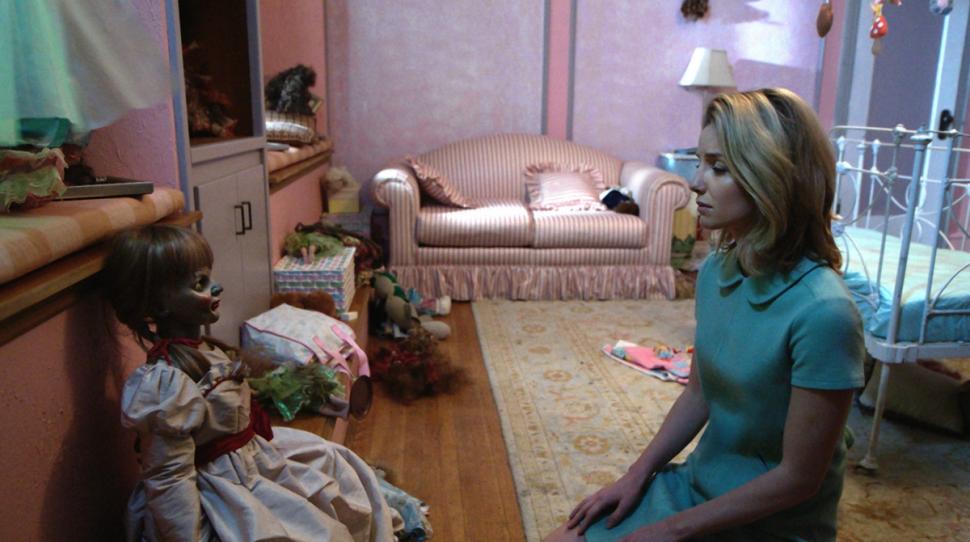 While The Conjuring certainly wasn’t a brave new direction in the realm of cinematic horror, it was skillfully executed and masterfully setup its scares. Annabelle does have a few decent boo moments, many of which were showcased in the trailer, but it cannot overcome the burden of all its clichés and wooden characters. Audiences are used to characters making poor decisions in horror films, but you still should have some level of believability or internal logic to their decision-making that doesn’t make your brain hurt. Sadly, Annabelle cannot rise above the limitations of its titular “monster” and so it has to rely upon an assemblage of familiar horror tropes to make due.
This paragraph is going into spoilers concerning the ending so I’d advise any reader wishing to remain pure to skip to the next paragraph. The great actress Alfre Woodard plays that grieving neighbor lady, the one who is joyously buying Mia baby clothes for her little one. During a climactic confrontation, Mia demands to know what the demon entity wants. It communicates via crayon scrawls on the ceiling: “Her soul.” One of the film’s creepier moments. Then the baby disappears and she wants to know what it will take to save her child. Mia looks to a window and written on it is, “Your soul,” just as it gently pushes itself open. Again, a creepy moment. I was starting to get the impression the film was picking up momentum. She’s about to sacrifice herself when she’s pulled back inside. This is where the film goes from bad to insultingly bad. I kept repeating under my breath, “Don’t do it, don’t do it,” and wouldn’t you know, they did it. Woodard realizes her purpose: she must sacrifice herself so this nice white couple will be safe. She dives out the window and evil is vanquished… sort of. It’s a stupid character arc made all the more unpleasant by the racial casting choices. I’d rather Woodard just save herself.
This small prequel has proven to be a smash at the box-office, so where does Annabelle go from here? Another prequel seems unlikely considering the events of this movie cover the birth of the demonic doll and lead directly to the prologue of The Conjuring, where this spunky little doll met her match with the married paranormal investigators played by Vera Farmiga and Patrick Wilson. The real Annabelle is encased in a glass prison. The only direction seems to be forward, with Annabelle breaking free of her prison and having a night on the town. Maybe she can locate Chucky and that Twilight Zone doll. I just hope future adventures with Annabelle, and its box-office grosses almost assure there will be, veer away from the overload of uninspired genre clichés. There’s not enough effort on display to warrant this solo side project for a creepy doll that mostly just remains creepy. Annabelle the film could have used less of Annabelle the doll. Then again an unblinking and silent doll was still the most interesting character on screen.
Nate’s Grade: C-
Share this:

Tusk (2014)
 You’ve never seen a Kevin Smith film quite like this. Even after the man’s first foray into the horror genre with the flawed but tonally ambitious Red State, I never would have expected the man best known for lewd discussions over pop-culture minutia to take note of The Human Centipede and more or less say, “Hey, let me try.” After a short self-imposed retirement, it seems like Smith is creatively reinvigorated, crafting even more boutique films that no one else would make, and Tusk is a prime example of this. Whether or not the world needs a film where a man is kidnapped and physically transformed into a walrus is a personal question you’ll have to answer in your own space.
Wallace Bryton (Justin Long) is an egotistical podcaster who is something akin to the mean-spirited version of Ira Glass. He travels around the country interviewing strange people for their strange stories, all to relate to his travel-phobic pal and podcast co-host, Teddy (Haley Joel Osment, all grown up). The two guys then crack jokes and make fun of these pathetic weirdos and losers. While in Canada, Wallace finds a curious posting in a men’s room from a man named Howard Howe (Michael Parks) seeking a companion to share his lifetime of stories with. Wallace jumps at the chance, enters Howard’s secluded home, and listens as the older, wheelchair-bound eccentric spins several yarns, notably a tale where he was lost at sea. His only “friend” was a walrus who he credits with helping to save his life. He misses his seafaring friend, and Howard has secretly drugged Wallace with the intent or transforming him into a human-walrus composite.
 If you’re a fan of bonkers body horror and demented humor, then Tusk just might be a short but potently nasty little treat for you. If you’ve seen enough similar genre entries you’ll likely be guessing several of the plot turns before they happen, like the tea being laced with a chemical or Howard holding back his real and fiendish capabilities. However, there are moments that simply defy prediction, especially the last half of the movie where Smith doubles down on the madness of executing his premise. The tone is rather uneven and can prove to be a hindrance, with the first half more dramatic and the second half more absurd comedy. Smith impresses early on by slowly teasing the reveals: the duplicitous Howard, the revelation of missing parts, the full-on transformation. The knowing camerawork and long, creepy conversations build suspense even when we stop and realize how ridiculous this entire movie can be. And that’s not an insult but a compliment, even a saving grace when the movie takes a few too many unwieldy detours (more on that later). With a premise this bizarre, and from a director in such unknown territory as Smith has waded, I, dear reader, was laughing throughout. Tonally, it felt like Smith was acknowledging the silliness of his movie but still being true to genre. There are some genuinely creepy and unsettling moments sprinkled throughout. The practical makeup gore can at times make skin look like a crumply raincoat. The final image of Long as a human walrus is both ludicrous and a horrifying sight you cannot un-see.
Much of the movie is a series of conversations and monologues featuring Long (Dodegball, He’s Just Not That Into You) and Parks (Kill Bill). Hell, even Genesis Rodriguez (Man on a Ledge) gets a monologue; she’s Wallace’s put upon girlfriend who doesn’t like the man he’s become with fame. It’s a rather rote part undeserving of a performance as good as Rodriguez delivers. She must have thought, “Here’s my acting reel for the next few years; look casting directors, I can do much more than look hot.” Back to the central duo, Long and Parks. The film’s greatest assets are these actors and the movie is at its best when they share the screen. After his skin-crawling turn as a bile-spewing zealot in Red State, I expected Parks to be unhinged and frightening, which he is in spades. The man’s calm demeanor is especially eerie. When he breaks into openly mocking his victims, adopting Wallace’s howling cry, is another moment that bounces from creepy to funny and back to creepy again. It’s a performance pattern that Parks nimbly dances throughout the film. Honestly, this may be the strongest performance of Long’s career. He gets to portray an array of different shades with his character, from egomaniacal jerk to timid victim and finally raging science experiment (Smith’s script reminds you often how much of a jerk Wallace was). It’s more than just a performance of panicked screams. Long manages to find a character here and stays true to him, even as Wallace’s psychological grasp is broken. He almost grounds the absurd third act due to the strength of his performance.
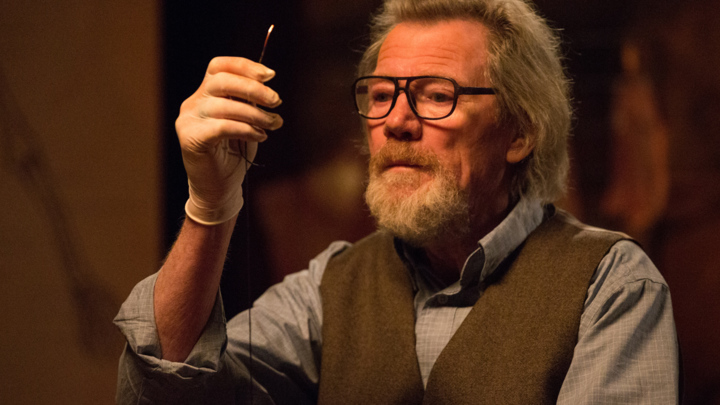 It’s that more jocular second half where Tusk starts to lose its momentum and focus, and that’s primarily because of the introduction of the character Guy Lapointe (Johnny Depp), a French Canadian private eye. Yes, that Johnny Depp, starring in a Kevin Smith movie, adopting a silly accent and a silly fake mustache and becoming what is essentially his take on Peter Sellers’ Inspector Clouseau. It’s a character that feels like he walked in from the set of a different movie, one that is far more aimlessly wacky. The sequences with Lapointe are also laboriously overstuffed. They just go on and on, and you fee whatever sense of momentum starting to flee, sadly. Depp is amusing and I’m genuinely thrilled to see him in a small movie where he can afford to be even weirder. The problem is that the Lapointe scenes feel more like an improv session that Smith was afraid to cut short or nudge in a different direction, as if he was so gracious about Depp agreeing to be involved that he ceded all control of those scenes. The introduction to the character is a ten-minute sequence, itself with an overextended flashback, and after the initial shock and fun of watching Depp wears off, I started wishing to get back to the man-walrus.
Tusk is a unique experience, a macabre experimental lark from Kevin Smith, but it also seems to be the first in a new direction for a man who made his millions on stoner comedies. Smith is currently underway on three other movies, all of them horror, two of which are the next stages in what has become his Canadian Trilogy of Terror. While Tusk hasn’t made a blip at the box-office (if ever there was a film that cried out for on-demand, here it is), it has reawakened Smith’s creative impulses and now the guy can’t stop. Tusk is gross, funny, and genuinely creepy before it goes overboard with its very special guest star. I understand from a plot standpoint why another main character was necessary, but the movie needs some further discipline and tightening that it lacks. Basically, after reading the premise, you’ll know whether or not this film is for you. My friend accompanied me without any knowledge of the plot or the genre, and she enjoyed it. Perhaps there’s hope for you as well.
Nate’s Grade: B-
Share this:

You’re Next (2013)
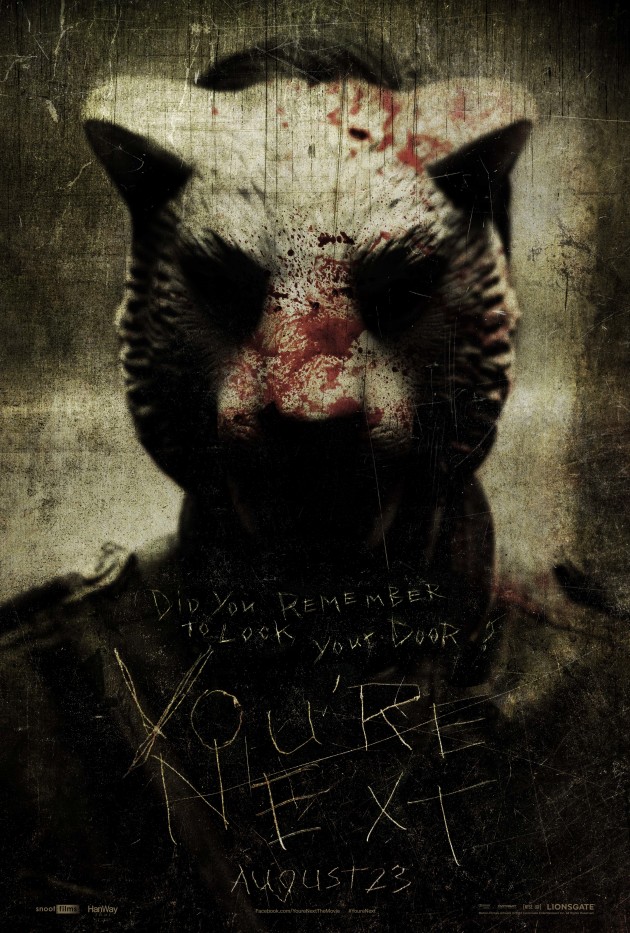 There has been a notable rise in home invasion thrillers in recent years but I am doubtful we’ve hit the crest just yet (this may also be hope speaking since I co-wrote one). Perhaps in an age of real-life anxiety on the news, the invasion of our personal sanctuary strikes an even more horrific chord. Whether you argue the upswing began with Panic Room, or Funny Games, or even the old Audrey Hepburn feature Wait Until Dark, the message is universal: nobody likes having their stuff messed with. This year we’ve already had The Purge make a splash at the box-office, and I’m sure Lionsgate is hopeful that their indie horror flick, You’re Next, which has been reaping great buzz along the festival circuit for years now, will make a similar splash. For me, You’re Next checked every box I would want in an effective horror film: good thrills, good humor, and a good ending. That adds up to one hell of a good time at the movies.
Crispian (AJ Bowen) is traveling all the way upstate for a family reunion at his parent’s palatial mansion in the woods. He’s also going to introduce his new girlfriend, Erin (Charni Vinson), an Australian graduate student that used to work as his teaching assistant at his college. Crispian’s rich family includes his excitable younger sister, his obnoxious older brother, his youngest detached brother, everyone’s boyfriend and girlfriend, and mom and dad. In between a lively family discussion/argument at the dinner table, arrows start flying through their window. Three mean wearing ominous animals masks are stalking outside, armed, and with every intent to kill everyone inside. The masked killers leave ominous messages painted in blood, noting, “You’re next” (I know they’re senseless murderers, but points for using the correct form of “you’re”). Erin snaps into survival mode and assembles a system of defenses but there are more threats than anyone imagined.
 To take nothing away from the artistic merits of You’re Next, the biggest selling point, and its greatest attribute, is that it knows how to properly work over an audience. While nowhere near the genre deconstruction that was last year’s Cabin in the Woods, nor as clever, here is a movie that knows it’s a horror movie, knows you’ve seen these movies before, and knows what you’re looking for as an audience member. And once the killing starts, the movie also gains a delightfully macabre sense of humor, an impish darkness that will leave you chuckling. I heartily recommend seeing this movie in a packed theater because the collective response will add to your enjoyment, or at least it did mine. Never have I experienced a movie where the audience cheered the plugging in of an ordinary kitchen appliance with such reckless enthusiasm. Thanks to director Adam Wingard and screenwriter Simon Barrett, the movie packs great payoffs in its second half, as our prototypical Final Girl outflanks her attackers. There are enough twists and turns to keep things interesting and the pacing swift. Once those arrows pop, this thing just flies by, moving at a speed that keeps you satiated with scares, thrills, and humor. In essence, You’re Next knows how to have fun with an audience, and for whatever reason, with the glut of dank home invasion horror thrillers, this is a surprise. With all the family trauma and killing, watching their loved ones cruelly slip away in horrific fashion, it’s worth praise that Wingard and Barrett find a happy tonal middle-ground that doesn’t blunt the horror or the comedy. The laughs don’t feel out of place with the screams. They make this work. And there are some really sick laughs to be had too.
My only familiarity with Wingard is from his involvement in the horror anthology series V/H/S and The ABCs of Death. It’s also somewhat entertaining to note that all three movies, both V/H/S and its sequel, have been released before You’re Next, a film that was completed two years prior. His anthology segments didn’t point to the same level of promise on full display with You’re Next. Wingard does a great job of orienting his audience to the geography of the play area, so to speak, while juggling different simultaneous threats and maintain a sense of clarity. He knows when to hold back, and he knows when the audience needs a peak of something gruesome. Initially, with the animal masks and the attack on the wealthy, I thought the film was gearing up for a dose of environmental social commentary, as if the killers were extreme defenders of Mother Nature. I’m actually relieved that the film never picks up any ham-handed political subtext.
 As a horror movie, it’s far more effective than most genre deconstructions that will undercut the terror for the chance at a good joke. Even Cabin in the Woods was like this. Again, You’re Next can be riotously funny, especially in the last act, but it can also, and often is, quite suspenseful as well. Once the game get sunder way, you start playing along as well, guessing which of our participants will indeed be next. They place themselves in precarious positions often, especially early, which makes it all the more suspenseful, because you’re suspecting anything can happen at any time. You’re lying in wait, and Wingard does an excellent job of drawing out that tension to a peak level before hitting the horror or gore. There are some gruesomely bloody moments in the film but it doesn’t lovingly linger on the deconstruction of the human body. And just when it seems like the number of housemates fighting for their lives has gotten so low that the thrills would have to be successfully all wrung out, You’re Next supplies a twist that changes gears, introducing a new threat and a new level of dramatic tension. When Erin assembles an ax to smash into the skull of whoever opens the front door, you’re eagerly waiting for that Chekov’s gun to fire (Can we rename it Chekov’s Ax to the Face?). The fact that the movie is almost designed as a Home Alone for demented adults is ingenious.
The acting is a bit hit or miss but the standout, by far, is Vinson (Step Up 3D). She’s our lead heroine, yes, but she takes charge in a way usually reserved for men in these types of movies. She has all sorts of crafty experience with wilderness survival and setting up traps, plus she is able to marshal the family from a bunch of WASPs screaming their guts out into something of a fighting force. And plus, Vinson just has an awesome screen presence to her. It’s a great role for her but credit the actress for knocking it out, giving the audience a strong, extremely capable, and empathetic hero. It’s satisfying to watch the masked killers be outfoxed by their prey. Many of the actors in the film are filmmakers themselves (Joe Swanberg, Ti West, Amy Seimetz), and they’ve collaborated on numerous projects, including other lo-fi horror features, the new Splat Pack if you will.
If you’re looking for a fun horror movie with a dark sense of humor, then You’re Next should be next on your list. It’s savvy, scary, and knows how to goose an audience at just the right moments. Wingard and Barrett know how to give an audience what they want without pandering, and that’s what elevates You’re Next from its peers. This is a horror film that can scare you one minute, make you laugh uncomfortably the next, and then ultimate leave you cheering the vengeful dismemberment of human life with kitchen appliances. It is a more than effectively put together horror thriller from beginning to end.
Nate’s Grade: B+
Share this:

The Conjuring (2013)
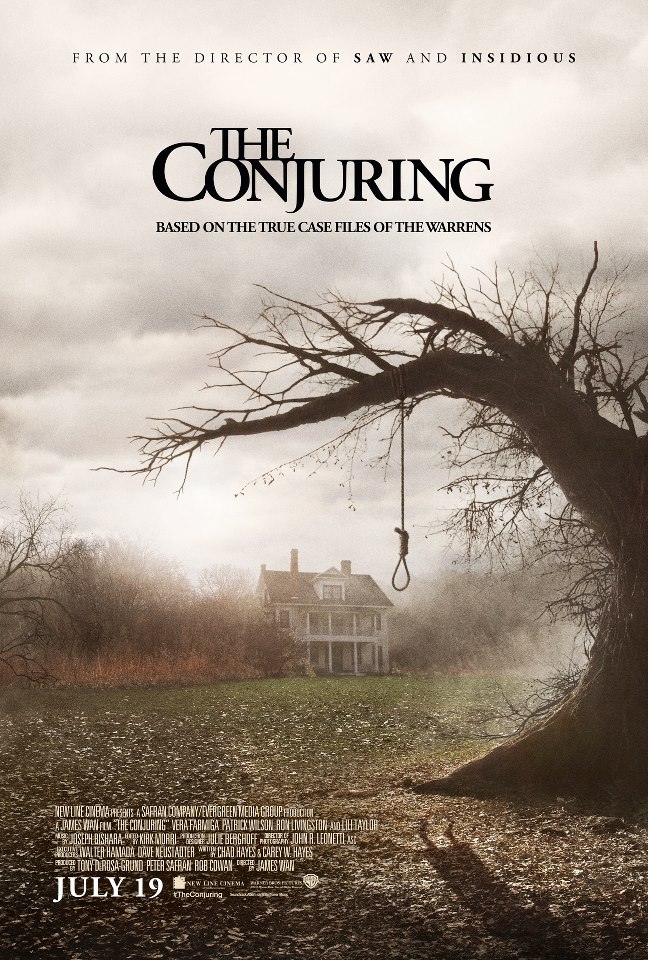 Does it seem like it’s getting harder and harder to scare people? Perhaps audiences have grown jaded by a real world kept at a fever pitch of post-9/11 anxiety and economic uncertainty. It seems that one solution is to just up the gore/gross factor, or overdose on grisly nihilism, but there has to be a law of diminishing returns to pointless shock value. The core elements of a good scary movie will usually be the same: make us care about the people onscreen and make us dread what happens next. What The Conjuring does so well, almost effortlessly, is what all provocative horror movies should accomplish, and that’s the formation of a truly effective spooky atmosphere. There may not even be any gore whatsoever in this film and very minimal jump scares, two overused tools in modern horror filmmaking. This is old school horror played to spine-tingling satisfaction.
Ed and Lorraine Warren (Patrick Wilson and Vera Farmiga) are the top paranormal investigators in the nation. In 1971, they’re asked to determine what is tormenting the Perron family in rural Rhode Island. Carolyn (Lily Taylor) and Roger Perron (Ron Livingston) and their five daughters cannot rest as a vengeful spirit is wrecking havoc with their lives. The spirit wants a body count and won’t go away before it has blood.
 Director James Wan (Saw) and his team take their time to build a direct sense of unease, a chilling mood that leaves you dreading what may happen next. The success of a horror film isn’t necessarily the fear of what you see but more so what you fail to see. The buildup, in essence, is more pivotal than the boo part. Credit also needs to go to twin screenwriters Chad and Carey Hayes (Whiteout, House of Wax) who show off their skill at setting up scares and delivering (I credit their work on Baywatch Nights because, well, someone has to remember that spin-off). The child game of Hide and Clap, where one person wanders blindfolded trying to find their compatriots, requesting three claps to locate them, is just a flat-out terrific idea to parlay into a horror movie. There’s the staple of dramatic irony, realizing what the onscreen character does not, and the increasingly suspenseful dredge into unknown danger. Another example is a wind-up toy that, when its jingle is complete, should reveal something ghostly in its mirror. This is a great device that delivers tension in budding anticipation. Then there’s one daughter’s habit of sleepwalking, which again leads to some effective unease. The Hayes find smart ways to introduce elements to their ghost story and then integrate them again and again in satisfying and spooky ways. Plus there’s all those groping in the dark moments and a super effective sound design. The film does an excellent job of developing old school scares, taking its time to get under your skin.
It also helps when you actually care about the character being tormented. The Conjuring does a good job of making its characters relatable given the outlandish circumstances. At no point does any character really violate the Law of Stupidity, where our allegiance reverses. They even present plausible reasons why the family can’t simply move out of its haunted abode (financially under water, no one to buy the estate, the ghost will just follow them). The Perron clan is a loving family that feels real. The Warrens themselves are given their own vulnerability, which is important since they are the experts. Having a know-it-all character without a weakness doesn’t make for an interesting battle against the paranormal. Lorraine can sense things, yes, but she also loses part of herself every time, thus endangering herself with every new case, making herself more susceptible to the forces she feels she’s been chosen to defend others from. When Lorraine accidentally leaves behind a family locket, with a picture of her daughter, it brings an escalated threat level that hits home for the Warrens. The acting form top to bottom is also exceptional. They don’t oversell the scares. You feel their fear in a palpable way.
Another aspect of a haunting story is the mystery surrounding the angry spirit. If it’s a compelling investigation, you’re intrigued by every new clue or revelation and enjoy how the pieces come together. While there isn’t a complex backstory to the haunting of the Perron home, The Conjuring has enough creepy historical details to add to the overall atmosphere. I enjoyed that the evil spirit cursed anyone who lived on her property, eventually divided up into different owners. I liked that the spirit had a mother-child fixation, turning mothers against their children. And I liked that these peripheral ghosts, many of whom killed themselves in ghastly fashions, also pop up to terrorize the Perrons. It adds further depth to the world of the film while upping the spooky factor.
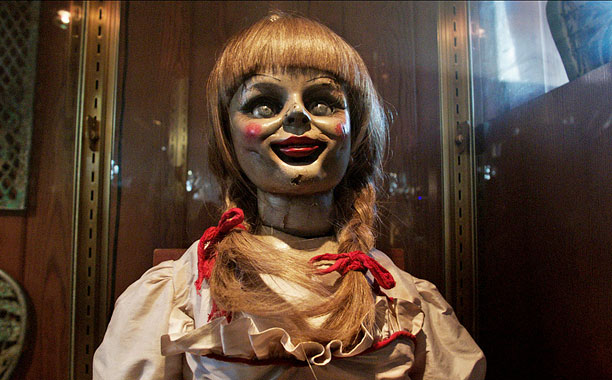 I need to single out one section of the plot that was eerie but also a bit confounding. The opening case doesn’t have anything to do with the Perron family but it does set a nice mood. It’s about a cracked, fraying, and altogether creepy porcelain doll that appears to be possessed and leaving notes for its roommates (“Miss me?”). We later see this creepy doll again because the Warrens have an entire garage filled with creepy artifacts from previous investigations. They argue destroying the possessed items because it would unleash all those demonic forces, so instead the garage serves as a sort of prison (a priest comes by every so often to re-bless the premises, which sounds like a nice side gig for the Vatican). I’ll accept the Warrens reasoning that locking away these dangerous items, each with its own troubling story, is safer for mankind. It’s also just a great set that begs for further analysis to pick apart every artifact. What I do not understand at all is that it looks like the Warrens have no protective lock with this door. Their young daughter stumbles in at one point. I don’t want to give anybody parenting tips, but if you have a room stocked with demonically possessed items that can escape, perhaps, I don’t know, you get a padlock for that door to safeguard against unwanted intrusions.
While entertaining to the end, the third act doesn’t have the same effect because it transitions wholly from a haunted house story into an overt exorcism film. For my tastes, it’s less interesting and exorcism films have always come across as fairly lazy for me. Once you bring a demonic possession and a set of familiar rules, it sort of goes on autopilot and rarely strays from the same template as the most famous of exorcism movies (Naturally I’m talking about Repossessed). For fans of that horror subgenre, they’ll be tickled, but I found it a lesser way to steer the movie to its conclusion. I realize that we’re dealing with the parameters of a personal account (I’m hesitant to say “true story” when it comes to paranormal events, but that’s my own bias), so I understand that this is the direction the story must conclude. I just thought it was a slight downgrade.
If you’re looking for a scary movie this summer, then The Conjuring will do the trick. It’s an old school horror movie that’s more concerned with properly established atmosphere, a mood of dread, and paying off well-developed plot elements that pack a punch. The best compliment I can give Wan, the Hayes, and everyone else involved is that I was squirming throughout much of the movie, uneasily shifting and dreading what was next. There’s a maturity to the film and Wan’s direction, as if he’s patterned his style after the films of the 1970s themselves. After Insidious, Wan definitely knows a thing or two about keeping an audience afraid. There are several moments of unsettling imagery that should find a way to creep out just about everyone. Just remember: don’t invite dolls to live with you, do investigate those strange bruises, and always lock up your demonic possessions, people. In short, The Conjuring doesn’t reinvent the wheel when it comes to ghost stories but it doesn’t have to, because this movie is scary good.
Nate’s Grade: B+
Share this:

V/H/S/2 (2013)
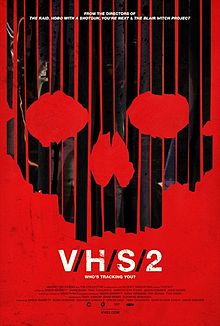 The second entry in the found footage horror anthology (and less than a year after the first to boot) is not as clever as V/H/S but more polished, better paced, and full of enough ingenuity to recommend, especially for horror fans. In my review of the first film I championed a shorter format, giving an audience the thrills they crave faster rather than slogging through an hour of slow buildup. The results are still fairly hit or miss, though none of the four segments is a misfire per se. The weakest is probably the last, “”Slumber Party Alien Abduction,” where the poor camera quality makes it hard to tell what is actually going on. The best, by far, is The Raid director Gareth Evans’ “Safe Haven” about a team of journalists picking perhaps the worst day to tour a creepy cult’s compound, notably during the apocalypse the cult predicted. This one takes a bit to wind up but when all hell breaks loose it goes nuts with glory. The wraparound segment tying everything together is more palatable and points to a promising mythology around the collection of these haunted VHS tapes that people keep watching and then dying over. All together, this is a concept that just works for horror and I’ll welcome presumed sequels as they come off the assembly line. This is found footage done right, with faster payoffs, more variety, and greater focus and ingenuity. If you enjoyed the first film, or are a fan of horror anthologies in general, then pop in V/H/S/2.
Nate’s Grade: B


You must be logged in to post a comment.