Blog Archives
Evil Dead (2013)
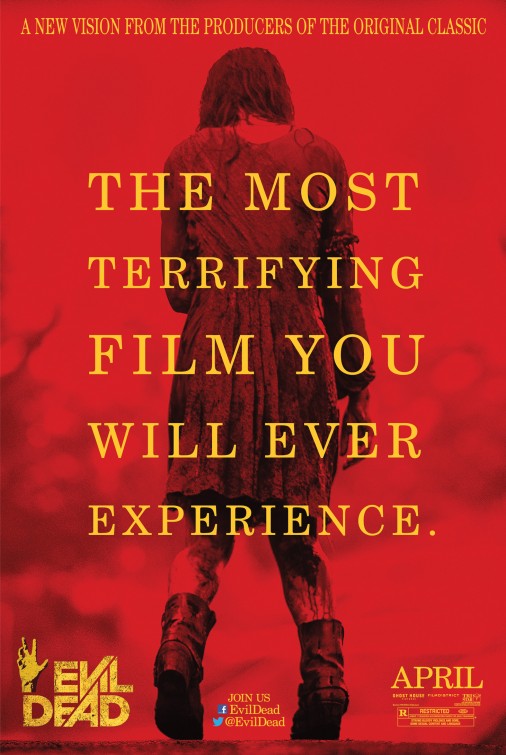 Upping the gore quotient considerably but having little else of merit, the remake of Evil Dead loses just about everything that made the original special. Gone is the sense of humor, unless you just count the quantity of gore to be the qualifier for “humor,” and gone is any real sense of a creative spark. It looks good thanks to director Fede Alvarez, and the practical gore effects can be memorable and truly disgusting in the best possible way, but it just doesn’t feel like an Evil Dead movie. It makes the same mistakes that your typical dumb horror movies do, from a lack of clarity to one-dimensional characters (I think Blonde Girlfriend had one line of dialogue for the first hour) to repeated rule breaking. There are a bunch of callbacks to the original Evil Dead but they serve little other purpose. The finale, after a series of fake-outs, involves a weak showdown with a Big Bad that’s anything but. I expect better from a remake sanctioned and produced by the original director, Sam Raimi, and star Bruce Campbell. Maybe they knew it was only a matter of time before their 1981 film, and its superior 1987 sequel, would be remade by a cannibalistic Hollywood, so they wanted to cash in while they could. Or maybe they just argued, if anyone was going to make a poor remake, it might as well be them. If you’re hungry for gore, then Evil Dead may suffice, otherwise it’s a horror movie that’s too familiar, too mediocre, and ultimately too disappointing to recommend.
Nate’s Grade: C+
Share this:

Warm Bodies (2013)
 Given the explosion in zombie culture and the avalanche of zombie movies, it was only a matter of time before a studio pitched the romantic possibilities. They may be dead but they still have needs. Based on Issac Marion’s young adult novel, Warm Bodies attempts to tell a love story from a zombie’s perspective. Writer/director Jonathan Levine, so skillful with tone in the comedy/drama 50/50, tackles an even trickier balancing act, making a zombie romantic. With some visual flair, an eclectic soundtrack, and a winning onscreen pair, Warm Bodies is a sweet love story that does enough right to leave you smiling.
In the aftermath of a zombie apocalypse, R (Nicholas Hoult) is a zombie who spends most of his days shuffling through an airport. Occasionally he has a series of conversations with his pal, M (Rob Corddry), which mostly amount to grunts. R can’t remember who he was before he became a zombie, or even what life was like before it all went to pot, but there is one thing that will make him feel alive again – human brains. You see, this tasty delicacy allows zombies to relive the memories of their victims. It’s a nice release from, you know, decomposing. The zombies that have completely given up all sense of self peel off all their skin, becoming the Bonies, a wraith-like band of creatures that will feed off anything, even the dead.
 This is R’s life until his chance encounter with Julie (Teresa Palmer). He’s smitten instantly and feels something weird in his chest. His heart has started beating again. He doesn’t want to eat her, just protect her. Of course he did also happen to eat her now-ex-boyfriend (David Franco). R whisks her to safety to his home in an airplane cabin. They listen to records and he instructs her on ways to pose as a zombie. She’s cautious but grows fond of her zombie protector (zombie Stockholm syndrome?). But R is proof that the zombies can change and that humanity can be saved. There’s just the matter of convincing Julie’s father, General Grigio (John Malkovich), who had to shoot his own wife after she turned. He wants them all dead and will do whatever it takes to protect the last bastion of the living.
Levine has found what may be one of the only optimistic zombie films out there. Usually these movies end one of two ways: 1) everybody dies (the preferred option), or, 2) the heroes manage a final escape but are most likely doomed beyond all hope (just pushes the inevitable off screen and into our imaginations). Tethered to a genial but winning romance, Warm Bodies is a zombie movie with a genuine sense of hope, revival, and even finds way to carve out a happy ending that, while predictable, feels right tonally.
The twee romance has a lot more in common with indie stylings than it does, say, Twilight, which will likely be invoked by many a critic and ticket-buyer alike. It’s not so much the brooding, sullen, exasperating kind of “romance” Twilight has primed people to expect when monsters date young girls. Thanks to the helpful voiceover, we see R as a thoughtful (being generous here considering his peers) guy who, like most teens, is trying to battle his inner urges and sense of awkwardness. He may be a zombie but Levine and Hoult have found a way to make R relatable and a likeable dead chap to root for. It also helps that he and Palmer (I Am Number Four) have above average chemistry together. Sure it’s a little weird that she takes the whole guy-crushing-on-me-kinda-ate-my-old-boyfriend, but like any relationship, there are just obstacles you’re going to have to overcome together. And as my pal Eric would attest, any Franco had it coming (his big bro did lead to the end of mankind in 2011, so maybe he’s responsible for the zombie apocalypse).
I appreciated that even with a PG-13 rating the movie still has a bite to it. Premise-alone, there is plenty room for some intriguing mismatched comedy. I enjoyed the aspect that consuming human brains unlocks that person’s memories. I like that R saves brains for later snacks. I liked that he used this absurd plot device to help him get closer with Julie and makes him feel guilty. Warm Bodies finds a way around the whole bodies decomposing issue, which is important since we don’t want our Romeo to be too disgusting for the teen girls. It refrains from overt gore, relying on implied carnage and preferring a chaste smearing of blood on lips, like he just got carried away eating a cherry pie. Honestly, I didn’t miss the gore. While the concept of a completely putrid corpse, with its flesh rotting and falling from its face, finding romance would be darkly comical, I think Levine chose the savvier path, forming a romance that doesn’t overdose on irony, which it would if the dead-boy-meets-girl romance were more grotesque. That’s the reason the Bonies exist, to provide a more grotesque and more evil foe that can provide perspective on the nobility of the not-all-the-way-dead people.
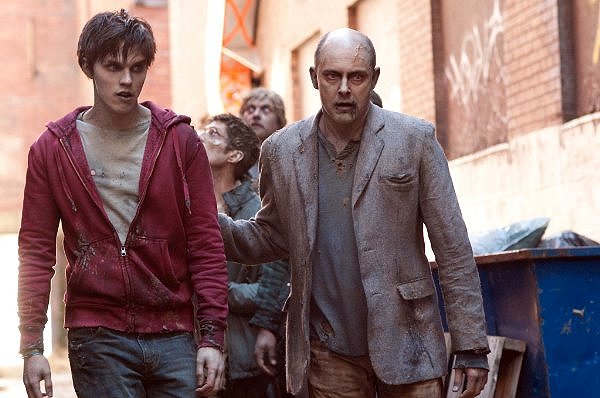 Levine works enough comic angles that the comic possibilities feel explored, although much like the horror and romance could have been pushed even further. As is, I found R’s musings wryly enjoyable, and his undead bromance with M provides some of the funniest moments in the film. Corddry (TV’s Children’s Hospital) is terrific in the movie and even finds what little room he can to add a touch of poignancy with his character. Often the humor, like the horror elements, is pretty relaxed but effective, refraining from oversized wackiness. You seriously would think that the movie would go bigger with its comedy considering everything at play.
Hoult (X-Men: First Class, TV’s Skins) does a credible job as a zombie, let alone an American zombie; it’s not all shuffling and caveman monosyllabic grunts. The actor is adept with communicating the awkwardness of his character in physicality. It’s funny how much you end of empathizing with a character that is dead. Hoult is also a pretty hunky guy, Vulcan eyebrows and all, but his amiable demeanor and young love clumsiness will win over as many guys in the audience as ladies. Palmer, also sporting an American accent, gets the blood pumping. Julie is underwritten but rises above just being a typical damsel-in-distress. It’s nice that later in the movie, when R breaks into the human camp, the roles are reversed, and Julie gets to protect him with her wits and will. Malkovich (R.E.D.) gets the worst of it just because his character is so rote.
I suppose I could lambaste the movie’s love-conquers-all logic with a dash of critical cynicism, but I feel like its low-key yet unfailingly romantic side is another of the movie’s charms. Sure, the idea that teenage love changing the world one beating heart at a time sounds like someone took the lyrics from an 80s power ballad and had it come to life (I’m reminded of the Patton Oswalt bit about the music video of an 80s hair band against the police: “He’d deflecting the bullets with the power of his rocking!”). There’s no real explanation why the zombies are getting better, though the concept of reclaiming their humanity appears to be contagious. I guess you could make some mild commentary on the healing power of human connection, but I don’t think Levine goes too far with any sort of subtext/social allegory, though there are enough slipshod Romeo and Juliet parallels. To the audience members who rankle at the unexplainable zombie cure, I would like to draw attention to the fact they are ignoring the fantastical logical puzzle of corpses coming back to life in the first place. If nobody minds why the zombie virus/crisis starts, then I don’t see why I should be sweating over what solves it.
Warm Bodies is a return to horror for Levine. Before his Sundance breakthrough The Wackness, the man got his start directing 2006’s All the Boys Love Mandy Lane. He’s made what may be the only zombie movie that I can say is “cute,” and that’s perhaps the best word for Warm Bodies. It’s a cute movie, perfectly pleasant, charming in its low-key sweetness while still managing to be clever. It’s dark but not too mordant, and sweet but not sappy. The last act doesn’t feel like it has the proper balance that the rest of the movie coasts with, but it wasn’t enough to ruin the film. At its core, it’s a cute love story, a zom-rom-com that’s much better than being relegated as “Twilight with zombies.” Yes it could have been darker, more macabre with its humor, and there are plenty of gloomy opportunities afforded by the premise of an undead boyfriend, but Levine and his actors have conceived a film that manages to be many things, chief among them enjoyable. It’s a zombie movie that might make you feel squishy but under completely different circumstances.
Nate’s Grade: B
Share this:

Mama (2013)
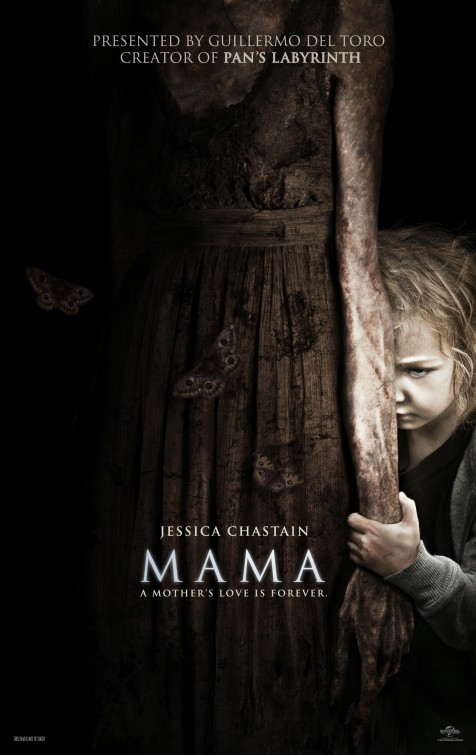 Guillermo del Toro is no stranger to the things that go bump in the night. He helped shepherd the horror film Mama to the big screen, and his love of heavy atmosphere and creepy, agile, lithe figures of terror is still evident. This is a rather effective and very creepy little horror movie that has enough little scares, big screams, and plain skin-crawling moments to recommend. The plot involves two little girls left to fend for themselves out in the wilderness. The two young actresses are fantastic, with terrific physical command of their bodies, able to slink and hop around like feral beasts. They help emotionally ground what could have been an otherwise ordinary ghost story. Oh yes, the girls prayed to a protector known as “Mama” who happens to be a malevolent and jealous spirit. Pity Jessica Chastain (Zero Dark Thirty), not just for her Gothic haircut and heavy eyeliner, but also as the girl’s reluctant foster mom. I’m shocked at how disturbing it is to watch a highly articulated physical specimen bend and snap and scurry at odd angles, broken arms bouncing like insect mandibles. And director/co-writer Andrés Muschietti knows how to properly tease an audience with just enough show and tell. The end is rather rote and familiar but, due to the emotional connection, has moments of genuine poignancy. Credit the considerable talents of the little ones as well as the devious vision of Muschetti and the guiding hand of del Toro. Give Mama a look.
Nate’s Grade: B
Share this:

Compliance (2012)
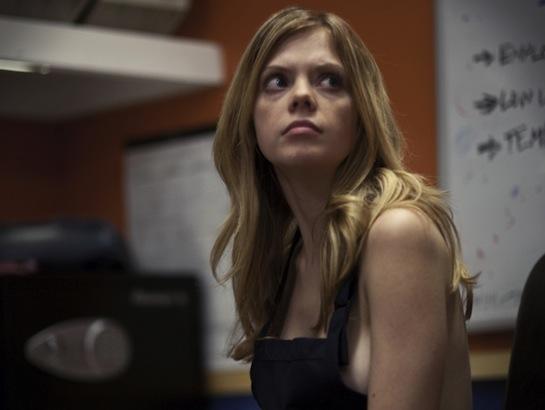
 The day at a fast food eatery began like any other. Sandra (Ann Dowd), the manager of the branch, has to shepherd her small group of employees through a hectic Friday evening. Then she gets a phone call from an “Officer Daniels” (Pat Healy). He tells her one of her workers, Becky (Dreama Walker), has stolen money from a customer. Sandra takes Becky into a storeroom and confronts her. Becky is aghast and professes her innocence. This is where things start to get out of control in writer/director Craig Zobel’s potent indie pressure-cooker. “Officer Daniels” insists that Becky be searched, then strip searched, and then worse, and Sandra and the employees begrudgingly go along. After all, it’s an officer of the law telling them what to do. Except that “Officer Daniels” is no police officer. This whole incident is an awful prank, and the people involved will never be the same.
This really is an indie horror movie, flipping the oft-repeated cry, “Don’t go in there,” with, “Why are you still doing this?” You may have to watch portions of this movie between your fingers. I was squirming and crying out at numerous points. The tension and dread just continue to mount, and you watch the characters slowly degrade, as they’re asked to do more insidious acts of humiliation in the name of compliance, and to watch them carry on the path of shame. It’s a step-by-step process of human degradation, so that the more disturbing moments of sexual obedience don’t feel entirely implausible given the journey through hell the characters have endured. It is impossible to watch this movie silent and detached. This is a provocative film that will garner many reactions but it’s also something of an endurance test. How long can you watch? How far can you watch these characters descend? The movie hooks you early and then you almost feel complicit, but you’re completely taken over by morbid curiosity.
 The movie is a powerful modern-day example of the Milgram experiment, the famous psychological exercise where a figure in authority, who assumes all responsibility, gradually gets average people to commit increasingly harmful acts to others. As long as people believe they are following orders, they can be convinced to do almost anything by someone in control. It’s easy to sit back and judge these characters, scoffing at how naïve they seem to be. It’s always easy for us to say what we would do in hypothetical situations, that is, until they happen. Compliance is an intriguing analysis of the shifting facets of power, authority, and manipulation. “Officer Daniels” enlists a host of tricks and verbal intimidation to persuade his victims to do things outside their better judgment (the caller’s true profession is a brilliant backstory). After a while, Sandra looks to be developing some slight Stockholm syndrome as she empathizes more with the plight of the phony officer on the phone than her employee. He provides just enough sympathy and validation she’s looking for to win her over. He also plays people against one another; he implores Becky to spare Sandra any extended grief, which often cows her into consenting. “Officer Daniels” isn’t the only one manipulating others; Sandra pressures employees to become involved in the situation, using her position of power to squeeze others into getting what she wants. There are numerous victims and culprits here.
Zobel could have easily given over to the exploitation elements of his story and made a very tawdry, voyeuristic exercise in sexual dominance. We watch as Becky bares all of herself and then goes even further, as “Officer Daniels” instructs male attendants to physically inspect her body cavities. It is a credit to Zobel’s sensitive direction that Compliance does not come across like a glorified S&M masturbation fantasy. He treats the incident very seriously, providing clear distaste without going overboard into preachy condemnation or superiority. It’s amazing that Zobel’s script finds so much empathy for his participants. You may be surprised at how relatable and “normal” these people seem. You may even recognize some of them. They’re all trying to do the right thing at heart, but that distinction gets extremely blurry as the night carries on. The point of Zobel’s script is that these people could be us. The added empathy makes the downward spiral all the more stomach-churning, as we want these characters to take a stand, to wise up and question the voice of authority.
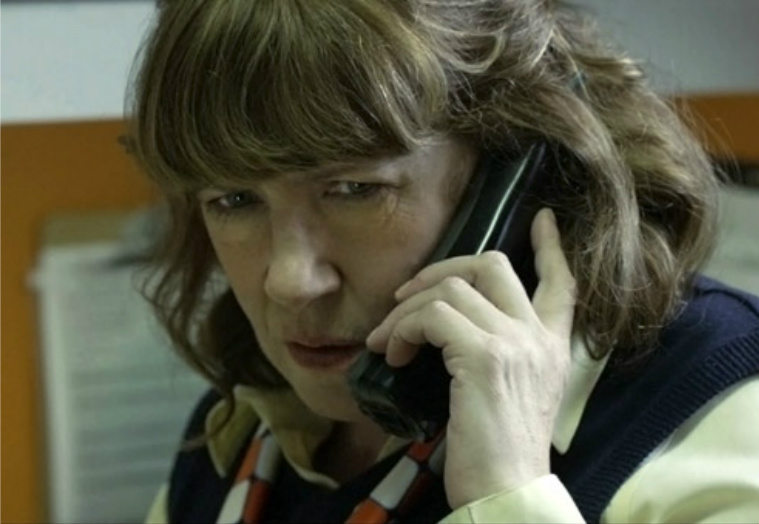 Dowd (Marley & Me) is downright heartbreaking and deeply frustrating in the movie. We get a clear sense of the pressure she’s under in her position, but she’s really the focal point of the movie. Walker (TV’s Don’t Trust the B in Apartment 23) is the martyr of the piece, and her slow resignation to the humiliation is deeply affecting, but this is Dowd’s movie. The longtime character actress takes the character of the dowdy Sandra, striving for respect, and transforms her into a figure worthy of Greek tragedy. She can be vindictive and, well, bossy, but she’s also a figure struggling for respect and validation and what she feels is morally just. We watch as her confidence starts getting chipped away, the flickers of doubt that she must tamp down because now she’s gone too far to reverse course. I don’t imagine that a movie as small as Compliance will be remembered around Oscar time, but I’ll certainly recall Dowd’s sad and transfixing performance.
I’d like to share a spooky bit of personal connection to the film. No I’ve never experienced anything this heinous before, but there was an offhand music cue that caught my interest. When we cut to the dining area early on, there’s an Admiral Twin song playing. Who is Admiral Twin? Why they’re a brilliant pop-rock band from Tulsa, Oklahoma that I’ve been singing the praises of since 2000. I’ve won over friends with my discipleship, but the band is still relatively unknown, playing few performances outside of their native Tulsa. Given the phonetic approximations of my name with the film’s writer/director, and the inclusion of an obscure indie band that few know (but should), it seems likely that Zobel may indeed be some far off relative of mine or, more likely, myself. I must have crafted an entire film without ever knowing about it. This seems like the most probable scenario.
I don’t want it sound like Compliance is some grueling exercise in group sadism. In lesser hands, it might have devolved to that. It’s a fascinating and provocative game that challenges and incenses an audience. The movie is a sickening but compulsively watchable dramatic experiment that will leave you talking for hours once it concludes. It’s an uncomfortable sit, yes, but that doesn’t mean it’s not worthwhile. The events in the film seem unbelievable and yet it’s based on a true story. This stuff happened, people. Not only that, it happened multiple occasions in multiple vicinities. What does that say about human nature? Will we only be as good as society lets us be? If we are absolved of responsibility, how far removed from our own sense of ethics will we go? Are we all susceptible to this moral failing under the right circumstances? I think that’s the truly terrifying and lasting lesson of Compliance. These people could be us, both victim and unwitting antagonist. Destined to stir debate and become a college ethics course favorite, Compliance is a gripping movie that will make you cringe but also give way to some scary introspection. How far would you go?
Nate’s Grade: A-
Share this:

Piranha 3DD (2012)
 Wow, I was not expecting the follow-up to the so-bad-it’s-excellent Piranha 3D to pretty much just inhabit the “so bad” spectrum, though I ignored warning signs at my own risk. I found the 2010 Piranha to be a sheer blast of campy entertainment, with some world-class gore effects and a game cast. I was actually terribly excited about a sequel; I’m ashamed to admit it now. Where did things go so horribly wrong? Much like Expendables 2, the movie’s tone shifts from tongue-in-cheek 80s throwback to meta self-awareness. The movie becomes more of a lousy comedy with some absurd violence rather than a horror movie with a nasty sense of humor. The entire premise is so labored, that a water park would become piranha-infested, and the characters are so unlikable; to dub them one-dimensional is to be too kind. The acting is abysmal even by bottom-of-the-barrel B-movie standards. The celebrity cameos feel wasted, with David Hasselhoff soaking up every second of desperation. The tension is next to nil and the gore effects are pretty cheesy, trading gallons of blood for ingenuity (many character deaths occur off screen, like Gary Busey’s). Then once the piranhas strike, the movie just completely abandons any sense of reality and becomes a gonzo comedy of the absurd, with characters behaving like idiots from another dimension. There’s even one character that gets decapitated by a simple string of flags. It’s at this point that Piranha 3DD drops any slapped-together sense of purpose. And yet this ghoulish mess can only barely make it to a scant 70 minutes (good luck getting through the abominably unfunny end credits outtakes). Reportedly, 3DD had almost the same budget of 3D. Where the hell did that money go? Piranha 3DD completely misfires on every level, failing as a horror movie, a horror-comedy, a comedy, a gore movie, hell, as a suitable movie. Whatever the metric, this movie blows. If you’re hard-pressed for gratuitous nudity soaked in blood, watch the superior 2010 Piranha film instead. I’m going to start drinking heavily and forget I ever looked forward to this monstrosity on taste.
Nate’s Grade: D
Share this:

V/H/S (2012)
 The found footage subgenre seems ripe for overexposure at this point. Just this year we’ve had a found footage party movie, a found footage superhero movie, a found footage cop movie, and this week will open Paranormal Activity 4, the latest in the popular found footage horror series. I understand the draw for Hollywood. The movies are cheap and the found footage motif plays into our culture’s endless compulsion for self-documentation. There are definite benefits to the genre, notably an immediate sense of empathy, a sense of being in the fray, and an added degree of realism. There are plenty of limitations too, notably the restrictive POV and the incredulous nature of how the footage was captured. With that being said, I think the people behind V/H/S finally found a smart use of this format. V/H/S is an indie horror anthology that offers more variety, cleverness, and payoffs, than your typical found footage flick.
Normally, found footage movies consist of 80 minutes of drawn out nothing for five minutes of something in the end. Usually, the payoff is not worth the ensuing drudgery of waiting for anything to happen. Watching the Paranormal Activity movies has become akin to viewing a “Where’s Waldo?” book, scrutinizing the screen in wait. V/H/S has improved upon the formula by the very nature of being an anthology movie. Rather than wait 80 minutes for minimal payoff, now we only have to wait 15 minutes at most. I call that progress. I haven’t seen too many found footage films that play around with the narrative structure inherit with a pre-recorded canvas. I recall Cloverfield smartly squeezing in backstory, earlier pre-recorded segments being taped over. With V/H/S, this technique is utilized once and it’s just to shoehorn in some gratuitous T & A. Plus, the anthology structure allows for a greater variety. If you don’t like some stories, and chances are you won’t, you know another one’s just around the corner.
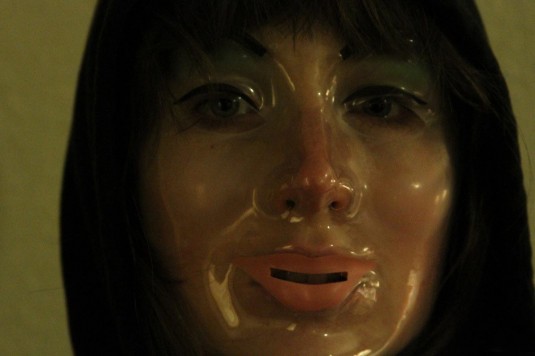 For my tastes, the stories got better as the film continued. I was not a fan of the first few stories. The wraparound segment (“Tape 51”) involves a band of delinquents who are hired to retrieve one VHS tape in a creepy home. The guys are annoying jackasses, and our opening image involves them sexually assaulting a woman and recording it to sell later, so we’re pretty agreeable to them being killed off one by one inside the creepy home. I just don’t know why anyone would record themselves watching a movie. It’s not like it’s Two Girls One Cup we’re talking about here. I found the wraparound segment to be too chaotic and annoying, much like the band of idiots. It ends up becoming your standard boogeyman type of story and relies on characters making stupid decision after stupid decision. Why do these idiots stay in the house and watch movies? Why do these people not turn on the lights?
The first actual segment (“Amateur Night”) has a solid premise: a bunch of drunken frat boys plan to make their own porn with a pair of spy glasses. They bring the wrong girl back to their motel room and get more than they bargained for. Despite some interesting commentary on the male libido (interpreting a woman’s spooky actions as being sexually aroused), this segment suffers from a protracted setup. There’s a solid ten minutes of boys being boys, getting drunk, that sort of thing. And when the tables are turned, the spyglasses lead to shakier recording, which is odd considering they are pinned on the guy’s nose. The horror of the ending is also diminished because it’s hard to make sense of what is literally happening. The weakest segment is the second one (“Second Honeymoon”), which is surprising considering it’s written and directed by Ti West, a hot name in indie horror after The Innkeepers. West’s segment is your standard black widow tale, following a couple on their vacation to the Southwest and their home movies. However, a stalker is secretly videotaping them while they sleep. Borrowing from Cache, this is a genuinely creepy prospect, and the sense of helplessness and dread are palpable. It’s surprising then that West concludes his segment so abruptly, without further developing the stalker aspect, and tacks on a rather lame twist ending that doesn’t feel well thought out. “You deleted that, right?” says one guilty character on camera washing away blood. Whoops.
The second half of V/H/S is what really impressed me, finding clever ways to play upon the found footage motif and still be suspenseful. The third segment (“Tuesday the 17th”) begins like your regular kids-in-the-woods slasher film. The very specific types of characters (Jock, Nerd, Cheerleader) are set for some frolicking when they come across a deranged killer. However, the slasher monster is a Predator-style invisible creature that can only be seen via the video camera. When recorded, the monster creates a glitch on screen. I think this is a genius way to cover the biggest head-scratcher in found footage horror: why are you still recording? With this segment, the video camera is the savior, the protector, the only engine with which they can see the monster. The fourth segment (“The Sick Thing That Happened to Emily When She Was Younger”) is shot entirely through Skype conversations on laptops. Emily is convinced her apartment is haunted and seeks support from her boyfriend, away on business. This segment’s co-writer and director, Joe Swanberg, is more known for being the mumblecore king than a horror aficionado, but the man makes scary good use of the limitations of his setup. The story might be a bit hard to follow, especially its ending, but there are some great jolts and boo-moments. There’s even a fantastic gross-out surprise as Emily shares her own elective surgery/exploration.
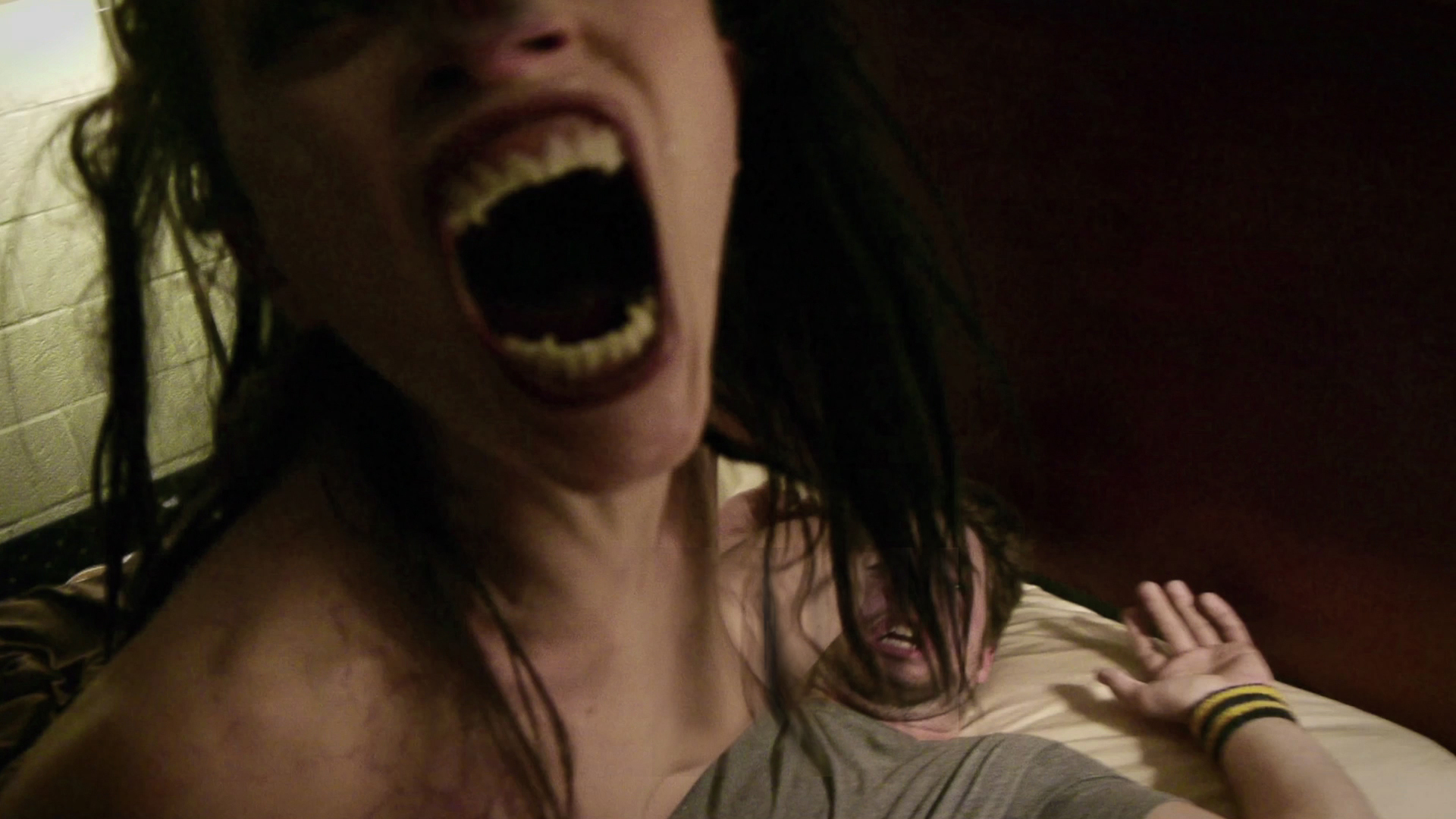 But it’s the last segment that takes the cake, ending V/H/S on a fever pitch of action. The wraparound segment isn’t even that, since it ends before the final segment, “10/31/1998.” It’s a haunted house story about a group of guys who stumble into the wrong house on the wrong night. Initially they think the human sacrifice in the attic is part of the show, but then weird things start happening like arms coming through walls and door knobs vanishing. This segment is a great example of how effective atmosphere can be aided by smart and selective special effects. When the madness hits the home, it feels just like that, and the rush to exit the house is fueled with adrenaline. You don’t exactly know what will be around the next corner. The CGI effects are very effective and the lo-fi visual sensibilities give them even more punch. The frenzied chaos that ends “10/31/1998” would be apt for a feature-length found footage movie, let alone a 15-minute short. It’s a satisfying climax to a film that got better as it went.
With all found footage movies, there’s the central leap of logic concerning who assembled this footage, for what purposes, and how they got it. With movies like the abysmal Apollo 18, I stop and think, “Why do these people assembling the footage leave so much filler?” V/H/S doesn’t commit a sin worthy of ripping you out of the movie, but when it’s concluded you’ll stop and ponder parts of its reality that don’t add up. The very idea of people still recording onto VHS tapes in the age of digital and DVD seems curious, but I’ll go with it. Several segments obviously had to be recorded onto a hard drive; the Skype conversations would have to be recorded onto two perhaps. So somebody transferred digital records… onto a VHS tape? And it just so happens that this tape then got lost.
While inherently hit-or-miss, V/H/S succeeds as an anthology film and generates new life into the found footage concept. Not all of the segments are scary or clever, but even during its duller moments the film has a sense of fun. There’s always something new just around the corner to keep you entertained, and the various anthology segments give a range of horror scenarios. The lo-fi visual verisimilitude can be overdone at times, but the indie filmmakers tackle horror with DIY ingenuity. I don’t know if anything on screen will give people nightmares, but it’s plenty entertaining, in spots. V/H/S is an enjoyable, efficient, and entertaining little horror movie just in time for Halloween. If you’re going to do a found footage movie, this is the way to do it.
Nate’s Grade: B
Share this:

The Devil Inside (2012)
 I heard all about The Devil Inside earlier this year, when supposedly midnight screening audiences were so incensed that they practically became a riotous mob, throwing items at the screen, loudly booing, some even destroying theater equipment. If that doesn’t sell this movie, then I don’t know what will. I wasn’t expecting much from this faux documentary about one pretty girl’s (Fernanda Andrade) search for her crazy mom who may or may not be possessed by demons. She enlists the help of two exorcists and a camera crew and goes searching for answers. Never mind that the movie is absent any scares outside the sudden jump variety, ignore the empty characters and nonsensical plotting and poor pacing and choppy editing, as well as some bad Italian accents, and let’s get down to what makes this movie so notorious – the ending. Just when it appears that The Devil Inside is gearing up for a climactic showdown between good and evil, just when it seems like the movie is finally getting somewhere, it ends in the most abrupt, ludicrous fashion (note to self: when transporting possessed people, stow them away in the trunk). You’re left dumbstruck, shocked that the filmmakers cheated you out of an ending. It’s a nonsensical and cheap thing to do, and I can understand why it inflamed audiences (it still made over $50 million, so I think the filmmakers are feeling fine). Only those easily spooked by demonic possession would find this movie scary. Everyone else will just find it upsetting, not because of its content, but because of its lack of a workable conclusion.
Nate’s Grade: D+
Share this:

Shark Night 3D (2011)
Piranha 3D was 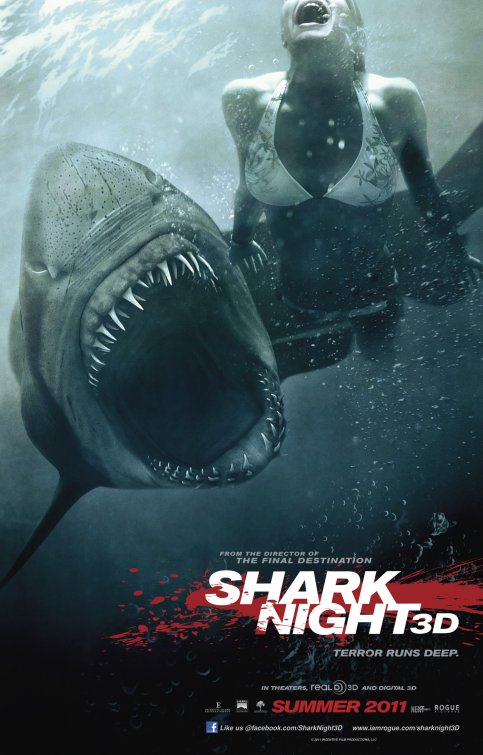 a horror movie that knew exactly what it was doing, and good gravy it did it well. Here was a horror comedy that brilliantly provided campy thrills, over-the-top mayhem, salacious T&A, and a jubilant sense of humor. It was a glorious 1980s-esque exploitation film adapted to modern times. In the wake of Piranha 3D came the pitiful Shark Night 3D, which was marketed with a similar celebratory exploitation angle. Besides the unifying aquatic threat, the two movies, however, couldn’t be any more different. Shark Night 3D is to Piranha 3D what Branson, Missouri is to Vegas.
It’s spring break on the Bayou, and seven friends are heading out to Sara Palski’s (Sara Paxton) family house on the lake. Nick (Dustin Milligan) has a full course load as a pre-Med major, so he’s looking to relax and finally make a move with his crush on Sara. Along for the ride are geeky Gordon (Joel David Moore), future NFL first-round pick Malik (Sinqua Walls), his girlfriend Maya (Alyssa Diaz), the rebellious party girl Beth (Katherine McPhee), and her ex-boyfriend, the self-absorbed Blake (Chris Zylka). Their revelry is interrupted when they discover that the lake is filled with all kinds of sharks. A group of menacing local rednecks terrorizes the gang and plan to feed them to the sharks.
What this movie reminds me of are the watered down soft-core “comedies” that used to grace the late night airwaves on the cable channel USA. Somebody had the bright idea to take movies that were primarily made to titillate with casual T&A; when you strip away those base exploitation elements, which in this case was sex and nudity, then you’re left with 90 minutes of strained filler and really flat jokes. That’s what Shark Night 3D (in non-3D) feels like. Ignoring the fact that Paxton (Last House on the Left) runs around in a bikini for 90 percent of the movie, the film is lacking guts of all kinds. The closest you’ll get to skin is some brief side boob from American Idol alum, and quizzically ever-present actress, Katherine McPhee (The House Bunny). I want to state for the record that giving McPhee a nose stud and some lower back tattoos is the unconvincing PG-13 translation of making her into a “bad girl.” I wouldn’t be as miffed about the omission of the exploitation elements if the movie presented a compelling story or some well-orchestrated suspense sequences. It presents itself as an exploitation film, replete with plenty of underwater POV shots of bikini bottoms but it pulls back at every opportunity, cruelly teasing the audience with the promise of something better, but better never comes.
Its ideas of suspense revolve around lame jump scares and quickly resolved sequences where characters are picked off by the sharks. The movie sets up a dramatic scenario and doesn’t waste much time. Characters get picked off with mordant efficiency, and yet there’s no pizazz to these deaths, no memorable or gruesome moments. Hope you like seeing people pulled under red water. Unlike Deep Blue Sea, an enjoyable campy outing, these sharks are just regular sharks and yet they behave like genetically engineered killing machines, leaping out of the water to snatch prey at high altitudes. They even know how to break an onboard motor, which sounds like the work of a shark suicide bomber. There’s never really a great explanation for why the sharks are even doing in a lake. Granted, it’s stated to be a salt water lake and spillovers from high waters have been known to deposit oceanic creatures inland, but then the dumb redneck characters take credit for the shark attacks. They say they put them in the lake. I don’t believe this for a second, nor do I believe that these goons are secretly clever when it comes to advanced technology. Their whole scheme, which includes one of them philosophizing about “moral relativism,” is completely unbelievable, as well as their crazy get rich quick scheme.
If you’re not going to deliver the goods, at least don’t pretend that your sharks-eat-college-kids horror movie is some serious work of art. Sadly, the thing that can save any low-rent horror movie, a sense of humor, is noticeably absent with Shark Night 3D. It goes all the way in the other direction, trying to churn serious drama out of ridiculous situations. Characters are prone to delivering long monologues that let us know how scared they are or of some past trauma. Sara is haunted by a drowning scare that put an irreconcilable rift between her and her ex-boyfriend, who happens to be one of the sinister rednecks. The stupid melodrama in this movie is played completely poker-faced serious. When one male character loudly bellows that his girlfriend, who died via shark, was the most important thing in his world, it’s something of a head-scratcher. Before this lady fell victim to nefarious shark attack, we knew next to nothing about her beyond superficial descriptions, namely her race and her designation as “girlfriend.” We don’t even see anything of this so-called relationship, so when the feeding frenzy starts and the characters start getting picked off, the wails of drama are comically misplaced. When that character tries to go back into the water to attain vengeance against the animal that took his woman (“They took one of ours, now I’m gonna take one of theirs”), it feels absurd and hilarious. The movie hasn’t even done a credible job to make us believe the significance of the character relationships.
 The screenplay by Will Hayes and Jesse Studenberg relies on stock roles almost to a degree of self-parody (the athlete, the smart wet blanket, the doofus, the virginal girl next door, the vampy girl – hey Cabin in the Woods, I got your lineup right here). You would think given the scenario of shark-infested waters, all you had to do was remain on land. The old chestnut about cell phone signals is here again, but I refuse to believe that Sara’s family house does not have a landline phone. I thought maybe for one shining moment Shark Night 3D would move into an unexpected direction, and then it didn’t. After our first shark victim struggles to pull through, our med student Nick takes charge. I thought it would have been great during this moment, when we fully expect Nick to be indispensable given his medical knowledge, that he gets eaten by a shark. Alas, my dreams of convention upheaval were not to be met. If you can’t predict every twist and turn the movie makes, including the heroic sacrifice and the “twist” betrayal, then you haven’t lived long enough to move on from the kiddie pool.
Shark Night 3D is a schlocky, tiresome, neutered exploitation film missing the elements that make exploitation films worth watching. After a while, it just becomes exasperating. This movie is 90 minutes of being lead around without a payoff. It wants to be a fun, campy movie, but then why does it take itself so seriously and lack the slightest sense of humor? It wants to be considered amongst exploitation horror movies, with nubile teens being stalked in their bikini bottoms below the murky depths, but then why does the movie pull back at every opportunity for sex and gore? Shark Night 3D is a movie that will appeal to no one. If you want thrills and chills, you’ll be disappointed. If you want T&A, you’ll be disappointed. If you want some good shark action, you’ll be disappointed. If you want a workable story and characters worth rooting for, you’ll be disappointed. If you love sharks, you’ll be disappointed, which is a real disappointment. The only people who won’t be disappointed will be the people who grew up on those late-night USA cut-for-TV soft core flicks. To those few people in their bubbles of ignorance, Shark Night 3D might be the best movie they’ve ever seen.
Nate’s Grade: D
Share this:

The Cabin in the Woods (2012)
 The Cabin in the Woods has been building an avalanche of buzz in the time it’s been sitting on the shelf. Originally filmed in 2009, the horror comedy from Buffy the Vampire Slayer creative heavyweights Drew Goddard and Joss Whedon has been patiently waiting to unleash its wicked Jack-in-the-box of surprises. Directed by Goddard, and written by Whedon and Goddard, The Cabin in the Woods is a brash enterprise, a blast of entertainment and a breath of fresh air in a genre that typically teeters into self-parody. If you haven’t seen the movie yet and have a strong, or even curious, desire to do so, then stop reading. Go in as blind and unspoiled as possible. Then you can come back and read my witty words. It’s okay. I won’t take offense. In the meantime, I’ll keep myself busy. Back? Good, let’s get started then.
You know the setup. A group of dumb teenagers spend a weekend at a friend’s cabin in the middle of nowhere. There’s the jock (Chris Hemsworth), the slutty girl (Anna Hutchinson), the stoner (Fran Kranz), the bookish one (Jesse Williams), and the mousy girl-next-door virginal type (Kristen Connolly). There’s the scary old guy at the gas station, there’s the promise of debauchery and sweet oblivion. But we’re not the only ones watching the gang. A group of lab techs, led by Hadley (Bradley Whitford) and Sitterson (Richard Jenkins), is watching their every move. They control the cabin and its surroundings and are manipulating events to lead to slaughter. But why are they going to all this trouble? That’s just the tip of the iceberg here.
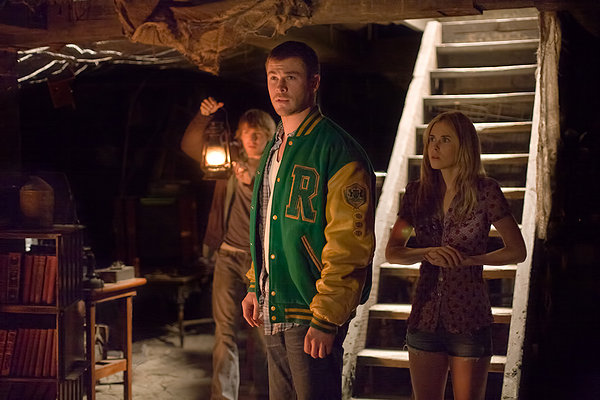 The macabre sense of humor is what will immediately separate Cabin in the Woods from its blood-and-guts brethren. The sharp dialogue is routinely laugh-out-loud funny, absurd in the right parts. Whitford’s downbeat reaction during a joyous moment of celebration had me howling. The movie is so smart, sometimes too smart for its own good. If you’re going to level one major charge against the movie, it’s that it isn’t really ever scary. Oh sure it has some stuff that should be scary given the particulars, and its 31 flavors of horror should find something that tingles everyone’s spine on some level. But this is much more of a deconstruction of the horror genre and its audience than an actual horror movie. Whedon and Goddard undercut their horror almost at every turn, settling for the ironic laugh or satirical tweak and repeatedly cutting back to the lab guys to provide a few good laughs and commentary (Jenkins has a terrific foul-mouth rant aimed at children that left me doubled over in laughter). Do not be mistaken; the lab stuff is easily the best part of the movie. Upon my second viewing, I found myself growing weary with the teens-in-a-cabin stuff and anxiously waiting our next detour into the weird and wonderful lab. The duo of Whitford (TV’s The West Wing) and Jenkins (Friends with Benefits) makes for some terrific and biting middle management corporate satire, as well as satirizing the jaded, bloodthirsty audience of slasher movies. You can tell that Whedon and Goddard love horror movies and are frustrated with the nihilistic rut the genre has found itself mired in. And as a deconstructive exercise, Cabin in the Woods is first-class. Roger Ebert succinctly called the movie a “fanboy final exam.”
It can be a tad clinical at times, failing to give us any true attachment to the characters even in an ironic sense, but when a movie is this fun, this wild, and this clever with its deconstruction of genre, I concede the point of having to root for somebody. The characters break the stereotypical mold; the jock is on academic scholarship, the smart guy happens to also be a hunky jock, the slut isn’t really slutty, the virgin isn’t squeaky-clean, and the stoner is the smartest guy in the group, aided by his cannabis (As one character later reasons, “We work with what we got”). He’s the only one who seems to be able to notice the strange manipulations at work. Once you dig into it, the very nature of how and why we watch horror is analyzed by Cabin in the Woods (get ready for some voyeurism parallels). The nature of fear and sacrifice is given some thought, though this stuff gets a bit lost in the madhouse of a final act. The movie becomes a funhouse of horrors and the frenetic carnage and chaos elevates the energy level. I cannot think of a movie that ended in such a whirling dervish of excitement and deep, demented satisfaction. This is one movie that doesn’t just end with a bang; it ends with every bang you can think of. Horror fans are going to be hopping out of the theaters, foaming at the mouth, desperate to tell every one of their friends what they just witnessed. I wish several of my friends would hurry up and see Cabin in the Woods so I had somebody to talk about its many pleasures, thrills, and surprises with. The movie has several terrific payoffs. This is the most fun I’ve had with a horror movie since 2003’s Cabin Fever. Must be something about cabins that brings out the meta-ness.
 Considering this was on the shelf for over two years while MGM worked out its bankruptcy dealings, it’s fun to see how fate has been to this lot of actors. The biggest name has got to be Hemsworth, better known as the flaxen, hammer-wielding God of Thunder Thor in the Marvel movies, and Whedon’s upcoming Avengers ensemble. He’s rather enjoyable onscreen and his hero moment is one that will definitely be a talking point. The two standouts from the cast, other than Jenkins and Whitford of course, are Connolly (“iGirl” on the Web series, iChannel) as the nubile Final Girl and Kranz (TV’s Dollhouse) as the clever pothead. Connolly has got a great face for movies, looking like the younger sister of Ellie Kemper (TV’s The Office) or Jayma Mays (The Smurfs), and I’m always a sucker for a redhead. Kranz is so good with the comedy that you may fail to notice all the work he’s actually putting into his role, which quickly becomes the audience’s voice of reason.
But the strangest quirk for a movie knotted with them comes to the casting of its resident “slut” played by Hutchinson. The woman has a sultry side that comes through without going overboard into parody. Scanning through her resume, I see that Hutchinson portrayed the Yellow Power Ranger (Lilly) for 32 episodes in Power Rangers: Jungle Fury. Now here’s where things get interesting. Being the movie aficionado that I am, I recognize that Cabin Fever also had an actress, Cerina Vincent, who portrayed the Yellow Power Ranger (Maya) for 45 episodes in Power Rangers: Lost Galaxy. Here’s where it gets even weirder. Both Hutchinson and Vincent are the only cast members in their movies to go nude in their respective films. So two actresses, both different versions of the Yellow Power Ranger, both get naked and star in horror genre deconstructive movies with “cabin” in the title! Is this one of the Mayan signs? Should I contact Dan Brown? Does it say something that the yellow ranger appears to be the most comfortable with nudity? This may be the greatest and most obscure observation I’ve ever made.
Of course there are so many fun surprises that it puts me in a bit of a critical bind. I don’t want to go into too much detail because that would spoil the fun, though rest assured that The Cabin in the Woods does not live or die based upon unknown plot twists. You may think you know given what’s already been revealed via the trailers, but really you have no idea how deep this thing goes and to what ends. Unless you just happened to be me, which at last count there was only one of (my evil twin long since slain… or was he?). I say this not as some point of pretentious bragging, but it’s because I wrote a horror screenplay a year ago that also satirized the genre tropes (for those few interested, it was called Blood Wake). I won’t go into spoiler detail, but both of our bad guys were called into question as being bad, from a greater good standpoint, and the killers had more on their minds than simply punishing dumb, horny teenagers. Well, after watching Cabin in the Woods, I know that screenplay goes back in the shelf now where it will live in eternal slumber thanks to core similarities. But if somebody’s got to be wielding the knife, at least it’s my man crush Joss Whedon.
Nate’s Grade: A-
Share this:

Silent House (2012)
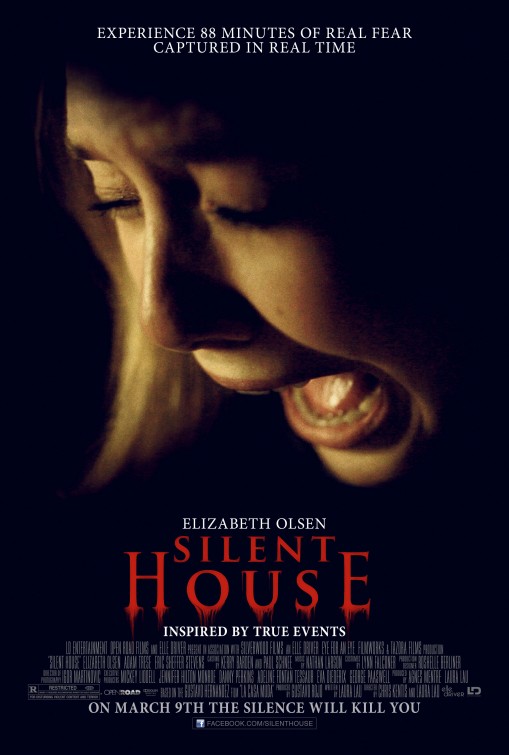 Ostensibly executed in one long, unblinking take (though you can tell the edit points; the directors admit they filmed it in 10-minute chunks), Silent House is a visceral experience in spookiness, tethered to the brilliant actress Elizabeth Olsen that unfolds in real time. It’s your standard scary house movie, lots of dark rooms and pitiful hiding under furniture; it begins as an intruder(s) stalking Olsen from room to room and then, in the final 20 minutes, transforms into a psychological thriller, with the realm between reality and hallucination blending. The bare-bones plot (girl chased through house) cranks out some decent scares due to directors Chris Kentis and Laura Lau (Open Water)’s tightly executed sense of reality, leaving us feeling as trapped and helpless as our heroine. The movie’s minor successes are also squarely due to Olsen, she of glassy eyes and hoarse scream. It’s almost a one-woman show and Olsen is so convincing in her terror, completely unnerving even when the movie is not. The climax is a bit of a letdown, to say the least, and leaves a lot of off-putting questions that cannot be answered by the movie’s absence of back-story. I won’t say the ending ruins the entire suspenseful experience of Silent House, but it’s certainly going to spur plenty of grumbling. Still, Olsen is a star and gives a terrific freaked-out performance worth getting spooked over. Also it’s based on a 2010 Uruguay movie with the same high-concept gimmick. Now you know Uruguay has a film industry. Don’t you feel better?
Nate’s Grade: B-


 nathanzoebl
You must be logged in to post a comment.