Blog Archives
Shark Night 3D (2011)
Piranha 3D was 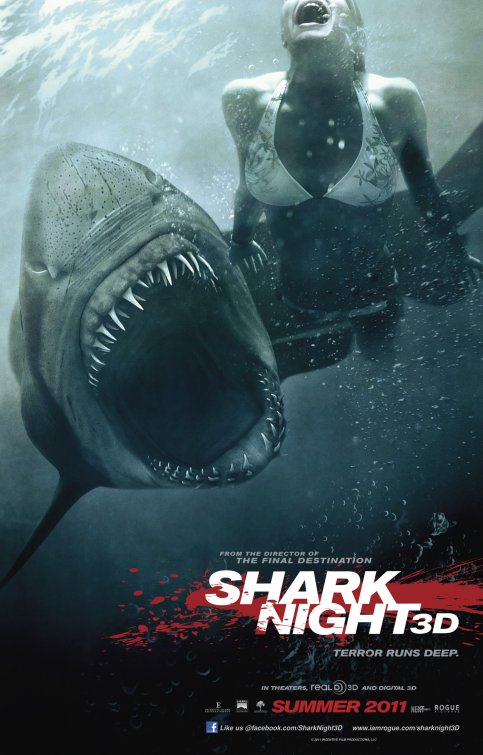 a horror movie that knew exactly what it was doing, and good gravy it did it well. Here was a horror comedy that brilliantly provided campy thrills, over-the-top mayhem, salacious T&A, and a jubilant sense of humor. It was a glorious 1980s-esque exploitation film adapted to modern times. In the wake of Piranha 3D came the pitiful Shark Night 3D, which was marketed with a similar celebratory exploitation angle. Besides the unifying aquatic threat, the two movies, however, couldn’t be any more different. Shark Night 3D is to Piranha 3D what Branson, Missouri is to Vegas.
It’s spring break on the Bayou, and seven friends are heading out to Sara Palski’s (Sara Paxton) family house on the lake. Nick (Dustin Milligan) has a full course load as a pre-Med major, so he’s looking to relax and finally make a move with his crush on Sara. Along for the ride are geeky Gordon (Joel David Moore), future NFL first-round pick Malik (Sinqua Walls), his girlfriend Maya (Alyssa Diaz), the rebellious party girl Beth (Katherine McPhee), and her ex-boyfriend, the self-absorbed Blake (Chris Zylka). Their revelry is interrupted when they discover that the lake is filled with all kinds of sharks. A group of menacing local rednecks terrorizes the gang and plan to feed them to the sharks.
What this movie reminds me of are the watered down soft-core “comedies” that used to grace the late night airwaves on the cable channel USA. Somebody had the bright idea to take movies that were primarily made to titillate with casual T&A; when you strip away those base exploitation elements, which in this case was sex and nudity, then you’re left with 90 minutes of strained filler and really flat jokes. That’s what Shark Night 3D (in non-3D) feels like. Ignoring the fact that Paxton (Last House on the Left) runs around in a bikini for 90 percent of the movie, the film is lacking guts of all kinds. The closest you’ll get to skin is some brief side boob from American Idol alum, and quizzically ever-present actress, Katherine McPhee (The House Bunny). I want to state for the record that giving McPhee a nose stud and some lower back tattoos is the unconvincing PG-13 translation of making her into a “bad girl.” I wouldn’t be as miffed about the omission of the exploitation elements if the movie presented a compelling story or some well-orchestrated suspense sequences. It presents itself as an exploitation film, replete with plenty of underwater POV shots of bikini bottoms but it pulls back at every opportunity, cruelly teasing the audience with the promise of something better, but better never comes.
Its ideas of suspense revolve around lame jump scares and quickly resolved sequences where characters are picked off by the sharks. The movie sets up a dramatic scenario and doesn’t waste much time. Characters get picked off with mordant efficiency, and yet there’s no pizazz to these deaths, no memorable or gruesome moments. Hope you like seeing people pulled under red water. Unlike Deep Blue Sea, an enjoyable campy outing, these sharks are just regular sharks and yet they behave like genetically engineered killing machines, leaping out of the water to snatch prey at high altitudes. They even know how to break an onboard motor, which sounds like the work of a shark suicide bomber. There’s never really a great explanation for why the sharks are even doing in a lake. Granted, it’s stated to be a salt water lake and spillovers from high waters have been known to deposit oceanic creatures inland, but then the dumb redneck characters take credit for the shark attacks. They say they put them in the lake. I don’t believe this for a second, nor do I believe that these goons are secretly clever when it comes to advanced technology. Their whole scheme, which includes one of them philosophizing about “moral relativism,” is completely unbelievable, as well as their crazy get rich quick scheme.
If you’re not going to deliver the goods, at least don’t pretend that your sharks-eat-college-kids horror movie is some serious work of art. Sadly, the thing that can save any low-rent horror movie, a sense of humor, is noticeably absent with Shark Night 3D. It goes all the way in the other direction, trying to churn serious drama out of ridiculous situations. Characters are prone to delivering long monologues that let us know how scared they are or of some past trauma. Sara is haunted by a drowning scare that put an irreconcilable rift between her and her ex-boyfriend, who happens to be one of the sinister rednecks. The stupid melodrama in this movie is played completely poker-faced serious. When one male character loudly bellows that his girlfriend, who died via shark, was the most important thing in his world, it’s something of a head-scratcher. Before this lady fell victim to nefarious shark attack, we knew next to nothing about her beyond superficial descriptions, namely her race and her designation as “girlfriend.” We don’t even see anything of this so-called relationship, so when the feeding frenzy starts and the characters start getting picked off, the wails of drama are comically misplaced. When that character tries to go back into the water to attain vengeance against the animal that took his woman (“They took one of ours, now I’m gonna take one of theirs”), it feels absurd and hilarious. The movie hasn’t even done a credible job to make us believe the significance of the character relationships.
 The screenplay by Will Hayes and Jesse Studenberg relies on stock roles almost to a degree of self-parody (the athlete, the smart wet blanket, the doofus, the virginal girl next door, the vampy girl – hey Cabin in the Woods, I got your lineup right here). You would think given the scenario of shark-infested waters, all you had to do was remain on land. The old chestnut about cell phone signals is here again, but I refuse to believe that Sara’s family house does not have a landline phone. I thought maybe for one shining moment Shark Night 3D would move into an unexpected direction, and then it didn’t. After our first shark victim struggles to pull through, our med student Nick takes charge. I thought it would have been great during this moment, when we fully expect Nick to be indispensable given his medical knowledge, that he gets eaten by a shark. Alas, my dreams of convention upheaval were not to be met. If you can’t predict every twist and turn the movie makes, including the heroic sacrifice and the “twist” betrayal, then you haven’t lived long enough to move on from the kiddie pool.
Shark Night 3D is a schlocky, tiresome, neutered exploitation film missing the elements that make exploitation films worth watching. After a while, it just becomes exasperating. This movie is 90 minutes of being lead around without a payoff. It wants to be a fun, campy movie, but then why does it take itself so seriously and lack the slightest sense of humor? It wants to be considered amongst exploitation horror movies, with nubile teens being stalked in their bikini bottoms below the murky depths, but then why does the movie pull back at every opportunity for sex and gore? Shark Night 3D is a movie that will appeal to no one. If you want thrills and chills, you’ll be disappointed. If you want T&A, you’ll be disappointed. If you want some good shark action, you’ll be disappointed. If you want a workable story and characters worth rooting for, you’ll be disappointed. If you love sharks, you’ll be disappointed, which is a real disappointment. The only people who won’t be disappointed will be the people who grew up on those late-night USA cut-for-TV soft core flicks. To those few people in their bubbles of ignorance, Shark Night 3D might be the best movie they’ve ever seen.
Nate’s Grade: D
Share this:

The Cabin in the Woods (2012)
 The Cabin in the Woods has been building an avalanche of buzz in the time it’s been sitting on the shelf. Originally filmed in 2009, the horror comedy from Buffy the Vampire Slayer creative heavyweights Drew Goddard and Joss Whedon has been patiently waiting to unleash its wicked Jack-in-the-box of surprises. Directed by Goddard, and written by Whedon and Goddard, The Cabin in the Woods is a brash enterprise, a blast of entertainment and a breath of fresh air in a genre that typically teeters into self-parody. If you haven’t seen the movie yet and have a strong, or even curious, desire to do so, then stop reading. Go in as blind and unspoiled as possible. Then you can come back and read my witty words. It’s okay. I won’t take offense. In the meantime, I’ll keep myself busy. Back? Good, let’s get started then.
You know the setup. A group of dumb teenagers spend a weekend at a friend’s cabin in the middle of nowhere. There’s the jock (Chris Hemsworth), the slutty girl (Anna Hutchinson), the stoner (Fran Kranz), the bookish one (Jesse Williams), and the mousy girl-next-door virginal type (Kristen Connolly). There’s the scary old guy at the gas station, there’s the promise of debauchery and sweet oblivion. But we’re not the only ones watching the gang. A group of lab techs, led by Hadley (Bradley Whitford) and Sitterson (Richard Jenkins), is watching their every move. They control the cabin and its surroundings and are manipulating events to lead to slaughter. But why are they going to all this trouble? That’s just the tip of the iceberg here.
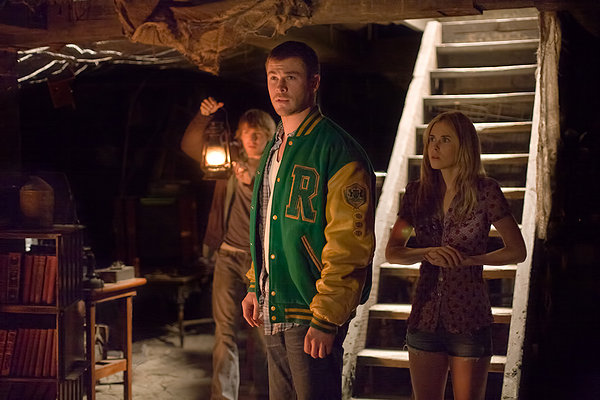 The macabre sense of humor is what will immediately separate Cabin in the Woods from its blood-and-guts brethren. The sharp dialogue is routinely laugh-out-loud funny, absurd in the right parts. Whitford’s downbeat reaction during a joyous moment of celebration had me howling. The movie is so smart, sometimes too smart for its own good. If you’re going to level one major charge against the movie, it’s that it isn’t really ever scary. Oh sure it has some stuff that should be scary given the particulars, and its 31 flavors of horror should find something that tingles everyone’s spine on some level. But this is much more of a deconstruction of the horror genre and its audience than an actual horror movie. Whedon and Goddard undercut their horror almost at every turn, settling for the ironic laugh or satirical tweak and repeatedly cutting back to the lab guys to provide a few good laughs and commentary (Jenkins has a terrific foul-mouth rant aimed at children that left me doubled over in laughter). Do not be mistaken; the lab stuff is easily the best part of the movie. Upon my second viewing, I found myself growing weary with the teens-in-a-cabin stuff and anxiously waiting our next detour into the weird and wonderful lab. The duo of Whitford (TV’s The West Wing) and Jenkins (Friends with Benefits) makes for some terrific and biting middle management corporate satire, as well as satirizing the jaded, bloodthirsty audience of slasher movies. You can tell that Whedon and Goddard love horror movies and are frustrated with the nihilistic rut the genre has found itself mired in. And as a deconstructive exercise, Cabin in the Woods is first-class. Roger Ebert succinctly called the movie a “fanboy final exam.”
It can be a tad clinical at times, failing to give us any true attachment to the characters even in an ironic sense, but when a movie is this fun, this wild, and this clever with its deconstruction of genre, I concede the point of having to root for somebody. The characters break the stereotypical mold; the jock is on academic scholarship, the smart guy happens to also be a hunky jock, the slut isn’t really slutty, the virgin isn’t squeaky-clean, and the stoner is the smartest guy in the group, aided by his cannabis (As one character later reasons, “We work with what we got”). He’s the only one who seems to be able to notice the strange manipulations at work. Once you dig into it, the very nature of how and why we watch horror is analyzed by Cabin in the Woods (get ready for some voyeurism parallels). The nature of fear and sacrifice is given some thought, though this stuff gets a bit lost in the madhouse of a final act. The movie becomes a funhouse of horrors and the frenetic carnage and chaos elevates the energy level. I cannot think of a movie that ended in such a whirling dervish of excitement and deep, demented satisfaction. This is one movie that doesn’t just end with a bang; it ends with every bang you can think of. Horror fans are going to be hopping out of the theaters, foaming at the mouth, desperate to tell every one of their friends what they just witnessed. I wish several of my friends would hurry up and see Cabin in the Woods so I had somebody to talk about its many pleasures, thrills, and surprises with. The movie has several terrific payoffs. This is the most fun I’ve had with a horror movie since 2003’s Cabin Fever. Must be something about cabins that brings out the meta-ness.
 Considering this was on the shelf for over two years while MGM worked out its bankruptcy dealings, it’s fun to see how fate has been to this lot of actors. The biggest name has got to be Hemsworth, better known as the flaxen, hammer-wielding God of Thunder Thor in the Marvel movies, and Whedon’s upcoming Avengers ensemble. He’s rather enjoyable onscreen and his hero moment is one that will definitely be a talking point. The two standouts from the cast, other than Jenkins and Whitford of course, are Connolly (“iGirl” on the Web series, iChannel) as the nubile Final Girl and Kranz (TV’s Dollhouse) as the clever pothead. Connolly has got a great face for movies, looking like the younger sister of Ellie Kemper (TV’s The Office) or Jayma Mays (The Smurfs), and I’m always a sucker for a redhead. Kranz is so good with the comedy that you may fail to notice all the work he’s actually putting into his role, which quickly becomes the audience’s voice of reason.
But the strangest quirk for a movie knotted with them comes to the casting of its resident “slut” played by Hutchinson. The woman has a sultry side that comes through without going overboard into parody. Scanning through her resume, I see that Hutchinson portrayed the Yellow Power Ranger (Lilly) for 32 episodes in Power Rangers: Jungle Fury. Now here’s where things get interesting. Being the movie aficionado that I am, I recognize that Cabin Fever also had an actress, Cerina Vincent, who portrayed the Yellow Power Ranger (Maya) for 45 episodes in Power Rangers: Lost Galaxy. Here’s where it gets even weirder. Both Hutchinson and Vincent are the only cast members in their movies to go nude in their respective films. So two actresses, both different versions of the Yellow Power Ranger, both get naked and star in horror genre deconstructive movies with “cabin” in the title! Is this one of the Mayan signs? Should I contact Dan Brown? Does it say something that the yellow ranger appears to be the most comfortable with nudity? This may be the greatest and most obscure observation I’ve ever made.
Of course there are so many fun surprises that it puts me in a bit of a critical bind. I don’t want to go into too much detail because that would spoil the fun, though rest assured that The Cabin in the Woods does not live or die based upon unknown plot twists. You may think you know given what’s already been revealed via the trailers, but really you have no idea how deep this thing goes and to what ends. Unless you just happened to be me, which at last count there was only one of (my evil twin long since slain… or was he?). I say this not as some point of pretentious bragging, but it’s because I wrote a horror screenplay a year ago that also satirized the genre tropes (for those few interested, it was called Blood Wake). I won’t go into spoiler detail, but both of our bad guys were called into question as being bad, from a greater good standpoint, and the killers had more on their minds than simply punishing dumb, horny teenagers. Well, after watching Cabin in the Woods, I know that screenplay goes back in the shelf now where it will live in eternal slumber thanks to core similarities. But if somebody’s got to be wielding the knife, at least it’s my man crush Joss Whedon.
Nate’s Grade: A-
Share this:

Silent House (2012)
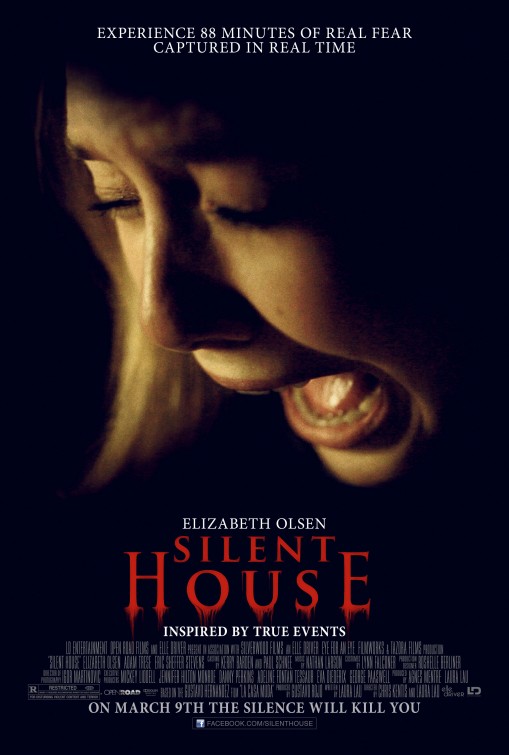 Ostensibly executed in one long, unblinking take (though you can tell the edit points; the directors admit they filmed it in 10-minute chunks), Silent House is a visceral experience in spookiness, tethered to the brilliant actress Elizabeth Olsen that unfolds in real time. It’s your standard scary house movie, lots of dark rooms and pitiful hiding under furniture; it begins as an intruder(s) stalking Olsen from room to room and then, in the final 20 minutes, transforms into a psychological thriller, with the realm between reality and hallucination blending. The bare-bones plot (girl chased through house) cranks out some decent scares due to directors Chris Kentis and Laura Lau (Open Water)’s tightly executed sense of reality, leaving us feeling as trapped and helpless as our heroine. The movie’s minor successes are also squarely due to Olsen, she of glassy eyes and hoarse scream. It’s almost a one-woman show and Olsen is so convincing in her terror, completely unnerving even when the movie is not. The climax is a bit of a letdown, to say the least, and leaves a lot of off-putting questions that cannot be answered by the movie’s absence of back-story. I won’t say the ending ruins the entire suspenseful experience of Silent House, but it’s certainly going to spur plenty of grumbling. Still, Olsen is a star and gives a terrific freaked-out performance worth getting spooked over. Also it’s based on a 2010 Uruguay movie with the same high-concept gimmick. Now you know Uruguay has a film industry. Don’t you feel better?
Nate’s Grade: B-
Share this:

The Woman in Black (2012)
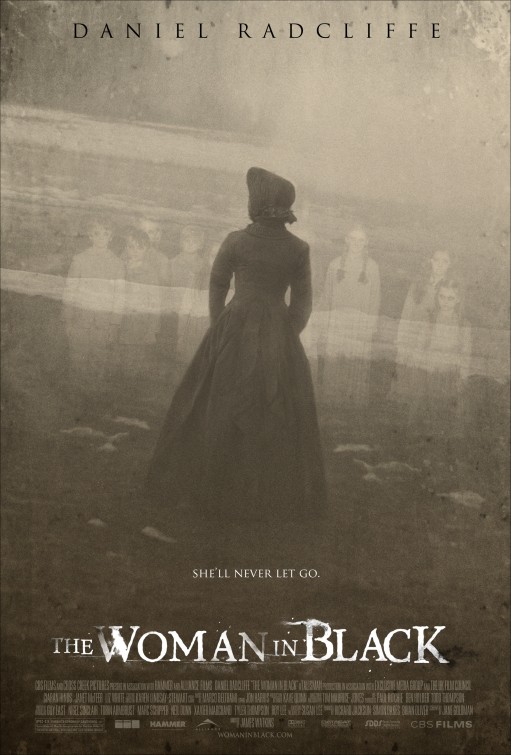 It’s got a decent ending but it’s a long, lumbering walk to get there. This handsomely mounted Hammer throwback involves Harry Potter himself, Daniel Radcliffe, slowly walking through a spooky old Victorian haunted house. And he slowly peeks around a door. And he slowly holds a candle. And I slowly go to sleep. There’s a 40-minute sequence where I swear only two things are spoken. Radcliffe plays a widowed father who has to investigate a haunted house to make ends meet. The movie has a few genuinely creepy moments, mostly owing to set design, but it gets hooked on jump scares and doesn’t know how to quit. The jump scares, accompanied by what sounds like an eagle screeching as music, happen at near two-minute intervals, like some sort of alarm the movie can’t turn off. Alas, The Woman in Black is a pretty staid ghost story where once again a restless spirit is terrorizing others and somebody takes it upon themselves to help that spirit find closure. The plot is so transparently predictable that it becomes fairly frustrating when the movie takes so long to get to its pre-designated stops. The pessimistic ending is weirdly given the most positive spin imaginable. For fans of this horror sub-genre, there may be enough going on to entertain. I just keep learning that ghosts are never grateful and satisfied even when you help them. Ghosts are jerks.
Nate’s Grade: C
Share this:

Final Destination 5 (2011)
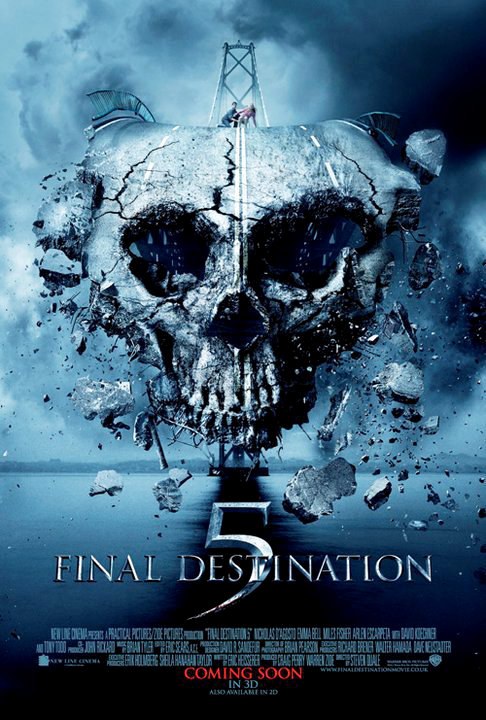 If there was any cosmic justice the Final Destination franchise would have been KO’d by death a long time ago. The initial interest of bizarre, fiendishly clever deaths and the constant macabre misdirection was fun, but now, after five movies, feels creatively exhausted. Once again a group of unremarkable characters survive a remarkable disaster, this time a collapsing bridge. And once again we have to follow them figuring out the rules of the movie series and that they’re all marked for death. The in-between stuff is some of the worst drama ever captured on screen. It makes you impatient for death to get off its duff and kill more teenagers so I don’t have to listen to their whiny, unrealistic problems. Coming off a limp fourth installment that was the highest-grossing one yet, the filmmakers once again turn to 3-D as their savior, which does not play well at all on your TV (a sailboat mast becoming an instrument for impaling?). It’s more annoying than anything. But the real draw of this movie is the gruesomely elaborate deaths, and they’re probably the weakest of the series (a gymnast’s body practically exploding once she hit a padded mat seems absurd even for this movie). There is one sequence that freaked me out but that’s because I’m quite squeamish when it comes to eye trauma. What ends up slightly redeeming Final Destination 5, as far as cheap horror movies go, is a surprising third act that breaks from the doldrums of the franchise formula. For once, the people decide to take life to save themselves when death comes calling, and they set their sights on each other, resentful that one of their own survived in the premonition staple. I think this horror franchise took a turn for the worst when it gave into its target audience’s cynical bloodlust, and I doubt there’s anything “final” about this series. At least the Saw franchise had the merit to die.
Nate’s Grade: C
Share this:

11/11/11 (2011)
 Here’s a lesson for you. Not all elevens are the same. Case in point, the apocalyptic horror film 11/11/11, picking this eleven-friendly doomsday. That’s because there are two movies released in 2011 that have this exact same concept. The other movie was written and directed by Darren Lynn Bousman, the man behind three Saw films and Repo: The Genetic Opera. That one, actually released on 11/11/2011, has a bit more publicity to its numerological case. The only thing separating the two movies is their choice of numerical separation. You see there’s the direct-to-DVD 11/11/11 and the theatrically released, Bousman-directed 11-11-11. It’s dashes or slashes, folks. I’d have to imagine that the dashes movie is better than this, the slashes movie, just on Bousman. But then again, expecting a better movie from the guy behind the middle section of the Saw franchise might be asking for too much. Still, I’d have to assume that a blind monkey could make a movie better than 11/11/11, a horror movie that could only scare you with how bad it is.
The basic plot is that a family moves into a new home. Jack Vales (Jon Briddell) is teaching a college course, taking over for a professor who killed himself. The professor’s widow just happens to live next door, and she’s batty. Melissa (Erin Coker) has found out that she’s pregnant again. The town’s doctors are keeping her sedated an awful lot. Then there’s 10-year-old Nathan “Nat” (Hayden Byerly) who is turning eleven on November 11, 2011, and it seems like everybody wants to celebrate. The neighbor lady knows the truth: on that date (Veteran’s Day?) the gates of hell will open and Nat is the key. The boy must be stopped, though there is a whole nest of Satanists trying to arrange events so that Nat does bring about the end of the world as we know it.
 To call this movie low-rent is a disservice to grungy pornographers, exploitation peddlers, and inept amateur filmmakers. This movie is pathetic on just about every conceivable metric of filmmaking. First off, the premise is vague. We have this magical date looming, but what exactly happens? We’re told later that hell will open and maybe it’s the apocalypse or the rise of Satan or whatever. The kid, Nat, which by the way is the most annoying nick-name for somebody named Nathan (what was wrong with “Nate”?), is never made clear what role he will take. He’s the key to this whole deal but is Satan going to take over his body, as we see when he does some dastardly “no no” activities, or is Satan going to use him to release himself from hell? It’s never made clear, like much in the film, so the screenwriters make sure to cover their bases. Nat’s a demon child. Nat’s possessed. Nat’s scared of what’s under his bed. Nat’s mute. Nat can see into the future. Nat’s everything you need him to be. You’ll watch this movie constantly scratching your head, trying to get a feel for the rules or the boundaries of the narrative, grasping for nothing.
What you will be able to identify is the stupidity, which this movie has a never-ending supply of. Let’s tackle this numerological boogeyman thing head on. The shaky premise of 11/11/11 is that on that fated day the devil will rise up and… something. I’ll let the crazy old neighbor lady explain it best: “11 is God’s perfect number. One plus zero equals one [Editors note: Then shouldn’t one be the perfect number?]. Eleven is Satan’s number, it shows his arrogance, one more than God. Don’t you see? 11! Your son must die!” Well, I don’t need to hear anything else, pass the sacrificial blade this way. So I guess 666 just became passé and now 11 has become the new Satanic number of choice. Has anyone ever heard about this change? You know what, I’ll even go with this stupid idea. Let’s say what she said is true, so why does that mean that the year 2011 is the ultimate date of Armageddon? What about 1911, or 1811, or the first year 11 AD, or, God help us all, the year 1111? If eleven is Satan’s favorite integer then he missed a golden opportunity with that savory Middle Ages palindrome. Never mind the fact that our calendar is actually years off, but I’ll just assume that 11/11/11 takes place on its stated date even if people don’t know when that was. As a result of this numerological fanaticism, we’ll see lots and lots of clocks with some form of 11, like the very appearance of this number is meant to fashion fathomless dread. Oh no, the clock says it’s 11:40! Oh no, the clock says it’s 3:11! The clock face you dread the most is your own watch indicating that this movie is still not over. I thought we covered this numbers-are-evil nonsense with The Number 23. Once again, we have characters bending over backwards to try and make numbers fit into a pre-ordained pattern, supposedly enlightening us on all the spooky coincidences. So we have a character saying stuff like, “Flight 92 on September 11. 9 plus 2 equals 11.” Let me try: Wal-Mart has a special on PopTarts for $3.99. If you buy two, now 2 times 4 is 8, plus 10, divided by 8, times .5, and take the square root of who gives a shit?
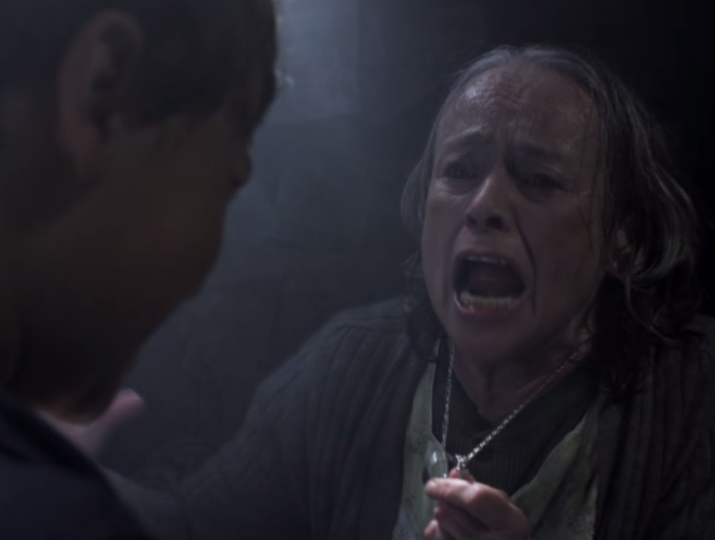 What else is stupid in this movie? Where do I start? The conspiracy of Satanists feels like a terrible rip-off of Rosemary’s Baby, as these people form the worst neighborhood watch imaginable. They’re scheming to get Nat to unlock the End of Days, so they all do their checking up on the Vales family and eliminate any neighbors who say too much. This cozy little neighborhood is replete with death, including the fact that the Vales home was the scene of a massacre. One skittish neighbor informs Jack and Melissa that somebody had an “accident” on the block. “Is he okay?” Melissa asks. “Well, he fell and got impaled on his fence. So, I’d say… no.” I kid you not, that’s his exact wording. This skittish neighbor is also murdered later. This band of secret Satanists includes the new Vales nanny, Denise (Aurelia Scheppers, looking like a poutier Denise Richards). This new nanny murdered the other prospective nannies, which is one way to move ahead of the competition. This nanny is bad news. She teaches Nat all sorts of bad behavior, from frying butterflies with glass to hurling rocks at joggers. And the dumb kid does it with glee, making me lose all interest in whether or not he is Satan’s seed/host/whatever. Then Denise gives the kid a birthday present – an old, spooky-looking comb. To demonstrate, in case Nat is unfamiliar with comb technology, she drags the teeth across her arm and draws blood. Then she gives it over to him to do the same. What? What kid is like, “Oh, wow, a way to ritualistically injure myself? That’s the best birthday present an eleven-year-old could want.” I’m pretty sure the kid would have liked an Xbox over a strange demonic comb. And wouldn’t you know it, this comb makes a return appearance when our Satanic neighborhood watch collects to conduct their business in, I kid you not, a station wagon parked on the side of the street. It’s literally a station wagon with eight or nine people crammed in it, and it’s there all hours of the day.
Then there’s our crazy neighbor lady, whose name I can’t even recall. The screenwriters want us to distrust her from the beginning, and that’s fairly easy when we see how weirdly creepy she’s behaving. She’s obsessed with luring young Nat into her shed, and she keeps offering promises of toy trains, glasses of (poison) lemonade, and promises of cool, fun things. If only she knew a comb was all it would take. This woman is trying to lure Nat with all the verve of a child molester. She’s frantic to kill Nat, even calling Jack at work to lecture him on the necessity of killing his son. Why does the Satanic neighborhood watch let this woman slide on by when they kill any other neighbor for the slightest slip-up? Anyway, this woman just so happens to have a machete in her shed and you can imagine what happens from there.
One more scene of ridiculousness, please indulge me. After Jack sees his son covered in bloody scratches, he accuses the nanny and has her arrested. In a scene of great hilarity for myself, we cut to a scene where the cop and nanny are already in the home, and Denise is dressed like she’s going out for a night on the town, and she’s twirling her hair in her fingertips. The image is so absurd. She gets arrested and thrown into the cop car. “You’re going to regret this,” she warns. Then, magically, wasps come out of a crevice in the side door and the car fills up with a swarm. The cop tries swatting them away and drives headfirst into a telephone pole. I need to note that the editing is so bad in this scene, cutting back and forth between the cop swatting and the car swerving, that the shots never match, so it seems like the longest reaction shots. The car crashes and mysteriously this has caused Denise to magically remove her handcuffs. She strolls out of the car, down the street, and then the car takes its cue and promptly explodes. If this wasn’t dumb enough, we then see different shots of characters around the block reacting to the explosion, heard over and over. One of the Satanic neighbors, still sitting in the damn station wagon, has adept hearing: “That must have been that cop car.” You see, her sense of hearing is so sharp that she can distinguish the make, model, and employability of the car via explosion. Just imagine how useful/useless she’d be in a Michael Bay movie.
 If 11/11/11 was just a supremely dumb movie it might work as camp, but it’s also inept as a scary movie. I don’t think director/co-writer Keith Allan could find an interesting looking shot if it held up a giant “11” sign. There is nothing scary about this movie whatsoever. All the shots of things with 11, it just doesn’t work, yet Allan keeps hitting it ad infinitum, mistakenly believing that while not effective on attempt 51, perhaps it will become effective on attempts 52-68. There’s a scene where Jack is standing watch at his son’s bed and the camera takes turns focusing on every stupid stuffed animal in the room, and Allan’s brilliant idea is to play a sound of the animal as we see its stuffed iteration. The stuffed bear is followed by a bear growl, etc. The fact that this series of animal noises continues for over a minute shows that Allan has no concept of what can scare or even what can entertain. His handling of actors is atrocious, as every single actor just bounces around the place, unmoored, unsure of what direction to take, so they take the wildest one. The actors are either monotone and flat or over-the-top, never believable for a second. Then there’s the “gotcha” ending which makes no sense considering Melissa is only three months pregnant and very much incapable of giving birth to a child, even if that unborn child is an unholy demonic terror.
11/11/11 is a date that will live in infamy, birthing this laughably awful, painfully ridiculous, atrociously inept movie, even by low-budget direct-to-DVD standards. The only entertainment you’ll find with this movie is the derisive sort, yukking it up over the unintended comedy bonanza that awaits. The movie is vague, silly, and overwhelmingly dumb, beholden to an inane numbers conspiracy that doesn’t hold up to scrutiny. I know my expectations should be kept at the minimum when dealing with this kind of movie, but that doesn’t mean I just ignore and excuse every artistic blunder, especially when I feel assaulted by them. 11/11/11 did bring on the apocalypse, and every audience member has left to go to a better place – the bathroom. Bousman should take some comfort knowing that the production house behind this movie, The Asylum, is somewhat notorious for rip-offs. I give you The Asylum releases: Battle of Los Angeles, Paranormal Entity, Transmoprhers, and The Day the Earth Stopped. 11/11/11 can hold one more numerical distinction: it’s the worst film of 2011.
Nate’s Grade: F
Share this:

Tucker & Dale vs. Evil (2011)
 This delightful indie comedy turns old, creaky horror conventions upside down, and in doing so becomes one of the most surprisingly enjoyable, surprisingly sweet little movies of the year. The titular Tucker (Alan Tudyk) and Dale (Tyler Labine) are a couple of hillbilly buddies going out to a cabin for a relaxing weekend of fishing. Their vacation is ruined by a group of snotty college coeds who are convinced, via a chain of misunderstandings and ignorance, that Tucker and Dale are out to kill them. The judgmental college kids go on the offensive and they keep getting killed through macabre accidents. The movie aims to show the “other side” of horror movies, from the mistakenly creepy redneck perspective. Tucker and Dale are a loveable pair of guys who react with genuine horror about all the trail of death that follows them (they think the college kids are a part of a suicide cult). The movie will play best for fans of horror that will recognize all the references and satire. Even if you’re no fan of the bloody, grisly stuff, Tucker & Dale vs. Evil is a clever movie that provides plenty of chuckles. You may not roll in the aisles with laughter, and the film’s aim is a tad slight, but the sweet, bumbling nature of the titular duo will keep you consistently amused.
Nate’s Grade: B+
Share this:

Insidious (2011)
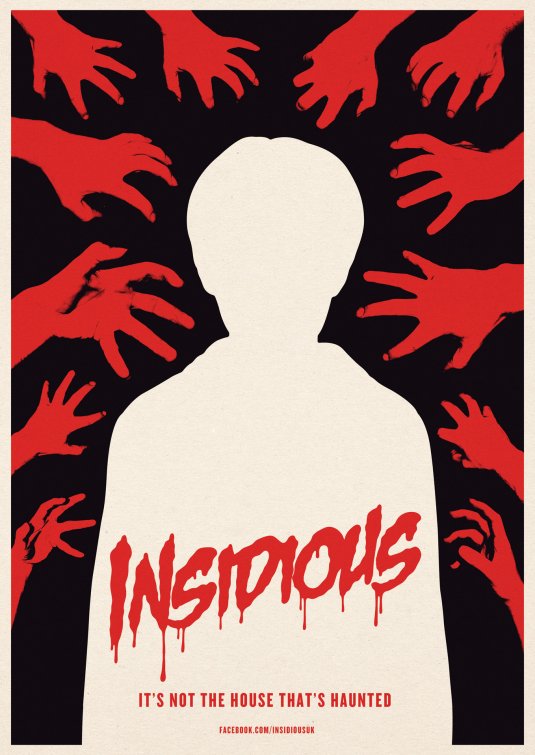 Insidious is like a fresh coat of paint on the old haunted house movie. Director James Wan and writer Leigh Wannell, the team that birthed the grisly Saw franchise, are working in a completely different realm of horror, tying together familiar genre elements (creaky doors, séances, possession, demons with a lipstick fetish?) into one seriously effective spine-tingler. This PG-13 frightfest is well paced and methodically constructed, giving you pause whenever a character ventures offscreen. It finds a way to make old fears scary again. Wan and Wannell find ways to get under your skin. The final act lacks the precision of the rest of the movie, settling on too many explanations and a jumble of action, but the movie works. There are plenty of memorable, deeply creepy images afoot, the score of shrieking violins is a great addition to the ambiance, and the characters seem, given the outlandish scenario, fairly realistic and relatable. Rose Byrne and Patrick Wilson make a rather sweet married couple. Insidious is something of an old school horror film, using clever tricks and avoiding obvious clichés while building a genuine atmosphere of trepidation. The movie got me to yell at my TV, which is an achievement in itself for a horror flick. I lost my sense of place and reverted back to a participant, spooked at what may be lurking in the dark. Not too bad for PG-13.
Nate’s Grade: B+
Share this:

Take Shelter (2011)
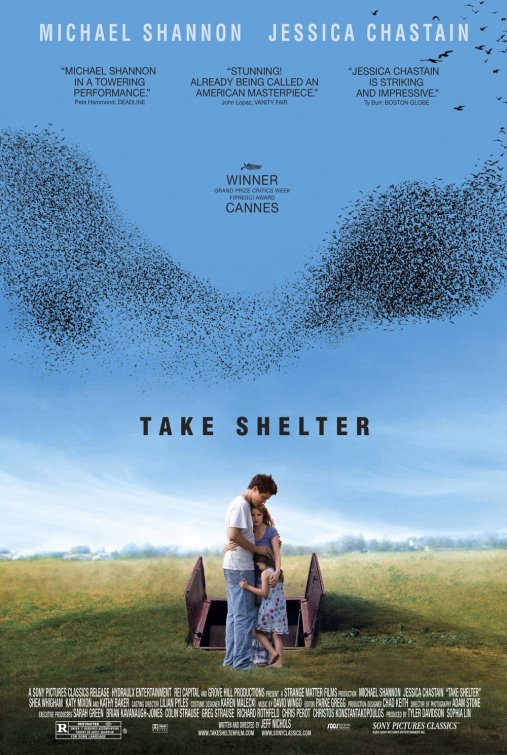 It’s rare that I get to take some local pride and puff my chest about a movie being shot in Ohio. Take Shelter, a small, suspenseful character-piece, was filmed in Loraine County, near Cleveland. Several of the actors in the production are local actors, including Tova Stewart, the adorable seven-year-old who plays the onscreen deaf daughter. The young gal, who is also deaf in real-life, is from Columbus and was in attendance at the theater I saw Take Shelter at. And I can beam with even more local pride at the fact that Take Shelter is unwaveringly magnificent. It’s a remarkably tense movie, deeply realized, expertly crafted, and one of the best films of the year.
Curtis (Michael Shannon) is a working-class family man in rural Ohio. He works as a manager of a two-man drill team, scouring the earth for valuable deposits. His wife, Samantha (Jessica Chastain), cares for their recently deaf daughter, Hannah (Stewart), and sews pillows and embroidery on the side. They are making ends meet to save up for Hannah’s cochlear implant surgery. This family tranquility is interrupted when Curtis begins having strange visions. He sees dark, ominous storms that no one else seems to see. He hears loud cracks of thunder during clear skies. He feels the dark rain fall on his person. He wakes from frightful dreams detailing friends and family turning on him. What does it all mean? Curtis feels compelled to remodel the storm shelter in the backyard. He even purchases a cargo container and buries it in the yard, collecting some end-of-the-world provisions. Could Curtis just be crazy? His mother has been in a psychiatric home since she abandoned Curtis as a child. She began having schizophrenic episodes in her mid 30s, and Curtis is now 35. Is he being warned of what lies ahead or is he succumbing to the pull of a hereditary mental illness?
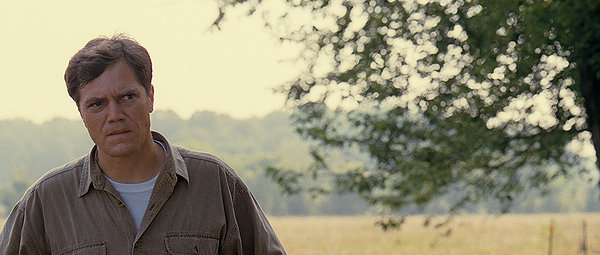 This is very likely the most nerve-racking, tense, dread-filled film I’ve watched since 2009’s Oscar-winner, The Hurt Locker. Writer/director Jeff Nichols (Shotgun Stories) masterfully lays out the particulars of his tale. Even the family drama has some nicely constructed tension. Curtis’ family is living paycheck to paycheck, so his backyard project is a real financial setback. By borrowing equipment from his work, Curtis is even risking losing his job, the only way he can afford his child’s cochlear implant. Not only do we dread stormy weather and strange flocking patterns for birds, we dread the everyday struggles of keeping afloat. Curtis following his visions can very likely put his family into financial ruin, but is that a risk worth taking? Nichols nicely creates an authentic small-town setting. There are small, acute character touches that enrich the story, like when Dewart (Shea Wigham) concludes that the best compliment a man can give is that “he’s lived a good life.” When Curtis and Samantha watch their daughter sleep, they share behavior they are still trying to kick in adjusting to having a deaf child (“I still take my boots off not to wake her,” he confides. “I still whisper,” she returns). These people and their troubles feel believable, and their reactions to Curtis’ strange behavior feel extremely believable. Whispers begin to spread and people start to treat madness like it’s a communicable illness. Religion seems like a natural landing zone when discussing anything apocalyptic and/or prophetic, but Nichols sidesteps this discussion. There could have been some interesting theological room to explore here, considering a Biblical prophet would likely be derided as mentally ill in our modern age. Nichols keeps things secular. Curtis is admonished for missing church again, but that’s about the extent of religion in the man’s life. He does not seek out spiritual advice. He seeks out psychiatry, at least if he could afford it he would.
There are some terrific standard thriller moments, like some well-calculated jump scares and many nightmare fake-outs, but the film’s real skill is drawing out tension to the point where you want to shout at the screen. This is a deliberately paced thriller knotted with unbearable tension. We become conditioned to start doubting the onscreen imagery after Curtis’ series of nightmares. Every time there’s a storm now the audience, too, fears the validity of what we witness. What is the significance of these portent signs? There’s a moment toward the climax, where a storm door needs to be opened, and I simultaneously was dreading every second leading up to that door opening and silently screaming in anticipation. Every part of me wanted to see what was going to happen next and I could not guess where Nichols would take us. I was a nervous wreck. The dread was so heavy, so all consuming, and not just from an apocalyptic standpoint. Curtis understandingly thinks he may be nuts, especially since his own mother is a paranoid schizophrenic. The threat isn’t just the strange apocalyptic signs but also Curtis himself unraveling and lashing out. He worries that he’ll become a danger to his own family, and if he cannot discern the difference between reality and fantasy it’s only a matter of time before he jeopardizes his loved ones. He fears he’ll be ripped away from his family. He wants to be better, he wants to be “normal,” but he can’t trust his own senses.
 Take Shelter is also so effective thanks to Shannon, a talented actor who always seems to be on the brink of freaking out. The bug-eyed, crazed, monotone actor has played plenty of nutcases in the movies. He was nominated for an Oscar in 2009 for Revolutionary Road for playing such a nutter. He’s a live wire of an actor, simmering, waiting for the final cue to explode. Shannon uses this intensity to his great advantage, wonderfully mirroring the movie’s compounding dread. Shannon’s character is troubled, that’s for sure, and worries about slipping into insanity. His performance is simply riveting, searching for answers amidst the desire to keep his family safe at all costs, even if that eventually means his removal. When he has to confront his central dilemma, the legitimacy of his visions, Shannon is racked with fear, eyes glistening with tears, terrified to go on faith, and your eyes are glued to the screen, completely taken in by the depth of the performance. I hope Shannon gets some due recognition come awards season because I doubt I’ll see few performances more compelling.
Chastain has had quite a breakout year for herself with lead roles in Tree of Life, The Help, and The Debt. She has a remarkable vulnerability to her, radiating an ethereal vibe (no doubt why Terrence Mallick chose her), and both aspects are put to fine use in Take Shelter. She’s much more than the oft underwritten put-upon wife, silently enduring her husband’s foibles. She’s desperate for an answer to explain her husband’s actions and motivations. She’s alert, angry, compassionate, and deeply concerned. Chastain holds her own with Shannon, and the two elevate each other’s performance subtlety, making their supportive relationship even more believable.
Take heed movie lovers, and make sure to find Take Shelter, an intelligent, expertly constructed, suspenseful drama with powerful performances and a powerful sense of dread. Shannon’s coiled intensity nicely fits the mounting tension. Nichols has created a taut thriller, a fiercely felt human drama, and an involving character-piece attuned to the talents of its cast. Take Shelter is a commanding, unsettling film that puts the audience in the unreliable position of the main character’s point of view. You may almost hope for some actual apocalypse just to validate the guy’s struggle. When was the last time you secretly hoped for the end of the world just to give one person a sense of relief? Take shelter from inferior movies and find a theater playing this tremendous movie.
Nate’s Grade: A
Share this:

Chillerama (2011)
 Chillerama is the latest ode to the drive-in B-movies of old. Like the higher profile 2007 Grindhouse, this movie is a series of short films from four different filmmakers celebrating the exploitation spirit of schlock cinema. Cecil B. Kaufman (Richard Riehle) is closing his drive-in theater, and for the final night of operation he’s showing four movies never before seen: the killer sperm movie “Wadzilla,” the unexpected lycanthropy romance “I Was a Teenage Werebear,” the black-and-white monster movie “The Diary of Ann Frankenstein,” and a final fecal-filled adventure into the abyss, “Deathication.” However, during this final night the drive-in is also ground zero for a new zombie outbreak, a disease spread through sexual fluids. Tobe (Corey Jones) has to navigate through the sex-crazed corpses to save his crush, Mayna (Kaili Thorne), and escape the drive-in- of death and maybe lose his pesky virginity.
 Given its vignette nature, not all of the segments will be equal in quality. The absolute highpoint is indisputably “The Diary of Ann Frankenstein.” I laughed long and hard during this clever, cock-eyed satire. The absurdity of its premise and the assured demented sense of comedy of its creator, writer/director Adam Green (Frozen, Hatchet), had me laughing until I was in physical pain. The Frank family (formerly Frankenstein) is found by none other than Hitler (Joel David Moore, embracing the silliness with gusto) who dispatches them and steals the family journal. In one of the movie’s funniest lines, Hitler tosses a journal to a Nazi cohort and instructs: “Here, write some depressing stuff in this. We’ll say the girl wrote it and make millions after the war.” Hitler creates his own Jewish Frankenstein-like creature, though a missing film reel reveals his true motivation for reanimating this corpse (and he sings!). Green’s sense of comedy is evident in the pacing, construction of layered jokes, and genre spoofing. There’s one point where the monster is locked in the laboratory and just walks around the set, breaking down the fourth wall. Green even has the entire segment subtitled, though if you listen closely you’ll notice only about 10 percent is German. At one point Moore is screaming “No!” for a solid minute but he says a different word or phrase every time, including “Goldie Hawn!” at one point. The segment is so good that you may not even notice that joke at first glance. “The Diary of Ann Frankenstein” is wickedly hilarious and too tacky to be taken as a serious offense.
The other vignettes falls somewhere in the middle. “Zom-B-Movie” is the slickest looking movie, set in the present, and is a lot of fun. It adds a twist to the crowded zombie genre by adding in a sexual element, making the zombies a sex-crazed orgy (expect nudity that makes you feel funny). There are plenty of solid gross-out effects, and several sequences of penile endangerment, and there are some ingenious camera angles to match the segment’s electric energy. It’s the most self-aware segment, as characters openly discuss horror movie conventions and their own place in the movie Scream-style (“I’m the Final Girl,” one guy declares). A good percentage of the dialogue is comprised of movie quotes and catch-phrases brilliantly placed in this incongruous setting. During the climax, Riehle (Office Space) shoots round after round into the bands of zombies, ripping off like 20 anachronistic movie quotes as if they were action movie quips (“Nobody puts baby in a corner!” he yells and then shoots a zombie in the crotch). I was flabbergasted that the segment actually quoted Billy Madison, and well. The self-aware humor and the overall feverish energy, plus some characters we’ve been investing with in between the earlier segments, makes for a fun and satisfying sendoff for the whole trashy enterprise.
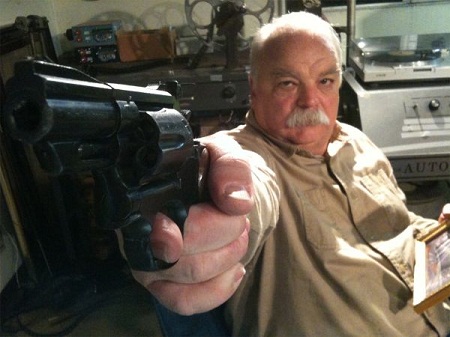 The first two segments rely more on base humor and seem to run out of gas midway through. “Wadzilla” is a one-joke segment about a man whose single sperm grows to monstrous, man-eating size. The cartoonish tone and low-rent visuals feel like a Joe Dante (Gremlins) homage. The segment does feature one truly inspired, wacked-out image: the giant sperm fantasizes the Statue of Liberty stripping out of her cloak and shaking her green goods (I think this segment just gave birth to a brand new fetish). But the overall concept is weak and the segment relies far more on shock value than wit. It’s more like a rejected Troma flick, though helped immensely by the presence of Ray Wise (TV’s Reaper). “I Was a Teenage Werebear” takes the 1950s beach blanket bingo teen films and gives it a gay twist, and to boot it’s a musical (territory covered well in Psycho Beach Party). The storyline of guy-meets-werebear doesn’t provide enough material to hold together the segment. Many of the actors cannot sing either, which adds to the joke but also makes the film more punishing to watch. The pacing is poor and the gags feel like they were the first things conceived. There’s not enough thought on display; the segment just peters out and becomes tiresome. The fact that Chillerama opens with “Wadzilla” and then “I Was a Teenage Werebear” makes it harder to appreciate the finished product.
Chillerama is certainly going to have a restricted audience interested in campy homages celebrating the trashy nature of cheesy low-budget, exploitative B-movies. Unlike Grindhouse, this collection lacks big names but it makes up for it with a cracked sense of humor. The segments all run about 25 minutes in length, which means even if you dislike one it’ll be over soon enough. The four segments vary in quality, though each has its moments. “The Diary of Ann Frankenstein” is easily the standout of the bunch, elevated by droll, absurdist, demented humor that’s skillfully constructed and deconstructed. “Zom-B-Movie,” the culmination of the film’s connecting characters, is a fun blast to conclude with. Chillerama is a messy, uneven, crude, occasionally brilliant, but most of all it’s a great way to spend a Saturday night with some friends and a supply of popcorn. Just watch out what’s in that butter topping.
Nate’s Grade: B


You must be logged in to post a comment.