Blog Archives
Red State (2011)
 Kevin Smith, love him or hate him, you can’t deny the man is a natural promoter. Earlier in the year, the indie filmmaker self-distributed his first foray into horror films, Red State, on a nationwide tour of screenings. I first saw Red State way back in March when Smith visited Springfield, Ohio to screen the film and then answer questions afterwards. I’ve been trying to wrestle with my critical opinion in the ensuing months. Fortunately for me, Smith has made it extremely easy to revisit my thoughts. Red State eschewed the traditional theatrical release pattern for a new digital-age model. It was available on demand through cable systems, available for download, and even broadcast in special theaters for a one-night only event. A month later the film hit DVD. In its better moments, Red State is the unholy union of Quentin Tarantino’s love of language, and penchant for jolting violence, and the Coen brothers’ nihilistic, cock-eyed sensibilities. This is strange new territory for the man. I wish I could say Red State is worthy of all the attention, though this sinister, messy, gritty little movie can work its wicked mojo, at least for a while.
The Five Points Church is a notorious family-operated cult. Under the guidance of their shepherd, Abin Cooper (Michael Parks), this fundamentalist Christian group pickets the funerals of dead soldiers, haranguing the grieved that their loved ones are dead because “God hates fags” (excuse me for failing to put two and two together). A group of teenage boys (Michael Angarano, Kyle Gallner, Nicholas Braun) is lured to Sara’s (Melissa Leo) trailer with the promise of sex. The middle-aged woman plies her young bucks with drinks and they are knocked out. The boys awaken to find they are inside the Five Points compound and witness to Abin Cooper’s solution to sinners. Rather than railing with signs, the family has decided to take a more hands-on approach and execute them. While this is going on, a sheriff’s deputy alerts the authorities and the ATF rolls up to the compound. Lead by Agent Keenan (John Goodman), the government agency engages in a firefight with the rightwing cult. Ordered to take down the compound, and all witnesses, the various characters will try and escape with their lives, never knowing when that fateful moment of atonement may drop.
 What Smith does well for a genre novice is to keep his audience constantly upended. Just when we think we’ve settled on a protagonist and a plotline, suddenly Smith switches gears. The surprises are sudden and often merciless, leaving the audience little room to adjust. In a genre usually beholden to formula, the consistency of Smith’s surprises makes for a darkly satisfying viewing. Watching Red State demands due attention. Naturally, not all of these tonal shifts work to the movie’s best interest. The final shift, to all-out action thriller, is the most leaden. The Ruby Ridge/Waco-style standoff allows for a lot of gunfire but very little action. We mostly just cut back and forth between the two sides firing and, inexplicably high numbers, being shot in the face. It can get repetitive and seem like all the mounting tension gets squandered. There is a nice storyline within of one family member, Cheyenne (Kerry Bische), forming a plan to save the compound’s children and escape. Bische (the lead on the last season of TV’s Scrubs) makes fantastic use of her limited screen time to render the anxiety and fear of her character. She’s second only to Parks in the performance department as far as I’m concerned. Then the climax comes along and Smith teases being audacious, going in a fire-and-brimstone angle that would completely obliterate audience expectations. And just when it seems like we’re about to get something radical… Smith falls back to what he knows – dialogue. For the final five minutes, Smith concludes his narrative with two government officials explaining what happened in florid detail. It’s a fairly big letdown.
The setup of luring teens to their doom is an old horror staple, though usually the ones doing the sacrifices are card-carrying Satanists. And when exactly would a Satanist be in a situation needing to prove their validity with a membership card (“I’m sorry Mr. Darkseed, but we can’t give you the ten percent discount on all those goat skulls unless we see some valid photo ID.”)? Smith flips the switch religious allegiance. Instead of Satanists or some other misunderstood fringe religion, the cult is a group of pious Christians. There’s plenty of room to work here and Smith refrains from making easy associations; the Five Points nutjobs aren’t meant to represent Christians as a whole or Christianity. They are extremists, and they will go to extreme measures. Ostensibly based upon the Westboro Baptist Church and Fred Phelps, you keep waiting for Smith to satirically carve up the clan, but this never really occurs beyond the superficial. Smith’s writerly instincts give Abin Cooper a ten-minute sermon/platform where the guy just unloads a hate-filled diatribe against homosexuals and progressives. For many, this will be the make it or break it point of the film. There are some genuinely tense moments to the first half of Red State. There’s one scene where the camera holds on Gallner (The Haunting in Connecticut) inside a wired cage. He rattles and screams and generally comes unglued, and we too piece together what he hears, dreading what is to come. The many escapes and narrow calls are also harrowing and finely edited to ratchet up suspense.
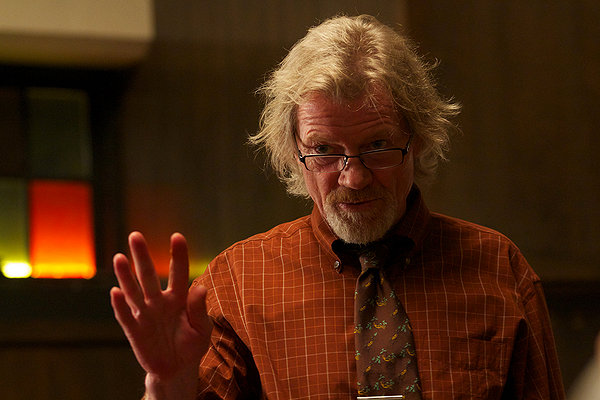 It seems, though, that Smith’s bleak screenplay does not present any characters we can truly root for. Horror has been shifting this way for the past twenty years. Thanks to the rise of the slasher flick, audience empathy has shifted from being with the running/screaming victims to being with the gruesome yet personable killers. Red State has a high body count but you won’t feel much when those bodies hit the floor. You’ll feel a jolt of shock, but from an empathy standpoint the needle barely registers. Sure, we don’t want people to be tortured and we want the abused to escape torment, but that’s not the same as characterization. The closeted sheriff (Stephen Root) feels like the start of an idea more than anything else. The trio of teen boys is presented with as little care as any other throwaway slasher flick. They are but meat for the grinder, our entryway into this hidden and spooky fundamental world. These aren’t so much characters as bodies waiting to be slain. The people are set up so they can be knocked down. This issue can become troubling when Smith wants us to rethink our loyalties, especially once the siege has begun. He wants us, dares us, to start feeling empathy for members of the Five Points Church. The problem is that the plot’s adherence to shock value and the underbelly of human nature has desensitized our empathy. When the ATF starts firing most in the audience will probably just cheer, not reflectively question the moral relativism. I doubt anyone will be switching allegiances midway through.
Cults are usually held together with a charismatic leader, and Red State has that in spades with Parks. The man just dissolves into his twisted character, a preacher that uses the Word of God to indoctrinate and arm for his own holy war. Parks has done fine supporting work before in the stable of Tarantino and Robert Rodriguez movies, but Red State is the actor’s biggest modern showcase yet. The man makes your skin crawl the way he can wrap hate into a honeyed, easily digestible product. Abin holds sway over his flock and likewise Parks commands the screen. He provides grandeur and menace to Smith’s words. It’s not a scenery-chewing performance; Parks doesn’t go for the obvious notes when he can hit something deeper and more unsettling. You get a sense that this man fully believes the dogma he teaches, and that makes him all the more terrifying. The other actors peopling Red State are fine, though Leo (Oscar-winner for The Fighter) seems a bit unrestrained especially in contrast with Parks. Goodman (TV’s Treme) gets to talk on the phone a lot to his unseen superiors. The end of the film just descends into frenzied yelling on everyone’s part.
Credited as a horror movie, though I view it more of a survivalist thriller but I suppose genre specifications are subjective, regardless, Red State is miles away from Smith’s usual output. The movie has its share of creeping dread and menace, thanks to Parks’ transfixing performance. The screenplay is unrepentantly dark, cruelly cutting down lives with shocking acuity. The constant surprises and upheavals are a way to keep the audience guessing, though the shock value starts to wear off by the noisy, repetitive gun battle climax. It’s hard to nail down exactly what kind of commentary Smith is presenting. Obviously he doesn’t side with the hateful fundamentalists (this is probably why he pulls back at the end), but he also shows the government’s reaction to religious zealots to be morally queasy at best. It’s hard to get a read what the commentary is, and with horror, if you don’t take a stab at commentary then you’re just watching high-gloss snuff films. Red State resembles a snuff film in several ways and not just in its grimy aesthetics. You feel a little dirty after it’s over, and you can’t help but question your motives for watching it. Plus you can’t help but think it could have been better done (note: I have never watched an actual snuff film, you sickos, but the point remains).
Nate’s Grade: B-
Share this:

The Thing (2011)
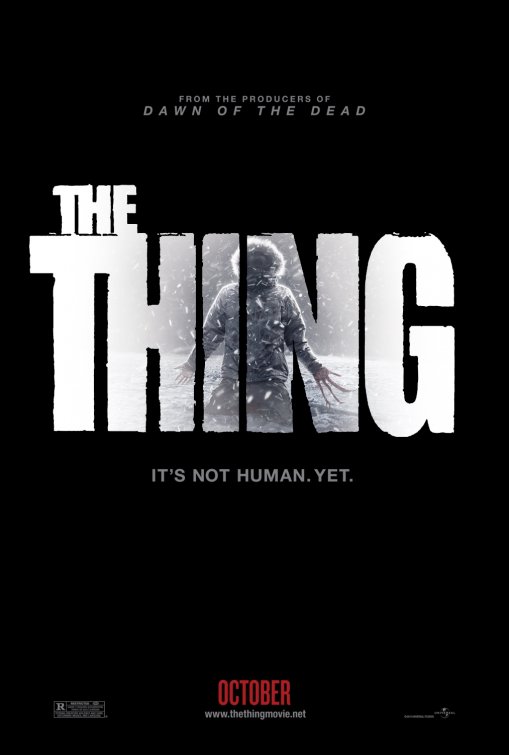 Has any modern filmmaker endured more crappy remakes of their films than John Carpenter? The man has suffered through remakes of Halloween, The Fog, Assault on Precinct 13, and now his 1982 creep-fest The Thing, itself a remake of the 1951 Cold War allegory, The Thing From Another World, gets the same awful treatment. This new Thing is some hybrid of remake and prequel, because it’s set before the events of the 1982 film but it pretty much follows the same overall plot. Once again a group of scientists (this time they’re Norwegian!) on a remote Antarctic outpost discovers an alien body buried in the ice. Once again the alien breaks loose and can assume the fleshy form of man. But this new film forgoes the rampant paranoia and rising tension of Carpenter’s film for cheap Boogeyman thrills. The alien monster is introduced early and the rest of the film succumbs to people looking around pensively, afraid it will jump out and attack. This alien creation is an odd quirk of evolution; a species that seems to be made of nothing but gnashing teeth, spindly legs, and vaginal imagery. How these things built and fly spaceships, I have no idea. Some of the gore effects are crafty and stomach-churning, but nothing is as memorable as the practical effects used sparingly and to great effect in the 1982 flick. This Thing is too much of a familiar monster to make an impact.
Nate’s Grade: C
Share this:

Scream 4 (2011)
 What do you do when your satiric self-aware take on pop culture becomes the MO for a generation? Back in 1996, Scream was a breath of fresh air by sending up dusty horror staples and having highly literate characters, with exceptional vocabularies, deconstruct genre elements while ironically falling victim to them as well. In 2011, Scream 4, an obvious paycheck grab, is showing its age. After a rather nifty series of opening fake-outs, which gave me hope that returning writer Kevin Williamson was going to finely skewer the conventions of horror since Scream last went dormant in 2000, but sadly this is not the case. “New decade, new rules,” one character says, but it’s all so much of the same. People run, they get stabbed, only the locations are truly different. There are a few witty jabs about the obsession with reboots and remakes, and Williamson does secretly work a crafty symmetry to the first film as far as characters go. The body count is much higher but the scare quotient is low. And then brining back the original cast (Neve Campbell, David Arquette, Courtney Cox) seems like a waste if they cede almost all screen time to a bunch of fresh-faced high school kids who were learning to walk when Campbell was learning to run for her life. The satirical elements feel so lazy; if you’re going to introduce technology-obsessed characters and the narcissism of social media, then do something with it. Don’t introduce an element like a webcam and then barely use it. The scares are about as flimsy as the commentary. The reveal of the killer(s) is stupid enough, as is the cracked motivation, but the ending just piles one absurdity onto another. It doesn’t know when to stop, and Scream 4 flirts with some daring possibilities to wrap up its bloodshed. Scream 4 is a drifting vehicle, wasting potential at every opportunity. The weight of all those red herrings, genre riffs, ironic twists, and self-aware characters has gotten to be too much. The Scream franchise has morphed into what it once parodied.
Nate’s Grade: C
Share this:

Piranha 3D (2010)
 Truly missing out on seeing Piranha (as its home release now calls it) in 3-D will be one of my life’s greatest disappointments. This boobs-and-blood-soaked ode to 80s exploitation horror has its tongue firmly clenched in cheek. This is a gleeful gorefest that plays many of its absurd elements for laughs while squeezing in gratuitous nudity at every turn. There’s an underwater lesbian synchronized swimming sequence that I’m utterly certain would have been the greatest thing to witness in the third dimension. Regardless, this Jaws rip-off (Richard Dreyfuss even shows up in the opening dressed identically to his character and named “Matt”!) plays like an ironic parody of the genre while still satiating its red meat-hungry target audience of teenage boys. To this point, it succeeds admirably. It is crass beyond belief and delivers exactly what it promises. Watching actors like Elisabeth Shue, Adam Scott, Christopher Lloyd, and Jerry O’Connell ham it up alongside some fairly cheesy special effects critters, you never feel the waft of desperation. The movie ends too abruptly for my tastes, leaving too much open and unresolved for presumable sequels. As my friend Eric Muller said: “We watched a 3D movie in 2D that was really 1D.” While the movie is entirely one-dimensional in scope, that lone dimension is a blast. I know where I’m going to be when the rumored Piranha sequel is released. And this time, I’m seeing the campy carnage in 3D.
Nate’s Grade: B
Share this:

A Nightmare on Elm Street (2010)
 The next in an endless assembly line of vapid horror remakes, a new trip to the realm of Elm Street at least held some promise. The famous boogeyman Freddy Kruger was going to be played by Oscar-nominee Jackie Earle Haley (Watchmen). Has any other actor of Haley’s caliber played a blatant slasher villain in recent memory? And the playground of the Nightmare on Elm Street franchise was the world of dreams, which should be fruitful territory for some bug screen chills. I mean you don’t have to adhere to earth logic anymore, not that horror movies tend to. I didn’t expect much but I expected the movie to do more. Many of the signature moments from the first film are simply repeated. How does an entire school of young kids forget that Mr. Krueger molested them? What is the point of hiring Haley and giving him nothing to do? Lead actress Rooney Mara (soon to be seen in as the “girl” in David Fincher’s Girl with the Dragon Tattoo) looks as bored as somebody watching her movie. Her performance is lifeless for a film that requires energy and action. There is such wasted potential in the world of reams and personal fears. The whole movie just feels so rote and routine, following an established pattern of terrorizing the teens and knocking them off one-by-one; you get an overwhelming impression that everyone was just going through the motions, repeating someone else’s song and not bothering to make it their own.
Nate’s Grade: C-
Share this:

Saw 7 (2010)
 The story behind Saw 7 (or as presented in theaters, Saw 3D) is more intriguing than anything you’ll find in this lackluster chum bucket of guts. The director of Saw 6, series editor Kevin Greutert, was all prepared to go off and direct the sequel to the surprise smash, Paranormal Activity. The folks at Paramount even penciled in a Halloween release date, long the fertile ground for the annual Saw sequels. It seemed like Paramount was rubbing in the fact that they now had the more exciting, buzz-worthy franchise and they would tap dance on the grave of Saw. Well the studio suits didn’t take too kindly to this broadside, so they activated a clause in Greuter’s contract. The man was legally required to leave the Paranormal Activity 2 project so that he could direct a seventh Saw film. Because nothing says “work of art” like forcing your director to make a movie by threat of legal action.
Saw 7 is billed as the “Final Chapter” but it doesn’t feel like a satisfying conclusion, more like an overdue mercy killing. It’s no secret that the Saw franchise has been flailing and sputtering for quite some time, with the bizarre exception of Saw 6 (my friend Eric proudly deems it the “Godfather II of the Saw franchise”). It was because of Saw 6, a fascinating return-to-form by tackling the topical issue of health care reform, that got my hopes slightly renewed for the franchise’s finale. Having health insurance employees as the victims gave the franchise some much-needed populist anger, a renewed morbid fascination that was surprisingly enjoyable. Imagine Saw 7 taking on the extension of the Bush tax cuts? Alas, my fledgling hope was for naught.
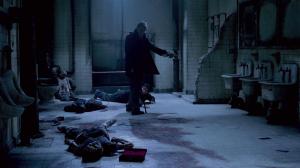 Part Seven follows a self-help guru Bobby Dragan (Sean Patrick Flanery) who talks about surviving a Jigsaw death trap as a spiritual awakening. Except that he’s a fake; he’s devised this phony survival tale as a scheme to get rich. Naturally Jigsaw (Tobin Bell, as always, in flashback) doesn’t take too kindly to this misrepresentation. Dragan would seem like a prime candidate for the haunted warehouse of horrors that Jigsaw usually specializes with, except that Jigsaw has been dead for four films now. His second apprentice, Hoffman (Costas Mandylor), is wanted by the police and FBI and even Jigsaw’s own widow (Betsy Russell), who unsuccessfully tried killing Hoffman with one of the series’ infamous bear traps masks. So let’s stop and think this out. Hoffman, who is on the run and established as a serial murdering fiend, still takes time out to set up a warehouse full of death traps for Dragan to fulfill his late employer’s wishes. If it’s not obvious now let me make it pointedly clear – in whatever city these murders, take place, it has the most incompetent police force in the history of the universe. Did they literally hire the Police Academy crew? That would make for an entertaining diversion that might reboot two franchises.
As always, the sinister death traps are the real draw of the franchise, and these convoluted killing devices have been getting less inspired from each shallow sequel. These contrived contraptions always bothered me in their uniform intricacy. The franchise began with some pretty simple scenarios: crawl through barbed wire to reach an exit, while covered in kerosene hold a candle to see a written combination, saw off your feet if you want to escape a filthy bathroom of doom. Then in order to top the previous film, the death traps got more contrived and involved a lot more engineering muscle. The more complex they got the less interesting they became. Now with Part Seven, some traps include a three-headed saw with each member of a love triangle in its aim. Two guys, the boyfriend and the “other man,” have to overpower a saw or they can relax and let the woman that’s come betwixt them lower onto a saw blade. This opening trap is the start of some dubious misogyny even for a genre as female punishing as horror. There’s a gauntlet of grisly horror in store for a bevy of female characters, usually involving something sharp penetrating them. But for the lone man who falls into a Jigsaw trap he meets his death by… hanging. Yes, a simple almost merciful hanging compared to the gruesome fates the women encounter. I’m not seeking feminist sensibilities from a genre that profits from their half-naked terror, but Saw 7 is even sicklier because of the undercurrents of misogyny. The traps in number seven aren’t memorable, interesting, and they feel like they’ve been done before in some earlier incarnation (a woman being “smoked” in a mechanical pig does seem to be different).
 The biggest problem with Saw 7 is that it doesn’t feel like anybody gives a damn anymore, including the filmmakers and actors. The production values seem like a world away from other movies in the series. The entire affair reeks of “direct to video” even though it was shopped as a 3-D theatrical experience. As you can imagine, because of the gimmicky 3-D, the movie is filled with plenty of pointy objects pointed at the screen. When watching in traditional 2-D, it gets fairly tiresome. Also because of the 3-D presentation, the filmmakers had to compensate for how dark the 3-D glasses make the movie. That means that the spurts of blood are in a rather unrealistic pink lemonade shade, like the retro blood from 1970s exploitation flicks. Without the glasses, as most will view the film at home, it further cements the overall cheap atmosphere. The production design, cinematography, and editing all feel like the Lionsgate intern team performed them. Every technical aspect feels more than sub par, it feels like no effort was exerted whatsoever. Sure it got finished, but finished and complete are different.
The Saw franchise has always been built around the craft death traps and a last-second twist ending accompanied by a barrage of scenes given new context. This formula has been repeated with each installment, so I expected nothing more and “nothing more” is what I received. Saw 7 thinks its audience demands to know its convoluted back-story, which gives way to all sorts of behind-the-scenes flashbacks that are always retroactively changing and channeling the timeline of events and participants. I think it’s all frightfully boring. I don’t care who screwed what bolt into what. I’m not watching Saw for realism (hence why the police NEVER think about tracking what vacant warehouses are sucking down gads of electricity). But at this point, with the thrill of the death traps long beaten into a bloody submissive pulp, I don’t even know what I would watch this series for. The appeal seems to have died along with its boogeyman, Jigsaw, four films back. The subtitle “The Final Chapter” seems like a promise destined to be broken. In the annuls of horror, any successful franchise will live on forever with cheap made-for-DVD sequels. Saw 7 just feels like the first made-for-DVD sequel, except it got a theatrical release as one final gasp at cash. Just wait twenty years and the whole thing will be rebooted as some sort of prestige picture that speaks to man’s inhumanity to man circa 2030.
Nate’s Grade: D
Share this:

Devil (2010)
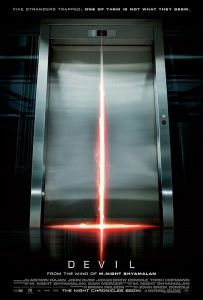 2010 has been a banner year for Trapped to Stuff Cinema. People have been trapped on a ski lift (Frozen), under a rock (127 Hours), in a coffin (Buried), and now with Devil… an elevator. The story comes from “the mind of M. Night Shyamalan,” not exactly a selling point at this juncture in time: five strangers are trapped in an elevator and one of them happens to be the titular devil. Now, that may sound like a waste of the Devil’s abilities; surely the Lord of Evil has better things to do than mess around with people in an elevator. Regardless, this low-rent thriller nearly overdoses on terrifically noisy jump scares as its primary source of spooks. As the candidates get picked off one by one when the lights go down, the guessing game becomes more tiresome. Even at a sparse 75 minutes the entire film feels exhausted. The characters are dumb. The Hispanic security guard tries to convince others that the devil’s responsible for the shenanigans. His method of argument: tossing a piece of toast in the air and saying because it landed jelly-side down, the devil is in play. Because when Old Scratch’s around, only bad things happen (protect your toast). The ending feels both contrived and tonally inappropriate, like putting a smiley face sticker on a school report on Ted Bundy. This is an entire movie that lands jelly-side down.
Nate’s Grade: C-
Share this:

Splice (2010)

Splice is a slice of freaky-deaky sci-fi horror done with enough style and weirdness to keep your eyes glued to the screen. Director Vincenzo Natali (Cube) takes a few notes from David Cronenberg in staging his creature feature. A scientific couple (Adrien Brody, Sarah Polley) are about to have their gene-splicing lab shut down, so they make a radical decision to start an experimental personal project. Utilizing human genes, they combine other DNA to create a new species. The moral ambiguity and scientific danger is thoughtfully addressed, with the couple quickly finding how easy it is to make moral compromises. Soon they become attached to the creature they name “Dren” and view her as a daughter. Things get even crazier when Dren starts exhibiting some Oedipal desires (I believe the reverse is more fitting, an Elektra complex). Slick cinematography and seamless practical and digital effects help ensure that Splice is never dull. The movie seems two steps away from achieving true greatness. In the end, after all the intrigue and surprising amount of emotional subtlety given the premise, Splice devolves into a by-the-numbers slasher film. The final act is all about character poking around in the dark for the big scary monster. It’s not nearly as intellectually stimulating. In this regard, Splice reminds me of 2007’s Sunshine, another sci-fi film that started strong, had some style and brains, and then blew it by devolving into a clichéd horror movie where characters outrun a super-powerful slasher villain. As a fan of intelligent sci-fi, it’s frustrating to get teased with greatness and have to settle with pretty good, but I’ll gladly take the gonzo pleasures of Splice over any rote action thriller.
Nate’s Grade: B
Share this:

Paranormal Activity 2 (2010)
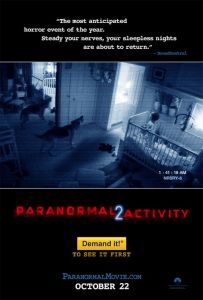 The real draw for the first Paranormal Activity was that it was a word-of-mouth secret that became a sensation. You just had to see what all the fuss was about. It was the super cheap little indie that could and took the nation by storm. Of course, with any product that makes money a sequel must come. But it’s hard to repeat a phenomenon, just ask the makers behind Book of Shadows: Blair Witch 2 (an odd, fascinating failure). Paranormal Activity 2 is a decent slow burn horror movie but it can’t escape the long shadow of its predecessor. There isn’t enough new or interesting to justify this redundant exercise in standard low-wattage terror.
The first film involved the haunted bedroom of a couple, Katie (Katie Featherston) and Micah (Micah Strout). They filmed their nightly haunted shenanigans and it all didn’t end so well. Now we have Katie’s sister and her husband. They’re welcoming home a brand-new baby boy, Hunter, when they find their home has been trashed. Rooms have been upended but no valuables are missing. The family gets a home security system installed with multiple surveillance videos to spy for intruders. Of course these cameras also begin catching strange occurrences in the house. It seems a sinister presence is after the baby. Apparently demons love children, did you know this? Hell has a really fantastic T-ball team.
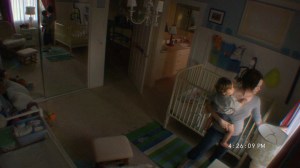 Like most other gimmick movies, duplicating the same effect leads to diminishing returns. Part of what made the first film work was its relative freshness and creative ingenuity. For a measly $11,000, director Oren Peli was able to fashion and sustain a mood of mounting dread that also stayed within the confines of the “found footage” concept. He built up suspense gradually and lead to some terrific “boo” moments. I’m still amazed how Peli was able to pull off some of his tricks sight unseen with such a minuscule budget. Part of the appreciation of Paranormal Activity was the level of skill for the craft. Now along comes a sequel with a $3 million budget, which is still chump change by Hollywood’s standards. However, it’s a large enough figure that I never once questioned how they were ale to pull anything off. I expected more from the sequel given the budget and the general nature of sequels to inevitably up the ante. You’ll still be scanning the frame of those surveillance camera angles, looking for any sign of something amiss or strange. The whole process can be maddening in both a good and bad way. Much of whatever tension does build is in these moments of uncertainty waiting with baited breath. It can seem like an interactive group game of Where’s Waldo. You’re sort of relieved when something actually does happen to break the nothingness.
As a whole, Paranormal Activity 2 doesn’t work as well when it comes to the construction of their scares. The first film primarily took place in one location, the bedroom, the sanctity of the modern man’s domicile. Whenever we got to beddy time we knew what waited. A visual vocabulary had been built to get the audience sweating as soon as the characters sleep. And isn’t disrupting our sleep the ultimate home invasion? With the sequel, there are multiple cameras to work through, always opening with the same shot of the pool cleaner busy at work. We start with pool cam, then after a while we add one more, kitchen came, then stair cam, etc., but we always cycle back to the original before moving forward. It can become an especially tiring pattern, especially when early camera angles prove to have nothing going on within. The pool-cleaning robot emerges as the breakout star of the film (evidently the first sign of a haunting is a dirty pool). There are some effective scares but it’s all in the jump scare/gotcha variety. The film toys with the possibility of a night vision mode for the ever-present camcorder tossed around the home. This possibility is woefully underutilized and only saved for a mad dash through the house at the conclusion.
 Repeating the same haunting elements may work in a narrative sense but it also mitigates the impact. You know what to expect. Hearing loud noises or watching doors slam shut does not offer the same jolt the second time around, especially on a larger budget. It’s unavoidable that Paranormal Activity 2 will become a victim of the first film’s success. Unless it raises the stakes, the movie is just going through the same paces with different faces. This time there’s a baby that’s being sought after by a malicious spirit. If all you’re doing is raising the “innocent quotient” of the victims then the film might as well be set in a impoverished Bangladesh orphanage where the kids all have terminal diseases as well. Paranormal Activity 2 tries to repeat the same tricks to mixed results. The scares are too few and far between and none have the same power as in the first film. The climax is lazily similar as well.
Unlike the first film, much of the movie feels like it’s just filling time to space out its scares. You won’t feel any true sense of attachment to these people nor will you get excited when they parcel out morsels of back-story (the first mom died and… what?). Instead of a young couple we now have a young couple… with a baby! And a teen daughter too but really it’s all about the baby. The family members sit and talk at length rationalizing the weird phenomenon. They even perform research on the Internet and make sure to record themselves with a camera they set down. Who does that? Who records simple conversations? The family’s main dilemma is that dad is unreasonably skeptical despite strong video evidence. Why do these people still let the baby sleep alone? Why haven’t they brought the baby’s crib into their own bedroom? The family pet, a trusted German shepherd, is good protection. The dog growls and barks because animals, just like Hispanic housekeepers the film asserts, innately know when evil spirits are afoot. Why do Hispanic women all have fine-tuned demon radar in the movies? Is this a feature that a Caucasian male can upgrade to? Apparently, the best protection you can afford your home is multiple dogs and multiple Hispanic housekeepers to stand guard.
Paranormal Activity 2 attempts to deepen the mythology of the franchise. It takes place both before and after the events of the first movie, providing some explanation as to what the demon is really after and how it came to terrorize Katie. It’s nice to watch how the two movies fold on top of each other and guess what areas will next connect. Katie makes numerous appearances and ironically offers the sage advice to her sister to just ignore those bumps in the night. When Micah makes an appearance he is accompanied by onscreen text that informs us that this is 3 weeks before his dead body is found. Why? We already know thanks to Katie’s early presence that the film is a prequel, so we already know the doomed fate of Katie and Micah. What does spelling it out have to offer the audience?
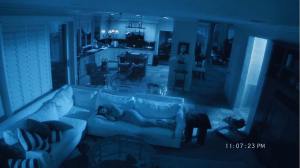 Paranormal Activity 2 runs into problems when it imitates what worked previously but doesn’t add any new flavor, escalation, or variety. The freshness of the concept is quickly turning stale. What was new and exciting is now being written into rote rules for the franchise. I can only surmise that the Paranormal Activity franchise will follow the same downward slide as befell the Final Destination franchise once the audience became hip to all the rules. Surprise goes out the window when films are made to meet genre expectations. You’re still relying overall on your imagination for much of the scares in Paranormal Activity 2, which will vary depending upon the individual. I just think it’s harder to trick you the second time around. My brain kept saying, “I’ve already seen this movie. Been there, done that.” I had no actual rebuttal for my brain, so I ate some popcorn and scanned the screen looking for more weird stuff.
Nate’s Grade: C+
Share this:

Saw VI (2009)
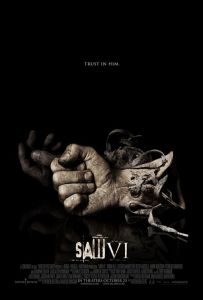 I checked out on Saw 4 and Saw 5 feeling like this horror series had grown stagnant, plus its central villain was killed off by the conclusion of the third movie. I thought the series wouldn’t go on for much longer, and oh how wrong I was. Jigsaw (Tobin Bell) has a second apprentice now fulfilling his departed master’s bidding, capturing even more people and trapping them into the franchise-favorite death traps. This means that there are yet even MORE recorded messages and vast, abandoned warehouses out there. FBI Agent Hoffman (Contas Mandyor, an amazingly horrible actor) has taken up the contrived contraption mantle. Of course it’s all preposterous and overly gory, but that never stopped the series before. Saw 6 boasts the franchise’s fourth director (the editor of all the previous movies just graduated to the big leagues). But this is mainly a franchise built around the hardened desires of its fans, indoctrinated in the gospel of gore. As I said before with Saw 3: “Just like the collapse of the Final Destination franchise, these movies started big but then bottomed out when their audiences had the rules memorized. At that point the only thing left is curiosity in what fiendishly outlandish ways people will get horribly killed.” This pretty much still holds true.
The real interesting draw for the sixth entry, and the only reason I drifted back in curiosity, is because Saw 6 is the weirdest participant yet in the current health care debate. The victims in this installment are health insurance employees. The people in charge of deciding who live and who dies are now put through morally challenging, queasy challenges. It’s a lot harder to kill somebody deliberately rather than by omission, by denying coverage or finding a loophole to get out of paying for a perfectly reasonable, and much needed, procedure. There’s a macabre enjoyment in watching health insurance officials put through Jigsaw’s battery of tests, though some of his victims seem pitiable — one guy is thrown in just because he’s a smoker (I suppose Jigsaw didn’t consider giving the guy a nicotine patch first). The main character going through the funhouse of horrors is an insurance company CEO (Peter Outerbridge) who has his mathematical equation about who earns coverage put to the test. Jigsaw is exacting vengeance after the CEO denied him coverage on an experimental treatment for cancer. It’s easy to see what side of the issue Jigsaw is on; he says that insurance companies put profits over human lives and get in the way between doctors and patients. This is a Saw movie even Michael Moore could cheer. I wish at the recent health care summit on Capitol Hill that the president had said, “Gentlemen, we’ve heard what the Democrats had to say about health care, we’ve heard what the Republicans had to say. I’d now like us all to see what Saw 6 has to say on the matter.”
 The story again is cut into two halves: the health insurance CEO going from death trap to death trap, and Agent Hoffman trying to stay ahead of the FBI investigation into the new Jigsaw killer. Guess which is more interesting? The FBI agents in this movie are those classical trained bumbling FBI goons that always come in late, take things over, and properly muck everything up. These people are lousy detectives and even worse at hiding their suspicions about Hoffman. It’s no surprise then that he manages to outsmart these idiots when Hoffman is, in fact, a dolt. This is not a smart man. Case in point, he’s using the severed thumb of a dead agent (Scott Patterson, apparently on Hoffman’s trail for the previous two films) to mark up bodies and frame the guy. Problem is that he’s framing a dead man, which means Hoffman has a really small window of plausible time to make this frame credible. It’s not going to work months later when the FBI wonders how a dead agent keeps kidnapping new people and putting them through hell. Then again, given the intelligence level of these onscreen agents, I’d assume that the FBI would blame zombies.
The apprentice aspect has always been the worst part of this series. I do not care whatsoever about the ins and outs of how Jigsaw set up his traps and who helped build the damn things. This isn’t some Discovery Channel series. I don’t need to watch the behind-the-scenes look at the grisly garage of doom. Just like the third Saw film, this is another entry that wants to play around with the bigger Saw picture. Scenes are introduced that retroactively alter the Saw timeline of events, causing characters to grow different motivations. I swear, the Saw movies all start to feel like they’ve been built from the rotting leftovers from each previous and less effective movie.
The only thing of note as far as acting goes is that the opening player (Tanedra Howard) won a VH1 reality show competition for a spot in this movie. Ladies and gentlemen, we now live in an age where people will compete for the luxury of being the first to cut open their insides in the SIXTH movie of a flagging horror franchise. You don’t want to know what they’re willing to do for a spot in the next flick.
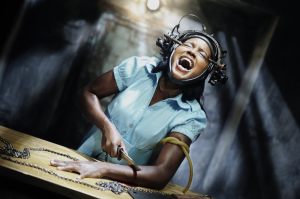 The draw of this franchise are its clever yet queasy death traps where the audience can place itself in the victim’s position and wonder what they would do given the life-and-death circumstances. How far would we all go to live? Well, in Saw 6 the traps aren’t that fiendish or memorable. The best one involves a group of six insurance actuaries (experts at finding loopholes to deny and cancel coverage) tied to a carousel with a shotgun pointed at them. One by one they swing by the kill zone, making it the most proverbially deadly game of musical chairs ever. Even better is the fact that the CEO is given the opportunity to “save” two on the carousel from the shotgun blast, so they each start screaming little arguments why they are worthy and their peers are not. It’s a neat little pressure-cooker of a scene, especially when one guy on the carousel realizes he’s the last to die. The thing slowly reels back around as he uses his final seconds to demand that the CEO look at him (“You look at me when you kill me!”). That defiant little moment manages to pierce through the ponderous personal growth edict the series has foolishly heralded as its purpose. The rest of the death traps are just cruel and labored and not nearly as interesting. You ca only watch people singe their skin on hot burners so many times before the body begins to involuntarily yawn.
Saw 6 is certainly no better than the other movies but neither is it worse. It’s the topical subject matter that makes this the only Saw movie worth a dubious look after the first flick. It taps into a populist rage against insurance companies that makes it vicariously satisfying and truly bizarre. It would be questionable to say that the franchise has recaptured any sort of creative juice, but I wouldn’t mind catching a future Saw film take on other big issues plaguing our country. Imagine Saw tackling predatory lending and the negligible banking industry resisting reform tooth and nail. Wait until the heads of Goldman Sachs and AIG get a load of Jigsaw.
Nate’s Grade: C


You must be logged in to post a comment.