Blog Archives
Jennifer’s Body (2009)
 Something of an unholy mess, Jennifer’s Body doesn’t have enough comedy to be funny and doesn’t have enough scares to be frightening. And yet the movie might have worked (heavy emphasis on the “might”) had someone completely rewritten the dialogue. Diablo Cody’s hallmark hyper-verbal, hipster dialogue runs at odds with the horror elements, undermining the finished product. Curses like “cheese and crackers” and calling each other names like “Monostat” and “Vagisil” are actually the high-point. This is just a big, swinging whiff for Cody’s wordsmith abilities. There are just some painful, wince-inducing lines that land with a thud. The film follows a strange story structure, placing the reveal of how Jennifer became what she is in the middle of the movie. By this point, we’ve seen her devour too many boys to see her as anything other than a monster. If the scene played out in a linear fashion, we may have actually felt sympathy for her as a scared, relatable girl, and her appetites might come across as some kind of cosmic justice. But it doesn’t work that way thanks to the scene order. Somewhere inside the body of this movie is a quasi-feminist reworking of the horror genre, but really the movie just seems like another genre fantasy byproduct that treats the ladies as walking meat. What does two girls kissing for an extended period of time have to do with female empowerment? The biggest surprise is that Megan Fox is actually kind of good as the demonic object of desire. Who would have thought that Fox would be the best thing in a movie written by an Oscar winner and directed by a Sundance Award winner?
Nate’s Grade: C
Share this:

Final Destination 4 (2009)
 I felt that this franchise was creatively exhausted after the third film in 2006, and I see no reason to change that opinion. The fourth film has the added feature of being in 3-D, which means you get the luxury of having entrails exploding in your face. I watched the movie in the limits of two dimensions, which may be why I wasn’t thrilled having every other visual thrown at the screen. Regardless, the cruelly elaborate deaths are the draw. This is a horror movie built from the inside out, finding the thinnest of tissue to connect all the gory gross-out moments. A documentary set in writer’s room for a Final Destination movie would be more interesting than the finished product. It seems like the producers aren’t even trying any more; the one-note characters exist in a world bereft of adults, cops, media, and anybody with a brain. The film doesn’t waste any time on characters because they’re all just meat for the grinder. The film does, literally, the bare minimum just to move the plot along to the next fiendish death trap (this flick has a franchise record 11 death sequences). At one point, a character says, “Don’t make fun, but we Google-ed ‘premonitions,'” and then they explain the rules of the series like somebody handed them a manual. Later, the teens celebrate because they think they broke death’s chain, and I’m yelling at the screen, “That hasn’t worked for three movies, you stupid kids!” They’re all running through the same worn-out patterns that the audience already knows by heart. The big question is whether the gruesome death sequences deliver the goods. Flaming escalators and killer car washes? Clever or desperate, you be the judge. For me, the fun of this franchise was killed long ago when it gave over to the cynical bloodlust of its target audience. Since Final Destination 4 made the most money out of any of the previous films, expect more entrails in glorious 3-D.
Nate’s Grade: C-
Share this:

Zombieland (2009)
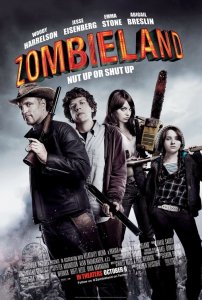 Zombieland is insanely entertaining and one of the most satisfying theatrical experiences of this year. It’s an American Shaun of the Dead, meaning that the zombie genre gets lovingly satirized with some wit, some bite, and a whole lot of blood. This movie isn’t nearly as clever as Shaun but it sure serves up the red meat of what you’d want in a crackling zombie action comedy. Woody Harrelson and Jesse Eisenberg make for an engaging odd couple pairing, director Ruben Fleischer posits a nice amount of visual whimsy with onscreen survival guide rules, and there is a glorious celebrity cameo midway into the movie that might qualify as my favorite 10 minutes of 2009. It’s funny and fiendish but it doesn’t break down the fourth wall. Zombieland does have some flaws to it, like a repetitious second act where the boys get duped by a pair of sisters (Emma Stone, Abigail Breslin) like three or four times, and the climax at an amusement park raises some obvious questions. Why turn on an amusement park and attract every zombie in town? Why dive out of a Hummer when you could drive off? The movie seems to take great aims to set up the damsels in distress, mostly because the inconveniently shut their brains off from survival mode. The silliness and macabre fun is infectious and Zombieland makes you hungry more adventures with these characters killing the undead in gross yet creative ways. I may be biased since Eisenberg’s character is from Columbus, Ohio (the crowd I was with cheered when we were informed our present home town had been decimated by zombies).
Nate’s Grade: A-
Share this:

Paranormal Activity (2009)
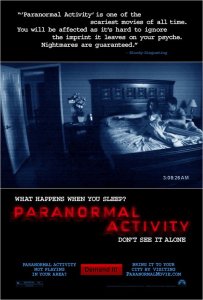 My eyes are bleary. I feel like a walking ghost. My body aches just a tad. I’m over responsive to sudden movement. Not only have I just seen Paranormal Activity, the small indie horror film that has been sweeping the nation, but also I’ve just endured my first post-Paranormal night of sleep. To say it was refreshing would be an outright lie. My then-partner was tossing and turning, routinely grabbing my arm to hold her, also sitting straight up to peer through the darkness of our bedroom, and occasionally she would request that our dog jump on the bed to sit with us for extra support. She and I have seen scary movies before but none have interrupted my sleep patterns like this low-budget sensation. That alone is the best blurb that I could possibly offer to the Paranormal Activity marketing gurus: this movie will make it difficult for you to sleep in your home.
The back-story to this Cinderella tale is that writer/director Oren Peli was hearing unexplained strange noises in his San Diego home. After some research he said, “Why don’t I set up a camera and make a movie about this?” He then hatched a plot involving a young couple, Katie (Katie Featherston) and Micah (Micah Sloat), who hear some bumps in he night while they sleep. Micah sets up a stationary video camera to record the strange happenings as a cool project. It begins with small, subtle noises, then the presence of something unwelcome becomes much more pronounced. Micah taunts the antagonistic spirit, coaxing some kind of response. Katie is terrified because, as they learn from a psychic, this is the same entity that has been following and haunting Katie her whole life; her family home burned down unexplainably when she was a child. It wants Katie. That was the story, though Peli says most of the dialogue was improvised (it shows). The actors doubled as camera operators, the movie was shot over seven days in Peli’s own San Diego home, and the total cost was $11,558, a pittance for a Hollywood movie. So how did this cheap home video haunting take the nation by storm, becoming the indie phenomenon of 2009 and one of the most profitable films in modern history?
 Let’s start with the fact that it’s actually scary. That’s likely what audiences have been responding to — competency. The film is presented as “found footage” much like the similar low-budget horror sensation, The Blair Witch Project (can you believe it?s ten years old already?). The story is presented as factual footage, and Peli makes a point of not breaking the terms of reality. Some of the spook stuff is easy to explain, like lights going on and off in the distance, but there are some moments that are more dramatic and give no hint of special effects. I am impressed by the ingenuity of Peli on his super low budget. I went from being startled to admiring the technical craftsmanship. Paranormal Activity isn’t a big scream movie, it’s more unsettling and the majority of its scary moments occur while the camera is on its bedroom tripod (the tripod should receive third billing in the credits, frankly). Sure, a creaking door or lights magically turning on doesn’t sound like surefire moments of blood-curdling terror, but the fact is that stuff is happening while this couple sleeps, a time when we are most vulnerable, is the point and why it’s scary. Peli structures the movie so that it fosters a slow burn of suspense. By making the camera the only viewpoint, we as an audience feel trapped, much like the characters. The idea that something will get us while we sleep isn’t new but it’s certainly creepy.
The actors work well enough not to betray the “found footage” motif as well. Neither gives a spellbinding performance, mind you, but Featherston and Slout are believable for almost every second onscreen. They’re a couple experiencing a home invasion of a different sort. Micah is more interested in his technical toys than the traumatic state of his girlfriend of three years, and Katie even admonishes him after a scare, “Did you actually run and get the camera first?” Featherston exhibits the most fear and trepidation, and her squeals and cries can be alarming. Their interaction and intimacy doesn’t really communicate a couple of three years time. However, this does not detract from the flick because the title isn’t Relationship Drama, now is it?
 So at this point I need to ask myself, why was I scared during Paranormal Activity and merely amused by the similar exploits in The Blair Witch Project? Maybe it’s the location. The bedroom is supposed to be your sanctuary, your respite. It’s a bit more universal than getting lost in the woods to make a movie. I also think the concept is responsible for my different reactions. In Blair Witch, they were being haunted by a forest ghost who had a thing for arts and crafts. Waking up to stone piles and stick figures just doesn’t resonate like footage of something happening to you while you sleep unaware. Peli does a fine job of making an audience dread what is to come next. Just as I wrote ten years ago for Blair Witch: “The anticipation of the unknown is far more frightening than being slowly chased by a man in a rain slicker. It’s no typical horror flick, it lets you create the fear in your head and let you drive yourself mad with it.” This is why Paranormal Activity works as well as it does. You can immerse yourself and then grip the armrest in fear and then laugh about it later. I also appreciate that Peli solved my number one problem with haunted house movies. You see, if your house is haunted then — MOVE! Simple, huh? Why try sticking it out to regain the resell value when the walls are dripping blood? At least in Paranormal Activity says that the evil spirit is attached to Katie.
Thanks to weeks spent at the top of the box office, even besting the lingering Saw franchise, it is inevitable that Paranormal Activity will balloon in hype that it cannot compete with. Rather than its budget limitations hindering the final product, Peli and his actors have embraced their low-budget aesthetics and produced something effectively eerie and occasionally ingenious. What these people have done with $11,000 (probably the budget for bagels on the pseudo true story, The Fourth Kind) is worth applauding. Like most horror movies, this one will play better with a full crowd ready to ride the roller coaster wave of screams and giggles. Paranormal Activity is proof that you don’t need stars and major budgets to get audiences scared. Your feelings of terror are the great equalizer, which is why cheap but smart and inventive horror movies can easily outpace their bigger budget brethren. Just be prepared for a few rough nights of sleep afterward.
Nate’s Grade: B+
Share this:

Drag Me to Hell (2009)
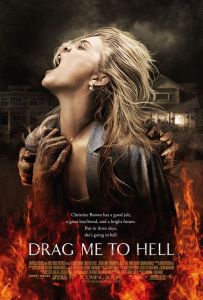 Sam Raimi returns to his spook roots in this delightfully disgusting horror flick. Drag Me to Hell has such a gleefully playful and perverse personality, alternating between being scary, being gross, being funny, and circling back for more. This is camp of the highest hokey order, and Raimi infuses every moment with inspired schlock. Poor Alison Lohman, the bank loan officer cursed to be dragged to hell in three days time. She gets a lot of fluids sprayed into her face (there’s an oral obsession to this movie; lots of mouth stuff) and she takes it like a trooper. She’s put through a physical wringer here and maintains her dignity and believability among staples to the head, grave digging, and talking goats. The ending seems to be coasting to a predictable finish and then it hits you in the head, upsetting your sensibilities. I loved it. Drag Me to Hell, ultimately, is little more than a glossy, entertaining blow-off, a reminder what an inventive director can do with the horror genre. It doesn’t all have to be nubile teenagers escaping a knife-wielding maniac. If there is one lesson I’ve learned from movies and television, you do not anger the gypsies. They have a monopoly on curses and they are not afraid to use them.
Nate’s Grade: A-
Share this:

The Unborn (2009)
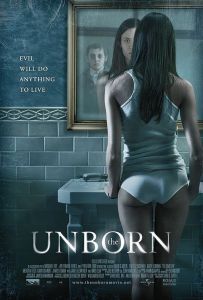 Writer/director David S. Goyer’s horror movie wants to be all things to all people and thus comes across as both conventional and sloppy. The story is about some evil presence that predates religion (all religion?), but somehow this is tied together with Nazi experiments on twins and a spooky kid that pops out. Most of the scares are cheap and silly, often giving way to vivid hallucinations that break when another character enters the room. Really, what is Holocaust material doing in such a by-the-book spook flick? It’s like a Jewish version of The Omen. The story manages to be hokey and too convoluted at the same time. Gee, for a movie that has the word “born” in the title and features a character getting sick weeks after sex, I wonder what the awesome twist ending will be? The movie is tedious from start to finish, though technically competent aside from the acting. It is unfathomable to me that Gary Oldman is a supporting actor in this tripe. It seems like the real purpose of this movie was to engineer gratuitous shots of Odette Yustman (Cloverfield) in her teeny, tiny cotton panties. In fact, I think there’s one review that only talks about her rear and its appeal, which is naturally why it is prominently displayed in the movie poster. When the malevolent spirit is going by its in-utero nickname, “Jumby,” it loses some serious scare factor. See this as a companion piece to the Oscar-winning drama, The Reader. Then tell me which has the stranger message.
Nate’s Grade: C-
Share this:

Repo! The Genetic Opera (2008)
 In a dystopian future, organ failure has become an epidemic. Fortunately, the GeneCo Corporation and its CEO Rotti Largo (Paul Sorvino) have devised a solution. They will loan out new organs to those in need. However, if the customer happens to be late on a payment then GeneCo sends out the Repo Man. This hooded figure will track you down and surgically remove GeneCo’s property, and perhaps they’ll harvest the rest of you too. People become obsessed with surgery upgrades (just think what wonders a third kidney could do for you). Blind Mag (Sarah Brightman) is a famous opera singer that signed a contract for new corneas. She’s now reconsidering retiring from the stage, no matter what that means. There’s also a powerful pain killer known as Zydrate that can be extracted from fresh corpses. Anyone caught robbing graves will be shot on sight.
One repo man, Nathan Wallace (Anthony Stewart Head), is working to keep his daughter safe. Shilo (Alexa Vega) has a rare blood disease she inherited from her mother, who died in childbirth. Nathan must keep her locked away in order for her to survive. His daughter must never know his true identity as a repo man. Rotti is informed that he is dying from inoperable cancer. His trio of bratty, homicidally crazy children (Paris Hilton, Bill Moseley, Nivek Ogre) are all fighting over who will get to run GeneCo once dad’s dead. Rotti plans a big bloody finale for everyone at the Genetic Opera’s final curtain call.
To answer the most burning question, yes it is an opera. There are perhaps five spoken lines and the rest of the movie is completely sung; you will get a solid 85 minutes of people singing while they engage in plenty of questionable acts. To say that Repo is unique is a disservice to the flick. I cannot imagine watching another movie that combines opera, vivisection, surgery addiction, Gothic costuming, and Paris Hilton actually doing a credible performance. Knowing that it is indeed a full-fledged opera, it mostly eliminates the snickers that arise from watching actors break into song at curious moments; when they’re singing all the time you’re more aware when they stop. It’s a futuristic rock opera that exists in the realm of a horror movie. There are several dispirited elements that can be occasionally awkward but that isn’t necessarily the flick’s fault. I just haven’t witnessed too many folks singing while arm-deep inside an exposed chest cavity. The movie isn’t as bloody or gory as repulsed film critics have lead you to believe. There are about four sequences of horror gore, though the film does resort to casual violence that can be off-putting, like stabbing extras. Repo possesses a wickedly entertaining and gleeful spirit.
 But how is the music for such an avant guard enterprise? It’s pretty solid, actually. It won’t be everyone’s cup of tea, naturally with some vulgar lyrics, but the music is certainly well crafted, with strong melodies, catchy hooks, squealing guitars, and some rather impressive singing. The music is reminiscent of industrial rock acts but it also has some pretty flavorful pop styling (the pounding hard rock beats reminded me of the underrated band, kidneythieves). These are tunes that will stick in your grey matter. Some of the highlights include “Infected,” where Shilo laments her condition and says, “I’m infected/By your genetics!/Mother can you hear me?/Thanks for the disease!” The tune is likely the catchiest of them all and has a fun pop-punk melody that becomes a leitmotif. Vega also proves immediately that she can sing. “Zydrate Anatomy” is led by the charming vocals of the Graverobber (Terrance Zdunich, who co-wrote the music and lyrics) as he exposits to the audience the ins and outs of the drug market. The guitars careen and the backup junkie chorus (“A little black vial? A little black vial!”) add some depth to the tune. But least you think it’s all Goth rock, Repo mixes in traditional arrangements as well, including plenty of harried violins, cellos, and some classical opera music. There are also subdued ballads like “I Didn’t Know I’d Love You So Much” and “Genetic Emancipation” that conclude the film on a high note. It all blends together into a unique soundscape that’s well worth singing along to.
Unlike the big screen version of Mamma Mia, the cast of Repo can actually sing, and they sing quite well. Vega (Spy Kids) sounds like a better Avril Lavigne than Avril Lavigne. She’s an ingénue that actually gets some good songs. Fans of Buffy the Vampire Slayer will recall that Head gave a standout performance on the TV show’s musical episode, and here he shows his amazing lung capacity. Head has a rich tenor voice that is lovely to hear. He howls with soulful anguish and holds onto notes for long duration. It’s tricky to present a performance only through song and Head has the most complex role (in one song he laments that “I’m the monster!/I’m the villain!”). Head also switches over into a gravely demonic voice, like his maniacal “I’m on the job” voice to frighten his victims. The personality shift is a credit to Head’s vocal range. The rest of the cast includes singers with actual opera experience (Sorvino, Brightman) and musicians (Skinny Puppy’s Ogre), and then there’s Hilton. She’s already proven with one flop album that the hotel heiress is not the surest singer in the world. However, she works with the material as a spoiled rich kid consumed by her vanity (at one point her face literally falls off).
 Repo! The Genetic Opera plays better as a soundtrack than as a movie. The story is mostly simple but still manages to be confusing at points because of unresolved subplots. The characters are given glimmers of outgrowing their stock roles, but most of them just accept their underwritten fates. Repo seems like it’s on the verge of making social commentary on vanity, man’s compulsion to destroy himself to live outside one’s means, the disposable nature of beauty, destiny versus free will, but it never really delves deeper. The surface is barely skimmed and then the movie kind of chugs along at a super brisk pace. The movie has a trashy, campy atmosphere that can wear thin at times, especially under director Darren Lynn Bousman’s lackluster lens. I know this is low budget but Bousman doesn’t conceal the budget limitations too well and his shot selections can seem rather redundant and mundane for a music video, let alone a feature length film. With that said, this is still worlds more ambitious than Bousman punishing audiences with another Saw sequel (he directed Saw 2-4 and took time off from 5 for this flick). Some of the songs, while fun, seem out of place given the narrative, like the punkish “Seventeen” where Vega declares her womanhood and pretends to be a rock star and pounces around her bedroom, complete with dancing stuffed animals. It’s almost like a Miley Cyrus/Hannah Montana moment of strange daydreaming. The finale at the opera is a tad overwrought and yet it seems appropriate given the operatic backdrop.
I’m dumbfounded that some critics would cite Repo! The Genetic Opera as the worst film of 2008. How could something this ambitious, with such a killer soundtrack, be worse than 88 Minutes, The Hottie and the Nottie, and the atrociously harmful Meet the Spartans? The movie is far from perfect and is bizarre, messy, and somewhat shambling, but I have a healthy appreciation for a film that tries something different, whether or not it succeeds. A bloody rock opera seems like it’s begging to be considered midnight movie material, but it’s better than that. This curious experiment works better as a soundtrack than a movie, but it’s well worth seeing because, really, when are you going to catch another freaking movie like this? If you ever venture inside a Gothic-themed club, you can expect to see this movie playing on a TV somewhere until the end of time. My advice: buy the soundtrack and get ready to have the songs take root in your brain.
Nate’s Grade: B-
Share this:

The Eye (2008)
 This is a punishing and blandly mediocre movie, one that cannot inspire any strong feelings whatsoever. It’s a limp remake of a Korean horror movie where a blind woman gets an eye transplant and starts seeing ghostly creatures. The glossy American version stars Jessica Alba as said blind woman and watching her bump into furniture would have been more entertaining. The production values are competent, though the characters exist in a strange world where ordinary apartment buildings are designed like labyrinths. The horror elements are mostly of the “Boo”-variety and The Eye does little to establish whatever rules govern its spiritual universe. Why would closing a door stop a ghost in its tracks? It’s a ghost! The flick follows the tired plot device that ghosts have unfinished business and need flesh-and-blood humans to fix it. Come on ghosts, you’re dead, you got plenty of time on your hands. Eventually the movie transforms into a non-scary road trip to Mexico (there’s no way Alba would have gotten an international eye transplant) to learn about the poor eye donor’s unfortunate demise. This then leads into a contrived scenario where Alba must use her combined ghostly glimpses to save lives. The ending is just kind of pathetic as well. The Eye has a few nice stylistic touches, like what goes down in a Chinese restaurant, but the movie seems to exist as young male wish fulfillment. And by that I mean the concept of a beautiful woman who is blind and therefore doesn’t realize how beautiful she is. It’s the only way the majority of men can ever legitimately fantasize about having a shot with Jessica Alba.
Nate’s Grade: C
Share this:

Seed (2008)
 Uwe Boll had some things he wanted to say with his low-rent horror flick, Seed. Like much of Boll’s output it’s based upon a video game. However, Boll opens the flick with a warning that footage of animal abuse and disturbing images will be incorporated into the movie. Seed gets the ball rolling with a two-minute montage of animals being cruelly beaten and mutilated before the title ever finds its place on screen. Boll’s opening text says that he decided to use this disturbing snuff footage because he “wanted to make a statement about humanity.” Yeah, sure Boll. Isn’t it a bit trite and easy to castigate the human condition for evil when you just roll out visceral real-life footage of cruelty? By highlighting the real stuff Boll is calling into question the significance of his whole stupid slasher movie. It opens with real-life cruelty and then plays out 90 minutes of fake cruelty, so what’s the point? I don’t think Seed has any interest in the subtext that can elevate horror movies. I think Boll just wanted to make his own torture-heavy horror film and found some animal abuse footage on the cheap (PETA probably gave it to him free of charge). The opening smacks of exploitation and opportunism and has zero thematic connection to the flaccid and empty-headed horror movie that follows. If I sound angry that’s because I don’t need to see animals having their skulls crushed in to get it.
Seed (William Sanderson) is a killer of astounding proficiency (for further details: see below). Matt Bishop (Boll BFF, Michael Paré) is the detective that’s been tracking Seed all these years. You can tell he’s a haunted cop because he has a drinking problem and hears the cries of dead babies. Eventually, Bishop tracks down Seed’s hideout and he arrests the murderous fiend. Seed is sentenced to die by the electric chair. The problem is that the prison doesn’t have a pristine electric chair, and the law says that if a man survives three jolts of juice then he’s free to go (for further details: see below). The warden (Ralf Moeller) decides to take command. He and a group of prison employees bury Seed alive and tell the world he died on the faulty electric chair. Of course Seed comes back and rekindles that old killing feeling.

 If Sanctimony was Boll’s attempt to manufacture the clever Saw-esque serial killer, a higher scale of serial killers, then Seed is at the opposite end of the serial killer equation. This is a dull slasher movie and Seed is about as dull as killers can be. His main attributes are that he’s a huge guy with a sack on his head, which is kind of similar to about 1000 different slasher movies. He looks particularly close to Leatherface from The Texas Chainsaw Massacre. I guess the slasher recipe is add one obscure mask plus one set of overalls plus dirt = killer. The guy has zero personality and is merely a silent killing machine that, in typical slasher fashion, always roams around at a deliberately slow pace. Sanderson (star of SEVEN Boll films) is unrecognizable as Seed and this is mostly because he wears a sack on his head and says maybe one thing for the entire 90-minute running time. I don’t recall Sanderson being as bulky either. Boll’s attempt at a horror movie wallows in exploitation and prolonged torture. As always, he’s late to the party.
Seed is credited as bring solely written by Boll, and the man screws it all up within minutes. When it comes to horror movies there will always need to be a somewhat healthy suspension of disbelief but only up to a point. Every movie no matter the genre or internal logic will have a breaking point. Seed cruises through that breaking point alarmingly early. Through the use of newspaper clippings, Boll introduces us to the backstory of Mr. Seed (he uses newspaper clippings for 90 percent of all exposition, meaning someone at the police department has a big thing for scrapbooking). We are told that from 1973-1979, Seed killed an astounding, and numerologically convenient, 666 people in those six years. Just take a second and think that figure over. One person in a ratty cloth mask and overalls killed 666 people. Ted Bundy and John Wayne Gacey weren’t even anywhere near that figure and they are highly prolific serial killers. Boll wanted to make his serial killer scary but he totally overcompensates and destroys any credibility the film could possibly attain. Why 666? There’s no way it’s a coincidence considering the pull of that number in our pop culture. Was that a target quota for Seed? Did he make a chart to know when he was falling behind?
The sheer magnitude of that number obliterates the facade of “reality” Boll wants to create in his movie. These cops have to be the worst investigative unit in history. Seriously, could they not tabulate any clues or patterns or habits of Seed after 665 murders? I think the FBI would have stepped in hundreds of unsolved murders ago. And yet Boll then shows again how staggeringly inept these local cops are. They find out Seed’s home, which is of course a dilapidated shack in the middle of nowhere. This naturally begs the question that Seed would have to venture out long distances to find so many victims, and yet no witnesses of any sort? But Boll ignores this and steamrolls ahead. What showcases the utter stupidity of these boys in blue is that they ride out in the middle of the night, into the middle of the woods, and decide to raid Seed’s house with only six officers. I’m sorry, but if any man killed 666 people with his own hands then you don’t plan on taking him down with a small unit of cops who have already proven to be inept. You bring in tanks.
 The premise itself is deeply flawed and begging for mockery. Seed proposes that there is a law on the books that somehow mandates prisoners must be set free if you can’t kill them after three jolts from the electric chair. We’re talking 45 second long jolts of 15,000 volts of electricity frying your brain. Your heart will eventually explode with all that electricity. So how does this law truly work? Surely no one would actually abide by it or fear that the government would punish them for breaking this law? Seed never specifies where it takes place, though the vibe I get is more southern, and they love to kill people in the South, especially Texas. Did the electric company propose this three-strikes-and-you’re-alive policy as an incentive to inmates? Do low-income prisons have a higher turnaround rate? Does this law cover firing squads and hangings as well? A judge and jury have found Seed guilty and sentenced him to be executed. That judicial ruling is not absolved because an inmate could withstand a high degree of voltage. The premise turns an execution into a contest.
Most slasher movies involve a near superhuman antagonist, and Seed follows suit. He can attack and kill four prison guards who try to gang rape him in his cell (what part of 666 kills says, “please expose your penis near me”?). He can step on a prison guard’s forearm and crush it so that it looks like a swaying doll part. He can bust out of a coffin and dig himself out of a grave. Now I did some quick math and a 6 feet by 6 feet by 3 feet grave is 108 total cubic feet. The lightest dirt will weigh is 42 pounds per cubic foot. That means that Seed had 4536 pounds of force weighing down on him in that grave. Yet he was able to free himself and go on his rampage. If Seed is this indestructible force then it’s ridiculous that Pare could kick him a few times and the man went down during the police capture. Which is the worse screenwriting sin? Having Seed wiggle out of 4500 pounds of force or the fact that the prison guards did a lousy job of BURYING ALIVE a man who killed 666 people! Why would you ever bury this maniac alive?! That seems hardly definitive. Common sense begs cutting off the man’s head just to be certain.
When it comes to horror movies, building an atmosphere is essential but there’s a notable difference between building dread and simply killing time. Boll does not know this difference. Seed doesn’t even get placed on the electric chair until 46 minutes in. The first 33 minutes of the movie is pointless because it retells Seed’s capture via a flashback while he sits on death row. Watching Seed finally get captured isn’t really important to the story, and a good half of that misspent time is simply gross and grainy home videos. Seed sends videotapes to the police to taunt them. The tapes are shot in a dungeon-like location and involve living creatures rotting thanks to the miracles of time-lapse photography. Naturally this raises two quibbles: 1) No one had personal video recording devices in the mid 1970s, let alone a maniac living in the middle of nowhere, and 2) watching dogs and babies die of dehydration and then decompose to ash means that these video projects took many weeks to accomplish. That’s a lot of time. Boll spends five plus minutes of screen time just showing these grainy snuff videos with the police recoiling. Perhaps the extent of their investigation was watching these gross videos and making faces. How many videos do the police have from Seed? It seems like Seed’s version of the fruit of the month club.
 But getting back to misspent time, Boll thinks just holding onto a shot and not cutting makes it scary or tense. It doesn’t. I don’t need nearly two minutes uninterrupted of watching guards fiddle with Seed’s chains as they try and latch him into the electric chair. I don’t need almost a minute of one shot panning around a boat departing the prison isle. I don’t need nearly two uninterrupted minutes of watching the prison doctor’s bedtime rituals before he eventually gets murdered. I especially don’t need over five uninterrupted minutes of watching Seed hit a woman in the head with a mallet. I’m not being facetious when I tell you that he literally hits her 40 times until her head is purified into a bloody stump of a neck. Seed literally paints the walls with this old woman’s blood (how did this genius not get caught?). The soundtrack soars to laughable heights and the scene just goes on and on, figuratively bludgeoning the audience as well. Boll believes that just holding onto a moment of depravity makes it sinister. It doesn’t when there’s no audience connection whatsoever to the tired material. Boll does craft one nicely tense sequence where Pare and the cops capture Seed. There’s a moment when one officer is tiptoeing through the basement of Seed’s home and the only source of light is the flicker of the police siren. It’s visually appealing and works to create tension as well. But this moment is short-lived. I’ll never know how a burly guy can see through a cloth mask in the dark and sneak around in a dilapidated home filled with crap covered in tetanus.
It may be hard to notice for some, but Uwe Boll is actually improving as a filmmaker, at least from a technical standard. Seed looks like an actual movie. Seed is grisly and nihilistic and futile. The killer is a bore and the story is poorly structured, taking far too long to get Seed in the ground and wrecking havoc. Boll’s screenwriting shortcomings are fully evident as he strings together genre clichés and ridiculous plot points that obliterate credibility. He grasps at making statements about the human capacity for cruelty. Well I didn’t need a Uwe Boll movie to educate me on man’s inhumanity to man, especially one this shoddy and empty. This movie isn’t even entertaining; it’s a chore to sit through. This is the first Boll movie that I sat just waiting for it to be over. There is no reason to watch this thing. During the extended scenes of video watching by the police, one of the cops watches a baby decompose and replies, “Sick bastard.” I think Boll was projecting here. And I didn’t need footage of animals being slaughtered to reach that conclusion either.
Nate’s Grade: D-
Share this:

The Happening (2008)
 M. Night Shyamalan is still reeling from the beating he took over 2006’s Lady in the Water, a colossal misguided attempt at a modern fairy tale. The man is trying to retain his cozy relationship with audiences that adored his earlier works like The Sixth Sense and Signs. Shyamaln’s latest, The Happening, isn’t going to dissuade the detractors. This man is a talented filmmaker and I think it’s finally time that he starts thinking of focusing on one creative job and one job only, either writing or directing.
There’s a pandemic sweeping across the Northeast United States. It first starts with disoriented speech, then moves to disoriented movement, and ends with people committing suicide. Nobody knows what is officially going on. High school science teacher Eliot Moore (Mark Wahlberg) tries to flee Philadelphia with his estranged wife, Alma (Zooey Deschanel). They travel out into the suburbs when their train stops. The conductor says that they’ve lost contact with everybody. Eliot eventually theorizes that what’s causing this pandemic isn’t terrorists, or the government testing some biological agent, but plants. Yes, plants. In their defense, the plants are releasing an airborne toxin that flips a neurological switch in human brains. Instead of self-preservation the brain is pushed toward immediate self-destruction.
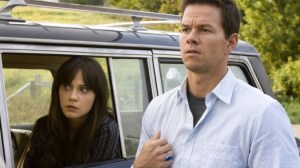 The Happening is no Lady in the Water, thankfully. The premise is pretty interesting in a feature-length Twilight Zone kind of way. Shyamalan does know how to spin an interesting idea and watch social paranoia explode. The best moments of The Happening take place during its beginning where confusion and panic reign. Shyamalan then takes a page from 2005’s War of the Worlds and follows the perspective of a handful of normal folk as the experience an apocalyptic event. We even spend the third act hiding out in the home of a crazy person (the creepy Betty Buckley). Unfortunately, we in the audience feel no involvement with the poorly written main characters. Once again Shyamalan utilizes a horrific and unique encounter as the impetus for reconciling the pains in a marriage. At a scant 99 minutes, there isn’t much time set aside for building characterization. There is not a whiff of personal connection to this tale.
Shyamalan doesn’t seem to explore the psychological ramifications of his premise. Suicide is very traumatizing and it would have swept over the East Coast in waves; millions would be dead. Yet the characters and Shyamalan never seem to focus on this point. Perhaps they’re in shock but no one seems to actually react realistically to the possible end of the world. Normal people would be freaking out. I would be freaking out. The idea that the country goes back to normal after three months is preposterous. Would anyone want to live on the East Coast again after all that death? People would be finding bodies for many months after the “happening;” just look at the slow recovery of New Orleans. Never mind the hit the economy would take from millions of people expiring.
The ecological message can also be incessantly heavy-handed. Characters run past a sign for a housing development that advertises the slogan, “You deserve this.” Oh, gee, I get it. A TV host at the very end interviews a scientist theorizing that what happened was a warning from the environment to shape up and change our ways. The TV host is so incredulous that he actually says, “Well, I’d like to believe you doc, but maybe if it just happened somewhere else again, maybe then I could believe you.” You idiot, millions of people died and there are how many witnesses? I know exactly what message Shyamalan is trying to say (wake up, we can’t ignore the signs) but having a character denying the obvious is too ludicrous given what happens in the story.
 But the story does invite further inquiries. How exactly do the plants communicate with each other? I can understand root structures but how does a bush talk to a tree unless they share root structures? Do plants speak different languages? Can a bush talk with a tree, and do French bushes speak differently than their English brethren? The plants seem to react to large numbers of people, but how do they know when there’s say enough folk running around to kill? Do they smell people? That toxin seems to not affect animals but I don’t see how that could be possible given that, as far as I know, animals inhale the air as well. Of course, if all surrounding animals and insects were to keel over then that would irrevocably harm the ecosystem and endanger the plants. This must be why the “happening” lasts a little over a day, coincidentally ending just when our protagonists are about to give up. And if Mother Nature, as a form of population control, triggers this toxin release then wouldn’t it stand to reason that some place like China or India would be hit first instead of the Northeast United States? Shouldn’t a science teacher know that still air would be filled with more toxins than when the wind blows? I’ll give Shyamalan this — he was able to make me fear a tree. There was one moment where a little girl was on a swing that was bolted into a tree limb and the constant creaking made me nervous that they would anger the tree.
Despite the flaws in storytelling, this narrative still could have worked as is if it just had a better director at the helm. Shyamalan lets everyone down on this one. Much of the marketing angle was how The Happening is Shyamalan’s first foray into R-rated material, but you can tell he doesn’t feel comfortable showing more than implying. One sequence follows a police officer’s gun as different individuals take turns shooting themselves in the head. Shyamalan shoots this sequence like the camera weighed 800 pounds, so the shot never rises above people’s feet. We see the gun fall on the ground, feet walk over to the gun, hands pick it up and lift it off screen, then a very unconvincing gunshot sound effect, then the process repeats. By not actually seeing the deadly aftermath Shyamalan risks the sequence becoming unintentionally funny and it almost happens. This directorial technique does not raise suspense, and in fact, Shyamalan botches most of the potential suspense in The Happening. Given the premise, Shyamalan doesn’t find too many sequences that make the audience squirm. A man wandering around in a lion’s cage is so fake and played in the wrong tone that it just becomes goofy even when his arms get ripped off. There’s only one protracted horror sequence that shows true gore, where a man lies down in the path of a giant lawnmower and we start to see the machine ride over him and whirl its blades. However, even this scene could have gone longer to fully draw out the shock and terror. Shyamalan just doesn’t have the temerity for R-rated material, and as a result the movie could have been a lot more terrifying had the man embraced the gruesome potential of a more mature rating.
Shyamalan’s visual storytelling is pretty rote. I kept thinking to myself how poor everything seemed to be looking. The cinematography is lackluster and the shot compositions are rather bland. Part of what makes a horror movie effective is clever visual setups that slowly leak tension like air from a balloon. Shyamalan’s idea of drawing out tension is to watch tress blow in the wind. After a while, when you realize this is the one trick Shyamalan has, it gets old and extremely boring. The Happening would have benefited from a stronger visual storyteller who could also goose the narrative with better-constructed scares. It’s disappointing because Shyamalan was able to elicit top-notch suspense in 2002’s Signs with simple sounds and the imagination. Now, when he’s given the chance to show terror he falls on his face.
 Another dent to Shyamalan’s direction is the fact that the actors all give bad performances. Wahlberg and Deschanel have given great performances in other movies so I know they are capable of more, and the blame must lie at the feet of Shyamalan. They overact with gusto and always seem to never be fully immersed in the reality of the drama. Even Wahlberg’s first line delivery raises your eyebrow because it seems too amateurish and flat. Deschanel is even worse and whatever emotion she is playing in a scene is the wrong emotion. She’s whiny and overly childlike when she should be reflective and contemplative, she’s wide-eyed and weepy when she should be tender, and she’s bad with just about every line. Alma is a weak character and seems to turn everything back to an injustice against her, even when people are killing themselves en mass. Part of the actors’ woes is complicated by Shyamalan’s wooden dialogue, which includes gems like, “We’ve just got to stay ahead of the wind” (how exactly does one do that?) and, “We’re not going to stand around like uninvolved bystanders” (who says that?). The most shocking aspect of The Happening is that Shyamalan totally betrays the trust of his very competent actors.
M. Night Shyamalan would be best served in the future by focusing on one role. He could direct someone else’s material or he could write and have someone else direct. If he had gone the latter route I’m convinced that The Happening would have worked even with a flawed script. The movie is too timid to push the horror boundaries available to a mature rating, the suspense is minute, and Shyamalan completely leaves his actors hanging out to dry. There is some laugh out loud moments of unintentional hilarity (like when Wahlberg calmly says “Oh no” upon hearing suicidal gunshots), but the movie also has moments of intrigue amidst its heavy-handed environmental message. Statistically, if there were a killer toxin there would be those who would be genetically immune to it, much like the scenario in I Am Legend. I have to say that if I was fortunate enough to survive I would whisper some threatening words to some choice flora and then I would set lots and lots of fires out of revenge. Take that, you stinking vegetation!
Nate’s Grade: C


You must be logged in to post a comment.