Blog Archives
Inside Out 2 (2024)

Of all the Pixar hits, 2015’s Inside Out is one of the better movies to develop a sequel for, and thankfully Inside Out 2 is a solid extension from the original. The internal world of Riley’s burgeoning sense of self is so deeply imaginative and creatively rewarding, balancing slapstick and broad humor with a deeper examination of abstract concepts and human psychology (Freud would have loved this movie… or hated it… or just thought about his mother). The unique setting was made so accessible by the nimble screenplay that the viewer was able to learn the rules of this setting and how interconnected the various parts are. While not being as marvelously inventive as its predecessor, nor as poignant (R.I.P. Bing Bong), Inside Out 2 is a heartwarming and reaffirming animated movie that will work for all ages.
Riley is now turning thirteen years old and in the midst of puberty. That means new emotions, and Joy (voiced by Amy Poehler) has to learn to work well with her co-workers, such as Envy, Embarassment, and Ennui. The biggest new addition is Anxiety (voiced by Maya Hawke) who wants to prepare Riley for her life ahead, which seems especially rocky now that Riley knows her two best friends will be going to a different school. A weekend trip to hockey camp becomes Riley’s opportunity to test drive the “new Riley,” the one who impresses the cool older kids and gains their acceptance. This will force Riley to have to determine which set of friends to prioritize, the new or the old, and whether the goofy, kind version can survive to middle school or needs to be snuffed out.

With the sequel, there aren’t any dramatically new wrinkles to the world building already established. We don’t exactly discover any new portions of Riley’s mind, instead choosing to place most of the plot’s emphasis on another long journey back to home base. This time the other core emotions get to stick around with Joy, each of them proving useful during a key moment on the adventure. The externalization of the emotions invites the viewer to feel something toward feelings themselves. When Joy, at her lowest, laments that maybe a hard realization about growing up is that life will simply have less joy, it really hit me. Part of it was just the sad contemplation that accepting adulthood means accepting a life with less happiness, but a big part was teaching this concept to children and being unable to provide them the joy they deserve. Since the 2015 original, my life has gone through different changes and now I watch these movies not just as an individual viewer recalling life as a former adolescent figuring things out, but now I also come from the perspective of a parent with young children, including one turning thirteen. The development of the mind of this little growing person is a heavy responsibility given to people who are, hopefully, up to that very herculean task. We can all try our best, but recognizing limitations is also key. The kids have to have the freedom to be themselves and not pint-sized facsimiles of a parent.
The emotions inside Riley’s mind are featured like internal surrogate parents, tending to the development of Riley’s emotions, morals, and personality. They presumably want what’s best for her, there just happen to be opposing interpretations of what that exactly means, which leads to the majority of conflict with Anxiety. However, there’s also an understanding that Riley has to do things on her own and be able to make mistakes and learn from them. Inside Out 2 is ultimately about accepting the limitations of providing guidance. Joy and Anxiety are both trying to steer Riley down a deliberate path they think is best, but Riley needs to discover her own path rather than have it programmed for her. I appreciated that Anxiety is not treated as some dangerous one-dimensional villain hijacking Riley’s brain. Much like sadness, there is a real psychological purpose for anxiety, to keep us alert and prepared. Now that can certainly go into overdrive, as demonstrated throughout Inside Out 2, including a realistic depiction of a panic attack. It’s about finding balance, though one person’s balance will be inordinately different from another. The stakes may be intentionally low in this movie, all about making the hockey team and being welcomed by the popular girl she may or may not be crushing over (more on that later), but the focus is on the sense of who Riley chooses to be through her life’s inevitable ups and downs. It’s about our response to change as much as it is our response to the presence of anxiety.
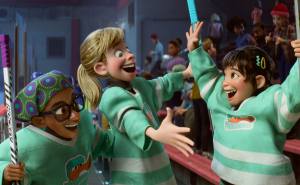
Inside Out 2 also answers a thorny world-building question that the original creators never thought to go into greater detail. It’s established in the 2015 original that even the adults have the same five core emotions manning their brain battle stations: Disgust, Fear, Sadness, Anger, and Joy. So if adults only see these same emotions, what happens to those new puberty emotions? Do they go away? As an adult, do we gradually work through anxiety and embarrassment to the point where they are no longer present (this is where every adult can wryly laugh)? There’s an emotion introduced as Nostalgia, depicted as a kindly grandmother so eager to remember the ways things were. Joy tells Nostalgia to leave, as it’s not time for her to be developed yet until Riley is older. This one moment clears up the world-building question; the emotions don’t leave, they just sit out for periods of time like bench players waiting to be called into the big game. And just like that, it all works and makes sense. I wonder what other new emotions make their appearances later in life. Resentment? Choosing to rather die in authority rather than give up an iota of power to a younger generation? Sorry, that last one was more directed at those stubborn folks clinging to Congressional offices.
There is some sight narrative and thematic redundancy here. The first movie was about learning the importance of accepting sadness as a vital part of the human condition and how we can process our emotional states. It was about Joy learning that not every moment in life can or should be dominated by joy, and that the other emotions are also necessary functions. With the sequel, we have a starting point where Joy is picking and choosing what memories are worthy of being remembered, banishing the “bad moments” to the back of Riley’s mind, forming a cavernous landfill of junked memories. It’s treading some pretty similar ground, prioritizing one set of memories or emotions over others wherein the ultimate lesson is that repression in all forms is unhealthy and robbing one of the necessary tools for self-acceptance and growth. This is further epitomized by a trip to one of these memory vaults where Riley’s Deep Dark Secret is willfully imprisoned. The movie proper never comes back to this self-loathing figure, and the revelation could have really supported the overall message of self-acceptance. Pixar could have done something really special here, like having Riley coming to terms with being bisexual/queer, and that perhaps something we may personally agonize over as a horrifying secret could, once shared, be far from the dreaded life-destroying culprit our minds make it out to be. This would have really worked with the perceived lower stakes of the movie, naturally elevating the ordinary to the profound, as life can often unexpectedly become. Alas, the Deep Dark Secret is just a setup to an underwhelming post-credits joke – womp womp. That’s it? Again, if you’re going to tread the familiar thematic grounds about the dangers of repression, at least give us something bigger to reach than the same lesson that all emotions have a place.

The first Inside Out was a masterpiece. That’s a hard act to follow. This sequel, of which we can all assume there will be more given its billion-dollar box-office, is a solid double to the original’s home run of entertainment. It’s not among their best but it’s one of their better non-Toy Story sequels. Inside Out 2 is a heartwarming winner.
Nate’s Grade: B
Share this:

Winnie the Pooh: Blood and Honey 2 (2024)
 The first Winnie the Pooh: Blood and Honey was, unquestionably, my worst film of 2023. It wasn’t merely a bad horror movie, it was a depressingly cynical cash-grab with such little forethought of how to subvert the wholesome legacy of its classic characters. As I said in my review: “The startling lack of imagination of everything else is depressing, as is the fact that this movie has earned over four million at the global box-office, hoodwinking enough rubberneckers looking for a good bad time. The problem is that Winnie the Pooh: Blood and Honey is only a bad bad time.” Oh, dear reader, I wasn’t looking forward to the inevitable deluge of follow-ups, as writer/director Rhys Frake-Waterfield would resupply his surprising success with further sinister revisions to public domain properties. He’s planning on a “Poohniverse” crossover event with a combination of Pooh, evil Pinnochio, vengeance-fuelled Bambi, and a traumatized or villainous Peter Pan. Again, schlocky movies that lean into their schlock can be wonderful things, but a movie that does next to nothing with its subversive hook, with the history of its cutesy iconography, and could be easily replaced with any other menacing slasher killer is beyond lazy, it’s insulting. I figured there could be nowhere to go but up with a sequel, and while Blood and Honey 2 is an improvement in just about every way, it’s still not enough to qualify as a fun or ironic treat.
Wakefield and new co-writer Matt Leslie (Summer of 84) completely rework the mythology and history established in the first movie, which is now revealed to be the literal movie-within-a-movie of the account of the Massacre of the 100 Acre Wood where Pooh and Piglet slaughtered a troupe of bad-acting British coeds. In this prior film, it was established that Pooh and his buddies were angry with Christopher Robin (Scott Chambers, replacing Nikolai Leon) when he left for college. They felt abandoned and grew feral and monstrous, rejecting the ways of man (though still wearing the clothes of man and driving the cars of man). However, now in the sequel it’s revealed they were always feral and blood-thirsty and it was Christopher who incorrectly remembered them as cute and fluffy. This scene makes for the hilarious visual of a child waving innocently at a blood-strewn manimal lurking about. Also, Christopher had a young brother who was abducted by the creatures of the 100 Acre Wood and never seen again. Also also, there was a mad scientist who was creating human-animal hybrids from missing children, so the blood-thirsty animals might not be actual animals after all (can you see where this is going?). While the first Blood and Honey movie did nothing with the characters, this movie actively gives them a tragic history with some twists and turns, enough to lay a mythos. The use of hypnotherapy-induced flashbacks isn’t exactly smooth or subtle, but I’ll take it. At least this movie provides a distinguishing plot that makes some use of its particular elements. Don’t mistake me, dear reader, this is faint praise at best, but after enduring the creatively bankrupt first film, it’s like a desperately needed oasis. Ultimately, it might all just be a mirage but at least it’s something to those of us who suffered!
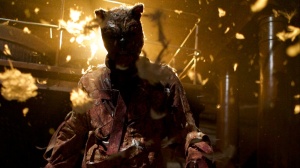
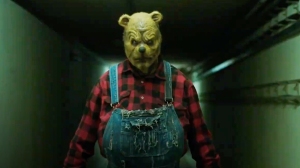 In the grand sequel tradition, bigger is better, and now instead of two ferocious beasts wreaking havoc, it’s four, with the addition of Owl (Marcus Massey) and Tigger (Lewis Santer). None of these monsters has a particular style or attitude that distinguishes them. I guess Tigger calls people “bitch” a lot and slashes people. There is one point where hapless cops are investigating a crime scene and say, “Let’s bounce,” and Tigger says from the luxury of the shadows, “Hey, that’s my line.” I figured they’d incorporate the signature Tigger bounce on his tail, but perhaps that was too expensive to perform or that bounce was more a byproduct of the Disney version of the character, still under copyright, and not the available A.A. Milne version. The animal costumes look better than the cheap Halloween masks of the original, though for my money Owl looks more like a turkey vulture wearing cray paper. I’m sure we’ll get Kanga in the inevitable third movie in 2025 where her zombie baby leaps out of her pouch to feed on brains. There is a snazzy addition late into the proceedings where Pooh is welding a fiery chainsaw. It makes little sense for the character but it’s cool, so it’s excusable in lapsed movie logic.
I was hoping for more unique kills, twisted takes related to the characters, like Pooh turning some poor soul’s head into a honeypot. The kills are just grizzly and extensive, favoring quantity over quality. There are plenty of decapitations, gougings, impalings, and other fraught and violent encounters, nearly all of them featuring squealing, terrified women. It’s always women that seem to get the worst in these movies, but of course this is a feature and not a bug of the genre back to its 80s heyday. It gets relentless but I suppose at least these girls aren’t having their tops mysteriously fall off while they’re being butchered. A third act rave set piece features maybe two dozen kills and risks becoming tedious slaughter. It got to the point where I was hoping not to see another cowering person hiding behind a corner because it meant the sequence was going to be even more unbearably long (I’m not personally cut out for the Terrifiers).
 In between the spillings of blood and guts is the attempts at human drama, namely Christopher Robin trying to live a normal life while also re-examining his past. Apparently people think he’s to blame for the massacre from the 100 Acre Wood, and so he’s become a pariah, whose very presence unsettles others. He’s trying to find steady work in a hospital setting but he’s blacklisted from pursuing his career because of the negative attention his name generates. He even has a romance with a single mom so that when the Robin family is inevitably skewered we have other characters that can be personally threatened to provide meaningful stakes. The life of Christopher Robin and his discovery of repressed memories makes for a surprising story foundation for Blood and Honey 2, especially when the plot of its predecessor was mostly Christopher being held prisoner and the baddies casually roaming and killing coeds. I think Chambers is a better actor as well, and he’s posed to be the writer/director of Neverland Nightmares, which just began principal photography a month and a half ago as of this writing. Good luck, guy.
While the budget has increased tenfold, Blood and Honey 2 is still a scuzzy, sleazy slasher movie at heart. If you’re in the mood for a low-budget exploitation movie heavy with gore, there may be enough to qualify this sequel as moderately mediocre, which again is a marked improvement from what I declared the worst movie of 2023. I’ll credit the influence of co-writer Matt Leslie to try and put some standards in place for this runaway gravy train of IP allocation. What’s scariest of all is what Frake-Waterfield’s unexpected success has wrought, encouraging imitators to jump on his now proven novelty act. There’s a 2025 Steamboat Willie horror movie called Screamboat as Steamboat Willie has now entered the public domain (but not other versions of Mickey). Will it be any good? I sincerely doubt it. Will it make money from curious horror hounds looking for an ironic twist on a wholesome childhood fixture? Most assuredly. This is our present. This is our future, and it’s the legacy of Frake-Waterfield and his ilk that stumbled onto a lucrative novelty act. Winnie the Pooh: Blood and Honey 2 is just bad, and for that it’s an improvement.
Nate’s Grade: D+
Share this:

Dune: Part Two (2024)
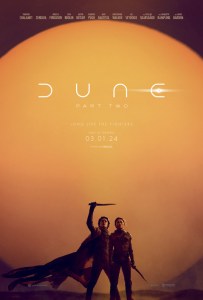 I wasn’t fully taken with the first Dune movie when it arrived in 2021. It was visually sweeping, with dense world building and careful development of characters and themes, but then it just hit the pause button without any certainty there would be a conclusion. Thankfully, director Denis Villanueuve was able to complete his vision, and what a spectacular science fiction landscape this man has fashioned, visually resplendent but also with a story that deepens and improves on all the promise and setup from 2021. The triumphant of Paul (Timothee Chalamet) becoming a hero and avenging his father from their betrayers is tempered by the tragedy of Paul, becoming the false messiah that will bring about mass genocide. The movie doesn’t hold back in its criticisms of its hero while also providing complexity that makes us root for him but uneasily dread what might become. The narrative structure is easy to follow with Paul ingratiating himself with the native culture, rising to power and influence, and organizing a resistance against the well-funded imperial overlords of Arakis. This is the kind of sumptuous, big screen spectacle with intelligence that is so rare in the Hollywood system, and Villaneuve once again shows his ability to perform artful blockbusters that put him in a rarefied class with hew others. After the first Dune, I was hopeful but a little wary. After the second Dune, I feel like all of my concerns were wiped away.
Nate’s Grade: A-
Share this:

Rebel Moon – Part Two: The Scargiver (2024)
 Back in December, Zack Snyder offered his very Snyder-y holiday take on big-budget space operas with Rebel Moon, a project that began as his Star Wars pitch that was turned down. It was what you would expect from a Snyder movie: big, loud, silly yet played completely serious, and drained of all vibrant color. Rebel Moon Part One was on my worst of 2023 list and I felt was a waste of two hours. I was not looking forward to the concluding Part Two. I was worried it would be two more hours of the same, and now having seen Part Two, a.k.a. The Scargiver, the edgy nickname of our lead rebel Kora (Sofia Boutella) fighting the good fight against the Evil Empire, I can now say that the Rebel Moon duology is now a dreary waste of four of your waking hours.
Saying Scargiver might be minimally better than Child of Fire (did you remember that was the subtitle for Part One? Don’t lie to me, dear reader, you know you didn’t) is a nominal victory. There’s more action and a clearer sense of climax, with our underdogs planning their guerrilla war against the overpowering forces approaching (we’re basically watching the training of a Vietcong-like insurgency) and then pulling off their unexpected victory. The problem is that we’re still stuck with all the same characters from Part One, few of which will prove to be emotionally engaging or intriguing. We’ve assembled our fighting force thanks to the events of Part One, but far too many of them are interchangeable and punishingly free of personality besides the default character creation setting of “stoic badass.” There’s one lady who has laser swords so at least that sets her apart. When it comes to attitude, personality, perspective, and even skill level, these characters are awash, which makes the action falter when it comes to any sort of meaningful emotional involvement. The bare bones story is so plain with broadly drawn good versus evil characters from its obvious cultural influences. The fact that it’s derivative is not itself a major fault, it’s the fact that it does so little with these familiar pieces that the movie feels like it’s trying to skate by on your familiarity. After four hours, it’s clear to me that Snyder and his co-writers composed this not as a living, breathing universe with its own lore and history and intrigue, but as a story where he could have used the Star Wars universe to fill in the gaps.
 Snyder can be a first-class visual stylist but his sense of fluid and engaging action stops at “cool images,” like living splash pages from comic books. Like Part One, there is no sense of weight to these action sequences. Things are just happening, and then in the next shot things are just happening. Occasionally there will be a sliver of relation, but whether it’s 60 minutes or 6 minutes, the effect is still the same. The action feels like it’s all happening in a vacuum, and the momentum we feel the upstarts are gaining is hampered. We went through the trouble of explaining their counter-offensives, so why does so much of it feel like it’s just watching a jumbled, ashen group of characters fire guns? This is best epitomized by Jimmy the robot (voiced by Anthony Hopkins) who has gone rogue from his programming and sits out much of the action for reasons entirely unknown. Then he arrives, takes down a few evil tanks, and I guess decides to sit back out. If this is our fighting force, what exactly has it amounted to? This makes the entire movie, and its predecessor, a frustrating viewing even for forgiving action fans. Things blow up good, and there are a few impressive visual orchestrations, but it’s so fleeting and slim.
Over the course of two two-hour movies, totaling four hours, with the promise (threat?) of more, it’s clear that what we really had here was perhaps one underdeveloped movie at best that has been unfortunately spread out over two (and counting) movies of time. Part One was entirely about assembling the team of rugged defenders, and this could have served as the first 45 minutes of the overall movie, with the events of Part Two filling in the rest. With Scargiver, the defenders don’t even start training the villagers until 40 minutes into the movie and the big battle doesn’t kick in until a full hour. Structurally, this doesn’t feel like we’re using our time wisely, and this is best evidenced by the fact that after AN ENTIRE MOVIE of character back-story, Snyder still stops the action to have his characters sit around and share their sad back-stories. Did these characters just not talk at all to each other after initially gathering person-by-person? Tarak (Staz Nair) still hasn’t put a shirt on. I felt like yelling at my TV as the character took turns, and another 15 minutes, for each member to share their tortured back-story again but with different visuals. I was almost worried that right before the battle another character would say, “Wait, before it all really goes down, I need to share, yet again, more of my back-story.” It’s not like these extra glimpses give us new understanding or even meaningfully differentiate their characters; they’re all just victims of an abusive space government that imposes its terrible will most forcefully.
 There is one tragic back-story that does separate itself from the pack, notably because it literally separates itself from the pack and is told well before our group share. Kora explains her part in the assassination of the royal family, securing the military coup that left the Evil Empire extra evil, and I guess the guy named Balisarius as supreme leader (oh how this man must have been teased for his name as a schoolchild, which might be his own tragic back-story that we’ll get three helpings of with an eventual Part Three). This betrayal is personal and stands out, with Kora being the one to shoot the little princess, a girl who, in her dying breath, says she forgives Kora. That’s rough. This is actually a good sequence from a character standpoint as it establishes Kora’s accountability and guilt convincingly. However, Snyder makes some baffling creative choices that blunt the impact of this sequence. During the assassination, the musical score favors a string quartet, which is an emotionally plaintive choice. However, the music is actually diegetic to the scene, meaning it’s coming live from the room. There is literally a string quartet of musicians playing in the room while the royal family is betrayed and slaughtered. These guys are really dedicated to their art to keep playing throughout, and I assume they must also be part of the conspiracy or else big bad Balisarus (snicker) would kill them too. You might as well have them also start stabbing the royal family with their bows. It’s details like this that trip up Snyder, a man beholden to images and ideas but lacking the finesse to make them work.
An issue I had with this conflict was the disparity in scale between the forces, mainly my nagging question of why put together a ragtag group of space adventurers to defend this town if the Evil Empire could just nuke the planet from space? Well Snyder attempts to answer this early with Part Two, and the answer appears to be… grain. This community theorizes that the empire needs their grain yield so badly that they wouldn’t do anything to damage it, so their plan is to harvest all their wheat, turn it into grain, and then use the grain like human shields, hiding behind the valuable resource as cover and distributing it across the village. This is beyond silly. First, this isn’t like an entire planet harvesting grain, it’s one little village on the outskirts. It’s not like we’ve seen a giant warehouse that goes for miles and miles stockpiled with thousands if not millions of deposits of this food. Also, we’re talking grain here (stay tuned for my exclusive Rebel Moon-related podcast called “Talkin’ Grain”). It’s not like we’re talking about some super rare mineral or substance that is only found on this one planet, something linked toward like the power source for an ultimate weapon or space travel. We’re talking about grain here. Grain. You think this Evil Empire won’t nuke the planet because they’re worried they won’t get enough grain, the same crop that can be harvested on multitudes of other planets? How about they just kill everyone and then repopulate the planet with robots to harvest the precious grain? Or how about this simple village make some upgrades as we’re in a future world with space travel and artificial intelligence but people are still harvesting wheat by hand like they’re the Amish. Regardless, I hope you love slow-mo montages of grain harvesting because that’s what you’re getting for the first 40 minutes, as if Snyder is rubbing your face in his silly non-answer.
 In the conclusion to Rebel Moon Part Two, once the dust has settled, and long since that grain has been harvested, the last five minutes sets up a would-be Part Three, informing us that an unresolved storyline is next up on the docket. The characters gang up for their next adventure, and you’re expected to be chomping at the bit for this continuation. I openly sighed. Every movie feels like a tease for the next adventure, and it seems to promise that this one will be the real one you’ve been waiting for, but it feels like franchise bait-and-switch. It’s more than incomplete or lazy storytelling, it’s a scheme to leverage interest in a world and series that deserves little. The universe of Rebel Moon is not interesting. The characters of Rebel Moon are not interesting. The visuals of Rebel Moon are fine, though some of the costume choices again can rip you right out of the reality of this universe (a guy fighting in blue jean overalls?!). In short, not enough has been established, developed, or even paid off to make Rebel Moon an interesting and satisfying movie, let alone two, let alone three, let alone however many Snyder wants to leech out of Netflix. I would say Part Two is better because at least it provides an ending but it doesn’t even do that, merely an intentional passing of the baton to the next movie, and round and round we go. Rebel Moon is a living poster stretched to its breaking point. Leave this shallow universe behind.
Nate’s Grade: C-
Share this:

Godzilla x Kong: The New Empire (2024)
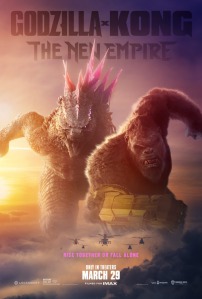 In 2021, the Monsterverse series, begat from 2014’s Godzilla franchise kickstart, finally matched up its two chief prizefighters by pitting King Kong against the mighty Godzilla. It was also by far the most successful movie in the fledgling kaiju franchise, and Warner Brothers was eager to keep the good times running. Now it’s three years later, but Kong is older and weary, living in the Hollow Earth realm below our feet but feeling very alone, the last of the giant apes. Suddenly, he discovers a new world beneath his feet, another level where there are other apes like him. However, they’re ruled in fear from the vicious Scar King, and so Kong needs to call upon his former rival and now tentative ally Godzilla for the ultimate homecoming smack-down.
Godzilla x Kong: The New Empire finds a comfortable resting place as solid disposable fun, a work that knows its real appeal and doesn’t get in the way of it, so why does this movie work for me whereas I had trouble really celebrating the 2021 predecessor? I think it comes down to streamlining and limiting the “dumb fun” to a more manageable quotient. There is still plenty of junk science and goofy moments that will likely inspire their share of guffaws, but I was more pleased this time than overwhelmed in 2021. I had plenty of friends that absolutely loved the 2021 showdown, and I’ll admit the big bouts of monster action were well developed and staged, but for me the dumb was more present than my “dumb fun” threshold could bear. Again, that’s not to say that this newest adventure doesn’t evoke similar eye-rolling. The very revelation of ANOTHER subterranean world and hidden civilization just under the feet of the other subterranean hidden world makes me wonder if every successive sequel will just keep digging downwards, discovering yet another undiscovered world, until they reach the molten core.
 This movie is broken into three storylines and only one of them has the human characters; the core of the movie is Kong’s exploration of the new subterranean world and this is told wordlessly and effectively. The 2021 movie had to juggle multiple human enclaves all having their own adventures and discovering components of our story that would ultimately prove helpful. There was the Godzilla Team and the Kong Team, but did you know that the 2021 movie included all these human characters: our unexpected lead of the Monsterverse now in Hall, the returning new characters from 2021 by Rebecca Hall, Brian Tyree Henry, and Kaylee Hottle, Alexander Skarsgard, Eiza Gonzalez, Julian Dennison, Demian Bichir, Lance Reddick, and the returning characters from 2019 by Millie Bobby Brown, Kyle Chandler, and the son of Ken Wantanabe’s deceased scientist. Top it off with the starring title bout of Kong v Godzilla, and that’s a lot of speaking roles to have to juggle over two hours of monster mash. Having only one human group and only one new significant character (Dan Stevens as a hip veterinarian) helps keep things moving and puts more emphasis on the real big star, Mr. Kong.
Godzilla is sidelined for the second movie in a row to give way for Kong, and it’s the right call as the giant ape is more of a wounded warrior, and his loneliness and desire for community is an easier emotional state to convey than anything from the large enigmatic lizard. Godzilla spends almost the whole movie, leading up to the climax, on a mission where he’s powering up, like it’s a filler Dragon Ball Z episode. It does build a sense of anticipation for his eventual return in the big arena, but it’s clear that Godzilla’s name should be second in the title. He’s presented almost like an angry cat, settling into the Colosseum as an impromptu nap den. With Kong, the emotional arc of a lonely creature seeking kinship is universal and easy to understand even without words. He believes he’s the last of his kind and then to discover a community of those like him, and adjust as an outsider, and then upset the power structure of a bully wrecking havoc. There’s even a budding stepfather-like relationship with a little ape who begins as quite an annoying little stinker and then warms up to this better paternal figure. It’s a simple story of discovery and reunification, as well as overthrowing a corrupt leader, but it’s enough to get you emotionally invested in this giant CGI monster and his giant sense of encroaching ennui.
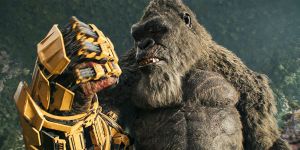 The biggest appeal of any monster movie is its destructive action, and Godzilla x Kong delivers in this regard while keeping things fluid and fun. Returning director Adam Wingard (You’re Next) makes sure the big brawls are easy to follow with minimal edits to better orient the viewer. The big hits feel like they matter, and the rules of the different fights and fighters and the varying geography matter. There’s a climactic fight in the Hollow Earth where gravity becomes a second thought, and it’s a tremendous visual spectacle as well as rousing sequence of excitement to watch these giants suddenly weightless and zooming through the air in combat. Wingard also knows when to give his characters their big hero moments, and the team-up between Kong and Godzilla has the same rousing satisfaction as you would wish for two titans of mayhem. I enjoyed the new orangutan villain, the Scar King, a fearsome beast that cannot match Kong for sheer brutal strength but makes up for it in speed and agility, and a whip-like weapon that controls a frost-breathing kaiju through fear and pain. It’s an interesting character at least in design and contrast from our hero kaiju, so it’s not just more of the same but with a horn or something. I have to think anyone coming for some top-tier monster wrestling will leave the movie happy.
As for the human drama, it’s mostly kept along the fringes and there to introduce necessary plot elements that a grunting ape couldn’t more adequately convey. Hall has to worry about possibly losing her adoptive mute daughter who is herself the last of an older civilization. It’s pretty simplistic but acceptable as a parallel about finding one’s place in the world from feeling alone.
Godzilla x Kong is silly and stupid and stupidly fun, appealing to any kaiju fan’s inner child, working that same primordial wonder of monsters and destructive spectacle. For my money, it’s a step above the 2021 initial brawl thanks to scaling down its many assorted plotlines dealing with too many forgettable human characters. The action is rip-roaring and proof that even more can be ceded to Kong and a lack of dialogue to tell this story in a meaningful manner. Wingard still has a natural feel for elevated B-movie material, and clearly this movie is going in a very different route than 2023’s now Oscar-winning Godzilla Minus One, a shockingly affecting post-war human drama that just so happened to have Godzilla in it. It’s a perfect blockbuster to chow down popcorn and hoot and holler along with our giant avatars of childhood glee.
Nate’s Grade: B
Share this:

Indiana Jones and the Dial of Destiny (2023)

I held off watching Indiana Jones and the Dial of Destiny for almost half a year as I feared that this even longer-in-the-tooth Doctor Henry “Indy” Jones (Harrison Ford) would make me reassess the 2008 Kingdom of the Crystal Skull more favorably. Having re-watched the original trilogy, I can say that Dial of Destiny has made me reassess the much-maligned 2008 sequel. It’s still not good, and has many wide misses, but it’s also a more interesting movie to watch even in its myriad ways of disappointment. Maybe that’s the Steven Spielberg difference, a filmmaker so talented that even his rare cinematic follies have their own dynamic appeal. Dial of Destiny is a nostalgia slog, including the opening action caper with a de-aged Indy set in 1944 battling Nazis, just like we like. The action sequences lack the whimsy and satisfying scope and scale of the past, but everything here just feels on autopilot, including a gruff Ford as an Indy well past his prime in a world that has only gotten more complex. He’s given two lackluster sidekicks, neither of which are well integrated, and an old former Nazi (Mads Milkkelsen) who literally wants to find the ancient time travel device to go back to WWII and give Hitler notes. It all feels so deflated and absent the spirit and fun of the original movies, and it’s disappointing in a manner that is more bland and predictable than crazy and outlandish (nuking the fridge, killer ants, Tarzan swings, etc.). There’s an interesting kernel of a concept here, an archeologist possibly finding a skeleton in an ancient excavation that belongs to himself, and an ending that could have been ballsy and poetically fitting for the adventurer to become literally part of history. Alas, the one really exciting aspect of Dial of Destiny wimps out, settling for an ending that feels like another weak feint to the franchise’s storied past. I was so thoroughly disengaged by this movie throughout its 154 minutes. It is bereft of lasting charm and imagination and fun. At this point, with an 81-year-old Ford, I think it’s time to leave the character in a museum.
Nate’s Grade: C-
Share this:

Aquaman and the Lost Kingdom (2023)
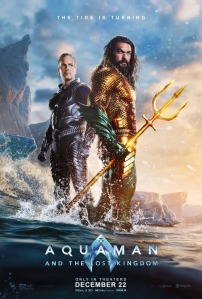 Aquaman and the Lost Kingdom is he last of the Zack Snyder-then-not-Snyder-verse DCU movies, and with that the ten years of mostly middling super hero heroics comes to an end not with a bang but with a whimper. I was a fan of 2018’s original Aquaman thanks to the self-aware craziness and visual decadence from its wily director, James Wan (Malignant). This is still the major appeal of the franchise, a universe that feels pulled from a child’s imagination and recreated in loving splendor on the big screen. The problem with this tone is that it’s a delicate balance between silly fun and silly nonsense. The goofy charm of these movies is still alive and well as they open up an even bigger undersea world of lore (Martin Short as a fish lord!), but this time it feels like a movie that is making it up as it goes, and all that “and this happens next” storytelling begins to feel like a monstrous CGI mess needing to be tamed. This might have something to do with the fact that Wan finished filming the movie over two years ago and it’s endured several re-shoots, including featuring two different Batman actor cameos at different points, to now bring to a close a decade of interconnected movies that are going to be blinked out of larger continuity in 2025 (excluding Margot Robbie’s Harley Quinn, I guess). Lost Kingdom has plenty of enjoyably weird undersea nightmare creatures, a specialty of Wan given his horror roots, but the ultimate villain spends most of his time sitting on a throne in wait and is laughably dismissed so easily in the climax. The whole evil magic trident that corrupts from its evil influence has a very Lord Sauron ring to it. I give the movie points for transforming into a buddy movie between Arthur Curry (Jason Momoa) and his brother Orm (Patrick Wilson) halfway through. The jail break sequence is fun and different, and their bickering dynamic makes for winning comedy. However, the drama feels too overworked, with holdovers from the first film (Black Manta, Amber Heard’s unremarkable love interest) repeating their same beats with robotic dedication. The opening reveal of Arthur being a new dad and it cramping his macho-cool style made he fear we were headed for Shrek 4 territory, where the new dad needs one more adventure to realize the importance of family, etc. Because even when you’re riding a mechanical shark, fighting alongside the crab people, and tunneling through worm prisons, it’s all about recognizing the importance of family, kids (the real undersea treasure after all). I defy anyone not to laugh at the literal concluding speech and its enigmatic “sure, fine, whatever”-energy. As a mere movie, Lost Kingdom is silly escapist entertainment that could enchant a few with lowered expectations, and as the final entry point in a universe of super heroes, it’s a fitting nonsensical end.
Nate’s Grade: C
Share this:

The Marvels (2023)
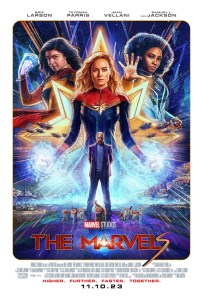
No Marvel Cinematic Universe (MCU) movie has had a bigger trail of negative buzz than The Marvels, the supposed sequel to not just 2019’s Captain Marvel but also an extension of two Marvel television series from the Disney streaming service. The film has had its release delayed three times, rumors abound that heavy portions were re-shot, and its own director, Nia DeCosta (2021’s Candyman), had already moved on to starting her next project while her last movie was still being finished in post-production (to her defense, the movie was delayed three times). The opening weekend wasn’t kind, setting an all-time low for the MCU, and the critical and fan reception was rather dismal, with many calling the movie proof that Marvel was in trouble. There is a lot going against this movie, and yet when I actually sat and watched The Marvels, I found it a flawed but fun B-movie that doesn’t deserve its intense pile-on. Although, caution dear reader, as I’m also one of the seemingly few critics who enjoyed Black Widow and most of Eternals as well.
Carol Danvers a.k.a. Captain Marvel (Brie Larson) has been absent for most of the past 30 years, trying to do right by the universe’s many alien civilizations in need. The people of Earth also feel a little left behind, notably Monica Lambeau (Teyonah Parris), who knew Carol as a child in the 1990s and is now acclimating to her own light-based superpowers (see: WandaVision). A power-hungry Kree warrior, Dar-Benn (Zawe Ashton, Tom Hiddelston’s wife in real life), is seeking a way to restore a home world for her people. She finds one super-powerful weapon, a bangle she wears on her arm that opens interstellar portals. The other bangle happens to belong to a New Jersey teenager, Kamala Khan (Iman Vellani), a first generation Pakistani-American who also moonlights as the bangled-powered hero, Ms. Marvel (see: Ms. Marvel). Through strange circumstances, Kamala, Monica, and Carol are all linked by their powers, so if one of them uses said powers they happen to swap places in space, teleporting from three different points. It makes it really hard when you’re supposed to save the day and work together to defeat the bad guy.
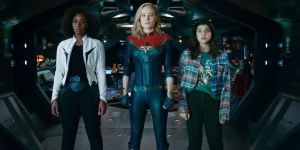
The core dynamic of the movie is this trio of powerful women learning to work together, and while that might sound trite for the thirty-third movie in a colossal franchise, it’s a serviceable arc for a movie that only runs 100 minutes, the shortest in MCU history. The swift running time is both a help and a hindrance, but it allows the film not to overstay its welcome while juggling three lead characters and multiple space-time-hopping action set pieces. I wish Marvel could return to an era of telling smaller stories that don’t have to feel so grandiose, with personal stakes tied more to their characters than saving the planet yet again (2017’s Spider-Man: Homecoming is a great example). Even though this too falls into the trap of world-destroying-energy-hole, it still feels lighter and breezier, and I think that is a result of its pacing and lowered ambitions. That’s not an insult to the filmmakers, more a recognition that The Marvels doesn’t have to compete with the likes of Endgame or the Guardians for emotional stakes. It can just be fun, and simply being a fun and well-paced action movie is fine. That’s what the MCU diet can use more of, especially considering the Ant-Man movies have transformed from palate cleansers to same-old bombast.
On the flip side, the speedy running time is also a very real indication of its troubled production and the attempt to salvage multiple versions into one acceptable blockbuster. There are signs of heavy editing and re-shoots throughout, from lots of ADR dialogue hiding actors visibly mouthing these patchwork lines, to world-building problems and solutions that can seem hazy. The rationale for why these three women become linked is so contrived that even Nick Fury (Samuel L. Jackson) bemoans Carol not to touch a strange unknown space light because it’s shiny. The concept of the three heroes being linked by their powers offers plenty of fun moments, of which I’ll go into more detail soon, but the execution left me questioning. Which superpower use qualified and which did not? It seems a little arbitrary which powers using light trigger the switcheroo. I don’t think the movie even knows. There’s also a late solution that feels so obvious that characters could have been like, “Oh yeah, we could have tried that this whole time.” A reasonable excuse was right within reach, blaming the inability to attempt the solution on not having sufficient power before assembling both of the bangle MacGuffins. It also, curiously, allows the villain to win in spite of her vengeful indiscriminate killing, but don’t think too much about that or its possible real-world parallels as that will only make you feel dramatically uncomfortable.

There are remnants of what must have been a fuller movie of Marvels’ past, as each character has an intriguing element that goes relatively under-developed. Monica was gone thanks to Thanos while her mother died and is also trying to square her feelings of resentment for Carol, a woman she felt so close to as a child who flew away and didn’t return for decades. So we have attachment issues and issues of closure. Carol is likewise trying to rebuild her relationship with this little girl she let down, and she has to also consider the unintended consequences of being a superhero. The Kree worlds refer to Carol as “The Annihilator,” a powerful being that doomed their civilization. She’s become a culture’s nightmare. That re-framing of heroism and perspective, as well as the larger collateral damage of the innocents from defeating villains makes for an interesting psychological stew of guilt and doubt and moral indecision. Then there’s Kamala, who worships Captain Marvel as her personal hero and wants nothing more than to join the ranks of superheroes. Her rosy version of the duties of being a hero could be seriously challenged by the harsher reality, like when Carol has to determine that saving “some lives” is more important than losing all life to save more. She could become disillusioned with her heroes and re-examine her concepts of right and wrong. And there are elements of all these storylines with our trio but they’re only shading at best. There’s just not enough time to delve into this drama when the movie needs to keep moving.
However, the fun of the body-swapping concept leads to some of the more enjoyable and creative action sequences in the MCU. DeCosta really taps into the fun comedy but also the ingenuity of characters jumping places rapidly. It begins in a disorienting and goofy way, as characters jump in and out of different fights and have to adapt. It makes for a fun sequence where at any moment the action can be shaken up, as well as forcing there to be enough action going on for three people. This also leads to some interesting dangers, as Kamala gets zapped high above her neighborhood and plummets to the ground, as these are the dangers when your two other linked superheroes can fly. The use of the powers into the action feels well thought through, and the combination of the women working together and strategizing when and where to swap places makes for creatively satisfying resolutions. The action sequences are also very clearly staged and edited without the use of jarring and confusing edits. You can clearly see what is happening and what is important, and the choreography is imaginatively spry.

There are some asides to this movie that had me smiling and laughing and just plain happy. The Marvels visit a planet where the only way to communicate with the locals is through song, and it starts out like a big old school Hollywood musical with some Bollywood flourishes. I wish the movie had done even more with this wonderfully goofy rule, possibly even setting a fight sequence that also plays into the musical quality of the weird setting. Oh well, but it was pure fun and forced the characters outside of a comfort zone (though this too had some hazy rules application). There’s also a montage involving alien cats and a life-saving and space-saving solution that had me giggling like crazy (my extra appreciation for the ironic use of “Memory”). It’s because of these sequences, the delightful exuberance of Vellani, and the above-average action sequences that make it impossible for me to dismiss the movie as a waste.
The Marvels has problems, sure, with its lackluster villain, some hazy rule-setting and application, not to mention an overstuffed plot that feels a bit jumbled from the likes of twenty other stories trying to appear as one semi-unified whole. But it’s also fun, light, and entertaining in its best moments, and even the good moments outweigh the bad in my view. I would gladly re-watch this movie over the likes of Multiverse of Madness, Love and Thunder, and Quantumania. While it can seem initially overwhelming to approach, the movie does a workable job to catch up its audience on who the other Marvels happen to be just in case you didn’t watch 17 episodes of two different TV shows. It’s mid-tier Marvel but refreshingly comfortable as such, only aiming for popcorn antics and goofy humor with some colorful visuals. It all feels like a special event from a Saturday morning cartoon, which again might be faint praise to many. Blame it on my lowered expectations, blame it on my superhero fandom, or simply call me a contrarian lashing out against what seems a very ugly strain of vitriol for this movie to fail, but I found The Marvels to be a perfectly enjoyable 100 minutes of super team-up tomfoolery.
Nate’s Grade: B-
Share this:

Mission: Impossible – Dead Reckoning Part One (2023)
 I was a nominal fan of the Mission: Impossible series after three movies, and it seemed like the American public was feeling the same. After 15 years, it felt like the franchise was considering a soft reboot/shift with 2011’s Ghost Protocol, setting up Jeremy Renner as the heir apparent to Tom Cruise’s super spy, Ethan Hunt (weirdly, Renner was also set up to be another franchise replacement for Matt Damon’s Jason Bourne in 2012). Except what may have been initially planned as a franchise hand-off became a franchise renewal, with a delightfully twisty plot, fun teamwork as they scramble to adapt, and a show-stopping action set-piece that remains the franchise’s high-point, the scaling of the towering Burj Khalifa skyscraper. It also reminded us that not only does Cruise love to run but the man has a death wish when it comes to performing his own amazing stunts. With Cruise firmly back in place as lead, and Renner jettisoned (which also happened after 2012’s The Bourne Legacy), the franchise was further boosted by two of its best additions: actress Rebecca Ferguson and writer/director Christopher McQuarrie. The Oscar-winning Hollywood screenwriting staple was not known as much for his directing efforts, but he became a Cruise confidant after 2008’s Valkyrie, and he’s worked almost exclusively on Cruise projects ever since. He earned the man’s trust and proved a fantastic action director. 2018’s Mission: Impossible Fallout is just blockbuster filmmaking at its high-stakes finest. I was bouncing in my chair with excitement and simply luxuriating in action thriller nirvana.
This time Ethan Hunt (Cruise) and his select team of trusted friends and colleagues are battling a villain terrifyingly relevant to our modern times, especially in light of the screenwriters’ strike – artificial intelligence. The big bad is an A.I. that can control the world’s security apparatus, and it’s become self-aware and resentful of its human overlords. It exists inside a computer console inside a Russian submarine at the bottom of the Arctic ocean under a wall of ice, and the A.I., known as “The Entity,” doesn’t want to ever be found (must be an introvert). If only it was that easy. The world is racing to be the first to claim this unparalleled prize, and the Impossible Missions team has to ensure they can find the location, which of course involves a MacGuffin, this time two interlocking keys to access the A.I. sub station. Can Ethan get there first and can he even trust his own government to do what’s best with access to this kind of power?
 Mission: Impossible – Dead Reckoning Part One is a mouthful of a title. We got a colon, a dash, and a “part one,” a presumptuous gamble that after 160 minutes the audience is going to be ravenously hungry for a continuation in a series that has never had a two-parter before. In short, the movie is a lot, a lot of the same action and renowned stunt work we expect, and a lot of setup and extension that might have been better trimmed by focusing on one movie rather than setting up two. McQuarrie has done this before and been successful without the need of a direct two-parter. For all intents and purposes, Fallout is a direct sequel to 2015’s Rogue Nation, carrying over the same villain for the first time in the series and the ongoing relationship between Ethan and Ilsa Faust (Ferguson). Both of those movies feel complete and satisfying and well-designed in structure and development without needing one part to complete the other. With Dead Reckoning Part One, henceforth known as M:I 7 to spare me from writing this title every time, it feels like an overlong setup. By the end of the movie, our characters know where the A.I. is located but they still don’t know where the sub is or how to get there, which means the entire movie could have been collapsed into a more streamlined venture. Part of this may be the production troubles where they had to shut down and rejigger the plot multiple times from COVID outbreaks, as M:I 7 is the last of the big Hollywood movies to release that was shutdown in 2020 by the devastating pandemic. It all feels a bit overstretched and absent a satisfying conclusion.
The draw of the franchise, and chiefly its 2010s renewal back into the zeitgeist, is still the eye-popping stunts and set-pieces and Dead Reckoning still delivers. Most viewers will likely find the final action sequence aboard a speeding train to be the high-point, and it’s got some wow moments, my favorite is when the train is hanging over a blown bridge and Ethan has to leap from train car to train car before it plummets, oh and it’s all at an incline. It turns each car into a new obstacle to overcome utilizing its specific dynamics, like a dining car with a falling piano to a kitchen with vats of hot grease to avoid. The standout stunt involves Cruise driving a motorcycle off a mountain in a desperate effort to parachute onto this speeding train. However, this whole train sequence didn’t excite me too much, outside of its beginning stunt and the end. Watching men chase one another atop the speeding train, let alone wrestle and fight with knives, only serves to limit what can be done and it reminds me how fake the moment is for a franchise that has made its mark on its daredevil realism. That extended middle feels a bit too much like other Hollywood thrillers and action movies, and that’s what made it disappointing for a series I consider the current gold standard of franchise action.
 A much less heralded sequence around the forty-five minute mark was my favorite, where Ethan is running around the Abu Dhabi airport while the following takes place: 1) Ethan trying to evade federal agents (the dependable Shea Whigham) looking to arrest him, 2) Ethan is trying to find the owner of one half of the MacGuffin keys who happens to be a pickpocket that keeps giving him the slip, 3) Ethan’s team, Luther (Ving Rhames, the only other actor who has appeared in every M:I film) and Benji (Simon Pegg) trying to find a nuclear bomb in a suitcase through the maze of baggage claim and disarm it, 4) the introduction of our villain Gabriel, well, our primary lackey to The Entity, who also happens to be a former IMF turncoat who killed Ethan’s girlfriend and essentially “made Ethan Hunt who he is” following Batman logic. This entire sequence is pure McQuarrie splendor, where it introduces the different characters, several at cross-purposes, lets them loose and then finds organic complications and specific turns that take advantage of the geography as well as the character’s emotional states. I loved it, and it made me hopeful that after a bit of a slow start that M:I 7 was now cooking and would be the prolonged deluge of near-perfect set-pieces that was Fallout. Not so much, but this sequence was indeed good fun.
Another issue I had was that our villain, again more like chief lackey, is so bland. I like Esai Morales (Ozark) as an actor, but the character of Gabriel is such a non-starter. Even giving him the personal history with Ethan feels like an admission that this bad guy has little to offer on his own. I think it’s part of how the character is written but I think it’s also a reflection that he’s the number two behind the all-powerful, scheming A.I., and then he too has a number two (number three?) played by Pom Klementieff (Guardians of the Galaxy vol. 3), and she is so much more engaging as an antagonistic presence. She’s the one driving through cars and stonework throughout Rome to chase down Ethan. She’s the one who fights him in a narrow alleyway, a nicely claustrophobic change-of-pace action moment for a series that gorges on scale. If the true villain is going to be an A.I., why can’t Pom simply be its number two hench-person? Gabriel is redundant and boring and his fight sequences don’t feel believable against this crew.
 There are a couple other storytelling choices that I wasn’t happy with, but I’ll save delving into those for the sake of spoilers. Suffice to say, I hope Dead Reckoning Part Two in 2024 course corrects and we have some welcomed returns. It’s kind of fun to see Kittridge (Henry Czerny, Ready or Not) make his first reappearance since the 1996 M:I and also get so much screen time. He’s essentially the face of the U.S. government infrastructure for the duration of the movie. His clenched-jaw consternation is a nice foil to the always rogue super spy.
Dead Reckoning – Part One is a good but not great Mission: Impossible movie, conceived as two parts and suffering some of the consequences of its over-extension. The thrills are still there, the sturdy production values, the emphasis on the spectacular stunts and fun action set pieces, so any fan of the franchise will find enough to enjoy over 160 minutes. The addition of Hayley Atwell (Avengers: Endgame) as the wily pickpocket who has stumbled into international espionage is great, though she cannot escape feeling like an Ilsa replacement while Ferguson is off-screen for too long. Cruise is still the movie star who delivers the most from film to film, and his high-wire efforts are appreciated. By the end of the movie, the sub is still at the bottom of the ocean, our characters are still in a race to find it, and I wondered why we couldn’t have ditched “Part One.” The answer, as much in Hollywood, is of course money, but I wish this Part One made me more psyched for Part Two.
Nate’s Grade: B
Share this:

The Meg 2:The Trench (2023)
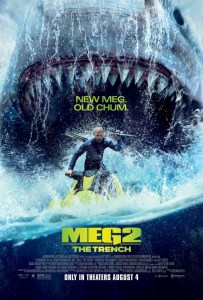 It’s Jason Statham riding a Jet ski and literally jousting giant sharks, so the fault should be on me expecting something more from The Meg 2, right? I wished there was more of this kind of gonzo schlocky action, moments like Statham kicking a guy into the mouth of a killer shark and saying, “So long, chum.” Too much of this movie is setting up an ensemble of characters that are boring and not Jason Statham, including villainous turncoats that I kept forgetting who they were. There are also small-sized dinosaurs but other characters just chase them down to shoot them. I was mostly fine with the first Meg movie as dumb fun, and this one seems to be going for the vibe of a bigger-budget Asylum/Sci-Fi Channel schlockbuster, the kind of movie with a “Sharktopus” or “Mega Shark” in its outlandish title. Unfortunately, the movie doesn’t seem to accomplish even that aim. I wish the movie had been even more crazy but it feels like, for whatever misplaced idea of tone, that the filmmakers held back. Next time just have Statham psychically linked to the shark and fighting dinosaurs and own it.
Nate’s Grade: C


You must be logged in to post a comment.