Author Archives: natezoebl
Atlas Shrugged: Part II (2012)
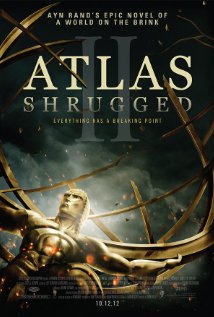 You’d think after the horrible and horribly boring Atlas Shrugged: Part One that a promised Part Two might just disappear into the ether. If only we could have been so fortunate. Ayn Rand’s cautionary opus about the evils of big government is given another creaky adaptation that fails to justify its existence. I feel like I could repeat verbatim my faults with the first film. Once again we don’t have characters but mouthpieces for ideology, an ideology that celebrates untamed greed. Once again the “best and brightest” (a.k.a. world’s richest) are disappearing and the world is grinding to a halt without their necessary genius. Does anyone really think if the world’s billionaires left in a huff that the world would cease to function? The assumption that financial wealth equates brilliance seems fatally flawed. Once again it’s in a modern setting where America has gone back in time to value railroads. Once again the main thrust of the inert drama is over inconsequential railway economics. Once again people just talk in circles in cheap locations. Once again the government agencies are a bunch of clucking stooges, eager to punish successful business. Once again Rand’s Objectivist worldview is treated as gospel and value is only ascribed to the amount of money one can produce. This time we have a slightly better budget, a better director, and some recognizable actors like Samantha Mathis, Esai Morales, Ray Wise, Richard T. Jones, and D.B. Sweeney as the mysterious John Gault. The story transitions to a ridiculous government mandate that include such incomprehensible edicts like making sure no one spends more money than another person. Can you imagine the paperwork involved? This woeful sequel will only appeal to Rand’s most faithful admirers, and you probably don’t want to hang out with those people anyway. There’s your clue: if you see someone carrying a copy of Atlas Shrugged: Part Two they either lack taste or are far too generous with movies. If there is indeed a concluding Part Three, it will be further proof that Rand’s market-based screeds are not accurate. The market has already rejected two of these dreadful movies.
Nate’s Grade: D
Share this:

A Good Day to Die Hard (2013)
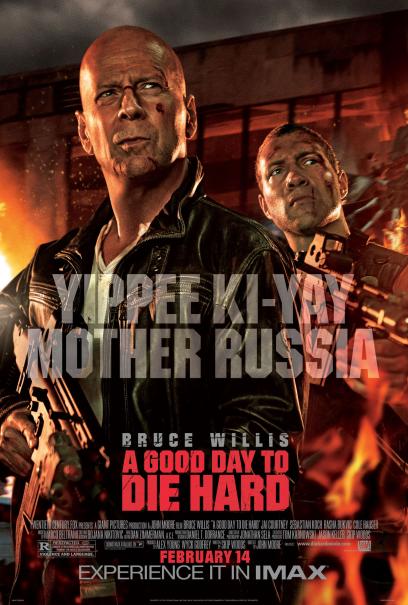 A Good Day to Die Hard, the fifth entry in the series, is clearly, on all fronts, the worst movie in the franchise. I suppose this shouldn’t come as that big of a surprise. Most fifth movies are not seen as peaks in creative achievement (I will go to my grave singing the praises of Saw 6, one of the few late sequel successes). I’m sad to report but Die Hard 5 is just a lousy action movie trying to get by on the good will of its famous heritage.
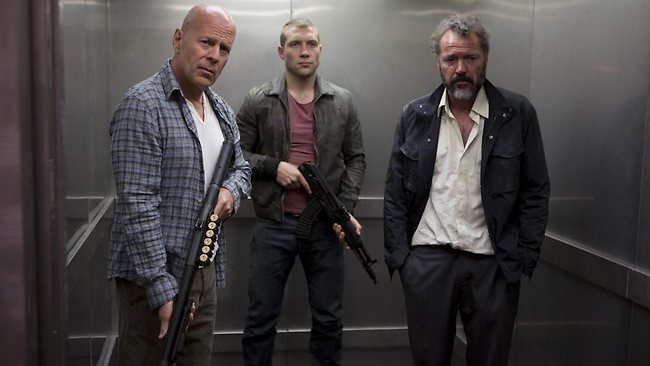
John McClane (Bruce Willis) is visiting Russia to find and help his estranged son, Jack (Jai Courtney). Dad thinks his boy is in trouble with the law but really Jack is a CIA agent working undercover to prevent a nuclear arms sale. A Russian political figure is promising to go public with his findings of corruption, and the man falls under the protection of John and Jack McClane. Father and son must dodge all sorts of danger and maybe, just maybe, they’ll bond over the experience of shared peril.
All of the story and character problems would have been forgivable, or at least mitigated, if this movie actually delivered the goods when it came to its action sequences. Sadly, Die Hard 5 is just thundering mediocre from start to finish. No, I take that back. In the last five minutes of the movie, it has one action development that is unexpected and interesting and different, and that’s when John McClane drives a truck out of the back of a helicopter to drag down the chopper. I repeat, this lone moment of action interest occurs with about five minutes left until the end credits roll. That’s a whole lot of gristle to get to something good. Until this point, Die Hard 5 is replete with car crashes and explosions and noisy exchanges of gunfire, but what does it all add up to? It’s like it has familiar action elements we’d expect in this sort of adventure, but it never seems to know what to do with them. Great action takes advantage of geography, moves the story forward, and escalates with natural complications. Most of Die Hard 5 is repetitious fights or shootouts in lazy locations (oh look, another warehouse-type building!). There’s a car chase through the streets of Moscow that should be exiting, but instead it just stays the same as it began. It’s two cars smashing into others. The final action takes place at the Chernobyl nuclear site, and yet it could have been just any other unwatched warehouse. I never thought I’d ever go to a movie with “Die Hard” in its title and be bored… by the action.
 Here’s the deal: if you’re going to produce action sequences that don’t just stretch believability, they throttle it, then you better produce some memorable material. I long for the simply days of the original Die Hard where John McClane was a mere crafty mortal, confined to one location, using his wits, training, and stealth to turn the tables on the bad guys. He was an ordinary cop and that made him even easier to root for. Now he’s graduated to the Table of Indestructible Action Stars, men who can survive any scrape with barely a scratch no matter how improbably or death defying. I accept this change, but if you’re going to present larger-than-life action, you have an obligation as a filmmaker to make it entertaining. Die Harder had the man ejecting himself out an exploding airplane, and that was cool. Live Free or Die Hard had McClane driving an 18-wheeler along a collapsing highway, finally jumping onto a downed fighter jet. It’s completely over-the-top but it’s memorable and entertaining and, yes, cool.
The more I think back, the better 2007’s Live Free or Die Hard looks. It worked surprisingly well, well enough that I claim it as my favorite Die Hard sequel. First off, that movie had memorable action exchanges; I can still recount four or five sequences off the top of my head years later. Even if it was a standard fight between two characters, it found ways to make it interesting, like a fight between McClane and Maggie Q (TV’s La Femme Nikita) that extended into an elevator shaft and a falling auto. While Timothy Olyphant (TV’s Justified) couldn’t hold a candle to Alan Rickman (Harry Potter franchise) as far as movie villainy, the man was tremendously better than the pitiful bad guys in Die Hard 5. You have to let your villains have opportunities to be villainous, but they also have to be competent at what they do or else the movie is too obviously one-sided. Look we all know the hero will prevail but we like to see an even match for most of the running time. The Russian bad guys in this movie just suck. They suck and characters and they suck as bad guys and throwing twisty double-crosses and triple-crosses, just to keep an audience awake, make their master plan seem even more convoluted and implausible. All of this chaos is over a file whose possession, if I’m not mistaken by the needless confusion of the twists, resides with the villains for a good period of time. Why are they still going through this whole charade? Also, they suck.

The idea of tagging McClane with his son seems like a weak attempt to extend the franchise beyond the ownership of an aging Willis. I don’t care about John McClane’s kid. This isn’t Roots. I don’t come to these movies to check up on the guy’s brood of feisty kids, which by the way, Die Hard 4 did this same storyline much better with his daughter, Lucy (Mary Elizabeth-Winstead). Jack McClane is a thickheaded dolt of a son, and as far as a charismatic action figure capable of taking over a franchise, don’t hold your breath. The father/son dynamic is so poorly developed. They mostly just grunt at one another and we call it characterization. Pairing McClane up with a sidekick has worked before but only when the characters are vastly different from the central man of action, like Samuel L. Jackson and Justin Long’s more comedic characters. They provided contrast and conflict and brought out different sides of the John McClane character. When you pair John McClane up with his son, who happens to be a younger version of his dad, you get nothing. I already got one John McClane onscreen; I didn’t need a watered-down, charisma-free clone. If they’re going to continue the franchise with one of John McClane’s kids, I pray that it’s the more assertive and capable Lucy.
A Good Day to Die Hard is just not a good movie at all, and it’s an even worse sequel. The fact that I endured 97 minutes of a Die Hard movie and had to scramble for anything positive to say about the action should say more than the problems with logic, plot, character, pacing, and overall production. Willis doesn’t even look like he’s enjoying himself any more. The film never grabs you, never bothers to show you something different, and after a while it simply just beats you into submission with its video game-like artificiality and redundancy. I demand more attention and care put toward my action sequences rather than treating them like a tossed salad. Sure the right elements are there but they’ve been given no thought or care. I was literally battling sleep during long portions of this awful movie. For fans of the series and Willis, it’s hard to settle on any other conclusion but one of disappointment. The story is muddled and generic, the villains are muddled and generic, the action is muddled and generic. You get the idea, and Die Hard 5 is routine to the point of autopilot, a soulless cartoon of careening bodies and speeding bullets. The only reasonable excuse I can give for seeing this movie, lowered expectations and all, is just to see how low the Die Hard franchise has fallen.
Nate’s Grade: C-
Share this:

Side Effects (2013)
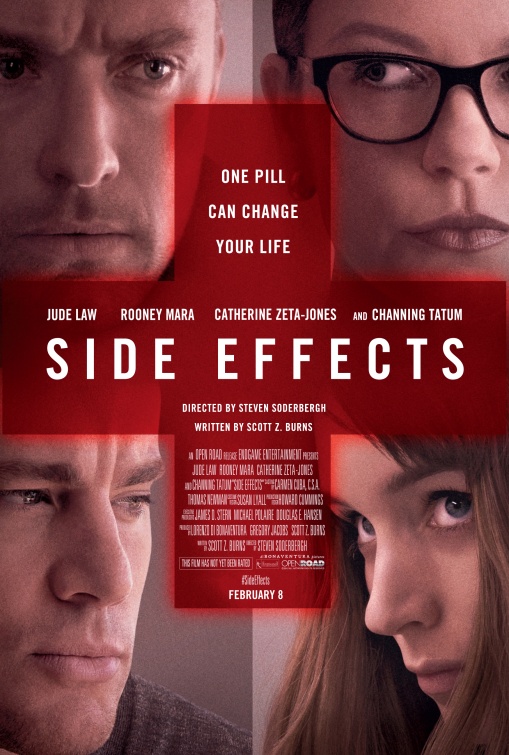 Steven Soderbergh’s supposed last stop before retirement is another of his genre exercises, but Side Effects feels like a firmer success, albeit modest, for the director to go out on. It’s the story of a woman battling depression, played with terrific cageyness by Rooney Mara (The Girl with the Dragon Tattoo). She gets prescribed a new drug and… does some very bad things. Who is culpable? The doctor, being funded by the drug companies? The woman who was sleepwalking at the time? The industry for blanketing patients with ads to demand their drug? After a rather slow start, the movie gets interesting and starts to try out different genres like hats. It appears for a good while we’re now going to be following her doctor (Jude Law) and his downfall as the industry turns on him and the media coverage intensifies. Written by Scott Z. Burns (Contagion), the movie has that same enticing sense of realism about how all the moving parts of a complicated industry would come into sync and conflict. Then the film tries out another identity, that of traditional thriller, with wronged parties orchestrating vengeance. I was invested until the end and felt sufficiently satisfied with the end results. Soderbergh’s smooth camerawork and cool color palate are well suited for a film about the battles of depression, and for a good while, before the thriller aspects take over, the movie is a fairly mature look at the struggles of depression and the industry that profits off it. Side Effects doesn’t seem like a closing statement for an artist as varied and unpredictable as Soderbergh, but as far as a Saturday afternoon goes, it’ll sure pass the time nicely.
Nate’s Grade: B
Share this:

Rust and Bone (2012)
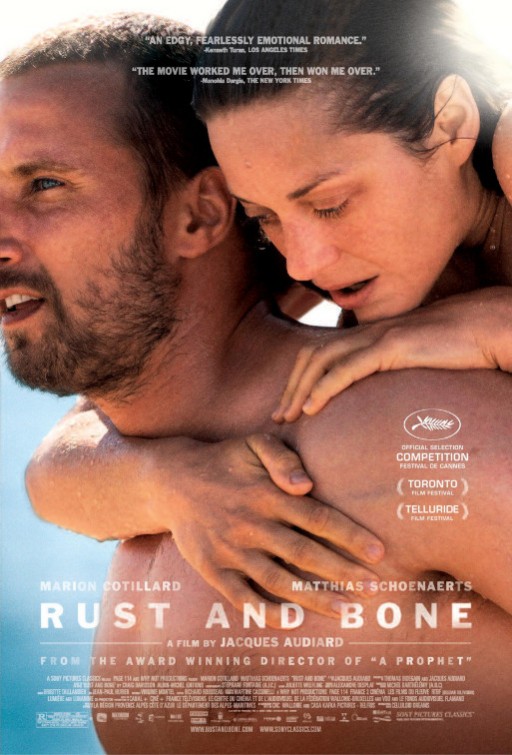 The French film Rust and Bone’s U.S. release seemed to hinge entirely on whether star Marion Cotillard would garner a coveted Oscar nomination. When that didn’t happen, it seemed like the studio just threw up its hands and said, “Well, that’s it.” Rust and Bone, co-written and directed by A Prophet’s Jaques Audiard, has been given a very ignoble release, an afterthought for an awards season that didn’t go Cotillard’s way. While I would have nominated Cotillard for her powerful performance, I certainly wouldn’t think much else about Rust and Bone, a frustrating film that doesn’t know whose story it’s telling or what movie it wishes to be.
Alain van Versch (Matthias Schoenaerts) is struggling to take care of him self and his young son, Sam. Alain’s ex-wife, and Sam’s mother, used the boy as part of her drug trades. Alain moves in with his sister and gets a job as a nightclub bouncer. It’s at the club where he meets Stephanie (Cotillard), a marine trainer. She’s also feisty and getting kicked out for starting a fight. Stephanie works at a Sea World-esque water park, and one horrific day one of the whales makes a wrong turn. It runs into the stage, knocking Stephanie unconscious into the water where, we learn, a whale has eaten her legs below her knee. She contacts Alain and the two form an unlikely friendship, one that turns physical as Stephanie worries what her sexual performance will be like under her new circumstances. Alain dreams of becoming a professional kick boxer/MMA fighter, and he performs in underground fights as another means of income. Stephanie tags along and helps motivate him win his fights. The two grow closer, but Alain struggles with what real feelings might mean.
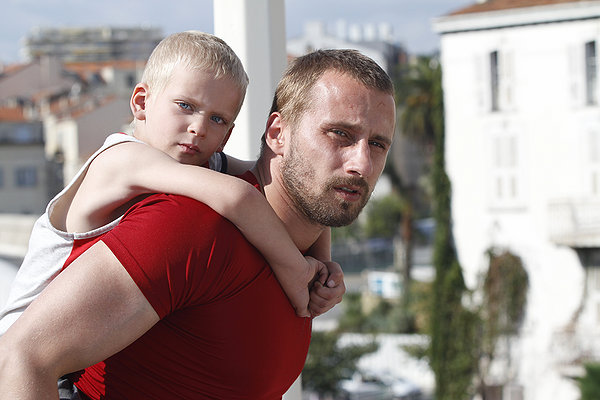 Rust and Bone has a serious case of multiple personality disorder. It looks like it’s going to be one movie, then all of a sudden it changes into another, and then when you think you’ve got a handle on that, it suddenly transforms into another. I’m perfectly fine with a movie switching gears suddenly, however, with Rust and Bone, I felt like I was getting three different half-hearted drafts rather than an actual movie. I went into the film knowing little other than the selling point, that Cotillard was playing a woman readjusting to life after a freak accident took her legs. For the first twenty minutes of the movie, I didn’t get a shred of this. I got a single father trying to scrape together what he could for himself and his son, often resorting to sneaky and illegal measures. Then shortly after Stephanie is introduced, the movie becomes all about her. We’re dealing with her recovery and her anger and her loss. Just when I think I’ve settled onto the narrative direction of the movie, it becomes Alain’s movie again. Now we’re following his budding career as an amateur kick boxer, with Stephanie as his cheerleader. Then she dissolves into the background of the movie yet again, and it’s all about him. I don’t think the movie knew which character it wanted to be its focal point, so we get a sloppy interspersing of storylines vying for dominance. Personally, I was much more invested and intrigued by Stephanie’s recovery than anything having to do with Alain trying to be a better father and failing. Then there’s other muddled storylines like hidden cameras in the workplace that only further distract. It’s just all too much and at the same time not enough.
Then there’s the matter of the romance between Stephanie and Alain. I suppose you could say they are both wounded people trying to gain a greater sense of independence, battling new concepts of self-identity, but I think I’m doing the film too many favors. The sad part is that these two people are extremely shallow and limited form a characterization standpoint. The only defining quality about Stephanie is her injury. Sure she’s feisty and can get into bar fights, and that fact that she’s attracted to Alain says something about her, but really, her only characterization is her new physical limitations and her adjustment to them. Her physical needs are given much more attention by the screenplay than her emotional resonance. It makes me sound like a hardhearted bastard but I’ve said it before, I need characters that have more depth to them other than that they suffer. Alain, on the other hand, is even worse. He’s a pretty flat character who’s actually a really terrible father. He loses his temper easily, chooses quick sex over picking up his kid at school, plus there’s the whole abandonment thing. It’s hard for me to believe that anything really sinks in with this lunkhead. His relationship with Stephanie, meant to open him up, instead reconfirms what a jerk he is. He uses women as sexual playthings, and treats Stephanie with this same careless abandon. He clearly doesn’t see her as anything but a comfortable fling, which he shows through his actions. If Alain’s romantic views have changed, the film doesn’t show any of this progression. I didn’t care about him and I certainly didn’t care about the two of them together.
Acting-wise, Cotillard (The Dark Knight Rises) is quite moving throughout as she tries to come to grips with everything that has been taken from her. Her more traditionally dramatic crying scenes are powerful, sure, but it’s the quiet moments that Cotillard nails. There’s a moment where she goes through her former routines hand motions, and in that moment, set to Katy Perry’s “Firework,” it becomes clear she is moving beyond her accident, accepting and getting stronger. It’s a subtle celebration of the human spirit’s ability to rebound, and Cotillard makes sure the moment is moving rather than cheesy. Also, there’s a very tender moment when she returns to the water park and reunites with the whale that took her legs. Through the glass, she goes through her training motions and the whale still resounds accordingly to her commands. It’s a wordless, touching moment that communicates so much, the nature of forgiveness, the culpability of an animal, but really about the connection between man and nature. Also, the fact that these two scenes are available on YouTube means somebody else must have seen them as standouts as well. She’s also naked frequently, if that matters to you.
 Schoenhaerts (Bullhead) is too opaque for his own good. He seems to settle for his brute physicality, and as such the movie does little to flesh him out further. He has a couple nice moments, especially at the film’s climax, but it’s too little to overturn the prevailing notion that his character is unworthy of co-lead status.
Probably the most impressive thing from Audiard’s film is the special effects to remove Cotillard’s legs. While the technology doesn’t seem like it has changed since Lt. Dan’s days in 1994, it’s still a striking image to process. I’m still wondering why exactly Stepheanie gets tattoos on her (remaining) thighs, reading “Right” and “Left.” Is she worried about going under the knife and the doctors taking more away from the wrong limb? That seems past the point of return. With the special effects technology, and the film’s quotient for sweaty sex scenes, this is the art house equivalent of erotica for those discerning few with amputation fetishes.
When it came time to determine which film would compete at the Academy Awards, France chose the feel-good buddy comedy The Intouchables over Rust and Bone. It’s easy to see why. Except for Cotillard’s fierce performance, and some spiffy special effects, there is nothing remarkable about this ultimately frustrating and shallow movie. The mismatched love story between Stephanie and Alain feels implausible and too focused on surface-level desires; not enough to justify some statement of personal growth on both their parts. There needed to be a complete restructuring of the screenplay. Too often it keeps switching focus, changing gears, mixing in other subplots until it all feels like one big mess lacking firm direction. I might have loved a movie that focused on Stephanie and her recovery, perhaps even one about Alain, though I doubt it. What Rust and Bone offers is a movie that’s persistently in doubt of its own identity, trying its hand at everything, forging necessary care to its lead characters. It’s a fine film that could have been a great one, if only it really knew what it wanted to be in the first place.
Nate’s Grade: C+
Share this:

Movie 43 (2013)
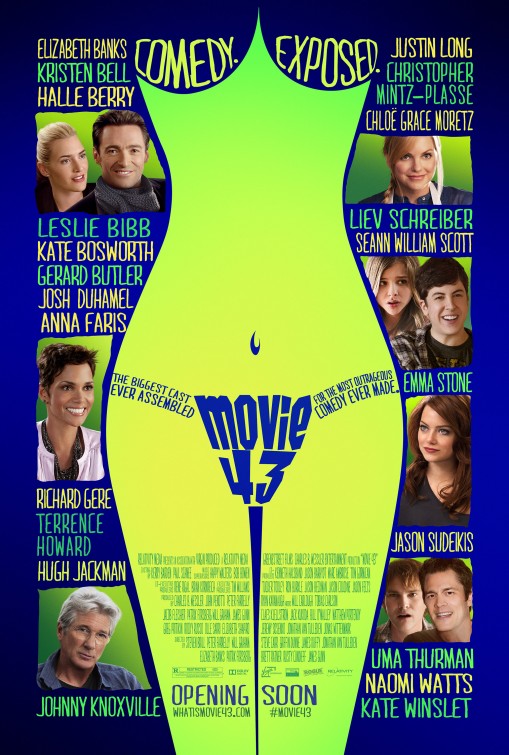 There were two driving reasons why I chose to go see Movie 43, the collection of 13 comedy sketches from different writers and directors. First, the red band trailer made me laugh, so I figured it was worth a shot. If one sketch didn’t work, there was always another ready to cleanse my comedic palate. The other reason is that I have been compiling sketches written by myself and my friends with the intent to make my own sketch comedy movie in 2013. Part of me was also concerned that something so high-profile might extinguish my own project; maybe we came up with similar material with sketches. After watching Movie 43, a tasteless, disconnected, and ultimately unfunny collective, I have renewed hope for my own project’s success.
Like most sketch comedy collections, Movie 43 is extremely hit or miss. This ain’t no Kentucky Fried Movie or even the Kids in the Hall flick. Rating this worth viewing depends on which side racks up the most. Unfortunately, there’s more terribleness than greatness on display, but allow me to briefly call out the film’s true highlights. The best segment in the movie, the one that had me laughing the longest, was a bizarre fake commercial that does nothing more than presuppose that machines, as we know them, are really filled with small children to do the labor. Seeing little urchins inside a copy machine or an ATM, looking so sad, with the faux serious music welling up, it made me double over in laughter.
 With the actual vignettes, “Homeschooled” and “Truth or Dare” where the standouts that drew genuine laughter. “Homeschooled” is about a mother and father (real-life couple Naomi Watts and Liev Schreiber) giving their son the total high school experience, which amounts to degrading humiliation. Dad makes fun of his son’s penis in the shower. Mom and Dad throw a party with the cool kids but don’t invite their son. Dad tapes his son to a flagpole. The kid gets his first awkward kiss thanks to his mom. It’s outrageous without falling victim into being crass for the sake of crass, a common sin amongst many of the vignettes. “Truth or Dare” starts off innocuously enough with Halle Berry (Cloud Atlas) and Stephen Merchant (Hall Pass) on a blind date. As the date progresses, they get into an escalating game of truth or dare that each has them doing offensive acts, like blowing out the candles on a blind kid’s birthday cake. This segment knows when to go for broke with it silliness and it doesn’t wear out its welcome, another cardinal sin amidst the other vignettes.
But lo, the unfunny sketches, or more accurately the disappointing sketches, outnumber the enjoyable. Far too often the sketches are of the one joke variety and the comedy rarely leaves those limited parameters. So a sketch about a blind date with a guy who has testicles hanging from his chin (Hugh Jackman) is… pretty much just that. There’s no real variation or complications or sense of build. It’s just that. A commercial about an iPod built to model a naked lady is… exactly that and nothing more. A speed dating session with famous DC superheroes like Batman (Jason Sudeikis), Robin (Justin Long), Supergirl (Kristen Bell) and others should be far cleverer than what we get. While I laughed at the sports sketch “Victory’s Glory,” it really all boils down to one joke: black people are better than white people at basketball. That’s it. “Middleschool Date” starts off interesting with a teen girl (Chloe Grace Moritz) getting her period on a date and the clueless men around her freaking out that she is dying. However, this is the one sketch that doesn’t go far enough. It really needed to increase the absurdity of the situation but it ends all too quickly and with little incident. “Happy Birthday” involves two roommates (Johnny Knoxville, Sean William Scott) interrogating an angry leprechaun (Gerard Butler) for his gold. It pretty much just sticks to slapstick and vulgar name-calling. That’s the more tiresome aspect of Movie 43, the collective feeling that it’s trying so desperately to be shocking rather than, you know, funny.
The worst offenders of comedy are the scathingly unfunny “Veronica” and “The Proposition.” With “Veronica,” Kieran Culkin tries to woo his lady (Emma Stone) with a series of off-putting sexual remarks, delivered in an off-putting “bad poetry delivery” manner, while the film is off-puttingly shot with self-conscious angles that do nothing for the comedy. It’s a wreck. “The Proposition” is just one big poop joke. It’s far more gross than gross-out.
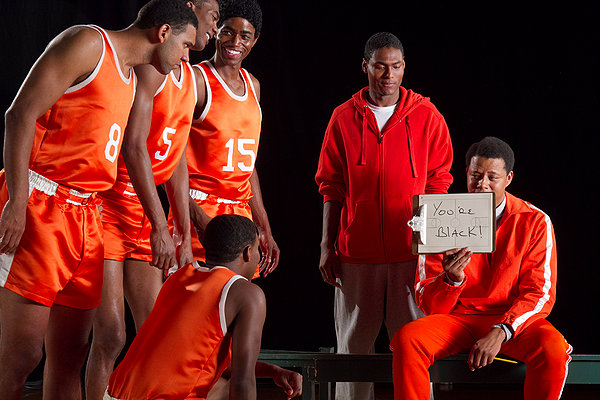 The frame story connecting the varied vignettes is completely unnecessary. Well, I suppose there is one point for its addition, namely to pad out the running time to a more feature-length 94 minutes. The wraparound storyline with Dennis Quaid pitching more and more desperate movie ideas never serves up any good jokes. Its only significance is to setup an ironic counterpoint that gets predictable and old fast. Example: Quaid says, “It’s a movie with a lot of heart and tenderness,” and we cut to a couple that plans on pooping on each other. See? You can figure out its setup formula pretty quick. I don’t understand why the people behind Movie 43 thought the perfect solution to pad out their running time was a dumb wraparound. These sketches don’t need a frame story; the audience is not looking for a logical link. For that matter why is the guy also pitching commercials? I would have preferred that the frame story was completely dropped and I got to have two or three more sketches, thus perhaps bettering the film’s ultimate funny/unfunny tally.
There will be a modicum of appeal watching very famous people getting a chance to cut loose, play dirty, and do some very outrageous and un-Oscar related hijinks. The big name actors do everything they can to elevate the material, but too many sketches are one joke stretched too thin. I suppose there may be contingents of people that will go into hysterical fits just seeing Hugh Jackman with chin testicles (I think the Goblin King in The Hobbit beat him to it), just like there will always people who bust a gut when a child or an old person says something inappropriate for their age, or when someone gets kicked in the nuts (the normal ones). I just found the majority of Movie 43 to be lacking. It settles far too easily on shocking sight gags and vulgarity without a truly witty send-up. It wants to be offensive, it gleefully revels in topics it believes would offend the delicate sensibilities of an audience, but being offensive and being funny are not automatically synonymous. You have to put real work into comedy. Movie 43 isn’t it.
Nate’s Grade: C-
Share this:

Warm Bodies (2013)
 Given the explosion in zombie culture and the avalanche of zombie movies, it was only a matter of time before a studio pitched the romantic possibilities. They may be dead but they still have needs. Based on Issac Marion’s young adult novel, Warm Bodies attempts to tell a love story from a zombie’s perspective. Writer/director Jonathan Levine, so skillful with tone in the comedy/drama 50/50, tackles an even trickier balancing act, making a zombie romantic. With some visual flair, an eclectic soundtrack, and a winning onscreen pair, Warm Bodies is a sweet love story that does enough right to leave you smiling.
In the aftermath of a zombie apocalypse, R (Nicholas Hoult) is a zombie who spends most of his days shuffling through an airport. Occasionally he has a series of conversations with his pal, M (Rob Corddry), which mostly amount to grunts. R can’t remember who he was before he became a zombie, or even what life was like before it all went to pot, but there is one thing that will make him feel alive again – human brains. You see, this tasty delicacy allows zombies to relive the memories of their victims. It’s a nice release from, you know, decomposing. The zombies that have completely given up all sense of self peel off all their skin, becoming the Bonies, a wraith-like band of creatures that will feed off anything, even the dead.
 This is R’s life until his chance encounter with Julie (Teresa Palmer). He’s smitten instantly and feels something weird in his chest. His heart has started beating again. He doesn’t want to eat her, just protect her. Of course he did also happen to eat her now-ex-boyfriend (David Franco). R whisks her to safety to his home in an airplane cabin. They listen to records and he instructs her on ways to pose as a zombie. She’s cautious but grows fond of her zombie protector (zombie Stockholm syndrome?). But R is proof that the zombies can change and that humanity can be saved. There’s just the matter of convincing Julie’s father, General Grigio (John Malkovich), who had to shoot his own wife after she turned. He wants them all dead and will do whatever it takes to protect the last bastion of the living.
Levine has found what may be one of the only optimistic zombie films out there. Usually these movies end one of two ways: 1) everybody dies (the preferred option), or, 2) the heroes manage a final escape but are most likely doomed beyond all hope (just pushes the inevitable off screen and into our imaginations). Tethered to a genial but winning romance, Warm Bodies is a zombie movie with a genuine sense of hope, revival, and even finds way to carve out a happy ending that, while predictable, feels right tonally.
The twee romance has a lot more in common with indie stylings than it does, say, Twilight, which will likely be invoked by many a critic and ticket-buyer alike. It’s not so much the brooding, sullen, exasperating kind of “romance” Twilight has primed people to expect when monsters date young girls. Thanks to the helpful voiceover, we see R as a thoughtful (being generous here considering his peers) guy who, like most teens, is trying to battle his inner urges and sense of awkwardness. He may be a zombie but Levine and Hoult have found a way to make R relatable and a likeable dead chap to root for. It also helps that he and Palmer (I Am Number Four) have above average chemistry together. Sure it’s a little weird that she takes the whole guy-crushing-on-me-kinda-ate-my-old-boyfriend, but like any relationship, there are just obstacles you’re going to have to overcome together. And as my pal Eric would attest, any Franco had it coming (his big bro did lead to the end of mankind in 2011, so maybe he’s responsible for the zombie apocalypse).
I appreciated that even with a PG-13 rating the movie still has a bite to it. Premise-alone, there is plenty room for some intriguing mismatched comedy. I enjoyed the aspect that consuming human brains unlocks that person’s memories. I like that R saves brains for later snacks. I liked that he used this absurd plot device to help him get closer with Julie and makes him feel guilty. Warm Bodies finds a way around the whole bodies decomposing issue, which is important since we don’t want our Romeo to be too disgusting for the teen girls. It refrains from overt gore, relying on implied carnage and preferring a chaste smearing of blood on lips, like he just got carried away eating a cherry pie. Honestly, I didn’t miss the gore. While the concept of a completely putrid corpse, with its flesh rotting and falling from its face, finding romance would be darkly comical, I think Levine chose the savvier path, forming a romance that doesn’t overdose on irony, which it would if the dead-boy-meets-girl romance were more grotesque. That’s the reason the Bonies exist, to provide a more grotesque and more evil foe that can provide perspective on the nobility of the not-all-the-way-dead people.
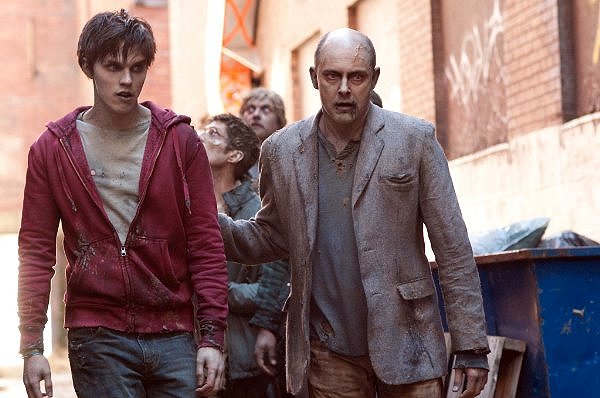 Levine works enough comic angles that the comic possibilities feel explored, although much like the horror and romance could have been pushed even further. As is, I found R’s musings wryly enjoyable, and his undead bromance with M provides some of the funniest moments in the film. Corddry (TV’s Children’s Hospital) is terrific in the movie and even finds what little room he can to add a touch of poignancy with his character. Often the humor, like the horror elements, is pretty relaxed but effective, refraining from oversized wackiness. You seriously would think that the movie would go bigger with its comedy considering everything at play.
Hoult (X-Men: First Class, TV’s Skins) does a credible job as a zombie, let alone an American zombie; it’s not all shuffling and caveman monosyllabic grunts. The actor is adept with communicating the awkwardness of his character in physicality. It’s funny how much you end of empathizing with a character that is dead. Hoult is also a pretty hunky guy, Vulcan eyebrows and all, but his amiable demeanor and young love clumsiness will win over as many guys in the audience as ladies. Palmer, also sporting an American accent, gets the blood pumping. Julie is underwritten but rises above just being a typical damsel-in-distress. It’s nice that later in the movie, when R breaks into the human camp, the roles are reversed, and Julie gets to protect him with her wits and will. Malkovich (R.E.D.) gets the worst of it just because his character is so rote.
I suppose I could lambaste the movie’s love-conquers-all logic with a dash of critical cynicism, but I feel like its low-key yet unfailingly romantic side is another of the movie’s charms. Sure, the idea that teenage love changing the world one beating heart at a time sounds like someone took the lyrics from an 80s power ballad and had it come to life (I’m reminded of the Patton Oswalt bit about the music video of an 80s hair band against the police: “He’d deflecting the bullets with the power of his rocking!”). There’s no real explanation why the zombies are getting better, though the concept of reclaiming their humanity appears to be contagious. I guess you could make some mild commentary on the healing power of human connection, but I don’t think Levine goes too far with any sort of subtext/social allegory, though there are enough slipshod Romeo and Juliet parallels. To the audience members who rankle at the unexplainable zombie cure, I would like to draw attention to the fact they are ignoring the fantastical logical puzzle of corpses coming back to life in the first place. If nobody minds why the zombie virus/crisis starts, then I don’t see why I should be sweating over what solves it.
Warm Bodies is a return to horror for Levine. Before his Sundance breakthrough The Wackness, the man got his start directing 2006’s All the Boys Love Mandy Lane. He’s made what may be the only zombie movie that I can say is “cute,” and that’s perhaps the best word for Warm Bodies. It’s a cute movie, perfectly pleasant, charming in its low-key sweetness while still managing to be clever. It’s dark but not too mordant, and sweet but not sappy. The last act doesn’t feel like it has the proper balance that the rest of the movie coasts with, but it wasn’t enough to ruin the film. At its core, it’s a cute love story, a zom-rom-com that’s much better than being relegated as “Twilight with zombies.” Yes it could have been darker, more macabre with its humor, and there are plenty of gloomy opportunities afforded by the premise of an undead boyfriend, but Levine and his actors have conceived a film that manages to be many things, chief among them enjoyable. It’s a zombie movie that might make you feel squishy but under completely different circumstances.
Nate’s Grade: B
Share this:

Seeking a Friend for the End of the World (2012)
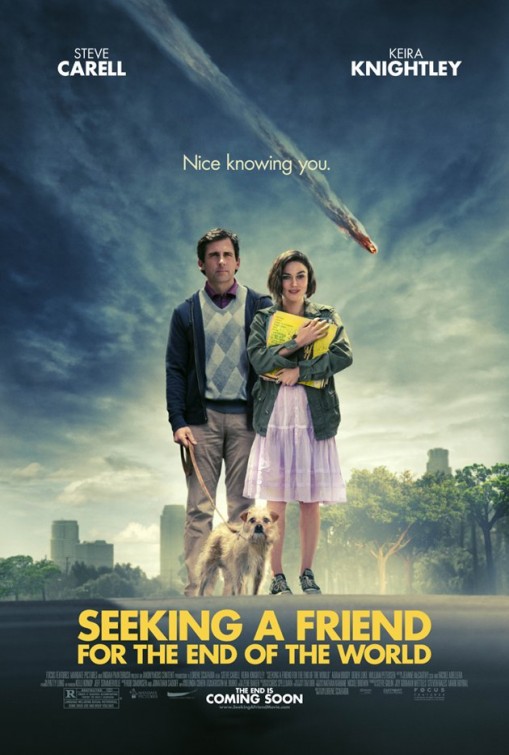 It’s the end of the world as we know it and I oddly felt fine… which is not a good sign for your apocalyptic movie. Seeking a Friend for the End of the World is a peculiar thing, all right. It takes place in the last three weeks of the human race. And lest you think the film wimps out on the promise of its title, think again. I was bemused for the first forty minutes, where writer/director Lorene Scafaria indulges in a series of one-scene vignettes of how humanity comes to terms with the certainty of annihilation. There’s an adult party where people joyfully try heroin, a hit man-for-hire service to bring back some of the mystery of death, and a restaurant where all the workers are spaced out on Ecstasy. I found each of these moments to be funny and a well though-out extension of the premise. But then the film’s diversions give way to the rom-com of our main characters, played by Steve Carell and Keira Knightley as your standard manic pixie girl. And the more time I spent with them the more I found myself not getting engaged. My emotional empathy was kept to a minimum; they’re nice people and all but I didn’t find them that interesting. The resulting movie feels like one of the weakest avenues given the premise. I credit Scafaria for not wimping out in the end, but as these characters faced oblivion together, I felt little emotional stirrings in my chest.
Nate’s Grade: C+
Share this:

Gangster Squad (2013)
 It’s hard to mention the action thriller Gangster Squad without a passing reference to the Aurora, Colorado movie theater shooting in the summer of 2012, the reason for the film’s five-month delay and reshot action sequence. Gone is a shootout at the movies and now we have a confrontation in the streets of Chinatown. I wish they hadn’t stopped there. If given the opportunity, and remember they did have an additional five months, I would have scrapped Gangster Squad almost completely and started fresh.
In 1949, former boxer Mickey Cohen (Sean Penn) has seized control of Los Angeles organized crime. His influence extends even into a police, which forces Chief Parker (Nick Nolte) to go to desperate measures. He asks Sgt. John O’Mara (Josh Brolin) to assemble a team of enforcers to fight back. They won’t have badges but they will be pushed to use whatever means necessary to carry out their mission, which means blurring the line between what is considered lawful. O’Mara assembles a super group of former officers and one of them, Sgt. Jerry Wooters (Ryan Gosling) gets into even deeper danger when he starts seeing Mickey Cohen’s main squeeze, Grace Faraday (Emma Stone).
This movie is like if The Untouchables and L.A. Confidential had an illegitimate child and then abandoned it in a sewer where degenerate hobos raised it. Gangster Squad rips off other gangster movies with liberal abandon that I can’t even begin to list the lifts. I’d be less offended if I felt that the movie had more on its mind than just replicating the tone and look of noir cinema. Actually, it feels more like what they want to replicate is the tone or style of the video game L.A. Noir.
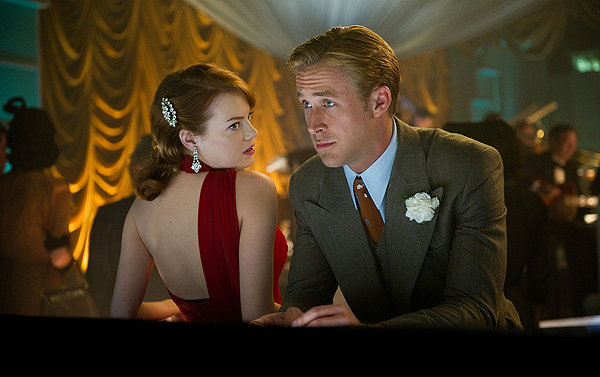 The main problem is that Gangster Squad really only has the skeletal outline of a plot. It’s missing any essential character and plot development. Here, I’ll summarize the barebones plot for you: Mickey Cohen is a bad guy. O’Mara forms a team. They have a montage taking out bad guys. Mickey takes out one of them. They have a showdown. That, ladies and gents, is it. There really aren’t any scenes that diverge from those scant descriptions. It felt like only five minutes passed from one of O’Mara’s guys getting killed (and just like The Untouchables, it’s the nerdy one) to them descending on Cohen’s headquarters and duking it out. Why does the film introduce the conflict of Wooters seeing Cohen’s girl if he never finds out? There isn’t even one scene presented to take advantage of this conflict. It just ends up being another half-baked plotline. It feels like the only development we get with Gangster Squad is through montages. What is also apparent is that O’Mara and his team really don’t have anything resembling the faintest notion of a plan. We watch them take out some bad guys via fights and shootouts but there’s no higher plotting to it. You get a sense that these former cops are just playing it by ear, looking for a fight every night. It’s hard to imagine that these people, even with their law enforcement and war experience, could be effective in the long term. Without any formative organization or greater planning, these guys just seem like dull bruisers bouncing from fight to fight with no sense of direction.
Then there’s the paucity of character work, relying solely on genre archetypes to do its work for the movie. O’Mara is the determined family man but his team can best be described by one-word classifications: The Black Guy (Anthony Mackie), The Nerdy Guy (Giovanni Ribisi), The Mexican Guy (Michael Pena), The Young Guy (Gosling), The Old Guy (Robert Patrick). That’s about it, though I suppose they do have different weapon preferences meant to supply all that missing characterization. Oh look, Officer Harris (Mackie) brings a knife to gunfights. That’s pretty much the beginning and end of his character. Wooters is so lackadaisical he feels like he’s on drugs, and Gosling’s soft-spoken, mealy-mouthed line delivery only adds to the effect. It feels like Gosling, in a stretch to find something interesting out of the mundane, said to himself, “I wonder if I could give a whole performance where I only speak under a certain vocal register.” Then there’s the woefully miscast Stone (The Amazing Spider-Man) as the femme fatale/mol to Mickey. I love Stone as an actress, but man-eater she is not and sultry seductress doesn’t fit her well either. Perhaps with the aid of a sharper script and a greater depth of character she could rise to the challenge. At no point does Gangster Squad really even attempt to make these people multi-dimensional. They never reflect on the moral turpitude of their own vigilante justice or the ramifications of their actions. There’s no room for ambiguity here.
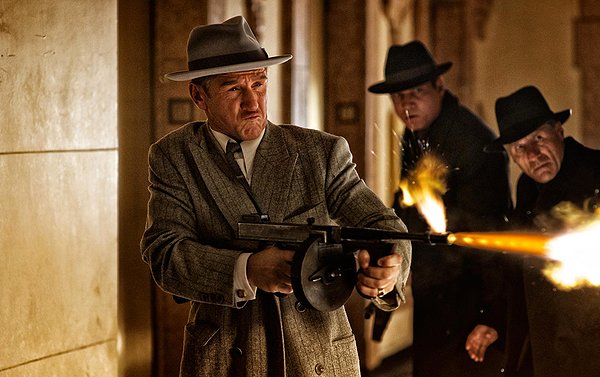 Finally, we must speak of Mr. Sean Penn (Milk). The man’s actorly gumbo goes into campy overdrive. In these rare circumstances, you aren’t watching Sean Penn Esteemed Actor so much as Sean Penn Human Vortex of Overacting. Normally I would criticize Penn for going over the top but over the course of 110 minutes, he single-handedly becomes the only entertaining thing in the movie. He’s chewing scenery up a storm, yes, but at least he’s channeling the pulpy silliness of the whole movie. I came to enjoy his antics and outbursts and thus became more empathetic of Mickey Cohen and his efforts than I did with O’Mara. Such is the danger screenwriters run when they spend more time crafting an interesting villain than a hero.
Gangster Squad is what happens when a movie is sold on title and genre elements. To be fair, it’s a bang-up title. The plot is half-baked at best, really only serving as a thin outline of a gangster movie, but instead of adding complexity and intrigue and characterization, they just ran with it. The actors are either camping it up or out of their element, the action and shootouts are pretty mundane, and the story is just uninvolving, even for fans of film noir like myself. It’s a good-looking film from a technical standpoint, but that’s as far as I’ll go in my recommendation (it could be an odd pairing with Milk considering the two shared actors). It feels like it just wants the setting elements of film noir, the atmosphere, and then figures just having good guys and bad guys shoot it out will suffice. That glossy, high-sheen period look just seems like a cool façade, and a cool façade seems like the only ambition of Gangster Squad. I can’t really recall any signature action sequence, snappy quote, plot development, or peculiarity worthy of remembering. It may be one of the most forgettable gangster movies Hollywood has produced.
Nate’s Grade: C
Share this:

Mama (2013)
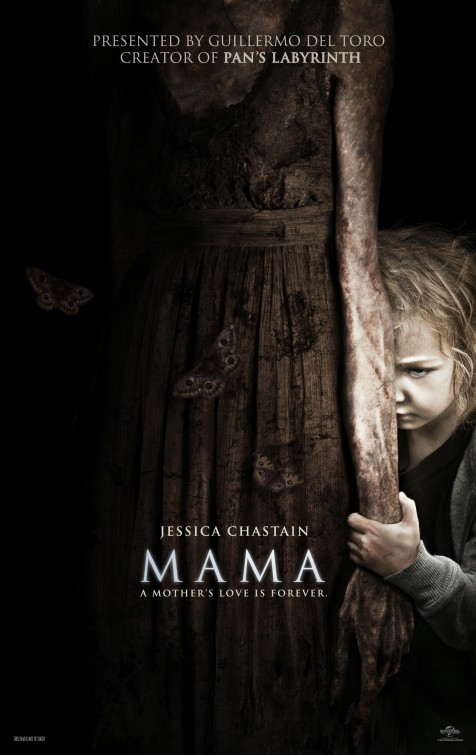 Guillermo del Toro is no stranger to the things that go bump in the night. He helped shepherd the horror film Mama to the big screen, and his love of heavy atmosphere and creepy, agile, lithe figures of terror is still evident. This is a rather effective and very creepy little horror movie that has enough little scares, big screams, and plain skin-crawling moments to recommend. The plot involves two little girls left to fend for themselves out in the wilderness. The two young actresses are fantastic, with terrific physical command of their bodies, able to slink and hop around like feral beasts. They help emotionally ground what could have been an otherwise ordinary ghost story. Oh yes, the girls prayed to a protector known as “Mama” who happens to be a malevolent and jealous spirit. Pity Jessica Chastain (Zero Dark Thirty), not just for her Gothic haircut and heavy eyeliner, but also as the girl’s reluctant foster mom. I’m shocked at how disturbing it is to watch a highly articulated physical specimen bend and snap and scurry at odd angles, broken arms bouncing like insect mandibles. And director/co-writer Andrés Muschietti knows how to properly tease an audience with just enough show and tell. The end is rather rote and familiar but, due to the emotional connection, has moments of genuine poignancy. Credit the considerable talents of the little ones as well as the devious vision of Muschetti and the guiding hand of del Toro. Give Mama a look.
Nate’s Grade: B
Share this:

The Odd Life of Timothy Green (2012)
 My friend and critical colleague Ben Bailey had warned me about The Odd Life of Timothy Green and he quite eloquently voiced his dumbfounded musings, which I will try my best not to knowingly replicate though I’m sure there will be some carryover. But whatever he wrote could not prepare me for what I ultimately got with The Odd Life of Timothy Green. Ladies and gentlemen, I think this movie broke my brain.
Cindy and Jim Green (Jennifer Garner and Joel Edgerton) are having trouble conceiving a child. One night they write a list of their hopes for a future child, place them in a box, and bury this chest of hopes in their garden. The next day they are shocked to discover a child covered in dirt claiming to be their son, Timothy (CJ Adams). He is the physical manifestation of all those buried hopes and wishes with some leaves attached to his ankles. The Greens take their magical parenthood in stride, trying their best to impart wisdom to their new son. They teach the kid how to play soccer, stand up to bullies, and interact with other human beings. Timothy has a secret he can’t bring himself to tell his new mom and dad, but if you have a hard time figuring out what his leaves falling off means, then there’s nothing I can do for you.
I feel like I just watched a movie where every person on Earth is depicted as being insane. Not goofy, not eccentric, not a little funny, no, we’re talking get the butterfly nets and padded cells. I feel partially insane just having watched the film, obviously still suffering from a contact buzz of insanity. I accept suspension of disbelief and that fantasy-based family films are going to have a whimsical nature to them. We cannot apply every rule of reality and logic to them, and I accept this. But The Odd Life of Timothy Green seems to exist in a fractured, cracked version of our own world, where the most bizarre and fantastical elements are just given a halfhearted shoulder shrug. People react to otherworldly events as if they were doing laundry. Where’s the awe? Or, more so, where is the skepticism? Seriously, if anybody told you they grew a child from a garden, would you accept this notion at face value? Their great piece of proof is that the kid has leaves attached to his ankles. Don’t you think, I don’t know, the parents could have taped those on? Beyond one guy, no one investigates this strange botanical phenomenon or even has the slightest inclination to. Where’s the intellectual curiosity, people? It’s like everyone in town has a lobotomy. Is there not one person in this small town that will dare stand and say, “You know, I think I’m going to require more empirical evidence to buy the story that this kid was formerly plant food.” And then they ran that one man out of town on a rail and salted his land.
 Timothy Green tries to gather a slew of messages and feel-good moments; it’s just that none of them feel coherent or truly earned. The parents don’t feel like responsible or even interesting adults. I understand we’re not going to dwell too much on the disappointments of a couple unsuccessful in conceiving a child (this is becoming an odd trend for Garner), but I expected more than one good cry and a bottle of wine. I want to empathize with these people but the movie makes it impossible time and again with their nonsensical behavior; it’s like they’re adults as envisioned by a child. On that note, I think the movie probably makes more sense from a fantasy point of view to flip the participants. It seems more likely that a child would try and grow new, ideal parents only to learn a lesson about the duds they’re stuck with. The Green family members all work one note, whether it’s the snide sister (Rosemarie DeWitt), the slaphappy grandpappy (M. Emmet Walsh), or the emotionally distant dad (David Morse), it’s all a tiny nub of characterization that gets whittled down to nothing. And then Timothy just seems to step into everyone’s lives and change them forever with little effort. He gets an older girl to fall in love with him, his father to stand up for himself and his family, and all the not nice people in town to be somewhat less not nice. He gets his mom to speak her mind to her bitchy boss (Dianne Wiest), which ends up getting her fired, so it’s a mixed message.
You want a prime example of this film’s collective shared insanity? Take this line from one of the board members from the town pencil factory: “If this boy can have leaves on his ankles, then we can make a pencil out of leaves.” What exactly does one have to do with the other, you may ask? I suppose it’s some claptrap about what is truly possible or whatever. My apologies to Ben Bailey for treading ground he has examined closely, but this cautionary line of dialogue glows with the intensity of 100 neon signs. It’s everything that is wrong and crazy about this movie, and the fact that it is spoken without a hint of irony or humor is all the more galling.
Here’s my problem with Timothy the life-changer: the kid is a dullard. He has no personality, he has no real insights or perceptions into life, he’s not funny, he’s not that interesting, and he eerily stays in the same modulated emotional presence. I found this kid far more unintentionally creepy than endearing. On paper, Timothy Green sounds like it should be a horror film and not the saccharine family slop that it is. Timothy just comes across like a rather bland kid with some weird tendencies, like his repeated inclination to soak up any sunny opportunity to photosynthesize (he gives Scott Stapp a run for his arms-wide-open pose throne). If a character is going to touch people’s lives and change their perspectives on life, then at least make that person fitting of praise. This kid just seems like a hazy mystic that’s playing it as he goes. Come to think of it, did anyone see him do anything superhuman? Cindy and Jim didn’t even find him in the garden, only inside their home covered in dirt. Who’s to say that young Timothy Green wasn’t a con artist this whole time?
 Then, likely as a defensive means to soothe my ailing brain, I started coming up with my own version of where Timothy Green should have gone. The ability to write down a bunch of general attributes and then grow a child seems too good to pass up. I desire more of this unique child cultivation process. For instance, Cindy and Jim want their kid to rock out as a musician, but they simply write “rocks” on their slip of paper before burying it. How is the magical entity that raises mutant plant kids going to be able to understand what the family intends with this vague entry? What if Timothy Green was born with rocks in his head? I wanted the film to simply turn into a comical version of The Monkey’s Paw, where every new version of Timothy Green would go horribly wrong. The first was born and then immediately suffocated because Cindy and Jim forgot to write “working lungs.” Then there would be the Timothy born with a “hunger for life” and become a cannibalistic plant zombie. Or the Timothy born with “his mother’s heart” and then upon his birth Cindy’s heart would go missing. What I wanted was a macabre trial and error game where the would-be parents had to refine exactly what they were asking for with the nondescript magical being in charge of answering hopeful parents. I want The Odd Lives and Deaths of Timothy Green and I want Cindy and Jim to have to bury all the malfunctioning prototypes in the same garden. Then, when they do perfect their perfect kid, the police find a yard littered with the corpses of children and haul them away.
The movie is told through the framing device of the Greens telling their story to the adoption agency, and why this adoption agency continues to listen after, “We grew a boy in our yard,” is beyond my guess. In a film breaking every boundary of believability known to mankind, this aspect to me seems the most incredulous. This is an adoption agency with standards and rules to follow, and to think they would allow a couple to drone on and on about their magical child that grew from a garden and changed people’s lives, instead of calling security and having them escorted from the premises, followed home, and then have their home exhumed for human remains of this child, is beyond me. And then, spoiler alert, they get a kid in the end. What adoption agency could reasonably and responsibly allow these two people, with no physical shred of evidence about their magical child other than some leaves and testimonies, to care for another human being?
Allow me to also question the sincerity of these two damaged people especially concerning their desire for a child. It sure seems like Cindy and Jim are planning on using their present and/or future child as means of settling some longstanding scores between relatives. When it looks like Timothy is finally going to do well in soccer, that’s when they pounce, airing out their resentments. Cindy brattily unloads against her sister: “I’ve had to listen to your perfect kids, well look at my kid! That’s my kid!” And then Jim finally let’s his distant father have a piece of his mind: “I could have been a good player too, dad. I had skills. If only you would have been more supportive.” Am I supposed to find any of this funny, because it comes across as far more sad. I feel like the reason that Cindy and Jim want a child is to desperately prove to their family that they are superior parents. It feels like one very crazy way of proving a point and one where the child will suffer, especially if he or she cannot live to a degree of excellence to provide mom and dad filial ammunition. Another example: both Cindy and Jim are oddly very jealous over the relationship their pseudo son forms with the slightly older gal, Joni (Odeya Rush). They try and talk him out of spending time with her, arguing there are so many fish in the sea for him to pay attention to. Are you really laying the argument that a 10-year-old should be playing the field? It also seems weirdly petty and controlling for two supposed adults to be jealous that their son chooses to spend part of his waking hours with another human being. So, does that sound like a loving and healthy family?
The Odd Life of Timothy Green is certainly odd but probably not for the reasons that Disney or the filmmakers had in mind. It feels like it exists in an alternative universe where everyone lacks any common sense, curiosity, or relatable human emotions. Nobody acts like a recognizable human being in this film, not for a single second. These people are all zombies, cowed into the cult of Timothy, the magical and, ultimately, messianic figure. But allow me to declare the emperor has no clothes. This Timothy is not worthy of the adulation he receives. He walks around like an ecological Forrest Gump, spitting sappy platitudes and changing lives with the insipid nature of all these easy messages. I wish I could say there was one genuine moment in this movie, but I cannot. It takes a magical premise and suffocates it with unearned solemnity. Why can’t a movie about growing a kid in your garden try and be, you know, fun? Well, I suppose embarrassing music recitals and kids getting hit in the head could be mistaken for fun, but I prefer a well developed story, characters I care about, and a genuine sense of enchantment to go with the supernatural. If we can make a movie about a kid with leaves on his ankles, then we can turn any sort of half-formed maudlin pap into family entertainment. Kids deserve better than The Odd Life of Timothy Green, and, for the record, so do plants.
Nate’s Grade: D


You must be logged in to post a comment.