Blog Archives
Supergirl (2026)

I have implicit faith in James Gunn as a filmmaker. He’s earned my trust over the decades, especially in the realm of superhero cinema, and especially after his rip-roaring and reverential relaunch of Superman in 2025. However, when it comes to James Gunn the reigning head of DC movies and television, well, I have more reservations. When he took over the high-profile position and plotted the new direction of DC cinema after the ignoble death of the Snyderverse, Gunn claimed that he would stress quality over quantity, particularly that the studio would not move forward with a project unless he felt the script was great. It’s a nice sentiment considering Marvel movies have for so long retooled and rewritten on the fly. However, it’s also a damning statement that can come back to haunt Gunn if any future DC movie has a script that feels, well, let’s say less than great. It’s one of those cautionary statements, like a politician saying, “I’ve never lied and I’ve never cheated on my wife.” You’re already priming your skepticism.
Enter 2026’s Supergirl, based on a highly regarded eight-issue comic Supergirl: Woman of Tomorrow by renowned author Tom King and artist Bilquis Evely. I’ve read the 2021-2022 series, being an enormous fan of King ever since his astonishing and award-winning Vision series, and I can see why Gunn would model Supergirl’s big-screen relaunch with this story. It’s essentially a sci-fi version of True Grit, a familiar formula that’s easy to grab an audience with salient themes about vengeance, forgiveness, duty, and responsibility in a world that often feels too indifferent (a frequent repeated refrain is “It’s too big. We’re too small”). It’s a pretty great story and seemingly a great blueprint for a potentially great movie. Having now seen the Supergirl adaptation, I come back to Gunn’s explicit promise. Did he think this screenplay, by actor-turned-playwright Ana Nogueira, was great? Did he think this movie was ready? The whole of me doubts it, given Gunn’s innate understanding of story and character development from his other blockbusters. Yet, I can also recall Gunn’s company-man hyping of 2023’s Flash movie, saying he genuinely felt it was one of the best superhero movies ever. Audiences generally disagreed. I’m starting to think there are two James Gunns, the filmmaker and the boss. I trust the filmmaker. I don’t know yet about the boss, and Supergirl’s muddled and disappointing execution does not help solidify my faith.

Kara Zor-El a.k.a. Supergirl (Millie Alcock) is touring the galaxy for her birthday. She’s specifically visiting planets with red suns because it neutralizes her alien powers so she can actually feel the inebriating effects of alcohol. She wants nothing to do with quests and the downtrodden and that’s where Ruthye (Eve Ridley) comes in. She’s looking for hired muscle to avenge her family. The marauding Krem of the Yellow Hills (Matthias Schoenaerts) is the leader of the Brigands, space pirates profiting off the abduction and sale of young women in particular. Things get personal for Kara when Krem steals her own spaceship and mortally wounds her dog, Krypto, with a poisoned arrow. Supergirl has three days before her little pooch succumbs to the poison. She sets out with Ruthye to track down Krem, rip the antidote conveniently hanging around his neck at all times, and maybe facilitate some old-fashioned vengeance.
Where did this movie go wrong? I think we have a few culprits and poor decisions when it comes to the development of character arcs, themes, and in general making an audience care. Most people do not have the generational built-in knowledge about Supergirl and her origin, so the movie needs to be an introduction for us and provide a compelling reason why we should care about this latest hero. Having an arc where a character begins in an isolated, self-loathing, and cynical place only to become more engaged, motivated, and virtuous is a common arc, the stuff of Westerns and the like, the redemptive story of the old gunslinger who learns to fight for something bigger than himself. As evidenced in Supergirl, she’s reclusive and drowning herself in alcohol because of her survivor’s guilt, being one of only two Krytonians, along with her cousin Kal-El, a.k.a. Superman. She doesn’t feel at home, both literally when it comes to a place to call her own as well as within her own skin as a person. She certainly turns up her nose at the idea of being a hero or let alone the prospect of do-gooders. She says, “Clark sees the good in people. I see them for how they really are.” You can see where this is going as far as a character arc. It should be an important and triumphant moment when she, at long last, dons the Supergirl outfit, something she had dismissively rejected earlier. We should care. I still recall how emotional it was for many to watch Wonder Woman triumphantly walk across No Man’s Land in full regalia. The moment in Supergirl is more of a shrug because Kara is mostly a shrug of a character. I don’t think the screenplay presents enough to invest an audience’s emotions into her journey. Part of this is because the entire story feels confused and muddled, so for her to have self-epiphanies made me say, “Uh, really?”
That’s because this character arc goes into a dismaying place, with Supergirl making a choice at the end that seems counter-productive to being a more virtuous example for others. I think she argues she’s sparing an innocent from having to live with something they will regret that could change them, not to allow them to become as hardened and hurt as Kara. But isn’t she also reforming? Doesn’t that say something about starting over with redemption? Also, we’re not given a sufficient back-story that delivers a credible life Supergirl would not wish others to follow. With some later flashbacks, which I think could have served as the opening five minutes, we see Kara’s tragic back-story, losing her planet, then her family, then her adopted home, the only one she’s ever known up until landing on Earth. It’s tragic but it’s not like she’s suffering because of her own mistakes she has to live with. What ills from her past is she trying to prevent others from repeating? The circumstances are not exactly immediately repeatable.

As we begin, Ruthye wants sweet vengeance whereas Kara is indifferent. That’s different from Kara being indifferent to life, reliant upon her super strength to pummel people into submission as her first option. You could begin with her prone to solving every problem with violence and then end on her recognizing the harm of violence and the power of mercy. That’s an identifiable arc. Same with Ruthye going from upstart on an adventure to a more sure-handed and capable fighter, gaining confidence and certainty and learning about the emptiness of vengeance to bring personal closure. The movie doesn’t really do that either. Ruthye is a wet blanket of a character prone to whining, and by the end of the movie, she’s just as hapless in a battle as she was in the beginning. I don’t want to overly harp on the differences with the source material, but in the original comic, the entire story was told from Ruthye’s perspective as our narrator, and she was verbose and assertive, essentially the same persona of Mattie Ross from True Grit, with Supergirl being our curmudgeonly Rooster Cogburn. It made her more relatable and interesting. Now she’s been turned into a sulky teenager who gets rewarded with partying with her new friend.
Director Craig Gillespie (I, Tonya, Cruella) has been directing for nearly twenty years, going back to 2007’s Lars and the Real Girl. He’s a versatile director but seems to lean toward the quirk, with a heavy dash of Scorsese stylistics like fourth-wall breaks, flashy camera movements, and specific music cues. I don’t know if he was wrong for this material because I don’t think any director would necessarily rise above this script and its problems. The characters’ arcs are muddled. The villain is a dud, which is why they make him a sex trafficker midway through, because he lacks more definition beyond having a bedazzled 1990s jean jacket’s worth of studs embedded in his face. There’s also the frequency of Supergirl losing her powers. I know it’s to provide some danger and stakes since she’s so overpowered to skew the battles, but this happens literally four times. At some point, Krem shoots her with kryptonite arrows, but if she isn’t widely known across the universe, why would he assume these would be effective? Regardless, the action scenes are relatively lackluster and visually sludgy. Much of the movie takes place in dust-heavy desert dwellings, so it makes the movie feel like you want to wipe the camera lens. I can see the Mad Max: Fury Road leanings, especially with rescuing captive wives from janky biker gangs, but if we were going this route, why not make it central from the beginning? The tone of the movie is going for a jokey, breezy, attitude with-a-capital-A Guardians of the Galaxy vibe but it doesn’t work. It feels too forced and phony, the pale imitator of Gunn’s signature prankster anarchy. Too much of the movie feels like disparate elements thrown together over a prolonged and chaotic editing and re-shoot period. The finished film feels far from cohesive, and while that’s not exactly all Gillespie’s fault, he doesn’t save it.

Jason Momoa (Aquaman) is simultaneously perfect for the role of intergalactic bounty hunter Lobo as well as completely extraneous to this movie. He doesn’t belong and takes away from important time we could have been building the characterization and arcs for our leading ladies. And yet, there was a transparently obvious way to make Lobo more integrated into the story, so much that it is baffling to me that the filmmakers didn’t utilize it. Lobo is after one of the other Brigands to bring him in for a bounty, a guy we never really get to know. Why isn’t Krem his sought-after bounty? Having this character trying to capture Krem would immediately improve his involvement in the narrative. Now instead of just being a guy on his own tangentially related solo mission, now he’s a competitor at cross-purposes with Kara. His appearances now have meaning and he becomes a more urgent threat, the guy who will snatch Krem and deny Supergirl and Ruthye completing their goal. That’s a significant added conflict. Ruthye wants Krem dead. Supergirl wants him alive to save her dog. Lobo just wants him to collect a sizable sum of money. That’s how you do it, and yet the screenplay misses this storytelling avenue. As a result, Lobo feels like an interloper, an occasional fighting ally but more so a haphazardly grafted-on character meant to goose a narrative lacking certain energy or humor. Momoa is perfect as this character (seriously, look up drawings of Lobo, first introduced in 1983) as it allows him to growl, guzzle beer, wisecrack, and act like a carefree badass with more than a nod of machismo buffoonery. He’s having fun, but he could have been more meaningful to the movie rather than a special guest appearance diversion.
Gunn and Gillespie have a well-known affinity for needle-drop songs, but there’s one needle-drop choice in Supergirl that is gasp-inducing in its miscalculation. Plenty of modern blockbusters will marry anachronistic music for specific effect, so I’m not against unorthodox music selections. Not everything needs to be literally on-the-nose like 2016’s Suicide Squad, a movie with so many needle-drop music selections that it served as a lazy narrative shorthand. With Supergirl, there’s a slow-mo sequence toward the climax that circles around Ruthye when she finds herself in the fraught center of battle. As explosions and debris tear around her, with Supergirl zipping to and fro averting possible harm, a lilting song begins with an acoustic guitar followed by a woman singing the lyrics to Jimmy Eat World’s “The Middle,” with electronic anthemic flourishes, enough so that makes it feel wrong to those familiar with the early 2000s tune. I generally enjoy tonally different takes on familiar pop songs, but this… does not work. Not only does it not work, it’s astounding how poorly matched this is to the scene. It immediately ripped me out of the movie and made me question the decision-making of so many related to this film. The cover itself is fine from a music standpoint. I have nothing against Kelty Greye and KidMote, the artists responsible. In fact I feel bad for them. They don’t deserve this derision. It’s not their fault. Their song could have been the perfect addition in a different movie. As used in Supergirl, it’s stunningly bad and joins the dishonorable hall of fame along with Leonard Cohen’s “Hallelujah” awkwardly playing during sex in Watchmen and the truly bizarre rendition of “Smells Like Teen Spirit” by child slaves in Pan.

We’re now two movies into Gunn’s renewed DC film universe, with only two more scheduled on the horizon, a smaller genre experiment following Batman villain Clayface, and Gunn’s Superman sequel in 2027, Man of Tomorrow (maybe why they stripped the comic’s original title from this movie?). There’s not a lot to establish a larger universe of heroes and villains and drama. It’s been almost three years since Gunn announced a new Batman movie directed by Andy Muschietti and we haven’t heard anything else. It’s possible that the expansion of this new filmic universe is on a shorter leash, seeing how a small output performs before investing in a larger vision. I don’t think this movie will help matters. Supergirl is a fairly disappointing entry in the superhero canon, lacking charm and panache and excitement and satisfaction. It fails to make the case for Kara as an engaging character, although Alcock’s performance is fine. There’s just a pervading sense of blandness and a grasping quality where you feel the filmmakers’ indecision. It would be easy to say this was far from super, but I’m going to say Supergirl certainly could have flown much higher.
Nate’s Grade: C
Share this:

The Old Guard 2 (2025)
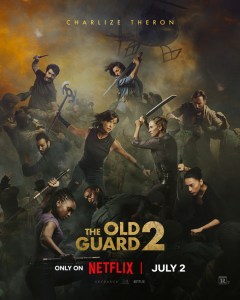
I wasn’t a big fan of the 2020 immortal action movie The Old Guard, but apparently it became one of Netflix’s most viewed movies, so here we are five years later with a sequel about the ancient conspiracy of warring immortals co-starring Chiwetel Ejiofor (not to be confused with Infinite, which is about an ancient conspiracy of warring immortals who are reincarnated into new bodies co-starring Chiwetel Ejiofor). I found the action and the general world-building to be underwhelming, but Old Guard 2 makes The Old Guard look like Michael Bay in comparison. There are two key developments in this sequel. Uma Thurman plays the first immortal and she wants to destroy the world or whatever. The second is that anyone injured by our newest immortal, Nile (Kiki Layne), loses their immortality. The rules of this universe get awfully hazy. I’m taking this directly from the film’s Wikipedia summary: “Additionally, anyone who has lost their immortality can regain their power by another wounded immortal who can transfer their power to the host they choose.” Still following? So we have one person who can make immortals mortal, but any mortal immortal can also choose to have their absent immortality bequeathed to a mortal immortal of their choice, reasserting their immortality. Okay. The confusing rules would be mitigated if we found any of the characters compelling. The sequel does bring back Andy’s (Charlize Theron) ex-beloved Quynh (Veronica Ngô) who was locked into an iron maiden coffin and dumped overseas. The established rules had immortals reawaken from death, so this poor woman would keep waking back up again only to drown instantly and repeat the horrifying process again. Let’s do the math here. On average it takes about two minutes to drown (FYI, I typed into Google “how long does it take to drown,” and now my computer is worried about my mental health). Let’s cut that in half from the extra water pressure filling her lungs. So let’s say she dies every minute. That means she dies 1440 times a day. Over the course of 500 years she has died 262,800,000 times. Rescuing this woman should be a recognition not just of her relentless suffering but the fact that her mind should be shot. Having to endure that horror would break anyone, and Andy coming to terms with her inability to heal someone who cannot die but is also unable to continue life any longer woukd be interesting. That’s my preferred sequel. Instead with The Old Guard 2 we get a bunch of lackluster fights and convoluted lore, and it doesn’t even offer a conclusion, more an implied hand-off to a third movie where the characters may indeed be able to finish what they’ve started. It’s time to let these mortal immortals just die in peace.
Nate’s Grade: C-
Share this:

Heart of Stone (2023)
 Heart of Stone is pre-molded for the Netflix formula of star-driven action vehicles and spy thrillers that are meant to pass the time and do little else to stimulate your thinking or entertainment. These expensive and generally disappointing genre movies feel remote and mechanical, as if the almighty Netflix algorithm thought, after housing and documenting thousands of action movies, that it too could make a competent spy thriller.
Rachel Stone (Gal Gadot) belongs to MI-6 but also another organization, The Charter. They’re a clandestine peace keeping force powered by a super A.I. known as The Heart. Super hacker Keya (Alia Bhatt, RRR) is after the Heart, and she’ll wreck havoc until she gets it.
There are plenty of recognizable genre elements and inspirations here, but the problem with Heart of Stone is that it never gets beyond feeling like another bland summation of its formula-laden parts. You’ve seen bits and pieces of this movie before, so the viewing experience becomes a personal guessing game of how long it will take for Heart of Stone to utilize this genre cliche or that cliche. There’s no surprise or verve or quirk to be had here. Everything is pulled from a big bucket of cliches and then reassembled to best simulate a genre movie that you mostly remember seeing before. This lack of effort and finesse can make the movie quite a slog to sit through. The lack of imagination translates even to its generic title. See, her last name is Stone, and she works for a secret organization where people have code names after playing cards. Do you get it? This clunky name generator title feels like something that some feeble social media post would ask as it really intends to steal your identity from security questions.
 I keep going back to the very core construction of the plot and scratching my head in confusion. Stone is part of MI-6, a spy agency, but she’s also part of ANOTHER even more secret spy agency, which she must keep secret from her fellow secret keepers already doing their spy thing. Why do we need the extra layer of subterfuge? What does this add? The situation where the very deadly and skilled person is hiding in plain sight, the Superman pretending to be the bumbling Clark Kent, is already there with her being a hidden spy, so why do we need a second layer? It’s a complication that doesn’t add anything of value. She’s already on a mission and getting tech help from her own spy team and agency, and she’s also given even more secret tech help from the other more secret spy agency. It’s redundant. It’s not like TV’s Alias or Hydra in the Marvel movies where there was an opposition force within the spy agency, actively working against its aims. It also has the detriment of prolonging the eventual revelation and inevitable betrayal from within the team (don’t act like you didn’t see this coming from the opening mission). We all know it’s coming, so then I think that perhaps the filmmakers will use this extra time with these co-workers to better develop them, give them intriguing dimensions, or at least complicate the relationships with our protagonist who is actively lying to them about who she is. Nope. She does take care of one guy’s cat.
Another element that made little sense to me was the chosen villain. Spy and action movies lend themselves to larger-than-life characters that aim at world destruction and big swings. This movie introduces us to a super hacker who excelled in her field. Okay, and? The character feels more like a hostage than the antagonist that is masterminding the world-trotting schemes. There’s nothing of interest to this Keya character; she’s practically amorphous, so poorly defined that any other character can project onto her. I kept waiting for the motivation for why she’s resorted to her schemes, what she would want to do with the secret supercomputer, something to better add dimension or at least context for this character. Her motivation is just as frustratingly vague as the rest of her, as it’s revealed quite late that she wants the supercomputer to right the wrongs of the world, though what exactly those are, and whether she has a personal connection, who knows? She’s so bland as a villain that (mild spoilers) when she’s eventually deposed by another villain, I felt a little surge of relief that maybe someone else could do better villainy.
Even familiar genre movies can be saved with well constructed and exciting action, like those Chris Hemsworth Extraction movies that coast off the fumes of the most tortured military action cliches. Alas, there is no relief for Heart of Stone. The action is supremely bland and lacking better connections to the characters and their plights. It’s usually just chases and shootouts. There’s one sequence that takes place inside a floating satellite station, and I thought that for once things might get interesting. The subsequent action is just another fist fight and beating the other person to grab a thing before everything explodes from a gas leak. This could have just as easily taken place in a warehouse or a boat or a house or a basement or anywhere. Why introduce a fantastical setting and then ignore utilizing those unique aspects? I guess it does lead to a debris chase that reminded me of Black Widow’s finale. There is a mid-movie chase through the streets of Libson that has some life to it as we watch cars careen at high speeds, but it’s also nothing we haven’t seen before and better in a dozen other movies with more conviction than this one.
 Gadot has rocketed to fame from her Wonder Woman status and she can be a charming screen presence, but let’s acknowledge there are definite acting limitations as well. I challenge you, dear reader, to think of a beloved Gadot performance outside of her Amazonian warrior woman. Were you floored from Triple 9? Or Keeping Up with the Joneses? Or Death on the Nile? There’s a reason the producers decided to just make everyone on Wonder Woman’s ancient island mirror Gadot’s Israeli accent. With that said, Gadot seems so thoroughly bored here. It might be the groan-inducing dialogue that confuses what constitutes banter and quips; take for instance a moment when a member of the spy team remarks about her haphazard driving, “Are you trying to kill us?” and Gadot woodenly replies, “Actually quite the opposite.” The movie is filled with these lackluster quotes and genre buzzwords but without any real meaning behind the words. It’s a movie going through the motions, and Gadot is following suit. It’s not that she’s bad here. She’s never asked to really try.
The conclusion of this review is as good a place as any to talk about the implications of the story, something that Heart of Stone doesn’t seem slightly interested in. The “heroes” of the super secret spy agency have a supercomputer that makes scarily accurate predictions, enough so that the spy agency takes them on blind faith as operating orders. Nobody really asks whether this is a good thing, except for a scant reference by our antagonist before they decide to jump ship and join Team Follow the A.I. Nobody explores the more existential question of whether these things are accurate because the machine was right or because the people were just doing what the machine said, thus making these things become accurate because of the engineering direction. There’s a Minority Report aspect about free will and abdicating this to machines that is begging to be better explored. Unfortunately, this all-knowing supercomputer is just any other disposable spy thriller element jumbled together to best resemble another disposable product. I read that Netflix intended for this to be the start of a franchise, and without an intriguing world, lead character, spy agency, or set of ongoing conflicts, it’s hard for me to envision anything Heart of Stone could offer that people would request a return visit. If you need something loud and derivative to take a drowsy nap to, then Heart of Stone is the next The Grey Man.
Nate’s Grade: C-
Share this:

The Old Guard (2020)
 What do you do with an action movie where the action is actually the least interesting part? The new Netflix film, The Old Guard, is based on a comic book series by Greg Rucka (Whiteout) about a mercenary squad staffed with immortals through the ages. Lead by Charlie Theron, whose character Andy traces back to at least the Medieval period, leads the team and sees promise in their newest recruit, Nile (Kiki Layne, If Beale Street Could Talk), a U.S. soldier who is shocked to discover she can come back to life. It’s through this new recruit that we get an introduction to the hidden world of immortals and their hidden history, and it’s these flashbacks that I found the most entertaining aspect of the entire two-hour movie. Watching Theron swing a Viking battle axe is a lot more fun than watching her stalk corridors with a gun. There’s also some great little moments that show an attention to developing the characters and their psychology. Andy has a centuries-old love that was trapped in a suit of armor and thrown into the sea. Besides the fact that drowning is horrifying, imagine dying, then reviving, and then drowning again and again, every few minutes, for an eternity. Wow that is a new level of horrifying. Each of the characters has an interesting history and some degree of dimension, and it’s these soul-searching conversations that I enjoyed the most as they discuss the costs of living forever. However, it’s not quite forever, because immortal heroes have an obvious problem about holding stakes, so at some point the immortals will lose their healing ability, though they don’t know when. It’s something, but it feels more arbitrary, and the super smarmy pharma CEO villain (Harry Melling) is a non-starter as a threat. The action sequences almost feel like a chore, like the filmmakers are checking boxes instead of using them to advance the plot in meaningful and exciting ways. The action isn’t bad but just mundane, lacking memorable set pieces or engaging complications. Even their use of taking punishment is under-utilized in the design. Simply put, a movie with this kind of premise and with Theron as your lead should be more exciting. I loved Mad Max: Fury Road. I loved watching Theron lay waste to goons and gangsters in 2017’s Atomic Blonde, a movie built around her physical capabilities and smartly constructed action set pieces. However, the action we get with The Old Guard lacks the same transformative ability and fight choreography. It’s just thoroughly fine, at best, and I kept wondering if they were saving themselves for a big finish. Sorry to disappoint, it’s just more office hallways with limited gunplay. The energy level is lacking and the music choice throughout the film affects this as well, with the same kind of downer tracks playing again and again. I would rather have spent these two hours listening to the immortal stories around a campfire.
Nate’s Grade: C
Share this:

Red Sparrow (2018)
 The Cold War-worthy spy thriller Red Sparrow is a misfire that doesn’t seem to be able to commit to what it wants to be. It wants to be provocative but serious; however, it lacks the substance to be serious and lacks the conviction to be provocative. It lands in a middle ground between the sleek genre fun of Atomic Blonde and the understated paranoid realism of a Tinker, Tailor, Soldier, Spy. By landing in the middle zone, Red Sparrow is that rare boring movie plagued by untapped potential.
Dominika (Jennifer Lawrence) is a classically trained Russian ballerina that suffers a gruesome injury. Her leering uncle (Matthias Schoenaerts) enlists her into a state-run school for spies and assassins who specialize in seducing their targets. “Whore school,” as Dominka terms it, is run by the Matron (Charlotte Rampling), who methodically trains her recruits by stripping away every ounce of fear, shame, and defiance. Their bodies belong to the state now, she says, and they will be put to good use for Mother Russia. Nate Nash (Joel Edgerton) is an American spy working in Europe who tries to convince Dominika to switch sides, to take refuge in the United States. Dominika’s superiors order her to get what she can on Nash, find their secret contact, and eliminate them both.
 Firstly, Red Sparrow is far too long and far too leisurely paced at a bladder-unfriendly 140-minutes. When things do get interesting, the overall slow pacing has a tendency to sap whatever momentum was starting to emerge. The entire first act should have been condensed down into an opening ten minutes rather than stretching out into 30-some minutes. We don’t need a full half-hour explaining what Dominika’s life was like before her new life as a deadly state-sponsored seductress. We don’t need all that time to see her life as a ballerina, her life caring for her sick mother, and her hesitancy with her first mission before she’s roped into fully accepting her fate. I don’t need this much convincing that her life was better before or that she was trapped into this decision. I don’t care that Lawrence studied ballet for four months. It’s not integral and it’s a deadly start to a story. Once Dominika is at her spy school, that’s when the movie really starts. I was getting awfully sleepy as the movie just seemed to drift along. I know a high school student who saw the movie and said, “I fell asleep at the beginning, and then I woke up later and it was STILL the beginning!”
Another problem is that the parallel storyline about Nash and the Americans is far less interesting. Every time the movie jumps to his perspective, you can feel the movie stalling. A U.S. spy who is pushing against his own brass and the politics of the agency can’t compete with a woman who is thrust into unfamiliar and dangerous missions that test every physical and psychological boundary she knows. When Nash and Dominika cross paths, he finally starts to justify his placement. Much like the delayed first act, though, the extra time setting up his life before he was important was not time well spent. Their relationship together is mean to appeal to Dominika to convince her to flip allegiances. They don’t feel like they really connect, and part of that is the lackluster chemistry between the actors. The emphasis on their romantic relationship is even more moot because Dominika’s real motivation is revenge. She didn’t need a handsome, doe-eyed American man for that to happen.
 Where Red Sparrow does work is with its unique, high-pressure, destabilizing training environment. There’s a prurient appeal when it comes to watching the training program for assassins who must strip everything away and use their bodies as a weapon. This is where the film is at its most interesting and its most sensational as far as use of genre elements. There is an uncomfortable amount of stark sexual violence depicted in the movie. I lost track of the number of times Dominika is raped, tortured, sexually assaulted, or assault is attempted upon her. I don’t feel like these moments of sexual violence are glamorized or designed for base titillation; it’s a window into the harsh reality these women face. They have been robbed of their agency, their very sex weaponized. There’s a fascinating story to be told from that perspective and the trials and tribulations within “whore school” are harrowing, shocking, and always intriguing, which makes it even sadder when the filmmakers try and posit an arty sheen of self-seriousness. This is a movie about training spies to seduce the enemy and then prove their skills. This is a movie where the head of the spy school runs a play-by-ply analysis on a student’s use of a handjob. This is not going to be John le Carre, and that’s fine. Rather than embrace its inherently trashy side, Red Sparrow tries to stay above the icky stuff, while still indulging in a heaping helping of blunt sexual violence. It’s truly strange. It’s like the filmmakers felt they were making something sober and thoughtful and didn’t want to taint their award-caliber production with too much emphasis on the thing that makes it most interesting. And then instead they threw in a lot more sexual violence, because that’s also serious, and that’s the kind of thing serious movies do to be serious.
Lawrence (mother!) is once again a strong anchor for the audience, even if her Russian accent falters from scene-to-scene. This is a very different role for Lawrence and requires her to simultaneously put much of herself on display physically while finding ways to hide the inner life and thinking of her character from the audience. There’s an interesting character here buried under layers. After her accident, Dominika viciously injures her dance partner and his new leading lady, and it previews the cruelty that Dominika is capable of. Much of the press in the lead up has focused on Jennifer Lawrence’s nudity, and it’s there, okay, but it’s never really emphasized. There is one sequence in particular where she disrobes and taunts her would-be rapist to try and ravish her available body, humiliating him, and it’s one of the few scenes where Dominika turns her body around as a tool of empowerment. Granted, it’s within the prism of a school that’s practically state-run sex slavery, so let’s not get carried away with larger feminist implications. Lawrence keeps the audience guessing scene to scene as she transforms from setting, slipping into different identities that suit her, thinking on her feet, and being, frankly, adult.
 There are a slew of good supporting actors tasked with saying ridiculous and foreboding things, like Charlotte Rampling as the headmistress of “whore school” and Jeremy Irons as a high-level Russian spymaster. What really catch the attention are the accents. We have a group of actors from the U.S., Britain, Belgium, Netherlands, and Germany portraying Russians, and with Edgerton, an Aussie portraying an American. As you might expect, the Ruskie accents can be a bit thick and obviously phony at times.
It’s not too difficult to see the kind of movie that Red Sparrow could have been. It even previews it from time to time, providing a glimpse into an alternative version of the movie that decides to take ownership of its more sensational, sexualized elements with genre pride. Red Sparrow feels like an out-of-time throwback to the erotic thrillers of the go-go 90s. I mean does Russia even need to train sexy assassins any more in the information age where a troll farm and some Facebook ads can get the job done? Director Francis Lawrence (The Hunger Games movies) has a controlled, precise Fincher-like visual acumen that gives the film a sleek and sterile allure to the spy shenanigans. It’s a nice-looking movie to watch, but without a better story, let alone a verdict on tone, it’s a nice-looking movie that runs self-indulgently too long. Consider it a screensaver you forgot was still going on but with Jennifer Lawrence nudity.
Nate’s Grade: C
Share this:

The Danish Girl (2015)
 While you watch The Danish Girl, you can feel the full weight of everybody’s good intentions. The filmmakers and cast all seem to realize that they are telling a story that will humanize and help others better understand trans issues. It’s the first sexual reassignment surgery and a community that is still fighting for wider acceptance. Nobody wants to screw up this story and do a disservice to representing the stories of the trans community. You feel the earnest good intentions with every frame, and yet I would argue those same good intentions end up paralyzing the movie and its impact.
Lili Erbe (Eddie Redmayne) is living her life as Einar Wegener, a Danish landscape painter of some renown in the 1920s. His wife, Gerda (Alicia Vikander), is a portrait artist trying to be more than the wife of a famous painter. One day, Gerda’s model is absent and she asks Einar to step in. He puts on stockings, holds a gown to his body, and it’s a revelation. Soon after Einar is wearing women’s garments under his clothes and Gerda dresses him up with makeup and a wig. It’s a fun diversion and something of a turn-on for Gerda, and then her husband informs her that Lili isn’t the costume, Einar is. Lili tries to find a sense of explanation with disdainful psychiatrists and doctors but is deemed aberrant. Lili is struggling with this crisis of identity and self-acceptance, and then a new beginning emerges with a helpful doctor who can physically transform Lili from a man into a woman. The surgery is not without risk but Lili is willing to do whatever it takes to feel whole (note: since Lili is the chosen gender identity for the film’s subject, I shall be referring to her as Lili and using feminine pronouns).
 Redmayne (The Theory of Everything) gives a suitably affecting performance that is full of empathy and a halting sense of fragility. He seems like he’s about to crumble at any moment, his nervous smile and pleading and confused eyes communicating Lili’s trepidation and flights of exciting discovery. Redmayne’s delicate androgynous features and long-limbed dancer’s body play to his strengths, as he adjusts his physicality to reflect his mind’s experimentation of what it would be like to be a woman. There’s a rather lovely visual where Lili visits a peep show in Paris. After a few minutes of bashful eye contact, she begins to mimic the peep show model’s physical poses, and the camera’s focus melts between the two. It feels like a dance between the two and in this simple visual much is communicated. Unfortunately, the majority of the movie lacks the impact of this poignant visual. Redmayne too often retreats into his stable of nervous gesticulations and halted speech. It’s a performance that feels too detached and too opaque to make you feel the full turmoil of Lili. There’s an interesting moment when, dressed as Lili, a smitten man kisses her without permission. Lili is upset at the lack of consideration, to which the man replies, “I couldn’t chance you saying no.” That little moment highlights the challenges of women in a society that doesn’t respect their agency. It’s too bad the movie doesn’t present more scenes that explore this new dynamic that Lili will have to adjust to. Instead the move repeatedly falls back on her as Brave and Strong. As presented, Lili is more catalyst than a fleshed-out character, which is remarkable considering the movie is reportedly about her struggles. Rather, the real focus of the story seems to be Gerda, who, incidentally, is the only person on screen referred to as “the Danish girl.”
Gerda is given equal attention in the screen adaptation by Lucinda Coxon (The Crimson Petal and the White), which is generous and will likely leave several viewers confused. First, Gerda is given the most complete character arc and a surprising amount of consideration for her perspective. I suppose she could be the audience’s entry point into this story, the relatable position for many audience members trying to better understand a loved one saying they were born in the wrong body. The movie presents greater empathy for Gerda’s plight than it does Lili, which is definitely unexpected and perhaps misplaced. Surely finding the courage to embrace a controversial identity that precious few will even acknowledge, let alone the bastions of contemporary medical science declaring such thinking to be signs of a degenerative brain, is a bit more of a risk than being a supportive spouse. I don’t want to mitigate Gerda’s own personal struggles dealing with the outward transformation of Einar into Lili. It’s a position that deserves deep empathy and the movie has it in spades, as we watch Gerda try to be supportive while the person she fell in love with erases himself. Vikander (Ex Machina) also kills it. Her performance is full of the breadth of emotions that I found wanting in her screen partner. Vikander’s face registers all the complicated emotions; she’s in a sense saying goodbye to her husband and a specific life they shared, and while for her it can feel like mourning, for Lili it is a rebirth. Viankder’s compassionate and nuanced performance as Gerda is the exclamation on one hell of a year for the Swedish actress.
Director Tom Hooper (Les Miserables, The King’s Speech) gives everything the proper stately appearance with his signature visual indulgences (the man loves his asymmetrical one-shots and generous head room in the camera frame). There are several landscapes or venues that look gorgeous or given a dream-like sense just from Hooper’s framing. His handling of his actors is first-rate, and there’s a comfortable sensuality to scenes between Einar and Gerda, further communicating just how enraptured each is with the other. The musical score by Alexandre Desplat (The Grand Budapest Hotel) is a bit over excited to explain all the many emotions you should be feeling, but other than that the technical aspects of The Danish Girl are pleasing to the senses and enhance the story. I just wish the screenplay gave us so much more to think about when it comes to Lili.
 As a strange aside, I’d like to question what the MPAA is referring to with its disclaimer that The Danish Girl is R-rated for such content as “full nudity.” I understand the concept of partial nudity since you’re only seeing a fraction of the form, but what exactly makes one’s nudity full? Do they mean “complete” as in you see everything, front to back? If so, I thought that content was already covered in the oft-used term of “graphic nudity.” For you ratings aficionados out there, or people who are intrigued with arcane movie trivia like myself, I’ve discovered that “graphic” often means two things: the sight of a penis or pubic hair. If its breasts, bottoms, or female genitals absent the appearance of hair, it’s commonly categorized plainly as “nudity.” There’s likely a larger essay on why male genitals are thought of as “graphic,” and especially why seeing pubic hair on women is somehow a sight in need of more forewarning than simply “nudity,” but I’ll set that bit of cultural soul-searching aside for a later day. If you must know, there’s a brief shot of Redmayne tucking his genitals behind his legs and creating the image of a woman. I double-checked and the MPAA hasn’t revised the rating rationale for 1991’s Silence of the Lambs (also a prominent film tuck display), but I’ll let you know, dear reader, if any more information comes across my news desk on this very weird subject.
Tasteful to a fault, The Danish Girl is a reserved biopic that goes about its story with a sincere and earnest sense of responsibility. It wants to tell its story correctly instead of telling its story in the best-developed and executed fashion, and there is a difference. The performances are strong, though Viankder is the standout as the film’s surprising focus. Redmayne feels too timid and fragile to make Lili’s story resonate beyond common human compassion. The screenplay doesn’t place us insider her mind. Instead, we’re treated more to how Lili’s choices are impacting her supportive but anguished wife. In 1930, a mere four months after the fourth and final surgery, Lili died from complications related to the operation, lending a greater sense of tragedy (this fact is left out of the concluding text). It’s a movie that feels too distant even from itself. Everything is so reserved, so tasteful, so artfully opaque, so afraid of making the wrong step that The Danish Girl ends up being an Oscar-bait biopic that feels too hesitant and bloodless.
Nate’s Grade: B-
Share this:

Rust and Bone (2012)
 The French film Rust and Bone’s U.S. release seemed to hinge entirely on whether star Marion Cotillard would garner a coveted Oscar nomination. When that didn’t happen, it seemed like the studio just threw up its hands and said, “Well, that’s it.” Rust and Bone, co-written and directed by A Prophet’s Jaques Audiard, has been given a very ignoble release, an afterthought for an awards season that didn’t go Cotillard’s way. While I would have nominated Cotillard for her powerful performance, I certainly wouldn’t think much else about Rust and Bone, a frustrating film that doesn’t know whose story it’s telling or what movie it wishes to be.
Alain van Versch (Matthias Schoenaerts) is struggling to take care of him self and his young son, Sam. Alain’s ex-wife, and Sam’s mother, used the boy as part of her drug trades. Alain moves in with his sister and gets a job as a nightclub bouncer. It’s at the club where he meets Stephanie (Cotillard), a marine trainer. She’s also feisty and getting kicked out for starting a fight. Stephanie works at a Sea World-esque water park, and one horrific day one of the whales makes a wrong turn. It runs into the stage, knocking Stephanie unconscious into the water where, we learn, a whale has eaten her legs below her knee. She contacts Alain and the two form an unlikely friendship, one that turns physical as Stephanie worries what her sexual performance will be like under her new circumstances. Alain dreams of becoming a professional kick boxer/MMA fighter, and he performs in underground fights as another means of income. Stephanie tags along and helps motivate him win his fights. The two grow closer, but Alain struggles with what real feelings might mean.
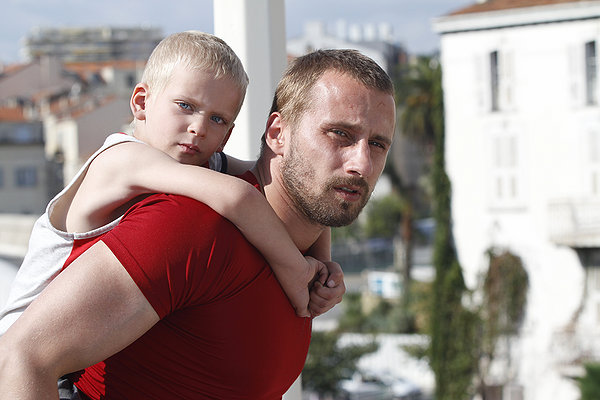 Rust and Bone has a serious case of multiple personality disorder. It looks like it’s going to be one movie, then all of a sudden it changes into another, and then when you think you’ve got a handle on that, it suddenly transforms into another. I’m perfectly fine with a movie switching gears suddenly, however, with Rust and Bone, I felt like I was getting three different half-hearted drafts rather than an actual movie. I went into the film knowing little other than the selling point, that Cotillard was playing a woman readjusting to life after a freak accident took her legs. For the first twenty minutes of the movie, I didn’t get a shred of this. I got a single father trying to scrape together what he could for himself and his son, often resorting to sneaky and illegal measures. Then shortly after Stephanie is introduced, the movie becomes all about her. We’re dealing with her recovery and her anger and her loss. Just when I think I’ve settled onto the narrative direction of the movie, it becomes Alain’s movie again. Now we’re following his budding career as an amateur kick boxer, with Stephanie as his cheerleader. Then she dissolves into the background of the movie yet again, and it’s all about him. I don’t think the movie knew which character it wanted to be its focal point, so we get a sloppy interspersing of storylines vying for dominance. Personally, I was much more invested and intrigued by Stephanie’s recovery than anything having to do with Alain trying to be a better father and failing. Then there’s other muddled storylines like hidden cameras in the workplace that only further distract. It’s just all too much and at the same time not enough.
Then there’s the matter of the romance between Stephanie and Alain. I suppose you could say they are both wounded people trying to gain a greater sense of independence, battling new concepts of self-identity, but I think I’m doing the film too many favors. The sad part is that these two people are extremely shallow and limited form a characterization standpoint. The only defining quality about Stephanie is her injury. Sure she’s feisty and can get into bar fights, and that fact that she’s attracted to Alain says something about her, but really, her only characterization is her new physical limitations and her adjustment to them. Her physical needs are given much more attention by the screenplay than her emotional resonance. It makes me sound like a hardhearted bastard but I’ve said it before, I need characters that have more depth to them other than that they suffer. Alain, on the other hand, is even worse. He’s a pretty flat character who’s actually a really terrible father. He loses his temper easily, chooses quick sex over picking up his kid at school, plus there’s the whole abandonment thing. It’s hard for me to believe that anything really sinks in with this lunkhead. His relationship with Stephanie, meant to open him up, instead reconfirms what a jerk he is. He uses women as sexual playthings, and treats Stephanie with this same careless abandon. He clearly doesn’t see her as anything but a comfortable fling, which he shows through his actions. If Alain’s romantic views have changed, the film doesn’t show any of this progression. I didn’t care about him and I certainly didn’t care about the two of them together.
Acting-wise, Cotillard (The Dark Knight Rises) is quite moving throughout as she tries to come to grips with everything that has been taken from her. Her more traditionally dramatic crying scenes are powerful, sure, but it’s the quiet moments that Cotillard nails. There’s a moment where she goes through her former routines hand motions, and in that moment, set to Katy Perry’s “Firework,” it becomes clear she is moving beyond her accident, accepting and getting stronger. It’s a subtle celebration of the human spirit’s ability to rebound, and Cotillard makes sure the moment is moving rather than cheesy. Also, there’s a very tender moment when she returns to the water park and reunites with the whale that took her legs. Through the glass, she goes through her training motions and the whale still resounds accordingly to her commands. It’s a wordless, touching moment that communicates so much, the nature of forgiveness, the culpability of an animal, but really about the connection between man and nature. Also, the fact that these two scenes are available on YouTube means somebody else must have seen them as standouts as well. She’s also naked frequently, if that matters to you.
 Schoenhaerts (Bullhead) is too opaque for his own good. He seems to settle for his brute physicality, and as such the movie does little to flesh him out further. He has a couple nice moments, especially at the film’s climax, but it’s too little to overturn the prevailing notion that his character is unworthy of co-lead status.
Probably the most impressive thing from Audiard’s film is the special effects to remove Cotillard’s legs. While the technology doesn’t seem like it has changed since Lt. Dan’s days in 1994, it’s still a striking image to process. I’m still wondering why exactly Stepheanie gets tattoos on her (remaining) thighs, reading “Right” and “Left.” Is she worried about going under the knife and the doctors taking more away from the wrong limb? That seems past the point of return. With the special effects technology, and the film’s quotient for sweaty sex scenes, this is the art house equivalent of erotica for those discerning few with amputation fetishes.
When it came time to determine which film would compete at the Academy Awards, France chose the feel-good buddy comedy The Intouchables over Rust and Bone. It’s easy to see why. Except for Cotillard’s fierce performance, and some spiffy special effects, there is nothing remarkable about this ultimately frustrating and shallow movie. The mismatched love story between Stephanie and Alain feels implausible and too focused on surface-level desires; not enough to justify some statement of personal growth on both their parts. There needed to be a complete restructuring of the screenplay. Too often it keeps switching focus, changing gears, mixing in other subplots until it all feels like one big mess lacking firm direction. I might have loved a movie that focused on Stephanie and her recovery, perhaps even one about Alain, though I doubt it. What Rust and Bone offers is a movie that’s persistently in doubt of its own identity, trying its hand at everything, forging necessary care to its lead characters. It’s a fine film that could have been a great one, if only it really knew what it wanted to be in the first place.
Nate’s Grade: C+


 nathanzoebl
You must be logged in to post a comment.