In the wake of COVID-19, some changes…
Everyone is feeling the effects of COVID-19 and the entertainment industry, in particular movie studios and theaters, have been dramatically affected. I will be continuing to review new films when I can, albeit many will likely be smaller indies unless Hollywood embraces Video on Demand. I’m also going to make a real effort to continue seeking out Ohio-made indies and providing reviews for them. I will continue what I did for my huge 1999 in Rewind article and look back at my original teenage reviews and assess my current feelings on the movies and my old writing, for the year 2000, 2001, 2002, 2003, and now 2004. I’ll be on the lookout for amazingly new so-bad-it’s-gotta-be-seen movies (have you seen Love on a Leash?). In short, I’m going to keep writing. I hope you keep reading.
Share this:

How to Make a Killing (2026)
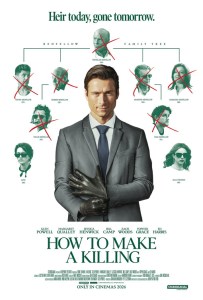 After the magnificence of 2022’s Emily the Criminal, I would watch anything by writer/director John Patton Ford. Inspired by the 1949 film Kind Hearts and Coronets, we follow Glen Powell (The Running Man) as the disowned grandchild of a wealthy family who schemes to gain his multi-billion inheritance. It just so happens he’s last in the line of succession, so he plots to kill his seven family members standing in his way of the life he covets. Given the premise is based on calculated murder, there are generally two ways to do this story that would work. The first was what I expected, an eat-the-rich satire where each of the family members is cartoonishly evil and we savor their executions. The second is a trial of the soul where our protagonist discovers that killing is harder than it seems and that these people, targets he’s projected his hatred onto, are more complex, which causes him to question whether he should continue in his deadly pursuit (the route that last year’s No Other Choice). How to Make a Killing doesn’t really do either, which made for a frustrating engagement. The assorted family members, beginning at cousins and then going into aunts and uncles, is played as buffoons but I kept thinking, “Well, they’re obnoxious, but do they really deserve to die? Would I feel entertainment at their deaths?” Their wickedness wasn’t exaggerated enough to get me salivating their demise, including several that are just lumped together as a quick montage. But these family members aren’t really fleshed out either, challenging our main character’s biases and grievances against people he’s never really known. As a result, the characters are under-written ideas of people, lacking depth to be contemplative and lacking garish ferocity to be irredeemable. Nor does the movie use this as a point of challenge against its protagonist’s skewed priorities. He’s trying to “earn the life he deserves,” but midway through, he already achieves this with a well-paying job, a good woman who loves him, but it’s not enough for him, and yet this conflict isn’t really examined either. It all makes for a tonally wish-washy movie that needed more refinement to nail its execution, in all manner of speaking.
Nate’s Grade: C+
Share this:

Disclosure Day (2026)
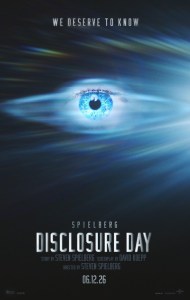
The prospect of Steven Spielberg returning to the world of aliens and summer blockbusters seems like a match made in heaven, the answer to the prayers of millions of eager moviegoers. Disclosure Day, based on a story Spielberg has been developing for decades, is all about forces trying to alert the world that aliens indeed do exist. The primary figures are Dr. Daniel Kellner (Josh O’Connor), a government whistle-blower on the run, and Margaret Fairchild (Emily Blunt), a local TV meteorologist who is suddenly speaking in foreign tongues, reading people’s minds, and even appearing as different people in the perception of others. Both are on a collision course to find one another and discover a repressed shared past as children. It just so happens there are a lot of armed paramilitary goons who want to stop them.
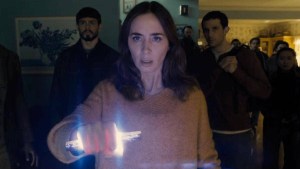
Disclosure Day is an old-fashioned Spielberg popcorn thriller, for better and for worse. Let’s focus on the good first. It’s an easy movie to get on board with, as the plot moves almost immediately from the start and it becomes one extended series of chases and escapes up until the very end, which makes for an exciting movie that has a definite sense of forward momentum. Does it always make sense? Do you care about the characters? Well, we’ll get more into that later, because right now we’re celebrating what works with Disclosure Day. It’s been eight years since Spielberg made a big-screen blockbuster action-thriller (Ready Player One), albeit it’s been twenty years since he made a great one (2005’s War of the Worlds). He’s been more prone to introspective or technically adventurous filmmaking choices of late, so to have Spielberg readopt the blockbuster mantle, and with aliens no less, feels like a thematic homecoming for the man who defined modern cinema over the last fifty years. He’s always been a little squishy and corny in his approach, and that can certainly be welcomed during trying times such as we find ourselves in (hopefully things have settled and improved when you’re reading this in the future). It’s a familiar yet old-fashioned model for a modern blockbuster that Spielberg helped perfect, so to have him return to this mode and have fun can be rewarding, especially for longtime fans giddy that the master is coming back to the world of extra terrestrials. Spielberg can still position his camera and visual arrangements like nobody else, and just immersing yourself in a masterful cinematic storyteller’s whims can be transporting and uplifting even if you’re not exactly on the same wavelength. In short, it’s gratifying to just experience Spielberg operate in his blockbuster space considering the man is almost 80. Who knows if we’ll ever get another one of these kinds of movies again, so there’s something thematically fitting for the master to return to his roots for added social commentary and sentiment.
I had more problems with the old-fashioned qualities of the movie that didn’t feel like they connected for me and connected to a realistic depiction of our modern-day. The problem with a movie set in the present-day that concerns the revelation of alien encounters is that it’s hard to get a plurality of Americans to believe anything no matter if it’s scientific and correct. Just recall the COVID outbreak at the turn of this decade where people couldn’t even agree on things like masking preventing the public spread of viral infection and vaccines being a life-saver. We had people literally eating horse paste and drinking silver nitrate because charlatans told them to do so. The crux of Disclosure Day rests firmly on the world believing the public disclosure of aliens, presented none other than through network evening news. It’s a bit outdated to think that enough Americans, let alone the world, would hold faith in mainstream network news in our increasingly splintered and information silo-ed era. There are people this week who claimed one political party was controlling the weather to the embarrassment of the other political party, and you’re going to tell me these people are going to believe in the existence of aliens because it happens to be presented by TV news? That’s a bit naive, but I think Spielberg could have sidestepped this by having the movie set in the 1980s or 1990s. It would have been more believable, and holding onto collective faith in humanity coming together in times of crises would be more aspirational rather than, you know, remembering that some people rejected minor inconveniences that could save lives like they were tyrannical affronts to liberties. I don’t know about you, but my ultimate faith in humanity has only lowered when it comes to collective action and shared sacrifice in the name of the greater good.
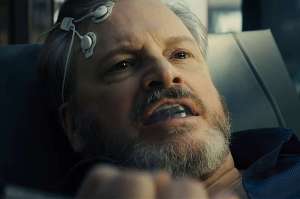
Brushing aside my own cynical modern perspective, the conspiracy itself, and the machinations of the participants, is kept so frustratingly vague with arbitrary solutions. The movie is populated by two clandestine forces, one looking to divulge the existence of aliens and expose the coverup, and other looking to maintain that coverup. You can easily label them Good Guys and Bad Guys for all the complexity provided. That’s fine. The teams can be generic stock roles as long as our main characters are interesting and well-developed. Unfortunately, our main characters feel easily forgotten, often dropping in and out of the movie for unknown reasons and miraculously reappearing in the exact right moments. There’s a climactic showdown where Team Bad Guys is literally going to shut off the power to the TV news station because that will completely stop the flow of information (it’s not like people would just record with their phones and upload to social media). Then all of a sudden, a character that hasn’t been seen for twenty minutes, is just there, and they have a magic alien device that they know will… restore the power. As a climax, it just feels so goofy, outdated, and sloppy in its clumsy plotting. The bad guys have the power to inhabit other people’s minds and control their bodies, so why aren’t they doing this all the time? Once you start introducing alien technology without any clear definition or limits, it basically becomes a magic wand that can provide whatever the user, or the screenwriter, desires in that moment. It’s an obvious narrative cheat. There are occasions where this power can be diverting and fun, like an invisible escape that doesn’t make much sense but was at least entertaining to experience. However, because so much of the story elements are under-developed, it makes the ultimate showdown unfulfilling.
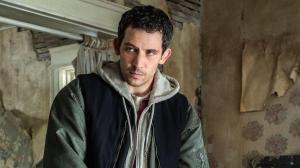
Another hindrance is that many of the characters feel more as tools of the story to get it from Point A to Point B rather than fleshed-out people. Not every character in a genre thriller needs to feel three-dimensionally accurate, but they need to feel interesting, at least enough to make us care or be curious. Daniel Kellner is the biggest dud for me. I genuinely like O’Connor as an actor and found him mightily compelling in last year’s Wake Up Dead Man, but he’s given so little to work with here. Being the point man on exposing a conspiracy should be plenty, and given the harrowing circumstances of constantly having to look over your shoulder it should provide plenty of mental conflict and second-guessing, showcasing different aspects of who this person can be. Instead, he’s less a character than a figure in motion, the person everyone else is chasing after. He’s more plot device than person.
Margaret is the more interesting character as she’s undergoing a mysterious change that she is struggling to recognize, but halfway through that confusion gives way to godhood, as she becomes essentially a superhero with powers of convenience. No matter what trouble she gets into, the script goes into a cheat code to get her out with a new alien power of contrivance. At some point, she stops even questioning or reflecting on these changes and just goes with it, which feels like the characterization simply giving up. It’s a shame because there’s great drama in the existential and personal crisis she was experiencing. I liked her revulsion at being worshiped as a religious icon once she could appear as people’s dead loved ones. Honestly, a whole different movie could have explored the psychological ramifications of that power and the needs of others to see and talk to departed loved ones one last time, to seek affirmations and closure, all against her own sense of agency with a power she feels has hijacked her identity. In the end, these two characters are mainly here to help convey the message, a human game of intergalactic telephone.
The biggest problem for me, besides the lackluster characterization, is that the most interesting part of this movie is its unsaid implications. I am less enthralled by two competing factions fighting over the alien conspiracy and more interested in how the world responds to the momentous revelation that we are not alone. I kind of wish that Disclosure Day’s Act Three had been its Act One, and rather ending on whether or not the world would discover the truth about little green men, the movie confirmed it and then said, “For the next 90 minutes, we’re really going to dig into how this affects people and changes society.” That’s the movie I want to see, the what comes next. The film briefly explores the spiritual ramifications as one character, a former nun, tries to square her faith with the reality of other intelligent life in the wider universe. Is that revelation comforting and confirmation or conflicting and confusing? I really wish the screenplay had gone further in that exploration, something akin to Arthur C. Clarke’s Childhood’s End, which richly examined the upheaval to societies and personal identity. I suppose I was looking for more of what happens after Disclosure Day rather than leading up to the big disclosure, and I doubt I’m alone.
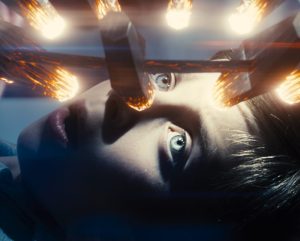
I will also be spoiling the exact ending because I believe it deserves unpacking, so if you would like to remain spoiler-free, please skip to the next paragraph, dear reader. Alright, with that out of the way, the climax hinges upon the news about aliens being disseminated to the public. It’s a little strange that so much of the climax is merely watching the footage with our characters on the sidelines. In fact, the emotional point of emphasis is placed on a new character, a news anchor played by Courtney Grace, who narrates the footage and its implications in real time. Her performance might be the best in the movie (Blunt is good, folks, but let’s pump the brakes on those “career-best” declarations) as she shows restrained and nuanced emotion trying to process the amazing and perspective-shifting revelation. It’s just strange that so much is placed on a brand-new character so late into the movie. Regardless, what stupefied me was that after all this the good guys literally roll out an elderly alien being in a wheelchair. What? You had a literal living, breathing, well more like rasping-alien (don’t want to cast aspersions, but maybe this alien adopted smoking in his time planet-side) and you just keep him at bay? Your whole goal is to raise awareness about the existence of aliens and you literally have an alien to prove the existence of aliens. Why did everything have to hinge on these two adults realizing they were given special powers as kids? Why did they have to wait 30-plus years for these powers to manifest? Why didn’t aliens just give adults these powers rather than children to wait on their maturation? Could the old alien not learn one of Earth’s languages or at least how to type? We have magic devices that can generally do anything but the creators of these magic devices cannot conceive of something to resolve a predictable language barrier? If the script were stronger or the characters engaging, my brain wouldn’t be consumed with these questions.
Reluctantly, Disclosure Day fits squarely in the fulcrum between good and not so good, teetering between one direction and the other. It’s got high production values, good actors, and Spielberg cooking in the sci-fi/action/thriller realm. It’s enjoyably more tactile with its action set pieces, of which some are exciting and visually inventive. Others are just characters getting overlooked in plain sight, and this is before they introduce magic invisibility. However, the promise of the movie is never truly fulfilled from a story awash in underdeveloped characters and themes, arbitrary and overly convenient plotting, and a resolution that feels less than satisfying and more confusing in execution and implication. I genuinely wish that Disclosure Day was more about the aftermath of the news rather than the reaching of the disclosure itself. Even a middling Spielberg thriller can still have more entertainment than the best of many filmmakers, so I’m sure many filmgoers can find something to enjoy, but they’re just as likely to find something that sticks in their proverbial craw, that they chew over for days, and question why it couldn’t be better.
Nate’s Grade: C+
Share this:

Scary Movie (2026)
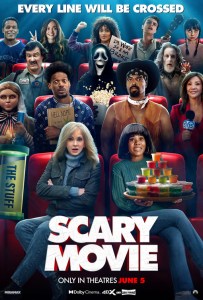 The Wayans brothers birthed the original Scary Movie spoof and then after one mixed sequel in 2001 they were ditched by the studio. There were three more Scary Movie sequels that became less and less popular. The Wayans stuck by their raunchy satirical playbook, making two A Haunted House spoofs and even a parody of Fifty Shades of Grey. Now the Wayans brothers are back, along with Scary Movie alums Anna Faris and Regina Hall, the real MVPs of the franchise. It’s a homecoming, a nostalgic throwback for fans of the original Scary Movie, and a hopeful upswing for big-screen studio comedy to make a comeback. If only the movie were funnier.
Since the last Scary Movie sequel in 2013, horror movies have flourished. There’s the Conjuring franchise, which has made over a billion dollars, the miraculous ascendancy of Jordan Peele as an Oscar-winning horror maven, as well as the rise in elevated “A24-style” horror, movies heavy in atmosphere and layered metaphors, by the likes of Ari Aster, Osgood Perkins, Robert Eggers, and Zach Cregger. Coralie Fargeat was even nominated for Best Director for making The Substance, generally unheard of in Academy Award history. There is so much that can be satirized about horror since 2013, especially how it compares to horror from the 1980s and 1990s. Instead of tackling any of these new perspectives and movements in a meaningfully satirical manner, Scary Movie 2026 is, much like the Scream franchise itself, stuck in the past. This movie could have even covered the evolution of modern slashers into grueling gore endurance contests, like the Terrifier films, or the more experimental genre deep dives like Ti West’s Pearl trilogy with Mia Goth and In a Violent Nature. That would require more effort, so since Scary Movie 2026 is setting itself up as a reboot/legacy sequel, there is a logic for it to attach itself to the plots of Halloween 2018 and Scream 5 (it’s shocking how much plot is pulled from Scream 5). However, any satirical derision over the nature of cash-grab franchise reboots is reserved for the very last ten minutes, which happens to be the best part. Instead, there are too many moments where the same joke is run into the ground (like Ray being closeted, which doesn’t make as much sense in 2026 America), or the end result is just somebody getting hurt. Personally, I chuckled maybe about five times, so my entertainment output was not high. The best joke is a visual gag that goes unspoken about the very disastrous Final Destination amusement park.
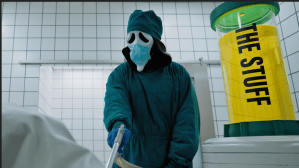 The spoof pacing requires a lot of material to burn through, and as a result everything gets sucked into the comedy cauldron whether it seems related to horror or not. There’s a parody of the Michael Jackson movie, most likely because it’s popular and not because there are new jokes to be had about one of the most famous celebrities who’s been dead for over 15 years. I’ll save you the time: the punchline is that a man moonwalks and falls down the stairs. Why is there an animated sequence parodying K-Pop Demon Hunters? Why is there an extended John Wick parody? The answer is simple: because they made money. Like the Friedberg/Seltzer (Epic Movie, Meet the Spartans) playbook, anything that has some minute draft of pop-culture cache gets thrown into the mix, sometimes references that have a perishable shelf life that will be considered old only in a matter of months. I wouldn’t ever advise it, but if you go back and watch any of the Friedberg/Seltzer spoofs of old, you probably won’t be able to remember a quarter of the references. This is because the filmmakers are sacrificing the integrity of their comedy for the quick dopamine hits of timely pop-culture recognition. Is anyone in five years going to remember that the Meagan robot became meme-famous from her weird dance? That’s all the Wayans seem to remember about M3agan, so that’s all you’re getting, folks. It all feels like swimming through someone else’s half-forgotten memories of pop-culture relics.
There’s also a string of jokes that I’ll call “these kids today don’t get it” observations from an older generation feeling rapidly out of place and thus resentful. Look, Gen-Z culture is ripe for satirizing and mockery, but when your targets are pronoun preferences and a trans character just… existing, then it certainly feels like your satire is regurgitating the same grievance points as most hacky Boomer comics. Every rendition of this felt like an example of the “old man yells at cloud” Simpsons meme. If they really wanted to hone in on this generational misunderstanding, they could have really gone further in the different perspectives from Cindy (Faris) and her teenage daughter, but that doesn’t really happen. It all makes the comic perspective feel not just out of touch but grasping and desperate. Why include a trans kid if the only joke is going to be a tedious series of misgendering them? These jokes are meant to act as a comedic heat shield, proposing the Wayans as no-holds-barred comics, unafraid to tackle whatever modern taboos we may have across politics. Except the fact that these jokes are so thin and obvious and disposable creates the unmistakable impression that these are sops for a commercial demographic, the same people that would get excited by seeing a character on the poster with a “woke is broke” sign.
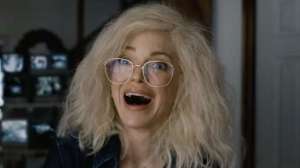 Let’s analyze just one example of the creative rut here. Weapons was a popular movie from 2025 and Amy Madigan’s Aunt Gladys character instantly became iconic. There’s plenty you can do with this character and the modern-day scenario of a wicked witch absconding with children (sample: Kristi Noem as Aunt Gladys as she cruelly sets up child abductions as part of ICE – the makeup preferences between the two could also cement the connection). The only thing Scary Movie 2026 does with this Oscar-winning horror movie is so thoroughly lazy and half-hearted. The joke is that the Trick or Treat kids received weed gummies and are running around high. That’s at least a starting point, and you could see where there could be comedic misunderstandings and mischief. However, that setup is just it. There isn’t anything else. We watch kids running like they did in Weapons and they have offhand ADR lines along the likes of, “I’m so high.” The worst example is a kid just saying the “six seven” meme. That’s it, like the utterance of the meme is the joke, another lowly example of the reference being misunderstood as a joke. Then one of the kids gets hit by a car (ha ha). Do we feature the driver freaking out thinking they’ve killed a kid? The kid protected thanks to the weed gummies? The driver mistaking the inebriated child for a dangerous tool for killing like, you know, in Weapons? Anything? The car hitting the kid, bouncing them high into the air like a trampoline, is the end of the scene. That’s it. It’s practically an admission that the writers didn’t know how to end their scene, and there are many, many examples of this throughout where scenes just abruptly end, lacking larger punchlines and escalation. It’s just weak.
The funniest thing might be the unintended poor timing on Scary Movie’s part. Had this movie waited maybe four months or longer, it could have incorporated the summer horror resurgence happening presently at the box-office. Backrooms is slated to become A24’s highest grossing movie of all time, opening at an eye-popping $80 million. That’s superhero movie numbers. Then there’s Obsession, which has grown and grown from its wide release and is now slated to become Focus Features’ highest grossing movie of all time. Obsession is a phenomenon we haven’t seen in decades. It made more money in its second weekend than its opening weekend, and then it made more money in its third weekend than its second, and then in its fourth weekend of release it STILL amazingly made $25 million. This is a genuine word-of-mouth sensation. I don’t want to overload you on box-office numbers, but as of this writing, Obsession has been released for a total of 24 days and only one of those days did it gross less than $3 million, and that was its fourth day of release. This just doesn’t happen, let alone to a movie that cost under a million dollars to make (we’re talking Paranormal Activity-levels of success here, where a $15,000 budget indie grossed nearly $200 million worldwide, and that was in 2009 dollars too).
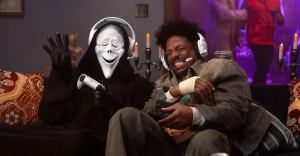 I bring this up because horror movies are clearly a force to be reckoned with in the larger culture, and with the success and critical accolades for movies like Get Out, Sinners, The Substance, and Weapons, there is plenty of material available to satirize this new ascendant horror movement. That’s why Scary Movie 2026 is even more disappointing and dispiriting, tying itself back to teen slasher movies that haven’t been relevant for decades. There was so much this movie could have critiqued about horror as it is today, and instead we get sketches without punchlines, fleeting reference-based humor, and lazy jokes that settle for easy vulgarity without a wisp of cleverness. With any comedy, especially spoofs, your mileage will vary on the hit-to-miss ratio, and it’s hard to be really mad at the Wayans for doing their same schtick for decades, but Scary Movie 2026 feels less transgressive and edgy and more tired and dated and, sadly, lost. It feels like the Wayans have lost hold of the cultural zeitgeist or the ability to recognize it, and as such Scary Movie 2026 isn’t any better than any other Scary Movie sequel slop. It’s all exaggeration and mugging with the same old scatological punchlines (when there are punchlines) and further diminishing results.
Nate’s Grade: C-
Share this:

Over Your Dead Body (2026)
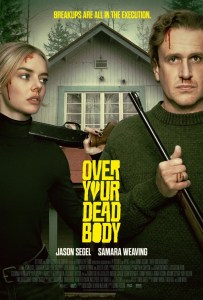 Based on the 2021 Norwegian film The Trip, we have a very War of the Roses-style duel between a bickering married couple, each trying to kill the other. Dan (Jason Segel) is a has-been director stuck filming “pop-up” ads. Lisa (Samara Weaving) is an Australian actress still trying to catch her big break. They plan a romantic weekend getaway with a cabin in the woods, a steak dinner, and a side of chloroform and tasers. Each reveals their scheme to kill the other and collect the insurance. They battle each other and the violence is exaggerated cartoon slapstick rather than off-putting. The screenplay keeps things lively with a structure that keeps doubling back, providing a new perspective or revelation to re-evaluate where this twisty narrative goes next. That’s when Over Your Dead Body is fun, elevated by the screwball energy and animosity of Segel and Weaving really going at it. It wouldn’t be a Samara Weaving horror/comedy if she didn’t get drenched in blood at some point. Then a group of antagonists are introduced and the movie transforms. Now the dark comedy seems to dissipate into general menace, the jokes become more forced and far between, and the violence loses its comic absurdity and just feels icky. I felt my interest lessening as it became less funny and set up our feuding couple to work together to escape their new antagonists. It becomes a bit too conventional. This structure could have worked, but I think it’s the mismatched tone that dooms this movie for me. It reminds me of the tone-shattering ugliness of the violence in Pineapple Express. I’d rather the couple continue arguing over the failings of their marriage than watch somebody get a lawnmower to the face or the threat of rape as public entertainment. This is a movie that needed a few more drafts to calibrate the tone and comedy to better maximize what it starts with. Over Your Dead Body is marriage counseling by way of home invasion thriller and, like its main characters, it’s a messy marriage of tones that needed further reflection and examination of its core problems.
Nate’s Grade: C+
Share this:

Backrooms (2026)
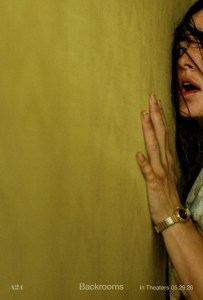
I’ve been a fan of horror movies since my high school days. I’ve literally watched hundreds of them over the decades and find myself more drawn to them of late, perhaps a reflection of the horrors we seem to be processing in our daily lives from the deluge of current events, scandals, and moral failures. I will often feel discomfort, dread, and tension from horror and suspense movies, but it’s rare for me to feel genuine terror, to be afraid to the point where I could be haunted afterwards with the threat of nightmares. It takes a lot to get to me. It’s been maybe ten years since a horror movie really unnerved me and got under my skin. Backrooms is that movie. I was deeply affected and jarred from this little liminal horror movie. That’s the highest praise I can offer, and the fact that a 20-year-old director is responsible for that is amazing. Even if you have no knowledge of the popular YouTube series, dive into Backrooms.
Based on the creepy pasta Web series, Backrooms is set in 1990 and primarily follows two characters. Clark (Chiwetel Ejiofor) is the owner of a failing furniture store with plenty of personal baggage over his failed marriage and unrealized career as an architect. His therapist, Dr. Mary Kline (Renate Reinsve), has her own parental trauma she’s trying to work through. One day Clark discovers a strange doorway to another dimension in the basement of his furniture store. It’s a seemingly endless hallway reminiscent of an open-spaced office building, and Clark decides he needs to explore this strange new space, but can he make it back, will he hold onto his sanity, and are there malevolent forces inside this space to avoid?
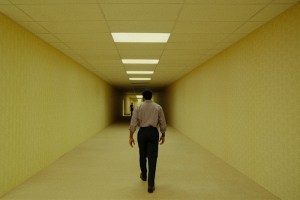
The strength of Backrooms, as a concept as well as a feature film, is how it taps directly into your limbic system to communicate that everything is just inescapably wrong. Everything looks wrong, everything sounds wrong, you worry that another turn of another hallway is only going to bring about further ruin, and so every additional second in this inter-dimensional space makes you want to retreat. It has the living contours of a nightmare world where there is a lack of concrete details, where things are approximating real-life but just a means off, little uncanny differences or limitations that alert your brain that things are not as they should be. There are small examples, like a chair with five legs instead of four or a stop sign with its writing backwards, and then there are more arresting imagery, like chairs sinking into the floor like sand, or a series of telephone poles increasingly bending forward like a splayed rib cage. Exploring a world of these distortions leads to deeply fascinating and also unsettling imagery that can lead to a suffocating atmosphere of unease. It makes for a rather entrancing experience of analogue, dead mall aesthetics that have a subliminal pull that draws you innately while making you feel off-balance. Like the definition of the uncanny, it takes the familiar and mundane and distorts it into something truly eerie.
But this is more than just a 100-minute extension of the short-form YouTube videos. Director Kane Parsons has certainly leveled up his craft in his film debut. This is a weird world he’s intimately familiar with, but the big-screen jaunt is carefully made to be inclusive and adapted like an actual movie. There’s work here on characters using the Backrooms as an exploration of their unresolved personal traumas, for Clark his rage against a world and the people he felt have failed him, for Dr. Kline her oppressive and mentally ill mother. I like that it’s never clarified whether or not Dr. Kline’s mother was just crazy or whether she too became aware of the Backrooms dimension and was trying to protect her daughter. There are hints of larger lore but the movie isn’t drowning in it, just like there’s some basic explanation given to this dimension and its rules, just enough to satisfy without going into too much explanation. This was my main issue with 2019’s Us, Jordan Peele’s creepy and thrilling nightmare about dopplegangers revolting, and also a movie that shattered its own credulity once it attempted to provide a logical explanation. Not everything that’s strange in a movie needs a thorough explanation. We can readily accept the unbelievable on its own terms. There are more traditional horror movie elements, like jump scares, frantic chases, and the Big Scary Something Coming to Get You, but Parsons makes them all work. There’s a jump scare in this movie that didn’t just make me jump but made me gurgle something unintelligibly in response. There are several agonizing setups of characters contemplating journeying through tight or slanted or altogether ominous spaces and I was shrinking in my theater chair, dissolving in the simmering anxiety, and repeating “no” a lot. The use of found footage is perhaps the best in any movie in a decade. Even at the young age of twenty, Parsons shows not just a knack for creepy imagery but on how to craft and escalate suspense set pieces, how to build and punctuate a suffocating atmosphere, while also balancing characters, story arcs (learning acceptance and accountability!), and metaphors (a concrete hand print she carries with her from childhood!) and themes without losing sight of the core scares and their appeal. Parsons has already proven that he’s the real deal and he’s not even old enough to legally drink in the U.S. yet.
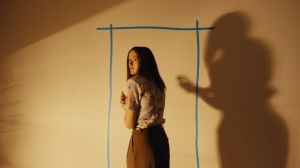
There’s an interesting meta commentary here about the junky iterative process of generative A.I., though this is speculation on my part, though I find it founded in logic within the movie. We’re told repeatedly that the Backrooms doesn’t create things as much as it recreates from its surroundings and the memories of its participants. There’s a reason most of what is explored is a reflection of the furniture store it’s attached to. Except it cannot get things exactly right. Clark explains it like describing a dog to an alien that’s never seen or known the reference and then having the alien create what it thinks a dog would be; the larger shape and idea might be there but the details are inexact or incorrect. For me, this corresponds with the rise of generative A.I., where it tries to replicate real-life but is often prone to strange hallucinations, like human bodies with peculiar joint hinges, extra fingers, or smoothly elastic skin. There’s also very Backrooms-esque visuals of furniture being eaten by walls and floors. Generative A.I. is limited to only replicating what it has been fed, and it often spits back something that looks alien, missing those crucial details to seem real. There’s a memorable tracking shot in the movie that descends floor after floor, and we witness the same room layout go through round after round of regeneration and distortion, getting further and further from the original source with each iteration. What begins with a recliner and windows becomes chairs sinking into the floor, the outlines of windows against solid walls, and finally nothing. Parsons doesn’t have to be explicit but the pointed commentary can be found on A.I.’s limits.
I don’t know about you but if I discovered a portal to another dimension, I don’t think I’d take it upon myself to go exploring. I understand why the movie does so because, well, we need a movie, and that discovery is where the horror lies, and it makes sense for Clark since it’s a reflection of his own memories and unfulfilled ambitions. I get it. However, if this was real-life, I would immediately retreat after confirming that, yes, this strange doorway indeed exists. Perhaps I’ve seen enough spooky movies or it’s just an overabundance of caution in my nature, but I would definitely stay home and let someone else become the latest lost entity to the siren song of human curiosity. Somebody else can be monster chow.
The origins of the Backrooms predates Parsons and his popular YouTube experimental shorts, but it was he who really popularized it and took it to another level, and now with his film debut, Parsons has done something remarkable. It’s not just the bold announcement of a new cinematic voice. It really feels like this movie could be the start of something monumental, a tide-changer along the lines of John Carpenter’s Halloween. He’s not the first filmmaker to explore liminal imagery and dream logic, as we’ve seen from Severance, to The Stanley Parable, to the entire career of David Lynch. I can already hear some Hollywood studio exec saying, “Gen-Z kids, they love them their liminal spaces,” or some kind of erroneous lesson from the runaway success of Backrooms. Get ready for a flood of imitators exploring minimalIst abandoned spaces. I was entranced and deeply disturbed by this movie to the point where I kept shuddering even after the credits rolled. It’s not because of shock value or emotional manipulation, it was because Backrooms got to me, unnerved me, and shook me up, in a way no movie has for a long time.
Nate’s Grade: A
Share this:

In the Blink of an Eye (2026)
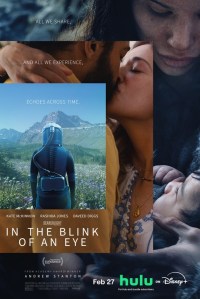 Having a sprawling meditation on the nature of humanity with a story spanning thousands of years sounds intriguing, at least for the ambition alone. Add in director Andrew Stanton (WALL-E, Finding Nemo) in his first live-action movie since 2012’s John Carter and there’s a greater curiosity factor. Unfortunately, In the Blink of an Eye is like speed-running through Cloud Atlas and losing all the connectivity and conflict. We have three storylines that we bounce between: 1) a Neanderthal family from 47,000 years ago, 2) Rashida Jones as a research scientist in modern-day, and 3) Kate McKinnon aboard a colony spaceship around 2400. Naturally, you would think these storylines would impact one another or at least find unexpected and interesting parallels, braiding together to demonstrate our shared humanity through past, present, and future. Yet it doesn’t really materialize, as the storylines feel too separate and fail to come together in a clever, satisfying, or enlightened way. As a result, In The Blink of an Eye now has three underdeveloped stories slammed together and butting in on one another over a still too tedious 94 minutes (about 75 minutes shorter than Cloud Atlas, by the way).
The problem is there isn’t much to learn from any of these storylines and they lack important conflict. The oldest, with the Neanderthals, has births and deaths, but it’s mostly a family sitting along a coastal forest. This entire storyline is also in an ancient language without subtitles, limiting its scope and impact. Next, the present-day story is an un-engaging romance between Jones and Daveed Diggs while she prepares to lose her mother. This dull relationship moves in such jarring starts and stops so it doesn’t feel believable, with Jones’ character more a prickly, socially-challenged egghead. The final storyline in the future has the most conflict with McKinnon having to figure out life-and-death stakes with depleting oxygen on her colony ship. With twenty minutes left to go, I kept thinking, “Everything is going too well in all three stories. We must be heading into Act Three disaster.” Nope. It’s such a strange movie experience because only one of the three stories has some danger and emotional involvement, with the middle only serving to provide some historical context for the oldest storyline (Neanderthals weren’t actually intellectually inferior, ya’ll) and vaguely set up the future. So we have an airy, slightly experimental movie driving at something more thematic and revelatory than a typical three-act structure following characters through momentous plot events. Despite some shared themes of grief, mortality, family, and legacy, the movie doesn’t have the space to really say anything meaningful, so its efforts at sentimentality feel mawkish and awkward, meant to salve the missing emotional investment. The characters thus become more symbolic and even less relatable. Even worse, it’s all so boring. We literally go from one scene where parents discuss their teenage son’s porn habits to the next scene where this same son, now an adult, is leading a Ted Talk about defying the laws of aging. They grow up so fast?
Lacking more thoughtful integration and contemplation, In the Blink of an Eye feels less like a film story and more like some overly generalized, glossy advertisement for some inscrutable company. It’s vaguely human-like, vaguely emotionally affecting or uplifting in intent, and forgettable in a blink. Just watch Cloud Atlas.
Nate’s Grade: C
Share this:

28 Years Later (2025)/ The Bone Temple (2026)
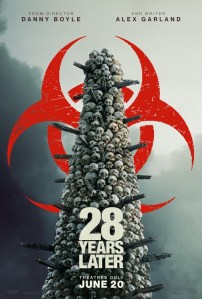 While not officially 28 years after its release in 2003, you’ll have to settle for only 23, comes a sequel to the zombie outbreak that kicked off a resurgence in zombie media in the 2000s. 28 Years Later is a far more experimental and meditative and genuinely surprising and surprisingly poignant sequel than I think many fans were expecting. They thought it was going to be more like a father/son (Aaron Taylor-Johnson, Alfie Williams) coming-of-age zombie hunt and weekend of survival. It is that, but it’s also a meditation on life, death, family, nature, and how we respond to grief. Director Danny Boyle returns, for his first film since 2019’s Yesterday, and screenwriter Alex Garland (Ex Machina, Civil War) returns, and together they provide a sequel that attempts to answer what society might be like growing up in this new dystopian world. The movie can get weird, with old movies and archival footage thematically mixed into scenes, Boyle’s camera in constant nervous anticipation, an active member of the hunt, and the use of an iPhone rig to provide Matrix-esque bullet time effects for zombie head shot splatter. Garland has also come up with some interesting zombie evolution over those ensuing three decades of development (granted I thought since the “zombies” were infected living people that you just had to wait them all out to die from dehydration). It seems like a father/son adventure thriller, and it’s quite good at being that, but then it transforms into something unexpected, giving mom (Jodie Comer) the spotlight as she confronts the reality of her physical and mental maladies. From there, the movie becomes this beguiling and thoughtful examination on grace and grief, on processing loss and finding a sense of stability in an unstable world. Ralph Fiennes appears late as a former doctor who seems a little crazy, the grave-keeper to an impressive monument built from thousands of human bones. It’s such a welcomed surprise for a movie replete with them, a movie that refuses easy categorization and wants to do something meaningful than just being a zombie action/thriller.
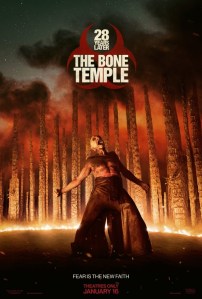 Even more unexpected was an immediate sequel and continuation a mere six months removed from 28 Years Later‘s wide release. The Bone Temple is divided into two stories, both holdovers from the prior film. Spike (Alfie Williams), the son going on his own journey of self, has been conscripted into a weird and violent gang, The Jimmies, lead by Sir Lord Jimmy (Jack O’Connell), the twisted grown-up version of the child seen in the harrowing prologue to 28 Years Later. He’s a sadistic leader who also tells his followers he’s the son of Satan. Then there’s Dr. Kelson (Ralph Fiennes) who we initially thought of as menacing but becomes the most humane caretaker in this post-apocalyptic landscape. The two male figures serve as competing responses to unmitigated tragedy, one retreating to religion as a tool for meaning but it’s really exploitation and manipulation through violence and fear, and the other devoting himself to science and making the world just a little more liveable through empathy and trial and error. Dr. Kelson develops an unexpected friendship with one of the big Alpha zombies, “Samson” (Chi Lewis-Parry), after he discovers this behemoth, who was ripping spines out in rage fits in the previous movie, is seeking out relief through the doc’s morphine darts. Dr. Kelson ponders whether or not there is a chemical compound that could bring back the humanity to the infected. The difficulties with communication do not deter the good doctor, and these paths cross in a climax where the Jimmies come to think of Dr. Kelson as the Dark Lord himself. The movie is consistently interesting, further building out this new damaged world began in 28 Years Later. Nia DaCosta (Candyman, The Marvels) takes over as director and offers a more patient camera, forcing us to dwell in the moments, both horrific and moving. There are torture sequences, long demented monologuing, and questions over the tenacity of human connection despite incredible obstacles, and yet the movie is both more a straightforward horror-thriller than its predecessor and a more focused human drama about loss and holding onto one’s sense of dignity and empathy. It lacks the visual fireworks of Boyle’s style, and I found Sir Lord Jimmy to be more tiresome than interesting, but The Bone Temple is an effectively engrossing lateral sequel that slowly builds Garland’s world a little wider. Now I’ll actually have a third 28 Years movie to look forward to that hopefully won’t take 28 (or 23) years..
Nate’s Grades:
28 Years Later: B+
The Bone Temple: B
Share this:

Slanted (2026)
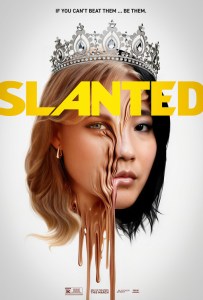 It’s The Substance meets Mean Girls and it’s a frustrating execution of a provocative concept. Writer/director Amy Wang follows Chinese-American teenager Joan Huang (Shirley Chen) as she struggles to be accepted in her predominantly white, middle class, suburban school system. She sets her sights on being accepted by the popular girls, so she abandons her Chinese heritage, food, and looks to better adopt the habits of the very blonde popular clique, but bleaching her hair isn’t good enough to get what she wants. She discovers a mysterious company promising a scientific solution: they will genetically alter you to the race that you desire. What a fantastic plot device to explore racial identity, assimilation, prejudice, stereotypes, and more. It’s a crying shame then for this premise to be completely shackled to a high school cliques storyline. It’s so boring for our protagonist to be completely consumed with being prom queen when she’s just undergone an amazing and ethically questionable procedure. I kept waiting and wanting Slanted to do something more, to better explore the social commentary at stake but it’s really no different than your familiar story of non-popular girl sacrifices her personality and old friends to be popular only for them to remark, “You’ve changed!” This is such a crushing waste of such a promising premise. There’s not even memorable body horror; at one point we do get droopy face. Slanted is less a horror movie and more a middling drama too timid to better explore the rich implications of its concept. This is the kind of idea calling for surreal and excoriating satire, something along the likes of Boots Riley (Sorry to Bother You). To narrowly frame this story as an outsider wanting to be popular in high school is just terribly limited and disappointing and ultimately dull.
Nate’s Grade: C
Share this:

The Crash (2026)
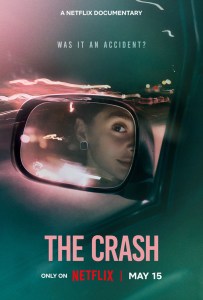 The Crash is an intriguing true-crime documentary on Netflix that hits a narrative wall, echoing its own case. It follows the fatal 2022 car crash of three young people in Steubenville, Ohio. The 17-year-old driver, Mackenzie Shirilla, was the only survivor and eventually tried for their murders. It appears that the car was going 100 miles per hour with no attempt at braking, no skid marks, no defensive maneuvering to avoid a high-speed head-on collision with a brick wall. The 90-minute documentary examines the tragedy and tries to ask how it could happen and then shifts into why, delivering agonizingly little in answers. The case seems pretty clear with forensic evidence, so it becomes an exploration into who Mackenzie Shirilla is and what might have driven her to make such a reckless decision. The problem for the movie is that Mackenzie is unhelpfully her own brick wall. She has convenient amnesia and doesn’t remember anything about the crash, though she knows she would never have done it. The selling point of “Mackenzie speaks out since her trial” is mitigated when she offers so little of value besides canned apologies and she refuses to divulge insights while her onset lawyer consults her interview responses. This, frustratingly, can make the movie feel rather inert when it comes to a deeper examination on the kind of person who might commit such an impulsive and volatile act. How did Mackenzie possibly end up like this? Is it negligent parents who refuse to hold their child accountable? Is it the allure of social media creating a false sense of self? Was her relationship with her boyfriend and crash victim as wholesome as believed? Are we getting drunk on outrage and vilifying this woman to make ourselves feel morally superior? The movie doesn’t offer answers or even exploration of these issues, and so The Crash feels like a protracted episode of any Dateline case-of-the-week scandal rather than an engrossing doc.
Nate’s Grade: C+
Share this:

Obsession (2026)
 It seems like the world has become obsessed with the new indie horror film, Obsession. It’s the gruesome brainchild of writer/director Curry Barker, a 26-year-old debut filmmaker best known for sketch comedy on his YouTube channel, That’s a Bad Idea. With RackaRacka’s Talk to Me, Chris Stuckmann’s Shelby Oaks, Mark Iplier’s Ironlung, and now Barker’s Obsession, it appears we’re heading into a renaissance of YouTube creators blossoming as indie horror mavens, and this is days away from 20-year-old Kane Parsons’ release of Backrooms, a feature based on his experimental liminal nightmare YouTube video. It’s probably inevitable for Mr. Beast to eventually make a horror movie, isn’t it? That’s scary.
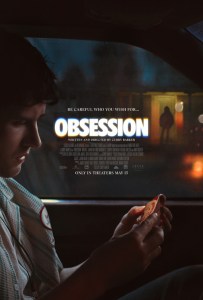
Baron “Bear” Bailey (Michael Johnston) has been nursing a crush on his friend and co-worker Nikki (Inde Navarrette) for years. He’s never had the courage to just tell her how he feels.Then one night Nikki just point-blank asks him: do you have feelings for me? He stammers and says, “I think we’re good as friends.” Immediately afterwards in his humiliation, he breaks a novelty One Wish Willow stick and says, “I wish Nikki loved me more than anyone in the world.” From that moment forward, Nikki changes. She’s ferociously devoted to Bear and incredibly needy and volatile. She takes clingy to another level.
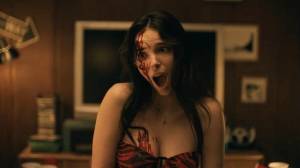 We’ve seen plenty of iterations of the “be careful what you wish for” tale of horror and irony, but Barker makes it his own with such confidence. There’s a prevailing sense of dread throughout the movie that just sits in your gut, miring every post-wish scene in discomfort. It can be greatly entertaining to anticipate just how things will go wrong with each scene. Barker demonstrates a tremendous sense of restraint and dedication, favoring to tease out the audience discomfort. I appreciate how much of the movie’s focus is on building unease over jump scares. There are moments where Barker’s camera forces you to study Nikki’s face draped in shadows as she stands upright in a corner, and it’s far more unsettling than if she had just popped around a corner to startle the audience. There’s a certain dark enjoyment to watching a character get in over their head, especially when they have robbed another character of agency, the whole reaping the consequences of their actions. Watching Bear get punished is a sort of cosmic reward as well as a test to see how far he will go to try and make this “relationship” work. Barker’s background in comedy is evident through his skill with pacing scenes and as a whole, and the film benefits from the mordant tone often dipping into cringe comedy and nervous laughter. This man clearly has an affinity for horror and the chops to make a compelling movie connect with an audience and leave a mark.
Obsession wouldn’t be nearly as worthy of obsession without the captivating and shifty lead performance of Navarette (Superman & Lois). I initially thought it was a mistake we see so little of the Before Wish Nikki, but limiting our exposure means we’re trapped in defining Nikki through Bear’s perceptions and projections, and I think that’s smart. The majority of her performance is after the wish, and Navarrette is just as terrifying as she is unexpectedly hilarious. She contorts her face into exaggerated, almost Jim Carrey-esque expressions. When she’s trying to be the blithely happy girlfriend, she scrunches her face into a pained smile that approaches a grimace, a mockery of how women might be expected to look when given the unhelpful advice to smile more. Her juvenile meltdowns and tantrums remind us that Nikki has degenerated into a sickening distortion. Navarratte’s performance has layers to it, finding little physical tricks to cue us about the Nikki imprisoned inside her own body. It’s amazing the flickers of “help me” she can manifest through her eyes alone while the rest of her face is pretending to be a different person. Some of the greatest acting performances of our modern era come from overlooked actresses in unfairly underrated horror movies. In a just universe, Florence Pugh would have been nominated for an Oscar for 2019’s Midsommar, Naomi Scott would have been nominated for 2024’s Smile 2, Sophie Thatcher would have been nominated for 2025’s Companion, and Inde Navarrette would be nominated for Obsession.
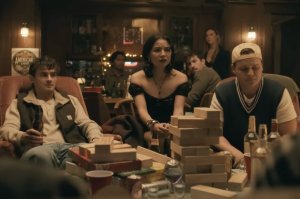 Obsession has such a great premise and direction, which is why it’s a shame that there are plot turns that feel disconnected from the rules and characterization Barker has established. Having a super obsessive significant other leads to obvious disadvantages, like being dangerously possessive, paranoid, and losing one’s sense of having an independent identity. Having Nikki make awkward scenes in public, test her partner’s love and devotion, and get easily jealous to the point of madness all makes sense as an extreme encapsulation of Bear’s wish for unparalleled love. Having Nikki stand literally in place for hours and wait for Bear to return from work, to the point that she even pees down her own legs, is quite effective at communicating just how much this woman is losing herself under this spell. Those decisions refine and perfectly demonstrate the disturbing outcomes of Bear’s wish. However, not all of her decision-making has this same identifiable logic. Early in the film, Bear’s cat dies from ingesting a bunch of his prescription drugs. How the cat got into the medicine cabinet or broke the child-proof seal without thumbs is never fully explained except for the implicit assumption that Bear had his pill bottles open and accessible (this guy really shouldn’t be trusted with anyone’s care, human or animal). Afterwards, when Nikki is fully under the wish’s evil power, she does two things with this dead cat. The first might be explained as a means of memorializing the pet, but the second one is just inexplicable and feels more like a cruel prank. It’s hard for me to connect this action to the film’s extension of obsessive love. It broke me from the movie, the same as when during a party game, Nikki recites a twisted retelling of Hansel and Gretel that devolves into incestuous role play. Does she think this little performance will impress Bear? If she’s purposely trying to just be oft-putting to the others, why even indulge the game? The problem for me is that Obsession has just enough of these questionable little turns that felt outside the bounds of its rules. The impulsive self-harm as misguided devotion or flagrant emotional manipulation makes sense. Looming over Bear while he sleeps to watch can even make sense. But not every crazy action has the same logic. Now, you could just wave away every crazy act as, “Well, it’s unexplainable magic,” but I find that an unsatisfying excuse for plot developments that feel more arbitrary than organic extensions.
The other area that nagged at me was the ending and how I felt it conflicts with not just the characterization of our protagonist but also the social commentary against Bear. In order to really delve into this, I’ll have to invoke spoilers, so skip ahead TWO paragraphs dear reader if you wish to remain pure. Earlier, when Bear is on the phone with the One Wish Willow customer support, a fabulous scene by the by, we learn that the wish will remain in gruesome effect until either the recipient or the wish-maker is deceased. Barker has set up the possibility for ending this nightmare but it involves permanent death. Late in the film, the “real Nikki” manages to speak to Bear while Nikki sleeps, like a ventriloquist voice sneaking out undetected. In this fleeting moment of communication, she begs for death to end her torment. Bear is aghast at the request but he’s also offended; would a romance with Bear be so intolerable to prefer death? That’s because Bear is a bad person. He shrouds himself in the armor of being the unassuming “nice guy” and yet his ensuing behavior seems far more selfish and entitled. It’s evident to everyone who knows Nikki that, post-wish, this version of her is not the real Nikki. She’s a completely different person. They’re justifiably worried. It’s purposely incredulous for Bear to think that Nikki has just come around and her sudden and very intense fixation is her genuine choice. He’s not that stupid. However, this Nikki is a scary, crazed cartoon version, with her personality, humor, and ambition hollowed out. For all intents and purposes, it’s like Bear has lobotomized his crush. He takes his time before getting physically intimate with her despite her begging, but it still doesn’t stop him. He finally got the girl and he doesn’t want to let go of her even if it means trapping her in a unique hell.
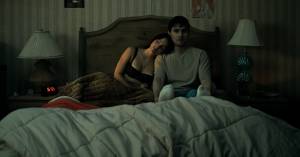 Now, after some unfortunate and bloody consequences, Bear locks himself in his bathroom with the determination to finally take account and end his life. He thinks about putting a gun in his mouth but doesn’t have the resolve for that. Instead, he takes the same prescription drugs his cat overdosed on and swallows the bottle’s contents. From everything I’ve witnessed of this character, I do not believe he would be the kind of person who would accept accountability and sacrifice himself. He’s too selfish and cowardly. He’s also just too meek and incapable of making hard choices. I could believe him wanting to be brave and noble and make the sacrifice to save Nikki but then, after swallowing the pills, he immediately regrets this decision and throws them up. I don’t buy Bear learning from his grave error. I can believe him having to live with it and being consumed by guilt, and yet he’ll grow numb and accept his new normal eventually, with the guilt likely leveling out over time. The pointed commentary is against the toxic entitlement that men feel in possession of women, especially those denigrating being “friend-zoned” as if platonic friendship is itself a worthless compensatory prize from a woman. It’s sizing up guys like Bear who think of themselves as the guy who just wants a break from the universe who also happens to be completely ignorant to those other opportunities within reach. He’s too fixated on what he doesn’t have to the point that it’s become his identity. He wouldn’t know what to do with Nikki if he got her, which is evident by the rest of the movie. God help this guy if he actually decided to work on himself or calibrate his insecurities and projections. This guy sucks and that’s the point. Horror movies typically end with a would-be solution to the dilemma that proves false, ultimately dooming the protagonist to misery. For Obsession to revive the real Nikki through Bear’s ultimate sacrifice feels completely wrong. It’s giving this loser character a chance at unearned redemption as well as harming its critical message.
While not quite living up to its momentous hype, Obsession is still an unnerving and memorably uncomfortable film experience, from its compounding dread, to its macabre laughs, to its provocative performances, chiefly our chief victim. I have some issues with the iffy internal logic too often feeling arbitrary, and the ending feels both rushed and wrong, sabotaging the larger commentary against men like our self-pitying protagonist. Some might complain that much of the movie could have been resolved had the four main characters just had one honest conversation, but that’s what makes the movie tragic. We see the many detours that could have avoided the worst. I know the majority of my review is me assessing my gripes, but Obsession is a good and very disquieting movie. I just felt like it could have been a great film. Still, this is quite a promising debut for Barker, who has now been tapped by A24 to remake none other than The Texas Chainsaw Massacre. While I might not be as smitten, Obsession is a creepy and entertaining modern update on an old cautionary adage.
Nate’s Grade: B


 nathanzoebl
You must be logged in to post a comment.