Blog Archives
Disclosure Day (2026)
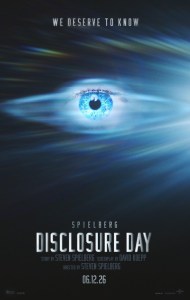
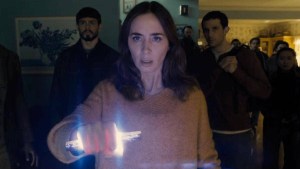
The prospect of Steven Spielberg returning to the world of aliens and summer blockbusters seems like a match made in heaven, the answer to the prayers of millions of eager moviegoers. Disclosure Day, based on a story Spielberg has been developing for decades, is all about forces trying to alert the world that aliens indeed do exist. The primary figures are Dr. Daniel Kellner (Josh O’Connor), a government whistle-blower on the run, and Margaret Fairchild (Emily Blunt), a local TV meteorologist who is suddenly speaking in foreign tongues, reading people’s minds, and even appearing as different people in the perception of others. Both are on a collision course to find one another and discover a repressed shared past as children. It just so happens there are a lot of armed paramilitary goons who want to stop them.
Disclosure Day is an old-fashioned Spielberg popcorn thriller, for better and for worse. Let’s focus on the good first. It’s an easy movie to get on board with, as the plot moves almost immediately from the start and it becomes one extended series of chases and escapes up until the very end, which makes for an exciting movie that has a definite sense of forward momentum. Does it always make sense? Do you care about the characters? Well, we’ll get more into that later, because right now we’re celebrating what works with Disclosure Day. It’s been eight years since Spielberg made a big-screen blockbuster action-thriller (Ready Player One), albeit it’s been twenty years since he made a great one (2005’s War of the Worlds). He’s been more prone to introspective or technically adventurous filmmaking choices of late, so to have Spielberg readopt the blockbuster mantle, and with aliens no less, feels like a thematic homecoming for the man who defined modern cinema over the last fifty years. He’s always been a little squishy and corny in his approach, and that can certainly be welcomed during trying times such as we find ourselves in (hopefully things have settled and improved when you’re reading this in the future). It’s a familiar yet old-fashioned model for a modern blockbuster that Spielberg helped perfect, so to have him return to this mode and have fun can be rewarding, especially for longtime fans giddy that the master is coming back to the world of extra terrestrials. Spielberg can still position his camera and visual arrangements like nobody else, and just immersing yourself in a masterful cinematic storyteller’s whims can be transporting and uplifting even if you’re not exactly on the same wavelength. In short, it’s gratifying to just experience Spielberg operate in his blockbuster space considering the man is almost 80. Who knows if we’ll ever get another one of these kinds of movies again, so there’s something thematically fitting for the master to return to his roots for added social commentary and sentiment.
I had more problems with the old-fashioned qualities of the movie that didn’t feel like they connected for me and connected to a realistic depiction of our modern-day. The problem with a movie set in the present-day that concerns the revelation of alien encounters is that it’s hard to get a plurality of Americans to believe anything no matter if it’s scientific and correct. Just recall the COVID outbreak at the turn of this decade where people couldn’t even agree on things like masking preventing the public spread of viral infection and vaccines being a life-saver. We had people literally eating horse paste and drinking silver nitrate because charlatans told them to do so. The crux of Disclosure Day rests firmly on the world believing the public disclosure of aliens, presented none other than through network evening news. It’s a bit outdated to think that enough Americans, let alone the world, would hold faith in mainstream network news in our increasingly splintered and information silo-ed era. There are people this week who claimed one political party was controlling the weather to the embarrassment of the other political party, and you’re going to tell me these people are going to believe in the existence of aliens because it happens to be presented by TV news? That’s a bit naive, but I think Spielberg could have sidestepped this by having the movie set in the 1980s or 1990s. It would have been more believable, and holding onto collective faith in humanity coming together in times of crises would be more aspirational rather than, you know, remembering that some people rejected minor inconveniences that could save lives like they were tyrannical affronts to liberties. I don’t know about you, but my ultimate faith in humanity has only lowered when it comes to collective action and shared sacrifice in the name of the greater good.
Brushing aside my own cynical modern perspective, the conspiracy itself, and the machinations of the participants, is kept so frustratingly vague with arbitrary solutions. The movie is populated by two clandestine forces, one looking to divulge the existence of aliens and expose the coverup, and other looking to maintain that coverup. You can easily label them Good Guys and Bad Guys for all the complexity provided. That’s fine. The teams can be generic stock roles as long as our main characters are interesting and well-developed. Unfortunately, our main characters feel easily forgotten, often dropping in and out of the movie for unknown reasons and miraculously reappearing in the exact right moments. There’s a climactic showdown where Team Bad Guys is literally going to shut off the power to the TV news station because that will completely stop the flow of information (it’s not like people would just record with their phones and upload to social media). Then all of a sudden, a character that hasn’t been seen for twenty minutes, is just there, and they have a magic alien device that they know will… restore the power. As a climax, it just feels so goofy, outdated, and sloppy in its clumsy plotting. The bad guys have the power to inhabit other people’s minds and control their bodies, so why aren’t they doing this all the time? Once you start introducing alien technology without any clear definition or limits, it basically becomes a magic wand that can provide whatever the user, or the screenwriter, desires in that moment. It’s an obvious narrative cheat. There are occasions where this power can be diverting and fun, like an invisible escape that doesn’t make much sense but was at least entertaining to experience. However, because so much of the story elements are under-developed, it makes the ultimate showdown unfulfilling.
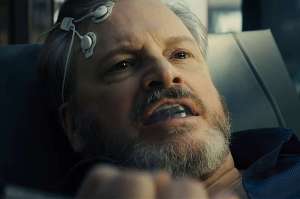
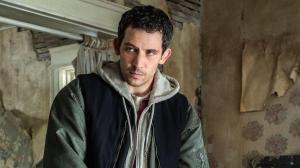
Another hindrance is that many of the characters feel more as tools of the story to get it from Point A to Point B rather than fleshed-out people. Not every character in a genre thriller needs to feel three-dimensionally accurate, but they need to feel interesting, at least enough to make us care or be curious. Daniel Kellner is the biggest dud for me. I genuinely like O’Connor as an actor and found him mightily compelling in last year’s Wake Up Dead Man, but he’s given so little to work with here. Being the point man on exposing a conspiracy should be plenty, and given the harrowing circumstances of constantly having to look over your shoulder it should provide plenty of mental conflict and second-guessing, showcasing different aspects of who this person can be. Instead, he’s less a character than a figure in motion, the person everyone else is chasing after. He’s more plot device than person.
Margaret is the more interesting character as she’s undergoing a mysterious change that she is struggling to recognize, but halfway through that confusion gives way to godhood, as she becomes essentially a superhero with powers of convenience. No matter what trouble she gets into, the script goes into a cheat code to get her out with a new alien power of contrivance. At some point, she stops even questioning or reflecting on these changes and just goes with it, which feels like the characterization simply giving up. It’s a shame because there’s great drama in the existential and personal crisis she was experiencing. I liked her revulsion at being worshiped as a religious icon once she could appear as people’s dead loved ones. Honestly, a whole different movie could have explored the psychological ramifications of that power and the needs of others to see and talk to departed loved ones one last time, to seek affirmations and closure, all against her own sense of agency with a power she feels has hijacked her identity. In the end, these two characters are mainly here to help convey the message, a human game of intergalactic telephone.
The biggest problem for me, besides the lackluster characterization, is that the most interesting part of this movie is its unsaid implications. I am less enthralled by two competing factions fighting over the alien conspiracy and more interested in how the world responds to the momentous revelation that we are not alone. I kind of wish that Disclosure Day’s Act Three had been its Act One, and rather ending on whether or not the world would discover the truth about little green men, the movie confirmed it and then said, “For the next 90 minutes, we’re really going to dig into how this affects people and changes society.” That’s the movie I want to see, the what comes next. The film briefly explores the spiritual ramifications as one character, a former nun, tries to square her faith with the reality of other intelligent life in the wider universe. Is that revelation comforting and confirmation or conflicting and confusing? I really wish the screenplay had gone further in that exploration, something akin to Arthur C. Clarke’s Childhood’s End, which richly examined the upheaval to societies and personal identity. I suppose I was looking for more of what happens after Disclosure Day rather than leading up to the big disclosure, and I doubt I’m alone.
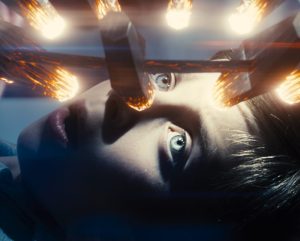
I will also be spoiling the exact ending because I believe it deserves unpacking, so if you would like to remain spoiler-free, please skip to the next paragraph, dear reader. Alright, with that out of the way, the climax hinges upon the news about aliens being disseminated to the public. It’s a little strange that so much of the climax is merely watching the footage with our characters on the sidelines. In fact, the emotional point of emphasis is placed on a new character, a news anchor played by Courtney Grace, who narrates the footage and its implications in real time. Her performance might be the best in the movie (Blunt is good, folks, but let’s pump the brakes on those “career-best” declarations) as she shows restrained and nuanced emotion trying to process the amazing and perspective-shifting revelation. It’s just strange that so much is placed on a brand-new character so late into the movie. Regardless, what stupefied me was that after all this the good guys literally roll out an elderly alien being in a wheelchair. What? You had a literal living, breathing, well more like rasping-alien (don’t want to cast aspersions, but maybe this alien adopted smoking in his time planet-side) and you just keep him at bay? Your whole goal is to raise awareness about the existence of aliens and you literally have an alien to prove the existence of aliens. Why did everything have to hinge on these two adults realizing they were given special powers as kids? Why did they have to wait 30-plus years for these powers to manifest? Why didn’t aliens just give adults these powers rather than children to wait on their maturation? Could the old alien not learn one of Earth’s languages or at least how to type? We have magic devices that can generally do anything but the creators of these magic devices cannot conceive of something to resolve a predictable language barrier? If the script were stronger or the characters engaging, my brain wouldn’t be consumed with these questions.
Reluctantly, Disclosure Day fits squarely in the fulcrum between good and not so good, teetering between one direction and the other. It’s got high production values, good actors, and Spielberg cooking in the sci-fi/action/thriller realm. It’s enjoyably more tactile with its action set pieces, of which some are exciting and visually inventive. Others are just characters getting overlooked in plain sight, and this is before they introduce magic invisibility. However, the promise of the movie is never truly fulfilled from a story awash in underdeveloped characters and themes, arbitrary and overly convenient plotting, and a resolution that feels less than satisfying and more confusing in execution and implication. I genuinely wish that Disclosure Day was more about the aftermath of the news rather than the reaching of the disclosure itself. Even a middling Spielberg thriller can still have more entertainment than the best of many filmmakers, so I’m sure many filmgoers can find something to enjoy, but they’re just as likely to find something that sticks in their proverbial craw, that they chew over for days, and question why it couldn’t be better.
Nate’s Grade: C+
Share this:

The Electric State (2025)

The fire hose that has been the Netflix cash flow may be reigning in, but that didn’t stop the streaming giant from making another attempt at a huge blockbuster to rival those Hollywood designs for the big screen. The Electric State is a $320-million sci-fi adventure spectacle from the Russo brothers, Anthony and Joe, the team that gave us the highs of the Marvel Cinematic Universe (MCU) later Avengers movies, and the lows of, well, everything after their MCU movies. Netflix is actively trying to compete with the theatrical experience brought to you at home, so they take these big expensive swings on large-scale, quippy, action vehicles like Red Notice and 6 Underground every so often to mixed results. Netflix has become the go-to place for a kind of movie that has altogether vanished in the studio sphere, the mid-tier movie for adults. We need those stories. What Netflix hasn’t done as effectively is compete with the big studios for comparable expensive action spectacle. The Electric State is further proof.
In an alternate America, robots were created and given menial tasks by mankind. Naturally, they grew tired of this and attempted a revolution for their equal rights. Mankind was on the brink when an unlikely savior emerged. Tech CEO Ethan Skate (Stanley Tucci) created an army of humanoid drones controlled via VR helmets. This disposable army of avatars was able to beat back the robots and forced their leader, literally an animatronic Mr. Peanut (voiced by Woody Harrelson), to sign a “peace treaty.” The results exiled the robots into a walled off wasteland in the American southwest, and humanity went on its merry way, now with VR-controlled avatars that allowed every American the luxury of staying on their duff. Michelle (Millie Bobby Brown, contractually obligated to be in every Netflix original not starring Joey King) is an orphan WITH AN ATTITUDE. One day she’s greeted by a pint-sized robot looking like the Cosmo cartoon character her younger brother was obsessed with. The little robot says he is her brother and Michelle realizes that maybe she has some family left after all. She and the Cosmo bot are on the run from scavengers and bounty hunters trying to stop their fateful face-to-face reunion.
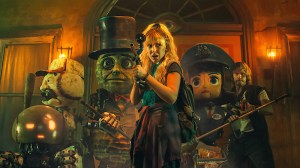
The Electric State is lacking such vital creative sparks to feel anything more than the ramshackle sum of its derivative sci-fi parts. It began as a melancholy mixed media book from the same Swedish author behind Tales From the Loop and it’s become a giant lumbering mess of mediocre and familiar elements. It kind of feels like the newer Ready Player One-era Steven Spielberg trying to emulate early E.T.-era Spielberg, but then that would give us an artist on the level of Spielberg, and that’s not what we have here. It’s standard adventure fare with a brother and sister crossing the country to save the day and thwart a big evil corporation along with scrappy, rakish rogues joining them along the way for fun and life lessons. Chris Pratt’s character is so transparently a Han Solo clone but he’s an empty vest with eye-rolling quips. This is an alternate history story with a literal robot uprising but it devotes so little interest in its own world building and history. The movie essentially castigates all the robots to a forbidden zone that naturally will be visited by our plucky heroes. The majority of the movie is watching these robotic avatars (reminded me of the Geth from Mass Effect) for people who can’t be bothered to leave their VR helmets. If this new world has devolved human interaction into a series of screens (commentary!) then maybe let’s explore that with meaning. If robots are going to be an exploited labor class (commentary!) then maybe let’s explore that too. If this is a future world where robots have been exiled and feared as an Other (commentary!) then let’s explore that too. There’s one moment where Evil Steve Jobs enjoys a VR recreation of his deceased mother, except he admits that this version is the version he wishes he had, and the real figure was far less doting and far more abusive. That’s an interesting concept, that VR offers users the ability to live in a reality of their own desires. But this isn’t a movie that wants to take time to explore interesting and relevant themes, because that would get in the way of action set pieces and goofy robot action. Seriously, there’s one fight where a U.S. postal service robot is literally hurling undelivered mail at a killer robot avatar and succeeds. Because this isn’t a deep movie, we have essentially good robots and bad robots, and if you’re shocked that the robots may have been misunderstood, well congratulations on seeing your first movie. I assure you, they mostly get better from here if you give them a chance.
The inclusion of robots is so underutilized, tapped for ready sidekicks and villains, that you could have replaced them with aliens or clones or any other disposable science fiction element. In this parallel world, Walt Disney created the robots for Disney World, so wouldn’t it be worthy of exploring that history and the sense of Victor Frankenstein-style paternal obligation? Wouldn’t the robots retreat to their ancestral home of Disney World? Or perhaps they view this as the birth of their enslavement? What about different generations of robots, especially older models being replaced with newer ones, thus creating class warfare within an exploited secondary class? What about looking at robots having to subsist off junk to continue with their meager existences? What about robots still living in forbidden zones that are hunted by the government and its armada of robot drones? There are so many possible ideas and stories and characters that are open through the inclusion of robots, but the movie doesn’t have the interest or drive to make them matter. As a result, it’s mostly a swift-moving travelogue with some ugly-looking or cranky guests riding shotgun. Occasionally The Electric State will remember, oh yeah, robots can do stuff people cannot, like having one of them hack into a server or having a smaller robot inside like a high-tech Russian nesting doll.
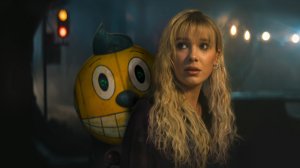
I think it was a combination of the uninvolved storytelling as well as the character design that left my emotional attachment to be null and void. I hated the Cosmo character design. He’s this big spherical head with little skinny limbs, but the head might as well be an un-moving mask. A giant toothy smile is drawn on the front and it’s so inexpressive. Also, the fact that the kid has to exclusively rely upon only using sound bytes from this canceled cartoon series makes for a quickly annoying little brother. I didn’t care about this kid, human or robot, and I didn’t care if Michelle ever reunited with her brother. Then the fact that the movie’s climax involves such a serious and emotional choice seems absurd considering what has been underdeveloped up until this abrupt shift in intended emotional stakes. It’s such an out-of-left field escalation that I almost laughed out loud at what the movie was asking me to feel, as well as what it was asking its protagonist to decide. Likewise, the betterment of robot-kind is given such little recognition, culminating in a showdown between the avatar of good robots and evil robots essentially going to revise a treaty that we don’t know much about. For a movie about how easy it can be to distance ourselves via technology, it sure fails to reasonably make the viewer care about robot equality.
Then there’s the fact that this whole enterprise cost an astounding $320 million for Netflix to platform it as its next hit movie to doze off to while in the middle of doing laundry. The Russo brothers have retreated back to Marvel to handle the next two Avengers movies, and it seems like at a time where both parties have missed and could use one another. Outside of Marvel, the Russos have delivered one super expensive action movie (The Grey Man), a super expensive spy action series (The Citadel), and one lackluster biopic that used every Scorsese stylistic trick they’ve been saving up (Cherry). With The Electric State, we have the brothers’ more familiar mixture of large-scale action and special effects in a mass appeal studio blockbuster space. However, every movie outside of Marvel has made me question their capabilities of handling these big movies. I know the Russos can be fantastic with comedy, as some of their TV episodes are the best of recent memory, and their stewardship of the big MCU movies in the wake of Joss Whedon’s departure was undeniably successful. So why isn’t The Electric State successful? It comes down to the screenplay which is so disinterested in its own ideas, world, and characters, held together by the familiarity of other adventure blockbuster staples like loose chewing gum. It’s a movie replete with famous faces and big effects but feels so devoid of life and creativity, a blockbuster automaton intended to hold the attention but rarely engage one’s imagination and emotions.
Nate’s Grade: C
Share this:

Sing Sing (2024)
 An uplifting ode to the power of the arts, Sing Sing follows the men of a prison arts program and it’s easily one of the finest films of 2024. We follow the men of the New York prison of the title, lead by Divine G Whitfield (Colman Domingo), a thespian that relishes the dramatic spotlight and the deserved lead of every production. When the next show is suggested as a comedy, Divine G has to accept ceding the spotlight and mentoring a promising but struggling new member (Clarence Maclin) with talent and potential. It’s effectively a “let’s put on a show” formula of old, however, the setting and the weary reflections are what provide the movie its power. All of these men have made mistakes in their respective lives to wind up here, though Divine G maintains his innocence and is preparing his case for a parole board hearing. This program allows them an escape, an opportunity as one puts it to “become human again” While some may scoff at the acting games and costumes, this is sacred ground, a precious oasis for them to discover more about themselves. The sincerity of Sing Sing is wince-inducing. It is beautiful, tender, compassionate, and deeply personal while being very universal. The lived-in details are fantastic and give great authenticity to these men and their stories, wonderfully portrayed by several non-actors making the most of their own spotlights. Domingo (Rustin) is amazing as the proud and generous leader who is ably trying to lift his fellow men up even higher. The film concludes with real footage from the Rehabilitation Through the Arts (RTA) program, and it’s the fitting culmination for a movie that readily reminds us how restorative and needed the arts are for a fuller sense of who we are.
Nate’s Grade: A


You must be logged in to post a comment.