Daily Archives: November 13, 2026
The End of Oak Street (2026)
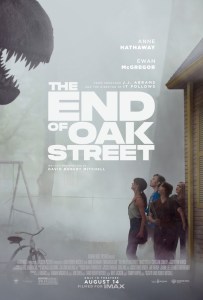 The End of Oak Street is always going to have a special designation for me. It’s a movie whose premise would have delighted the inner child in every dinosaur-loving adult, but it also delighted my dinosaur-loving two-year-old. Upon its streaming release, my family began watching the family action-adventure throwback, and my two-year-old son was spellbound. Even before dinosaurs appeared, he stood in rapt silence watching the travails of a 1982 American family investigate the unusual. When the dinosaurs did appear, he got so excited, and audibly yelled “Oh!” when a neighbor got her face munched by a leaping dinosaur. I figured there would be moments that would be too intense for him and yet he seemed unphased. He even wanted to watch it again later in the week, and he responded with just as much excitement and focus, again, even when there were no dinosaurs. I can’t explain it. We’ve tried sitting him down for other movies, mostly animated and more age-appropriate, and he’ll typically wander off so far into the sustained attention demands. That’s why his absolute undivided attention with The End of Oak Street was so stunning and enchanting for me. It made me wonder if this little kid will, like his father, be a lifelong lover of movies and their enchanting escapism. Anyway, I found The End of Oak Street to be a charming, thrilling, and gloriously fun throwback to 1980s Spielberg/Amblin projects. Even though I have some minor misgivings, this is exactly the kind of movie I wish Hollywood was making more.
The neighborhood of Flowervalle, Michigan has some very unexpected new neighbors. On the night of July 11, 1982, a multi-block portion of the neighborhood gets transported back to prehistoric times. Now instead of arguing with your next-door neighbor over the dog pooping in the yard, you’ve got giant creatures that are eager to try this new delicacy exclusively brought to them through space and time. The Platt family, Anne Hathaway and Ewen McGregor as parents Denise and Greg, and Maisy Stella and Christian Convery as Audrey and Brian, must band together, along with their trusty dog Starbuck, to survive and discover a way out. But is survival even an option or are they merely delaying an inevitable dinosaur-induced demise?
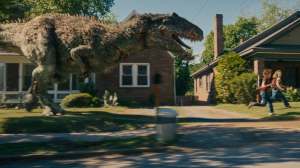
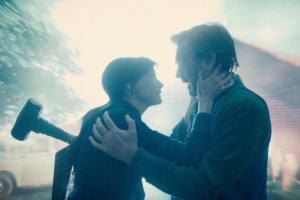 For many film critics and viewers, the fact that The End of Oak Street was so clearly evocative of its Steven Spielbergian influences was considered a fault, whereas for me, I consider it one of the movie’s greatest virtues. The entire movie feels like a time capsule, not merely of its setting but more about the kind of high-concept family adventures of the 1980s that Spielberg specialized in shepherding. It’s a movie that is patient, allowing its characters and audience a sense of discovery. I loved watching the characters explore and hearing the eerie sounds of creatures in the distance that are not of our times. I loved the building of dread that things were not right, like from a rooftop view where we see a neighbor drive off to work but then seconds later the man returns and flees back into his house in a panic. I even loved Greg running in parallel with a dinosaur on the other side of the fence and all kinds of things being thrown about by the unseen danger. You don’t even see a dinosaur until over a half hour into the movie, and by then its actual reveal has been built up so much that the appearance deserves its own applause moment. Under the guidance of writer/director David Robert Mitchell (It Follows), there is a careful calculation not just to the homages but also to maintaining a sustained atmosphere. This is very much in keeping with the man that favored long takes and tracking shots for It Follows. The camera movements are fluid and the edits are sparse, allowing the experience to feel more immersive. There’s a dynamic shot on the run of an Allosaurus chasing the family that changes directions twice. Some of these visual arrangements are A-plus Spielberg material, like a shot moving through the inside of a house tracking a dinosaur on the outside, or a shot of a family backing out of their driveway and casually seeing a dinosaur through the passenger window. The dissonance of seeing dinosaurs in modern-day suburbs creates some vivid imagery and it just honestly never gets old. Each new dinosaur is a treat, just like a shot of a long-necked dinosaur digging into an overturned ice cream truck and enjoying a future delicacy.
There’s also a casual darkness to the movie that reminds me of 1980s family films that weren’t afraid to be scary. I was amused at how often scenes of the neighborhood will feature some character being chased or screaming or likely eaten in the distance. There’s almost a cruel indifference to the other families that have been transported along with our main characters, and I don’t know if maybe that’s Mitchell making a statement about man’s existential place in the universe or him just wanting to have fun with more carnage. These are not cuddly dinosaurs. There are some genuinely tense sequences that Mitchell teases out beautifully. The patient style allows the monsters to go unnoticed by the characters, cranking up the dramatic irony and the tension of when characters will learn of their imminent danger, though it’s hard to imagine giant creatures the size of houses stomping with near-silent footfalls. Helping the tension is the fact that I cared about the characters, even with their writing shortfalls, and felt that their grief and terror was genuinely portrayed.
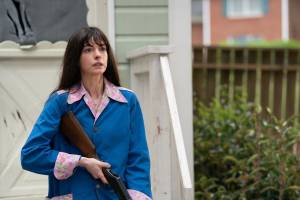 And yet I have more than a few nagging points that hold back the movie. There are several points that feel like setups without payoffs, thus becoming underdeveloped additions. Denise being a budding author is really symbolic of her sense of malaise, and the fact that her manuscript’s protagonist is a woman with a family trying to mentally prepare to leave her husband is too obvious as a shortcut for character insight. If we’re starting here, fine, but then what do we do with it? How do we express her conflict over her individual preservation versus maternal responsibilities? How do we pull out details about what has soured in the relationship between husband and wife? Is it one-sided? It’s more of a half-hearted setup to begin the character arc of wanting a divorce and ending with reconciliation. In grand tradition, a traumatic event of supernatural proportions has given a feuding couple perspective on relationships. Halfway into the movie the basement is revealed to be flooded. Denise is upset because her manuscript was wasted (what she thought she might still do with her manuscript during dinosaur times, I don’t know). You might assume the sunken basement would be revealed as an unexpected entrance for a creature to strike. It doesn’t, especially when bedroom windows are open regularly. It’s the kind of movie that has Brian carry around a bow and arrow for the whole movie, even before getting zapped to prehistoric times, and absolutely gives him no hero moments with the weapon. He’s actually quite bad with it. I don’t know if this is a missed payoff for how long it’s featured or Mitchell is undercutting his own character.
The characterization of the family feels a little too limited and archetypal. We’re told that Brian is “acting out,” though that manifests as him admitting to smoking occasionally and the inexplicable decision to make a kid crash his bicycle. Did Brian have an issue with this kid? It’s never explained, simply that Brian hurt him and the kid’s older brother is now seeking vengeance. Granted, they should be able to find out where he lives so they don’t have to chance upon a fortuitous encounter on bicycles. Why include any of this? It makes Brian look poorly but not in an intriguing contradictory manner. It feels like a contrived inclusion for the 1980s neighborhood bully, except is Brian the real bully? Brian kind of sucks. There was one moment with his surprise injury where I laughed out loud and thought, “I think the universe hates you, kid.” Another underwhelming aspect is the generally unspoken attraction both siblings have for the new neighbor girl Jeanette who gets to tag along for the second half of the adventure after her parents get eaten. We know Audrey is queer because she looks crestfallen when the girl she’s talking to has a boyfriend and then she has a tearful rendition of Steve Winwood’s “Valerie” in the family ca at night. From there, she applies a bandage to the wounded Jeanette and gives the girl some PG-13 bedroom eyes’ smolder. That’s it. So Audrey’s defining characterization is she likes science and girls. Anything else? I feel like the dog has better characterization than both the kids, and he certainly has the hero moment denied to Brian.
 There are also distressing ethical implications that the movie doesn’t want to explore, for good reasons as to not disrupt the surface of its happy ending. I’ll be delving into major spoilers because I feel, much like the unexplored ethical dilemma at the end of 2011’s Source Code, this too deserves consideration. With Oak Street, the way out are these convenient time warp bubbles. The third act thus revolves around the mission of reaching essentially the end of a level and finding a portal back to their time. When Denise and the kids leap through the portal they are transported back to their neighborhood the day of their disappearance but hours before everyone is zapped into dinosaur times. They will watch from afar as the neighborhood disappears again. Except Denise realizes they have twenty minutes before the event, which means she has a chance to save lives. She makes a phone call and places a pizza delivery, and lo and behold Greg appears to deliver this order and at a safe distance. Denise and the kids are overcome with emotions at having their father return to them. Except this isn’t their father exactly. This is their dad but not the one who experienced all the character development and heroics from the timeline that they shared for several days before dying. Still, I understand the joy at having your loved one gifted back to you through the convenience of time travel. However, the more distressing implication is that Denise and her kids are choosing to doom their other selves to get blasted to the past. They’re robbing this family of their dad. The timeline will then inevitably be different for them without his involvement. If they could save the dad, could they not save the entire family unit from this same fate? Denise is able to save just about every neighbor they personally witnessed get killed, but what about everyone else? Could you not have set off a phone chain where everyone calls two people and implores them to pack up and leave? I could perhaps understand Denise, or especially her science-minded daughter, thought through timeline causality and determined that if they intervene to save their past selves from traveling, they will cease to exist because then the timeline will negate their excursion. That could have made for a really bittersweet ending where there’s a reunion of sorts but also a knowing sacrifice, and in a way they will see one another again even though these versions will fade away. Regardless, the ending of The End of Oak Street is not quite the feel-good ending you may want to happily accept upon first viewing.
In the past week, my family has already re-watched The End of Oak Street perhaps three times, and yes my baby has been a happy consumer each time. It’s quite amusing and even heart-warming to watch him respond with excitement to the thrills and revelations of a movie, let alone one I also enjoy. Mitchell has crafted a movie that makes you feel like you’ve discovered a genre gem plucked from the 1980s, a fun and tense and gratifying experience that makes you feel like a kid again. Video essayist Patrick H. Willems devoted an entire essay to bemoaning why there weren’t more big-screen dinosaur movies, and The End of Oak Street is proof that these kinds of mass-appeal blockbusters can exist beyond the Jurassic franchises. You might not have the personal connection to the movie that it presented me by chance; I can assure you I had no clue my baby would latch onto this movie of all movies. Yet I think most viewers can latch on too. It’s not perfect but what it does well it does extremely well, and I hope Michell is given more studio fare. He’s proven to me that he can meld his indie sensibilities with a blockbuster blueprint and make a winner.
Nate’s Grade: B+


You must be logged in to post a comment.