Blog Archives
It Follows (2015)
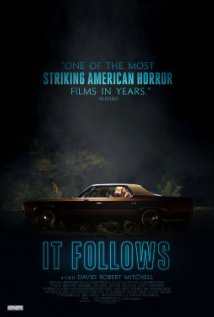 Indie horror is always looking for the Next Big Thing, and at the start of 2015, that movie was It Follows. Coming out of relatively nowhere, the second film by writer/director David Robert Mitchell was dubbed the real deal, and audiences flocked to see what all fuss was over. I would have been intrigued before the positive word-of-mouth namely because Mitchell made one of my favorite films of 2011, the understated and perfectly yearning ode to adolescence, The Myth of the American Sleepover. I dearly hoped that Mitchell was not another flash in the pan. In retrospect, I did not have need to fear. It Follows is unsettling, suspenseful, and borderline ingenious with its concept, but it also has some faults that mitigate its concluding power.
Jay (Maika Monroe) is a normal 19-year-old girl going to college in Michigan until the night she sleeps with her object of desire, Hugh (Jake Weary). In her post-coital mediation, he drugs her, ties her to a wheelchair, and then waits. He wants to show her something, or more accurately someone (perhaps something is actually more appropriate). A woman slowly trudges toward them, the embodiment of a curse he passed on to Jay through sex. It will keep following her until it gets her and kills her. The only way she can protect herself is to sleep with someone else, to pass the curse onto a new recipient. Then the monster goes after them; however, once this newest curse-holder is murdered, the monster moves back up the ladder, attacking the next curse-holder. Once you have it, there’s no getting rid of this curse, only delaying it.
 The top question with a horror movie is whether it provides enough suspense, spooks, and scares to jolt an audience, and in this regard It Follows is quite good; not as unsettling as last year’s Babadook but still plenty unnerving and extremely well executed and developed. The opening hooks you, with a teen girl constantly looking in the direction of the camera and clearly scared out of her mind. The camera has adopted the identity of the monster. The central premise is wonderful, rich with thematic potential about the alienation and anxiety of being a teenager navigating the world, but also intriguing enough that I always wanted a large expository info dump scene just to learn more about the rules or its history. Rare is the film, let alone a horror film, where I’m left desiring lengthy exposition. One of the clever developments of its monster is that it can adopt the appearance of anyone, including people close to you (though it rarely does this for an unexplained reason). That means anyone can be your doom and the only way to know is to double-check whether other people can see this menacing phantom as well. Imagine going the rest of your life always having to look over your shoulder, always having a little nagging doubt in your mind about whether or not this person or that person is real. The premise is well developed with sequences that draw out the tension and make us dread what’s coming next or what may or may not be real. Now, slow-trotting fully naked people might not be a scarier monster than, say, Leatherface, but it’s still alarming.
The premise also allows the audience to imagine what course of action they would do if they were stuck in this situation. Would you doom an innocent human being to protect yourself? If so, would you be upfront about it and the ensuing danger? Would you formulate a plan like Hugh and drive long distances to provide further distance? If you thought you were being followed, would you immediately find a sexual partner? The clever premise gets your brain thinking of what you would do to survive and at what cost.
There’s a distinct Stanley Kubrick and John Carpenter vibe with the filmmaking, which will enhance the overall mood of the film or drive certain viewers crazy. The camera movements fall into very few selections, mostly slow pans, slow zooms, or long tracking shots with the subject routinely framed in the center. It’s hard not to evoke feelings with The Shining, an all-time great horror film that likewise built a sense of foreboding terror, and Halloween. You’re conditioned to feel that something bad is about to happen as the camera turns or hovers, waiting for the creepy thing to pop around the corner. It plays into second-guessing everything you see, taking away the illusions of safety, and the steady and controlled camerawork enhances this mood. The entire movie feels vaguely out of time, notably a capsule from the 1980s save for one strange inclusion of a wireless reading device. The musical score by Disasterpeace (nee Rick Vreeland) is another throwback to the 80s, and its fuzzy synth-drenched soundtrack smoothly blends in and enhances the atmosphere.
 If anyone caught Mitchell’s previous film, you’ll know that besides a wonderful eye for framing visual compositions, the guy has a very natural feel for developing realistic teenage characters milling about their relatable existences. It Follows is no different, and while I would stop short of saying that the characters have depth to them, they are realistically drawn and portrayed by actors who look and act like scared teenagers. The relatablility of unrequited feelings, or going out on a limb and getting your heart broken, of trusting the wrong people who have ulterior motives, are universal pains that makes it all the easier to put ourselves in these unfortunate character’s shoes. It also helps that, up until the final act, the characters defy the arc of rampant stupidity in horror. After realizing the danger she’s trapped in, Jay actually seeks out the one person who she can get answers from, even if he’s the same person who doomed her with the curse.
It’s unfortunate that the movie loses steam when it creeps into its third act and forces a solution and showdown with the monster that makes no sense whatsoever. I understand the need to feel like the teens can regain the upper hand or somehow outsmart the curse that doggedly follows them, but with everything presented, it’s just not believable. For the entire movie, we’ve seen that this supernatural force doesn’t really have a loophole in its system of rules. The only way to stave off annihilation is to pass it along and create a series of firewalls as protection with other sexual partners. Otherwise, it’s relentless and like zombies the eventuality is what helps magnify the sense of dread. We even see it get shot in a hasty defense from the teens and the gunshots do nothing. And yet, this vital information doesn’t seem to register with our band of teenagers. Their third act solution (spoilers): they’re going to lure the following terror into a pool and… electrocute it. Huh? Why would a supernatural entity that has not shown any weakness to electricity, or any mortal dangers, be able to be killed? This plan makes no sense and not one character voices a counter-argument to what is proven to be a very bad plan. Maybe the point is that it’s supposed to be bad, that it’s an example of how desperate these characters have become that they would hold out hope for something that is completely inaccurate. After this failed plan, Jay does exactly what you’d expect with the boy who’s been itching to jump her bones for the entire movie. He gets what he wants (physical copulation, being the white knight), she gets what she wants (flimsy security), and then the movie just kind of peters out and ends. I understand that Mitchell’s extended point is that there is no happy ending possible and the characters will have to uneasily look over their shoulders for the rest of their lives. However, the point could have been made even without the third act. I wish It Follows could have found a better landing than just shrugging and saying, “Well, what are you gonna do with curses, you know?”
 Before the movie hits the skids in the third act, I was pondering the greater implications and logistics of its sexually transmitted curse. Does “passing” it along require some form of genital contact? Does it require fluid exchange? If you wear a condom, does the prophylactic also protect your sexual partner from the transmission? Does the curse function relatively the same for same sex couples? What about people with non-functioning parts below the waste? Can someone who suffers from erectile dysfunction pass the curse along? Can it be transferred onto inanimate objects? Can men ejaculate into some sort of container and then send the container into space via the space shuttle and be protected? Actually, banging an astronaut who’s about to live on the space station or go to Mars might be the smartest move. I enjoyed thinking of a stratagem to best protect myself if I was caught in this scenario; even after passing it along and providing a buffer, you still always have to be on guard for the curse to move back up the ladder. My solution: have relations with a prostitute. This is probably a guarantee that the curse will be passed on within a 24-hour period, and even if that john is found and killed, chances are this prostitute may have already passed the curse along to a new client. If one cannot inoculate themselves from a supernatural STD-like curse with the aid of prostitutes, then there’s no hope for the rest of us poor mortals. Anyway, my mind wandered a tad.
It Follows may suffer due to the hype, the inconclusive resolution, and a third act that deflates, but it’s still an extremely well executed horror thriller with a terrific concept at heart. The sense of dread is stark and the camerawork and storytelling draw out the tension until you feel you’re about to break. It’s more unnerving than traditionally scary, but it has a power that does stay with you, particularly its fascinating premise and the natural relatability of the characters and their choices. I don’t know if this premise could sustain a sequel, especially with a villain that appears to be unstoppable, but that hasn’t thwarted the horror genre before in its stampede at cashing in on success. It Follows is a solidly entertaining and creepy movie, but it’s even more confirmation for me that David Robert Mitchell is going to be a filmmaker who has staying power. I’ll be following him.
Nate’s Grade: B+
Share this:

The Myth of the American Sleepover (2011)
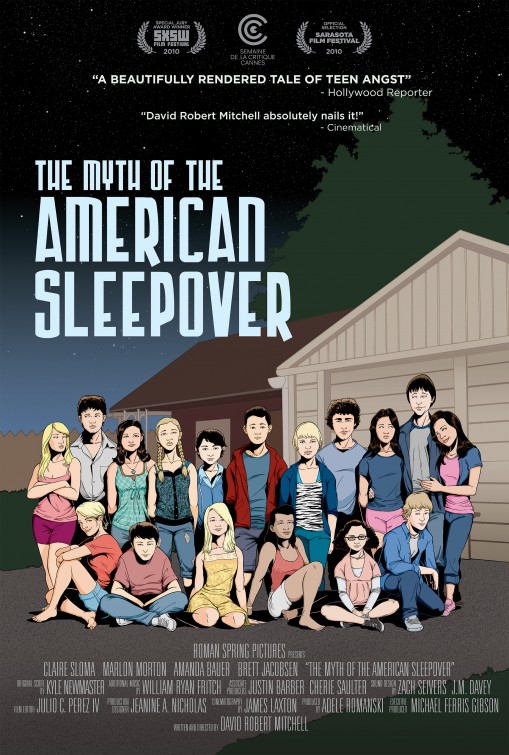 The curiously titled Myth of the American Sleepover owes as much to American Graffiti as it does to the works of John Hughes. This sprawling teenage opus by debut writer/director David Robert Mitchell resonates with all the beautiful aches and joys of adolescence, wonderfully understated but brilliantly realized. I fell in love with this movie.
Set over the course of one night in suburban Michigan, a slew of teenagers try and make the waning summer days worth remembering. Claudia (Amanda Bauer) is the new girl in school and invited to the cool gal’s (Shayla Curran) slumber party. She learns her boyfriend slept with the cool gal and plots a little boyfriend stealing of her own. Rob (Marlon Morton) is obsessed with a pretty blonde girl he once shared a look with in a supermarket. He is scouring the neighborhood, going from party to party, looking for her so he can reveal his true feelings. Scott (Brett Jacobson) is unsure of whether he wants to finish his final year of college, now the site of a painful breakup from his longtime girlfriend. One day while walking the halls of his former high school, he comes across a picture of him with twin sisters, Ady (Nikita Ramsey) and Anna Abbey (Jade Ramsey). He heads out to the University of Michigan, where the twins are enrolled, convinced he could win one, or both, of them over. Maggie (Claire Sloma) is navigating between the middle school sleepovers of her peers and the world of the cooler upperclassmen. She’s been nursing a crush on an older boy (Douglas Diedrich) who worked at the community pool all summer, and will find the courage to make a move.
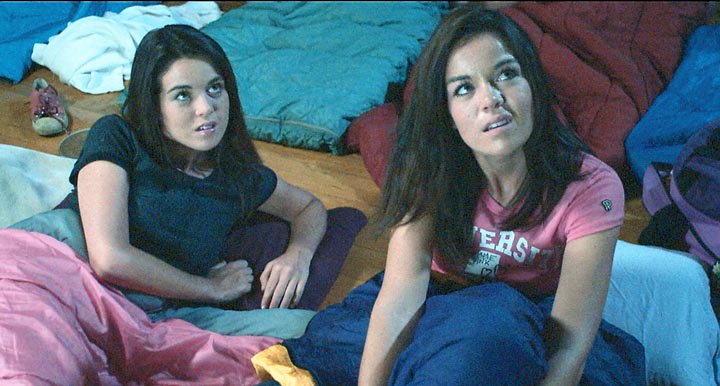 Unlike other coming-of-age entries, this is a movie that forgoes scatological comic setups and other Big Events meant to mark the passing into adulthood, like the loss of virginity, college admittance, or the prom; instead, Sleepover tackles a subject much more honestly and with tremendous naturalism. The level of detail is outstanding; set in what seems like the late 80s or early 90s, I was astounded at all the nostalgic artifacts of adolescence brought back to life. I kept going, “Oh yeah, I forgot about those,” or, “That’s totally something that me and my friends did.” I loved that the movie shows different social spheres and age ranges, so we go along with the late teen house party but we also get see a middle school/junior high sleepover that involves girls staying up late, talking about boys, and eating large bowls of chips. Obviously not everyone will have this reaction, but it just shows the commitment to recreating a very specific time, place, and sense of being. These feel entirely like real teenagers, and their troubles and desires are achingly articulated. You feel the powerful sense of yearning throughout, where the nudge of a knee, the closing distance between two hands that can cause your insides to fill up with a thousand butterflies. Sleepover is about teenagers grappling with emotional connection and personal identity, but it never drags out a soapbox or breaks from its verisimilitude. Every single character in this movie, even the ones meant to be seen in a questionable light, is deeply empathetic. Being an ensemble, you’ll gravitate to different characters and their pursuits, but the movie balances a nice mixture of storylines, cutting back and forth to build a graceful picture of the uncertainty of adolescence.
I found this movie to be so charming, so overwhelmingly affecting, and poignant without slipping into mock sentimentality, which would have been easy. It’s been a big year for nostalgia, but nostalgia is the “least authentic of all feelings,” according to Enrique de Heriz. It’s easy to sit back and say, “Oh I remember that too,” and feel the tingle of some wistful pull from the past, the yearning for a bygone time and place that has magically transformed in your mind into some idyllic spree. Does anyone remember those times, before there was an Internet, and cell phones, and social media, when you got together with your friends to witness the shared experience of a movie with female nudity (this might just be a guy thing), or when you didn’t know if you’d see your crush ever again? The Myth of the American Sleepover does, and so do I. In the words of Lou Reed: “I don’t like nostalgia unless it’s mine.”
 Indeed, it seems like the film exists in a bit of a cultural time warp, where sleepovers were the social apex and holding hands and making out were considered victories worth celebrating. There are no computers or cell phones, thank God. If you excuse the casual and extensive teenage drinking, Sleepover is a rather wholesome film. I was wary that some storyline might take an unexpected dark turn, especially with all the alcohol and hormones, but the movie maintains its sweet appeal without fail. While ostensibly existing in a late 80s/early 90s, I believe this movie is timeless and can be felt effortlessly by people of any age. The pains of adolescence and the anxiety of growing up, not to mention the peculiarities of the other sex, are universal. There is a superb scene where Rob and the girl who secretly likes him pass each other accompanied by friends. We get both sides of the story cut together; he tells his bud that one night he kissed her and then they made out. “It was a pretty good day,” he admits. She says she spent all night trying to get him to hold her hand and then just gave up. We instantly know that her side of this tale is far more accurate, but then this small exchange tells us even more about Rob, his fumbling attempt to be seen as cool with girls. Later, this same girl gives Rob a pep talk about unrequited crushes; she wonders if a person thinks hard enough about an individual, if they’ll know. Like most men, Rob misses her real meaning, but I’m happy to say that this story is tied up in such a sweet manner that I got choked up. The emotions of Sleepover are genuine and genuinely felt, no big overtures or outbursts, but the quiet moments of realizing who you are, who you like, and what you are and aren’t willing to compromise. It all feels utterly real and relatable.
The one storyline that seems to stand out amongst the rest of the panoply of sleepovers is that of Scott. He’s a college junior and at least three years outside the social realms of the majority of the other characters. You can’t help but feel at the start that he doesn’t belong and his presence, in a movie primarily about 14-15-year-olds, might feel a tad icky. Scott’s misguided attempt to get over his ex-girlfriend seems like some strange leftover plot from a sitcom. The fact that he’s trying to drown his sorrows in twin sisters almost seems skeevy. However, he comes clean early and opens up to reveal startling vulnerability, thanking the twins for a memory that would be incidental to them but has meant so much to him. It is this memory that gave him hope. The twins reveal that one of them had a huge crush on Scott back in high school, wishing he would one day reciprocate. But they won’t tell him who. He has to guess. The fact that this setup is actually a push toward personal growth and maturation is a great revelation and a relief.
 The cast of unknowns may be low when it comes to star-wattage but they lend the film another degree of authenticity. I wouldn’t say a single participant in this movie is a bad actor, though their characters are often understated, which under the wrong guidance can lead to blandness. None of these characters are exceptionally verbose or opinionated, which leaves the impression that they are thinly drawn. However, the characters coexist within the impressionistic nature of the film; it’s like a coming-of-age movie with the tone poem ambitions of Terrence Mallick. They are not as memorable or as sharp as the characters from Dazed and Confused and American Graffiti (Rob’s pursuit of his blonde dream girl, and his several near-misses, screams Graffiti homage), but the goal is a disarmingly sweet authenticity, allowing the viewer to discover relatable moments throughout the ensemble. I will say that Sloma imparts the biggest impression as the pieced, platinum pixie-gal feeling out the level of interest in her crush. I think we’ll be seeing more of Bauer and her cherubic, Scarlet Johansson-etched features as well.
The Myth of the American Sleepover is a sincere, observant, insightful, gentle, and overall wonderful little movie, brimming with life and the rocky experiences of growing up, but mostly it will make your heart sing. The details and small gestures feel completely believable; building an ode to youth that feels earnest without being sentimental and knowing without feeling like a know-it-all. There wasn’t a moment in this movie that didn’t leave me smiling, chuckling to myself, and feeling immersed in this innocent, heartfelt, exuberantly youthful world. The pleasures of Sleepover are small but numerous, and I don’t mind admitting to tearing up at several points, shaking in anticipation, and celebrating the personal triumphs of the cast of characters. The Myth of the American Sleepover made me feel like a teenager all over again, nervous, anxious, excited, and beguiled by the imprecise negotiations into adulthood. I’m sure some people will find this movie boring or too embryonic, a coming-of-age tale crystallized in dewy emo-earnestness. For me, I fell in love with this movie. It filled me with joy. I know it will do the same for others; Sleepover just needs a little tenderness and an open heart. The movie and its homespun magic will do the rest.
Nate’s Grade: A


You must be logged in to post a comment.