Blog Archives
Wolf Man (2025)
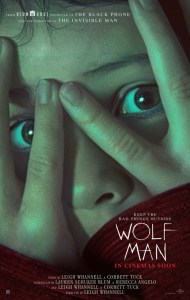 I had high hopes for writer/director Leigh Whannell’s second take on the classic monsters after how thrilling and satisfying his take on the Invisible Man was in the early months of 2020. Werewolves have served as a fertile metaphorical ground for genre storytelling to cover such varied topics like coming of age, self-actualization, and addiction. Considering Whannell was able to use an invisible man to explore toxic masculinity and gaslighting, without losing sight of a monstrously entertaining movie, I was hoping for repeated success. Wolf Man is ostensibly about inherited curses and the relationships between fathers and children, but it’s really about dealing with flaring tempers and whether or not our shortcomings are a result of our genetic inheritance. It’s also about a family trapped in a cabin helplessly watching their father/husband transform into a dangerous beast. I suppose there’s something here about the cycles of trauma and abuse, anger as a sickness, but the problem with Whannell’s Wolf Man is that it all feels like an incomplete beginning. There are definite identifiable themes here, and a scenario that would lend to slow-building dread amid losing control over one’s sanity to become a monster against their loved ones. I just kept waiting for something more. The movie runs out of steam shockingly once it strands its family in the cabin. We’re treated to many scenes of Christopher Abbott, as the beleaguered father, blankly staring and then seeing his vision where people are highlighted with neon outlines. It’s a neat visual but what does it mean? I was waiting for more development, more character work, more culminating of themes, more… anything. It’s a lot of sitting around, like this promising genre movie had been hijacked by, like, some self-sabotaging arty Godard-obsessed filmmaker trying to Say Something with all the protracted scenes, pained silences, and repetition without revelation. It’s a surprisingly boring movie and, I repeat, it’s a werewolf movie. The makeup effects also make our titular monster look more like a shaved wolf, or a goblin rather than a lupine-centric creature of the night. I don’t even think there was a single shot of a full moon in the whole movie. Regardless, Wolf Man is a disappointing a d dull monster movie that’s too shaggy for its own good.
Nate’s Grade: C
Share this:

Smile 2 (2024)
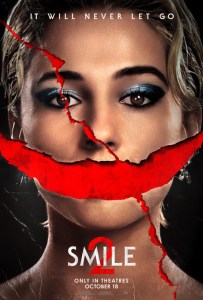 In 2022, thanks to genius viral marketing and the acknowledgement how deeply unnerving happy people can be, Smile was a surprise horror smash hit. Writer/director Parker Finn expanded on a previous short film and made serious money, which meant a sequel was a given. Finn returns to lead Smile 2 to even creepier genre pastures, this time following the mental demise of a pop star, Skye Riley (Naomi Scott) trying to make sense of this malignant curse. As much as I enjoyed the first Smile for its careful development and visceral intensity, I think Smile 2 might be even better.
From the opening sequence, it’s clear that we’re in the hands of a filmmaker that knows exactly what they’re doing. This is not merely another paycheck for Finn. He’s thought about how a sequel can build from its predecessor, stand on its own, incrementally build out the mythology, but mostly how to be an expertly made horror thriller designed to get under your skin. There were multiple sequences where I kept muttering variations of , “No,” or, “I don’t like that at all,” enough so that my wife in the other room would inquire what was directing these responses. Finn is tremendous at setting up the particulars of a scare sequence and allowing the audience to simmer in that anxious period of dread as we wait for something sinister to happen. He reminds me of James Wan and his ability to set up a nasty little scenario and then traps you inside awaiting the worst. There are sequences that compelled me to look away, not simply because they were overpowering, though the gore and makeup effects can best be described as impressively gross, but because the movie was finding different ways to make me uncomfortable, but in that good horror movie way. Finn’s camera makes what we should fear very clear, and his editing is precise. This is a movie that wants you to see the darkness and persistently worry about what’s coming just out of the frame.
 One of my minor complaints with the first Smile was that there wasn’t much below its grinning surface. Sure, the entire premise of a curse that spreads through witnessing horrific acts of self-harm lends itself toward the discussion of how trauma begets trauma, but beyond that the first film was more reliant upon supreme craft and well-engineered scares. There’s nothing wrong with a movie that exists primarily as a thrill ride as long as those thrills deliver upon their promise. However, with Smile 2, Finn uses the character of Skye Riley as a beginning point to discuss the toxic relationships that come with fandom. It should be very obvious for every viewer that Skye is going through some serious issues. She’s overcoming addiction, physically rehabilitating her body as well as socially rehabilitating her image, and trying to learn all her new choreography for an intense world tour. This is a woman who could use a significant break. And yet, as the movie progresses, you start to sense that there is this large machinery around her that needs her to perform because that is how she makes them all money. Even her own mother-as-manager (Rosemarie DeWitt) can seem questionable as far as her motivations; is she pushing her child because she knows it’s what best for her to focus on for recovery, or is she pushing her because the tour pays for her lifestyle? As the movie progresses, the characters fret that Skye’s increasingly bizarre behavior is going to ruin the tour first and foremost, and concern for her actual well-being is secondary at best. All these people have their paychecks attached to this woman fulfilling her contractual obligations. You can also extrapolate the intense pressure the industry places on people with mental illness and self-destructive personalities to conform to standards that are unfair and often un-meetable. You might question why more pop stars don’t have head-shaving outbursts.
Because we know that the evil entity has the power to alter our sense of sight and sound, it means the viewer must be actively skeptical about what is happening. Is this really happening? Is this sort of happening but elements are different? Or is this completely a hallucination? It makes the plot the equivalent of shifting sand, never allowing us to be comfortable or complacent. This can lead to positive and negative feelings. It keeps things lively but it can feel like the plot never really moves forward, at least in a cause-effect accumulation. It can often feel like the movie is moving in starts and stops, and if you’re not onboard for the craft, the acting, and the scares, then the results can likely feel frustrating, especially when large swaths of time are canceled out. For me, I enjoyed the extra sensory game of keeping me alert because it led to a barrage of surprises and rug pulls, some of them admittedly annoying, especially losing what amounts to maybe an entire act of the movie, but also they were a definite way to keep upending the narrative certainty. This sneaky approach also very viscerally places us in the paranoid mindset of our protagonist, as we too are unable to trust our senses and tense up with certain unsettling auditory cues. Mainly, I was having too much fun with the devious twists and turns, and some wickedly disturbing imagery from the director, that I felt like it was an ongoing thrill ride through a funhouse of insanity that kept me guessing.
 In a just world, Scott (Aladdin, Charlie’s Angels) would be at the front of the pack in the discussion for the Best Actress Oscar. This woman is put through the proverbial wringer and she showcases every frayed nerve, every degenerating thought with such verve and command. It’s essentially a performance of a woman completely breaking down mentally, but Scott doesn’t just go for broke, putting every ounce of effort into inhabiting the breakdown, she creates a character that reveals herself through the breakdown. It’s not just screaming hysterics and histrionics; there are different levels to her dismantling psyche, and Scott portrays them beautifully. I felt such great levels of dread for her because of how successfully Scott was able to anchor my emotional investment. She’s also portraying different versions of Skye, and some key flashbacks reveal just how toxic her former addict self was that she’s trying to put to rest. It’s a performance about metaphorical demons and literal demons haunting a woman, as well as guilt that is eating her alive. Scott allows us the pleasure of watching a first-class performance through her shattering.
There’s a curious motif to the movie that many will probably ignore but my wife and I fixated on, and so I feel the need to briefly discuss this so that, you too dear reader, can have this fixation as well. There are at least four scenes where Skye drinks a large bottle of water in a manner that can be best described as monstrously destructive. She drinks that bottle like a lost man in the desert finding his first drink of water. She attacks it. My best analysis is that this is a character detail about Skye’s addictive personality and sense of dependency, projecting the same all-consuming need onto water that she had previously for narcotics. One of the best laughs is when a doctor takes stock of Skye and says how dehydrated she is. Regardless, take in how desperately Skye Riley drinks and think about perhaps applying that technique next time you need a refreshing drink.
 By its nightmarish conclusion, Smile 2 finds a fitting and satisfying end stop that promises a possible even bigger and more disturbing escalation for a Smile 3. Finn has established himself with two movies as a major horror filmmaker who can work within the mid-major studio system and still keep a perspective and integrity. I’m pleased that Smile 2 isn’t just more of the same old Smile, and in fact very few instances involve strangers with that signature facial expression. By the time you’re seeing the smile, it’s usually too late. I enjoyed the choice to find menace and darkness in a world of pop music brightness (the fake pop songs actually sound indistinguishable from what currently airs on the radio, bravo). I enjoyed the continuing tradition of casting famous Hollywood scions, like Jack Nicholson’s son playing Skye’s dead boyfriend (that family grin is uncanny, also bravo). What I really enjoyed was Scott’s uncompromising performance. Smile 2 has convinced me that Finn is the real deal, Scott might be one of our best modern scream queens and young actors, and to confirm introverted habits to avoid anyone who looks directly at me and smiles.
Nate’s Grade: A-
Share this:

Tarot (2024)
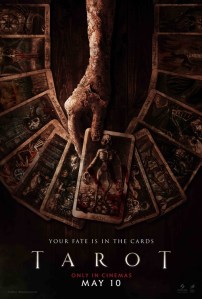 In the long line of horror movies about dumb teenagers stumbling onto curses, Tarot might be one of the most ineffective and ridiculous. First off, tarot readings are so detailed and specific, while also being vague to most of us unfamiliar with what you can find on the playing cards. This means the movie must constantly remind the viewer what the fateful readings were as well as the spooky imagery. Also, being a PG-13 movie, means that the terror is kept more on a psychological bullying level, where the teens have to “face their fears” but they’re not terribly personalized. One girl finds herself in a magician’s performance for ghouls and literally hides in a box only to be sawed in half. What was the personal fear there? Stage magicians? One guy is in a subway station and comes across a newspaper with his face on it and the headline, “You Die Today” (who says print media is dead…. wait a second). This is one of those movies that suffers because the rules of the curse are sketchy at best. We don’t know the escalation or how the teens might beat it. However, I wanted to almost applaud in amazement when the script practically plays an Uno Reverse card on its angry spirit (“If she’s killing everyone because they got their horoscope read, what if WE read HER horoscope to HER, huh?!”). The entire enterprise feels transparently like some studio exec optioned the concept of a tarot deck and said, “You know, make it haunted or whatever.” Unless you’re desperate for some derisive entertainment chuckles, skip Tarot.
Nate’s Grade: D+
Share this:

Smile (2022)
 Smile was not initially intended for a theatrical release. The $17 million-budgeted horror thriller had been intended as a streaming exclusive for Paramount Plus, but after the movie tested so well, its parent company thought why not try a theatrical run? They even hired real actors to creepy stand still grinning outside Good Morning America or behind home plate for baseball playoffs. Then the movie made over $200 million worldwide and possibly began its own franchise. Not bad. After having finally watched Smile, I can understand why it became a word-of-mouth sensation. It’s thoroughly unnerving and a horror film that just knows its fundamentals.
Dr. Rose Cutter (Sosie Bacon) is a clinical psychologist with her own trauma. As a child, she discovered her own mentally ill mother’s body after she had overdosed on pills, and this has spurned Rose to try and help others suffering from depression and mental illness as a career. She encounters one very frantic young woman, Laura (Caitlin Stasey), who fears she is in danger. She says she keeps seeing… smiling people, people that aren’t there, and she was told today was her last day to live. Sure enough, the woman struggles and then stands, eerily smiling, and casually slices her own throat in front of Rose. While she tries to shake off the disturbing burst of violence, Rose is starting to see Laura again, smiling that same eerie smile, and this propels Rose to investigate the origins of this curse that leads each victim to take their own life.
 There isn’t much in the way of deeper themes or social commentary here, though I suppose you could find some pieces about how we stigmatize mental illness or that the curse has to be spread through witnesses of trauma. Smile isn’t an example of elevated horror and instead it’s just a well-constructed, well-developed horror movie that knows what to do to properly get under your skin. The premise reminded me of the indie breakout in 2014, It Follows, where there is a curse with very specific rules for passing it along, and new chains can be created or broken depending upon the duplicity of the person (see also: The Ring). I liked thinking of the curse as a puzzle, and my wife was able to jump to a conclusion before the movie as far as how to possibly break the curse, going against the assumptions of Rose and her ex-boyfriend police detective, Joel (Kyle Gallner). Much of the second half of the movie is this discovery period, untangling the longer history of the curse, implicit with this is that each new occurrence involved a violent suicide and an observer. I suppose maybe there is some theme possibly attempted about the shared nature of trauma, how it unpredictably spills out before us and is tricky to be cleanly contained. After establishing the pattern with the curse, now it’s time for our protagonist to wonder if she can beat the odds. I appreciate that writer/director Parker Finn provides plausibility to make her efforts credible. My issue with the latter part of It Follows was why the beleaguered teens would have thought that they could electrocute an invisible phantom and kill it when it was otherwise unfazed by bullets.
As a straightforward horror thriller, Smile knows what it takes to make you squirm and jump. It taps into something universal: smiling, without careful context, is often very creepy. It’s not a world-breaking observation and yet its simplicity is part of what makes it all so effective. Very often, the movie will anticipate the audience’s dread, feeling out that something is about to go off the rails or a jump scare might be approaching, and it will deliver in a different direction. Much like James Wan’s Conjuring movies, the film also has a firm handle on setups and payoffs, establishing a situation and then letting the audience simmer in dread. There was one moment where Rose was instructed to turn around and look behind her by a voice that no longer seemed so helpful, and the drawn-out response was deliciously squirm-inducing. There was another moment that I knew a jump scare was coming, it was literally walking towards Rose, and I kept thinking, “Okay, here comes the startle,” and then the movie brought it but in a way that still surprised and elated me. Given the nature of the curse messing with its victim’s mind, you might start to anticipate what Rose sees and hears is not to be trusted, and there are a few fake-outs too many. Thankfully, the movie doesn’t just rest on one spooky trick. There’s a children’s birthday party that manages to tie a few plot elements together in a masterfully traumatizing manner. When Smile does start revealing more about the design of its monster, that’s when my wife started averting her eyes more often and muttering “No no no” to herself. Some of the imagery is prime nightmare fuel, and I applaud Finn’s innate ability to scare the hell out of an audience.
 Some action movies and horror flicks are best described as thrill rides, an experience that exhilarates and delights and doesn’t offer much more by the end than the experience, and that’s perfectly acceptable. Not every movie has to be one with deeper meanings or breaking the mold in a way that no filmmaker has ever achieved before. Sometimes just having a good time from a well-constructed thrill ride is sufficient for a fun and diverting viewing. Smile is that film, a horror/thriller that is cleverly focused and developed to garner every goosebump. I will also say that I incorrectly thought that this movie was PG-13, and that was quickly disproven by the intensity and disturbing nature of its violence. I can’t say why I always thought that this was a PG-13 movie, maybe because of its instant box-office success, but it definitely doesn’t soft pedal its intense atmosphere and disquieting nature. It takes a lot to scare me, and Smile made me sit on the edge of my seat and perfectly dread the next moment, that is, when I wasn’t averting my eyes like my wife and trying to forget its nightmarish imagery.
Nate’s Grade: B+
Share this:

It Follows (2015)
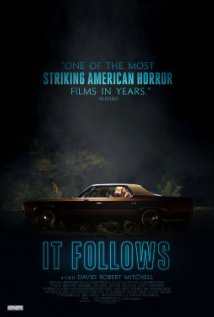 Indie horror is always looking for the Next Big Thing, and at the start of 2015, that movie was It Follows. Coming out of relatively nowhere, the second film by writer/director David Robert Mitchell was dubbed the real deal, and audiences flocked to see what all fuss was over. I would have been intrigued before the positive word-of-mouth namely because Mitchell made one of my favorite films of 2011, the understated and perfectly yearning ode to adolescence, The Myth of the American Sleepover. I dearly hoped that Mitchell was not another flash in the pan. In retrospect, I did not have need to fear. It Follows is unsettling, suspenseful, and borderline ingenious with its concept, but it also has some faults that mitigate its concluding power.
Jay (Maika Monroe) is a normal 19-year-old girl going to college in Michigan until the night she sleeps with her object of desire, Hugh (Jake Weary). In her post-coital mediation, he drugs her, ties her to a wheelchair, and then waits. He wants to show her something, or more accurately someone (perhaps something is actually more appropriate). A woman slowly trudges toward them, the embodiment of a curse he passed on to Jay through sex. It will keep following her until it gets her and kills her. The only way she can protect herself is to sleep with someone else, to pass the curse onto a new recipient. Then the monster goes after them; however, once this newest curse-holder is murdered, the monster moves back up the ladder, attacking the next curse-holder. Once you have it, there’s no getting rid of this curse, only delaying it.
 The top question with a horror movie is whether it provides enough suspense, spooks, and scares to jolt an audience, and in this regard It Follows is quite good; not as unsettling as last year’s Babadook but still plenty unnerving and extremely well executed and developed. The opening hooks you, with a teen girl constantly looking in the direction of the camera and clearly scared out of her mind. The camera has adopted the identity of the monster. The central premise is wonderful, rich with thematic potential about the alienation and anxiety of being a teenager navigating the world, but also intriguing enough that I always wanted a large expository info dump scene just to learn more about the rules or its history. Rare is the film, let alone a horror film, where I’m left desiring lengthy exposition. One of the clever developments of its monster is that it can adopt the appearance of anyone, including people close to you (though it rarely does this for an unexplained reason). That means anyone can be your doom and the only way to know is to double-check whether other people can see this menacing phantom as well. Imagine going the rest of your life always having to look over your shoulder, always having a little nagging doubt in your mind about whether or not this person or that person is real. The premise is well developed with sequences that draw out the tension and make us dread what’s coming next or what may or may not be real. Now, slow-trotting fully naked people might not be a scarier monster than, say, Leatherface, but it’s still alarming.
The premise also allows the audience to imagine what course of action they would do if they were stuck in this situation. Would you doom an innocent human being to protect yourself? If so, would you be upfront about it and the ensuing danger? Would you formulate a plan like Hugh and drive long distances to provide further distance? If you thought you were being followed, would you immediately find a sexual partner? The clever premise gets your brain thinking of what you would do to survive and at what cost.
There’s a distinct Stanley Kubrick and John Carpenter vibe with the filmmaking, which will enhance the overall mood of the film or drive certain viewers crazy. The camera movements fall into very few selections, mostly slow pans, slow zooms, or long tracking shots with the subject routinely framed in the center. It’s hard not to evoke feelings with The Shining, an all-time great horror film that likewise built a sense of foreboding terror, and Halloween. You’re conditioned to feel that something bad is about to happen as the camera turns or hovers, waiting for the creepy thing to pop around the corner. It plays into second-guessing everything you see, taking away the illusions of safety, and the steady and controlled camerawork enhances this mood. The entire movie feels vaguely out of time, notably a capsule from the 1980s save for one strange inclusion of a wireless reading device. The musical score by Disasterpeace (nee Rick Vreeland) is another throwback to the 80s, and its fuzzy synth-drenched soundtrack smoothly blends in and enhances the atmosphere.
 If anyone caught Mitchell’s previous film, you’ll know that besides a wonderful eye for framing visual compositions, the guy has a very natural feel for developing realistic teenage characters milling about their relatable existences. It Follows is no different, and while I would stop short of saying that the characters have depth to them, they are realistically drawn and portrayed by actors who look and act like scared teenagers. The relatablility of unrequited feelings, or going out on a limb and getting your heart broken, of trusting the wrong people who have ulterior motives, are universal pains that makes it all the easier to put ourselves in these unfortunate character’s shoes. It also helps that, up until the final act, the characters defy the arc of rampant stupidity in horror. After realizing the danger she’s trapped in, Jay actually seeks out the one person who she can get answers from, even if he’s the same person who doomed her with the curse.
It’s unfortunate that the movie loses steam when it creeps into its third act and forces a solution and showdown with the monster that makes no sense whatsoever. I understand the need to feel like the teens can regain the upper hand or somehow outsmart the curse that doggedly follows them, but with everything presented, it’s just not believable. For the entire movie, we’ve seen that this supernatural force doesn’t really have a loophole in its system of rules. The only way to stave off annihilation is to pass it along and create a series of firewalls as protection with other sexual partners. Otherwise, it’s relentless and like zombies the eventuality is what helps magnify the sense of dread. We even see it get shot in a hasty defense from the teens and the gunshots do nothing. And yet, this vital information doesn’t seem to register with our band of teenagers. Their third act solution (spoilers): they’re going to lure the following terror into a pool and… electrocute it. Huh? Why would a supernatural entity that has not shown any weakness to electricity, or any mortal dangers, be able to be killed? This plan makes no sense and not one character voices a counter-argument to what is proven to be a very bad plan. Maybe the point is that it’s supposed to be bad, that it’s an example of how desperate these characters have become that they would hold out hope for something that is completely inaccurate. After this failed plan, Jay does exactly what you’d expect with the boy who’s been itching to jump her bones for the entire movie. He gets what he wants (physical copulation, being the white knight), she gets what she wants (flimsy security), and then the movie just kind of peters out and ends. I understand that Mitchell’s extended point is that there is no happy ending possible and the characters will have to uneasily look over their shoulders for the rest of their lives. However, the point could have been made even without the third act. I wish It Follows could have found a better landing than just shrugging and saying, “Well, what are you gonna do with curses, you know?”
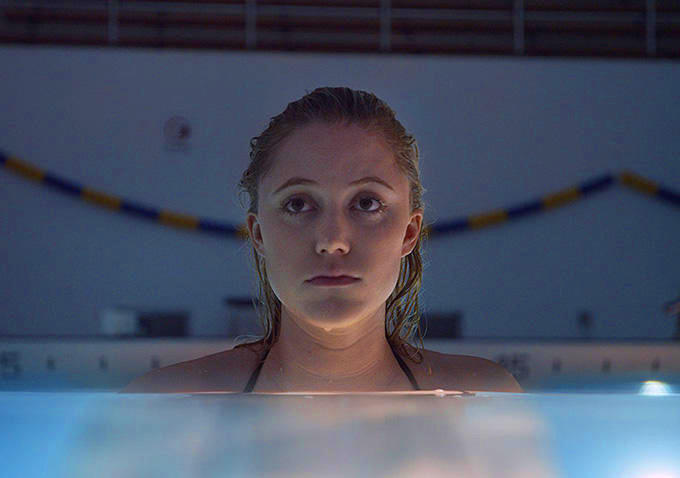 Before the movie hits the skids in the third act, I was pondering the greater implications and logistics of its sexually transmitted curse. Does “passing” it along require some form of genital contact? Does it require fluid exchange? If you wear a condom, does the prophylactic also protect your sexual partner from the transmission? Does the curse function relatively the same for same sex couples? What about people with non-functioning parts below the waste? Can someone who suffers from erectile dysfunction pass the curse along? Can it be transferred onto inanimate objects? Can men ejaculate into some sort of container and then send the container into space via the space shuttle and be protected? Actually, banging an astronaut who’s about to live on the space station or go to Mars might be the smartest move. I enjoyed thinking of a stratagem to best protect myself if I was caught in this scenario; even after passing it along and providing a buffer, you still always have to be on guard for the curse to move back up the ladder. My solution: have relations with a prostitute. This is probably a guarantee that the curse will be passed on within a 24-hour period, and even if that john is found and killed, chances are this prostitute may have already passed the curse along to a new client. If one cannot inoculate themselves from a supernatural STD-like curse with the aid of prostitutes, then there’s no hope for the rest of us poor mortals. Anyway, my mind wandered a tad.
It Follows may suffer due to the hype, the inconclusive resolution, and a third act that deflates, but it’s still an extremely well executed horror thriller with a terrific concept at heart. The sense of dread is stark and the camerawork and storytelling draw out the tension until you feel you’re about to break. It’s more unnerving than traditionally scary, but it has a power that does stay with you, particularly its fascinating premise and the natural relatability of the characters and their choices. I don’t know if this premise could sustain a sequel, especially with a villain that appears to be unstoppable, but that hasn’t thwarted the horror genre before in its stampede at cashing in on success. It Follows is a solidly entertaining and creepy movie, but it’s even more confirmation for me that David Robert Mitchell is going to be a filmmaker who has staying power. I’ll be following him.
Nate’s Grade: B+


You must be logged in to post a comment.