Blog Archives
Teenage Mutant Ninja Turtles: Mutant Mayhem (2023)
 As an elder millennial, the Teenage Mutant Ninja Turtles have been a formative franchise for me. I grew up on the cartoon, got the toys for Christmas, died endlessly during the shockingly hard underwater stage of their Nintendo video game, and generally have a soft spot in my 80s nostalgia for the likes of Leonardo, Donatello, Raphael, and Michelangelo, plus their surrogate father, Master Splinter. Apparently Seth Rogen felt the same way, and he and his writing partner Evan Goldberg have spearheaded a new animated variation of TMNT that just so happens to also be co-written and directed by the man behind my favorite film of 2021, The Mitchells vs. The Machines. It was a recipe to guarantee my personal enjoyment, and Mutant Mayhem thusly delivered. The biggest selling point for me was how lovingly realized the “teenage” part of the title was, getting a foursome of actual adolescents to portray our heroes, and using high school experience about acceptance and fitting in as effective and even poignant parallels. I loved just hanging out with these characters, who view their surrogate dad (voied by Jackie Chan) with a mixture of love and embarrassment, and who want to be accepted by a world predisposed to finding them monstrous. Naturally, becoming crime-fighting heroes is their best method for winning over the public, with a young and aspiring journalist April O’Neil (The Bear‘s Ayo Edebiri) hoping to improve her own social standing at school by breaking the existence of these unknown mutants. The comedy is robust and layered while allowing for nice character details and moments, giving each turtle their own satisfying arc. The action is fun and inventively staged while still being thematically relevant. The vocal cast is great, and the young actors are tremendous together, sparking an enviable improvisational energy that made me smile constantly. The art style has an intentional messiness to it, like smeared colored pencil drawings, and the imperfections are themselves part of the vast visual appeal. It’s a family movie that will succeed with old fans and new, and Mutant Mayhem is the best film depiction yet of the famous heroes in a half-shell.
Nate’s Grade: B+
Share this:

Guardians of the Galaxy vol. 3 (2023)
 It’s taken me longer to review the third, and reportedly final, installment of the Guardians of the Galaxy trilogy because I didn’t think that I nor my family had the emotional bandwidth when the movie was originally released to herald the summer. I’ve been a big fan of writer/director James Gunn’s comic book escapade efforts with the Marvel Cinematic Universe (MCU), as well as his first DC entry, 2021’s The Suicide Squad, the best DC film of the new era, so I’ve been highly anticipating a third Gaurdians ever since the second ended six years ago. Of course all fans have had to wait a little longer after Disney fired Gunn in 2019 for offensive social media posts they already knew about before the first Guardians film in 2014, and then they came to their senses and re-hired one of the most unique voices working within their giant sandbox of superheroes. The reason I decided to wait even longer is because I had been warned by many of my critical colleagues about the heavy thematic nature of the third entry, namely the frequent sequences of animal abuse. My family had to put down their household dog of over ten years in late April, and having to re-open that wound by watching pretend animals get abused was not the best for any of our emotional states. And so I waited until it was available on digital and in the comfortable sanctity of my home, and I alone in my family watched Volume Three, partly as a harbinger of future warning over what scenes to skip over for them. It’s a fitting end to a strange and funky series of movies that taught us to feel real emotions over racoons and trees, and even though I’d rate this as last in its respective Guardians standing, it’s still a winner and a topical reminder that these big-budget blockbusters are only ever as good as when the passion is evident.
The Guardians are on a mission to save their friend, Rocket (voiced by Bradley Cooper). He’s been incapacitated and is sought after by his creator, The High Evolutionary (Chukwudi Iwuji), a maniacal man with a god complex who is trying to create a perfect life form. This forces the Guardians to learn more about Rocket’s tragic past as a cruel science experiment, and it brings back Gomorrah (Zoe Saldana), though she’s not the same woman who fell in love with Peter Quill (Christ Pratt), and he’s having a hard time reconciling the different green girls. They’ll have to work together to rescue Rocket and stop the High Evolutionary from further harm.
 This is a movie built around the back-story and emotional connections of Rocket, a character that, prior to Gunn’s first film, had fewer than a dozen comic appearances but has had an outsized influence over the movies. If the first movie was about the formation of our team, and the second was deepening the supporting characters, as well as exploring Quill’s daddy issues, then the last movie is all about how we say goodbye to the ones we love. Volume Three is clearly structured like Gunn’s fond farewell for these characters rather than merely a pause in their contractually obligated appearances (whether Marvel overrules Gunn is another matter). It makes the interaction more meaningful and also more emotionally rich, not just because certain characters might perish, but because of the journey we’ve been privileged to hop along for, how far they’ve come and how much they matter to others, and by extension us, the audience.
Case in point: the emotional evolution of Rocket Racoon. He began as a surly visual joke, a teeny mammal with a big gun and a big attitude. It wasn’t until a drunken outburst in Volume One that you got a glimpse of the trauma and pain beneath that antisocial demeanor. With Volume Three, he gets sidelined pretty early, which means the majority of the time we spend with Rocket is through a series of flashbacks with baby Rocket and his cute pals, all ongoing science experiments (one needs only to recognize the absence of these childhood friends as grown-ups to anticipate where this is inevitably heading). In some ways, it is cheap and manipulative. It’s not hard to make an audience feel extreme emotions by introducing a slew of adorable animals as well as a villain who hurts them and sees them as expendable experiments undeserving of sympathy. I wish Gunn hadn’t gone so hard in this direction because it feels excessive in the ideas that the film bluntly communicates. Yes, a storyteller will need time to establish a baseline of relationships, conflicts, and looming change, but do we need six or seven flashbacks to settle the concept of animal testing and animal cruelty being a bad thing? I credit Gunn with making his thematic intent unambiguous; this is wrong, and you will feel it explicitly. However, sidelining Rocket for a majority of the movie and having characters project onto his unconscious body, while providing more insight through a system of excessive and heavy-handed flashbacks, might not be the best model for ensuring this character gets his due when it comes to this showcase. Quill keeps calling Rocket his “best friend” and I’m trying to remember when this happened. I re-watched Volume Two this summer, and now consider it the best of the trilogy, and I cannot recall the specific events that bonded these two bickering alphas into inter-species BFFs.
 Another facet of Gunn’s relevant themes is personified in the romantic realizations of Quill. Not to get too complicated, the current Gomorrah is a past version of herself and not the one who joined the Guardians, fell in love with Quill, and died in Infinity War. She’s back, but from her perspective she never left, and this moon-eyed dolt keeps projecting his feelings onto her. I respect that Gunn doesn’t try and wave away this complication, nor does he mitigate the agency and importance of this Gomorrah not having to follow the same path as her predecessor. The easy thing would have been for Quill to wait and for this new/old Gamorrah to see the same qualities that made the old/dead Gomorrah fall in love. It would be like one of those soapy romances where a person suffers amnesia and gets to fall in love with their spouse all over again. Gunn doesn’t do that. These are different people, and despite the aching desire of Quill to rekindle what he had, it has been lost, and this needs to be acknowledged and accepted. “I bet we were fun,” she says, and it’s a bittersweet summation that extends beyond the Guardians.
There is still Gunn’s signature sense of style and humor while checking the boxes of a big-screen action blockbuster. There’s an infiltration set piece that plays like a goofier Mission: Impossible setup but in a squishy bio-mechanical facility that reminded me of the eccentric and schlocky sci-fi diversions personified in the Lexx movies and TV series. There’s an entire planet of animal-human hybrids that feels wasted as further proof of the High Evolutionary’s already established evil. The entire character of Adam Warlock (a beefed up Will Poulter) is a himbo that definitely feels lacking in larger purpose now that the Infinity Era is over. There is one signature action scene involving a protracted fight through a crowded hallway, and it’s exciting and fun. The jokes are mostly contained to sardonic banter, which can be hilarious depending upon the combination of characters, though it also can be grating when it feels forced, like Mantis (Pom Klementieff) and Nebula (Karen Gillan) butting heads. The celebrated dad rock soundtrack has moved onto 90s and early 2000s music, and as a 90s kid, it gave me a personal nostalgic lift watching scenes jamming to dreamy whoo-hoo alt-rock acts like Radiohead and Spacehog and The Flaming Lips.
 This also might be the grossest MCU movie yet, and not just from the animal abuse but a face-peeling scene that will startle most. I had to pause the screen and drag my 12-year-old stepdaughter into the room with the promise, “Want to see the grossest thing ever in a Marvel movie?” She agreed that it was indeed that. It’s reassuring that no matter the budget, Gunn’s sensibilities that make him the unique storyteller he is, the same man who began with Troma, will be there. Though this point also concerns several of my friends wondering if Gunn can abandon these silly and schlocky tendencies to tell an earnest and tonally appropriate tale for his 2025 Superman reboot.
Guardians of the Galaxy volume 3 is the end of an era for Gunn and for the MCU. As the new head of the DC film and TV universe, it’s unlikely he’ll be lending his talents to Marvel any time soon, although the characters he made us fall in love with could carry on. Gunn clearly loves these characters, and especially identifies with Rocket, the angry malcontent lashing out in pain, so it’s fitting to give this character the big stage for a final outing, and if he can throw in some animal cruelty messaging along with silly humor and pathos, then so be it. This practically feels like Marvel is giving Gunn even more leeway as an apology for firing him. The Guardians trilogy stands out from the prolific MCU assembly because of how much Gunn has personalized these movies to make them special. They have permission to be weird, to be heartfelt, and to be reflections of their idiosyncratic creator, a much more benevolent force than the High Evolutionary. Perhaps there’s even a parallel to be drawn there, a filmmaker trying to endlessly tinker with their creation in the futile pursuit of perfecting it whereas the imperfections and rough edges are often the lasting appeal of a movie. I don’t know if the MCU will contain a series quite like this again, and that adds to the feeling of this serving as a farewell. It was a fun, messy, ridiculous ride, and it was all Gunn.
Nate’s Grade: B
Share this:

The Super Mario Bros. Movie (2023)
 Colorful and eminently pleasant, The Super Mario Bros. Movie is about everything you would expect from an Illumination project. To begin with, there’s not a lot of story in the 30-plus years of Mario video games, so it’s not surprising that the story is kept relatively familiar with characters each inhabiting simple motivation (Mario wants to impress his dad, Luigi wants to be brave, Peach wants to protect her people, Bowser wants to be accepted by his unrequited love). Much of the movie is establishing a new location and giving some moment of fan service before moving on, like an extensive Mario Kart Rainbow Road sequence or Mario meeting Donkey Kong. It feels like the risk-averse creative process started with a list of characters, levels, and references and then how to squeeze them in. This is a movie kept at a kiddie level, which is fine even for adults to enjoy, but it means there is a lowered ceiling of ambition (so… many…. needle-drop song selections…). Much of the movie is fleeting and fine, with highlights including Jack Black’s performance as the love-struck Bowser, the training sequences making use of the bizarre physics and accoutrements of the Mushroom Kingdom, and a delightfully nihilistic little blue star with a cheery child’s voice. The movie is earnest to the point of being a little corny, which might be refreshing for parents and children used to a recent slate of overly glib kid’s movies trying to act smarter than they are. This movie is cute and harmless and a sugar rush to be forgotten after it wears off. Now re-watch the 1993 version that attempted to take the same source material and make a parallel world Blade Runner with Dennis Hopper as King Koopa. There’s also one hundred percent less Chris Pratt.
Nate’s Grade: B-
Share this:

Puss in Boots: The Last Wish (2022)
 Puss in Boots: The Last Wish is, surprisingly, genuinely great. No kidding. It’s very very good. It’s been eleven years since the first Puss in Boots spinoff, and that itself was seven years after the character was introduced in 2004’s Shrek 2, and there hasn’t been a Shrek movie since the franchise-killing Forever After in 2010. I would have assumed that Dreamworks had just moved on from this character in the ensuing years, especially as How to Train Your Dragon became their big new commercial franchise, until they too ran that into the ground with 2019’s disappointing third film. I had little expectations of greatness once I heard there was a new Puss in Boots feature, even after I started hearing the growing critical consensus. Early in, only mere minutes, I realized that a Puss in Boots sequel was one of the best movies of 2022 and an exciting and heartfelt sequel that proves that with the right artists and storytellers, any old character can still have vibrant relevance. It’s a children’s movie that can appeal to everyone.
Puss (voiced by Antonio Banderas) is a famous adventurer, sword fighter, and lover of women, but he’s also nearing the end of a long journey. He’s used up his eight lives and is now on his ninth and last, and to escape Death, he sets out on a quest to retrieve a fallen star that will grant one person a wish. It just so happens there are a lot of other characters in this fairy tale kingdom that want to get there too.

It is amazing how hard this movie goes. In its opening sequence, it establishes its bold artistic style that enlivens every second onscreen, it establishes its caliber of exciting action that feels akin to wild comic books and anime, and an emphasis on mortality that provides a sense of danger and emotional foundation for what could have been just another shoddy animated sequel drafting off brand recognition. Let’s just focus on the animation style to begin with. I was expecting the same old CGI that has dominated the world of animation for twenty years, but The Last Wish has been clearly inspired by the greatness of 2018’s Into the Spider-Verse. There is a distinct 2D edge given to the designs, accenting the imagery, and during bouts of action they will lower the frame frate, making the movements much more stark and pronounced. Add to this a lovely, painterly watercolor visual style, more emphasis on the overall impression than finite definition, and the movie is a consistent feast for the eyes. There are stylized sequences that communicate fear and desperation, as well as sequences that exemplify the kinetic movement of superhuman action, smartly altering its visual appearance to better serve whatever emotion it wants you to feel. I hope more and more animation companies continue this magical hybrid of CGI and traditional animation techniques, as also seen in 2021’s The Mitchells vs. the Machines. It’s a great step forward combining the old and the new into a stylized look that allows the creators to make the best of both animation worlds.
The action is also satisfying and surprisingly well developed. The opening sequence involves Puss awakening a giant behemoth and it made me think of the exaggerated and intense action of anime series with giant kaiju monsters like in Attack on Titan. The camera will freely circle and zoom around the theater of action, heightened with exaggerated motion lines and split screens and POV swaps. I also love that the filmmakers understand the inherent qualities of what makes for good action, incorporating the personality of the characters into the situations, providing organic consequences, tailoring to the geography, and providing clear mini-goals. After introducing the secondary antagonist of greedy Jack Horner (John Mulaney), as well as Goldilocks (Florence Pugh) and the three bears (Ray Winstone, Olivia Coleman, Samson Kayo) “crimin’” gang, the movie transforms into a delightful and unexpected fantasy version of Midnight Run. There are multiple groups racing against one another to a destination, all the while jostling for supremacy and bumbling into one another’s way. It makes for a fun series of events as every group has their own reasons for gaining the wishing star. Because of this, their behavior feels in-character and the cross-purpose motivation allows for fun combinations of characters getting in the way of one another and utilizing the specifics of their fantasy character details. There was a midpoint sequence combining all sides in a colorful brawl, including unicorn horns exploding into confetti upon contact, and I just felt a surge of pure incandescent joy.

In yet another of the movie’s pleasant surprises, it has one of the best villains of the year as it deals with the concept of mortality with actual nuance. The main antagonist is literally Death itself, personified as a red-eyed, grinning bounty hunter wolf and voiced by Narcos’ Pablo Escobar, Wagner Moura with a menacing purr. This Wolf is after Puss because he’s now on his last life and the Wolf is personally offended at the idea of having multiple lives. Their first encounter makes Puss feel fear for perhaps the first time in his nine lives. In a morbidly amusing montage, we zip through Puss’ previous eight lives and specifically the moments leading to their comical end. He’s flippant with an unchecked ego, and Death seriously humbles him, being the first to ever land a blade on Puss in Boots, a detail he’d been bragging about even in song. From here, Puss is deathly afraid and the hairs of his body will stick up whenever he suspects the return of the Wolf, who certainly enjoys terrorizing his targets with an ominous whistle to announce his presence. So at a moment’s notice, the crazy and colorful hijinks can stop from hearing that familiar yet eerie whistle. In some ways, it’s a family-friendly depiction of working through trauma. The larger theme is Puss acknowledging his moral shortcomings with his many lives, the time wasted on frivolity and ego, and making the most of the time he has left. The need to re-up his lives is a fine starting motivation based upon fear, personified as trying to literally escape the scary wolf, but it’s also what makes Puss confront his own behavior and want to change as well as hold himself accountable.
The heartfelt portion of the movie is its emphasis on found families, and it was done so well that I actually teared up at points. Yes, dear reader, Puss in Boots 2 had me on the verge of tears more than once. Goldilocks is the leader of her gang of squabbling thieves, but she still views herself as an orphan first, whereas the bears view her as an equal and valued member of the family and crime gang. Even her character arc comes to a poignant conclusion where she realizes that her real family isn’t the one she comes from but the one who makes her feel that she belongs. This theme is also demonstrated with little Perrito (Harvey Guillen, What We Do in the Shadows TV series) as the adorable and undying optimist puppy sidekick. His selfless vantage point contrasts with Puss, and greatly annoys him, but Perrito also has his own goal. He wants to be a comfort dog, and one of the sweetest moments of the movie involves him helping Puss come back from a traumatic response through a shared moment. Even typing these words makes me tear up. The screenplay knows how to develop characters that can grow as friends and family and the drama is directly connected to well-honed characters and thoughtful story without being overly sentimental and maudlin, a slippery slope to doom many child-friendly animated efforts with messages.

Puss in Boots: The Last Wish does everything well. It’s funny and colorful and exciting and meaningful and heartfelt and everything you would want in any movie, let alone one featuring a talking cat swashbuckler in tiny boots. No matter your mixed feelings on Dreamworks animated movies, or their iffy sequels, or even children’s movies as a whole, I whole-heartedly recommend that everyone give this magical movie a fighting chance. The animation is gorgeous and vibrant and colorful, the vocal performances are terrific, the action is fun and well-developed, and the themes and character arcs have substance to provide meaningful layers and emotional heft. This is superior entertainment and all in about 90-some minutes. While I’d slot it below Guillermo del Toro’s masterful stop-motion Pinocchio, this is a wonderful movie and one of the best to ever bear the Dreamworks mantle. It’s the 2022 sequel you never knew that you needed but will be oh so happy that it rightly does.
Nate’s Grade: A-
Share this:

The Bad Guys (2022)
 Even though it’s based on a popular series of children’s books, if you’ve seen Zootopia, you’ve seen the better version of The Bad Guys. As far as entertainment aimed at the wee ones, you can certainly do worse. It’s brisk, silly, and the animation is quite enjoyable, adding hand-drawn overlays and accents that really make the images pop and provide additional, gratifying textures. The story, on the other hand, is the same old-same old. We have a group of “scary animals” in a world where anthropomorphized creatures walk side-by-side with humans. These spooky creatures get a bad rap because people fear them, so they lean into social prejudices and become a notorious criminal gang. Except now they might want to go good because being good feels better than being bad. Thematically, it’s the same territory that Zootopia trod and with better world-building. We have “bad animals” that are tired of being looked as bad because people wrongly interpret them as scary threats. It’s the predator/prey dynamic but without the depth. Having an all-animal heist crew provides some creative entertainment and Ocean’s 11-style moments of frothy fun; I especially enjoyed that the giant shark is the team’s master of disguise and always very obvious. The character arcs, supposed betrayals, redemption, and plot should be familiar and predictable, which means much of the movie must coast on the appeal of the animation, vocal actors, and general sense of humor. The comedy can be amusing but too often falls upon cheap gags, like the piranha’s defining trait of being a nervous farter. The Bad Guys is suitable for animation aficionados, fans of the book series, and people who have never seen Zootopia, and if that’s you, then just watch Zootopia.
Nate’s Grade: C+
Share this:

The Suicide Squad (2021)
 When Disney foolishly fired writer/director James Gunn for offensive past tweets, tweets the studio had already known about before hiring him to helm the first Guardians of the Galaxy Marvel movie, the brass at DC was more than happy to pounce. They offered Gunn the opportunity to tackle any of their many superhero properties. Gunn had earned a reputation as a blockbuster filmmaker whose bizarre sense of humor and style made him just as much as selling point as the property itself. Gunn gravitated to the Suicide Squad, though he didn’t want to be beholden to the 2016 film from writer/director David Ayer. The studio gave Gunn free reign. He could do whatever he wanted creatively, which just happened to be an extremely violent, R-rated sequel that also serves as a soft reboot. Gunn was the perfect person to tackle a project like The Suicide Squad and even with all his goofy humor, gallons of gore, and slapdash dispatching of numerous big names, there’s a real affection for these scruffy characters. Not that there was a big hurdle to clear, but this is clearly the superior big screen Suicide Squad.
Amanda Waller (Viola Davis) has assembled another team of criminals and has-beens and tasked them with a mission. If they fail, or deviate from their orders, she will detonate an explosive placed within the skulls of Task Force X a.k.a. the Suicide Squad. Skilled marksman Bloodsport (Idris Elba) is extorted into being the defacto leader of a band of squabbling misfits that includes Harley Quinn (Margot Robbie), the patriotic warrior Peacemaker (John Cena), the vermin-controlling Ratcatcher (Daniela Melchior), and even a giant living shark, King Shark (voiced by Sylvester Stallone), with a voracious appetite. The squad must destroy a scientific station on an island nation that has undergone a military coup and great political instability. Within that station, run by mad scientist The Thinker (Peter Capaldi), is a threat that could doom the world. Enter the Suicide Squad, but can they even be bothered to save the day?
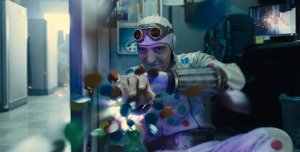
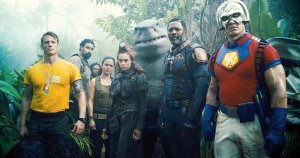 It feels like Gunn wanted to take the most ridiculous, pathetic characters in DC cannon and then find a way to make them appealing and worth rooting for. There is a strategy to take the scraps of the comic book universe and to make gold out of them. Case in point, Polka Dot Man (David Dastmalchian), a figure easily ridiculed by fans and populating just about every list of the worst villains of comic book lore. Gunn takes the maligned character and says, “Yeah, I’m going to keep his dumb power of flinging polka dots, and by the end, you’re going to care,” and you do care, or at least I did over the course of the film’s 132 minutes. Gunn is drawn to strange, dysfunctional found families, the misfits of society who find an unexpected kinship with one another. You can tell that even when Gunn is at his most irreverent, he still has an acute sense of reverence. The team-comes-together aspect of these sort of movies plays as a predictable but satisfying formula, and while I wouldn’t say anything took hold of my emotions like the best of the Guardians entries, I did come to care about the core of the team. I cared about the father/daughter dynamic between Bloodsport and Ratcatcher. I cared about Polka Dot Man coming into his own as a hero. I cared about King Shark feeling like he had a group of friends. The fact that I typed those last two sentences, which would sound insane absent context, is a testament to Gunn’s strengths.
The climactic villain, whom I will not spoil, is the greatest example of making the most with the least. It is immediately goofy to the point of laughter but still threatening and creepy. Gunn has taken one of the weirdest characters in comics and given it its due. Even by the end, as this villain is vanquished (not a spoiler), the movie finds a small moment to re-contextualize this absurd character as another victim. It was happier before being kidnapped and experimented upon by its devious captors. Even that extra passing consideration is impressive.
The movie also lets its weirdos have their fun. Watching bad guys, who are somewhat bad at being bad guys, try their hand at being good guys, but badly, or at least not as well, has plenty of comedic possibility as well as setting up the redemption and community payoff. The opening beach assault sets the sardonic and sloppy tone. I consistently enjoyed the contentious banter between the different members of the Squad and the jockeying for position. The gag about Polk Dot Man envisioning every enemy as his abusive mother is enjoyably goofy when visualized from his perspective (Elba’s line reading for “It’s YOUR MOM!” is a delight). King Shark’s dullard nature is a routine source of comedy that almost wears out its welcome. Nothing seems out of bound for him to say or do, whereas the others have more defined comedy boundaries. I laughed out loud frequently though some of the comedy bits feel a bit too stale and juvenile even for Gunn (a 69 joke?). This all feels very much like this is Gunn’s $180-million-dollar Troma movie he miraculously got to make with a studio blessing. The violence is over-the-top, occasionally gasp-inducing and occasionally beautiful. That’s an odd but an adept combination for Gunn as a filmmaker, a man who digs into the grimy bins of exploitation cinema and elevates it upon a bigger stage while still managing to stay true to his own silly style.
 Gunn hasn’t dulled the darker reality of his rogue’s gallery either. Bloodsport and Peacemaker get into a macho contest of killing foot soldiers in increasingly theatrical and flamboyant ways where their flippancy and hostility toward one another is the joke. King Shark is portrayed as a dumb brute who also tries to eat team members. Many, many characters have similar back-stories where their parent or guardian or captor experimented on them and live with the lingering trauma, trying not to have their pain define them. The 2016 movie wanted you to see the Squad as PG-13-approved antiheroes. The 2021 movie wants you to remember that they are indeed crazy, demented, dangerous, and murderers. Even Peacemaker, meant to evoke shades of the patriotic Captain America, says he will ensure peace “no matter how many men, women, and children I have to kill.” Harley isn’t fetishized as a punky pinup in short shorts like in 2016 (digitally shortened), but she’s still a psychopath who makes impulsive decisions. Her recognition about always falling for the wrong kind of man is a mixture of sadness, character growth, and a clear reminder that you should not let down your guard around this woman.
Spending time with these characters is made even better from the superb casting. Elba (Hobbes and Shaw) is the biggest welcomed addition; his character was likely initially intended to be the continuation of Will Smith’s Deadshot. Elba is charismatic and self-effacing and handles the comedy and action with equal measures of confidence. When he loses his patience, or opens up about his hidden phobia, it’s even more amusing because of how it contrasts with how naturally suave he is as a default setting. I wasn’t missing Will Smith at all with Elba and his natural accent. Robbie (Bombshell) was born to play Harley Quinn and should hopefully get many more opportunities. Cena (Fast and Furious 9) is so natural at comedy and slides comfortably into a macho blowhard coming into conflict with the other alpha males on the Squad. I loved the simple visual of him strutting around in vacation shorts for a long period of the second act. Viola Davis (Ma Rainey’s Black Bottom) is always excellent and might be the scariest character of them all. There are many joke characters played by actors firmly in on the tongue-in-cheek game.
 As a second chance at franchise-making, The Suicide Squad is a brash, bloody, and irreverent retake and the best DCU movie yet from a studio that seems to be throwing anything at the wall to see what potentially sticks. That has its benefits, like allowing Gunn the creative freedom to make a movie this crazy and schlocky and entertaining. It’s a shame, then, that this Squad movie looks like it will make a whopping hundred million less in its opening weekend at the box-office compared to its 2016 predecessor. It’s a sign that the traditional theatrical market hasn’t quite rebounded from COVID-19 (even Marvel’s own doesn’t look like it will crack $200 million domestic). It may also be a sign that audiences are not terribly interested about a sequel to a movie they didn’t really care for five years prior. Beforehand, I would have bet even money that the studio would give a blank check to bring Gunn back for more after he fulfills Guardians of the Galaxy volume 3 for Marvel, but maybe that’s not the case. Maybe The Suicide Squad will be more of an entertaining one-off than the start of a new direction for this lagging franchise. Regardless, if anything good came of Disney firing Gunn on dubious terms, it’s the existence of this movie in the interim for the in-demand filmmaker. While not everything works in The Suicide Squad, and the emotional depth is sacrificed for giddy gory bombast, it’s what you would hope for with the combination of James Gunn, wacky superheroes, and a commitment to an R-rating.
Nate’s Grade: B+
Share this:

The Witches (2020)
 Rare is the Hollywood movie where the biggest question afterwards is simply, “What in the world were all these talented people thinking?” Why did Robert Zemeckis want to remake The Witches after a perfectly good and eerie 1990 movie starring Anjelica Huston? Why did the screenplay adjust the action to be set during a segregationist South without any added social commentary? What exactly is Anne Hathaway, as the lead witch, even doing with an accent that sounds like she’s blindly jumping from nationality to nationality? In one second she’s Hungarian, in another she’s Scottish, in another she’s Swedish. What was with this bizarre character design for the witches that gives them dinosaur talons and one-toed clog feet and, most off-putting, extended mouths visible with slits along the sides that they don’t even bother concealing? Why does the movie keep making fun of the chubby kid at every opportunity for being chubby? Why, even in life-and-death stakes, is the chubby kid unable to stop himself from losing all willpower around food? Why does Octavia Spencer’s grandmother character sound almost exactly like a rambling Grandpa Simpson when she’s just given enough room (“So I had an onion on my belt, as it was the style of the time…”)? How could a screenplay, that includes the likes of Oscar-winner Guilermo del Toro, include lines like, “That’s the thing about snow — it’s slippery”? I was groaning throughout this movie and just beside myself trying to make sense of the inexplicable creative decision-making on display. I also felt embarrassed for Hathaway, an actress I have enjoyed and find to be quite accomplished, who is just inhaling every piece of scenery that is not bolted down on set. It’s such a crazily misconceived performance of theatrical bombast that I felt like Zemeckis had done Hathaway wrong. This is a big hot mess of a movie and it’s so joyless.
Nate’s Grade: D+
Share this:

The One and Only Ivan (2020)
 Disney’s latest talking animal movie is based on a real story. Not the talking animals part, more a gorilla (voiced by Sam Rockwell) who lived in a strip mall as a circus performer and then became a painter and the notoriety of his art built a movement to free him. The One and Only Ivan is a good-natured family film with affirming lessons and a conservationist advocacy. Kids may laugh at some of the silly animals, or they might cry as the maternal elephant (Angelina Jolie) entrusts onto Ivan the promise to break the newest baby elephant free of bondage. Ivan was raised by Mack (Bryan Cranston) who runs the strip mall circus, though times are tough and he may have lost sight of his priorities with his animals. Enter cute kid, cute baby elephant, cute and scrappy dog, and Ivan’s passion for the arts. The one element that makes this movie different, Ivan’s ability to paint his emotions and reflections, is barely included and that’s a real shame. Ivan becomes like the spider from Charlotte’s Web and uses his position to advocate for another animal, using the subsequent attention to spare this small creature. He paints once and the movie zips to its resolution. The thrust of the story is Ivan addressing his own personal tragedy and letting others in, risking his own safety and ego to protect those vulnerable. The CGI special effects are suitable if unremarkable, landing in that middle zone of meeting expectations of semi-reality but not exceeding them. I would have preferred a documentary going into the actual events of the real Ivan, getting interviews from the people who were there and mattered, their own insights and experiences, and really dwelling more on what the idea of artistic expression means for an ape and what it might mean concerning our connections to these creatures. I think there’s a compelling, enlightening, and heartfelt documentary to be had with the subject matter. The live-action talking-animal movie, however, is just more of the same inoffensive family film treacle and clearly not the one and only.
Nate’s Grade: C+
Share this:

Chicken Run (2000) [Review Re-View]
 Released June 23, 2000:
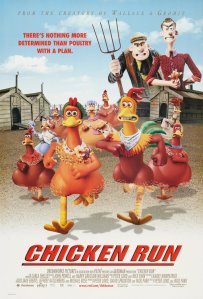
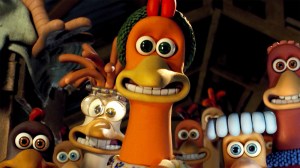
I strongly urge everyone out there if ever given the opportunity to see this movie. Do not confuse Chicken Run as a “kids only” affair while you yourself sneak into something “better.” This movie is easily the best movie of this lackluster summer of commercial perpetual bile, and possibly one of the better if not best films of the year. It’s no secret I have an affinity for animation and the claymation choices of directors Nick Park and Peter Lord, of Wallace and Gromit fame, give the characters real emotion. I can just look at one of the chickens in the eye and feel emotion that I couldn’t get seeing many Hollywood films. The cinematography and animation is lush, vibrant, and breathtakingly beautiful. The story is fresh, wonderfully hilarious, and even touching. The voice artists are terrific, with Miranda Richardson pulling out as my favorite for her delightfully vile Mrs. Tweedy. Treat yourself to one of the very few decent movies this summer and see the incredible fun of Chicken Run, and if you still feel conflicted it has Mel Gibson in it. And if you still feel bad you can say you got lost on your way to the restroom.
Nate’s Grade: A
——————————————————
WRITER REFLECTIONS 20 YEARS LATER

I’ve been a fan of animation since I was young, and stop-motion animation has its own unique and impressive charms. While it has been smoothed out with recent high-profile Laika entries (ParaNorman, Kubo and the Two Strings), there’s a distinct un-reality to stop-motion animation, a stutter-stop to the movements and its physical details that can place it in a beguiling middle-ground between fantasy and reality. I know thousands of hands toil many thousands of hours with every hand-drawn and CGI animated film, but seeing a literal canvas of three-dimensional physical proportions and knowing, with every second, that a person individually moved this figure bit by infinitesimal bit to provide movement, it gives me awe. It’s one of the reasons why 1993’s The Nightmare Before Christmas is one of my all-time favorite movies, plus its top-shelf soundtrack by Danny Elfman at the peak of his talents (I wore out my cassette tape listening to the soundtrack so often). The Aardman production team became famous from the success of their Creature Comforts and Wallace and Gromit shorts, but it wasn’t until 2000 that they tackled their first feature film. I saw Chicken Run in theaters three times that summer. I was so taken with the imagination, humor, storytelling, and efficiency of it, that I kept returning for more. Checking back in twenty years after that initial release, it’s still an effortlessly enjoyable comic caper.
 This is an all-ages comedy that asks what if you remade The Great Escape but from the perspective of poultry. It’s a prison break movie that takes its stakes seriously but can still find room for goofy humor and a little romance. The screenplay by Karey Kirkpatrick, working off the story by directors Peter Lord and Nick Park, is minus any fat. Everything in the script sets up the characters, their distinct personalities, goals, stakes, and complications, especially once our main characters of Ginger (voiced by Julia Sawalha) and Rocky (Mel Gibson) are at cross-purposes; he only wants to think of himself and she can only think about saving everyone. He’s hiding the secret of his limitations; she sees him as the answer to their plight, and they’re both growing closer to one another as their time to escape dwindles. Every character is responsive to the action of the others, so the repercussions of the escape attempts lead to the villains escalating their plans. Instead of seeing the chickens as egg providers and meat when they can no longer produce eggs, now they are all expendable and meat is the top Tweedy Farm meal ticket. There’s a clear connection between all the plot beats that is deeply satisfying. Chicken Run is only 85 minutes long and it doesn’t waste a moment to make you smile and tell a good story.
I laughed several times, especially with the daffy Babs (“Are we going on holiday?”), and also the ingenuity of the slapstick. There’s a sequence going inside the machinations of a pie-making machine that is wonderfully developed with great obstacles leading to great slapstick. There’s one stretch where Ginger and Rocky find themselves inside a giant lit oven and they have to race out by leaping from pie to pie. Ginger is fleet and gets ahead, but Rocky tumbles into one pie after another, which is already good slapstick paired with an exciting scenario. Then it cuts to an overhead shot and you see that Rocky has somehow managed to trip and fall in every pie in the oven. It’s small comic touches like that where the Aardman team excel with their funny.
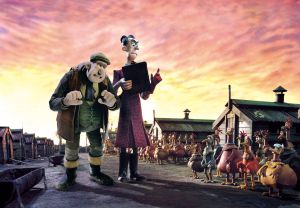 This is also a deceptively visually impressive movie. The Aardman design, the big eyes and buck teeth, seems underdeveloped to a layman but Chicken Run is a beautifully made movie. The stop-motion animation is professional and fluid, but it’s the degree of camera movement and visual enhancement that wowed me. There are long camera pans between human-sized characters and chicken-sized characters. There are visual gags that pop, especially during its thrilling finale when the chickens build their own flying contraption to escape. Mrs. Tweedy (an amazingly wicked Miranda Richardson) is hanging by a cord of lights, smashes through a billboard advertising her pies, and her face is replaced with the smiling billboard version a second before she rips it apart to reveal her frenzied homicidal expression. The use of montage in the opening to establish the many failed escape attempts by Ginger and her solitary confinement punishment is fantastic. Even just keeping the scale between the humans and dogs and chickens is an impressive feat as a physical production. The color palette can be, understandably, a bit muddy, but the imagination on display on a micro and macro level is thoroughly entertaining.
The vocal cast perform excellently. In my original review, I cited the inclusion of Gibson as a reason to encourage animation-wary moviegoers to see Chicken Run. In the ensuing twenty years, Gibson is definitely not seen in the same light thanks to his anti-Semitic and misogynist rantings. I can understand not wanting to watch this gem of a movie simply because you don’t want to listen to the man’s voice. I get it, but if you can overlook the man’s failings, his performance is lively, brash, and all the character requires. Sawalha (TV’s Absolutely Fabulous) is a plucky and expressive lead and gives a real heart to the movie. Ginger could easily escape but she’s determined to save all her peers even if they don’t appreciate her help. In 2020, Netflix announced they were producing a sequel to Chicken Run, and they also announced they are replacing Sawalha as the voice of Ginger. This deeply hurt her and the stated reason was that she sounded too old now. Sawalha recorded herself reading the same lines from twenty years ago, and she sounds identical to her 2000-circa self (listen for yourself), at least to my ears. Ginger just won’t be the same without her.
 This was also one year before the Academy created the Best Animated Film Award, which would go onto 2001’s Shrek. I’m convinced if this award had been established one year earlier that Chicken Run would have been its very worthy inaugural recipient. Other animated films released in 2000 that might have contended: The Emperor’s New Groove, The Road to El Dorado, Titan A.E., Sinbad, and France’s Princes and Princesses. It seems bizarre today but there wasn’t a single wide-release CGI animated movie from Pixar, Disney, DreamWorks, or Nickelodeon. This was the last-year it was predominantly hand-drawn animation, which I do miss dearly.
Looking back on my brief review in 2000, I cannot recall why I had such antipathy for the major studio releases that summer. Gladiator was a success, though Mission: Impossible 2, Gone in 60 Seconds, Shaft, Titan A.E., Me, Myself & Irene, and The Perfect Storm disappointed me. Plus, there was the cataclysmic misfire Battlefield Earth. Whatever the case, Chicken Run was a breath of fresh air for my 18-year-old self that summer season. My younger self felt more compelled to argue that animation was not merely a medium for children, a stigma I believe has been significantly chipped away over the decades, especially with the publicity of Pixar. The Academy Award also gave the field a long-overdue honor and boost to the public. Aardman has released several movies after Chicken Run, including the absolutely delightful 2012 Pirates: Band of Misfits, which I highly recommend for all ages. I love animation and filmmakers that take advantage of the overwhelming possibilities the medium affords. My A grade stands. Chicken Run is just as enjoyable today. It might not be an all-timer of animation but it’s 85 minutes wonderfully spent.
Re-View Grade: A
Share this:

Dolittle (2020)
 Here’s the revelation of the new year: I didn’t hate Dolittle. In fact, I kind of admire it and mostly enjoyed it. Given the advertising, bad buzz, and mountain of critical pans, I was expecting very little from this movie, so perhaps it chiefly benefited from dramatically lowered expectations, but I feel comfortable going on the record in the Dolittle fan club. Robert Downey Jr. stars as the magical vet and adventurer who can speak with animals, and for the first 15 minutes or so, I was laughing at this movie and shaking my head. There’s a moment where Dolittle, a gorilla that just showed its backside while playing chess, and a duck are laughing uproariously in their own languages, and the moment holds awkwardly and it was so weird. After 15 minutes, I began to adjust to the movie’s wavelength and I began to appreciate how committed to being weird the movie was. This is not exactly a movie that aims for a safe broad mass appeal, even though it has familiar messages of family, acceptance of loss, and confronting personal fears. It takes chances on alienating humor. You could take any incident from this movie, including its finale that literally involves disimpacting a dragon’s clogged bowels, and on paper, without context, it would be the dumbest thing you could imagine. However, when thrown into a movie that never takes itself seriously, that is actively, almost defiantly being weird (a joke about a whale flipping off humans with its fin made me cackle), the things you might mock take on a new charm. Director/co-writer Stephen Gaghan has worked in Hollywood for years and given the world Traffic and Syriana, so he knows his way around working within a studio system. Dolittle at times feels like a live-action Aardman movie with its anarchic spirit. Downey Jr. (Avengers: Endgame) bumbles and mumbles in a thick Welsh accent that he may regret but he’s fully committed. Michael Sheen (Good Omens) is a delight as a seafaring antagonist, and he knows exactly what kind of movie he’s part of. The animal CGI can be a little dodgy at times for a movie this expensive and not every jokey aside works but enough of them did to win me over. I’m under no illusions that a majority of people will just scoff at Dolittle and never give it a chance, and I thought I was ready to join their ranks, but then a funny thing happened when I sat down to watch the movie and accepted it on its own silly terms. I had fun, and I know there will be others that do as well. It may be a disaster to many but to me it’s a beautiful mess.
Nate’s Grade: C+


You must be logged in to post a comment.