Blog Archives
The Maze Runner (2014)
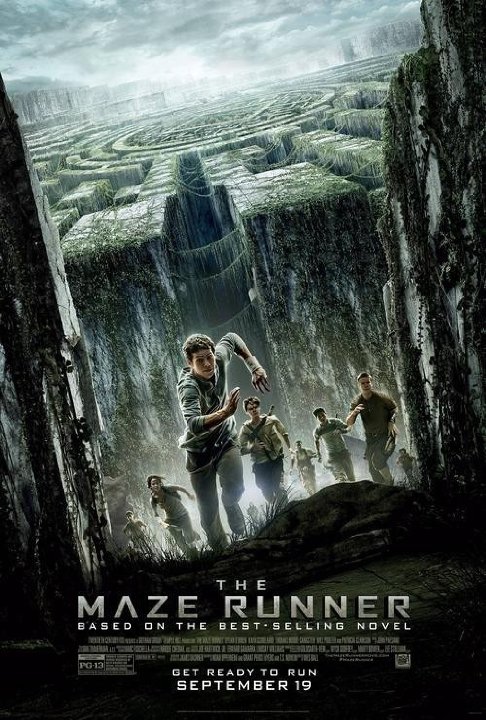 If anyone can reasonably explain to me the end of The Maze Runner in a way that makes some tangible amount of sense, I will give you money. The latest YA-franchise-in-the-making starts off with a storyline that reminded me of Rod Serling. We follow a group of teen boys, memories wiped, as they wake up in the center of a giant mechanical maze. Who put them there? Why? What’s on the other side? As long as the maze and the mystery of it are front and center, the film works, twisting in intrigue. However, when the story veers away to the characters, mostly flat archetypes, and their new society, that’s when I started getting sleepy. You got this awesome huge maze to explore, kids. The film ends up being an exercise in less-is-more restraint when it comes to sustaining a mystery and knowing what points to emphasize and which to skip over. There’s a girl brought into their camp, the first, which they say should be a big idea and change the social dynamics of a group of boys, but it doesn’t. There are silly mechanical spider monsters that scamper through the maze, as if the filmmakers felt a giant maze wasn’t a sufficient enough obstacle and selling point. Scattered flashbacks early on spoil who is responsible for the maze, but when we get to the actual ending, the rationale for who built this large contraption and for what purpose doesn’t add up, like, at all. An explanation wasn’t necessary, but if they needed a quick one I would have accepted, “Aliens did it because.” There’s already a planned sequel in the works. My idea: the kids escape the maze only to discover… they’ve just entered a larger maze. Then they escape that maze only to discover… you get the idea. The Maze Runner is moderately enjoyable. Just don’t expect to enjoy, understand, or even accept the ending and its implications.
Nate’s Grade: B-
Share this:

Lucy (2014)
 If you’re looking for one of the more fun summer movies that have no intention of taking itself seriously at all, might I suggest Lucy, which is one part superhero origin tale and one part wonky French existential drama. It starts off quickly, with the titular character being forced into a being a drug mule. The substance breaks in her bloodstream and the concoction transforms her from meek to a kickass vigilante of science. Lucy can now access far more of her brain’s potential, not just that meager 10 percent we plebs utilize, and who knew that we could all be superheroes if we really put our minds to it? Despite the presence of Morgan Freeman as really a talking head to let us know about the potential of the human brain, none of this really makes any sense, and thankfully the movie doesn’t pretend that it should. Lucy literally gains a new superpower every time we see her, from telekinesis to manipulating radio waves to eventual manipulation of matter and time travel. Yeah, it gets weird, but thankfully it’s also relatively entertaining, funny, fun, and short and sweet at a briskly efficient 90 minutes. The plot doesn’t exactly feel fully developed, more a gallop between events as we charge up the percentages from 10 to 20 to 30 percent, and so on. The criminals don’t seem like much of a threat despite their numbers. I’m shocked nobody assessed what happened to Lucy and said, “Hey, maybe I should ingest this drug into my bloodstream and become a super powerful being too.” While the action is well orchestrated, there is less of it than advertised, as Lucy spends a good amount of time adjusting to her new self-actualized human superiority, played by a detached yet amusing Johansson. I can’t even explain the bonkers ending except to note that maybe there’s a very good reason why human beings were not capable of using a maximum percentage of their brain’s capacity. It doesn’t make much sense but it’s pretty, entertaining with its messiness, and short enough not to waste your precious time.
Nate’s Grade: B
Share this:

Guardians of the Galaxy (2014)
 Who would have guessed that a movie that featured a talking tree and an anthropomorphic raccoon would be one of the best films of the year and one of the top grossing films of the summer? At this point for audiences, the Marvel name can do no wrong, but really it’s the degree of latitude given to Guardians of the Galaxy, an admittedly weird movie with strange characters, that allows this unique film to shine. Attaching offbeat director James Gunn (Super, Slither) to be writer and director was a risk that paid off tremendously, as Guardians is the Marvel film most entrenched with the particular personality of its creative director. This is a gleefully imaginative film that enjoys wading deep into weirdness, dancing to its adventurous Star Wars throwback beat, always with its focus set on comedy but not at the expense of quality drama or character development. Really, the characters are the focus of this entry into the franchise, and Gunn and his actors do a bang-up job of gathering the team and getting you to care about each and every one of them. Each one of these characters has a goal, several payoffs, and each is given their proper attention. In an ordinary superhero film, the archetypes would be ironclad. With Guardians, the tough guy made of muscle can also be a source of unexpected comedy with his literal-minded speech patterns. With Guardians, the talking raccoon can also be an emotionally disturbed victim of genetic experimentation who doesn’t know how to play well with others. These are damaged characters and their formation of an unconventional family unit is deeply satisfying and rather touching. I have seen the film twice and gotten teary-eyed both times. The real star of the film is Chris Pratt (TV’s Parks and Recreation), and what a breakout role he is afforded; he’s like Han Solo’s more juvenile nephew. But like the others, the part is surprising in its depth, with a well of sadness and displacement he still hasn’t processed while he scavenges the galaxy. The plot can be a bit unwieldy at times but pays off better for repeat viewings. This is a world I want to spend far more time exploring and with these characters as my merry prankster guides. With a movie this action-packed, thoroughly entertaining, and gratifying, why come back to Earth?
Nate’s Grade: A
Share this:

Dawn of the Planet of the Apes (2014)
 Anyone else think the titles of these Apes prequels should be retroactively switched? Coming off the heels of the surprisingly excellent flick Rise of the Planet of the Apes, those damn dirty apes are back with another summer blockbuster that’s just as mature, engrossing, emotionally resonant, and visually remarkable. Dawn of the Planet of the Apes takes place ten years after the events of the previous entry, with mankind devastated by the “Simian Flu,” the same bug that has kick-started the evolution of the primates. Caesar (Andy Serkis in motion capture) is leading a fairly conservative life; he has a home, a family, a wife, and a community he’s trying to build. Then a group of humans wander into their territory needing access to the remains of a dam for a power supply. The apes do not trust the humans, but Caesar accepts their terms, looking to avoid war. However, fear, resentment, and hate fester on both sides, and it’s not long before it’s apes vs. humans and you witness one of the greatest things your eyeballs will ever see – an ape firing two machine guns while riding a horse. Plot-wise, this film is more a bridge to a larger conflict between the two factions. The human characters (including Jason Clarke, Keri Russell, and Gary Oldman) are given short shrift. And that’s fine because the movie belongs to the apes; they are the stars rightfully. Half of this movie is in subtitles for ape sign language. Director Matt Reeves (Let Me In, Cloverfield) dwells in the moments other blockbusters don’t have time for. He lingers in the shadows, with silences, and we slowly integrate into the world of the apes and their own power dynamics. The all-out action of the third act doesn’t feel like a natural fit for the thoughtful movie that has played out until that point. The visual effects are again top-notch and the motion capture tech captures a stunning range of human emotions that you can witness play out across the CGI creations. Toby Kebbell (Wrath of the Titans) portrays Koba, the more hawkish member of the ape tribe, and he is just as good as Serkis, which is saying a lot. I’d still call Rise a better overall film, but Dawn is a more than worthy follow-up that reminds audiences what great storytelling can achieve with the right people behind the scenes.
Nate’s Grade: A-
Share this:

Snowpiercer (2014)
 I have seen Snowpiercer twice and it’s still a hard movie to describe. It’s the English-language debut of Korean filmmaker Joon-hoo Bong, notable for The Host (the good one) and Mother. It’s based upon a French graphic novel only printed in France and South Korea. It’s an international production, filmed in the Czech Republic, and populated with recognizable actors like Octavia Spencer, Tilda Swinton, John Hurt, Ed Harris, and Captain America himself, Chris Evans. It’s a dark dystopian allegory about class warfare, it’s a stunning sci-fi action movie, it’s a parable about humanity, it’s a stylish thriller that puts most of Hollywood to shame; it’s many things, chief among them, an incredible movie that demands to be seen on the big screen when able.
To combat global warming, world leaders disperse a chemical to lower temperatures, and oh boy does it work, inadvertently causing a new Ice Age that kills almost all life on the planet. Almost, because a few hundred got aboard the train owned and operated by Wilford (Harris), a rich and secretive industrialist. He built a train that can circle the globe, running on a perpetual motion motor. The last of humanity is housed on Wilfrod’s train. After seventeen years aboard, the class system has become rather rigid. The important and wealthy are at the front of the train, and the poor are crammed in the back, given gelatinous protein blocks to eat, and kept in line by armed guards. Curtis (Evans) is plotting a revolt, biding his time, consulting with the wise Gilliam (Hurt), an aging leader missing several limbs. Together, they storm ahead, capturing effete Wilford spokesman Mason (Swinton) as a hostage, rescuing an engineer (Kang-ho Song) with a drug addiction who will help them open the train cars, fighting car by car to take control of the train. Naturally, those in power fight back in force to maintain the uneven status quo.
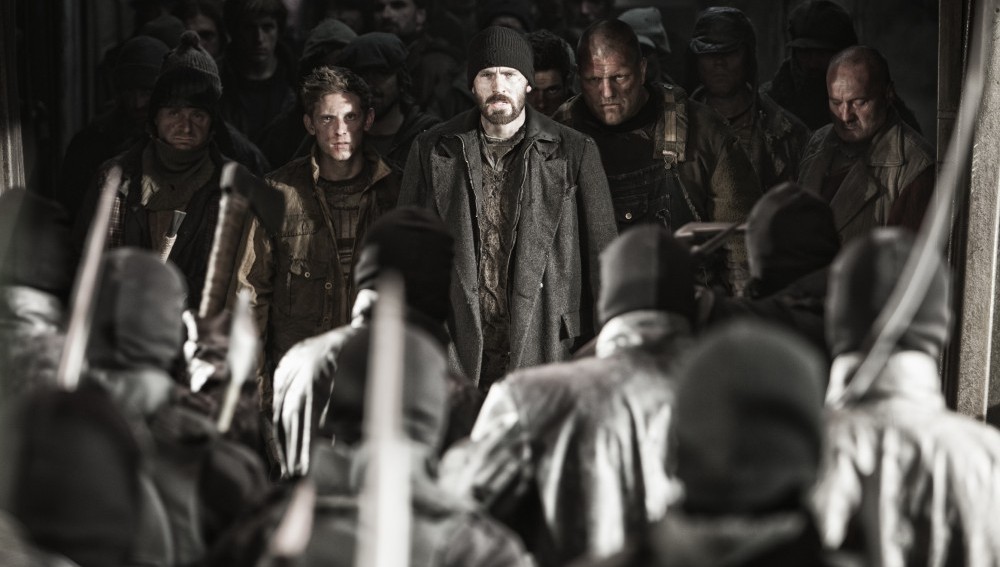 Short of the adrenaline-soaked Raid 2, there hasn’t been a better action movie this year than Snowpiercer. It starts slow, drawing the audience in, setting up its initial burst as a prison break of sorts where the tail section passengers have to figure out a way past the guards and several security doors open for only a few seconds. When the break does happen, in a clever fashion, you feel the full rush of the new opportunity thanks to the movie properly setting up the stakes and obstacles. Each new car presents a new world and a new obstacle. There’s one car where Curtis and his revolutionaries are met with fifty ski-mask wearing grunts with axes. This is the standout action sequence because of how it keeps changing. At first its brawn versus brawn, complete with swinging axes. Then the fighting stops briefly and all the grunts put on night vision goggles. The train enters a long tunnel, condemning Curtis and company to the dark. The grunts then go to town, spearing and slashing the hapless passengers blindly swinging in the dark. I won’t spoil the solution to this scenario but it too is properly set up and leads to some extremely satisfying action imagery, the kind of stuff that pops in a trailer. There’s an entirely different sequence later that also stands out. As the train goes into a long curve in the track, certain train cars are visible from others. Our chief heavy, listed as Franco the Elder (Vlad Ivanov), sees Curtis in the car ahead and starts firing. Eventually Curtis and Franco blast small holes in the protective glass and wait, wait for their moment, for their shot. It’s a tense neo-Western standoff moment, and another delightful addition. The accumulative action has a surprising degree of variety and development.
Snowpiercer is a stirring action movie that keeps your eyes glued to the screen, but it does an equally impressive job of building its world and adding dimension to its storytelling. Reportedly, Harvey Weinstein wanted to cut twenty minutes out of the 126-minute film, but I’m puzzled as to where those edits would come. Every scene in this movie drives the film forward or imparts crucial pieces of information or metaphor that will play out later. Even something as comical as stopping for sushi in the aquarium car (balancing the ecosystem) has greater meaning and subtext when you look back at the film as a whole. Joon-hoo Bong and his co-screenwriter Kelly Masterson (Before the Devil Knows You’re Dead) have given serious consideration to how this world operates and what life would be like when all of humanity is confined to one long train. The past is revealed incrementally, gingerly allowing the audience to become consumed with this odd dystopian landscape, our fascination brewing with each new puzzle piece being added. I was enthralled with the rich details, the cruel methods of keeping those in the tail section in line, the regular head counts, the protein block bars and what they truly are made of, the annual celebration of passing a certain bridge marking their own New Year, and especially the deification of Wilford. The characters worship the engine, and why not since it is the source of life for them, or as the chirpy schoolteacher (Alison Pill) sings: “What happens if the engine fails? We all freeze and die!” The later reveals are the best, giving full explanation why tail section children are important and, particularly, why Curtis is so ashamed at having two good arms. That monologue by Evans, looking back on the earliest and most cruelly chaotic days on the train, is a whopper. I truly hope that aspiring actors will use it during future auditions. It will make an impression.
 Its dark sense of humor and political and philosophical subtext provide an even richer texture to this strange, bleak world. The political commentary isn’t exactly subtle, I’ll admit, but it’s exceedingly better executed and integrated into its plot than, say, last year’s Elysium. The class-consciousness provides a greater depth to the proceedings, providing a new spin on the have/have nots that’s just as relevant today. It’s not just tacked on, either. The political commentary is intertwined with the mechanics of the plot, as we’re witnessing class warfare against inequality, how barbarous acts can be co-opted for personal gain. When Curtis and his small company finally reach Wilford and the engine, it’s a moment akin to visiting the Wizard in Oz, the man behind the curtain they’ve heard so much about. There’s a great degree of incredulous humor from Wilford’s vaulted perspective, but the longer you listen, the more you start to follow his twisted logic and why exactly the status quo must be upheld despite the bloody consequences. Then there’s the macabre humor, which can be bracing at points, none more so than the school car sequence with Alison Pill (TV’s The Newsroom). Also doing plenty of comedic heavy lifting is Swinton (Only Lovers Left Alive, We Need to Talk About Kevin) with such an odd authority figure character. With a mouthful of fake teeth, some owlish glasses, and a peculiar speech pattern, it feels like she stepped out of a Terry Gilliam movie, and we’re all the better for it. Often she’s the only source of humor in what is otherwise a dreary story about the strong preying upon the weak.
Stylish, intelligent, rewarding in surprising ways while still being thoroughly entertaining, with tremendous technical attributes such as production design, Snowpiercer is a sci-fi flick that borrows from many but creates its own unique and enthralling landscape. Rare is the movie going experience where you sit at the edge of your seat, completely taken in by the creativity of the artists at work, transported to somewhere new and exciting, and you dread the approaching end credits. Snowpiercer is an experience that’s hard to describe beyond an unrelenting checklist of positive, glowing adjectives. Simply put, it’s movies like this that make going to the movies special.
Nate’s Grade: A
Share this:

Edge of Tomorrow (2014)
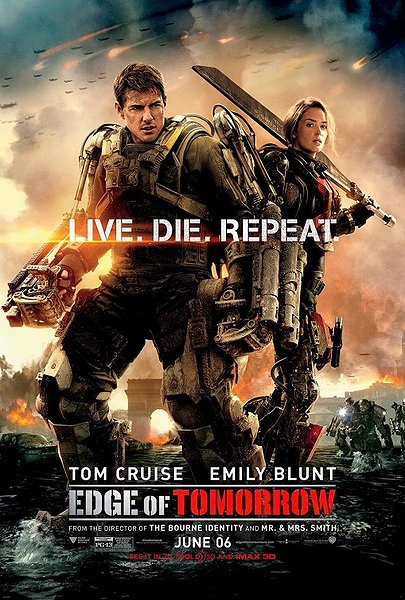 I’ve always been one able to separate the art from the artist, so while Tom Cruise may annoy people in real life because he jumped on a couch one summer, that doesn’t halt my enjoyment of the man’s movies. It seems with every new Cruise vehicle that under-performs at the box-office that I must be in the minority. Cruise hasn’t had a hit to his name since 2011’s suitably awesome Mission Impossible: Ghost Protocol. Both Oblivion and Jack Reacher, perfectly solid action movies, failed to make over $100 million domestically, further calling into question the drawing power of Tom Terrific. It seems that his latest, Edge of Tomorrow, is going to suffer a similar fate. This is a shame. As my critical colleague Ben Bailey said in his own review for the film: “Edge of Tomorrow might just be the most critically acclaimed box-office bomb of 2014.”
William Cage (Cruise) is chiefly an Armed Forces PR flak. He goes on TV to push the talking points of the United States military, which is in a heap of trouble. Aliens have landed in central Europe and spread quickly, proving to be nearly unstoppable. There was one soldier who was able to lead a successful counter attack. The “Angel of Verdun” is Rita (Emily Blunt), a soldier Cage proudly chirps only spent a day in her mechanical fighting suit beforehand yet proved to be so deadly. After vaguely threatening a high-ranking official rather than report for a doomed counter assault, Cage is shipped to the frontlines as a deserter. In hours he and a motley crew of ground forces are flown to the beaches of France, where the aliens will slaughter them. In the firefight, Cage is covered with alien blood and gains their special power. The reason the aliens have won every battle, save one, is because they have the power to reset time. They learn from their errors, which is why they always anticipate humanity’s attacks. Now Cage has this power. Every time he dies, the day resets and he starts over, trying once again to survive. The only person who understands him is Rita, who once had the same power. Together, with some extensive training, they may be able to thwart the alien invaders for good.
 Edge of Tomorrow is the ultimate video game movie, and while I would normally mean this in a pejorative sense, it is actually a compliment. With every death, Cage gets to start over, looking for a way to complete the next stage of the next level, learning from his costly mistakes and hoping to get to the boss battle that usually closes the level. From a structure standpoint, it’s a pure video game, albeit an older sidescroller (remember those, kids?). The visuals and mechanical battle suits also further support the video game comparisons. But really, Edge of Tomorrow is Groundhog Day meets Starship Troopers but brilliantly executed. There is something deeply satisfying about the Groundhog Day formula, namely getting seemingly endless chances to fix one’s mistakes, to try out new paths. It’s also inherently satisfying as an audience member because you watch your hero fail time and after time but they’re still active, they’re still trying to achieve a goal, or a new goal, and thus when they do succeed it’s even more triumphant and gratifying. We get to learn alongside our protagonist. Also, it allows the narrative to explore new material without going stale. In most stories we have one set path, but in films like this one with a time loop, it’s like we get to see all the wheels-within-wheels, the stories just offscreen happening simultaneously. It opens up the world in more interesting and playful ways, providing more payoffs than just one set narrative destination. We get assorted answers to our “what if”’s. Plus we get more screen time with Bill Paxton (2 Guns) as a comically hardass master sergeant. Edge of Tomorrow mines all these areas expertly. This is a movie that embraces the possibility of its sci-fi premise. It’s constantly clever, fast-paced, lively, and expects its audience to keep up with the pace.
It’s great to see director Doug Liman flex his action-thriller abilities again, ineffective or dormant since 2005’s Mr. and Mrs. Smith. The man has an innate ability to orchestrate action without losing sight of character. The beach invasion sequences have plenty going on, enough so that you won’t be bored after multiple trips, and unlike last summer’s disappointing Elysium, this is one movie that knows how to make proper use of a mech suit. These suits don’t look that impressive but they pack some mighty firepower. It’s rather cool when Cage, after a litany of failed trips, has the beats of combat to memory, knowing to shoot in this direction at the right second. It’s like watching a man harness the omniscient power of God (“I said I was a god. Not THE God.”). Under Liman’s guidance, the action is big and exciting and fun, more so than any other Hollywood action movie I’ve seen this year (The Raid 2 is still in a class its own).
The action sequences and special effects are all relatively good, but it’s just the sheer fun of the movie that makes it special for a summer would-be blockbuster. It’s like you get multiple movies smattered together but the eye is always forward to the goal, taking out the alien brain/host. The structure is almost foolproof: by the end of Act 1 he gets the time-tripping powers, and by the end of Act 2, he loses them and the heroics to close the movie have to count for real. I wish the final boss battle didn’t happen to take place in the bowels of a famous landmark/destination, but I suppose Liman and company needed a change of pace from all the beach activity. While the movie covers plenty of ground repeatedly it never feels old or directionless; while it has its share of sticky exposition and silly plot mechanics, it never overwhelms the story or the entertainment factor. The basics of who the aliens are, how they attack, what their magic blood does, what the rules are for utilizing said alien time-repeating power, you would imagine that they would be too silly or bog things down, but they don’t. Except for the very end (the concluding two minutes), the movie plays within its own system of rules. That also means no unrealistic romantic entanglement. Sure we expect movie stars to fall for one another, especially in peril, but for Rita, every day is the first day she’s ever met Cage. He develops feelings for her but she credibly keeps thoughts of romance at bay.
 It’s also a mordantly mirthful movie. Cage can only reset when he dies; if he is just wounded and passes out, he’ll lose his special reset power. So every insurmountable roadblock, wrong choice, or crippling injury must be met with one conclusion, namely Cage being snuffed out. Rita carries out most of the executions in the second half, with a blasé sense of routine duty, like a plumber fixing a clog. It doesn’t really get old and Liman utilizes montage well to give the comedy an extra punch. It lightens a movie more or less centered on human annihilation and mortality. And for the legions of Tom Cruise haters, there’s got to be some degree of entertainment value in watching the man die again and again and again and, well you get the point.
Cruise ably shows again that he is more than capable of carrying an action film (he’s over 50 now too). The man still has enough energy and physical stamina of an action hero in his 30s, and his charisma is still there in spades. It’s also interesting to watch Cruise play a cowardly character. I should have expected it considering that Cage’s arc has to start somewhere before he becomes the super soldier. However, the movie would never have been as good if Cruise didn’t have a strong leading lady, and the surprisingly buff Blunt (Looper) is an excellent match for her costar. She’s tough and can beat the snot out of you. Just her very walk exudes confidence and determination (is it too late for her to be Wonder Woman in the next Superman film?). Having walked in Cage’s shoes before with the time-replay power, she has an extra weariness to her, a certain devil-may-care attitude, especially in battle. The two actors make a winning team and Cage’s recruitment of Rita is another mission with another worthy payoff.
The original title was All You Need is Kill, based on a Japanese graphic novel, and I can’t help but think how much of a better, striking title that is to describe this movie. It’s a wonderfully entertaining movie, with its action spectacle tempered with an intelligence rare for a summer blockbuster that doesn’t have Christopher Nolan’s name attached as director. Here is a playful sci-fi movie that doesn’t downplay its sci-fi, doesn’t dumb down its plot, and explores the richness of its world one dead Cruise at a time. It’s clever and satisfying and brings all the visual fireworks you’d demand. It’s a rotten shame that Edge of Tomorrow appears destined for the cinematic scrapheap. We need more movies like this one. Reverse the tide people and see this movie on the big screen while you can. It’s everything we want in a summer blockbuster fully realized.
Nate’s Grade: A-
Share this:

X-Men: Days of Future Past (2014)
 Ever since Marvel’s Avengers destroyed the box-office in 2012, every studio with super hero franchises has been looking to follow suit. It’s not just about comic book franchises; it’s about building a comic book universe. It’s been a long dark period for the X-Men ever since the regrettable 2006 debacle The Last Stand, which callously killed characters, butchered others, and botched the most famous storyline in the history of the comic. In 2011, Matthew Vaughn proved there was still life to be found in the franchise with his terrific 60s-era prequel, X-Men: First Class. Now, post-Avengers, Fox is salivating at combining the past X-Men and the present X-Men into one colossal movie with a colossal budget. Back on board is director Bryan Singer, the director of the first two X-Men films and the man who helped kickstart the modern superhero era. If that wasn’t enough riding on the film, X-Men: Days of Future Past also follows the second most famous storyline in the history of the comic.
In the horrible future, killer robots known as Sentinels hunt down mutants. These are the invention of Dr. Boliver Trask (Peter Dinklage), a military scientist who was killed back in 1973 by the vengeful shape-shifting mutant, Mystique (Jennifer Lawrence). The murder convinced humans to subsidize Trask’s killer robot plan of defense. Thanks to experiments replicating Mystique’s mutant ability, the Sentinels have the ability to adapt to any power, turning them practically indestructible. In the future, the Sentinels are eradicating all mutants, mutant sympathizers, and eventually human beings. Magneto (Ian McKellen) and Professor Xavier (Patrick Stewart) have teamed up with a small band of surviving mutants, including Wolverine (Hugh Jackman). Thanks to the phasing powers of Kitty Pryde (Ellen Page), they can send Wolverine’s consciousness back to 1973 so that he can prevent the Trask assassination. The only ones who can help Wolverine is the younger Xavier (James McAvoy) and Magneto (Michael Fassbender), former mentors to Mystique. Except Xavier is a recluse and strung-out on drugs to dull his powers and Magneto is locked away underneath the Pentagon.
 The X-Men films have always had a topical advantage to them that provided a weightier sense of drama than your typical story about a reluctant soul blessed with amazing powers. The mutant allegory automatically applies to any sub-group facing oppression mostly through fear and ignorance. What other superhero franchise has two opening scenes in a German concentration camp? The stakes are even larger with this movie because of the Horrible Nightmare Future that must be prevented. Now we all assume said Nightmare Future will be avoided by film’s end, so the movie provides a proverbial reset button that the filmmakers can have fun with, and they do (look out future mutants). Excluding the Nightmare Future framing device that becomes an unnecessary parallel storyline, the majority of the film takes place in 1973. If X-Men: First Class tapped into the groovy optimism and “take me for what I am” sense of social justice of the time, then this film certainly taps into the disillusionment of the 1970s, where the promise of reform and hope morphed into anger and cynicism (hey, that’s like us today!). This loss of innocence is typified in Mystique, who becomes the central figure of the movie in many ways. Her seething desire for vengeance is what animates her, as well as the pain of betrayal from the men closest in her life, as well as the world who once held such promise. Also, Jennifer Lawrence (The Hunger Games) has become one of the biggest female stars on the planet, so it makes sense to bolster her role. The central conflict is stopping an assassination, one domino that leads to many others, but it’s emotionally about Mystique having to confront her feelings of hate. It’s another platform for the ongoing conflict of perspectives between Xavier (restraint, tolerance) and Magneto (strong defense, eye for an eye). But as I found in First Class, it’s hard not to agree with Magneto as human overreaction leads to rash and thoughtless actions, like Horrible Nightmare Future.
That’s not to say that X-Men: Days of Future Past fails to deliver when it comes to the popcorn thrills and action highs we crave in our finest summer blockbusters. The action set pieces are large without dwarfing the characters, playful and imaginative without losing a sense of edge and danger. I loved how the character Blink (Bingbing Fan) would utilize her mutant power of opening portals as a fighting strategy. It makes action sequences so much more inventive and visually exciting to throw a series of portals. The pacing is swift short of the second half of Act Two, gearing up for the climactic showdown in D.C. that dominates Act Three. The time travel story starts with a lot of exposition but it gets smoothed out as it goes, the rules of the story fall into place. Every action sequence hits, some admittedly better than others, but it’s the small touches that Singer injects that made me smile most. I enjoyed Magneto pointing a gun, being toppled, but still using his power to have the gun fire in midair. I enjoyed the animalistic nature of the Beast/Wolverine brawl. Jackman is looking even veinier than usual in his bulked out form. Thankfully the fish-out of-water timeline jokes are kept to a minimum. Wolverine is the perfect glue to hold both timelines together. And then there’s that standout Pentagon prison break sequence (more on that later). Singer might not have the most natural instincts developing and staging action, but the man is a surefire talent when it comes to staging eye-catching visuals (I would say the same about Christopher Nolan). Even his unfairly maligned Superman Returns is proof of the man’s cinematic gifts. As far as entertainment value, this is right up there with X-Men 2. I still view Vaughn’s savvy First Class as the best X-film of the bunch, which has only gotten better the more I’ve watched it.
 And if that wasn’t enough, Singer’s new film does what every fan has been hoping for: (spoilers) it erases all the crummy X-Men movies, namely 2006’s Last Stand and the first Wolverine solo effort, from the official timeline. It’s time to start anew, toss out the old stuff nobody liked, and forge ahead with a new unified timeline. There can be two parallel X-Men franchises, one present/future and one with the prequel casts, and they can go on forever as desired, or until the prequel cast prices itself out. In one fell swoop, Singer and company have reset the mother franchise and given fans new hope about the possibilities. Make sure to stick around to the very end of the credits for a scene that indicates directly who the next major villain will be in the 2016 sequel.
Let me take time to single out just how expertly Evan Peters (TV’s American Horror Story) steals the entire mutant-heavy movie. First, he’s the most comically attuned character, which is a nice break from how serious, and rightly so, every character is so often. Quicksilver provides a whole new jolt of entertainment, and when he checks out after the prison break sequence you’ll dearly miss him. The character is a rapscallion (as my late grandmother might have termed) that enjoys using his super speed powers to mess with people, to test his limits, to see what he can get away with, and a Pentagon jailbreak is right up his alley. Ignore the silly yet period appropriate outfit and ignore what initially seems like Peters’ smirking self-involvement from trailers and ads. When this character is onscreen the movie has a joyful sense of irreverence. He is instrumental to freeing Magneto and the onscreen depiction of his super speed is the best illustration of the power ever conceived in film and TV. There is a segment sent to Jim Croce’s “Time in a Bottle,” and some wonderful special effects, which is just so playful, so giddy, and so cool that it very well might be my favorite moment in any superhero movie… ever. It is definitely an applause-worthy moment and my audience responded in kind. Quicksilver is a perfectly utilized supporting player in a movie stuffed to the gills with characters.
The time travel geek in me has a few quibbles with the parallel lines of action from past and present. Wolverine’s consciousness is sent back in time but he film plays out like it’s happening simultaneously to the events of the future. So if Wolverine is pulled out in the middle of the movie, he’ll have failed his mission to change the future, even though by going back in time he’s already, blah blah blah butterfly effect. Anyway, I understand how they want to make the future story have a sense of urgency but it’s not like waking Wolverine from a dream; the times are not happening concurrently. He’s in the past, meaning that the moment he goes back there, the future will already be altered due to the consequences of his actions, for better or worse. There is no race against time to keep his consciousness back in time until he complete his mission. I can see why they went this route for a summer blockbuster, but that doesn’t quell the quibbles.
 X-Men: Days of Future Past is a time-hopping, unabashedly fun time at the movies; well as fun as preventing nightmarish futures built from the consequences of oppression and prejudice can be. With Singer back in the saddle and the bridging of the two X-Men universes, the series is back on track and once again the promising font of stories and characters. The newest X-film is one of the most entertaining, funny while still being dramatic, and while burdened with the largest cast of any super franchise, finds notable moments for its characters big and small to remind us that these people matter. While less philosophical and funky than First Class, this is one of the best films in the franchise, on par with X2. The action sequences and visual eye-candy are great fun with some inventive and memorable touches. It’s also nerdy fun getting to watch the past and present interact, and for many this is their first return since 2006’s crappy Last Stand. It’s not a perfect movie; I wish there was more early Sentinel action, I wish Dinklage had much more to do, and I wish that the plot didn’t so transparently hinge on Xavier not having his powers. The slate is clean and all X-Men fans can breathe a sigh of relief. The future is once again rosy. The X-Men, and not just Wolverine, are relevant once again.
Nate’s Grade: B+
Share this:

Godzilla (2014)
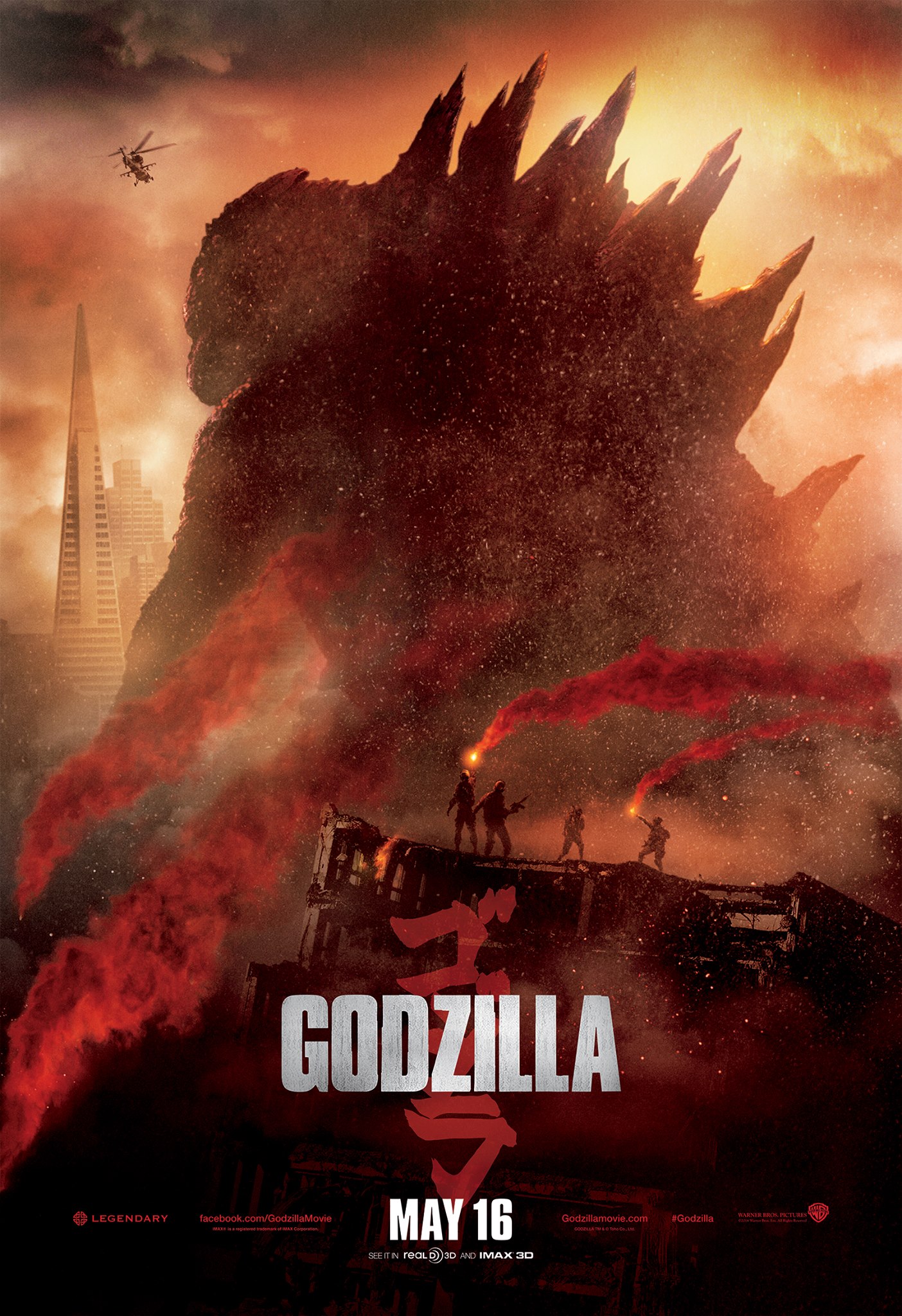 When it comes to the monsters of cinema, it’s hard to beat out Godzilla, and not just because, you know, he’s hundreds of feet high and can breath fire. The famous monster began as a cautionary tale about nuclear weapons, destroying man’s hubris and often the good people of Tokyo. The legendary beast has been hibernating as such since 1998’s not-so-spectacular big-budget return, a film that the Japanese loathed. But like all ancient being, Godzilla has been resurrected again and given a splashy new coating of CGI devastation. If only the filmmakers had decided to leave out the humans and make Godzilla the rightful star.
A scientist (Bryan Cranston) warns the Japanese government of a massive impending danger. The offspring of a giant creature, a Massive Unidentified Terrestrial Organism (MUTO), has hatched and heading straight for the United States coastline. Attracted by nuclear power, the U.S. military tries to lure it away from populated centers. Ford Brody (Aaron Taylor-Johnson) is witness to the monstrous destruction and just wants to get back home to his wife (Elizabeth Olsen) and child in San Francisco, exactly where the creature is headed. There’s also the emergence of an older creature, one that has taken to combating the MUTOs to the death. This is the legendary Godzilla.
The big guy is back in a very different approach from 1998’s Godzilla (i.e. “better” approach). Director Gareth Edwards (Monsters), an avowed Godzilla fan, has made a reverent big-budget ode to the king of all monsters; however, the resulting film is more of a disaster epic than a monster brawl. The perspective is often framed at the human-level, which grounds the film from going too overboard into disaster porn territory like, say, Man of Steel. The effect is thrilling and adds a greater sense of verisimilitude to the mass chaos and destruction. It reminded me in some ways to 2008’s Cloverfield, where a group of characters is just trying to survive the periphery of all the collateral damage of a giant monster. There are sequences that directly relate to Fukushima as well as the tsunami from 2004. It’s almost like somebody watched the stirring movie The Impossible and said, “Yeah, give us some of that in our giant monster movie.” I don’t know if these sequences are entirely necessary. Watching Ford carry around a little Japanese tyke, wondering where his parents might be amidst the confusion post-monster attack, it relates to our modern response to tragedy and worldwide disaster, but do you really want to watch Ford have to find this kid’s parents? If there is a commentary to be found in the movie, it’s the uncontrollable and destructive power of nature pushed to the brink by mankind’s own energy crises. After all, the MUTOs are attracted to and strengthened by consuming nuclear energy. Godzilla is argued to be an “alpha predator” but also a figure to bring balance back to nature. I think it means that there can be only one giant monster and Godzilla is going to eliminate the competition.
 But the real question of any giant monster movie is the degree of satisfying, smash-em-up fun it provides, and the new Godzilla is a mostly agreeable venture. The action sequences, mostly saved for the climax, are cool and well thought out, but Edwards proves to be a brilliant visual stylist than a composer of action. This is a movie where the moments stand out better than the action. Edwards’ command of cinematic visual arrangements is at Spielberg levels of being a natural showman. I can easily think back on small moments, images that pop, visual reveals that are executed with aplomb, far more so than a central example of an action piece. I loved the horror-esque reveal of the elevated train being on track to head right for the MUTO. I loved the hide-and-seek nature of Ford waiting for the MUTO to pass. I loved when Ken Watanabe’s advice was literally just, “Let them fight” (I started chanting it in my seat). My favorite part of the movie is actually what was previously shown as a teaser trailer, namely Ford and several other paratroopers diving into the destructive city scene. The eerie hum of the 2001: A Space Odyssey monolith plays over, each man has a red flare streaking from their leg, and we watch them quickly descend through the sky, nervously awaiting what is on the other side of those heavy clouds, only to discover a city on fire, glowing like a hearth, and through the goggles, a monster fight taking place. The entire sequence is a visual standout, a thrilling set piece, and a reminder that Edwards has more on his mind.
Edwards does a lot of intentional teasing of Godzilla, so much so that it can get frustrating for an audience. I understand he’s building to a payoff reminiscent of Jaws; we’ve been teased for so long that we will go nuts when we finally see Godzilla in full glory, and it works. However, it also works as a detriment. There are several points in the film where it looks like we’re about to get some exciting Godzilla/MUTO action, or even just a MUTO wrecking havoc, and then the film cuts away, often to news footage. It’s a choice that begins as artistically clever but can become maddening in time. There is a lot of visual obfuscation throughout the film, far more so than the same compliant I had with last year’s Pacific Rim. Edwards will show Godzilla’s tail just swinging behind a building, or his colossal foot coming down with authority, or the wispy shadow of giants in billowing clouds of smoke. All those near misses can add up to cinematic blue balls. And so much of the action and destruction happens at nighttime, leading to a dour color palette heavy in grey and dark blacks, making the good stuff all the harder to see. I cannot even fathom why someone would want to see this film in 3D with those darkened glasses. It’s 90 minutes of foreplay that you may start to grow restless that we’re getting a Godzilla movie that will never show the goods (shouldn’t Godzilla be in a Godzilla film?)
 The problem with a disaster movie on a human-scale is when you don’t give a damn about any of the human characters. Now, Godzilla should be the star of any Godzilla movie but I understand execs fearing that their monster movie needs some relatable human drama. The problem is that the writing doesn’t do anything with these characters, forcing them into tidy and token roles that we’ve come to expect from large-scale disaster movies. Did anyone really feel anything about whether Ford would get back to his wife and child? Did anyone feel anything for anyone in this movie, beyond a slight reservation whether they would be squished, if even that? I’m not expecting three-dimensional characters here but even Roland Emmerich films do a decent job of establishing a milieu of people at various points of the globe we know will somehow coalesce together. There is so little effort to mask the character’s grand design: exposition mouthpieces, symbols of military threats, the noble family man, the beleaguered and crying wife. Seriously, there is a great cast of actors in this movie and they are given nothing to work with. Olsen (Oldboy) gets to look realistically scared and cry but she deserves so much better. Cranston (TV’s Breaking Bad) gets all the best yell-worthy lines. But it’s really Taylor-Johnson (Kick-Ass 2) who suffers the most since he’s placed as our impassive stand-in for a human protagonist. He’s so blank throughout the film and there’s little charisma to pull you in. His character, and the performance, feels no better than an elevated extra, Grunt #13. When we have to spend 90 minutes with these lackluster characters rather than some awesome monster fights, that’s when the film flounders.
I’m conflicted about the end results of Godzilla, an entertaining, surprisingly artistic film that can nail small moments of cinematic grandeur but has trouble matching its vision. The human-scale approach grounds the action, but do we want a giant monster movie grounded from a limited vantage point? The constant teasing builds a payoff for finally seeing Godzilla, but don’t we want more actual Godzilla in a film bearing his name? The human-scale, as well as the slow dodging of showing Godzilla, mean the storytelling emphasis is on an array of human characters, but what happens when they are poorly written, poorly developed, and lacking in charisma? The movie does more right than wrong but I’m left with the unmistakable feeling that, while a step in the right direction, there is too much self-sabotage holding back the movie. It actually made me re-evaluate and appreciate Pacific Rim even more. I can’t say this movie is nearly half the fun as Rim was. The monster design of the MUTOs is rather lacking, resembling a cross between the monster from Cloverfield and more patently the arachnid aliens of Starship Troopers, down to the heads that look like staple removers. Edwards has proven himself a big screen talent with a terrific feel for grandiose visual spectacle. I just hope if there is a sequel that we can skip all the slow buildup and just get to the main event – Godzilla beating the crap out of some other lesser yet still giant monster.
Nate’s Grade: B
Share this:

Divergent (2014)
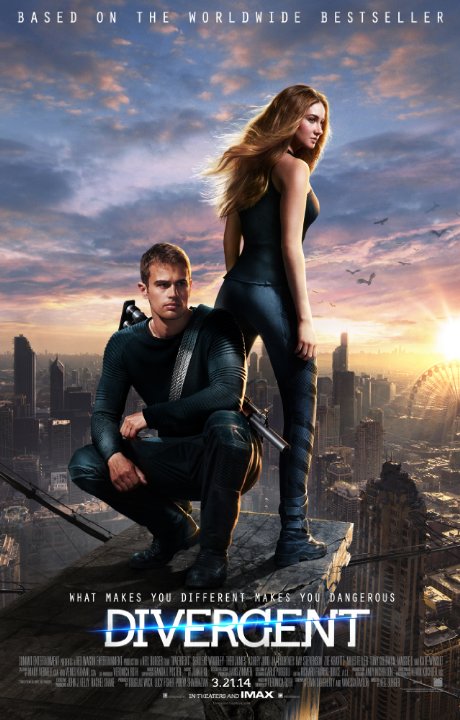 High school for many was a personal version of hell, with its class system and pressure to conform. Divergent built a whole future dystopia around this relatable concept. The problem with the movie is that the source material doesn’t think that much further.
In the future, 100 years after a great war that scarred the world, the survivors have holed up in the remains of Chicago with a large fence as their protection. The government decided to split off into five different factions, each with their important purpose. The five factions (Abnegation, Candor, Erudite, Amity, and Dauntless) work in harmony. Tris (Shailene Woodley) comes from a family of Abnegation, the selfless ones who run the government, though Jeanine (Kate Winslet), the head of Erudite, would like her faction to be on top. At the choosing ceremony, a candidate can select which faction they wish to live within. However, if rejected, that person will be factionless and on the outskirts of society. Rather than choose the comfort of her boring life, Tris decides to join Dauntless, the faction in charge of the security of the city. Before she can say goodbye to her family, she’s off joining a new one, but Dauntless has many tests to weed out the weak. Paramount in her mind is the fact that Tris is told she’s a divergent, one who doesn’t fit neatly into any one of the factions. Divergents are being singled out and executed because they are feared; they can’t be so easily controlled. Tris has to prove herself against tough competition in Dauntless while hiding her true divergent nature.
 Having not read the best-selling Young Adult books, I went into Divergent and walked away entertained enough though questioning the larger appeal. My movie partner told me that the adaptation hews closely to the book, fitting in all the major plot beats; she even said it was a better adaptation than the first Hunger Games, so fans should be relieved. What the movie came down to was one long plot about Tris getting through the Dauntless tests. It’s like a post-apocalyptic Full Metal Jacket, just minus the war half. With this tight focus, the film actually plays better and is easier to digest. The stakes are made clear and the hurdles are easy to understand. In a way it reminded me of the Ender’s Game film where we watch a recruit move up the ranks of their sci-fi training, though Ender’s was better at establishing dimension to its world. I did like the small touch that the Abnegation people won’t allow themselves to see their reflection because they see it as vain. I could have used more touches like that.
There are simple pleasures watching Tris, the plucky underdog, rising to the challenge and besting her snobby peers. The games get more intense and Tris learns from trial to trial, eventually learning how to hide her divergent nature by blending in against her nature. There’s also an intensity to this world that’s appreciated; people will die if they can’t keep up (there is one shocking sequence where a batch of jealous recruits literally try and kill Tris). The physical trials are fun but the mental ones are even more entertaining because they function around the candidate’s fears. It’s a tad lazy to simply broadcast a character’s fear for them to confront in a dream, but it provides some creepy imagery and new wrinkle for Tris to master. Even the requisite romance that every YA property has to have is handled respectfully without overdoing it. The mentor/teacher relationship with Tris and Four is a natural conduit for their budding romantic feelings, though James (Underworld: Awakening) looks way older than Woodley (The Descendants). In reality, he’s 30 and she’s 22, though she’s supposed to be… 17? 18 years old? I don’t know but it just didn’t sit right.
 Where the movie gets into problems is the larger world outside those Dauntless camps. It feels too ill defined and purposely vague. What’s on the other side of the giant electrified fence (hopefully dinosaurs)? I suppose that’s what sequels are for (they’re already filming the second Divergent for March 2015). The world just feels too small even for one city, and the history doesn’t feel integrated into the cultivations of this society. In a sense, the movie doesn’t give you enough to go on with its world building and spends far too much time dragging out its story. At a hefty 142 minutes, a time frame becoming de rigueur with YA adaptations, the film feels laboriously padded. I kept thinking the movie was going to check out at any moment, robbing me of some semblance of a complete ending. Fear not, there is an ending, though one that feels far too definite to continue a franchise. The bad guys are so obviously guilty, that even while still being at large, it’s hard to fathom a scenario that doesn’t unite everyone against the common threat. Does every YA post-apocalyptic mold eventually lead to unlikely heroes becoming the focal points of revolutions? I’m being facetious, but also highlighting just how derivative this movie is. Divergent borrows from its larger influences liberally, having enough story sense to know how to construct a satisfying tale of heroes and villains. It’s a well-polished film thanks to director Neil Burger (Limitless) but it’s also lacking necessary elements to distinguish it from the glut of dystopian imitators and predecessors.
I just can’t wrap my head around the world of Divergent. It lacks the clean clarity of, say, The Hunger Games, where the game is kill-or-be-killed and it’s very much a class warfare allegory. In Veronica Roth’s novel, the post-apocalyptic Chicago is divided into five factions but this isn’t a caste system. The different factions are looked at as equals, meant to cooperate harmoniously. So there goes any sort of class conflict when the factions are presented more as lifelong clubs. The design is that branching people off into five groups will somehow prevent the strife that lead to the unnamed war of the past. This doesn’t really make a lot of sense to me. Why would limiting people’s options for careers and lifestyles eliminate conflict? I understand the not so subtle message about conformity and the strength in controlling others, but it still doesn’t hold. Then there’s the notion that a divergent is a dangerous rogue, but it’s not like the divergent are mutants or genetically different. These are just people who don’t fit neatly into one of the five faction options. If you eliminate the conformity obsession, who cares? It’s only an aptitude test in the end, like what you take in middle school that say, “Hey, you like drawing, maybe you’d like to be a police sketch artist” (true personal anecdote of mine). It’s not something that looks deep into the souls of boys and girls and presages their future. It’s an aptitude test for crying out loud. The world of Divergent also feels strangely unfulfilled, with too many lingering questions about the logistics of how this future Chicago is able to function. There’s a confusing aura around this world and it doesn’t get explained because we spend so much time in Dauntless boot camp.
There was a weird motif I kept noticing throughout the film and that’s the future’s unsafe disregard for medical safety. The Dauntless kids are all about the running, jumping, punching each other in the face, but it all begins at their choosing ceremony. The candidates walk to the front of an auditorium, slice their palm with a ceremonial knife, and then squeeze blood into a bowl representing the faction they select. Of course they reiterate “faction before blood” so it’s a little strange that the ritual involves their blood. Anyway, what I picked up was that every candidate was using the same knife, only with he most perfunctory of wiping the blade. That is just unclean and a way for blood-based disease to spread. Then later during the mental round of testing, Four injects Tris and himself with the same needle. Clearly these post-apocalyptic people have forgotten all about AIDS and other deadly diseases. Why else would Jeanine be so calm as her hand is covered in someone else’s blood? I’m surprised she just didn’t lick it for effect.
 The actors are all well cast for their parts, with Woodley again proving herself as one of the best young actresses today in Hollywood. Her part isn’t anywhere as complex or demanding as her terrific turn in The Spectacular Now, but she’s able to slide in emotion where possible, expressing much through the power of her eyes. She’s a heroine you want to root for, and when she goes into badass mode it feels earned. James is suitably hunky while still being mysterious and broody. Interestingly enough, Miles Teller, Woodley’s onscreen beau in Spectacular Now, is here as a bully and Ansel Elgort, who plays Tris’ older brother, will soon play Woodley’s onscreen beau in The Fault in Our Stars. It’s like this weird cross-section of Woodley’s film history of boyfriends. The adults do fine jobs with their limited time, with Winslet (Labor Day) being a better realized version of what Jodie Foster was possibly going for in Elysium. My favorite adult actor was Jai Courtney (A Good Day to Die Hard, Jack Reacher) who hasn’t found the right fit for his talents, until now (he was great on Starz’s Spartacus TV show). As a no-nonsense Dauntless captain, he’s imposing in many respects and also intriguingly devious. He’s a grade-A heavy and adds a jolt to the scenes he’s in.
Poised to be the next YA breakout franchise, Divergent will likely be a hit with its target audience and reap the rewards at the box-office, though I think its flaws will hold it back from being embraced by a wider audience with no affiliation with the books. It’s an entertaining story with good actors and enough well constructed payoffs, but it’s also confusing, vague, and lacking enough urgency, class conflict, and developments to parlay into a more interesting story once Tris graduates from the Dauntless ranks. As a standalone film, Divergent works enough and duly entertains, thanks again to Burger’s visual sensibilities and the strength of Woodley. I’m just not invested at all in this world or its larger characters to compel myself to find out what happens next. I ravenously tore through the Hunger Games books, but to each their own. As a big screen sci-fi film, it’s strange that Divergent would work best in its smaller moments and settings. It’s too bad the movie doesn’t diverge enough from the pack of YA-modeled adventures. Well there is one thing to look forward to: I’ll see if I get my wish for dinosaurs in March 2015.
Nate’s Grade: B-
Share this:

The LEGO Movie (2014)
 Highly creative, cheeky, frenetic, and bursting with visual splendor, The LEGO Movie will likely surpass all expectations you had for what was assumed a 90-minute LEGO commercial. I cannot even tell if it’s actually a commercial or a subversive consumerist satire, or perhaps a blending of both. Writer/directors Phil Lord and Christopher Miller take their same anarchic, comic rambunctious absurdity exhibited in Cloudy with a Chance of Meatballs and 21 Jump Street and produce another movie so fast-paced, so freewheeling in energy, and so comically alive that you feel rejuvenated by the end. These are gentlemen who fully know the storytelling power with animation and they create worlds that are astounding to watch. While completely computer generated, the world looks like it was stop-motion. In fact, the detail that everything in the physical world is made of LEGOs was a nice touch, including fire, water, and smoke. The story of an unremarkable guy (slyly stupidly voiced by Chris Pratt) mistaken for The One, and the complications that arise, is a fitting satire of superhero fantasy mythos filmmaking. The social commentary on conformity and the media is cutting without distracting from the plot’s ongoing mission. The characters are fun, the jokes land assuredly, and the action sequences are mesmerizing. But then it takes a meta turn in the third act that gives the movie a whole other prism that helps define its previous outrageousness while leading to a poignant message about the inclusiveness of play. It’s a movie that celebrates imagination and individuality, and while it will more than likely also sell a crapload of toys, it’s an animated film with more on its mind. To paraphrase the top radio hit in the world of LEGOS, everything is just enough awesome.
Nate’s Grade: A-


You must be logged in to post a comment.