Blog Archives
Into the Woods (2014)
 Theater fans, take this review with a Broadway-sized grain of salt because I’m going to admit I’ve never seen Into the Woods prior to its film release. I consider myself a Stephen Sondheim fan, especially with Sweeney Todd. Now with all that established, I found Into the Woods to be a thoroughly uninvolving and middling musical without any memorable tunes and a series of annoying characters that just kept running in comic redundancies. Perhaps it’s my own ignorance to the original 1987 theater production, considering subversive and edgy and not the most natural fit for the Disney brand. Perhaps I’m just not hip enough to Sondheim’s academic use of melody. Or perhaps others out there will share my opinion that Into the Woods is a tuneless bore.
In a fantasy kingdom, a Baker (James Corden) and his wife (Emily Blunt) are trying to conceive a child but having difficulty. A witch (Meryl Streep) reveals that the only way to undo the infertility curse is to gather a series of magical items. The baker ventures into the aforementioned woods, desperate to find these items, often running into the likes of other fairy tale icons like Red Riding Hood (Lilla Crawford), Cinderella (Anna Kendrick), Prince Charming (Chris Pine), the Big Bad Wolf (Johnny Depp), Jack (Daniel Huttlestone) and his beanstalk, and the entrapped Rapunzel (Mackenzie Mauzy).
 It must have been more relevant back in 1987, but today we are awash in the darker side of fairy tales. Analyzing the implications of “happily ever after” in a more adult and pessimistic way is nothing new. We’re saturated with TV shows and movies that have explored these issues before, revealing the darker truths to some of our favorite fairy tale characters, so it’s hard for a Woods novice to approach the show without a sense of ”been there, done that.” It’s unfair for Sondheim but that’s the reality that greets an adaptation of a musical that’s almost thirty years old. Because of this context, the insights and subversions with the fairy tale characters never feel somewhat pat. The fact that Little Red Riding Hood might be featuring a sexual awakening related to the dangerous Big Bad Wolf is the only striking one that adds dimension to her character. Other “twists” given to the characters are either predictable or just underwhelming. Oh, Prince Charming isn’t so nice and marrying into royalty isn’t the fantasy it’s made out to be? Then there are character betrayals that come out of nowhere, without any proper setup, that feel like the musical is just flailing around in transparent shock value. Just because someone suddenly does something out of character does not mean it was a good plot choice. The guilty party even sings, “I’m in the wrong story,” admitting the identity crises. I wouldn’t have a problem with these wrinkles if they felt better setup or there was more commentary attached. Instead, as delivered in the film, it feels rushed and unearned.
Music is inherently subjective (then again so is film, I mean…), so I’m sure others will vociferously disagree with my stance that Into the Woods is mediocre. True to Sondheim’s works, he establishes character-based melodies that fold and cascade atop one another, weaving in and out. The problem is when none of those melodies captures your attention. These are not humable tunes. To my ears, the songs just collided into one another forming one long string of tonal mélange. The singing is more than adequate by the performers (though Pine’s crooning is a bit subpar) but the songs just flatline. I just took a break from writing and listened through Amazon.com’s soundtrack for the show, sampling every song one again, and they all just blend together. There isn’t one song that burrows its way inside your brain, taking residence beyond the immediate. Then again, if you’re one of the fans of the show who loves these songs then having a fresh coat of Hollywood production will make them sound even better for you, especially with Corden and Blunt and Streep as the top performers.
Another hindrance for me was that I found many of these characters to be insufferably annoying. I found Red Riding Hood and Jack to be irksome and thieves, and so I didn’t feel much sympathy when Jack’s breaking and entering and giant manslaughter lead to dire consequences in the last act. Does not the lady giant deserve her vengeance? Her home was broken into, pilfered for its valuables, a small portion of which would have been sufficient but Jack cannot help his felonious ways, and then the boy killed her husband in a hasty escape attempt. If anything, I would have preferred the lady giant picking her teeth with the plucky lad. I also wanted Little Red to remain in the belly of the wolf (spoiler alert?). Cinderella lost my interest with her wishy-washy behavior. I believe it’s meant to be funny that she keeps returning and running off for three days in a row of princely balls. Another way of looking at that behavior is frustration. The only characters I actively cared about were the Baker and his wife, and the calamitous plotting of the musical’s second half tested even those allegiances.
 The story gets to be rather redundant as well once the main characters are established and their plight is set in motion. I suppose I can now understand why Into the Woods is one of the most popular stage productions to perform at high schools and colleges: the scarcity of scene changes. Much like other aspects of the film, the setting just blends together and becomes tiresome. My pal Eric Muller remarked, “It’s called Into the Woods and not Into Multiple Sets.” I got sick of the woods. The plotting requires the various characters to keep running into one another again and again. It’s amusing at first but once it keeps going, and going, and going, the repetition loses its charm. You start to feel like the show is as lost as the characters and just going in circles to bide its time.
Acting-wise, I cannot fault the big-screen version. Blunt (Edge of Tomorrow) has a great singing voice and has shown great range as an actress in 2014. Streep improves upon her shaky start to musical theater from Mamma Mia. She’s still the great Meryl and seems to be one of the few people having fun. She enlivens every scene she’s in. Pine (Star Trek Into Darkness) is enjoyably self-involved as his caddish prince. Depp (Transcendence) is suitably lascivious though he only has about five minutes on screen. Corden (soon to be the new host of CBS’ Late Late Show in 2015) is the real standout. The man has a self-effacing likeability to him that serves as an anchor for the show. He’s funny and tender but he’s the heart of the story, and the film is at its best with Corden as its center.
If you’re a fan of the original Into the Woods, chances are you’ll likely find enough in this adaptation to enjoy. Director Rob Marshall (Chicago) and his crew re definitely fans and you can feel their appreciation for the source material. However, if this is your first exposure to the Broadway show, then you may too find the characters annoying, the commentary underdeveloped and dated, the songs tuneless and unmemorable, and the plotting to be redundant and tedious. The actors do what they can but it was ultimately a losing cause to my ears. I found the film more exhausting than transporting. I’m at a loss how people can work up such passions for a show that feels so thoroughly blah. I await the Sondheim crowd to tar and feather me as an ignorant heathen, but there you have it. Into the Woods is an underwhelming musical that made me want to turn on the radio.
Nate’s Grade: C
Share this:

Birdman or (The Unexpected Virtue of Ignorance) (2014)
 Expecting a comedy from Mexican director Alejandro Gonzalez Inarritu would have preposterous. The man was known for his cinema verite of suffering, notably Babel, 21 Grams, Biutiful, and his best film, Amores Perros, roughly translated to Love’s a Bitch. Perhaps there isn’t much of a shift going from tragedy to comedy. Inarritu’s newest film, Birdman or (The Unexpected Virtue of Ignorance), has been wowing critics and audiences alike, building deafening awards buzz for its cast, Iarritu, and the superb cinematography, but will it fly with mainstream audiences? This may be one of the weirdest Oscar front-runners in some time.
Riggan (Michael Keaton) is an actor best known for playing the superhero Birdman in the early 1990s and walking away from the franchise. He’s still haunted by that role (sometimes literally) and struggling to prove himself as an artist. He’s brokered all his money into directing, adapting, and starring in a theatrical version of Raymond Carver’s short story, “What We Talk About When We Talk About Love.” The show is in previews and about to open its run on Broadway but it’s already got a rash of problems. The leading man needs to be replaced immediately. The supposed savior is famous actor Mike (Edward Norton), an undeniably talented but temperamental actor who pushes buttons to find some fleeting semblance of “truth.” Mike’s girlfriend, Lesley (Naomi Watts), is growing tired of his antics and desperate for her own long-delayed big break. Laura (Andrea Riseborough) is Riggan’s “girlfriend” and co-star and may be pregnant. Sam (Emma Stone), Riggan’s personal assistant and also his detached daughter, is fresh from rehab, and spiteful against her neglectful dad. Toss in Riggan’s best friend/manager/play producer (Zach Galifianakis), Riggan’s ex-wife (Amy Ryan), and a feared theater critic (Lindsay Duncan) who is determined to kill Riggan’s show to send a message to the rest of Hollywood polluting the integrity of the theat-tah. Oh, and throughout all this, Riggan hears an ominous voice that alternating encourages him and humiliates him.
 It’s an industry satire, a bizarre comedy, a father/daughter drama, an examination on identity and the complicated pulls of affection and admiration, and a stunning virtuoso technical achievement. As a movie, Birdman is hard to pin down or categorize. It’s a movie that you definitely need to experience on your own rather than have described (don’t stop reading, come back…), and that is a reason enough to see the film, a rare aspect among modern movies. It’s an artistically offbeat movie and yet it ultimately is about one has been actor looking back on his career and coming to terms with his own impact with pop-culture, art, and his family. It’s about a man struggling to find his place in his own life, beset at all odds by doubters and traitors and obstructionists. The refreshing aspect about Riggan is that he’s a has-been but not a sad sack; he’s fighting from the beginning, sometimes pathetically and sometimes in vain, but the man is always fighting to regain his dignity, to reclaim his life’s narrative, and to fight for his legacy. Riggan, after all, set the stage for the modern superhero industry that currently dominates Hollywood bean counters. He was too just soon, and the parallels with Keaton (Batman) are superficially interesting but there’s more of an original character here than a reflection of the actor playing him. He’s neurotic, egotistical, hungry, and fighting for respect, like many actors, and the film flirts with the façades people inhabit. Many of the characters are emotionally needy, desperate for validation wherever they can find it.
Another strength of the film is that it finds a moment for each of its talented ensemble players to shine, chief among them Keaton. The actor hasn’t had a showcase like this in some time and he is a terrific guiding force to hold the entire story together. Whether it’s marching in his tighty whities or working through his complicated degrees of neuroses, Keaton is alive in a way that is electrifying. We see several highs and lows over the course of two hours, some moments making us cheer on Riggan and others making us wince, but he comes across more like a person than just the butt of a joke. It’s also just fun to watch him adopt different acting styles when he steps on stage, including one early on where he’s purposely too stilted. It’s so comforting to watch Norton (The Grand Budapest Hotel) get to be great again, not just good but great. Early on, you see the appeal of Mike, his allure, and Norton keeps pushing the audience, as well as the characters, back and forth with his wealth of talent. Stone (Amazing Spider-Man 2) spends most of the film as the sulky daughter but she gets to uncork one awesomely angry monologue against her loser dad. The thawing father/daughter relationship ends up supplying the film with its only degree of heart. Watts (The Impossible) is comically frazzled for the majority of her time but gets a memorable character beat where she breaks down in tears, realizing her dream of “making it” might never materialize. Riseborough (Oblivion) also has moments where he sadness and vulnerability cut deep. The supporting characters aren’t terribly deep but they all have a moment to standout.
It’s a decidedly offbeat film that dips into the surreal though never dives completely inside. The movie is rather ambiguous about whether or not the fantastical flourishes are a result of Riggan being mentally ill, or at the least overtaxed with stress. Is there really a Birdman or is it a voice in his head, a manifestation of his ego or a ghost to remind him of the past when he was a star? Does Riggan really have the powers he seems to believe he does, including the ability to make objects move with his mind? Innaritu playfully keeps the audience guessing, treating the bizarre in an offhand manner reminiscent of magic realism. The bizarre embellishments blend smoothly with the film’s darkly comic tone. It’s a funny movie but one that you laugh at between clenched teeth.
 Is it all the unblinking camerawork a gimmick? I don’t think so. While the story can engage with its weirdness and surreal unpredictability, the long tracking shots bring a heightened reality to the unreal, they bring a larger sense of awe to the proceedings, watching to see the magic trick pulled off to the end. If anything, it’s an extra thrill to the script and greatly compounds the artistic audaciousness of the film, but I think it also channels the live-wire energy of theater, of watching actors have to walk that tightrope of performance and blocking, weaving together to pull off the ensemble. It makes the film medium feel more like live theater. Thematically I think the style also connects to the anxious mentality of Riggan. In the end, I don’t truly care that much whether it’s a gimmick or not (though I vote it is not) because the camerawork is rapturous. Made to resemble an entire two-hour tracking shot, it is a joyous thrill to watch these technical wizards do their thing, to watch the best in the business perform a visual magic trick over the duration of two hours. Even if you don’t care for the overall movie you can at least be entertained by the imaginative and thoroughly accomplished cinematography by Emmanuel Lubezki, fresh from his Oscar for Gravity and who should be clearing shelf space for the next bushel of awards he’s destined to win with this film. It’s an intoxicating experience to behold, though the film is structured into 10-minute or so chunks for feasibility. If you want to watch a real cinematic magic trick, check out the film Russian Ark, which is an entire movie, performed in one uncut single tracking shot.
I’m still wrestling with the debate over whether Birdman is an artistically ambitious romp or a truly great movie. Much like the characters in the film, I’m wrestling with whether I have confused my admiration with adoration. It’s a movie that I feel compelled to see a second time, and maybe a third, just to get a handle on my overall thoughts and feelings. That may be a sign that Birdman is a film for the ages, or maybe it’s just a sign that it’s not as approachable and denied a higher level of greatness by its obtuseness. Inarritu’s surreal showbiz satire is plenty entertaining, darkly comic, and a technical marvel thanks to the brilliant camerawork. The percussion-heavy musical score is another clever choice, naturally adding more urgency and anxiety to the proceedings. Birdman is a strange and beguiling movie, one that deserves to be seen, needs to be experienced, and stays with you rolling around in your brain. That sounds like a winner to me.
Nate’s Grade: A
Share this:

In the Name of the King 3: The Last Mission (2014)
 You ever get a sense of déjà vu while watching movies? The world of cinema is replete with derivative ideas and an intense sense of, we’ll call it, sharing. However, when it comes to notorious director Uwe Boll, the man has a habit of changing his style to suit his newest interest in flattery (i.e. ripping off some other influence). With In the Name of the King 3: The Last Mission, he ends up ripping off himself, namely the previous film.
Hazen Kane (Dominic Purcell) is a mercenary looking to get out. He’s been working in Bulgaria ever since a tragic event in his past. His boss (Marian Valev) gives him “one last mission” – kidnapping two preteen daughters of Bulgarian royalty and locking them in a shipping container. Hazen reluctantly goes through with the kidnapping, but after he takes one of the girls’ strange necklace, a portal opens that sucks him into a fantasy kingdom, a kingdom that just also happens to be called Bulgaria. Hazen is befriended by a pair of sisters (Ralitsa Paskaleva, Daria Simeonova) who we learn are deposed princesses. Their uncle Tervin (also Valev) killed their father and usurped the throne. Tervin also has a dragon at his command. The sisters and the people of the land look to Hazen as the man who will save them from their evil king. Oh, and he has to figure out a way back to Real World Bulgaria because he feels guilty about those locked away kids.
There truly is no reason for this movie to exist, which may seem obvious to many simply by having Boll’s name attached. The reason is this: In the Name of the King 3 is pretty much the exact same story as In the Name of the King 2. Sure there are qualifying differences in plot and character, but once again it’s a fish-out-of-water tale as a modern man, with military/mercenary experience who’s gone somewhat rogue, is transported into a magical fantasy world in dire need of rescue. Once again an evil king has slain the good one and the bereaved royal relatives need a hero to topple the current order. Once again the protagonist kinda sorta falls for a lass from the fantasy kingdom. Once again there’s an ancient prophecy to be reckoned with. Once again, there’s a dragon that sort of is forgotten about. It’s the same plot beats just given a “copy and paste” treatment because, perhaps, Boll still had access to the medieval costumes and didn’t feel like returning them just yet. The more interesting aspects of the previous film, namely Dolph Lundgreen’s blasé fish-out-of-water observations, are replaced with a rush to get to the finish line, resulting in one of the most predictable, formulaic fantasy films imaginable. Just given the premise, you can likely foresee every major step in the plot that follows, and the movie puts forth no effort to surprise or entertain if you deign to have higher standards.
 The shopworn, simple story is also sabotaged by the most one-note of characters, each given futile amounts to work with. These people are more defined by their outfits than anything they say or do. In seconds, I had Purcell’s character figured out. He’s got a woman’s name engraved on his watch he stares at with great despondency, so it’s either got to be a dead wife or a dead daughter. He’s in deep with some shady people but wants to get out, which shows him as flawed but with some form of a moral compass intact, making him dangerous but acceptably bad. Apparently his dead wife (surprise, not daughter) insisted he get a certain tattoo design, and this tattoo just happens to look exactly like the necklace emblem of the kidnapped Bulgarian royal girl. Did his wife have any connection to Fantasy Bulgaria or did she have any sense of clairvoyance when it came to her husband’s destiny? We’ll never know. The deposed Fantasy Bulgaria princesses are just as bland as you would expect, more basic fantasy avatars than people. They ride horses, shoot arrows, and talk tough. Oh, and they’re pretty. The assorted supporting characters, all resigned to sad stock roles, fail to register, so much so that the actually evil king Tervin only has two scenes before the final battle.
The action is unspectacular, routinely unable to conceal the limitations of Boll’s budgets,, chiefly the small number of fighters present. When we flash to Tervin’s castle, it always seems like the majority of the castle guard must be on an extended lunch break because the place is so lightly fortified. If the princesses had just studied the guard lunch habits, they would be able to retake the throne without even having to wait for their Chosen One. The special effects for the dragon are decent for the low budget but it too points out the limitations. If you had a dragon under your spell, why wouldn’t you continuously use that strategically valuable asset to engulf all your enemies in flame? A few of the dragon attacks are then followed by the dragon being mysteriously absent, as if this winged creature was too aloof to follow-through with killing its prey, like a cat with a bug. This dragon is a hard creature to read. In one moment it’s chasing the good guys, then taking out the bad guys, then just doing whatever it wants. Maybe it is like a cat. Anyway, if you like watching people in cloaks and thatched huts talk about prophecies and destinies and a childish notion of good and evil, then enjoy In the Name of the King 3.
I may be reading too much into this film in a vain attempt to search for any sort of meaning, but there was one storyline that left me feeling odd. In Real Bulgaria, Hazen kidnaps two royal sisters and locks them away, and then when he is transported to Fantasy Bulgaria, he’s immediately teamed up with another group of royal sisters. This is no coincidence, right? They have to be stand-ins for the imprisoned gals. For crying out loud, it’s even the same actor in both worlds that threatens them (Valev plays both baddies and no mention is made about this fact). If this all connects, then it’s really uncomfortable when Hazen starts making out with one of Fantasy Bulgaria’s princesses. She’s the analogue for the captured pre-teen girl in Real Bulgaria, and he’s becoming romantically involved with her. Weird, right?
 Purcell (TV’s Prison Break) has become the latest actor to assimilate into the Boll Repeat Players, appearing in three Boll flicks in a row. He actually performed well in Assault on Wall Street, a Boll movie that almost worked, but in this movie he’s just the Reluctant Hero set to sleepwalking mode. He’s supposed to be haunted by his past, his gambling debts leading to his wife’s demise, but it never seems like anything rattles Hazen, who just kind of half-heartedly shrugs his way through the entire fantasy journey. He grumbles and spews profanities (the film’s only R-rating quality), but at no point do you ever feel like he has processed just how strange what has happened to him is. He even stops to brew and savor a cup of coffee in the same room he just murdered a bunch of security guards. The rest of the actors are unrecognizable to America audiences and may be to Bulgarian audiences as well. There’s no standout, however, there is one single standout moment. It involves Valev responding to a charge of betrayal. “Betrayal?” he bellows indignantly. “Whatdoyouknowaboutbetrayal?! I’vebeenthroughthisallmylife,” then spills out like a chunk of undigested word vomit, the words falling all over one another. After I heard this awful line reading, my attention refocused. I had to watch the scene again just for this. It’s the highlight of the entire movie.
Another complaint: whoever came up with these character names (presumably debut screenwriter Joel Ross) should be fired and never given this privilege again. The protagonist’s name is Hazen Kane, not to be confused with Raisin’ Canes, the delicious fried chicken restaurant that would be a better use of your time and money (love me that Cain sauce). According to Babynamespedia.com, “Hazen” had its peak of naming around 1901 when it was the 807th most popular baby boy name. Not to be outdone, our villain’s name is Tervin. That’s the kind of name of the kid who gets picked on at school, not a feared tyrant. Other names include Arabella, Emeline, Alys, Ayavlo, Andon, Ana, Alekandar, Kardam, and Sophie. Just from a screenwriting standpoint, it’s not a good idea to have a vast majority of your speaking roles all start with the same letter as it can get confusing to the reader, let alone the eventual audience, if there is one.
By all accounts, In the Name of the King 3 is a step backwards for Boll, both figuratively and literally. It’s a simplistic and lazy fantasy film that doesn’t bother to set up its characters, develop those characters, or even provide much in the way of entertainment. The fact that Boll is essentially repeating the previous In the Name of the King, which makes it even harder to justify its existence. It’s your typical fantasy epic with the epic parts sanded down to the limits of its budget. The characters are nonstarters, our hero is dull, the quest is rushed, the action is plain, and even the dragon is under utilized. I’ve seen considerably worse with Boll’s name attached as director, but rarely have I seen a Boll film where I’m struggling to even come up with anything, good or bad (mostly bad), to reference to possibly validate a derisive viewing. This is just bland, formulaic pap from start to finish and nobody puts much effort into disguising this. Three films is more than enough for this undercooked fantasy film series. Let it stay in Fantasy Bulgaria for good.
Nate’s Grade: C-
Share this:

Maleficent (2014)
 We’ve seen several stories try their hand at reclaiming villains, telling the tales from their relegated and forgotten points of view; after all, history is written by the winners. This technique can be illuminating and fascinating when done right, like Grendel or Gregory Maguire’s popular Wicked novels. However, does the public really have that much knowledge of Maleficent? Did most people even know what her name was? For that matter, do most people even know what the real name of Sleeping Beauty is or do they, like myself, just indifferently refer to her as Sleeping Beauty? That relative audience ignorance provides a wide canvas to retell this woman’s story.
In an ancient kingdom, there were two lands, one with men and one with magical creatures. Maleficent (Angelina Jolie) is a cheerful fairy with long angelic-like wings and a pair of horns coming from her head. She befriends Steffen (Sharlto Copley) an orphan with ambition to be the next king of men. He betrays Maleficent, drugging her and cutting off her wings to prove to the dying king that she is dead. Years later, and now king, Steffen has a christening for his new baby daughter, Aurora (Elle Fanning), and Maleficent shows up. She curses the young child, declaring that on her sixteenth birthday she shall prick her finger on a spinning needle, fall into a deep slumber, and only be awakened by true love’s kiss. Steffen destroys all the spinning wheels he can find and sends out his daughter into the countryside for protection where she’s raised by three fairies taking on the form of humans (Imelda Staunton, Leslie Manville, Juno Temple). It’s really Maleficent who helps raise her, watching over her and protecting her through the years, regretting the horrible choice she made in anger.
 I’ll start by saying the reason you should see this film, by far, is Angelina Jolie (Wanted). She is terrific. You can readily tell how much fun she’s having with the character, and everything from her command, her physicality, her presence, her vocal delivery, is top-notch. She’s great from start to finish, the perfect embodiment of the character. Would you believe this is her first live-action film role in almost four years? Wow, did movie audiences miss her. If only the remaining movie was as good as Jolie.
It’s a shame then that just about everything falls into a rigid fantasy formula that squeezes any sense of magic dry. Maleficent is the queen of the fantasy half of this world, and after her betrayal by Steffen (more on that below), she seeks vengeance, cursing an innocent child and then remarkably caring for her through a hasty montage. It’s hard to ever accept Maleficent as a malevolent character, and I’m sure that’s by design by the Mouse House. She doesn’t do anything too scary and when the time comes she ends up making the right decisions. There isn’t really much of an exploration of her character here. There’s the pretense that she’s hero and villain but that falls away very quickly, especially with her loving relationship with Aurora. She wants to do right and feels terrible about the curse, but again that’s quickly taken care of. Aurora literally spends five minutes onscreen in her “eternal slumber.” It’s more like a magical nap. If the relationship between Aurora is what makes our heroine whole again, then the climax is saving Aurora, not getting vengeance against Steffen in a dumb CGI battle.
The magical fantasy world also feels oddly underutilized. At least in past Disney efforts like Alice in Wonderland and Oz the Great and Powerful, the worlds at least felt like they had been explored, with many of the magical creatures pitching in during an Act Three battlefield. That isn’t the case here. The opening with young Maleficent (Isobele Molloy) introduces some strange creatures and some fairies, but they end up being little more than background dressing, meant to only communicate the change in Maleficent. In the end, it’s just Maleficent and her trusty crow (Sam Riley in human form) and that’s it. Question: if she can transform her pet into any number of creatures, including a dragon, then why didn’t she do this before? When she’s racing to save Aurora from pricking her finger, would a dragon have not been a faster mode of travel than a horse? Maleficent’s powers are also too ill defined, and her big weakness just happening to be iron feels trite, like her version of kryptonite. The fairy world and its powers aren’t given the examination it deserves. As a whole, the world of Maleficent feels less than magical. It feels more like a series of scenes rushing through a plot holding fast to the beats of recent Disney live-action hits.
I don’t think I’m reading too much into what is intended as a fantasy film for families, but Maleficent is one big analogue for rape. Hear me out. The title character falls in love with a man who likewise tells her he loves her but is just using her to his own advantage. He then drugs her drink and while she’s unconscious has his way with her, leaving her physically disfigured and feeling betrayed. She turns inward, rejects the outside world, and dwells in sadness and seclusion. She doesn’t tell others about her attacker until many years later. The public is quick to blame the victim. And then ultimately, once she feels “whole” again thanks to reaching out to others/support, she is able to confront her attacker and rise above his destructive influence, returning to some semblance of her former self. When looked at in its entirety, does that not sound like an intentional analogy for rape/sexual assault? Maleficent’s character arc mirrors the experiences of rape victims, and the fact that this kind of mature storyline is played out in a Disney summer family film is kind of extraordinary. It’s not so explicit that little kids will walk home asking mom and dad about the persistent nature of “rape culture,” but its presence and articulation is a start. As a rape analogue, it’s not offensively handled unless you are one who finds its very inclusion an offense for a PG-movie. Now, this storyline does transform the character in a way others may dislike. Rather than being a powerful agent of evil, she’s a woman who was victimized by a man and that’s why she turns toward the dark side. For some this will be a disappointing turn of events. I can’t say one approach is better than the other from a feminist point of view, but I credit Disney for following through with uncomfortable symbolism for rape to describe Maleficent’s arc.
 The rest of the cast fill out their roles but lack the flare of Jolie. Copley (District 9) is proving that he may be best under the guidance of Neil Blomkamp. He was one of the better parts of Elysium but without Blomkamp he makes such mystifying choices as an actor. His voice and performance were powerfully wrong for Spike Lee’s unnecessary Old Boy, and his demeanor is all over the place with Maleficent. To his credit, the character is horribly underwritten and given so little mooring to try and understand his ever-changing decisions and temperament. Fanning (Super 8) is an innocuous Aurora though the actress has often showed much more ability. Here she just laughs a lot. Riley (On the Road, Control) is wasted comic relief and as a companion. The three color-coded fairies are consigned to broad comic relief, usually bumbling and getting into slapstick brawls with one another. I can’t imagine children finding them too funny.
Maleficent the character is given great care by Jolie, the actress. Maleficent, the movie, is slapped together and feels devoid of any sort of engaging storytelling or big-screen magic to leave a favorable impression. It’s a rather expected and unexceptional retelling that hits all the notes you’d expect, though without as many magical fantasy creatures, which seems like an oversight for a world of fantasy. The rape analogue is a bold choice for the filmmakers and deserves credit. I wish I could also give them credit for the storytelling and characterization, both of which are rather flat and rote. The special effects are likewise unremarkable. Outside of the rape symbolism, this is a movie you can likely predict every step of the way just looking at the poster. I was able to even predict the left-turn ending concerning “true love’s kiss,” though Frozen already got there first. If you have low expectations and simply want to watch Jolie and her killer cheekbones be fierce, then perhaps Maleficent is worth checking out. Otherwise, this villain’s retelling feels far too familiar and safe and underwhelming to be worth the effort.
Nate’s Grade: C
Share this:

Noah (2014)
 Meticulous director Darren Aronofsky gained a lot of creative cache after Black Swan raked in over $200 million worldwide, a Best Actress Oscar, and heaps of critical acclaim, including from myself (not to imply I was a deciding factor). The man had what all artists dream of, a perfect moment to seize whatever creative project his heart desired. And what he chose was to remake the biblical story of Noah for the masses, with an artistic fury and idiosyncrasy the likes of which audiences have never witnessed. The decision left many scratching their heads, wondering why Aronofsky would waste his time with a story already well told, in an outdated genre (Biblical epic), that would likely turn off evangelical ticket-buyers with any deviations and turn off mainstream audiences with any devotion. It looked like a big budget folly with no way of winning. The box-office is still unwritten, though I suspect the effects will net a pretty penny in overseas grosses, but as far as a creative statement, Noah is far more triumph than folly.
Noah (Russell Crowe) is living his life in isolation from the communities of king Tubal-cain (Ray Winstone). Noah and his wife Naameh (Jennifer Connelly), their two older sons Shem (Douglas Booth) and Ham (Logan Lerman), youngest son Japheth (Leo Mchugh Carroll), and adopted daughter Ila (Emma Watson), are living on the outskirts of civilization, aided by a group of fallen angels. Then Noah is given apocalyptic visions of an oncoming flood and the mission to save the world’s animals. After speaking with his 900-year-old grandfather Methusselah (Anthony Hopkins), Noah is convinced what he must do, and it involves a lot of intensive manual labor.
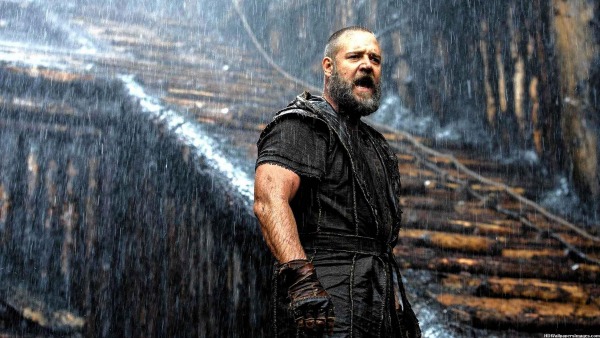 Aronofsky treats Noah and the beginnings like Greek mythology mixed with a Lord of the Rings-style fantasy epic, and it’s madly entertaining. The visuals are stirring, large-scale, and sumptuously memorable (the Earth covered in spiral weather patterns is a standout, along with Noah’s visions and a Tree of Life-style triptych narrating the birth of life). The film has come under fire from conservative critics for its creative deviations from the Bible, but sidestepping a larger conversation, why should a movie be punished because it wants to entertain a wider berth of people than the faithful? Does it truly matter that the people refer to the Big Guy as “The Creator” rather than “God”? Would these people even use the word “God”? This just seems like a petty battle of semantics. It seems like certain critics are looking for any nit to pick. Sure giant rock monsters that were fallen angels might make people snicker, but why should this aspect of the story be any more preposterous than a man and his family gathering two of every biological creature on the planet? I loved the rock creatures, I loved how Aronofsky introduces them, I love how they walk, I love that Aronofsky even finds a way to give them a redemptive storyline, offering an emotional payoff. Seriously, why should these be any harder to swallow for narrative stability?
There were fears that Aronofsky would be less than reverent to the source material with his additions and subtractions bringing it to the big screen; Noah is a Biblical epic for our modern age but also one fervently reverent to the lessons of the tale. First off, a literal version of the Genesis tale would be boring and short. There is going to be some additions and they should be welcomed. What Aronofsky and his co-writer Ari Handel (The Fountain) have done is taken a story filled with casual larger-than-life events and given it a smaller human perspective that is thought provoking. When Noah’s sons ask about wives, it’s personal planning but also a necessary part of, you know, repopulating the planet. They’re being anxious teen males but the small, relatable plot line also finds a way to relate to the larger picture, a tactic Aronofsky frequents. There’s a focus on family, fathers and sons, jealousy, but it really comes down to a personal level, differing perspectives about the overall purpose of man. The human-scale provides a richer context for the Biblical tale’s better-known aspects, like Noah turning to the bottle. As a result, we get the special effects spectacle without sacrificing the potent human drama at work. While the movie may never refer to “God” by name, it’s respectful and reverent.
 Another aspect about what makes Noah so daringly visionary is that it doesn’t blink when it comes to the darkness of the story. Over the years popular culture has neutered the tale of Noah into a cutesy tale about a guy on a boat with a bunch of happy animals. I think we’ve purposely ignored the lager picture, namely how truly horrifying the entire story is. It’s an apocalypse, humanity is wiped out; children and babies are drowning. Everybody dies. The later brilliance of Noah is that it doesn’t mitigate this horror. Once Noah and his family are inside, the floods having arrived, they painfully listen to the anguished wails of those struggling for life in the waters. The movie forces the characters, and the audience, to deal with the reality of a world-destroying cataclysm. Noah’s visions of the ensuing apocalypse are beautifully disturbing. The film takes place eight or nine generations removed from Adam, and God is already willing to take his ball and go home. After watching mankind’s wickedness, you might sympathize with The Creator. Aronofsky’s film has an unmistakable environmentalist stance (how does one tell this story without being pro-nature?), but he also shows you the brutality of mankind. The citizens of Tubal-cain have no respect for life, at one point kidnapping crying young girls and literally trading them for meat to eat. Resources are dwindling and people are pushed to the brink. There’s some sudden and bloody violence, as death is not treated in the abstract or with kid gloves. This is no cutesy story for the little ones. No stuffed animal tie-ins.
Of course once the flood occurs, the story seems like it’s at an end, Noah and his family having only to patiently wait out before starting over. It’s during this second half where the movie becomes even more personal, challenging, and philosophical. Noah believes that his family was spared to save all of those creatures born on Days 1-5, not so much Day 6 (a.k.a. mankind). He accepts this burden with solemn duty, declaring that his family will be the last of mankind to ever walk the Earth. However, spoilers, his own family pushes him to the test of this declaration. His adopted daughter is pregnant. There is hope that mankind can continue if the child is a girl. Noah sticks to his guns, saying that the child will live if a boy but killed if a girl. Now we’ve got a ticking clock, so to speak, while in the ark, and it manages to be a personal test of Noah’s own faith. How far will he go to enact what he believes to be God’s plan? He’s single-minded in this regard but he’s no zealot, more a flawed and troubled man of virtue trying to make sense of an improbably difficult conundrum. That’s the stuff of great drama, finding a foothold in a debate over the nature of man, whether man is inherently evil and shall lead, once again, to the ruination of God’s paradise. Can Noah place the personal above his burden? This looming conflict tears apart Noah and his family, forcing them into hard choices. Even assuming the film wouldn’t end with Noah butchering his grandchildren, I was riveted.
There’s an intellectual heft to go along with all the weird, vibrant spectacle. The film doesn’t exactly break new ground with its fundamental arguments and spiritual questions, but when was the last time you saw a Biblical movie even broach hard topics without zealous certainty? Definitely not Son of God. There’s an ambiguity here to be admired. Noah isn’t a spotless hero. The villain, Tubal-cain, actually makes some good points, though we all know they will be fleeting. Tubal-cain is actually given more texture as an antagonist than I anticipated. He’s a man who interprets man’s mission on Earth differently. Whereas Noah views man’s role as being stewards of the Earth, Tubal-cain views man as having been given dominion. They were meant to reap the pleasures of the Earth. Before marching off to take the ark, Tubal-cain pleads for The Creator to speak through him; he longs for a connection that he feels is missing, and so, perhaps a bit spiteful, he declares to act as the Creator would, laying waste to life. That’s far more interesting than just a slovenly king who wants to live to see another day.
 Aronofsky also benefits from a great cast that sells the drama, large and small. It’s been a long while since Crowe (Les Miserables, Man of Steel) gave a genuinely great performance; goodness it might have been since 2007’s 3:10 to Yuma remake. The man can do quiet strength in his sleep, but with Noah he gets to burrow into his obsession, which just so happens to be sticking to the edict that man does not deserve to spoil the Earth. It’s a decision that challenges him throughout, forcing his will, and Crowe achieves the full multidimensional force of his character. He can be scary, he can be heartbreaking, but he’s always rooted in an understandable perspective. Connelly (Winter’s Tale) overdoes her mannerisms and enunciation at times, like she’s practicing an acting warm-up, but the strength of her performance and its emotions win out. Watson (The Bling Ring) is winsome without overdoing it, Hopkins (R.E.D. 2) provides some comic relief without overdoing it, and Lerman (Percy Jackson) gets to thrive on angst without overdoing it. In short, you’ll want these people to live. Winstone (Snow White & the Huntsman) is always a fabulous choice for a dastardly villain.
Darren Aronofsky’s Noah is a labor of love that maintains its artistic integrity amidst special effects, threats of infanticide, and giant rock creatures. Aronofsky has forged a Biblical epic that reaches beyond the pew, providing added surprise and depth and suspense. The man takes the modern fantasy epic template and provides new life to one of mankind’s oldest tales, staying reverent while opening it up for broader meditation. It’s a weird movie, but the silliness is given a wider context and grounded by the emphasis on the human perspective. It’s a dark movie, but the darkness is tempered with powerful feelings and a sense of hope that feels justified by the end. It’s also a philosophical movie, but the questions are integral, the stakes relatable, and the answers hardly ever easy to decipher. This is a rare movie, let alone an example of a Biblical film, that succeeds by being all things to all people. It’s reverent, rousing, thought provoking, exciting, moving, and a glorious visual spectacle of cinema. Aronofsky’s epic is a passionate and thoughtful movie that deserves flocks of witnesses.
Nate’s Grade: A-
Share this:

Muppets Most Wanted (2014)
 The Muppets are back, though their new film seems to vaguely be recreating the amusing if somewhat slight Great Muppet Caper. The same blend of Muppet-staple sweet goofiness and anarchy is still a pleasure to watch, causing me to laugh throughout; it’s just that there are more leaden stretches between the laughs. The side stories have more interest and humor than the main storyline where Kermit has been replaced by a nefarious Russian doppelganger. Ricky Gervais is wasted as a criminal sidekick and he doesn’t bring much energy to the film. Fortunately Tina Fey, as a gulag prison guard, and Ty Burrell, as a Pink Panther-like Interpol agent, rise to the occasion. Burrel, teamed up with Sam the Eagle, made the movie for me. Their comic interplay and rivalry is the best and gives way to the best use of sight gags. It’s an amusing and agreeable film but there’s a noticeable spirit missing, possibly from the departure of living Muppet Jason Segel as an actor and a co-writer. I was shocked that Bret McKenzie, who won an Oscar for the 2011 movie, was the same man behind these new tunes. With the exception of maybe two songs, the remaining majority of the songs are downright dreadful. Within minutes of leaving my theater I could not for the life of me remember one of the tunes. The celebrity cameos are also less fun, many poorly integrated into the film, just the actors appearing and then vanishing. James McAvoy just walks onscreen to deliver a package. Is that the best use of everyone’s time? Still, while a noticeable step down from 2011’s The Muppets, the movie still has enough of the Muppet charm and silliness to entertain. It’s just missing some of the magic that made their return so special.
Nate’s Grade: B
Share this:

Mr. Peabody & Sherman (2014)
 Surprisingly adroit, Mr. Peabody & Sherman might just be more fun for adults, especially fans of the original 1960s cartoon, than for little kids. It’s under the “family film” banner, a dubious one historically, but I was laughing consistently and good, snorting laughs, long chuckles; the whole gamut. With The LEGO Movie, the wide release of The Wind Rises, and now this, 2014 is shaping up to be a stellar year for animation aficionados. The movie between a genius dog and his adopted son is given the right amount of reverence before all the cheeky irreverence through history. The hops through time, notably the French Revolution, ancient Egypt, and the Trojan War, are fast-paced and clever without stooping to provide much context for the jokes; you either get them or you don’t. Even the necessary character building components between father and son are treated smartly, coming together for an ending that approaches poignancy. The plot can get a little complicated toward the end, what with opening a space-time paradox, but I respect the movie for being complex and tricky and scientific and trusting its audience to play along. The animation looks a little scruffy compared to other big screen efforts, but the script just flat-out works. The comedy, the drama, the relationships, but especially the comedy. If you’re on the fence, please, do yourself a favor, and go see Mr. Peabody & Sherman, especially if you appreciate history and those who love it. I saw it with my father and we both laughed ourselves silly. Needless to say, this blows 2000’s Adventures of Rocky and Bullwinkle out of the water.
Nate’s Grade: A-
Share this:

Winter’s Tale (2014)
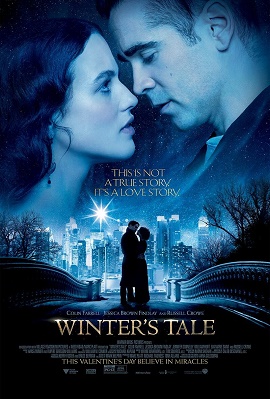 Every now and then you get to witness a special movie that doesn’t so much offend as it inspires, and what it inspires is a question you grapple with during the entirety of its run time, mainly – How did this get made? At any point, did the producers or actors or anyone stop, take a moment to reflect on the movie they were participating in, and think, “Wait, what is going on here?” Bad movies made by hacks are easy to shrug off because, well, hacks don’t know any better but bad movies (see: InAPPropriate Comedy, or better yet, bleach your eyeballs first). With Winter’s Tale, there are people who should know better, people that have been awarded Oscars. These people should resolutely know a terrible movie while they’re making it. Maybe they did. Look deep into their eyes.
In 1918, Frank Lake (Colin Farrell) is an orphan long abandoned by his family so he could have a better life in America. He hasn’t taken this message to heart. Frank worked as an expert safecracker under the employ of local crime boss Pearly (Russell Crowe), and Pearly hasn’t taken kindly to Frank leaving. Frank is able to escape Pearly’s goons and finds love with Beverly Penn (Jessica Brown Findlay), a wealthy heiress afflicted with consumption. Pearly doesn’t want Frank to get away because Pearly is really a demon in the employ of the Devil (Will Smith, yes you read that right). In the battle of good versus evil, Frank and Beverly appear to be at the focal point.
 I have to give writer/director Akiva Goldsman some credit for making an unabashedly earnest movie in an era of irony and ready-made snark. His goopy romantic fantasy longs to exist in a simpler era, but even then Winter’s Tale would fall apart on many levels. Its sheer unbending corniness is both a blessing and a curse. Magic realism is one thing (check out 2001’s Amelie as a how-to guide), but what Goldsman seems to be going for is a modern fairy tale (our maiden locked away in her tower, true love’s kiss, etc.). The film wants the audience to fall under its spell but instead will likely elicit numerous unintentionally hilarious moments; I was laughing to myself throughout, trying to comprehend all of the hokum and poor decision-making (Will Smith as the devil?).
Let’s begin with the fact that the movie is an obtuse fantasy that feels like it makes up its plot and its rules as it goes along. Bleeding fantasy and fantastical creatures into the everyday world is a marvelous conceit but it needs finesse and careful rule building. Otherwise it doesn’t so much feel like a story with a sense of internal logic as it does a bedtime story that can always just create a new shortcut or extension. The very first few minutes of the film will already push your credulity to the test. We see an adult Peter on the run from Pearly and his goons and all of a sudden he runs into… a white horse. Ah, but this is no ordinary horse, this is a magic flying horse, and Peter flies away to live another day. Yep, within minutes, we’re given a magic flying horse. No groundwork. Worse, the horse just randomly appears when the plot demands, and I think the horse is supposed to represent the side of God in this cosmic battle between good and evil. Whatever, there is a magic flying horse. From there the film gets even cornier. It’s the type of movie that posits the stars are really human beings, and so, in the end, rather than having our hero ride off into the sunset he (spoilers be damned) flies off into space on his magic flying horse and he BECOMES a new star, resting beside the star meaning to represent his beloved (never mind that these stars would be millions of light years apart). If you can read that sentence without rolling your eyes then congratulations are due.
Another problem is this massive time leap that creates far more plot holes. After Beverly succumbs to her illness, which I might add happens literally SECONDS after she’s done having sex for the first time (Colin Farrell killed her with his penis), the film leaps forward to present-day. However, Peter was given immortality through Beverly’s miracle. I suppose you could view miracles as a byproduct of sex. At first glance, this almost seems like a cruel gift; your love is dead and now you have to live forever without her. For no discernible reason, Peter also suffers amnesia, because, really, why not? All he does day after day, presumably for… 90 years, is sketch the same image of a redheaded girl in public places. In the intertwining years, why hasn’t evil Pearly picked up on the fact that Peter is still alive? He’s only been sketching the exact same image. Also, how does Peter even support himself? How does he feed himself? Who are his friends? These are the questions that arise when you take this foolish route with the plot. It could have been avoided with a simply Rip Van Winkle-style hibernation or time jump. Another problem is that Peter grew up with the 90 years of history, meaning he should know what things like the Internet and library cards are. He’s not a man out of time. The solution to Peter being confirmed is to seek out the still-living Willa (Eva Marie Saint, nice to see you again). The problem with this is that Willa should at least be over a hundred years old if you do the math. If the purpose of the leap forward was to just save another character we hadn’t seen previously, why does it have to be 2014? Why couldn’t it just have been 1940 or any other earlier period?
And the central romance between Frank and Beverly is just so boring you wish Frank would move on to someone new. Presumably they fell in love at first sight, which just so happened to be when he was in the process of robbing her home. Ah, but you see, her love redeems him because that’s really the whole role of the sick love interest in movies, to make the other figure a better person through this shared experience of grief. So in this regard it’s no surprise that Beverly lacks defining characteristics outside of her ailment. She plays the piano and falls fast for Farrell’s bushy eyebrows, but that’s all we got here. The entire second act of the film follows their abbreviated courtship, but there’s no real moment where you buy into their romance. Like most of the film’s storytelling, we’re told something is and expected to buy into it 100 percent without flinching. They’re in love, what more do you need? Well, some interesting characters would be a start.
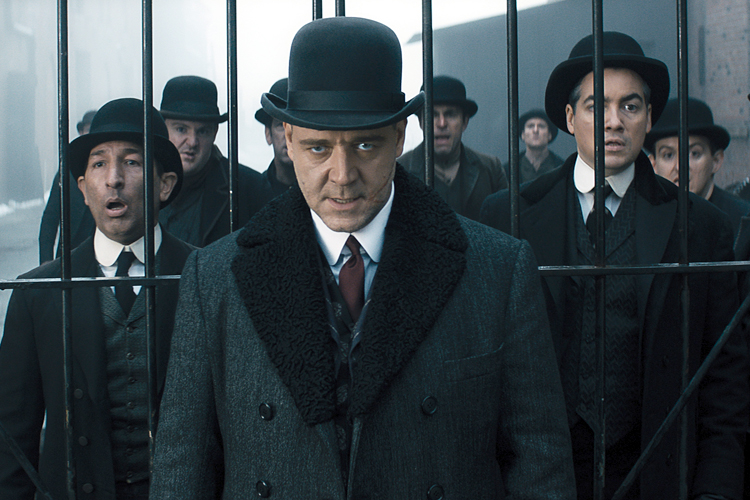 I’m fairly certain that all of these actors were doing Goldman a favor by appearing in this nonsense, but only Farrell (Saving Mr. Banks) walks away favorably. He is the best person onscreen who burrows into their character, ignoring the absurdity of every moment, yearning so hard that you almost want to give in. You won’t. Many will best remember Findlay as the Lady Sybill on TV’s Downton Abbey (she was also the reoccurring ghost on the BBC’s Misfits). Here she gets little else to do but smile and give those knowing looks that all afflicted characters give, as if their illness has opened up the secrets to the universe for them. Crowe’s performance will likely draw up comparisons to his maligned work in Les Miserables, a performance that wasn’t as bad as advertised theater snobs. This performance, however, is as bad, as his Irish brogue seems to overtake him and he comes across like a hotheaded big bad wolf. Jennifer Connelly’s appearance isn’t even worth mentioning as it is that slight beyond the fact that she’s the mother of a terminally ill child (you really thought the movie had any sense of restraint?). The film has numerous well known actors for flashes, like Kevin Corrigan, Kevin Durand, Graham Green, Matt Bomer as Frank’s immigrant father. One suspects their brief time was either a sign that the screenplay evolved as production went or that they were repaying a debt.
I will say the only saving grace in this entire blunder is the cinematography by Caleb Deschanel (The Passion of the Christ). Even when the cheesy special effects take flight, Deschanel makes sure the images are worth watching, having a special skill with the cool hues of the wintry color palette. I wanted to at least credit one redeeming aspect.
The inconsistent plotting and rules, the corny and overly wistful characterization, the overwhelming silliness of every single moment, Winter’s Tale will spark far more guffaws and derision than plaudits. It’s a movie that bludgeons you with its unrelenting maudlin nature disguised as romantic fantasy. The source material is beloved by some but it all comes across as nonsensical twaddle onscreen. Goldsman’s screenwriting credits run the gamut from award winning (A Beautiful Mind, Cinderella Man), to big budget to notorious stinkers (Batman & Robin, Lost in Space). It’s hard to judge the man’s talents with such a wide range of quality. However, I can question the finished results of Winter’s Tale and openly wonder what in the world convinced Goldsman to cash in all his Hollywood cache to direct this dreck. I’m almost tempted to encourage people to watch Winter’s Tale just to try and make sense of it themselves, to try and take in 118 minutes of earnest bad decisions. Whether it’s the magic flying horse, the 100-year-old news writer, or the fact that we’re dealing with a bad guy named Pearly, or Will Smith as Lucifer, but sometimes Hollywood unleashes a disaster that begs to be seen.
Nate’s Grade: D
Share this:

The LEGO Movie (2014)
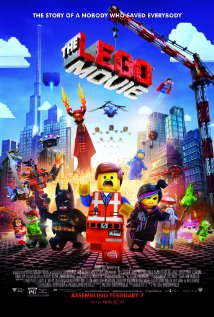 Highly creative, cheeky, frenetic, and bursting with visual splendor, The LEGO Movie will likely surpass all expectations you had for what was assumed a 90-minute LEGO commercial. I cannot even tell if it’s actually a commercial or a subversive consumerist satire, or perhaps a blending of both. Writer/directors Phil Lord and Christopher Miller take their same anarchic, comic rambunctious absurdity exhibited in Cloudy with a Chance of Meatballs and 21 Jump Street and produce another movie so fast-paced, so freewheeling in energy, and so comically alive that you feel rejuvenated by the end. These are gentlemen who fully know the storytelling power with animation and they create worlds that are astounding to watch. While completely computer generated, the world looks like it was stop-motion. In fact, the detail that everything in the physical world is made of LEGOs was a nice touch, including fire, water, and smoke. The story of an unremarkable guy (slyly stupidly voiced by Chris Pratt) mistaken for The One, and the complications that arise, is a fitting satire of superhero fantasy mythos filmmaking. The social commentary on conformity and the media is cutting without distracting from the plot’s ongoing mission. The characters are fun, the jokes land assuredly, and the action sequences are mesmerizing. But then it takes a meta turn in the third act that gives the movie a whole other prism that helps define its previous outrageousness while leading to a poignant message about the inclusiveness of play. It’s a movie that celebrates imagination and individuality, and while it will more than likely also sell a crapload of toys, it’s an animated film with more on its mind. To paraphrase the top radio hit in the world of LEGOS, everything is just enough awesome.
Nate’s Grade: A-
Share this:

The Hobbit: The Desolation of Smaug (2013)
 Back to another three-hour trip to Middle Earth. While the second Hobbit film is an improvement in just about every way, it’s still a clear example of a franchise stretching to the breaking point. Peter Jackson gets the second installment moving a lot quicker, and there are several standout action sequences that are glorious on the big screen. Unfortunately it still takes almost two full hours to get to the dragon of the title, but when it does, oh does the movie become that much grander. Benedict Cumberbatch gives frightful life to Smaug (pronounced, for whatever reason, as “Smaa-oog”), and the special effects are top-notch. The last forty minutes of the movie are solid gold, as Bilbo and the dwarves work together to battle Smaug in a virtuoso development of imaginative action; it’s wonderful how many moving parts are involved in this action set piece. However, Hobbit 2 still feels needlessly padded to meet out a trilogy. Does Gandalf (Ian McKellen) need to just disappear on his own mission that accomplishes what? Do I care at all about the people of Lake Town let alone their populist revolts? Do I need a parallel storyline about an injured dwarf? And for that matter, do I need a budding lady elf-dwarf romance? J.R.R. Tolkien fans will be in heaven (though maybe just purgatory with all the changes) to gawk at the realm of Middle Earth, but I always feel antsy (“Get on with it already”). Still, The Desolation of Smaug is an entertaining and at times majestic fantasy epic, I just wish Jackson and company didn’t take so many pit stops. Well at least we won’t have to wait so long for the dragon in Hobbit 3.
Nate’s Grade: B


You must be logged in to post a comment.