Blog Archives
Toy Story 3 (2010)
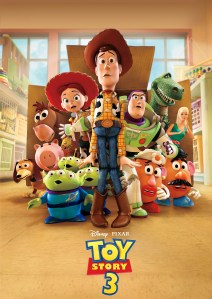 I was completely unprepared for how emotionally involving Toy Story 3 would be. Sure, Pixar has managed to break and melt your heart through ten previous movies, but I suppose I foolishly felt that I was beyond caring for toys. But even in the opening minutes, a tremendous make-believe fantasy, I felt punches of emotion as each character was reintroduced. It felt like I was reconnecting with old friends and it was such a pleasant reunion. It’s okay, guys, to cry over toys.
Cowboy sheriff Woody (voiced by Tom Hanks), the leader of Andy’s toys, is trying to keep hope alive. Andy is now 17 years old and on the verge of leaving for college. His favorite childhood toys have long since been relegated to a chest as Andy has matured. Joining Woody are spaceman Buzz Lightyear (Tim Allen), Jessie the cowgirl (Joan Cusack), Mr. and Mrs. Potato Head (Don Rickles and Estelle Harris), Slinky Dog (Blake Clark), the timid Rex (Wallace Shawn), and the piggy bank, Hamm (John Ratzenberger). They are all the toys in their gang that remain. As Andy leaves their main goal seems to have been accomplished. They were there for their owner and now he no longer needs them like he once did. The toys have a few options left: stuffed into the attic, sort of like a retirement home, until perhaps Andy digs them out for his own kids, or being thrown out with the trash. Woody assures them that Andy would never just throw them all out, though even he has his doubts about their current purpose. They all feel the loss.
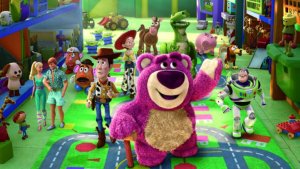 After a mix-up, the toys decide to take matters into heir own adjustable hands. They will sneak away inside a donation box for Sunnyside Day Care. The center seems too good to be true. The courtly Lotso Hugs Bear (Ned Beatty), who seems to lead the center, promises that all toys will never be forgotten again. When the children grow too old then a new batch moves in to play. It’s a toy’s dream, that is, until Buzz and the gang discover that they’re canon fodder for hyperactive, maniacally destructive toddlers. They can’t keep up with the daily abuse. Sunnyside Day Care is less a haven than a prison. New toys have to pay their dues and earn a place in the vaulted Butterfly Room, where young children lovingly interact with their toys. It’s a toy class system. Lotso refuses to cotton to rule-breakers, and toys are locked away nightly so they cannot escape. Woody must try to save his friends by breaking them out and getting back to Andy before he departs for college.
Given that the movie tackles major issues like moving on, growing up, and mortality, I knew I was in for some heavy moments, but absolutely nothing prepared for some of the emotions that clobbered me. You do realize through the course of this third film as the toys try and find a suitable place to retire, if you will, how attached you are to these characters. Late in the movie the toys are in some dire circumstances. There’s a horrifying junkyard sequence that even manages to evoke Holocaust imagery, which means parents are going to have to calm some spooked tykes come bedtime. There’s a silent moment, where the toys all seem to accept their fate, and all they want to do is join hands and face it together, as a united family one last time … and my God, I could not control myself. My face was dripping with tears (even thinking back right now is causing my eyes to well up a bit). Toy Story 3 isn’t the strongest of the trilogy in terms of character or plot (in some respects, the plot is a reworking of The Brave Little Toaster), but you better believe that it delivers emotional resonance in spades. Major credit goes to screenwriter Michael Arndt who won an Oscar for Little Miss Sunshine.
 But fear not, Toy Story 3 is not all sturm und drang, it also provides plenty of laughs and plenty of visual wonder and excitement. The toy’s point of view has always allowed for plenty of amusing insights and satirical riffs. The personality clashes makes for the most jokes, and the new characters pull their own weight, particularly Ken (Michael Keaton), an effeminate clothing-conscious doll who finds his true love with the arrival of Barbie. The use of Big Baby as a malevolent goon is also refreshing and quite creepy. The Spanish Buzz reboot personality seems superfluous but cute. The jokes come by at a steady pace and while they all may not work as well (Ken in a trying-on-clothing montage set to “Le Freak”?) there are still moments of great creative ingenuity. The detailed escape from Sunnyside feels like a terrific parody of prison movies, and they way it utilizes all the different characters as key components is satisfying and fun. But the best moment of the break-out, by far, is when Mr. Potato Head is trapped, hurls his pieces out of an opening, and reassembles thanks to a tortilla body. It’s a weird visual, like something out of Salvador Dali, and yet I could not stop giggling from watching his floppy movements. It’s comedic while at the same time a genius move in drawing out an action sequence — it makes keen use of the players and their skills. From an action standpoint, G-rated Toy Story 3 manages to have more thrills and spills than any other 2010 movie so far.
Director Lee Unkrich (co-director for three previous Pixar flicks) makes quite a debut for himself. The complexity of the action, while still maintaining an internal logic, is hugely rewarding. The Pixar wizards truly know how to craft inventive action sequences and stay true to character. Unkrich’s command of visuals is impressive. The action is well paced, but it’s the man’s use of composition, camera movement, and editing make Toy Story 3 a visual treat. Unkrich fully knows how to best utilize and fill up the screen. The world of Toy Story is popping with color and visual whimsy, as well as plenty of sight gags and subtle movie references for adults. Ten years of advancements in computer effects has also allowed the toys to get a bit of a facelift. The 3-D process enhances the overall experience without calling attention to itself. There aren’t any standard 3-D moments where big and pointy things keep flying out at the audience. The 3-D provides a greater field of depth without distracting you from the pivotal moments of story.
The voice acting is just about perfect from top to bottom. Allen and Hanks are a welcomed pair, Cusack provides plenty of spunk, Rickles brings his usual dish of joyful disdain, and new characters like Timothy Dalton as a stuck-up thespian porcupine and Kristen Schaal (TV’s Flight of the Conchords) as a bubbly triceratops toy are fun additions that don’t overstay their welcome. Blake Clark takes over the voice of Slinky Dog from the late Jim Varney who died in 2000, and he does a fine job without sounding like a direct imitation. I was really delighted by Beatty. He has such a Southern gentlemanly demeanor that underscores the hardened heart of his villainous character. And yet, Lotso gets his own rich back-story of abandonment and bitterness similar to Jesse the cowgirl. Even when he’s dastardly we can see where the big purple Teddy bear who smells like strawberries is coming from. Ned Beatty has finally appeared in another breakthrough cultural film to redefine his identity. Perhaps now he won’t be best remembered as the guy who gets raped in Deliverance. He probably still will be.
A lot has changed in the 15 years since Pixar revolutionized the world of animation and family films with their first feature, Toy Story. Kids at the time are now teenagers; some embarking on college this summer themselves much like Andy. They too have to put away former childish things and move forward. Toy Story 3 is magic confluence of heart, wit, visual whimsy, cleverness, and drama. Not quite as sharp as the first two installments, or as artful as Pixar’s high-water mark, WALL-E, the third Toy Story is still a mighty entertaining piece of work. The last 30 minutes of this movie is harrowing and then deeply satisfying and moving, finding a fitting sendoff for characters that we’ve come to love. It’s all about moving forward, saying goodbye, and reflecting about times shared. I wouldn’t be surprised if Toy Story 3 inspires kids, and adults alike, to go home and play with their old toys, giving them renewed life and purpose.
Nate’s Grade: A
Share this:

The Princess and the Frog (2009)
 It’s taken this long to get an African-American leading lady/princess in a Disney animated film, and she gets to spend the majority of the flick as a slimy frog? This return to traditional 2-D animation for Disney is less than a triumph due to a pretty dull storyline. All the familiar elements are there, but the characters just fill voids rather than tell a story. There’s the downtrodden heroine with her dream, the arrogant prince who learns to value others, the comical talking animal sidekicks, and get ready for a slew of songs you will instantly forget despite the added gumbo flavor. Set in 1920s New Orleans, the film has plenty of ravishing visuals to get you through the formulaic plot. It’s a nice return to Disney’s bread and butter before the 3-D animation craze took off, and I pray that there will be plenty more traditional 2-D animation on the horizon from the Mouse House, but this isn’t the best film to reestablish the glory of traditional animation, racial politics aside.
Nate’s Grade: B-
Share this:

Prince of Persia: The Sands of Times (2010)
 This video game adaptation has the curious distinction of being both too simplistic and too complicated, sometimes in the very same breath. The harried screenplay could have used a lot more clarity concerning back-story, exposition, character roles, setting, rules of this Middle Eastern time period, supernatural rules, etc. At the same time, Prince of Persia is saddled with a pretty dopey story with weak characters. The plot is far too repetitious; somebody has the magic dagger that can turn back time, they lose it, they regain it, they lose it, repeat for over an hour. It feels like the story is never getting anywhere despite the fact that new, and still weak, characters are being introduced. The tone and look of the movie feels too beholden to its video game roots; the action is momentarily rousing but then seems overly coordinated to squeeze in all the game’s special signature moves. You’ll grow tired of all the wall flipping, wondering if a controller is stuck somewhere. For a movie dealing with a time-traveling dagger, give me more time travel. This fantastic plot device is used too sparingly in a ho-hum plot about an adopted son (Jake Gyllenhall, buff and with a sporting accent) of the king being accused of killing the king. Despite the Disney name, this feels less like a Pirates of the Caribbean knockoff and more cut from the same cloth that gave us the Mummy sequels. It’s loud, stuffed with empty special effects, and feels like junk food for your brain but it’s not even good junk food. Weirdest of all, the movie is one big metaphor for the U.S. invasion of Iraq (acting on false intelligence about some country aiding an enemy by manufacturing weapons). Seems Prince of Persia is Hollywood’s second attempt to rewrite our past political blunders in the Gulf and come up with a dubious happy ending.
Nate’s Grade: C
Share this:

Ponyo (2009)
 It was hard for me to watch the initial trailers and advertisement for this movie because the animation just looked so … simple. I was forlorn that legendary director Hayao Miyazaki was taking a step backwards. He was stepping away from the complexity of his recent works. While his take on Han Christian Anderson’s Little Mermaid tale is intended for young children, I was relieved when I finally saw the finished animation. I got what he was going for: a painterly aesthetic that is seductively simple. The boy meets fish-turned-girl tale is resoundingly cute with a delightful sense of wonder; however, it really just sort of comes to an abrupt stop. The character relationships are established, the conflict of a sea princess being on land is developed, and then all the magical creatures team up and chat with the humans, and then we’re pretty much done. It’s a curiously hasty conclusion and it makes the movie feel less formalized and finished; Miyazaki is still one of the most imaginative filmmakers alive, in any medium, but Ponyo, while visually appealing and mostly adorable, suffer from shrift storytelling that ultimately makes this a cute if passing diversion.
Nate’s Grade: B
Share this:

Alice in Wonderland (2010)
 Director Tim Burton seems like the perfect candidate to take on the imagery of author Lewis Carroll. I would argue that, short of Dickens’ Christmas Carol, Alice in Wonderland is the most reproduced piece of literature in modern history. It’s going to take a keen vision to make these old characters interesting (the macabre American McGee video game sure felt like it could have been born from the mind of Tim Burton). Unfortunately, Burton and some 3-D wizardry are not enough to compensate for a story that only works in one dimension.
Alice (Mia Wasikoswki) is now a teenager girl who can barely remember her jaunt to Wonderland in her youth. She’s assigned to marry a simpering lord because in Victorian England that’s how women took care of their futures. Alice is more interested in taking over her dead father’s trading company. So when the time comes for her lord to ask for her hand in marriage, Alice stammers, says she needs some air, and chases after what looks like a rabbit with a pocket watch. She falls down a rabbit hole and winds up back in Wonderland, however it’s really known as Underland. It’s been 13 years since Alice visited this magical world, and in the meantime the Red Queen (Helena Bonham Carter) has ruled as a tyrant quite fond of removing the bond between head and neck. Her sister, the White Queen (Anne Hathaway), was deposed and lives in exile. The (W)underland residents live in hope that an Alice will return and free them as an old prophecy foretells. She’ll have to rely on old friends, like the Cheshire Cat (Stephen Fry) and the Mad Hatter (Johnny Depp) to fulfill her destiny, and, why not, slay the Red Queen’s fearsome dragon, the Jabberwocky.
 You would think that the combination of Burton, Depp, Lewis Carroll, and 3-D would produce an irrefutable masterpiece, at least from a visual and entertainment standpoint. I’m compelled to argue that the finished results are pretty much a mixed bag. The world of (W)underland seems fairly drab. Sure it was some big stuff and some weird stuff but from a color standpoint everything comes across as washed out, like Burton took one look and said, “Bright colors equate happiness. We can’t have that.” I understand the world wanting to convey a dispirited mood, but this isn’t any regular Burton film, this is Alice in Wonderland and we need a sense of, wait for it, wonder. Instead, we get an overwhelming feeling of drabness. Now, full disclosure, I didn’t catch the 3-D version of this movie for two reasons: 1) my then partner’s head was hurting and she couldn’t take 90 minutes wearing nose-pinching, eye-hurting glasses that play with her depth of field, and 2) the 3-D shows were all sold out. I could tell which elements where intended to pop in a 3-D environment, namely the Hare always throwing objects as a calling card and the materialization of the Cheshire Cat. The tone isn’t too dark to scare the Disney families but at the same time there’s a bit more menace to the proceedings. The Red Queen’s bulbous, disproportionate head makes for an eye-catching visual that doesn’t get stale. (W)underland is a more hostile world but at the same time it’s not too threatening. Pretty much all the villains have some moment of redemption that makes them less threatening. The weirdest motif in the movie is eye gouging, which happens twice thanks to the same diminutive character.
Having said that, this is a visual decision that I could live with if the story engaged my senses more. Alice is now an older 19-year-old girl that has to defend (W)underland by fighting a dragon and suiting up in armor. She has to accept her destiny and be THE Alice and save the kingdom. The mystery of whether Alice is the one true Alice, look no further than the title, folks. He doesn’t remember anything from her first encounter in (W)underland and yet she has no sense of awe or curiosity. Also, why now do the residents of (W)unerland seek out Alice to rescue them? They never thought about reaching out in the 13 years the Red Queen has been ruling?
 The plot is a fairly pedestrian “hero’s quest” that ends in a fairly pedestrian battle sequence where the armies of good and evil clash in CGI combat. The problem is that the original Alice in Wonderland source material really didn’t have much of a plot to it; it was really more a satire of the times, which featured Alice essentially going from one oddball to the other. The appeal was more the language than the story. It’s not the easiest piece of literature to adapt, to find a through line for a plot, so I guess making it about a hero’s destiny seems like the easiest, laziest path. The screenplay by Linda Woolverton (Beauty and the Beast) assembles all the memorable characters but gives them little else to do, other than act mad. You may start to feel Alice’s sense of frustration after a while. Because of the threadbare story, you know exactly where the movie is going to be headed (wow, unintentional pun). In some ways this movie functions as a sequel and in some ways this movie functions as a remake, meaning that the plot is pretty much stuck trying to decide where to go next in a standard fantasy narrative device.
And then there’s the dance scene. Oh, the dance scene. How do I approach this gingerly? The climax that’s established is not Alice slaying the dragon, accepting her destiny, and (W)underland triumphing over the Red Queen’s tyranny. The climax is Depp break-dancing. You read that right, though the residents refer to his crazy legs movement as “futterwackin,” which sounds suspiciously naughty. It’s a moment so goofy, so tonally inappropriate that it shatters the entire notion of suspension of disbelief. It rips you out of the movie and all for a cheap laugh. It’s bizarre. I acknowledge that, given the fantasy framework, that the ending ought to stay in touch with the fantastical setting. But break-dancing? Would The Wizard of Oz have ended better if the Tin Man and the Scarecrow started break-dancing? At least the Tin Man could effectively perform the Robot. It’s a real-world artifact that has no place in the world of fantasy.
 Depp is usually such a valued performer, digging deep into his character and reveling in their eccentricities. He’s the strangest and most exciting character actor that has become a box-office star. But that doesn’t mean he’s immune from giving a rare bad performance. While nowhere near as off-putting as his Willy Wonka, Depp’s Hatter is more distraction than anything. He comes across like a figure grappling with post-traumatic stress, causing him to mutter incomprehensibly in a Scottish brogue. He’s tiresome after a while. Carter (Sweeny Todd) can be pretty shrill, playing the same overwrought note time and again, but she still manages to give the best performance in the movie. Hathaway just sort of acts flighty and raises her arms, waltzing around like she’s trying to imitate Depp’s Jack Sparrow. She’s entirely wasted. Stephen Fry (V for Vendetta) is a delight as the voice of the Cheshire Cat, and our heroine, Wasikowska (HBO’s In Treatment) has a striking Grecian presence, even if her performance is more dour than it needs to be given the fanciful environment.
Tim Burton and Johnny Depp usually make for an unbeatable creative team, but I think Disney was the key figure in this arrangement. Alice in Wonderland wants to thrill without getting too scary, wants to delight without getting too original, and wants to dazzle without getting too weird. Burton’s visual inventiveness manages to make the movie entrancing at times and bewildering when the rest of the movie fails to live up to those fleeting moments. Truth be told, I actually enjoyed the real-world Victorian scenes more than many of the ones in (W)udnerland. The film is just too disjointed and uneven to fully embrace, regardless of the 3-D upgrade. There are moments that I adored and moments that I could have lived without — like the break-dancing finale. The finished product isn’t a terrible night out at the movies, and there are plenty of enjoyable elements to savor. However, Alice plays like a familiar fantasy that takes Lewis Carroll’s creatures and rearranged them into a watered-down Lord of the Rings hybrid.
Nate’s Grade: C+
Share this:

Legion (2010)
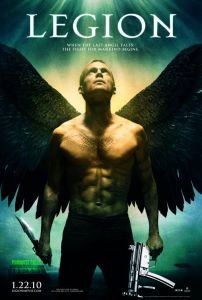 Just to be upfront, I am a big fan of action movies making use of Christian mythology (sorry if the use of the word “mythology” offends some). You tell me a tale about angels, demons, in a contemporary setting no less, and I’m hooked. You give those two sides weapons and have them fight over the fate of mankind, and I’m already revving my engines. So please know that no matter what the artistic achievements of Legion may be, I was predisposed to enjoying a movie that features the angel Michael (Paul Bettany) on the poster with a sword in one hand and an automatic weapon in the other. The premise of Legion is that God has finally had it with mankind and is making good on his threat to “turn this thing around right now.” He’s sending a host of heavenly angels to … eliminate humanity. Michael rebelled, believing man was still capable of making good on its promise. So he fights alongside a handful of characters shacked up in Dennis Quaid’s greasy spoon diner in the middle of nowhere. The action isn’t really involving but the movies does have some cool moments, like when Michael goes mano-a-seraphim with Gabriel (a marble-mouthed Kevin Durand). Legion deals with an antagonist (God) that is so powerful that there have got to be arbitrary limits placed on that power. So the attacking angels don’t overwhelm the tiny diner with their superior numbers, nor does the Almighty just blink the troublemakers out of existence. The end doesn’t really give much in the way of clarity but I got what I wanted from a movie like Legion. Though, in retrospect, I really didn’t want sizzling acid popping from boils.
Nate’s Grade: C+
Share this:

Where the Wild Things Are (2009)

Studio execs are always seen as the bad guys, right? They meddle in the affairs of artists, more concerned about dollar signs and marketing potential than in lasting, authentic artistic achievement. Director Spike Jonze, the most lauded video music director of all time, has gone through five years of trials to bring the adaptation of Where the Wild Things Are to the big screen. He’s had his funding cut, he’s been dropped by one studio, and the second studio contemplated starting over from scratch after seeing an early cut of the movie. The studio heads were worried that Jonze’s take was too sullen and too scary for children. They asked for something a tad more uplifting about a boy that runs away to have adventures with giant monsters. Jonze and co-screenwriter Dave Eggers (Away We Go) insisted on their vision and stuck it out, and 18 months later, that vision is what made it to theaters. Having now seen Where the Wild Things Are, it pains me to accept that maybe those studio honchos had a point all along. Jonze’s film is eclectic and visually wondrous but this is not a children’s movie; this is a movie about childhood intended for thirty-something adults and film critics. And man, it’s a downer.
Based upon Maurice Sendak’s masterful 1963 book about an unruly child “sent to bed without supper,” we follow Max (Max Records), a nine-year-old on a tear through life. His older sister is growing up and hanging out with older friends, his dad is absent, and his mother (Catherine Keener) is trying to juggle work, kids, and having a life her own. One night she has a man over (Mark Ruffalo, in cameo form) and Max gets upset. His mother isn’t giving him the attention he feels he’s owed. So he acts out, bites his mother, and when she responds with genuine terror, he runs away. He finds a small boat and sails away across the ocean to a mysterious island. It is here that he encounters the titular wild things, giant beasts that act out in very similar ways. Max declares himself the king of the beasts and they accept. Carol (voiced by James Gandolfini, a fabulously warm performance) is the happiest to have somebody new to play and listen. There’s also the small goat-creature Alexander (Paul Dano), the eagle Douglas (Chris Cooper), the elusive KW (Lauren Ambrose), and the married monster couple, the pushy Judith (Catherine O’Hara) and the subdued Ira (Forest Whitaker). Together they form an unorthodox family that still falls prey to in fighting and jealousies.

First off, Jonze does a magnificent job of creating the world of the wild things. The cinematography by Lance Acord (Lost in Translation) uses a lot of handheld cameras to trail after Max, communicating the kinetic energy of youth. The movie looks gorgeous but doesn’t resort to a self-conscious gloss. Acord makes the wilderness look inviting and dangerous. The wild things are amazing creatures to watch, brought to startling life by Jim Henson’s creature shop and seamless CGI artistry to provide facial expressions. If these creatures were purely computer generated, they would lose a sense of magic. Watching the furry suits interact with the real world brings so much more enjoyment to the movie. These giant creatures look real and intimidating. I liked the fact that there’s one character, The Bull, who just stands in the background alone, and the other wild thing monsters make a point of not noticing him. He’s the weird disaffected kid on the outside. I also appreciated that the movie doesn’t pander to make the monsters cute and cuddly. They continue to be scary. At one point Carol even chases after Max with the intent to eat him. Jonze and Eggers have made a movie about childhood that doesn’t coddle children. The production design by K.K. Barrett (Marie Antoinette) is nicely imaginative, though it only deals with a handful of stick huts. The fort that the wild things construct is fantastical, like an alien structure but made completely out of twigs.
Jonze and Eggers have made a movie all about the feelings of childhood; however, it seems that almost all of those feelings are negative. Sure Max bounces around with youthful energy, and his imagination goes to exuberant places, but the movie paints a broad picture of how painful and disappointing childhood can be. The movie doesn’t capture the wonder and excitement and possibilities of childhood; it focuses on the somber realities of what it’s like to be misunderstood, lonely, and incapable of changing anything. What about the pleasures of childhood? Even when Max engages in his fantastic creativity it usually leads to destruction and hurt feelings; everyone ends up in a worse place. A great example is in the opening sequence where Max tries to snare his older sister and her friends into a snowball fight. He gets them to play along and then everything is great, until the older kids accidentally take it too far and Max is left embarrassed, hurt, scared, and incredibly angry, which leads to lashing out, which then leads to regret and attempts to rationalize it as not his fault. This pattern is repeated throughout, where Max will get scared or confused and this triggers bouts of physical violence, like literally biting his mother. You might think his time on the island would be an escape, but really all of the monsters are manifestations of Max’s fractured psychology. KW represents his older sister’s approval so deeply longed for; Judith represents his defensiveness; Alexander represents his feelings of marginalization and helplessness; and Carol most closely resembles Max’s id, concerned that his family is falling apart, prone to jealousy and sudden violent outbursts when he doesn’t get his way. It all can make for an interesting psychoanalytical experience but it also can get tiresome. Listening to needy, whiny, morose monsters can be exasperating after awhile when there isn’t anything else resembling a plot. Where the Wild Things Are feels somewhat like Jonze and Eggers are subjecting everyone to their own therapy.

This shaggy, somewhat draggy movie has little else going on, so we watch Max boss around the monsters, commission colossal forts, run around, sleep in a big pile, and more or less try and hold a family together when they are moving in different directions. Things slow down a lot on this island. Max himself is a polarizing figure. Some people find him relatable, his pain and fears, and still others find him to be a wild brat. His behavior seems to go beyond that of a normal child acting out. I’m not going to prescribe the kid but me thinks there may be something else amiss with Max (am I alone in my diagnosis, people?). My friend thought Max was an insufferable and unsympathetic brat who learned nothing by the end of the movie. I feel that Max has to have learned something, since his entire time spent on the island was him working out his troubles to gain a little more perspective. Records is a real find as a child actor, and he’s the only human onscreen for like 90 minutes. I thought he carried the movie ably enough and finely displayed the conflicting emotions of being nine years old.
Will you like Where the Wild Things Are? That’s difficult to surmise. It may depend upon whether you can identify with Max; I couldn’t for the most part. This is a much easier movie to admire than to like. There’s very little fun to be had. The movie has an implicit sense of loss and melancholy throughout. Children’s movies don’t need to be all happy endings and feel-good lessons, but then again they don’t also have to be densely Freudian. Childhood isn’t all innocence and rainbows, but it’s also not all rain clouds and emotional meltdowns and feelings of impotence. The movie presents childhood as an unyielding hell. I know other people love Where the Wild Things Are, and I respect that artistry Jonze and his crew brought to this movie, but I doubt I’ll ever watch this movie again in my life. For once, the studio execs had it right.
Nate’s Grade: B-
Share this:

Harry Potter and the Half-Blood Prince (2009)
 Not every film franchise gets to a sixth installment, although Police Academy and Friday the Thirteenth managed to. After over twelve hours of storytelling, is it even possible for non-fans to enter the Harry Potter world (only an idiot would begin a film series at number six)? I am a willful Muggle to this universe. I am content to wait for the movies, and it drives the readers nuts. “The books are so much better,” they all say. Then they tell me what was left out of the movies, and honestly it’s usually a good thing. Harry Potter and the Half-Blood Prince echoes the increasing darkness of the later books by author J.K. Rowling, but now I can finally walk out of a Potter film and know, without a shadow of a doubt, that the book must have been superior. Half-Blood Prince is a film adaptation that spends too much time in all the wrong places.
Lord Voldermort (Ralph Fiennes, seen only for literally a split-second) is back with a vengeance, and his followers, Death Eaters, are branching out and attacking the Muggle world as well. Headmaster Dumbledore (Michael Gambon) has asked Harry (Daniel Radcliffe) for help in recruiting a former Hogwarts professor. Horace Slughorn (Jim Boradbent) used to be an esteemed potions professor, and one of his bright students was none other than a young Voldermort (Hero Fiennes-Tiffin, Fienne’s real-life nephew). Dumbledore and Harry explore liquid memories that belong to the Dark Lord in hopes of learning how to defeat him. In the meantime, the kids are under attack not by Voldermort but by hormones. Harry’s friend, Ron (Rupert Grint) and Hermione (Emma Watson), are secretly in love but neither has the heart to say something. Ron uses his star Quidditch status to “snog” with the eager Lavender Brown (Jessie Cave), who’s infatuated with Ron. This infuriates Hermione and she seeks comfort in a studly student herself. Harry is starting to feel his heart go pitter-patter for Ron’s sister, Ginny (Bonnie Wright), which requires Harry to be very delicate in negotiating the “Can I snog your little sister?” portion of male friendship. Oh yeah, and apparently Harry is also using a potions textbook that used to belong to some whiz kid known as the Half-Blood Prince.
 The further I get away from Half-Blood Prince the more certain I am that it is the least involving film of the series. The plot is somewhat nebulous and unclear, and so much of the story is dominated by boring teenage romance. I understand that Hogwarts is swimming in hormones, but these kids spend the whole time making shifty doe-eyes at each other than doing anything substantial. That makes for a boring romance, and when the movie is dominated by this stuff for two hours it doesn’t make the movie too engaging. I understand that the Ron/Hermione courtship has been setup for some time, but it takes forever to move even incrementally closer to that coupledom. The Harry/Ginny material is lacking at best. She’s such an empty presence and they do so little with her character that I have no idea what would warrant Harry’s affections. There is no spark, no heat, no sexual tension, and no interest. I was actually relieved when Half-Blood Prince drops practically every storyline with twenty minutes left. Seriously, these plotlines aren’t resolved or capped or even addressed, they just don’t exist once Harry learns the word “horacrux.” And let’s talk about that subject just for a moment. Dumbledore lures Professor Slughorn back to Hogwarts so Harry can learn Voldermort’s secret of eternal life, a secret that Dumbledore already knows because he’s been taking leaves to locate and destroy Voldy’s horacruxes. I felt detached and disenchanted throughout Half-Blood Prince.
There are other plot holes and irregularities, and I wonder if writer Steve Kloves (who took the fifth movie off) is merely serving up 153 minutes of plodding prologue for the big finish. The drama is becoming more static and the supporting characters of previous installments reappear and do little but stand with hands in their pockets; they have nothing to do. The flashbacks to Voldermort as a child reveal relatively nothing new; only indicating her was a creepy kid. The two action sequences squeezed in are not from the book, meaning Kloves was trying to add some excitement to what is a rather sleepwalking storyline. The action sequences mean little; the opening attack on London’s Millennium bridge offers some nice sights but little consequence, and the destruction of the Weasely house comes across like Kloves was grasping for greater conflict. Too much of his film is the young love foibles with the occasional sideways glance at Draco (Tom Felton) brooding in the shadows. The ending, with its notable death, still strikes an emotional cord but it also comes across as rushed and without depth and resolve.
 What is the significance of the Half-Blood Prince in this adaptation? The mysterious figure was good in potions class and his old textbook helps Harry in class. That is it! The late reveal of the identity of the Half-Blood Prince is so incidental and off-the-cuff, that the actor practically has to say, “Hey, remember that whole Prince thing like an hour ago? That’s me. Yep. So see ya.” It’s such an indifferent plotline handled with such indifference. I had to ask my Potter-versed wife why Rowling would even bother naming the book after such a minor, irrelevant plot footnote. Kloves’ adaptation feels lost and mostly like filler.
So why does a slower, less coherent, less interesting Harry Potter rank better than the first two films? Because director David Yates takes an artistic step forward and this addition has style to spare. Returning to the Potter director’s chair, Yates has a stronger feel for the world and creates striking film compositions with the added help of noir cinematography by Bruno Delbonnel (Amelie, Across the Universe) and the foreboding production design by Stuart Craig. The sets have a grand Gothic appeal and help compensate in tone for what is lacking in the screenplay. The opening bridge attack allows for soaring flights through London and then into the magic world, and it’s a great opening visual rush. The memory flashbacks have splendid visual artistry to them as we watch inky brush strokes coalesce into solidified images. It’s a fantastic special effect and it is welcomed every time. This isn’t one of the more special effects heavy installments but the effects are as good as ever especially when seen through Delbonnel’s lens.
It’s interesting to have watched the three main actors grow up in their roles, which also gives them the ability to revert to autopilot when the movie lags. In the Half-Blood Prince, the trio burrows back into previous acting episodes. Radcliffe gets talked to a lot so much of his acting in this jaunt seems to involve intense bouts of nodding. He does have one sequence of exaggerated comedy when he swallows a luck potion, and the actor feels delightfully unrestrained. Grint gets the most screen time he’s had in ages and continues to dial up the daffy humor. As I stated with my review of Order of the Phoenix, I think Watson began as the best actor of the trio and is now on a fast-paced downward slide. Her character gets to experience jealousy and heartache, and Watson shows some ability to convey mixed emotion. The most interesting actor of all the kids is Felton, who I found to be surprisingly empathetic. He’s tortured over his fate, a mission given to him by the Dark Lord. He’s torn apart by moral indecision and a sense of duty. That’s way more interesting than watching Ron and Hermione try to make each other jealous. Why didn’t Kloves devote more time to the anguish of Draco? That’s where the drama is. There just isn’t much room for character growth and acting in the rest of Half-Blood Prince. The best acting award goes to Broadbent (Moulin Rouge, Hot Fuzz). He conveys the regret of Slughorn with every manner and gesture. His sad, poignant confession is oddly the emotional highlight in a movie that includes a momentous death later.
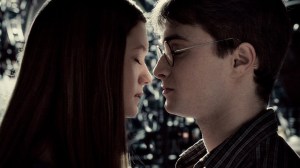 Harry Potter and the Half-Blood Prince feels like a half-hearted adaptation, with way too much time spent on tepid teen romance. This is the most visually arresting Potter film next to 2004’s Prisoner of Azkaban, but it just fumbles the storytelling. The sixth film is too often boring and inconsequential. Too much of the film feels like it was purely made for the die-hard Potterheads, and if any Muggles have questions of clarity they are required to seek out a friend to ask. This is just sloppy writing. It feels like everyone is just busying themselves before the sprint to the big finale. We’re just about at the end of the long winding road that is Harry Potter, though I’m sure the fact that the producers are splitting the final book into two movies likely will not mean that the individual movies can finally have a two-hour running time. Half-Blood Prince would have greatly benefited by being shorter, more precise, and more significant; the 16-year-old romantic squabbles seem so slight in the backdrop of Voldermort and his army on the rise. I’ll give everyone the benefit of the doubt, but this is not a Potter venture I’ll likely return to again. It just doesn’t measure up when it comes to movie magic.
Nate’s Grade: B-
Share this:

Coraline (2009)
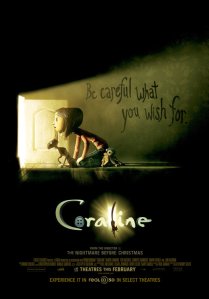 The beauty of stop-motion animation is that everything is painstakingly handcrafted so that it’s like watching a whole other world. Coraline is a wonder for the eyes and I loved just watching the movement of characters, their facial expressions, which were all done in great fluid motions. I loved that I could see Coraline thinking just through how her eyes were animated. The story, based upon the Neil Gaiman book, is about an alternative world where people have buttons for eyes provides enough eerie intrigue and some creepy imagery to spook younger kids. This is a fantasy film that doesn’t shy away from childhood scares. Coraline has an altogether pleasant feel with its spunky heroine and fine vocal cast (Dakota Fanning did not get on my nerves at all), but what’s most special is just watching the movie come alive; it’s enchanting to watch this world simply exist. There are some terrific displays of imagination in the alternative world, and it all looks even snazzier in 3-D where the world takes on further depth. Director Henry Selick (Nightmare Before Christmas) is the master of this peculiar art and thankfully Coraline follows its own visual style, never stooping to imitating Nightmare (like Corpse Bride). This is a visually stunning movie that may not leave much of an impression once it’s over (predictable story, thin plot, kind of slow ending). Coraline is a feast of artistic talent with something to discover in every awesome second.
Nate’s Grade: A-
Share this:

The Curious Case of Benjamin Button (2008)
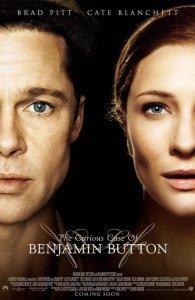 This lavish and long-winded spectacle is curious, all right. Director David Fincher (Se7en, Zodiac) has all the technical wizards at his disposal to produce a near three-hour fantasy about life, love, and death. The Curious Case of Benjamin Button works around the bizarre gimmick of a man going through the process of aging backwards. It’s loosely based on F. Scott Fitzgerald’s short story, adapted by Eric Roth (Forrest Gump), and the results are befuddling. Benjamin is a handsomely mounted and incredibly expensive work engineered for one purpose: to win Oscars. Benjamin Button is a film that strives for making grand statements and wringing a maximum amount of tears, but it’s also a film that lives more in a series of moments than as a cohesive whole. It’s a fine piece of work but feels overburdened by its urgent desire to be profound.
Benjamin Button (Brad Pitt) is born on the day the first World War ended in 1918. He is born as a small infant that better resembles an 80-year-old man (in Fitzgerald’s short story he is born as a full grown old man, which means it must have been fun for his mother). Benjamin is aging backwards but his mind is still as it should be, so while he is all wrinkly, arthritic, and covered in liver spots, Benjamin is like other small kids who want to make friends. Benjamin’s father (Jason Flemyng) is horrified by his son’s condition and abandons him at the steps of a nursing center. Queenie (Taraji P. Henson) raises Benjamin as her own child and he grows up (down?) surrounded by a colorful cast of elderly residents (one woman remarks that a young-old Benjamin looks just like her ex husband). It is here that Benjamin meets the love of his life, Daisy (played by Cate Blanchett in her older years). She’s enchanted by Benjamin’s condition but she has her youth to live and Benjamin is left behind. Daisy becomes a trained ballerina and tours the world. Benjamin goes on a series of escapades, like working on a tugboat, traveling to Russia and having an affair with a diplomat’s wife (Tilda Swinton), and discovering his biological father and the family business of buttons. But he’s always been waiting for Daisy, and eventually they “meet in the middle.”
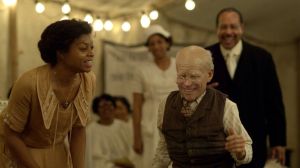 The very nature of the premise means that the movie isn’t going to have many pure, joyful moments. The idea of a romance that needs to take 40 years to connect, and even then has a limited shelf life before they go in their separate aging directions, is beautiful and heartbreaking. Waiting decades for a glimmer of your happiness with your mate, that’s a hard pill to swallow. Benjamin Button explores a similar situation covered by vampire-immortal romances, where you must endure watching your precious loved ones grow old and die. The entire movie radiates with an overwhelming sense of melancholy. The movie manages to find humor and grace amidst its melancholic dirge. The reflections on mortality are ever-present though rarely profound. It may not say anything new or original but it has many things to say about life, death, and the fleeting moments in between. By that notion, the film is structured so that the beginning, where Benjamin is a young old man, it’s more comic and beguiling, then as he and Daisy match up we finally get the pairing we’ve been pining for from the start. The pent-up passion provides great conflict, and then we barely get to enjoy the coupling before reality strikes. The final twenty minutes of the film, where old Daisy cares for old young Benjamin, are incredibly moving and have an indelible symmetry to them, watching an old lady lead a child by the hand.
 So then why do I feel so hesitant about fully accepting this movie? The story follows a similar Gump like pattern of incidents but the movie refrains from being mawkish. The main character is mostly passive with little personality; he’s nice but take away his unusual condition and not many folks would remember their time with Mr. Button. Before he gets with Daisy the film feels a bit episodic with the chapters of Benjamin’s life, and they are entertaining asides but they fail to amount to much more. Benjamin Button feels like something important is absent; it’s not cold as others have claimed but it feels, perhaps, remote, stopping just shy from being a full emotional investment by keeping the audience at a somewhat objective distance. This may be Fincher’s own design because Fincher ensures that a film about living life to the fullest doesn’t degenerate into sentimental claptrap. The end hits hard but not as hard as it could if I was more invested in Benjamin as a character. The Hurricane Katrina framing device seems tacked on, but then again the story mostly takes place in New Orleans and Katrina is rather noteworthy, you could say. The “elderly lady recalls her life story” is reminiscent of Titanic, and might not even be necessary though it offers Daisy the ability to look back over her years with added insight. The layers of realistic makeup piled onto Blanchett are impressive, though I worry what would happen if the actress had to go to the bathroom.
Technically, the movie is nearly flawless. The visual effects are astounding, seamlessly allowing Pitt to play the role even as a young child. The Curious Case of Benjamin Button is a glorious experience to watch but a mildly curious experience to register. The film is so meticulously crafted and it has all the right components of a tragic romance for the ages, but it somehow misses the mark. It’s an entertaining and moving film but it leaves something to be desired. The most resonant moments are also the ones that are the simplest, the ones that lack the window dressing of expensive special effects. I appreciated the film’s expressions of symmetry, but I have the nagging feeling that Benjamin Button both tries too hard and perplexingly doesn’t try hard enough. It keeps audience involvement at a distance, wishing to comment on humanity without embracing humanity. It is difficult for me to articulate what is lacking, because it is an enjoyable if overly long movie, but it falls into the “almost” category of poignant filmmaking. It’s almost a challenging movie, it’s almost an affecting movie, it’s almost a movie worth falling in love with. The film’s story and sensitivity and scope cannot match the technical audaciousness.
Nate’s Grade: B


You must be logged in to post a comment.