Blog Archives
Toy Story 5 (2026)
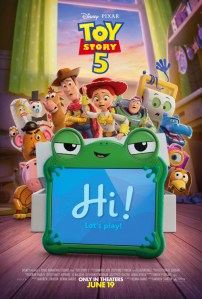
Every time Pixar resuscitates the storied Toy Story franchise, going on three decades now, I get a little wary of them upending the good will. The series had a perfect ending in the third edition in 2010, but being Pixar’s golden and most bankable franchise, it wasn’t allowed to remain an ending. I quite enjoyed the fourth edition in 2019 and consider it a fitting and poignant sendoff for Woody, if, of course, they could accept this as his settled ending. Now in 2026, here comes a fifth Toy Story, and my emotions are decidedly mixed, excited for the creative possibilities of another entry in Pixar’s flagship series and girding myself in anticipation of whether or not these fitting and earned endings are disturbed. Perhaps I’ve been overly protective of these endings, or perhaps it’s just a reflection of our modern IP-revivial cycles that studios cannot accept anything that makes money having finite story endings. Well, while I believe Toy Story 5 to be likely the weakest of the five films, it’s still a marvelous movie that elicited tears from my grown-up eyes on more than one occasion.
Now that Woody (voiced by Tom Hanks) has settled into a new life, the plucky leader of Bonnie’s toys has become the next cowgirl in line, Jessie (voiced by Joan Cusack). Life is good until Bonnie’s parents introduce an educational tablet device, Lilypad or “Lily” (voiced by Greta Lee). They want Bonnie to socialize more and make friends with the neighbors, something she’s having difficulty achieving. Bonnie becomes enthralled with her first smart screen, spending hours upon hours with it inches away from her unblinking face. Jessie sees the new tech as an enemy to traditional play time, as Bonnie’s toys have been chiefly neglected as she devotes all of her attention to this new shiny device. She plots to remove the Lilypad; however, Lily has her own ideas about what Bonnie needs, and it involves getting rid of the outdated toys of childhood so she can be better accepted by her more tech-adopting peers.

Right away, Toy Story 5 provides a meaningful reason for its own existence, examining the immersion of technology and in particular screen time into the development and maturation of children. It’s a substantial issue today for millions of parents, and a genuine worry about whether or not these magical electronic devices are helping or hindering childhood development. Are we building synapses with these games and social media apps or are we building a dependency and despondency when un-synched? It’s an age-old question over whether technology is facilitating growth or substituting for it, an especially pertinent question in the realm of education that ruling parties go back and forth with. This is a fabulous and thorny issue to explore in the Toy Story universe, and with co-writer/co-director Andrew Stanton (WALL-E, Finding Nemo) at the helm, there’s an assurance that all will be handled with wit and warmth (Stanton has co-written all five Toy Story movies, though this is his first directing credit). I actually think this movie utilizes its central premise better than Toy Story 4 did with the murky existential questions with Forky over what constituted play and thus was granted existence and consideration. Now, that movie transformed into a different and more emotionally resonant theme about broken toys still having purpose and dignity after being cast off from their owners, a disability empowerment message that was beautifully handled, so much so that I forgave the dropped exploration of thorny prior themes. With Toy Story 5, the question over the role of tech is front and center throughout.
At the core of this movie is the question of growing up and the malignancy of time. Lily wants Bonnie to be accepted and thus happy, and her reasoning is that these other toys are a detriment to this goal. In her view, they are dragging Bonnie down and imprisoning her in a juvenile state that her peers have already graduated from. For Lily, growing up is a process to be hurried, to become more like a “grown kid,” and thus more like everyone else on the block who has adopted tech and screens earlier in their lives. For Lily, Bonnie, even only at a mere eight years old, is already behind in her maturation process and she’s desperate to get her caught up. For Jessie, it’s about holding onto the status quo as long as possible. For three sequels now the movies have explored the nature of change, acceptance, and identity, and it’s still a wellspring of insight and emotional and intellectual relevance. Having Jessie be the primary protagonist of this sequel was a brilliant choice because she’s the toy who has been defined by abandonment issues. She’s been left behind by two other kids, first Emily and then Andy, and she’s afraid history is repeating with Bonnie’s dwindling attention now that tech has entered the home. There’s a clear parallel with the original Toy Story when Woody became jealous and insecure about the shiny new toy of Andy’s fascination, Buzz Lightyear (voiced by Tim Allen). Oh, and thanks to 2022’s Lightyear, we now know all these toys were the discount knockoffs of Chris Evans’ voice and that this original movie that Andy declared his favorite was not quite worthy of his adoration. Anchoring the major theme onto Jessie’s existing emotional attachment issues is smart, and it allows the fifth film to serve as a means of long-delayed closure for the cowgirl much as Toy Story 4 was a means of closure for Woody. It’s about confirmation that these relationships they build with their kids are not one-way, and that even after they end, and everything has an ending whether we like it or not, we know that they have mattered. No one, not even toys, wants to feel disposable.

I especially loved the imaginary play sequences in the film, highlighted by a different animation style. It’s painterly and with pastel colors, and it’s a great artistic choice to visually code the imaginary sequences from the standard reality. I loved how chaotic and silly these sequences were, converging escalating threats, dramatic twists, and ridiculous double crosses and resolutions, perfectly embodying the wild mind of a child in the midst of imaginary play. These little interludes were welcomed at every turn.
I did say Toy Story 5 was the weakest entry in the franchise, again no shame being a bronze medalist at the Olympics, so to speak, as you’ve gotten ahead of so many others to attain this honor. I enjoyed the lowered stakes of simply trying to tell a story about two factions fighting over what they felt was best for the mental well-being of a child. There’s something inherently sweet about a movie whose big goal is to just help a shy little girl make some friends. I do wish there was more persistent commentary on what screen-addiction has done to a generation of kids at an important time besides turn the neighborhood girls catty and mean. Bonnie, you are not the “weird kid” just because you prefer playing outdoors. At no point is Jessie really threatened with annihilation, and even as she’s lost she still finds a new and nurturing owner that could possibly even replace Bonnie. Because of those lowered stakes, the script can feel a little like an expanded TV episode where a character learns a valuable lesson. The supporting characters are sidelined with few exceptions. This is the second movie in a row that merely gives Buzz a jokey storyline, this time working up the courage to ask Jessie to be his wife. It’s more a recurring joke at his fumbling awkwardness. It feels like Pixar knew it was giving the character such a short shrift, which is why they also included an ongoing subplot of a group of Buzz Lightyear action figures bandying together to go searching for “star command.” Until finally tied into the action at the very climax, they’re a diversion that is never really as funny as it could have been. I will also firmly proclaim my stance that Woody should not have returned for this sequel. He offers little to the story, beyond to once again reflect upon how old he has gotten, which itself is just turned into a repeating joke. Woody’s involvement is wasted and his perspective isn’t different enough that some other toy, perhaps Buzz, could have fulfilled his role and left the former sheriff in retirement with Bo Peep.

Does Toy Story 5 upend the cherished endings of its predecessors? No, not really. Those endings still have meaning because the audience has invested relationships with these characters over thirty years. The latter sequels, in my mind, have served as closure vehicles for individual characters, and I think that’s a smart way to handle the franchise. Of course, I also think just telling original stories with new characters in this universe would be even more appealing, but the likelihood of that seems slim when Disney wants to sell another billion dollars in merch with their established and beloved characters. It’s probably naive to think this movie will ultimately be the franchise’s last, so instead I’ll just hold out hope that its ongoing quality will persist, and as long as Stanton and other Pixar brain-trust remember its innate and lasting appeal, I have a buoyant sense of hope that newer editions can still capture that initial magic that began in 1995.
At the conclusion of Toy Story 3, which I still gauge as the best in the series, it made me reflective and want to break out my old neglected toys, giving them one more hurrah of play. At the conclusion of Toy Story 5, it made me reflective, but I didn’t want to reach for any old toys and give them an extra dose of affection; it made me want to grab my toddler and soak up the time I have available with him, now, in this moment, while there’s a childhood to relish before it too vanishes at the mercy of time. This movie is all about the struggle over childhood, one side hoping to elongate it and the other hoping to rush through. From a different perspective, like a parent, it’s inevitably a losing battle, but it makes me reflect more on cherishing those moments while they are available. That’s pretty deep for a movie with a talking electronic poop assistant voiced by Conan O’Brien. Not too shabby, Pixar. Here’s your billion dollars.
Nate’s Grade: B+
Share this:

Toy Story 4 (2019)
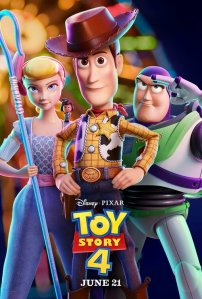 The Toy Story franchise has been the gold standard for Pixar with three excellent movies, the last of which was released back in 2010. When the Pixar bigwigs announced they were making a fourth entry, I felt some degree of concern. The hidden world of toys still felt like an interesting world with more stories to be told, but did we need to revisit Woody and Buzz and the gang? Everything ended so beautifully and perfectly with the third movie, with the toys getting their sendoff from their original owner and a new life in the possession of a new child, little Bonnie. I’ve been more wary about this movie than just about any other Pixar film because the audience had something that could be lost, namely closure. If they harmed that perfect ending in the crass desire to extend the franchise for an extra buck, it would have been aggravating and depressing to disturb something that felt so complete. It’s like when Michael Jordan came out of retirement (the second time) to be a shadow of himself for the Washington Wizards in order to sell tickets for the team he was part owner of. Nobody wanted that. I’m happy to report that Toy Story 4 is a treat of a movie and a worthy addition to the franchise.
Bonnie is gearing up for kindergarten and nervous about the change. She isn’t allowed to take toys with her to school, though that doesn’t stop Woody (voiced by Tom Hanks) from tagging along. In her desire for a friend, and with a little assist from a certain cowboy, Bonnie creates a fork-figure named Forky (Tony Hale), and amazingly it comes to life. Woody tries valiantly to convince Forky that being a toy to a child is the greatest gift but he’s also really reminding himself now that he sees his influence waning with Bonnie as he’s selected for play time less and less. During a family road trip, Forky escapes and Woody leaps to find him, both of them coming into the clutches of Gabby Gabby (Christina Hendricks), an antique doll missing a functional voice box who has her sights set on Woody’s voice box. It’s at this small-town pit stop for a carnival that Woody discovers Bo Peep (Annie Potts), an old flame he never thought he would see again. She’s assured, happy, and preaching a life of being independent from a kid. Woody has defined himself for so long by one identity, and now he must decide which to follow.
 In many ways, Toy Story 4 takes themes and questions from the third movie and improves upon them, making what could have been a retread feel like a do-over you didn’t know you desired. It’s been many years since I saw the third film but I recall the major themes being the fear of change, reconciling one’s self-identity, and the courage of letting go and starting over. The toys had to recognize that their owner was growing up and their old place wasn’t going to be the same. This same issue finds new life in Toy Story 4 primarily through the lens of Woody, who finds himself on the decline with his kid’s interest. He’s not offended or upset by this but is still trying to provide what assistance he can as a beloved toy, even if that relationship becomes more and more one-sided. His identity is in selfless sacrifice for another, but with the re-emergence of Bo, he is now contemplating a life on his own, a life without a kid. This alternate path never seemed a possibility until his former flame stepped back into his life. It challenged Woody in a way that feels more personal and more relevant than it did with 3, especially with the removal of a larger external threat to occupy the attention of our main characters. This places a renewed focus on Woody’s internal dilemma beyond his role as leader and protector.
Toy Story 4 might also be the weirdest movie of the franchise, which really elevates the comedy into another realm. I thought the characters played by Jordan Peele (Us) and Keegan Michael-Key (Predator) were going to quickly wear out their welcome; they seemed to be a heavy part of pre-release teaser trailers. The filmmakers don’t overdo them and use them in clever ways, which is a compliment that can be applied to every new character in this sequel. The plushies by Key and Peele have a hilarious running gag of their increasingly absurd plans to attack a woman, and one instance deliciously prolongs the eventual punchline, becoming more bizarre and macabre to the point that I lost control from laughter. Keanu Reeves (John Wick 3) is fun as a very Canadian Evel Knievel motorcycle driver, and the weird references to the Canada-ness of it are played completely straight, making it even funnier (his laments with the French-Canadian boy’s name made me snicker every time). There’s a trio of action figures, Combat Carls, and one of the three is always left hanging for high-fives and he just leaves his arm up waiting, silently pleading, and then lowers it in defeat, and it’s hysterical even just as a background gag. The ventriloquist dummies are routinely played for creepy laughs and physical humor. There’s a running joke where Buttercup, the unicorn voiced by Jeff Garlin, is always suggesting getting Bonnie’s father sent to jail no matter the circumstances. It’s these touches of weirdness that make the movie stand out that much more from the three others.
 The villain of Toy Story 4 is given a surprising sense of poignancy, enough that I genuinely sympathized with her plight. She’s a damaged doll used to being behind glass, isolated and separated from the children she wishes to be part of. She views her salvation in fixing in her damaged voice box, her perceived disability. She’s after what Woody has physically, the voice box, but it’s a means to an ends to have what Woody has had emotionally, the love of a child in need, the connection she yearns for. I won’t spoil what happens with her but even when there are setbacks the film and the characters don’t give up on Gabby Gabby. Her perspective and desires are still seen as valued, and the eventual resolution of her character put a lump in my throat. She wasn’t really the villain after all. She was just another toy in pain looking for acceptance and having to adjust her identity. I feel like there is a conscious disability empowerment message implanted in Toy Story 4, namely that those who are disfigured, disabled, or seen as “broken” can continue to be valuable and that their lives don’t end.
If this serves as the finale of the franchise, it will end on a fitting and resonant high-point. As much as Toy Story 3 was about change and acceptance, this sequel does a very respectable effort of personalizing that message even more to one central character’s dramatic arc. It also works wonderfully playing off of our collective investment in the character over the course of four movies and twenty-four years. There are some drawbacks to this approach. It makes the majority of the other toy characters feel like they have little to do on the sidelines, other than fret about retrieving Woody and Forky. Buzz is given a cute joke about listening to his inner voice but it doesn’t amount to much more than a cute joke. The inclusion of Forky feels like an exciting and even daring addition, tackling some existential questions and how and when toys are “made” and brought into being, and he presents these for a while. Once we get to our carnival setting and Forky is captured, he seems to be forgotten about. He’s more a motivation point for Woody than overtly anything else. I suppose you could make the analysis that Forky represents how Bonnie is moving on even with invented toys at the expense of Woody. However, these are minor quibbles considering the quality and emotional involvement of what Pixar has produced.
It goes without saying that the animation is beautiful but what amazed me is how expressive the faces of the characters could be, even when they were relatively inflexible toys. The relationship between Woody and Bo actually has a surprising amount of nonverbal dramatic acting to communicate nuance. As the years go by, I continue to be further and further amazed at the Pixar animators and their abilities.
 As protective I was over Toy Story 3’s perfect ending, I am happy to say that Toy Story 4 more than justifies its own existence in this hallowed franchise and even improves from the third film. The themes are something of a repeat but the filmmakers have elected to focus almost entirely on Woody and his personal journey, and it makes the loss and possibility more robustly felt. In many ways the film is an exploration on relationships and the need to redefine ourselves, to move onward when the time is right, and to try something new even if things get scary. Between Woody and Gabby Gabby, ostensibly the hero and villain of the piece, they’re looking for meaningful connections where they can. They may be secondhand, they may be disabled, but that doesn’t mean they aren’t worthy of affection. This is a joyous movie that finds time to be wonderfully weird and often funny. It might not have the set pieces or ensemble showmanship of the prior Toy Story tales, but what it does have is a character-based emphasis on the most complex figure in this universe of toys. The conclusion is moving and satisfying and I don’t mind admitting that tears were shed. I even teared up at different other earlier points. Toy Story 4 could have gone a lot of different ways but I’m relieved and appreciative with this new sendoff we’ve been granted.
Nate’s Grade: A
Share this:

Toy Story 3 (2010)
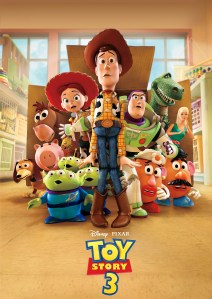 I was completely unprepared for how emotionally involving Toy Story 3 would be. Sure, Pixar has managed to break and melt your heart through ten previous movies, but I suppose I foolishly felt that I was beyond caring for toys. But even in the opening minutes, a tremendous make-believe fantasy, I felt punches of emotion as each character was reintroduced. It felt like I was reconnecting with old friends and it was such a pleasant reunion. It’s okay, guys, to cry over toys.
Cowboy sheriff Woody (voiced by Tom Hanks), the leader of Andy’s toys, is trying to keep hope alive. Andy is now 17 years old and on the verge of leaving for college. His favorite childhood toys have long since been relegated to a chest as Andy has matured. Joining Woody are spaceman Buzz Lightyear (Tim Allen), Jessie the cowgirl (Joan Cusack), Mr. and Mrs. Potato Head (Don Rickles and Estelle Harris), Slinky Dog (Blake Clark), the timid Rex (Wallace Shawn), and the piggy bank, Hamm (John Ratzenberger). They are all the toys in their gang that remain. As Andy leaves their main goal seems to have been accomplished. They were there for their owner and now he no longer needs them like he once did. The toys have a few options left: stuffed into the attic, sort of like a retirement home, until perhaps Andy digs them out for his own kids, or being thrown out with the trash. Woody assures them that Andy would never just throw them all out, though even he has his doubts about their current purpose. They all feel the loss.
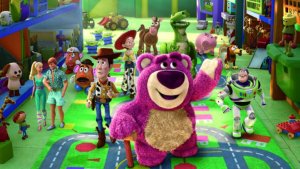 After a mix-up, the toys decide to take matters into heir own adjustable hands. They will sneak away inside a donation box for Sunnyside Day Care. The center seems too good to be true. The courtly Lotso Hugs Bear (Ned Beatty), who seems to lead the center, promises that all toys will never be forgotten again. When the children grow too old then a new batch moves in to play. It’s a toy’s dream, that is, until Buzz and the gang discover that they’re canon fodder for hyperactive, maniacally destructive toddlers. They can’t keep up with the daily abuse. Sunnyside Day Care is less a haven than a prison. New toys have to pay their dues and earn a place in the vaulted Butterfly Room, where young children lovingly interact with their toys. It’s a toy class system. Lotso refuses to cotton to rule-breakers, and toys are locked away nightly so they cannot escape. Woody must try to save his friends by breaking them out and getting back to Andy before he departs for college.
Given that the movie tackles major issues like moving on, growing up, and mortality, I knew I was in for some heavy moments, but absolutely nothing prepared for some of the emotions that clobbered me. You do realize through the course of this third film as the toys try and find a suitable place to retire, if you will, how attached you are to these characters. Late in the movie the toys are in some dire circumstances. There’s a horrifying junkyard sequence that even manages to evoke Holocaust imagery, which means parents are going to have to calm some spooked tykes come bedtime. There’s a silent moment, where the toys all seem to accept their fate, and all they want to do is join hands and face it together, as a united family one last time … and my God, I could not control myself. My face was dripping with tears (even thinking back right now is causing my eyes to well up a bit). Toy Story 3 isn’t the strongest of the trilogy in terms of character or plot (in some respects, the plot is a reworking of The Brave Little Toaster), but you better believe that it delivers emotional resonance in spades. Major credit goes to screenwriter Michael Arndt who won an Oscar for Little Miss Sunshine.
 But fear not, Toy Story 3 is not all sturm und drang, it also provides plenty of laughs and plenty of visual wonder and excitement. The toy’s point of view has always allowed for plenty of amusing insights and satirical riffs. The personality clashes makes for the most jokes, and the new characters pull their own weight, particularly Ken (Michael Keaton), an effeminate clothing-conscious doll who finds his true love with the arrival of Barbie. The use of Big Baby as a malevolent goon is also refreshing and quite creepy. The Spanish Buzz reboot personality seems superfluous but cute. The jokes come by at a steady pace and while they all may not work as well (Ken in a trying-on-clothing montage set to “Le Freak”?) there are still moments of great creative ingenuity. The detailed escape from Sunnyside feels like a terrific parody of prison movies, and they way it utilizes all the different characters as key components is satisfying and fun. But the best moment of the break-out, by far, is when Mr. Potato Head is trapped, hurls his pieces out of an opening, and reassembles thanks to a tortilla body. It’s a weird visual, like something out of Salvador Dali, and yet I could not stop giggling from watching his floppy movements. It’s comedic while at the same time a genius move in drawing out an action sequence — it makes keen use of the players and their skills. From an action standpoint, G-rated Toy Story 3 manages to have more thrills and spills than any other 2010 movie so far.
Director Lee Unkrich (co-director for three previous Pixar flicks) makes quite a debut for himself. The complexity of the action, while still maintaining an internal logic, is hugely rewarding. The Pixar wizards truly know how to craft inventive action sequences and stay true to character. Unkrich’s command of visuals is impressive. The action is well paced, but it’s the man’s use of composition, camera movement, and editing make Toy Story 3 a visual treat. Unkrich fully knows how to best utilize and fill up the screen. The world of Toy Story is popping with color and visual whimsy, as well as plenty of sight gags and subtle movie references for adults. Ten years of advancements in computer effects has also allowed the toys to get a bit of a facelift. The 3-D process enhances the overall experience without calling attention to itself. There aren’t any standard 3-D moments where big and pointy things keep flying out at the audience. The 3-D provides a greater field of depth without distracting you from the pivotal moments of story.
The voice acting is just about perfect from top to bottom. Allen and Hanks are a welcomed pair, Cusack provides plenty of spunk, Rickles brings his usual dish of joyful disdain, and new characters like Timothy Dalton as a stuck-up thespian porcupine and Kristen Schaal (TV’s Flight of the Conchords) as a bubbly triceratops toy are fun additions that don’t overstay their welcome. Blake Clark takes over the voice of Slinky Dog from the late Jim Varney who died in 2000, and he does a fine job without sounding like a direct imitation. I was really delighted by Beatty. He has such a Southern gentlemanly demeanor that underscores the hardened heart of his villainous character. And yet, Lotso gets his own rich back-story of abandonment and bitterness similar to Jesse the cowgirl. Even when he’s dastardly we can see where the big purple Teddy bear who smells like strawberries is coming from. Ned Beatty has finally appeared in another breakthrough cultural film to redefine his identity. Perhaps now he won’t be best remembered as the guy who gets raped in Deliverance. He probably still will be.
A lot has changed in the 15 years since Pixar revolutionized the world of animation and family films with their first feature, Toy Story. Kids at the time are now teenagers; some embarking on college this summer themselves much like Andy. They too have to put away former childish things and move forward. Toy Story 3 is magic confluence of heart, wit, visual whimsy, cleverness, and drama. Not quite as sharp as the first two installments, or as artful as Pixar’s high-water mark, WALL-E, the third Toy Story is still a mighty entertaining piece of work. The last 30 minutes of this movie is harrowing and then deeply satisfying and moving, finding a fitting sendoff for characters that we’ve come to love. It’s all about moving forward, saying goodbye, and reflecting about times shared. I wouldn’t be surprised if Toy Story 3 inspires kids, and adults alike, to go home and play with their old toys, giving them renewed life and purpose.
Nate’s Grade: A
Share this:

Wild Hogs (2007)
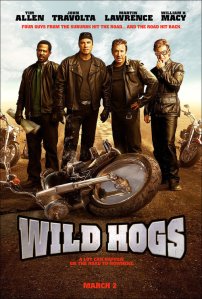 It’s hard to imagine that this lowbrow, homophobic, uninspired, painfully nostalgic film is the top grossing comedy of the year so far. I don’t really want to further elaborate on what this says about the general public. The boys (John Travolta, Tim Allen, Martin Lawrence, William H. Macy, a more random grouping of actors I challenge you to find) are all henpecked and unhappy with their dull, predictable, socially comfortable lives, so what’s a group of men facing midlife crises to do? Road trip. The idea of the freedom of the open road and the rebelliousness of touring the country on the back of a motorcycle seems quaint and naive at this point in life. What follows on their biker odyssey is a lot of lame slapstick and each actor trying to outdo the other in masculinity. A protracted third act standoff brings the film to a halt that it can never recuperate from. Wild Hogs isn’t a comedy disaster of sorts but it’s definitely got enough aimless misogyny and retroactive Boomer nostalgia to make you gag.
Nate’s Grade: C-
Share this:

Toy Story 2 (1999)/ Princess Mononoke (1999)
 There is a false prejudice circulating the land of merry movie goers as they skip from one theater to the next. This assumption is that animation is a kids only event, that’s it’s something to appease the screaming masses under three feet of height. Lately movies are giving more credit to the cause that animation can be a wonderful escape and isn’t just for the kids.
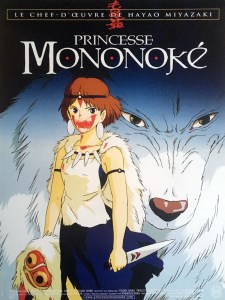
Animation can take people to worlds that otherwise could not have existed, and so is true with Princess Mononoke the 1997 Japanese import with a fresh English dubbing. Mononoke speaks of the battle between harmonious nature and forging industrious man. Often the film displays such scenes of visual passion that it seems like an animated love letter to those wishing to venture out to find it. The story is vivid and non-judgmental, you see the stories and reasons behind both warring forces and not everything is easily black and white. The English dub does not distract from the overall enjoyment as many professional actors yield their vocal talents to this masterpiece. Princess Mononoke leaves a spellbinding impression of intense ecological thought and aching beauty. The best anime has to offer.
 At the other end of the animation spectrum lies Toy Story 2, the kid friendly three-dimensional quest of action figures and plush dolls. What is amazing about Toy Story 2 is how it not only matches its ground breaking predecessor but even surpasses it both in visuals and story. Story is packed with sly humor not just for kids, and it contains a poignant message about mortality and what one seizes with the opportunities they are given. The animation is mesmerizing and the humor is fast and fierce. Toy Story 2 proves that not all sequels are bad ideas.
Fresh from the gate are two examples of the great gifts animation has to offer. Couple these with the wonderful The Iron Giant, a ferociously funny South Park movie, an okay Tarzan, and the upcoming Disney redux Fantasia 2000 and it appears to be a solid time for animation. Go out and see some.
Nate’s Grade: Both movies A


You must be logged in to post a comment.