Blog Archives
Holy Motors (2012)
 I like movies that are different. I like movies that can be hard to understand. Holy Motors, a surreal French film, is both very different and very hard to understand. The movie follows a man as he goes about transforming into nine different characters, each with their own bizarre mission. Is he performing? For whom? Who is behind all this? Does he ever stop assuming false roles? Questions such as these hardly matter in movies such as this. You’re either transported by the lyrical weirdness and unpredictability, or you find it tiresome and much ado about nothing. After a while, I just gave up with this movie. I’m not a fan of weird for weird’s sake and I felt like that was all I got with Holy Motors. I’m sure you could write a doctoral-level thesis decoding this movie, but why waste valuable hours of your life? This movie is nothing but strange imagery that adds up to precious little. I thought the concept of playing roles/manufactured realities was better explored in Charlie Kaufman’s Synecdoche, New York. When a Kaufman movie is more accessible than your film, your name better be David Lynch or you’re in trouble. I’m sure several fans of the obscure and outrageous will find amusement at the sheer randomness with Holy Motors. It’s got martial arts acrobats, Kylie Minogue breaking out into song, magical resurrection, spontaneous band performances, talking cars, and for good measure chimpanzees. I hope you get more out of it than I did. I found the enterprise to be more tedious than titillating, more frustrating than fascinating, and not worth the trouble of fashioning meaning from the discarded puzzle pieces.
Nate’s Grade: C
Share this:

Breaking Dawn: Part Two (2012)
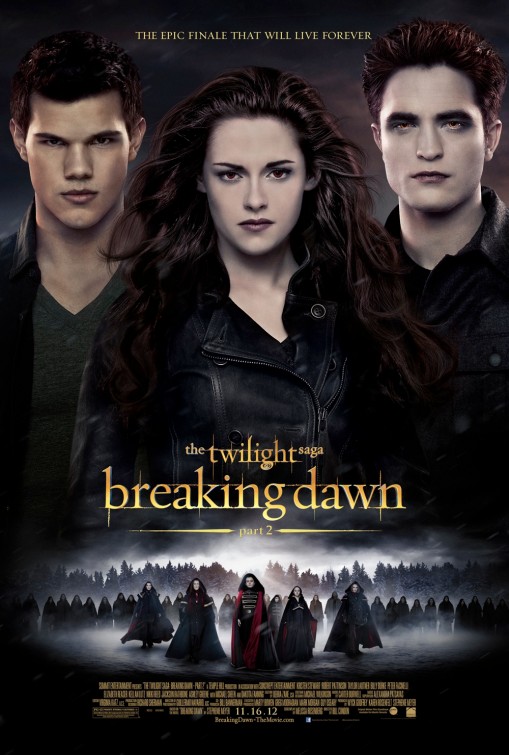 Ignoring the ironic nature of the Breaking Dawn Part 2 poster taglines declaring love to be “forever,” the box-office juggernaut that is the Twilight franchise is coming to an end. Based upon Stephenie Meyer’s outrageously popular series of books, we’ve followed the love life of Bella Swan as she’s experimented with human, vampire, and werewolf. The studio heads decided to take Meyer’s final book and split it into two books. Breaking Dawn Part 1 had a wedding, honeymoon, pregnancy, supernatural birth, and Bella’s death/resurrection. And yet, that movie was still crushingly boring. My hopes were substantially low for Part 2, despite director Bill Condon’s (Dreamgirls) best efforts to jazz up all the awful plotting, characters, and romance. Then a funny thing happened. I started enjoying myself, and then the movie took some chances that I felt were daring considering its rabid fanbase. And then watching Breaking Dawn Part 2 became more than watching the film, it was also the experience of watching the audience. To that end, the movie delivers and I may rue these words but I kinda sorta almost liked enough of it.
Bella Cullen nee Swan (Kristen Stewart) and her husband, immortal vampire Edward (Robert Pattinson), have gone through the wringer. In her waning days as a human, Bella got knocked up during her honeymoon, and her half-human half-vampire baby killed its mama on the way out. Now Bella’s a vampire and a mom (note to self: start writing new script – “Single Mom Vampire”). Her daughter, Renesmee (Mackenzie Foy’s face on a whole lot of other people’s bodies), is rapidly growing. She’s mistaken for a vampire baby, which is a punishment worthy of death. This news gets Aro (Michael Sheen) to rustle up his Volturi forces, a group of vampires with super powers. They’re coming for the Cullens and little Renesmee. The friendly vampires scour the world, gathering “witnesses” to the tyke’s half-vampire status, but really they’re gathering an army to defend themselves. It’s super vamp against super vamp and heads will roll.
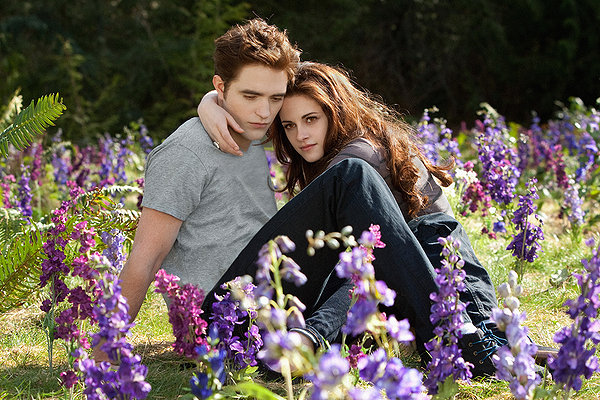 I clearly understand that I am in no way the target audience for this franchise and that my reams of pithy words will find little traction in the hearts of the Twi-hard faithful, but I’d like to state that I’ve never been a hater of the movies. Well, let me rephrase that. My thoughts ping-pong from liked okay (Twilight) to hated (New Moon) back to liked okay (Eclipse) back to hated (Breaking Dawn Part 1), and now here we back are to liked okay. Consider it a double-dip recession in quality. I still view the whole franchise as an exercise in pre-teen wish fulfillment, but I’ve already written extensively upon that theory so I won’t bother re-litigating that battle. With all that said, I found myself oddly enjoying myself for sustained durations. It’s just as silly as the other movies but finally we can move on from mopey Bella and her dubious romantic triangle. Finally we don’t have to suffer through two hours of kids making (new) mooneyes at each other (did I just out myself as “old”?). By this I mean finally something ELSE happens rather than the incremental coupling of Bella and Edward. Granted their kid is really more a prop than a character, but at least the story has taken one gigantic leap forward. Finally Stewart can actually smile and, you know, do things of actual consequence!
It’s no secret that the Twilight saga, as its monetary benefactors would like to dub the franchise, has noticeably been better the less time it spends with its female protagonist, Bella. Breaking Dawn Part 2 might just be the least Bella-filled episode yet, a cause of celebration for my brethren who view Ms. Cullen as an infuriating, insufferable, insulting protagonist. At least in this movie she develops a sense of self-identity, though too often that identity falls into the camps of Wife and Mother. With this movie, she’s adjusting to life as a vampire, so we get cutesy scenes of her hunting prey, learning how to fake looking like a puny human, and arm-wrestling the strong cocky vampire guy to, you know, for the strides in girl power. Too little too late, Bella. I find it more than a little funny that Bella’s super power is passive in nature, fitting a passive protagonist that waist for people to give her meaning and tell her what to do. I should stop before another rant unspools as I’ve done on previous Twilight writing occasions. In short: Bella sucks.
We’re introduced to a lot of new characters in this movie and each brings some sliver of backstory to develop. I’m not saying they’re all deserving of attention or interest, but at least these new clans of vampires brought some much-needed life to what has often been a claustrophobic, monotonous love triangle. Opening up Meyer’s world and seeing other vamps with special powers are a fun detour that I wish had taken place sooner. I liked seeing Lee Pace (TV’s Pushing Daisies) as a soldier from back to America’s colonial days. I’m left scratching my head why certain vampire members were added to the ranks when they didn’t even show up for the final showdown. What was the point of having Joe Anderson (Across the Universe) show up and be all skeptical about the group’s chances of winning… and then not have him join? So he was skeptical from the start and then remained so, choosing to sit the finale out. Well I’m sure glad we spent time on him then. Also, the movie falls into the trap of establishing super-powered beings that are too powerful. We get one guy who can control the elements. Not just one or two but freaking all of the elements. He’s like Captain Planet minus that dumb kid with the lame heart power. During the climactic battle, this kid uses his power ONCE. How do you give him a wealth of super powers and then sideline him? There’s also an Amazon vampire who can control people’s vision, namely making them see whatever she wants. How are these two assets not utilized for tactical supremacy?
 I had the suspicion that Breaking Dawn Part 2 might be the best film in the series simply by the fact that it’s the one with the most Michael Sheen. God I love this man. His last-minute turn in the appalling New Moon banished the suicidal thoughts swirling in my head. Even when he’s in bad movies, Sheen is usually the best thing about them (see: TRON: Legacy or the Underworld films). Here’s an actor who knows exactly how ridiculous everything about this universe is, and by God he sinks his teeth in. The benefit of added Sheen cannot be overstated. The movie greatly benefits by having a strong outside threat early. Only the third movie, Eclipse, had an external threat from the start, and that gave the film a much-needed sense of urgency. I was with Sheen and the Volturi on this one. They were merely following the laws of vampires meant to protect their own kind. Vampire babies are a no-no since they cannot control their otherworldly urges, so they and their makes must be destroyed. You know you’re in for a darker Twilight when early on we witness a baby getting tossed into a roaring fire. I admit that I have a susceptibility to falling under the sway of magnetic villains. Perhaps this speaks to some character defect of my own. It probably just speaks to the fact that movies often have boring heroes and charismatic villains. Sheen is so hammy and delightful and I just wanted more of him amidst the melee that punctuates the end. The man even looks like he’s about to lead a marching band during the battle and he’s still badass. Such is the awesomeness of Michael Sheen. Of this there can be no question.
But then the Condon and series scribe Melissa Rosenberg do something almost extraordinary given the slavish devotion to the series fans have. They divert from the source material in broad strokes during the climactic vampire brawl. I won’t go into exact details but the preview audience I was with was absolutely losing their collective minds. Women were screaming, cries of “Nooo” rang through the room; all around me was the echo of consternation and shock, women trying to absorb the reality of what they were viewing. Sitting with them, taking in their shrieks and lamentations, the general horror of what might happen next… it was a thing of beauty. I can almost recommend seeing Breaking Dawn Part 2 simply to be part of this experience. However, you’ll have to act quickly and be selective. You’ll need a packed theater filled with vocal Twi-hards, likely an opening weekend evening crowd, the kind that openly cheer shirtless revelries from the male co-stars. And then just sit and wait, knowing that soon all that revelry will turn to shock. I sound so mean-spirited explaining this and that’s not my intention. I didn’t necessarily enjoy the discomfort of the Twi-hards. I enjoyed the bewilderment. It felt like the theater was alive, coursing with the energy of alert uncertainty. Anything could happen, including some very not nice things. To be one tiny drop in an ocean of furious estrogen, well it’s an experience that deserves mentioning. Its strange experiences like this that make me love going to the movies, and that, ladies and gentlemen, is a combination of words I’d never thought I would write about any Twilight film.
Also, though my expectations were never that high to begin with, I have to credit Condon with fashioning a fairly exciting action brawl, one that’s surprisingly graphic at spots for a PG-13 movie primarily aimed at young girls. The series has been building up to a massive showdown, and the movie itself has been putting the feuding factions into place, so it’s satisfying that the finale truly feels climactic and delivers some thrills. For the record, Meyer’s book was free of any climactic battle. This movie is chock full of decapitations. I cannot recall another PG-13 film that had this many beheadings. I think you could watch a drama set during the French Revolution and you wouldn’t witness this many people lose their heads. Is there no other ay to kill a vampire? What ever happened to the good old fashioned staking of the heart? These kids these days; all they want to do is decapitate. To dull the grisly spectacle, the beheadings are weirdly bloodless. Condon does a bangup job of setting up plenty of mini-payoffs and duels throughout his busy action centerpiece. Then when it looks like the carnage is at an end, the movie takes a page from the Final Destination playbook, which Twi-hards will probably find relieving. I thought it was a major cop-out but whatever. Let the kids have their happy ending.
 Before you get your hopes up too extravagantly, this movie still offers plenty of stupid. I don’t care how you explain it, the imprinting thing is stupid incarnate. I still find it eternally creepy that Jacob couldn’t have the mother so he settles for the daughter. The fact that everyone treats this development so seriously makes me laugh. And oh boy, let’s talk about those Amazon vampires. First off, I find it hilarious that Meyer’s vision of vampire clans from around the world really just boils down to Europe and the Amazon. When they stepped onto screen wearing, and I kid you not, loin clothes and tribal markings, I was flabbergasted. Doesn’t anyone find this depiction to be at least deeply ignorant and culturally insensitive? I’ll stop short of calling it quasi-racist; though attaching “quasi” to anything lets you get away with most declarations (“This movie is quasi-watchable”). But when our big battle over a frozen lake takes place, why are these Amazon characters STILL wearing loincloths in the frozen landscape? Then there’s the annoying fact that Renesmee rapidly grows, meaning that Bella and Edward get to skip out on actually raising a baby. If Meyer intended to punish these kids for having sex in Part 1, then she needs to follow through on her antiquated sexual hang-ups.
As the franchise draws to a close, I’m trying to take stock of the five films and their overall impact (sadly, we all know with the potential riches, a reboot is likely only five years out). The end credits play out like a gauzy yearbook for the franchise, visually highlighting every significant speaking role, including the two different actresses who played villainous Rachel. The Twilight series has been very good to me as a writer; I’ve produced long-winded reviews with each new entry, and the opening-day people watching has become part of the spectacle I enjoy. That’s really what we’re dealing with here – spectacle. It’s all gooey romantic fantasy nonsense with some pretty bland characters, questionable messages for young girls, and such deadly seriousness. If we were grading on a curve, I’d say Breaking Dawn Part 2 is actually tolerable thanks to nominal character development, less whiny Bella, an influx of new characters, extra Sheen time, a better sense of humor, and a climax that truly feels climactic.
I can’t say the Twilight movies have gotten better as they’ve gone, though Condon has proven to be an apt choice to steer this franchise to a close. He’s given the franchise a bit more life, a bit more blood. I’ll never admit that the love story of Bella and Edward deserved five full-fledged movies, but I recognize the significance Twilight stands in many young girls lives. Fans will eat this stuff up. They’ll certainly enjoy the Bella/Edward sex where she doesn’t end up bruised. For them, it ends in a fitting sendoff, even after the jolts of text deviation morphs into giggled recounts on car rides home. For them, Breaking Dawn Part 2 will be the perfect ending to their beloved series. I can’t imagine anyone indifferent to the series working up that much interest, but I can say with sincerity that Breaking Dawn Part 2 is the best film in the Twilight series and potentially worth seeing for the rollercoaster ride of bewildered fan reactions. Now that the last blood has been drained from this franchise, let’s move on to more important items… like the next Hunger Games movie.
Nate’s Grade: B-
Share this:

Wreck-It Ralph (2012)
 Disney has taken plenty of drubbings with its non-Pixar animation output. They’ve all but abandoned traditional 2D animation, and the failure of The Princess and the Frog is unlikely to alter that decision-making. The Disney stand-alones have gotten better in quality; last year’s Tangled was well received and banked some nice dough. I expect Wreck-It Ralph to do even better. A film about the lives of video game characters seems ripe for a merchandizing bonanza, plus all the parents will need something to shut up their sweet little bundles of joy for two hours of relief.
Wreck-It Ralph (voiced by John C. Reilly) is the villain of a classic arcade game. He climbs a condo building, Donkey Kong-style, and smashes windows. Felix (Jack McBrayer) is the handyman the player controls, hopping from ledge to ledge fixing what is broken with his magic hammer. But Ralph is tired of always being the bad guy, getting hurled off the roof at the end of every game by the residents. He’s labeled as a “bad guy” but he doesn’t believe he’s so bad. To convince the townspeople of his game of his worth, Ralph abandons his game to seek a medal like what Felix earns at the end of every game. He trounces around an assortment of games, including a space Marine shoot-em-up led by the no-nonsense Calhoun (Jane Lynch), before landing in Sugar Rush, a girlie version of Mario Kart. Here he meets the rascally girl Vanellope (Sarah Silverman). She agrees to help Ralph get his medal if he’ll help her build a racing car and get her in the game. Vanellope lives on the run as a glitch in programming. The other game characters tell her she’s a mistake, but she knows she’s a racer at heart. Except without Ralph, Felix and the other game characters seem like they’re glitching. If they can’t get him back, they may lose their game and their home.
 It’s essentially a Toy Story for gamers, discovering the hidden world of video games when nobody’s looking. There’s a great sense of fun and discovery learning about these characters and their worlds as well as what they do off the clock. I love the idea of a support group for video game villains coping with their lot in life. I feel like this could have been a movie unto itself and I would have been pleased. There are plenty of references to games from the 80s and 90s, before everything became an endless variation on first-person shoot and kill games of sport. Really the references are only going to work for former or current gamers in their 20s or 30s, maybe even 40s. Are teenagers even going to understand the famous Konami code or get the subway scrawl, “All your base are belong to us”? Heck, are teenagers even going to know what arcades are at this point? The cameos are kept to a minimum as we switch over to our main characters. Wreck-It Ralph isn’t as clever or groundbreaking as the Toy Story films, but it gets points for trying something different than most family films, which are content with the somehow irresistible combination of fart jokes and inappropriate pop-culture references. Even non-gamers will likely find something to enjoy with the movie. I’ve gone on record saying that there will likely never be a good video game movie. Allow me to amend that statement: there will never be a good movie BASED upon a video game.
Set in the world of video games is another matter. The animation style is very colorful and impressive, with some fun quirks to give the movie an extra dash of personality. I really enjoyed how the Weeble-like people in Ralph’s game move in staccato 8-bit style; a herky-jerky movement that left me smiling every time. The running jokes helped to turn a half-hearted gag into a thing of beauty, like Calhoun’s tragic bridal backstory. The antagonist of King Candy (voiced by an unrecognizable Alan Tudyk) proves to be more interesting than at first glance. The different game settings all have very different tones, allowing the movie to present a nice variety of visual imagery. Some of the more frenzied action of the “Hero’s Duty” game might scare young children. The animation looks wonderful and even the recreation of the graphically limited games is cause for some amusement. That’s probably the best word for Wreck-It Ralph; it’s routinely amusing and provides enough chuckles for me to mildly recommend to others. I would not, however, recommend seeing this movie in 3D. You would think a world of video games would be quite a boon in the extra dimension, but the 3D is hardly noticeable at all. This may be the worst 3D rendering of a major movie I’ve ever seen, and usually animated films are the best ones to see with 3D. Regardless, the substandard 3D won’t detract from what is an enjoyable theatrical experience.
What helps smooth over the film’s flaws is the presence of heart. Yes it too can get saccharine at turns, and that’s not a joke about Sugar Rush, but you’ll be surprised that by the end of the movie, you may actually be feeling things in your heart-space for these characters and their plights. Again, here is another 2012 movie that rips off the ending to the brilliant 1999 animated classic, The Iron Giant. Perhaps some of my emotional engagement is residual association from that masterpiece. If this is true, and Hollywood filmmakers have found the secret formula to make audiences feel emotions, then I await the onslaught of movies copying the ending to The Iron Giant (I won’t spoil it but for God’s sake, go out and see that movie). After about 30 minutes, the film really becomes a buddy picture between Ralph and Vanellope, outcasts from their games. Neither character is that deep, though perhaps that goes with the programming. They both are denied better lives because of others prejudices against them. When they join forces as a team to buck the establishment is when the movie finds a wealth of sweetness. While their character arcs will be completely predictable, from the misunderstanding and reconciliation, but that doesn’t mean it misses the mark. Their relationship, and the film’s simple goals, can get bogged down in the messy plot mechanics of the movie (there are a lot of rules to digest). The climax, though, is filled with all number of payoffs, some big some small, some you’d forgotten about; I’m genuinely impressed how smoothly the movie ties together storylines, finding a perfect return of the bad guy support group pledge to form an emotional peak.
 There is a fun to be had and Wreck-It Ralph has enough colorful imagery to make your eyes glaze over. However, the story is a blend of familiar “be yourself” aphorisms given a retro polish. The motivation for Ralph, and Vanellope as well, is very flimsy, and the more time they repeat these miniscule goals (get a medal/compete in a race) the flimsier they become. Ralph is risking it all to get a medal because a shiny award is all it takes to convince the people in his game that he deserves better. The dubious logic seems pulled right out of a video game. There’s also a fair amount of messages about not being trapped by labels, breaking from the herd, believing in yourself, all those sorts of Disney beatitudes they’ve been dishing since the 90s. The plot also seems to fly well below its potential. We’re talking about a world of video games, and there’s a definite interest in seeing these realms mix and match. Unfortunately, the movie spends 2/3 of its running time in the candy-coated land of Sugar Rush. It’s here where Vanellope takes over the movie. Her relationship with Ralph works in fits and starts, and her annoyance level will vary sharply depending upon your tolerance index for Silverman’s baby-doll voice. Aside from a few retro cameos and puns, the humor is assuredly juvenile and filled with endless slapstick. Hope you like three minutes of “duty/doodie” jokes. You’re better than this, Wreck-It Ralph.
There’s one glaring plot hole that I feel deserves some deliberation. Throughout the film we glimpse Felix’s hammer magically fixing things that are broken. Just one whap and good as new. A late conflict arrives with the danger of the Sugar Rush game getting its plug pulled. The residents of the game could flee, but Vanellope would be stuck because she is a glitch, she cannot escape the game if it goes dead. Well couldn’t Felix use his hammer, tap Vanellope, and then “fix” her? To that end, what happens if the whole arcade goes out of business? We see the displaced game characters hang out at the surge protector, modeled like a train station. But what if that gets unhooked as well? How far can these guys run away to? They all seem inevitably doomed due to the dwindling business of arcades. Maybe somebody should start up a non-profit charity. Cue the Sarah McLachlan song (for just quarters a day, you can help a video game character in need…).
Colorful, vibrant, and occasionally witty, Wreck-It Ralph is Disney’s latest animated film to succeed with a solid formula of heart, attitude, and with an extra dash of nostalgia. I did enjoy the film but I always kept thinking there were so many better movies ready to be made given this setup. It does seem a little confused about who its audience is. It’s a bit too childish for grown-ups and a bit too plot-heavy and full of nostalgia for little kids. It packs a lot of jokes and plot into 108 minutes, which feels draggy at turns but flies by with enough spirit and energy that it’s hard to complain. Wreck-It Ralph is a perfectly entertaining movie that fits the definition of cute. It manages to make you care about the characters, which is a small miracle when you’re dealing with characters named Vanellope. Now that they’ve established this universe, hopefully Disney and the writers can expand their storytelling and really have fun with the possibilities at play.
Oh, and the short before the movie about a couple looking to find one another in the big city is rather cute though I liked it better before it went overboard with the supernatural.
Nate’s Grade: B
Share this:

Beasts of the Southern Wild (2012)
 After months of rapturous praise from Sundance and Cannes, allow me to be the wet blanket of the critical community, because Beasts of the Southern Wild is one big helping of “meh.” I didn’t enjoy this movie at all and its mixture of strange fantasy elements and a hellish childhood reminded me of another misfire, 2009’s Where the Wild Things Are.
Six-year-old Hushpuppy (Quvenzhane Wallis) lives on a spit of land off New Orleans and below the levy. This tucked-away land is nicknamed by its colorful, besotted residents as the Bathtub. Hushpuppy lives with her father Wink (Dwight Henry) in large shacks elevated high off the ground. This comes in handy because after a disastrous flood, Hushpuppy and her father have to navigate the waters to find others and scramble for some return to their life and culture. The residents must also make sure to be cautious because the U.S. government, which is evacuating all flood-devastated areas, is looking for survivors to forcibly remove. Wink is sick and has to impart the ways of his family and culture to young Hushpuppy, who sees herself as one piece in a big puzzle.
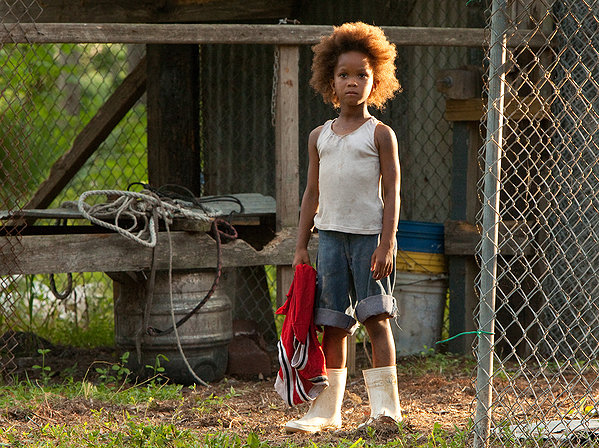 This movie is awash in all sorts of tones and storylines, failing to cohesively gel together or form some kind of meaningful message. I could have sworn that the fantasy elements, namely the giant thundering pack of large boars, were just going to be a visual metaphor for Hushpuppy’s journey. And then they actually show up and every person can see them. So, now what? The boars are one of many ideas that the movie just sort of toys around with before losing interest. This is not a film of magic realism. This is not a film about the escapes from a hard reality. In a way, this movie plays out like if Terrence Malick had made Gummo, and if you know me, you know I loathe both Gummo and Terrence Malick movies. Beasts constantly flirts with pseudo-intellectual pabulum, trying to reach something profound but instead settling for confounding. Hushpuppy’s curlicue unnatural narration talks about being a little piece in a big universe and the interconnectedness of all things, but by film’s end you get no dynamic sense of this. What I got was a little kid’s poor life getting worse, and that’s about it. If the film has anything larger to say about the world, Katrina, human connection, then I’m at a loss as to explain what that may be. Beasts offers half-formed ideas, strange, conflicting imagery, and characters that are rather thinly written and barely register. I never found Hushpuppy an engaging protagonist and felt like her very age and the heavy burdens she is forced to carry were manipulative substitutes for actual characterization. I cannot understand the love here.
The movie is something of a wild stew of Southern folklore and coming-of-age tropes and plenty of indie trappings, like weak political allegory, roaming handheld camerawork, and sacrificing story to the altar of realism. So much of this movie feels like it was made to give a sense of how an overlooked life in poverty is lived. From that standpoint the film does a commendable job of showing everyday life and the struggle to feed and survive. There’s a certain sense of ingenuity at work. But all of these setting details do not take the place of an involving story and characters we should care about. I felt sorry for the various residents of the Bathtub and their lot in life, but I never felt attached to any of them. That’s because, as mentioned before, they’re bland and simplistically drawn, but also because Beasts doesn’t bother to do anything else other than create its rich, tragic, harsh world. It’s authentic all right, but what does all that authenticity have to add to genuine character work? Artistic authenticity is not always synonymous with telling a good story. The Bathtub feels real, got it. So now what?
Hushpuppy lives in squalor and the movie has a disquieting romanticism of abject poverty. To the residents of the Bathtub, they are living in some forgotten paradise away from the concerns of the mainland. They refuse to leave their homes and their lives, even though there isn’t much of a home to call one’s own. We wade in this horrible existence and are meant to pretend like it’s an idyllic lifestyle, you know, with all the creature comforts of child abuse thrown in for extra measure. While Beasts looks entirely authentic with its impoverished, junkyard-esque production design, the overall mood and atmosphere hardly seems worth celebrating. Now, I’m not saying that characters can’t make the most of whatever life has given them and meet the implacable with fearless optimism. These characters would likely shun our pity; they reject any government assistance after the great flood and just want to sneak back to their simpler lives. This is not an enviable life, and the fact that the movie tries to romanticize it feels deeply irresponsible. At least with a film like Winter’s Bone, where you felt the crushing existence of systemic poverty, the filmmakers didn’t try and put a smile on all the drudgery. In that movie, you felt the trappings of poverty and how it can sink into your soul. On some level perseverance in the face of adversity is noble, but so would escaping poverty. Regardless, this is not worthy of romanticizing or fetishizing.
 Little Wallis is certainly getting her fair share of attention for anchoring the film. She’s six years old so it’s hard to assess her full acting potential, but the kid looks to have some fire in her. However, it is not a performance that leaves a lasting impression. I realized that much of her performance was long reaction shots and that ponderous voiceover narration. True, she does get some dramatic sequences and lets loose a few tears, but it feels like the movie didn’t want to push her too far and settled on a barrage of shots of Hushpuppy being stoic. I was more impressed with Henry, he too an acting novice making his debut. His character is more complex than an innocent naïf we have as our protagonist. He’s clearly dying and trying to quickly get his daughter prepared for a life of independence. He’s also quick to anger and you can feel the heavy weight of his life and his fledgling mission. In fact, I think Beasts would have been better if it had been told from the father’s perspective rather than our child trying to understand the great big scary world. There’s certainly a lot more drama and an easier route for sympathy, even if he could be accused of being cruel and neglectful.
I’ll admit that Beasts of the Southern Wild is different, daring, and fitfully imaginative, as well as benefiting from strong production design and special effects work. But “different” and “daring” doesn’t always mean good. I cannot in good faith say I enjoyed this movie, especially with its freeform plot, messages, tones, and occasional garish imagery. The plot seems desperate for some form of greater meaning, defaulting to ponderous poetry rather than supply a workable narrative and characters that are developed. Then there’s the whole romanticizing of systemic poverty that I find off-putting and wrongheaded. This is just a swampy mess of a movie, one that sinks under the weight of its own pretensions. It’s admirable from a technical standpoint but as a movie, Beasts of the Southern Wild is an exercise in eclectic navel-gazing.
Nate’s Grade: C+
Share this:

Snow White & the Huntsman (2012)
 Snow White & the Huntsman is meant to be a darker, splashier, more action-packed retelling of the classic story, and when compared with the earlier 2012 Snow White venture, Mirror, Mirror, it certainly merits all those descriptions. With Twilight star Kristen Stewart at the helm, this movie seems tailored for teens looking for some girl power. I have no problem with reworking fairy tales to suit our modern-day cultural interest, but just giving a person a shield and a sword does not instantly make them a warrior. And just plopping Snow White into a medieval war does not instantly make this a movie worth watching.
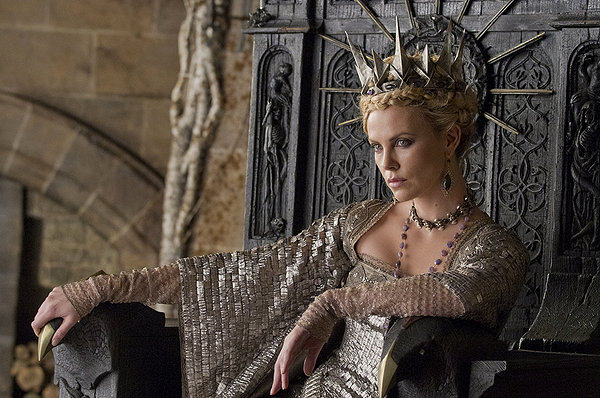
The wicked Queen Ravenna (Charlize Theron) killed the king and installed herself on the throne. She sucks the youth directly from ingénues to keep those good Theron looks of hers. She is the fairest of them all but she is warned that one day the king’s daughter, Snow White (Stewart), will overtake her in fairness. Snow’s been living in a prison cell for about ten years since her evil step-mom took power. She escapes her imprisonment and flees to the Dark Forrest beyond the castle grounds. The Queen’s powers will not carry over into the Dark Forrest (for whatever unexplained reason), so she hires the Huntsman (Chris Hemsworth) to retrieve Snow White. The Huntsman changes sides, allies himself with Snow, and some dwarves, and then everyone bands together to retake the kingdom under Snow’s stout leadership.
 Snow White & the Huntsman falls victim to that age-old screenwriting curse of failing to show us its work. I get so sick of movies, or any narrative really, that heaps praise upon some person and then never shows us any convincing evidence. If somebody is said to be a great poet, I want to hear one of his or her great poems. If somebody is said to be a great leader, then I want to see him or her inspire. To make up for the plot shortcomings, the screenplay reminds us at every moment of downtime how special Snow White is, how glorious she is, how different she is, how she is the only one to bring down the tyrannical rule of Ravenna. At no point did I believe any of this. Just because I have characters tell me, ad naseum, that someone is special doesn’t make it so. I need to see the evidence, and from what Snow White has to show, it is not that impressive. She’s somewhat resourceful, escaping from captivity, but she’s not exactly a figure of compelling strength, magnetism, or inspiration. She gives one “rally the troops” speech that gets the townspeople all fired up to go to war; it’s no St. Crispin’s Day speech, but even if we’re grading on a curve, it’s a pretty weak motivational speech. There’s no reason these people would line up behind this displaced damsel other than the fact that the plot requires them to do so. This Snow lady has, much like the infamous Bella Swan, the personality of a dead plant, and all the proclamations to the contrary will not change that fact. Snow White is just not an interesting of compelling person, period.
There are two reasons why Stewart is completely wrong for this part. First off, when we’re objectively talking about one who is “fairest of them all,” and Charlize Theron is in your movie, you’re going to lose every time. I’m not saying Stewart is wretched looking; quite the contrary. Debut director Rupert Sanders finds ways to film her that make her look lush and vibrant. Some would argue “fairest of them all” is not in references to physical beauty, which it has always been, but to the fact that Snow’s heart is so pure and good. If that’s the case, that’s just stupid. Then why even make it Snow White if the nemesis to the evil queen is simply somebody who is morally just? You could have had a commoner play the role and that would have brought about more interesting class conflicts. Secondly, Stewart is such a modern era actress, someone who has so effectively channeled the rhythms of a blasé generation of young people, that dropping her into a medieval time period is jarring. She doesn’t fit. Everything about her aloof acting style screams modern times. Maybe that’s why her speaking is kept to a minimum. She can ride on horseback, dress in Joan of Arc armor, but she’ll never strike anyone as a fitting Epic Heroine. I feel that her acting has blended with the sullen nature of Bella Swan to the point that it’s hard to separate the two. I’m not a Stewart hater at all. I actually think she can be quite a capable actress (see: Speak, Adventureland, the upcoming adaptation of Kerouac’s On the Road) when paired with the proper material. Snow White & the Huntsman is not the proper material.
Aside from casting errors, this dark fairy tale doesn’t find any time to settle down and develop anything that could approximate characterization. Case in point: all we know about Snow is that she is a princess, everyone tells us how beautiful she has always been, she runs away, and then leads a rebellion, then she become queen (don’t pester me about spoilers). What else do we know about her? She’s defined entirely by outside forces, especially the charitable words of others. Snow White is not a character but a symbol, the prophetic Chosen One. She’s really a placeholder for every lazy archetype needed for epic fantasy. Stewart cannot connect with the material, so she seems to wander around, mouth agape, almost like she’s stumbling drunk through the whole movie. It seems that Snow White & the Huntsman just provides us the familiar elements of the story (evil stepmother, huntsman, dwarves) and expects us to fill in the rest with our own wealth of knowledge over the famous fairy tale. The rote insertion of a long-lost childhood friend/eventual love interest (Sam Claffin) is made tolerable only by the fact that he does not eventually become a love interest. This Snow doesn’t need a man, and good for her.
Sanders’ background in commercials definitely shows in his superb visual palate. The man knows how to frame a beautiful shot, and the visual highpoint is Snow’s hallucinogenic shamble through the Dark Forrest. Without the narrative traction, though, the movie starts to resemble one very long, very excruciating perfume ad, particularly when Snow comes across a white horse just laying down in the surf. Some of Sanders’ “ain’t nature great” creations deeper into the forest reminded me very strongly of Miyazaki’s Princess Mononoke, especially with the godly stag. Despite its considerable faults, Snow White & the Huntsman is a great looking movie. Sanders’ crisp visuals are further enhanced by wonderfully theatrical costumes from multiple Oscar-winner Colleen Atwood (expect another award on that mantle come 2013). Queen Ravenna has more eye-catching outfits than Cher in her heyday. They seem to be made out of interesting organic elements, like a gown accented with diminutive bird skulls. She may be a ruthless tyrant, but man does that lady know how to dress. The fashion choices became so exotic and intriguing that it provided another reason for me to hope we’d get more time with the queen. The production design by Dominic Watkins (United 93) is fittingly medieval. At least there’s always something nice to look at with this monotonous bore.
I don’t really get the geography of this kingdom. By all accounts, it looks like one poorly guarded castle, one poor mud town, and a deep expanse of forest. The fact that it’s labeled as the Dark Forrest seems shortsighted, since it takes a few hours continued walking to come across all sorts of other civilizations, including our scarred matriarchal society. And then there are dwarves too. It all feels so listless, lacking any sort of connective tissue to help round out this magical world. After a while, it just becomes an assortment of cool stuff just put into a movie because it’s cool. The fact that none of these magical creatures or assorted villagers ever pop back again, except for our coronation in the resolution, means they were meaningless to this story other than being a rest stop.
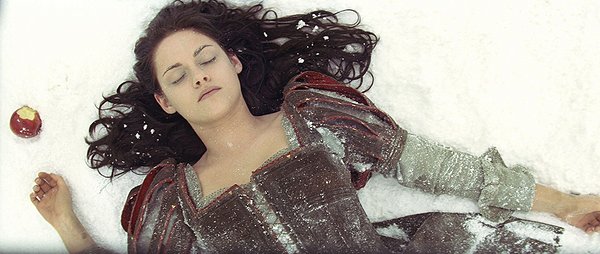 The screenplay is surprisingly rushed; rarely do we spend more than five minutes in any location. I was interested in a city of women with self-inflicted facial scars to protect themselves from Ravenna coming for them. Just as things start to get interesting, it’s like the movie gets antsy and has to keep moving, and we’re off again. It’s hard to work up any sort of emotional engagement for anyone when we just spend a few minutes with these characters. The brisk pacing also gives the impression that the characters really don’t matter in the end. If it weren’t for a scene where the Huntsman blatantly explains every feeling he has to a comatose Snow White, we’d know nothing about him. The Huntsman is grieving over the loss of his wife, and oh she just happens to have been killed by Ravenna’s creepy albino brother (Sam Spruell). The pigment-challenged dolt confesses this convenient bit of information at a strange time. Why confess to killing a man’s wife when you’re battling to the death? Confess afterwards. It’s another example of lame screenwriting and nascent characterization. Even the queen gets a bizarre throwaway bit of characterization. For whatever reason, we have a flashback to when she was a child and her mother forced her to drink the magic immortality elixir. Why did we see this? It’s too late to make her sympathetic. And yet, even this brief glimpse at Ravenna’s back-story makes her more interesting than our feckless Snow White.
The bleakly brilliant Young Adult renewed my fondness for Theron as an actress. For a while, she seems to really sink her teeth into the role, lapping up the villainy in a satisfyingly menacing manner. It’s at this lower level of burn, the quiet intensity, where Theron is most enjoyable. When the movie requires her to raise her voice is when things start to go bad. She shrieks in such a campy, over-the-top, weird overly enunciated style. Any hope of secretly enjoying this movie died with Theron’s stagy agitation. Hemsworth (The Avengers) adopts a thick Scottish brogue but does little else. At times I found that he looked remarkably like a cartoon tough guy; just something about his face lends itself to clean, burly definitions. The best actor in the movie is Bob Hoskins (Mrs. Henderson Presents) as a blind dwarf, and perhaps that sentence alone should say all that needs saying.
This film is more Lord of the Rings than fairy tale. It’s got some battles and some siege action to pacify the men folk, but this is obviously aimed at the ladies. It’s a feminist, Robin Hood-esque reworking of the Snow White tale, recasting the damsel as action heroine, and I’d have no problem with this revision if: 1) the film made her an actual character, 2) it had been played by anyone other than Kristen Stewart. It’s got all the familial elements but they have no context in this reworking; it lacks internal logic. If I did not have sufficient background knowledge about this tale, I’d be left wondering why any of this should make sense (apples are poisonous now?). At every turn, the movie has to tell us why things should matter rather than showing us. There’s no evidence onscreen why this Snow White lady deserves any fuss. Snow White & the Huntsman is a movie obsessed with appearance and precious little else. Snow White & the Huntsman is one boring, truculent, dreary chore of a movie that goes on far too long. Just because it’s darker doesn’t make it more mature or exciting. Fairest of them all, my ass.
Nate’s Grade: C
Share this:

Wrath of the Titans (2012)
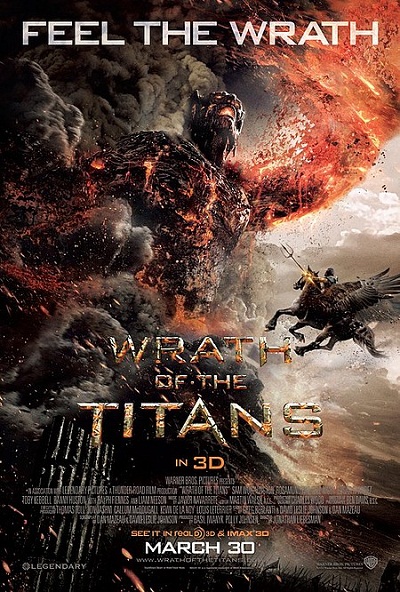 The 2010 Clash of the Titans made some sizable sums of money but it really became famous for one reason – the beginning of the 3D fleecing and the public’s souring on what was supposed to “save the movie going experience.” Clash was converted to 3D in post-production, and its lack of foresight and rushed conversion showed. After the high of Avatar, it only took approximately three months for the public to feel ripped off by 3D. Certain Hollywood bigwigs are concerned that bad 3D conversions will kill the golden goose, and it is having an effect. The percentage of movie audiences seeing big releases in 3D has slipped steadily from 2010. Whether it is the added cost or the underwhelming conversion, movie audiences are warier of the third dimension. And it was Clash of the Titans that destroyed a nation’s innocence. Two years later, the sequel is out and, surprise surprise, you also have the ability to see it in 3D. Either way, this movie will cause you a headache.
In the wake of Perseus successful slaying of the Kraken, he is now a widower with a young son, living their lives quietly, trying to avoid the daring heroics of his earlier life. Fat chance, kid. The gods are at war, particularly Hades (Ralph Fiennes) and Aries (Edgar Ramierez) versus Olympian head honcho Zeus (Liam Neeson), Perseus’ absentee father. The titan Kronos will be unleashed from his prison, Tartarus, and this powerful behemoth will lay waste to the armies of mankind. The gods have grown weak due to mankind’s dwindling faith, and as such they cannot conquer Kronos without the help of man. It’s up to Persues, Queen Andromeda (Rosamund Pike), and Poseidon’s demigod son a (Toby Kebbell) to track down the right magic artifacts to take down Kronos.
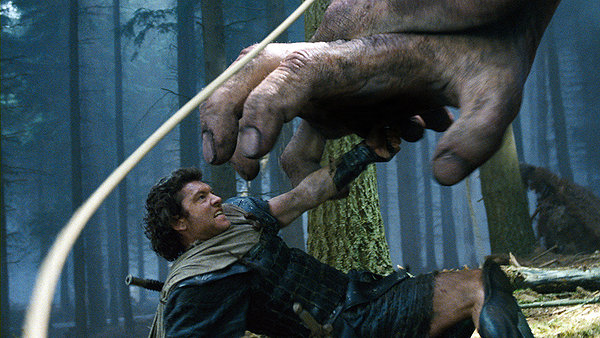 Once again we have a threadbare story that involves running from one location to another to find a clue that leads to the next location; the plot is just a series of magic-item gathering missions, much like a video game. Greek mythology made regular use of magic weapons to slay great monsters, but the myths at least gave their audience heroes worth fighting for. Worthington’s scowling rendition of Perseus is a bore, and giving him a son doesn’t help much. Just because the guy keeps insisting he has someone to protect doesn’t fill his void of characterization. He’s so free of charisma, so gruff and without any defining personality, that you wish he could find some magic shortcut to find his dumb magic items faster. The whole setup with our villain is also vague, beyond the very specialty of the god in question. And then there’s the whole concept of the gods dying, which was also featured in last fall’s glorious-to-look-at-but-empty-on-the-inside Immortals, another cinematic tussle with the titans. What’s the point of being a god anymore if the defining quality, immortality, can be ripped away? I suppose the screenwriters wanted to raise the stakes when Zeus and other gods enter the fray, dangling the threat that they too could perish. “We may not have weapons, but we’ll fight how long we can,” Zeus declares with modesty, and then he proceeds to zap enemies with lightning bolts. I don’t think a club is going to outrank a giant projectile of electricity. Realistically, I think the whole death-of-the-gods angle, which cold have brought some real somber and existential weight to the film, was just a setup to allow the producers to recast future sequels with less costly actors (goodbye, Neeson and Fiennes; they’ll be no more Kraken-releasing for either of you).
Director Jonathan Liebesman (Battle: Los Angeles) isn’t going to wow anybody with his addition to cinema, but he can put together a serviceable sequence of action. My favorite sequence in the entire film is when Perseus and crew enter the underground maze of Tartarus. The stone walls are constantly shifting around and the characters are zooming all around the room. It reminded me of the moving staircases in the Harry Potter world or think of it as the real prequel to Cube. And yet, even this nice sequence is limited because Liebesman and the screenwriters don’t take full advantage of their situation. We have a constantly shifting three-dimensional maze, and nobody gets lost at all? And the heroes, after discarding the map, easily find their way to the other side? What kind of design flaw is that? Liebesman prefers a lot of handheld camerawork and low angles, which can be jarring at times. Worse, the action favors a visceral chaos rather than steady development. There are plenty of people dying, columns exploding, fireballs tossing, but little of it adds up to much. It’s all disparate shots, like every character is in a separate movie. Such a shame because the special effects are rather good. If you’re going to spend this kind of money on a Greek mythology spectacle, at least make us care beyond a “fire pretty” level of tepid enjoyment.
The movie is in some breech of false advertisement since the title clearly states a plurality of titans, but by my modest account we only really have one titan to deal with, the giant lava beast Kronos (do the smaller creatures and Cyclops count as titans? I doubt this). Now we all love how fire looks, though some love it a bit too much. And lava itself has long been a childhood adversary. Who amongst us has never pretended the floor was once lava and but a handful of couch cushions were the only stepping-stones to safety? It’s hard to get an exact feel for how massive Kronos is considering he emerges from a mountaintop and seems to extend even higher into the sky. It’s intended to be a threatening and horrifying sight, but I kept thinking of a Marine ad from the 1990s where prospective recruits displayed their mettle by combating giant lava creatures (“Marines: Keeping the U.S. safe from lava men since 1916”). Instead of being awed by Kronos, I started picking apart the logistics of being a lava man. I suppose when you’re a god, or a titan for that matter, you don’t have to really eat or drink or do the things we mortals must for sustenance. But how does a lava creature work when part of his fiery M.O. is how drippy and malleable he can become? Perseus flies into the mouth of the lava beast but why does a beast, which needs no food or drinks, even needs a mouth? It’s not like this guy is speaking beyond a ground-shaking mumble. The entire face is almost superfluous. It’s not like a lava creature has eyes or a working circulatory system. Now I could apply these same annoying ticky-tack questions to any monster or mythological creature. The reason I did this is because the monster of monsters is no more intimidating, or satisfying, as the array of giant monsters that Godzilla would fight (or for you youngins – the Power Rangers). When your ultimate bad guy, and lone titan, can just as easily be blown up in the same manner as the Death Star, then we have a problem.
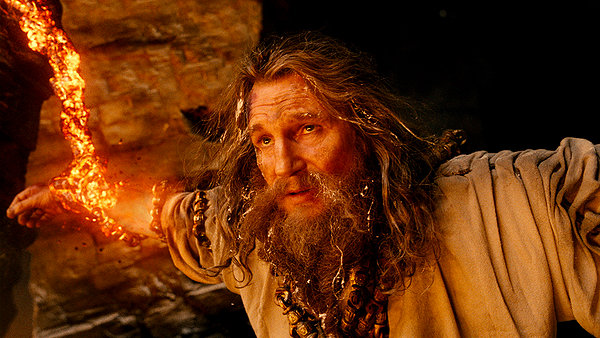 There’s a certain level of entertainment watching dignified actors in something so inherently campy. Neeson (The Grey) and Fiennes (Harry Potter and the Deathly Hallows: Part Two) are a long way from their Shindler’s List collaboration. The two men lend a level of gravitas to a movie that is leagues below their talents. Perseus proves to be such a dull demigod, that I wish the entire movie had followed the warring gods instead. That approach would have been much more interesting considering that they must confront mortality. Worthington (Avatar) still has a notable screen presence in the realm of action cinema, but his constant scowling is just getting tiresome. Hollywood, give this man something to do other than scowl and he may surprise you, like in The Debt. Pike (Doom) is unconvincing as a warrior princess, and her forced romance with Persues could not be more contrived (did somebody say, rebound?). The best actor in the movie is Bill Nighy (Underworld) who shows up as a daffy version of Hephaestus, the god of metallurgy and blacksmiths. Nighy understands how completely cheesy the whole getup really is and delivers a performance on the comic wavelength that the entire movie should have held.
While not nearly as humorless and joyless as the 2010 edition, Wrath is still a fairly block-headed romp through the noisiest parts of Greek mythology. After two movies with “titans” in the title, it’s somewhat remarkable that we only witness one single titan in the entire combined 245 minutes. It’s all CGI sound and fury with little cohesion to make anything feel important, despite huge mythological creatures demolishing cities. From an action standpoint, Wrath packs enough serviceable, escapist sights for the eyes to please diehards of Greek mythology and genre fans with low expectations. I wish there was a more compelling reason to run through all this stuff than big monsters needing to be killed; this hero’s quest needs more motivation or at least a grander sense of awe. The demise of the gods due to mankind’s mounting religious doubt seems like a juicy subject that could have opened these characters up. But then the theological discussions would get in the way of people hitting made-up CGI monsters. If you like your cheese feta, then Wrath of the Titans will provide enough wrath for your bucks, though found lacking in titans.
Nate’s Grade: C
Share this:

The Lorax (2012)
 Colorful, energetic, and with a nice message about conservation, The Lorax is an amusing film that is pleasant enough but with little else to recommend it. The visuals are terrific and the Dr. Suess-level of imagination is nicely incorporated in weird ways. The story is about a boy (voiced by Zac Efron) trying to impress a girl (Taylor Swift), but really it’s the story of the Once-ler (Ed Helms) and his destruction of the forest for the sake of making money. The Lorax (Danny DeVito) is an orange, mustachioed creature who “speaks for the trees,” and conflicts with the Once-ler. The framing devices of the young starlets feel unnecessary, and the movie descends into a series of wacky chase scenes. The humor stays around family-friendly slapstick and a few knowing winks for the adults. The songs are amiable and witty but fairly forgettable. I’m having a hard time even summoning a single melody hours after seeing the movie. The rest of the movie is kind of the same way. It’s pleasant and nice enough while watching, but afterwards it evaporates from your memory, leaving only the faint reminiscence of colorful imagery. It’s from the makers of Despicable Me but lacks that movie’s heart. The environmental message will drive some blowhards nuts, but the same activist message existed in Suess’ original book. Anyway, I think The Lorax is a bit too busy and yet simplistic to be anything other than a pleasant diversion. The story just can’t match the greatness of the animation.
Nate’s Grade: B-
Share this:

The Secret World of Arrietty (2012)
 This adaptation of Mary Norton’s classic book, The Borrowers, is colorful, imaginative, and the antithesis of what has become the modern-day family film. It’s less antic with its pacing, it has a more somber mood, and the ending is essentially anticlimactic. While commendable on one hand, The Secret World of Arrietty is also a minor work under the tutelage of the brilliant Hayao Miyazaki. Like other Miyazaki works, the film immerses you into an imaginative world where all the details fit. The story itself within that world is a bit low-key. Arrietty is a 13-year-old tiny person, a Borrower, living with her mother and father inside a human being’s home (they refer to people phonetically as “beans”). Her friendship with one of those “beans,” a boy named Shawn, is pleasant and gradual, as she feels she cannot trust the enormous human. I kept waiting for something larger and more significant to happen, but it didn’t. The story feels too slight to justify being the introduction, and likely final, chapter of these characters. The world of Arrietty is beautiful to watch but after a while you’re just watching pretty pictures.
Nate’s Grade: B
Share this:

In the Name of the King 2: Two Worlds (2011)
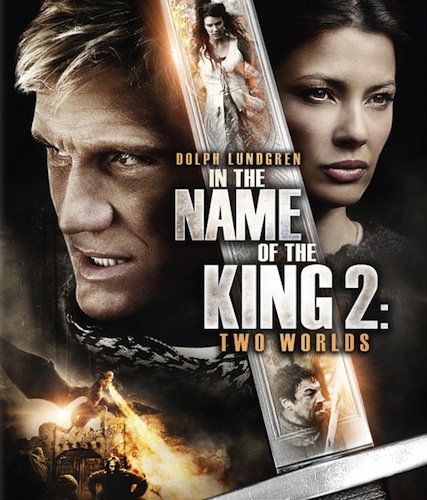 In the Name of the King 2: Two Worlds has a tenuous at best connection to the original 2008 In the Name of the King, noted as the most star-studded Uwe Boll film and the last Boll film to get a theatrical release. I think that highest-profile belly flop, and the revision of the German tax code loopholes, is what banished Boll to the little league of direct-to-DVD movies. I suppose the movie does involve things happening in the name of a king, but that’s being overly generous. There’s barely a mention of Jason Statham’s (The Transporter) character from the first flick, a commoner who arose to become king and who was slain by an enemy that is pathetic and embarrassing. The only meaningful connection lies in the title and the prospect of Boll trying to draft attention to his sequel off the momentum of his pitiful predecessor.
Granger (Dolph Lungren) is a former Special Forces soldier who has retired and runs a karate studio for kids now. Then one day he stumbles upon a mysterious woman being chased by ninjas (Vancouver’s ninja crime rate has skyrocketed since 2008). A portal to another world is opened and Granger gets sucked back to a feudal kingdom. The King (Lochlyn Munro) has awaited for a special visitor who would restore balance to the kingdom, drive away the Dark Lords. The prophecy says that Granger is their man. He’s a little skeptical and even turns down the services of a concubine, though still accepts a little cuddling. Manhatten (Natassia Malthe) is the king’s medic of sorts and accompanies Granger on his journey to defeat the evil sorceress and save the Kingdom of Whatever.
 After having viewed 19 different Boll movies, all to certain degrees of willingness, I can safely say that this is the most boring of the bunch, and hopefully those words will still have meaning. The plot never really evolves further than its premise, another rehash of A Connecticut Yankee in King Arthur’s Court, or to genre fans, a rip-off of Army of Darkness, or to idiots, a rip-off of Black Knight. Granger goes back in time, bumps around some rather stock characters, gets told about prophecies and destiny, and then there’s a fight and a dragon and a jump back to Earth and we’re done. In between is very little to care about. This is the first movie I’ve seen that feels completely constructed as one long saggy middle. Just about every scene takes place in the forests of Vancouver (I mean… whatever the hell the other world is called). It gets repetitious very quickly, never seizing on the fish-out-of-water comedic possibilities or just giving in completely to the genre elements of a medieval sword and sorcery flick. It’s all just irritating blather; a “chosen one” here, a “dark one” there, something something “prophecy.” When people badmouth fantasy, they think of this kind of stuff. I kid you not at one point Malthe’s character says, “You are the villain of this tale” to the said villain. Thanks for clarification, but the third act betrayal was telegraphed well over an hour ago.
The writer, Michael Nachoff, has written exactly one other movie, Bloodrayne 3, and served previously as an office coordinator, post-production assistant, and in material serving. That last one sounds like a made-up job or some kind of finessing that a prostitute would put to make her resume sound more professional. Whatever the case, Nachoff has shown that after two movies he cannot be counted on to deliver anything resembling a competent plot. This is the laziest more yawn-inducing hero’s journey I’ve ever witnessed. The movie literally put me to sleep. There are all sorts of dropped setups and subplots, including the notion that Granger must complete three trials, though we only ever get one. That’s bad sooth-saying, but then again the seer gets murdered so I can’t imagine she was first in her class at prescience. Nachoff keeps using the phrase “time travel,” and so do I, but I think what they really mean is dimensional travel. I’m fairly certain that Granger is not just from the future but an altogether different world. Yet at one point a character says, “Your fear will carry you to the pits of hell.” Ah, I see that Christian missionaries must have visited this alternate dimension. Oh well, the character also seem to keep erroneously saying “biological weapon” when clearly the bad guy assembled it out of various powders and chemicals. They even refer to his skill as alchemy, which of course is all about biology, right?
The action is mirthless and hastily thrown together, often becoming incomprehensible because the villains, the Dark Lords, wear dark cloaks and our heroes too wear dark clothes. Good luck deciphering who’s who on the battlefield. Maybe you’ll be like me and just become crippled by apathy. Granger isn’t a very compelling hero either. Under Nachoff’s compliant attention, he is strictly stock: 1) he is retired, 2) he helps kids, 3) he has a past that haunts him, 4) he drinks to cope, 5) he is entirely boring. If you’re going to go fish-out-of-water, at least have your guy be funny. Granger’s quips just seem too surreal even given the nature of the movie. After killing a baddie and sampling his stew: “Underdone.” On entering the Black Forest: “Given the name, bigger is probably better,” and brings a larger broad sword. Oh boy. Nobody’s gonna miss you, are they?
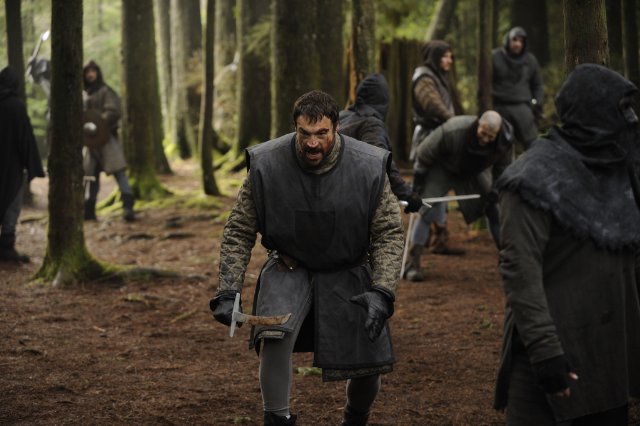 The production seems to be taking a cue from Lungren (The Expendables), who is unfazed from beginning to end despite some strange goings-ons. The man just sleepwalks through the whole film, cracking wise in the same somnambulant tone. It’s like Lungren swallowed an entire bottle of Quaaludes. Lungren isn’t exactly the most charismatic or expressive actor on the planet given that he’s made a living being tall and beating up smaller men, but I would have hoped for some life in the guy. He’s so straight-laced that it’s absurd. It drains any potential interest from the character, sapping our time-traveling hero of empathy. Who cares if he can’t be bothered to care? Malthe (Bloodrayne: The Third Reich) is just as uninspiring as his sidekick. She’s just so impassive, probably because she doesn’t get to wear a corset in this Boll movie to highlight her assets. Letting her speak medieval vernacular and syntax was a mistake. Usually actors can at least adequately hide their displeasure about their participation in a lousy movie. Either these actors aren’t even good at that or they just don’t care, take your pick.
And now it’s time for my regular reoccurring segment in a Boll film review – who got ripped off this time? Allow me room to pontificate. The concept of a fantasy world mixed with some adult themes, like strong bloody violence, nudity, sex, profanity, and darker themes, would lead me to believe that Boll was inspired by HBO’s hit fantasy reinvention series, Game of Thrones. Then again Boll shot this movie in December 2010, a full four months before Thrones’ aired its excellent pilot episode. Then again who’s to say that Thrones didn’t influence Boll during the editing stage or at least make him itchy for some reshoots to tart up this tedious movie. At least that would give the viewer something worthwhile to look at besides an oft-used castle exterior that LARP-ers would howl at.
In the Name of the King 2: Two Worlds just reeks of lethargy and indifference. Devoid of interesting characters, an engaging story, even tasty genre elements, this low-budget fantasy flick would falter in comparison to the cheesiest Sci-Fi Channel original movie. I cannot overstate how boring this movie is. I’m struggling even to effectively communicate how monotonous this movie is; I’m tempted to just write “boring” a thousand times but you, dear reader, deserve better. And so I rack my brain to come up with more specific and sarcastic criticism of what is execrably an awful movie. Boll’s no stranger to awful movies, but In the Name of the King 2 is the first time where I felt like even he didn’t give a damn about his final product in any shape. And it shows.
Nate’s Grade: C-
Share this:

The Smurfs (2011)
 What a smurfin’ terrible movie. This big screen debut for the little blue commune dwellers is a painful experience, magically transporting the little creatures to New York City. They find themselves in the care of Patrick (Neill Patrick Harris), an ad man who’s pretty much a jerk, especially to his doting, pregnant wife. At one point, in his ad man frenzy, he yells, “ I never wanted any little people running around here!” Oh no, what a bizarre outburst that somehow cuts directly to his fears of being a father. The movie spends so much time with the human characters, who are shrill, exasperating, and dull form the get-go. The comedy is a mixture of slapstick and insufferable kiddie wordplay, replacing “Smurf” for just about any word in a sentence for a miserable attempt at humor. It’s like the screenplay was a Mad Libs page (Am I being too generous crediting a whole page to the script?). The Smurfs is clearly designed for a 3D audience, hence there is crap flying at the screen at every turn. Yeah, another stupid thing thrown at the screen. Hank Azaria plays the thankless role of Gargemel, the man who created Smurfette (voiced, not too badly actually, by pop singer Katy Perry) but schemes to capture Smurfs for their… smurfness. I don’t know. If this guy could create his own Smurf, why doesn’t he just keep doing this? Instead, Azaria runs around New York speaking in an arch manner, falling down a lot. I suppose the real question is whether this piece of blue excrement could entertain children, its target audience. Perhaps the youngest of tykes will be tickled by the Smurf adventures, but I think most kids will be puzzled and bored and weirded out by the movie, wondering what they had done wrong to deserve watching this dreck.
Nate’s Grade: D


You must be logged in to post a comment.