Blog Archives
Long Shot (2019)
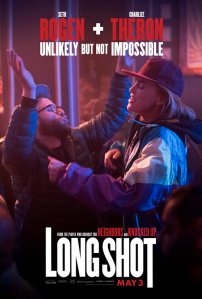 Secretary of State Charlotte Field (Charlize Theron) is preparing for the moment she feels her whole life has been leading up to: a presidential run. the current president (Bob Odenkirk) has decided not to run for a second term and wants to endorse her. Charlotte and her team of dogged, loyal assistants (June Diane Raphael, Ravi Patel) are sifting through ways to improve her negatives as a candidate, and that’s where Frank Flarsky (Seth Rogen) comes in. He’s an activist journalist that has just been fired and he also happens to personally know Charlotte; she was his babysitter. He comes aboard her campaign with the condition that she really fights for what’s important and not cave to the powerful lobbies and interest groups. He rewrites her speeches and the two of them grow closer together, bonding over their past and a possible future, not just as president but as boyfriend-girlfriend. They must keep their feelings a secret for the time being. If the press found out it might kill her candidacy before it ever really began.
The film’s biggest strength is the emphasis with the leading characters and the crackling chemistry between Rogen and Theron. It’s a fairly familiar dynamic between the more buttoned-up personality learning to cut loose and the more wild and impulsive personality learning a degree of self-restraint and responsibility. And to be fair Long Shot does pull from this familiar foundation for a starting point with its odd couple dynamic. However, it goes further by making their differences more attuned to politics and compromise. Fred is unwilling to back down for the things he knows are right and would rather have nothing than a watered-down version of the important issue he had been fighting for. Charlotte is more the political animal and used to working with others, including scoundrels and morons, in order to affect change. She’s about incremental, pragmatic change for the greater good and he’s about ideological purity as a moral imperative. This isn’t just a small character quick either; it’s a defining conflict between both characters and a subject that gets further examination as Charlotte confronts the realities of running for president and the many compromises of self and vision may or may not be needed.
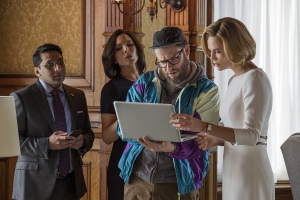 Being a woman running for president is an obstacle course of having to deal with latent sexism and other people’s expectations of what is socially appropriate. Charlotte is going to be judged harsher for the same behaviors men will be excused for; this isn’t a new observation by any means (apply your favorite double standard here) but the film makes you understand the pressure and scrutiny that befalls her at every turn. It defines her character, which is why finding someone she can unwind with and be her true self away from the cameras is such an understandable and desirable escape valve. She’s running to inspire little girls that they too can be president but at she also has to assess the cost of how much she’s willing to hide or lose from herself in order to get across that finish line, and if she does, what will be left? That’s the role for Alexander Skarsgard, the Justin Trudeau-like Canadian prime minister, who represents what is left of a person after bowing to opinion polls. Again, this isn’t new material, especially as anyone who can recall the 2016 presidential election will recall the questions of physical and mental fortitude that only seemed attached to one candidate and not as much the other. What this political reality does is provide a relevant substance for the romance and comedy portions of the film, making the characters feel more human. When Fred is articulating just what he must do to serve as a secret boyfriend for Charlotte, and a potential future they would have, you can hear his heartbreak with each new syllable. You also realize that he shouldn’t have to endure that and maybe these two are destined not to be together because of how unfortunate our politics and media environment have become.
Rogen and Theron are a blast together and have a fun rhythm they play off each other for unexpected comedy beats. His mellow vibes and good-natured joviality, as well as general awkwardness around people in power, are a nice fit with her sterner self. The best parts of the movie are just watching both of these actors enjoy their company. I won’t say that the romantic spark became overly apparent but what was undeniable was how well they paired as an onscreen buddy duo. With each new movie and every different role, Theron proves she’s one of the best actors of her generation. She can kick your ass, she can make you cry, she can win your heart, she can make you bust a gut. In short, Charlize Theron can do anything. She has several disarmingly funny moments, like when she’s high on ecstasy and pulled into an international crisis and has to maintain her cool. Rogen could easily fall back on his ease playing the oafish, insecure, crass characters of his past, but he does a fine job imbuing his charm, energy, and authenticity with Frank. Rogen is an anxious and generous scene partner who typically elevates his costars, and he and Theron as so good together that it sells their romance even better than the writing.
 Thankfully, Long Shot is consistently funny and bases much of its humor on the characters and their needs and developments. The movie isn’t just a retread of the incredulous fantasy of some ugly dude successfully romancing a beautiful woman. We’ve already had this dynamic explored in another Rogen comedy, 2007’s Knocked Up (in another universe where Katherine Heigl’s career didn’t stall, I could have seen Long Shot serving as an unofficial reunion for her and Rogen). There are jokes to be had about the unbelievable nature of this central romance and Rogen’s overall appearance, and that’s expected. What made me happier was that these wisecracks served a purpose to highlight how professionally damaging this potential relationship could be for Charlotte’s chance of winning office. They didn’t just feel like gratuitous put-downs. The joke emphasis is heavily tilted in favor of our two leads but there are nice moments with the supporting cast, like Raphael’s constant passive-aggressive comments, Bob Odenkirk’s buffoonish sense of betrayal with TV being turned against him, Randall Park’s frankness, and Skarsgard’s awkward and obsequious flirting. I don’t think the filmmakers fully knew what to do with O’Shea Jackson Jr. and provide some last-minute character shading that felt clumsy.
Long Shot follows the Judd Apatow rom-com formula closely and demonstrates that if you get funny, talented people together, provide them solid characterization and realistic conflicts, you can produce a winning romantic comedy that matters. Rogen and theron make an excellent team, the political content is savvy without getting too far into the weeds, and the romance is sweet and agreeable, with two genuinely enjoyable people coming to realize what they would be willing to risk for the other person. Long Shot is a reliably funny, bawdy, and heartwarming little movie with a little more on its mind than gross-out comedy set pieces. It’s worth seeking out this summer. I’d happily vote Theron for anything, especially if she was running for elected office as Furiosa. That’s a candidate that get results.
Nate’s Grade: B
Share this:

Avengers: Endgame (2019)
 This may prove to be the most difficult review I’ve ever written in my twenty years (!) of reviewing movies. How do I ever begin to describe the events of Marvel’s culminating blockbuster Avengers: Endgame without stepping too far into the dark and dangerous territory of the accursed spoilers? I thought it would be difficult talking about last year’s Infinity War considering the shocking plot events and general secrecy, but this concluding chapter to a 22-movie journey is even more secretive (the trailer accounts for only footage roughly from the first twenty minutes). I’ll do my best, dear reader, to give you the clearest impression I can of this unique experience while respecting your need to be un-spoiled. In short, Avengers: Endgame is unparalleled in our history of modern popular blockbusters because it needs to work as a clincher to a decade-plus of hugely popular blockbusters for the Marvel Cinematic Universe (MCU), and boy do they ever stick the landing.
The film picks up with our surviving Avengers picking up the pieces following the events of Infinity War, namely Thanos (Josh Brolin) eliminating half of life throughout the universe. The original six Avengers are all suffering through guilt, depression, and degrees of PTSD following their failure to defeat Thanos. Scott Lang a.k.a. Ant-Man (Paul Rudd) arrives after having spent time in the quantum realm and has a potential solution that will involve traveling through time to correct the mistakes of the past and bring everyone who vanished back to life. The remaining teammates assemble at the behest of Steve Rogers a.k.a. Captain America (Chris Evans), including Bruce Banner a.k.a. Hulk (Mark Ruffalo), Black Widow (Scarlet Johannson), Thor (Chris Hemsworth), Hawkeye (Jeremy Renner), Rocket Racoon (voiced by Bradley Cooper), Nebula (Karen Gillan), and War Machine (Don Cheadle). However Tony Stark a.k.a. Iron Man (Robert Downey Jr.) needs the most convincing, as he is most afraid of making things even worse and losing more people he feels are too precious to be casualties to their failures once again.
 The thing to know ahead of time is that Endgame is not for the casual fan. This is a long love letter to the fans that have pored over all 22 preceding films, not just a scant one or two. Infinity War was accessible to relative newcomers because of the structure and focus on Thanos as the main character, providing a self-contained arc that lead up to his finger-snapping triumph. It also benefited from the fun factor of simply watching a bunch of popular characters interact and team up for the first time in MCU history. Now that a majority of those characters have turned to dust, the emphasis falls back on the original core of the Avengers, bringing things full circle. In several ways, Endgame is about bringing to a close this mammoth project that began with Iron Man, this decade of storytelling ambition that has stretched out into multiple inter-connected franchises. If you love these characters, then Endgame is a movie made specifically for you. There is a long stretch in Act Two that relies upon a decent amount of fan service and sentimentality, but I don’t think either is an automatically negative attribute. Before we reach the finish line it’s important to take stock of how far we’ve come and this goes for the essential characters and their long arcs. There are several fun cameos strewn throughout and the filmmakers even take an interesting tack of trying to reclaim and re-contextualize the MCU movies that fewer people enjoyed. It makes for a filmgoing experience that is heavy in references, in-jokes, Easter eggs, and cozy nostalgia, which will confuse and frustrate those not well versed in this big world.
The other thing to know, especially if you’re a long-standing fan, is that there will be tears. Oh will there be tears. I lost count of the amount of times I was crying, which was pretty much on and off nonstop for the final twenty minutes. I was even tearing up for supporting characters that I didn’t know I had that kind of emotional attachment for. The film is done so well that the first third actually could play as the MCU equivalent of HBO’s The Leftovers, an undervalued and elegant series about the long-term recovery of those that remain in a post-rapture world. The opening scene involves a character having to go through the loss of loved ones via Thanos’ snap, and it’s brutal as we wait for what we know is coming, dread welling up in the pit of your stomach. The Russo brothers, the returning directing team from Infinity War, know what scenes to play for laughs (the line “That’s America’s ass” had me in stitches), what scenes to play for thrills, what scenes to play for fist-pumping cheers, and what scenes to play for gut-wrenching drama. They allow the movie to be an existential mood piece when it needs to be, actually dwelling on the repercussions of a life post-universe culling. There’s a character who frantically searches to see if a loved one was among the missing, and that eventual reunion had me in tears. With the three-hour running time, the Russos have the luxury of allowing scenes to naturally breathe. This might be the most human many of these characters have ever seemed, and it’s after recovery and grief. Needless to say, the conclusion feels very much fitting but also unabashedly emotional, unafraid of diving deep into its feelings. I sobbed.
 I was worried once the film introduced the time travel plot device that everything was simply going to be erased and invalidate the struggles that came before. The worst use of time travel is when it eliminates any urgency or danger, allowing an endless series of do-overs to correct the past. Fortunately, returning screenwriters Christopher Markus and Stephen McFeely (Civil War, Winter Soldier) realize that in order for there to be a reversal, a glint of a happy ending, there must be a cost or else it all meant little to nothing. There are finite events in the movie that cannot change (as of now) and losses that will be permanent (as of now, if they don’t want to cheapen the journey). People died with Infinity War but we all knew, at least when it came to its dreary conclusion, that it wasn’t going to be too long lasting, which allowed the communal grief to be short-lived. After all, there’s a new Spider-Man film coming down the pike two months from now, so it’s highly unlikely the teenage web-head will remain dead. However, with Endgame, the deaths serve as the cost for resurrecting the MCU, and they will be felt for years. The screenplay provides limitations to the time travel mechanics, though I don’t think the collective hand-wave to the nagging paradoxes was as successful as the movie thinks it was. The film barrels ahead, essentially telling you to forget about the paradoxes and enjoy the ride, focusing on the characters and remembering what is really important.
Suffice to say Downey Jr. is once again his charming, self-effacing, and enormously entertaining self. The MCU began with this man and his contributions cannot be overstated. He is the soul of this universe. Evans is compelling as the straight-laced inspirational figure who takes stock of what he’s sacrificed over the years, Hemsworth showcases a potent mixture of comedic and dramatic chops, Johannson is definitely the Avenger going through the “bargaining” phase to try and make things right and she has some subtle emotional moments that belie her desperation and guilt, and Renner makes a welcomed return in a way that made me appreciate Hawkeye like I never had before. Brie Larson does reappear as Captain Marvel but the movie smartly puts her back on the sidelines protecting the many other worlds in the universe needing assistance because of how overwhelmingly powerful she can become. Larson filmed her scenes for Endgame before her own solo movie, released a month prior, so forgive the different hair and makeup, Twitter nit-pickers. I will say there is one scene that is a bit convoluted how it gets there but is destined to make women in the audience cheer with excitement as the MCU says, “Hey, that whole ‘strong female character’ thing? Yeah, we’ve had all that for years, and here you go.”
 How does one properly assess a movie like Avengers: Endgame, a conclusion not just to an Infinity War cliffhanger but to a twenty-two movie prelude over the course of eleven years? The emotional investment in these characters, their journeys, has to come to something to be ultimately meaningful when it’s time to close the chapter on one massively ambitious story before starting the next. And there will be a next chapter; the MCU’s unparalleled financial success assures the fanbase they’ll have plenty more high-flying and wild adventures to come in the years, and more than likely, decades to come. Marvel had the unenviable task of wrapping up a major narrative in a way that would prove satisfying without devaluing the individual films and overall time investment. Hollywood is filled with trilogies that messed up their conclusions. Nailing the ending is just as important as getting things going right, because without a satisfying conclusion it can feel like that level of emotional investment was all for naught. Endgame reminds you how much you’ve grown to love these characters, what fun you’ve had, and genuinely how much you’ll miss these characters when they depart for good. It’s hard not to reflect upon your own passage of time with the ensuing eleven years, how you’ve changed and grown from the MCU’s humble beginnings in the summer of 2008. These heroes and anti-heroes can begin to feel like an extended family for many, and so fans desperately need the ending to do them justice. Avengers: Endgame is the ultimate fan experience.
Nate’s Grade: A
Share this:

Missing Link (2019)
 The stop-motion animation wizards at Laika have made some of the most charming and visually impressive movies of the last few years, including The Box Trolls, Kubo and the Two Strings, and ParaNorman. They’ve built up enough trust that I will see anything that they attach their name to. Missing Link is probably their least successful big screen effort yet, though that still means it’s only perfectly fine rather than great-to-amazing. It’s a heartfelt buddy comedy about a Bigfoot creature (voiced by Zach Galfianakis) that seeks out mentorship from a dashing adventurer (Hugh Jackman). It’s a sweet story but not fully emotionally engaging because the characters are fairly simplistic. There isn’t a lot of depth here and, surprisingly, more crass jokes aimed at a younger audience than their earlier output. From a visual standpoint, it’s beautiful with vibrant colors and fluid animation that has become indistinguishable from CGI nowadays. The action set pieces, usually appearing at a regular clip with each new location change, are fun and have their clever moments, like a capsizing ship that reminded me of the spinning Inception hallway. It’s an amusing, lower tier animated movie for Laika, but I’m worried that there might not be more of these movies the way they’re going at the box-office. Laika was treading financial water with excellent movies, and anything “less than” seems like it could possibly tip the independent animation production company over for good. Missing Link is a cute, mostly harmless, mostly entertaining movie that just doesn’t have the same ambitions and level of execution that previous Laika films have had. With that being said, it’s still worth a watch on the big screen for any animation aficionado.
Nate’s Grade: B
Share this:

Shazam! (2019)
 It seems like the secret to the success of the DC movie universe is making fun, lower stakes adventures with the characters the public has the least knowledge about. Shazam actually begun as a “Captain Marvel,” and now comes on the heels of the MCU’s Captain Marvel. We follow Billy Batson (Asher Angel), a teenage orphan trying to find his missing mother. He stumbles into a wizard’s realm and is given a special power whereupon he turns into a square-jawed, broad-shouldered superhero (Zachary Levi) by saying “Shazam.” What follows is like a superhero version of Big and it’s goofy, charming, and reminiscent of an 80s Amblin movie, where children’s movies were allowed to be a little creepy and weird. The movie is light, cheerful, and heartfelt with its doling out of family messages to go along with the slapstick and personal growth. It’s very much envisioned from a young boy’s fantasy perspective of being a super-powered adult, where the first things to be done include buying beer, going to a “gentleman’s club,” in between testing out bullet invulnerability and flight. Levi (TV’s Chuck) is excellent at playing an adult version of a kid. I was initially dismissive of his casting but he’s perfect for this part. There’s a satisfying sense of discovery for Shazam and his excitable foster brother (Jack Dylan Grazer) that doesn’t get old. The movie is more concerned with how the superpowers are affecting Billy’s relationships and sense of self than any larger, planet-destroying danger. The film even sets up its villain (Mark Strong) by giving him a decent back-story and opening the movie to explain his crummy family. It’s not a three-dimensional villain by any means but the attention given to make him something more is appreciated. The other foster kids in Billy’s new family are more archetypes but amusing, and their involvement in the final act raises the joy level of the finale. Shazam! is a movie where people are genuinely excited to be superheroes or associated with them, and that gleeful, buoyant revelry is downright infectious.
Nate’s Grade: B+
Share this:

How to Train Your Dragon 3: The Hidden World (2019)
 How to train your expectations for the concluding chapter in the How to Train Your Dragon franchise: step one, lower them. I was dispirited to discover what a disappointing final chapter The Hidden World comes across, especially considering the previous movies, including the 2014 sequel, are good to great. At its core it’s always been a tale of prejudice and family, dressing up a simple boy-and-his-dog story with fantasy elements. It also presents a world with danger and cost; even the fist film ended with the main character, Hiccup, losing a freaking foot. He loses his father in the second film. It’s a series that has grown naturally with heart, imagination, and a real sense of stakes. This is why I’m sad to report that the third film feels like a different creative team made it. The villain is a repeat of the second film, a dragon hunter with little to be memorable over. The plot is very redundant, stuck in an endless loop of capture, escape, capture, escape, etc. The addition of the new lady dragon is a perfunctory means to drive a wedge between Hiccup and toothless, his dragon. The lady dragon has no personality and needs rescuing too often. Her inclusion relates to a rather regressive emphasis on the need for coupling and marriage. The titular Hidden World amounts to a grand total of five minutes of screen time. The action starts off well involving the various colorful side characters but misses out on that sense of danger that defined the other movies. It feels goofy and safe and listless. How to Train Your Dragon: The Hidden World is a sizeable disappointment and coasts on the emotional investment of the first two movies. You’ll feel something by the end, sure, but it’s because of the hard work of others and not this movie.
Nate’s Grade: C
Share this:

The Lego Movie 2: The Second Part (2019)
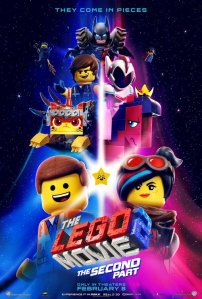 Everything might not be awesome but it’s still pretty great for this creative, heartfelt, and hyperactive family franchise that is better than it has any right to be thanks in part to returning writers Phil Lord and Chris Miller. It’s not quite as fresh and clever as the first go-round but it manages to better its predecessor in some key ways. Now that we know the colorful and zany antics of the animated Lego characters are also simultaneously the imaginative play of a real-world family, it provides a deeper thematic subtext with the unseen nature of siblings in conflict. I remember my own younger sister wanting to play with me and my toys, and me rebuffing her, and the film struck home some key emotional points about the inclusion of cooperative play. The different styles of play are on display as our characters are abducted by a shape-shifting space queen (voiced by Tiffany Haddish) who is determined to marry Batman and possibly rule the universe. A fantastic running joke is how transparently malevolent the queen is, which leads to an even better payoff. There are more songs and each is pretty well constructed, relevant to the story, and assuredly catchy, like “Catchy Song” used to brainwash people through pop, and a mournful version of “Everything’s Not Awesome” that becomes genuinely inspirational and uplifting by its climax. The life lessons are easily digestible and the sense of breezy fun is still alive and well. I was laughing throughout, sometimes quite hard, and the brother/sister subtext had me wondering if I owed my younger sister a decades-late apology for my behavior (sorry, Natalie). Lego Movie 2 is a worthy sequel that finds new and interesting ways to build off the irreverent original’s model. Bring on the Toy Story 3-style ending where our grown-up owner says goodbye to his childhood toys and friends. At this point, Lord and Miller can do anything and imbue it with wild wit, whimsy, and unparalleled mass entertainment (except Star Wars, I suppose).
Nate’s Grade: B+
Share this:

Stan & Ollie (2018)
 This sweetly nostalgic film looks back at the friendly and fractious relationship between classic comedy partners Stan Laurel (Steve Coogan) and Oliver Hardy (John C. Reilly), the top comedy duo for decades. Flash forward to 1957 and they’re older and touring England to regain enough relevancy to scrap together a movie deal. It’s a delight to watch both actors just perform as the famous comedians and they cannily turn any opportunity into a recitation of a physical comedy bit. At its heart, the film is about the close relationship of the two men, what pushed them apart, and what brings them back together. It’s a very undemanding movie that is very nice, populated with nice people doing nice things for one another, bowled over by the sincere power of humor. Coogan and Reilly (in a very big fat suit) give honest performances rather than impressions. I never knew Laurel was so instrumental in developing their material, and he continued writing Laurel and Hardy material long after his partner died. The movie glides along on its good feelings and historical recreations, settling into a nostalgic sweet spot that isn’t too far into maudlin but interesting enough to justify the trip. If you’re a fan of Old Hollywood magic and Laurel and Hardy, then Stan & Ollie is a dream.
Nate’s Grade: B
Share this:

Show Dogs (2018)
 I was expecting something much worse but ultimately it’s hard to get too upset with Show Dogs, a lowest common denominator slice of entertainment for the youngest of children. There are two separate Lego Movie references in relation to star Will Arnett, a cop who partners with a dog for an undercover operation. The weird part is that the movie seems to exist in a world where animals talk to one another but humans cannot hear them. Fine, except then why does Arnett treat a stray dog like an equal? Occasionally human beings will interact with the animals like they can hear them. World building inconsistency aside, it’s simply a very unfunny comedy. The lazy puns and slapstick are somewhat excusable in smaller doses but the movie is nothing but. The only reason to watch Show Dogs is to look for the former material relating to a storyline that literally involved the hero dog having to learn to go to a happy mental place while adult judges fondle his genitals. Shockingly, the filmmakers did not see any problem with this storyline aimed at children until weeks after its initial release, and then it was re-cut with the offending and abuse-grooming material wisely removed. How does something like this happen? How does it pass through so many editorial approvals? It wasn’t a simple joke but an ongoing character arc for the protagonist. Show Dogs is for the dogs.
Nate’s Grade: C-
Share this:

Spider-Man: Into the Spider-Verse (2018)
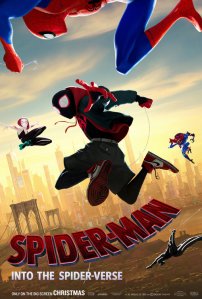 Walking out of Brad Bird’s hotly anticipated sequel to The Incredibles, I was convinced there wouldn’t be a better-animated film for the rest of the calendar year. Then I saw Ralph Wrecks the Internet and felt the same conclusion. What could top these two incredible movies from Disney? I wasn’t expecting a parallel world Spider-Man animated film to contend with that heralded echelon, but after watching Spider-Man: Into the Spider-Verse, I am now certain. This is the best-animated film of the year and one of the best films of the year, full stop. It’s rich, imaginative, exciting, satisfying, and way too much fun.
Miles Morales (voiced by Shameik Moore) is an ordinary teenager starting a new school he’s eager to leave. His police officer father, Jefferson Davis (voiced by Brian Tyree Henry), is pushing him and can be embarrassing. His cooler uncle Aaron (voiced by Mahershala Ali) encourages Miles to express himself through his graffiti art. One night, Miles encounters the famous Spider-Man, a particle collider, and a special spider from another dimension that bites him. He develops super powers and seeks out Peter Parker (voiced by Jake Johnson) as the only other person who might understand what he’s experiencing. Except there happens to be multiple Spider-laden heroes, including Spider Gwen, a.k.a. Gwen Stacy (voiced by Hailee Steinfeld), Spider-Pig (voiced by John Mulaney), Spider-Man Noir (voiced by Nicolas Cage), and an anime heroine Peni Parker with a giant spider robot friend. They’re all from alternate dimensions, dragged into Miles’ world thanks to Kingpin’s (voiced by Liev Schreiber) particle collider. If they don’t get back to their original worlds they’ll glitch out of existence, and Miles’ own world, and everyone inside it, is threatened by the instability of that collider.
 Into the Spider-Verse is bursting with color, imagination, kinetic energy, and a real celebration of the art form of animation and comics. Once that super spider bites Miles, the visual mechanics of the movie alter as well as him. Suddenly his thoughts are louder and appear in floating boxes (only we can see), in addition to thought bubbles, sound effects, and the occasional panel shifting transition device. It gets far closer than Ang Lee’s Hulk at recreating the experience of a living comic, and it’s joyous. The animation style too recreates the cross-shading effect of comic artists and the fluidity of the animation has purposely removed frames, giving it a slight stutter-step more often found in stop-motion animation. This distinct style might be off-putting to certain audience members accustomed to the smooth movements of modern animation mimicking real life, but for comic fans, it better approaches the captured stills of comic panels being connected into a whole. The different animation styles of the new Spider characters, Looney Tunes to anime to stark noir Frank Miller riffs, become reminders of separate universes with their own visual rules that keep things fun. The film is vibrantly colorful and gorgeous to watch on the big screen where a person can best luxuriate in that flamboyant palette. The finale feels like an explosion of splash pages and graphic designs merging together, even mimicking the sprawling graffiti art of Miles. It’s a spectacular visual feast that manages to be that rare treat of something new yet familiar.
The action of Into the Spider-Verse is delightful when it’s comedic and thrilling when it’s serious, but at every turn its fun, well developed, and wonderfully rendered. Early on, as Miles learns the tricks of his new and confusing abilities, the action is wildly funny. Take for instance a sequence where he becomes attached to an unconscious Peter Parker through the Spider-Man webbing. Soon after, the police approach Miles, and now he has to make a break for it while still attached to another body, forcing him into a series of comic escapes. It’s highly spirited and filled with enjoyable jokes. Later, as Miles gets more centrally involved in Kingpin’s scheme, the action becomes harsher, more violent, and dangerous. A battle between Miles and The Prowler gets more and more extreme, especially after some twists an audience may or may not see coming depending upon their source material knowledge (this is a parallel universe, after all). The action is frenetic, inventive, and visually engaging, easy to follow and filled with wonderful organic complications that allow each scene to feel vital and different from the last.
 Into the Spider-Verse is also brashly hilarious from beginning to end. Being co-written by the writers responsible for The Lego Movie and 22 Jump Street, I was expecting a combination of clever and antic, and that’s what they delivered and then some. There are brilliantly conceived and executed jokes but, and this is what separates the professionals, they do not distract from the larger work of the characterization. Often the humor is built through the characters, their personality and motivation differences, and the unique circumstances, so even when its zany it feels connected or grounded. There’s a silly joke about getting more bread from a waiter that works on multiple levels and they keep going back to it for further meaning, and it’s one example of many that shows the work put into their funny is meaningful and smart. After six movies and several animated series, audiences are well versed in the origin of Spider-Man, so Into the Spider-Verse even turns that knowledge into a source of humor itself, laying a formula for each new Spider character to introduce themselves with the same fill-in-the-blanks origin speech. The alternate universe Spider heroes do not overstay their welcome and, miraculously, even find themselves with some potent small character moments, which is an amazing feat given the 100-minute running time. The laboratory break-in with Peter Parker and Miles is a comic highlight with plenty of complications, and there’s a smart, sly joke about personal biases that just slides by nonchalantly that had me howling. The post-credit scene had me laughing so hard that I was crying. Please, I implore you, stick around for it and go out laughing with the biggest smile on your face.
Besides being a great comic book movie and a great action movie, Into the Spider-Verse is also just a great movie. The Spider-Man character is so familiar that the film easily could have gone on autopilot yet it puts in the work to build characters we care about, give them arcs, and provide setups and payoffs both big and small to maximize audience satisfaction. Miles is a terrific new character with a voice all his own, and his teenage foibles are both recognizable and refreshing. He’s a hero worth rooting for, and his more personal family issues can be just as compelling as the end-of-the-world adventures. That’s the core of what makes Spider-Man still an invigorating character 50 years later, and Into the Spider-Verse taps into that essential element even with an alternate universe Spider hero. It’s got the DNA of Stan Lee and Steve Ditko’s original creation and given a welcomed jolt of relevancy thanks to the onscreen racial diversity and youthful perspective.
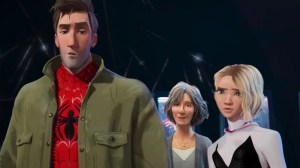 There are two relationships at the core: Miles and his father and Miles and Peter Parker. The latter is an unexpected mentor/pupil relationship that provides the enjoyment of watching both members grow through their bond, and the former allows a familial baseline to come back to and demonstrate how far we’ve come. The Peter Parker/Miles relationship has that big brother/little brother angst that keeps things sharp while still maintaining an undercurrent of emotional need. There were genuine moments where my eyes welled up. The film can be that affecting because it is so well structured and developed from a characterization standpoint. Even the chief villain, the Kingpin, has a motivation that is personal and effectively empathetic. Everyone involved gets careful consideration, even the bad guys.
Let me cite one prime example that showcases how great the storytelling can be (minor spoilers). At one point, Miles is bound and gagged by the other heroes to prevent him from joining them in a dangerous activity they do not believe he is ready for. They’re removing him from the team for his own good. Then, at this low point, his father comes to visit him and tries talking to him through the other side of his dormitory door. They’ve had some challenging moments between them and what Mr. Davis has to say is extra challenging. He’s trying to connect with a son he feels he’s losing touch with, and it’s a one-sided conversation where Miles is unable to respond to his father’s pleas, who eventually walks away knowing his son is there but not ready to talk. Right there, the screenwriters have gone from the fantastic to the personal, finding a way to bring Miles even lower but in an organic fashion that plays right into his ongoing communication problems. It’s a simple moment to start with, standard even, but then having it contribute to the father/son estrangement is beautiful and handled so well. The sparkling screenplay for Into the Spider-Verse is packed with moments like this.
The voice acting is perfectly suited for their roles. Moore (The Get Down) is an expressive and capable young actor that brings a terrific vulnerability to Miles, selling every emotion with authenticity. Johnson (Tag) is the absolute best choice for a slacker Spider-Man who has become jaded and self-indulgent. His laid back rhythms gel nicely with Moore’s eager breathlessness. Henry (Widows) is so paternal it hurts your heart. Steinfeld (Bumblebee) is poised and enjoyably spry. Cage (Mandy) is doing everything you’d want a Nicolas Cage-voiced crime fighter to be. Schreiber (Ray Donovan) can be threatening in his sleep with that velvety voice of his. Plus you get Katheryn Hahn as a villain, Zoe Kravitz as Mary Jane, and Lily Tomlin as Aunt May, and they’re all great.
 As the credits rolled for Spider-Man: Into the Spider-Verse, I tried searching my brain for any flaws, minor quibbles, anything that would hold the film back from an entertainment standpoint. The only thing I could think of is that animation style, but different people will either find that look appealing or irritating. This is a glorious and gloriously entertaining movie replete with humor, heart, surprises, payoffs, and a great creative energy that bursts from the big screen. This really is a movie to see on the big screen as well, to better feast on the eye-popping visuals and pop-art comic book aesthetics that leap from the page to the screen. It’s the second best Spidey movie, after 2017’s impeccably structured solo venture, Homecoming. The late addition of the other alternate universe Spider heroes keeps things silly even as it raises the stakes. The film is a wonderful blending of tones and styles, from the different characters and universes to the heartfelt emotions and vicarious thrills of being young and super powered. This is a movie that even Spider novices can climb aboard and fall in love with. Into the Spider-Verse is a film for fans of all ages and nothing short of the best animated film of 2018. It’s as good as advertised, folks.
Nate’s Grade: A
Share this:

Green Book (2018)
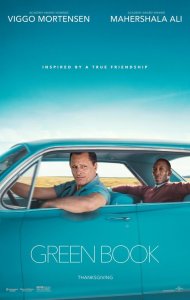 Green Book plays like a twenty-first century rendition of Driving Miss Daisy, a well-meaning and relatively gentle movie about race relations where a prejudiced white person comes about thanks to their firsthand friendship with an African-American male. It’s reportedly inspired by the true story of Tony Lip (Viggo Mortensen), a nightclub bouncer, driving around a famed pianist, Dr. Don Shirley (Mahershala Ali), as he performed throughout the South in 1962. The best part of the movie is the character interaction between this odd couple, and you’ll get plenty of it too. The actors burrow into their very distinctly conflicting characters, so it’s a natural pleasure to watch them eventually bond and learn from one another. This is the kind of racism that doesn’t make people feel too uncomfortable, and you could say that about the film as a whole. It’s a bit safe and has its intentions set on being a big, inclusive crowd-pleaser, and it plays like one. There are moments to make you laugh, moments to make you cheer, and moments to make you tear up. Morstensen and Ali are terrific together and find dignity and humanity in characters that could have easily become one-note stereotypes. The more we learn about Dr. Shirley the more interesting he becomes, a man used to feeling like an outsider no matter the company he keeps. Watching the two men grow and open up to one another can be heartwarming and deeply satisfying. Remarkably, the film is directed and co-written by one half of the Farrelly brothers, the pair responsible for ribald comedies like There’s Something About Mary and Dumb and Dumber. It’s an easy movie to fall for, with its winning formula and enjoyable actors, but there’s a little nagging concern I have that Green Book is too safe, too straight, and too pat in its life lessons. Despite its Best Picture win, it’s not like Driving Miss Daisy has any lasting cultural impression, and I wonder if maybe Green Book is destined for the same. Still, the acting and writing is enough to bring a smile to your face and remind one’s self about the power of kindness.
Nate’s Grade: B


You must be logged in to post a comment.