Blog Archives
The Box (2009)/ Capitalism: A Love Story (2009)
 Both films on the surface seem so radically different and yet I found lots of common ground between a sci-fi conspiracy and a muckraking documentary about the biggest financial meltdown of the modern era. Both are centered around the concept of greed and whether humanity can forgo selfishness for empathy of their fellow man. Would you kill a stranger for a million bucks? Would you rig a financial system so that the richest one percent can gamble the life of a nation? Both movies also bite off more than they can chew and both movies exist as interesting yet dispirit elements that could use more cohesion and resolution.
You have been given a box with a button. If you press the button tow things happen: somebody you do not know will die and you will receive a million dollars. Do you press it? That’s the hook of writer/director Richard Kelly’s sci-fi morality tale based upon a short story by Richard Matheson. The Box is a messy and outlandish conspiracy sandwiched between two moral tests, the second a consequence of the first and a means to wipe the slate clean. There’s plenty of weird unsettling moments, including the horrendous wallpaper of the 1970s, but not everything really hangs together. Kelly’s intergalactic conspiracy can get readily outlandish with all the variables and needed participants, but like in Donnie Darko, he lays out enough tantalizing info to keep your attention and then keeps the narrative vague enough for personal interpretation. However, unlike Darko, this movie needed to cleanup its loose storylines. It just sort of ends in perplexing rush, and I sat in silence through the end credits waiting for some kind of scene to help tie together dangling storylines that were left to dangle for an eternity. The Box has a nicely tuned foreboding atmosphere, and it certainly keeps you guessing, but it will also keep you scratching your head to try and make sense of everything from button boxes to teleportation pools to Mars probes to sudden nosebleeds to Satre’s No Exit. Kelly, as he has done with his previous movies, packs a lot in two hours. Whether or not it all formulates is up to the viewer’s wearying patience. I’d rather have more movies like The Box than more thoughtless drivel from the Hollywood assembly line.
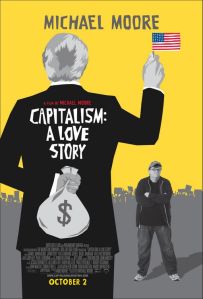 After 20 years, you pretty much know at this point what you’re going to get from a Michael Moore documentary. There’s the anecdotal evidence, emotional interviews of the downtrodden, the one-sided arguments, the nods to the depressive state of Flint, Michigan, and Moore trying to bully his way to see the powers that be that have no interest seeing him. In a way, Capitalism: A Love Story is like a greatest hits collection for Moore that reminds you of his better moments and better films. Despite all the outrage, Moore wants to throw the baby out with the bath water. He cites capitalism as an evil that needs to be eradicated. His thesis isn’t very cohesive and consists of a series of related and unrelated anecdotes, some of them grossly offensive like companies profiting from the death of employees thanks to “Dead Peasant” life insurance policies. But at no point do you walk away thinking, “Let’s start from scratch. What has capitalism gotten us?” Several of his points are easy to agree with. There is a flagrant disregard for the well being of others on Wall Street, who carelessly gambled the nation’s fortunes and then got the taxpayers to cover the loss. The bailout is a crime of pure capitalism and in a true capitalistic society there is no such thing as “too big to fail,” there is only fail. It’s not following an ideology built upon greed that has hurt the U.S., it’s unchecked greed, capitalism run amok without any oversight or regulation that has endangered the nation’s livelihood, and I’m surprised Moore didn’t emphasize the process of deregulation from Reagan to Bush more. The story of our financial meltdown is too large for a confined two-hour narrative window, and it’s too important a lesson for a man like Moore to use it as fire to ignite a people’s revolution.
Both movies: C+
Share this:

Transformers: Revenge of the Fallen (2009)
 Transformers: Revenge of the Fallen pretty much sells itself. More giant freaking robots. That was enough to make the first movie a worldwide blockbuster. My own teenaged brother-in-law, when he first saw the first Transformers movie, declared it his favorite live action film. Director Michael Bay completely empties his creative cupboard into a bladder-unfriendly two and a half hour endurance test. It’s too bad that that cupboard was bare when it came to story.
Sam (Shia LaBeouf) is headed off to college, and he’s leaving behind his girlfriend Mikaela (Megan Fox) and robot guardian, Bumblebee. Optimus Prime and the other Autobots have been working with the U.S. government to hunt down Decepticons around the globe. There?s a war on the horizon, and weasely U.S. bureaucrats want the Autobots to take a hike. Sam discovers a tiny shard from the super Cube, which was the source of life for the alien robots. His brain is zapped with an alien language that will lead him to a secret location to a secret ancient machine. The Decepticons want this info and chase after Sam and Mikaela. The biggest bad of them all, The Fallen, is sitting at home waiting to return to Earth and exact interstellar vengeance. The Fallen was foiled in 17,000 B.C. by the Prime family line, and only a Prime can kill him. The Decepticons resurrect their leader Megatron and go about trying to snatch Sam, kill Optimus Prime, and destroy man’s planet.
Bay has been condemned for his erratic ADD-shooting style, and this was the first film where I really felt pounded and punished. To contest that this movie is just “a popcorn summer movie” is just making excuses. What the hell was going on? The movie is simply a blur of colors and noise. Transformers 2 is entirely incoherent, both from a story standpoint and simply from a visual standpoint. Bay at least pulls back his camera so that the audience can identify the fighting robots easier this time; this time it’s not like deciphering scrambled porn. It’s the rest of Bay’s characteristically bombastic display of carnage that suffers. Bay is a man that doesn’t know the meaning of the word “small,” and so nonstop explosions and massive destruction litter the movie. Sam is always running or riding in his car to escape. At one point, Sam and his posse hide in a campus library only to have the building turned into cinders (showing Bay’s opinion on what books are really good for). But what exactly is happening? Why does it matter? What are the obstacles? Everything is way too busy and accomplishing so little. Half of the movie consists of the human character running and screaming. It’s excessively excessive and taxingly so.
 A strong example of the film’s incoherence is the 40-minute climax set amidst the pyramids of Egypt. At no point does Bay establish the geography or bother to let the audience follow along. The stakes and parameters have not been made adequately understandable. Ordinarily, in large action sequences there will be different groups of segments and we’ll watch each progress. Here we disjointedly cut back and forth between the groups but I have no idea what?s going on, where the characters are, where they need to be, and what is stopping them. Megatron calls down 13 different evil Decepticon robots to take part in the climactic battle but Bay never introduces these new figures; they get no setup to explain each of their unique weapons systems or general appearance. We see them only at a distance walk through wafting smoke clouds. So when they do pop into battle in quick blurs it’s just another point to be confused about. If you’re like me, you can only endure so much confusion before your brain just gives up. Bay is a fantastic visual stylist, but his action sequences are poorly developed and poorly staged. He needs to check out The Hurt Locker and take notes. Transformers 2 is nothing but non-stop careless mayhem. For what it?s worth, the special effects are incredible at every stop.
The highly ramped-up action would have been acceptable if we knew what the hell was going on and we actually cared about the story. Transformers 2 makes the first film look like poetry in comparison. The story for this movie is simply atrocious and it’s made worse by the merciless attempts at comedy. This movie is stuffed with tin-eared exposition, so our only break to try and assess what the hell we just saw is when the characters take a breather and rapidly spout more plot vomit. It’s like listening to a homeless man shout nonsense for an hour. After a while you just tune out the crazy. If the Decepticons can construct a robot that has the ability to take human form, why the hell aren’t they doing this all the time? Why aren’t they infiltrating government offices instead of prancing around colleges in hot pants? Why in the world would an 18-year-old boy leave the mega hot Megan Fox and his TALKING ROBOT CAR? Why would anyone leave these two to live in a dorm and shower in flip flops? What universe does this college that Sam attends exist in? The place is crawling with leggy, waif-thin bombshells. The movie doesn’t even resort to college stereotypes; there isn’t a single gal that doesn’t look like a magazine cover girl. The Fallen is kind of like the evil leader of the Decepticons and he’s, what, confined to sitting in his robo La-Z-Boy on his home world like Archie Bunker? Get up and do something. The Transformers fought ages ago amidst man?s loin-clothed hunter and gatherer ancestors but leave no record? You’d think some caveman type might consider that worthy of painting on a wall. Why is Megatron even in this movie? What was the point of bringing him back alive if he’s just another lackey to The Fallen guy? Why does no one consider turning over Sam to the Decepticons if it could save the planet? In the big Egyptian battle sequence, where is the Fallen the whole time? He just kind of lazily shows up at the end. Also, ancient robots made a special key to jumpstart an ancient planet-destroying machine, but then we are informed when Sam visits, no joke, Transformers heaven that this key does not work unless the holder has earned the right to use it. It’s like some high tech moral barometer. Why didn’t these alien robots say anything about this? It would have spared a lot of time and energy trying to make sure the Decepticons never got a hold of it. How does a dead human end up going to robot heaven anyway? Does that mean there’s a robot God? Was robot God created by our God? Is there a robot Devil? Does Bay do the work of the robot Devil?
 This time the comedy is puerile and embarrassing. The jokes make this movie tonally feel like a cartoon strictly for snickering adolescents. In the span of 150 minutes we’re given dogs humping twice, a tiny Transformer humping Megan Fox’s leg, Sam’s mother going berserk from ingesting pot brownies, a Transformer testicle joke (why would a robot even need genitals?), and let us not forget John Turturro in a thong. The humor aims low and still finds a way to be even worse. To save you the trouble, I am going to spoil the only two good jokes in this self-indulgent, bloated mess. Here there are, enjoy:
1) Sam is at a frat party, and it’s a frat party unlike anything ever seen unless modern fraternities can afford expensive interior decorators. One unamused frat guy asks Sam what he’s doing. Sam responds, “Going out to get you a tighter shirt.” The frat guy’s flunky clarifies: “There isn’t a tighter shirt. We checked.” I laughed. Sue me.
2) Sam and the gang at one point talk to a Transformer that’s thousands of years old. Apparently the guy is being housed at the Smithsonian Museum, which means that this is the second summer movie that is trying to inform the public that there’s something weird over at the Smithsonian. The old Transformer even has a robot cane, which is too bizarre. He rambles about the old days like Grandpa Simpson, and then finally gave this gem: “My father was a wheel. The first wheel. You know what he could transform into? Nothing! And he did so with honor.” This made me want to think about a period Transformers costume drama, where they exist as textile steam engines and phonographs and Model Ts. Would that not be a vastly more entertaining movie?
Despite all the painfully juvenile attempts at comedy, by far the biggest eyesore would have to be Bay’s Sambot twins, Mudflap and Skids. To say that these two irritating robots are politically incorrect does not go far enough. It’s one thing to reflect a cultural or ethnic stereotype, and it’s another thing entirely to keep digging deeper and deeper. These robots talk in eye-rolling faux gangster street talk, one of them has a big gold tooth, and these robots admit to being illiterate. It’s practically breathtaking to watch how racially insensitive and appalling these characters become. It’s essentially a robotic minstrel show. I’m surprised Bay stopped short of having Mudflap and Skids eat a big bowl of watermelon. This got me thinking about what other highly insensitive Transformers characters that didn’t make the cut over these two. Was there an Asian bot that turned into a car that didn’t drive well? Was there a Jewish bot that chided Optimis Prime to settle down and quit running around with those shiksa sports cars (“You know those aren’t her original parts?”). Bay can dismiss these characters as merely dumb robotic comic relief, except for the fact that these two bumbling, detestable heaps of scrap metal are never, ever funny.
 The actors have little impact in this type of movie. I like LaBeouf (Eagle Eye) but he’s got little to do but stretch his legs. Fox became a star thanks to the previous Transformers flick, and she hasn’t gotten any less attractive. Amazingly enough, she manages to lose more clothes the more she runs in slow-mo, allowing the male audience members to follow the nuance of her bouncing breasts. She’s clearly not the next Meryl Streep but this girl deserves more than being wordless arm candy. Many words have been spilled about the quasi-racist twin robots, but I’m disappointed that people aren’t as equally up in arms over the film’s blatant misogyny. Women don’t seem to exist in the Michael Bay world, only parts and pieces of women. They are all like Alice, the robot programmed to do nothing else but seduce the men. All of the special effects and noise just overwhelm the other actors. The robots themselves have no personality to offer, good or bad.
Transformers: Revenge of the Fallen is an obnoxious block-headed mess that feels like it’s being made up as it goes along. It’s sensory overload without a lick of sense, clarity, wit, and general entertainment. This sequel takes everything that was good about the first Transformers film and undermines it, and it takes everything that was awful and magnifies that awfulness. The first Transformers movie was fun. This is just work to sit through. Apologists will try and rationalize their disappointment, decrying anyone who hoped for something more than a big dumb summer blockbuster about rock’em, sock’em robots. Bay wants to show you everything and as a result you rarely get a chance to process little in this movie. There is absolutely nothing more than meets the eye here. It’s all arbitrary and tedious and it goes on for what feels like an eternity. It’ll make a gazillion dollars at the box office but will anyone remember a single moment from this exhausting junk? Make sure to bring the earplugs and aspirin in abundance.
Nate’s Grade: C-
Share this:

Star Trek (2009)
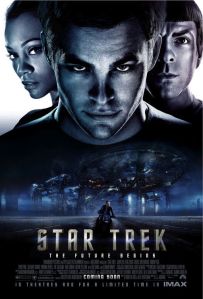 Star Trek has a hold on geek culture like no other franchise. It’s lasted over forty years, sustained five television series, and ten feature films (about four of them good), and let’s not forget the plethora of fanatical merchandise that includes everything from Trek cologne to Trek coffins. Star Wars has all the box office clout, but Trek has followers so devoted that they will create and learn a separate language, Klingon, that almost assuredly will never be spoken by anyone else outside of the festival circuit (you will never see a written Klingon exam that asks you “Where the library is?”). The Star Trek fans have been a foundation of geek culture for over four decades. People take this stuff very seriously. Trek has always been a headier brand of sci-fi, more devoted to ideas and moral dilemmas than shoot-outs and space chases, though Captain Kirk did teach the universe how to love, one green-skinned buxom alien babe at a time. 2002’s abominable Star Trek: Nemesis was meant to open up the franchise to a wider audience, but the film was the low-point for a franchise that also included William Shatner writing and directing the fifth flick (Nemesis also broke the odd/even movie curse).
When director J.J. Abrams approached Star Trek with the purpose of reinvigorating the flagging film series, you would think the man would wade into such a storied franchise with trepidation. Nope. He openly said he was making a “Star Trek movie for people who weren’t fans of Star Trek.” He was even going to change Trek canon. I imagine Trekkies (and no, I will never use the preferred nomenclature “Trekkers”) were nervous about an outsider, the author of the cinematic classic Gone Fishin’, meddling with hallowed ground. As I suspected, these fears were unfounded. The newest Star Trek does more than put a new coat of paint on an old franchise. This movie boldly goes where none of the Trek movies have gone before — turning reverent geek culture into a grand populist entertainment smash.
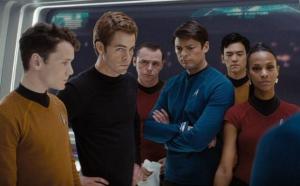 This new incarnation looks backwards, explaining how the crew of the U.S.S. Enterprise came together. The movie shows the path of Jim Kirk (Chris Pine), from troubled youth to eventual starship captain. Kirk’s father captained a starship for about 10 minutes, but he managed to save 800 lives under attack, including the birth of his son. Captain Pike (Bruce Greenwood) recruits Kirk to Starfleet Academy with the promise of doing something more with life. We also witness the boyhood of Spock (Zachary Quinto), who is teased for being half-Vulcan and half-human. His human mother (Winona Ryder) encouraged Spock to embrace his human emotions instead of cutting them off, Vulcan-style. Kirk and Spock clash at the Academy, and then an emergency requires all the recruits to saddle up for their first mission in space. Nero (Eric Bana) is a dastardly Romulan who has traveled back in time. In the future, he blames an older Spock (Leonard Nimoy) for the destruction of his home planet and the deaths of billions of Romulans. To ensure this does not happen, Nero is going to eradicate Starfleet home planets, starting with Vulcan and then Earth.
J.J. Abrams is a geek’s best friend. He understands geek culture, and yet the man is able to take genre concepts and make them easily accessible to the unconverted while still making a finished product that is respectful, playful, and awesome. Abrams is an expert on the pop culture catalogue, and he knows how to make genuinely entertaining productions that succeed on brains as well as brawn. He brought tired spy conventions into the twenty-first century with the cool, twisty Alias and Mission: Impossible III, which was really an extravagant two-hour episode of Alias, and I mean this in the best way. He has an innate understanding of action sequences and knows well enough that an audience needs to be engaged emotionally, so he makes the action as character-based as much as possible. Abrams has a terrific imagination behind the camera, and he reminds me of a young Steven Spielberg in his ability to marry artistic integrity with big-budget crowd pleasers. Abrams and his screenwriters Alex Kurtzman and Roberto Orci (Transformers, TV’s Fringe) have crafted a stellar Trek that will appeal to die-hards and those who couldn’t tell a Romulan from a Vulcan (I fall somewhere in between).
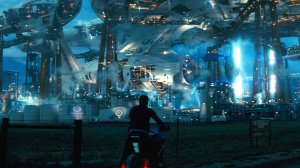 The time travel storyline could have used more juice, however, it serves its purpose by establishing a parallel Trek universe to work with. Beforehand, Trek had established so many previous stories that it hamstrung writing new stories because they had to be extensively researched to make sure they did not conflict with 40 years of canon. Abrams and company wrestled free from the grip of the established history and can now play around unencumbered to a degree. I mean, fans don’t want to see something radically inauthentic, but Uhura and Spock as a couple? Sure, why not? The fan favorite character catch-phrases (“She’s givin’ it all she’s got,” “Dammit Jim, I’m a doctor?,” etc.) are organically worked into the story so that they don’t become falling anvils.
Star Trek‘s pacing can be whiplash inducing. It speeds through two hours of action and setup while still maintaining an emotional connection to the characters involved. The movie has a boyish enthusiasm for adventure and it’s fun watching well-known characters assemble and amble into new and interesting directions. The action is routinely thrilling and I enjoyed Abram’s small touches, like watching a crew member get sucked out into space and cutting all sound to illustrate the cold, empty vacuum. The amount of humor injected into the movie can be distracting at times, not because it isn’t funny but because of the brisk tone breaking. One second it’s a life-or-death scenario and the next Kirk is running around with giant goofy hands. Still, it’s good to see some humor in the Trek universe that isn’t related to alien culture clashes.
The young ensemble is amazingly well cast. I didn’t think a younger generation of actors would be able to step right in and play such lived-in characters, but they pull it off. The hardest shoes to fill are unquestionably Kirk’s, and Pine (Smokin’ Aces, Just My Luck) carries that same cocksure bravado without stooping to a stilted Shatner impersonation. His performance feels at times like Han Solo and Luke Skywalker rolled into one, and he’s an appealing presence that captures the essence of a dashing and rebellious scrapper. This Kirk is still an adventure-seeking, skirt-chasing 1960s kid at play. Quinto (TV’s Heroes) is blessed to look remarkably similar to Nimoy, but the actor also gets to explore the human side of Spock. He feels compelled to harness emotion, like all Vulcans, yet it’s intriguing when certain emotions slip out and build a bigger picture about what’s going inside the mind of a being dominated by logic. Quinto has less to work with by design and yet the man finds interesting ways to ensure Spock can be recognizable. Each of the supporting actors has their moment, but my biggest surprise was Karl Urban as Dr. Leonard “Bones” McCoy. Urban has mostly been confined to lame action movies as of late, like Doom and Pathfinder. But he’s really funny and his performance captures DeForest Kelly’s mannerisms down without turning into a caricature.
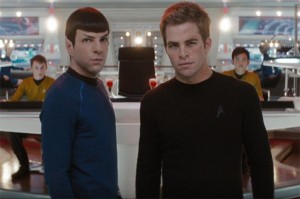 If there is a main weakness to Abrams’ Trek outing it’s that it feels far more like the opening act of a larger movie. Nero is a fairly weak villain, though Bana gives him a nicely polished glower. The villain is really just a tie-in for the time travel storyline, which is also a narrative quirk to secure an open field for further stories. Meaning, that much of the movie can be seen as assembling the pieces to simply move forward on their own. It’s an expensive set-up movie, and Abrams makes sure that the audience sees every dollar of the splashy visuals onscreen. Personally, I was also getting tired of the cinematography decision to fill the screen with as many light flares as possible. It seemed like every other moment had a blast of light beam in from some direction. After a while it sort of felt like an eye exam where the optometrist shines a flashlight back and forth. And it takes far too long for Scotty (Simon Pegg) to appear in the movie.
J.J. Abrams does more than hit the restart button. He has made a Star Trek that manages to be respectfully reverent but at the same time plays along to the mainstream visual sensibilities of modern cinema. It’s fun without being campy, reverent without being slavish, and this Trek never forgets to entertain from the opening assault on a starship to the Michale Giacchino’s closing credits score. This is an enjoyable rush of sci-fi escapism. The Star Trek series was always deeply hopeful and humanistic, believing in the best for humanity and that man, in cooperation, could achieve greatness. I think further escapades with this cast and Abrams at the helm could reach greatness. For now, I’ll be happy with this rollicking first entry into a franchise that seemed adrift in space. Bring on more of the green-skinned women.
Nate’s Grade: A-
Share this:

Knowing (2009)
 Knowing is a movie about the consequences of seeing the Eternal Plan. If you could know the exact day of your death, would you want to know? How would that impact your life? Would you feel motivated to live every other day to its fullest, or would it cast a pall over the rest of your time? One character in Knowing is told the day of her death and it destroys the rest of her life. I think this topic is interesting but perhaps I’m in the minority. Knowing has been savaged by film critics, and I can certainly see the validity of some of their complaints. It’s not a flawless movie by any means, but I found Knowing to be an effective and suspenseful B-movie.
In 1959, a Massachusetts school buried a time capsule with drawn predictions of what students though the world would be like in 2009 (lots of robots and rockets, how we’ve let them down). One girl, Lucinda Embry, wrote a series of numbers. Flash forward 50 years. MIT professor John Koestler (Nicolas Cage) is a widower raising his eight-year-old son, Caleb (Chandler Canterbury). When the school reopens the time capsule, the schoolteachers pass out the individual letters to students. Naturally Caleb is given the envelope with the number code. He brings it home to show his father, who becomes intrigued and looks for patterns. John reasons that the string of numbers is an eerie predictor for major disasters around the world. They predict the date, the number that die, and the location via longitude and latitude. All of the numbered disasters have already taken place (including the hotel fire that killed John’s wife), but there are three more numbered disasters that have yet to happen. It?s about this time that Caleb is visited by mysterious thin men in long black trench coats. John seeks out assistance from Lucinda’s daughter (Rose Byrne), whose daughter also hears the same voices that Caleb does about an impending doom.
 Count me genuinely surprised at how taut I found Knowing. This movie builds a good head of steam and I dreaded what was to follow (in the good sense). When John figures out the exact design of the numbers, pinpointing date and location of disasters, he feels compelled to try and prevent the loss of life. Would you do the same? I think if I had been given a secret celestial code that predicted cataclysmic disasters that I would make sure to steer clear from those locales, rather than running to them. Director Alex Proyas (Dark City, I, Robot) expertly stages the carnage, to the point that I was grimacing and wincing. The plane crash, all shown in one unending shot, is a realistic nightmare that gets more and more disturbing. John hops through the wreckage to attempt to save people and encounters one burning victims after another, all screaming in terror. There are subsequent explosions amongst the wreckage that engulf more people in flames. The scene is spellbinding and unflinchingly horrific. The same can be said about the second disaster sequence in New York City, indelicately evoking some 9/11 memories. After these sequences I was dreading every moment leading up to the next, yet I was also perversely interested to see what would happen next.
I?m glad that the screenwriters tackled the fallacy of numerology early. One of John’s MIT colleagues says that people see what they want to see in the numbers, and surprise then they find them. This was completely the case with the ridiculous 2007 thriller, The Number 23. Jim Carrey went crazy deducing everything to one number, but it was the human mind projecting what it desired to see. The same thing goes for psychics who express vague statements so that the poor saps paying can fill in the details and make it personally relevant (“I’m thinking of a grandfather who died… He was a man?”). I had less of a logic gap with the numbers in Knowing. Granted, I have no idea which set of numbers the code is going with. For example, it lists a set number of deaths for the 2004 tsunami that killed over 250,000 people. But with such a massive event, how do we calculate the dead? There could be loads of people missing and presumed killed by the tsunami. Do people that die as a result of injuries count as direct victims, or are they victims of infection? My point is either the number code is going by the reported estimate on the news or has the exact number, which would be different than what the estimate was in the press. Either way, it presents a mild discrepancy for John.
The movie paints itself into a corner and the astute viewer will realize that it?s only a matter of time before one of the two supernatural A-words gets dropped as the force behind the strange occurrences (or a hybrid of both options). While the movie gets somewhat silly toward the end with its apocalyptic resolution, Knowing refrains from getting stupid. Yes it’s weird that John somehow lives in a giant house decorated to look like some peeling haunted mansion. Yes it’s weird that some supernatural force could predict every man-made disaster yet decide not to intervene in the biggest one. Yes it’s weird when Cage screams, “We have to go where the numbers want us to go.” But here’s the thing, Knowing is packed with ideas, some of them derivative (the ending borrows liberally from Arthur C. Clarke’s novel, Childhood’s End), but there is an ongoing discussion over the nature of science, religion, destiny and free will, and this discussion does not pander. I would have expected a conventional movie to transform John back into a man of faith over the amazing course of events, but it never fully happens. The movie never deduces that religious faith is the right prescription for our ailing times, and it even questions the ideas of divine intervention, namely that we live in a universe of determination rather than randomness, though it won’t specify what that determination is. The movie adheres to its pessimistic viewpoint right down to the end, which result in some ballsy choices for a mainstream Hollywood thriller. The heavy-handed ending didn’t break the enjoyment of the movie for me, though I expect it will for many.
 Not that it was needed but Knowing offers some nice little moments of characterization. I really enjoyed John’s monologue about his wife’s passing. He laments what he was doing at the time of her death, mainly blowing leaves off the lawn. He thought you were supposed to know, to feel something when your loved ones are in peril. He was just tending to the leaves, unaware of his wife’s fiery death. I really appreciated this insight into John and also how realistic the scenario felt: the depressing realization that the universe let you down. This seems like a much more believable reason for John’s scientific atheism than anything Mel Gibson went through in Signs.
The acting is cranked up to an exaggerated level of screaming. Cage spends a good portion of the movie with his mouth agape. The rest of the time he’s frantically screaming, which could account for most of the acting. It alternates between catatonic and hysterical. Cage is rather decent as his life is consumed by mysteries. I must say though that the acting only made me raise my eyebrow a few times and never pulled me out of the movie. This is no Wicker Man embarrassment of monumental proportions.
[Knowing is a solid B-movie with some super special effects to go along with its haunting scenes of disaster. It?s a step above your average sci-fi flick thanks to a lack of pandering to easy answers. I’m somewhat amazed that a movie this fatalistic and bleak would be greenlighted and given the budget it has. Proyas make sure the movie doesn’t succumb to numerology hokum, though the movie does tilt a bit toward the silly by its conclusion. I went into Knowing knowing little beyond the fact that the movie was ripped apart by other critics. Perhaps my positive reaction is born completely out of low expectations, but I found Knowing to be a juicy bit of sci-fi escapism that diverted the time nicely
Nate’s Grade: B
Share this:

The Day the Earth Stood Still (2008)
 The 1951 original The Day the Earth Stood Still is considered a sci-fi classic for a reason. Versatile director Robert Wise (West Side Story, The Sound of Music) used a robot and an alien invader to help hold a mirror up to the world, asking how humanity was treating its brethren. The technology is easily dated and the tone a bit stately, but the movie is a complex, thoughtful, and relevant tale that begs for caution and kindness. It still holds up much better than most sci-fi chestnuts from yesteryear. And of course anything that film audiences have warm feelings for will be repackaged by Hollywood into a new more mass-appealing product. That means that big-budget Day the Earth Stood Still remake is likely to have no real improvement over the original. Well, it is in color. That’s an improvement for some.
A giant glowing spaceship lands in New York City’s Central Park. A glowing figure exits the craft and enters our world. This figure is Klaatu (Keanu Reeves) who is an alien creature in the guide of a human body. He has been sent by a community of planets to judge the inhabitants of the Earth. You see, the universe is an awfully large expanse of space but it has a limited number of habitable planets. The rest of the universe is taking note of how human beings have treated their home, and they may just decide that the planet is better off without us. Klaatu is helped out by a sympathetic scientist, Helen Benson (Jennifer Connelly). Eventually the alien escapes and the entire U.S. government is on high alert. Helen is trying to convince Klaatu to not rush to judgment. She’s also trying to connect with her angry step-son Jacob (Jaden Smith) after his father died in war. He’s not very trustful of Klaatu and, like plenty of other people, wants the alien dead.
 Whereas the original was a cautionary tale about the Cold War and mutual destruction, and Klaatu was a peaceful Christ-like figure, the new version skips all this. It would rather recycle a message that human beings need to be nicer to Mother Nature. Now, this is an important concern but it’s harder to take seriously when the movie pretends it’s all about doom and gloom and then basically wimps out on an ending. The film is ready to wipe humanity off the globe and even gets a head start with what looks like swarms of microscopic metallic locusts. But then Klaatu looks out at mother and child, embracing as the world they know may come to an end, and concludes that human beings deserve yet another chance because they have the ability to “change.” That’s all it takes? This kind of cop-out ending reminds me of The Happening, another eco-horror movie that wanted to kill off all those pesky humans but then decided they could walk the Earth a tad longer and hopefully wiser. I’m sorry but this is weak. Profess an environmental message but do something with it, don’t thump your chest about taking personal responsibility and then skimp on repercussions. Remember filmmakers that this is fiction. You have the ability, nay the right, to destroy mankind on screen while I safely watch and consume popcorn.
You know what else keeps hurting the weight of the environmental message? The lousy relationship between Helen and her step-son Jason. This entire storyline needs to not exist. I recognize that the original movie had a substantial storyline where a single mom and her precocious son befriend Klaatu, but that doesn’t mean this remake has to reignite old storylines if they just simply won’t work in this retelling. Every time the movie spends significant time with Helen and Jason I felt like the Earth was standing still. This storyline just does not fit. The kid comes across as bratty and dumb and I actually wanted him to be micro-locust food at some points. He’s angry because his father died and that makes him argue that “Kill them all” is a serviceable foreign policy position. Whatever. This storyline is handled so terribly that every moment of drama it is intended to evoke hits with a resounding thud. When the little kid suddenly turns on a dime and helps his alien fugitive, there’s no explanation. He says he’s afraid of being alone. Well what did you think would happen when you called the U.S. government to come and abduct you? I swear that I do not have a heart of stone, and I love children, but every moment of this character felt false and annoyingly so. That’s why The Day the Earth Stood Still grinds to a halt whenever it switches back to this kid. It makes the whole alien threat a lot less menacing when we spend more time with this kid. Don’t we have far more significant things going on in this story than one kid working through his grief and learning to be less bratty?
 Director Scott Derickson (The Exorcism of Emily Rose) doesn’t have a firm handle on how to establish an exciting action set piece, and he also makes his points very bluntly, though that’s also due to the script by David Scarpa. The beginning is the best part of the film, as scientists are whisked away by government authorities who can only say that the threat to the planet is grave. Interest is piqued at this point, as we, like the scientists, try and discover with a mixture of curiosity and anxiety what exactly the Earth is facing. It doesn’t much improve after the 15-minute mark. The movie just looks so drab. There is a discerning lack of action or excitement in a movie that threatens to eliminate the human race. The movie has long boring stretches that almost kill all momentum, and then the movie tries to compensate with an avalanche of special effects.
There are plenty of intriguing concepts and conflicts that fall by the wayside. In the original Klaatu hid among human beings and came to understand people, but in this new version he’s on the run from the start. I don’t necessarily need some tired fish-out-of-water comedy with Keanu, but seeing him learn about humanity before making a judgment is vital to his character. The remake opens in 1928 with aliens taking a DNA sample from a mountain climber (also Keanu Reeves) and then they use his blood to create a human host. What if that guy is still alive and sees his face on the news? What about his family going through and wondering what connection they might all have to the fate of mankind? Wouldn’t it have been easy just to swap Connelly’s character into this role and thus she is the descendant of that mountain climber and has to look in her grandfather’s face as he proclaims humanity’s end? That storyline would be more interesting and playful than anything with the step-kid.
Occasionally sci-fi movies can be partially redeemed by superior special effects. The Day the Earth Stood Still has some pretty shoddy effects that didn’t look much better when I watched the film in IMAX. The aliens have scrapped the older model flying saucers and decide to travel in giant glowing spheres, which may be awe-inspiring to see in person but it’s mostly lame to watch on screen. It’s not even that hard of a CGI effect to perform. The new likeness is completely wrong for Gort, one of the most famous movie robots of all time. In the 1951 original, Gort was a teen foot tall robotic guardian for Klaatu. Derickson has made Gort 40 feet tall and he looks weirdly like an Oscar statuette. The awesome robot is ridiculously captured by the U.S. military so that they can try and drill into it, which makes no sense at all. Then the robot transforms into that swarm of robo-locusts and that’s the last we see Gort in action. That’s just dumb. I would much rather see a giant robot wrecking havoc than a swarm tear apart Giants Stadium. The filmmakers decided that a hazy cloud would be more visually interesting than a giant robot. Give me more Gort!
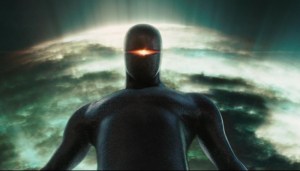 I must say that hiring Reeves was the smartest move that the movie made. Reeves’ naturally stiff and aloof line delivery works nicely as an alien trying to some to grips with his new flesh and blood body. Reeves consistently entertains and adds a dash of fun that is mostly missing in this humorless and stubborn remake. Connelly works with what little she’s given, and man can she make her eyes glisten in the most beautiful manner, tearing up at a moment’s notice. Most of the other actors are wasted in stock roles, including Kathy Bates as the Secretary of Defense and Mad Men‘s Jon Hamm as a man who only serves to spout exposition. That’s the dashing Don Drapier, and you give him exposition? I won’t belittle Smith’s performance because in all honesty the kid is a fairly good actor. It’s not his fault he got stuck playing a dumb character that routinely hijacks the movie.
The newest Day the Earth Stood Still does little to justify its existence. This remake would have been better served either cribbing more of the superior original film or just cut off all ties. The remake tries to incorporate plot points that don’t work while also trying to tell its own environmental tale with bigger effects, which also doesn’t fully work. The Day the Earth Stood Still is a plodding and unnecessary remake that fails to stumble into an exciting scenario despite the fact that it involves aliens threatening the planet. But hey, it is in color.
Nate’s Grade: C
Share this:

Indiana Jones and the Kingdom of the Crystal Skull (2008)
 I lived in New Haven, Connecticut for a year while then-partner was earning her Master’s degree at Yale. We hated it. New Haven is a college town that doesn’t know it’s a college town, so everything closes at 10 PM, there are no student prices for anything, and the people there more or less sucked. We were happy to depart from the Nutmeg State. Then the week after we were going to leave was when Steven Spielberg, Harrison Ford, and the production team for Indiana Jones and the Kingdom of the Crystal Skull were coming to town. They were going to film a motorcycle chase along Chapel Street (where I walked to work every day) and all along the Yale campus. Finally, a reason to stay in New Haven presents itself and it has to happen after we escape. It’s not often one of the most anticipated movies comes to your doorstep.
I could have been an extra in the motorcycle chase, which set in 1957, could have used a long-haired Beatnik type (played by yours truly) for an exaggerated reaction shot. I could have been sipping on an espresso and then Indiana Jones could have zoomed by on the bike snatching by hot beverage, leaving a long-haired Beatnik type (me again) to mug shamelessly for the camera. It would have worked. Alas, it was not to be, though it certainly would have made this ages-in-development sequel more enjoyable on my part.
It’s been a long time since part-time archeology professor and full-time treasure hunter Henry “Indiana” Jones (Ford) beat the Nazis. The world has gotten a lot more complicated thanks to the Cold War, the atomic bomb, and the fact that Jones is now well into his 60s. It’s been 19 years since his last adventure but the man with the bullwhip and the dusty fedora still has a knack for intrigue. Soviet KGB agents have captured Indy and his friend Mac (Ray Winstone) and taken them to the Area 51 warehouse. They’re seeking a recovered artifact of alien origins that can wield tremendous power, as they always do. Irina Spalko (Cate Blanchett) is the head KGB agent and likes to threaten her enemies with a riding crop (perhaps she earns some extra money on the side punishing bad, bad comrades). Indiana Jones manages to escape and is pursued by the Soviets and blacklisted by his government due to his perceived involvement with Russia.
 Mutt Williams (Shia LaBeouf) seeks out the help of Dr. Jones. Mutt is a greaser on a motorcycle that might be a chip off the old block. His parents are in trouble. The stepfather that raised him (John Hurt), an old archeology buddy of Indy’s, has traveled to South America and found a legendary crystal skull. The bizarre artifact would lead the way to the mythical golden city and crazy amounts of Mayan supernatural power. Unfortunately, the skull has also made him as batty as a bat and Spalko is going to kill him. Indy and Mutt fly down to South America to save the crazy old man. Oh, and Mutt’s mother is also in danger, and she would be none other than Marion Ravenwood (Karen Allen), who has plenty of romantic history with a certain swash-buckler afraid of snakes.
Seeing Ford back in action just feels right. His character has grown into a bit of a curmudgeon but he’s working the same territory Bruce Willis did last year in the long gestated Die Hard sequel. He’s an old man serving some justice to all these young punks that won’t get off his lawn. The film acknowledges his age and mostly uses it as a means for comedy (he cracks that a life of adventure isn’t “as easy as it used to be”). Ford looks more alert than he has in years.
Blanchett is one of our finest actresses on the planet but she has serious trouble maintaining her Ruskie accent; she alternates between Russian and British the whole movie. Her dominatrix-styled villainess is certainly interesting, and man does she have great posture, but the film doesn’t really know what to do with the Soviet bad guys. They become more or less Nazi stand-ins and seem to repeat the same ambitions that the Nazis carried out in two or the three previous films. Allen has aged magnificently and is a welcome return. She and Ford have terrific screwball comedy chemistry and pick up right where they left off in 1981’s Raiders of the Lost Ark. LaBeouf does a solid job even though he doesn’t have any meat to his character after his Marlon Brando-like introduction in leather jacket and motorcycle. Instead, Spielberg continuously winks at the audience about Mutt’s obvious familial line. It wouldn’t be a Spielberg movie without some family dynamic.
 I’m pleased to reunite with Indiana Jones, I like the new characters, and I even like Mutt, but the story the characters are saddled with is lousy. This is the script that Ford, Spielberg, and co-creator/producer George Lucas all agreed upon? I’m not one of those people that have an issue with aliens being the primary movers and shakers in the plot (in informal talks with friends, many are upset that little green men are the stars). The first three Indy films dealt with a religious supernatural power and now this new installment covers a space alien supernatural power, so that doesn’t concern me. What bothered me is that Crystal Skull is a murky mash-up of [i]Temple of Doom[/i] and Stargate. Once the primary characters reach their hidden temple the movie takes a nosedive. Spielberg almost crafts an anti-intellectual message, where finding out the reality behind the magic ruins the soul. The exact story behind the Crystal Skull is frustrating in how oblique it is, and Spielberg doesn’t want to offer any clarity. I’m at a loss to explain exactly why anything happened in the concluding 20 minutes, least of all how an alien race must have a very different definition of the word “gift.”
Never before has the action in an Indiana Jones film come across as so campy. This is likely the most disappointing part of Crystal Skull: the action is too tongue-in-cheek. There were moments where I thought the film was one step away from Army of Darkness. Spielberg is enough of a brilliant tactician to know how to setup and build satisfying and stylish action, which normally involves organic complications and letting the audience fully grasp what’s happening. This means no rapid-fire edits and plenty of long, high angle shots to get the big picture. And when he’s in his groove, there are few that can top Spielberg when it comes to an action sequence. There are points in Crystal Skull where the action is rollicking and joyously packed with excitement and wonder. The opening sequence inside Area 51 starts the film off with a bang, the motorcycle chase through Yale is well choreographed, and a car chase in the jungle is fantastic in the amount of back-and-forth scuffles and emerging obstacles. It’s by far the film’s high point and then there was one point where Mutt was swinging from vine to vine like freaking Tarzan and he enlisted the help of monkeys. It took me completely out of what had been a rip-roaring action sequence. Then there’s the moment where Marion drives everyone off a cliff and onto a tree that bends to drop them safely before smacking back like a rubber band. I’m not asking for complete believability in an action caper but I’d prefer it not become an embarrassing Looney Tunes cartoon. Crystal Skull is filled with little moments that will completely yank you out of the movie.
The action sequences feel too pat for the material the film wants to cover. Even that great jungle car chase could have been boosted with some extra ingenuity. The scene opens with the Soviets driving a vehicle that is slicing the forest to splinters and clearing a path for the caravan of cars to follow. Now I know the Spielberg of 1981 would never have introduced such an interesting machine in a unique setting without using it later. The Spielberg of 2008 is different because this nifty blade mobile isn’t even seen again after its initial introduction to establish how a car chase in a jungle could be possible. The action relies too heavily on distracting CGI that takes the action sequences on annoying, over-the-top detours. Just because computers can make it happen doesn’t mean it’s always a good avenue to go down. In short, the CGI is undercooked and over used.
 I also need to speak frankly about the CGI — it is terrible. However, when I watched Crystal Skull my party got a tad lost on the way to the theater so the only seats left were the third row from the screen. I spent the entire movie with my neck craned up. Perhaps if I saw the film in a position it was more intended to be seen the special effects would come across as more professionally polished, but from my neck-cramping position they looked pitifully amateurish for a major summer blockbuster with Spielberg and Lucas’s names attached. The effects work is shockingly shoddy, but the practical production design is amazing. Unfortunately, this does not balance out in the film’s favor.
I’m coming across as harsh but I only get this way when my expectations are raised because of a pattern of quality. The three prior Indiana Jones films were lively, imaginative, and deeply charming and satisfying adventures that leaned toward the exaggerated but still managed to thrill without feeling dumb. Raiders of the Lost Ark is one of the few perfect movies in existence, in my opinion, and set the standard for all action/adventure movies to follow. It’s unfair to expect the same sensation watching a sequel 19 years after its predecessor, but Kingdom of the Crystal Skull does manage to hone in on the same spirit that made the other Indy films such high-flying thrill rides. If you set your brain to a low frequency, enter the theater with lowered expectations, and already know that at one point Mutt will swing from vine to vine like freaking Tarzan, then Crystal Skull will provide the necessary popcorn entertainment you’d seek in a summer blockbuster. It is possible to think Crystal Skull ranks up with its predecessors but that requires so much contortion that I wouldn’t know how to arrive at that opinion. I suppose we should all resort to the consolation that even with E.T. taking over the plot, this thing could have been a lot worse. Just remember that if an alien offers you a “gift” to run in the other direction.
Nate’s Grade: C+
Share this:

The Invasion (2007)
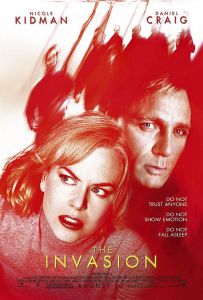 The fourth remake of The Invasion of the Body Snatchers is a more interesting behind-the-scenes story than as a film. German director Oliver Hirschbiegel (Downfall) created a movie that was described as more psychological thriller than action chase movie. The studio and producers scrapped many pieces of the film, hired the Wachowski brothers to rewrite portions of the story and cram in some action, and then James McTeigue (V for Vendetta) directed the reshoots. As a result, the movie is wildly displaced and hacked together and never feels whole. There’s a slow burn of intrigue and mob madness and paranoia that gives way to chase scenes, car wrecks, and a ridiculously contrived happy ending. I’m sorry, but when you do The Invasion of the Body Snatchers, you cannot have humanity win; that destroys the entire point of the story. It’s like having King Kong climb the Empire State Building and deciding to live there and dance for peanuts. Nicole Kidman and her lithe frame seem like an odd choice as humanity’s last hope with a gun. The Invasion flirts with some philosophical ideas about free will, assimilation, and the cost of peace, but then it speeds headfirst into an abrupt finish. This movie is unsatisfying to all parties.
Nate’s Grade: C
Share this:

Cloverfield (2008)
 I can think of no movie that has come out of virtually nowhere to build tremendous hype like Cloverfield. Before the summer of 2007 this movie didn’t appear on anyone’s radar whatsoever, and then came a teaser trailer before Transformers. The tease was nothing but party footage of well-wishers when, all of a sudden, explosions are in the distance, people are fleeing, and the Statue of Liberty’s severed head rolls to a stop in a street. Bam. Release date. Nothing else, not even a title. All of a sudden the world had an insatiable appetite for everything Cloverfield. Mega-producer J.J. Abrams had done it again. In one fell swoop he took control of geek nation. I never expected Cloverfield to live up to the massive hype, but this modern monster movie delivers more bangs than whimpers.
The first twenty minutes of the film introduce us to our cadre of yuppy characters. Rob Hawkins (Michael Stahl-David) is leaving for Japan to take a business promotion. His friends throw him a surprise going away party to celebrate and wish him the best. Rob’s brother Jason (Mike Vogel) and his girlfriend, Lily (Jessica Lucas), start videotaping the party. Jason hands off the taping duties to Hud (T.J. Miller) who, thankfully, has a much steadier hand. Hud walks around the party gathering interviews and he zeroes in on Marlena (Lizzy Caplan), a gal he’s been nursing a crush on. Rob is nervous to see if Beth (Odette Yustman) will come to the party. Beth and Rob are long-standing friends that took the plunge and had sex a couple weeks prior. Now Rob is hoping for something more but Beth isn’t on the same page; she brings a date to the party. Interrupting all this twenty-something relationship drama is a giant monster attacking New York City and dropping little baby monsters to scurry the streets and feed.
 While not entirely unique, Cloverfield is certainly a reinvention of the dormant monster movie. By seeing its gimmick through to the very end, the film gives a perspective rarely seen in movies that involve cataclysmic disasters. Usually films that involve space aliens, monsters, or some form of incredible destruction follow the people in power, the Army generals, the politicians, the President of the United States as he solemnly looks out his office window and says “God help us,” under his presidential breath. Cloverfield, however, eschews all of that. This movie is all about people caught on the peripheral of a disaster and just trying to survive. They have no idea what’s happening, they have no idea when they will be in danger, they have no idea where to go, they have no idea how long they have, and they definitely have no idea what it is that’s obliterating the city. The film dares to place us in the shoes of ordinary civilians as they document the fantastic. The “found footage” concept and the ordinary perspective are interesting though some will quibble that staying inside one point of view is too limiting for the scale of Cloverfield. This film is more than The Blair Witch Project meets Godzilla; this movie is a collective manifestation of the nation’s 9/11 anxieties. Cloverfield is the first 9/11 disaster movie. The shock and confusion of the situation take on even more resonance by triggering some of the same emotions many experienced on that fateful day in 2001. And yet Cloverfield doesn’t feel exploitative or disrespectful as it draws upon our 9/11 memories and fears, which is saying something substantial about the filmmakers’ skill and the remarkable healing power of time. Some images are unmistakable, like a white cloud of dust that blows through the city and also helps to shroud the monster. People scamper around the city yelling for some kind of explanation when some character, offhandedly, says, “Do you think it’s another terrorist attack?”
The film is also got some fabulously frightening moments that are not related to 9/11 anxiety. Cloverfield is a great, old school horror movie on top of a subversive social experiment. Talented writer Drew Goddard has had experience building tension on some of TV’s finest shows, like Buffy, Angel, and Lost. Now with his debut screenplay, Goddard cranks up the suspense and creepiness to maximum effect. Part of the horror is trying to find meaning in the madness but another equally enjoyable part is walking into perfectly executed classic horror moments. You will be on edge about what could possibly be around a corner. Our band of survivors decide to walk through the subway tunnels and discover that Hud’s camcorder has night vision; sure enough, you are waiting with baited breath for the second that night vision is shifted on and something pops out in view. There’s a distinct difference between cheap jump scares and spooks that, as I say, earn their boo. This tunnel scare is catapulted to frightening from the ominous buildup that comes from seeing hundreds of rats running away. When I saw the fleeing rats, I knew something very bad was coming from behind. The structure is clever as Goddard gives us back-story on Beth and Rob via the original footage of them canoodling that cuts in here and there. Goddard earns his stripes with a script swiftly paced, filled with genuine scares, and smart enough to keep an audience laughing with gallows humor at key moments (“Okay, so our options are… die here, die in the tunnels, or die in the streets.”).
 You the viewer are in the middle of the action with this film and there’s no getting out, no distancing yourself from the chaos, no watching men in lab coats and military uniforms dissect the situation over large boards. The gimmick of Cloverfield is flawlessly executed thanks to director Matt Reeves, who spectacularly resurfaces from movie jail after writing duds like The Pallbearer and Under Siege 2: Dark Territory. Reeves explores some dark territory of his own but never breaks the tenuous tone needed for the movie to succeed. The movie is constructed with many long takes and it never exposes its secrets. I watched spellbound by the artistry of maintaining the illusion from beginning to end. Watching the Brooklyn bridge collapse from the inside is exciting and terrifyingly real. Reeves and Goddard smartly decide not to show their monster for as long as possible. Catching glimpses of a shadow or the flash of a tentacle-like appendage are enough to register goose bumps; the human imagination will always be more capable of engineering horror. Eventually the film does give its monster the proverbial close-up and the giant, skyscraper-sized beast looks a little familiar in design (think Vin Diesel sci-fi movie).
Cloverfield is a well-executed genre movie with a clever concept that is fully realized. The constantly bouncing and roving handheld camera might make an audience queasy, but the perspective of the end of New York City as brought to you via YouTube is stimulating and a comment on our self-absorbed culture. The film works as a finely tuned fright film elevated by its stylistic concept and the filmmaking skill to pull it off. Cloverfield being “found footage” and evidence from the Department of Defense doesn’t exactly bode well for the characters onscreen, and the film dispatches them with cool malice. No one is safe and no one can stop what’s coming. If that doesn’t sound like the perfect summation of 9/11 fears, then I don’t know what else is.
Nate’s Grade: B+
Share this:

Transformers (2007)
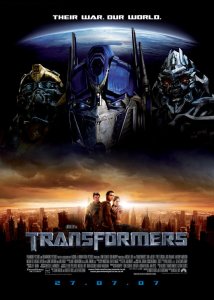 Once again Hollywood is quick to prove that if any television show emits some level of nostalgia, or merchandising potential, it is only a matter of time before it finds itself reconfigured as a big screen blockbuster movie. In all honesty, I was never a huge Transformers fan; I was more into Ghostbusters and then transitioned into Teenage Mutant Ninja Turtles. It may be sacrilegious, but I thought the knockoff cartoon/action figures, The Go Bots, were just as good. Steven Spielberg and critically derided director Michael Bay (Bad Boys II, Armageddon) have teamed up to bring the world a lengthy and noisy Transformers feature film. I can’t wait for the Go Bots to get their own equally pricey close-up.
Sam Witwicky (Shia LaBeouf) is your typical teenager obsessed with getting his own car. He can only afford an old Camaro at a used car lot, and his dreams of impressing the hot girl in school (Megan Fox). But Sam’s car isn’t just any old busted jalopy, no sir, it is really a robot in disguise from another planet. Sam’s car, codenamed Bumblebee, is apart of a robotic race known as the Autobots, led by their leader Optimus Prime (Peter Cullen returning to voice with gravitas). They can transform into vehicles that they scan with their optical sights. The Autobots are trying to save the planet from their evil counterparts, the Decepticons, who have already infiltrated our world in search of their fallen leader, Megatron. It seems Sam holds the key to the survival of Earth. His great grandfather was an Arctic explorer and happened upon the frozen sight of Megatron. He left behind an artifact that reveals the location of the chilled robot as well as a source of unparalleled power known as the Allspark. Needless to say, the military and the Secretary of Defense (John Voight) are a little aghast at how their weapons stack up to big bad robots.
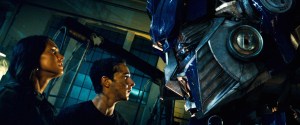 Michael Bay was born to direct a live-action, ultra expensive Transformers movie. The testosterone is through the roof and the film worships everything shiny, fast, and automotive. This is the kind of movie that fits exactly into the artistic parameters of Bay. The film is one gorgeous product placement orgy that is all about the eye candy; the cars are hot and desirable, the car chases are cool, the explosions are a lovely shade of orange, and Megan Fox is quite hot and desirable too (engaged to a 90210 actor? Why oh why, Megan?). The special effects are downright flawless and the action sequences are enormous. The scale of destruction is, like most aspects of Transformers, cranked to such a high degree that summer satisfaction can only ensue. Everything is bigger in Michael Bay world. Transformers is Bay’s best movie so far and it delivers the goods when it comes to hyper-kinetic action and plenty of thrills.
While the movie runs on silliness it also keeps its wits about it and delivers solid and exciting action with a breathless pace. What really surprised me about Transformers is how much humor they squeezed into 143 minutes of loud and hyper bombast. Screenwriters Alex Kurtzman and Roberto Orci (The Island, Mission: Impossible 3) have a great economy to their storytelling. They also have created a wacky teen comedy that just so happens to also be inhabited by giant robots. Much of the first hour is spent with Sam and his attempts to look cool with his new ride and impress the pretty girl. Sam is hocking his family wares on eBay and the Decepticons are on the hunt for… LadiesMan217. There’s a lengthy sequence where five Autobots have to duck and hide outside Sam’s house so he doesn’t get in trouble with his parents. Ma and Pa Witwicky look out the windows, and the robots dodge getting caught, and it’s like a classic bumbling slapstick comedy. A good action movie can become a great one when aided by well-timed humor, and Transformers has so many quips, sight gags, and goofy sidesteps (“Mountain Dew machine must destroy all humans!”) that is could be considered the most expensive comedy of all time (take a seat, Evan Almighty).
 There is, however, a price to be paid for all this comedy and that is that no one acts with any true sense of awe. They are witness to large walking and talking monsters of metal that are out to enslave the planet – there has got to be some wonder there, but the film doesn’t treat anything seriously. Its jokey nature keeps the film from being anything more than disposable, throwaway entertainment. I mean, I find it difficult to take any movie seriously that features a robot “relieve” itself on John Turturro.
Shia LaBeouf (Disturbia) carries the film on his sturdy shoulders. The shape of Transformers has more to do with his horny, smart allecky character than the robots that fight. Normally the only thing required in an effects-heavy action flick are some fast legs and a healthy set of lungs, but LeBeouf has charisma to spare. He has a young Tom Hanks everyman feel to him. The greatest compliment I can give him is that he is the most memorable figure in a movie with big brawling robots. Fox is pretty easy on the eyes. Voight is adept at playing government figures in times of national peril. If you need a guy to stare at something massive, or formative, or formatively massive, and utter, “My God,” then Voight is your man. Kevin Dunn and Julie White provide nice comic additions as Sam’s mother and father.
Transformers may be a perfect slice of summer thrills, but unlike its titular gigantic robots, it’s little more than meets the eye. The movie loses steam whenever it deters from its main story involving Sam. I understand that the filmmakers were trying to widen their story scope, but nothing is gained by the inclusion of such useless characters like the overweight super computer hacker who lives at home with his mom. There’s an elite team of national security analysts and they all happen to be scruffy multi-cultural hippies. We have a blond Aussie (with a nose ring, oh so rebellious) who discovers the Decepticon signal and then, well, she sits in a room for a long while and then mostly sits on her hands during the climax. The opening follows a band of soldiers in the Middle East (which the film reminds us is where Qatar is, because apparently it does not feel that your core Transformers fan has a basic grip on geography) who also must reach the bigwigs in Washington with important info on these killer robots. These dangling storylines could be lost and little momentum would be lost. None of these extra characters are given a lot of attention. Most of them will vanish for long stretches so that when they do reappear you’re reminded how much you did not miss their absence. You’re going to need stock roles, like military men and tech geeks, but Transformers has cast its lot with the simple story of a boy’s first car and his unyielding teenage hormones. Transformers could use a good pruning for balance.
 The robust action sequences are somewhat hampered by the typical Michael Bay ADD edits, but what really hurts the action sequences are the robots themselves. The original Transformers were designed smoothly, because in all reality they were animated toys and needed to function for kids. These 21st century Transformers have parts all over the place. There are gears and wheels and who knows what sticking out everywhere. They look far too cluttered, like a little kid’s art project where he keeps slathering on more junk. As a result of this robo design, when it comes to action you may not have a clue what’s actually happening. When the big robots wrestle you’ll be left trying to piece together in your mind which part is the robot mouth, the robot head, the robot fists/claws/drill/whatever. I suppose in a way this kind of demanding user activity is similar to watching scrambled porn; both involve trying to dissect the image into something workable and, thusly, satisfying to the senses. That’s right, I compared Transformers to scrambled porn, which is also quite more than meets the eye.
Obviously, with a film about powerful robots from space, there is going to be a stopgap of logic. If you can accept interstellar robots that arrived from a robotic planet, oh and by the way, they learned English from the Internet (it’s a wonder they speak in full sentences), then you should be able to shrug off any other shortfalls in logic. Transformers was never too deep a subject to being with; every episode of the cartoon revolved around the Autobots and the Decepticons battling over new energon cubes, and that was all the plot needed for a show about robots that fight.
There could be 20 minutes sliced out. Lots of ancillary characters are just dropped. There may be too much humor. The climax is way too long. The dialogue is corny. And yet with all its flaws considered, Transformers is an exhilarating entry into the world of summer smashups and blown eardrums. Michael Bay may never stretch his creative wings with a Victorian costume drama, but the man does what he does well. Transformers is a perfect match for Bay’s noisy and boisterous sense of action and his love of things fast and expensive. There isn’t much below the surface when it comes to Transformers, but it’s such a fun and exciting popcorn movie that it’s hard to argue with the results.
Nate’s Grade: B
Share this:

Superman Returns (2006)
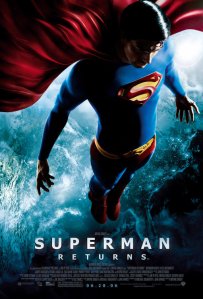 It’s been a total of 19 years since we saw Superman grace the silver screen in the mega-bomb Superman IV: The Quest for Peace. The big question is… did we miss him at all? I know a lot of people that say they just can?t get into Superman as a character. He’s always been a do-gooder, someone with infinite power but too great a sense of nobility to abuse it. Does the Man of Steel still hold relevancy in today’s more erratic, cynical, fearful world? Is it possible to make an indestructible alien relatable or empathetic? Director Bryan Singer is interested in finding out, and he brought nearly his whole X-Men 2 team with him. Instead of retooling the franchise Singer has adopted the idea of starting shortly after the events of 1980’s Superman II. (Yes, I know Richard Lester is credited with directing Superman II but it’s still contentious that Richard Donner, who helmed the first super outing, directed a majority of the sequel. From here on out, Donner will cited as the director of Superman and Superman II).
Superman (Brandon Routh) has been absent for five years trying to look for pieces of his home world, Krypton. Lex Luthor (Kevin Spacey) and his moll (a cheerfully batty Parker Posey) have got some big plans up their villainous sleeves. Using crystals from Superman’s home world, they plan on building a new continent of land to prosper with. He also has a nice supply of kryptonite to make his own fortress with. When Clark Kent does arrive back in town, coincidentally along the same time Superman rescues Lois Lane (Kate Bosworth) in a plane crash, he’s shaken by the changes that have taken place in his absence. Lois is engaged to Richard (James Marsden), nephew of The Daily Planet‘s editor in chief, Perry White (Frank Langella). She’s also won a Pulitzer Prize for her article, “Why the World Doesn’t Need Superman” (a kiss-off letter to a lover if ever there was one). To top it all off she also has a five-year-old son, which would put him within the realm of having a super dad (Lois and Supes took a roll in the hay at the Fortress of Solitude in Superman II). The Man of Steel has a lot on his plate, obviously.
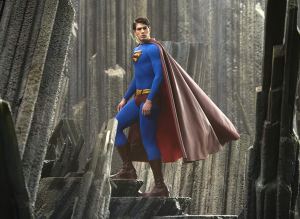 This is rumored to be the most expensive movie of all time, with budget predictions going as high as $260 million. If that?s true than Singer let’s you see every dollar onscreen. As a movie going experience, Superman Returns has little to no equals. The special effects are astounding and the imagery is simultaneously iconic and awe-inspiring. We now exist in a world where we can see a man in a red cape zoom through the sky and have it become believable. Singer, after two X-Men flicks, has a terrific eye for glistening visuals and boy does he know how to conduct Hollywood bombast with equal parts genuine character. His loss was considerably noticeable with X-Men 3, which wilts in direct comparison as unfair as it may be (it’s like the difference between a Van Gogh and a third grader’s imitation of a Van Gogh). The difference is that you can feel the respect the filmmakers had for superman; not so much with X-Men 3. But alas my countrymen, I come here to praise Superman not to bury X-Men 3. The sheer breathtaking visual artistry of Superman Returns demands to be seen on as big a screen as possible. Singer has crafted a wonderful tableau for the eyes and ears, filled with religious symbolism, opening the wonderful possibility of the movies just a little wider.
Singer’s film is a show-stopping pop spectacle, which is good, because the story itself, upon fresh perspective and distance, is good, but not great. The story doesn?t pursue character as strongly as last year?s fellow franchise reboot, Batman Begins, nor does it interlace themes as well. The characters in general are pained but left with little other expressions. Lex Luthor’s evil scheme is grand in cataclysmic scope but at the end of the day it’s still a real estate scam. It’s like if Donald Trump was human or less evil (he’s definitely got the same hair stylist as Luthor). How exactly is Luthor planning on keeping control of a new continent of land? I would think the world would have some way of establishing order. Once again a villain’s scheme is ruined by the less dastardly, more squeamish baddie in the entourage. In fact, the villains are on their own for a long while, embarking on their own tangential movie to play alongside the return of superman. The first hour is slower paced and the final climax could have used an additional boost, but these are quibbles. Superman Returns could have done a lot more with their characters, especially considering their take-off point is two films hence, but this movie is more about reassembling the pieces. To that end, Singer’s satisfying retread is forgivable for its shrift characterization.
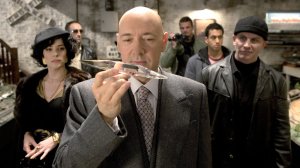 Do not let any misgivings about character and story betray how awesomely entertaining Superman Returns is when it turns on the magic. Even at a bladder-unfriendly 2 hours and 40 minutes in length, the film has little drag and a great sense of confidence of a crowd pleaser that knows how to play to an audience while respecting their intelligence. The movie is self-indulgent (how many slow-mo shots do we need of Superman in the air?) but it never falls short on thrills. Between plane crashes, bank robberies, sudden explosions, and spontaneous, cavernous land masses, you’ll likely be glued to your seat waiting for the outcome, which even with a nigh indestructible being isn’t always a given.
The action is grand in scale but Superman Returns also has the unmistakable stripes of a chick flick. Lois is jilted, moves on to a good man, and suddenly the man of her dreams, the one she thought was gone for good, reenters her life. The film’s sharpest plot point is the complication of its love triangle with Richard and a child in tow. The romantic yearning and interplay give the film its biggest emotional involvement. Even though the filmmakers are deliberately vague, the answer of who’s the father should be rather easy to deduce. Still, the audience has an increasing desire to know the paternal truth.
Singer’s louder, brighter Superman is a loving tribute to the Richard Donner Superman films, you know, before Richard Pryor, evil twins, and the rather rash, though very effective, decision of hurling the world’s supply of nuclear weapons into the sun (the less said about The Quest for Peace the better). It even exists in the same universe so we don’t have to go the origin tale route, though we do get flashbacks to Clark’s past. Marlon Brando’s original performance as Jor-El, father of Superman, is reused and John Williams’ theme gets a new polish. Even the opening title graphics, so horribly dated like a “cutting-edge” Atari game, are the same from the Donner era. There’s such reverence for nostalgia and a fondness for what makes Supes Superman, and that’s why it gets closer than even the Donner flicks, which are good but have weathered with age and can come across as too silly or cheesy.
Even Routh looks uncannily like Chistopher Reeve. Routh is an interesting choice; he’s chiseled, handsome, and questionably appealing. He comes across more like a being finding his place, like a kid fresh out of college, than a being of incalculable power protecting our blue planet. At any rate, Reeve played the comedy better, being both suave hero and clumsy earthling. I wish Superman Returns would go further exploring the perils and expectations of being Superman, a life devoted to servitude and always being an outsider. There’s a small scene where he orbits the Earth listening to 1000 overlapping voices crying for help before zeroing in on one. Otherwise, the movie doesn’t pay much notice to the burdens of Superman, which may unfortunately keep many at a distance.
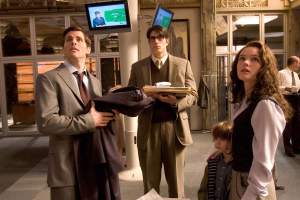 Bosworth is just too young for her role; she resembles Lois Lane’s baby sister, not the feisty Margot Kidder incarnation that left such an impression. This Lois Lane doesn’t so much bicker as she does harrumph. It’s like they took the role, dolled her up, muted her, and then told her to play Lois Lane as if she had stayed up all night binging on Sex and the City reruns. Bosworth is at the mercy of her character, a figure pressed into danger more than she is into emotion. There are some nice moments, like a midnight stroll through the atmosphere with her knight in blue tights. I just wish there were more.
But at least there’s two-time Oscar winner Spacey, who’s terrific as the infamous Lex Luthor. He’s got a funny quirkiness and a perfectly deadpan sarcasm. The opening that reveals how Luther earns back a sizeable fortune is hilarious and perfect to a T. Everyone else seems a bit dour but Spacey is having a ball; he’s even employed Kumar as part of his muscle (you’re a long way from White Castle, Kumar). However, Spacey’s spirited take is a lot more menacing than Gene Hackman’s version, which always came across as an oily used car salesman, more huckster than arch villain/evil genius. Spacey has a really strong disdain for the Man of Steel and his eyes sparkle at the opportunity to get vicious. I’m all for a darker, angrier, down-and-dirty villain to better torment Superman. Not to be out done, used car salesmen have their moments of intimidation.
The story may be good, not great, but Superman Returns is a first-rate cinematic spectacle. Singer and his X-Men 2 team have crafted a nostalgic, reverent movie that smartly addresses whether today’s world has outgrown a big blue Boy Scout. The action sequences and special effects are astounding, and, for the first time in a Superman movie, they are wholly believable. This helps when the main guy wears his underwear on the outside and shoots lasers from his bullet-proof eyeballs. The film stalls when it comes to characterization and the interplay of strong unified themes, but much is forgivable because Singer has worked his ass off getting a storied franchise back on its feet with dignity.
After three super hero films in a row, each with an escalating budget and running time, I’d say the man needs a break, perhaps a tiny independent movie to rejuvenate the batteries. But after watching Superman Returns, what I really want is for Singer to get right back to work as fast as possible. We’ve got this world back in order. Now it’s time for Superman to truly take flight.
Nate’s Grade: B+


You must be logged in to post a comment.