Blog Archives
Apollo 18 (2011)
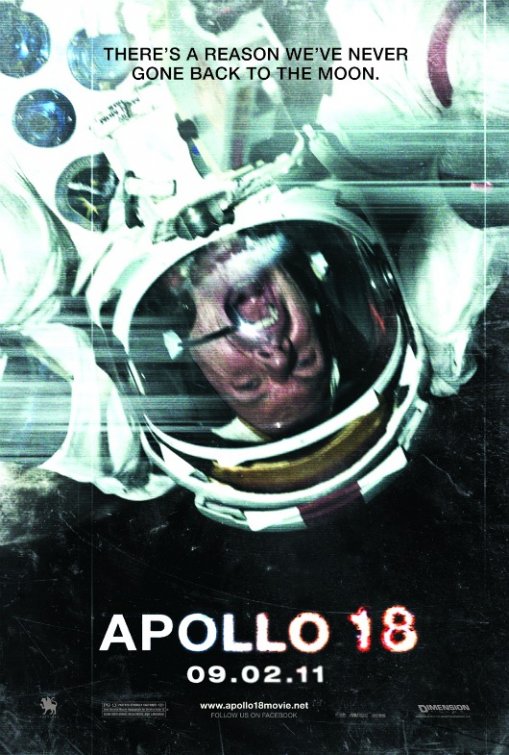 Apollo 18 is the latest in a swelling subcategory of films known as “found footage,” movies that purport to be discovered documents and aesthetically adhere to this premise. That means lots of handheld camerawork, selective editing, and other efforts meant to convey that what the audience is watching is not a movie made by professionals. It’s a professional attempt to look unpolished and amateurish, which is like having a four-star chef make you Taco Bell. 1999’s The Blair Witch Project popularized the found footage concept, and to this day there are still people today hoodwinked into believing it as unvarnished reality. Maybe that’s why NASA issued an actual press statement this week wishing to inform the general public that Apollo 18 is a work of fiction. I don’t think they have much to worry, because very few people will be seeing Apollo 18 and even fewer will enjoy it.
Apollo 18 concerns the failed secret mission of three astronauts (Warren Christie, Lloyd Owen, Ryan Robbins). The astronauts were sent to the moon for the Department of Defense, which means this is the second film of the year to concern a covert reason for landing on the moon. The two astronauts who actually land of the moon’s surface discover a dead Cosmonaut and some strange occurrences. They realize that they have been lied to by their own government and placed in a danger that few can comprehend.
But an intriguing premise can only get you so far and Apollo 18’s clumsy execution makes the movie disintegrate upon reentry, or, any critical thought. A secret NASA mission that went horribly wrong sounds like a great start to a conspiracy thriller, that is until you realize all you’re being presented with is the fake found footage. That means that we spend an eternity watching guys in suits float around, biding their time. Then they go outside and wander around the lunar surface. Then they hear an occasional noise. Or did they? Then they go back to floating around, to make up for the lost time they weren’t floating around. Really, this movie is an hour of nothing. It fails to create a sustainable atmosphere of dread or even basic curiosity. But when locked into the found footage concept, we are generally left with a lot of time on our hands. You would think that the basic premise that people have reassembled this footage would lead to cutting a lot of the filler and just getting to the good parts. It seems almost resentful that this hypothetical editor trying to showcase a long-buried truth would decide that the important stuff can wait. I was so thoroughly bored with Apollo 18 that I started counting stars.
 The structure of the story is just too insular and limited in scope. I strongly feel that Apollo 18 would have benefited greatly by opening up its storytelling parameters. It could have kept the found footage motif, but instead of being an entire 90-minute movie the found footage would be one component of a wider faux documentary. Interviews with science experts, conspiracy theorists, former NASA employees speaking under the protection of anonymity, and even family members, particularly the now grown-up son of one of the astronauts holding out hope, would add some balance. It would make the story feel larger and more authentic, let alone give the audience something new to watch. There could have been a parallel story of the discovery of this evidence, the process of getting it authenticated, and the potential dangers that would be exposed. It all seems a little too slapdash and simplistic to just say the footage was uploaded to a website. Anything, really, is what I’m looking for to broaden Apollo 18. There’s so much more that could have been added, but alas we’re stuck with three blander-than-bland, interchangeable characters collecting moon rocks and battling interstellar cabin fever.
Now I’m about to enter into the orbit of some serious spoilers concerning the ending to Apollo 18, so skip to the next paragraph if you wish to remain pure. The entire premise of this mission gone wrong (why did NASA create Apollo 18 uniform patches for a secret mission? It seems counterintuitive to create merchandise for something meant to be covert) is that there is something on the moon that the higher-ups in government want to investigate. This dangerous mystery claimed the life of a Russian cosmonaut, whose body is discovered by our American squad. When exactly the Russians put a man on the moon is never explained; yet another ingredient that would have worked better as a faux documentary. So you have one dead man on the moon, but soon the body count rises. It’s not some strange cosmic virus that infects the astronauts, leading them to psychotic episodes and murder. No, that would have been too plausible. You see, the villain of Apollo 18 is the moon rock. The rocks themselves somehow can transform into spider-like creatures that like to scurry around. Never mind the fact that we’re dealing with life that evolved in an environment without any atmosphere, but what have these moon rocks been doing for billions of years? It seems to me that after Neil Armstrong stepped onto the moon, the rocks must have been like, “There goes the neighborhood.” After twelve moon walkers, my only explanation for the motivation behind these killer rocks is that they just got sick and tired of being disturbed so often (“You stomp around like you own the place, you leave your trash behind, that’s it!”). A post-script tells us that these moon rocks were brought home and sent as “gifts” (their emphasis, not mine) to leaders and dignitaries of foreign countries. What are the implications with this? That the United States has kept its place atop the world because of the threat of moon rocks? Do the moon rocks even work on a planet with a vastly different climate than the arid moon? For that matter, since Apollo 18’s mission ended circling the moon, how the hell was any of the film footage retrieved? It wasn’t broadcast, so how did NASA or any truth-seeker come a hold of this damning evidence of killer lunar rocks? And to think we once thought that the moon was made of cheese. Oh how naïve we all were.
Apollo 18 is probably the most boring of all the found footage horror movies thus far. It does nothing to justify being 90-minutes, lacks any minor thrills or chills, and seems creatively stagnate. There are some cheap jolts, including having a character awake from a dream screaming twice. This Paranormal-Activity-on-the-moon fails to live up to the possibilities of its intriguing premise, instead settling for something aiming for slow-burn but achieves no-burn. The laughable conclusion is meant as a payoff but only for the nuttiest of geologists. Apollo 18 sticks with its core limited concept to the bitter end. This is a disappointment from all angles. It fails to scare, it fails to stimulate, and it fails to entertain big time. In space, no one can hear your boredom.
Nate’s Grade: C-
Share this:

Transformers: Dark of the Moon (2011)

After the obnoxious, oafish mess that was 2009’s Transformers: Revenge of the Fallen, a sequel that took everything good from the first flick and undermined it and took everything awful and magnified it, I wasn’t expecting much. True, low expectations have benefited this franchise built upon merchandizing, product placement, and giant freaking robots that fight. I still remain a fan of the first film back in 2007, and I do feel like director Michael Bay (Bad Boys, Armegeddon) is a natural fit for this material. But after another overlong, overblown, and overloaded Transformers film, I’m starting to think that the franchise’s best days left with Megan Fox and her cut-off jean shorts.
Sam Witwicky (Shia LaBeouf) has graduated from college and is now perusing a job in Washington D.C.’s vast center of government contracts. He’s living with his new girlfriend, Carly (Rose Huntington-Whiteley), the assistant to a rich billionaire (Patrick Dempsey) and his fleet of collector cars. Sam gets a job with at a military private contractor run by a angry loon (John Malkovich). But Sam’s post-collegiate journey once again runs afoul with killer alien robots. The villainous Decepticons are plotting to steal a spaceship that crash-landed on the dark side of Earth’s moon. Inside that spaceship are teleporter orbs and a sleeping robotic giant known as Sentinel Prime (voiced by Leonard Nimoy, hooray). Optimus Prime, leader of the noble Autobots, revives his predecessor. Together, the group attempts to thwart the Decepicons, lead once again by Megatron (voiced by Hugo Weaving).
The Transformers films have been getting larger and larger in scope and destructive power; the first film messed up some L.A. streets, the awful second film trashed Egyptian pyramids (only Six Wonders of the World left in your punch card, Bay), and now the third film pretty much obliterates downtown Chicago in stunning and overblown fashion. The climactic Windy City beatdown lasts a solid 50 minutes and may just be the greatest thing Bay has ever put onscreen, which admittedly might be faint praise to many. Perhaps the city of Chicago thought this would make for good tourism: ”Hey kids, come see the buildings that were turned to rubble in your favorite summer movie!” The impressive special effects are uniformly terrific, and the integration of reality and fantasy seems seamless. That goes without saying. I must credit Bay for creating sustainable action that is, here it goes, actually coherent. I know that “Bay” and “coherency” rarely go together, so I’m as shocked as everyone. No longer does geography become a hindrance to understanding. During this climactic Chicago onslaught, the locations are established, the objectives are clear, and the audience has a crisp understanding of the different teams, their paths, and their organic roadblocks and setbacks.
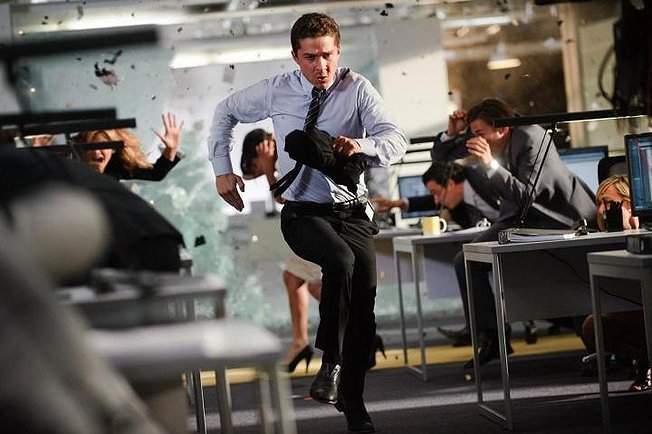 There’s a strong set piece within this 50-minute assault where Sam and company enter into a crumbling skyscraper that then teeters on its side. The organic complications allow for some nifty, almost ingenious, split-decisions utilizing a specific location, the hallmark of good action sequences. One moment they’re climbing up the floors, the next moment they’re tumbling through the floors, then sliding down the sheer glass wall, then firing at the glass to fall back inside and tumble some more. All the while a giant worm-like robot is churning through the foundation of this collapsing building. The scale of the sequence is quite thrilling for the time being. And yes, the 9/11 imagery is undeniable and relatively unearned without even a nod to solemnity or anything less than brainless summer spectacle. Sure the “cool-ness” of the individual parts never really materializes into something greater, and yeah maybe the action would have more impact if you actually felt for the characters, or knew who some of them even were, but you take what you can get in Michael Bay world. The extended climax for Transformers: Dark of the Moon is relentless and will beat you into submission, admiring the intrinsic beauty unique to Bay’s epic, albeit mind-numbing, demolition of the senses.
But Dark of the Moon is also the most visually coherent of Bay’s troika of Transformers flicks because the man has finally settled down when it comes to editing. Now no one will confuse this movie for Rope or Russian Ark (look it up, Transformers geeks), but the edit/panic button is given a slight reprieve. The shots last longer; the editing is far less frenetic and chaotically ADD-addled, and no longer does a Transformers action sequence look like jumbled, mechanical scrambled porn. Image A and Image B make a logical connection, at long last. You can tell which robot is which, for the most part. Perhaps this editing epiphany was a result of Bay’s corporate betters insisting that the film be shot in 3D (I chose to see the film in good old boring 2D, feeling that 150-minutes of Michael Bay with headache-inducing glasses was not worth the extra dough). Perhaps Bay had to consciously think about his audience’s well being so his shot selections lasted longer than his usual whirlwind of cuts. Perhaps the secret was loading Bay with cameras that weigh the same as couches. Maybe a little extra weight was all the man needed to formulate lucid action sequences.
And yet Dark of the Moon is just as stupid, outlandish, and tonally disjointed as the other movies, particularly the abysmal Revenge of the Fallen. The comedy remains at a puerile, sophomoric level. Bay’s sensibilities have always somewhat mirrored that of a snickering 14-year-old boy; the love of destruction, the fascination with things that go “boom,” the ogling of lithe feminine bodies. No joke, the first image seen directly after the film’s title is a close-up of Huntington-Whiteley’s ass ascending a staircase. I imagine there were plenty of men spasming in their 3D glasses trying to reach out and grab the circumference of a Victoria Secret model’s talents. I wrote about the second film: “Women don’t seem to exist in the Michael Bay world, only parts and pieces of women.” Huntington-Whiteley’s character certainly leaves much to be desired, outside aesthetics. At least Megan Fox’s character had, you know, some character traits. I also wrote: “Amazingly enough, [Fox] manages to lose more clothes the more she runs in slow-mo, allowing the male audience members to follow the nuance of her bouncing breasts. She’s clearly not the next Meryl Streep but this girl deserves more than being wordless arm candy.” Seems apt to me. Carly is as bland as she is blank-eyed beautiful, just the way Bay likes ‘em.
The first 90 minutes of the film is spent with the humans and it’s like being trapped inside a bad comedy. There has always been a strong comedic bent to the franchise ever since the first film in 2007; however, the latter films have taken to grotesque caricature. In Dark of the Moon, the comedy is so deeply unfunny but so consistently antic, trying to overwhelm you with its bad taste. There’s a scene where Ken Jeong (yes, you read that right) corners Sam in a bathroom stall to distribute his crackpot manifesto. Then Sam’s boss walks in and, oh boy, he overhears and thinks they’re having a homosexual liaison in the men’s stall. What a hoot. Then Sam’s mother gives him dating advice, stating there’s no earthly way her son is going to nab a third “hottie” unless her boy has a giant…. and trials off (wouldn’t a mother kind of have an idea about that subject?). And then there’s the little Autobots, the size of remote control cars (perfect presents for Christmas mom and dad), who wheel around spitting smart-alecky backtalk. The entire Malkovich portion could have easily been cut from the film without damaging a soul. The Ken Jeong stuff should have been eliminated first. There’s something to be said when John Turturro’s returning Agent Simmons is the least annoying comic sidekick in this movie. But hey, at least there aren’t any overt racist depictions and jokes about robot scrotums. Nope, there’s only infantile humor and nonchalant misogyny. The comedic pit stops and non-sequitors never allow the movie’s tone to gel.
 Before the movie descends into an all-out series of explosions and shrapnel, the setup actually has some genuine interest. Then it just all goes nuts at warp speed. The fact that the space race to the moon had a sinister ulterior motive, investigating alien technology, is an intriguing start. Bay even shoots the 1960s sequences like he’s ripping off Oliver Stone, swapping film stocks and black and white film to showcase his historical reinactors (three presidents get represented, including Obama). Apparently after this film and X-Men: First Class, the breakout star this summer is archived footage of JFK (man did he have a full plate, mutants and robots, and the man still found time to bang Marilyn Monroe). There’s even a cameo by the real Buzz Aldrin, which served to make me remember his better cameo on TV’s 30 Rock (“Would you like to yell at the moon with me?” he politely asked Tina Fey). The space race was a pretense for getting our human hands on some alien technology. Of course we were warned years ahead of time via Pink Floyd but nobody could put the pieces together. But there’s more alternative history to be had. Turns out that the disastrous nuclear accident at Chernobyl was caused by the Russians trying to operate alien/Transformer technology. I’m sure modern-day Ukrainians will adore having their deadly tragedy turned into a plot point in a stupid movie about fighting robots. The Decepticons wicked plan is to open a teleportation portal and bring their dead planet, Cybertron, to Earth. Then they will use Earth’s human population as slave labor to bring their dead planet back to life. My question is this: when you’re a huge robot the size of a building, wouldn’t puny little humans make for a terrible labor force with their stunted little legs and feeble muscles? I know there’s billions of them, but there’s a reason human beings have never turned on ants and forced them to become a labor force for our construction projects. How many more deadly things from Cybertron are secretly going to be hidden on Earth? And yet none of this is even one-tenth as stupid as Transformers’ heaven in Revenge of the Fallen.
Transformers: Dark of the Moon is likely everything fans would want from a franchise. There’s wanton destruction, a plethora of noisy explosions, and plenty of eye candy both in special effects wizardry and pouty, full-lipped women. But at a colossal 150-minute running time, this is a Transformers film that punishes as much as it entertains. There’s really no reason a movie about brawling robots should be this long. There’s no reason it should have to resort to so much dumb comedy. There’s no reason that the women should be fetishized as if they were another sleek line of sexy cars. There’s no reason why something labeled a “popcorn movie” can’t deliver escapist thrills and have a brain too. Dark of the Moon is saved by its long Chicago-set climax, which gives way to some staggering action set pieces. The newest Transformers movie is just as stupid as the rest (what the hell is up with the weird Igor robots tending to Megatron that just seem to grumble and grunt?) but, unlike the previous installment, it’s not offensively stupid. Dark of the Moon is an exhaustive experience whose thrilling high points even feel mechanical and pre-programmed. Is this the future of Hollywood? Bay and his army of robotics and excessive spectacle have taken over the world. When it comes to big-time summer entertainment, the machines of Hollywood are going nowhere fast and even louder.
Nate’s Grade: C+
Share this:

Green Lantern (2011)
 To quote that sage Kermit the Frog and his words of wisdom concerning Green Lantern: “It ain’t easy being green.”
Hal Jordan (Ryan Reynolds) is a cocky pilot working for his ex-girlfriend, Carol Ferris (Blake Lively). Hal never takes anything too seriously and seems to freeze up in moments, recalling his own father’s crash. Then one day a purple alien crash-lands on Earth and seeks a replacement. This alien belongs to the Lantern Corps, a group of intergalactic policemen for the universe. He was mortally wounded by Parallax, a creature that grows stronger on fear but looks like a big rain cloud. The alien’s ring chooses Jordan as the replacement. Next thing you know, the guy is training on the alien world Oa and meeting lantern officers from all over the universe led by Sinestro (Mark Strong). Jordan is unsure of his heroic destiny, though we are reminded many times “the ring does not make mistakes.” In the meantime, Hector Hammond (Peter Sarsgaard) is dissecting the dead purple alien and gets infected with the fear cloud/Parallax. He lashes out at his father (Tim Robbins), at Jordan, and signals to the giant evil rain cloud that Earth is an all-you-can-eat fear buffet ready for the binging.
For starters, he power is a bit silly and hard to explain. I fall in with the majority of the public when I say, “Green Lantern who?” So the guy’s super duper power is to channel his imagination into green-tinted reality? It’s a bit vague and hard to quantify. So when a helicopter is falling to earth, instead of, say, picking it up or steadying it, Jordan creates a green Hot Wheels racetrack for it to zoom around to a stop. When the evil rain cloud fires its energy projectile, Jordan conjures a catapult to catch the projectile and fire it back. And of course at some point he materializes a green gun to use in combat. I’m sorry but for me this just seems silly. It’s one thing to say, “His strength is the power of his imagination,” and I can see where young kids would gravitate to this stuff, but when it’s realized on the big screen is seems infantile. What are the rules here exactly? It just seems dumb. I can better accept a magic ring that allows Jordan to fly or shoot sparkly lasers. If a healthy imagination is key, then the rings should be choosing some of the world’s greatest living authors and artists. Can you imagine Charlie Kaufman (Being John Malkovich) with a lantern ring, or Neil Gaiman (Sandman)? Surely those guys would come up with something more interesting than catapults and racetracks. But you see, the rings, and the lantern world itself, runs on the power of will. Will power is their energy resource (talk about going green). The enemy, the cosmic rain cloud, runs on the power of fear, which is represented by yellow energy. What are the other colors of the rainbow? Is the power of love red? Is the power of envy a darker green? Is orange the color of hunger? Is brown the color of painful bowel movements? Is the power of apathy… forget it.
The biggest misstep is all the time the screenplay squanders on boring old Earth. Just like Thor, the alien worlds are the best part of the movie. But in Green Lantern, we see the training home world (Oa) and the thousands of weird, fun-looking aliens staffed to police the universe. We get a taste of the lantern life and the heavy responsibilities. We get a sense of the powers. And… then… Hal… quits. He up and quits. He says, after about five minutes of training, “You got the wrong guy,” and we head back to Earth. What the hell? We then get to spend the majority of Act II with this guy moping over whether he should or shouldn’t be a superhero. Memo to Hollywood: no one spends this kind of money on a movie where the main character can’t be bothered to accept being a hero with amazing super powers. I can’t be bothered with a hero who can’t be bothered. The screenplay structure should have been: Act I spent on Earth, Act II spent on Oa and in space, Act III return to Earth to save the day. Instead we get about ten minutes spent on Oa. And while I’m on the subject, whenever we see this alien planet it’s like a non-stop Green Lantern convention (does Oa host other conventions? Is next week the semi-annual gathering of amateur ornithologists?), so who is left policing the universe? I understand that a majority of the universe is empty space, but if the lanterns keep getting together for pep rallies on Oa, what’s to stop a universe full of criminals from stealing everybody’s car stereos? Also, lanterns intervene in the universe when evil is afoot, but nobody seemed to give a damn about planet Earth until we got lantern representation with Hal Jordan.
So the bad guy here is a semi-formless rain cloud with a head that sucks people’s fear. It feeds on fear. That is its energy source (get a job in the media, son). Like much else in the film, the rules concerning the villain are never fully explained. At times, this rain cloud thing seems invincible. Most of the time it’s never explained what exactly this thing could do. See, if you explain things then you box in your characters. So if you don’t establish rules for your villain, your heroes, their respective powers, the history of the universe, etc., then they are limitless. It also means that everything onscreen lacks any sort of logic, internal or otherwise. So the villain is really just a fuzzy concept of fear. Hal Jordan and the lanterns have nothing to fear but fear itself. That means that the screenplay falls prey to a plethora of hackneyed messages that feel ripped out of some Saturday morning cartoon series. Everyone feels fear. Accept your fear. Courage means rising above. It’s the same patter that’s been rehashed for hundreds of episodes of people in tights teaching schoolchildren it’s okay (take a drink every time a character utters the word “afraid” or “fear”). The simplistic moralizing on fear and courage made me yearn for a ring so that I could imagine a better villain. Lastly, there’s a scene where our dastardly cosmic rain cloud descends to Earth and starts sucking away people’s fear/energy/souls. There’s a shot of a school bus screeching to a halt and children dashing away. I imagine children’s fears are more heightened since their healthy imaginations and lack of world experience would exaggerate scary things that adults would try and simply deny. Their fear has to be like a delicacy. I guess what I’m getting at is, if I were a giant space cloud that fed on people’s fears, I’d go for the children first.
Director Martin Campbell has crafted some truly spellbinding, breathless action sequences in movies like Goldeneye and Casino Royale, but you can tell that he seems to be straining against the onslaught of computer effects. Campbell is more at home with the open world of practical effects and the tangible. Being confined to the realm of green screen and CGI seems like a shackle for this guy’s own imagination. He constructs solid action sequences, admittedly, but nothing worth bearing the name of Campbell. It’s a special effects bonanza without a hint of realism, like a computer start vomiting onto the screen. It feels weightless and formless, like a giant evil rain cloud. The film reportedly cost over $200 million, which is a high figure for a movie that spends so much freaking time on Earth! Here’s an example of a costly filmmaking expenditure – the suit. Hal Jordan has a skin-tight green suit that is complete a computer effect. That means that every second Reynolds is seen onscreen in his signature outfit, it’s another effect that people labored over for months. Why? I’m pretty sure that in this day and age we have the technology for clothing. Campbell succumbs to the limitations of the material and Green Lantern ends up feeling more like a TV pilot with a runaway budget than the beginning of an epic franchise for its parent company.
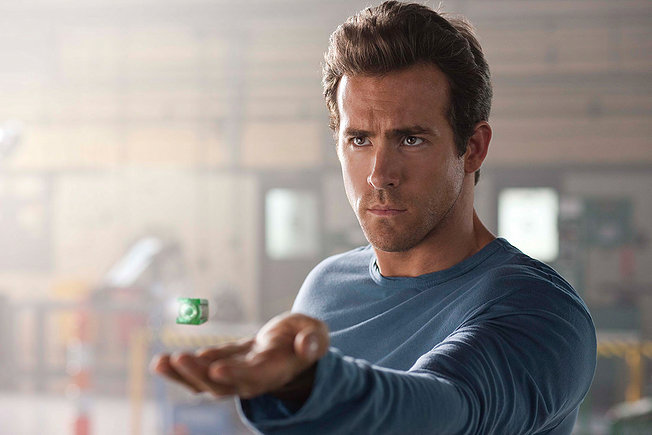 Reynolds (The Proposal) is an extremely likable actor whose biggest drawback is that he rarely seems serious, last year’s Buried a notable exception. He’s got this carefree attitude, practically bobbing his head and winking to the audience, and you like the guy even when he’s being a cad or a wimp. His character’s arc is supposed to be the guy who accepts responsibility, learns to accept and move beyond his fears, and it’s a character track that has been long journeyed and will continue to be. It makes for a simplistic hero’s journey storyline that seems to do the least work necessary to move things along. The movie did not fail on Reynolds’ shoulders; you can blame the four screenwriters and a ballooning budget for that one. Lively showed that she really could act in The Town. She shows no proof of this ability in Green Lantern. She speaks every line in a flat, monotone delivery, so much so you start to think she has like an inner-ear infection and can’t hear her own modulation. Her character is the weak love interest/damsel in distress role that regularly peoples these kinds of movies. Her monotone delivery does nothing for the lukewarm chemistry between her and Reynolds. Only Sarsgaard (An Education, Orphan) comes away mostly unscathed. His underwritten villainous character undergoes a monstrous transformation that would elicit sympathy from the Elephant Man.
Green Lantern is a movie that will thrill twelve-year-old boys and few others. It’s full of special effects, noise, and little clarity or wit. It’s not even a particularly fun movie. It repeatedly tells the audience things it should be showing, and it can’t help showing the audience character points (like Hal’s dead dad) that could have been handled with smoother nuance. The movie never feels like it can trust its audience for anything subtle. This is the kind of movie that needs to spell out everything. Green Lantern is muddled, tonally disjointed, the rules are not established, the villain is abstract, the messages are simplistic, the powers are ill-defined and also silly, the action is lackluster and overly dependent on often needless CGI, and the hero can’t even be bothered to accept his super powers. Apparently Green Lantern has about 60 years of comic history and a rich sci-fi universe, and this is the best four screenwriters could come up with? This is the best stuff they pulled from? Green Lantern is a movie that feels dimmed from start to finish.
Nate’s Grade: C
Share this:

Super 8 (2011)
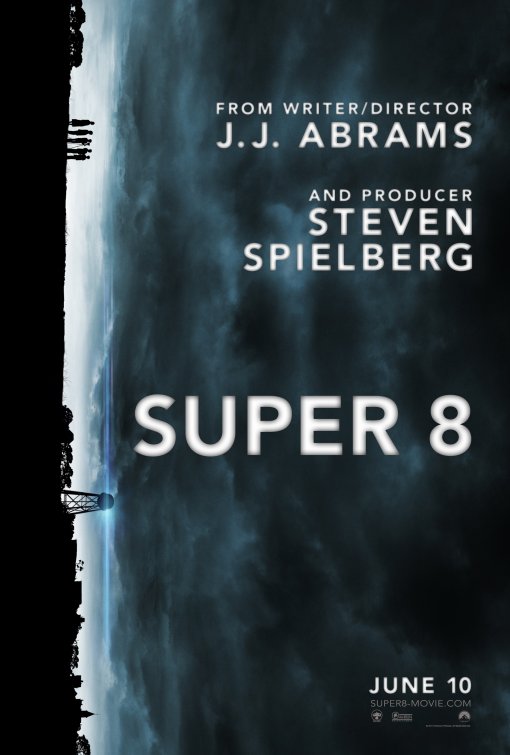 Super 8 is writer/director J.J. Abrams’ reverent homage to early Spielberg movies. For some, it will be too reverent to the point of being a slobbery love letter.
In 1979, a small Ohio town, 13-year-old Joe Lamb (Joel Courtney) is reeling from the death of his mother in a factory accident. His father, Jackson (Kyle Chandler), is a police officer who doesn’t know how to raise his boy. He even tries to convince his son to spend the summer at a baseball camp. “It’ll be good for you to spend some time with kids who don’t run around with cameras and monster makeup,” he says. That kid is Charles (Riley Griffiths), a self-possessed amateur filmmaker. Charles is writing and directing a short Super 8 film and all his friends are helping. Joe’s specialty is makeup, given his attention to delicately painting models. Being the makeup guy comes in handy when the gang invites the local pretty girl, Alice (Elle Fanning), to be in their movie. Joe gets to apply her zombie makeup. One night, the gang sneaks out to a train yard to film a scene in their movie. A U.S. Air Force cargo train is passing by and suddenly derails, in grand apocalyptic fashion. Strange things start happening all over town shortly after the train crash. Car motors and electrical equipment go missing, dogs run away to neighboring communities, and people start to go missing. The Air Force comes into town and takes charge. It seems that train was carrying something and that something has escaped.
What Super 8 does best is replicate a time, place, and mood. The movie is successfully awash in nostalgia, and that childhood nostalgia is the best aspect of an otherwise ordinary film. Abrams has fashioned the greatest film tribute to Spielberg in history. But its limited ambition makes it feel like the greatest cover band of all time. You’ve assembled al your talent and energy into replicating someone else’s original work. Congratulations, Super 8 is a glossy tribute to Spielberg. Now what? Well, the movie works well at finding that unique, infectious spirit of being young and full of ideas. Filmmaking, and movies in general, has a magic to it, the synergistic creativity and the sheer possibilities that can abound. Translating the imagination into a communal artistic experience. I’m sure Abrams was just as excited about the possibilities of a camera in his childhood as Spielberg was. That feeling of discovery, that rambunctious creativity, and the endearing clumsiness of amateur productions, it all rings completely true. I made silly movies with a camera and my friends when I was younger; my group of friends and I became known for our video projects in high school. So I could have readily watched an entire movie about kids and cameras and their artistic aspirations (as long as it was better than Son of Rambo). The highpoint of Super 8 for me was, surprisingly, the children’s short film “The Case” that plays over the closing credits. It’s funny and charming and sweetly affable. Finally seeing Charles’ finished film is the ultimate payoff.
Abrams as a director is quite capable of delivering big summer moments. He’s a genre specialist and a geek’s best friend. I’ve even compared his style to that of a young Spielberg in my review of 2006’s Mission: Impossible III. Abrams has a natural feel for putting his camera in the right placement. While Abrams can do exciting action with the best of them, crafting compelling screen compositions to ignite the senses, it’s the smaller touches that connect to his storytelling that impress me most. The very opening shot tells you so much and grabs you. It’s a slow zoom into a factory’s sign proclaiming how many days have gone by without an accident. A man takes down the number plates and the count drops from 750 to 1. There’s a small moment where alice imitates a zombie, cocking her head, lurching, going in to bite Joe. And you see her, in that moment, as Joe does: a lovely young woman who makes your heart melt. With the aid of Michael Giacchino’s very John Williams-esque score, you effectively feel Joe’s burgeoning young love. Then when we pull back there’s a trace of Alice’s red lipstick along Joe’s neck, indicating she made actual contact. It’s a small detail that makes you smile all over. It’s these small details that often play to plot or character that affirm for me that Abrams is a director of fantastic promise, a true Spielberg protégé. Now if Abrams could lay off his excessive use of lens flairs (though it’s not as prevalent as Star Trek; you could make a drinking game into every time there was a lens flair).
The young actors are pretty good despite the somewhat hollow characterization by Abrams. These kids are defined by one-note traits (the kid obsessed with explosives, the wuss, etc.). I was going to be more upset by this until I remembered that movies like The Goonies, deemed a nostalgic classic by my generation, also had flimsy, one-note characterization (the fat kid is fat, the Asian kid has funny gadgets!). The scenes where all the kids are assembled make for some of the best entertainment. The young actors have a great rapport with one another and feel like a true makeshift band of friends. Their camaraderie, uncertainty, and hopes seem entirely genuine. They seem like real kids with real kid problems and worries. Courtney is a strong emotional center for the film. It’s hard to believe this is his first role on the big screen. Fanning (Somewhere, Curious Case of Benjamin Button) has been acting ever since she was the two-year-old version of her famous big sister in I Am Sam. I’m on the record as saying that Elle is a superior actress to her sister, and I feel like that claim bears fruit with Super 8. There’s a scene where Fanning’s character is asked to practice some feeble dialogue. Her cohorts think of her as a pretty girl and a source of transportation. But in this one scene, she turns on a dime, bringing out real emotions that leave the boys breathless and the audience too. It’s reminiscent of the audition scene in Mulholland Drive where Naomi Watts, at the flip of a switch, transformed into a different person, coursing with vibrant life. Consider it the toned-down kiddie version.
 Truthfully, the monster stuff is actually the weakest part of the film. Super 8 works best as an endearing, nostalgic trip about being young. It works best as a coming-of-age tale and a somewhat touching first romance between teenagers. It does not work well as a sci-fi monster movie. You can tell that the monster/alien stuff has been grafted on to a separate storyline; the plots have little to no bearing on one another. If the kids happened to never go to that train stop that one night, their storyline would be almost entirely unaffected. It’s like parallel movies that pass each other occasionally but have little shared resonance. I found the human stuff, about being young and hurt and with your friends, to be affecting and interesting. The big-budget explosions, the monster mystery teased far too long, the subterranean third act that ends in a gob smack of logic issues, the heavy-handed metaphor about “letting go” (after only fours months? I think you’re still allowed to be sad four months after your mom dies) – that stuff plays well in trailers, but it’s far less interesting. The monster/alien conspiracy fails to lead to anything ripe in the narrative; the Air Force antagonists are more furtively empty than menacing. They don’t seem to care so much about a group of kids filming around the crash site. They’re pretty ineffective antagonists. The monster is hidden for so long, the film builds to an expectation level that it could never meet. The creature design of the monster/alien looks exactly like a smaller version of the Cloverfield creature (also produced by Abrams). When Super 8 is a poorly mimicking other B-movies, trying to wring tears by the film’s somewhat forced ending, I kept thinking, “The Iron Giant did this much better.” I guess once again aliens or a supernatural encounter helps people heal their family strife, which is something M. Night Shyamalan has been selling for years. This is one monster movie that would have been infinitely better without its monster.
Super 8 is obviously a personal film for Abrams, harking back to his boyhood days of monster movies, amateur filmmaking, and young love. This nostalgic time warp will likely succeed with many audience members. Nostalgia is a powerful narrative weapon. It taps into our warm memories of old. But nostalgia is easy to pattern. What’s difficult is creating a work of art that people will be nostalgic over a generation hence. Super 8 is not going to be an inspiration to a new generation of budding young filmmakers; it reconfirms the joy of monsters, movies, and creative possibility. But the elements don’t gel. The monster stuff feels tacked on to an affecting coming-of-age tale about a group of kids working together to make a movie. Rarely will the two plots really have much traction with one another. I think Super 8 would have been an even better movie had the “summer movie” elements been stripped. No monster. No sci-fi thrills. No military intervention. No train crash. Just kids, a camera, and the emotions of growing up.
Nate’s Grade: B
Share this:

Skyline (2010)
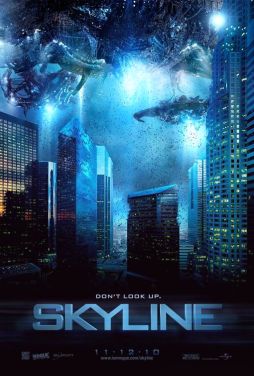 This movie is out-of-this-world terrible. Who wouldn’t want to spend an alien invasion stuck in some L.A. condo with a load of insufferable Los Angelinos? From a storytelling standpoint, watching characters I don’t care about talk about amazing and horrible things happening off camera is not the best use of anyone’s time. Skyline is a movie that keeps surprising you with the depths of its stupidity; just when you think it couldn’t plumb any deeper, the aliens have invaded to eat our brains. Yes, they’re after our brains. So that explains why gigantic monsters will claw away at a building, scrounging for the tiniest morsel of human (that still doesn’t explain it, really). That does not explain why they targeted L.A. if they’re after brains. The special effects are notable for a $10 million dollar movie, but due to the budget restraints, that’s probably why most of this alien invasion is spent indoors and behind trusty sets of Venetian blinds. The pacing is as shoddy as the character work. I kept waiting for these nitwits to step into the light and be vacuumed up into the alien mothership. The end almost looks like it might redeem part of this monstrosity, with our survivors accepting a doomed fate together. But then… I can’t even put into words how shocking, dreadful, and groan-inducing the true ending is for this junk. Suffice to say, it ends with zero resolution, a jagged plot left turn, and setup for a sequel that I’m absolutely positive not one person will be demanding.
Nate’s Grade: D
Share this:

Battle: Los Angeles (2011)
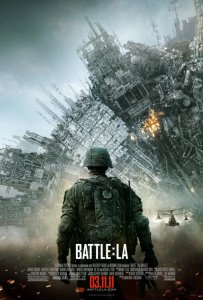 It’s just your typical sunny, Southern California day. Blue skies, good vibes, and aliens wiping out the indigenous species (read: us) for our bountiful resources. Staff Sergeant Michael Nantz (Aaron Eckhart), literally a morning away from retirement, is pulled back into combat to be apart of a Marine platoon that must hold up in the city and fight back against our otherworldly intruders.
Well there is a battle, and it is set in Los Angeles, but that’s about all you’re going to get from this movie. If you were looking for something approximating character, you’re looking in the wrong place. The characters are purely defined by one-note superficial differences, like this guy’s a doctor from Nigeria, this guy has a pregnant wife, this guy has… glasses, etc. The characters were so powerfully indistinct that there were three separate times that a person appeared onscreen and I said aloud, “Hey, I thought that guy died.” Battle: Los Angeles is a military movie, a grunts-eye-view to an alien invasion. And we keep that limiting POV for the entire movie. Battle: Los Angeles has more in common with Black Hawk Down than it does with Independence Day. Replace the depiction of angry, faceless Africans with aliens and there you go. We move from house to house, rubble-filled street after another, shooting wildly, barking commands, and trying to make sense of the urban battles. I’m doing the film too much of a favor because that makes it sound thrilling, which it is not. While there is plenty of action kept at a fairly frenetic pace, that action consistently stays at the same level of intensity. Nothing truly builds or develops to add extra levels of tension. The action is consistent, shooting through one neighborhood after the next, and when the action is plentiful but fails to develop, then the entire movie feels stagnant. Sure it develops from a “We have to go here now” assembly of plot dominoes, but advancing from one location to another with fewer characters each time is not the same as a plot.
 These have got to be some of the dumbest aliens in the universe. These are the aliens that the other aliens pick on. Some scientist/exposition device pontificates that the aliens are after our water, which is a better reason than invading a planet to harvest our tasty brains (Skyline, I’m looking in your direction). The talking head says it’s a rarity to find a planet with liquid water and thus Earth is so attractive to outsiders. Okay, so you’re going to tell me that aliens lack the ability to take ice melt it? There’s an awful lot of ice in the universe that could be more easily obtained. That seems like a better solution than an interstellar road trip for a drink. The creature design is decidedly lacking as well. The aliens look like a cross between squids and a hardware store shelf; they have metallic weapons forged to their skin. At one point Nantz and his crew is dissecting an alien POW to look for vulnerable spots (this might violate some sort of treaty somewhere) and find a lone sack underneath about five layers of armor and exoskeleton. Then they relay the news about this “delicate” spot to all the troops and miraculously all of the aliens start to now go down easily by being shot at a great distance and having the bullets penetrate layers to hit one spot a half a foot in diameter on a moving target. Makes perfect sense now that they know. That info didn’t seem any more helpful than just blindly shooting at the area below the head, which was the previous method for killing. These alien spaceships look like someone attached rockets to the shantytowns from District 9. These ships look like something assembled over at a junkyard and I thought to myself, “You traveled through space in this heap?” It’s like an invasion from an impoverished alien race that also happens to be ignorant and uneducated, which might explain the whole coveting water thing. Battle: Los Angeles might secretly be a metaphor for class warfare. Or not. Probably not.
The movie transforms into a two-hour commercial for the Marines. Battle: Los Angeles espouses the selfless bravery and honor of our servicemen, which is commendable, but it should have been done in the ame of recognizable human characters. It does the honor of good men no justice when they are turned into statues. These aren’t people, they’re recruitment figures spouting poster slogans through gritted teeth. The valor turns just this side of jingoism, and that does a disservice to the sacrifice of the men and women of the armed services. It’s hard to watch Battle: Los Angeles and not come away with the impression that the Marines are superhuman badasses and let’s fight some aliens! What compounds this messy association is that the Marines have long featured TV ads where their square-jawed recruits battle fantastical monsters (I recall one of them being made of lava).
 Director Jonathan Liebesman (Texas Chainsaw Massacre: The Beginning, most famous for Jordana Brewster’s gravity-defying low-rise pants) is no great lensman. He gives shrift attention to the significance of geography in action composition, but he makes up in quantity what he lacks in quality. There is plenty of loud noises and the like, so you’ll be kept awake, that is until you heard the stilted dialogue and wish you could fall asleep. The film packs enough stuff into an overlong 110 minutes but it’s not terribly interesting stuff, which is saying something for an alien invasion movie.
Disappointingly, the movie makes no usage of its titular location. Los Angeles may be the battlefield in name, but this movie could have been set anywhere. It does not take advantage of any of the geographic features that are unique to Los Angeles, or even California. Why bother establishing a specific location in the title and premise when the execution means you could have set the story anywhere (Battle: Cleveland?). It’s a crumbling city; it could be Libya for all that matters. Some of this is likely due to the fact that the movie was almost entirely filmed in Louisiana, which seems like a rather unnatural double for Los Angeles pre and post-alien invasions.
Battle: Los Angeles is a studio film that gets its job in an efficiently empty-headed manner. The space invaders are dumb, the action is too limited and erratically framed, and the story exists only in a theoretical state. Eckhart grunts in his raspy Two-Face voice from The Dark Knight for the entire film. I suppose if you have low expectations and just want to fill up on special effects, Battle: Los Angeles should sate your desire for straight-forward shoot-em-up entertainment. It’s not brainless but it’s close to it. Near as I can tell, Battle: Los Angeles is devoid of political or topical commentary on contemporary conflict because that would just get in the way of its straight-laced heroics. Sorry District 9, what were you thinking?
Nate’s Grade: C
Share this:

I Am Number Four (2011)
 Despite being based upon a young adult book series, I Am Number Four is an unfortunate title. What do you call the sequel? I Am Number Four 2? I Remain Number Four? Let’s not even mention the obvious pan that is begging to be covered by that title (“I Am Number Four? More like I Am Number Two!”).
Number Four, a.k.a. “John” (Alex Pettyfer), is your normal teenage alien hiding on Planet Earth and trying to live a regular life while eluding intergalactic mercenaries. Numero Quatro has relocated to the town of Paradise, Ohio with Henri (Timothy Olyphant), his alien guardian who poses as dear old dad. The two are trying to keep a low profile because Number Four is one of the last nine super-powered aliens from a dead planet. The aliens develop different special abilities as they mature and Number Four has begun to notice that his hands glow in the dark. Number Four catches the attention of Sarah (Dianna Agron), a pretty gal whose ex-boyfriend happens to be the super jealous quarterback. Number Four also befriends the school’s nerd (Callan McAuliffe) who thinks his father was taken by aliens. He’s not exactly keeping the desire low profile. Numbers 1-3 have been killed by a pack of alien mercenaries who intend to dominate Earth, and now Number Four is next.
While neither special nor afflicting, I Am Number Four is a pretty mundane, mediocre, special effects driven goof aimed primarily at young teen males. The plot lacks any trace of nuance and seems fantastical in what should even be ordinary. The Ohio town is one of those small towns that exist in the minds of west coast studio executives, where everyone gathers round for a carnival and the roads are mostly of the dirt variety. Sarah’s family is one of those ideal, chatty families that exist primarily in the minds of nostalgia. They don’t just sit around and chew their food; they are actively involved in dinner cutesy dinnertime games and cutesy embarrassing interactivity. But the movie never lets you think about these inauthentic tidbits for long before more explosions or colorful special effects rattle you. The plot follows an almost mechanical process, supplying some PG-13 skin (ladies in low rise jeans! Cleavage!) or some rudimentary chase scenes at a fairly brisk pace. The story borrows liberally from many sources, including a dash of super powered loner Spiderman stuff, angsty teen romance from Twilight, and a sprinkle of whatever is playing on TV right now as you sit reading this.
 The action is never really takes off beyond the general concept of Things Exploding and People Running. Director D.J. Caruso (Eagle Eye, Disturbia) can string together a series of pleasing visuals but they never amount to much. The film lacks real suspense and any risible sense of excitement. The action sequences are disposable but at least Caruso makes sure that the audience can follow along. I thought with all the sci-fi elements that the film would make more interesting choices, but alas I Am Number Four relies all too easily along commonplace action tropes like it’s an accomplishment. Number Six (Teresa Palmer) gets to walk away from an explosion in slow-motion (while she wears sunglasses). Nobody in town seems to ever pick up on the mounting collateral damage of this interstellar spat. Caruso and the screenwriters are too content to just be happy playing with the special effects toolbox, emulating the favorite moments of the sci-fi action genre. And one of those tropes is that ANIMALS CAN NEVER DIE. Number 4 has a shape-shifting guardian pet that decides to take the form of a dog. Then when things get rough, this dog mutates into a hulking CGI creature, which still looks like a dog. And when he gets wounded fighting another CGI monster, it’s not enough that we get the pained dog cry but the filmmakers decide that he also has to transform back into a regular Earth dog at this point to hammer home the image of pooch in trouble. Shameless to the very end. And then, during our resolution this space dog has to come hobbling out.
Fortunately for the audience, the actors are all rather beautiful. Pettyfer (Alex Rider) isn’t much when it comes to this thing called acting, but he’s got abs you could scrub laundry with and really that’s half the part of playing a hunk from outer space. I give the guy more credit just for having to be saddled with the lame superpower of glowy hands. It’s a long wait for those glowy hands to become instruments that launch glowy fireballs. For most of their screen time, Pettyfer’s power just looks like he’s clenching two very powerfully charged indigo-glowing cell phones. Olyphant (Deadwood, Hitman) is too young for me to be covering as the dad to a 17-year-old kid. I still remember Olyphant in 1999’s Go. Maybe that’s just my hang-up. The ladies are all gorgeous are all in the flawless skin and teeth variety, you know, the ones that populate every small town. No one truly makes much of an impression but they’re easy on the eyes. It’s like an Abercrombie and Fitch catalogue come to life with extra explosions (and more clothes).
 The only actor that stands out is Kevin Durand and he’s under pounds of makeup as the chief villain. Durand first came to serious attention as a season-long villain on TV’s Lost as Martin Keamy. He has a real distinct menace that doesn’t come across as self-satisfying or ironic. He’s got a real presence and it seems like casting directors have caught on to this former Canadian standup comedian. From there Durand has become something of a go-to guy when it comes to large intimidating men and men with some kind of mild speech impediment; his characters in X-Men Origins: Wolverine, Legion, and even Robin Hood all sounded like they had their mouths stuffed with cotton. Durand always has a good time with his bad guy roles, whether they are flinty or over-the-top. I enjoy watching this man onscreen even if he’s under some fairly lackluster creature makeup that makes him look like a tattooed shark man.
The point that caught my attention, and was scantily mentioned but once without nary a rejoinder from any character, was the fact that the big bad evil aliens are killing the alien teens in order. No reason is ever attempted. There are nine super alien teens but for some reason these interstellar killers are uncontrollably anal-retentive (“We may be vicious monsters, but we respect the value of numerology”). It makes little strategic sense to stick to the doctrine of taking out your enemy one at a time and in a predetermined order that everyone knows about. It also means that presumably Number 9 will be the hardest to vanquish since they will have the longest time to master their super power. Later on, Number 4 gets an added boost from a sexy, slinky Aussie who happens to be Number 6. My first thought: “What the hell happened to Number 5?” Then I figured that Number 5 has to be locked away somewhere in a protective safe house at an unknown location. Because that affords Number 6 to do whatever the hell she wants; the evil aliens would just have to stop and say, “Look Number 6, we’d really, truly love to vaporize you right now, but first we gotta go find and kill Number 5 first. See ya later.” If that’s the case then Number’s 7-9 need to get off the bench and team up. Number 4 can’t keep this up forever, guys.
I Am Number Four is tailor-made for a young male audience that doesn’t have the urge to see something harder or edgier. It’s got superfluous jet-ski stunts, girls with flat tummies, explosions, cool space weaponry, CGI monsters, villains in long black trench coats, failed attempts at romance, a dog, and even a reference to famous Cleveland Browns quarterback Bernie Kosar. It’s not an incoherent cacophony of light and sound like you’d find in a Michael Bay film; director D.J. Caruso is like Bay lite with more self-discipline. I Am Number Four is fairly derivative stuff but nothing worth getting upset about. After you see derivatives of derivatives, you start forgiving the final product for lacking any discernible flavor. All of the elements come together in rather harmless fashion making a rather empty but harmless sci-fi action flick.
Nate’s Grade: C
Share this:

Predators (2010)
 For a solid 45 minutes, Predators is a fairly good genre movie. No, it’s a very good genre movie. We snap awake in freefall with a ripped Adrien Brody. A group of deadly warriors from all cultures find themselves stranded in some strange jungle. For that 45-minutes of goodness, the assembled killers (and Topher Grace as a doctor?) try and piece together their circumstances while exploring the foreign terrain. It’s a setup straight out of the Twilight Zone catalogue. And then, at minute 46, they find out they’re on a game preserve planet for the notorious alien bounty hunters, the Predators. The characters get picked off one-by-one and the patient buildup unwinds in a familiar and depressing bloodbath. Predators will work as a quick fix of junk food, but it teased a promising alternative that never came to fruition. The action is bloody but listless. The plot twists are seen from miles away (Topher Grace as a doctor?) and after all that badass macho posturing, the end credits blast the song… “Long Tall Sally” by Little Richard? It’s the most bizarre element in a movie with killer space monsters in dreadlocks.
Nate’s Grade: C+
Share this:

District 9 (2009)
 I can’t believe I forgot to review this some how. The sleeper hit of the summer, District 9 is an intelligent, and rather obvious, apartheid metaphor, and a grandly executed action thriller with a strong moral compass. Aliens crammed into ghettos and being mistreated and abused? Sounds like Alien Nation to those with longer memories, however, writer/director Neill Blomkamp forges a docu-drama that manages to be bristling with ethical questions and kick-ass action. It’s very easy to get wrapped up in all the excitement, so much so that I was trying to will the characters onscreen to take certain precautions. Blomkamp manages to take shots at some easy targets, like shady corporations and mercenaries, but that doesn’t make the movie any less affecting. The movie belongs to actor Sharlto Copley, who begins the film as a dithering bureaucrat and ends as a truly unlikely action hero, and you buy every single step of this man’s satisfying emotional arc. While the Academy is picky when it comes to genre films, Copley deserves Oscar consideration; I haven’t seen a more compelling performance by an actor all year. The special effects are astounding, and they were accomplished on a scant budget of 30 million, which is probably what Transformers 2 spent on one explosion. District 9 makes you feel that movies can still surprise you, as long as we have visionary, intelligent life working outside the studio system.
Nate’s Grade: A
Share this:

Race to Witch Mountain (2009)
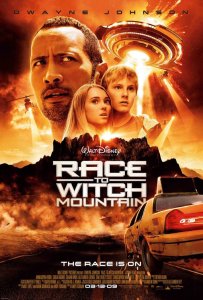 Does anyone ever fondly recall, let alone even recall, the 1975 original children’s film, Escape to Witch Mountain? This remake is Disney-fied in all places. It’s a lackluster kiddie adventure with more special effects, car crashes, and one-liners. Dwayne “The Rock” Johnson cements his tight grip on the family film genre; I really like this guy as an action hero and as a charismatic comedic actor, but being a wisecracking chauffeur to monotone yet strikingly Aryan-looking space aliens isn’t cutting it. The little green pre-teens need to get back to their ship and escape the clutches of government agents and an alien killer. This is one of those movies were everyone leaves their brain at home. This is the kind of movie where everybody is profoundly stupid and easily tricked. You’d think space aliens and intergalactic travel and psychic abilities would be met with more than incredulous jokes. Regardless, Race to Witch Mountain is devoid of fun, wonder, and excitement despite a decent effort by the assorted cast. This is lazy, by-the-numbers stuff masquerading as quality family entertainment. Families and children deserve coherent stories with actual characters and action sequences that feel like they matter. The only thing that really matters in Race to Witch Mountain is the fact that nobody will remember this movie in 35 years time, allowing Disney (or whatever alien/robot/alien robot overlords run the show at the time) to follow through with another thoughtless, mechanical remake.
Nate’s Grade: C


You must be logged in to post a comment.