Blog Archives
Logan (2017)
 The Wolverine solo films have not been good movies. The 2008 first film was widely lambasted and while it made its money it was an obvious artistic misfire. The second film, The Wolverine, directed by James Mangold was an improvement even though it had its silly moments and fell apart with a contrived final confrontation. The Wolverine movies were definitely the lesser, unworthy sidekick to the X-Men franchise, and this was a franchise that recently suffered from the near abysmal Apocalypse. Mangold returns for another Wolverine sequel but I was cautious. And then the cheerfully profane Deadpool broke box-office records and gave the Fox execs the latitude needed for a darker, bloodier, and more adult movie that’s more interested in character regrets than toy tie-ins. Thank goodness for the success of Deadpool because Logan is the X-Men movie, and in particular the Wolverine movie, I’ve been waiting for since the mutants burst onto the big screen some seventeen years ago. It is everything you could want in a Wolverine movie.
In the year 2029, mutants have become all but extinct. Logan (Jackman) is keeping a low profile as a limo driver and taking care of an ailing Charles Xavier (Patrick Stewart) south of the border. Xavier is losing his mind and a danger to others with his out-of-control psychic powers that need to be drugged. Caliban (Stephen Merchant) is also helping, a light-sensitive mutant with the ability to innately track people across the globe. Logan is ailing because his healing power is dwindling and he can’t keep up with the steady poison of his adamantium bones. A scared Mexican nurse tries to convince Logan to help out the little girl in her care, Laura (Dafne Keen, feral and a better non-verbal actor). She’s an angry, violent child and built from the DNA of Logan. She too has unbreakably sharp claws and a healing ability. Bounty hunter Pierce (Boyd Holbrook) is trying to recapture the runaway merchandise/science experiment, capturing Caliban and torturing him to track his prey. Logan goes on the run with Xavier and they try to make sense of what to do with Laura, a.k.a. X-23. They’re headed north to Eden, a hypothetical refuge for mutants to sneak over into freedom in Canada, and along the way are deadly hunters who aren’t afraid of leaving behind a trail of bodies to get their girl back.
 It feels like it shouldn’t haven taken Jackman’s reported final outing for the execs to realize that a guy with freaking knives attached to his hands might be a concept that would work in the more grisly, more adult territory an R-rating creatively affords. It’s about time this man got to fully use his claws, and it was a joyous explosion of violence and gore built up for fans such as myself for a long time coming. It feels like Fox has been planning for this event as well, as if they stationed a production lackey to devise all sorts of grotesquely fun ways that Wolverine might skewer his competition in bloody beauty (“Finally, your preparation will not be in vain, Ronald”). There’s one scene in particular where a bunch of armed henchmen are psychically frozen in place and Logan struggles to move past each, and we get to anticipate just how each one will be viciously stabbed. For a series that has shied away from overly gory violence, Logan certainly celebrates its new opportunities with bloody glee. The fact that the first word spoken is an f-bomb and there’s a gratuitous moment of drunken sorority girl boob flashing is like the producers trying to directly communicate to the millions of ticket buyers and saying, “Hey, we’re sorry it took so long. Hope it was worth the wait.” Oh dear reader, it was worth the wait.
It’s not just the action that’s invigorating but the emotional core of the film is deeper and more compelling and ruminative than ever before, and finally these great actors are given material to deliver great performances worthy of their talent. Stewart and Jackman have never been bad in their respective roles even if and when the movies have been. They just have never been called upon for much more than genre heroics, anguish, and pained moral dilemmas. With Logan, both actors are finally given meaty material that affords nuance and ambiguity, and they are excellent. Charles Xavier is losing his battle with Alzheimer’s and ALS, which is a major concern when his mind is considered a weapon of mass destruction by the government. He’s going through his own end of life deliberations (“You’re waiting for me to die,” he groans at Logan) and it brings out a far different Xavier than we’ve ever seen, even with the youthful cockiness from James McAvoy. This is a cranky, defiant, and doddering Xavier, someone who is barely outpacing his sense of grief, guilt, and depression. There’s a tragic back-story we only get a glimpse of but it’s suitably devastating for a man who has devoted his life to others. He’s looking for a few last moments of grace and looking to hold onto something by journey’s end.
 Thanks to his healing ability and the star wattage of Jackman, there was little fear that anything serious would ever befall Wolverine in his many previous film appearances. Sure bad things happened to him and he lost plenty of female love interests, but you never feared that he wouldn’t be able to ultimately handle himself. That’s not the case in Logan, which opens with a Wolverine who has clearly lost more than a step or two. He’s tired, rundown, and his adamantium skeleton is slowly poisoning his body. His healing powers are slowing down and he’s not as berserker fast and agile as he used to be. For once there’s an uncertainty attached to the character and a vulnerability. This turn greatly increases the intensity of the fight sequences and the greater stakes of the drama. The comparisons of the samurai were rife in The Wolverine and now the comparisons to the aging, lone gunslinger are ever-present in Logan. He’s drawn into a conflict that he was not seeking and he’s found a little bit of his remaining humanity and compassion to do right in the face of overwhelming odds and near certain destruction. There’s a subtle moment that the film doesn’t even dwell on that stuck with me. It’s after an accident, and in the thick of confusion, Logan is trying to save his mentor but he’s also worried that Xavier will think he betrayed him. “It wasn’t me,” he repeats over and over, not wanting this man to suffer more. It’s a small moment that doesn’t get much attention and yet it really spoke of their relationship and the depth of feeling during these fraught final days. This is the first Wolverine movie that feels like the characters matter as human beings just as much as purveyors of punching and kicking (now with gruesome slashing at no extra cost). Jackman showcases more than his impressive physique this go-round; he delivers a wounded performance that’s built upon generations of scars that he’s been ignoring. It’s the serious character examination we’ve been waiting for.
I also want to single out Merchant (Extras) who gives a performance I never would have anticipated from the awkwardly comedic beanpole. He even gets a badass moment and I never would have thought Stephen Merchant would ever have a badass moment in life.
Mangold’s film plays as a love letter to Western cinema and uses the genre trappings in ways to further comment on the characters and their plight. This is a bleak movie. It’s not a dystopia. In fact it resembles our own world pretty closely with a few technological additions; automated machines and trucks, the common knowledge that mutants have been wiped out like the measles. Knowing that it’s reportedly the end for Stewart and Jackman playing these characters, I was anticipating the film to strike an elegiac chord. His past and legacy are catching up with Logan. He becomes an unlikely guardian to Laura and explores a fatherhood dynamic that was never afforded to him before. The unlikely partnership, and it is a partnership as she’s a pint-sized chip off the block of her tempestuous father, blossoms along a cross-country road trip for a paradise that may or may not exist, while desperadoes and powerful black hat villains are out to impose their will upon the weak. This is explored in a leisurely pit stop with a working class family (welcome back, Eriq La Sale) that welcomes Logan and his posse into their home. We get a small respite and learn about greedy landowners trying to pressure them into giving up the family farm. It’s completely reminiscent of something you might see in a classic Western of old, just transported to a new setting. There’s even an extended bit where Laura watches 1953’s Shane on TV, and when those final words come back in expected yet clunky fashion, I’d be lying if they didn’t push the right emotions at the right time.
 But when it comes to action, Logan more than satisfies. The action is cleanly orchestrated by Mangold in fluid takes that allow the audience to readily engage. The film doesn’t go overboard on the Grand Guignol and lose sight of the key aspects of great action sequences. There’s a refreshing variety of the action and combat, and the action is framed tightly to the characters and their goals. It makes for an exhilarating viewing. If there is anything I would cite as a detriment for an otherwise incredible sendoff, I think the movie peaks too soon action-wise. The emotional climax is definitely where it ought to be (tears will be shed whether you like it or not) but the third act action doesn’t have quite the pop. Also, while Holbrook (Narcos) is an entertaining and slyly charismatic heavy, the villains in the movie are kept relatively vague as is their overall plan. The vacuum of villainy is kept more one-dimensional, which is fine as it allows more complexity and character moments to be doled out to our heroes, but it is a noticeable missing element.
One of the best attributes I cited from last year’s Captain America: Civil War is that the full weight of the character histories was felt, giving real emotional stakes to all the explosions and moralizing. When our characters went toe-to-toe, we felt a dozen films’ worth of setup that made the conflict matter. Logan carries that same emotional weight. We’ve been watching Wolverine and Professor Xavier for almost two decades and across nine films. These characters have gotten old, tired, and they carry their years like taciturn gunslingers looking for solitude and trying to justify the regrets of their lives. It’s a surprisingly emotional, serious, and altogether mature final chapter, one that provides just as many enjoyable character moments and stretches of ruminative silence as it does jolts of gritty, dirty, hard-charging action and bloody violence. It’s as much a character study as it is a superhero movie or Western. I cannot imagine this story as a watered down, PG-13 neutered version of what I saw on screen. This is a movie for adults and it pays great justice to the characters and the demands of the audience. The final image is note-perfect and can speak volumes about the ultimate legacy of Wolverine and by extension Xavier and his school for gifted youngsters. Logan is the second-best X-Men movie (First Class still rules the roost) and a thoughtful and poignant finish that left me dizzy with happiness, emotionally drained, and extremely satisfied as a longtime fan.
Nate’s Grade: A-
Share this:

Noirvember: Double Indemnity (1944)
 Billy Wilder’s Double Indemnity is a classic film noir and a classic crime drama about bad people doing bad things and doing them badly. It’s a rich narrative environment that has been explored in droves before and after. Double Indemnity was a box-office sensation, critical hit that was nominated for seven Oscars, and solidified Wilder as one of the most creative and daring writing and directing voices in cinema. This was only his third directing effort and it provided the freedom to make his own way through Hollywood. There’s a certain danger in going back to cinematic classics. It’s easy to see their influence in a sea of imitators and sometimes the accomplishments can be taken for granted just because the viewer is too removed from the initial splash the film made. Double Indemnity is a sharp, surefooted, and highly influential film that still resonates with suspense and intrigue. The formula was refined with Wilder at the helm and his genius can be readily recognized.
Walter Neff (Fred MacMurray) is a mid 30s insurance salesman in Los Angeles. He gets into some big trouble when a prospective client, Phyllis Dietrichson (Barbara Stanwyck), intimates that she would like to bump off her husband and profit from the act. Walter is appalled but also intrigued, drawn to the charms of the sexy Mrs. Dietrichson. He agrees and says they’re going to do it right. She takes out a hefty insurance policy on her husband that pays double for rare accidents, which spurs Neff to stage a phony accident where the injured Mr. Dietrichson (Tom Powers) fell to his death off a train. The scheme is elaborate, with alibis, swapped identities, hiding places, and a minimal of public interactions. It seems perfectly executed that is until Neff’s boss, Barton Keyes (Edward G. Robinson), starts inspecting closer feeling something is amiss. Neff must outwit his boss and co-workers and keep the scheme from getting further out of control.
“I killed him for money – and a woman – and I didn’t get the money and I didn’t get the woman.”
 Thanks to the morally and creatively restrictive Hays Code, it’s easy to see all the roadblocks that could have sabotaged the movie from getting made, let alone becoming a great film. It’s a movie not just about adulterers but they’re also murderers, and the script places you in their perspective, clinging to hope they might succeed in their scheme. Admittedly, the characters are punished for their misdeeds by the film’s end as the Hays Code would demand, but the film experience was different, and Wilder made it so early on. Within minutes, as Walter Neff dictates his confession in his boss’ empty office, he admits to being a killer, to killing Mr. Dietrichson, and in doing so out of a desire for Mrs. Dietrichson. By the very fact that he’s slumped over, panting heavily, and confessing in sordid detail, we can rightfully assume that he did not get away with it. What’s left for the audience to discover? Wilder has already established the major turns of his story for his audience and seemingly robbed us of any notion of surprise. But that’s where Wilder’s storytelling prowess emerges, because it’s not so much a story of whether something was done or would be done, it’s a story of how and how to elude capture.
We’re locked into Neff’s perspective, and with it as an experienced insurance salesman, he knows the proper way to stage a murder, make it look like an accident, and not get caught. It’s in the details that Wilder hooks us, and as we watch the trap unravel, the movie becomes an exercise in nervous tension wondering what will trip up our lovers. An audience generally gravitates to smart characters trying to outwit others, appreciating the wiles but also, perhaps, wanting to see if the scheme can be accomplished. It pushes the audience into an interesting position of rooting for our murderer. There’s a wonderful scene right after Neff and Phyllis have deposited the body of her dead husband. They’ve hopped in her car and are ready to flee the scene of the crime, and that’s when her car won’t start. Wilder simmers in the moment, luxuriating in the encroaching panic as key turn after key turn only results in the sounds of a stalled engine. Finally, it starts, but during the sequence you empathize with the killers and their panic. Wilder and company have done their job and at least some part of the audience is pushing for them to escape. What happens later tests audience loyalty, but we’re still firmly in the perspective and in the shoes of the film’s killer, the only killer in the picture at that. He’s our man.
“I think you’re rotten.”
“I think you’re swell – so long as I’m not your husband.”
 The staples of noir cinema really came alive with Wilder’s excellent crime drama. The visual signifiers we associate with the genre are all here in accordance, like the chiaroscuro lighting that bathed the actors in swaths of invading darkness. The lighting does a great job of reflecting the sordid schemes of our lovers. As soon as Walter accepts, the lighting changes drastically and the layers of dark creep in on the actors’ faces. The dialogue by Wilder and Raymond Chandler (his first screenwriting gig in Hollywood) has that robust rat-a-tat rhythms of hardboiled genre fiction that we love. The twists and turns keep an audience glued even though we have already been told the major plot particulars. The inclusion of Mr. Dietrich’s twenty-something daughter Lola (Jean Heather) from his previous marriage presents an intriguing complication. She suspects her wicked stepmother might have something to do with her father’s death as well as her mother’s death. Walter Neff keeps tabs on her as a means of trying to dissuade whom she tells her suspicions to, as a means of manipulating her, but then when Lola reveals that her ex-boyfriend has been seeing Phyllis on a nightly basis, we don’t know what to think. Is Phyllis setting up her own scheme to kill Neff? Is Lola knowingly manipulating Neff to enact vengeance against her hated stepmother? Is there anyone a guy can trust? It’s a fine character and played sincerely by Heather (Going My Way) almost to the point of ache. She stopped acting altogether in 1949, to the detriment of us all.
But the ultimate femme fatale is Stanwyck (The Lady Eve). I think what makes her work is the fact that she doesn’t immediately leap to mind as a femme fatale. She’s not the most gorgeous actress in Hollywood, though clearly still an attractive woman. The stiff blonde wig they saddled her with doesn’t help on that front. She’s a temptress that doesn’t sizzle off the screen so much as step from the mind because she feels more realistic. Working within the repressive confines of the Hays Code, Stanwyck still knows how to provide a sexy smirk to things left unsaid with her character. There are a few looks she employs that could make you melt. A standout scene focuses entirely on her face. Her husband is being murdered just off screen. That violent act is left to our morbid imaginations while we watch Stanwyck’s subtle expression of satisfaction cross her face only to dissolve when she knows better. I wish MacMurray (The Absentminded Professor) was a better scene partner with her. He seems overly stiff like he’s trying harder to get out the stylized dialogue in the tone the director wants. Wilder finds ways to subvert the actor’s tendencies but I feel like he’s at best a likable but limited dolt of an actor.
“You’re not smarter, Walter… you’re just a little taller.”
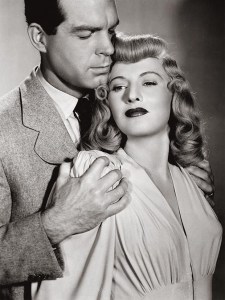 Phyllis is a classic femme fatale figure and Stanwyck plays her with a beautifully controlled sense of menace, but I want to offer a different theory as to what kind of twisted love story inhabits Double Indemnity. I think Walter Neff was never in love with Phyllis, though he acknowledged her beauty and general seductive effect. This much is clear from his first meeting with her where the insurance veteran can’t help himself with how forward and transparent his flirting is. He’s interested, though he’s also interested in getting a sale, and then when she floats the idea of life insurance, his tone immediately changes. The flirting stops cold and he promptly sees himself out. But he can’t stop thinking it over. I propose he isn’t drawn to Phyllis so much as he’s drawn to the intellectual challenge of pulling off the “perfect crime.” He considers himself a clever man and this would put all his skills to the test. He knows what agents look for to suss out foul play. He knows what the police ask about. Now he gets to see if he can fool them all. In this interpretation of mine it’s not Neff’s love for the dame that gets him but his love of his ego. There’s a cold manner in how often he calls Phyllis “baby,” lacking apparent affection and instead seemingly turning the pet name into something dutiful. Oh, but you’ll argue, his voice over goes into great detail about the magnetic and sexual appeal of Mrs. Dietrichson, and that’s the point to remember, that it’s his voice over. Neff is retelling this story, knowingly dictating his confession, and perhaps he’s playing into a narrative that removes some of the emphasis from his true intentions. I propose Neff is an unreliable narrator. Since it’s from his perspective, his words are all we know about Phyllis and her assumed seductress ways. Having the final word on his story would provide a perfect opportunity for Walter to alter the story as best he sees fit, shifting some blame onto the woman who done him wrong. I believe that in the end it was Walter Neff’s desire to prove he could outsmart the world of law enforcement and get away with murder that drove him onto this wayward path and not a woman as fetching as Stanwyck and her anklet may have been.
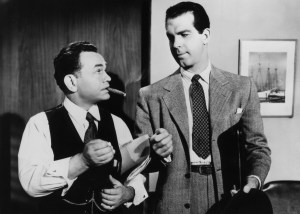 There’s a very unexpected emotional current that surfaces fully by the conclusion of Double Indemnity. Edward G. Robinson was at a transitional point in his career, having been the lead in a slew of older crime pictures. An audience was prepped from association to consider Robinson a disreputable character, just as they had prepped to consider MacMurray’s character a likeable fellow from his previous comedic roles. Wilder’s film flips audience expectations to great effect. MacMurray is the cunning murderer and Robinson is the moral center. Keyes is exceptionally skilled at insurance fraud and it naturally should be him that unknowingly tightens the noose around his beloved employee as he gets closer and closer to the truth. He just can’t see it; Walter Neff is so close he inhabits a blind spot. When Keyes does discover the truth, his crushing sense of disappointment he tries to hold back is an emotional moment that hits hard. It’s the professional and loving relationship between these men that helps to add something more to Double Indemnity; it’s got the noir staples we come to expect nowadays but it also has a surprisingly sweet and affecting father/son relationship between mentor and student. Robinson is terrific in the bravado moments like when he unleashes a torrent of statistical categories on suicide types and methods and he also sells the quiet hurt of a proud man who must admit he placed his trust in the wrong recipient.
“I couldn’t hear my own footsteps. It was the walk of a dead man.”
Double Indemnity is a film classic that holds up thanks to deft plotting that puts the audience in the place of the killers, solid twists and turns, and a clear understanding of the strengths of the genre. It’s a standout film noir that still stands rather tall. It’s always reassuring when the great pieces of art can still transport, still excite, and still resonate with the same feeling that communicates why they deserve their decades of plaudits and acclaim. Wilder was one of Hollywood’s greatest storytellers who could hop genres like few others. His foray into noir cinema left a long lasting legacy for the genre and its fans to follow, and Double Indemnity is still the crackling crime thriller it was under the Hays Code. Perhaps the scrutiny of censorship forced Wilder and Chandler to get more creative, and the finished product is a taut and stylish imprint that others eagerly copied. There’s just something inherently interesting about bad people doing bad things badly no matter the best intentions of the moral crusaders of its day.
Nate’s Grade: A
Share this:

Split (2017)
 It’s hard to even remember a time when writer/director M. Night Shyamalan wasn’t a cinematic punching bag. He flashed onto the scene with the triumviri of Sixth Sense, Unbreakabale, and Signs, what I’ll call the Early Period Shyamalan. He was deemed the next Spielberg, the next Hitchcock, and the Next Big Thing. Then he entered what I’ll call the Middle Period Shyamalan and it was one creative and commercial catastrophe after another. The Village. Oof. Lady in the Water. Ouch. The Happening. Yeesh. The Last Airbender. Ick. After Earth. Sigh. That’s a rogue’s gallery of stinkers that would bury most directors. The promise of his early works seemed snuffed out and retrospectives wondered if the man was really as talented as the hype had once so fervently suggested. Then in 2015 he wrote and directed a small found footage thriller called The Visit and it was a surprise hit. Had the downward spiral been corrected? With a low-budget and simple concept, had Shyamalan staked out a course correction for a mid-career resurgence. More evidence was needed. Split is the confirmation movie fans have been hoping for. An M. Night Shyamalan movie is no longer something to fear (for the wrong reasons), folks.
Split is all about Kevin (James McAvoy), a man living with twenty-three different personalities in his head. One of them, Dennis, kidnaps three young ladies, two popular and well-adjusted friends (Haley Lu Richardson, Jessica Sula) and the introverted, troubled teen, Cassie (Anna Taylor-Joy). The girls wake up locked in a basement and with no idea where they are and whom they’re dealing with. Kevin takes on several different personas: Barry, a fashion designer, Hedwig, an impish child, Patricia, a steely woman devoted to order, Dennis, an imposing threat undone by germs. The altered personalities, or “alters” as they’re called, are preparing for the arrival of a new persona, one they refer to as simply The Beast. And sacrifices are needed for his coming.
Right away you sense that Split is already an above average thriller. This is clever entertainment, a fine and fun return to form for a man that seemed to lose his sense of amusement with film. The areas where Split is able to shine that would have normally doomed the Middle Period Shyamalan are in the realms of tone, execution, and ambition.
 Very early on, Shyamalan establishes what kind of feeling he wishes to imbue with his audience, and he keeps skillfully churning those sensations, adding new elements without necessary breaking away from the overall intended experience. You’re meant to be afraid but not too afraid. It’s more thriller than outright horror. There is a level of camp inherent into the ridiculous premise and in watching a grown man act out a slew of wildly different personas populating his brain. Shyamalan swerves into this rather than try and take great pains to make his thriller a more serious, high-minded affair. His camera lingers on the oddities, allowing the audience to nervously laugh, and he allows McAvoy extra time to sell those oddities. It’s especially evident in the introduction of the Patricia alter ego, where McAvoy uses a lot of faux grave facial expressions to great comic effect. Shyamalan no longer seems to fear being seen as a bit silly. Shyamalan even knows in some ways that he’s making a genre picture and an audience expects genre elements or the reversal of those elements. At one point, Dennis insists that two of our girls strip to their underwear because they’re dirty. I shook my head a bit, believing Shyamalan to sneak in some PG-13 T&A. Except it’s just enough for some trailer clips. Shyamalan’s camera doesn’t objectify the teen girls even after they run around in their skivvies. He doesn’t have to indulge genre elements that will break the film’s tone. He also doesn’t have to overly commit to being serious. He can be serious enough, which is the best way to describe Split. It treats its premise and the danger the girls are in with great seriousness, but the movie still allows measures of fun and intended camp. The cosmos themselves don’t have to be responsible for all of time’s events to click together to form his climax. It can just be a young woman trying to escape a psycho thanks to her wits and her grit.
Execution has also been a nagging problem of the Middle Period Shyamalan (affectionately his Blue Period?). I may be one of the few people that thought 2008’s Happening had some potential even as is if another director with a better feel for the material and less timidity embracing the full possibilities of an R-rating had been aboard. With Last Airbender and After Earth, both movies were exceptionally bad from a number of standpoints, but Shyamalan’s botched execution of them made the anguish all the more realized. You walked away from both disasters and openly wondered why Shyamalan was given such large-scale creative freedom and at what point the producers knew they were sunk. With Split, Shyamalan has pared down his story into a very lean and mean survival thriller anchored by a mesmerizing performance from McAvoy. The story engine kicks in very early, mere minutes into the movie. The man doesn’t even wait the usual ten minutes or so before introducing the inciting incident. This Shyamalan has no time to dawdle, and the rest of the movie lives up to this pacing edict. It’s efficiently plotted with the girls in a position of discovery and learning their surroundings, the different alters, and how to play them against one another. Each piece of info builds upon the last. It’s a survival thriller where you think along with the characters, and their decisions make sense within the internal logic and story that Shyamalan commands. There are scattered interruptions from our subterranean terror, mainly exposition from Kevin’s shrink and some hunting flashbacks from Casey’s childhood with her father. I figured they would show Casey to be similar to the feisty heroine from You’re Next, revealing her as a fiendishly clever and capable survivalist that the villain underestimates to his great peril. It’s not quite that but the flashbacks do serve a purpose, a very dark purpose, and a purpose that could lead to some very uncomfortable personal implications others may interpret.
 Shyamalan’s ambition has often exceeded his reach when it came to his post-Signs oeuvre. The man never seemed like a great fit for the fantasy and sci-fi blockbusters that Hollywood was hoping he’d sprinkle his “Spielberg scion” magic all over. The number of moving parts seemed to overwhelm and his worst instincts took over. To be fair, Shyalamlan is also to blame as his ego became inflated and he started chasing after his cinematic windmills convinced he was creating great works of art. In Lady in the Water, he inserted himself as the writer that will eventually save all of mankind. That’s a step above arrogant. And he reserved time in that fishy-woman-out-of-water misfire to literally eviscerate a crotchety film critic because the man obviously held no grudges. My point is that when Shyamalan’s stories got too big so did his sense of himself. He lost limitations and people reeling in his excesses and wayward plotting. Even Shyamalan’s early successes are smart examples of how to get the most bang for your buck. Unbreakable is his “comic book movie” and that has like one fight scene. Signs left most to the imagination. Shyamalan has always been a better filmmaker when he holds back and embraces the limitations of his situations, finding more resonant creative solutions. Shyamalan has blossomed under the Blumhouse model, a factory for cheap high-concept thrillers in the $1-10 million range. With that kind of minimal budget, it forces Shyamalan to be very economical with his filmmaking and very meticulous with his storytelling. It worked for The Visit and it especially works with Split. This is a movie that emphasizes its strengths, storytelling and performance, and a large-scale budget is not essential for those elements to flourish. You want to know Shyamalan’s cameo this time? It’s a computer tech literally billed as “Jai, Hooters lover.” We’ve certainly come down from savior of the human race, and it’s a welcomed sign (no pun intended).
The movie would be so much less without the intensely captivating performance from McAvoy (X-Men: Apocalypse). A character with multiple personalities totaling twenty-three, with twenty-four on its spooky way, must be an actor’s dream. McAvoy loses himself in the sheer playfulness of the part. The characters are distinct down to his poise, posture, the way he carries his body, subtle facial expressions or movements that he’s keyed into specific altered personalities. It’s a lot more than silly voices. It’s a shame that this kind of performance will never really get the recognition it truly deserves. This is an Oscar-worthy performance from McAvoy as he transforms himself again and again. The man finds several different ways to be creepy and menacing, never overdoing the same note. It’s an astonishing chameleon-like performance and definitely deserving of future awards consideration, and we’re in the general cinematic dumping ground of January. I would like to also call attention to Taylor-Joy (The Witch) and her resourceful and thoughtful performance. She’s playing a scared and scarred young woman but a fighter worth rooting for who rises to the many challenges. She’s a Final Girl you can love.
Split is a solid and atmospheric thriller with a killer crazy performance by James McAvoy. The movie flies by, drawing you into its clutches, and the ongoing twists and turns feel organic. There really isn’t so much a twist ending as a culmination of flashback implications. The end has an uncomfortable implication in its resolution, but that’s the worst of it. As long as his head doesn’t get too big, I could welcome Shyamalan cranking out fun mini-budget thrillers in the Blumhouse model. It could be the beginning of a, dare I say, Shyamassaince. I’m sorry (I’m not sorry).
Nate’s Grade: B+
Share this:

Silence (2016)
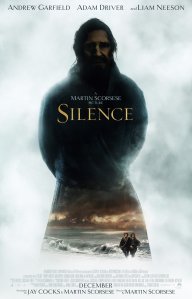 A nearly three-hour movie about Portuguese Jesuit priests facing persecution in 17th century Japan and struggling with the personal demands and costs of their faith sounds like a hard sell for your casual moviegoer. It may seem even stranger coming from the likes of director Martin Scorsese. This is a deeply personal film and perhaps the greatest movie about the nature of spiritual faith, both good and bad, I’ve seen. Two priests (Andrew Garfield, Adam Driver) sail to Japan in 1635 to find their mentor after hearing he has renounced his ties to Christianity and taken up a Japanese wife. Christianity has been outlawed and those caught practicing the religion can be turned in for 100 pieces of silver, and a priest for 300 pieces. The repression forces Christian converts to make difficult choices, especially when their refusal to recant their faith causes suffering for others. The Inquisitor (Issei Ogata) is a fascinating figure who argues that these misplaced missionaries never understood Japanese culture and that this foreign religion simply cannot flourish. The meaning of individual faith is explored beautifully with existential highs and lows. When the priests come across a village of secretly practicing Christians, it’s a powerful example of the goodness of faith, as these people are nourished body and soul, empowered. They can also finally confess their sins and garner a clean slate. However, much of the film is about the internal struggle to retain one’s faith in the seeming absence of confirmation. The priests are eventually caught and ordered to apostate, and their ongoing refusals are met with harder and harder challenges to bear. It’s an ongoing process for many people to square the concepts of a loving God and the horrors and general torment that do not merit said God’s intervention. At one point one of our priests, shaken by his experiences, asks if he is merely praying to silence. In some regard, I think the movie is about coming to terms with the fact that faith is often a relationship with a silent partner. Silence may be the greatest spiritual epic about doubt. It feels like a thriller at times and also the most Christian movie at other times. It puts the simplistic tripe starring the likes of Kirk Cameron to shame. Scorsese’s camera is unmistakably his and the movie is often dazzling to just experience. The pacing is very much a slow burn but the historical context felt increasingly intriguing for my tastes. Ogata is the real star of the movie, embellishing his antagonist with a magnetic power. Every time he was off screen I wished for his return. Silence is not going to be a movie for everyone or for many. It’s too long and airless, but it’s a deeply serious, deeply meditative, and deeply searching film about the power of belief and the price we pay to hold on.
Nate’s Grade: B+
Share this:

Live by Night (2016)
 With only three films, Ben Affleck has successfully reinvented himself as one of Hollywood’s most talented directors when it comes to adult crime thrillers. It’s not just his superb directing chops; the man also serves as producer, lead actor on most films as well as a screenwriter, and Affleck’s ability to write flawed yet deeply human characters within genre parameters has accomplished actors flocking to work for him. Beyond his 2012 film Argo winning Best Picture, Affleck has gotten three different actors supporting Oscar nominations (Amy Ryan, Jeremy Renner, Alan Arkin). He’s an actor’s director and a man who knows how to satisfy an audience hungry for authentic genre thrills and interesting characters. His latest film is an adaptation of Dennis Lehane’s novel and is Affleck’s most ambitious film yet and it’s gorgeously brought to life. There’s still plenty to like and entertainment to be had with his Prohibition era gangster flick Live by Night, but it’s also unquestionably Affleck’s weakest film yet as a major director.
 Joe Coughlin (Affleck) is a hardened WWI veteran who says he came back to Boston as an “outlaw” (he seems to turn up his nose at being called a “gangster”). Joe settles into an easy life of crime with the local Irish gang lead by Albert White (Robert Glenister). Unfortunately, Joe’s lover, Emma Gould (Sienna Miller), happens to be White’s main squeeze. Joe and Emma sneak around and carry on their relationship without proper discretion. Their secret is found out, Emma is dealt with, and Joe escapes with his life, serving a prison sentence and then enlisting in the Italian mob under local boss Maso Pescatore (Remo Girone). Joe is sent to Tampa to manage the rum-running business, starting his life over. The area is ripe for expansion and it isn’t long before Joe is making friends and enemies over his exploits. He falls in love with Graciella (Zoe Saldana), a fellow criminal with a working operation of Hispanic bootleggers. Joe warms to a local police chief (Chris Cooper) and his daughter, Loretta (Elle Fanning) a girl who experiences the darker side of vice and becomes a troublesome born-again leader. All the while Albert White has relocated to Miami, and the specter of vengeance looms just within reach.
It’s a Prohibition gangster flick and Affleck makes sure to check as many boxes as he can when it comes to audience expectations for a pulpy hardboiled action drama. The production design is aces and the cinematography by Robert Richardson (The Hateful Eight) is beautifully composed with its use of light, shadow, and framing. There are shots of violence that are exquisitely rendered so as to be their own art, like a man falling down a stairwell with a Tommy gun blasting above bathed in light. The production details are a sumptuous aspect that Affleck and his team put supreme effort into to better make their movie transporting. The action sequences have a genuine delight as they pop. A shootout throughout the grounds of a mob-owned hotel is an exciting climax that finds fun ways to provide genre thrills. The rise-and-fall structure of the story, mingled with a simple revenge motivation, is a suitable story vehicle for the audience to plug into. There are fun characters, fun moments, and sizzling action, all decorated in handsome period appropriate details. While Live by Night has its share of flaws, a dearth of entertainment is not one of them.
Tone and coherency end up being Affleck’s biggest obstacles he cannot overcome. It’s somewhat of a surprise considering his other directorial efforts brilliantly melded several genres while telling invigorating stories. I think the main fault is a screenplay trying to do too much when more streamlining was optimal. The specific goal that sets Joe in motion is a bit hazy and fails to provide a larger sense of direction for the arc of the tale. Affleck’s previous films were rock-solid in crafting overarching yet specific goals that propel the scenes onto a natural narrative trajectory. With Gone Baby Gone, it’s finding the missing girl. With The Town, it’s getting closer to a bank employee without having that relationship discovered by his cohorts. With Argo, it was rescuing the hostages. With Live by Night, it’s mostly getting vengeance against Albert White, though we don’t know how. In the meantime, we have episodic incidents failing to register connective tissue or at least a cause/effect relationship where it feels like a natural order of organic conflicts. The opening act in Boston that sets up Joe’s tragic love, jail time, and enmity with White could be removed entirely. I’d miss the thrilling 1920s car chase, which is also unique in that it’s the first period car chase I can think of that utilizes the mechanical limitations of the vehicles for extra tension, but it’s at best a moment of flash. Having the story pick up with Joe putting his life back together in sunny Florida would have been a cleaner entrance into this world for an audience. Once Joe ingratiates himself into this new world, the audience has to play another game of character introductions and assessing relationships and the balance of power. It feels a bit redundant after having our previous act pushed aside to reboot Joe’s world.
 It feels like Affleck is trying to corral so many historical elements that he loses sight of the bigger picture. Joe’s criminal path seems comically easy at times as he builds a fledgling empire along the Floridian west coast. First it’s the law and then it’s the KKK and then it’s religious revivals that need to be dealt with. Each incident feels like a small vignette that observes the historical setting with an angle that will be perfunctorily dropped in short order. The conflicts and antagonists don’t feel sufficiently challenging and that lessens the intended suspense. When Joe is dealing with the KKK, it feels like he’s restraining himself out of politeness rather than a series of organic restrictions. The elements and tones don’t really seem to inform one another except in the most general sense, which leads to the film lacking suitable cohesion. It’s easy then for Affleck to overly rely on stock genre elements to provide much of the story arrangements.
The characters have difficulty escaping from the pulp trappings to emerge as three-dimensional figures. Graciela gets the worst of it, proving to be a capable bootlegging criminal in her own right who loses all sense of personality, agency, and import once she becomes romantically entwined with our hero. It’s as if she erased herself to better heal his broken heart. How kind of her. The religious revival element is ripe for further examination but it’s kept at a basic level. We’re never questioning the validity of Loretta’s conversion and sudden celebrity. Chris Cooper’s pragmatic lawman has the most potential as a man trying to keep his morals amidst the immoral. The character isn’t utilized in enough interesting ways that can also flesh out his dimensions, and his conclusion suffers from that absent development. The characters serve their purpose in a larger mechanical sense but they don’t feel like more recognizable human beings.
Affleck’s innate talent with actors reappears in a few choice moments, just enough to tantalize you with the promise of what Live by Night could have been. The standout moment for me is a sit-down between Joe and Loretta where she unburdens her self-doubts. This is a woman who has been preyed upon by others, had her hopes dashed, and is trying to reinvent herself as a religious leader, but even she doesn’t know if she believes that there’s a God. The scene is emotional, honest without being trite, and delivered pitch-perfect by Fanning (The Neon Demon). It’s the kind of scene that reminded me of The Town and Gone Baby Gone, how Affleck was deftly able to provide shading for his characters that opened them up. Miller (American Sniper) has immediate electricity to her performance and reminds you how good Affleck is at drawing out the best from his actors. British TV vet Glenister is so good as a villain that seems to relish being one that you wish he were in the movie more. He has a menace to him that draws you in closer. Maher (The Finest Hours) is a memorable cretin who you’ll be happy to be dealt with extreme prejudice. There isn’t a poor casting choice in the film (hey Clark Gregg, hey Anthony Michael Hall, hey Max Casella) except possibly one, and that’s Affleck himself. I know part of the reason he selects his directing efforts is the possibility of also tackling juicy acting roles, but this time he may not have been the best fit. He’s a little too calm, a little too smooth, a little too out of place for the period, and his director doesn’t push him far enough.
 A strange thing happened midway through, namely how politically relevant and vicariously enjoyable Live by Night feels specifically for the year 2017. It’s a movie largely sent in the 1920s with characters on the fringes of society, and yet I was able to make pertinent connections to our troubled times of today. After a contentious presidential election where many feel that insidious and hateful extremist elements are being normalized and emboldened, there is something remarkably enjoyable about watching a murder montage of Klansmen. The Tampa chapter of the KKK takes aim with Joe’s business that profit from fornicators, Catholics, and especially black and brown people. They’re trying to shake Joe down for majority ownership but they’re too stupid, blinded by their racist and xenophobic ignorance, to accept Joe’s generous offers, and so they can’t help but bring righteous fury upon their lot. There is something innumerably enjoyable about watching abusive bigots brought down to size with bloody justice. I could have seen an entire movie of Joe and crew tearing through the Florida chapters of the KKK and just cleaning out the rabble. This sequence whets the appetite for what comes later. Without going into specific spoilers, the climax of the movie involves the put-upon minorities rising up against their bosses who, like the Klan, felt they were too powerful, too indispensable, and too clever to be seriously threatened. In its own way, it’s like a dark crime actualization of the American Dream. Unpack that if you will.
Live By Night is Affleck losing the depth of his world to its surface-level genre pleasures and they are indeed a pleasure. This isn’t a bad movie by any measure, only one of slight disappointment because it had the markings and abilities to be much more than the finished product. The tonal inconsistency and storylines provide episodic interludes and enticing moments, whether in action or acting, but they don’t blend together to form a more compelling and impressive whole. It’s a gangster movie that provides the gangster genre trappings but loses sight of what makes the characters in these movies so compelling, the moral complications, shifting loyalties, the impossible positions, and enclosing danger. I don’t think you’ll sweat too much over whether the main character will come out on top, which somewhat hinders the intensity of the action. When your movie is more predicated on those genre thrills than character or story, that’s an even bigger hindrance. It’s a fun world worth visiting but it doesn’t have the staying power of Affleck’s better efforts.
Nate’s Grade: B
Share this:

The Handmaiden (2016)
 I’m glad there’s still a filmmaker at the talent level of director Park Chan-wook (Oldboy) dedicated to making genuine Gothic romance with style and reverence. The Handmaiden is a ravishing, enrapturing, and momentously engaging movie with dark delights, startling depths, palpable romance, simmering tension, and high-wire twists and turns that keep redefining the story. The absurdly talented filmmaker takes a novel set in Victorian England and adapts the setting to 1930s Korea during the time of Japanese occupation, a fascinating and little-known time period for a Western audience. A poor orphan Sook-Hee (Tae-ri Kim) is pressured into a scheme to trick the wealthy Lady Hideko (Min-hee Kim) into being admitted to an insane asylum, her family riches sold. From the opening minutes, The Handmaiden produces immersive drama that pushes the central characters into consistent conflict to achieve their varying goals. They’re constantly at odds with one another and themselves. There’s even tension between those who hold onto their Korean culture and those who adopt the culture of their oppressors, namely Lady Hideko’s perverse and treacherous uncle. Sook-Hee grows an unexpected affection for her mistress, and this includes a burgeoning attraction that the movie communicates with serious sensuality. The passionate lesbian sex scenes are, if anything, a tad restrained from what I was expecting from Chan-wook, and they’re definitely far more restrained and absent the male gaze than the still excellent Blue is the Warmest Color. I felt the same carnal desire the characters were discovering, a feat worth celebrating for still staying true tonally without veering into tawdry exploitation. More than the sex or the top-notch technical aspects, it was the characters that hooked me and refuse to relinquish. The deepening relationships and the subtle shifts of loyalty, perception, and desire make what is essentially a twisty and twisted chamber-play into world-class drama. You think it’s one kind of movie, and then it flips the script, and then it does it again, each time opening wider this mysterious, dangerous, and invigorating world. My one quibble is that the final twenty minutes feels unnecessary and self-indulgent, Chan-wook finally scratching a few violent tendencies he had been keeping as veiled up to that point. The Handmaiden is a ridiculously entertaining movie that is handsomely mounted, wonderfully acted by its leading ladies, and a romance worth losing your self over. Plus, there’s also the sex.
Nate’s Grade: A-
Share this:

Nocturnal Animals (2016)
 Fashion designer Tom Ford made a big splash with his debut film, 2009’s A Single Man. It was a gentle and introspective character study of a middle-aged gay professor determined to end his own life. It was lush, full of feeling, and anchored by a deeply humane performance from Colin Firth. In short, it is everything that his follow-up Nocturnal Animals is not. This is a movie overflowing with vacant artifice that is mistaken for profundity.
Susan (Amy Adams) is an art gallery owner and living a posh life with her second husband, Hutton Morrow (Armie Hammer). She gets an unexpected present in the mail from her ex-husband Edward Sheffield (Jake Gyllenhaal). He’s sent her his newest manuscript, a departure from his usual works. It’s dedicated to Susan. With Hutton away on business, and philandering with a mistress, she dives into the story. It tells the story of Tony Hastings (also Gyllenhaal) and his wife (Isla Fisher) and teen daughter (Ellie Bamber) traveling through west Texas. They run afoul of some contemptuous locals lead by the sadistic Ray (Aaron Taylor-Johnson), who kidnaps Tony’s wife and daughter. Left for dead, Tony teams up with a terminally ill police officer, Bobby Andes (Michael Shannon), to hunt down Ray and make him suffer for his crimes. As Susan continues reading, she goes through a mixture of emotions trying to determine what her ex-husband is trying to communicate to her within the subtext and metaphor of his sordid story.
 I grew increasingly restless with Nocturnal Animals because it failed to justify its excessive dawdling and vapid artistic pretensions. This is a movie that doesn’t really know what it wants to be so it dabbles in many different genres, none of them fully convincing or worth the effort. It’s a high-gloss erotic thriller, it’s a gritty exploitation film, it’s a morally compromised revenge thriller, and it’s a subtle relationship drama amidst the upper crust of the L.A. art scene. It’s none of these. It’s two primary stories, neither of which justifies the amount of time spent on what amounts to so little. The worst offender is the frame story with Susan, which amounts to watching Amy Adams read for two hours. She takes a lot of baths and showers in response (symbolism!) but most of the cutaways and time spent with Adams is to merely watch her react. It’s like she’s a nascent studio audience handcuffed to tell us how to feel with her reactions. Would you have known that you should feel bad during onscreen death if we didn’t cut back to Susan also feeling bad and concerned? It amounts to emotional handholding and it’s grating, also because Susan is an terrible character. She’s conceited and thinks she is owed better, which is why her mother successfully pressured her to dump Edward, a man well below her self-styled station in life. Her second marriage is crumbling apart and part of her sees Edward’s out-of-the-blue note as a potential romantic rekindling. That’s right, this is a person who reads a revenge opus that may be all about seeking cosmic vengeance against her, and she thinks to herself, “Ooo, I think he like likes me after all.” Her self-involvement is rewarded in the end but the ambiguous ending is more just missing in action. Ford’s film just peters out and leaves you hanging, just like its heroine.
Edward’s manuscript is easily the best story and even that is only by default. It’s an easier story to get involved with because of the simple story elements that naturally draw an audience in, namely a revenge fable. The initial altercation with the family and Ray’s crew lasts almost a half hour. Specifically the roadside confrontation itself is a solid ten minutes and it just goes round and round, repeating its overdone sense of menace. I wasn’t dreading the horror to come but more so getting impatient for it to be over. Without depth to the characters or escalating stakes and complications, it all just amounts to a Texas hillbilly repeatedly threatening a cowering family for ten solid minutes. The vengeance in the second half of the movie is just as predictable and too drawn out. Edward schemes with Bobby Andes to take justice into his own hands, but the movie takes far too long to reach its predictable conclusion, which still manages to be so drawn out that I was screaming at the screen for the inevitable to finally happen. When the movie ended I felt a rush of relief to go along with my general sense of perplexity.
Nocturnal Animals has the illusion of highbrow art mixing with lowbrow thrillers but it lacks the substance of the former and the courage of its convictions for the latter. Ford’s mercurial taste in costuming and set design shows in every moment with Susan, as the sets feel exquisitely designed and the cinematography designed to encapsulate this. It’s a good-looking movie but there’s not enough under the surface. It’s all empty window dressing to disguise the vapid whole at its center. Let’s tackle the opening credits, which will most certainly capture your undivided attention. It’s a foursome of overweight women dancing naked and in slow motion, their large bodies bouncing and jiggling to the self-serious musical score. Eventually it’s revealed that these women are part of an installation exhibit in Susan’s art gallery, and that’s when you get a tip-off just how hollow and attention seeking the movie will be. The gallery consists of overweight women lying face down on raised platforms. That’s it. No wonder her gallery isn’t doing that well (note: not a fat-shaming comment but more a comment on the lazy application of its sense of “art”). You get a sense that Ford comes most alive in the scenes where he can arrange figures and images, not so much the demands of storytelling.
 I can already hear supporters saying I just don’t get it; no, I got it because there’s very little to understand with Nocturnal Animals. It’s a story-within-a-story so we’re already training our brains to look for parallels but they aren’t obvious so they’ll be more metaphorical. I kept waiting for it all to tie together in a substantial way by film’s end, and sorry but it just doesn’t (spoilers ahead). Edward has a whammy of a day when he discovers 1) his wife is pregnant, 2) she’s aborted his child, and 3) she’s in the arms of her new boyfriend, and he discovers all of this standing in the rain for further symbolism. He has a grievance against Susan, though we’ve been suspecting it for some time. His manuscript is a revenge thriller about a family murdered and how a weak man finds the strength to seek justice and retribution. The parallels are fairly obvious there, and the fact that there are only so many characters in the story-within-a-story means there are few options to play the analogue guessing game. I’ll just claim that Ray is meant to represent Susan since he/she is the murderer of Tony/Edward’s family. There’s a reason that Tony’s family all share Susan’s red hair. He dedicated the book to her, after all, and said she was who made it all possible. From there you could argue whether Tony represents Edward’s real past, weak and remorseful, whereas Bobby Andes is meant to represent how he wishes he could be, decisive and strong (end spoilers). That’s about all the parallels you’re going to find because the story-within-a-story only involves a very tiny number of characters. There just isn’t much to go on here and yet Ford’s movie stretches and drags and just keeps going until it reaches its predictable destination. There isn’t any more depth here than straightforward avatars and even those are lean.
I was debating a question with my friend Ben Bailey while we watched this movie, and that’s whether the stakes are removed somewhat when you know that a storyline within a movie is fictitious. Knowing that Tony is a pretend person, does that eliminate some of the tension and investment in his storyline? I recognize this is a distinctly meta question considering that a majority of film characters are fictitious by nature, but I do think there’s a different set of standards for the people of the story-within-a-story. I don’t remember feeling less for the characters in A Princess Bride, The NeverEnding Story, or Adaptation. My only conclusion is that I just did not care a lick for any of the characters in Nocturnal Animals, whether they were fictional or twice fictional. They didn’t deserve my attention just because pretty people were playing them. They didn’t deserve my attention because Big Bad Things caused them to experience Big Emotions. Combined with the ponderous plot and the emaciated substance, the dull characters and the overwrought acting they inspire are a recipe for audience detachment. I can’t help but shake my head as other critics trip over themselves to shower this film with overly enthusiastic plaudits. Nocturnal Animals is a tiresome exercise in lazy symbolism, patience-demolishing pretension, and emptiness masquerading as contemplation.
Nate’s Grade: C-
Share this:

Miss Sloane (2016)
 Miss Sloane is an intelligent and exacting political thriller that should appease fans of the genre who enjoy a good arm-twisting from a powerful manipulator, in this instance the towering and intimidating full force of Jessica Chastain. She plays the titular Sloane, the best lobbyist inside the beltway, and a woman who leaves the comfort of her firm for the challenge of taking on the gun industry to help pass a reform bill. From there it’s an underdog tale powered by the winds of moral righteousness and given a tough-talking yet flawed hero that will burn down whatever she can, including her own reputation, to win. The biggest draw is the performance from Chastain (Zero Dark Thirty) as she gets to yell at people for approximately two hours and look good doing it. It’s a game of persuasion and leverage and D.C. voter politics, and she makes the constant stream of information accessible while providing a focal point for our interest. It’s a pretty information heavy film with a minimal of supporting characters that stand out (Gugu Mbatha-Raw as a school shooting survivor-turned-team member is the notable exception). With her victory never in doubt no matter the odds, the movie establishes that it exists in a parallel world where actual gun control reforms can be advanced. In the wake of doing nothing from Sandy Hook, this must be a fantasy world. Director John Madden (The Debt) keeps the tone as cool and calculated as his heroine. The script by Jonathan Perera is plenty smart though the final act relies upon some unbelievable shenanigans that betray its sense of pragmatic realism. Still, the cunning gamesmanship of a pro working the levers of power for a worthy cause allows for some liberal fantasy indulgence. Miss Sloane is a suitably entertaining thriller that whisks you away and says even “bad people” have a purpose in our broken political system.
Nate’s Grade: B
Share this:

Noirvember: L.A. Confidential (1997)
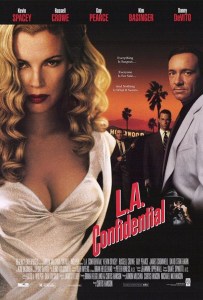 There was no stopping Titanic in 1997, iceberg be damned. James Cameron’s epic disaster movie had all the momentum of the times, and yet it’s a smaller movie that captured more of the critics and was far more deserving of the ultimate Oscar prizes that year. L.A. Confidential was based upon a James Ellroy novel that many argued was unfilmable. Enter journeyman director Curtis Hanson and novice screenwriter Brian Helgeland, and the pair stripped the book down from eight main characters to three, kept the spirit and essence of the book alive while rearranging the storylines for large-scale popcorn thrills. It’s been nearly twenty years since L.A. Confidential first seduced big screen audiences and its powers are still as alluring to this day. It’s a neo noir masterpiece.
In 1950s Los Angeles, not all is what it seems. The captain of the police, Dudley Smith (James Cromwell), is looking to keep the peace in the City of Angels as outside criminal elements are looking to fill the void from Mickey Cohen going to prison. Three police officers of very different stripes find themselves on the edges of a complicated murder case stemming from a massacre at the Nite Owl cafe. Ed Exley (Guy Pearce) is the son of a famous police captain and wants to rise up the ranks as quickly as possible. He’s a political animal and unafraid of ruffling feathers. Bud White (Russell Crowe) is a bruiser of a man who enforces his own level of justice when it comes to men who beat or harass women. Jack Vincennes (Kevin Spacey) is a happily shady officer who serves as a consultant for a hit TV police procedural. The Night Owl case takes them into many sordid corridors of sex, money, and power, including Lynn Bracken (Kim Basinger), part of Pierce Pratchett’s (David Strathairn) stable of prostitutes meant to look like movie stars, the mysterious self-serving sources to tabloid journalist Sid Hudgens (Danny DeVito), and good cops and bad cops on the controversial L.A. police force.
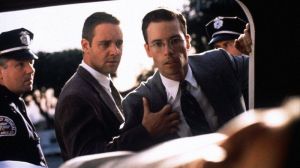 This movie is a master class in plotting and structure, enough that it should be taught in film schools. By nature noir plots are meant to be busy and mysterious, and a guarantee for mystery is a Byzantine plot full of plenty of suspects, dispirit elements, and strange coincidences that eventually coalesce into a larger picture. The beauty of what Hanson and Helgeland have done is that they have made the script complex yet accessible, able to lose one’s self in the tangled web of intrigue but still able to see how all the myriad pieces fit perfectly together by the conclusion. There is an efficiency to the screenwriting that is mesmerizing. It all seems so effortless when you’re with storytellers this gifted or who have a divine connection to the source material. Forgoing the customary slow builds of recent film noir like the oft-cited Chinatown, L.A. Confidential just moves from the opening narration. Within the first 25 minutes, the movie has expertly set up all three of its main characters, what defines them, their separate goals, the obstacles in place, and previews how they will intersect into one another’s orbit, and then the Nite Owl case explodes. Every scene drives this narrative forward. Every scene reveals a little more depth to our characters or fleshes out a superb supporting cast. Every scene cements that contradictory theme of the glitzy allure and unseemly darkness of the post-war City of Angels. My only quibble is that before the truncated third act the movie resorts to a few easy shortcuts but by that point Hanson and Helgeland had more than earned their paces. This is one of the greatest modern screenplays, period (WGA listed it as #60 all-time).
There are so many remarkably assured sequences but I want to emphasize one in particular – Exley’s interrogation of the three Nite Owl suspects. “Oh I’ll break him,” Exley promises his superior before entering into the first interrogation room. At first you’re with the other officers and morbidly curious with his arrogance. By the end, your jaw hangs in amazement at the intuitive pressure this man is expertly applying. It’s a terrific moment that allows Exley to masterfully manipulate three different men, taking pieces and running toward accurate insinuations, building momentum and clarity. Each man is different and each man offers a new piece of the overall puzzle. A slight reference by one unlocks another’s confession. An overheard sound byte pushes another into self-defense. I’m convinced it was this scene that ensured robust and thorough interrogation was a crucial element of the gameplay for the 2011 video game L.A. Noire, a noble misfire that definitely looked to replicate Hanson’s film as a user experience.
 Noir is one film genre with a visual code that can get the best of directors, but Hanson played this to his advantage. Classic noir is filled with criminal activity and the allure of sex and violence, typified perhaps best in the position of the untrustworthy but oh-so-sexy femme fatale. Yet the majority of film noir was produced in an era of censorship thanks to the implementation of the notorious Hayes Code, making sure that audiences didn’t enjoy the sordid elements too far. Free of these restrictions, some modern filmmakers take the opportunity to revisit the noir landscape and fill in the blanks of old, furnishing an outpouring of unrestrained exploitation elements. Brian DePalma’s 2006 film The Black Dahlia (also based on an Ellroy novel) gets drunk on this mission, though “restrained” has never been a word I would associate with DePalma’s filmmaking anyway. My point, dear reader, is that it’s easy to get lost in the superficial trappings of the genre: sexy dames, corrupt lawmen, temptation, shootouts, schemes, and chiaroscuro lighting. It’s easy to dabble in these elements because they’re so nostalgic and celebrated.
Hanson did something different with his 1997 masterpiece. He builds upon the audience expectations with noir but he doesn’t let his complex story and characters come second to the visual spectacle of the famous genre. L.A. Confidential is in many ways a movie that straddles lines; old and new, indie and Hollywood classicism, and film noir and drama. It’s an adult film that doesn’t downplay its darkness, brutality, and moral ambiguity, yet when it comes to those exploitation elements, especially sex, it’s almost chaste. The relationship between Lynn and Bud seems refreshingly square, like it was pulled from Old Hollywood. The entire movie feels that way, an artifact that could exist any decade.
Hanson was something of a journeyman for most of his career, directing competent thrillers like The Hand That Rocks the Cradle and The River Wild. As Variety film critic Owen Gleiberman wrote in his eulogy for Hanson (he died in September 2016, a fact I shamefully didn’t know until writing this review), after 25 years in the industry the man became an earth-rattling auteur after the age of 50. That is a rarity. Who knew the guy had something this singularly brilliant within his grasp his entire career? The care he puts into the screen is evident from the opening montage onward. There’s an elusive magic to the filmmaking on display, a bracingly divine sense of how to move the camera for best effect, how to escalate and deescalate audience nerves. He knows his story structure and characters inside and out, but he also knows how to play an audience. His time making serviceable studio thrillers certainly helps him during the film’s climax, a bloody shootout that’s also a mini-siege thriller.
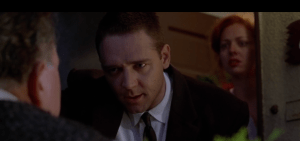 Hanson also assembled an incredible crew to enable his vision. The technical elements recreate the early 1950s L.A. time period with beguiling immediacy; the cinematography by Dante Spinotti (Heat) gives a sense of the darker elements just under the surface without having to overly rely upon the film language of staid noir visuals. Peter Honess’ sharp editing provides a downright Thelma Schoonmaker-esque musical orchestration to the proceedings, especially as the multiple storylines and developments spill onto one another. Speaking of music, the score by Jerry Goldsmith (Star Trek) is thick with the jazzy overtones of the genre. It’s a score that simmers with sexual tension and malevolence. The casting director deserves a lifetime free pass. There are a whopping 80 speaking parts in the movie, and each person is a great hire that builds a richer film.
While the plot of L.A. Confidential sucks you in right away, its characters take hold the strongest. Film noir is one genre that has a codified cheat sheet of character archetypes, and this movie fulfills and subverts them, finding surprising and gratifying ways to further round out these figures into complex and nuanced human beings. The three main characters all provide a different approach to law enforcement and when we see them start to work together it’s a wholly wonderful turn of events. Bud is the muscle, Exley is the brain, and Vincennes is the charm, and each one attacks the Nite Owl case and its subsequent leads from different angles that best apply to their set of skills. Each of the three characters discovers new pieces of evidence, new contacts and suspects, and when they start to work together it not only provides a payoff with the combined evidence but with the satisfying nature of their teamwork. That’s because they become better people when they work together and each moves closer to some moral redemption.
Bud is the loyal cop with a hair trigger and a penchant for being a white knight to abused women. His personal history of abuse makes him seek justice, often by his own fists. He has a rigid moral code of right and wrong and isn’t afraid to cross lines to achieve it. He’s also tired of being a bully and wants to be more than just the muscle. Exley is a straight arrow with a strong sense of moral righteousness and a mind for politics. He knows how to play sides for his own gain. He’s not afraid of making enemies within the department, and his opportunistic choices create many. He’s trying to forge his own path outside the shadow of his father, a famous lawman who was gunned down by a random purse-snatcher (“Rollo Tamassi”). He has to learn that he can’t do everything on his own. Finally, Vincennes is in many ways the face of the department as an ambassador to the world of TV and film. He’s succumbed fully to the glamour of Hollywood but he’s also full of profound self-loathing, trying to count how many compromises he’s made in life and where it’s gotten him. The appeal of the old life is crumbling and his detective instincts are reawakened, spurring Vincennes into the fray and surprising even himself. It’s extremely rare for any movie to successfully develop more than one protagonist, let alone three, and yet L.A. Confidential achieves this milestone so that when we alternate perspectives there isn’t a drop in viewer interest. Each man brings something different and interesting, each man reveals new hidden depths, and each character is fascinating to watch in this setting.
 The gifted actors take the already excellent written material and elevate it even further, turning an already sterling movie into one of the all-time greats. Almost twenty years later, it’s fun to see these famous actors when they were young and, arguably, in their prime. Spacey (House of Cards) was on a tear at this point in his career, between his two well-deserved Oscar wins, and having the time of his life in every role. His character seemingly has the least complexity, a man who knows he’s sold out but believes himself to be enjoying the ride, but Spacey offers poignant glimpses of the man behind all that oily charm and sly glances. There’s a scene where he stumbles across a mistake of his making and the subtle, haunted expression playing across his face is amazing. The man was capable of expressing so much, and still is. Crowe was still a couple years from his big breakout in 2000’s Gladiator but he put himself on the Hollywood map as Bud White. He’s a coil of anger and pain looking for an outlet, and Crowe is magnetic as hell. His glowers could burn right through you. Pearce (Memento) was another knockout that solidified leading man status thanks to his performance as the rigidly self-righteous Exley. He’s a character that thinks he’s above moral reproach, and his humbling is a necessary part of solving the case. Exley is constantly surprising his peers and it feels like Pearce does the same, showing exciting new capabilities from scene to scene, from his stirring hire-wire act with the interrogation scene to his understated glimmer of fear through a poker face. These three performances are golden.
Nobody better represents sleaze than Danny DeVito’s character and the man brings a merry lechery to his tabloid journalist/exposition device. His unquenchable thirst for the worst in humanity to sell more papers feels even more sadly relevant given the media climate that contributed to the recent presidential election. Kim Basinger (Batman) won an Oscar for her somber performance, which reinvigorated her career. She’s good but I can’t help but feel that she won the Oscar in a weak field (my choice would be Julianne Moore for Boogie Nights). David Strathairn (Good Night, and Good Luck) is enjoyably nonplussed as a man who specializes in delivering vice. James Cromwell used every bit of audience warmth associated as the loveable farmer from Babe and used that to his advantage. His pragmatic police captain is a father figure for Exley and the audience and perfectly sets up a turn that leaves the audience spinning even twenty years later.
There are little details the could go unnoticed but confirm for me just how much thought was put into L.A. Confidential. Exley is chided by his superiors for wearing glasses as they think it makes him look weak. As the film develops and he gets more immersed in the Nite Owl case, his compulsions against violence and rash judgment start to waver about the same time he stops wearing his glasses, a subtle symbol of his difficulty to see things for what they truly are. I enjoyed that our introduction to Lynn is in a liquor store and she’s wearing a winter cloak that strongly resembles a nun’s habit. It’s a memorable costuming choice and also suggest Lynn’s penchant for straddling the line of devotion. The Patchett “whatever your heart desires” line of high-class prostitutes has allusions to our current media culture of celebrity worship and personalized sexual fantasies. It naturally ties into the exploitation of the dream factory of Hollywood that takes young ingénues with dreams in their head and squashes them pitilessly. It’s not the first film to explore the darker side of the film industry but that doesn’t make its themes lesser.
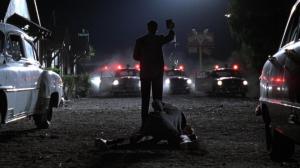 L.A. Confidential feels like the noir thrillers of old but stripped down to its essentials and given a new engine. It’s something that celebrates noir thrillers of old and Old Hollywood but it isn’t so lavish to either the genre or older time period that it loses sight of its own storytelling goals. The elaborate plot is complex and intensely engaging while still being accessible, populated with memorable and incredibly well developed characters, each given their own purpose and own insights that contribute to the larger whole. Hanson’s lasting accomplishment is a near-perfect masterpiece to the power of story structure and characterization. The three lead detectives are compelling on their own terms and the movie keeps them separate long enough that when they do come together it feels like a payoff all its own. Hanson recreates the world of classic film noir and makes it his own, using new Hollywood to lovingly recreate Old Hollywood. It’s the kind of movie I can watch again and again and discover new depths. It gave way to a wave of success for its participants. Hanson never quite delivered another movie on the level of L.A. Confidential, though I’ll posit that In Her Shoes is an underrated character piece. Helgeland has become a go-to screenwriter for many projects low (The Postman) and high (Mystic River) and became a director for A Knight’s Tale and 42. It’s a movie that plays just as strongly today as it did almost twenty years ago, and that’s the mesmerizing power of great storytelling and acting. L.A. Confidential is a lasting achievement that proves once more the power of our darker impulses. It’s stylish, seductive, smart, subversive, and everything you could ask for in a movie.
Nate’s Grade: A
Share this:

Doctor Strange (2016)
 After eight years and over a dozen movies, the unstoppable box-office juggernaut that is the Marvel Cinematic Universe (MCU) seems like it could successfully sell the public on any concept, no matter how undeniably bizarre. This is the same studio that made us weep over the death of a tree that said three words. At this point, I think I can argue that the MCU has a higher film-to-film consistent quality of excellence than Pixar, the other most trusted brand in cinema (Pixar’s creative/emotional highs are certainly higher but they’ve had their share of misses). Marvel has earned the benefit of the doubt. The common complaint is that their movies feel too formulaic and insubstantial. I would definitely argue against the latter and the former needs no real defense. Marvel has built an empire on a system that works because it delivers crowd-pleasing and character-oriented blockbusters that are packed with payoffs for fans and newcomers. The alternative, chiefly the dour bombast of the fledgling DC film universe, isn’t much more appealing, but then again I have been labeled a “Marvel shill” by those infuriated from my inconceivable pan of the very conceivably terrible Suicide Squad, so take my word with some skepticism. For any other brand, Doctor Strange could be too weird. With the MCU, it’s another comforting sign they really know what they’re doing.
Stephen Strange (Benedict Cumberbatch) is a brilliant New York neurosurgeon who loses full control over his hands after a horrible car accident. He travels to Nepal to seek out holistic remedies to aid his recovery and instead finds the Ancient One (Tilda Swinton), a powerful mystic. She takes a liking to Strange and invites him into their temple to train as a pupil of powerful sorcerers (Chiwetel Ejiofor, Benedict Wong). Former sorcerer, Kaecilius (Mads Mikkelsen), has gone rogue and believes the only way to survive the oncoming cosmic giant Dormammu is to join him. Doctor Strange must summon all the skills of multiple dimensions in order to save the day.
 Doctor Strange is at its core an origin tale and one that feels somewhat familiar at least for its first half. It’s likely not an accident that Stephen Strange bears more than a passing resemblance to Marvel’s other egotistical, arrogant charmer, Mr. Tony Stark. He’s a man who has to be humbled and learn the error of his ways and his outsized hubris, which makes for an effective character arc to structure an introductory movie around. It also makes fine work of Cumberbatch’s otherworldly sense of haughty superiority (I can’t wait to watch future Strange and Stark banter). The first half is essentially Training Montage: The Movie. Strange learns about the ancient mystic arts and, more importantly, super powers. The movie doesn’t follow Thor’s lead and argue that magic is another form of science. It declares magic as its own thing. Strange learns how to open portals, how to shift reality, how to astral project, and even how to stop time. Each new power is given proper attention and the learning curve adjusts as needed, allowing an audience to process the various rules and dramatic stakes. It’s a structurally smart assembly of mini-goals to keep an audience secure in what otherwise could be overwhelming for its New Age mumbo jumbo.
After the origin heavy lifting is taken care of that’s when Doctor Strange becomes everything I could hope for, namely a highly imaginative action movie with a breakneck pace and a boundless sense of imagination. This movie feels kinetically alive and unpredictable in ways that few Marvel movies even approach. Once Strange and Kaecilius meet at the halfway mark it becomes a gallop to the finish line with one highly entertaining action set piece after another, and even better they are wildly different. We don’t have battles about running and firing weapons or just punching bad guys extra hard; instead, it’s reality itself that bends to the will of the fighters. Characters walk on walls, shift the state of architecture, create teleportation portals to hop in and out of, shift the entire gravity of the world to force people away from said portals, and turn New York City into a kaleidoscopic playground. There’s an extended chase scene that literally feels like a series of M. C. Escher paintings come to starling life. The sequence is eye-popping in the best way and, shocking enough, it’s not even the climax of the movie. There are so many fun possibilities for crazy action sequences. There are other sequences that stand out, such as an out-of-body fight between two warring astral projection foes. The real climax of the movie is something I’ve never seen before, a battle that takes place as time resets. The smoldering ruins of a cataclysm are put together brick-by-brick and characters dodge the debris as it rapidly reforms. It’s visually thrilling to watch but it’s also a clever sequence because there are continuous opportunities for danger and in many ways that your brain cannot naturally suspect, like when a wall reforms and traps someone within. Whatever your feeling on the general MCU and its blockbuster formula calibrations, Doctor Strange is a great leap into something different, momentously exhilarating, and inventive.
Director Scott Derrickson (Sinister) was an intriguing choice considering his background in supernatural horror, but, as should be obvious, the MCU overlords score again with their foresight and risk-taking. Derrickson’s visual influences hew much closer to Christopher Nolan and the Wachowski Siblings than the greatest hits of the MCU, and that’s exactly what this world needed to stand out on its own. I cannot overstate just how enjoyable the last hour of the movie can be, though this isn’t meant as a backhanded slight against that first half. The action-packed hour only works because of the setup from before and laying a careful foundation for the characters, their dynamics, and the rules of this trippy universe that bends conventional physics. All the careful world-building and training montages set up the sprint through a fireworks factory of fun, and I had a smile plastered to my face the whole time, eagerly anticipating the next detour into crazy.
I’m even going to impart you, dear reader, with some advice I haven’t given since 2013: if possible, see this movie in 3D. The hypnotic visuals and elusively shifting reality demand to be seen with the added help of the third dimension. The movie will still obviously work in a non-3D format but why deny yourself the full impact of these incredible visual experiences? New York City contorting is worth the extra few bucks alone.
 The acting is another highlight for such an enjoyable movie. Cumberbatch (The Imitation Game) easily makes for a terrific lead actor, someone who can bring a sense of gravitas or dry sarcasm when called upon. His sense of comedy is underrated and this Sorcery Supreme gets his fair share of punctuating the weird and wild with a perfectly delivered joke. A bit with a sentient cape allows for great physical comedy. His American accent is also much improved from earlier far spottier efforts in 2013’s August: Osage County and 2015’s Black Mass, which featured perhaps the worst “Baustun” accent in recent memory. Cumberbatch is the charming smartass, the know-it-all who realizes how much he still has yet to learn, and his final showdown with the Big Bad Evil sheds large-scale disaster for something much more personal (no giant portal in the sky or faceless army of monsters/aliens, hooray!). His character arc of learning that it’s not about himself culminates in a brilliantly conceived sequence that satisfies. The other standout is Swinton (Snowpiercer) who once again melds with her character, who happens to be a mysterious Celtic mystic who may not even be human. The early half is instantly elevated when Swinton is on screen. She presents a matter-of-fact sense of the preposterous that is downright serene. It’s also a role that is more than just a requisite mentor as The Ancient One has some secrets that will be revealed. I was also genuinely pleased with how much screen time Mikkelsen (TV’s Hannibal, Rogue One) gets for his villain, who has a wicked deadpan. I pity Rachel McAdams (Spotlight) who plays the underwritten love interest role we’ve seen similar to Natalie Portman prior performances. She at least gets a few good scenes before being forgotten.
With each additional entry into the ever-expanding Marvel Cinematic Universe, the fan in me gets to reexamine and realign the pecking order of quality. In my own subjective rankings I would say that Doctor Strange is just below the top tier of the MCU (Guardians of the Galaxy, Civil War, Iron Man) and on par with Winter Soldier. This is a highly enjoyable and highly imaginative action movie teeming with eye-popping visuals. Many of the visual set pieces are stunning and demand to be witnessed on the largest screen possible. The movie never loses its sense of fun and wonder while still respecting the dramatic stakes of the cataclysmic events, and when it goes big it makes it matter. I have no previous attachment to this character and Doctor Strange was just about everything I wanted the film to be and then some. It’s another sign that Marvel can take any property and find the formula to make it a satisfying smash. I enjoyed Doctor Strange enough that I want to see it again, and this time even bigger to better soak up the strange.
Nate’s Grade: A-


You must be logged in to post a comment.