Blog Archives
The Mountain Between Us (2017)
 At what point can you tell an onscreen pairing just isn’t working? Chemistry is one of those elusive and ineffable qualities that can make or break a film, especially one that relies upon sexual tension and romantic yearning. If the actors don’t feel like they want to be with one another, it’s all going to fall apart. This is what I kept thinking as I watched The Mountain Between Us and was dumbstruck by the powerful lack of chemistry between its leads, each an accomplished actor in their own right. I don’t thin the movie could have been saved given its script but it certainly could have been at least better. If you’re going into The Mountain Between Us expecting a thrilling survival tale or a stirring romantic pairing, then you’ll be sorely disappointed.
Ben (Idris Elba) and Alex (Kate Winslet) are strangers who have the same problem. Their flights have been canceled and they have important places to be. He’s a surgeon. She’s a journalism photographer who is getting married. They share a single engine propeller plane to fly over the mountains and into the Denver airport. Unfortunately, the pilot suffers a stroke and the plane goes down, stranding Ben, Kate, and the pilot’s helpful labrador in the mountains. They’ll have to rely upon one another to survive in a hostile wilderness and seek rescue when nobody knows where they may be.
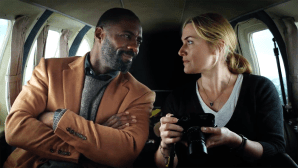 Watching pretty people endure hardships and persevere is as old a story as Hollywood, and The Mountain Between Us fails on so many levels, but none more so than chemistry. Elba and Winslet are meant to fall in love with one another over the course of their struggles and it is that love, we are told, that was the real key to their survival. If that sounds like Nicholas Sparks dribble, you’re on the right track, as the source material was very much a romance story. I’m sure the characters had to be better established and the romance felt more organic than what we get in the movie. I think the setup is an interesting place to start: two strangers who rely upon each other for survival and that co-dependence transforms into something they deem to be love. However, we don’t really get much in the way of the consequences of this except for an extended coda that doesn’t feel like nearly enough. Other than a spur-of-the-moment sex scene the movie doesn’t dwell on this looming romantic relationship in any way other than glances of gratitude. We hardly know anything about these characters before they are in a plane crash, and from there the survival against the elements takes precedence. Winslet spends most of the movie laying down and needing to be taken care of. If this movie needs to survive on their romance then it was doomed at casting. Granted, there is nil in the way of characterization and plot development for them to work with as well. At no point do you feel any emotional connection or even any sort of sensual heat between them. They seem far more irritated and put-upon by one another, but that’s supposed to melt away into something deeper and meaningful, though it never does. These are two talented actors but whoa do they not work together (other pairings were going to be Michael Fassbender and Margot Robbie, Charlie Hunnam and Rosamund Pike). Let this film be a lesson to everyone about the importance of hiring the right actors.
 Given the life-and-death survival, it seems shocking that the film has such low or non-existent stakes. You never once feel like these characters are in real jeopardy. They always seem to luck out, whether it’s a perfectly placed flare gun to ward off a bobcat, a cabin that’s none too far from their crash site, or that same dead bobcat that can provide some nourishment. There doesn’t seem to be much of a struggle on screen other than walking through the snow. It’s missing the visceral realism that survival stories offer audiences as entertainment. Ever since watching Wind River, stories about characters running long distances in sub-zero climates is ruined for me. I keep thinking, “Why aren’t their lungs exploding now?” I was surprisingly bored through much of their survival outdoors because none of it felt that serious or memorable (this isn’t Kate Winslet’s personal Revenant). This is less a survival story than a sudsy romance. Apparently, how they survive is less important than their eventual acknowledgement of love. It removes all sense of danger. The inclusion of the dog is the single greatest antidote to realism. Ben and Alex have a cute pet this whole time. This makes The Mountain Between Us feel like a “movie” rather than a “story,” and so we just wait and wait for precious moments that will successfully entertain, few and far between they are.
Director Hany Abu-Assad (Paradise Now, Omar) makes fine use of the Canadian Rockies to provide breathtakingly picturesque landscapes. Even if you’re relatively bored with the characters there’s always the scenery to take in and enjoy. Abu-Assad does have one memorably effective sequence and that’s the plane crash itself. His camera bobs and weaves inside the tiny cabin as long unbroken shot, reminiscent of the famous sequence inside the car in Children of Men. It’s an effort level that isn’t really matched, or at least evident, for the rest of the movie. It peaks at the crash. The human drama seems more interested in the human drama than the survival thrills, which is fine, but if that was the case then we should have gotten better characters and the room for them to develop so that whatever romantic connections form feel and believable and desirable.
 I have a solution to all of these issues except the chemistry one. This movie needed a radical rehaul at the structural level to be a better-developed and more interesting story. The movie needed to be told primarily AFTER Ben and Kate are rescued (spoilers, I guess, but I doubt many thought this was going to end in Greek tragedy). It’s during this fifteen-minute coda where the movie becomes its most interesting, and that’s because our characters have to readjust to the outside world but are forever changed. Starting from that point allows the characters to open up so much more and we see a different array of challenges, ones that are more relatable but also with an undetermined outcome. We know these actors are going to live by the film’s end without question. We don’t know if they’ll still be psychologically stable or whole though re-acclimating to their lives. This needed to be more like the second half of Room. This approach would give substantially more for these great actors to dig into. You could also use flashbacks to fill in notable experiences during their time stranded in the mountains. This would provide contrasts but it would also smartly allow us to skip all the dull stuff we know is just filler. This would also allow more genuine surprises and chances for narrative irony. At one point Alex develops the film roll she took during her time in the mountains, and at this point we already know she snapped a picture while Ben was asleep post-coitus. What if seeing these pictures was our first clue that some romantic intimacy happened? These two people bonded over the course of a couple weeks and no two other people may fully understand what they’ve gone through. Explore that with their difficulty to reconnect to the “outside world” and how much they have come to rely on one another after their rescue. That way it’s a character-piece about relationships with worthy material.
The Mountain Between Us is a mediocre romantic drama hindered by terrible chemistry, half-formed characterization, and a poorly developed story. When the life-and-death survival after a plane crash in the mountain feels lacking in stakes and peril, then you have a problem. When the romantic union between its mega-watt stars feels perfunctory, you have an additional problem, especially when it seems to be the point of the exercise. The Mountain Between Us plays, as one other astute critic wrote, as “Idris Elba fan fiction,” with the injured lead being tended to by the handsome and capable protector who can’t help but fall in love with this woman. It’s not an offensively bad movie but a fatally flawed disappointment that had potential given its premise. There needed to be a dramatic restructuring of the screenplay to emphasize their recovery, which would have better served the talents of these actors. Still, there are worse people to be stranded with.
Nate’s Grade: C
Share this:

Blade Runner 2049 (2017)
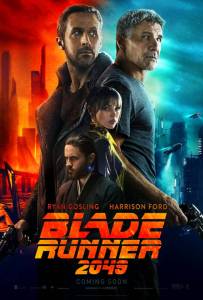 It’s confession time, dear reader. I do not love Blade Runner. In fact I find it to be overrated and then some. I’ll freely admit that it’s been an extremely influential science fiction work and its noir-soaked depiction of a cyber punk future has been the starting point for cinematic storytelling in that vein for decades. It’s got merits but I find the real merits to be its amazing use of production design, special effects, and the establishment of an overall atmosphere. It has some big ideas, yes, but it doesn’t know what to do with them, neglecting them for a slapdash story with some so-so acting. Rutger Hauer’s soulful yet doomed replicant should have been our central perspective. I wish I enjoyed the film more but I cannot attach myself without nagging reservation, and that’s not even accounting Ridley Scott’s numerous re-edits and the harebrained idea to imply that Harrison Ford was really a replicant after all even though that runs counter to the logic and themes of the film and Scott had to splice in unused unicorn footage from a movie he shot years later, thus proving this new twist ending was never part of anyone’s original story conceit. Anyway, what I’m saying is that the 1982 Blade Runner was not going to be an impossible hurdle to clear as far as I was concerned. The sequel 35 years in the making, Blade Runner 2049, is a better and more accomplished film experience and film story than the original, and it’s also one of the best, most visionary movies of the year.
Set in 2049, replicants have been shuttered and replaced with a new breed of android slave labor controlled by the enigmatic Niander Wallace (Jared Leto). He’s after a very special kind of replicant, one that will lead to even greater success, allowing mankind to reach further out into the stars. Agent K (Ryan Gosling) is a blade runner who finds himself looking for this same special kind of replicant. He must find it before Niander does and K’s journey of self takes him right to the doorstep of retired blade runner, Deckard (Ford).
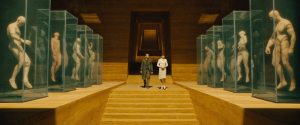 Apologies for the frustratingly vague plot synopsis above, but I’m trying to keep things as relatively spoiler-free as possible because I think that will improve the overall viewing experience. In an age where trailers and TV advertisements tell us everything about a movie in a zealous attempt to get our butts in seats, I was genuinely surprised at significant plot beats the 2049 advertising had successfully and deliberately kept under wraps. There are intriguing plot turns and character moments that I want to leave the reader to discover on their own. It will be worth the wait.
Director Denis Villeneuve (Arrival, Sicario) has created a filmgoing experience that immerses you in feeling. Every set, every little corner, every minor character goes toward enriching this world and making it feel real, like we’re just dropping in for a visit. He builds off the iconography from Scott in the first film and creates a future that is hypnotic and eerily beautiful, aided by the greatest living cinematographer, Roger Deakins. Seriously, if Deakins finally doesn’t win his long overdue Oscar for this, then the Academy is just never going to favor him. The visual landscapes of this movie are jaw dropping and the use of lighting is gorgeous. There’s a late sequence set in an irradiated Las Vegas where an orange fog hovers over the empty landscape of earthly pleasures. There’s a hiding sequence that takes place in a casino showroom, with holographic dancers and even Elvis fritzing in and out, static movements and bursts of sound that make for a dream-like encounter. Another wonderful hypnotic sequence is a threesome between K, a prostitute, and a virtual intelligence (V.I.) named Joi (Ana de Armas). Reminiscent of Spike Jonze’s Her, the sequence has one woman literally folded over another as hands caress, mouths kiss, and the whole sequence has an alluring disconnect during the acts of physical intimacy. This is a gorgeous movie to simply take in and appreciate the sumptuous visual brilliance. Villeneuve has quickly become one of the best big screen visual artists we have today.
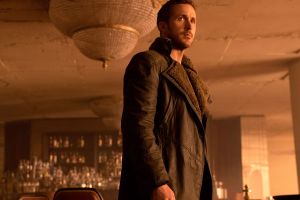 What separates 2049 and makes it better than the original is that here is a film that takes big ideas and knows what to do with them. This is an intelligent film that finds time to develop its ideas and to linger with them. This is a long movie (2 hours 43 minutes, the longest film so far of 2017) and one that many will decry as boring. That’s because Villeneuve and screenwriters Michael Green (Alien: Covenant) and Hampton Fancher (Blade Runner) commit to allowing the movie time to breathe, and scenes can take on an elegant life of their own becoming something of stunning power. Take for instance a scene where K visits the woman in charge of creating the false memories for replicants. Because of an autoimmune disorder, her life is behind glass, but she gets to create her own world to thrive in, and we watch her fine-tune the memory of a child’s birthday party while K asks her questions over her work. He has questions over the validity of memories, and this opens up a deep discussion over the concept of self, authenticity, and ownership over memory, all while still being character-based. It’s lovely. It’s like somebody saw the potential of the original Blade Runner and added the missing poetry.
2049 is driven by a central mystery but it’s also an exciting action movie. The sequences are few and far between but when they do happen they too luxuriate in the extra ordinary. The way the replicants are able to move again brings up that visual disconnect that can be so pleasing. A replicant-on-replicant fight is like a sci-fi superhero brawl. Dutch actress Sylvia Hoeks is our chief antagonist, Niander’s muscle on the outside. She might not have the languid magnetism of Daryl Hannah or playful philosophy of Hauer but she more than makes for a memorable and impressive physical force. The action and chase sequences are minimal, but when they do pop up Villeneuve doesn’t put the rest of the movie on pause. The characters are still important, the story is still important, and Deakins’ visual arrangements are still vastly important. 2049 is a movie at its best when it’s still and meditative, savoring the moment, but it can also quicken your pulse when called.
Gosling (La La Land) is uniquely suited for this character, another in the legacy of Sam Spade and Phillip Marlowe. His taciturn nature is essential to his character. This is a man going from day to day. His only emotional attachment is to Joi, the V.I. projection, and even that relationship is called into question knowing she is a product meant to serve. This relationship is given a healthy dose of ambiguity so that an audience never fully knows whether Joi genuinely cares or is just following the dictates of her programming. Gosling provides a quiet yet impactful turn as a man searching for answers. In the opening scene, Dave Bautista (Guardians of the Galaxy vol. 2) plays an older replicant that K must “retire.” Bautista says the difference between them is one of faith, as he has seen a miracle, and this allows him to believe in something greater. This opening interaction lays the foundation for K’s character arc, as he searches for his own faith. It’s not necessarily a spiritual faith per se but definitely a belief in a renewed hope.
 Another aspect lovingly recreated is the trance-inducing synth score from Vangelis, this time cranked up all the way to eleven by composers Hans Zimmer and Benjamin Walfisch (It). It comes in like waves, blaring loudly to the point that you swear you can hear the theater’s speakers rattling. It’s omnipresent and oppressive and it’s so freaking loud. I challenge anybody to fall asleep in the theater and actually stay asleep.
Blade Runner 2049 is one of those rare sequels that not only justify its existence but also improve upon its predecessor (again, not the biggest fan of Scott’s movie). It’s reverent to the older film and its film legacy while still charting a path all its own that it can stand upon. It takes a far more interesting narrative perspective to jump forward, possibly serving as a corrective to the original. I was fully engaged from the start as it challenged and entertained me to its concluding image of snowfall (oh no, spoilers!). This is a long movie but your patience pays off and then some. This is a deeper dive into the themes of author Phillip K. Dick and a better development of them. See it on as big a screen as possible, make sure to get your bathroom visits out of the way before it starts, and prepare for your eardrums to bleed from Zimmer’s blaring tones. Villeneuve has created a thoughtful, mature, exciting, and absorbing work of art that will stand the test of time. It won’t be as monumentally influential as the original Blade Runner but it is the better movie, and right now, in 2017, that’s a much more important factor for me as a viewer.
Nate’s Grade: A
Share this:

It Comes at Night (2017)
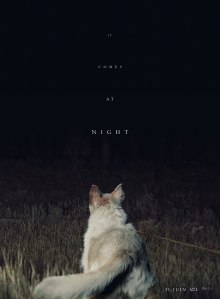 Like an earlier harbinger of the potential pitfalls of mother! marketing as something it’s not, the vaguely apocalyptic drama It Comes at Night is a paranoid thriller that is so bleak and absent resolution that you’ll wonder why anyone bothered. It’s not a bad film, and actually writer/director Trey Edward Shults has a knowing command on how to raise and develop tension with very precise camerawork and visual composition. The slow inspection of offscreen noise is still ready to build tension. The story has promise. Joel Edgerton is the father of a family trying to eek out an existence after the spreading of a deadly plague. He has a strict series of guidelines to protect his family members and keep them secure. This is put into jeopardy when he meets another family and invites them into his home. The rest of the film follows the slow dismantling of trust and the rise in suspicion and how it ruins both families. That’s essentially the movie. There is no “it” of the It Comes at Night. The post-apocalyptic element is at best tertiary to the plot, and the titular warning seems odd considering sickness can arrive at all hours. I think the reason audiences seemed to froth wildly at the mouth over this movie is due to its grossly misleading marketing. I re-watched the trailer and all of the supernatural imagery, which is extensively highlighted, is from dream sequences, and one dream sequence within a dream sequence. There’s a moment where the grandfather’s dog runs off into the woods at barks at an unseen force. You hear strange sounds but you never see anything, and this becomes just another unresolved, underdeveloped element. This is more a Twilight Zone parable about the destructive nature of man. The look of the film is moody, the performances are good, but I felt underwhelmed by the end and questioned the point of it all. It Comes at Night is okay. I can’t see what people loved and I can’t see what people hated, though I can see more of the aversion.
Nate’s Grade: C+
Share this:

It (2017)
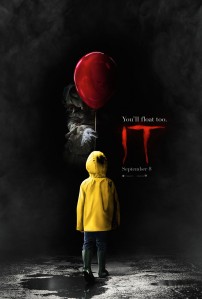 Stephen King movies have had a spotty track record at best. For every Shawshank Redemption or The Shining, there’s an overwhelming multitude of disappointments and dreck, including this summer’s long gestating and prophetically disappointing Dark Tower adaptation. The two-part It mini-series came out in 1990 and is best known for Tim Curry’s unnerving performance. Otherwise, it wasn’t that great itself but, grading upon a steep King curve, it comes out as perfectly tolerable. Hollywood has been trying to get a new It movie in development for years, and I mostly just shrugged at the idea. Did we really need another version? After seeing the 135-minute finished film, I can say that the answer to that is a definitive and enthusiastic yes. It is a fiendishly fun horror movie with rapturously composed visuals, an affecting emotional core, and impressive craftsmanship. It’s easily already in the top echelon of King adaptations.
Back in 1989, children have been mysteriously disappearing from the small town of Derry, Maine. Bill (Jaeden Lieberher) is still recovering from his younger brother who went missing one fateful rainy day. Bill holds onto the hope that somehow his brother is still alive, washed away through Derry’s series of sewers. He and his group of friends, affectionately nick-named The Losers, are being hunted and haunted by a strange clown who calls himself Pennywise (Bill Skarsgard). This evil clown feasts on the children’s fears and has been frightening Derry every 27 years, snatching children to consume, including Bill’s lost little brother. The Losers band together to stop this clown menace.
 Director Andy Muschietti (Mama) brilliantly brings to life a dynamic funhouse of scares, suspense, and big screen delights that will leave you howling for more. Much like James Wan’s Conjuring films, Muschietti doesn’t present anything radically new into the world of horror, but he takes older, sustained horror techniques and executes them to near perfection. The greatness of horror is when you simmer in that delicious sense of tension nervously awaiting what’s to come next. For this effect to have any punch, a filmmaker needs to lay a deliberate foundation to then twist and manipulate. Muschietti is amazing at heightening the atmosphere of dread and drawing it out. There are scares in It that are textbook in their masterful orchestration. Take for instance a scene with Ben (Jeremy Ray Taylor) in the basement of a library. He looks over his shoulder to see an ashen child’s body standing on the stairs. Given the lowered camera angle, the top of the ceiling cuts off the ashen kid’s head. Then as he stumbles down the stairs it’s revealed… he has no head. It’s a startling reveal and it carries on from there. Pennywise coming through a haunted slideshow of Derry was another creepy highlight. The red balloon of Pennywise transforms into an alarming totem for the audience, a signal to begin your nervous anticipation. The movie keeps finding new ways to creep you out until the very end. It’s movies like It that can remind you what tremendous fun horror movies can achieve.
Let’s get straight to the clown, the star of so many nightmares. Curry is the reason why anyone remembers the 1990 TV mini-series. Fortunately, Skarsgard (Atomic Blonde) goes in his own direction for his own personal interpretation of the character. There are similar tics, in particular the lisp, but Skarsgard makes it his own and he is wonderful. His command over his body is incredible and it magnifies the creepiness of every appearance. He holds his cheeks together in a rictus grin that looks downright painful, and he’ll lock into expressions and just let dribbles of saliva drip off his chin. Even while playing this big, broad, malicious character with a penchant for theatricality, Skarsgard can find little touches to create an even more unsettling impression. I’ve never been impressed by Skarsgard’s performances before, mostly amounting to my unchecked hatred of his awful Netflix TV series, Hemlock Grove. He impressed the hell out of me in It. This is a Pennywise that has such loose, alarming contortion over his body. When he pulls his face back revealing row after row of sharp teeth, it’s almost a relief from the more horrifying human version of Skarsgard’s outsized antics. Tim Curry owned his character’s sense of campiness. In contrast, Skarsgard feels deliberately more unhinged and also a creature in complete revelry of being so deranged. If you have a fear of clowns, I would advise that you simply never watch this movie in your entire life.
 While I was expecting the big top entertainment from Pennywise, I was surprised at how involving and relatable the teenage drama can be. The screenwriters have done an admirable job at taking time to establish the characters and their relationships to one another. The town of Derry is a world of criminally neglectful adults. Everyone in this town seems to be an asshole; even the librarian chides Ben for the indecency of looking at books in a library during the summer (do your job, lady!). It’s a world where grownups disappoint and where adulthood is just a miserly existence of abuses. Beverly’s father lecherously takes ownership over his daughter’s body. Eddie’s (Jack Dylan Grazer) hypochondriac mother tries to lock her son away from the larger world, not out of protection but out of her own selfish comfort. These are the kind of people that look the other way while the local town bullies are literally carving initials into a child’s flesh. With all of this awfulness, the coming together of the Losers and their unified friendship provides a lifeline of support. They’re relatable, realistic, and heart-warming in their affection for one another. They talk and act like authentic kids, which also means they make dumb decisions out of curiosity. The movie stops to share little coming-of-age moments that ring true, like Beverly’s (Sophia Lillis) awkwardness at shopping for her first tampons or the boys trying to act cool in front of a girl. As he did with Mama, Muschietti is super-humanly adept at directing child actors. Seriously, he might have to direct all child performances from here on. The young actors do fine work at building out their characters, though some are expectedly underwritten. Special notice should go to Lieberher (Midnight Special) as the stuttering Bill still trying to grasp his brother’s death.
Given the childish nature of the fears and the theatricality of its villain, the movie is inevitably going to skid into goofy territory, but instead of rejecting this It swerves into the skid and becomes even better. When you deal with a killer shape-shifting clown who hides in the sewers and lives upon the fear of children, things can get silly and pretending otherwise is a waste of time and energy. Muschietti and company acknowledge the otherworldly with proud panache, making the goofiness part of the fun and ultimately part of the terror. Skarsgard is tremendous at turning on a dime, having his lisping, big grinned clown go from broad and ridiculous to terrifying, and he can do it with just a look. It happens even in his earliest big screen appearance. This is a Pennywise who feels like an alien’s idea of a party clown; the original elements are there but connect wrong or are amped up. There are a couple instances where Pennywise dances, and I absolutely adored each. His malevolent gesticulations felt like an exaggerated cartoon given unholy life, which seemed more than fitting. You may laugh at points and then gasp the next, and I’m fully convinced that’s the intended response. The childhood fears are much improved from the classic Universal monsters from the original novel (I’m sorry, nobody is afraid of mothballed versions of Dracula or Frankenstein in this day and age). Seeing them manifested as misaligned phantoms is far worse, even if the effect might not be as jarring without the accompanying music and sound design.
 The only structural problem I would cite is that It has a little too much fun with its scary set pieces and starts to feel redundant in the middle. It becomes a figurative funhouse (before the literal haunted house) of set pieces with each one of the Losers being tormented by our clownish friend multiple times. There are seven of them after all. We could have probably done with one or two fewer of these encounters. You’re having so much fun waiting with anticipation for each encounter that I can’t complain too hard. It’s difficult to push yourself away from the funhouse and get back on track to a narrative conclusion meant to cleave a 1000-page book into a workable satisfying endpoint. I thought the bully character featured considerably throughout the story was going to become an increasingly significant antagonist into Act Three. That didn’t quite happen. The ending scene bonding the children together also seems to exist in such an earnest tone, and yet the amount of blood onscreen for their bloody hand-holding ritual is comically excessive, which caused me to giggle. I choose to believe it was Muschietti undercutting the feel-good triumphant moments with some darkly macabre touches, to remind the viewer that while our characters have survived they are still forever distorted.
Let’s also discuss the most controversial aspect of the original novel that so many people seem to have conveniently forgotten and for good reason. Spoilers follow, though they do not pertain to this adaptation, because nobody in their right mind would ever include this. At the end of the childhood section, as the kids defeat Pennywise, they’re all coming down from facing the living embodiment of their fears. So what do you do next? Well if your answer is “have a child orgy,” then you’re correct, and also likely sick in the head. The kids all start having group sex, in the dank sewers mind you, with Beverly, the only girl, being the recipient of much of it. It’s an out-of-nowhere plot development that serves no justifiable artistic purpose and feels so wrong-headed that it’s hard to believe. But it’s real, folks. King won’t admit what seems the most obvious culprit (he was on a lot of drugs in the 1980s), and instead has offered some strange rationale saying the act was a connection between childhood and adulthood and… I don’t know. This narrative choice also grossly mistreats Beverly. It seems like an obvious and baffling misstep to have a pre-teen girl suffer viciously demeaning sexual rumors, the very real sexual abuse from her father, and then decide her ultimate gift to the group of boys that accepted her is to let them all have their way with her (excuse me while I vomit). Stephen King, just admit you were on drugs and this was a weird, lamentable mistake. It’s that easy, man.
 The newest incarnation of It is a glorious chiller with top-notch acting, directing, cinematography, production design, sound design, and just about all the elements that suffered from the lackluster 1990 TV mini-series. The 2017 movie is top-notch nightmarish mayhem treated as a marquee thrill ride. You strap yourself in and wait for the carefully calibrated scares and suspense and payoffs. However, the human element is not lost amidst the ride, and the children and their bond forms an emotional anchor. Muschietti demonstrates a consistent mastery of classic horror techniques. He allows scenes to build, to surprise, to startle in uncomfortable ways. Having such a talent at the helm, I was pinned to my seat and lapping up every moment of wonderful unease. The It mini-series was split into two stores, one focusing on the characters as children and another as middle-aged adults (the childhood stuff was, without question, superior material). The movie ends with the title “Chapter One” and the promise that, if the box office gods deliver, there will be a second chapter transporting us to the present. I was indifferent before but not longer. Muschietti has made me a believer. Give me more of It.
Nate’s Grade: A-
Share this:

Wind River (2017)
 With just two finished movies attached to his resume as screenwriter, Taylor Sheridan has enjoyed immediate success. Sicario and Hell or High Water were both some of the finest films of their respective years. Sheridan has a classical sense of structure but he also pumps his big, bold Hollywood dramas with meaningful commentary and substance to communicate a systemic rot from within, whether it is the spiraling war on drugs, the rapacious banking industry, or an entire enclave of people that are ignored as an act of historical penance. When you come to a Taylor Sheridan movie, you leave feeling full on a banquet of superior screenwriting. Wind River is his next feast.
A young Native American woman, Natalie (Kelsey Asbillie), is found barefoot and dead in the snow on a Wyoming reservation the size of Rhode Island. A confluence of law enforcement officers investigate while questioning who has rightful jurisdiction, the state police, the Native police, or FBI Agent Jane Banner (Elizabeth Olsen). She’s frustrated that, while the coroner will confirm she was raped the night of her death, Natalie is not being dubbed a homicide because of the cause of her death. Jane seeks out the assistance of Cory Lambert (Jeremy Renner), a wildlife hunter for the Fish and Game Department who watches out for predators. He knows the land, he knows the people, he personally knows Natalie’s family, and he knows the loss of a daughter. Cory agrees to help Jane discover who is responsible for the murder and seek justice and, possibly, vengeance.
 This is a deeply felt character-driven mystery that examines the lingering damage and defenses of a group of people often left on their own and often forgotten. Sheridan is quickly establishing himself as cinema’s finest voice when it comes to a twenty-first century cowboy ideal, the taciturn, wounded man soldiering onward in an unfair world. Sheridan has a commanding sense of place and character, but his perspective rarely connotes judgment. He’s more an observer, a therapeutic device for his characters to finally express themselves and their brokenness and how the world made them this way. He can be downright poetic but his instincts are for a large canvas with Hollywood thespians. He writes meaty, distinguished, and humane characters all around, not just for the leads. One of the hallmarks of Sheridan’s writing is how precise and generous he can be with his stable of supporting actors. As the story develops, we see just how the death affects the small community, a community struggling to hold itself together anyway through poverty, drug abuse, and limited work opportunities (according to a 2012 New York Times feature, life expectancy on the reservation was 49 years). There is a pervading sense of hopelessness that carries over the land. The people in this movie feel real, lived in, and haunted, and the location feels exactly the same. The ending text leaves a stark reminder of this feeling like a world on our peripheral: no statistics are kept for missing Native American women. Nobody has any sense how high that figure could be.
The leading man of Wind River is Renner (Arrival) but the real star is his character, a gritty and experienced wildlife hunter with an abiding reserve of unresolved issues pertaining to his own teenage daughter’s murder. He has some beautiful monologues in this movie, exquisitely written by Sheridan to showcase characterization and back-story. The first is when he helps his grieving friend by sharing the routine he went through with his own personal loss, specifically how forgetting the person, and the pain of their loss, is the worst thing one can do to honor them. “Take the pain. It’s the only way to keep her with you,” he says. Renner delivers his best performance since 2010’s The Town and it’s one that asks him to slow things down. This isn’t a flashy role, and even though there are some stunning monologues, it’s a role that asks for more understatement. Sheridan has a clear favorite archetype but he finds ways to make each person distinct.
Elisabeth Olsen’s (Ingrid Goes West) character is intended as the audience entry point into the land and history, so as such she will suffer as the rookie who always seems to be out of her depth. This is exemplified by just about every assailant getting the drop on her, even after a meth head answered the door by spraying her with pepper spray. To her character’s credit, other characters befell these same missteps but they aren’t the next most significant character. She’s an outsider trying to find her footing in delicate territory. Olsen is the one asking questions often, pushing others to explain, which usually means much of her performance is reactive, with characters uncorking those fantastic monologues. However, her best moment is during the end, when Cory is talking her through a traumatic recovery. It’s so obvious that he’s saying the words he always wish he could have said to his daughter, and so the psychological projection becomes too much for Jane who breaks down sobbing, serving as therapeutic vessel for empathy. It’s a powerful scene and the closest thing to catharsis the movie has to offer.
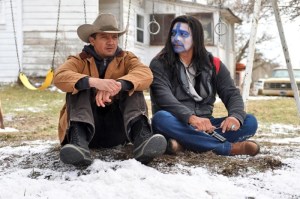 As such, the story is more a reflection and outlet for the characters, but it’s also an intriguing mystery until Sheridan decides to just throw up his hands and explain everything. Until the third act, the central mystery of who killed Natalie is filled with curious and dangling questions that are made all the more interesting from the unique setting and circumstances. Her lungs exploded from the cold after she ran, barefoot in the snow, for six miles for help before collapsing. That’s an interesting aspect I’ve never considered before when it comes to environmental dangers. Tracing back the events of her last night, Sheridan opens up an analysis on the precipitous lives of small-town America, except it’s a Native American reservation that’s sovereign from America. It’s an engrossing look into a culture and way of life few ever see. It’s a very unique setting that unfurls gradually over time, allowing the viewer to engage with the people, their fraying community, and the pain endured. And then the film hastily introduces its obvious culprits, shifts into an extended flashback sequence that explains everything, and zooms right into its tense climax. It all still works, don’t get me wrong. You’ll feel the mounting dread gnaw away at you during that flashback, and you’ll feel the rush of adrenaline during the shootout, and the sense of vindication by its conclusion. However, Sheridan was doing such a fine job at parceling out his elegiac story before that it almost feels like he quickly looked at the time and decided to rush into the finish.
This is also Sheridan’s first time behind the camera as director and he acquits himself well enough. A distinct sense of style doesn’t emerge but his directorial instincts follow his screenwriting strengths; the man knows when to get out of the way. The conclusion has a nasty snap of tension to it and the action hits its marks with power, having given quite the windup. Sheridan is best at directing his actors, who as stated above, give strong, emotive performances that linger with you. Wind River doesn’t prove that Sheridan has more to offer from a directing chair, but it does provide a baseline for a start to grow. I imagine from here on, having built up a reputation for writing critically acclaimed adult thrillers that big name actors flock to, that Sheridan will be directing the majority of his favorite scripts. He might not have the visual acuity or sense of vision that a Denis Villeneuve has, but he’ll reliably deliver strong performances from capable actors. He’ll also be the best steward for his stories, and I need so, so many of them.
Nate’s Grade: A-
Share this:

Detroit (2017)
 Something akin to an art house exploitation film, Kathryn Bigelow’s Detroit is a pressure cooker about the horror of institutional racism, but it’s also a limited drama that lacks any sense of catharsis for an audience. Set among a hellish series of days in 1967, the film follows the events at the Algiers Motel, where Detroit police officers killed three innocent black men in their pursuit of what they believed to be a sniper. An all-white jury then acquitted the officers. Will Poulter (We’re the Millers) plays the lead racist cop and instigator, the man who tries using every effort to get a confession. His bad decisions lead to further bad decisions and miscommunication and then cold-blooded murder. It takes a solid 45 minutes to establish the various supporting characters, the fragile tinderbox that is Detroit during a series of riots, and getting everyone to the fateful motel. Afterwards, it’s like a real-time thriller that’s extremely harrowing to watch. It’s very intense and very well made by Bigelow and her go-to screenwriter Mark Boal (Zero Dark Thirty). Like Get Out, it turns the day-to-day black American experience into a grueling horror film. I was squirming in my seat and felt nauseated throughout much of the movie. I wanted to scream at the screen and tell people to stop or run away. However, it’s a movie with a lower ceiling, whose chief goal is to provoke primal outrage, which it easily achieves, but it feels like there’s little else on the artistic agenda. The characterization can be fairly one-note, especially with the racist cops who stew over white women hanging around virile black males. It’s victims and victimizers and we get precious little else. Your blood will boil, as it should, but will you remember the characters and their lives, their personalities, or mostly the cruel injustices they endured? It’s an intense, arty, exploitation film, and I can perfectly understand if certain audience members have no desire to ever watch this movie. It’s not so much escapism as a scorching reminder about how far race relations have come and have yet to go in this country. Detroit is a movie with plenty of merits but I think it’s the least of the three major Bigelow-Boal collaborations.
Nate’s Grade: B
Share this:

Dunkirk (2017)
 Christopher Nolan is one of the rare filmmakers in the world that can do anything he wants. He’s reached a level of critical and commercial success that he has earned the leeway to tell the stories he wants with a blank check. Apparently he’s been eager to tell the big screen story of Dunkirk, the mass evacuation of 400,000 Allied troops on a French beach in World War II, and it would be the first film of his career to not have a crime or science fiction slant. If this is what he has to turn into in order for mainstream Oscar attention then please go back to making your sci-fi puzzle boxes, Mr. Nolan, and let someone else make the underwhelming WWII epics. Don’t believe the effusive praise from critics saying this is Nolan’s masterpiece or the finest of his career. Dunkirk is Nolan’s least engaging film and maybe even the least ambitious of his otherwise storied Hollywood career.
Dunkirk is less of a cohesive movie and more a series of moments, never eclipsing the next or coalescing into a larger, more meaningful, more satisfying whole. We keep cutting from primarily three perspectives (air, sea, land) but it fails to feel more than a check-in before moving onto the next vantage point. It’s a shame because the opening ten minutes launch you immediately into this world of danger and Nolan sets up the different perspectives with effective visual clarity. I thought it was a great moment having the soldiers collect the fluttering propaganda fliers meant to remind them about how the enemy surround them. The initial burst of violence is visceral and unnerving. The burial of a soldier in the sand is a somber moment. Things were getting good, and then I kept waiting for the movie to escalate, to hit a new gear, and it never came. Instead it repeated the same plotting that just forced the bland characters from one curtailed escape to another. Screenwriting is about setups and payoffs, and that is strangely absent throughout Dunkirk. Bad things just kind of happen, and then they happen again, and then you tune out. That’s even before Nolan throws in needless non-linear elements that I was ignorant about. Dunkirk is Nolan’s first film under two hours since 2002’s Insomnia, and yet it could still stand to lose even more. After a while, your mind drifts when all you’re watching is poorly written characters, many of whom you can’t identify, jump from one crummy situation to another without a stronger storytelling drive. If you want a more personally involving retelling of the heroes of Dunkirk, just watch the film-within-a-film of the underrated 2017 gem, Their Finest.
 The miracle of the Dunkirk evacuation is really lost in this film. Without a more involving story, it’s hard to get a sense about the personal sacrifices and risks of the evacuation. The scope feels mishandled. We’re told that 400,000 men were rescued but I did not get any sense of that scale. We’re stuck to a small corner of a beach, or a small section of the sky and sea, for the far majority of the film, which again traps the film at a lower register. We don’t adequately sense the monumental scale of what is at stake. The embodiment of the threat is condensed down to a single German fighter plane that Tom Hardy has to chase for half the movie. It’s like this guy is the freaking Red Baron. Another aspect that exacerbates this issue is Nolan’s haphazard command of screen geography. When the camera is inside the various ships, your sense of space is uncertain. When things go bad, it just all feels like a mess, with no clear indication of where the characters are, their proximity to others, or even the interior design of the ships. Without a coherent sense of geography, the action and suspense is going to be inherently limited. Nolan locks into a claustrophobic sensation at the expense of audience clarity, and without better-developed action and interesting characters, it’s a decision of diminishing returns.
The characters are so indistinct that most of them in the end credits didn’t even merit names (Irate Soldier, Shivering Soldier, and Furious Soldier are among the lot). This is one of the biggest mistakes of Nolan’s movie. By not providing characters that an audience can engage with he’s handicapped how much an audience can care. We don’t learn about any of the main characters we follow, with the slight exception of Mark Rylance’s even-keeled seafaring father. I challenge audience members to even remember a who’s who of the young men because I don’t think I’d be able to identify them in a lineup. I was still trying to recall which of them may have died. I haven’t had this much trouble keeping people straight in a war film since Terrence Malick’s The Thin Red Line. With Dunkirk, there are faces we follow really more than characters. The most recognizable is Tom Hardy and that’s because he’s Tom Hardy and not because of anything related to his character. Kenneth Branagh’s character just seems to be here to stare off into the distance with awe and say something about “seeing home.” It’s as if Nolan had no interest in telling a war story from a human perspective, which is a vastly strange approach considering the large-scale human cost.
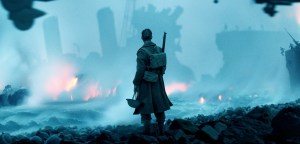 Nolan is a smart filmmaker. He has to know these characters are thinly sketched ciphers at best, so the question becomes why is Nolan choosing to make Dunkirk this way. If I had to hazard a guess I think Nolan was trying to accomplish a visceral, immersive war experience to echo the hopelessness and confusion of those men in jeopardy. They’re meant to be faceless everymen. This would explain why it feels more like a series of moments, of jumping from one failed escape to another and one fraught encounter to another. Nolan does a fine job of introducing conflict (in a wartime setting this also shouldn’t be too hard) but without more distinction he runs the serious risk of everything feeling like more of the same. At the end, thousands of soldiers are ferried back to England and congratulated. One of them is incredulous, not feeling like retreating is worth the fuss. “We just survived,” he says. “Well that’s good enough,” the other says. It’s like Nolan intended to place the audience into a crucible where just getting out was enough to satisfy demands. I don’t think it is.
From a technical standpoint, Dunkirk is often breathtaking, no more so than in its mesmerizing sound design. Nolan uses brilliant sound tacticians to heighten your senses and build a sense of dread. An oncoming fighter plane tearing through the sky can raise the hair on the back of your neck. The sound does the heavy lifting when it comes to creating tension. The score by Hans Zimmer is very effective in that regard as well. Its central musical element sounds literally like a ticking clock, which instantly heightens any scene. Granted adding a ticking clock sound against anything would make it more fraught (you’ll never fill out boring paperwork the same way again). Visually, the aerial photography is gorgeous with the IMAX cameras able to take in such startling depths. Cinematographer Hoyte Van Hoytema (Interstellar) has some beautiful visual compositions, especially as different boats capsize and the water rushes in at odd angles. This is a film that has commendable technical achievements. It’s Nolan who lets down his team.
War movies often run the risk of being overly reliant upon broad themes of heroism, nationalism, patriotism, sacrifice, and such, which can be in replacement of a strong narrative and well developed, interesting characters. War is a film genre like any other, and there are inherent genre shortcuts that can be abused. However, it’s like any other genre in that, regardless of the setting or situation, you are expected to tell an interesting story with characters the audience cares about. Nolan sacrifices all for the immersion in his war experience machine, providing listless, interchangeable characters and a story that amounts to a collection of harrowing moments but not a movie. My pal Joe Marino chided the movie as akin to visiting a planetarium, sitting back, and taking in the wonderful visual spectacle but walking away unmoved. It’s like Nolan has created the Dunkirk Experience: The Ride instead of an actual worthwhile story.
Nate’s Grade: C+
Share this:

47 Meters Down (2017)
 Summer is the perfect season for escapist B-movies about man-eating killer sharks, the film equivalent to the paperback beach read. The famous marine predators have become a Hollywood industry unto itself. Just add “shark” to a pitch and you got yourself a movie or at least an Asylum movie (the studio behind Sharknado and Sharktopus). 47 Meters Down was originally titled In the Deep and was scheduled to come out on DVD in 2016. It’s low budget, light on stars, and driven by its concept. It’s also not good enough to be good and not bad enough to be enjoyable. It just is.
Lisa (Mandy Moore) and Kate (Claire Holt) are sisters vacationing in Mexico. Kate is wild, Lisa is a bore, and they meet some cute local boys. They all agree to go swimming with sharks in a giant metal cage that will lower five meters into the water. Captain Taylor (Matthew Modine, you bet it is) takes the gang out to the ocean and dumps chum and blood in the water to attract the great whites. The ladies are in the cage, the shark has made itself known, and that’s when the cable snaps. The cage descends the titular 47 meters (approximately 150 feet) onto the ocean floor. The sisters are stranded, trapped with limited oxygen, and there’s a hungry shark waiting to strike.
 47 Meters Down has many challenges to overcome and it ultimately falters under the pressure. For starters, having a movie take place almost entirely on the bottom of the ocean provides filming and storytelling limitations. The suspense sequences are going to be restricted because there’s only so much variance that can happen. The geography is also rather murky and it’s very dark in presentation, which means that it’s hard to fully understand what’s happening around the characters. This detracts from implementing suspense sequences that need multiple points of action. Take a sequence in The Shallows, where Blake Lively has to time the shark’s pattern to determine how many seconds she has to retrieve a valuable item in the water. She plunges into the water with the ticking clock letting us know about the impending window of danger. That’s a good arrangement. An audience appreciates being in on the suspense and that requires clarity. 47 Meters Down supplies some immediate mini-goals that feel organic to the situation but it can’t last long. The immediate need to try to get out of the cage supplies a cleanly understood series of goals. They need to remove the debris on top of the cage’s entrance. Before that they need to slip out of the cage. Before that they need to remove their mask in order to fit through the bars, which provides another even more pressing danger.
Beyond that promising early challenge, 47 Meters Down essentially becomes a contained thriller with a boogeyman repeating the same routine. Once this realization settled in I started losing significant interest. Because of the overall murkiness of geography we’re stuck with repetitions of jump scares. A few of them are pretty good as far as jump scares go, but without anything else to subsist upon the tension fades precipitously. It’s the aquatic equivalent of a big scary monster jumping out of the dark and yelling, “Boo.” In moderation and with effective setup, this is fine. When it’s all you have then diminishing returns is to be expected. 47 Meters Down supplies cinematic “fetch quests” for the characters to leave the relatively safe confines of their station, but the larger particulars are never fleshed out efficiently. Much of the second act involves a character having to leave the cage to grab something and worrying about the shark appearing out of nowhere. The hypothetical omnipresent nature of the killer shark is meant to foster a claustrophobic sense of anxiety. Instead it achieves the opposite. I grew bored wondering what random moment the shark was going to rear its CGI head.
 The third act goes into a more mainstream action-survival mode and supplies the heroics that mass audiences have come to expect. The problem is that 47 Meters Down tries to have it all and actually loses everything in a misapplied series of endings. This is one of the most egregious cases since A.I. of a movie not knowing when to call it quits. Kate and Lisa are given the bare minimum of back-story before being thrown to the sharks (Lisa just got dumped for not being spontaneous enough so… swimming with sharks… to prove the ex wrong… that she still wants back?). They’re mostly annoying and whiny, and perhaps I have a heart of stone but I was indifferent to whether or not they became shark food.
Then when the third act rolls around (spoilers to follow), Lisa decides to take charge and becomes an action movie heroine. She’s active and rescues her injured sister, swims to the surface, and even kills a shark after it chomps down on her leg twice. It feels like a climactic finish and serves at least as a modest endpoint for Lisa’s character arc, going from meek to assertive. Then Lisa notices the blood floating from her cut hand and it’s revealed, twist, that everything relating to the escape was a hallucination caused by nitrogen narcosis. Captain Taylor was worried that switching to another oxygen tank would be too much for the ladies and produce strange behavior and hallucinations. If the movie decided to end at this point then it could have worked. However, 47 Meters Down unwisely keeps moving for a needless resolution that left me staggered. Lisa is rescued by faceless Coast Guard diving members and brought to the surface. That’s it. Dear reader, what’s the point of having a dark twist ending if she’s just rescued immediately? For that matter, why even have the twist then if she’s going to be rescued? Why not just keep the earlier sequence where she gets her heroic moments of action? The filmmakers replaced an ending where the protagonist is active with one where she is passive. That’s not a satisfying decision and it erases Lisa’s entire agency as a character (end spoilers).
 There’s also a massive plot hole in how exactly are Kate and Lisa able to hear anything? Astute audience members will notice that there is no listening device in either woman’s pair of ears and their scuba helmets cut off their ears. How can they hear anything? A simple fix would have been just literally having a speaker in their ear like local newscasters. This way the illusion would not be broken and it would also allow the filmmakers to directly communicate with their actors while underwater. It’s win-win. Maybe they can introduce in-ear speakers for the sequel, 48 Meters Down.
If you need to beat the heat this summer for 90 minutes, you could do worse than venturing into the shark-infested waters of 47 Meters Down. The visuals are pretty grimy and indistinct but it does offer the occasional thrill, though to stark diminishing returns. I would advise everyone to instead just watch The Shallows, a superior shark thriller with natural style, tautly wound suspense sequences, and the luxury of an emotionally compelling character arc to go along with the benefits of a sun-kissed Blake Lively. If anything, this feels like the Asylum knockoff on The Shallows. Audiences with a deep abiding fear of the water or killer sharks may find enough entertainment to be had, but for everyone else 47 Meters Down is an exercise in treading water.
Nate’s Grade: C
Share this:

Alien: Covenant (2017)
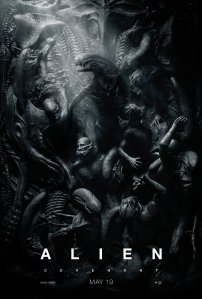 Was Prometheus really as bad a movie as fans made it out to be? While the 2012 Alien prequel could be rather obtuse, and the characters made some of the stupidest decisions as reportedly intelligent scientists, it had an intriguing central mystery, moody sense of atmosphere, great sets, some viciously memorable sequences like Noomi Rapace’s self-directed surgical operation, and a delightfully supercilious Michael Fassbender bot. By the film’s end there were still plenty of outstanding questions unanswered, and so five years later director Ridley Scott has returned with Alien: Covenant to further confound and entertain. The crew of a colony ship takes a detour to land on a habitable world and trace the mysterious transmission belonging to the android David (Fassbender). As expected, all is not what it seems and the crew is almost immediately put into jeopardy. For fans who wanted more answers from Prometheus, there is a surprising amount of carryover to serve as a resolution for the prior film. There are a few big reveals, particularly about the xenomorph evolution, but the overall Alien storyline is moved just mere inches forward, slightly closer to the events of the 1979 original. The biggest problem with Covenant is that it’s too pedestrian for far too often. It sticks pretty close to the formula we’ll all familiar with, so we know it’s only a matter of time before the xenomorphs hit the fan. There is a dearth of memorable scenes here. The characters in Covenant aren’t that much smarter and make their fair share of stupid decisions (hey, let’s ignore the existence of wheat on an alien world or the possibility of killer microbes being in this breathable air). There’s just more of them to be killed off. The movie doesn’t really bother getting to know a far majority of them, consigned to the fact that they’re only here to be later ripped apart and exploded in gore. Katherine Waterston (Fantastic Beasts and Where to Find Them) does a fine job as a Ripley replacement. Danny McBride (Eastbound and Down) has some effective dramatic moments too. But the best reason to watch Covenant, an altogether middling Alien sequel/prequel, is for twice the Fassbender robot action (there’s a Fassbender-on-Fassbender kiss, which will likely break Tumblr). Alien: Covenant is a missed opportunity of a movie hampered by a disappointingly predictable script, tedious characters, and a lack of strong set pieces. It’s acceptable entertainment but not much more. The moral: don’t be a dick to robots.
Nate’s Grade: C+
Share this:

The Belko Experiment (2017)
 An efficient B-movie with a crazy high body count, The Belko Experiment is just about everything I wanted. The residents of the Belko office in Bogata, Columbia are informed by a disembodied voice that if they do not kill two people in the next 30 minutes, there will be further casualties. Everyone thinks it’s a joke until four people’s heads explode (the company placed “tracking devices” in them in case they were kidnapped). The office workers are now informed that if they don’t kill 30 people in the next two hours then 60 will die. The typical breakdown in order and moral relativism follows, although perhaps a bit too quickly for our main antagonist to assume his role. The bigger surprises for me were what Belko was lacking. There isn’t any real satire of office politics, corporate subcultures, or even capitalism and American culture. There is also only one office-specific kill, which is a real creative shame. I was expecting the Belko-ites to take their office supplies and turn them into post-apocalyptic-styled weapons. There is also much more implied gore and violence than you would expect; it’s certainly a bloody film, but it seems oddly restrained. I was expecting some level of commentary to provide further substance, but it was merely a well-developed, kill-crazy B-movie. With that being said, The Belko Experiment held my attention early with its foreboding clues that something wasn’t quite right, and it does a great job of visually identifying about twenty characters for us to follow through the stages of carnage. Writer James Gunn (Guardians of the Galaxy) definitely relishes his return to his horror roots, like a refresher on how awful human beings can be to one another. He purposely subverts our expectations at several points, though sometimes he’s hitting the same beat too often. Even the mostly satisfying ending provides as much of an explanation as you would require for a premise that has no serious rationalization. The Belko Experiment is like a Twilight Zone episode given extra length and extra violence. It does just enough with its attention-grabbing premise and familiar setting to justify a casual viewing if one has a certain taste for Battle Royale meets Office Space.
Nate’s Grade: B


You must be logged in to post a comment.