Blog Archives
Tragedy Girls (2017)
 I wanted to enjoy Tragedy Girls. I really did. There’s a good starting point with a story about two self-involved teenagers who turn to murder to raise their social media profiles. I like the lead actresses, Alexandra Shipp and Deadpool’s Brianna Hildebrand, and the film has a quirky sense of style by co-writer/director Tyler MacIntyre. The opening is even great where Hildebrand purposely lures a lover to his sacrificial death in order to trap a familiar slasher film-styled villain. Where it all goes wrong is that Tragedy Girls doesn’t have enough substance or commentary to outweigh its arch nihilism. The message is very flimsy (millennials are shallow, social media is harmful) and the film wants you to revel in the girls’ violent, gory murders but also be repelled by them. It’s a sisterhood of slaying. There are some interesting story ideas that don’t feel better attended. The girls are clumsy at their murders and luck into some absurd Final Destination-worthy kills, but the film doesn’t embrace this concept and makes them untouchable. They kidnap a local serial killer in the opening and demand he train them, but the guy refuses and is shoved to the side for almost the entire movie, stranding another interesting possibility. The high school characters are thinly designed and unworthy of their demises, though that’s also the point. Tragedy Girls doesn’t earn its candy-colored nihilism. It ultimately left a bad taste in my mouth and I found it off-putting and empty. It thumbs its nose with prickly devil-may-care attitude but without anything to really say.
Nate’s Grade: C-
Share this:

Mom and Dad (2018)
 The appeal of the indie thriller Mom and Dad is its frenetic, gonzo, absurdist spirit that accelerates into delicious dark comedy with a maniacal glee seldom seen in movies. The nature of the movie and its bloody violence will put off many viewers; however, if you have a healthy appetite for the bizarre and tonally incongruous, then Mom and Dad will serve as a thrilling and hilarious treat.
The Ryan family, father Brett (Nicolas Cage), mother Kendall (Selma Blair), teen daughter Carly (Ann Winters), and young son Josh (Zackary Arthur), are a typical suburban family with their share of secrets and antipathy. It’s a normal day until it isn’t. While at school, a mob of parents forms to collect their children. A rumor of a terrorist strike has circulated widely. But when the parents get close to their children they viciously harm them. It seems someone or something has flipped that parental instinct to protect one’s child at all costs. Now the urge is to kill one’s young. Carly and her friends escape the school mob and have to survive their homicidal parental units.
 I didn’t realize it while watching but it became obvious in hindsight that this was the fodder of one of the debased, juvenile, and altogether hyperactive minds from the Crank movies, a series best described as debased, juvenile, and hyperactive. Brain Taylor takes a Twilight Zone premise and shoots it full of adrenaline and mescaline and whatever else was lying around on the ground. The action gets going in a relatively efficient fashion, establishing our family unit, and then setting them up for a collision course. From the 45-minute mark onward, it becomes more a self-contained thriller inside the family home, pitting our kids against their homicidal elders. It reminded me a tad of Don’t Breathe in its ability to set up a playing field and have its characters find organic ways to get into trouble, escape it, and get into worse trouble. It’s a series of moving pieces that feel elegantly arranged on the playing field. It keeps the movie barreling forward while still finding room for surprises and payoffs, including a glorious late Act Three payoff that I had long ago forgotten about its setup. It’s not quite dues ex machina because there’s more to come after, but it made me so happy.
This is a movie that strangles the concept of tone, and yet it decidedly knows what points to hit up the darker comedy, what moments need more drawn out suspense, and what moments can straddle the difference. The build-up of dread can be beautifully applied and then turned for laughs. Take for instance a moment when a teen girl comes home and notices an open blender with margarita mix, implying her mother is home. Just as a signifier of terror, it’s kind of fun, but then she leans closer and reaches into the open blender, her hand picking the blades. We’re leaning in, waiting for the blender to turn on all of a sudden, and then… she walks away, and the moment passes. Then we laugh to ourselves about how something so ordinary was turned around to be menacing. Taylor finds other little moments like this to assure the audience he’s thought through the premise and found ways to properly develop it to its potential. I was covering my face at parts in tense anticipation and I was cackling to myself at other times.
Cage (Snowden) is one of the few actors that seems to get exponentially more compelling to watch the nuttier he acts, and his crackpot zeal can elevate bad movies into something approaching unintended hilarity, like 2006’s woeful Wicker Man remake. There are few actors that go for broke regardless of how silly they eventually come across. In the wrong hands, this is an attribute that can betray Cage’s efforts and sink a movie. In the right hands, like Taylor’s, it provides the spark of madness needed to push a movie into another level of irascibility. Cage finds humor in the strangest of places, and it’s not a derisive sort of humor but more a genuine delighted bafflement at the character. If you love crazy Cage, you’ll have plenty to love in Mom and Dad.
 Blair (Hellboy 2) is the more restrained parent while still getting scenes to cut loose. She’s having terrific fun getting to play bad. When she’s teamed with Cage, they form a darkly funny couple bonding over their shared intent for murder. It becomes an oddball romantic comedy in the darkest sense. Blair also impresses in her scenes of dramatic response. She’s one of the last parental figures to succumb to the hysteria, so we get to witness her process the shock and confusion of the day. There’s a great scene where she’s present in a hospital birthing room. Blair scrambles to save the newborn and try to understand what is happening, and it’s a personal kind of fear and betrayal that registers.
One of the more surprising aspects of Mom and Dad was how it’s able to build the parents as characters in clever and genuinely sincere ways. This is a crazy movie, and that’s its main appeal, but it can also find room to take things seriously. Taylor will momentarily pause the action to insert choice flashbacks that are enjoyable little asides, monologues that provide texture to the world and the characters. The flashback relating to a pool table’s demise opens up an entire analysis of a rocky marriage, a middle-aged man raging against his life’s mediocrity and the faded glory and promise of his youth, and the despair of losing your sense of self through parenthood. It builds and builds and allows the actors to unload. It doesn’t serve as significant a narrative point as other character-based flashbacks setting up ironic convergences. It’s just Brett and Kendall being able to voice their insecurities and disappointments. It’s about this point where the movie positions both as unswayable evil forces, so giving them a chance to come across like genuine human beings before they’re kill-crazy cartoons is unexpected and effective.
I know I’m having a great time with a movie when the worst thing about it is the last few seconds. Mom and Dad just sort of ends. It almost feels like there was some kind of editing accident and you may turn and say, “Wait, is that it?” I didn’t want Mom and Dad to end. This is a raucous dark comedy with an anarchic spirit but a strong sense of pacing, tone, and structure, layering in surprises and escalations dutifully while still finding equitable space to better shade the characters. If you’re looking for a risky dark comedy that will make you feel a tad crazier for watching, give Mom and Dad a whirl. This is the kind of movie you might hate yourself for loving.
Nate’s Grade: B+
Share this:

The Commuter (2018)
 Liam Neeson has been bedeviled on an airplane. He’s been bedeviled on a train. At this point, Neeson is going to find trouble on every form of public transportation. The Commuter is the fourth collaboration between America’s favorite geriatric action star and director Jaume Collet-Serra (Unknown, Non-Stop, Run All Night). None of those movies had the success of Taken but several had some pleasures or an intriguing mystery or hook. The Commuter makes Non-Stop look like Agatha Christie in comparison.
Michael MacCauley (Neeson) is an ex-cop-turned life insurance salesman who commutes into New York City every weekday. He recognizes many familiar faces on the train, except for Joanna (Vera Farmiga), an expert on human behavior. She makes a strange offer: find a passenger by the code name of “Prynn” before the last stop and he’ll receive $100,000. The passenger, a high-value witness, will be less well off. Michael taps into his old cop instincts to deduce who might be the desired target. As each stop passes, he has less time to figure out the identity and decide whether he’ll go through with it all.
It’s impossible to ignore the fact that the plot is so bizarrely similar to 2014’s Non-Stop, with Neeson as a former cop trapped on a mode of travel, being harassed by a mysterious figure, and tasked with discovering the identity of someone on-board before it’s too late while he’s possibly being set up to take the fall. It’s almost as if the producers said, “Hey, let’s get the director of Non-Stop, the star of Non-Stop, and why don’t we just make Non-Stop but, like, on a train?” And then that man bought a new house in celebration of his genius. I look forward to the next entry in the Neeson-Stuck-on-Transportation Trilogy where he’s stalking a ferry approaching Niagara Falls and being blackmailed into finding hidden diamonds. The major problem, besides being so recycled that it could have been retiled Phoning It In: The Movie, is how nothing makes sense at all. With lower-rent genre thrillers, things don’t always have to make the best of sense. Even the best thrillers suffer from leaps of logic but are excused because of how engaged we are in the movie. With The Commuter, I was so detached from the movie that I was impatiently waiting to get off on the next stop, no matter what was waiting on the other side.
 The villainous scheme is predicated on so many people doing so many stupid decisions that are far more complicated than they have any right to be. First, this villainous organization essentially looking for a witness on the train has been tipped off from an inside source in the FBI. Except this source cannot say what that witness looks like. Also, why is the FBI allowing such an important witness travel by his or herself minus protection and among the public? I know for a fact that there’s an FBI office in New York City. The FBI members picking the witness up also don’t know what this person looks like, which again begets stupidly bad communication. The bad guys are also pretty bad if they have to resort to such efforts to suss out a witness. Can’t they find somebody to hack a phone? The bad guys steal Neeson’s phone to limit his communication. Yet, as he does in the movie, he simply asks another passenger to use their phone. What was the point of all of that? The villains also immediately inform Neeson that his family has been kidnapped, allowing little room for raising he stakes. Why don’t they wait to see who gets off and leaves with the FBI and use a sniper to take them out? Maybe it’s not about killing the person but destroying the evidence, so in that case you do random bag checks from a train worker. That’s it. Then there’s the nickname given to the target (“Prynn”). Who gave birth to this nickname and why would the witness carry the one item in public that would confirm their identity? If that’s the case, why did any of the bad guys need Neeson? He seems best served as a patsy considering he acts like a maniac, at one point pointing a gun at people and making demands, before settling back and assuring the passengers he’s trustworthy. That’s what stable people do, naturally. Why should anyone believe anything this guy says?
Here’s an example of how dumb this movie is. There are a few characters introduced in the opening act that you know will come back again because of the economy of characters and because name actors don’t take do-nothing parts in genre fare (unless you’re Chloe Sevigny in The Snowman, apparently). I’m waiting for confirmation that one of these characters is revealed to be working with our nefarious villains. A character has a very specific phrase they share with Neeson. Then, upon figuring out who the sought-after witness is on the train, he or she relates their story about bad cops and how one of them used the exact phrase. Fine, as expected, but then Neeson doesn’t respond. It triggers nothing from him even though he had only been with these people hours ago. It’s only later when this same phrase is said for the THIRD time does Neeson finally connect the dots. If a magic phrase is going to be the trigger then why have this extra step? It just makes Neeson look dumb and it doesn’t speak well to the film’s opinion of its audience.
 Regardless of how nonsensical a thriller comes across, as long as it delivers the suspenseful genre goods, much can be forgiven. This is another area where The Commuter doesn’t perform well. There’s one decent hand-to-hand fight filmed in a long take that has a solid visceral appeal, but other than that this movie takes turns either looking ugly or like its budget wasn’t simply enough. The location calls for very cramped and limited environment that will require some combat ingenuity that the movie just isn’t up to the task for. Watching Neeson stalk from car to car, playing his Columbo detective games with resolutely stock characters (Lady Macbeth’s breakout star Florence Pugh deserves better), is not as fun as it sounds, and it doesn’t sound that fun. Maybe if the rote characters were better drawn, if the evil scheme was a bit cleaner, if the hero was more morally compromised, then maybe the downtime wouldn’t be as boring. There’s a ridiculous derailing sequence and then there’s another twenty minutes after. Collet-Serra can only bring so much to the movie, and the script doesn’t have enough clever inventions or reversals to spur much in the director’s imagination. As a result, everything feels like a deflated by-the-numbers thriller that would be better appearing on late night TV.
Neeson (Mark Felt: The Man Who Brought Down the White House) is on action autopilot as he settles into the shed skin of one of his past Collet-Serra performances. He’s gruff, he’s cunning, he’ll take your best and keep swinging, and as he reminds the audience at three separate points, he’s sixty years old. He can still offer simple pleasures, and if your only requirement for entertainment is watching Neeson punch people and things, then The Commuter will fulfill your needs. His character is supposed to be placed in a moral question of self-interest but there’s never any doubt. If Neeson was a corrupt cop, I think that would be a better character arc and starting point for a guy questioning selling out a stranger. I’m surprised at how generally wasted every actor is, notably Farmiga (The Conjuring 2), who is literally only in two scenes on screen (her role is mostly nagging phone calls). She’s the only person given a little personality. Perhaps that’s because we already know where her allegiances lie so the sloppy screenplay doesn’t have to keep her an inscrutable suspect to interrogate.
The Commuter is a dumb ride to the generic and expected, and then it just keeps going. If you’re really hard up for entertainment and have a love affair with Neeson’s fists, I suppose assorted thrills could be found, but for everyone else this is one to miss.
Nate’s Grade: C-
Share this:

Molly’s Game (2017)/ Call Me By Your Name (2017)
 Two new awards-caliber film releases couldn’t be more different. One of hyper-literate in a high-stakes world of drama, gambling, and crime, and another is somber, lackadaisical, and personal, chronicling a summer love that changed lives. One movie has scads of plotting it zooms through with high-powered visuals and voice over, and another luxuriates in the moment, a placidity on the surface interrupted by rising passions. One of these movies I found captivating and the other I found perfectly nice but unremarkable.
Molly’s Game is Aaron Sorkin’s directorial debut, clearly having studied at the altar of David Fincher, and he packs a lot into his 140 minutes chronicling the rise and fall of Molly Bloom (Jessica Chastain), a former Olympic hopeful who found herself running an expensive, private series of poker games. She’s drawn into an unfamiliar world and through her tenacious grit, preparation, and fortitude, she is able to become a fixture amongst the rich. Then the FBI comes knocking and wants to charge her in conjunction with being part of a Russian money laundering operation. Driven by a fierce performance from Chastain, Molly’s Game is a gloriously entertaining movie that glides by. It burns through so much plot so quickly, so much information, that you feel like you might have downloaded Bloom’s book while watching. The musical Sorkin dialogue has never sounded better than through the chagrined, take-no-prisoners Chastain. The snappy dialogue pops, the characters are richly realized, and even during its more outlandish moments, like a surprise paternal reunion therapy session, Sorkin packs multiple movies of entertainment in one brisk, excellently manicured production.
 In contrast, Call Me By Your Name is a slower peak into the discovery of romantic feelings between 17-year-old Elio (Timothee Chalamet) and grad student Oliver (Armie Hammer). Set amid the sunny countryside of northern Italy, the film takes it sweet time establishing the lazy world of its characters and their closely intersecting orbits. I became anxious because the characters kept me at arm’s length, leaving their burgeoning romance to feel distant and tame. I understand the hesitation of both parties and the age difference complicating matters. I understand caution. But it feels like the film is cautious to a fault, to the point that one of them laments later why they wasted so much time. The acting is pleasant if undistinguished. The best scene is a terrific monologue by Michael Stuhlbarg as the world’s most lovably accepting father. For an earth-shattering romance, I too often felt unmoved and restless. If we’re going to spend this much time hanging out with these people we should get to know them more intimately, and not just in the physical sense. I missed the compelling artistic charge of something like a Moonlight. I’m a bit stupefied at all the praise heaped upon Call Me By Your Name, a fine indie drama that, for me, too infrequently delves below its pretty surface into something more substantial.
I don’t know if this recent comparison sheds light on any personal insight, but perhaps I just love big, showy, obvious plot that calls attention to itself, with characters that fill a room, rather than an airy romance that moves at the speed of its own breeze. Anyway you have it, one of these movies makes my Best Of list and the other just makes me shrug.
Nate’s Grades:
Molly’s Game: A-
Call Me By Your Name: B-
Share this:

The Bye Bye Man (2017)
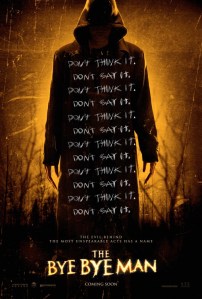 I think La La Land has a shadowy culprit to blame for the big slip-up at the 2017 Academy Awards where it mistakenly was declared Best Picture before the rightful winner, Moonlight, was crowned. Actress Faye Dunaway was the one who spoke aloud the infamous slip-up, but I think she had something else on her mind. She was so preoccupied with trying NOT to think about the Bye Bye Man that she wasn’t fully paying attention to the moment. Fortunately, Moonlight got its rightful due. Unfortunately, The Bye Bye Man exists as a horror film and Dunaway within it. This is a movie whose mantra is “Don’t say it, don’t think it,” all but begging to be forgotten.
If The Bye Bye Man had been the film it appears to be in its opening scene, we might have had an effectively unnerving horror thriller. We watch in a single long take as a distressed man drives home, mutters to himself, and takes out a rifle and systematically kills every person who admits they said “it” or told someone. He goes from person to person, pleading whether they told anyone, and it’s always yes. Then he moves on to kill that person, asking them the same question. It’s an effectively chilling scene and a fantastic way to open a horror movie. And it’s all sadly downhill from there, folks. The rest of the movie is a stupid thriller with stupid teenagers doing stupid things.
 Any power the Bye Bye Man has as a concept, a mimetic virus, is wasted as a goofy Boogeyman knockoff with vague powers and intentions. Apparently, one of the insidious side effects of the Bye Bye Man is his ability to cause erectile dysfunction. After the first night he-who-shall-not-be-named is named, two of our college students talk about trying again and how “that” never happens to them, all but implying the Bye Bye Man was a sexual detriment. Another weirdly defined power is that the Bye Bye Man causes his victims to see hallucinations, though sometimes they’re nightmares like maggots crawling out of eyeballs, and other times they’re fantasy, like a naked friend beckoning for a lustful tryst. One character hears disturbing scratching noises and then visions of people standing buck naked on train tracks (the amount of brief nudity made me recheck that this received a PG-13 rating). “We’re all losing our minds at the same time,” a character bemoans at the 41-minute mark. At one point, the Bye Bye Man sends himself as a GIF, knowing how to reach millennials. I don’t understand why these kids don’t accept that if they see something horrific it’s probably false. They know the Bye Bye Man is terrorizing them with their fears and yet they fall for it every time. When you’re talking with someone and all of a sudden they start seeping blood from every orifice, maybe that should be a clue. If Elliot (Douglas Smith) knows he’s afraid of his girlfriend sleeping with his best friend, then shouldn’t he doubt the voracity of seeing them together after the malevolent force with evil visions has entered his life? What’s the point of scratching “don’t say it, don’t think it” as a preventative measure? That calls more attention to the forbidden item. It’s like in Inception, when they say, “don’t think about elephants,” and invariably that’s what you’re going to think about.
If the Bye Bye Man can make people say its name, then why isn’t it doing this all the time? Why all the hallucinations to drive teens to kill themselves? That seems ultimately counter productive to Bye Bye Man business. Any businessperson will tell you the key to expanding your outreach is through happy customers. Fulfill these people’s wishes and then come to collect later. I can write an entire proposal for the Bye Bye Man to shore up his business. He seems to be doing everything wrong. If the goal of the Bye Bye Man is to spread its name/message, along the same lines of self-preservation through proliferation like the haunted Ring VHS tape, then it needs a more straightforward approach. Let these doomed teenagers know their nightmares will end if they bring in an additional however many new victims. Alas, the Bye Bye Man is painfully unclear (it even has zero references on the Google imitator search) and just another boo spook.
Even for horror movies, the characters can be powerfully boring and meaningless. The entire premise is a group of college kids moving into a house that used to be owned by the crazy guy in the opening flashback. They each take turns seeing things, hearing things, and doing things, some as mundane as scribbling without their direct knowledge. The plot is in a holding pattern that requires characters to repeat the threat over and over. The only setup we have with these characters is one house party so we don’t exactly know what they’re like before they start going crazy. Much of their hallucinatory confusion could be mitigated if they just communicated with one another. “Help, Friend A, I am seeing [this]. Is that what you are seeing as well, Friend A?” It leads to a lot of rash actions for supposed friends. Elliot even refers to his friend as a “jock,” which is a term I don’t think anyone out of high school says. When the police suspect Elliot of foul play once his friends start dying, he is acting completely guilty. He begs Carrie Anne Moss (The Matrix) not to force him to say a certain name or else her kids might be in danger. That sounded like a thinly veiled threat. And then the police let him go!
 The mystery of the Bye Bye Man’s history is the only point of interest in this story, and even that has its limits. The librarian (Cleo King) is hilariously hyper focused on delivering exposition. She even knows the protagonist on a first name basis. I think she lives to tell people about this one weird event in the school’s history. She even calls Elliot on the phone! The librarian reaches out to him, saying, “I’ve had some strange dreams ever since we talked.” She then asks if she can come over to his house later. What kind of relationship does this person forge with students? Dunaway is featured as the wife of the opening killer, and I just felt so sorry for her during every second on screen. She deserves better than this. Somebody go check on Faye Dunaway and make sure she’s okay.
The Bye Bye Man is a horror movie that’s so bad it can be outlandishly funny. It starts off well and deteriorates rapidly, abandoning sense and atmosphere for jumbled scares. There’s an extended bit during a climactic dramatic moment where a father has to convince his daughter to pee out in public. I felt so bad for every actor involved. I’ll even spoil the ending, which made me howl with laughter. A little girl talks about how she saw a table with some writing. “What did the writing say?’ her father asks, and oh no, here we go again you think to yourself. Then a second later the little girl says, “Daddy, you know I can’t read in the dark! What do you think I am, a flashlight?” My God, that moment should have been followed by a rimshot. This half-baked movie opens up a lot more questions than it has the ability to answer. What is the mythology of this character? What’s with the constant train imagery? Why does the Bye Bye Man have a pet dog? Why are the coins a significant part of its Bye Bye motif? And always, if it can simply make people talk, why isn’t it doing this all the time to spread its name? The Bye Bye Man is fun bad but oh is it still bad.
Nate’s Grade: D
Share this:

All the Money in the World (2017)
 All the Money is the World used to star Kevin Spacey as the prolific oil billionaire John Paul Getty, that is until director Ridley Scott elected to reshoot the part, replacing Spacey with Christopher Plummer after Spacey’s unsavory history of sexual assault came to light. In only ten days, Scott changed his movie with only a month to spare before its release. It’s an amazing feat, especially when you consider Plummer is in the film for at least a solid half hour. He’s also the best part as the mercurial, cruel, penny-pinching magnate who refuses to pay his grandson’s ransom even though he’s the richest man who ever lived. In 1973, John Getty III (Charlie Plummer, no relation) was kidnapped by Italian criminals. With the miserly grandfather offering no help, Gail (Michelle Williams) tries to negotiate with the criminals and her father-in-law to secure the release of her son. I didn’t know anything coming into this film, but afterwards I felt like it focused on the wrong characters. The mother stuck in the middle is not the most interesting protagonist here and seems like a go-between for the two more immediate and intriguing stories, the elder Getty and the youngest Getty. Williams (Manchester by the Sea) is acceptable as the strong-willed, put-upon mother, though her mid Atlantic accent made me think I was watching Katherine Hepburn. Mark Wahlberg (Daddy’s Home 2) is completely miscast as a former CIA agent that helps Gail. He succeeds in converting oxygen to carbon dioxide and that’s about it. The central story is interesting enough, though there are points that scream being fictional invented additions, like a last act chase and a kindly mobster who undergoes reverse Stockholm syndrome. John Paul Getty is an interesting character, and Plummer is terrific, though I am quite curious what Spacey’s performance would have been like under octogenarian makeup (Plummer already happens to be in his 80s). All the Money in the World is an interesting enough story with decent acting but I can’t help but entertain my nagging sense that it should have been better even minus Spacey.
Nate’s Grade: B-
Share this:

Bright (2017)
 Netflix has been fighting to get into the world of theatrical features. While its original series have met remarkable acclaim, Netflix still wants to draw filmmakers. There have been a few high-profile film buys like Brad Pitt’s War Machine, the live-action American Death Note, and it’s become Adam Sandler’s new home. Bright is a $90 million dollar fantasy film directed by David Ayer (Suicide Squad, End of Watch) and written by Max Landis (American Ultra, Dirk Gently). The big buzzy movie has been met with big derision from critics, some even referring to it as the worst film of 2017. After watching Bright, I think my friend Drew Brigner sums it up pretty well: “It’s not terrible, but it’s not great.” Slap that onto the poster, Netlfix.
In an alternate Los Angeles, humans exist side-by-side with fantasy creatures like fairies, elves, and orcs. Daryl Ward (Will Smith) is assigned a “diversity hire,” Jakoby (Joel Edgerton), the first orc on the force. Nobody wants to work with him. The humans are looking for whatever means they can of getting rid of the orc, and Ward’s superiors are looking for his assistance. Then one night on patrol, Ward and Jakoby come across a nightmarish crime scene. Bodies are burned in place. A woman is stuck in a wall. There’s one survivor, Tikka (Lucy Fry), an elf who has gotten hold of a magic wand. It so happens that magic wands are powerful weapons and only Brights can hold them. Word gets out about their discovery and every group in L.A. is after this powerful item. Ward and Jakoby have to escape gangs, orcs, corrupt cops, and an elf cult leader, Leilah (Noomi Rapace), who needs the wand to summon her Dark Lord back to dominate Earth.
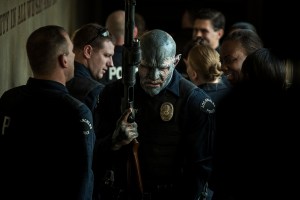 For the first 48 minutes or so of Bright I was willing to give it a welcomed chance. The world building from Landis presented enough interesting wrinkles to keep me intrigued. The banter felt believable enough to fit into its desired genre. Edgerton (It Comes at Night) is engaging and charming as a good-hearted orc whose life’s dream is to be a police officer. He is viewed as a traitor by his own kind, so that makes us like him even more for what he’s willing to sacrifice for this precarious position. There’s a personal source of conflict between Ward and Jakoby that is introduced early for them to work through. There are magic police, which is kind of cool. The world feels lived-in with clever details even though it could have used more of that sense of living. Too often it feels like the only difference in this new L.A. are scattered creatures in different locales. Elves are the rich elite. Orcs are the poor and disadvantaged. I could have used more magical creatures in the mix. What about dwarves, wizards, dragons, anything? Still, Landis’ script was providing enough breadcrumbs to carry me along, building up to the wallop of finding the magic wand. It forces Ward to make a startling personal choice that will define the rest of the film. It took a while to get going, but I was still willing to give Bright the benefit of the doubt.
However, it’s after the 48-minute mark that Bright begins its disjointed descent and never truly recovers, disassembling at an alarming rate. What follows is a series of poorly developed, poorly shot action sequences as the characters bump into one violent group after another. The interesting plot development gets put on hold and the weaker elements begin taking greater significance. It wouldn’t be a fantasy film without a great prophecy, which comes into bearing in the most contrived of ways. Speaking of contrived, there is a coincidental rescue late in the second act that made me loudly groan. Then there’s redoubling back to previous locations presumably to save money on set design. Once the movie sets things in motion for the mad scramble for the wand, it just feels like one unrelated sequence after another to keep our characters on the run. Even with the fantastical world building, you’ll be hard-pressed to muster genuine surprise. That’s because all of the later plot turns are readily telegraphed, like the coincidental save. We’re told that only a Bright can handle a magic wand and anybody else that touches it will explode. First off, why doesn’t this make the magic wand a defensive weapon if you know how rare Brights are? If you know idiots are going to have grabby hands, why not slide it toward your enemies? Regardless, knowing that dichotomy, you know one of the two main character will be revealed to be a Bright during a climactic moment, because why else have it? Anticipating payoffs isn’t necessarily a bad thing, but when you can anticipate all of them, then you’re in trouble. The most surprising aspect of Bright is how ultimately it’s still a formulaic buddy copy movie dressed up with some extra fantasy spectacle.
Another weakness that becomes more apparent as the film continues is the characters. Ward and Jokoby are pretty thinly sketched out with a few clarifying details. Ward is the lightly racist archetype who learns to accept his partner’s differences over the course of one long night. He’s pretty indistinguishable from the character Smith plays in the Bad Boys films. I suppose his prejudice and desire to better support his family is enough setup to question whether he’ll follow in the corrupt patterns of his colleagues. But after he makes his choice at that 48-minute mark, it’s like his character growth just stops. He still barks orders, he still quips one-liners, and he makes the big sacrificial gesture, but his character development is iced for a solid hour. Jakoby has more ground to cover and fairs somewhat better as the Jackie Robinson of the orc community. Except this guy seems way too inexperienced, clumsy, naïve, and simply not good at his job. In order to be the first diversity hire, I’m expecting this guy to have to go above-and-beyond to even be considered for a position. It reminds me of Shonda Rhimes quote where she says, as a black woman, “you have to be twice as good as them to get half of what they have.” I didn’t believe Jakoby was the best candidate for shattering that orc-sized glass ceiling. The harassment from the other cops can be painfully juvenile as well, like tacking on a stupid middle school-esque “kick me” sign to his back. He wants to make more of himself and because of that dream he’s shunned by his fellow orcs and distrusted by humans. That perspective should be far more interesting than what we get with Bright.
 The supporting characters fare even worse as bodies given momentary activity. Tikka is merely a plot device and not a character. She doesn’t even speak until close to 85 minutes into the movie, and it wasn’t really worth the wait. A toaster could have replaced her and the plot would remain relatively the same. She is the definition of a prop. She has no personality, no agency, and no goal beyond keep the powerful thing away from the villain. Because she’s a Bright she’s one of the few who can wield the magic wand, but even those rare occurrences are underwhelming. If this thing is as advertised, a “nuclear bomb that grants wishes,” then why doesn’t Tikka just utilize it to destroy the villains once and for all or at least help Ward and Jakoby? Poor Fry (The Darkness) just gets yanked around from scene to scene, shivering and generally looking frail. She’s got some killer eyebrows though.
Noomi Rapace (Prometheus) doesn’t have much to work with as the chief villain, Leilah. She’s an acrobatic murder machine who wants to summon the Big Evil Thing of Old, and that’s about it. Rapace does have a naturally elfin-looking face, so it’s solid casting. The other characters, especially the various antagonists, are just slight variations on heavies. No real personalities. No dimension. They’re just a video game stage of slightly different looking goons to be cleared before the next stage. Maybe there’s a larger point about the similar darker impulses all races are tempted by, but I think that’s giving the movie more credit than it deserves.
On that front, the racial commentary of this alternate L.A. is muddled, to say the least. The orcs are obviously meant to take the place of lower-class African-Americans in this newfangled City of Angels. However, what does the movie do with this? The orcs are judged to be troublemakers, prone to violence, and generally subhuman, with several people holding a thousand-year-old grudge over the mistakes of previous orcs. Under Ayer’s murky direction, the orcs easily resemble the black and Latino gangs we’ve seen in many of his police dramas. They’re meant to be an underclass. What does that make black people? There’s a tone-deaf joke in the opening where Ward yells, “fairy lives don’t matter” before swatting the winged nuisance to its death. I guess racism against orcs has replaced all other forms of intra-human racism. Landis’ script takes a hot button issue and drops the ball on making the commentary meaningful. Just think about what Zootopia did with its racial allegory on predators and prey. They took a serious topic and had something to say about it. Landis takes a serious topic and ignores the greater potential. By the end of the film, it feels oddly like Landis just took an old buddy cop story concept and grafted some incidental fantasy elements onto it and called it a full day.
 Ayer doesn’t help matters by filming in his Suicide Squad-vision of drizzly grays, cool blues, lens flares, and lots of dim shadows. The very look of the movie is so downcast and the action sequences are too poorly developed and choreographed. The combat is very often close-quartered and the jumpy edits and slippery sense of geography make the brawls practically incomprehensible. The sequences don’t develop organic complications. It’s just the same concept over and over, get to that place, shoot the bad guys before they shoot you, repeat. The action also misses opportunities to connect with the character motivations and to derive mini-goals that can help spice things up. Bright has none of that. Even with the inclusion of magic and magical creatures! The best scene is an attack in a convenience store that gets closest to involving parallel lines of action with some organic consequences related to its specific setting. Otherwise it’s a lot of shootouts in locations you’ve seen in other grimy cop movies (alleys, warehouses, strip bars, etc).
Bright is the most expensive movie in Netflix’s history and they’re already reportedly developing a potential sequel. The world Landis has created has enormous potential. It’s unfortunate that it’s not realized in this first edition. It’s not as bad as some film critics have been harping about but Bright should have been much better. The characters are lacking, the world building feels unfulfilled, the narrative is predictable, the social commentary is simplistic, and the action sequences are dreary and unexciting. I think something like Bright might in the end be intended as a loss leader for Netflix, something they initially lose money on but ultimately draws in new subscribers. It’s almost the same cost for that canceled Baz Luhrmann series, The Get Down (at least got eleven episodes from that). Bright is an underdeveloped genre mash-up that might make you reach for a magic wand of your own, your remote.
Nate’s Grade: C
Share this:

The Killing of a Sacred Deer (2017)
 Greek filmmaker Yorgos Lanthimos might just be the most perversely ingenious creative mind working in movies today. After Dogtooth and The Lobster, I will see anything that has this man’s name attached to it, especially as a writer/director. Lanthimos’ latest, The Killing of a Sacred Deer, is a challenging revenge thriller, a macabre comedy, a morality play, and a generally uncomfortable watch that is just as alienating as it is totally brilliant.
Steven Murphy (Colin Farrell) is a heart surgeon with a loving family that includes his wife, Anna (Nicole Kidman), teen daughter Kim (Tomorrowland’s Raffrey Cassidy), and young song Bob (Sunny Suljic). Then there’s Martin (Barry Keoghan), the lonely son of a patient who died on Steven’s operating table. He won’t leave Steven alone and doesn’t understand boundaries, even trying to hook up Steven with his lonely mother (Alicia Silverstone, yep you read that right). Martin even takes an interest in Kim. However, once Steven’s son falls victim of a mysterious illness and becomes paralyzed, Martin makes his true intentions clear. He’s poisoned all three of the Murphy family members and they are destined to die slowly unless Steven kills one of them. He has to choose which family member’s life to take with his own hands, or else they all die.
 It’s hard for me to think of whom exactly to recommend this movie to because it is so intentionally off-putting. It’s intended to make you awkwardly squirm and question what you are watching. This will not be a fun watch by most accounts unless you’re a very select person who has a dark sense of humor and an appreciation for something different. Lanthimos seems to be purposely testing his audience’s endurance from the start. We open on several seconds of black to test our patience and then an extended close-up of real open-heart surgery. My pal Ben Bailey had to shield his face from the screen. From there, the movie defies your expectations at most turns and digs further into its depths of darkness. This is one of those movies where you wonder whether it will go “there” and it most assuredly goes there and beyond. One minute you’ll be cringing, the next you’ll be cackling, and the next you’ll be deeply unsettled, and then maybe back to laughing if you’re like me. Much like Lanthimos’ other movies, his deadpan sense of comedy is his prescription for an absurd world. It’s a movie where you have to actively work to adjust to its bizarre wavelength, but if you can, there are rewards aplenty. I can’t stop thinking about it.
Unlike The Lobster, this doesn’t exist in a completely parallel universe but more of a cracked, heightened version of our own. Lanthimos’ breakout film, 2009’s Dogtooth, dropped the audience into a strange world and expected us to catch up. This is similar. The flatly comic conversations become a sort of absurdist poetry. Everyday moments can be given one extra strange beat and become hilarious. Scene to scene, I didn’t know what would happen. The movie allows its story to properly breathe while finding room for its characters to discover intriguing diversions and insights, like Martin’s recollection of how he and his father eat spaghetti the same way. There’s an unusual sexual kink that involves giving oneself completely to another that makes more than one appearance, enough to question the connection between them. The very geneses of that kink I think alligns with a character’s god complex, but that’s my working interpretation. It made me rethink about the aberrant concepts of sexuality in Dogtooth, a.k.a. the nightmare result of helicopter parenting. The handling of pubescent sexuality, and the idea of incorrectly applying information learned from other settings, is just one more tool to make the audience uneasy. Killing of a Sacred Deer exists in a closer approximation of our world in order for there to be a better sense of stakes. Somebody is going to die, and if Steven cannot choose then everyone will die. This isn’t a fantasy world but a real family being terrorized by a demented and vengeful stalker. This gangly teenager is more terrifying and determined than just about any standard slasher villain.
 This is a modern-day Greek tragedy literally inspired by an ancient one. Prior to the Trojan War, Agamemnon was hunting and killed one of the sacred deer belonging to Artemis. The angry goddess stranded Agamemnon’s ships and demanded a sacrifice in order for the winds to return. He had to choose one of his family members to kill, and Iphigenia got the short end of that one. Euripides’ classic work gets a fresh retooling and Lanthimos is not one to merely stand on ceremony. He smartly develops his premise and takes it in organic directions that feel believable even given the ludicrous circumstances. That is Lanthimos’ gift as a storyteller, being able to make the ludicrous feel genuine. After the half-hour mark, where Martin comes clean, the movie really takes off. Does Steven tell his family and how much? Does he take matters into his own hands to convince Martin to stop? Is he actually culpable for the death of Martin’s father? Once the reality becomes clear and people starting getting increasingly sick, the movie becomes even direr. Steven is given the unenviable position to choose life and death, though he frequently shucks responsibility and only continues to make matters worse. Once his family comes to terms with the reality of Martin’s threat, they each try different methods to argue their personal favor to dear old dad. They vie to be father’s favorite or, at least, not his most expendable loved one. It’s a richly macabre jockeying that had me laughing and then cackling from the plain absurdity. Lanthimos presents a tragedy and forces the audience to simmer and contemplate it, but he doesn’t put his characters on hold either. They are adapting and have their own agendas, mostly doing whatever they can to campaign for their lives at the expense of their family (Vin Diesel’s Fast and Furious character would loath this movie with a sleeveless fury).
The end deserves its own mention but fear not dear reader I won’t spoil it. It’s a sequence that had me literally biting my own hand in anxiety. I was pushing myself backwards in my chair, trying to instinctively escape the moment. It’s the culmination of the movie and feels entirely in keeping with Lanthimos’ twisted vision and the depiction of Steven as a weak man. There’s a strange sense of inevitability to it all that marks the best tragedies. I don’t know if I’ll sit through a more intense, uncomfortable few minutes in 2017, and yes I’ve seen, and appreciate, Darren Aronofsky’s mother! of difficult 2017 sits.
As much as this is a thriller it also feels just as much a satire of overwrought Hollywood thrillers. The killer isn’t some shadowy evil genius. He’s just a very determined teenager in your neighborhood. There are several moments that are difficult to describe but I know Lanthimos is doing them on purpose as a critique of thrillers. At the end, a character shakes a generous heaping of ketchup onto a plate of French fries, and we’re meant to get the lazy metaphor of the sloshing ketchup as spilled blood. However, under Lanthimos’ heavy direction, the shot holds longer, the accompanying soundtrack becomes an operatic crescendo, and the whole thing turns comic. Lanthimos has to know what he’s doing here, commenting on the lazy symbolism of dread in overwrought thrillers. There’s another instance where Martin has severely bitten into Steven’s arm. Martin’s apologetic and promises to make it right and then proceeds to bite a chunk of flesh out of his own arm and spit it onto the floor as an offering. That would have been creepy enough but then Lanthimos goes one step further. “Get it, it’s a metaphor,” Martin explains. It’s one in a series of moments where Lanthimos goes a step further into pointed genre satire. It’s possible I’m reading too much into the rationale behind some of these oddities but I don’t really think so. It seems too knowing, too intentional.
 The Killing of a Sacred Deer is a movie that invites discussion, analysis, and just a general debriefing in the “what the hell did I just watch?” vein. This is a movie experience that calls upon the full range of human emotions, and sometimes in the same moment. Lanthimos’ modern Greek tragedy serves up a self-aware critique of its own genre, as he puts his personal stamp on the serial killer thriller. This is also an alienating film that doesn’t try to be accessible for a wider audience. It almost feels like Andy Kaufman doing an experiment replicating Stanley Kubrick (and it was filmed in Cincinnati). Even if you loved Lathimos’ most high profile work, The Lobster, I don’t know if you’d feel the same way about Killing of a Sacred Deer. It wears its off-putting and moody nature as a badge of honor. I found it equally ridiculous and compelling, reflective and over-the-top, sardonic and serious. Dear reader, I have no idea what you’ll think of this thing. If you’re game for a demanding and unique filmgoing experience and don’t mind being pushed in painfully awkward places, then drop into the stunning world of Lanthimos’ purely twisted imagination. Killing of a Sacred Deer just gets better the more I dissect it, finding new meaning and connections. If you can handle its burdens of discomfort, The Killing of a Sacred Deer is one of the most memorable films of the year and also one of the best.
Nate’s Grade: A-
Share this:

Suburbicon (2017)
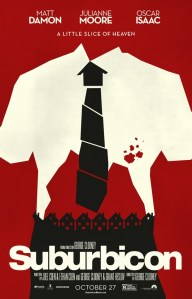 Suburbicon began as a script written by Joel and Ethan Coen back in the 1980s. They shelved it and went on to other stories and justifiable acclaim. George Clooney came across the old screenplay and rewrote it with his longtime partner Grant Heslov (Monuments Men). Clooney’s version of suburban strife is a wash and also easily the worst effort of Clooney’s Oscar-nominated directing career. I wish Suburbicon would make up its mind on which of the three different movies it wants to tell. This is possible proof that Coen brother stories should best be left chiefly to the Coens.
Set amidst the 1950s, an African-American family moves in to an all-white suburban neighborhood and instantly changes the climate. The Mayers have upset the other middle-class white neighbors who want them gone, and they don’t mind subjecting this black family to all forms of harassment to get the job done. Meanwhile, Gardener (Matt Damon) and his wife (Julianne Moore), her twin sister (also Moore), and his son, are threatened by loan shark goons. The family is never the same but there’s more than meets the eye to this domestic tragedy, and the costly cover-up ensnares everyone in danger.
 This is a movie that feels badly stitched together with competing ideas and storylines. Two of these competing movies are so haphazard and lazily explored that it feels like Clooney and company tacked them on for some sort of extra failed social commentary about The Way We Live Now. The shame of it is that either of these vestigial storylines could have existed as their own compelling movie. The integration of the suburbs with a black family brings about an intense reaction. Fellow suburbanites harass the family at all hours of the day, destroy personal property, and do everything to let them know they are unwelcome in this “good-natured” community. The reactions are so virulent and disgusting, and all for a family just existing on the block, shopping at the same grocery store, thinking they too were eligible for the American Dream. There’s a movie there in its own right because, as evidenced in Suburbicon, it’s just background for a larger indictment on suburban values hypocrisy that never generally materializes. At no point does Clooney give the racist response any depth, nuance, or even a deserving spotlight. The only thing we learn is that it’s wrong, which should already be obvious. The entire storyline feels so unfairly attached to another unrelated movie. This family’s story is worth telling right rather than just having something else to cut back to.
Then there’s the larger satire on suburbia itself and its reported family values philosophy. Just because bad people exist and bad things happen in a “nice” community does not mean your satirical work is done. You’re just supplying air quotes to your location. This is the most facile form of irony, lazily slapping together something vulgar against an idyllic setting of morality. That’s why I had no interest in The Little Hours, a comedy that looked to be built around one sole joke, unexpectedly offensive nuns (“Oh ho, that pious person used profanity, and that will never not be funny”). Suburbicon is a story that could have existed in any setting, which further devalues any attempt at legitimate social satire. This isn’t about The Way We Live Now or Even Then.
If you look closely you can see the bones of a Coen brothers’ story here, the only movie of the three that could have worked for Suburbicon. An insurance fraud scam that involves murder and complications is a juicy start for a thriller with some dark comedy edges. This aspect of the movie is the most compelling because it’s obvious that the most attention has been paid to it. Also, there are reversals and unexpected turns that keep the story twisting and turning while accessible. However, the impact of the story is limited by the fact that none of the characters are generally likeable or that interesting. You won’t really feel anxiety over whether or not these people get away with their scheme, which deflates the film’s acceleration of tension despite the best efforts of Alexadre Desplat to replicate an ominous Carter Burwell, a.k.a. “Coen brother,” score. If you don’t care about the characters then they better get into some crazy escalating collateral damage. For a while, it feels like Clooney and Suburbicon understand this principle and begin to ratchet up a body count, though oddly it’s far too fast. Oscar Isaac (The Force Awakens) turns up as a nosy insurance investigation and is taken care of only in his second appearance. The film doesn’t take the time to force the characters to luxuriate in the unease. It just goes straight for the sudden violence, and after awhile it becomes pat and expected.
 This is Clooney’s weakest directorial effort yet. He’s clearly working from the visual framework of the Coen brothers’ classics, using the cookie-cutter production design of colorful suburbia for intended kitschy menace. Even some of the camera angles feel like something lifted from the Coen brothers. Alas, Clooney is not the Coens. He is a director capable of great things depending upon the subject matter, but this movie is a misfire from the start. Clooney cannot decide what the tone is supposed to be, so different actors seem to be operating in their own separate, competing movies. Damon (The Martian) is at either turn hapless or malevolent. I never knew what his read on his character was supposed to be. Moore (Kingsmen: The Golden Circle) is so over-the-top as a distressed housewife that you think she might start bouncing off the walls. It’s only Isaac that feels like he finds the sweet spot of what Clooney must have been going for, and thus it’s even more disappointing about his character’s limited screen time.
Messy, tone deaf, and lacking greater commentary, Suburbicon is a fatally flawed, overbearing dark comedy that has things on its mind and no clear idea about how best to articulate them. It feels like dissonant movies badly stitched together. The overall execution is lazy and relies upon the simplest form of irony to substitute as subversive suburban satire. The tone veers too wildly and the actors are desperate for some better sense of grounding. The characters are pretty flat and poorly developed. It’s an altogether mess that has a few inspired moments and a whole lot more uninspired. The victimized black family deserves to have their own movie and not be the backdrop of somebody else’s broad comedy. The racism is far too real to mesh with the comic goofiness of the rest of the criminal shenanigans. Clooney needed to settle on the movie he wanted to tell. I doubt the final version of Suburbicon that I saw is close to the Coen’s original screenplay. There may have been a good reason that they originally shelved it. Clooney shows that replicating the Coen look and style can be a fool’s errand even by an otherwise talented director. This is the worst Coen brother movie and it’s not even theirs.
Nate’s Grade: C-
Share this:

The Snowman (2017)
 The Snowman is an awfully dumb movie that mistakenly believes it is smart. It’s convoluted, impenetrable, serious to the point of hilarity, and a general waste of everyone’s times and talents. When the best part of your movie is the scenic views of Norway, and unless it’s a documentary about Norwegian winters, then you have done something very, very wrong. The Girl with the Dragon Tattoo this ain’t.
Harry Hole (Michael Fassbender), possibly the most regrettably named protagonist in recent memory, is a brilliant detective on the hunt for a killer in Oslo. Someone is abducting women and chopping them up into snowmen. The killer even sends Harry a taunting note with a crude drawing of a snowman. Together with a new partner, Katrine Bratt (Rebecca Ferguson), they try and hunt the cold-blooded killer with a penchant for snowmen.
 The plot is so convoluted and hard to follow that it’s a challenge just to work up the energy to keep your eyes open as scene after scene plods along. The Snowman doesn’t so much exist as a functional screen story but more a series of incidental scenes that barely feel connected. It feels like one scene has no impact upon the next, which eventually sabotages any sense of momentum and direction. It feels like it’s going nowhere because none of these moments feel like they’re adding up to anything. There are entire subplots and characters that are, at best, tangential to the story and could have been culled completely with no impact. J.K. Simmons’ wealthy sleaze and storyline about securing the World Cup for Oslo comes to nothing. The self-recording police device seems destined to record something significant. It does, but then the killer just erases the footage. This entire storyline could have been achieved with a smart phone, including the part where a severed finger is required to break the device’s fingerprint lock. Val Kilmer’s flashbacks (he sounds weirdly dubbed and looks sickly) as a murdered detective don’t really come to anything or offer revelations. In fact the revelations that do arise are not gleaned from clues but are merely told to us with incredulous haste. The Snowman poster boasts “I gave you all the clues” but I challenge anyone to tell me what they are. What’s the point of a mystery where nothing matters? It’s a film stuffed with nonessential details and lacking a key point to engage.
I’ll give you another example of how moronic and wasteful this movie is, and it involves none other than Oscar-nominated actress Chloe Sevigny (Boys Don’t Cry). Harry Hole and Katrine visit Sevigny’s character and (mild spoilers but who really cares?) approximately two minutes later she is decapitated. Seems like a pretty big waste of an actor of Sevigny’s caliber on a do-nothing part. The police show back up on the scene and Sevigny is still walking around alive, this time introducing herself as the twin sister we never knew about. Ah, now perhaps the inclusion of Sevigny will be warranted and maybe the killer having confused his victims will be a significant clue that leads the detectives onto the right path. Think again, hopeful audience members. Sevigny is never seen from again, never heard from again, and never even referenced again. Why introduce the concept of an identical twin and do nothing with it? Sevigny had not one but two do-nothing parts in this mess.
Even the ending (again spoilers, but we’ve come this far, so why the hell not?) elicited guffaws. Harry Hole tracks down the killer outside onto an icy lake and screams for this person to confront him. The killer then immediately shoots Harry in the chest, immobilizing him. The killer then slowly stalks Harry and then simply walks into an open hole in the ice and drowns. Was that there the entire time? Did Harry somehow create it? Did he find it and strategically position himself near it? Did the killer not see this hole in the ice at all considering they were walking up on Harry from a distance? It’s such a hilariously anticlimactic ending that it feels like the killer, and so too the movie, is meekly giving up and accepting defeat.
 The main character is just as uninteresting as the gruesome killer. Harry Hole is reportedly a brilliant detective and one whose past cases are so revered that they are taught in places of higher learning. Yet, at no point in the movie do you gain the impression of his oft-stated brilliance. He seems pretty bad at his job, plus he constantly loses track of his gun. It’s another example of the movie telling us things without the requisite proof. Harry Hole (referred to as “Mr. Hole” and “the Great Harry Hole” too) is your typical super driven alcoholic detective who pushes his family away because he’s too close to his work. There is the germ of a starting idea of a character that is too selfish to make room for his family, but this isn’t going to be that story. At one point, Harry Hole’s ex-girlfriend (Charlotte Gainsbourg) seems to be having a self-destructive affair with Harry Hole, but this dynamic isn’t explored and only surfaces once. It’s a scene so short that it’s over before Harry Hole can literally get his pants off. We don’t see the brilliant side of the character and we’re also denied the evidence for his destructive side. Fassbender (Assassin’s Creed) is on teeth-gritting, laconic autopilot here and the English-speaking cast tries their own game of playing Norwegian accents while sounding mostly British or Brit-adjacent.
Even the title is one more example of how woefully inept this movie becomes. Surprise: the snowman means absolutely nothing. It’s not some key formative memory from the killer’s childhood or some integral icon attached to a traumatic experience. It’s not even a bizarre sexual fetish. The snowman doesn’t even mean anything to the guy making the snowman in the movie! You’d be forgiven for thinking that the presence of snowmen are entirely coincidental throughout Oslo and the whole of the film. It’s so stupidly misapplied as well, with the movie working extra hard to make the very sight of a snowman as a moment to inspire uncontrollable fright. It goes to hilarious lengths, like a camera panning around an ordinary snowman that then reveals… a second snowman built into its snowy back. OH NO, NOT THE DOUBLE SNOWMAN. There’s a moment when Harry looks down to his car parked on a street and sees… a snowman having been carved into the snow atop the car. OH NO, NOT A SNOWMAN INDENTATION. Just imagine the killer standing on the hood of the car and digging snow out on top to craft his masterpiece of snow-art-terror. I just start laughing. Then there’s the application of the murders. When the killer is severing heads and putting human heads atop snowman bodies, now we’re in business. That’s an image worthy of the genre. However, there’s also a scene where the killer blows someone’s head off and replaces it with a snowman’s head. It’s such an absurd image and it’s going to melt before most people find it, so what was the point exactly? Then there’s the idea of thinking of the killer rolling a severed head into a snowball, which just makes me laugh thinking about somebody stooped over and toiling to make this happen. Ultimately, the snowman is so peripheral and meaningless, my friend Ben Bailey remarked it would be as if you renamed Seven as Toast because the killer also ate toast occasionally (“No, no, trust me, the toast is more important than you think…”).
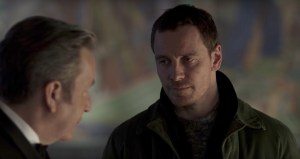 I thought at worst The Snowman was going to be a high-gloss Hollywood equivalent of a really stupid episode of TV’s really stupid yet inexplicably long-running show, Criminal Minds. This is far, far worse. At least with your casual Criminal Minds episode, it’s garish and lousy and icky in its sordid depiction of grisly violence against women, but you can still understand what is happening on the screen. You can still follow along. The Snowman is impenetrable to decipher, not because it’s complicated but because it’s all misinformation and filler. According to interviews, director Tomas Alfredson (Tinker, Tailor, Soldier, Spy) was unable to film about 10-15 percent of the script because of hectic schedule demands, so no wonder it’s so difficult to follow. Very little makes sense in this movie and what does has been done better in a thousand other movies. This makes The Girl with the Dragon Tattoo look like Shakespeare. With a dull protagonist who doesn’t seem exceptionally competent at his job, paired with a dull antagonist with no larger game plan or purpose, or even personality, and a mystery with a dearth of clues to actively piece together, the movie turns ponderous, punishing, and psychologically shallow. It’s a dumb, dumb, dumb movie that thinks it’s smart and contemplative with a cold streak of nihilism. This silly thing takes itself so seriously that, if you’re like me, you’ll find yourself cackling at its desperate attempts to make the visage of a snowman into the stuff of nightmares. This feels more like genre parody. The Snowman is an aggressively bad whodunit that fails to make an audience care about any single thing happening. You’re better off staying home and watching the worst of Criminal Minds instead.
Nate’s Grade: D


You must be logged in to post a comment.