Blog Archives
Adrift (2018)
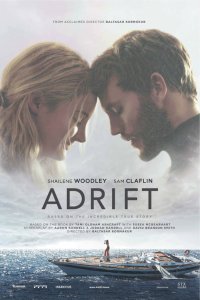 It’s one part survival-at-sea drama, one part relationship drama, and you get an equal slice of both until an unforeseen ending explains why the narrative was so divided. Based on a true story, Adrift tells the journey and survival of a couple (Shailene Woodley, Sam Claflin) lost at sea for 41 days after getting too close to a hurricane. Woodley takes the lead to fix the sailboat, gather supplies, tend to the grievous injuries of her boyfriend, and plot their treacherous path to Hawaii. If they’re off just a few degrees, it will be life and death. The survival half is viscerally entertaining and steady with its details, allowing the audience to get comfortable in following the steps and reasons. The camerawork by director Baltasar Kormakur (Everest) is sweeping and methodical, pulling us into the danger and isolation while creating a sterling sense of verisimilitude. The screenplay vacillates between the present and past, supplying flashbacks to fill out the romantic relationship. It’s a smart move because it allows us to immediately get into the stakes of survival while also finding room to develop the characters in a more normal setting. Plus it also makes more sense by the Tully-esque end. This is pretty much Woodley’s (HBO’s Big Little Lies) show; her secondary co-star might as well be her nipples poking through her character’s swimwear and tops. As readers may know, I’m a big fan of Woodley and the naturalism she brings to her performances, and Adrift is no exception. She can say so much through her smiles. She’s a great anchor for a storyteller. Ultimately, Adrift is a survival drama that takes a while to get going but leaves a favorable impression thanks to the acting and technical merits.
Nate’s Grade: B
Share this:

Revenge (2018)
 Can you tell a rape-revenge movie from a feminist perspective? The lazy storyteller or analyst would say movies like I Spit on Your Grave are feminist because it involves a wronged woman wrecking righteous vengeance on her almost-assuredly male attackers. However, if you’ve seen I Spit on your Grave, or its remake, or any genre thriller where rape is treated as the inciting incident, you’ll know these movies are hardly feminist. The protagonists typically exist to be objectified, then traumatized, then transformed into sadistic killers. It’s not exactly the most nuanced or dignified portraits of sexual violence. French writer/director Coralie Fargeat attempts to give this tired trope a feminist spin with Revenge, a thrilling, grueling, wildly bloody good time. It’s a thriller with real bite.
Jen (Matilda Lutz) is enjoying a vacation with her boyfriend Richard (Kevin Janssens), who also happens to be a married family man. She’s lounging around in a deserted bungalow for Richard’s hunting getaway, a regular vacation he shares with his other pals Stan (Vincent Colombe) and Dimitri (Guillaume Bouchede). Jen makes herself at home and Stan, in particular, lusts over her. While Richard is away, Stan attacks and rapes Jen. Richard offers to set her up with a new life in another country but Jen refuses, demanding to go home. She runs off and is pushed off a cliff by Richard. Miraculously, she survives, and from there the three hunters try to track her down and cover up their misdeeds.
 It’s a simple story but Fargeat has an uncommonly sharp command of her craft, knowing what exploitation elements to double down on and when it’s best to show restraint. This allows Revenge to unfold with a natural sense of pacing and direction while still achieving a high level of thrills and satisfaction. I appreciated that Jen doesn’t suddenly become an expert merchant of death. This isn’t like 2013’s You’re Next (though the final act starts to dip into that film’s black comedy of absurdity) where the damsel ends up secretly being a highly-skilled and highly-trained warrior. In Revenge, the self-entitled creeps think they have the upper hand throughout, constantly underestimating the resourcefulness and will power of Jen. Very early in the second act, the three men are on the hunt for Jen, so the movie becomes a cat-and-mouse thriller with each new set piece being its own engrossing mini-movie, adopting varying degrees of tone. There’s a lovely A-to-B-to-C sense of progression to the plot as Jen confronts a new set of obstacles, all the while being hunted by three cocky sexual predators. There’s great joy in rooting for a worthy underdog and also watching villains robbed of their own joy.
Revenge easily taps into our desire to see justice befall some very bad people, and maximum carnage ensues. This is an outstandingly gory movie and the first I can recall in quite some time that genuinely forced me to avert my sight. Fargeat’s camera gets you up close and personal to gashes and seeping wounds, enough to see layers of tissue and fat, and her camera lingers on the bodily destruction, forcing us to squirm in discomfort. It’s highly effective and yet doesn’t feel gratuitous. When the camera dwells on Jen’s wounds, it’s about her perseverance and strength. When the camera dwells on the wounds of the gents, it’s about the extent of their outlandish punishment. There is a hallucinogenic series of gonzo, gory kills meant to goose the audience for extra fun, and it had me laughing after the third daffy dream sequence-within-a-dream sequence. The final act ramps up the bloodletting to an almost comic degree. Characters are literally slipping and sliding on the floor from the copious amount of blood spilled.
This is a gruesome movie to watch but Fargeat knows what an audience wants to see and squirm over and what they don’t. This is typified in how the rape is portrayed. For the beginning of the first act, the camera seems to adopt the perspective of voyeur, often perfectly framing portions of Lutz’ body, notably her posterior. The men take turns leering at her but so has the audience at this point. It affects us to the male gaze. Then an increasingly agitated Stan harasses Jen. This uncomfortable sit-down is excruciatingly tense because we’re waiting for him to pounce, but it also has an effective power because it illustrates the daily minefield women experience deflecting the unwanted attention and affections of men. She’s desperately looking for safe ways out of the conversation that still save the man’s ego, a tricky navigation so as to not upset one’s toxic masculinity. The ensuring rape happens off screen as the camera leaves the scene with Dimitri who even turns up the TV volume to drown out Jen’s panicked screams. For anyone who’s sat through these kinds of movies, they often glorify the horror of the rape and can readily cross a line into icky intentional titillation. Leaving rape off screen is practically admirable.
 Revenge is a cut above its genre ilk thanks to its strongly developed suspense sequences. Each set piece or confrontation presents itself in a memorable and different manner, requiring our heroine to use a different set of survival skills. Fargeat has a terrific sense of space, allowing the audience to understand the distances between the two participants. This allows the tension to simmer and boil as directed. Take for instance that bloody finale, which has an extended and very tense portion that revolves around two characters literally chasing around a circular hallway trying to get the jump on one another. That sequence doesn’t work without crisp editing and a proper sense of space. The director also knows when to draw out a scene with long takes and a wandering camera that makes you nervous about what’s going on where we don’t see. There are some wonderful moments of anticipatory dread to amplify the suspense. Fargeat’s smooth camerawork and sense of pacing allows the suspense to nicely develop, as she draws out the dangers for Jen and finds organic complications per scenario.
The actors ably perform their parts and Lutz (Rings) is a future star-in-the-making. A lot of physical acting is required from her and she is highly persuasive in every moment. Her happiness early on is infectious, her discomfort is grueling, and her desperate escapes feel frantic and wild, more a realistic human being fighting for their life than as some slick movie character coasting on a divine sense of cool. Her second half onslaught of titular vengeance still manages to keep the character grounded and mortal; she suffers setbacks and grievous injuries during these fights too, yet she endures. The other gentlemen give strong performances displaying different degrees of toxic masculinity, entitlement, and hapless weasel-ness when exposed. Stan, who previously had been enjoying his turn as an unpredictable threat in preparation to raping Jen, becomes a big blubbering weakling. Belgian actor Kevin Janssens reminded me a lot of a younger Aaron Eckhart. The movie is certainly elevated a few notches thanks to the actors giving you strong rooting points.
Revenge is a grisly, gory, and wild genre movie that will appeal to fans of indie thrillers but also extend behind that loyal clientele. Writer/director Coralie Fargeat demonstrates an innate understanding of not just the genre but the mechanics of suspense as well, engineering and executing terrific suspense sequences while keeping her familiar narrative fresh. I loved her attention to details (not just the gory ones) like the fact that Jen has these pink star earrings for the entire run of her vengeance. Fargeat understands this genre and its audience but also brings an empathetic, feminine perspective to our heroine’s awful plight. I was impressed how grounded this movie remained with its characters even as they were losing a blood bank’s worth of inventory. Even if you are more on the squeamish side when it comes to blood and gore, I’d recommend Revenge as an above average thriller that only becomes more satisfying in execution.
Nate’s Grade: B+
Share this:

The 15:17 to Paris (2018)
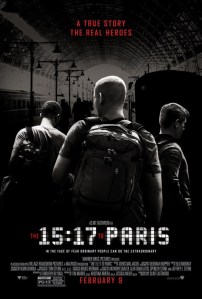
Spencer Stone, Alek Skarlatos, and Anthony Sadler were three ordinary servicemen taking a train ride into Paris when they found themselves in the middle of an armed terrorist attack. The three men rushes into danger, disarmed and subdued the attacker, and treated the injured on the scene. The 15:17 to Paris is a big screen movie directed by Clint Eastwood (American Sniper) that tells their life stories played by the men themselves. It got some of the worst reviews of Eastwood’s storied career (mine won’t be better). There are two gigantic miscalculations when it comes to 15:17 to Paris: 1) having the real-life subjects play the adult versions of themselves, and 2) that there was enough material here to fill out an engaging, enlightening, fulfilling film experience.
I assumed telling this real-life story as a movie was going to be a challenge to produce enough meaningful material to eek out a feature-length running time, and within the first five minutes I knew that I was doomed. We’re sitting down to two single moms discussing their boys with their classroom teacher, and that teacher literally says, “If you don’t medicate them now they’ll just self-medicate later. Statistically, boys of single moms are more likely to have problems.” My response: “What the hell, lady?!” This character was obviously engineered, from her very foundation, to be a walking, talking point of exposition and disagreement. No real teacher would ever utter these words so callously. It was this rude awakening that made me realize what a terribly written slog I was in for. At no point were these supporting characters going to come across as authentic human beings. Instead, it’s a world populated by robots with bad social skills or unshakable faith played by familiar actors (Judy Greer, Jenna Fischer, Thomas Lennon, Tony Hale, Jaleel White of all people). Also, what little kid has a Full Metal Jacket poster in his bedroom? Did he not understand what that movie was about?

These men can rightly serve as an inspiration, rising to the occasion in a true test of courage. No one will challenge the heroism. But what else is there to this story? The attack is presented as the framing device and as it plays out we segue into lengthy flashbacks about their lives leading up to this pivotal point in time. It’s just that these three men lived fairly uneventful, normal lives until finding themselves in a unique situation. We don’t seem to trace any significant, formative moments. Spending time with them as kids, then teens, and finally as adults doesn’t so much provide greater understanding of them as people as it does pad out the running time. We watch them get in trouble twice at school for not having a hall pass. We watch them watch football. We watch them endure training montages. We watch the trio tour the sights of Italy and eat gelato. We watch an Army team retrieve a backpack. We watch Spencer get demoted for not stitching properly. Seriously, this is given time. It’s not even until a full hour-plus into the movie before they confront the attack on the train.
Chronicling the lives of normal, real-life people under extraordinary circumstances is not by itself a fatal flaw, as evidenced by the masterful and mournful United 93. The power of empathy allows us to leap into a multitude of perspectives. However, with United 93 there was an ongoing story that could unfold because of the scope of events. There were developments, deadly complications, and the slow realization of what was happening, what was going to happen, and what needed to be done. With 15:17 to Paris, the attack is uncomplicated and over relatively quickly. There’s a reason Eastwood saves the train attack for the end because it cannot function as a sufficient movie plot on its own. Eastwood had a similar predicament with his previous film chronicling the heroism of the pilot who landed a plane on the Hudson River. The plane crash was thrilling and Tom Hanks added some layers to the portrayal of a man uncomfortable with the spotlight. 15:17 to Paris doesn’t even have that much. It’s a tedious trek to an all-too swift climax.

The other large miscalculation was having the real-life actors portray themselves. These guys just are not actors. I suppose Eastwood felt the real-life figures would best understand the emotions of each scene, in particular the attack, but another approach would be simply teaching actors. The forced verisimilitude feels like a marketing gimmick meant to appeal to a select audience. Making things more difficult is that these guys just aren’t that interesting as subjects. Sure there are broad strokes of characterization applied here and there but it’s with very minimal effort (see above for some of the just-had-to-include plot moments). This is another reason actors would have been preferable, because these guys’ lives don’t have to be interesting for my benefit. Their lives were not destined to one day entertain me on the big screen. They can simply be normal people. On the other hand, watching normal people do normal, boring things without a more enriching sense of introspection, personalities, or depth is like being trapped watching someone else’s home movies on a loop. Spencer Stone performs the best of his buds but none of them should expect a second career as an in-demand thespian.
I feel bad saying this but I really just didn’t care, and that’s because the movie gave me no reason to do so here. Yes, these three men are heroes and their sense of normality might lend itself toward a larger theme about the everyday capabilities of heroism, but there isn’t enough here to make me care beyond the train attack. The screenwriting does not present them as multi-dimensional characters and perhaps that’s because of the guys’ limitations as actors, exacerbating a spiral that only makes 15:17 to Paris less involving as it chases after the idol of authenticity. Eastwood is known for being an economical filmmaker but it feels like he should have been even more judicious here. The adherence to strictly the facts strips the film of some of its larger emotional power. There’s far too much filler and not enough substance to balance out 90-plus minutes. You’ll grow restless. If there’s a lesson to be learned from The 15:17 to Paris, let it be that every story needs a reason to exist and, when in doubt, trust actors to deliver that story.
Nate’s Grade: C-
Share this:

Life of the Party (2018)/ Breaking In (2018)
 Just in time for Mother’s Day weekend comes two eminently bland, safe, and unmemorable movies that generally waste their female stars. Melissa McCarthy has proven herself one of the most funny and dynamic performers in comedy, but Life of the Party is a listless and groan-inducing back-to-school comedy that feels tonally off, adopting the persona of its tacky, talky, and awkward middle-aged mother. You would think the premise would lead to plenty of R-rated shenanigans, but instead the film adopts a very sedate PG-13 atmosphere, dulling the wild collegiate experience into something so predictable and safe as to be completely inoffensive. It feels like a caricature reminiscent of a feature-length rendition of a Saved by the Bell: The College Years. McCarthy falls back on tired, corny jokes that don’t attempt to be anything else, and the supporting cast is left to gasp and grasp for anything to spark laughs (special credit Gillian Jacobs for doing everything possible as “coma girl”). McCarthy is best when given room to improvise and discover interesting odd angles for jokes, but she also needs a stronger comedic vision, and that’s not going to come from husband/co-writer/director Ben Falcone (Tammy). It feels like they had a general outline for a comedy and, in grand collegiate tradition, pulled an all-nighter and sloppily finished a serviceable draft. I chuckled about four times, mostly involving an exuberant Maya Rudolph and the one clever structural payoff revolving around a much younger fraternal hookup. Mostly, Life of the Party lacks a sense of stakes, credibility, surprises, development, and laughs, though the middle-aged mothers in my preview screening lapped it up, so take my opinion with a grain of salt if the trailer seemed moderately appealing for you.
 On the other side, Breaking In is a mundane, low-budget home invasion thriller that disappears almost instantly from memory. I’m struggling to even come up with enough to say in this review that isn’t just repetitions of the word “boring.” Gabrielle Union (Bring it On) plays a mom who brings her two children to visit the estate of her recently deceased, estranged father. Also visiting is a trio of stupid robbers searching for a hidden stash of money. They take the kids hostage though keep them locked in a room and in little danger. Union’s determined mother must break in and save her children. It’s a thriller without anything genuinely thrilling to experience, as each chase or near miss hums along ineptly and tediously, finding the least interesting conclusion. There are no well-drawn suspense set pieces to quicken the pulse, no clever escapes or near-misses, no intriguing villains with strong personalities, and no entertainment to be had through its strained 88 minutes. There are glaring plot holes, chief among them why doesn’t she just flag down a car and call the police rather than hack it alone. Depressingly, Breaking In is actually directed by James McTeigue (V for Vendetta) who seems to have exhausted any sense of style and excitement he may have had earlier in his directing career. It feels like nobody really cared about the movie they were making, and that lack of enthusiasm and effort translates into one very boring and very poorly written and executed thriller. Union deserved a better showcase but, then again, the audience deserved a better movie too.
Nate’s Grades:
Life of the Party: C-
Breaking In: D+
Share this:

A Quiet Place (2018)
 I’m going to write a sentence I’ve never written in my history of writing about film: make sure you get all the gas out of your system before sitting down to watch A Quiet Place in the theater. This intense little thriller relies upon a nearly silent film experience which makes you, in the audience, hyper aware of just about every little noise permeating your surroundings. Munching popcorn, opening candy wrappers, brief coughs, you’ll become highly attuned to the faintest of noises. This is why you, dear reader, should be advised to make sure you have no bodily gasses stored in your system. Unless that’s your plan all along, to break the tension with a well-timed expelling of flatulence, going from screening to screening, finding new purpose with being that guy, eating plates of beans in preparation for the long withholding. With all that being said, A Quiet Place is an ingenious little thriller with near flawless execution.
It’s over a year into a world overrun by monsters that are trained to attack the smallest of sounds. What’s left of humanity has had to adapt to a very quiet way of life. The Abbott family has ironically be given a head start to adapt into this scary new world that prioritizes silence. Lee (John Krasinski, also co-writer and director) and Evelyn (Emily Blunt) have a daughter, Regan (Millicent Simmonds), who is deaf, so the family has learned to communicate via sign language. The family walks barefoot on paths of sand and resides in a farmhouse on the edge of a rural community. The Abbott clan is still overcoming the loss of their youngest child who, at and innocent and naïve four years old, was taken by the monsters. Now Evelyn is expecting a new child and the Abbotts must stick together if they are going to survive.
 A Quiet Place is a brilliantly simple concept that’s exceptionally well developed and executed. Using the very concept of sound itself as the monster, or the prelude to the monster, is so clever and completely relatable. It trains the audience to fear sound itself. It also serves the role of placing the audience in a hyper aware state of continuous dread. Any little sound we deeply dread, and there are so many ways to make sound in this world above a whisper. The emptiness of the aural landscape creates a template to build upon, so that any small noise feels like an alarm to the sense. The gripping sound design brings a sense of the looming dangers as we hear the thundering claps and crashes of the monsters approach. Krasinski also very cleverly communicates the world from Regan’s deaf perspective. When the camera focuses on her, the sound levels drop entirely, and then when another character is onscreen, they rise back up. It’s an extremely effective and smart way to drop the audience into her vulnerable position.
This is a movie that sets up the stakes upfront. A young child dies for doing something stupid but entirely in character for a young child (whom I’m assuming never personally encountered these creatures). A Quiet Place establishes immediately that this new world is unforgiving of mistakes. A distracted mind, a false step, a sudden impulse, and anyone can be gone forever.
Like the similarly themed Don’t Breathe, the fun is setting up the world, the playing space, and the rules, and then watching it all play out. A Quiet Place does a great job of establishing its world and surroundings and once the action hits midway through it doesn’t let up until the end credits. Fortunately, the thrills never get old too because Krasinski and the other screenwriters, Bryan Woods and Scott Beck, keep finding new and intelligent challenges to explore. The pieces all add up and the details make this world feel extremely well realized, from the marked squeaky floorboards to the routines if separated to the colored warning lights. The tension is already at a constant simmer from its very effective opening sequence that sets the mood. A simple exposed nail on a stair can be a returning point of tremendous uncertainty time and again. The very presence of a pregnancy with a looming due date feels like a bomb waiting to explode. How in the world will a baby be born in a world that punishes sound? I watched this movie with my hand covering my mouth for a far majority of it. Even the jump scares feel well distributed and earned in this movie. Mostly, it’s a film that makes you twist in that delicious sense of anxiety as you wait. It’s nerve-rattling in the best possible way.
 Another aspect of what makes the film so worthwhile that won’t get as many headlines is how well developed it is as a drama about a family overcoming grief and guilt. Each member of the Abbott family feels some level of blame for the tragedy and is punishing his or herself. In a way, the events of the film are about processing that grief and handing over the protection of the family. It’s an unspoken shroud that hangs over the entire family, you can see it on their faces, with the heaviness in their eyes, and in their day-to-day anxiety. The film does a great job through the character of Marcus (Noah Jupe), the middle child, of showcasing how this terrifying new normal would affect and fray one’s psyche. He’s petrified with fear and consumed with the scary burden of having to ascend into the role of protector and provider that his father is trying to groom him for when the inevitable comes. The happy version of “the inevitable” is Evelyn and Lee growing old and feeble. The more realistic version is the two of them at some point being felled by these murderous monsters. When Marcus is given a moment to let his guard down, to not worry about the volume of his voice, it’s a sweet father/son moment of bonding that feels entirely fulfilling as well as insightful about this new, peculiar way of life.
A central conflict is the friction between Regan and her father and their desire to understand and empathize with one another. The film’s biggest emotional moment is the conclusion of this, and it feels so fully earned and poignant that even typing it out now stirs me. It’s the culmination of a well-structured screenplay that has found its moments for character development in a nearly silent movie, so that when declarations are made, even with the monsters and its creepy gimmick, you’ll still feel something. These characters matter and their struggles are universal and emotionally appealing. The acting all around by the young children and Krasinski and Blunt is completely believable and engaging.
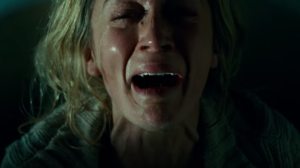 For a relatively low-budget thriller, I was surprised how much of the monsters we actually saw onscreen. Krasinski still prefers to keep his monsters on the peripheral or in the background, letting the audience’s imagination fill in the horrifying rest. That’s where I thought the movie would stay, but it does not. There are several close-ups of the creatures at work, a mass of teeth and auditory sensors. Their heads open up like blossoming flowers. I know the designs are CGI and yet they looked very realistic, as realistic as a fanciful monster can, naturally. It had the sheen of practical effects, which is the best compliment. The monsters reminded me of the Cloverfield creatures mixed with the Pitch Black aliens. It’s a spooky design and under Krasinski’s attention the menacing creatures never stop being scary.
Who knew John Krasinski had this in him? The affable actor best known for portraying Jim Halpert on the long-running American version of The Office has directed before, an adaptation of a David Foster Wallace book and an indie family dramedy. He’s never ventured into genre filmmaking before. But then again, neither had fellow funnyman Jordan Peele, who came out of nowhere in 2017 with Get Out and rode that to box-office riches, critical acclaim, and an Oscar for Best Original Screenplay. Maybe more performers we view simply through the lens of comedy have tremendous potential to be genre virtuosos. A Quiet Place is not an outright silent movie but one where silence is most keenly felt. The simple premise is beautifully realized, the characters and their plights are affecting, the details are fully thought through (though newspaper publishing is questionably late into this sound apocalypse), and the structure is smartly placed and paced. If you’re looking for a suspenseful, intense, and invigorating movie, A Quiet Place feels like a work out for the senses.
Nate’s Grade: A-
Share this:

Unsane (2018)
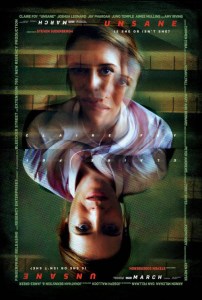 Steven Soderbergh is a restlessly experimental filmmaker who enjoys adopting new technology to tell familiar stories. Unsane was shot entirely on an iPhone (7s, if you must know) but I’ll never know the reason other than to see if it could be done. Otherwise, Unsane is Soderbergh’s woman-in-peril Lifetime movie of the week. Claire Foy (Netflix’s The Crown) plays a harried woman on the edge that accidentally commits herself to an in-patient mental hospital. That’s the best part of the movie, the first twenty minutes, as she diligently tries to convince everyone she is not crazy and there has been some sort of mistake. From there she begins seeing images of her stalker (Joshua Leonard) from another city. Is she really crazy? Is he really there? Has he followed her and gotten a job at a mental hospital and been waiting his time anticipating she would commit herself to this exact facility? The film answers this question ridiculously early and finds the most boring yet also preposterous route to go with its pedantic thrills. There’s a good concept here with the idea of a person trying to navigate the Byzantine, bureaucratic system to prove their sanity from behind bars, but it’s so poorly developed as to feel like a promising TV episode stretched thin. There simply are not enough twists and turns to keep an audience consistently engaged. Soderbergh has played in the trashy B-movie realm before with 2013’s Side Effects to much better effect. There aren’t enough credible characters to grapple onto. Foy is enjoyably incensed and erratic and keeps your attention, though I think she studied at the Kate Winslet School of American Accents. Gorgeous looking movies have been shot on cell phones, like Sean Baker’s Tangerine. This movie looks like it was shot on someone’s phone while it was dying. It looks so ugly on the big screen, flat and over-saturated in lighting, and just unappealing. It’s deeply un-cinematic and Soderbergh has the skills to do better. Unsane is un-good.
Nate’s Grade: C-
Share this:

Thoroughbreds (2018)
 Thoroughbreds is a dishy, tart little treat that kept me squirming, laughing, and gleefully entertained. Olivia Cooke (Me, Earl, and the Dying Girl) and Ana Taylor-Joy (Split) are outstanding as privileged teenagers trying to resuscitate their former friendship through collaborative murder. Cooke plays Amanda, a sociopath who cannot feel anything, who is incurably honest, and has stopped caring what others think. Taylor-Joy plays Lily, a self-involved young lady that feels overwhelmed by life and is skilled at dissembling. Together, the girls scheme to kill Lily’s boorish stepfather and enlist the aid of a hapless small-time dealer with big plans (Anton Yelchin, in his final performance) through blackmail. The story from writer/director Cory Finley is immediately engaging with how it naturally reveals the complicated histories between Amanda and Lily as well as what makes each questionable. These are two very interesting people and just watching their probing push-and-pull was entertaining enough, especially with such strong performances. The characterization of a sociopath without a heavy moral condemnation was refreshing. We assume Amanda will be the bad influence but it really becomes the other way around, with Lily faking for her own purposes. Thoroughbreds is more dread-filled and unsettling than conventional thriller, and while there are some gallows humor to be had from the abnormal characters, this is less a dark comedy. There are drawn out tracking shots and methodical push-in camera movements meant to build audience anticipation, and they’re mostly effective. The first half is a bit more engaging than what it ultimately delivers as a climax. It’s still satisfying and well handled, but Finley throws in some misdirects that don’t add a rising sense of stakes. The stakes are really more personal, which works since the crux is on the relationship between the girls and whether they are being honest or manipulative with one another. By the end, I thought I could argue either way who was manipulative and when. Small irony: the last scene you see of Yelchin is him as a valet parking other people’s cars.
Nate’s Grade: B+
Share this:

Red Sparrow (2018)
 The Cold War-worthy spy thriller Red Sparrow is a misfire that doesn’t seem to be able to commit to what it wants to be. It wants to be provocative but serious; however, it lacks the substance to be serious and lacks the conviction to be provocative. It lands in a middle ground between the sleek genre fun of Atomic Blonde and the understated paranoid realism of a Tinker, Tailor, Soldier, Spy. By landing in the middle zone, Red Sparrow is that rare boring movie plagued by untapped potential.
Dominika (Jennifer Lawrence) is a classically trained Russian ballerina that suffers a gruesome injury. Her leering uncle (Matthias Schoenaerts) enlists her into a state-run school for spies and assassins who specialize in seducing their targets. “Whore school,” as Dominka terms it, is run by the Matron (Charlotte Rampling), who methodically trains her recruits by stripping away every ounce of fear, shame, and defiance. Their bodies belong to the state now, she says, and they will be put to good use for Mother Russia. Nate Nash (Joel Edgerton) is an American spy working in Europe who tries to convince Dominika to switch sides, to take refuge in the United States. Dominika’s superiors order her to get what she can on Nash, find their secret contact, and eliminate them both.
 Firstly, Red Sparrow is far too long and far too leisurely paced at a bladder-unfriendly 140-minutes. When things do get interesting, the overall slow pacing has a tendency to sap whatever momentum was starting to emerge. The entire first act should have been condensed down into an opening ten minutes rather than stretching out into 30-some minutes. We don’t need a full half-hour explaining what Dominika’s life was like before her new life as a deadly state-sponsored seductress. We don’t need all that time to see her life as a ballerina, her life caring for her sick mother, and her hesitancy with her first mission before she’s roped into fully accepting her fate. I don’t need this much convincing that her life was better before or that she was trapped into this decision. I don’t care that Lawrence studied ballet for four months. It’s not integral and it’s a deadly start to a story. Once Dominika is at her spy school, that’s when the movie really starts. I was getting awfully sleepy as the movie just seemed to drift along. I know a high school student who saw the movie and said, “I fell asleep at the beginning, and then I woke up later and it was STILL the beginning!”
Another problem is that the parallel storyline about Nash and the Americans is far less interesting. Every time the movie jumps to his perspective, you can feel the movie stalling. A U.S. spy who is pushing against his own brass and the politics of the agency can’t compete with a woman who is thrust into unfamiliar and dangerous missions that test every physical and psychological boundary she knows. When Nash and Dominika cross paths, he finally starts to justify his placement. Much like the delayed first act, though, the extra time setting up his life before he was important was not time well spent. Their relationship together is mean to appeal to Dominika to convince her to flip allegiances. They don’t feel like they really connect, and part of that is the lackluster chemistry between the actors. The emphasis on their romantic relationship is even more moot because Dominika’s real motivation is revenge. She didn’t need a handsome, doe-eyed American man for that to happen.
 Where Red Sparrow does work is with its unique, high-pressure, destabilizing training environment. There’s a prurient appeal when it comes to watching the training program for assassins who must strip everything away and use their bodies as a weapon. This is where the film is at its most interesting and its most sensational as far as use of genre elements. There is an uncomfortable amount of stark sexual violence depicted in the movie. I lost track of the number of times Dominika is raped, tortured, sexually assaulted, or assault is attempted upon her. I don’t feel like these moments of sexual violence are glamorized or designed for base titillation; it’s a window into the harsh reality these women face. They have been robbed of their agency, their very sex weaponized. There’s a fascinating story to be told from that perspective and the trials and tribulations within “whore school” are harrowing, shocking, and always intriguing, which makes it even sadder when the filmmakers try and posit an arty sheen of self-seriousness. This is a movie about training spies to seduce the enemy and then prove their skills. This is a movie where the head of the spy school runs a play-by-ply analysis on a student’s use of a handjob. This is not going to be John le Carre, and that’s fine. Rather than embrace its inherently trashy side, Red Sparrow tries to stay above the icky stuff, while still indulging in a heaping helping of blunt sexual violence. It’s truly strange. It’s like the filmmakers felt they were making something sober and thoughtful and didn’t want to taint their award-caliber production with too much emphasis on the thing that makes it most interesting. And then instead they threw in a lot more sexual violence, because that’s also serious, and that’s the kind of thing serious movies do to be serious.
Lawrence (mother!) is once again a strong anchor for the audience, even if her Russian accent falters from scene-to-scene. This is a very different role for Lawrence and requires her to simultaneously put much of herself on display physically while finding ways to hide the inner life and thinking of her character from the audience. There’s an interesting character here buried under layers. After her accident, Dominika viciously injures her dance partner and his new leading lady, and it previews the cruelty that Dominika is capable of. Much of the press in the lead up has focused on Jennifer Lawrence’s nudity, and it’s there, okay, but it’s never really emphasized. There is one sequence in particular where she disrobes and taunts her would-be rapist to try and ravish her available body, humiliating him, and it’s one of the few scenes where Dominika turns her body around as a tool of empowerment. Granted, it’s within the prism of a school that’s practically state-run sex slavery, so let’s not get carried away with larger feminist implications. Lawrence keeps the audience guessing scene to scene as she transforms from setting, slipping into different identities that suit her, thinking on her feet, and being, frankly, adult.
 There are a slew of good supporting actors tasked with saying ridiculous and foreboding things, like Charlotte Rampling as the headmistress of “whore school” and Jeremy Irons as a high-level Russian spymaster. What really catch the attention are the accents. We have a group of actors from the U.S., Britain, Belgium, Netherlands, and Germany portraying Russians, and with Edgerton, an Aussie portraying an American. As you might expect, the Ruskie accents can be a bit thick and obviously phony at times.
It’s not too difficult to see the kind of movie that Red Sparrow could have been. It even previews it from time to time, providing a glimpse into an alternative version of the movie that decides to take ownership of its more sensational, sexualized elements with genre pride. Red Sparrow feels like an out-of-time throwback to the erotic thrillers of the go-go 90s. I mean does Russia even need to train sexy assassins any more in the information age where a troll farm and some Facebook ads can get the job done? Director Francis Lawrence (The Hunger Games movies) has a controlled, precise Fincher-like visual acumen that gives the film a sleek and sterile allure to the spy shenanigans. It’s a nice-looking movie to watch, but without a better story, let alone a verdict on tone, it’s a nice-looking movie that runs self-indulgently too long. Consider it a screensaver you forgot was still going on but with Jennifer Lawrence nudity.
Nate’s Grade: C
Share this:

Game Night (2018)
 Very funny and surprisingly satisfying, Game Night is a comedy thriller that further cements my appreciation for the comedic prowess of writer/directors John Francis Daley and Jonathan Goldstein (Spider-Man: Homecoming, Horrible Bosses). The premise about a group of couples on a wild “game night” they don’t know is real seems like it could go wrong in so many different ways, chiefly being unable to sustain its premise. Fortunately, the film is filled with strong characters who are each given a moment to shine. Jason Bateman and a loose Rachel McAdams are fun as our lead couple, and they’re even better when they’re bouncing off one another, but the real star of the movie is a hilarious Jesse Plemons (Hostiles) as a creepily intense neighbor. Plemons will hold onto certain jokes, taking something that was funny and pushing it into an even funnier, more awkward place. The comic set pieces are well developed and clever, set up earlier and allowed to go in unexpected directions to better complicate matters. While the movie is clearly a riff on David Fincher’s The Game, with some sly visual nods to Fincher’s signature style, the jokes don’t get lost when the action heats up. A good action-comedy makes sure that the action or suspense sequences are still constructed through the prism of comedy. I was laughing often and surprisingly hard throughout the whole movie. Game Night is a wickedly fun movie that has plenty of rewards and enjoyable surprises.
Nate’s Grade: B+
Share this:

Annihilation (2018)
 Alex Garland has been one of Hollywood’s most stable sci-fi screenwriters for some time. In 2015, Garland made his directorial debut with Ex Machina, a sly and invigorating potboiler that made you think. It helped make Alicia Vikander a star and Garland himself was nominated for an Academy Award for his original screenplay. The movie even won an Oscar for best visual effects, beating out some pretty pricey competition. With one movie, Garland displayed a natural knack for directing. His follow-up, Annihilation, is based on a book by Jeff VanderMeer and has already run into some trouble. After poor test screenings, the producer tried to force changes but these were refused. In a face-saving outreach, Annihilation will only be playing theatrically in North America and will debut on Netlfix weeks later for the rest of the world. The suits are not confidant in the larger public clicking with Annihilation, and they might be right. This isn’t going to be one of those films that people leave declaring their love over in effusive terms, despite what the critical praise may lead you to believe. This is a movie that you leave saying, “Huh.” It’s so powerfully inscrutable to the point that most other conventional forms of cinematic entertainment and narrative are smothered. And yet, it’s that inscrutability that might be the movie’s biggest point and might be its biggest asset.
Lena (Natalie Portman) is a biologist whose husband (Oscar Isaac) has been missing for a year ever since he ventured into a strange environmental disaster zone. Then he reappears with a mysterious illness and little memory of the events. Lena joins an all-female crew of scientists (Jennifer Jason Leigh, Tessa Thompson, Gina Rodriguez, Tuva Novotny) to find out some answers by exploring The Shimmer, the site where an alien meteorite collided with coastal land and has been changing local life forms at an alarming pace.
 Like I said, this movie is a conundrum, not just in a “What did I just watch?” sort of analysis but also in a, “Did I actually like that movie?” personal introspection. There isn’t really a mystery here to unpack as there is an enigmatic experience to explain. I’m doing something I don’t normally like to do, which is immediately type my review shortly after seeing a movie. I generally like to marinate on my feelings after experiencing a movie; however, with this one I felt compelled to put furious fingers to the keyboard, trying to explore my myriad conflicted feelings and find my way out the other side, or at least articulate that journey. I’ll try and steer away from any major spoilers though I worry that even discussing some of my confounding responses will require some thematic and plot context, so beware readers who wish to go into this experience completely pure.
Annihilation is an existential horror movie about biology’s indifference to mankind; at least that’s my best thematic interpretation. In the beginning, Lena is explaining the history of cellular life, the simple splitting of cells that begat all life on the planet. There was no larger forethought, no agenda, and no malice, only the enacting of DNA programming. Ultimately, I think the alien mutations are running on a similar principle. This isn’t an invasion by any traditional definition. This isn’t anything nefarious. This isn’t even anything as clearly identifiable as a virus spreading its illness. This is simply life stirring in a few new recipes. There’s a general level of indifference to the overall setting, which makes the environmental wonders and horrors more dispiriting. For those who demand clear answers from their storytelling, they will be left sorely disappointed. Annihilation doesn’t have any real answers for why these things are happening. They just are occurring, much like the beginning steps of cellular life that found new modes of survival on Earth billions of years prior. It’s just another stage in the development of life. The fact that humanity can be so easily cast aside, it’s hard not to feel insignificant. There’s a mounting sense of existential dread about man’s inevitable demise. One character dubs their mission suicidal and is corrected by another. “People confuse suicide with self-destruction,” she says. “Very few people are suicidal, but all of us are self-destructive.” The plotline confirms this as characters fall victim to hubris and curiosity. However, one may argue there is biological in destruction and reconstitution.
 Be warned, dear reader, this is a rather slow movie with a lot of space for breathing, the kind of thing meant to establish a particular atmospheric mood. If you connect with the material, it works, obviously. The problem with Annihilation is that because it’s so inscrutable, because it keeps you at a distance on purpose, that it allows more opportunities to check out. We’re anticipating weirdness and a general breakdown in the group of scientists, and Garland seems to understand this, which may be why he gradually delivers his genre scares. There is an amazing sequence in the middle that is the fuel of nightmares, made all the more searing and scaring by a horrifying sound design that’s even worse when you connect it with the visual source. I was almost compelled to look away and spare my memory this ghastly sight. There are other unsettling moments and the overall feel of the film is definitely one of discomfort and dread, but it’s this scene I’ll always remember and that also solidified the nasty surprises from Mother Nature. Unfortunately, these moments are few and far between. The eventual ending should be easy enough to predict thanks to Garland’s flash-forwards tipping your expectations, that is, if you can actually understand the ending. I still cannot say for certain what happened and why or whether I cared about a why. If, as stated above, the point of the movie is man’s inability to find a recognizable motive in the replication of life by biological factors, then that lends itself to a generally unsatisfying end.
One interesting idea that I regret gets short shrift is just the fact that this is an all-female group of scientists venturing where literally only men have gone before. I’m not celebrating this as some sort of nod at feminism but because it offered an interesting storytelling avenue. All the previous groups were all men and they either were killed by the new environmental dangers or went crazy and killed each other. Minor spoilers, but the women fall under the same sway, destined to the same fate, and it feels like a shame. If you’re going to make a point of questioning whether the deterioration of order and sanity is related to an all-masculine entanglement of thinkers, then don’t just have the women repeat the same decline. Or maybe that’s the point? I don’t know.
 Portman (Jackie) does an convincing job of alternating looking confused and spooked, mimicking most of the audience reaction. Her character isn’t asking to be found likeable, only capable, though the first time we get a little taste of her as a person is far too late into the movie. Her marriage might not have been built on the strongest foundation, which again leads to the potential thematic deliberation over self-destruction and rebirth. Leigh (The Hateful Eight) is a bit too flatly monotone for my liking. It feels like she’s sleepwalking through the film, like maybe she was on Ambien and can’t remember even performing in this movie. Tessa Thompson is underwhelming especially with knowing how fully captivating she can be onscreen (see: Thor: Ragnarok). The other notable actress is Rodriguez (TV’s Jane the Virgin) who put on some muscle and swagger and has a terrific breakdown sequence that showcases some unnerving desperation.
I still cannot even say if I liked Annihilation. There are aspects I can definitely admire, like the commitment of its actors, the emphasis on a more scientific approach to an outbreak/invasion thriller, and Garland’s general sense of place. I still think the majority of audiences are going to leave shrugging. Annihilation is more akin to an Under the Skin or Solaris than a monster hunt. It’s quiet, philosophical, and also often boring. It has its thrilling points, its moments of mystery and intrigue, but it also feels like a slow windup to the eventually disappointing reveal that won’t be enough to justify the lethargic pacing. In the end, this is a difficult movie, but not in a way that requires a thorough decoding like mother! or even in a way that requires repeat viewings to play out the twists. Annihilation is difficult by design, keeping its audience from fully engaging, and then offering little in the way of answers or resolution. And I still don’t know if I like that. Dear reader, this is a confounding movie but it might not be the good kind of confounding.
Nate’s Grade: C+


You must be logged in to post a comment.