Blog Archives
Searching (2018)
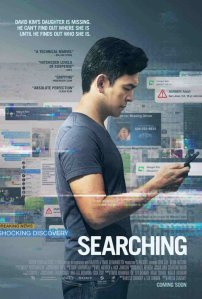 Searching is a clever, crafty found footage mystery told from the point of view of a computer screen. Unlike many found footage entries, writer/director Aneesh Chaganty has put considerable thought into the mechanics of his storytelling gimmick. The opening sequence even reminded me of Up as far as how deft it was with the economy of storytelling while providing an affecting emotional blow. In the opening, we watch a little girl grow up as computer technology and websites also advance documenting her life, culminating in her mother getting cancer and passing away, communicated via a “Mom’s Coming Home” date removed from a calendar. It was so well done I actually felt like I just might summon some tears for the passing of this woman. Right away I realized I was in for something special. Flash forward and the teen daughter goes missing and her stressed-out father (John Cho) dives into the investigation firsthand by looking through her online history and realizing how little he may have known his not-so-little girl. The movie illustrates nicely how easy it is to hide your real self online and how easy it is for others to find you and your digital impressions. Every time Cho is visiting a website, whether it’s Venmo or Instagram or Facebook or a webcam, there’s a solid reason for it and the movie has a satisfying step-by-step progression. The mystery has plenty of unexpected twists and turns and it’s anchored by a harried and distraught Cho (Star Trek Beyond), who does not look like he’s in his mid 40s at all (Kal Penn has also aged well, which makes me only want a cross-generational Harold and Kumar sequel more). The only knock on Searching is that there really isn’t a pressing need to see it on the big screen. After all, you’re watching a computer screen and typing for much of the movie. It will play just as well, if not better, on your home television or whatever smaller screen is at your discretion.
Nate’s Grade: B+
Share this:

Operation Finale (2018)
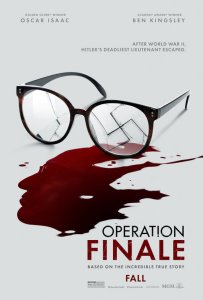 Operation Finale is one of those kinds of movies that is just good enough to make me wish it had been better. It’s based on the true story of an Israeli team of spies that located Adolph Eichmann (Ben Kingsley), one of Hitler’s lieutenants who authored The Final Solution. He’s been hiding in Argentina for years and giving public lectures, which isn’t helpful with keeping a low profile. Oscar Isaac (The Last Jedi) leads the Israeli spies as they plot to kidnap Eichmann, get him to admit his guilt for the Holocaust in writing, and smuggle him out of the country and to Israel to stand trail for the deaths of millions. This story should be exciting, it should be fascinating, it should be compelling, and for stretches it can be, but Operation Finale errs in capturing Eichmann too quickly. The majority of the film is the spy team holding him in a secret location and interrogating him, while the surprisingly Nazi-coddling police force of Argentina hunts for their location. I’m assuming the filmmakers were accurately telling the true story, but you start to question why the spies are taking their sweet time. Why not get on a boat as soon as possible and sail to another country to fly away, one less friendly to former Nazis? There aren’t really any set pieces where their cover might be blown. It’s mostly Isaac talking with Kingsley, and while their conversations are entertaining, it’s yet another preview of a better movie that we’re never going to have delivered. The film lacks enough urgency. The characterization is too limited and the supporting characters are more faces than people; Melanie Laurent essentially plays The Woman Spy. Operation Finale should have either spent more time on the specifics and complications of nabbing Eichamann, presenting a challenge, or it could have accentuated the debate between Isaac and Kingsley over the nature of culpability, rationalization, guilt, and vengeance. There’s probably a really good Nazi-hunting mini-series or Nazi-debating play in here. Either way, the actual finished film is well made, well acted, and well intentioned but also dramatically lacking.
Nate Grade: C+
Share this:

First Reformed (2018)/ You Were Never Really Here (2018)
 Both First Reformed and You Were Never Really Here use sly genre subversion to act as commentary on what kinds of movies the audience associates with these kind of haunted men, their arcs, and the nature of violence. Subverting audience expectations is in and of itself not necessarily a better option. You can have unexpected things happen but the narrative that happens after needs to be compelling, and if possible, unavoidable in hindsight (Game of Thrones is good at this). By the same notion, the finale of Breaking Bad was pretty easy to anticipate but that’s because of how well written the storytelling trajectory was pointing to its natural end. I can tell a tense father-son reconciliation story and then if I end it with a meteor wiping out the Earth all of a sudden, well that’s unexpected but that doesn’t make it better storytelling. What helps elevate both movies is that the subversions are thematically related to the relationship between violence and vengeance, absolution and atonement, and the audience and our desires with these films.
In First Reformed, Reverend Toller (Ethan Hawke, enthralling) is the caretaker of a small upstate New York church where the weekly attendance can be counted on one hand. The church, First Reformed, is nearing the commemoration of its two hundred-fiftieth anniversary that will be celebrated by local dignitaries and the governor. Reverend Jeffers (Cedric the Entertainer, surprisingly adept in drama) is the pastor for the mega church that seems to have everything that First Reformed lacks. Jeffers wants to help out Toller but the humble man of the cloth refuses. Rev. Toller is pushed out of his comfort zone by the husband of a pregnant woman (Amanda Seyfried) who challenges him on man’s stewardship of the environment. The husband worries about bringing a child into this world and contributing the larger problem of climate change. This interaction gets Rev. Toller to think about his own culpability and sets him on a path of righteous justice.
 Writer/director Paul Schrader is famous for his stories about violent men confronting the wickedness of the world around them. From Taxi Driver to Raging Bull to Hardcore, Schrader has a penchant for documenting the self-destructive recourse of flawed men who feel removed or constrained by a society they feel is out of step with morality. What better canvas then for Schrader than a middle-aged pastor at a small, reclusive church? Rev. Toller is so humble he doesn’t own more than a few sticks of furniture in his home, the adjoining parsonage to the church. He’s friendly but often choosing to keep to himself, forgoing comforts and perceived handouts from the people around him. A woman his own age keeps trying to connect with him, their romantic coupling in the past a platform for her to continue hoping he’ll come around to her. She’s a perfectly nice woman, a choir headmistress for the mega church down the road, but she reminds Toller of his weakness and maybe even something worse. The aforementioned mega church basically keeps Toller’s small parish afloat as a charity (First Reformed is nicknamed the “gift shop church” for its historical notoriety). Rev. Jeffers is concerned about his fellow man of the cloth and the toll his solitude and seclusion is taking on him. It’s like he’s trying to atone for something, taking on a very Christ-like path of penitence. It’s around here that the character is activated into a higher calling in conflict with the church.
I’ll explain what I was expecting given the premise and presence of Schrader. I was expecting a movie much in keeping with A History of Violence, where a small-town man is thrust back into a past life of violence by outside forces and he has to confront how far this “new him” has come from the sins of “old him.” I was expecting Toller to become more violent and radicalized, pitting others in his cross-hairs for retribution. That’s not really First Reformed at all. First off, it’s the slowest of slow burns. You better be prepared to luxuriate in the day-to-day details of Rev. Toller’s simple life, from unclogging toilets to visiting with parishioners in their homes and having long philosophical conversations with them about faith and man’s role in the ecosystem. That conversation specifically teeters toward ten minutes and serves as the end of Act One, and I think if you’re still invested by then, you’ll be along for the rest of the film. However, it’s not going to be an easily accessible movie. This conversation stirs something deeper inside Toller, dissatisfaction with the church and how it coddles with big business, the chief polluters of God’s kingdom. Toller becomes a late-in-life environmental activist who questions the stewardship of the church body. This sets him on a path that seems destined for bloody violence. He’s going to go out in a fury of righteousness. We’re expecting a big bang by the end, especially given Schrader’s history of these kinds of stories with these kinds of men. But that doesn’t happen.
 I’ll try and avoid spoilers but discussion over the thematic relevance of the end of First Reformed will unavoidably suggest to the reader some significant plot developments, so please feel free to read this paragraph or skip to the next one. The second half of the movie is setting you up for a very specific ending, one where Toller strikes back against forces he feels are detrimental to the well being of the church. It’s setting you up for a climactic showdown with powerful forces that feel unaccountable for their actions. I was ready for a final rush of violence to serve as the crescendo to Schrader’s slow burn. This is where the movie swerves away from audience expectations. We’re prepared for a meaningful death but instead Schrader’s ending, in retrospect, makes us question why we should have desired such a violent and vengeful finale. Why should this character be a martyr for our bloodlust against the powerful? Ultimately, Schrader’s movie ends on a romantic, optimistic note of personal salvation after setting you up for a dark story with a predetermined, self-destructive end. The abruptness of the ending may inspire some titters, but when you look back at the film, it makes complete sense and calls into question why we would wish for blood and violence over human connection and forgiveness. Schrader is saying that you wanted the wrong kind of movie.
First Reformed takes the modest aims of its protagonist to heart when it comes to the presentation of its story. Schrader films the entire movie in the old-fashioned 4:3 aspect ratio, the square box of old pre-high definition televisions. It’s an aspect ratio that keeps everything centered for the audience and on display. I think there was exactly four camera movements in the entire movie; almost the entirely of the 113 minutes is from a stationary, documentary-styled camera. It’s a very specific visual style that limits the visual information and dynamism but manages to personalize the main character even more. It’s his movie and his journey of self, so the visual representation is also restrained. There’s really one flash of upsetting violence in the whole movie, as if to remind the audience how a violent death is not something to be celebrated. For an R-rated Paul Schrader movie, it’s far more reserved, subtle, and thoughtful. It left me thinking about Rev. Toller and his messianic mission and our desire for a big bloody finish. The idea of a selfless death directed toward violent retribution is inherently self-involved. It’s not death that provides meaning but life, it’s not how we end but what we do with the days beforehand.
 You Were Never Really Here is built as a hitman thriller based on Jonathan Ames’ novel. Joe (Joaquin Phoenix) is a hired gun who specializes in rescuing young women. He’s hired to find the missing adolescent daughter of a senatorial candidate. He investigates the underbelly of sex trafficking to save this little girl, but larger forces are at play and will make Joe suffer gravely for interfering with their wanton exploitation.
The average audience for You Were Never Really Here has been steadily fed a diet of these kinds of movies, from the artful (Luc Besson’s The Professional), to the pulpy (The Long Kiss Goodnight), to any number of hollow, nihilistic video game-styled murder fantasies (Hitman, a thousand straight-to-DVD movies). We’re expecting men of action who are ruthlessly efficient and clever when it comes to their killing. We’re expecting stylish merchants of death who leave behind a heavy body count with swagger. That’s not what brilliant Scottish writer/director Lynne Ramsay (We Need to Talk About Kevin) has in mind at all. She takes the iconography of the hitman thriller and turns it into an expectation-smashing existential character study, but not just of its disturbed main character but also for the audience and our relationship to these movies. We expect remorseless killing machines that turn death into splashy and cool tableaus. These movies aren’t so much key on mediation and reflection, beyond the standard “reap what you sow” adage.
Much of the violence is kept off screen or purposely denied to the audience. I’m trying to remember if we even see Joe kill anyone on screen. The infiltration of the sex trafficking organization hops between fixed security angles, edited together in a dissonant manner, where the last shot doesn’t fully line up for a smooth edit, leaving a half second. The effect is one that’s knowingly alienating and challenging. When Joe does unleash his violent skills, it’s rarely given a showcase for entertainment. This is a movie that doesn’t celebrate its violence. There’s a moment where Joe lies on the ground beside a mortally wounded bad guy. They exchange a few cordial words, he procures some vital information, but then Joe stays with the man and the two sing a song together. It sounds bizarre when written out but it’s a moment that really stuck with me. After everything, these two men can find a small sliver of humanity between them to share. Even the final confrontation, the big climactic set piece of any other movie, ends with a shoulder shrug, as if Ramsay is saying to the audience, “Why would seeing all that be cathartic?”
 For Ramsay, the focus of the movie is on the man committing the acts of violence rather than how stylish and cool and cinematic those acts of violence can be. This is the one area where I feel a longer running time could have better helped her goal. I think Ramsay might be the best filmmaker we have for triptych narratives. 2011’s We Need to Talk About Kevin is a startling and insightful movie that opens up the guilt of a woman whose son grew up very badly, jumping around time periods, using a repetition of images to provide visual stings and associations. You Were Never Really Here does similar labor, establishing our strong silent protagonist through glimpses of a troubled past, from a childhood with an abusive father and a mother he would have to save, to incidents during military service and police investigations that reminded Joe about the depravity of others, in particular the ability to exploit and dehumanize women as disposable property. Ramsay offers discorded images and brief flashes and asks the audience to put together the pieces to better understand Joe as a man propelled and haunted by his bloody past. However, at a slim 89 minutes, the audience could have used more time and opportunity to better develop and analyze this central character. The pieces are tantalizing but I wanted more, and as a result I found Joe to be an interesting start to a character that was in need of more time and attention to transcend the boundaries of his archetype. I needed a little more from him and his world.
There are several moments that quickly come to my memory, sticking with me because of the level of artistic arrangement or implication. Because Ramsay wants to take the Hollywood hitman revenge thriller and deconstruct it and provoke her audience and its desires for violence, there isn’t much of a plot to this movie. I could literally spoil the whole thing with the following sentence: a man of violence is hired to find a missing girl, finds her, loses her, and finds her again at great personal expense. The movie is more of a poignant and intriguing exercise in our relationship to these kinds of stories. There are moments of beauty in the movie that took my breath away, like when Joe lowers a wrapped body into the depths of a lake, and with the shafts of light, the curls of hair, the small visual details, it felt like watching a living baroque painting. There are also several bizarre moments that stand out, like when Joe fantasizes about blowing his brains out at a diner while the patrons, and the blood-soaked waitress, go about their day. It’s these little flourishes that make the movie stand above other hitman movie deconstruction exercises like George Clooney’s overly solemn The American. It’s not all tragedy and inescapable dread. Amidst Joe’s tortured past and troubled future, there’s a necessary sense of hope. You don’t know what will happen next but you’re not resigned to retrograde nihilism.
 Both First Reformed and You Were Never Really Here are slow burn indie character studies that ask their audience to question the movies they’ve been set up for. Schrader and Ramsay are deft storytellers who pair their visual gifts to the psyches of their damaged, haunted, and self-destructive middle-aged men. Hawke is phenomenal as Rev. Toller and Phoenix is suitably unsettled from a life of confronting predatory violence. Both movies have also stayed with me, though First Reformed I find to be the better developed, better executed, better acted of the two films. It’s enough of a comeback for Schrader, whose last film I remember seeing was the laughably bad Lindsay Lohan “erotic thriller” The Canyons. These are two movies that aren’t exactly the most accessible. Both challenge the audience to analyze the personal relationships with genre storytelling. If you have patience and an open mind, both First Reformed and You Were Never Really Here provide thoughtful and methodical examinations on genre, violence, and the visceral appeal of empty bloodshed.
Nate’s Grades:
First Reformed: A-
You Were Never Really Here: B
Share this:

The Meg (2018)

Ever since Steven Spielberg’s Jaws cemented the concept of a Hollywood blockbuster, sharks have been synonymous with the summer movie season. Just last year a small-scale indie thriller, 47 Meters Down, was a breakout hit with a planned sequel on the way (they ignored my obviously brilliant suggestion of naming it 48 Meters Down, thus proving each additional entry would move the depths a measurable increment of peril). People love them some killer shark movies and the bigger the better. Well it doesn’t get much bigger than The Meg, a movie with a monstrous prehistoric Megalodon shark approaching 75 feet long (that’s one half of 47 Meters Down, if you think about it). The Meg has enough awareness, payoffs, and fun to stay afloat and be a better B-movie.
Deep under the Mariana Trench, a team of deep-sea scientists has discovered a new habitat previously cut off by man. From here emerges the Megalodon, a ferocious predator that has no earthly competition. The team seeks out the help of Jonas Taylor (Jason Statham), a one-man rescue squad who had a run-in with The Meg in his tragic past. The science team must rescue its trapped members, track and evaluate the shark, and prevent the ancient beast from feasting on the locals in the South China Sea.

This is a big stupid shark movie about a big stupid shark, and The Meg provides enough fun to at least warrant one trip out into the water. It’s a monster movie that follows a well-worn formula of discovery, containment, escalation, and then all-out large-scale disaster. I appreciated that the succession of events followed enough of a logistical cause/effect relationship that allows the audience to better suspend disbelief and stay within the movie’s agreeable wavelength of campy thrills. This is the kind of movie that introduces a family of whales only to mercilessly kill them off screen as passing shark food. It’s the kind of movie that knows we want to watch Statham punch sharks in the face. There’s genuinely more shark action than I was expecting and the action sequences have been given consideration to maximize their popcorn thrills. I am used to recent shark movies that hinge on the threat of the shark as an aquatic Boogeyman, on the peripheral and always threatening to return. With The Meg, once the shark is loose it’s a constant presence and persistent problem. There is one moment where our hero has to shoot a tracking device into its dorsal fin. He has to get close while also not disturbing the water and calling attention to himself. It’s a well-engineered and developed suspense sequence that takes advantage of the fun possibilities at play. There are more moments like this that exemplify a degree of thinking and development than sloppy, slapdash CGI mayhem.
This is a major co-production with China and it’s easy to tell. It’s a $130 million Hollywood hybrid with an inclusive cast, global danger, and the havoc wrought on the human population this time are Chinese beach dwellers running in panic. The co-lead is Chinese star Bingbing Li (Transformers: Age of Extinction) who is set up by literally every character to be the romantic interest to the dashing Statham. Even the man’s ex-wife is on the same mission, trying to hook these two up. Statham banging this single mom is the key to bridging these two market forces together, apparently.

Speaking of the man in question, Statham (The Fate and the Furious) is dependable and irony-proof no matter the absurd film scenario. He provides the audience a reliable anchor amidst the genre silliness, plus gratuitous shirtless beefcake shots. He can say the most ridiculous lines of dialogue with a straight face and make you believe it. He’s also great with children. Some of his best moments are his interactions with little Meiying (Shuya Sophia Cai), the young daughter of Li’s character. Statham is so charming and natural around children, and he’s able to coax instant chemistry with a child actor. Why hasn’t somebody given Statham a Rock-style family vehicle where he acts alongside a precocious group of kids? What if he’s an over-the-hill action star helping a group of kids make their own amateur movie? What if he’s an ex-special forces agent-turned-birthday party magician trying to fish out a hidden target? What if he’s a retired movie star trying to coach a pair of kids how to get their parents back together? I never knew I wanted this.
There’s enough of a knowing awareness that let me know the filmmakers understood the goofy kind of movie they were making. It’s not exactly turning to the camera and winking but it feels like it’s nodding at you, asking you to play along. This is exemplified in Rainn Wilson’s (TV’s The Office) character Morris, the outspoken billionaire who founded the whole science station. He’s general comic relief in a movie about a giant shark because The Meg doesn’t treat the shark as comic. After discovering the creature, the science team is ready to take things slowly and cautiously, and Morris flatly screams that we have no time for slow here. When Jonas jumps into the water to take on the shark, it’s Morris exclaiming how awesome it is. The best example is when one of the lead scientists takes a moment to bemoan the overreach of science in a “what have we done?” speech, and Morris just throws up his hands and walks away grumbling, disinterested in listening to any self-serious yammering. Morris kept amusing me because we were repeatedly alike in our commentary and requests for this film experience.

Even with scaled-down expectations, The Meg is still a monster movie that probably needed to be campier or more frightening to be a better movie (I gave the same diagnosis to Krampus). It’s a fun film that understands what a genre audience wants, though it could have pushed further and found ways to subvert those expectations or given us more mayhem. This isn’t a tiresome so-bad-it’s-good-but-it’s-still-bad genre wankfest like the tacky Sharknado movies. It’s also not the delightful, campy, gory B-movie that is Deep Blue Sea. It’s a monster movie that has a sense of amusement and doesn’t waste time pretending to be too serious even when the professorial characters are given to lament. It achieves a middle zone that satisfies enough of your cravings but not fully hitting them.
Not quite as enjoyably dumb as the earlier Rampage, The Meg is still a relatively silly, splashy monster movie with solid thrills, action development, and a good sense of what its core audience demands and how to go about fulfilling that promise. Statham and company plow ahead through the genre shenanigans and make it out the other end bloody yet unscathed. My biggest criticism is that I wanted more; more camp, more carnage, more knowing nods, the kind I got in abundance in last year’s gloriously entertaining Kong: Skull Island. It gave me enough of a tantalizing preview of the better movie it could have become. Still, The Meg is a slice of summer escapism that gave me enough thrills, laughs, and satisfaction to leave me wanting more but mostly content with what I ultimately got.
Nate’s Grade: B-
Share this:

The Equalizer 2 (2018)
 The Equalizer 2 is lucky that the threshold for entertainment is just low enough to cover even middling affairs where Denzel Washington dishes out righteous justice to the cocky criminals and ne’er-do-wells of the world. This is very much a strict formulaic second entry for 2015’s original movie, based on the TV series. It’s lesser in just about every regard although it returns Washington, director Antoine Fuqua, and writer Richard Wenk. It’s hard not to feel like a paycheck venture where everyone went on some autopilot. The plot takes a bit long to get into gear and it’s desperately missing the first movie’s lead mob investigator to create an enticing game of cat and mouse. I miss the gradual escalation, as Washington’s character gets in worse and worse trouble as he moves up the ranks of the Russian mafia. I would actually say Equalizer 2 is a movie that peaks in its first act (my favorite moment was an episodic dishes of violent retribution with a group of arrogant sexual assaulters). There just isn’t anything truly memorable here. The action can often feel murky with how it’s been photographed, and there is the occasional questionable quirk that would take me out rather than fully engage (baking flour is combustible now?). There is a satisfying storyline where Washington reaches out to an at-risk youth to dissuade him from joining a gang. It has some nicely drawn character moments that feel meaningful, but then it’s back to the grind of whatever an Equalizer movie means in the twenty-first century. I enjoyed the first Equalizer as a modern-day Canon action vehicle with some pretty sickly entertaining deaths and taut action/suspense sequences. It was a movie that made its presence felt beyond Washington’s cool charisma. With the sequel, all we’re left with is Washington’s charisma performing the heavy lifting.
Nate’s Grade: C+
Share this:

American Animals (2018)
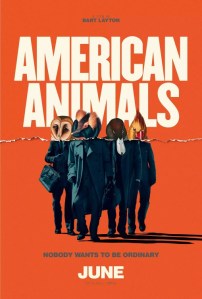 This review is weeks late after having sat down and watched American Animals, and it’s stuck with me in a powerful way. It’s a movie that pulls back the disparity between crime in the movies, so stylized and slick and carefree, and crime in real life, often traumatic, dehumanizing, and with lifelong complications for both victim and perpetrator. It’s a movie that examines a youthful sense of ennui that their lives are missing out on something extraordinary, and a step too far over a very clear moral line thanks to a fantasy given shape by escapist movies and other media. It’s also a slippery I, Tonya-style look at memory and contradiction but this time from the real-life people involved. It’s an entertaining dark comedy, an unexpected true-crime caper, and most resonating of all, a nerve-wracking thriller that left me morally queasy and unwell, but in a good way. In short, American Animals is one of the best films I have seen so far in 2018.
In 2004, at a small Kentucky liberal arts university, four young men are planning their own version of the “perfect crime.” The school has a rare books section including an original copy of Darwin’s Origin of Species and a large and valuable edition of John James Audobon’s The Birds of America. The books are appraised at $12 million dollars. Spencer (Barry Keoghan), an art student, teams up with Warren (Evan Peters), Erik (Jared Abrahamson), and Chas (Blake Jenner) to plot a daring heist. The men feel like their lives are missing something exciting and a heist is just the ticket. They just have to break in, steal the books, and subdue a librarian (Ann Dowd). Easy stuff, right?
 For the first half of the movie, American Animals plays out like a dark comedy. I had no prior knowledge that we were going to get the real-life subjects appearing as themselves in interviews cut throughout the film (their family members are still actors though). The film even plays around with this narrative hook for a few laughs, making quick cuts for punchlines and trying to square conflicting accounts, like having one scene alternate between two locations in dispute of its telling. It also helps set one of the major themes going forward in a nimble fashion, namely the difference between the reality of events and the whimsical, fantasy movie version of what an excursion into crime would be like. Having been bred on cinema’s glorified depictions of heists, the guys come to assume that a heist is sexy and fun and something that doesn’t end up hurting anyone. There’s a charming quality to the fact that Spencer uses his art skills to create models of the rare books room. There’s a laughable ingenuity to the fact that they’re planning on holding the heist in the middle of their class exams, since who would suspect students during that important time? There’s a bemused naiveté about the power of their disguises when they dress as a shuffling group of old men in powdered faces. We’re set up for a funny story about bumbling students falling all over themselves at attempted criminal shenanigans.
I was expecting a relatively light movie just from the plot particulars. It’s a heist film and the goal is to steal a bunch of books. It seemed small-scale in scope and anodyne. What trouble could a group of students get into attempting to steal books? Writer/director Bart Layton (The Imposter) seems to know this, lulling the audience into a false sense of security. He even teases the movie version of what the heist might be like, with our characters suavely stepping into their parts with practiced precision, all while music reminiscent of the Ocean’s Eleven franchise hums in the background. This is the cool-movie version, the version the characters have fantasized over in their minds, and the version that the audience is more attuned to expect. What we actually get is something very different. The heist itself plays out in excruciating detail and it runs counter to their planning. The reality of subduing the librarian is upsetting. It’s supposed to be so simple, after all, but the reality is anything but. The characters almost avoid this whole scenario, aborting their heist only to return back to it the next day. You feel the anguish of how close they were to turning away at several steps, the moments this ordeal could have been avoided, and yet fate barrels onward, energized by a misplaced sense of purpose. American Animals doesn’t let you or its characters off the hook either. I was fidgeting and sweating nervously throughout the heist and its subsequent fallout. Again, this is all about a bunch of stolen books, and I was beside myself with anxiety.
 It’s only afterwards and looking back that you realize how masterfully Layton has built up his scenes and the necessary information to make you squirm. With every heist, the particulars of the setting, the challenges and tight window need to be established, and once that occurs, we’re hoping for unexpected complications. But in order for those unexpected consequences to really hit hard, we have to be trained with what Plan A was going to be, and American Animals does this superbly. People have their designated roles and areas they refuse to partake in, like Eric makes it clearly known he will not be responsible for subduing the librarian in any way. Of course, you can expect what will eventually happen, pushing his character to an even more uncomfortable place. I was very appreciative that there’s an extended resolution after the heist, where the guys try to unload the books to a seller, and the further complications. You really feel the screws being tightened and the overwhelming feeling of dread. It’s another confirmation for me that I’m just not cut out for a life of crime. The day-to-day anxiety is just too much.
I left this movie feeling a strange mixture of jubilation and sadness, still reeling from the expertly developed and executed moral tension. The technical skills are just as strong, each working in succinct harmonious sequence to bring about Layton’s vision to startling effect. The editing is extremely tightly constructed. The smooth cinematography by Ole Bratt Birkeland frames the tension and comedy expertly, and the ominous music by Anne Nikitin kept me on the edge of my seat. It’s almost like a full-blown David Fincher film by the end. The acting is another strong point, with each actor initially relegated into a stock role (“The Muscle,” “The Wheelman,” etc.) we’ve come to associate with these kinds of movies. The film nicely pushes the characters beyond a casual, cursory understanding, blurring the lines of who they are as they blur lines of their own. A surprise standout is Blake Jenner (unrelated to the Kardashians/Jenner clan) who joins the team the latest, seems like a stereotypical rich jock lunkhead, but when he breaks down and articulates why the team is as screwed as they are, his clarity can catch you off guard. He’s the first to realize they’ve trashed their lives and are doomed and for nothing. Also deserving of praise is the always-wonderful Ann Dowd (The Handmaid’s Tale); your heart hurts for this poor woman who is confused, scared, and undeserving of her harrowing ordeal.
 American Animals hasn’t been able to leave my thoughts for weeks, which is usually the sign of a pretty good movie. It upset me. It rattled me. It entertained me. Most of all, it made me think, about the lines people cross in the name of missing out on some vague sense of grand experience, of the differences between the reality of crime and our appealing fantasy versions of crime, and why those stories appeal to us in general. I kept thinking about the pain these four men had caused themselves and others and their regrets. I kept thinking about how smartly Layton utilizes documentary storytelling techniques to enhance his film as well as better examine the disconnect of reality-versus-movies. It’s a movie that could have been told as a documentary but excels best as a hybrid of the two, one that challenges our conception. I’m shocked it wasn’t credited to a book or news article as its source material, meaning Layton compiled all of this impressively on his own. This is a movie that got under my skin, that made me uncomfortable, but also thrilled me and entertained me from its first minute until its very last. I highly advise looking for American Animals once it becomes readily available.
Nate’s Grade: A
Share this:

Skyscraper (2018)
 Dwayne Johnson has fought giant monsters, earthquakes, armies, drug cartels, race-enthusiast criminals, and video game villains, so now, as we run out of opponents, enjoy Dwayne Johnson versus… a building. Skyscraper is much more Towering Inferno than Die Hard, as Johnson plays a security specialist fighting to break into a burning building in order to rescue his family from a group of armed criminals. It’s a movie that struggles to keep pace with schlock throughout its relatively brisk running time. There are some definite detriments, like a team of uninteresting villains with a pretty haphazard plan (in order to flush out a rich guy, they… set a building on fire?). Some of the sequences are just goofy in conception, like an access panel placed right under a spinning turbine, or a top floor architectural design that makes no sense except to provide a requisite location for a “hall of mirrors” finale. However, it’s a perfectly serviceable action thriller, with a better handle on the material than I would have thought for the director of ribald comedies We’re the Millers and Central Intelligence. Johnson is a perfectly magnetic leading man and the plot has a satisfying A-to-B-to-C progression of obstacles and practical solutions. Neve Campbell plays Johnson’s wife and she is actually given important things to do rather than being a damsel in distress. She even saves the day. Skyscraper won’t be a movie you’ll remember long after having seen it, but it’s got enough charm and decently structured set pieces to serve as disposable entertainment.
Nate’s Grade: B-
Share this:

The First Purge (2018)
 This is the first Purge movie to exist in the era of President Donald J. Trump, and that has made the films more political and even more oddly relevant. The movies have been pretty upfront about the political machinations of the Purge events from the start, the rich elites (read: white males) using the annual occasion to sweep the world of undesirables (read: poor, minorities). The fourth film, The First Purge, goes back to the origins and it’s even more bluntly political with its commentary. However, when we see children being held in cages in our daily headlines, it’s an affirmation that we may live in blunt times and perhaps we need blunt instruments of dark social satire to get the message across.
The residents of Staten Island have been selected for a social experiment from the governing party of the New Founding Fathers (NFF). For twelve hours, all crime will be legal. Dmitri (Y’lan Noel) is a local gang leader with his eye on his community, making sure his people will be taken care of and protected. His ex-girlfriend Nya (Lex Scott Davis) rejects his outreach, and little brother Isaiah (Jovian Wade) is looking for vengeance against a psychopathic loner in the neighborhood. The creator of the Purge, social scientist Dr. Updale (Marisa Tomei), only wants to see where the data leads. The NFF, on the other hand, have their own motives and will make sure the experiment succeeds at all costs.
 Never has the Purge universe felt closer to our own than with this new movie, and that’s a testament to the film franchise finding new ways to spin its stories, but it’s also an indictment on our own modern times. When we have a president who on a whim, as recently reported, asked why we can’t just invade Venezuela or why we can’t just use nuclear weapons, it doesn’t seem too far away that he might, without a moment’s notice or hesitation, champion a real Purge program. The new movie reflects this reality with even more explicit relevance. The figures of oppression and white supremacy are preying upon vulnerable black and brown Americans. We have militiamen dressed in Klansmen garb, shiny Nazi outfits, police uniforms, and even masks that evoke blackface. These same creatures of hatred have been given a new platform of legitimacy from a president who has trouble saying anything bad about his fans, thus ennobling and enabling the fringe elements into renewed visibility. This is a movie where the citizens of a poor neighborhood have to fight back against the racist elements set to kill them and empowered by the government. If that doesn’t sound eerily relevant today, you haven’t been keeping up with the omnipresent news cycle of outrageous offenses.
Another interesting turn of events is that this might be the first Purge movie that is hopeful about the human race. For three movies, the Purge has celebrated our darker natures, positing that mankind when stripped of responsibility for its actions would inevitably trend toward brutish violence because they could. The core belief of the Purge is that people need a release of the evil inside them, as if there was a finite level. We’ve watched crazy people do wantonly destructive and murderous acts for three movies. The First Purge offers a completely different perspective. Once the event happens, the majority of the “participants” will elect not to engage in casual mayhem and murder. There will be the occasional few acts of vandalism and theft, and an outlying psycho or so (more of that dude later), but the majority of State Island residents just stay indoors, find refuge in their church, or simply attend a block party. They actively disengage. It’s then that the NFF fret that the social experiment they’ve bet so much political capital on will not turn out with the preferred results they need. They need Americans to be afraid, and it also helps eliminate the minority voting bases for their rival political parties. This reality is not to their liking, so they will simply repackage the news to their liking. That’s when the NFF push the reactionary elements (paramilitary white supremacists) to infiltrate and instigate mass death to ensure the Purge experiment is successful. The numbers are skewed, and paying people based upon their level of violent participation may start the process skewed to begin with. In an unexpected bout of optimism,The First Purge argues for the morality of humanity.
 Because of this very purposeful perspective, it also means that the movie is a bit slow and dull for the first hour. The First Purge has the same flaws as the other films, notably an over reliance on jump scares and less-than-interesting peripheral characters. One female supporting player (Mugga) is meant to be comic relief but I found her to be exceptionally grating, like she had been ported in from the sitcom version of the Purge (There is a TV show headed for USA and a commercial for it in the end credits, the first I’ve ever seen that happen). The glowing iris contact lenses of the participants created an eerie mood in place of larger set pieces. Some of the run-ins are actually rather lame, like an armed holdup where the gun is revealed to be… a water pistol. Who is running around pranking people with a toy when actual murder, with actual murder-capable guns, is sanctioned? That’s just beyond stupid. Likewise there’s a crew of people waiting in the sewers to… sexually assault women by grabbing their crotches. It’s a bit odd considering all of the uncomfortable waiting they must endure. I did find the lead character Dmitri to be quietly compelling as he tries to protect his neighborhood. When the final act comes, and Dmitri becomes a one-man wrecking crew taking down murderers in Nazi regalia, that’s when the movie transitions into the action spectacle we’ve been craving. The final fight is righteous and satisfying, and it even brings back a wildcard character you may have forgotten. By its conclusion, The First Purge has packed its best, most exciting stuff, but until then it’s a somewhat somber, somewhat restrained experience that may rankle the blood-lusting audience that had grown familiar with the series’ depravity.
And now we have to talk about the best character in the whole movie, and maybe second best after Frank Grillo’s grizzled badass hero. Skeletor (Rotimi Paul) is a local criminal who seems pretty unstable, prone to violent outbursts and self-aggrandizing talk. Whenever he talks it feels like you need a spittle guard as protection. He either has facial implants of scars running along his exterior, though I’d bet they were self-induced scars. He is, as my friend Ben Bailey attributed, the human equivalent of Roberto from Futurama, a psychopathic stabby robot that would mumble to himself and, very often, stab repeatedly. That is Skeletor, who is so brazenly crazy that he circles around from threat to figure of entertainment, like some 80s slasher villain elevated by personality and execution (not literally). When he reappeared I would chuckle to myself and say, “Oh, what’s that Skeletor going to get up to next?”
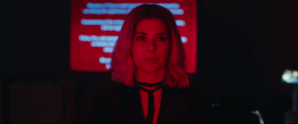 The First Purge is the latest in an unsubtle sci-fi thriller franchise, though this is the first Purge movie to separate itself from its grisly ilk in interesting and thematically relevant ways. It rejects the core pessimistic belief system that human beings, when given the freedom to be violent, will exercise that opportunity. This is the first questionably (naively?) optimistic Purge movie, even though we know what comes after. It’s a bit slow and still beholden to the overall staid formula of the franchise, but this is a Purge film with enough sharp contrasts and a streamlined thematic perspective that it stands out. I won’t say it hits the peak of 2014’s Purge: Anarchy, but I would easily call this the second best entry in the franchise. In Trump America, it’s scary how relevant these movies have become and it’s refreshing they haven’t shrunk from that unexpected relevance.
Nate’s Grade: B
Share this:

Gemini (2018)
 Dear reader, I want you to know upfront that I’m writing this review for one major purpose, and that is to complain about its ending. Had this movie ended differently, I probably would have simply postponed writing about it. Then writer/director Aaron Katz (Land Ho!) went with his ending, and now we need to talk about Gemini, a neo-noir set in the world of movie stars, paparazzi, and sycophantic hangers-on in the city of angels.
The beginning thirty minutes do a fine job of establishing a world and perspective. We follow the day-to-day of Jill (Lola Kirke), a personal assistant to a popular actress, Heather Anderson (Zoe Kravitz). She deals with pushy directors, invasive press, and boundary-blurring fan interactions. She’s Heather’s support and one of her best friends. Katz does a very effective job of establishing Jill’s world of responsibilities as well as her confusing sense of where she fits in this equation. Is she more hired-help or BFF? Heather backs out of a movie and talks about starting her own production company, with Jill and her developing projects that appeal to them. That night, Heather is fearful that someone has been following her and asks for a gun. Jill gives her one, loading the bullets. The next day, Jill comes back to Heather’s palatial home and finds her dead on the floor and the growing realization that she is the number one suspect (her fingerprints are on the gun).
 That’s the first third of the movie and it works well. Katz’s screenplay slowly builds, organically establishing the complicated world of Jill and her general sense of being an outsider wherever she goes. Once the murder takes place, Gemini becomes more recognizable with its film noir elements, as Jill adopts a disguise and investigates a series of suspects that could have killed the starlet, including the director she spurned and an old boyfriend who has trouble letting go. This is also where Katz introduces a new threat in the presence of Detective Edward Ahn (John Cho). He’s a calm, empathetic man but he always seems to know more than he lets on, asking probing questions that Jill doesn’t feel comfortable answering. Each new trip to a suspect presents a different mood and aim. Jill’s visit with the director becomes a humorous sit-down where the guy theorizes who is guilty if it were a movie, finally concluding it would probably be Jill as a twist. Jill infiltrates the ex-boyfriend’s hotel room and has to avoid detection and it is an efficient small-scale suspense sequence. All the while the detective appears to be circling something.
The are several merits of Katz’s film that are worth mentioning. The acting is generally good all around, especially from Kirke (Gone Girl, Amazon’s Mozart in the Jungle). She’s a natural screen presence while still radiating a sense of relatability. There’s a lot going on behind those saucer-eyes of hers and I wish the movie served her better by the end. Kravtiz (Rough Night) and Cho (Star Trek Beyond) are both unpredictable in different ways, making the audience glean extra subtleties from their guarded performances. The sleek cinematography by Andrew Reed (Cold Weather) deals in cool teals and purples, creating a hazy, 1980s-esque atmosphere without becoming annoying omnipresent like in a Nicolas Refn film. It’s style without being eaten alive by it (Neon Demon broadside?). The musical score by Keegan DeWitt (Hearts Beat Loud) is suitably moody, working in typical noir elements like brass instruments with a modern ambient sensibility. Under Katz’s direction, the movie has fun with introducing classic noir tropes and giving them a twist, as well as diverting from them, like our heroine being an ordinary outsider.
And now comes the part where I must discuss the ending to Gemini and, in doing so, will spoil the movie significantly. If you’d like to continue reading and understand the bulk of my grievance, please proceed ahead with spoilers. This has served as your warning, dear reader.
 As the film is nearing its end, it looks like Heather’s secret bisexual fling is being presented as the most likely candidate. The two of them were caught smooching by a late-night paparazzi and this could present some career problems. Jill sneaks away from the supposed lion’s den and heads out to a cabin in the California woods, the spot the fling was talking to. She enters the cabin and finds… Heather there alive and well. You see the dead body in Heather’s home was not her but the super eager fan they had encountered earlier, a look-alike made more obscured with parts of her brain missing. Apparently Heather killed her because she was stalking her and she feared for her life, or so she says. She hid out and waited for everything to die down. Jill is understandably very angry especially since she became the prime suspect. Heather is sorry but not that sorry. Do the crime scene investigators not take fingerprints? Blood samples? I’m uncertain of the timeline of Gemini but this fake-out could only last a couple days, charitably. It creates suspicion that there’s more than Heather is willingly admitting.
This sets up an exclusive interview with a big journalist, the first point in re-branding Heather after the news came out, and trying to push the narrative in the direction they want. Then all of a sudden Detective Ahn shows up at the taping and asks if he can watch as a favor. Jill considers this, confirming the case is closed, and allows it. All right, it’s at this point where all the major players are together in a crucible of secrets. Something good is going to happen, because why else bring these characters together in this moment? And then as the interview begins and Katz’s camera slowly pans over to the L.A. skyline and slowly zooms in, and this is where I started yelling at my screen. This is not an ending. This is five minutes away from an ending. The comeuppance of a starlet thinking she can get away with anything and put upon her vulnerable and faithful assistant is all set. The instincts of our wily detective will be proven right. Jill will have become a stronger character, able to suss out the truth and cut off a destructive force. Justice will be had, the truth will come out, and it will feel like a natural climax of the entire 90-minute movie. And then none of that happens. Nothing happens. It’s all setup and then the L.A. skyline (end spoilers).
Gemini is a frustrating movie with good acting, a dash of style, and some potently moody moments to tickle a neo-noir enthusiast. Until the ending. I was flabbergasted. Katz delivered a cop-out of an ending, and subsequently makes his overall film one that I don’t even think I can recommend, even to neo-noir acolytes. Gemini, I wrote this review because of your ending and I’m still waiting on one. I’ll be here if you need me.
Nate’s Grade: C
Share this:

Hereditary (2018)

Hereditary has built up a great roaring buzz from film festivals and its oblique marketing. Numerous critics are hailing writer/director Ari Aster’s debut film as one of the scariest movies of a generation. The studio, A24, which has built up a fine reputation for art movies and genre fare, is releasing it. Except A24 has some trouble when it comes to its horror thrillers. Last year’s It Comes at Night was similarly beloved by critics yet audiences generally disliked it, angered by the misleading marketing that framed it as a supernatural horror (there was none, no titular “it” to come at night). I wonder if A24 learned their lesson and that’s why the trailers and ads for Hereditary have been intentionally hard to follow. After watching Hereditary and feeling let down, I wonder if A24 is in for another disparity between critics and audiences. This is a sloppy, unfocused film with little sense of structure, pacing, or payoffs. It’s a movie of moments and from there your mileage will vary.
Annie (Toni Collette) and Steve (Gabriel Byrne) are ordinary middle-class parents living with two teenage children, the older Peter (Alex Wolff) and the younger Charlie (Millie Shapiro), a girl given to peculiar habits. Following a tragic accident, the family is struggling to come to terms with their loss and their new lives. Annie seeks out comfort from a group meeting, and that’s where she meets Joan (the great Ann Dowd) who shows her how to contact the spirits of the dead via a handy incantation. From there, Annie tries to establish a connection to the realm beyond and possibly unleashes a spirit targeting her family.

With the rapturous critical acclaim that Hereditary has garnered, I was expecting something far more engrossing and far less sloppy. Structurally, this movie is a mess. It feels very directionless from a story standpoint, like the movie is wading around and blindly looking for an escape route into the next scene. Rarely will scenes have lasting impact or connect to the following scene; you could literally rearrange the majority of the scenes in this movie and not affect the understanding whatsoever. That’s, simply put, poor screenwriting when your scenes lack a more pertinent purpose other than contributing to an ongoing atmosphere of paranoia (more on that later). I’m struggling to make broader connections or add lasting thematic relevance to much of the plotting, and that’s because it feels so convoluted and repetitious for so long, until Aster decides it’s time to throw the audience the most minimal of lifelines. There is a moment late in the second act where a character finds a convenient exposition dump by looking through a photo album and a book that is literally highlighted. That at least explains the intent of the final act, but even as that plays out, by the end it’s still mostly confounding. The film ends with another exposition dump, this time as voice over, and I got to thinking that if it wasn’t for these two offhand moments you would have no idea why anything is happening. I had a friend whose girlfriend had been bugging him for Hereditary spoilers for months, so I carefully explained the movie to them as precisely as I could. By the end, he told me, “I still don’t get it.” Yeah, I didn’t get it either and I was actively trying.
There is a type of horror fan that will lap up Hereditary, namely the kind that places the creation of dread and atmosphere and memorable moments above all else. If you’re a gushing fan of David Lynch movies or Dario Argento and their sense of strange dream logic, you’ll be more ready to prize the sum rather than the whole of Hereditary. The aesthetics are pleasurable thanks to crafty production designer Grace Yun (First Reformed) and the moody photography from Pawel Pogorzelski (Tragedy Girls) that maximizes the space and draws out the anticipatory dread. There are effective moments where I gasped or squirmed, but there were also moments where I wanted to laugh. The key term is “moments.” Without a structure, sense of development, and attachment to the characters and their lives, Hereditary left me chasing fleeting entertainment.

Now when it comes to horror moments, I’ll again admit that everyone’s mileage will vary. Some people will watch Hereditary and be scared stupid. Others will shrug. That’s a deeply personal response. I can look at a movie like A Quiet Place and point to its intricate structure and execution to explain why its suspense was so affecting and satisfying. With Hereditary, because all it supplies is moments, I can’t explain why something will work or won’t for a person. Maybe you have a thing against headless corpses. Maybe you have a thing for jump scares (there are more than a few). Maybe you have a thing for invisible girls making clicking noises with their tongues. Then again maybe you’d enjoy a narrative that gave you a better reason to care and that organically built meaningful scares through tangible circumstances.
If you can hang onto the final nightmarish act, that’s when Hereditary is at its best, finally picking up a sense of momentum and finality. The first forty-five minutes of this movie more closely resemble something like Manchester by the Sea, a family unit becoming undone through grief and guilt, simmering grievances just under the surface. It’s well acted, especially by Toni Collette (Krampus) as a mother barely escaping the pull of her boiling anger at her son and the universe as a whole. She gets a few quality moments to blow up and it feels like years of painful buildup coming out. The awkward family interaction is chilly but missing greater nuance. It has marked elements that should bring nuance and engagement (Personal Tragedy, Mental Instability, Blame, Guilt, Obsession), but with Aster’s undercooked screenplay those elements never coalesce. This is a movie experience that is never more than the sum of its spooky parts. Byrne (The 33) is essentially just there, and the fact that the 68-year-old actor has two teenage children is a little hard to swallow. Wolff (Jumanji: Welcome to the Jungle) does a fine job of showing his deteriorating mind late in the movie. The problem is that these characters just aren’t that interesting, so when the supernatural acceleration creeps in, there’s already a ceiling as far as how much we, the audience, will care about what befalls them. What are the stakes if you don’t understand what’s happening and don’t genuinely care about the central characters?

My pal Ben Bailey chided me after seeing Hereditary that I was trying to do the movie’s work for it by looking for deeper connections and foreshadowing clues. Is there some greater meaning for the headless women motif? Is there a larger reason why the dollhouse God imagery is prevalent? Is there a reason, after finding out about the haunting, that the family still leaves their beleaguered son alone? Is there a mental illness connection or is it all a manifestation of hysterical grief? The English teacher discusses the Greek tragedy of Iphigenia (see: a better movie following this model, 2017’s Killing of a Sacred Deer) and whether being predestined for sacrifice is more tragic than choosing your own self-destruction, and is that a glimpse at thematic relevance in a way that seems almost half-hearted? The problem with a long, incoherent story built upon a heaping helping of creepy imagery and atmosphere is that it can often fall into the lazy trap where the filmmaker will just throw up their hands as if to say, “Well, it’s up for interpretation.” I don’t mind a challenging movie experience (I was on the side that enjoyed, if that’s the correct term, Darren Aronofsky’s mother!). I can appreciate a movie that’s trying to be ambiguous and ambitious. However, the pieces have to be there to form a larger, more meaningful picture to analyze and discuss, and Hereditary just doesn’t offer those pieces. It’s an eerie horror movie with its moments of intrigue and dread but it’s also poorly developed, too convoluted, and prone to lazy writing and characterization. I’ll highlight it for you, Hereditary-style: if you’re looking for more than atmosphere and tricks, seek another horror movie.
Nate’s Grade: C


You must be logged in to post a comment.