Blog Archives
Bad Times at the El Royale (2018)
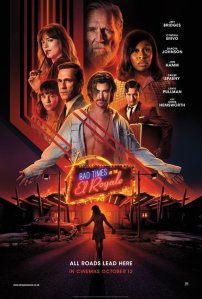 It is no disservice when I say that Bad Times at the El Royale joins the ranks of the finest of Tarantino imitators. It’s packed with twists and turns that keep an audience glued to the screen and continually re-evaluating the characters that we thought we knew. Because of that dynamic the movie invites the audience into becoming more involved, dissecting the information available and waiting for the next clue or plot revelation. It turns watching the film into a game and makes the experience that much more active and thrilling.
In the summer of 1969, the El Royale hotel is in for one hell of a night. The old fashioned hotel sits on the border between Nevada and California, allowing its dwindling customer base the opportunity to choose which state they would like to stay in. A group of strangers cozy up for the night including a priest (Jeff Bridges), a chatty vacuum salesman (Jon Hamm), a hopeful lounge singer (Cynthia Erivo), a skittish bellhop (Lewis Pullman), and a mysterious woman (Dakota Johnson) who happens to have a hostage in her trunk. As the night progresses and the characters uncover one another’s secrets, sometimes with deadly results, menacing cult leader Billy Lee (Chris Hemsworth) comes swaggering to the El Royale to reclaim by force what he feels is rightfully his.
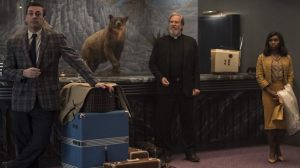 There are Act One twists and reveals in El Royale that would have been the Act Threes of other movies. Writer/director Drew Goddard (Cabin in the Woods, The Martian) has packed his movie full of sinister intrigue as he establishes the hotel, the main characters, and an immediate impression of each in the first 15 minutes. From there, the movie is divided into chapter titles (another Tarantino motif) where we follow different room inhabitants who get 20-minute-vignette spotlights. Once in private, the characters shed their false faces and begin to reveal who they really are, or who we think they might really be, and the movie starts to resemble Tarantino’s own hidden identity parlor game, 2015’s Hateful Eight. The vignettes begin to overlap, ending on cliffhangers and then circling back with a new character as our focal point, re-watching prior scenes but from a different perspective. Goddard’s script is wonderfully clever, layering in questions and answers and a constant desire to upend audience expectations. Even though some segments will repeat, Goddard doesn’t waste time on redundancy. A character will be seen prying loose floorboards searching for something desirable, and we never have to relive the before or after of this moment from that character’s perspective because we’ve been imparted the necessary info and can put the pieces together with the next jump. I appreciated Goddard’s faith in the intelligence of his audience. The pleasure of El Royale is watching it deftly unfold as a fun, funny, startling, appealing mystery.
The characters must also be worthy of our attention, and Goddard does fine work teasing out his colorful cast of criminals and lost souls and deepening most. Everyone has something to hide at the El Royale, and finding out his or her true intentions and motivations is part of the film’s fun. I won’t spoil any of the big surprises or which characters are really putting on a show. Despite all the many plot machinations intertwined, Goddard still finds time for his film to breathe and let the characters talk, opening themselves to one another, sometimes with the assistance of dramatic irony. Jeff Bridges and Cynthia Erivo play the best characters and deliver the best performances. Both of them are haunted by pasts they don’t feel like sharing, both are under some element of disguise to embark on finding their happy ending, and both form a sort of bond throughout the film as kindred spirits, even if they can’t fully trust one another. Bridges has the most complicated back-story but it actually links with a very real and emotional condition: memory loss. His character is (legitimately) going through early dementia and he’s losing full control of his sense of self, occasionally blanking and forgetting who he even is and how he got where he did. For a character pretending to be someone else, there’s a cruel irony to this malady. The seven main characters aren’t all on the same level (some are more plot devices than people) but Goddard knows this, making sure his 142-minute movie spends the most time with the best of them.
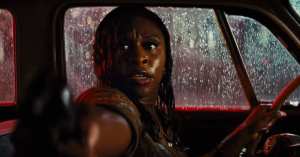 The actors given the best characters are also the ones that deliver the best performances, if you can imagine that. Bridges (Hell or High Water) brings a strong sense of pathos to his memory-addled priest trying to assess his life and his choices. He seems genuine in every moment, which is a feat considering his character has his share of secrets like anyone else. Erivo is a Broadway star making her film debut here, and she steals the show with her bruised sense of optimism. She’s the heart of the movie and a proven survivor, especially from a rigged system that protects predatory men. She brings a quiet power to her character as well as a believable vulnerability that makes you care. Hemsworth (Avengers: Infinity War) is all shaggy, scraggly charm as a cult leader who gets off pitting his followers, and captives, against one another. Really he likes to listen to himself speak, and Hemsworth is having a grand ole time with the part. Another actor exhibiting clear joy is Hamm (Baby Driver) who is, if you’ll pardon the pun, hamming it up with great gusto. He does a far majority of the talking for the first twenty minutes. He’s practically bouncing all over the place as an unchecked extrovert, but when alone, Hamm demonstrates an additional layer to his outlandish character. Another strong impression is from Pullman (Strangers: Prey at Night) as the lone employee eager to find absolution for his part in the El Royale’s history of sin as well as his own personal demons. The weakest of the ensemble ends up being Johnson (Fifty Shades Freed) who gets lost in her femme fatale archetype and can’t seem to find her way out again.
This is only Goddard’s second directing feature and his best directing aspect is that he knows when to linger on the written page. There are several segments that dwell in a certain emotion, elevated by Goddard’s tracking shots to continue the predicated unease. There’s one early moment where the bowels of the El Royale are revealed as hidden viewing areas to secretly record the guests doing their seemingly private illicit good times. The lead character of this vignette walks along the corridor, studying other characters and slowly realizing the implications of what he or she is finding. The scene is given a beautiful and eerie soundtrack thanks to Darlene practicing her singing, belting out “This Old Heart of Mine” like her life depended upon it, the tune taking on a sinister edge as it echoes through the dark hallway along with the tick-tock of the metronome. There’s another terrific singing suspense segment in this very same location, except with a different character spying on Darlene as she and another character work in conjunction to coordinate their movements, timing striking sounds in the room to her claps. Goddard has an adequate eye for visuals but he benefits from the gorgeously conceived and constructed El Royale setting, allowing the quirks of the rundown hotel to serve as another character to his ensemble. I enjoyed little touches, like only the Nevada side having a liquor license and the bright red line that runs down the middle of everything.
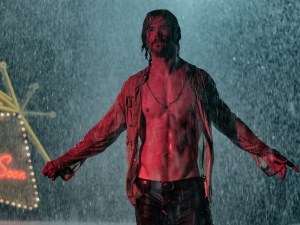 And yet there are some lingering doubts that halt me from a full-throated endorsement of El Royale, and I’ve been trying to articulate them better in the days since I watched the film. It frankly doesn’t fully come together by the end in a way that feels suitably climactic. Once Billy Lee enters the third act, the movie stabilizes and we spend time with the remaining characters assembled together to be terrorized by the cult leader. After seeing everyone else’s story in smaller vignettes with some slippery non-linear perspectives, we’ve finally come to our big confrontation and summit with everyone. Except it doesn’t feel as big as the movies needs it to be. Characters will be dispatched swiftly, and instead of it feeling shocking it feels abrupt and contrived, devaluing the character arcs that had been shuffling forward to that point. The deaths feel too ho-hum, and the final confrontation and melee too chaotic and random. The sacrifices feel wasted and sloppy rather than the payoff from some long established setup. It’s here where Goddard cannot hide his narrative trickery anymore and the machinations are exposed. I couldn’t help but feel that the final act was slowly losing the momentum and excitement that had been built carefully over the course of two hours. Billy Lee isn’t quite the force that his whispered presence has been made out to be, no fault to Hemsworth, who impresses me more and more with every new performance. It’s like by the end of his movie Goddard has realized that certain characters were inevitably just more interesting than others and he saves room for them to get a climax and brushes off the rest. Thematically I don’t quite know if it comes together with any sort of final statement about the 1960s, the dichotomy of good and evil, or anything else. It’s a final act that left me a little disappointed and realizing the end wasn’t nearly as fun as the journey.
Bad Times at the El Royale is a movie jam-packed with twists, plot turns, and colorful characters played by great actors who are clearly enjoying themselves, given the room to roam and stretch their muscles as exaggerated and dangerous criminal cohorts. Goddard’s film is impeccably structured up until its final act where it feels like the answers and confrontations cannot match the mysteries and setup that had been laid before. If you’re a fan of the top level of Tarantino imitators, like Things to Do In Denver When You’re Dead or Lucky Number Slevin, or enjoy unpacking a good mystery, then check into the El Royale, a hotel where maybe the cockroaches have the best chance at survival.
Nate’s Grade: B+
Share this:

First Man (2018)
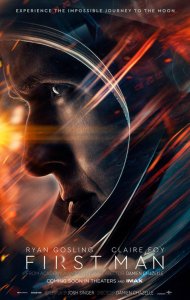 Oscar-winning filmmaker Damien Chazelle got to be the director of a Best Picture winner for approximately three minutes, which, to be fair, is more than most us will ever experience. La La Land won the top prize at the 2017 Oscars only to have it taken away and given to the smaller indie, Moonlight. Where an Academy of old white people that love to celebrate Old Hollywood decide to award a small million-dollar movie about growing up gay and black in the 80s, where does one go next? For Chazelle, it seems the answer is something even more irresistible to the Academy. First Man is partly a biopic on Neil Armstrong and partly a recreation of the 1960s Space Race. The finished movie is so mercurial, so insulated, so dry that I found a far majority of it be kind of boring.
Neil Armstrong (Ryan Gosling) is one of the select pilots training for space. NASA is racing to beat the Russians to the moon, and every new breakthrough is thanks to long hours of hard work. Janet Armstrong (Claire Foy) worries at home, listening to every radio broadcast and wondering if her husband will come back safely.
What First Man does best is make you realize how dangerous every step of the way was to get to the moon. Every leap forward required months of trial-and-error, and sometimes those mistakes cost lives, like the crew of the Apollo 1. The film opens on Armstrong flying above the atmosphere. The emerging curvature of the Earth is beautiful, but the beauty turns to horror quickly as it appears Armstrong’s plane is bouncing off the atmosphere and drifting into orbit. There’s another sequence where he and Buzz Aldrin (Corey Stoll) are above the Earth and planning to dock in space and their capsule spins wildly and if they can’t fix it they’ll black and out and assuredly die. These moments remind the audience about the inherent dangers of the Space Race that we don’t necessarily get in the history books. Looking back, we know the American astronauts succeed in the ultimate mission of landing a man, or an eventual dozen, on the moon, but that foreknowledge produces a false sense of security. Chazelle’s movie reminds us of the enormity of this challenge and the enormity of the dangers. The sound design in this movie is terrific, and Chazelle makes sure you hear every ping, every metal-on-metal scrape, to the point that you fear the whole thing could fall apart at any moment. When Janet furiously dresses down the Mission Control head (Kyle Chandler) that tries to calm her concerns, she accuses them of being boys who think they know what they’re doing. Even after the triumph of the final act, we know what happens two missions later (Apollo 13) to reconfirm just how much we still haven’t perfected when it comes to space travel.
 Besides reminding you of the precarious nature of early space travel, let alone the tests leading up to said travel, First Man doesn’t find much to justify its own existence other than as the latest in Oscar bait. It’s not exactly an in-depth look at the heroism and chutzpah of the Space Race like The Right Stuff, and it’s not exactly an examination on the frailty of man and the meticulous problem solving needed to achieve big goals, like Apollo 13. In fact, while watching this movie I would repeatedly think to myself, “Man, I should go home and watch Apollo 13 again.” When you keep thinking about watching a better movie, you have lost your audience, and that happens throughout First Man. There are thrilling, awestruck sequences to be sure, but that only accounts for perhaps a quarter of the lengthy 140-minute running time. The rest is spent at a distance trying to understand a man who comes across as largely impassive. He’s intensely focused but it’s like the movie adopts his very no-frills attitude, and it goes about its business with little thought for letting an audience into its inner world. We’re still only visitors at best here.
I admittedly don’t know much about Armstrong the man, so I can’t tell if the role was shaped for Gosling’s talents or he just matched perfectly with the man. Armstrong feels like one of the Nicolas Winding Refn roles (Drive) that we’re used to watching Gosling portray. Armstrong feels like somebody ported over a guarded, reserved, mostly silent Refn character into a staid biopic and asked Gosling to communicate a majority of emotion through unblinking stare downs. If there’s one actor you don’t want to challenge to a staring contest, it’s Gosling. Armstrong comes across a very internal man who seems uncomfortable in the spotlight, far less natural than Buzz Aldrin, who the movie unexpectedly positions as kind of a saying-what-we’re-all-thinking jerk. Because Chazelle has decided to keep Armstrong so guarded, it makes the film feel distant, like we’re being told the story second-hand, and that requires Chazelle to fill in the gaps as to the internal motivations and insights for an intensely private man. The answers we’re given seem almost cliché (the death of his young daughter is what drove him into his work, to escape the bounds of his Earthly grief, and to finally say goodbye to her). It’s too convenient as a simple character arc to be fully believed, but that’s all we have to work with because the movie won’t give us much more. It feels more like you are getting the idea of Neil Armstrong the Man rather than a realization. It’s a frustrating experience, watching a biopic and having the filmmakers keep their prized figure behind glass.
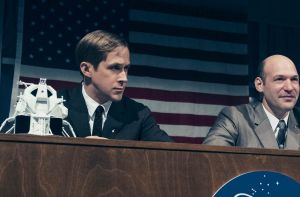 As a director, Chazelle is proving to be a remarkably skilled chameleon. First Man is completely different in style and approach to La La Land as it is to Whiplash (still his finest). His chosen approach for First Man is locking to Armstrong’s perspective, so we’re working with a lot of handheld camerawork that orbits our movie star. Chazelle’s cameras emulate a docu-drama aesthetic and there are several moments where the action happens onscreen and the cameras race to frame it, leaving the image blurry for seconds. I’m not sure that was the best decision. It does create a sense of verisimilitude, which heightens the thrilling aspects of the film like the excursions into space travel. However, it does little to heighten the underwhelming domestic drama on the NASA block. The added realism only benefits a small portion of the movie. At times, a camera racing to catch up with the onscreen action would be considered a hindrance. The claustrophobic feelings are heightened from Chazelle’s cramped camerawork, reminding us again of the tightly precarious spaces these men were willingly sliding into, the fragility of the cockpit walls separating them from an unrelenting empty void. When we switch over to the Apollo 11 mission, Chazelle keeps the attention squarely with the three men making the famous lunar landing. There’s a stirring thrill of destiny and the film transitions into an IMAX footage to make the moment that much more immersive and transformative.
First Man is much like the man of its title, reserved, guarded, and with a laser-like focus on its mission at the expense of outside drama. Chazelle is an excellent filmmaker and the craft on this out of this world, from the production design to the thrilling recreations of the dangers of space, bringing together the alarm through a sumptuous combination of editing, sound design, and cinema verite photography. Of course that verite style is also a double-edged sword, providing another layer to distance the audience. This is a pretty guarded movie with few insights into Armstrong the person. We get more Armstrong the pilot and numbers-cruncher, and I wish Chazelle had steered more into whatever version of Armstrong that opened him up to the audience. The family drama stuff is pretty pat and Foy (The Girl in the Spider’s Web) is generally wasted as the supportive and anxious wife. Most of the actors are generally wasted in this movie, with the potential exception of Gosling, who slips into the shoes of an impassive and emotionally restrained protagonist like it’s second nature. First Man might not be a giant leap artistically, and in fact a majority of the film is dull, but the artistic highs are enough to warrant one viewing. From there, you’ll likely conclude that you don’t need to watch Neil Armstrong stare forlornly into the middle distance again. Frankly, I’d rather watch La La Land again, and that’s saying something.
Nate;s Grade: B-
Share this:

Assassination Nation (2018)
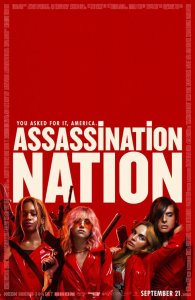 Assassination Nation is an explicitly potent and timely Movie of the Moment; it’s a modern “Monsters Are Due on Maple Street” for the Age of Trump, exposing the fissures in our society, primarily the elements that prey upon, police, and punish women. The film is brimming with female rage that you may leave shaking. It’s a movie that wants to grab you and scream its message in your face, and that will be off-putting to several, but the overall experience was so stimulating, so ambitious, so affecting, and so emotionally cathartic, that I wanted to howl back, now championing this audacious movie to whomever might listen. This is one of 2018’s best movies and most vital statements.
In Salem, four teenagers have become the most hated people in town. An anonymous hacker has been stealing people’s private information, correspondence, and intimate pictures and uploading it for the public to digest. The town has gone mad with this feeding frenzy of new info and open secrets, leading to suicides, retribution, and murder. Lily (Odessa Young, a strong debut that reminded me of Olivia Cooke) and her BFF posse, Bex (Hari Nef), Sarah (Suki Waterhouse), and Em (Abra), become the main suspects and the town turns on them, looking for some good old fashioned vigilante justice.
The film is messy and chaotic but these are not the usual detriments; it is exploding with things it wants to say about the hypocrisy and nastiness of our modern era. Early on Lily remarks to the audience, “I read this quote from a writer once who said 10 percent of the population are cruel, and 10 percent are merciful, and the other 80 percent can be swayed in either direction. I’m sure that writer has never seen 4chan or Twitter.” At the end of the day, Assassination Nation will not allow its audience to take comfort even as it transforms into a female revenge thriller. Here is a movie that grabs you forcefully and says, “This is who we are now so what are you gonna do about it, huh?”
 When Twilight Zone creator Rod Serling wrote “Monsters Are Due on Maple Street” he was critiquing the veneer of civilization we clung onto through our “good manners,” yet with the right pressure points we could just as easily turn on our fellow man with suspicion. The divisions in our current political climate often feel unable to be bridged; how does one reconcile a middle ground between one side that views gay people, trans people, women, people of color, and immigrants as human beings deserving of rights and protections and another side that laments the Way It Used to Be? There was one tense moment at gunpoint where a character that had previously led a literal lynch mob says, through convenient tears, that he’s sorry. Oh, he’s sorry he almost murdered an innocent classmate? Are there some decisions, some votes that you just can’t erase with a “sorry”? When people are willing to drop all pretenses of humanity for tribal allegiance, then perhaps those people don’t get away with an apology for their grievous harm. As the hacking begins, it’s initially pinpointed coming from a Russian IP address, and I wondered if maybe writer/director Sam Levinson (son of Barry) was making an additional comment about how easily these divisions can be exploited by an outside actor, as they were with the Russian propaganda missions of 2016 (and beyond). There’s another culprit responsible for the dissemination and the eventual explanation for a motive is a pitch-perfect end note demonstrating the destructive nature of casual cruelty.
The breakdowns in the Salem society stem from a deluge of secrets being unleashed and consumed without abandon. Everyone feels exposed, naked, some of them quite literally considering the treasure trove of hacked pictures, again drawing comparisons to celebrities like Jennifer Lawrence getting their intimate personal pictures broadcast. The expectations of privacy are malleable in a digital age of consumption, where the wider public is insatiable to know and see everything no matter the violation. The ravenous consumption of intimate secrets then foments into a mindless mob in need of blood. It’s the social media horde that has to find a new victim to point the outrage machine at. This is best demonstrated by the school’s principal (Colman Domingo), an early victim of the hacker. Included on his cell phone’s gallery are nine pictures of his young daughter in the bathtub. Ready to take down another target, the community demands that the educator resign despite his pleas that they are innocent pictures but the crowd argues that all nudity is the same and therefore sexualized, especially when it depicts females. He’s dubbed a pedophile and a child molester and every horrific term. He’s pressured by the school board to resign and he faces down his hostile, accusatory crowd. I was so taken with this storyline and the personal anguish this man was going through that I wish we had gotten more time and appearances with him as a significant supporting character (this refrain will be referenced again). It’s these early moments that made me think of the Salem of Arthur Miller’s play, a bluntly obvious comparison point for a painfully blunt movie.
 The world of Assassination Nation is deadly to women. It’s the kind of movie where male entitlement can turn a street harasser into a would-be murderer, which dredges up memories of Mollie Tibbetts, killed by a man who refused to accept that she didn’t have to talk with him or acknowledge him while she was out jogging. The teen girls are pressured to be sexual beings by those who want to commoditize their bodies, and then they are puritanically demonized when these actions become public knowledge. I kept finding relevant correlations with so many moments and themes throughout the film, and I imagine many others will do the same. That is one of the charms of a movie bursting with so many things to say; each person may be challenged or affected by something different. The satire is unsparing and darkly comic but when it needs to be serious and disturbing, Assassination Nation can switch tones with ease. You’ll be laughing at some violence, cringing at other examples, and possibly cheering by the end as just deserts are served. Having a multitude of tones and messages doesn’t detract from the overall impact; it just means there are more storytelling avenues to chase and different emotions to elicit.
Take for instance a scene that occurs after the end of the movie. We watch an African-American marching band lead by a lead female performer with a baton. They stomp in unison through the smoldering remains of a suburban neighborhood and play a brassy rendition of pop scion Miley Cyrus’ “We Can’t Stop.” It’s a song about youthful revelry but also a declaration of independence from the oppressive expectations of others (“It’s our party, we can say what we want/ It’s our party, we can kiss who we want”). Can this moment relate to the idea that a younger generation must keep marching onward in the face of tragedy after tragedy, that the racism and misogyny and mass shootings won’t stop, that we’re a constant shuffling funeral march in the unmovable face of broken politics? Is there reference to the expectation of African-Americans to perform through horrifying adversity for the entertainment of a white audience? Is this a celebration or elegy? It’s a strangely beautiful coda that left me thinking even more, and if something that happens even after the end credits can stay with me, you know you have a worthy work of art.
 This is a movie that affected me deeply as a drama and, as it changes gears, a suspense thriller. There are some extended assault and torture sequences that will test the comfort level of every viewer. There is a healthy exploitation streak that runs through the film, but I found it far more meaningful than say the recent gonzo art flick earning overzealous critical raves, Mandy. Levinson’s camera will adopt the male gaze that imprisons these teen girls with close-ups of gyrating movement and pouty stares. Some will characterize these moments as Levinson muddying his message by indulging in the same objectification he has been criticizing. I can understand that analysis but I think it goes deeper. I think the camera is adopting the objectification of the world and Levinson is asking us how we feel now that we’ve gotten to know many of these women. Are they so easily disposable once you widen the lens and see them as vulnerable, sympathetic, and relatable human beings?
The final act delves into full-on exploitation vengeance thriller and becomes a feminist rallying cry against the wider array of misogyny poisoning society. I imagine future generations will memorize Lily’s final speech to the American public with the same degree of awed reverence as college-aged males do for Tyler Durden (a movie where its target audience missed the satire). It would be glib to simply dismiss Assassination Nation as an opportunistic RiotGrrrl response to the Me Too movement. This is a primal cry against the Age of Trump and feels like the first great film in response to our 45th president and all that his ascension has wrought.
When the film does go into thriller mode, Levinson proves surprisingly adept. There is an extended tracking shot that swoops from window to window, floor to floor as we slowly watch a home invasion in progress, and it’s exceptionally taut. The camerawork by cinematographer Marcel Rev (White God) is remarkably fluid, floating around its subjects in glides like the camera is serving as the eye of god. There’s a mesmerizing quality to the visuals that transcends the array of genres the film effortlessly hops between. One minute you’re caught up with the arresting, upside down camerawork leading to an explosion of violence, and the next you’re taken with a surreal depiction of suburbia. The music selection is also on fire with choice tracks by K. Flay, Bishop Briggs, Joywave, Bams Courtney, Gracie Mitchell, Billie Ellish, and others. It alternates between guttural and polished, angry and contemplative, but it screams as loud as the film itself. I’ll be surprised if I come across a better contemporary soundtrack to a 2018 movie.
If there is a niggling detraction for the movie it’s that we could have used more time spent rounding out the supporting characters. Besides Lily and Bex, the other girls are more defined by their relationships and proximity to our protagonist. I wanted them to open up more as characters. I also wanted even more catharsis by the end of the movie. After almost two hours of rampant misogyny and subjugation, I could have used even more lingering vengeance as the girls defended themselves from their attackers. Still, my biggest regret with Assassination Nation is that I didn’t spend more time with the supporting characters and their individual personalities and trials. I just wanted more.
 Bristling with anger and feminine agency, Assassination Nation is a warning shot, a rallying cry, and a daring artistic statement about the role of women in response to the rise of Trump and his cronies. It’s not subtle but that doesn’t mean it isn’t effective. It’s blunt and extreme because our times are blunt and extreme, it’s messy because our news cycles are messy, desperate to cover a cascade of catastrophes and scandals, it’s using the language and imagery of exploitation cinema because that is too often the lens with which women are viewed in modern society, as achievements to unlock, as trophies to be won, and as a product for mass consumption. Levinson has put together a movie that has a possibility of being a seminal film, of being a touchstone of the resistance to the Trump Era and all that it stands for, but at its core it opens up with excoriating detail the pressure and punishment women must persevere through on a daily basis as targets of patriarchal entitlement and the dangerously fragile egos of dangerous men. In the recent weeks we’ve watched a possible Supreme Court nominee who might have committed multiple acts of sexual assault, and the response has been to “plow ahead” and appoint the man for a lifetime position ruling on the legality of women’s rights without further inquiry or investigation. The film feels even more charged, relevant, and prophetic with each new allegation of wrongdoing being hand-waved away as mistaken identity, boys-will-be-boys moral relativism (more like rapists-will-be-rapists), and the same kind of nonsense that women have been subjected to since the original Salem and well beyond that. For every woman fed up with the status quo, Assassination Nation is your movie, and for every man whom needs a feminist lesson with an extra dose of Purge-style bloodletting and vengeance, here is a brazen and affecting statement. Assassination Nation is the movie of the moment and it’s a knockout.
Nate’s Grade: A
Share this:

The Predator (2018)
 It’s been 31 years since the first Predator strutted its camouflaged self onto the big screen and bedeviled Arnold Schwarzenegger and company. Since then the dreadlock-sporting intergalactic sportsman has become a familiar vaginal face to movie audiences around the world. One of those company deaths in the original movie was none other than Shane Black, years before the writer/director became a bankable Hollywood commodity. Black is going back home to revive the dormant franchise with The Predator, a big-budget sequel/reboot that aims for the stars and falls far, far too short.
An alien spaceship belonging to a rogue Predator crashes on Earth, scattering important debris. Quinn McKenna (Boyd Holbrook) is a black ops sniper and the only surviving member of his team who happened to be on site when the ship crashed. The government says he’s crazy and transfers him onto a bus filled with other mentally disturbed military vets who call themselves “the Loonies” (Trevante Rhodes, Keegan-Michael Key, Thomas Jane, Alfie Allen, Augusto Aguilera). A tough-talking government agent, Traeger (Sterling K. Brown), seeks out a biological specialist, Dr. Brackett (Olivia Munn), to examine their interstellar prize. At the secret lab, the Predator breaks free, Dr. Brackett chases after the specimen, and she teams up with the “Loonies” to track down the alien. After his initial Predator encounter, Quinn mailed the alien helmet and other evidence to his son, Rory McKenna (Jacob Tremblay), a young boy with autism who cracks the alien code and becomes the target of a Predator, a Super Predator, and the government.
 The Predator is a supremely messy movie, often feeling like two separate screenplays inelegantly stitched together, one a big bloody action thriller, the other a winky Shane Black vehicle with a cavalier, macabre sense of humor. It doesn’t quite work because the movie can’t fully settle on a tone, or a direction, and thus it keeps providing glimpses of the many versions of the kind of movie it could have been instead. I’ll openly admit to being a Shane Black fan when he embraces his sly instincts, command of genre, and ribald wit (Kiss Kiss Bang Bang is a modern comic masterpiece; The Nice Guys is… pretty good), so the Black touches were my favorite part especially because they stood out the most. I enjoyed the characters entering into scene-breaking asides, like Dr. Brackett questioning why the alien would be named a “predator” given its behavior is more akin to a hunter or a fisherman, and Traeger shrugging, “Yeah, well, we took a vote and ‘predator’ was cooler. Right guys?” Or when a character is being held at tranquilizer gunpoint and mocks the danger, only to be tranqued point blank in the eye, killing him. Or a bully suddenly getting drilled by the defense mechanisms of the Predator helmet and murdered. It’s these moments that kept me most entertained, demonstrating Black’s unique voice that can take genre filmmaking within a studio sphere and turn it on its head with a devilish grin. If The Predator had been more a Shane Black vehicle than a Shane Black studio reboot, then perhaps the final product would have risen above the mediocrity that sinks it.
Much of that mediocrity comes from the middling plotting, mostly after the first act. For a solid half hour, I think Black has something promising, having set up the various characters and gotten them to intersect and go on the run together as a merry band of outlaws and amateur alien hunters. Once the “Loonies” break free with Dr. Brackett is where the movie loses its sense of direction. The plot just stumbles from one set piece to another, rarely with good reason. One minute they’re running away from a Predator creature and the next they run into an apparently unlocked high school building rather than flee in cars and RVs. Most of the plot movement follows little Rory, first reaching him before the bad men do, then rescuing him from Predator dogs, and Predator, and then he’s kidnapped by the bad guys, then he’s hunted by the Super Predator and I’m tired. This kid is a spectrum-walking, spectrum-talking plot device (more on that below). It feels decidedly odd to have a super sniper paired with a renegade group of mentally disturbed and dangerous military castoffs and instead of them primarily hunting and killing a space alien they are rescuing a little boy with special needs. It would be like having a Tarantino rouges gallery teaming up to teach a child how to read. It feels like a misapplication of the character dynamics onscreen, which again gets to my central criticism of the final film feeling too much like separate movies in conflict. The studio elements (supportive yet feisty ex-wife, autistic savant, Predator dogs) feel too obvious.
 The action is serviceable with a few dandy practical gore effects. There’s a nasty, visceral quality of the action that proudly wears its R-rating as a badge of honor, as a PG-13 Predator movie would be a disservice to the universe’s most fearsome hunter (the first Alien vs. Predator was PG-13; I suppose acid and florescent blood are less traumatic to be seen gushing from hacked limbs?). The action gets a lot more boring once the Super Predator is introduced, an eleven-foot all-CGI monstrosity that needed a bit more work. Beforehand the Predator is a combination of makeup and practical effects, allowing longer interaction with its environment. I enjoyed the Predator breaking out of the lab. I did not enjoy the team taking on the Super Predator at night in the middle of the woods because it decided to go… sporting. Seriously, the second-to-last action set piece has the flimsiest formation. Rather than accomplish its mission, the Super Predator invites all the humans to one more game, though the alien acknowledges that “McKenna” is their only true champion. It devolves to jump scares in the spooky woods, but hey, at least characters can start being eliminated (some of them so abruptly that it’s a blink-and-you’ll-miss-it exit). There are touches throughout the action that keep things lively before ultimately succumbing yet again to the freefall of the project’s creative dissonance.
The actors are enjoyable but I felt bad they weren’t given more. Holbrook (Logan) is consistently upstaged by his eccentric band of compatriots, but only Jane, Key, and Rhodes get any personality. The other guys are just kind of there. I don’t think I laughed once at Key’s (Netflix’s Friends from College) many, many wisecracks. The Tourette’s syndrome tic given to Jane (TV’s The Expanse) is rarely funny, and yet Black goes back to it again and again (the adolescent kid behind me in my theater thought every profanity was the funniest thing ever committed to film). The actors glide by on Black’s signature macho, cocksure style, clinging to every new quip like a lifeline. Munn (X-Men: Apocalypse) has a few fun, feisty moments but is still basically featured as The Girl. Tremblay (Wonder) is making me rethink my evaluation of him after Room. The best actor in the movie, by far, is Brown (Black Panther) who has a malevolent charm that connects most fluidly with Black’s sensibilities. Even his self-satisfied laughter made me laugh.
 We need to talk about the film’s views on autism (there will be some spoilers in this paragraph, so skip ahead if desired). Rory McKenna is of that kind of Hollywood Autism, the kind we see on TV (The Good Doctor) or of classic movies (Rain Man). It’s the designation of autism as a gateway to super powers (never mind that having savant abilities only impacts ten percent at best). Whatever, it’s an unrealistic depiction in an age of better, more nuanced depictions of mental health and disabilities. Where The Predator gets crazy is when Dr. Brackett offers this nugget: “You know many people think autism is just the next step in human evolution.” No. Nobody thinks this. As someone who has worked extensively with children with autism, this is not a thing. I’m not saying by any rationale that those with autism are lesser by any means but they’re no more the next stage in human evolution than any other condition. Ask a person with autism if they feel like the next stage in human evolution, like an X-Men mutant. What makes matters worse is that Black confirms this strange notion when the Super Predator, surprise surprise, was most impressed with Rory McKenna and not his big bad dad. The Super Predator plans to take the kid back to, presumably, harvest his autism DNA so the future predators will… know how to fly their spaceships that they already know how to fly? I don’t know.
The Predator is part sequel, part reboot, part Shane Black genre riff, part muscular R-rated action movie, part chase movie, and part Hollywood mishmash. Apparently the film underwent extensive reshoots as well, retooling the entire third act, which seems obvious in hindsight and only magnifies the disconnect between the central story elements. Shane Black’s signature elements are but glimmers of what could have been. It needed to be more of a genre send-up of 80s-action farce, or a more straight-up action movie, or something where the plot generally made sense and had characters we liked. Was Shane Black playing a joke on the studio? The Predator will probably be most known for editing out a real-life sexual predator, or from its dreadlocked alien dog being domesticated after getting shot in the head, or its depiction of autism, or anything that isn’t really the entertainment level of a mediocre rehash. Check out Predators instead.
Nate’s Grade: C
Share this:

Mandy (2018)
 Mandy is a gonzo, psychotropic mood piece that will infuriate some, test others, and delight a select audience that responds enthusiastically to atmospheric indulgences. Set in the 1980s, because of course it’s the 80s, a logger (Nicolas Cage) and his titluar girlfriend Mandy (Andrea Riseborough) have a bad run-in with a small cult. Their leader, Jeremiah Sand (Linus Roache), declares that the god of the universe told him he is entitled to everything, and he picks Mandy. Bad things transpire and Cage is left for dead. He sets off on a quest for vengeance against the cult and a fetish-clad biker gang they employ as muscle, and in the process he might be going insane.
So what kind of movie is Mandy? There really isn’t a plot here so much as an immersive experience of fever dream imagery with a loving yet detached nod to its cultural influences from the 1980s, heavy metal music videos, Heavy Metal magazines, heavy metal album covers (sensing a trend?). There is the bare bones of a plot here, a revenge formula, but it’s really more about the moments and the feelings that writer/director Panos Cosmatos (Beyond the Black Rainbow) is trying to communicate through the screen. He’s another disciple of the Terrence Malick/Nicolas Winding Refn School of Filmmaking, ditching the story details for a visually immersive and hallucinatory sensory experience. The problem with these kinds of movies is that you either check into that wavelength or you don’t. I know that sounds like an oversimplification, as all movies either engage or disengage, but because the story and characters are so minimalist, the opportunities to click with the material rely entirely upon the moody atmosphere and creative execution.
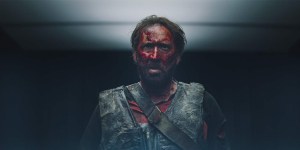 Mandy is overwhelmingly a campy revenge thriller that celebrates the unique Cage-ness of Nicolas Cage’s more unhinged, bizarre performances. This is a movie that asks Cage to go the full Cage, and that can be a beautiful thing. There’s a knowing campiness to the whole exercise that doesn’t feel condescending. It’s not making fun of the onscreen antics so much as it is celebrating the artful absurdity. This is the kind of movie where there’s a chainsaw-on-chainsaw duel and it’s awesome. This is the kind of movie where every patch of woods has a blast of fog to make it feel like a dark fairy tale. It’s the kind of movie where the practical gore effects are stomach churning and memorable. It’s the kind of movie where Cage lights his cigarette from the fire of a decapitated head. It’s a movie where Cage goes on a journey where he transcends into the mythic. He is no mere mortal by the end; he is the mythic figure of vengeance. The man doesn’t just find his foes to foil; he has to first construct his own metallic scythe straight out of a fantasy adventure. Cage is fully aligned with the bizarre and eerie primal nature of the film. His crazed intensity is matched perfectly with the overwrought atmosphere and villains. There are moments where his bug-eyed stare or maniacal laughter will give you chills. He has one sequence that’s petty much non-stop screaming on a toilet as he tries to process shocking grief. It’s a performance that asks Cage to be unrestrained and tightly coiled at parts, relying more on physicality and intense looks than dialogue. For fans of the ironic and sublimely weird Nicolas Cage, Mandy should be a deranged delight to hoot and holler.
However, there’s really no entry point for a viewer if they do not celebrate the campy, gonzo, detached atmospherics of the film. Walking out of Mandy, I told my friends that it needed 20 percent more plot and 20 percent less movie. There’s no reason this movie needs to be over to hours long, especially with its threadbare plot. It takes far too long to get going, with the cult attacking Cage and his girlfriend at the one-hour mark. The second half has improved pacing but still takes its sweet time too. Cosmatos seems to favor a dreamy sense of pacing, so instead of, say, ten seconds of watching Cage’s pained reaction, we’ll get 30 seconds. The self-indulgence has a way of making the artful intent redundant. Did we need those extra 20 seconds to really feel the full artistry? Or, perhaps, could Cosmatos have used all the extra time saved from collectively trimming the excess moments and diversions to better develop the characters and story? The other problem with diverting the majority of the attention to atmospherics is that the eventual comeuppance of the cult lacks a full sense of satisfaction. If we don’t get to really know the cult members then we won’t feel the rush of catharsis when they are dispatched. I talked about this very topic with my review for Peppermint, another revenge thriller with inherent structural problems that mitigated audience payoffs. The revenge formula is a simple thing and engineered to deliver payoffs. Here are two September releases that fumble that formula, although Mandy places less importance upon it. Most of these cult members are given a look, at best, which makes them interchangeable and disposable. Jeremiah Sand is an intriguing, hilarious, pathetic creature, and so the final showdown proves satisfying and somewhat revelatory, as his ego-driven bluster transitions quickly to pleading and bargaining and abject fear. It’s a fitfully climactic moment but did we need two hours to get here? There’s a better 90-minute movie trapped inside here, subsumed and suffocated by Cosmatos’ love affair with his influences and indulgences.
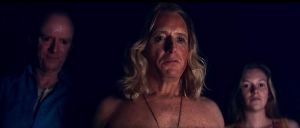 This is also sadly the last score from composer Johann Johannsson, who passed away in February of this year. He was an eclectic creative voice whose musical abilities were diverse. He could create a thundering score that felt like an incoming army, like with Sicario, or a soaring melody that could lift your spirits, like his Oscar-winning score for Theory of Everything. With Mandy, Johannsson relies upon those 80s metal influences and produces a sonic landscape fitting for Cosmatos. The score is kept at a rumble that accentuates the nightmarish qualities of the visuals. To the end, Johannsson sought unconventional methods to give voice to his movies.
Mandy is a crazy, dreamy, moody movie heavy on brooding atmosphere and light on story and characters. If you can hop on its wavelength, Mandy will prove to be a gonzo good time. If you can’t, it’s going to be overly reverential to its cultural influences and laboriously long. I fall somewhere in the middle. I’m not a fan of most Refn movies because I feel like they fall into the trap of emphasizing pretty yet hollow imagery. The ideas don’t tend to go as deep as the filmmakers think they do, and I grow restless for more. Mandy needed more time spent giving greater shape to its world and narrative. This criticism may sound unfair given the nature of the film (do you ask for the details of a dream?) but I feel dismissing its lack of substance is a step too far. Mandy is essentially a dream with hazy plotting, vivid imagery, and intense feelings, but it can wash away upon waking. I left my theater torn over the movie, wanting to celebrate its artistic vision and weirdness while also wishing there was more weirdness and more of a vision.
Nate’s Grade: B-
Share this:

The Nun (2018)

It’s amazing to me that The Conjuring series has become a literal billion-dollar franchise and in only four cost-effective movies. Rare is the film franchise that births spin-offs so readily, but The Conjuring has already introduced two Annabelle movies, one Nun film, and an upcoming Crooked Man feature. It’s almost as if any supernatural creature given a minor spotlight in the James Wan-produced series is destined for greater things. It’s like the Conjuring universe is a pipeline to stardom for America’s next big malevolent demon. I’m thinking the Conjuring 3 could spend 30 seconds on some tall tale about a haunted plunger and it would be spun off into its own franchise within a year, tops. The Nun is the fifth film in the series, the second spin-off film, and probably the movie with the least amount of narrative substance given its starting material. It’s a mixture of old horror staples and exorcism mumbo-jumbo, and it’s also not half bad.
In 1950s Romania, a small abbey is being haunted by an evil presence that had been confined behind a door that ominously warned, “God ends here.” A nun has committed suicide under mysterious circumstances. Father Burke (Demian Bichir) is called by the Vatican to investigate the strange happenings. He teams up with a local nun-in-training, Sister Irene (Taissa Farmiga), and a traveling merchant Frenchie (Jonas Bloquet) who first discovered the dead nun’s body. The sisters inside the abbey are behaving oddly and it’s not long before our characters realize they’re trapped in the abbey with something wicked looking for a human host to escape.
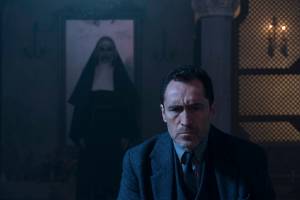
There’s not really much to the plot of The Nun so the emphasis comes in the realm of atmosphere, unsettling visuals, and unnerving set pieces. The investigative process with our priest and nun-in-training doesn’t amount to many revelations, and the information won’t be new for the audience considering this specific demon Valak has been seen in two other Conjuring-related movies now (maybe three?). It becomes a haunted house thriller and, like the earlier and much ballyhooed Hereditary, a movie of moments. So your mileage will vary depending upon how affected you are by the atmospherics and imagery. With The Nun, I felt like the visuals were built upon more rigorous Catholic religious iconography and a foundation of decades of accumulated exorcism film imagery. Plus the very design of the titular nun is just super unsettling by itself, let alone placed in a spooky setting with spooky lighting. Director Corin Hardy (The Hallow) finds visually pleasing and distressing imagery that he emphasizes for better effect, like a team of faceless nuns standing in formation, or a tormented boy with a snake that slithers out of his screaming mouth. It’s not subtle in the slightest but credit for not relying upon an inordinate number of jump scares for its chief spooks. In the realm of schlocky horror, The Nun is actually a little restrained when it isn’t being ridiculous, but it’s the kind of ridiculous that makes you laugh and anticipate the next scene rather than check your watch. Again, your mileage will vary, but I enjoyed the theatrics and imagery more than the overrated Hereditary.
This brings me to the biggest head-scratcher in the movie that would have seemed designed to ensure audience investment. I had no idea Taissa Farmiga (TV’s American Horror Story) was going to be in this movie let alone the co-lead of the movie. As soon as I saw her face I leaned forward, newly intrigued. My working assumption was that the younger Farmiga was going to be the prequel version of the character played by her older sister, Vera Farmiga (yes, they’re sisters and not mother/daughter). Suddenly this made her character that much more interesting and created a direct connection from the events of the nuns to the larger Conjuring universe, providing a back-story for the Warrens to lean upon. It also allowed me to transfer my feelings for the character onto Taissa Farmiga, making me care far more about her well-being as she creeped around dimly lit corners than if she had been any other woman in a habit in a bad place. The fact that The Nun had so effectively hidden Taissa Farmiga’s presence from the marketing made it feel like an intentional surprise, something to let the audience know the filmmakers weren’t skating by. It raised my opinion of the movie and my enjoyment from scene-to-scene.

And then I found out Taissa Farmiga’s Sister Irene is a separate character from Lorraine Warren. Huh? Of all the young actresses in the world to select, choosing the literal younger sister of Vera Farmiga, who looks strikingly similar, feels far too intentional to be coincidental. Why isn’t she just the younger version of Lorraine Warren, setting her up for a life of hunting the supernatural after this formative experience? She’s even presented as a nun in training and not a full-fledged bride of Christ. Even the decades in age difference would add up. It’s not like you’re playing that close to the facts of the case when it concerns the Warrens who, by modern accounts, are considered frauds by many. Come on, James Wan. Come on Conjuring universe. What are you doing here? The solution was right within reach and you deliberately ignored it.
The Nun is a moderately entertaining movie subsisting on strong production design, exorcism iconography, and solid performances from capable actors. It’s not really more than the sum of its parts but, for me, there were enough effectively creepy moments and punchy images that won me over by the end of its 96 minutes. If you’re a fan of the Conjuring series, or particularly demonic possession/exorcism movies, then you’ll likely find enough entertainment to be had, even if the filmmakers absurdly decide not to have Taissa Farmiga play the younger version of an already established central character. Was this a late-in-the-game rewrite to absolve her of her connection to Vera Farmiga? I’m happy for anyone connected to the production to contact me and clear this up (after my surprising conversation with a key creative on Sherlock Gnomes, I’ll just start openly asking for clarifying correspondence from Hollywood filmmakers now). The Nun in essence does just enough to be silly or scary when needed and possibly worth a watch for horror fans. Now about that haunted toilet plunger. I may have a pitch ready if you’re open to it, James Wan. After all, what’s scarier than a broken toilet?
Nate’s Grade: C+
Share this:

Peppermint (2018)

I invite all my readers to re-watch the trailer for Peppermint and apply this simple listening test. It opens with Jennifer Garner repeating the precious nursery rhyme claim about her daughter’s virtues. She has “love in her heart, snow in her eyes,” and the final claim, “peppermint in her blood.” At least I’m certain it’s got to be “blood,” because the first time I watched this trailer and my ears got a hold of that line, it genuinely sounded like Garner was saying “peppermint in her butt.” This flummoxed me and even more so that they would name the movie after this. Try it yourself and see what you hear, then listen for the other word (it’s like the new yanny/laurel aural conundrum). If I concentrate on either interpretation, I can hear it. Regardless of whether this “butt” vs. “blood” mystery can ever be resolved, the filmmakers decided to cut the entire verbal exchange from the finished version, leaving no reason for Peppermint to be called Peppermint other than the daughter’s passing affinity for the ice cream flavor. As asinine and odd as this whole endeavor reads for you, this might actually be the best part of Peppermint, a rote and tiresome action exercise that does too little too often and squanders the resources of a perfectly game Garner.
Our heroine, Riley North (Garner), started as mild-mannered mom and bank teller. Then one day Latinx gang members brazenly gun down her husband and child. A corrupt legal system lets the killers go free and Riley disappears for five years. When she returns, she’s become a ninja trained in an array of weapons. She takes her one-woman crusade against the gang, the cartel, and the corrupt judges and lawyers who serve them, while the police, lead by John Gallagher Jr., try and stop her from going too far and becoming the very monster that she’s been fighting to protect others from.

This is basically another Death Wish-style grisly revenge thriller when, as a true sign of how repeated this formula has become, we already even had a literal Death Wish remake with Bruce Willis earlier in 2018. It’s easy to understand the appeal of the lurid revenge fantasy, but they require more effort than Peppermint is willing to provide if they’re to rise above the litany of direct-to-DVD drivel. I’m in no way against this kind of movie, or direct-to-DVD action entities, but it all comes down to development and execution, and that’s where Peppermint slips up, having peaked at the idea stage. Clearly this was sold to film executives as a “lady Punisher or Taken” and it’s from the director of the first Taken, Pierre Morel. Garner was kicking (peppermint) butt and taking names for years on TV’s Alias. Why not? The problem is that there’s so little thought put to the characters, the plot, the action, and even the structure of basic payoffs. Here’s a telling example. The three gang members responsible for killing Riley’s family are themselves killed around the 45-minute mark, and they’re killed off-screen in a terribly anti-climactic and abrupt plot move robbing the viewer of any sort of emotional punch watching our heroine gain her years-in-the-making vengeance. Think this over. The only characters we’re really rooting for her to topple, to watch them be punished on screen for their misdeeds, and it’s off-screen. This isn’t No Country for Old Men here; it’s barely the eightieth rendition of Death Wish.
Garner’s character is too opaque to be that interesting. She’s allowed to vacillate between Grieving and Angry but that’s the extent of her depth. We never really get a sense of what’s going on with her, how her actions are affecting her. She’s not even that interesting as an action lead. There’s no real glimpse of a personality here. She’s more a weapon poised to her next target, with little down time between. Garner gets into toned fighting shape and has a flinty, F-you vibe and it all feels wasted on creatively lacking fight choreography. Riley becomes a social media avenger and this is about as much commentary or depth the film affords her. Because we squandered the catharsis of seeing the guilty gang members get their just rewards, the movie has to manufacture more disposable Latinx criminals, like they put out a casting call for characters they forgot they were going to need. From a structural standpoint, you never get a great sense of where Peppermint is going after that 45-minute mark. It just opens on one location after another and we watch Riley wreck havoc on personality-free bad guys we never got a chance to know and loathe. It starts to feel like a series of mundane video game stages to be cleared.

Many of the shortcomings can be forgiven if the action delivers, and it simply cannot. It’s one bland fistfight and shootout after another. There isn’t a sequence I can remember that stands out. There are moments, punctuations of vicious violence that has a brusque, darkly comic accentuation. There’s nothing remotely John Wick, or Atomic Blonde, when it comes to the fight choreography. The geography is too rarely taken into account and there are few organic complications. This is flabbergasting when you remember that Morel also directed the vividly kinetic French action movie District B13. The editing here also feels very choppy, taking more away from Garner’s physical skills having their showcase. One of the great moments of 2017 was the brutal and brutally long tracking shot following Charlize Theron’s super spy pummeling men through her growing fatigue. It was a sequence designed to showcase the choreography and the actress’ refined skills. What constitutes Riley North’s own “particular set of skills”? There’s nothing especially clever about how she dispatches with the bad guys. Her path to vengeance comes across as too easy. She’s able to torch an entire piñata warehouse of gang members like a cheap… piñata. The easy victories and lazy action development are the final reminders that this is a rote genre paycheck and little more.
Whether the peppermint was in her daughter’s blood, her butt, or any other personal cavity, it’s a terrible title for an R-rated action movie and reeks of the forced sweet/nasty irony I think the filmmakers, or marketing team, want to employ by having a woman as their Charles Bronson-styled deliverer of death and destruction (what, a woman as a killer?). The action is forgettable, the characters are barely one-dimensional clichés, and Garner deserves better. She’s 47 years old and as spry and captivating as ever. Give her an Atomic Blonde of her own. Peppermint isn’t it. If your expectations are generous, you may find just enough to keep your interest with Peppermint. It left me with a bad taste in my mouth.
Nate’s Grade: C-
Share this:

Searching (2018)
 Searching is a clever, crafty found footage mystery told from the point of view of a computer screen. Unlike many found footage entries, writer/director Aneesh Chaganty has put considerable thought into the mechanics of his storytelling gimmick. The opening sequence even reminded me of Up as far as how deft it was with the economy of storytelling while providing an affecting emotional blow. In the opening, we watch a little girl grow up as computer technology and websites also advance documenting her life, culminating in her mother getting cancer and passing away, communicated via a “Mom’s Coming Home” date removed from a calendar. It was so well done I actually felt like I just might summon some tears for the passing of this woman. Right away I realized I was in for something special. Flash forward and the teen daughter goes missing and her stressed-out father (John Cho) dives into the investigation firsthand by looking through her online history and realizing how little he may have known his not-so-little girl. The movie illustrates nicely how easy it is to hide your real self online and how easy it is for others to find you and your digital impressions. Every time Cho is visiting a website, whether it’s Venmo or Instagram or Facebook or a webcam, there’s a solid reason for it and the movie has a satisfying step-by-step progression. The mystery has plenty of unexpected twists and turns and it’s anchored by a harried and distraught Cho (Star Trek Beyond), who does not look like he’s in his mid 40s at all (Kal Penn has also aged well, which makes me only want a cross-generational Harold and Kumar sequel more). The only knock on Searching is that there really isn’t a pressing need to see it on the big screen. After all, you’re watching a computer screen and typing for much of the movie. It will play just as well, if not better, on your home television or whatever smaller screen is at your discretion.
Nate’s Grade: B+
Share this:

Operation Finale (2018)
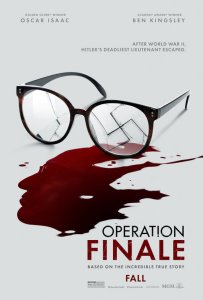 Operation Finale is one of those kinds of movies that is just good enough to make me wish it had been better. It’s based on the true story of an Israeli team of spies that located Adolph Eichmann (Ben Kingsley), one of Hitler’s lieutenants who authored The Final Solution. He’s been hiding in Argentina for years and giving public lectures, which isn’t helpful with keeping a low profile. Oscar Isaac (The Last Jedi) leads the Israeli spies as they plot to kidnap Eichmann, get him to admit his guilt for the Holocaust in writing, and smuggle him out of the country and to Israel to stand trail for the deaths of millions. This story should be exciting, it should be fascinating, it should be compelling, and for stretches it can be, but Operation Finale errs in capturing Eichmann too quickly. The majority of the film is the spy team holding him in a secret location and interrogating him, while the surprisingly Nazi-coddling police force of Argentina hunts for their location. I’m assuming the filmmakers were accurately telling the true story, but you start to question why the spies are taking their sweet time. Why not get on a boat as soon as possible and sail to another country to fly away, one less friendly to former Nazis? There aren’t really any set pieces where their cover might be blown. It’s mostly Isaac talking with Kingsley, and while their conversations are entertaining, it’s yet another preview of a better movie that we’re never going to have delivered. The film lacks enough urgency. The characterization is too limited and the supporting characters are more faces than people; Melanie Laurent essentially plays The Woman Spy. Operation Finale should have either spent more time on the specifics and complications of nabbing Eichamann, presenting a challenge, or it could have accentuated the debate between Isaac and Kingsley over the nature of culpability, rationalization, guilt, and vengeance. There’s probably a really good Nazi-hunting mini-series or Nazi-debating play in here. Either way, the actual finished film is well made, well acted, and well intentioned but also dramatically lacking.
Nate Grade: C+
Share this:

First Reformed (2018)/ You Were Never Really Here (2018)
 Both First Reformed and You Were Never Really Here use sly genre subversion to act as commentary on what kinds of movies the audience associates with these kind of haunted men, their arcs, and the nature of violence. Subverting audience expectations is in and of itself not necessarily a better option. You can have unexpected things happen but the narrative that happens after needs to be compelling, and if possible, unavoidable in hindsight (Game of Thrones is good at this). By the same notion, the finale of Breaking Bad was pretty easy to anticipate but that’s because of how well written the storytelling trajectory was pointing to its natural end. I can tell a tense father-son reconciliation story and then if I end it with a meteor wiping out the Earth all of a sudden, well that’s unexpected but that doesn’t make it better storytelling. What helps elevate both movies is that the subversions are thematically related to the relationship between violence and vengeance, absolution and atonement, and the audience and our desires with these films.
In First Reformed, Reverend Toller (Ethan Hawke, enthralling) is the caretaker of a small upstate New York church where the weekly attendance can be counted on one hand. The church, First Reformed, is nearing the commemoration of its two hundred-fiftieth anniversary that will be celebrated by local dignitaries and the governor. Reverend Jeffers (Cedric the Entertainer, surprisingly adept in drama) is the pastor for the mega church that seems to have everything that First Reformed lacks. Jeffers wants to help out Toller but the humble man of the cloth refuses. Rev. Toller is pushed out of his comfort zone by the husband of a pregnant woman (Amanda Seyfried) who challenges him on man’s stewardship of the environment. The husband worries about bringing a child into this world and contributing the larger problem of climate change. This interaction gets Rev. Toller to think about his own culpability and sets him on a path of righteous justice.
 Writer/director Paul Schrader is famous for his stories about violent men confronting the wickedness of the world around them. From Taxi Driver to Raging Bull to Hardcore, Schrader has a penchant for documenting the self-destructive recourse of flawed men who feel removed or constrained by a society they feel is out of step with morality. What better canvas then for Schrader than a middle-aged pastor at a small, reclusive church? Rev. Toller is so humble he doesn’t own more than a few sticks of furniture in his home, the adjoining parsonage to the church. He’s friendly but often choosing to keep to himself, forgoing comforts and perceived handouts from the people around him. A woman his own age keeps trying to connect with him, their romantic coupling in the past a platform for her to continue hoping he’ll come around to her. She’s a perfectly nice woman, a choir headmistress for the mega church down the road, but she reminds Toller of his weakness and maybe even something worse. The aforementioned mega church basically keeps Toller’s small parish afloat as a charity (First Reformed is nicknamed the “gift shop church” for its historical notoriety). Rev. Jeffers is concerned about his fellow man of the cloth and the toll his solitude and seclusion is taking on him. It’s like he’s trying to atone for something, taking on a very Christ-like path of penitence. It’s around here that the character is activated into a higher calling in conflict with the church.
I’ll explain what I was expecting given the premise and presence of Schrader. I was expecting a movie much in keeping with A History of Violence, where a small-town man is thrust back into a past life of violence by outside forces and he has to confront how far this “new him” has come from the sins of “old him.” I was expecting Toller to become more violent and radicalized, pitting others in his cross-hairs for retribution. That’s not really First Reformed at all. First off, it’s the slowest of slow burns. You better be prepared to luxuriate in the day-to-day details of Rev. Toller’s simple life, from unclogging toilets to visiting with parishioners in their homes and having long philosophical conversations with them about faith and man’s role in the ecosystem. That conversation specifically teeters toward ten minutes and serves as the end of Act One, and I think if you’re still invested by then, you’ll be along for the rest of the film. However, it’s not going to be an easily accessible movie. This conversation stirs something deeper inside Toller, dissatisfaction with the church and how it coddles with big business, the chief polluters of God’s kingdom. Toller becomes a late-in-life environmental activist who questions the stewardship of the church body. This sets him on a path that seems destined for bloody violence. He’s going to go out in a fury of righteousness. We’re expecting a big bang by the end, especially given Schrader’s history of these kinds of stories with these kinds of men. But that doesn’t happen.
 I’ll try and avoid spoilers but discussion over the thematic relevance of the end of First Reformed will unavoidably suggest to the reader some significant plot developments, so please feel free to read this paragraph or skip to the next one. The second half of the movie is setting you up for a very specific ending, one where Toller strikes back against forces he feels are detrimental to the well being of the church. It’s setting you up for a climactic showdown with powerful forces that feel unaccountable for their actions. I was ready for a final rush of violence to serve as the crescendo to Schrader’s slow burn. This is where the movie swerves away from audience expectations. We’re prepared for a meaningful death but instead Schrader’s ending, in retrospect, makes us question why we should have desired such a violent and vengeful finale. Why should this character be a martyr for our bloodlust against the powerful? Ultimately, Schrader’s movie ends on a romantic, optimistic note of personal salvation after setting you up for a dark story with a predetermined, self-destructive end. The abruptness of the ending may inspire some titters, but when you look back at the film, it makes complete sense and calls into question why we would wish for blood and violence over human connection and forgiveness. Schrader is saying that you wanted the wrong kind of movie.
First Reformed takes the modest aims of its protagonist to heart when it comes to the presentation of its story. Schrader films the entire movie in the old-fashioned 4:3 aspect ratio, the square box of old pre-high definition televisions. It’s an aspect ratio that keeps everything centered for the audience and on display. I think there was exactly four camera movements in the entire movie; almost the entirely of the 113 minutes is from a stationary, documentary-styled camera. It’s a very specific visual style that limits the visual information and dynamism but manages to personalize the main character even more. It’s his movie and his journey of self, so the visual representation is also restrained. There’s really one flash of upsetting violence in the whole movie, as if to remind the audience how a violent death is not something to be celebrated. For an R-rated Paul Schrader movie, it’s far more reserved, subtle, and thoughtful. It left me thinking about Rev. Toller and his messianic mission and our desire for a big bloody finish. The idea of a selfless death directed toward violent retribution is inherently self-involved. It’s not death that provides meaning but life, it’s not how we end but what we do with the days beforehand.
 You Were Never Really Here is built as a hitman thriller based on Jonathan Ames’ novel. Joe (Joaquin Phoenix) is a hired gun who specializes in rescuing young women. He’s hired to find the missing adolescent daughter of a senatorial candidate. He investigates the underbelly of sex trafficking to save this little girl, but larger forces are at play and will make Joe suffer gravely for interfering with their wanton exploitation.
The average audience for You Were Never Really Here has been steadily fed a diet of these kinds of movies, from the artful (Luc Besson’s The Professional), to the pulpy (The Long Kiss Goodnight), to any number of hollow, nihilistic video game-styled murder fantasies (Hitman, a thousand straight-to-DVD movies). We’re expecting men of action who are ruthlessly efficient and clever when it comes to their killing. We’re expecting stylish merchants of death who leave behind a heavy body count with swagger. That’s not what brilliant Scottish writer/director Lynne Ramsay (We Need to Talk About Kevin) has in mind at all. She takes the iconography of the hitman thriller and turns it into an expectation-smashing existential character study, but not just of its disturbed main character but also for the audience and our relationship to these movies. We expect remorseless killing machines that turn death into splashy and cool tableaus. These movies aren’t so much key on mediation and reflection, beyond the standard “reap what you sow” adage.
Much of the violence is kept off screen or purposely denied to the audience. I’m trying to remember if we even see Joe kill anyone on screen. The infiltration of the sex trafficking organization hops between fixed security angles, edited together in a dissonant manner, where the last shot doesn’t fully line up for a smooth edit, leaving a half second. The effect is one that’s knowingly alienating and challenging. When Joe does unleash his violent skills, it’s rarely given a showcase for entertainment. This is a movie that doesn’t celebrate its violence. There’s a moment where Joe lies on the ground beside a mortally wounded bad guy. They exchange a few cordial words, he procures some vital information, but then Joe stays with the man and the two sing a song together. It sounds bizarre when written out but it’s a moment that really stuck with me. After everything, these two men can find a small sliver of humanity between them to share. Even the final confrontation, the big climactic set piece of any other movie, ends with a shoulder shrug, as if Ramsay is saying to the audience, “Why would seeing all that be cathartic?”
 For Ramsay, the focus of the movie is on the man committing the acts of violence rather than how stylish and cool and cinematic those acts of violence can be. This is the one area where I feel a longer running time could have better helped her goal. I think Ramsay might be the best filmmaker we have for triptych narratives. 2011’s We Need to Talk About Kevin is a startling and insightful movie that opens up the guilt of a woman whose son grew up very badly, jumping around time periods, using a repetition of images to provide visual stings and associations. You Were Never Really Here does similar labor, establishing our strong silent protagonist through glimpses of a troubled past, from a childhood with an abusive father and a mother he would have to save, to incidents during military service and police investigations that reminded Joe about the depravity of others, in particular the ability to exploit and dehumanize women as disposable property. Ramsay offers discorded images and brief flashes and asks the audience to put together the pieces to better understand Joe as a man propelled and haunted by his bloody past. However, at a slim 89 minutes, the audience could have used more time and opportunity to better develop and analyze this central character. The pieces are tantalizing but I wanted more, and as a result I found Joe to be an interesting start to a character that was in need of more time and attention to transcend the boundaries of his archetype. I needed a little more from him and his world.
There are several moments that quickly come to my memory, sticking with me because of the level of artistic arrangement or implication. Because Ramsay wants to take the Hollywood hitman revenge thriller and deconstruct it and provoke her audience and its desires for violence, there isn’t much of a plot to this movie. I could literally spoil the whole thing with the following sentence: a man of violence is hired to find a missing girl, finds her, loses her, and finds her again at great personal expense. The movie is more of a poignant and intriguing exercise in our relationship to these kinds of stories. There are moments of beauty in the movie that took my breath away, like when Joe lowers a wrapped body into the depths of a lake, and with the shafts of light, the curls of hair, the small visual details, it felt like watching a living baroque painting. There are also several bizarre moments that stand out, like when Joe fantasizes about blowing his brains out at a diner while the patrons, and the blood-soaked waitress, go about their day. It’s these little flourishes that make the movie stand above other hitman movie deconstruction exercises like George Clooney’s overly solemn The American. It’s not all tragedy and inescapable dread. Amidst Joe’s tortured past and troubled future, there’s a necessary sense of hope. You don’t know what will happen next but you’re not resigned to retrograde nihilism.
 Both First Reformed and You Were Never Really Here are slow burn indie character studies that ask their audience to question the movies they’ve been set up for. Schrader and Ramsay are deft storytellers who pair their visual gifts to the psyches of their damaged, haunted, and self-destructive middle-aged men. Hawke is phenomenal as Rev. Toller and Phoenix is suitably unsettled from a life of confronting predatory violence. Both movies have also stayed with me, though First Reformed I find to be the better developed, better executed, better acted of the two films. It’s enough of a comeback for Schrader, whose last film I remember seeing was the laughably bad Lindsay Lohan “erotic thriller” The Canyons. These are two movies that aren’t exactly the most accessible. Both challenge the audience to analyze the personal relationships with genre storytelling. If you have patience and an open mind, both First Reformed and You Were Never Really Here provide thoughtful and methodical examinations on genre, violence, and the visceral appeal of empty bloodshed.
Nate’s Grades:
First Reformed: A-
You Were Never Really Here: B


 nathanzoebl
You must be logged in to post a comment.