Blog Archives
Arctic (2019)
 Mads Mikkelsen is stranded in the Arctic and that’s about all you need to know plot-wise about the film, a thrilling and immersive survival thriller. Right away the film lets us in on the routine of this survivor of a plane crash and how resilient and resourceful he had become. Then it introduces a new sense of urgency, a critically injured pilot in another aircraft, that pushes him into leaving the safety of his homemade confines. The movie relies so heavily on elemental, visual storytelling that I think any person on the planet could easily understand and appreciate the pared-down storytelling. The visuals are so immersive and accessible that every item bears import or sets up critical information to be relied upon later. The harsh Arctic landscape and unique dangers push our hero to the extreme in order to save another life. It’s enough to inure us to this relatively silent man. Mikkelsen (Polar) uses every physical muscle of acting to communicate the struggle his character is undergoing. You believe every moment. There’s not much in the way of story beyond stubborn survival against brutal conditions. We don’t get any flashbacks. We don’t get any monologues. It’s one man against the full force of nature and it’s enough for a brisk, simple, straightforward focused 97-minute survival story with Mads persevering amongst the beautiful and terrifying wasteland.
Nate’s Grade: B
Share this:

Happy Death Day 2U (2019)
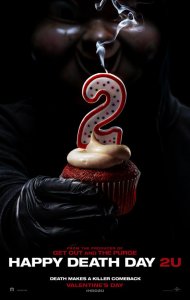 On one hand I can admire the “who gives a damn?” ethic behind the sequel to Happy Death Day, a fun time loop of slasher cinema tropes. The original had some darkly comic edges but mostly played its premise straight in the realm of horror. The sequel doesn’t play anything straight. It’s completely bonkers and looking to turn anything into a joke. This provides a charming carefree sense of bravado; however, if you were a fan of the first film, it also might rub you the wrong way and seem overly flippant and messy. We get a science fiction explanation involving parallel universes as to why the time loops are happening, and now our heroine Tree (Jessica Rothe) is stuck in a parallel version of her looped day. The film sidesteps a Back to the Future 2 sense of repetition but doesn’t stray too far from the outlines of the original Happy Death Day, just with a few new surprises. The big question is whether Tree will return to her home dimension or stay as a tourist in this new dimension, a world where her mother is still alive but her boyfriend is with somebody else. As should be obvious, this hard choice isn’t really that hard considering that she could always still get with the would-be boyfriend again. There are some comedic sequences that borderline on farcical sitcom, like a montage of suicide set to Paramore’s “Hard Times” and a woman faking being a bumbling blind student, and too many of the plot complications feel artificial and random, especially the delays to return to the home dimension. The world can often feel constrained as well, like this bustling campus only comprises the same eight faces (and their bushy eyebrows). My biggest gripe is that the first act is completely superfluous and it presented a more compelling mystery, a student from a future trying to kill their past self to avert a crisis. That’s way more interesting than another dopey killer in the baby mask. Still, the movie never pretends to be anything other than a fun couple of hours with sprightly visual comedy and a terrific anchor in Rothe, a comic stalwart. Happy Death Day 2U gets more ridiculous as it goes and I hope it just keeps digging further, never finding its bottom.
Nate’s Grade: B-
Share this:

Glass (2019)
 M. Night Shyamalan has had a wildly fluctuating career, but after 2017’s killer hit Split he’s officially back on the upswing and the Shyamalan bandwagon is ready for more transplants. At the very end of Split it was revealed it had secretly existed in the same universe as Unbreakable, Shyamalan’s so-so 2000 movie about real-life superheroes. Fans of the original got excited and Shyamalan stated his next film was a direct sequel. Glass is the long-anticipated follow-up and many critics have met it with a chilly response. Shyamalan’s comeback is still cruising, and while Glass might not be as audacious and creepy clever as Split it’s still entertaining throughout its two-hour-plus run time.
It’s been 18 years since David Dunn (Bruce Willis) discovered his special abilities thanks to the brilliant but criminally insane Elijah Price (Samuel L. Jackson), a.k.a. “Mr. Glass.” David has been going on “walks” from his security day job to right wrongs as “The Overseer,” the rain slicker-wearing man who is incapable of being harmed (exception: water). He looks to stop David Wendell Crumb (James McAvoy), a.k.a. The Horde, a disturbed man inhabited by over dozens of personalities. David Dunn and Kevin are captured and placed in the same mental health facility as Elijah. The three are under the care of Dr. Ellie Staple (Sarah Paulson) who specializes in a specific form of mental illness with those who believe to be superheroes. She has only so many days to break through to these dangerous men or else more extreme and irrevocable measures might be taken.
 Shyamalan has a lot on his mind and spends much of the second half exploring the classical ideas of superheroes via Dr. Staple and her unorthodox therapy treatments. She’s trying to convince each man they are simply wounded individuals and not superior beings blessed with superior powers. Because the audience already knows the fantastic truth, I’m glad Shyamalan doesn’t belabor this angle and make the crux of the movie about her convincing them otherwise. The second act is something of a sleeping predator, much like the wheelchair-bound, brittle-bone Elijah Price. You’re waiting for the larger scheme to take shape and the snap of the surprise, and Shyamalan throws out plenty of red herrings to keep you guessing (I’ve never been more glad that convenient news footage of a new skyscraper opening meant absolutely nothing for the final act setting). Part of the enjoyment is watching the characters interact together and play off one another. The conversations are engaging and the actors are uniformly good, so even these “slow parts” are interesting to watch.
It’s fun to watch both Willis and Jackson to slip right into these old characters and conflicts, but it’s really McAvoy’s movie once more, to our immense benefit. Between a ho-hum character who has accepted his ho-hum city guardian role, and an intellectual elite playing possum, the narrative needs Kevin Wendell Crumb/The Horde to do its heavy lifting. McAvoy is phenomenal again and seamlessly transitions from one personality to another, aided by Dr. Staple’s magic personality-switching light machine. The command that McAvoy has and range he establishes for each character is impressive. He reserves different postures, different expressions, and different muscles for the different personas. I was genuinely surprised how significant Ana Taylor-Joy (Thoroughbreds) was as the returning character Casey, the heroine that escaped Kevin’s imprisonment in Split. She’s concerned for the well being of Kevin, the original personality who splintered into many as a means of protection from his mother’s horrifying abuse. I was worried the movie was setting her up to be a disciple of Kevin’s, looking to break him out having fallen under an extreme Stockholm syndrome. This is not the case. She actually has a character arc about healing that is important and the thing to save Kevin’s soul. There are in-Kevin personalities here with more character arcs than the other famous leads.
Shyamalan has been improving in his craft as a director with each movie, and stripping down to the basics for a contained thriller gave him a better feel for atmospherics and visual spacing with his frame. With Glass, the cinematography by Mike Gioulakis (It Follows, Us) smartly and elegantly uses color to help code the characters and the development of their psychological processes. The direction by Shyamalan feels a bit like he’s looking back for a sense of visual continuity from his long takes and pans from Unbreakable, which places greater importance on the performances and precise framing.
 I think the disappointment expressed in many of the mixed-to-negative critical reviews comes down to a departure in tone as well as the capitalization of being an Unbreakable sequel. Both of the previous movies in this trilogy were less action vehicles than psychological thrillers that emphasized darker human emotions and personal struggle. Shyamalan purposely grounded them, as much as one can, in a sense of vulnerable realism, which only made both of their endings stick out a little more. The movies weren’t about existing in a superhero universe but more so about unknown heroes and villains of comic-sized scale living amongst us every day. It was about the real world populated with super beings. Because of that tonal approach, Unbreakable was the epic tale of a security guard taking down one murderous home invader and surviving drowning. It was more the acceptance of the call, and part of that was getting an audience that had not been fed as much superhero mythos as today to also accept that secret reality hiding in plain sight. 18 years later, movie audiences have become highly accustomed to superheroes, their origins, and the tropes of the industry, so I was looking forward to Shyamalan’s stamp. I think our new cultural environment gave Shyamalan the room to expand, and Glass moves into a less realistic depiction of these elements. It’s not the gritty, understated, and more psychologically drawn dramas of his past. It’s more comfortable with larger, possibly sillier elements and shrugging along with them. There are moments where characters will just flat-out name the tropes happening on screen, with straight-laced exposition. It can lead to some chuckles. I think fans of the original might find a disconnect in tone between the three films, especially with this capper. They might ask themselves, “I waited 18 years for these characters to just become like other supers?”
And that refrain might be common as well, namely, “I waited 18 years for this?” While it’s inherently true that a filmmaker doesn’t owe fans anything beyond honest effort, an extended time between sequels does create the buildup of anticipation and the question of whether the final product was worth that excited expectation. Fans of Unbreakable might be somewhat disappointed by the fact that Glass feels like more of a sequel to Split. McAvoy is top-billed for a reason. Perhaps Shyamalan had more of a desire to foster the continuation from a recent hit than an 18-year-old movie. Whatever the rationale, David Dunn gets short shrift. After the opening segment, he’s being institutionalized but he’s not actively trying to escape. As a result, the attention focuses far more onto our two villains, and one of them doesn’t says a word until an hour into the movie. This further exacerbates the disproportionate emphasis on Kevin Wendell Crumb (and The Horde). As stated above, I think that’s where the emphasis should be because he has the most storytelling potential, and McAvoy is amazing. However, if you’ve been waiting 18 years for another face-off between Mr. Glass and the Unbreakable Man, then this might not seem like the special event you dreamt about. Shyamalan still has difficulty staging action sequences. The fights with David and The Beast are pretty lackluster and involve the same non-responsive choke hold moves. There are like half a dozen characters involved with the climactic showdown but half of them are bystanders waiting to be tapped in when the narrative needs them to console their fighter.
 I think the ending will also turn some people off for what it does and what it doesn’t do (I’ll avoid spoilers but will be speaking in vague terms this paragraph, so be warned, dear reader). The ending opens up a larger world that leaves you wanting more, even if it was only a passing scene acknowledging the resolution to the final actions. This holds true with an organization that you get only the smallest exposure to that adds to the deluge of questions seeking answers. It sets up a bigger picture with bigger possibilities that will ultimately be left unattended, especially if Shyamalan’s recent interviews are to be taken at face value. What Glass does not do is play with the implications of its ending and explore the newer developments. The ending we do get is indeed ballsy. I gasped. Shyamalan takes some big chances with the direction he chooses to take his story, and I can admire his vision and sense of closure. On the other end, I know that these same decisions will likely inflame the same contingent of disgruntled and disappointed fans.
Shyamalan’s third (and final?) film in his Unbreakable universe places the wider emphasis on the three main characters and their interactions. While McAvoy and Kevin get the light of the spotlight, there are strong moments with Elijah and David Dunn. There are some nifty twists and turns that do not feel cheap or easily telegraphed, which was also a Shyamalan staple of his past. It’s not nearly as good or unnerving as Split, the apex of the Shyamalanaissance, but it entertains by different means. If you were a fan of Unbreakable, you may like Glass, but if you were a fan of Split, I think you’ll be more likely to enjoy Glass. It might not have been worth 18 years but it’s worth two hours.
Nate’s Grade: B
Share this:

The House That Jack Built (2018)

I believe I’m ready to cast Lars von Trier in the same dustbin I’ve consigned Terrence Malick and Michael Heneke. I think I’m done with him and his films. The man has obvious talent but is often his own worst enemy, given to self-destructive impulses and excessive cruelty meant to be daring and challenging but is mostly perfunctory. The House That Jack Built is distasteful by design but also heavy-handed, obvious, and vacuous to a fault.
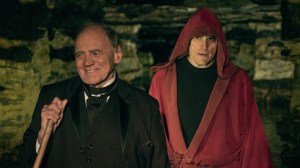
Jack (Matt Dillon) narrates his life as an American serial killer in the 1970s and 80s. He’s traveling through the afterlife with the help of Verge (Bruno Ganz), a supernatural guide and easy listener. Jack divides his murderous exploits into a series of five key incidents: Lady 1 (Uma Thurman) being picked up looking for car help; Lady 2 (Siobhan Fallen Hogan) as a suspicious neighbor answering the door; Lady 3 (Sofie Grabol) as a mother with kids who is taken hunting and then literally hunted; Simple (Riley Keough), the one who tried to get away; and finally the last scenario where Jack tried to kill multiple men with a single “full metal jacket” bullet. Along the way, Jack talks about the frustrations of his boyhood and adulthood, living with OCD, and the implications of his life’s legacy.
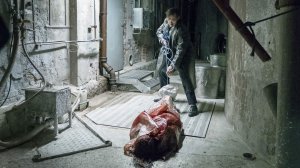
It’s not that a serial killer film, whether it be a psychological examination or gnarly genre thrill ride, can be without artistic merit, but von Trier settles for empty provocations. He’s using the nature of the movie serial killer to essentially terrorize the audience and make them question what entertainment value they ever saw in these kinds of figures and stories, or von Trier’s films at that. I was expecting an unsettling experience given the nature of the subject and the reputation of the filmmaker, but what made the situation all the more oppressive and disquieting is how obvious and heavy-handed everything comes across. The central metaphor could not be any more transparent for any person familiar with von Trier’s back catalogue of punishing feature films. Jack views himself as an artist, specifically an architect, and his art is via terrorizing women for personal satisfaction. In case you needed it further spelled out, Jack is von Trier, a filmmaker who makes movie after movie featuring a central heroine being abused and exploited with no cosmic justice. A von Trier film experience is all about unchecked suffering and systemic abuse from the patriarchy. Sometimes this can be a condemnation that elicits strong emotional responses like a Dancer in the Dark, and other times it feels like von Trier wallowing in flip nihilism, like the conclusion of his two-part Nymphomaniac opus that undid the preceding four hours. Jack kills women for his art; von Trier tortures women for his art. There you go. With that central metaphor established, you’d expect the movie to become an introspective and excoriating probe into von Trier as a notorious filmmaker who often shocks and appalls. Oh how wrong you would be. The House That Jack Built is the same stale slog only with a slight meta twist.
For no better example of how heavy-handed the movie is, simply observe its unnecessary framing device where Verge/Virgil is literally leading Jack in the dark toward the subterranean bowels of Hell and the two are digressing the long walk. My friend and filmmaker Jason Tostevin said he was watching The House That Jack Built with a “scrunched-up face” for its majority until the last thirty minutes when he accepted it as a morose comedy, and then it started playing better for him. That might just make sense, considering von Trier’s overwrought pitch-black sense of humor and overall belief that life is a joke. I did laugh out loud once Jack and Verge are floating in bubbles. It also provides some, not much, context to scenes like Thurman’s, where she keeps needling Jack about what a bad serial killer he would be based on his decisions. It’s almost like von Trier is trying to say that Jack took the psycho killer plunge because a bossy woman kept annoying him and pushed him into it. The early sequence of Jack stumbling into being invited into a woman’s home has a clumsiness that almost invites a degree of wicked comedy, especially after Jack tries to treat the woman who seems incapable of dying. There’s also the absurd conclusion of the “house” Jack actually finally constructs. However, even as a supposed “comedy,” The House That Jack Built is an obnoxious experience that will make you feel worse by the end of its painfully lugubrious 150-minutes.
There was one kernel of an idea that could have worked, the nature of a serial killer with OCD. Those competing impulses would provide a level of new interest. During the second incident, Jack is compelled to go back to the crime scene again and again, risking being caught by a pesky neighbor or police officer, but he can’t help it. He’s obsessed that he didn’t check every last square inch and there’s an unseen blood droplet that will doom him. The concept isn’t new as Ray Bradbury had a short story “The Fruit at the Bottom of the Bowl” about a killer obsessed with eradicating every trace of his fingerprints. It puts the killer in a position of vulnerability that makes every killing more fraught. It’s almost like von Trier can suspect his audience enjoying this aspect of his story and so he must snuff it out. For whatever reason, Jack says he eventually just stopped caring. He just got over his crippling OCD tendencies through the power of criminal apathy. Jack is never in any danger of being caught because, and even Verge interjects on this, the people of this world are preposterously stupid. Nobody believes Jack is a potential murderer, and so this level of ignorance (and white male privilege) enables him to kill with impunity. By removing the possibility of any external threat, Jack becomes that much more boring. The only possible points of interest now become his disturbing murder tableaus. An extended sequence with Keough (Logan Lucky) made me feel queasy, especially when her character’s breasts end up getting severed and slapped onto an ignorant officer’s windshield. That moment felt like von Trier rubbing it in that a good-looking white man can get away with anything.
Even with its five-incident structure, plus celestial-spanning epilogue, the movie is all over the place. von Trier never met a Wikipedia article he didn’t like and want to awkwardly shoehorn into a longer narrative. Get ready for more seemingly unrelated academic asides meant to come across as philosophical pontification on the nature of art, evil, culpability, and whatever else sounded smart at the time. Jack compares his murder sprees to… medieval architecture. He then digresses about pianist Glen Gould, dessert wines and their decomposition process, the screaming WWII German airplane the Stuka, the theory of Ruin Value, the balance of light and shadow from two streetlamps, and you bet there are concentration camp anecdotes. At one point Jack and Verge are debating how one can best enjoy art and von Trier uses clips from his own movies as examples of “challenging art” in case you wondered whether or not he was going to be too hard on himself and his past. These quizzical asides often feel tacked on like academic footnotes, yet the film is stuffed full of them. It lurches from incident to incident and footnote to footnote, mostly because Jack is a rather boring lead character with a boring worldview and past. Then there’s the final epilogue that literally takes place in Hell. If you can make it past that, dear reader, you’ll be treated to a smash cut to the end credits set to, I kid you not, “Hit the Road Jack.” It’s a baffling, tonally discordant decision that only furthers the theory of Jack as a comedy.

I feel like I’ve endured enough von Trier films in my life at this point that I can walk away, content with the decision. It’s getting harder and harder for von Trier to tell a new story and his old tricks have grown tired, placing him into unintentional (or intentional?) self-parody. There isn’t enough introspection or insight or narrative complexities to justify this bloated and bedeviled look at one man’s many misdeeds. The characterization is slack and there are no significant supporting figures, only victims and stooges, and sometimes both at once in von Trier’s mocking reflection of our universe. I felt varying degrees of sympathy for every actor in this movie. They deserve better. Matt Dillon can play to the dark side well but he deserves more than to be a smiling cardboard cutout. Uma Thurman was one of the best actors in Nymphomaniac Part One. Doesn’t she deserve better than to get repeatedly smacked in the face with a broken car jack (get it, a “broken jack,” because the main guy’s name is… oh, you do get it?)? Riley Keough definitely deserves better than to have her breasts fondled for a solid minute onscreen and then used as a coin purse later. And the audience likewise deserves better than to spend 150 minutes watching misguided torment and misogyny disguised as introspection and social commentary. The House That Jack Built is rotten to its very foundations and another excuse in cheap sadism for the cheap seats.
Nate’s Grade: C-
Share this:

The Mule (2018)
 Clint Eastwood plays a real-life 90-year-old drug mule, though I must inform you dear reader that at no point does he hide his cargo in a very uncomfortable place. The Mule is an interesting story about the most unexpected mule. Eastwood plays a man broke and on the outs with the family he’s neglected their entire lives. He takes up an offer to simply drive albeit for a Mexican drug cartel. As with most life-of-crime movies, what starts off uneasily becomes second nature as our characters get in over their heads. Except that doesn’t really happen in The Mule. I would estimate twenty percent of the movie is watching Eastwood drive and sing along to the radio. There are some tense near misses where he’s almost caught, but these are confined to the first half. In the second half the cartel becomes the chief source of danger, all because he doesn’t go by their routes. If he’s their most successful mule, having never had a ticket in his life, then why micromanage? There are some other nitpicks that nagged at me, like the cartel knows the DEA agents (Bradley Cooper and Michael Pena) are pulling over a very specific color and kind of car, but at no point do they change out Eastwood’s car. Also, Eastwood is spending vast sums of money in public for a man who was losing his house, and yet no red flags there. Eventually Eastwood has to make a choice of family over angering the cartel and risking his life, and I think you’ll know where his character arc is destined. The dramatic shape of the movie feels a little too inert for the stakes involved, leading to an all too tidy conclusion. Eastwood delivers a fine performance, as does every other actor involved. The movie kind of coasts along, much like Eastwood in his truck, on the inherent interest of its premise and the star power of its lead/director. The Mule might have worked better as a documentary.
Nate’s Grade: B-
Share this:

The Strangers: Prey at Night (2018)

Coming ten years too late, the inane sequel to The Strangers is a home invasion thriller that was so bad that I had to stop it five separate times to collect myself. It’s about a boring family that takes a vacation (?) to a trailer park (?) and is terrorized by mask-wearing strangers who insist on killing set to diegetic 80s pop music (?). Seriously, the music is part of the scene and these imbecilic killers almost have an OCD-level compulsion to have to listen to their kickin’ tunes when they’re kicking in heads. One killer literally won’t leave a car radio until he gets that exact right soundtrack. This is the only aspect of note in what is otherwise a thoroughly rote slasher film. At one point one of the killers is going to be unmasked and the film plays it up as great reveal? Who could it be? Oh, it’s nobody, because the anonymity is the point but the movie forgot. I paused this movie to give myself a break and only 20 minutes had passed! Here’s another example of the bad plotting: we have a teen girl kicked out of school for some rebellious, disciplinary action. Surely, you would assume, that in the final act, she will make use of this same skill to save herself, you know attaching a payoff to a setup. This never happens. It’s just one poorly executed attack sequence after another with nothing to offer but forced irony. It feels like random scenes that just stretch and stretch and it’s hard to even bother paying attention. The kills are lame, the suspense set pieces are dumb, and the attackers are boring. How the hell do these people get the jump on everybody? It’s like they can choose to make sound or not. Listen for the looming 80s soundtrack as a giveaway, people. The Strangers: Prey at Night is worth burying in the past.
Grade: D-
Share this:

Truth or Dare (2018)
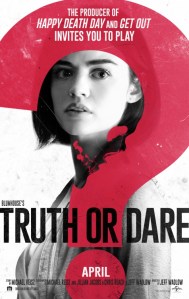
A group of college friends spend Spring Break south of the border and stumble into a deadly game of… truth or dare? Blumhouse has spun gold out of just about any high-concept horror property but can it make Truth or Dare work? Here’s the truth: nope.
This is a powerfully dumb movie that caused me to yell at the screen several times, shake my head even more, and contemplate my own life choices. The entertainment level is related to every befuddling choice this movie makes, and it makes many of them. Take basic dramatic opportunities that it weirdly pushes aside. One character is gay and hasn’t come out to his father yet, so the demon-inhabited game dares him to come out. Rather than watch this genuinely dramatic moment play out, Truth or Dare has it all take place entirely off-screen. Hilariously, the gay student comes back and recaps the audience what they missed (“Yeah, I came out to my dad, and he said some things, and we’re good now.”). Imagine if an action movie did something similar (“Hey, yeah, so I jumped out of a flaming helicopter onto that skyscraper and then scaled down only using my pants as a makeshift rope”). That’s bad writing no matter the genre. Take another scene where Olivia (Lucy Hale) tracks down the old Mexican lady who supposedly started the curse. She gets there but is told by the granddaughter to wait outside. So she does. Then we cut to a later scene where the granddaughter says, “She has agreed to see you.” Why did we need that first scene denying them entry? If all it does it kill mere seconds in the running time, why is it even included? This scene also involves the granddaughter being coy when Olivia asks to speak to the old lady. She cut out her tongue long ago and the granddaughter knows this but is just being a jerk. These are basic storytelling miscues that Truth or Dare doesn’t seem capable of overcoming.

We must talk about these silly demonically possessed faces. Oh the faces. It looks like a bad Snapchat filter promotion. I am convinced some studio exec saw a Snapchat filter and said, “Hey, we can make a horror movie based on that” (Look out for the upcoming dogface filter horror movie in 2019). The faces are so dumb. They pinch into pained rictuses, big eyes, and triangular, pointy chins. It’s not a creepy image at all. It’s like a bad special effect trying to turn the cast into caricature. Then they even directly address it, as one character literally cites the look as a “Snapchat filter.” Don’t hang a lampshade on it, movie, and make us all realize that even you know how dumb and derivative you are. The accompanying scary modulated voice is also worth a hoot. The end credits even end on the demonic voice challenging the audience to a game of truth or dare. Joke’s on you, movie, because nobody stuck around for the end credits of this one (except for me). The faces are never scary, are always goofy, and always funny looking, and that’s all we get.
The scariest thing in Truth or Dare is the uproariously bad dialogue. These are actual lines of dialogue spoken in the movie: “The game followed us home from Mexico.” Oh? “We’re not playing the game, it’s playing us.” Uh huh. “I dare you to get on the pool table and show everyone your pool cue.” Oh, PG-13 movie, how naughty of you. “I know things have been a little Bette and Joan since Mexico.” No, movie, you do not earn referencing Bette Davis and Joan Crawford or even Bettie and Joan from Mad Men.
The characters might be as bad as the cringe-inducing, laughable dialogue. Our protagonist is kind of a terrible human being (spoilers to follow). Olivia is obviously in love with her best friend Markie’s (Violett Beane) boyfriend Lucas (Tyler Posey), blurts out her best friend’s cheating ways to the whole world, will eventually sleep with the best friend’s boyfriend (more on that later), and then also reveals a painful secret regarding her best friend’s deceased father, namely she is indirectly responsible for his death, suggesting he kill himself after he tried to sexually assault her. All of these abuses are targeted at her best friend, and yet she constantly keeps trying to say, “You have to trust me,” as if these cruel torments should be waved away. It’s so one-sided and directed at one person, her ostensible best friend, that it becomes comical. At one point Markie has a gun to her head and screams she has nothing left. “You have me,” Olivia says, and I wanted Markie to pull the trigger right then because this was after Olivia told her everything. Hale (TV’s Pretty Little Liars) has a fixed expression of confusion with her large doe eyes, which don’t require that much in the way of adjustment for the Snapchat filter face. I don’t think we’re supposed to care about any of these characters, including our eventual Final Girl played by Hale. I was rooting for the demon to bump them off in bulk.

The mysteries of Truth or Dare are exasperating and demand further analysis, which I will ably try and perform for you, dear reader. First off, the rules of this game are very sketchy and feel rather arbitrary. A demon will jump around participants but needs more contestants, like the Ring cursed videotape. Eventually more players will be roped in but the old players are still part of the game, I guess, which means there’s no escape. This all started because some demon was released from its containment pot at an abandoned monastery, and it just so happened there was a group of teens playing truth or dare. So the evil demonic spirit said, “Hey, why not?” and adopted the game as its own? What if they had been playing spin the bottle or “Head’s up 7 UP”? I am almost certain, given the cannibalization of the horror genre, there has to be an evil spin the bottle movie somewhere (a cursory Internet search found a 2011 film with the premise). I feel like the other demons at Hell High pick on this particular demon and with good cause.
When given a choice between answering a question and doing some dangerous dare the choice seems obvious. The game seems to know this as well, which is why halfway through the characters are not allowed to choose “truth” any longer. This seems like cheating. The game is called “truth or dare” and not “…or dare.” By removing the choice it stops becoming a game. Admittedly, most human beings will tap out of horrible truths to reveal after a while unless you happen to be a politician. After a while it will just resort to making people talk about their Internet search histories. When these people have to blurt out painful truths, why do they scream them? Could not whispering achieve the same results? There’s the question of what constitutes finishing a dare as well. Since one’s life is on the line, it’s important to see the dare through. There’s one scene where the game dares Olivia to have sex with her best friend’s boyfriend. I don’t know about you, but if somebody said, “an evil force says I must have sex with you or else I’ll die” it would be a real mood killer. Regardless, they strip off their clothes and take the wanton opportunity given to them (Her: “You’re just doing this because you have to” Him: “No, you do. I’m doing this because I want to”). Except in the middle of their coitus the dare demon returns and possesses Olivia, challenging Lucas to pick next. Has Olivia finished fulfilling her dare? What constitutes “finishing” when it comes to sexual congress? The dares also escalate to an arbitrary degree, often robbing the player of a real chance to see it through. When the demon dares you to kill one of two people and the previous dare was far less significant, then it feels like the movie is compensating for a lack of developing thrills. If I go, “I dare you to eat that cheese,” and then next, “I dare you to rip it out of your intestines,” it feels like too much too soon. Alas, demon party games and pacing.

Then there’s the would-be solution, which as you could assume also doesn’t make much in the way of logical sense. They can rope the demon itself into the game if they reach the hallowed spot where the game began and time things right. the demon has the ability to alter your vision and hearing, so it can already alter your reality to its whims to whatever ends it wants. When the rules are arbitrary and you’re dealing with a supernatural presence that flouts mortality, what good is any of this going to do? It’s like the kids from a Final Destination movie scheming to have Death killed by Death. This isn’t the only movie to offer false hope as far as defeating a supernatural curse, like with The Ring and It Follows. Actually a lot of the plot is similar to It Follows. Just watch It Follows.
Truth or Dare is a thoroughly entertaining and thoroughly bad movie. It’s not scary and it’s not effectively dramatic. It’s confusing and capricious and hilarious. And yet, it does find that ineffable groove to come across as something in the “so bad it’s good” echelon, something I wouldn’t mind watching again with a group of friends and some adult beverages at hand. Truth or Dare is this year’s Bye Bye Man. I dare you to watch it.
Nate’s Grade: D
Share this:

The Ballad of Buster Scruggs (2018)
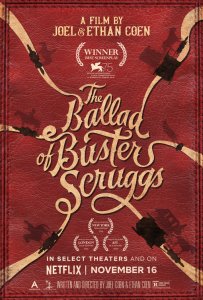 Netflix might just be the best pasture yet for brothers Joel and Ethan Coen. The Oscar-winning filmmakers were reportedly creating a Western series for the online streaming giant but that has turned into an anthology film, The Ballad of Buster Scruggs. The Coens’ love of the beautiful, the bizarre, the bucolic and the brazen are on full display with their six-part anthology movie that serves as reminder of what wonderfully unique cinematic voices they are. The Ballad of Buster Scruggs is uneven, as most anthology films tend to by design, but it reaches that vintage Coen sweet spot of absurdity and profundity.
The best segment is also the one that kicks things off, the titular adventures of Buster Scruggs, a singing Gene Autry-style cowboy who manages to get into all sorts of scrapes. The tonal balancing act on this one is pure Coen, at once inviting an audience to nostalgically recall the Westerns of old while kicking you in the teeth with dark, hilariously violent turns that veer into inspired slapstick. There is a delightful absurdity to the segment thanks to the cheerful sociopath nature of Buster Scruggs, the fastest gun in the West that’s eager to show off at a moment’s notice. He’s a typical Coen creation, a wicked wordsmith finding himself into heaps of trouble, but through his quick wits and sudden bursts of violence, he’s able to rouse an entire saloon full of witnesses to his murder into a swinging, carousing group following him in song. I laughed long and hard throughout much of this segment. I was hooked and wanted to see where it would go next and how depraved it might get. Tim Blake Nelson (O Bother Where Art Thou) is wonderful as Buster Scruggs and perfectly finds the exact wavelength needed for the Coen’s brand of funny and peculiar. He’s like a combo Daffy Duck and Bugs Bunny breaking the fourth wall to let the audience in on his merry bravado. The segment ends in a fitting fashion, another song that manages to be hilarious and strangely poignant at the same time. The Coens allow the scene to linger into a full-on duet of metaphysical proportions. I could have watched an entire series following Buster Scruggs but it may have been wise to cut things short and not to overstay its novelty.
 The other best segments take very different tonal destinations. “All Gold Canyon” is a slower and more leisurely segment, following Tom Waits as a prospector who systematically works the land in search of a hidden trove of gold he nicknames “Mr. Pocket.” The step-by-step process has a lyrical nature to it, and it reminded me of the opening of There Will Be Blood where we follow Daniel Plainview’s initial success at unearthing the beginning of his fortune. Waits is fantastic and truly deserving of Oscar consideration as the prospector. He’s hardscrabble and resilient, and there’s a late moment where he’s narrating a near escape from death where he’s tearfully thankful, possibly losing himself in the moment, and so grateful that it made me tear up myself. The segment ebbs and flows on the strength of the visual storytelling and Waits. It’s a lovely short with a few hidden punches, which is also another fine way to describe the other best segment, “The Gal Who Got Rattled.” It stars Zoe Kazan (The Big Sick) as a woman making her way to Oregon with a wagon train. She’s heading west for a new life, one she was not prepared for and only doing so at the urging of her pushy brother who dies shortly into the journey. Now she’s on her own and struggling to find her own place in the larger world. There’s a very sweet and hopeful romance between her and Billy Knapp (Bill Heck), one of the wagon train leaders who is thinking of settling down. It’s also a segment that slows down, accounting for the longest running time of the six. It goes to great care to establish the rhythms of life on the road, where many people walked the thousands of miles across the plains. The budding courtship is at a realistic simmer, something with more promise than heat. It’s such an involving story that its downturn of an ending almost feels criminal, albeit even if the tragic setups were well placed. Both of these segments take a break from the signature irony of the Coens and sincerely round out their characters and personal journeys and the dangers that await them.
 The remaining three segments aren’t bad by any stretch (I’d rate each from fine to mostly good) but they don’t get close to the entertainment and artistic majesty of the others. The second segment, “Near Algodones,” has some fun moments as James Franco is an inept bank robber who seems to go from bad situation to new bad situation, getting out through miraculous means until his luck runs out. The interaction with a kooky Stephen Root is a highlight but the segment feels more like a series of ideas than any sort of story. Even for an anthology movie, the segment feels too episodic for its own good. The third segment, “Meal Ticket,” is about a traveling sideshow in small dusty towns in the middle of winter. Liam Neeson plays the owner and the main act is a thespian (Henry Melling, best known as Dudley Dursely in the Harry Potter films) with no arms and no legs. The thespian character says nothing else but his prepared oratory. It makes him a bit harder to try and understand internally. I was also confused by their relationship. Are they father/son? Business partners? It’s also the most repetitious short, by nature, with the monologues and stops bleeding into one another, giving the impression of the thankless and hard life of a performer trying to eek out a living. It’s a bit too oblique. The final segment, “The Mortal Remains,” is like an Agatha Christie chamber play. We listen to five characters engage in a philosophical and contentious debate inside a speeding stagecoach that will not slow down. It’s an actors showcase with very specifically written characters, the Coens sharp ear for local color coming through. The conversation takes on a symbolism of passing over to judgment in the afterlife, or maybe it doesn’t and I’m trying to read more into things. You may start to tune out the incessant chatter as I did. It’s a perfunctory finish for the movie.
 Being a Coen brothers’ film, the technical merits are mesmerizing. The cinematography by Bruno Delbonnel (Amelie, Inside Llewyn Davis) is sumptuous and often stunning. The use of light and color is a gorgeous tapestry, and some of the visual arrangements could be copied into ready-made scenic postcards, in particular “Meal Ticket” and “All Gold Canyon.” The isolation, hostility, warmth, majesty of the setting is expertly communicated to the viewer. The production design and costuming are consummate as well. The musical score by longtime collaborator Carter Burwell is classic in its use of melancholy strings and motifs. It’s a glorious looking movie made with master craft care.
Before its release, the Coens had talked about how hard it was to make their kind of movies within the traditional studio system, even with their 30 years of hits and classics. Netflix is desperately hungry for prestige content, so it looks like a suitable match. I’d happily welcome more Coen brothers’ movies like The Ballad of Buster Scruggs, a goofy Western that’s equally heart wrenching as it is heart-warming, neither shying away from the cruelty and indifference of the harsh setting nor neglecting to take in its splendor. Just give them whatever money they need Netflix to keep these sort of movies a comin’.
Nate’s Grade: B+
Share this:

Widows (2018)
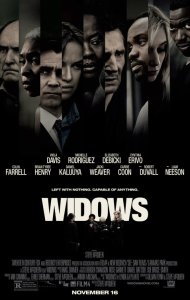 Widows has an all-star cast, an Oscar-nominated director, and a best-selling novelist-turned screenwriter, so my expectations might have been turned up a bit too high. It follows a team of titular widows (Viola Davis, Michelle Rodriguez, Elizabeth Dibecki) picking up the pieces in the wake of their husbands’ deaths. It seems their dearly departed spouses stole money from a local criminal who very much demands the sum returned. The women must enter into a criminal heist, using notes left behind by a dead hubby, to settle the debt and spare their lives. Widows is a higher caliber crime movie with notable texture given to a wide assortment of characters; even the villains are given small character touches to better flesh them out and feel more realized. There’s a concurrent election tying together different corrupt and criminal enterprises that widens the scope of the film into a grander scale. The characters and performances are the selling point of the movie and provide consistent entertainment. Davis (Fences) is the strong-willed linchpin of the group and I could watch her boss around people for hours. Dibecki (The Great Gatsby) has a nice turn as a trophy wife accustomed to being abused. The problem is that there might be too many characters. Rodriguez has far more significance in the first thirty minutes and then is put on ice. Likewise, Carrie Coon and Cynthia Erivo are hastily added when the plot requires something of them. That plot, adapted by Gillian Flynn (Gone Girl) and director Steve McQueen (12 Years a Slave), proves to be the film’s biggest hindrance by the end. The second half plot turns seem to come from a schlockier version of this story, not the classier version we had been treated to beforehand. There are character decisions that baffle credulity and personal safety. The quality of the characters deserved a movie that could refrain from the hacky genre twists. McQueen’s precise camerawork is still alive and well and highlights tension and also moments of social commentary, like when we watch a car travel mere blocks from a rundown inner city neighborhood to a fancy gated residence. There’s a lot to like with Widows, and plenty to get excited about, but I wanted to like even more.
Nate’s Grade: B
Share this:

The Girl in the Spider’s Web (2018)

The Girl with the Dragon Tattoo was an international best-selling trilogy that gave way to three hit Swedish movies, one Hollywood remake that netted a Best Actress nomination, and millions in worldwide revenue. The problem was that its author, Stieg Larsson, died of a heart attack in 2004, before the publication of any of the original novels. The property was too valuable to simply collect dust and thus a new author came aboard to tell further adventures of Lisbeth Salander, the pint-sized Gothic avenger. A new set of novels began being published in 2015, and after David Fincher’s 2011 version underperformed at the box-office, it seemed expected to reboot the franchise with a new big screen story that had yet to be adapted. In steps a new director, a new dragon-tattooed lady for The Girl in the Spider’s Web. Unfortunately, my fears have come true and the eventual reckoning has happened: they have made Lisbeth Salander boring.
Lisbeth (Claire Foy) is thrown into another criminal conspiracy with shadowy forces at play. A network of high-powered assassins, known as “spiders,” has stolen a dangerous technology that will allow the user control of nuclear arsenals. Lisbeth is hired to retrieve this tech, betrayed, and then on the run from Swedish authorities, professional killers, a dogged NSA operative (Laketih Stanfield), and the head of this cabal, Camilla Salander (Sylvia Hoeks, Blade Runner 2049), her long lost sister Lisbeth left behind years ago.
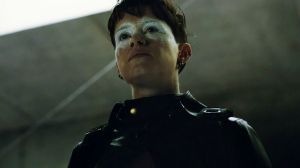
In her first 2010 outing, Salander was presented as a complex, emotionally withdrawn figure, eminently capable but flawed, hurt, and looking to punish others from her fraught history with terrible men. Strip away all the Gothic trinkets and camouflage, her assertions of identity, and she’s still a deeply intriguing human being. However, even the latter Swedish films started veering in this more derivative direction. As I wrote presciently with the second Swedish Dragon Tattoo movie back in 2010: “We project the interest we felt for her from the first film to the Salander stand-in represented in the second film. She’s still a resourceful, loyal, and cavalier presence, but the plot corners her into being a creature of action. She becomes the fantasy bisexual ass-kicking protagonist that was merely hinted at previously. That sounds like a good thing, but trust me, it does the audience a disservice to box in such a fascinating character.” With Spider’s Web, Lisbeth Salander has become a Gothic Jason Bourne spy figure, and as anyone who has seen the Bourne movies can attest, he’s the most boring character in his own movies, which is why he needs to be kept constantly on the move and hunted. He’s only interesting when he’s getting out of jams, and Lisbeth is now sadly in that realm.
Lisbeth has been reduced to her most essential, and most superficial, characteristics, which also go for the film as a whole. The Dragon Tattoo series began as a twisty investigative procedural with a litany of suspects and dark secrets worth killing over. From there, the Swedish films turned Lisbeth into an indestructible Terminator capable of getting the drop on anyone and axe-fighting oversized men. The Swedish series began more grounded as a mystery/thriller and suddenly, and regrettably, transformed into a preposterous Hollywood-style action-thriller, following the edict of bigger being better. That same mentality has carried over past Larsson’s contributions, and now Lisbeth has become an action superhero and the series has become trashy fun, high-calorie junk food, a safe excursion to a seedy underbelly. The Girl in the Spider’s Web still provides a consistent degree of entertainment, but it’s not playing at a higher level, content to hand-wave away its story for cool chases and fights. It’s the kind of movie where, to escape an encroaching fireball, Lisbeth dives into a bathtub of water. It makes for a visually interesting shot but it’s pretty cliché 90s action movie stuff. Director Fede Alvarez has a slick handle with visuals and evidenced real talent at sustaining and developing tension with 2016’s Don’t Breathe. He has obvious visual talent. There are some engaging fights, like a close-quarter struggle in a bathroom, and some nifty chase scenes, like a motorcycle chase over a frozen lake. I would have liked even more action if Spider’s Web was going to brush aside narrative and moral complexity for stylish set pieces.

The story of The Girl in the Spider’s Web feels like a lukewarm repackaging of spy clichés, and the film does little to make any of it feel important or relevant. There’s a super powerful technology that everyone wants, which falls into the wrong hands, and now it’s about retrieving this device and saving the world. That’s like the plot of just about every James Bond movie. It’s a formula, but where Spider’s Web missteps are that it doesn’t add anything else to this staid foundation. There are scenes but it’s usually about this group going after this group, or this group now going after this group, and without wider relevance it becomes redundant plot placeholders, something meant to distract long enough to get our characters from Point A to Point B. With a mystery, there’s a natural momentum that builds as the case builds coherency and the investigation focuses the direction. With action thriller mode, Spider’s Web just has a bunch of guys that occasionally interact until the movie needs some of them dead. This model by itself can work but it requires concerted effort, and that just isn’t present here.
The most interesting aspect of Spider’s Web is the further examination on Salander’s troubled upbringing, this time introducing a sister that has been plotting vengeance. Salander is, first and foremost, the selling point of this franchise; she is, after all, the titular girl with that particular tattoo. She is what separates this from any other paperback thriller. The Swedish sequels opened up her past traumas with her Soviet-defected father. He was the Big Bad Man behind the scenes trying to institutionalize and neutralize her. While skirting into the above-stated dangerous territory, the Swedish sequels still knew that Lisbeth Salander’s complicated history was the real mystery the audience craved, and it set up a series of antagonists ready to be foiled for years-in-the-making payback. I don’t really know how the events of Spider’s Web gibe with the overall series. I had to look up whether the evil father in the opening was the same evil father in the other films (both are listed as Alexander Zalachenko, so I think so). But the established history has Lisbeth committed after trying to set dear old dad on fire to save her abused mother. I don’t see how any of that is likely if she escapes her father’s clutches as a pre-teen and is supposedly on the run. The secret Salander sister revelation also impacts little. She was the one left behind, whose continued abuse and degradation are strongly referenced. It doesn’t feel like Lisbeth harbors great guilt over leaving her sister behind. During their final face-to-face, Camilla actually poses a worthy question: “Why did the woman who hurts men who hurt women never come back and save her own abused sister?” Because this storyline is flagrantly underdeveloped, the evil sister angle is a cheap twist. There’s nothing to the Camilla character, so she serves as a symbol of shame, and yet the movie doesn’t seem to capitalize on this in the slightest, which is a puzzling disservice.

Foy (Netflix’s The Crown, First Man) is having a big year for herself but feels slightly miscast. She never really gets an opportunity to show off her range, which is a byproduct of the streamlined, reductionist screenplay emphasizing bare plot mechanics. She is missing the intensity or fire that we’ve seen in prior Salanders, breakout-star Noomi Rapace and the Oscar-nominated Rooney Mara. When Foy tries for glower you see the effort. She’s more grumpy than tortured, like maybe she skipped a meal. Even with the requisite piercings, tattoos, and black leather wardrobe, Foy seems a bit too clean-cut for the part. Personal admission: Foy with her sharp bangs, saucer-eyes, facial shape, and Gothic accessories, looks remarkably like an ex-girlfriend of mine from the early 2000s. That was something that kept sneaking into my mind throughout the film, which made the experience a tad stranger as if I was imagining an ex engaged in action heroics. Even excusing that personal connection, Foy ranks a distant third place for the Girls With.
The new Dragon Tattoo movie will likely also be its last. I can’t imagine fans getting too much pleasure out of a streamlined, underdeveloped spy thriller that sands away the edge and complexity of its characters for rote action movie chases. It’s not a bad movie and it does carry moments of excitement and entertainment, but it’s also become a standard Hollywood thriller, no different than a dozen other high-tech, junky hacker thrillers. The Girl in the Spider’s Web gets caught in its own formulaic web. If Lisbeth Salander has been transformed into a standard action hero, then we don’t deserve more adventures.
Nate’s Grade: C


You must be logged in to post a comment.