Blog Archives
John Wick: Chapter 3 (2019)
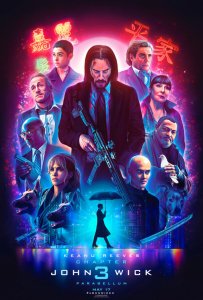 When we last left human killing machine John Wick (Keanu Reeves) he was on the run. He had just committed the cardinal sin in this world of professional hired guns — killing a protected man on safe ground. As a result, The High Table, which governs this ordered realm of trained assassins, has excommunicated Mr. Wick and placed a $15 million dollar bounty on his head. John is desperate for an exit and leans on old pals (Angelica Huston, Halle Berry) before coming home once again to face off against all the gun-toting wrath The High Table can offer.
Plenty of Hollywood action movies can elicit cheers and thrills, and John Wick 3 is definitely in that mix, but what sets it apart is the sheer number of “Oooo”s, “Oww”s, and, “Holy shit”s. Most other action movies have one or two moments that make you wince or make you shake your head in astonishment of something intense, gnarly, or self-evidently awesome. John Wick 3 is packed with these moments. There are numerous examples just in the opening action sequence. There’s one long extended fight where John uses whatever is at his disposal, including knives and shards of broken glass and mirror, to take down his mounting enemies, and then he pulls these deadly projectiles out of their bodies to use again in a pinch. By the end of this action sequence, my preview audience burst into applause. I can’t think of another movie where this happened especially in Act One. The movie has lots of standout action sequences and the good sense to let the audience enjoy the disciplined, imaginative fight choreography in full with long expansive takes. There are moments that are just incredible to witness, like John Wick utilizing a kicking horse to his advantage, or seeing the full take-down effect of whirling attack dogs in combat, and a two-on-one fight where every glass cage in sight must be smashed to bits. For action fans, the John Wick series is a simplified adrenaline shot where the director and star are working in unison to compose goose bump-triggering action cinema for the masses.
 Another hallmark of the series is its sense of macabre humor and the world building peculiarities. Amidst the wild carnage and bloodshed, there are moments that shocked me with how funny they were. I was almost in tears toward one baffling moment toward the very end. I loved that the chief antagonist, a samurai sword-wielding Zero (Mark Dacascos), can also be a fanboy. During a rare moment of downtime, he gets to gush and freak out that he’s actually interacting with the John Wick. There’s a new character played by Asia Kate Dillion (TV’s Billions, Orange is the New Black) who behaves like a peeved middle manager trying to get back on the next red-eye home. She’s the best new addition in Chapter Three. Don’t expect much from high-profile new faces like Angelica Huston and Halle Berry as their screen time is brokered into short segments. There’s a sequence where John combats trained soldiers in body armor, and so he has to constantly be reloading because it takes multiple precise shots to down the bad guys. It’s a smart way to escalate the stakes of the scene while staying true to its world, because who wouldn’t wear everything and the kitchen sink when being tasked with killing John Wick? I laughed out loud when Wick returned to an armory perturbed that he had to reload so soon, muttering to himself in agitation.
The action is relentless and all kinds of fun to watch but the movie starts to lose its momentum by the conclusion. Part of this is by the sense of lowered emotional stakes in its finale (more on that below) and another factor is its general plot-less nature. The entire story of John Wick 3 is the title character trying to outrun the people set out to kill him, jumping from one supposed safe landing spot to another. This works for a frenetic sense of pacing, knowing that any lag time will be minimal before the next kickass brawl. Because the movie rarely catches its collective breath, it can also feel like a mindless video game, with each new location a new level and with innumerable, faceless cohorts rushing in to be battled. The violence can be brutal but also feel a bit programmed, lacking some of the visceral dynamic realism of The Raid movies, the closest equivalent action franchise I can think of. There’s nothing here that challenges the brilliant set pieces and organic complications from the last Mission: Impossible movie. It’s a fun action franchise but it runs the risk of resting on its (considerable) laurels, feeling too same-y, and that can prove deadly. The clever fight choreography, sense of humor, and conviction of Reeves does enough to mask the negative effects of this artistic choice. This may affect people differently especially fans of the series, as lavishly produced action can be rewarding enough to ignore other pressing faults. For me, I was feeling as gassed as John Wick by the end.
 The further and further we get from the events of the original John Wick, the less emotional involvement the series seems to ingratiate, especially with its central baddies onscreen. Every dog-loving audience member was wiling Wick to get his vengeance in the first movie. We wanted him to get the bad guy in the sequel. Now it’s basically wave after wave of hired guns that he has to defeat, and without a better connection to that opposing force, the movie franchise runs the risk of losing any longstanding personal stakes. The bad guys are just interchangeable and only present to be dispatched. There’s no emotional victory or satisfaction for the audience if Bad Guy #12 gets toppled by the climax. The John Wick franchise is magnifying this accelerating problem; by making the conflict carry over into an additional movie, and now into another additional movie, the audience is getting further and further distance from the origin of this conflict, and thus its resolution becomes less of a desirable and satisfying goal and more a perfunctory endpoint. I would recommend the John Wick team review 2008’s Quantum of Solace to see a recent example of a big action movie hampered by overextending a thin storyline.
If you’re coming to John Wick 3 for another heaping of high-quality action, you won’t leave disappointed on that front. If you’re looking for signature moves, dark humor, and lots and lots of casual headshots, then you won’t leave disappointed. If you’re looking for a thrilling good time at the movies, you won’t leave disappointed. As a fan of the series, this was the movie I was wanting from the first sequel, dealing with the larger consequences of his rule-breaking life-and-death decision. As the third act ramped up for John Wick 3, I turned to my friend and said, “If this was the second movie, it would end right here.” Perhaps if you watch John Wick 2 and the third movie in short succession some of the problems would be smoothed out, namely a depleted sense of personal stakes and too little plot stretched over multiple movies and counting. I’ll happily continue watching further adventures of John Wick, though I’d be just as interested in an exploration of the world without its titular star. At some point it may be necessary to retire John Wick (Reeves seems to have lost a step, but he’s still like a hundred steps beyond most of us) and when they do, I hope this interesting and peculiar world is allowed to house further weird and exciting adventures. In the meantime, John Wick 3 will more than delight those action urges and sate the action appetites of its fans.
Nate’s Grade: B
Share this:

Miss Bala (2019)
 At the start of 2019, there were an amazing three Hollywood remakes of foreign films released. It was a peculiar time where we had the American version of France’s global hit The Intoucheables (The Upside), the American version of Norway’s quirky and violent In Order of Disappearance (Cold Pursuit), and the American version of Mexico’s searing beauty pageant crime thriller, Miss Bala. The films didn’t seem like a studio dump job, the new regime quietly dropping doomed movies into the early months of the year to go hopefully unnoticed. The Upside was a $100-million grossing hit, once again proving the durable and international power of that story. The remake I was most concerned about was Miss Bala, which looked via trailers to have strayed so far from the original. It felt like a potent and tragic movie was being turned into an empowerment vehicle, pretty much flipping the artistic intent of the 2011 Mexican original.
Gloria (Gina Rodriguez) is a pageant makeup artist visiting her good friend in Tijuana. The nightclub they’re in becomes a scene of gag violence and Gloria is a reluctant witness to who was responsible. As a result, the cartel gang kidnaps her and forces her to do their bidding, including unwittingly driving a car full of explosives to a DEA safe house. Gloria is forced to be a DEA informant, a courier for the cartel, and all the while she’s searching to find her friend Suzu (Cristina Rodlo). By the end this new “Miss Bala” (“bala” means bullet in Spanish) will be forged by fire and find her strength to fight.
 This is a very different version of the Miss Bala story, and for the purposes of this review and critical clarification, I think it would be helpful to reprint my brief analysis of the 2011 film for easier comparison. So here is my 2011 review in full:
“Miss Bala (Mexico’s foreign film Oscar entry for 2011) is an unwavering, startling, and deeply tense movie about one woman’s tragic and unwilling association with a powerful drug cartel. Laura (Stephanie Sigman) wants to be the next Miss Baja California, but she’s unwittingly pulled into a life of crime after she witnesses a gang hit. The cartel ensures that Laura wins the beauty pageant and becomes a courier for them. The movie takes a Lars von Trier approach to storytelling, putting its heroine through a torture chamber of anxiety and terror. This woman only wants to escape the hell she has accidentally found herself a part of, but every attempt to escape, be it going to the police or confessing assassination plots to the intended targets, gets her corralled back into the fray. For Laura, there is no escape. The movie packs a near-constant surge of paranoia, as we fear that at any time something awful will happen. In fact it’s usually only a matter of time. Laura is more a symbol of the collateral damage of Mexico’s billion-dollar drug war than a character, and she kind of becomes a numb zombie by the movie’s latter half, perhaps accepting her doomed fate. Director Gerado Naranjo favors long unwinding takes and handheld cameras, which add a gritty realism and sense of compounding dread to the picture. The movie has an unflinching level of realism to it that makes it all the more haunting, stripping the romanticism from a life of crime. Much like Italy’s heralded crime film Gomorrah, this bleak but impassioned movie shows the inescapable tentacles of organized crime and gives a face to innocents caught in the middle. Miss Bala is a testament to the hidden toll of a nation at war with itself.”
That sounds like a pretty interesting movie, right? It is and is worth checking out regardless of your feelings for the 2019 Miss Bala. The original protagonist was simply a victim of being in the wrong place at the wrong time, and as a result she became a pawn in a larger game of leverage between warring factions. Her entire goal was to simply escape the terrible danger she was in, but every refuge just put her back into the fray or used her for their own devious purposes. The protagonist wasn’t completely passive since she’s constantly reacting to the dangers and dangerous men around her, assessing her ability to escape, who she can trust and when, but she is decidedly less empowered.
 That is the biggest divergence with the 2019 Miss Bala, making our protagonist an empowered woman who struts in slow-mo in a ball gown and an automatic weapon, the kind of image you’d see in any number of schlocky Michael Bay action thrillers. Over the course of her harrowing experience, Gloria becomes a Strong Woman, a Fighter Who Fights Back, whereas the protagonist of the 2011 film, Laura, was just trying to be a Survivor first and foremost. There’s a distinct difference in intention and execution there. One is curated with more realism and the other becomes a revenge fantasy. One is meant to disquiet and jar a crowd and the other is meant to be a fist-pumping crowd-pleaser.
I’ll admit there was less action in the 2019 Miss Bala than I had feared from the commercials. However, the action that does occur is indistinguishable from other bigger budget crime shootouts. You’ve got grenade launchers, exploding cars, nightclub shootouts, and other cliché moments handled in relatively cliché ways. There is a final confrontation between Gloria and one of her chief antagonists that includes the line, “I did what I had to do. We both did!” I’m stunned they didn’t feel the need to have the villain denote, “You know you and I are not that different.” Actually, now that I think about it, I’m fairly certain this scene did exist between these characters, with the guy talking about his American upbringing as a means of making connections with her. What I’m ultimately saying is that 2019 Miss Bala kind of misses the point of 2011 Miss Bala. It’s like using the Iron Giant, a figure of pacifism (“I am not a gun”) into a weapon of war (ahem, Steven Spielberg, Ready Player One).
But why don’t you judge the movie on its own merits instead of simply comparing it to its superior source material? That’s a reasonable argument so allow me to do so, dear reader. The new Miss Bala doesn’t work as the fist-pumping crowd-pleaser because it doesn’t know what to do to build its tension and escalation. Take for instance a scene after Gloria is taken in by a rogue DEA agent (Matt Lauria) and told she works for them now. She’s sent back to the clutches of the cartel and then alone in a bedroom with a leader. This guy tells her to start taking off her clothes. It’s certainly an uncomfortable moment, and the camera weirdly lingers on Rodriguez’s breasts as she’s about to remove her bra, but the scene is merely a scuzzy guy wanting to see her skin. What if she was wearing a wire or had been hiding something from the DEA, and then removing her clothes would put her in far more danger than being uncomfortable? To further hammer this home, we have a second scene where he acts sleazy to her, touching her and making her uncomfortable, so why do we need two scenes of this making the same point?
 The Gloria of 2019 Miss Bala is also a bit too predisposed to be that figure of empowerment in the face of dismissive and dangerous men. Again, nothing wrong with this storytelling perspective, it’s just the film makes it so obvious and clunky at every turn. Within the first minute of screen time, we see Gloria apply her artistic skills at home, go to work, and be dismissed by a snooty male pageant worker telling her, “We’re not paying you to think.” So, as you can see, subtlety is going to be this movie’s strength. Within the next few minutes she travels to Mexico and gets a friendship bracelet from her BFF and she declares, “You are my family.” Again, subtle. Once the club attack goes down, Gloria’s mission becomes finding her missing friend who she assumes is still alive. In the original (here I go again), the protagonist was only interested in escaping and staying alive, and here we have a main character that must save others. The problem with this development is that the movie, like the above described scene, doubles down needlessly. Gloria is already threatened by the cartel that if she escapes they will harm her godson. Why does she need two personal reasons to stay in the thick of the cartel? She already has the DEA pressuring her to do their bidding or else she’ll never find her way back to the United States. The extra conflicts don’t feel like escalations but more like redundancies.
Rodriguez (TV’s Jane the Virgin) is the best thing going with the 2019 Miss Bala. She is a luminescent actress with skills and was unrecognizable for her in Annihilation. The best thing director Catherine Hardwicke (Twilight) does is train her camera closely on Rodriguez’s face to gauge the pained, panicked expressions playing out across her very expressive face and glassy eyes. Rodriguez is a real talent who can carry herself in an action vehicle (her muscular turn in Annihilation was a genuine pleasure). She could headline an action movie, but this isn’t the one for her. Her desperation and fear gives way to a quiet confidence that loses the “quiet” part as she undergoes a slow-mo action hero transformation when the movie needs her to zip to the end of her character arc.
I would thoroughly recommend the 2011 Miss Bala for fans of thoughtful, intense, and affecting thrillers. The paranoia and dread were strong throughout that combustible movie that had more on its mind than some cheap thrills. Comparatively, the 2019 Miss Bala remake feels only designed for cheap thrills and a misguided empowerment message. As the main character is turned from a survivor into a fighter, the edges smooth out, the complexity gets distilled, and the movie becomes any other number of action thrillers where our fragile, scared character becomes an avenging angel by the climax. If that’s your recipe for an enjoyable movie, 2019 Miss Bala still has problems with its execution and poor development. You won’t regret watching the new Miss Bala but your time would be better spent watching the original film and hoping better for Rodriguez.
Nate’s Grade: C
Share this:

The Curse of La Llorona (2019)
 The Conjuring universe has gotten pretty big pretty quickly, but all it takes is one substandard spin-off to make you realize just how much craft and care are needed to make these things work right. The Curse of La Llorona (safe bet the most mispronounced title of the year) has a connection to the priest from the first Annabelle movie, and it features a supernatural spirit, a ghostly woman in a wedding dress hunting for children to replace the ones that she murdered in spite centuries ago. The main problem with Llorona is that it is so repetitive. The ghost story winds up being over an hour of the same jump scares over and over, the same high-pitched shrieks, the same door slams, the same overzealous film score, again and again. The movie occasionally introduces a unique plot mechanic like the spirit not being able to cross a makeshift barrier as long as it stays unbroken. One minute later: one of the dumb kids breaks it to reach for her dumb doll. Why even introduce a plot mechanic that involves limitations for your supernatural villain to simply cast it aside literally minutes later? If a horror movie is not going to go to the trouble of developing characters I care about, it better produce clever and effective suspense set pieces to generate that missing entertainment. This movie is cursed by not doing either, and so it becomes a redundant series of the same lame scares. There really isn’t a reason for The Curse of La Llorona to exist other than one more chance to remind me just how much better James Wan is when it comes to horror scene construction. Skip this one, folks.
Nate’s Grade: C
Share this:

Dragged Across Concrete (2019)
 S. Craig Zahler is the real deal when it comes to budding genre auteurs. He’s been writing in Hollywood for some time and after numerous un-produced scripts he finally decided to take matters into his own hands. In 2015, he wrote and directed the terrific and terrifically violent western Bone Tomahawk, and then in 2017 he tried his hand at another genre movie, the brutal prison drama, Brawl in Cell Block 99. Now Zahler has hopped to another genre, the more familiar cops-and-robbers crime thriller territory, Dragged Across Concrete. I’ll watch anything that Zahler decides is worthy of his precious time, and I was unprepared for how engaging, exciting, and uncomfortable the movie made me. It’s still early but I already feel confident this is destined as one of my favorite films of 2019.
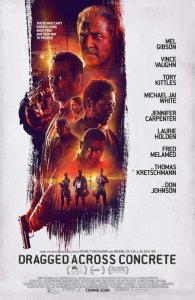
One bank robbery. Many different sides fighting for the score. Henry Johns (Tory Kittles) is an ex-con fresh for prison and attached to a crew thanks to a childhood friend, Biscuit (Michael Jai White). Brett Ridgeman (Mel Gibson) is a police detective who has been in the same position for nearly 30 years. His wife has MS and his daughter is being assaulted in their urban neighborhood. His partner, Anthony Lurasetti (Vince Vaughn), is struggling to work up the nerve to propose to his girlfriend and he sees his partner slipping. Both of them are on suspension after a video of them beating a handcuffed suspect appears online. Then there are the mysterious, masked men (labeled as Grey Gloves and Black Gloves) working alongside Vogelmann (Thomas Kretschmann) who hire Henry John and Biscuit to be their getaway drivers. This culminates with a bank robbery that places every character in greater jeopardy as things spin out of control.
 What separates Zahler from the pack is simply the magnificent manner he can write scenes, building and building, unlocked intriguing character details, building to startling conclusions or everyday relatability given a new, brash context. It’s a screenwriting edict that every scene should in essence be its own story, having a beginning, middle, and end, a drive, and if possible a reversal to something unexpected, shedding further examination onto a problem, person, or setting. I was greatly enjoying just watching the various characters talk in their understated, hard-boiled, often funny conversations, which don’t feel too self-consciously stylized. It’s just damn good writing. Even when they’re doing bad things, or mistakes that cost them greatly, Zahler has his characters respond like people and not hip, soulless movie cartoons. There’s a reason Concrete is two and a half hours long and that’s because Zahler really lets his scenes breathe at their own pace, which can be too languid if it wasn’t for how exquisitely written they are, particularly with character details. Each scene sheds a startling non-judgmental spotlight on a different character, some criminal, some corrupt, most struggling to keep their heads above water and provide for family, and you feel the narrative expanding, growing, transforming, and providing the needed space to make these people feel real.
Each one of these scenes could be a marvelous short film upon themselves, and sometimes it feels that way with the skipping perspectives. What happens to Jennifer Carpenter’s character, a woman beset with anxiety about returning to work after maternity leave, is its own wonderful movie that provides a glimpse into a life and in only five minutes’ time. Her reluctance to go back to work, her need to be with her child, the simple, heartfelt plea with a child’s sock. It all works in impressive tandem to make this person feel authentic. The same with an exchange between two lifelong friends about a birthday cake and naming dinosaurs, reaching back to ease the current tension. It’s insight rarely afforded to characters in a standard heist movie. The actors are all given these artistic arias to work with, and the extra attention to detail brings a depth of dimension that makes them feel fully realized. Zahler has captured recognizable, complicated human beings and placed them in a pulpy genre movie. This is the sort of A-level elevation of B-movie material that is usually the purview of Quentin Tarantino.
 Because of my general awe with the characterization, Zahler had the added benefit of making the rising dread feel powerfully unnerving. It’s major a slow burn of a movie, setting up the various players that will be directly or indirectly involved with the robbery, and that robbery doesn’t even hit until well after an hour into the film. Because of that patience, or self-indulgence some will decry, the movie fleshes out all the participants and their various motivations so that the audience feels degrees of sympathy for many people on different sides of the equation. This leads to amazing tension for the last hour. I was tying myself in knots waiting for awful things to happen to characters I found compelling because, frankly, awful things happen easily in Zahler’s movie universe. There is a stash of guns in the glove compartment of a getaway van. The first sequence involves the growing tension of characters placing themselves in a vulnerable position by giving up their weapons. Then, as the scene transforms anew, the guns in that compartment become a reminder of an ironic advantage that only one character knows about, and we wait for their retrieval to escalate the danger of the new scenario. That’s fabulous writing with organic developments. There are several characters at cross-purposes with little reason to trust one another, and so we wait for that looming explosion of violence fed by mistrust and greed. Zahler understands this and that’s why many of the scenes in the last hour follow the writing style, slow burns that hang onto the unease and breathing space. There are several long takes aided by long shots that amplify the gnawing tension, as your eyes scan the screen waiting for the boom.
I’ve read more than a few negative reviews for Dragged Across Concrete and I don’t understand their central criticism, namely that Zahler’s movie is “problematic” because of a supposed conservative, bigoted point of view. I think these critics are conflating a featured viewpoint with an endorsement of that viewpoint. Take for instance the brouhaha that erupted over a 2015 episode of the Hulu comedy series Difficult People where a narcissistic, caustic character makes an inappropriate joke featuring super scion Blue Ivy and vilified R. Kelly. In the context of the show, the character is berated for her off-color joke and suffers social consequences. When the episode aired, people went after the show and producer Amy Poehler and entirely missed the point. The character was not put in a positive light for making this joke. She was shamed. Clearly the show did not endorse her behavior but others could not see through their own misplaced outrage. With Dragged Across Concrete, we are presented with middle-aged police officers with a chip on their shoulder who feel justified in engaging in brutality against a suspect of color. That’s not a good thing. Zahler’s film does not endorse their actions or worldview but allows them space to exist, filling in their experiences, so we have a greater understanding of how their perspectives have been honed and hardened over time. It’s the same empathetic lens given to other people, like the opening where Henry comes home and discovers his mother has been forced to turn to prostitution to fend for herself and Henry’s disabled younger brother. I don’t think Zahler endorses the abusive cops any more than the ruthless masked killers.
 I’m keeping things light in this review for the reason that I want you, dear reader, to be surprised by the many twists and turns of Dragged Across Concrete. As the film builds in intensity, the body count rises and the conclusion feels inevitable because of the superb writing that laid a tight foundation to build upon. Even in death, the characters stay true to whom they are, which can often be very not nice people. The acting is great from every player. This movie grabbed me from the beginning and refused to let go and I was genuinely spellbound from Zahler’s storytelling prowess and ability to weave a net of complex, flawed, humane, and fascinating characters into a tragic scenario of violence that left me anxious and exhilarated. When people complain that Hollywood isn’t making thinking-person films for adults, please invite them to the burgeoning oeuvre of Zahler, who is charting a path for himself on his own terms thanks to his instincts and tremendous writing voice. Dragged Across Concrete is a ferocious punch to the gut in the best way possible.
Nate’s Grade: A
Share this:

Serenity (2019)
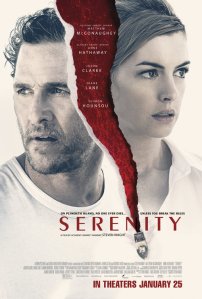 Serenity might have the most bizarre plot twist of any film this year, or maybe even the last few years. For the sake of you, dear reader, I’ll not spoil it, but it’s hard to talk about this neo-noir crime thriller without revealing its larger grand design. I have no real idea what writer/director Steven Knight, a talented wordsmith who has written Eastern Promises, Locke, and Peaky Blinders, was going for with this murky genre mishmash. Matthew McConaughey plays Dill, a local fisherman who for the first 18 minutes of the movie is obsessed with a hard-to-catch tuna like it’s Moby Dick. Literally, this is the key plot for 18 minutes. Then his old flame (Anne Hathaway) comes to town and looking for Dill to help her kill her abusive husband, Frank (Jason Clarke). Now we’re on fertile noir ground, and then one hour in the film throws a curve ball that nobody will see coming, and it spends another 45 minutes dealing with those repercussions. Some of this added knowledge leads to creepy exchanges where Dill is peeling back the veneer of his sleepy island town residents, but really it’s a confusing and unnecessary twist that leads to strange thematic implications and tonal oddities that may lead to unintentional laughter. The sentimental ending conclusion, born out of murder both real and imaginary, feels like it was ripped out of Field of Dreams and forcibly grafted on. So much of the drama is about following what is expected of us, and there are more than a few passing, though intriguing, Truman Show-esque moments that reward further examination, but these are put on hold to slay the abusive husband/step dad through the power of an elusive fish. I don’t know what to make out of Serenity. The acting is fairly solid, the photography is stylish, and Knight knows how to spin a mystery, but to what end exactly? It feels like a passionate albeit misguided student film trying to say New Things about old tropes. In the end, it’s a fish tale that is better off being thrown back. See, I can do fish things too.
Nate’s Grade: C
Share this:

Us (2019)
 I think it’s important to state that Us is not Get Out and that’s perfectly okay. Not every movie can be a Get Out, an experience that was so refreshing, socially relevant, wickedly fun and dynamic that I immediately wanted to see it again and tell everyone I know to join in. Writer/director Jordan Peele shed his funnyman past and flexed his impressive genre know-how to make a knockout of a movie with an amazingly structured story, allowing all of the pieces to snap together with clever precision. It was my own second favorite film of 2017 and I was highly looking forward to Peele’s follow-up in the realm of what goes bump in the night. Don’t go into Us expecting Get Out. It’s not quite the sum of its parts and has some storytelling shortcomings that limit the impact of its visceral thrills. It’s an engaging horror movie, but it’s far more allegorical and far less tidy and satisfying.
The Wilson family is spending their summer vacation at a rental home in Santa Cruz, California. Adelaide (Lupita Nyong’o) and her husband Gabe (Winston Duke) are trying to enjoy a getaway with their children, teenage daughter Zora (Shahadi Wright Joseph) and young son Jason (Evan Alex), when strange coincidences keep occurring. This is the same beach town where many years ago Adelaide had a traumatic childhood experience getting lost from her bickering parents. Then one night Jason informs his family that there’s another family standing in their driveway. The Wilson family is hounded by mysterious doppelgangers, each a cracked mirror version of themselves. This new family wants what the Wilsons have and will use any bloody means to see that they get it.
 Us is more a straight horror film and has plenty of excellent, terrifying, and smartly directed scenes to make an audience squirm in their seat. Peele has established in two movies a strong instinct for horror and how to expertly stage a scene. His camera is judicious in what it does and does not show the audience, holding onto moments to escalate tension and providing no escape for an eager audience. The majority of the second act is a home invasion thriller and these scenes and subsequent chases and escapes can be nerve-wracking. Each character has their own opponent and each has their own method of trying to outsmart or out maneuver their downtrodden doppelganger. I was getting plenty of Funny Games vibes, a movie I downright despise, but what it could have been if the creator actually cared about the inhabitants. The family and their bonding is a strong empathetic anchor for the audience, so we watch each member of the family battle a literal incarnation of their inner demons. Peele also assembles an effective collection of spooky imagery, from caged rabbits, to the slice of golden scissors, to a carnival funhouse, to even the nature of that 80s social event, Hands Across America. You can sense Peele’s love of horror and the entertainment value horror movies afford. There’s a strong central mystery to guide the narrative and the sense of discovery from Act Two onward keeps things fresh as we learn more and more about these doubles.
From a technical craft standpoint, Us has the upper hand over Get Out. This is a movie that wants to scare you and Peele has devoted great consideration into his artistic elements to achieve that key principle. Peele knows exactly how to craft a particular mood and what genre elements to pepper in and to what amount for the right response. The photography by Mike Gioulakis (It Follows) is evocative and makes great use of limited light to capture an eerie and unsettling feeling. The musical score by Michael Abels is also exceptional, making the most of each heightened scene and doing wonders with a dark, operatic version of the chill 90s song “I Got 5 On It” by Luniz. It makes for a fun, frightening, and favorable film experience in the moment-to-moment sequences of build and release.
The performances are another strength, with each member of the family getting extra range thanks to their dual roles. Nyong’o (Black Panther, 12 Years a Slave) is the standout and emotional center of the movie. Her double is the leader of her clan and the only one that has the ability to speak, except speaking isn’t quite the right word. It’s more like the words escape her throat, raspy and without intonation. It’s a remarkable commitment on her part and she tries a lot of weird character tics, most of them work, from her herky-jerky to robotically possessed physical movements, unblinking eyes, and then there’s that startling voice. Duke (Black Panther) finds his footing as a comedic foil, starting as a corny but loving dad and thrust into a family defender that gets more and more tired of the horror movie nonsense he endures. The kids all do solid, effective work with what they’re given, seizing their moments. Elizabeth Moss (The Handmaid’s Tale) plays a bourgeoisie friend and has a fantastic moment with lip gloss that made me horrified and entranced all at once.
 This is where the merits of the film start running into conflict with Peele’s muddled intentions and messy execution toward the finish. As I said, it’s far more allegorical in approach; meaning for the longest time it seems to be a film outside the bounds of literal interpretation. That’s fine since many horror films rely upon a heaping helping of metaphor for larger implications. I was prepared for Us to stay in this creative territory. Except Peele makes a late decision to squeeze his movie into a bizarre and distracting middle ground, where it feels like the metaphor is the real message, if you can decode it. Once you stand back and assess the full Us, it doesn’t hold together in allegory or explanation.
Even hours after seeing the movie, I cannot say whatsoever what the intended theme is for Us, and this really befuddles me since Get Out was laser-focused in this regard. Peele isn’t just cranking out fun, throwaway genre movies, he’s trying to make statements through horror and elevating the genre in artistic ways. Get Out postulated how being a black man in America was like living in a horror movie and a Stepford Wives-meets-Being John Malkovich commentary on the usurpation of minority agency and the commodification of black bodies. It’s not every day that a horror movie wins an Oscar for Best Original Screenplay, let alone deserves it, and Peele’s treatise on race relations was perfectly structured, each piece snapping together and better informing the whole, with setups and payoffs galore, and at its heart was its relevant message. With Us, I don’t really know what Peele is trying to say here. There’s a simple duality theme but that seems pretty weak and underdeveloped. There may be a have/have not inequality discussion but this gets into trouble in the final act (more on that below). I don’t think race even factors into the overall message, as a late turn reveals that the doppelgangers extend beyond our central African-American family. What is Peele trying to say with Us? I’m at a real loss and I’m trying to process that confusion and my own expectations.
This might have worked better had Peele not elected to supply a hasty sci-fi explanation for why things are the way they are, and in the process he strands his film in a contentious middle zone that tries to find a logical context to plant his allegory. I won’t get into what exactly the details of this explanation are but suffice to say it doesn’t really hold together and invites far more questions, each one picking apart the reality of the film, which disintegrates at an ever-increasing speed. How far-reaching is this conspiracy? What is the ultimate goal? How do these people think they will win? Why now? There’s also a big twist ending that should be obvious for anyone paying attention, but what makes this decision worse is not that it’s predictable but that it hardly sheds any new dimension to what came before. It doesn’t really change our reading of certain people because of the time it happened and so the big meaning is its existence as a twist. It doesn’t redefine the narrative in the way that great twists should. It might play into a larger thematic point except, as described above, that area is hard to ascertain. The last third of Us gives a sense of scope and rationale but the movie also loses its form, trading in dream logic and then trying to provide a new real world context that cannot hold.
 Friends have already asked me whether Us is a good movie, and I’ve found myself saying, “Yes, but…” Peele’s follow-up left me with more questions than answers and a nagging sense of dissatisfaction that began to eat away at my otherwise good time in the theater. Us has some fantastic moments and tense scares but I cannot say what its muddled theme is, the hazy explanation doesn’t really work, and the overall intent left me perplexed. It’s an evocative horror movie with solid to great performances from a very game cast of characters. Given its more free-floating plot, it feels like the kind of movie that would hold together by a strong thematic core. I think most people will leave Us somewhat scratching their heads and wondering what it was all about, but not as an accessible puzzle to decode. It’s more a puzzle that doesn’t resemble the picture on the box and is frustratingly missing a few too many pieces to come together.
Nate’s Grade: B
Share this:

Captive State (2019)
 The fraught world of Captive State is interesting, a political landscape ten years into an alien occupation. We follow a small band of human resistance fighters working to get past a security stopgap to strike back at the alien overlords who resemble human-sized pine trees. John Goodman plays a police security chief trying to unravel the insurgent conspiracy while working with the collaborative government. It has a slight cat-and-mouse feel of a good conspiracy thriller and there are asides that broaden the world, giving an interesting peak at the realities of this strange new world. The problem is that it feels like a whole mini-series stripped into a two-hour movie. The characters feel less like people and more like impressions of people, and the story is plowing through so many incidents that there isn’t much time to flesh them out except for the occasional trope. As a result, the movie feels like it has a lot of things happening but my interest level flagged because I felt little for the characters. The limitations of the budget are felt here and there as far as the sense of scale. Director/co-writer Rupert Wyatt (Rise of the Planet of the Apes) takes a docu-drama approach and favors nighttime chases and sneaking, which also conceals special effects restrictions. The visual grittiness adds a visceral level of realism but can lend itself to additional logic questions. I kept waiting for the world to feel more lived-in and offer important slivers to add layers of context to this conspiracy. Captive State is frustrating with how much it leaves unspoken and unclear. It’s ten years in to this occupation and what exactly have the aliens offered the world? What has changed? Why are these freedom fighters fighting back? What are the goals of the aliens? I can handle ambiguity and nuance but with too much the world building can feel unsatisfying and incomplete. It comes together well but by the climactic end I felt the universe it established was more intriguing with potential than the story it delivered.
Nate’s Grade: C+
Share this:

Arctic (2019)
 Mads Mikkelsen is stranded in the Arctic and that’s about all you need to know plot-wise about the film, a thrilling and immersive survival thriller. Right away the film lets us in on the routine of this survivor of a plane crash and how resilient and resourceful he had become. Then it introduces a new sense of urgency, a critically injured pilot in another aircraft, that pushes him into leaving the safety of his homemade confines. The movie relies so heavily on elemental, visual storytelling that I think any person on the planet could easily understand and appreciate the pared-down storytelling. The visuals are so immersive and accessible that every item bears import or sets up critical information to be relied upon later. The harsh Arctic landscape and unique dangers push our hero to the extreme in order to save another life. It’s enough to inure us to this relatively silent man. Mikkelsen (Polar) uses every physical muscle of acting to communicate the struggle his character is undergoing. You believe every moment. There’s not much in the way of story beyond stubborn survival against brutal conditions. We don’t get any flashbacks. We don’t get any monologues. It’s one man against the full force of nature and it’s enough for a brisk, simple, straightforward focused 97-minute survival story with Mads persevering amongst the beautiful and terrifying wasteland.
Nate’s Grade: B
Share this:

Happy Death Day 2U (2019)
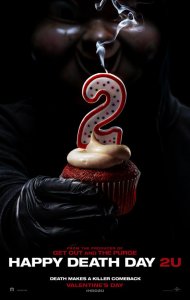 On one hand I can admire the “who gives a damn?” ethic behind the sequel to Happy Death Day, a fun time loop of slasher cinema tropes. The original had some darkly comic edges but mostly played its premise straight in the realm of horror. The sequel doesn’t play anything straight. It’s completely bonkers and looking to turn anything into a joke. This provides a charming carefree sense of bravado; however, if you were a fan of the first film, it also might rub you the wrong way and seem overly flippant and messy. We get a science fiction explanation involving parallel universes as to why the time loops are happening, and now our heroine Tree (Jessica Rothe) is stuck in a parallel version of her looped day. The film sidesteps a Back to the Future 2 sense of repetition but doesn’t stray too far from the outlines of the original Happy Death Day, just with a few new surprises. The big question is whether Tree will return to her home dimension or stay as a tourist in this new dimension, a world where her mother is still alive but her boyfriend is with somebody else. As should be obvious, this hard choice isn’t really that hard considering that she could always still get with the would-be boyfriend again. There are some comedic sequences that borderline on farcical sitcom, like a montage of suicide set to Paramore’s “Hard Times” and a woman faking being a bumbling blind student, and too many of the plot complications feel artificial and random, especially the delays to return to the home dimension. The world can often feel constrained as well, like this bustling campus only comprises the same eight faces (and their bushy eyebrows). My biggest gripe is that the first act is completely superfluous and it presented a more compelling mystery, a student from a future trying to kill their past self to avert a crisis. That’s way more interesting than another dopey killer in the baby mask. Still, the movie never pretends to be anything other than a fun couple of hours with sprightly visual comedy and a terrific anchor in Rothe, a comic stalwart. Happy Death Day 2U gets more ridiculous as it goes and I hope it just keeps digging further, never finding its bottom.
Nate’s Grade: B-
Share this:

Glass (2019)
 M. Night Shyamalan has had a wildly fluctuating career, but after 2017’s killer hit Split he’s officially back on the upswing and the Shyamalan bandwagon is ready for more transplants. At the very end of Split it was revealed it had secretly existed in the same universe as Unbreakable, Shyamalan’s so-so 2000 movie about real-life superheroes. Fans of the original got excited and Shyamalan stated his next film was a direct sequel. Glass is the long-anticipated follow-up and many critics have met it with a chilly response. Shyamalan’s comeback is still cruising, and while Glass might not be as audacious and creepy clever as Split it’s still entertaining throughout its two-hour-plus run time.
It’s been 18 years since David Dunn (Bruce Willis) discovered his special abilities thanks to the brilliant but criminally insane Elijah Price (Samuel L. Jackson), a.k.a. “Mr. Glass.” David has been going on “walks” from his security day job to right wrongs as “The Overseer,” the rain slicker-wearing man who is incapable of being harmed (exception: water). He looks to stop David Wendell Crumb (James McAvoy), a.k.a. The Horde, a disturbed man inhabited by over dozens of personalities. David Dunn and Kevin are captured and placed in the same mental health facility as Elijah. The three are under the care of Dr. Ellie Staple (Sarah Paulson) who specializes in a specific form of mental illness with those who believe to be superheroes. She has only so many days to break through to these dangerous men or else more extreme and irrevocable measures might be taken.
 Shyamalan has a lot on his mind and spends much of the second half exploring the classical ideas of superheroes via Dr. Staple and her unorthodox therapy treatments. She’s trying to convince each man they are simply wounded individuals and not superior beings blessed with superior powers. Because the audience already knows the fantastic truth, I’m glad Shyamalan doesn’t belabor this angle and make the crux of the movie about her convincing them otherwise. The second act is something of a sleeping predator, much like the wheelchair-bound, brittle-bone Elijah Price. You’re waiting for the larger scheme to take shape and the snap of the surprise, and Shyamalan throws out plenty of red herrings to keep you guessing (I’ve never been more glad that convenient news footage of a new skyscraper opening meant absolutely nothing for the final act setting). Part of the enjoyment is watching the characters interact together and play off one another. The conversations are engaging and the actors are uniformly good, so even these “slow parts” are interesting to watch.
It’s fun to watch both Willis and Jackson to slip right into these old characters and conflicts, but it’s really McAvoy’s movie once more, to our immense benefit. Between a ho-hum character who has accepted his ho-hum city guardian role, and an intellectual elite playing possum, the narrative needs Kevin Wendell Crumb/The Horde to do its heavy lifting. McAvoy is phenomenal again and seamlessly transitions from one personality to another, aided by Dr. Staple’s magic personality-switching light machine. The command that McAvoy has and range he establishes for each character is impressive. He reserves different postures, different expressions, and different muscles for the different personas. I was genuinely surprised how significant Ana Taylor-Joy (Thoroughbreds) was as the returning character Casey, the heroine that escaped Kevin’s imprisonment in Split. She’s concerned for the well being of Kevin, the original personality who splintered into many as a means of protection from his mother’s horrifying abuse. I was worried the movie was setting her up to be a disciple of Kevin’s, looking to break him out having fallen under an extreme Stockholm syndrome. This is not the case. She actually has a character arc about healing that is important and the thing to save Kevin’s soul. There are in-Kevin personalities here with more character arcs than the other famous leads.
Shyamalan has been improving in his craft as a director with each movie, and stripping down to the basics for a contained thriller gave him a better feel for atmospherics and visual spacing with his frame. With Glass, the cinematography by Mike Gioulakis (It Follows, Us) smartly and elegantly uses color to help code the characters and the development of their psychological processes. The direction by Shyamalan feels a bit like he’s looking back for a sense of visual continuity from his long takes and pans from Unbreakable, which places greater importance on the performances and precise framing.
 I think the disappointment expressed in many of the mixed-to-negative critical reviews comes down to a departure in tone as well as the capitalization of being an Unbreakable sequel. Both of the previous movies in this trilogy were less action vehicles than psychological thrillers that emphasized darker human emotions and personal struggle. Shyamalan purposely grounded them, as much as one can, in a sense of vulnerable realism, which only made both of their endings stick out a little more. The movies weren’t about existing in a superhero universe but more so about unknown heroes and villains of comic-sized scale living amongst us every day. It was about the real world populated with super beings. Because of that tonal approach, Unbreakable was the epic tale of a security guard taking down one murderous home invader and surviving drowning. It was more the acceptance of the call, and part of that was getting an audience that had not been fed as much superhero mythos as today to also accept that secret reality hiding in plain sight. 18 years later, movie audiences have become highly accustomed to superheroes, their origins, and the tropes of the industry, so I was looking forward to Shyamalan’s stamp. I think our new cultural environment gave Shyamalan the room to expand, and Glass moves into a less realistic depiction of these elements. It’s not the gritty, understated, and more psychologically drawn dramas of his past. It’s more comfortable with larger, possibly sillier elements and shrugging along with them. There are moments where characters will just flat-out name the tropes happening on screen, with straight-laced exposition. It can lead to some chuckles. I think fans of the original might find a disconnect in tone between the three films, especially with this capper. They might ask themselves, “I waited 18 years for these characters to just become like other supers?”
And that refrain might be common as well, namely, “I waited 18 years for this?” While it’s inherently true that a filmmaker doesn’t owe fans anything beyond honest effort, an extended time between sequels does create the buildup of anticipation and the question of whether the final product was worth that excited expectation. Fans of Unbreakable might be somewhat disappointed by the fact that Glass feels like more of a sequel to Split. McAvoy is top-billed for a reason. Perhaps Shyamalan had more of a desire to foster the continuation from a recent hit than an 18-year-old movie. Whatever the rationale, David Dunn gets short shrift. After the opening segment, he’s being institutionalized but he’s not actively trying to escape. As a result, the attention focuses far more onto our two villains, and one of them doesn’t says a word until an hour into the movie. This further exacerbates the disproportionate emphasis on Kevin Wendell Crumb (and The Horde). As stated above, I think that’s where the emphasis should be because he has the most storytelling potential, and McAvoy is amazing. However, if you’ve been waiting 18 years for another face-off between Mr. Glass and the Unbreakable Man, then this might not seem like the special event you dreamt about. Shyamalan still has difficulty staging action sequences. The fights with David and The Beast are pretty lackluster and involve the same non-responsive choke hold moves. There are like half a dozen characters involved with the climactic showdown but half of them are bystanders waiting to be tapped in when the narrative needs them to console their fighter.
 I think the ending will also turn some people off for what it does and what it doesn’t do (I’ll avoid spoilers but will be speaking in vague terms this paragraph, so be warned, dear reader). The ending opens up a larger world that leaves you wanting more, even if it was only a passing scene acknowledging the resolution to the final actions. This holds true with an organization that you get only the smallest exposure to that adds to the deluge of questions seeking answers. It sets up a bigger picture with bigger possibilities that will ultimately be left unattended, especially if Shyamalan’s recent interviews are to be taken at face value. What Glass does not do is play with the implications of its ending and explore the newer developments. The ending we do get is indeed ballsy. I gasped. Shyamalan takes some big chances with the direction he chooses to take his story, and I can admire his vision and sense of closure. On the other end, I know that these same decisions will likely inflame the same contingent of disgruntled and disappointed fans.
Shyamalan’s third (and final?) film in his Unbreakable universe places the wider emphasis on the three main characters and their interactions. While McAvoy and Kevin get the light of the spotlight, there are strong moments with Elijah and David Dunn. There are some nifty twists and turns that do not feel cheap or easily telegraphed, which was also a Shyamalan staple of his past. It’s not nearly as good or unnerving as Split, the apex of the Shyamalanaissance, but it entertains by different means. If you were a fan of Unbreakable, you may like Glass, but if you were a fan of Split, I think you’ll be more likely to enjoy Glass. It might not have been worth 18 years but it’s worth two hours.
Nate’s Grade: B


 nathanzoebl
You must be logged in to post a comment.