Blog Archives
Wildwood (2026)
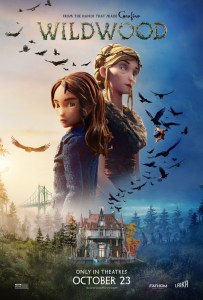 Every time Laika releases a new feature film, I consider it an event. Over the course of five movies since 2009, there’s only been one dud in the bunch, 2019’s Missing Link, and the rest have been great to all-time great. Short of the Aardman crew, they’re also the only reliable production company still making stop-motion animated movies, a dying art form in an era of streamlining and streaming. These movies by their nature take a long time, but Wildwood has taken even longer than most. Starting from the 2011 release of the source material, a children’s book by Colin Meloy, the lead singer of the indie folk-rock band, The Decembrists, the movie has been in some form of development over the course of 15 years, recording the vocal artists during the early months of the COVID 19 outbreak. This has been a long time coming and waiting for the technology to catch up with the ambition of bringing this fantasy adventure to startling life. While I have some quibbles over world-building and plotting, Wildwood is undeniably special.
In the strange realm of… Portland, Oregon, Prue McKeel (voiced by Peyton Elizabeth Lee) would prefer to hang out outside rather than babysit her two-year-old brother, Mac. Her parents are very protective and warn about the dangers that the outside world poses. She meets up with her classmate, Curtis (voiced by Jacob Tremblay), a nervous and talkative child, and the three of them head for a playground. While distracted, little Mac is abducted by a murder of crows and taken into the forest nick-named the Impossible Wilderness. It’s up to Prue and Curtis to find her baby brother and survive the unknown.
 It should go without saying but the animators at Laika are nothing short of movie magicians. That old-fashioned stutter-step movement of stop-motion animation has been eliminated to the point that the medium is now as fluidly smooth as traditional hand-drawn animation. Given the time-sucking nature of the medium, many stop- motion features have very static cameras, because to involve camera movement means having to time it with all the other microscopic movements within the intended shot. It’s one more complexity in an artistic medium that is defined with back–breaking labor. I was stunned that Wildwood has so much camera movement and dynamic shot compositions, so much so that it felt like it was directed as a three-dimensional animated movie (note: I know it’s already three dimensions but you know what I’m referring to so don’t get too pedantic with me, dear reader). There are striking sequences where the camera will move like any other movie, or rack focus shots that changes our perspective within a scene; the kinds of immersion and activity we don’t expect from stop-motion animation, and that’s before the grandiose epic climactic battle as well as a hurricane of ivy that truly amazes the senses. It’s become staid to simply proclaim the genius of the animators, how much subtle life they can inform through movement, how much emotion they can perform with essentially action figures. The elasticity of the faces really struck me with this movie, how the flesh looked more human-like and translucent rather than hard plastic gel. I was amazed at the subtle animations involving mouths and teeth, how they would pull at the edges to reveal such little additional degrees of emoting to a line or a moment. I know all animation is time-consuming and often eye-popping, but there’s just something about the tactile nature of stop-motion animation that I find so much more astonishing to witness and become immersed within.
The story of Wildwood feels definitely influenced by the 1980s of children’s fantasy and novels that allowed things to go a little dark, like Return to Oz or Secret of NIMH and, of course, Labyrinth, also about a pre-teen girl looking to save her baby brother from an otherworldly dictator. This is Laika’s first PG-13 movie and the violence can feel harsh without feeling gratuitous. There was one sudden strike of violence that took my breath away, and the results stuck. Like other fantasy adventures, there’s a child learning more about herself, the world, but also learning that adults don’t always have the answers and are just as fallible as everyone else. The supporting character of Curtis has an equally compelling character arc, a nerdy kid who is socially awkward who’s thrown into a universe of struggle that he’s obviously ill-suited for, and yet he adapts, finds points of courage, but still doesn’t change who he is. Minor spoilers, but early on he calls himself a pacifist who doesn’t want to engage in violence, and in the climactic battle, he is forced to use violence to save a life. This harsh necessity of action versus inaction isn’t played in some heroic moment of triumph, with the character exhaling in satisfaction over his capability. He meets the moment with horror. He recognizes the necessity but is still aghast at the results. That’s because what he believes is firmly rooted in his conception of who he is, and even thrown into a fantasy realm, he doesn’t lose sight of his convictions even as he grows as a person. That’s refreshingly nuanced.
 I appreciated how the villain is given degrees of complexity that provide explanation for her single-minded resolve. Alexandra (voiced by Carey Mulligan) too is a victim of the vice-grip of grief, unable to fully move on from the untimely death of her son until his bones can be found. It lays groundwork for a hostility against the forest, against the powers of nature, the environment she feels she needs to clear in order to locate the hidden remains of her only child. There’s something very raw about that, about being denied even the body of her lost child, and wanting that closure. In the evocative, nearly dialogue-free opening, we learn of her desperation and ache, using dark magic to bring her child’s spirit into a mechanical doppleganger. I’m surprised she didn’t continue tinkering with this process of robotic replacements, each of them eventually discovering the horrible truth and determining that death is a better alternative. She’s ultimately an example of what grief can do to a person, how it shuts out everything else, and she serves as a cautionary tale for our heroine, whether she might go down a similar path if she never recovers her abducted brother. She functions as a parallel for Prue without being overtly obvious. I really enjoyed Mulligan’s vocal performance as well, which has an edge to her voice throughout without giving way to larger histrionics. You can hear the pain in her every word, and the animators do a fantastic job of expressing this as well. I appreciate villains who see themselves as the real hero in their own story, who have genuine reasons for their motivations, and who can even teach our heroes some hard-won life lessons. Although it takes Alexandra too long to realize the availability of blood from “a child of magic.”
By the time the film settles into its final climactic act, if you had told me this was the most expensive movie ever made, I would believe you (the actual reported budget of $100 million is still a fraction of what Pixar spends). The level of ambition in the staging is staggering. It’s hard for me to even fathom the hours put into the minute details of this large-scale battle put to screen, with hundreds of figures in different points of articulation amidst the stages of battle. When Prue slides into the middle, I could feel my heart beating faster and my anticipation build. Oh, they really are going to go right into the thick of it with the animation. The scale of it is truly stunning, and the reality that you know each figure, each item, was moved incrementally by human hands and photographed for a fraction of a second, then reset, makes the breadth of the artistic achievement even more amazing. Dear reader, allow me to get into a sentimental digression here. Stop-motion animation is a hard medium to work in, demanding and challenging and, most of all, slow, and to witness this climax and the level of detail and scale dazzles me and genuinely inspires me. It’s a clear demonstration of the passion and talent of the dedicated artists all working together to bring to stunning life this work of art, and it just makes me think about the collective value of art for our culture and ourselves, how necessary it is. During the early months of COVID lockdowns, when people needed an escape and something to nourish them, they turned to movies and television and music and books and stories. We turned to art when we needed it. We will never stop needing art, the way that we make sense of ourselves, the world, and our palace within it, and if we can occasionally have a work of art as mesmerizing as Wildwood, then we’ve done well. By the end of its 130 minutes, it’s easy to feel the immeasurable love and passion many artists have imbued with this project.
 However, there are some storytelling flaws that hold Wildwood back from being its best version. For a fantasy universe that we drop into, by the end it still feels rather messy and under-developed. The different factions of characters feel piled on rather than as organic extensions. There are indigenous peoples forcibly removed from their lands fighting to regain their homes. What’s the history or connection they have to the land? Is there a spiritualism or power they have that gives them an advantage? There are talking animals but there doesn’t seem to be a distinction between them beyond the coyotes that have taken up arms as Alexandra’s muscle. Why did this one group turn against their animal brethren? There are hoity-toity aristocrats but no larger sense of a kingdom than one building. How are the humans maintaining a government, or even independent productivity, when a displaced governess is deposed and regaining her power? There is a small farming community of animals and humans living in harmony, an aspect not really explored as being so different from the other locales. Then there’s the revelation that Alexandra can venture into the outside world to enact small miracles, and if that’s the case, why isn’t she pulling in outside technology or resources that would provide a new balance of power? If what she’s looking for is a “child born of magic,” why hasn’t she gone full Elon Musk and just traveled the land seeding future children through her powers of magic? Surely that would increase the odds of success. None of these questions destroys the reality of Wildwood, but enough of them make it feel like the world hasn’t been sufficiently developed to have its own set of internal logic and rules that prove satisfying. I also found the characters for the most part to be under-developed as well, kept as more archetypes than honing with the attention they deserved.
Even though not everything worked for me, I’m eager to re-watch Wildwood in the near future because I’ve found, with rare exception, that Laika’s movies grow on me with more viewings. I was initially admirable but reserved with 2016’s Kubo and the Two Strings but after multiple viewings I now consider it to be a remarkable movie with stunning visuals and stirring emotional resonance. It’s quite possible that with some distance and contemplation that Wildwood would follow a similar path. I can also say my emotional investment in the movie was a bit personal as the three human children, Prue and Curtis and baby Mac, matched my family of little ones exactly, even down to similar physical appearances, so I found myself feeling more for these characters thanks to the wonders of psychological projection. Wildwood is a marvel of a movie that I presently wish had just spent a little more time on fleshing out its world and its intricacies and conflicts to make the fantasy realm feel more unified than ramshackle. It’s certainly worth seeing and cherishing even if it may not click fully with the individual viewer. The fact that something this ambitious and beautiful exists after 16 years of loving toil is its own miracle. We need more movies like Wildwood to remind us of the escapism and necessity of impassioned art.
Nate’s Grade: B+
Share this:

Nuremberg (2025)
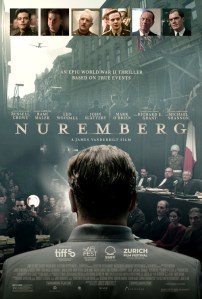 Taking an Oscar-winning courtroom classic and eliminating 40 minutes sounds like a surefire gamble, and while Nuremberg has its heart in the right place, bringing Nazis to justice, it cannot help but feel like a more shallow and rushed version of 1961’s Judgement at Nuremberg. That’s not to say different movies cannot exist from the same source material or true story, even in the shadow of famous stories. However, this version feels strangely perfunctory, condensing the worldwide judicial response to the horrors of the Holocaust into a simplified buddy movie about a psychologist (Rami Malek) who has to learn the hard way that maybe, just maybe, Hermann Goring (Russell Crowe) might not be trustworthy. It’s frustrating that the depth of this story and the plight of so many is reduced to one guy getting too close to his subject as well as having to learn the most obvious lessons about applied evil. Also, the culminating courtroom showdown, where so much hangs in the balance and Goring has been hyped as the most of challenging of cross-examination opponents, and it all resolves so easily, with a different prosecutor essentially using a cheat code to undo Goring’s pseudo-intellectual front. It’s quite a lot of buildup for a, “Wait, that’s it?” response, and much of the movie follows this same disappointing route. The acting is relatively good all around, with Crowe especially good as a chummy narcissist, and the production quality is sufficient to recreate its post-war period, but I couldn’t help but feel that I was missing out on a richer story. It’s so flattened out and self-important with its limited details to actually satisfy. The ending tries to draw a direct line to Trump today and I don’t quite know if it’s done the work. Nuremberg is one of those Important Movies that garners early Oscar buzz on paper, and then when people actually see it, falls away as an also-ran, mostly because it was missing a few too many important elements to resonate. It takes 130 minutes for Malik to learn that Nazis might not make good friends. You’ll probably know that already.
Nate’s Grade: C+
Share this:

Death of a Unicorn (2025)
 Unfortunately, this never became the glorious B-movie its premise promises, a monster movie with ghastly gore that also satirizes the rich business elites. Death of a Unicorn has enough appealing elements, from the father/daughter relationship between Paul Rudd and Jenna Ortega, to some ridiculous gore and kills, to impressive creature prosthetics to bring the unicorn to life (and death). The setup has Rudd and Ortega run over a unicorn in a secluded nature reserve on their way to meet dad’s boss. They discover the unicorn blood can be miraculously healing, which is a fortuitous discovery considering Rudd’s boss runs a pharmaceutical company. You can see where this goes, especially when you learn that there are more unicorns out there and they are not happy. It becomes a wily creature feature from there, with unicorns picking off the characters one-by-one as they try and escape. The satirical broadsides are a bit too broad, thus only really glancing in their pointed attacks that the people in charge of medical care are themselves venal and selfish. Got it. Much of the humor is related directly to the absurdity of watching a unicorn as a blood-thirsty monster. If you replaced the unicorn with, say, a yeti, would the situation still be amusing? Maybe, but I seriously doubt it. Death of a Unicorn could have been a little scarier, funnier, even freakier, and maybe carried through on the courage of its convictions.
Nate’s Grade: C+
Share this:

Argylle (2024)
 Knocked around by critics and tagged as the latest excuse for the Death of Filmmaking thanks to its overwhelming budget and general ironic indifference, Argylle is a goofy spy comedy that, while lesser, is an easy watch and would earn regular rotation as a TNT afternoon giant. It’s not trying to be more than a good time, and while its quippy attitude can feel forced and approaching irony overload, it’s also the kind of movie that entertains as breezy escapism. It’s fun. Enough.
Elly Conway (Bryce Dallas Howard) is a best-selling spy novelist with a dashing super spy Lothario lead character by the name of Argylle (Henry Cavill in the worst haircut of his career). She’s journeying with her pet cat, her closest relationship, when she’s stopped on a train by Aidan Wilde (Sam Rockwell). He tells her that he’s a real spy and that everything she’s written in her five novels has come true, and different covert agencies are taking notice. She’s got teams of assassins and spies coming for her, while Aidan tries his best to protect her and get her to remember key details that could save the world from nefarious forces.
 Argylle is too breezy and too predictable by half. It’s a spy thriller that I’m positive many will be able to predict the big twists miles before they occur. Why do all these spies want Elly Conway, and how could she know about the intricate world of international spy craft? The answer is exactly what you’d expect, if you’ve watched more than your share of twist-laden thrillers. Thankfully, director Matthew Vaughn (Kingsman, X-Men: First Class) and company dispatch with this central twist after an hour, providing more time to deal with the aftermath and build off of its story impact. Ah, dear reader, but there’s going to be another twist once you know the first, and again, if you can predict the first, you’re likely to predict the second, because stories about universally good people are often dull, and movies have provided a new medical maxim that characters use maladies to re-evaluate their prior life and choose to be better (oh how nimbly I’m dancing around these spoilers). What makes these predictions forgivable is that the movie seems to know you will anticipate them and has more to offer.
That’s because in this silly universe, very little seems to matter besides getting to the next scene. It’s not a satirical send-up of the genre like Vaughn’s Kingsman movies. Instead, it’s more of a generic distillation of spy thrillers, complete with bad guys walking through mission control banks of computers and barking impotent orders. The only added cleverness that sets the Argylle world apart is Elly’s writing, the fictional version of this far more bland spy universe. In the book parts, Vaughn takes note to raise the style as well as the tongue-in-cheek comedy. It’s supposed to be tone-deaf and dumb and ridiculous, because it’s the big screen version of bad genre writing. You can have fun with that, with characters so serious to the point of parody, with nonsensical technology and near escapes. But when you try to do the same thing in the so-called real world, then the movie starts to eradicate any sense of a baseline for credulity. I did like the practical advice of Aidan on how to crush the skulls of your downed enemy (“Just imagine you’re dancing The Twist.. twist and smash”). By the end of Argylle, Elly and Aidan can do just about anything because they’re practically superheroes. The entertainment of the fish-out-of-water aspect of Elly’s story is short-lived and unfulfilled because the movie becomes more of a tale of automatic self-actualization rather than growth.
 The direction feels rather drab at points, and many locations and scenes have a general sense of missing… something. Just watch any set and it appears so drastically empty that I questioned whether they cut back on the set dressers and props. Empty dance clubs. Empty streets. Empty hallways. Everything is too pristine, too sleek, and too empty and green screened (might be a result of COVID filmmaking). This carries over into the disappointing visual aesthetic, as Vaughn’s signature style feels dampened by the pesky CGI additions of many sequences, adding to the unreality rather than building out this minimalist world. If there had been an extra EXTRA twist that everything was also a story-within-a-spy-story, I would not have been that shocked, and it honestly would have explained the underwritten and underwhelming world of clandestine spy-making.
Vaughn errs in the core creative decision of having his main character mix reality and fantasy, not through the idea itself, which could be ripe, but through its confusing execution and editing. Having Elly hallucinate Agent Argylle in place of a real secret agent is fine, as we can contrast from her idealized version of a super spy, her James Bond, versus the actual grunts struggling to win the day. There are a couple problems with this execution though and firstly that the “reality” isn’t that far removed from the fantasy. This is still a world where Rockwell’s spy is able to commit amazing acts of dexterity and martial arts and balletic violence flying around rooms, but I guess he falls down more. The difference isn’t that fantastic when it’s already a hyper-stylized action world. The bigger issue is just how confusing it all plays out visually because we’re seeing Elly’s perspective and in rapid blinks Cavill will turn into Rockwell and vice versa. It makes for a jarring sequence that doesn’t fully capitalize on the comic potential while keeping the audience distant from fully engaging with the sheer simple pleasures of watching a fun fight. This happens throughout the first half of the movie and severely hampers the action scenes from being accessible. I think we needed a longer duration for this to work. We see Elly’s version for a period of time, and then we cut to the real world where Aidan is bouncing into walls, falling down, and flailing. By continuously jumping back and forth, not just in the scenes but in the same shots, Vaughn has made his movie harder to watch and harder to comprehend, and with a loud soundtrack blaring.
 There is one sequence of great filmmaking for Vaughn, but to explain such will require some spoilers, so beware, dear reader. There are three instances of the whirly-bird dance where a woman is lifted spread-eagle atop a man’s shoulders who then spins her around. The first time, it’s Agent Argylle and Legrange, played by Dua Lipa (Barbie) dripping with sexual energy. The second time is when Elly and Aidan are on a mission and he lifts her up, to her amusement and flirtation. She’s living out her fantasy version, with Rockwell standing in for Cavill and Howard standing in for Dua Lipa. We’ve gone from these stunningly attractive human specimens to people who look more ordinary, including a fuller figured woman engaging in the same sexy shenanigans as the conventional blonde bombshell. She can be her dream version of herself. Finally, the third occurrence happens during a climactic showdown where Elly and Aidan team up against an onslaught of faceless armed henchmen. With the aid of colorful smoke canisters, their offensive surge plays out like a couples’ dance routine, including holding one another for high kicks to incendiary devices. It’s all set to Leona Lewis’ cover of Snow Patrol’s “Run,” and as the music swells, it’s easy to get swept up too. Even the gunshots are set to the beats of the song, culminating in the final whirly-bird dance, except it’s not Elly being lifted, this time it’s Aidan. See, she’s not the Bond girl bombshell, she’s James Bond. It’s a silly moment but with the added setup, thematic underpinnings, and Vaughn’s virtuoso stylistic seizing of the moment, it plays out as empowerment and an expression of love. For real.
I can understand being generally disappointed with Argylle. It looks and feels like it’s been built on the parts of other better spy franchises and desperately lacks the charisma and personality of Vaughn’s Kingsman movies, themselves giddy and perverse satires. I wasn’t the biggest fan of 2017’s The Golden Circle sequel, but it’s got oodles of style to spare compared with Argylle. I wish Vaughn would push himself beyond the orbit of making cheeky, winky spy action comedies, the same genre he’s been playing in since 2015 and now for four movies. While the original Kingsman was a breath of fresh air with fun characters, a snarky attitude, and slick style, Argylle is all snark and minimal style. There’s so much comedy that feels like it should be funnier, from the travails of Elly’s CGI-enchanced cat to the floundering hand-to-hand combat. When recognizable names start showing up playing forgettable genre stock types, and then they start dabbling in accents as other genre stock types, it feels like the whole exercise is a miss. However, the central buddy relationship between Rockwell and Howard is where the movie works, and fortunately that’s the element that has the most foundational effort. This is a movie that, in the future, if it was on TV during a lazy day, you’d sit down and watch the rest and mostly be happy about it. Argylle isn’t anything new or fresh but it’s buoyed by its stars, and not the magazine cover models but its real stars, Rockwell and Howard. In their hands, even lesser spy comedies can still be fairly worthwhile escapist entertainment. Still, I must deduct some points for the movie missing a perfectly setup opportunity to have Henry Cavill and John Cena kiss onscreen at the end. It was right there, folks, and we all deserved it.
Nate’s Grade: C+
Share this:

Saltburn (2023)

Promising Young Woman was easily one of my favorite films of 2020. It used the structure of a rape-revenge genre movie to tell a hard-hitting drama and pitch-black comedy. Writer/director Emerald Fennell was nominated for Best Director and won the Oscar for Best Original Screenplay, so I wasn’t alone in singing her praises (my critics group declared it the top film of 2020, huzzah). It was, in short, pastiche elevated into something jarring and relevant and daring. With her follow-up Saltburn, she has taken the British class drama of an outsider trying to fake their way in the world of the rich and powerful, a Vanity Fair or Brideshead Revisited if you will, and attached a whole lot of salacious campy nonsense. If Promising Young Woman was elevating a trashy genre movie with vision and daring, then Saltburn is taking the soapy costume drama and degrading it with cheap shock, and “degrade” is quite the appropriate term.
Oliver Quick (Barry Keoghan) is a young Oxford student who doesn’t quite fit in with his peers. He doesn’t come from money and instead from a broken home, but he’s set his sights on success, and that includes winning over the handsome Felix Catton (Jacob Elordi). He’s popular and athletic and from a rich family, and Felix takes a liking to Oliver, even defending him against his posh peers. Oliver is infatuated with Felix and convinced that he’s in love. After a personal tragedy, Felix invites Oliver to summer at Saltburn, his family’s enormous private estate in the country. Oliver amuses Felix’s parents (Richard E. Grant, Rosamund Pike) and sister (Alison Oliver) and settles into the black-tie dinners and racchous parties. He might not ever want to leave, and he might not be able to leave, and he might not ever want to be able to leave.
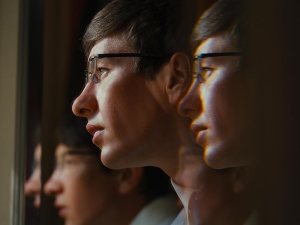
Saltburn is like if The Talented Mr. Ripley was made by the auteur of tawdry trash Larry Clark (Kids, Bully). It’s trashy nouveau camp that works as a sour class comedy until it becomes too sour and most definitely doesn’t work as any sort of engaging character piece or legitimate thriller. I don’t really know what Fernell was going for here and it doesn’t feel like she does either. I think back on the similar tale of Mr. Ripley as an advantageous upstart who got a taste of the good life and didn’t want to give it up. Like Saltburn, we know about our lead’s duplicitous and untrustworthy nature early, but with that movie we could see why others could be charmed by Tom Ripley, and we understood why he would want to stay in this privileged life. With Saltburn, when the rich are treated as shallow twits practically bored with one another from their opulence, the question remains what exactly is the appeal beyond simply attaining more? Also, the appeal of watching con artists slip into a world not their own includes seeing how they will get away with everything, how they’ll cleverly avoid all the traps that materialize. With Saltburn, there is no thrill of clever escapes because the insidious force is obvious and the other characters are too stupid to recognize because they’re meant to be satirical send-ups. It’s a would-be thriller that has gutted all its thrills by eliminating a foreboding sense of consequences.
However, the movie cannot work because all of the surprises were alleviated through poor character development of Oliver and in the performance of Keoghan. I don’t think anyone who ever watches this movie will be even the slightest surprised that Oliver isn’t quite the noble and honest young coed that he may have appeared to be. Except after maybe a couple of early scenes of nerdy awkwardness, Oliver has been depicted as an obvious predator. From the beginning, as he’s sharing his sad family back-story, I was already shaking my head in skepticism and predicting that the truth would be something ordinary and boring that he would choose to cover-up. It’s just too obvious where this scheming, covetous character is going, and Fennell doesn’t do anything to counter this overwhelming and, again, transparent assessment. If you have a character acting all weird and shifty and literally slurping up spent bathwater belonging to the target of his obsession, you shouldn’t then make the later machinations a big reveal. I wanted to laugh that Fennell thought the audience would need flashbacks to better clarify Oliver’s scheming nature behind a series of tragic events. I always assumed it was him because who else would it be? It’s an obsessive young man with oblique and yet obvious motivation to have what he desires from the privileged. We get it. The problem is that the movie never really better examines this desire from his outsider status. We already know he’s the malignant force.
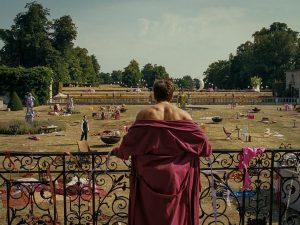
Keoghan is a great actor but “naif” is not a comfortable role for the man. By his casting alone, you’re already looking at Oliver with measured distance and scrutiny. He’s already got a leer that will set people ill at ease. The way the character is written only further confirms this judgment. If Tom Ripley was acting this outlandishly bizarre and creepy from the get-go then he would have been arrested immediately. It’s not even a lack of nuance that hurts Oliver. Not all villains and screen psychos require a full three dimensions, but the characterization is just so lazy and unexplored. He’s just a font of unchecked lust. At least in 2017’s Killing of a Sacred Deer, where Keoghan also played a malevolent young man tearing apart a family unit, his character was meant to have a mythic quality of inescapable retribution, like the Greek tragedy its title was in reference to. With Saltburn, he’s just a creepy perv, but he’s also a boring and redundant creepy perv by the ongoing refusal to provide other context. He’s less a character than a proverbial set of hands to prod characters and poke the viewer in the eye. He’s a recycled program of tedious provocation.
Given how masterfully Fennell utilized and subverted salacious elements in Promising Young Woman, I’m shocked there wasn’t much more than empty shock value. Whatever intended satirical value of this movie is glancing and fleeting. Did you know rich people can be, wait for this, superficial? Saltburn becomes a gross-out game of how far this daft creeper will go with his deadly obsessions, and on that front it all feels too annoyingly flimsy, constructed merely to be transgressive for its own provocative sake. Watching the lengths Oliver will go to prove his disturbing bonafides, it overwhelms the movie and simply becomes the movie’s purpose itself, a measurement between how far Fennell can repulse you before you reach a breaking point. It’s not merely that the characters are easy jokes, it’s that they’re bad jokes. I will say though that the ending shot is so joyously performed that I wish the rest of the movie had this kind of entertainment.
I do think there is an audience for Saltburn, the kind of people who celebrate Harmony Korine’s art-trash movies (Gummo, Spring Breakers), the kind of people who love candy-colored stylistic excess and tongue-in-cheek provocations, and people that seek out twisted love stories and dark romances. Satburn styles itself as a romance, at least early, but it’s clear that there’s nothing romantic about watching a predator set his sights on his prey and work through the family. Sadly, there’s also nothing truly entertaining here either, other than wondering when the next extreme yet desperate attempt at shock value would appear. The characters are too thin and unexplored to support this movie, and the antagonist is too obvious, as are his machinations, though his motivation remains cloudy and also undeveloped. This movie would be akin to watching a bad flu work its way through a family for all the personality Oliver offers. Fennell is a talented storyteller and exceptional at spinning genre pastiche into something so much more, so it’s quite disappointing that Saltburn is so much less than even the sum of its sundry parts.
Nate’s Grade: C
Share this:

Persuasion (2022)
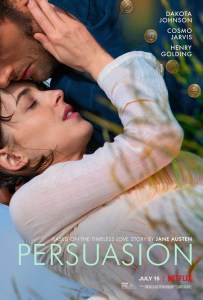 Jane Austen is one of those name brand institutions, and yet the pioneering author only has six actual titles to her name (a seventh was unfinished; two were published after her death, including Persuasion). There have been five previous adaptations of Persuasion, including one from 2021, so I wasn’t rankled when the early trailers for Netflix’s Persuasion took a chance with their adaptation. There are plentiful fourth wall breaks where our protagonist, Anne (Dakota Johnson), and handheld camerawork that makes it feel more faux documentary at points, and there is more modern jokes and modern rom-com sense and sensibilities, and judging by the social media response, there are a lot of angry Austen purists who loathe these changes (could this movie be more heretical than Pride and Prejudice and Zombies?). I found the 2022 Persuasion to be perfectly pleasant and easy to watch. Johnson is tailor-made for the headstrong, intelligent, yearning lead of an Austen movie, and with her directly speaking to the camera, I felt a kinship with her, and this stylistic choice also allowed the screenwriters to sneak in more of that flowery Austen prose. Some of the jokes are a little clunky but I laughed or smiled at most of the comedic elements, especially Richard E. Grant as Anne’s foppish and status-obsessed father. I enjoyed Henry Golding (Crazy Rich Asians) as the caddish Mr. Elliot, a man born with a Cheshire grin. I enjoyed plenty of this movie, including its racial diversity, and the staples of these Regency romances like the exquisite production design, costumes, and English countryside. I can understand some grumbling that this isn’t “their Persuasion,” but not every movie is for every person, and there’s nothing about the 2022 movie that retroactively cancels out other adaptations that fans would prefer. For 100 minutes, it felt like Austen had been re-framed as a rom-com blueprint, and Persuasion had renewed charm for me.
Nate’s Grade: B
Share this:

Everybody’s Talking About Jamie (2021)
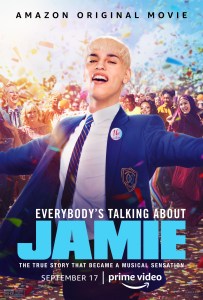 What a jubilant, heartwarming, and celebratory musical to lift up your spirits and evoke a few happy tears, especially in the wake of trying to comprehend the mystifying ongoing appeal of another high-profile musical, Dear Evan Hansen. I wish every person chose to watch this Amazon Prime original movie versus that other musical that made me deeply uncomfortable and angry. This is based on the London stage show, and adapted and directed by the original creators, we follow the true-story of a 16-year-old Jamie (Max Harwood) who dreams of embracing his inner drag queen. His conservative father (Ralph Ineson) doesn’t approve and has left him and his working-class mum (Sarah Lancashire) behind to start a new family. Jamie is working on finding his voice and confidence. He comes under the tutelage of an aging former drag queen (Richard E. Grant) who encouraged and educates Jamie in the ways of showbiz and style (“A boy in a dress is someone that can be laughed at, but a drag queen is someone to be feared!”). Right away, I felt like this was what The Prom was aiming for, a big LGBTQ+ musical bursting with empathetic feeling and anthemic empowerment. The musical numbers are fun and frothy when they want to be, taking playful advantage of the expanded visual space of film. However, when the film wants you to feel emotions, it can hit you hard, and I was tearing up as Grant’s character poignantly sings about the heyday of 80/90s drag scene with the AIDS crisis taking its tragic toll. I don’t mean to keep harping on this, but I felt more genuine emotion in that one moment than throughout the entirety of Dear Evan Hansen. The movie is more considerate with its supporting players and finds moments of grace and compassion for just about every player, and with thrumming harmonies and feel-good lyrics. It’s a charming, funny, and definitely worth remembering. Everybody should be talking about Everybody’s Talking About Jamie.
Nate’s Grade: B+
Share this:

Star Wars: The Rise of Skywalker (2019)
 In 2017, there was a great disturbance in the Force when Star Wars Episode 9 director Colin Trevorrow (Jurassic World) was unceremoniously jettisoned. He had spent over a year developing a script for the concluding film in this new Star Wars trilogy (he’s still listed in the credits for story) and I guess the producers must have had some strong feelings. Trevorrow was out and J.J. Abrams returned to close out the saga he had kicked off with 2015’s The Force Awakens. It felt like a safe choice, the return of an artist best known for dabbling in other people’s established worlds. 2017’s The Last Jedi, written and directed by Rian Johnson (Knives Out), was, to say the least, divisive with the fanbase. It made sense to jump back in with Abrams who had delivered a fun, lively kickstart that made box-office records. Surely Abrams and his army of magicians would steer the franchise into safe territory and provide a satisfying ending to the character he created?
Note: I promise to keep this review free of significant spoilers beyond some minor plot points. If you want to avoid reading anything further until after having seen the film, I understand.
The Emperor (Ian McDiarmid) is alive and well and offering a fleet of planet-destroying starships if Kylo Ren (Adam Driver) will kill Rey (Daisy Ridley). She’s trying to uncover hidden clues about her parentage and still believes she can reform Kylo from the dark side. Finn (John Boyega) and Poe (Oscar Isaac) are chasing after a series of artifacts to find the secret location for the Emperor’s secret planet and rebuild the fledgling resistance. Kylo and Rey are headed for a final confrontation to determine whether they turn to the light side or the dark side.
 It is with a heavy heart that I feel like I have to admit that there wasn’t a single storytelling choice that I enjoyed in The Rise of Skywalker. It feels like Abrams and company were in a mad panic after the divisiveness of The Last Jedi and retreated to the safety of nostalgia and fan expectations. This feels like the producers made a list of fan demands and then acceded to them. It certainly feels like an overblown course correction, let alone discarding major changes and characters from Episode 8. Now fan service in itself is not a negative; there is such a thing as good fan service and bad service. The difference is that bad fan service relies heavily on pandering and reference points, leaving an audience unchallenged, and that certainly feels like Episode 9, a movie ever beholden to its calcifying past. My anecdotal evidence already tells me that many fans will love this movie, more than likely the same contingent that found such stinging fault in Episode 8, and I don’t wish them ill. I’m happy for them. For me, Episode 9 is a mess of bad plotting, rushed pacing, truncated character arcs, useless cameos, and a reheated Return of the Jedi climax that was as boring as it was exhausting and dispiriting. It’s supposed to be an end to this new trilogy, and a trilogy of trilogies, but the backwards-looking franchise will never be done paying homage to its cherished past while it eats its own tail until it vomits. This movie is so eager to please as many fans as possible that it feels like an anxious hostage.
I think it was a major mistake for The Emperor to come back into play this late. The very reappearance already cheapens the sacrifice Darth Vader made in Return of the Jedi, and it begs the question what has this evil old man been doing for three decades? Has he just been hanging around his completely empty rock planet sitting on his uncomfortable rock throne? Abrams throws some haphazard lip service that Palpatine was really behind everything, we just never knew it, but that feels cheap. It’s like in 2015’s Spectre when Christoph Waltz emerges and says, “Hey James Bond, while you’ve never met me until this moment, I’m responsible for every bad thing that happened in your life, not those other bad guys, and I just didn’t feel like saying anything.” It wasn’t a satisfying plot development then and it isn’t now. The “boss’ boss” manipulating in the shadows is simply an aggravating shell game. If Palpatine lived even after the second Death Star exploded, then what’s to say if he can ever be defeated? Even if he is toppled in Episode 9, what’s stopping him from being resurrected in Episode 12 to serve as another quick excuse for a major villain? This decision to bring him back to life also taps into a further reverence for bloodlines that The Last Jedi was valiantly fighting against. Star Wars may take place in a different galaxy but it frustratingly feels like only three families populate it. The Last Jedi proposed that you didn’t have to come from select magic bloodlines to be somebody important, that your past was irrelevant, and now Abrams and company sharply reverse course, hugging the concept of the Chosen One until it bursts. It feels creatively starved.
 Too much of the movie’s 142-minute run time was devoted to hasty, convoluted plotting that served little else than to fill time. By the concluding movie in a trilogy, there should be no moments left to fill time, nor should we really be introducing new worthless side characters rather than using the people we’ve already established. The first 90 minutes of this movie could be condensed to “get a thing to get a thing.” It’s one superfluous obstacle after another, one item to gain another, that reminded me of video game fetch quests. Even worse, none of it felt like setbacks or difficulties because the movie was rushing through every sequence. If we have to rush through to cover four abbreviated action set pieces, why can’t we consolidate to two really good and developed action set pieces instead? A great way to make your movie forgettable is to cram it full of disposable plotting and short action sequences that never take off. I kind of liked one lightsaber battle along the surf of the ruins of a Death Star (of course there has to be another Death Star!) but that was it for the action. There wasn’t anything onscreen that even came close to replicating the thrills or suspense from Episodes 7 and 8. I felt more suspense in The Last Jedi for Rose’s doomed sister than I did for anyone in Rise of Skywalker. There was space where Abrams and company could have expanded and developed important themes and given characters room to grow, but the pacing feels so breathless in order to distract from the hasty plot retreats.
Characters feel like they zapped to the end of their character arcs because that was what was expected, but why they reached these milestones feels arbitrary from a plotting standpoint. It reminded me of, I’m heartbroken to even say, the final season of Game of Thrones; fans didn’t object on their face to character destinations but the journey to reach these points felt like it was missing key moments to serve as connection. Why redemption now? Why tempted by the dark side now? It plays more like Abrams said, “Well, we ran out of time folks, so let’s skip to the end.” Looking back on the trilogy, it was clearly Rey and Kylo’s story first and foremost, but the supporting characters ultimately feel abandoned and wasted. Finn had a great perspective, a Stormtrooper who defects, but that unique position is cast aside by introducing a new side character that serves no purpose other than to remind you that Abrams must have really not liked Rose (Kelly Marie-Tran). Seriously, Rose is sidelined to study monitors. Abrams tapped an old Lost alum, Dominic Monaghan, for this thankless duty, so why can’t Rose at least be the sidekick? We don’t need another new sidekick this late. Poe is another wasted character. He learns greater responsibility and teamwork in Last Jedi, but he’s really just a Han Solo stand-in, the rakish rogue quick with a quip. Episode 9 gives him an old flame but not much in the way of additional characterization. He feels the same from his first scene in Episode 7. Oh, and all the forced cameos Episode 9 makes time for feels almost like a Star Wars reunion special. That’s including the awkward use of existing General Leia footage to cobble together something for her. I’m wishing more and more that it was Leia that went badass kamikaze in Episode 8 as her exit.
 At every point, the movie seemed determined to undercut itself when it came to themes, when it came to character growth, and when it especially came to sacrifices and stakes. There are four fake outs when it comes to deaths. What’s the point of sacrifices when it can just be reversed with little explanation? What’s the point of learning when the Force can just serve as a magic hand-wave solution for anything you need? There are some pretty remarkable leaps in what exactly the Force can do in Episode 9. The Rise of Skywalker even resets some pretty inane things, like Kylo Ren gluing his smashed helmet back together or a certain character getting a long-overdue medal for valor. The themes Abrams works with are extremely broad and lack the questioning of the inerrancy of the Jedi order from Episode 8. It’s also confusing when the theme is that your destiny is not written by your station when the movie repeatedly elevates the mythic at the expense of the nuance and human. It’s like saying your past doesn’t dictate your future while slavishly venerating the past at the expense of the present story.
Given the budget, talent involved, and Abrams’ natural pedigree for blockbuster filmmaking, Rise of Skywalker still has moments of grand spectacle and fun. The actors are still enjoyable to watch and Adam Driver (Marriage Story) is the definite MVP of this new trilogy. His character is, by far, the most interesting and the one that goes on the biggest emotional roller coaster. Abrams slides in some rather pleasing visual compositions. The score by John Williams serves as kind of a greatest hit collection of his many themes over the course of the 40-year saga. The denouement feels right, even if I quibble with the final line spoken. There are things to like, plenty, and I know many fans will find even more, but the good is trounced by the mistakes and miscalculations which just happen to be the really big stuff (plot, resolutions, characterization, action development, structure, payoffs, etc). Abrams himself has joked that he’s really good at starting stories and not so great at finishing them, so maybe choosing to have Episode 9 function as a conclusion not just to three movies but to three times three was overburdening.
 I’ve seen it twice now and given some time to think it over, and I think I’ll declare Star Wars: The Rise of Skywalker as my least favorite of the nine core movies. I know these are inflammatory words, and for an easily-inflamed fanbase, but my level of disappointment is immense. I’ve enjoyed both of the previous Star Wars saga installments but I wasn’t quite expecting this. I groaned throughout the movie more than I laughed. Even the much-derided Phantom Menace had less at stake, and that’s why I hold the disappointment of Rise of Skywalker as the more grievous of the two. It had much to accomplish and much to payoff and its missteps cast a shadow over the previous movies. It also reconfirms for me my worry that there will only be a small world for Star Wars, a set of pre-approved parameters that creatives must adhere within, taking the same pieces and delivering variations of the same story. There are definite ideas that could work here with Episode 9, but the rushed pacing, inconsequential plot filler and side characters, and its use of nostalgia as a heat shield (look at that cameo please!) doom its execution. As much as Abrams wants to reject destiny, his Star Wars are still driven by a devotion to destiny. We won’t be getting another Star Wars for several years until 2022 and I think that’s a good thing (also without the Thrones writing team now too). The producers need some distance to determine where to go next. I just hope they understand they have an awfully big universe of untapped stories at their disposal and a wealth of eager storytellers with fresh ideas. Star Wars will always be Star Wars but it can also be much more if it wanted to be.
Nate’s Grade: C
Share this:

Can You Ever Forgive Me? (2018)
 Melissa McCarthy adopts the Oscar bait route of pre-approved credibility, which usually means playing a tragic, self-destructive real-life figure, stripping away any sense of vanity, and working with an up-and-coming indie film director (Diary of a Teenage Girl‘s Marielle Heller). The recipe is alive and well in the consistently entertaining, but only for so far, Can You Ever Forgive Me? which traces the life of literary author Lee Israel, a biographer who nobody wants to read, that is, until she starts “discovering” lost letters from the likes of Noel Coward, Dorothy Parker, and other famous authors. In total, Israel forged 400 letters and sold them to private collectors and archivists until the FBI charged her with fraud. Because of the relatively low-stakes nature of her accidental jaunt into criminality, the “how” is less interesting than the budding friendship formed between Israel and a malcontent bawdy barfly/partner in crime (Richard E. Grant). Their rapport is wonderful and they truly seem to be having a ball with their ill-gotten gains, yet they still maintain a vulnerability even to the very end. In many ways this film does for McCarthy and her standard barrage of caustic, anti-social characters what Punch-Drunk Love did for the Adam Sandler introverted goofball sad-sack barely concealing his explosive rage. It’s a grounded deconstruction on that familiar movie archetype we’ve seen from a popular comic actor. There are some interesting aspects about Israel’s lonely life, like a timid female bookshop owner who circles around a potential romance with Israel, but it’s really a two-hander of a movie between Grant and McCarthy. Can You Ever Forgive Me? is a slight character-driven drama with comedic elements, but McCarthy shows that she has the acting chops to play multi-faceted characters in any genre if given the right opportunity.
Nate’s Grade: B
Share this:

The Hitman’s Bodyguard (2017)
 The Hitman’s Bodyguard feels like a 90s Tarantino knockoff remake of Midnight Run, and I don’t mean that in any pejorative sense. This is a movie that knows exactly what it aims to be and strikingly new and original isn’t one of those qualities. When you deliver a late summer movie that has this much depraved entertainment and energy, I don’t mind.
Michael Bryce (Ryan Reynolds) is a disgraced bodyguard-for-hire who lost a high-profile client to an out-of-nowhere sniper. Stuck shielding coked-out white-collar traders, he still knows more than a thing or two about keeping a client safe. His former flame, Interpol agent Amelia Roussel (Elodie Yung), is tasked with getting notorious contract assassin Darius Kincaid (Samuel L. Jackson) to the International Criminal Court at The Hague. Kincaid is the only living witness who can testify against Vladislav Dukhovich (Gary Oldman), a former Belarus military dictator. Coincidentally, all of the witnesses and evidence against him seem to always disappear. Roussel’s team is ambushed and she reluctantly seeks out Bryce for assistance. He has 24 hours to keep Kincaid alive and transport him to The Hague, but Kincaid has some ideas of his own, like arguing, escaping, and visiting his wife (Salma Hayek). It’s a battle of wills and a healthy deployment of the versatile F-word.
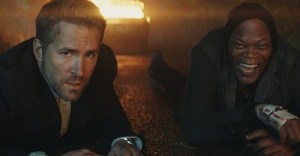 When it comes to genre filmmaking, especially in action or horror, the level of entertainment is much more related to the singer and not the song. Sure a well developed script with interesting characters, organic complications, and memorable set-pieces connected with payoffs are still desired, but often it’s execution that separates the brashly fun bombast from the dreck that dots late night cable. The selling point of this movie is its central pairing of Jackson (Kong: Skull Island) and Reynolds (Deadpool). Hell, both of them aren’t straining too hard from their familiar big screen personalities, Jackson the gleefully stubborn badass and Reynolds as the incredulous smart-alleck with the quick wit. Some critics will chafe and say that the actors are stuck in stale riffs and acting on autopilot. I look at this as a certain virtue of the film. They hired Jackson and Reynolds and let them do exactly what we demand that Jackson and Reynolds do. They were hired for a specific reason. Their crackling repartee keeps the movie alive even as the first half feels too sludgy getting everything going. The comedy can be a tad forced (riding on a bus with chirpy nuns! Gatorade bottle of pee?) and exaggerated at times (really, a fart joke, sound designers?) but this isn’t a film for subtlety, and Jackson and Reynolds, who can outdo just about every working actor for sarcasm and volume, are at their best when they’re big and broad. The rapport elevates even moments that would otherwise be redundant.
I thought the action scenes were going to take a backseat to the Jackson/Reynolds buddy road trip, popping up here and there to move things along and kill off an antagonist or two. To my great surprise, the action in The Hitman’s Bodyguard is uniformly great. Director Patrick Hughes (The Expendables 3) makes each action scene its own story and he thankfully varies the scenarios so they nicely stand out. There’s a terrific motorcycle chase through Amsterdam’s canals and streets, smashing things to bits in the most exciting ways. The action is often divided into two parallel points following Jackson and Reynolds, which allows the film to pair the right sequence for the right character. There’s a late foot chase that’s filmed in refreshing long takes (newest Hollywood action trend?) that stops into the back kitchen of a restaurant and then a hardware store. Each location is well utilized to provide a unique opportunity for the fight choreography and use of props. The movie does a very successful job of approaching action by thinking how to use geography, character, and purpose to plot. Hughes also has a solid inclination when to punch for humor with visual gags, including a few gems involving a minivan. When the comedy wasn’t completely working, I knew I could rely upon the dependable thrills.
The movie also has one of the dumbest attempts at injecting urgency into a story. The plot hinges upon Darius Kincaid arriving at The Hague at an exact time to testify against Oldman’s dictator. In a moment that made me blurt out laughing, an expositional device/news lady informs us that if nobody comes forward to testify then The Hague has to drop all charges, Oldman’s dictator goes free and apparently becomes the president of Belarus immediately again, and probably the end of democracy. First, this false sense of urgency requires witnesses to arrive at a court. That’s not how testimony works. You can give a sworn statement anywhere. You can appear in court via teleconference. The location is not the problem here. And then his testimony is aided by (slight spoilers) photographic evidence of the dictator’s genocide… except it’s all digital pictures. This entire movie hinged on the mad rush to get Jackson to The Hague when he could have just made an email attachment with the incriminating pictures at any wifi spot. There’s also the factor that if it was one second after five or so the court would not accept any testimony. I don’t think courts work that way, especially when it’s a decision over dictators and due process. And yet a wall clock is treated like the ticking clock on a bomb detonator. It’s so dumb I question whether the filmmakers were self-aware and making a satirical riff.
 While being an enjoyably profane experience, The Hitman’s Bodyguard doesn’t know when enough is quite enough. It has problems walking away and routinely falls upon overkill in several elements. There’s almost way too much plot here. Every character has a back-story that nabs a lengthy flashback with an ironically chosen pop song. There are obvious betrayals that the film thankfully doesn’t belabor in revealing the culprits, but did we need them anyway? Hayek seems to have said yes just to be a vulgar badass that would attract Jackson. It’s fun but her shtick gets old quickly. She’s all unchecked exaggeration. Hayek’s character is just here to provide a counterpoint for Kincaid to wax poetic about romance and relationships, to nudge Bryce to “man up” and realize what he’s let slip away. The romantic elements are presented on the same wavelength as the comedy, meant to be a shoulder-shrug of cocksure cool. When they try and get earnest on their own terms it doesn’t quite work out tonally. The movie also runs rampant with false endings, going from one escape to another just as it should be winding down. It’s like the filmmakers were having so much fun they didn’t know when to walk away from their story.
I think every ticket-buyer knows what they’re getting when they walk into The Hitman’s Bodyguard. It’s two actors doing what they do best, in an action vehicle that cribs from Midnight Run, and with a sense of style and attitude that resembles a bluntly ironic return to 90s R-rated action excess. Fortunately, the execution of these genre tropes and elements lead to one of the more profanely entertaining popcorn flicks this summer season. It’s a movie that doesn’t take itself too seriously, coasts on above average action and the charged comic chemistry of its two loud-mouth leads. It’s a movie that doesn’t require much thought and rewards you for the effort. The Hitman’s Bodyguard is everything you want it to be, and if that’s good enough for you, then you’ll find satisfaction here.
Nate’s Grade: B


You must be logged in to post a comment.